Tag Archives: transformation

Why Most Corporate Mindset Programs Are a Waste of Time

What to Focus on Instead

Why Most Corporate Mindset Programs Are a Waste of Time

GUEST POST from Alain Thys

You may know that I’m hunting for a Transformation Algorithm

Its goal is to help us move beyond the >70% failure rate of corporate transformations and create transformative experiences for employees, customers and society. Ambitious? Moi?

To get there, I’m walking around the problem.

Looking at it from all perspectives (Japan style). So without claiming expertise in any domain, I’m blending systems thinking with neuroscience, behavioral psychology, philosophy and my background in experience design. There’s even a little math (I couldn’t resist .

It’s a work in progress, but I’m getting there.

Meanwhile, here are some more thoughts as I put together the puzzle. The article starts a bit gloomy, but it ends more upbeat… I promise.

It’s all work in progress in which I’m still improving both language and content.
So don’t hold back on comments, compliments or corrections.

These days, every company wants to see a ‘mindset change’.

People need to be customer-centric. Digital. Agile. Sustainable. Innovative. More in love with the color blue. After all, the consultants, executive trainers and software vendors say this is the future. Not to mention Mark’s metaverse:

To make this happen, organizations unleash a barrage of initiatives

They do enthusiastic presentations. Introduce new KPIs and dashboards. Launch internal communication programs and training academies. Create new journey maps. Introduce AI. Get some fancy software.

Some even call me (obviously the smartest ones ).

At first, the signs are good.

After all, with enough pressure, you can get water to go uphill. Also, any decent third-party consultant or vendor will make sure that employees leave those workshops with a smile and some quick wins. Especially those that show progress in pretty graphs and numbers.

But then – one by one – the ‘old ways’ assert themselves

They raise dozens of practical, budgetary, emotional and IT concerns which are all valid and require the change program to be calibrated. After all, leaders need to be pragmatic. These thousand slight cuts erode the big transformative vision and expectations get lowered. Things might even become as they were.

#endofmindsetchange?

What if we were aiming at the wrong target?

If you look up mindset in a dictionary, you find it is a mental attitude or inclination. The combined set of assumptions, methods and notions with which each of us approaches problems and the world at large (our perspective). Something rooted in the way we view the world and our perception of reality (our paradigm).

This means that every mindset change is in fact a change in perspective or paradigm.

Let me illustrate with a consumer electronics company that wanted to go from product- to customer-centric value propositions. Digging deep, we found that from the engineer’s perspective, the requested mindset change meant letting go of their long held belief that as the world’s best technical experts they knew how to make the best products on the planet (and had the awards and accolades to prove it).

Instead, they had to embrace that the customer knew better what great looked like and their opinion didn’t matter as much as they thought.

If you’ve worked all your life to become that smart and esteemed technical expert, this is an existential pill to swallow. Especially if the only rationale from the top is that “our Net Promoter Score should improve”.

These shifts in perspective lurk in any transformation

Being agile means seeing that we live in a chaotic world where we can never really be sure of our best next step. True sustainability means accepting that there are limits to growth, also ours. Going digital means letting go of activities we have long considered to be uniquely human (ours?). Innovation requires unlearning the orthodoxies and beliefs we may have held since childhood. And so on.

For some people, these steps may be easy. But for most, they can challenge the core of who they are (even if they may not admit this to themselves).

Ignoring this deeper reality can doom your transformation from the start.

If the new KPIs, processes, systems and incentives you introduce do not match the worldview of the people you target, they will reject them. Sometimes they rebel. Sometimes they stand in the way without realizing it themselves. Either way, your culture will eat your strategy for breakfast, lunch and dinner.

So what to do instead?

Frustration

If you want mindset change, focus on the paradigm shift first.

Before you expect people to approach problems differently (mindset), work on the way they perceive these problems and their context. Clearly describe the required paradigm shift in a FROM… TO… statement and make it as compelling as possible. All while acknowledging the uncomfortable bits head on.

Then, give people opportunities to embrace this new narrative through experiential programs (remember: the old brain doesn’t do PowerPoint).

Once they see the world with fresh eyes, the mindset and changes will follow.

Or as my ultimate change guru Antoine de Saint-Exupéry used to say: “if you want to build a ship, don’t drum up the men to gather wood, divide the work and give orders. Instead, teach them to yearn for the vast and endless sea.”

But always remember that your perception as a leader is flawed too.

When you say: ‘I want a mindset change’, you are actually saying: ‘I want you to see the world as I do’.

This is often a big ask, as chances are you live in a world that is more affluent, more educated and more informed (I won’t mention diversity … oops, I did). You probably have a different education, live in a different social media bubble and even shop in different stores. You may even have the freedom to make your own decisions.

Seeing life your way, may not be as easy for someone who has grown up, works and lives in a different context (no value judgment here, just observation).

Inversely, unless you’ve done their jobs and lived their lives, you will have difficulties to imagine the world through the eyes of your people. No matter how you try.

So before you talk about mindset change.

Understand and start from your people’s perspective and then expand it in the direction you propose. And if the gap between the two is too big, consider adapting your strategy.

Perhaps your world view and sense of possibility need an update too.

Image Credits: Pixabay

Subscribe to Human-Centered Change & Innovation WeeklySign up here to get Human-Centered Change & Innovation Weekly delivered to your inbox every week.

Not Everyone Can Transform Themselves

Not Everyone Can Transform Themselves

Here’s What Makes the Difference

GUEST POST from Greg Satell

The conservative columnist John Podhoretz recently took to the New York Post to denounce the plotline of Disney’s new miniseries The Falcon and the Winter Soldier. In particular, he took umbrage with a subplot that invoked the Tuskegee experiments and other historical warts in a manner that he termed “didactic anti-Americanism.”

His point struck a chord with me because, in my many years living overseas, I always found that people in other countries were more than aware of America’s failures such as slavery, Jim Crow, foreign policy misadventures and so on. What they admire is our ability to take a hard look at ourselves and change course.

It also reminded me of something I’ve noticed in my work helping organizations transform themselves. Some are willing to take a hard look at themselves and make tough changes, while others are addicted to happy talk and try to wish problems away. Make no mistake. You can’t tackle the future without looking with clear eyes at how the present came into being.

A Pregnant Postcard

The genesis of shareholder capitalism and our modern outlook on how things are supposed to work can, in some sense, be traced back to Paris in 1900. It was there and then that an obscure graduate student named Louis Bachelier presented his thesis on speculation to a panel of judges including the great Henri Poincaré. It described the fluctuation of market prices as a random walk, a revolutionary, albeit unappreciated, idea at the time.

Unfortunately for Bachelier, his paper went mostly unnoticed and he vanished into obscurity. Then, in 1954, he was rediscovered by a statistician named Jimmie Savage, who sent a postcard to his friend, the eminent economist Paul Samuelson, asking “ever hear of this guy?” Samuelson hadn’t, but was intrigued.

In particular, Bachelier’s assertion that “the mathematical expectation of the speculator is zero,” was intriguing because it implied that market prices were essentially governed by bell curves that are, in many respects, predictable. If it were true, then markets could be tamed through statistical modeling and the economy could be managed much more effectively.

Samuelson, who was pioneering the field of mathematical finance at the time, thought the paper was brilliant and began to actively promote it. Later, Eugene Fama would build Bachelier’s initial work into a full-blown Efficient Market Hypothesis. It would unleash a flurry of new research into financial modeling and more than a few Nobel Prizes.

A Refusal to Reckon

By the 1960s, the revolution in mathematical finance began to gain steam. Much like had happened in physics earlier in the century, a constellation of new discoveries such as efficient portfolios, the capital asset pricing model (CAPM) and, later, the Black-Scholes model for options pricing created a “standard model” for thinking about economics and finance.

As the things gathered steam, Samuelson’s colleague at MIT, Paul Cootner, compiled the most promising papers in a 500-page tome, The Random Character of Stock Market Prices, which became an instant classic. The book would become a basic reference for the new industries of financial engineering and risk management that were just beginning to emerge at the time.

However, early signs of trouble were being ignored. Included in Cootner’s book was a paper by Benoit Mandelbrot that warned that there was something seriously wrong afoot. He showed, with very clear reasoning and analysis, that actual market data displayed far more volatility than was being predicted. In essence, he was pointing out that Samuelson and his friends were vastly underestimating risk in the financial system.

In a response, Cootner wrote that Mandelbrot forced economists “to face up in a substantive way to those uncomfortable empirical observations that there is little doubt most of us have had to sweep under the carpet until now.” He then added, “but surely before consigning centuries of work to the ash pile, we should like to have some assurance that all of our work is truly useless.”

Think about that for a second. Another term for “empirical observations” is “facts in evidence,” and Cootner was admitting that these were being ignored! The train was leaving the station and everybody had to either get on or get left behind.

The Road to Shareholder Value

As financial engineering transformed Wall Street from a clubby, quiet industry to one in which dashing swashbucklers in power ties and red suspenders became “barbarians at the gate,” pressure began to build on managers. The new risk management products lowered the perceived cost of money and ushered in a new era of leveraged buyouts.

A new breed of “corporate raiders” could now get control of companies with very little capital and demand that performance—and “performance” meant stock performance— improve. They believed that society’s interest was best determined by market forces and unabashedly pursued investment returns above all else. As Wall Street anti-hero Gordon Gekko put it, the overall sentiment was that “greed is good.”

Managers were put on notice and a flood of new theories from business school professors and management consultants poured in. Harvard’s Michael Porter explained how actively managing value chains could lead to sustainable competitive advantage. New quantitative methods, such as six sigma, promised to transform management into, essentially, an engineering problem.

Today, the results are in and they are abysmal. In 2008 a systemic underestimation of risk—of exactly the type Mandelbrot warned us of—caused a financial meltdown. We are now in the midst of a second productivity paradox in which technological advance does little to improve our well-being. Income inequality, racial strife and mental health are at historic levels.

Since 1970, we have undergone three revolutions—financial, managerial and digital—and we are somehow worse off. It’s time to admit that we had the wrong theory of the case and chart a new course. Anything else is living in denial.

A Different Future Demands You Reject the Past

Underlying Mr. Podhoretz’s column is a sense of aggrievement that practically drips from each sentence. It’s hard to see the system in which you have succeeded as anything other than legitimate without tarnishing your own achievements. While he is clearly annoyed by what he sees as “didactic,” he seems unwilling to entertain the possibility that a large portion of the country desperately wants to come to terms with our history.

We often see the same thing with senior executives in our transformation work. Yet to chart a new path we must reject the past. As Thomas Kuhn pointed out in his classic, The Structure of Scientific Revolutions, every model is flawed. Some can be useful for decades or even centuries, but eventually circumstances change and they become untenable. After a period of tumult, they collapse and a new paradigm emerges.

What Podhoretz misses about both The Falcon and The Winter Soldier is that they were able to make common cause around the values that they shared, not the history that divided them, and partner on a shared mission. That’s what separates those who are able to transform themselves and those who are not. You need to take a hard look and achieve a level of honesty and integrity with yourself before you can inspire trust in others.

In order to improve we first must look with clear eyes on what needs to be corrected in the first place. To paraphrase President Kennedy, we don’t do these things because they are easy, but because they are worthwhile.

— Article courtesy of the Digital Tonto blog
— Image credit: Pixabay

Subscribe to Human-Centered Change & Innovation WeeklySign up here to get Human-Centered Change & Innovation Weekly delivered to your inbox every week.

Voting Closed – Top 40 Innovation Bloggers of 2021

Vote for Top 40 Innovation BloggersFor more than a decade I’ve devoted myself to making innovation insights accessible for the greater good, because I truly believe that the better our organizations get at delivering value to their stakeholders the less waste of natural resources and human resources there will be.

As a result we are eternally grateful to all of you out there who take the time to create and share great innovation articles, presentations, white papers, and videos with Braden Kelley and the Human-Centered Change and Innovation team. As a small thank you to those of you who follow along, we like to make a list of the Top 40 Innovation Bloggers available each year!

Our lists from the ten previous years have been tremendously popular, including:

Top 40 Innovation Bloggers of 2015
Top 40 Innovation Bloggers of 2016
Top 40 Innovation Bloggers of 2017
Top 40 Innovation Bloggers of 2018
Top 40 Innovation Bloggers of 2019
Top 40 Innovation Bloggers of 2020

Do you just have someone that you like to read that writes about innovation, or some of the important adjacencies – trends, consumer psychology, change, leadership, strategy, behavioral economics, collaboration, or design thinking?

Human-Centered Change and Innovation is now looking to recognize the Top 40 Innovation Bloggers of 2021.

It is time to vote and help us narrow things down.

The deadline for submitting votes is December 31, 2021 at midnight GMT.

Build a Common Language of Innovation on your team

The ranking will be done by me with influence from votes and nominations. The quality and quantity of contributions to this web site by an author will be a BIG contributing factor (through the end of the voting period).

You can vote in any of these three ways (and each earns points for them, so please feel free to vote all three ways):

  1. Sending us the name of the blogger by @reply on twitter to @innovate
  2. Adding the name of the blogger as a comment to this article’s posting on Facebook
  3. Adding the name of the blogger as a comment to this article’s posting on our Linkedin Page (Be sure and follow us)

The official Top 40 Innovation Bloggers of 2021 will then be announced here in early January 2022.

Here are the people who received nominations this year along with some carryover recommendations (in alphabetical order):

Adi Gaskell – @adigaskell
Alex Goryachev
Andy Heikkila – @AndyO_TheHammer
Arlen Meyers – @sopeofficial
Braden Kelley – @innovate
Chad McAllister – @ChadMcAllister
Chris Beswick
Dan Blacharski – @Dan_Blacharski
Daniel Burrus – @DanielBurrus
Daniel Lock
Dr. Detlef Reis
David Burkus
Douglas Ferguson
Drew Boyd – @DrewBoyd
Frank Mattes – @FrankMattes
Gregg Fraley – @greggfraley
Greg Satell – @Digitaltonto
Janet Sernack – @JanetSernack
Jeffrey Baumgartner – @creativejeffrey
Jeff Freedman – @SmallArmyAgency
Jeffrey Phillips – @ovoinnovation
Jesse Nieminen – @nieminenjesse
Jorge Barba – @JorgeBarba
Julian Birkinshaw – @JBirkinshaw
Julie Anixter – @julieanixter
Kate Hammer – @Kate_Hammer
Kevin McFarthing – @InnovationFixer
Lou Killeffer – @LKilleffer

Accelerate your change and transformation success

Mari Anixter- @MariAnixter
Maria Paula Oliveira – @mpaulaoliveira
Matthew E May – @MatthewEMay
Michael Graber – @SouthernGrowth
Mike Brown – @Brainzooming
Mike Shipulski – @MikeShipulski
Mukesh Gupta
Nick Partridge – @KnewNewNeu
Nicolas Bry – @NicoBry
Pamela Soin
Paul Hobcraft – @Paul4innovating
Paul Sloane – @paulsloane
Pete Foley – @foley_pete
Ralph Christian Ohr – @ralph_ohr
Richard Haasnoot – @Innovate2Grow
Robert B Tucker – @RobertBTucker
Saul Kaplan – @skap5
Scott Anthony – @ScottDAnthony
Scott Bowden – @scottbowden51
Shelly Greenway – @ChiefDistiller
Soren Kaplan – @SorenKaplan
Stefan Lindegaard – @Lindegaard
Stephen Shapiro – @stephenshapiro
Steven Forth – @StevenForth
Tamara Kleinberg – @LaunchStreet
Tim Stroh
Tom Koulopoulos – @TKspeaks
Yoram Solomon – @yoram

Subscribe to Human-Centered Change & Innovation WeeklySign up here to get Human-Centered Change & Innovation Weekly delivered to your inbox every week.

We’re curious to see who you think is worth reading!

Nominations Closed – Top 40 Innovation Bloggers of 2021

Nominations Open for the Top 40 Innovation Bloggers of 2021Human-Centered Change and Innovation loves making innovation insights accessible for the greater good, because we truly believe that the better our organizations get at delivering value to their stakeholders the less waste of natural resources and human resources there will be.

As a result we are eternally grateful to all of you out there who take the time to create and share great innovation articles, presentations, white papers, and videos with Braden Kelley and the Human-Centered Change and Innovation team. As a small thank you to those of you who follow along, we like to make a list of the Top 40 Innovation Bloggers available each year!

Our lists from the ten previous years have been tremendously popular, including:

Top 40 Innovation Bloggers of 2015
Top 40 Innovation Bloggers of 2016
Top 40 Innovation Bloggers of 2017
Top 40 Innovation Bloggers of 2018
Top 40 Innovation Bloggers of 2019
Top 40 Innovation Bloggers of 2020

Do you just have someone that you like to read that writes about innovation, or some of the important adjacencies – trends, consumer psychology, change, leadership, strategy, behavioral economics, collaboration, or design thinking?

Human-Centered Change and Innovation is now looking for the Top 40 Innovation Bloggers of 2021.

The deadline for submitting nominations is December 24, 2021 at midnight GMT.

You can submit a nomination either of these two ways:

  1. Sending us the name of the blogger and the url of their blog by @reply on twitter to @innovate
  2. Sending the name of the blogger and the url of their blog and your e-mail address using our contact form

(Note: HUGE bonus points for being a contributing author)

So, think about who you like to read and let us know by midnight GMT on December 24, 2021.

We will then compile a voting list of all the nominations, and publish it on December 25, 2021.

Voting will then be open from December 25, 2021 – January 1, 2022 via comments and twitter @replies to @innovate.

The ranking will be done by me with influence from votes and nominations. The quality and quantity of contributions by an author to this web site will be a contributing factor.

Contact me with writing samples if you’d like to self-publish on our platform!

The official Top 40 Innovation Bloggers of 2021 will then be announced on here in early January 2022.

We’re curious to see who you think is worth reading!

Subscribe to Human-Centered Change & Innovation WeeklySign up here to get Human-Centered Change & Innovation Weekly delivered to your inbox every week.

Digital Transformation – Ask Me Anything on LinkedIn

Digital Transformation - Ask Me Anything on LinkedIn

Ask Me Anything on LinkedIn about Digital Transformation

On Tuesday, August 31, 2021 at 11am EDT I will we be hosting an Ask Me Anything session on LinkedIn about Digital Transformation.

To participate in this first in a series of virtual office hours, you only need do two things:

  1. Follow me on LinkedIn
  2. Visit my LinkedIn profile at 11am EDT this Tuesday, August 31, 2001 and post a comment on the 11am EDT post with your question and I will answer it!

I’ve written extensively about Digital Transformation for a number of publications including CEO World, the HCL Technologies Blog, and of course Human-Centered Change and Innovation. Please feel free to check out some of my writings to inspire your questions August 31st at 11am EDT!

Join me with your questions Tuesday, August 31, 2021 at 11am EDT on LinkedIn!
(watch for the post and add your question as a comment)

Subscribe to Human-Centered Change & Innovation WeeklySign up here to get Human-Centered Change & Innovation Weekly delivered to your inbox every week.

The Rebirth of Blogging Innovation

The Rebirth of Blogging Innovation

Join Us Here at Human-Centered Change and Innovation

Fifteen years ago I started writing Blogging Innovation on a cumbersome platform called Blogger.

It started as a place to share my observations and insights about business and innovation. Leveraging what I learned operating and optimizing the marketing engine powering what is now VRBO.com from Expedia, Blogging Innovation grew.

Blogging Innovation drew an increasingly large audience and its mission grew into:

“Making innovation insights accessible for the greater good.”

This led me to invite other leading innovation voices onto this growing platform to broaden the chorus of voices across a range of innovation-related specialties and topics.

I had the opportunity to go out and do video interviews with luminaries like Dean Kamen, Seth Godin, Dan Pink, John Hagel, and many others, sharing them with you on the blog and via my YouTube channel.

A global innovation community was born with Blogging Innovation transforming into Innovation Excellence and then into Disruptor League before I stepped away.

Recently I posted a slideshow on LinkedIn of the Top 40 Innovation Bloggers of 2020 and in communicating with the authors recognized for their contributions on the list it surfaced that people would be interested in contributing guest posts here.

Please follow the link, give it a like or leave a comment on LinkedIn supporting your favorite author on the list or add a name of someone I should watch for this year’s list.

Because people expressed interest in contributing articles to Human-Centered Change and Innovation, I’ve decided to allow some guest posts from select authors.

Here are the first three:

1. How to Conduct Virtual Office Hours
by Arlen Meyers

2. Innovation organization only thrives along with innovation culture
by Nicolas Bry

3. Catalysing Change Through Innovation Teams
by Janet Sernack

If you’ve contributed articles to Blogging Innovation in the past and are interested in contributing to Human-Centered Change and Innovation, please contact me and I’ll set you up with a user account.

Topics of particular interest include:

  • Innovation Culture
  • Innovation Methods
  • Change and Transformation
  • Human-Centered Design
  • Behavioral Science and Economics
  • Customer Experience and Insights
  • Employee Experience and Engagement
  • Organizational Psychology

Keep innovating!


Accelerate your change and transformation success

Subscribe to Human-Centered Change & Innovation WeeklySign up here to get Human-Centered Change & Innovation Weekly delivered to your inbox every week.

What is Human-Centered Change?

by Braden Kelley

Arriving into the profession of change management and leadership honestly, having led organizational change programs for world-beating organizations like Wunderman and Microsoft, I’m excited to help others take their change efforts to new heights using new tools.

What is Human-Centered Change?

People Are the Heartbeat of Change

It should go without saying that if anything should be human-centered, it should be change. But, ten years ago, and even to a great extent today, the practice of change management is still very much process-centric instead of human-centric.

Worse yet, digital transformations are unfortunately often technology-centric instead of human-centric.

Because of this mismatch between what’s needed to plan and execute change successfully and the tools available to organizational change management (OCM) professionals, I decided to create a Human-Centered Change methodology. At its core is the Change Planning Toolkit and my latest book Charting Change explains how to put the 70+ visual, collaborative tools and frameworks into practice.

Only by using the more visual and collaborative methods that humans prefer can you give yourself the opportunity to literally get everyone all on the same page for change, and to beat the 70% change failure rate.

Are People Ready for Change?

Too often we run head long into yet another change initiative without considering what the levels of change readiness and change saturation are across the organization’s various human, financial and physical resources.

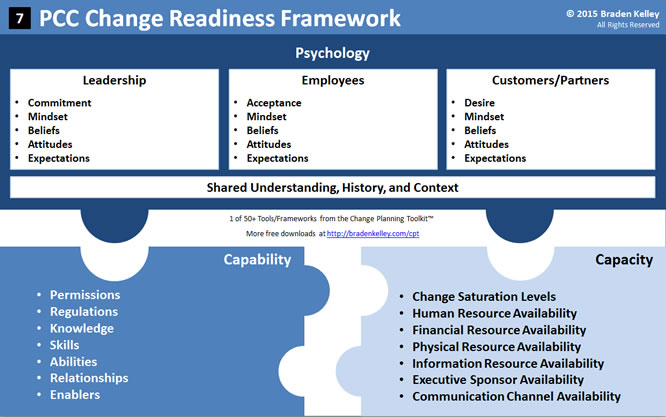
PCC Change Readiness Framework

To help people identify whether the people AND the organization are ready for change I created the PCC Change Readiness Framework. It starts with the organization’s shared understanding history and context and then helps you evaluate various components of:

  1. Psychology
  2. Capability
  3. Capacity

Exploring these three areas in detail will allow you to uncover many of the human elements that not only will determine whether your change effort will be a success or not, but that you will need to create a plan to manage.

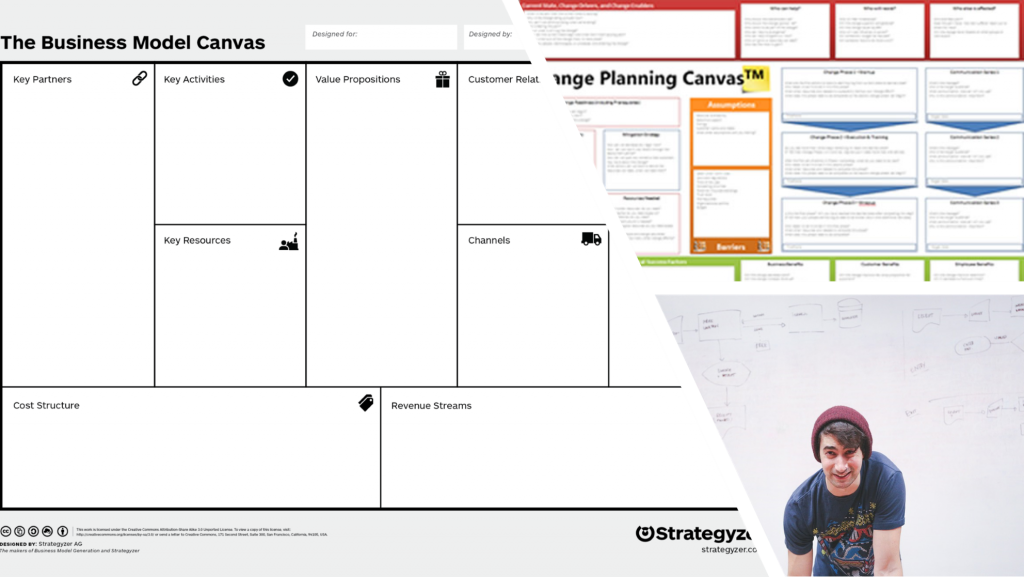
Business Model Canvas and Change Planning Canvas

What does Human-Centered Change look like?

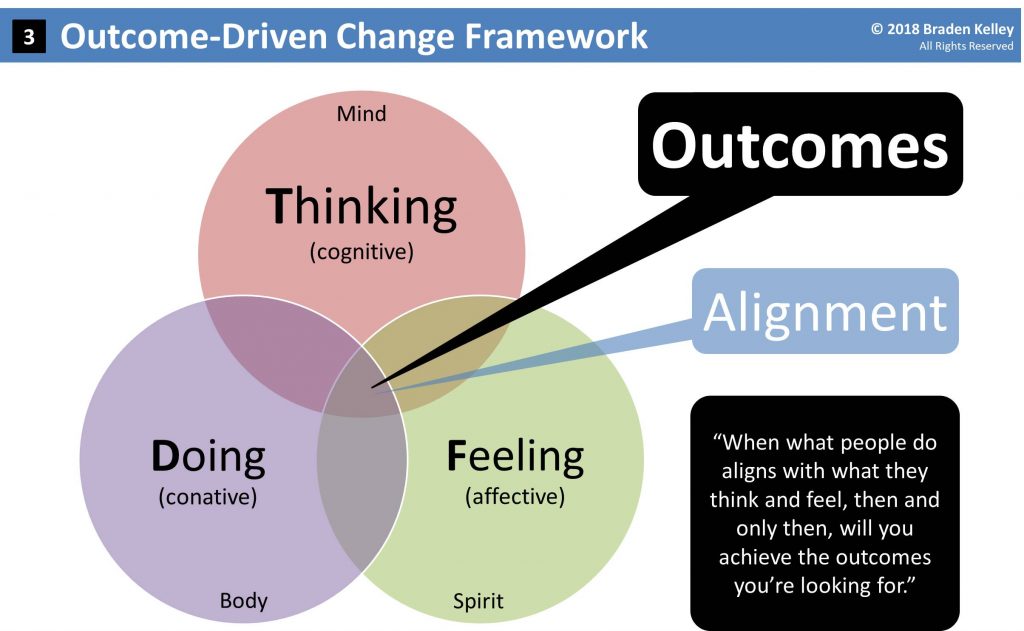
Visual, collaborative tools like the Empathy Map, Business Model Canvas, Service Design Blueprint, Lean Canvas, Value Proposition Canvas, Experience Maps, and even Customer Journey Maps have laid the groundwork for a more powerful modern way of working that leverages the whole brain of individuals and groups:

  1. Cognitive (thinking)
  2. Conative (doing)
  3. Affective (feeling)

And where these tools all represent the beginning of a visual, collaborative endeavor to create change, they are missing the tools to help plan for and execute the changes that are being proposed.

Outcome-Driven Change Framework by Braden Kelley

This is where the Change Planning Toolkit comes in. It has been designed with the Change Planning Canvas™ at its core to feel familiar to those already using the aforementioned tools and empower teams to take the next steps on their journey to be successful:

  1. Change Initiatives
  2. Digital Transformation
  3. Design Thinking
  4. Service Design
  5. Experience Design
  6. Customer Experience (CX) Improvement Efforts
  7. Projects (make sure you also get the Visual Project Charter™)
  8. Innovation and Intrapreneurship
  9. Startup Creation
  10. New Product Development (NPD)

What About Other Change Methodologies like ProSci ADKAR or the ACMP Standard for Change Management?

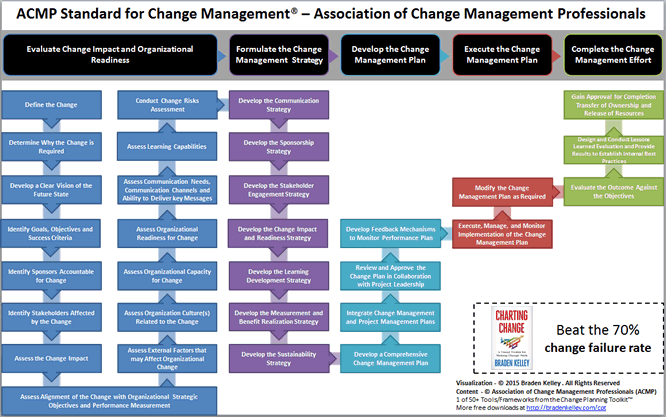
The human-centered change methodology is informed by the very best thinking in the various change disciplines to date, and consistent with other methodologies like ProSci’s ADKAR, PMI’s PMBOK, and the Association of Change Management Professionals (ACMP) Standard for Change Management. These other methodologies have their uses, and in fact I’ve created a poster-size visualization of the ACMP Standard:

ACMP Standard Visualization

But Human-Centered Change goes beyond these process-focused methodologies to create more visual and collaborative approaches for change leaders to use in planning and executing productive change programs.

How to Begin Practicing Human-Centered Change

The Human-Centered Change methodology will help you beat the 70% change failure rate, create more efficient and effective change initiatives (and even projects), and accelerate your pace of successful change in order to keep up with the accelerating pace of change all around us and to be more nimble, agile, and responsive than your competition.

There is a simple three step process for people to familiarize themselves with the Change Planning Toolkit’s 70+ tools used with the Human-Centered Change methodology:

  1. 10 free tools available to download now
  2. 26 free tools when you buy the book
  3. 70+ tools when you license the toolkit

I’ve invested more than $1 million into the Change Planning Toolkit so you don’t have to, and so you can leverage this investment to gain all of the benefits above while also saving yourself thousands or millions of dollars in consulting fees – every year.


Accelerate your change and transformation success

Subscribe to Human-Centered Change & Innovation WeeklySign up here to get Human-Centered Change & Innovation Weekly delivered to your inbox every week.

The Future of Education

How Technology is Transforming Learning

The Future of Education: How Technology is Transforming Learning

GUEST POST from Chateau G Pato

In an age where technological advancements are reshaping every industry, education stands at a pivotal moment. The integration of technology within learning environments is not just a forthcoming trend, but a necessary evolution to prepare future generations for a rapidly changing world. As we navigate the future of education, we must understand how technology is fundamentally transforming the way learners engage with content, educators impart knowledge, and institutions evolve.

Key Technologies Driving Change in Education

Before delving into specifics, it is crucial to recognize the technological pillars that are facilitating this transformation:

  1. Artificial Intelligence (AI) and Machine Learning (ML): These technologies are personalizing learning experiences, enabling adaptive learning platforms that cater to the individual needs of students.
  2. Virtual Reality (VR) and Augmented Reality (AR): These tools are creating immersive learning experiences that can transcend physical classroom limits.
  3. Blockchain Technology: Ensuring the secure and transparent management of educational credentials and records.
  4. Internet of Things (IoT): Facilitating smart classrooms that enhance the accessibility and interplay of educational resources.

In this article, we’ll explore real-world case studies demonstrating how these technologies are transforming education.

Case Study #1: Closing the Learning Gap with Artificial Intelligence in India

In a country as vast and diverse as India, educational disparity is a significant challenge. Despite concerted efforts to improve educational access, rural and underserved urban areas often lag behind in academic achievement. Enter *BYJU’S*, an edtech company leveraging AI and ML to bridge this gap effectively.

BYJU’S Approach:

BYJU’S offers personalized learning experiences through their AI-driven app, which adapts to each student’s learning pace and style. The adaptive learning platform uses algorithms to analyze performance and engagement metrics, tailoring content accordingly. Questions and problems are presented based on the student’s prior interactions, ensuring that learning is neither too easy nor too difficult—a perfect equilibrium to maintain interest and facilitate comprehension.

Impact:

  • Enhanced Engagement: By providing interactive and gamified content, BYJU’S has significantly increased student engagement rates. Learning isn’t a chore; it’s fun.
  • Personalized Pathways: Students receive a bespoke educational journey. The AI identifies areas needing improvement and revisits them with alternative explanations and varied problem sets.
  • Scalability: The digital nature of the platform ensures that it can be deployed across vast demographics, accommodating millions of students without the limitations of physical infrastructure.

In a country where educational resources may be scarce in rural areas, BYJU’S is democratizing education, offering every child a chance for personalized learning.

Case Study #2: Immersive Learning Environments in the United States

At the heart of Silicon Valley, *Stanford University’s Virtual Human Interaction Lab (VHIL)* is pioneering the use of VR and AR to create immersive learning experiences. Traditional learning methods can be abstract and difficult for students to relate to, particularly in fields like history, science, and engineering. VHIL addresses this by bringing lessons to life in a virtual environment.

Stanford’s Approach:

VHIL employs VR to simulate real-world scenarios that complement the theoretical knowledge delivered in lecture halls. For example, engineering students can interact with and troubleshoot complex machinery in a virtual space, gaining hands-on experience without the constraints and safety risks of real-world setups.

Impact:

  • Increased Retention: Studies have shown that immersive learning experiences significantly improve information retention. As students “experience” the content, they are more likely to remember it.
  • Active Learning: Instead of passively consuming information, students are active participants in their educational journey. This fosters critical thinking and problem-solving skills.
  • Accessibility: With VR, education is no longer confined to the classroom. Students can participate in field trips to historical sites, natural habitats, or even outer space, all from their school desks.

Stanford’s initiative illustrates how VR and AR can transform theoretical knowledge into practical understanding, making learning a more engaging and effective process.

The Future Roadmap: Challenges and Opportunities

While these case studies highlight the transformative potential of technology in education, there are challenges to consider. The digital divide remains a critical issue worldwide, with unequal access to technology putting disadvantaged students at risk of falling further behind. Ensuring inclusive access to technological advancements is paramount.

Moreover, the integration of technology necessitates teacher training and curriculum adjustments. Educators must be equipped not just with digital tools, but with the pedagogical strategies to incorporate them effectively.

Final Thoughts

Technology is undeniably propelling education into a new era, fostering a more personalized, engaging, and accessible learning environment. As we look toward the future, continued innovation and thoughtful implementation will be key to unlocking the full potential of these transformative tools. By harnessing the power of AI, VR, AR, and other emerging technologies, we can shape a future of education that is equitable, dynamic, and capable of preparing learners for the complexities of the modern world.

As educators, policymakers, and technologists, our mission is clear: to embrace this educational renaissance and to ensure that the benefits of technological advancements reach all corners of society. The future of education is not just for those with access and privilege—it is for everyone. And that is the most transformative aspect of all.

SPECIAL BONUS: The very best change planners use a visual, collaborative approach to create their deliverables. A methodology and tools like those in Change Planning Toolkit™ can empower anyone to become great change planners themselves.

Image credit: misterinnovation.com

Subscribe to Human-Centered Change & Innovation WeeklySign up here to get Human-Centered Change & Innovation Weekly delivered to your inbox every week.

Why Change is Hard

Why Change is Hard

In 250 Words or Less

When we think about change, often we look at it as being done to us, not something that we are part of. Initiating change is a scary, overwhelming process that we often avoid because we lack the tools to accumulate buy-in and successfully plan and execute the change in the face of the following obstacles/barriers:

  1. psychological/political
  2. logistical
  3. financial
  4. external

This leads to inaction and preservation of the status quo until the pain becomes too much to bear, or the promise of the change becomes so enticing, that people are willing to drop their resistance and begin engaging in the activities necessary to realize the intended outcomes of the change.

Organizations must identify up-front not only why people may resist, but also who will likely resist. Some of the typical reasons why people will resist include:

  • loss of certainty (includes fear of job loss)
  • loss of purpose, direction, or status
  • loss of mastery (includes loss of expertise/recognition)
  • loss of control or ownership
  • loss of connection or attachment
  • lack of trust or clarity
  • fear of failure (feel unprepared)
  • seeing proposed change as irrelevant or a bad idea

Finally, change is hard because even if you idedntify and overcome the resistance/obstacles/barriers, hiding below the surface is the even more daunting prospect that according to a 2009 ProSci study, 73% of organizations are at or near change saturation — the point at which organizations are incapable of absorbing additional change.

(248 words)

SPECIAL BONUS

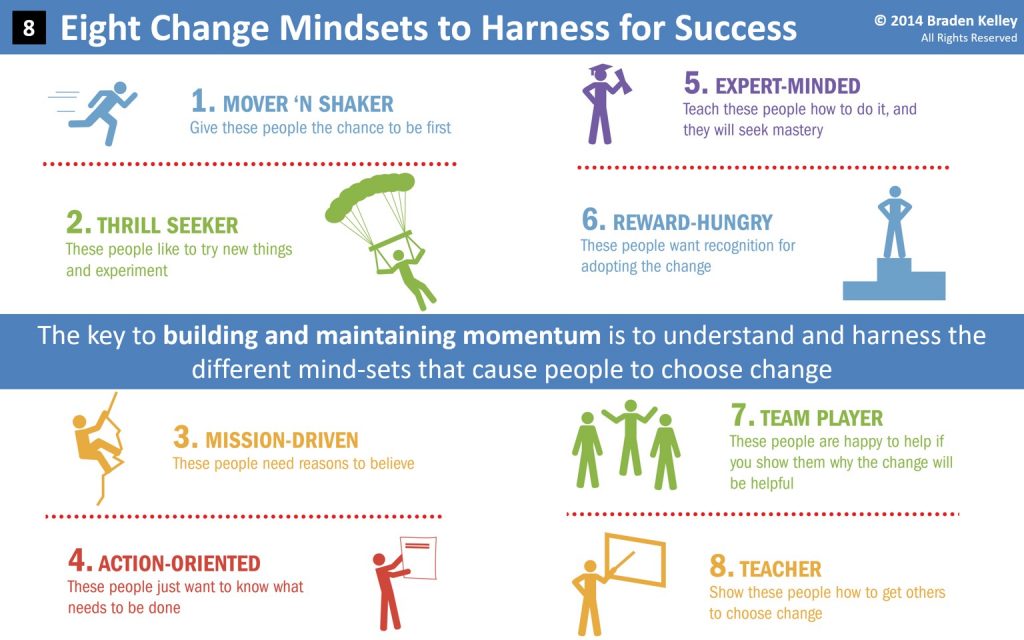
One tool I created for the Change Planning Toolkit™ that will assist you in creating a stronger change strategy and more targeted communications as you lower resistance and get people to choose change are the Eight Change Mindsets:

Eight Change Mindsets to Harness for Success

Obviously it is really hard to fit everything into 250 words so I had to leave some great other highlights of why change is hard, including this one:

In a 2008 global CEO study conducted by IBM on the enterprise of the future, the top challenges to successfully implementing strategic change were identified as:

  1. changing mindsets and attitudes (58 percent)
  2. corporate culture (49 percent)
  3. underestimating complexity (35 percent)
  4. shortage of resources (33 percent)
  5. lack of commitment from higher management (32 percent)
  6. lack of change know-how (20 percent)
  7. lack of motivation of employees involved (16 percent)

And here are some other challenges I would have included in the list:

  • lack of tools
  • lack of training
  • stakeholder misalignment
  • lack of buy in
  • change saturation
  • change fatigue
  • lack of change readiness
  • missing prerequisites
  • underestimating resistance
  • missing resources needed to succeed
  • underestimating risks and barriers
  • underestimating benefits of the status quo

To make change easier you’ll definitely want to transform how you plan and execute change into a more visual and collaborative approach, ideally suited for remote and hybrid interactions. It’s all laid out in my latest book Charting Change and supported by the Change Planning Toolkit™. A growing number of universities are picking up and teaching this new modern approach. Why not you?

Sources:

  1. Charting Change by Braden Kelley, Palgrave Macmillan, 2016
  2. Marsh survey on health, productivity and absenteeism—Prosci, 2009

Image Credit: Unsplash


Accelerate your change and transformation success

Subscribe to Human-Centered Change & Innovation WeeklySign up here to get Human-Centered Change & Innovation Weekly delivered to your inbox every week.

From Traditional to Innovative

Transforming Established Organizations

From Traditional to Innovative: Transforming Established Organizations

GUEST POST from Art Inteligencia

In today’s rapidly changing business landscape, the ability to innovate is no longer just a nice-to-have for companies – it’s essential for survival. However, many established organizations find themselves stuck in a traditional mindset that stifles creativity and hinders progress. In order to thrive in the face of technological disruption and shifting consumer expectations, these companies must undergo a transformation that allows them to embrace innovation and drive meaningful change.

Case Study 1: General Electric

One such company that successfully made this transition is General Electric (GE). Once known for its bureaucratic structure and hierarchical decision-making processes, GE recognized the need to adapt to a more agile and innovative approach in order to stay competitive in the digital age. Under the leadership of CEO Jeff Immelt, GE began to prioritize innovation by investing in research and development, fostering a culture of collaboration and experimentation, and embracing new technologies such as the Internet of Things.

As a result of these efforts, GE was able to launch new products and services that captivated customers and drove revenue growth. For example, GE’s Predix platform, which uses data analytics to improve the performance of industrial equipment, has revolutionized the way companies manage their operations. By embracing a culture of innovation, GE was able to transform itself from a traditional conglomerate into a modern, forward-thinking organization that is leading the way in the digital industrial revolution.

Case Study 2: IBM

Another example of a company that successfully transitioned from a traditional mindset to an innovative culture is IBM. Once known for its focus on hardware and consulting services, IBM faced a decline in revenue as its legacy businesses became increasingly commoditized. In response, CEO Ginni Rometty implemented a strategy to pivot towards higher-growth areas such as cloud computing, artificial intelligence, and blockchain.

To foster a culture of innovation within IBM, Rometty encouraged employees to think creatively, take risks, and challenge the status quo. One initiative that emerged from this push for innovation was IBM Watson, a cognitive computing platform that has been used in industries ranging from healthcare to finance. By encouraging experimentation and embracing new technologies, IBM was able to reinvent itself and establish a leadership position in emerging markets.

Conclusion

The transformations of companies like GE and IBM serve as powerful examples of how established organizations can adapt to a rapidly changing business environment by fostering a culture of innovation. By investing in research and development, encouraging collaboration and experimentation, and embracing new technologies, these companies were able to reinvent themselves and drive growth in new markets. As other organizations face similar challenges, they can look to these case studies for inspiration and guidance on how to navigate the path from tradition to innovation.

Bottom line: Futures research is not fortune telling. Futurists use a scientific approach to create their deliverables, but a methodology and tools like those in FutureHacking™ can empower anyone to engage in futures research themselves.

Image credit: Pexels

Subscribe to Human-Centered Change & Innovation WeeklySign up here to get Human-Centered Change & Innovation Weekly delivered to your inbox every week.