Tag Archives: transformation

Sustainable Change Leadership

Driving Long-term Transformation

Sustainable Change Leadership

GUEST POST from Art Inteligencia

In today’s rapidly evolving business landscape, organizations face constant pressure to adapt, innovate, and drive sustainable change. While change is inevitable, the ability to lead transformations that have a long-term impact is the mark of exceptional leaders. Sustainable change leadership requires a holistic and forward-thinking approach, rooted in a deep understanding of the organization’s goals and values. This article explores the essence of sustainable change leadership and illustrates its effectiveness through two case study examples.

Case Study 1: Ford Motor Company – A Shift towards Sustainable Mobility

The automotive industry is undergoing a significant transformation to address the challenges of environmental sustainability. Ford Motor Company took a proactive stance by embracing sustainable change leadership to navigate this shift successfully. Recognizing the long-term viability of electric vehicles, Ford committed to becoming a leader in the field by investing $11 billion in electric vehicle (EV) production.

Ford’s CEO, Jim Farley, adopted a holistic approach to drive this transformation. By prioritizing sustainable mobility and integrating it into the company’s core values, he fostered a culture of innovation and personal responsibility. The change was not just about technology or manufacturing; it was a comprehensive shift that required the engagement of employees, suppliers, consumers, and even policymakers.

This sustainable change leadership approach not only helped Ford stay ahead of its competitors but also contributed to positive environmental impact. By 2030, Ford aims to have 40% of its global vehicle volume to be fully electric. This commitment to long-term transformation, driven by sustainable change leadership, positions Ford as a frontrunner in the sustainable mobility revolution.

Case Study 2: Unilever – Scaling Sustainability with Purpose-Driven Leadership

As a multinational consumer goods company, Unilever recognized the critical need to integrate sustainability throughout its operations. Under the leadership of CEO Alan Jope, Unilever adopted a purpose-driven approach to sustainable change leadership. By aligning the company’s purpose, “making sustainable living commonplace,” with its business strategy, Unilever transformed its operations to reduce its environmental footprint while simultaneously growing its business.

One aspect of Unilever’s sustainable change leadership is its commitment to reducing waste and enhancing recycling. The company launched initiatives like the “Less Plastic, More Fantastic” campaign, which aimed to help eliminate plastic waste and promote recycling. Through innovations such as recyclable packaging and ingredient sourcing, Unilever reduced its global plastic footprint by over 100,000 tons.

Unilever’s purpose-driven sustainable change leadership has not only improved its brand reputation but also boosted profitability. By insisting that sustainability is not a mere add-on but an integral part of its business strategy, Unilever has built customer loyalty and attracted environmentally conscious consumers. This case study exemplifies how sustainable change leadership can drive significant, long-term transformation while creating positive societal impact.

Conclusion

Sustainable change leadership is a vital quality for leaders who aim to make a lasting impact by driving transformation within their organizations. The case studies of Ford Motor Company and Unilever showcase the efficacy of sustainable change leadership in driving long-term transformation. By emphasizing sustainability as a core value and incorporating it into business practices, these organizations have not only adapted to emerging trends but have also set the standard for their respective industries. Consequently, sustainable change leadership acts as a catalyst for organizational growth, customer loyalty, and a more sustainable future.

Bottom line: Futures research is not fortune telling. Futurists use a scientific approach to create their deliverables, but a methodology and tools like those in FutureHacking™ can empower anyone to engage in futures research themselves.

Image credit: Pixabay

Subscribe to Human-Centered Change & Innovation WeeklySign up here to get Human-Centered Change & Innovation Weekly delivered to your inbox every week.

Voting Closed – Top 40 Innovation Bloggers of 2020

Vote for Top 40 Innovation BloggersFor more than a decade I’ve devoted myself to making innovation insights accessible for the greater good, because I truly believe that the better our organizations get at delivering value to their stakeholders the less waste of natural resources and human resources there will be.

As a result I am eternally grateful to all of you out there who take the time to create and share great innovation articles, presentations, white papers, and videos and to make a list of the Top 40 Innovation Bloggers available each year.

My lists from the eight previous years have been tremendously popular:

Top 40 Innovation Bloggers of 2012
Top 40 Innovation Bloggers of 2013
Top 40 Innovation Bloggers of 2014
Top 40 Innovation Bloggers of 2015
Top 40 Innovation Bloggers of 2016
Top 40 Innovation Bloggers of 2017
Top 40 Innovation Bloggers of 2018
Top 40 Innovation Bloggers of 2019

Business Strategy Innovation is now looking for the Top 40 Innovation Bloggers of 2020.

Do you, or does someone you know, write articles about innovation?

Or do you just have someone that you like to read that writes about innovation, or some of the important adjacencies – trends, consumer psychology, change, leadership, strategy, marketing, management, collaboration, or social media (as they relate to innovation)?

Well, Business Strategy Innovation is looking to recognize the Top 40 Innovation Bloggers and you helped us find them with your nominations. Now it is time to vote, and help us narrow things down to a list of the Top 40 Innovation Bloggers of 2020.

Build a Common Language of Innovation on your team

The deadline for submitting votes is January 7, 2021 at midnight GMT.

The ranking will be done by me with influence from votes and nominations. The quality and quantity of contributions by an author will be a BIG contributing factor (through the end of the voting period).

You can vote in any of these three ways (and each earns points for them, so please feel free to vote all three ways):

  1. Sending us the name of the blogger by @reply on twitter to @innovate
  2. Adding the name of the blogger as a comment to this article’s posting on Facebook
  3. Adding the name of the blogger as a comment to this article’s posting on our Linkedin Page (Be sure and follow us)

The official Top 40 Innovation Bloggers of 2020 and the contest winners will then be announced here in early January 2021.

Here is who received nominations (in alphabetical order):

Adi Gaskell – @adigaskell
Alex Goryachev
Andy Heikkila – @AndyO_TheHammer
Arlen Meyers
Braden Kelley – @innovate
Chad McAllister – @ChadMcAllister
Chris Beswick
Dan Blacharski – @Dan_Blacharski
Daniel Burrus – @DanielBurrus
Daniel Lock
Dave Wendland
David Burkus
Douglas Ferguson
Drew Boyd – @DrewBoyd
Frank Mattes – @FrankMattes
Gregg Fraley – @greggfraley
Greg Satell – @Digitaltonto
Hugo de Sousa
Ian Ure
Janet Sernack – @JanetSernack
Jay Boolkin
Jeffrey Baumgartner – @creativejeffrey
Jeff Freedman – @SmallArmyAgency
Jeffrey Phillips – @ovoinnovation
Jorge Barba – @JorgeBarba
Julian Birkinshaw – @JBirkinshaw
Julie Anixter – @julieanixter
Kate Hammer – @Kate_Hammer
Kevin McFarthing – @InnovationFixer
Kevin Namaky – @knamaky
Kevin Popovic
Lou Killeffer – @LKilleffer
Mari Anixter- @MariAnixter
Maria Paula Oliveira – @mpaulaoliveira
Marty Zwilling – @StartupPro
Matthew E May – @MatthewEMay
Michael Graber – @SouthernGrowth
Mike Brown – @Brainzooming
Mike Shipulski – @MikeShipulski
Mukesh Gupta
Nick Partridge – @KnewNewNeu
Nicolas Bry – @NicoBry
Pamela Soin
Paul Hobcraft – @Paul4innovating
Paul Sloane – @paulsloane
Pete Foley – @foley_pete
Ralph Christian Ohr – @ralph_ohr
Richard Haasnoot – @Innovate2Grow
Robert B Tucker – @RobertBTucker
Rowan Gibson – @RowanGibson
Saul Kaplan – @skap5
Scott Anthony – @ScottDAnthony
Scott Bowden – @scottbowden51
Shelly Greenway – @ChiefDistiller
Soren Kaplan – @SorenKaplan
Stefan Lindegaard – @Lindegaard
Stephen Shapiro – @stephenshapiro
Steven Forth – @StevenForth
Tamara Kleinberg – @LaunchStreet
Tim Stroh
Tom Koulopoulos – @TKspeaks
Yoram Solomon – @yoram

We’re curious to see who you think is worth reading!


Accelerate your change and transformation success

Subscribe to Human-Centered Change & Innovation WeeklySign up here to get Human-Centered Change & Innovation Weekly delivered to your inbox every week.

Nominations Closed for the Top 40 Innovation Bloggers of 2020

Nominations Open for the Top 40 Innovation Bloggers of 2020Business Strategy Innovation loves making innovation insights accessible for the greater good, because we truly believe that the better our organizations get at delivering value to their stakeholders the less waste of natural resources and human resources there will be.

As a result we are eternally grateful to all of you out there who take the time to create and share great innovation articles, presentations, white papers, and videos with Braden Kelley and the Business Strategy Innovation team. As a small thank you to those of you who follow along, we like to make a list of the Top 40 Innovation Bloggers available each year!

Our lists from the ten previous years have been tremendously popular, including:

Top 40 Innovation Bloggers of 2012
Top 40 Innovation Bloggers of 2013
Top 40 Innovation Bloggers of 2014
Top 40 Innovation Bloggers of 2015
Top 40 Innovation Bloggers of 2016
Top 40 Innovation Bloggers of 2017
Top 40 Innovation Bloggers of 2018
Top 40 Innovation Bloggers of 2019

Do you just have someone that you like to read that writes about innovation, or some of the important adjacencies – trends, consumer psychology, change, leadership, strategy, behavioral economics, collaboration, or design thinking?

Business Strategy Innovation is now looking for the Top 40 Innovation Bloggers of 2020.

The deadline for submitting nominations is December 31, 2020 at midnight GMT.

You can submit a nomination either of these two ways:

  1. Sending us the name of the blogger and the url of their blog by @reply on twitter to @innovate
  2. Sending the name of the blogger and the url of their blog and your e-mail address using our contact form

So, think about who you like to read and let us know by midnight GMT on December 31, 2020.

We will then compile a voting list of all the nominations, and publish it on January 1, 2021.

Voting will then be open from January 1-7, 2021 via comments and twitter @replies to @innovate.

The ranking will be done by me with influence from votes and nominations. The quality and quantity of contributions by an author will be a contributing factor.

The official Top 40 Innovation Bloggers of 2020 will then be announced on here in early January 2021.

We’re curious to see who you think is worth reading!


Accelerate your change and transformation success

Subscribe to Human-Centered Change & Innovation WeeklySign up here to get Human-Centered Change & Innovation Weekly delivered to your inbox every week.

The Power of Design Thinking in Government

Transforming Public Services

The Power of Design Thinking in Government: Transforming Public Services

GUEST POST from Chateau G Pato

Design thinking is a human-centered problem-solving approach that empowers organizations to create innovative solutions. While traditionally associated with the private sector, design thinking has found a significant role in government organizations to transform public services. This article will explore two case studies that highlight the power of design thinking in improving government services and its potential to drive positive societal change.

Case Study 1: Redesigning the User Experience of a Government Website

In 2017, the Australian government embarked on a project to redesign their official immigration website, aiming to provide a more user-friendly experience. The initial website was complex, cluttered with excessive information, and used technical language that confused and overwhelmed users. Consequently, people struggled to find relevant information and complete application processes efficiently.

Applying design thinking principles, a multidisciplinary team comprising government officials, designers, and user experience experts collaborated to re-imagine the website. They conducted extensive user research, including interviews, focus groups, and user testing, to gain insights into the pain points and frustrations of website users.

Based on these insights, the team simplified the navigation structure, reorganized information, and revamped the language to be more accessible and user-friendly. They implemented a streamlined application process that focused on user needs, reducing redundancies and unnecessary steps. Additionally, they incorporated interactive elements and improved search functionality to enhance the overall user experience.

The redesigned website was rolled out, and its impact on user satisfaction and efficiency was immediately evident. User feedback indicated higher levels of understanding, reduced confusion, and a significant decrease in time required to complete tasks. This case study demonstrates how design thinking can drive the transformation of government services by prioritizing the needs and experiences of citizens.

Case Study 2: Improving Public Transportation Systems

Public transportation plays a crucial role in the daily lives of millions of citizens. Recognizing the need for an improved public transportation system, the Singapore government utilized design thinking principles to initiate a holistic transformation. They aimed to create a seamless and user-centric experience for commuters, thereby increasing overall public transportation usage.

The government engaged with citizens and stakeholders through surveys, interviews, and immersive empathy exercises to understand their pain points, desires, and aspirations related to public transportation. This comprehensive research informed the creation of personas representing different commuter profiles, which became the focal point for designing solutions.

Design thinking techniques were applied to various aspects, including bus stop design, route planning, mobile applications, and fare collection systems. Bus stops were redesigned to provide shelter, seating, and real-time information, catering to the needs of different user groups. Route planning was optimized based on commuter data, and mobile applications were developed to provide live updates on bus timings, route changes, and fare information.

The result was a remarkable enhancement in the overall public transportation experience. Commuters reported reduced wait times, improved convenience, and increased ridership. The government’s successful implementation of design thinking principles demonstrates its potential to transform public services by incorporating user needs into the core of service delivery.

Conclusion

Design thinking has an unrivaled power to transform public services by prioritizing citizen needs and experiences. The case studies discussed above exemplify how governments can leverage this approach to drive positive change. By emphasizing empathy, collaboration, and iterative problem-solving, design thinking can revolutionize the way governments design and deliver public services. It is time for governments worldwide to embrace design thinking as a catalyst for innovation and citizen-centric transformations.

EDITOR’S NOTE: Braden Kelley’s Problem Finding Canvas can be a super useful starting point for doing design thinking or human-centered design.

“The Problem Finding Canvas should help you investigate a handful of areas to explore, choose the one most important to you, extract all of the potential challenges and opportunities and choose one to prioritize.”

Image credit: Pixabay

Subscribe to Human-Centered Change & Innovation WeeklySign up here to get Human-Centered Change & Innovation Weekly delivered to your inbox every week.

Creating a Strong Change Coalition

Discussing the Importance of Assembling a Diverse and Influential Group of Change Agents to Drive Successful Transformation Efforts

Creating a Strong Change Coalition

GUEST POST from Chateau G Pato

Change is an inevitable part of any organization’s growth and evolution. However, ensuring the success of transformation efforts requires more than just a well-crafted strategy. It demands the creation of a strong change coalition – a diverse and influential group of change agents who can effectively champion and drive the change process. In this article, we will explore the significance of assembling such a coalition by reviewing two compelling case studies.

Case Study 1: IBM’s Transformation

IBM, a technology giant, faced a critical need to transform its business model to adapt to the rapidly changing technology landscape. To accomplish this, IBM embarked on a strategic transformation effort in 2012, which involved a significant shift towards cloud computing and cognitive computing solutions, such as their AI platform Watson.

One crucial aspect of IBM’s successful transformation was their ability to assemble a strong change coalition. The coalition consisted of top executives, mid-level managers, and frontline employees who possessed deep domain expertise, diverse perspectives, and influential positions within the organization. This diverse group of change agents worked collectively to overcome resistance, align stakeholders, and drive the necessary changes across the organization.

By assembling a strong coalition, IBM harnessed the power of its employees’ collective intelligence and created buy-in at every level. The influential members of the coalition facilitated communication, generated enthusiasm, and ensured the implementation of the transformation efforts. They also provided feedback and ensured that the change journey remained aligned with the company’s overarching vision. As a result, IBM successfully achieved its transformation goals, solidifying its position as a leading player in the technology industry.

Case Study 2: The British Airways Turnaround

In the late 1980s, British Airways (BA) faced serious challenges, including high operating costs, a demoralized workforce, and intense competition. To address these issues, BA relied on a strong change coalition to drive a successful turnaround. Led by CEO Colin Marshall, the change coalition included senior management, union leaders, and key stakeholders from various departments within the organization.

The diversity and influence of the coalition members played a crucial role in the transformation’s success. Marshall understood the importance of gaining commitment from unions, which historically opposed major changes. By actively involving union leaders in the change process, Marshall built trust, fostered collaboration, and ensured employee support for the necessary cost-cutting measures and improvements in customer service.

The change coalition at BA also focused on communication and transparency, ensuring that all employees were informed and engaged in the transformation efforts. Marshall, along with other influential members, actively listened to employees’ concerns, addressed them promptly, and recognized their contributions to the turnaround. This created a sense of ownership and commitment among the workforce, leading to significant improvements in both financial performance and customer satisfaction.

Conclusion

These case studies demonstrate that assembling a diverse and influential change coalition significantly contributes to the success of transformation efforts. Such coalitions not only provide the necessary expertise and perspectives to navigate through complex changes but also foster buy-in, build trust, and ensure continuous alignment with the organization’s vision.

When implementing your next strategic transformation endeavor, remember the importance of creating a strong change coalition. Identify influential individuals from various levels and functional areas within your organization, and empower them to champion the change process. By investing in a diverse and influential coalition, you lay the foundation for a successful transformation that can propel your organization towards greater success and sustainability.

SPECIAL BONUS: Braden Kelley’s Problem Finding Canvas can be a super useful starting point for doing design thinking or human-centered design.

“The Problem Finding Canvas should help you investigate a handful of areas to explore, choose the one most important to you, extract all of the potential challenges and opportunities and choose one to prioritize.”

Image credit: Pexels

Subscribe to Human-Centered Change & Innovation WeeklySign up here to get Human-Centered Change & Innovation Weekly delivered to your inbox every week.

The Future of Robotics: How Automation Will Transform Industries

The Future of Robotics: How Automation Will Transform Industries

GUEST POST from Art Inteligencia

Over the past few decades, advancements in robotics and automation have heralded a new era in industries across the globe. From manufacturing and healthcare to transportation and agriculture, the potential of robots has reached unprecedented heights. This technological revolution has not only increased efficiency and productivity but also sparked considerable speculation about how it will transform various sectors. Two case studies demonstrate the transformative power of automation and provide insights into the future of robotics in industries.

Case Study 1: Automotive Manufacturing

The automotive industry has long been at the forefront of automation, and the rise of robots has significantly transformed the sector. Traditionally, car manufacturing involved human workers on assembly lines performing repetitive tasks. However, the introduction of robots has revolutionized this process, leading to increased precision, speed, and cost-effectiveness.

Tesla, the electric vehicle manufacturer, is a prime example of how robotics have transformed automotive manufacturing. Tesla’s Gigafactory in Nevada, one of the largest manufacturing facilities in the world, heavily relies on automation. The plant is equipped with thousands of robots that perform tasks like welding, painting, and assembly, greatly reducing the need for human labor. As a result, Tesla can produce vehicles faster, with higher quality, and at a lower cost.

The future of robotics in automotive manufacturing lies in the development of autonomous vehicles. Companies like Waymo and Uber are already testing self-driving cars, which will have a profound impact on transportation and mobility. This integration of robotics and artificial intelligence (AI) will not only revolutionize the way vehicles are manufactured but also disrupt the entire automotive industry.

Case Study 2: Healthcare

As the demand for healthcare services continues to rise, robotics and automation offer potential solutions to challenges faced by the sector. From surgical procedures to patient care, robots are being developed to improve medical outcomes, reduce costs, and enhance overall efficiency.

Intuitive Surgical’s da Vinci Surgical System is a prime example of how robotics have transformed surgical procedures. The da Vinci System enables minimally invasive surgeries by providing surgeons with enhanced vision, precision, and control. This advanced robotic technology allows for smaller incisions, reduced blood loss, and faster patient recovery times. As a result, patients experience shorter hospital stays and fewer complications.

In addition to surgical robotics, automation is increasingly being used in rehabilitation and eldercare. Robots like PARO, a therapeutic seal robot, and Pepper, a humanoid social companion robot, are being employed in healthcare settings to provide emotional support, alleviate loneliness, and assist in physical therapy. These robots not only enhance patient experiences but also alleviate the burden on healthcare professionals.

Looking ahead, the future of robotics in the healthcare sector holds immense potential. Advancements in AI and machine learning will enable robots to perform more complex medical procedures, analyze large amounts of patient data, and provide personalized healthcare recommendations.

Conclusion

The future of robotics and automation is undeniably changing the landscape of industries around the world. As seen in the automotive manufacturing and healthcare sectors, robots are revolutionizing traditional processes, increasing efficiency, and improving outcomes. Looking ahead, the integration of AI, machine learning, and advanced robotics will continue to transform industries, leading to increased productivity, cost savings, and even new job opportunities. Harnessing the full potential of robotics and automation will be crucial for industries to thrive in the future.

Bottom line: Futurists are not fortune tellers. They use a formal approach to achieve their outcomes, but a methodology and tools like those in FutureHacking™ can empower anyone to be their own futurist.

Image credit: Pexels

Subscribe to Human-Centered Change & Innovation WeeklySign up here to get Human-Centered Change & Innovation Weekly delivered to your inbox every week.

Change Leadership and the Role of the CEO

Change Leadership and the Role of the CEO

GUEST POST from Chateau G Pato

Leadership is essential for any organization to move forward and reach success, and in today’s fast-paced world, change leadership is essential for companies to stay relevant. Change management and leadership skills require CEOs to direct, motivate, and inspire their teams towards achieving long-term success. Change leadership is the process of leading teams through a transition — allowing them to adjust to the changes and new environment with the ultimate goal of increasing effectiveness, efficiency, and leading them towards success. In order to ensure a successful transition, it is important for the CEO to have an active role and to set an example for their team.

The CEO’s role in leading transformation and organizational change is a key component of success. From setting objectives and developing strategies to leading the team into the future, the CEO is the one who must set an example and inspire the rest of the organization to join the change effort. In order for the CEO to create a successful change leadership culture, the following are essential:

  • Developing a vision and objectives for the organization
  • Identifying the necessary resources to achieve the vision
  • Establishing the necessary processes and systems to support change
  • Creating a positive atmosphere and fostering collaboration
  • Motivating the team and aligning their efforts towards the mission
  • Assessing the impact of change and measuring progress
  • Learning and adapting to changes quickly and effectively
  • Recognizing and celebrating successes

The success of a CEO’s change leadership is usually seen in the results. CEOs with the ability to lead, motivate, and inspire their organizations through changes often experience increased success and reach their desired goals that much faster. To further illustrate the role of the CEO in driving successful organizational changes, here are two examples of successful change leadership:

Case Study 1 – PepsiCo

First, let’s look at how the CEO of PepsiCo, Ramon Laguarta, has successfully navigated the company through a period of transition. At the start of his tenure, he outlined four key elements in his strategy: driving innovation, winning with customers, optimizing operations, and transforming the company’s culture. There was a particular focus on transforming the culture of the organization to foster collaboration and empower its employees to take initiative and share ideas. To further this effort, the CEO created several development programs to drive innovation and learning. Additionally, he assigned dedicated resources to talent development, and provided employees with exposure to executives to the highest level. Ultimately, the company was able to achieve success and to successfully navigate the process of transition under the change leadership of the CEO.

Case Study 2 – Airbus

Second, let’s examine the example of Phillipe Houze, the CEO of Airbus. He recognized that the success of the company relied heavily on its ability to remain competitive and innovate in the aerospace industry. Starting from his first day at the helm, he issued a decree to the organization that all levels of the company’s operations should focus on customer service and product innovation. He established a culture of collaboration that included both technical and commercial expertise, ensuring that all decisions were made with the customer in mind. As a result, the company innovated and steadily increased their market share and their success.

Conclusion

These two examples demonstrate the impact a CEO can have in leading his or her organization through times of transition and change. Change leadership is key for a CEO to initiate and set an example for their team, and the ability to successfully navigate and manage change will have a direct impact on the results of the organization. In conclusion, the role of the CEO in change is central to the success of any transformation effort and is key in driving the desired results.

Image credit: Pixabay

Subscribe to Human-Centered Change & Innovation WeeklySign up here to get Human-Centered Change & Innovation Weekly delivered to your inbox every week.

Understanding How Human-Centered Design Can Transform Your Organization

Understanding How Human-Centered Design Can Transform Your Organization

GUEST POST from Art Inteligencia

As organizations strive for success in the digital age, understanding human-centered design (HCD) is essential. HCD is a method of problem-solving that puts the focus on the end-user or consumer, considering their needs and preferences first and foremost. This design strategy has been proven to yield high-quality, user-friendly products and services that respond to the needs of the consumer.

Organizations that implement HCD are often more successful in the long run, as they are able to create products and services that are tailored to the consumer, resulting in improved user engagement and loyalty. Additionally, organizations that use HCD can better understand the needs of their target audience, allowing them to quickly adapt their offering to stay ahead of the competition.

Case Study 1: Dyson

Dyson is a perfect example of an organization that has leveraged HCD to create an innovative product and remain competitive. Dyson was founded in 1993 when James Dyson decided to use HCD to solve the problem of inefficient vacuum cleaners. By observing the user in their home environment, Dyson was able to identify the shortcomings of traditional vacuum cleaners, and design a product that addressed these issues. The result was the Dyson vacuum cleaner, which revolutionized the industry and has remained a top-seller ever since.

Case Study 2: Airbnb

Airbnb is another great example of an organization that has successfully implemented HCD. The company recognized the need for a better way to book short-term lodging, and created a service that was tailored to the needs of their target audience. By understanding the needs of their users, Airbnb was able to create a booking platform that was both user-friendly and secure, resulting in improved customer satisfaction.

Conclusion

By understanding and implementing HCD, organizations can create more user-centric products and services that are tailored to the needs of their target audience. This not only leads to improved user engagement and loyalty, but also allows organizations to stay ahead of the competition and remain competitive in the ever-changing digital landscape.

SPECIAL BONUS: Braden Kelley’s Problem Finding Canvas can be a super useful starting point for doing design thinking or human-centered design.

“The Problem Finding Canvas should help you investigate a handful of areas to explore, choose the one most important to you, extract all of the potential challenges and opportunities and choose one to prioritize.”

Image credit: Pexels

Subscribe to Human-Centered Change & Innovation WeeklySign up here to get Human-Centered Change & Innovation Weekly delivered to your inbox every week.

Why Change is Accelerating

Why Change is Accelerating

In previous articles I’ve spoken about how the pace of change is accelerating, and how for many people (and organizations) things are changing so fast that they feel overwhelmed and that things may be changing faster than some of us humans are able to absorb. I’ve spoken about how we are in the middle of a period of discontinuity thrust upon us by the rapid advances in computing and mobile connectivity that have put a supercomputer in everyone’s pocket and a target on most organizations’ backs.

Why are things changing so fast?

Is it that we’ve hit some sort of inflection point never achieved before in human history that is allowing us to innovate and displace the status quo faster than ever before?

Maybe.

Have we reached some sort of perfect storm where the innovation curve has gone vertical and the singularity will be here tomorrow?

Probably not.

So if we are not necessarily innovating faster than ever before or destined to reach the singularity tomorrow and become one with machines, then what is creating the feeling that things are changing more rapidly?

One word…

“Expectations”

Changing Customer Expectations

It feels as if the world is changing faster than ever before because the expectations of our customers and our expectations as customers are changing faster than ever before. Why?

Because we as consumers are seeing better customer experiences enabled by digital technologies in parts of our personal lives and more efficient and effective business processes in parts of our business lives, we are now expecting every organization (not just companies) and every aspect of that organization to deliver an efficient, effective experience and information exchange in whatever channel we choose, whenever we want to experience it.

This incredible change in expectations is being thrust upon all organizations simultaneously and threatening the very existence of entities that have existed for dozens or even hundreds of years. This discontinuity has created immense technical debt for organizations large and small to overcome and the only way for an incumbent organization to recover and to survive in this new digital age will be to undergo a complete digital transformation.

This doesn’t mean creating a digital strategy to address one part of the organization or a single constituency, but a path to a complete transformation that brings digital approaches to both every part of the organization and its operations, but also to all of its constituencies, at the same time. This means re-imagining every system, every policy, every procedure, and every process as a digital native organization looking to enter and disrupt your industry might, and then make a plan for transforming yourself. This will require IMMENSE amounts of change, and is no small task given the 70% change failure rate, but it is the key to your organization’s survival.

The problem is that the organizational change thought leadership status quo isn’t up to the task of planning and executing the scope and scale of change required for existing organizations to survive the digital evolution underway. A new set of tools is needed. My new book Charting Change and the accompanying Change Planning Toolkit™ were designed to inspire a change revolution to free people from the tyranny of the blank word document and poorly planned change efforts.
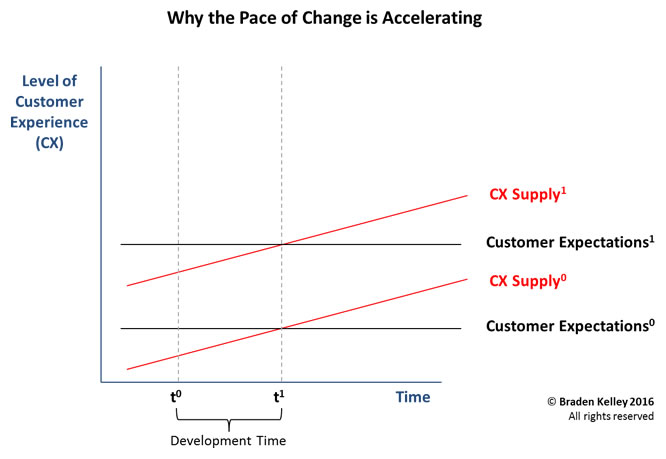
Why the Pace of Change is Accelerating

Economics 101

Because the challenge we face is not a static one. Organizations that focus on catching up to where the customer is today and wedging their efforts into existing budget constraints are those that will find themselves falling further behind the curve of changing customer expectations.

No longer is it a victory to be seen by customers as ‘best in class’. No, now customers are expecting every organization to be ‘world class’. This means that increasingly customer satisfaction will be achieved only by providing one of the best experiences in the world. Talk about changing expectations!

And so given the time to develop new technology solutions, you should be aiming not to incrementally improve your current experience to get closer to the leaders in your industry, but instead investing in a solution that will anticipate what the best customer experience allowed by technology 12-18 months from now and start building that instead.

It’s Economics 101 all over again. In today’s reality, as most organizations seek to move up the customer experience supply curve, the customer experience demand curve is constantly shifting outward, leading your share of the market to wither and die unless you make the strategic investment required to actually shift your customer experience (CX) supply curve outward as well.

I’ve tried to capture the scenario in the figure above titled ‘Why the Pace of Change is Accelerating’. Most organizations when they see at Time0 that their level of customer experience is below Customer Expectations0 they invest in projects to increase their CX Supply0 up the CX Supply curve to CX Supply1 thinking that they will then be meeting the customers’ level of expectations at Time1. But that’s not how it works in the digital world of today, as customer expectations are changing (shifting upward) just as fast as the technology used to create better customer experiences. So, organizations that invest in moving up the CX Supply curve to catch up with current customer expectations find themselves continuously falling short of future customer expectations.

Conclusion

The reason nearly every organization follows this approach of climbing the CX Supply curve to close the gap on customer expectations is usually financial. Most managers are forced (or compelled) to try and close the gap with existing budgetary resources and by creating a digital strategy as part of these efforts. Very few organizations have visionary leaders willing to invest in a digital transformation and fundamentally re-think the architecture and capabilities the organization needs to successfully compete in a digital age. Very few organizations see how to properly use technology to fulfill the mission of the organization and to exceed customer expectations, and as a result create a shift outwards in the CX Supply Curve itself.

Choosing not to digitally transform your organization, creates the space in the market for new digital native organizations to enter and establish a beachhead and attack the incumbents.

At the same time, as our world and organizations continue to digitize this will result in decreasing variable costs and increasing fixed costs, leading to increased consolidation in many fragmented industries. Those organizations bold enough to invest in shifting their customer experience supply curves outward by undergoing a true digital transformation will improve their position to be a buyer instead of a seller as this consolidation occurs. So the real question is…

If we are living in an era of survival of the digital fittest, which side of the digital evolution do you want to be on?

I hope you’ll join the change revolution, get your copy of Charting Change today and check out the Change Planning Toolkit™!

Image credit: Winggz.com
Accelerate your change and transformation success

Subscribe to Human-Centered Change & Innovation WeeklySign up here to get Human-Centered Change & Innovation Weekly delivered to your inbox every week.

Digital Transformation Matters

Digital Transformation Matters

The pace of change is accelerating.

Much has changed since we all started to dial in with our modems and connect to online services like America Online or Compuserve and eventually directly onto the Internet and the World Wide Web. Elements of our digital world continue to invade our language and our consciousness.

  • “Text me later.”
  • “Skype me tomorrow.”
  • “Google it.”
  • “#hashtag”
  • “rtofl”

Whether we like it or not the physical world and the digital world, and people are more likely to freak out about leaving their mobile phone at home than their wallet. Soon you won’t even need to carry a wallet (unless you want to). Canada stopped making pennies. In Sweden many businesses no longer take cash. Have you tried buying a drink on an airplane lately? (no cash accepted there either)

We now live in a digital age.

Not because technology is new, but because the way we react to technology and interact with it is different.

We’ve had technology for a while, but we used it primarily for performing calculations, and then for information storage and retrieval. But now, because the computer has moved from being a machine in a lab programmed with punch cards, to something nearly every one of us carries in our pocket or wears on our wrist, we’re beginning to form relationships with machines and more importantly, to use our machines to form, maintain, and even deepen, our human relationships.

So what does this mean for you as a business person?

It means that people like me have to drag you kicking and screaming away from the way you’ve always done business, away from the way you’ve always structured your enterprise, away from the ways you’ve facilitated communication among employees and between you and your customers, partners, and suppliers and towards a fundamentally different way of organizing and operating your business.

Are you ready to do business in a digital way for the digital age?

No?

Well, your market is large and attractive to me and my digital native friends. While you struggle under the weight of your legacy systems and the denial that you must change how you think, change how you interact with customers, change how your business works inside, maybe we will re-imagine your business and your entire industry from the ground up with a collection of digital strategies that utilize the power of the digital mindset to more efficiently and effectively utilize people, process and technology with some venture capital backing to challenge the incumbents and put them out of business. People are fascinated with startups like Uber and with good reason, but they should also be looking at what established technology companies like Amazon are doing because you’re either have to think like a technology company or go out of business.

In my next article on digital transformation we will circle back to discuss Uber in a bit more detail as we explore the difference between a digital strategy and a digital transformation. Because they are not the same and are vastly different in what they require to be successful. The one thing they both have in common is that they will inflict change (in varying amounts) upon the organization, and with a more visual, collaborative approach to planning that change – like that enabled by the Change Planning Toolkit™ that I introduce in my new book Charting Change – you will increase your odds of beating the 70% change failure rate and successfully achieving your digital change goals.

Stay tuned!

This article originally appeared on Linkedin

Accelerate your change and transformation success

Subscribe to Human-Centered Change & Innovation WeeklySign up here to get Human-Centered Change & Innovation Weekly delivered to your inbox every week.