
Tag Archives: transformation

3 Ways to Get Customer Insights without Talking to Customers

3 Ways to Get Customer Insights without Talking to Customers

GUEST POST from Robyn Bolton

Most of my advice to leaders who want to use innovation to grow their businesses boils down to two things*:

  1. Talk (and listen) to customers
  2. Do something

But what if you don’t want to talk to customers?

After all, talking to customers can be scary because you don’t know what they’ll say. It can be triggering if they say something mean about your product, your business, or even you as a person. It can be draining, especially if you’re an introvert.

Plus, there are so many ways to avoid talking to customers – Send a survey, hire a research firm to write a report, invoke the famous Steve Jobs quote about never doing customer research.

Isn’t it just better to stay tucked away in the office, read reports, state opinions as if they are facts (those opinions are based on experience, after all), and make decisions?

Nope.

It is not better. It is also not safer, easier, or more efficient.

To make the best decisions, you need the best data, which comes from your customers.

But that doesn’t mean you need to talk to them to get it.

The best data

The best data helps you understand why your customers do what they do. This is why Jobs to be Done is such a powerful tool – it uncovers the emotional and social Jobs to be Done that drive our behavior and choices (functional Jobs to be Done are usually used to justify our choices).

But discovering Jobs to be Done typically requires you to talk to people, build rapport and trust in a one-on-one conversation, and ask Why? dozens of times so surface emotional and social JTBD.

Luckily, there are other ways to find Jobs to be Done that don’t require you to become an unlicensed therapist.

Observe your customers

Go where your customers are (or could be) experiencing the problem you hope to solve and try to blend in. Watch what people are doing and what they’re not doing. Notice whether people are alone or with others (and who those others are – kids, partners, colleagues, etc.). Listen to the environment (is it loud or quiet? If there’s noise, what kind of noise?) and to what people are saying to each other.

Be curious. Write down everything you’re observing. Wonder why and write down your hypotheses. Share your observations with your colleagues. Ask them to go out, observe, wonder, and share. Together you may discover answers or work up the courage to have a conversation.

Quick note – Don’t be creepy about this. Don’t lurk behind clothing racks, follow people through stores, peep through windows, linger too long, or wear sunglasses, a trench coat, and a fedora on a 90-degree day, so you look inconspicuous. If people start giving you weird looks, find a new place to people-watch.

Observe yourself

Humans are fascinating, and because you are a human, you are fascinating. So, observe yourself when you’re experiencing the problem you’re hoping to solve. Notice where you are, who is with you, the environment, and how you feel. Watch what you do and don’t do. Wonder why you chose one solution over another (or none).

Be curious. Write down everything you did, saw, and felt and why. Ask your colleagues to do the same. Share your observations with your colleagues and find points of commonality and divergence, then get curious all over again.

Quick note – This only works if you have approximately the same demographic and psychographic profiles and important and unsatisfied Jobs to be Done of your target customers.

Be your customer

What if your business solves a problem that can’t be easily observed? What if you don’t have the problem that your business is trying to solve?

Become your customer (and observe yourself).

Several years ago, I worked with a client that made adult incontinence products. I couldn’t observe people using their products, and I do not have important (or unsatisfied) Jobs to be Done that the products can solve.

So, for one day, I became a customer. I went to Target and purchased their product. I went home, wore, and used the product. I developed a deep empathy for the customer and wrote down roughly 1 million ways to innovate the product and experience.

Quick note – Depending on what’s required to “be your customer,” you may need to give people a heads up. My husband was incredibly patient and understanding but also a little concerned on the day of the experiment.

It’s about what you learn, not how you learn it

It’s easy to fall into the trap of thinking there is one best way to get insights. I’m 100% guilty (one-on-one conversations are a hill I have died on multiple times).

Ultimately, when it comes to innovation and decision-making, the more important thing is having, believing, and using insights into why customers do what they do and want what they want. How you get those insights is an important but secondary consideration.

* Each of those two things contains A TON of essential stuff that must be done the right way at the right time otherwise, they won’t work, but we’ll get into those things in another article

Image Credit: Pixabay

Subscribe to Human-Centered Change & Innovation WeeklySign up here to get Human-Centered Change & Innovation Weekly delivered to your inbox every week.

Strategy for a Post-Digital World

Strategy for a Post-Digital World

GUEST POST from Greg Satell

For decades, the dominant view of strategy was based on Michael Porter’s ideas about competitive advantage. In essence, he argued that the key to long-term success was to dominate the value chain by maximizing bargaining power among suppliers, customers, new market entrants and substitute goods.

Yet digital technology blew apart old assumptions. As technology cycles began to outpace planning cycles, traditional firms were often outfoxed by smaller competitors that were faster and more agile. Risk averse corporate cultures needed to learn how to “fail fast” or simply couldn’t compete.

Today, as the digital revolution is coming to an end, we will need to rethink strategy once again. Increasingly, we can no longer just move fast and break things, but will have to learn how to prepare, rather than just adapt, build deep collaborations and drive skills-based transformations. Make no mistake, those who fail to make the shift will struggle to survive.

Learning to Prepare Rather Than Racing to Adapt

The digital age was driven, in large part, by Moore’s law. Every 18 months or so, a new generation of chips would come out of fabs that was twice as powerful as what came before. Firms would race to leverage these new capabilities and transform them into actual products and services.

That’s what made agility and adaptation key competitive attributes over the past few decades. When the world changes every 18 months, you need to move quickly to leverage new possibilities. Today, however, Moore’s Law is ending and we’ll have to shift to new architectures, such as quantum, neuromorphic and, possibly, biological computers.

Yet the shift to this new era of heterogeneous computing will not be seamless. Instead of one fairly simple technology based on transistors, we will have multiple architectures that involve very different logical principles. These will need new programming languages and will be applied to solve very different problems than digital computers have been.

Another shift will be from bits to atoms, as fields such as synthetic biology and materials science advance exponentially. As our technology becomes infinitely more powerful, there are also increasingly serious ethical concerns. We will have to come to some consensus on issues like what accountability a machine should have and to what extent we should alter the nature of life.

If there is one thing that the Covid-19 crisis has shown is that if you don’t prepare, no amount of agility will save you.

Treating Collaboration as a New Competitive Advantage

In 1980, IBM was at an impasse. Having already missed the market for minicomputers, a new market for personal computers was emerging. So, the company’s leadership authorized a team to set up a skunk works in Boca Raton, FL. A year later, the company would bring the PC to market and change computer history.

So, it’s notable that IBM is taking a very different approach to quantum computing. Rather than working in secret, it has set up its Q Network of government agencies, academic labs, customers and start-ups to develop the technology. The reason? Quantum computing is far too complex for any one enterprise to pursue on its own.

“When we were developing the PC, the challenge was to build a different kind of computer based on the same technology that had been around for decades,” Bob Sutor, who heads up IBM’s Quantum effort, told me. “In the case of quantum computing, the technology is completely different and most of it was, until fairly recently, theoretical,” he continued. “Only a small number of people understand how to build it. That requires a more collaborative innovation model to drive it forward.”

It’s not just IBM either. We’re seeing similar platforms for collaboration at places like the Manufacturing Institutes, JCESR and the Critical Materials Institute. Large corporations, rather trying to crush startups, are creating venture funds to invest in them. The truth is that the problems we need to solve in the post-digital age are far too complex to go it alone. That’s why today, it’s not enough to have a market strategy, you need to have an ecosystem strategy.

Again, the Covid-19 crisis is instructive, with unprecedented collaborative efforts driving breakthroughs.

Drive Skills-Based Transformations

In the digital era, incumbent organizations needed to learn new skills. Organizations that mastered these skills, such as lean manufacturing, design thinking, user centered design and agile development, enjoyed a significant competitive advantage. Unfortunately, many firms still struggle to deploy critical skills at scale.

As digital technology enters an accelerated implementational phase, the need to deploy these skills at scale will only increase. You can’t expect to leverage technology without empowering your people to use it effectively. That’s why skills-based transformations have become every bit as important as strategic or technology-driven transformations.

As we enter the new post-digital era the need for skills-based transformations will only increase. Digital skills, such as basic coding and design, are relatively simple. A reasonably bright high school student can become proficient in a few months. As noted above, however, the skills needed for this new era will be far more varied and complex.

To be clear, I am not suggesting that everybody will need to have deep knowledge about things like quantum mechanics, neurology or genomics a decade from now any more than everybody needs to write code today. However, we will increasingly have to collaborate with experts in those fields and have some sort of basic understanding.

Making the Shift from Disrupting Markets to Pursuing Grand Challenges

The digital economy was largely built on disruption. As computer chips became exponentially faster and cheaper, innovative firms could develop products and services that could displace incumbent industries. Consider that a basic smartphone today can replace a bundle of technologies, such as video recorders, GPS navigators and digital music players, that would have cost hundreds of thousands of dollars when they were first introduced.

This displacement process has been highly disruptive, but there are serious questions about whether it’s been productive. In fact, for all the hype around digital technology “changing the world,“ productivity has been mostly depressed since the 1970s. In some ways, such as mental health and income inequality, we are considerably worse off than 40 or 50 years ago.

Yet the post-digital era offers us a much greater opportunity to pursue grand challenges. Over the next few decades, we’ll be able to deploy far more powerful technologies to solve problems like cancer, aging and climate change. It is, in the final analysis, these physical world applications that can not only change our lives for the better, but open up massive new markets.

The truth is that the future tends to surprise us and nobody can say for sure what the next few decades will look like. Strategy, therefore, can’t depend on prediction. However, what we can do is prepare for this new era by widening and deepening connections throughout relevant ecosystems, acquiring new skills and focusing on solving meaningful problems.

In the face of uncertainty, the best way to survive is to make yourself useful.

— Article courtesy of the Digital Tonto blog
— Image credit: Pixabay

Subscribe to Human-Centered Change & Innovation WeeklySign up here to get Human-Centered Change & Innovation Weekly delivered to your inbox every week.

Five Myths That Kill Change and Transformation

Five Myths That Kill Change and Transformation

GUEST POST from Greg Satell

I first became interested in transformation in the fall of 2004. I was managing a leading news organization in Kyiv, Ukraine when the Orange Revolution broke out. It was an amazing thing to witness and experience. Seemingly overnight, a habitually dormant populace suddenly rose up and demanded change.

One of the things that struck me at the time is how no one really knew what was going on or what would happen next—not the journalists I spoke to in the newsroom every day, not the other business leaders and certainly not the political leaders. Anyone with any conventional form of power seemed to have completely lost their ability to shape events.

That’s what started me on my 15 year-long journey to understand how transformation works that led to my book, Cascades. What I found was that many traditional notions about change management are not only wrong, but they can also actually kill a transformational effort even before it really starts. Here are five myths that you need to avoid if you want to bring change about.

Myth #1: You Need to Get Off to a Fast Start

Traditionally, managers launching a new initiative have aimed to start big. They work to gain approval for a sizable budget as a sign of institutional commitment, recruit high-profile executives, arrange a big “kick-off” meeting and look to move fast, gain scale and generate some quick wins. All of this is designed to create a sense of urgency and inevitability.

That may work for a conventional project, but for something that’s truly transformational, it’s a sure path to failure. Starting off with a big bang will often provoke fear and resistance among those who aren’t yet on board. Real, lasting change always starts with small groups, loosely connected, united by a shared purpose.

A much more effective strategy is to start with a keystone change that represents a concrete and tangible goal, involves multiple stakeholders and paves the way for future change. That’s how you build credibility and momentum. While the impact of that early keystone change might be limited, a small, but meaningful, initiative can show what’s possible.

For example, when the global data giant Experian sought to transform itself into a cloud-based enterprise, it started with internal API’s that had limited effect on its business. Yet those early achievements spurred on a full digital transformation. In much the same way, when Wyeth Pharmaceuticals began its shift to lean manufacturing, it started with a single process at a single plant. That led toa 25% reduction of costs across the entire firm.

Myth #2: You Need to Demand Early Commitment

Another thing that leaders often do is demand early commitment to a transformational initiative. They point out a new direction and they want everybody to get on board—or else. Any lingering questions or doubts are considered to be tantamount to disloyalty and are not tolerated.

This is silly. If an initiative really is transformational, then by definition it’s very different than what the rank and file have come to accept. If people don’t have any questions or doubts, then that means they never really believed in the organization before the transformation. They were just keeping their heads down and playing along.

Rather than demanding commitment, smart transformation initiatives start out as voluntary. By allowing people to opt-in, you are much more likely to get people who are truly enthusiastic and want things to work. That will make things much easier than wasting a lot of time and energy trying to convince people that change is a good thing.

Smart, devoted people should have questions. Certainly, you wouldn’t want people to change direction on a dime and have absolutely no doubts. At least in the beginning, you want to allow people to self-select. That’s how you ensure that people are genuinely enthusiastic and engaged, rather than just playing lip service to the idea.

Myth #3: You Have to Have a Unique Value Proposition and Differentiate Yourself

Because traditional change management programs rely so much on persuasion, they tend to borrow a lot from marketing. So the first step they often take is to differentiate the change they seek from the status quo by formulating a unique value proposition. This is almost always a mistake.

It is difference that makes people uncomfortable with change in the first place, so presenting unfamiliar concepts is a sure way to heighten resistance. Rather than focusing on differentiation, what you want to do is present change in the context of shared values.

For example, many organizations today are trying to adopt agile development techniques. Unfortunately, evangelists often start by promoting the Agile Manifesto, because that’s what makes them passionate about the idea in the first place. Yet for people outside the Agile community, the Agile Manifesto can seem strange, or even threatening.

If you want to attract people to your cause, you need to focus on shared values to create a comfortable entry point. In the case of Agile development, while most people are unfamiliar with the concepts in the Agile Manifesto, everybody understands the value of better-quality projects done faster & cheaper. As Darrell Rigby and his co-authors explain in Doing Agile Right, Agile, at its core, is really about becoming a high-performance organization.

Myth #4: You Have to Engage Your Fiercest Critics

One of the things we’re most frequently asked about in our workshops is how to persuade those who are dead set against change. The underlying assumption is that if you can come up with the right communication strategy or rhetorical flourish, anybody can be convinced of anything. That’s clearly not the case. Nobody is that clever or charming.

The truth is that if an idea is important and has real potential for impact, there will always be people who will hate it and work to undermine it in ways that are dishonest, deceptive and underhanded. You will not convince them, and you shouldn’t even try. You will just be wasting time and energy.

What you can do, however, is listen. The arguments your opposition uses will clue you in to the shared values that can bring people over to your side. For example, for a long-time people who opposed LGBTQ rights emphasized that they were defending families. It is no accident that gay marriage, with its emphasis on committed relationships and raising happy families, became the vehicle to drive the movement forward.

In a similar vein, those who oppose diversity and inclusion initiatives often do so on the grounds of performance (while strongly proclaiming that they support fairness). Yet the vast preponderance of the evidence shows that diversity improves performance. By making that case, you are tapping in a value that even your opposition has highlighted as important.

Myth #5: Transformation Is Either Top-Down or Bottom-Up

There has been a long running debate about whether change should be top-down or bottom-up. Some say that true change can only take hold if it comes from the top and is pushed through the entire organization. Others argue that you must first get buy-in from the rank-and-file before any real change can take place.

That is a false choice. For any given idea or initiative, you are likely to find both support and resistance at every level of the organization. You don’t start a movement for change by specifying who belongs and who doesn’t, you need to go out and identify your Apostles wherever you can find them.

The truth is that transformation isn’t top-down or bottom-up but moves from side-to-side. Change never happens all at once and can’t simply be willed into existence. It can only take place when people truly internalize and embrace it. The best way to do that is to empower those who already believe in change to bring in those around them.

And that reveals what is probably the most important myth of all, that creating change takes special personal qualities. One of the things that amazed me in my research was how ordinary even legendary change leaders were at the beginning (as a young lawyer, Gandhi was too shy to speak up in court). What made them different is what they learned along the way.

Transformation is always a journey, never a particular destination. So, the most important thing you can do to bring change about is simply to get started. If not now, when? If not you, who?

— Article courtesy of the Digital Tonto blog
— Image credit: Unsplash

Subscribe to Human-Centered Change & Innovation WeeklySign up here to get Human-Centered Change & Innovation Weekly delivered to your inbox every week.

Transformation Insights – Part Two

Transformation Insights - Part Two

“The world needs stories and characters that unite us rather than tear us apart.”~ Gale Anne Hurd, Producer of Aliens and The Terminator

GUEST POST from Bruce Fairley

In my early years I was fortunate to spend some time on film sets. Unlike how the entertainment industry is portrayed in the Netflix series, The Movies that Made Us, I did not come to blows with any of my directors as Eddie Murphy apparently did with John Landis during the making of Coming to America. Nor did I witness an entire crew mutiny, as James Cameron did on Aliens. Instead, I often saw the same dynamic I’ve witnessed in the tech sector from the first moment I stepped off set and into I.T.

People coming together.

Skilled, diverse, passionate people hard at work fighting against miscommunication, technical issues, and time constraints – coming together to achieve something significant. I referred to this in my previous Transformation Insights post, The Future Always Wins as:

Collaboration Between Complementary Influencers.

This dynamic is as true of a film set as it is of a firm engaged in digital transformation. In both cases, expertise in various areas is required to create a successful whole, with C-Suite leaders in the corporate sphere tasked with providing the articulated vision at the helm. Of course, the success of any endeavor comes down to human-powered action and decision making at every level of execution. And while the challenges of a digital transformation project may not be as bone-breaking dangerous as the stunts in an action film, getting to greatness requires a similar fusion of mind and machine – of talent and technology.

If that sounds like The Terminator, consider that its box office success speaks to the fusion of mind and machine as an unstoppable trajectory – but those who deepen their humanity rather than succumb to machine rule are the heroes that triumph. This was mirrored in the making of the film, which was nearly shut down when the crew put down their tools. Addressing their humanity and acknowledging the value of their contribution changed the story from disaster to blockbuster.

Humans lead – technology serves. Not the other way around.

When that is reversed, dystopia ensues whether on screen or in the boardroom. Having witnessed many occasions in which technology was expediently obtained before its value to the user could be established, I am convinced we have lost the plot in telling a wider, corporate story. Technology was supposed to liberate not enslave. Instead, how many times have you attended a Zoom meeting or prepared weeks for a presentation only to discover the sound not working, the slide deck freezing, or even a hidden ‘on’ button? These may be simple examples, but they rob the intrepid hero of the corporate journey; the chance to shine and advance their creative talent much like the crew of Aliens putting down their tools. Now multiply that by the large scale digital transformation projects I’ve spearheaded, and it becomes clear how a broken axis between human-powered decision making and technology can break the bottom line.

Optimism and momentum towards a more positive, successful outcome hinges on more than technological expertise. It requires an understanding of the whole story – and how the team, tech, leadership, and consumers each play a role. The story you wish to tell about your corporate journey requires buy-in at every level of service – human and tech. Obstacles are not indictments, they are merely obstacles. But they do often require a third-party complementary collaborator that understands how to transform pitfalls into profits.

When I launched the Narrative Group I wanted to amplify the genius of C-Suite executives through the optimization of the business-tech relationship. Similarly to how I observed the inner workings of a set and how all the pieces had to fit together to create a screen success, I spent years observing digital transformation from the inside. Across continents and boardrooms, I learned, led, and transformed as well. This only increased my commitment to helping talented leaders tell their story successfully.

If you’re a C-Suite leader that would like to storyboard the trajectory of your corporate success, please feel free to reach out and continue the conversation at:

connect@narrative-group.com

Image Credit: The Narrative Group

Subscribe to Human-Centered Change & Innovation WeeklySign up here to get Human-Centered Change & Innovation Weekly delivered to your inbox every week.

Taking Personal Responsibility – Creating the Line of Choice

Taking Personal Responsibility - Creating the Line of Choice

GUEST POST from Janet Sernack

In our last blog, we described how people’s personal power is diminished when they don’t take personal responsibility for the impact of their behaviors and actions and the results they cause. Where many people are feeling minimized and marginalized, anxious as a result of being isolated and lonely, worrying about losing their security and freedom, and dealing with the instability in their working environments.  Resulting in many people disengaging from the important conversations, job functions, key relationships, workplaces, and in some instances, even from society. Where managers and leaders lack the basic self-awareness and self-regulation skills to control the only controllable in uncertain and unstable times, is to choose how to respond, rather than react to it.

We have a unique moment in time to shift their defensiveness through being compassionate, creative, and courageous towards helping managers and leaders unfreeze and mobilize to exit our comfort zones.  To take intelligent actions catalyze and cause positive outcomes, that deliver real solutions to crises, complex situations, and difficult business problems.

Why do people avoid taking personal responsibility?

People typically avoid taking personal responsibility for reasons ranging from simple laziness, risk adversity, or a fear of failure, to feeling change fatigued, overwhelmed, or even victimized by the scale of a problem or a situation.

Resulting in a range of different automatic defensive, and a range of non-productive reactive responses including:

  • Avoidant behavior, where feel victimized and targeted, people passively “wriggle” and the buck gets passed onto others, and the real problem or issue does not get addressed or resolved.
  • Controlling behavior, where people ignore their role in causing or resolving the real problem or issue, and aggressively push others towards their mandate or solution, denying others any agency.
  • Argumentative behavior, where people play the binary “right-wrong” game, and self-righteously, triggered by their own values, oppose other people’s perspectives in order to be right and make the other person wrong.

Creating the line of choice

At Corporate Vision, we added a thick line of “choice” between “personal responsibility” and “blame, justification and denial” to intentionally create space for people to consider taking more emotionally hygienic options rather than:

  • Dumping their “emotional boats” inappropriately onto others, even those they may deeply care about,
  • Sinking into their habitual, and largely unconscious default patterns when facing complex problems, which results in the delivery of the same results they always have.
  • Not regulating their automatic reactive responses to challenging situations, and not creating the vital space to pause and reflect to think about what to do next.

To enable them to shift towards taking response-ability (an ability to respond) and introducing more useful options for responding in emotionally agile, considered, constructive, inclusive, and creative ways to the problem or the challenge.

Noticing that when we, or others we interact with, do slip below the line to notice whether to “camp” there for the long term or to simply choose to make the “visit” a short one!

Doing this demonstrates the self-awareness and self-regulation skills enabling people to take personal responsibility. Which initiates ownership and a willingness to be proactive, solutions, and achievement orientated – all of which are essential qualities for 21st century conscious leadership that result in innovative outcomes that result in success, growth, and sustainability.

Shifting your location – from “you, they and them” to “I, we and us”

Developing the foundations for transformational and conscious leadership involves:

  • Supporting people to acknowledge and accept that the problem or challenge is not “out there” and is within their locus of control or influence.
  • Shifting the “Maturity Continuum” to enable leaders and managers to be both independent and interdependent.
  • Creating a line of choice to think, act and do things differently.
  • Calling out people when they slip below the line.

It involves supporting people to let go of their expectation that “they” or someone else, from the outside, will fix it, and supporting them to adopt a stance where:

  • “I” or “we” can and are empowered to do it,
  • “I” or “we” are responsible for getting above the line,
  • “I” or “we” can choose a different way of being, thinking, and acting intelligently in this situation.

Developing conscious leadership

At any time, everyone is either above or below the line because it is elemental to the type of conscious leadership we all need to survive and thrive, in a world where people are seeking leaders, managers, and working environments that require interdependence.

To operate in the paradigm of “we” – we can do it; we can cooperate; we can combine our talents and abilities and create something greater together.

We cooperate together by creating the line of choice where we call out to ourselves and others when we slip below it, to get above the line as quickly as possible.

Where interdependent people and communities combine their efforts, and their self-awareness and self-regulation skills with the efforts of others to achieve their growth and greatest success by increasing:

  • Transparency and trust,
  • Achievement and accountability,
  • Diversity and inclusion,
  • Experimentation and collaboration.

All of these are founded on the core principle of taking personal responsibility, which is an especially crucial capability to develop self-awareness and self-regulation skills in the decade of both disruption and transformation.

Bravely calling out self and others

When we take responsibility for managing our own, “below the line” reactive responses, by habitually creating the line of choice, we can bravely call out ourselves and others when we slip below it.

Because when we don’t call ourselves and others we interact with, we are unconsciously colluding with their emotional boats, default patterns, and automatic reactive responses, which inhibit their ability to effect positive change.

When we safely awaken ourselves and others, we can get back above the line quickly and choose different ways of being, thinking, and acting intelligently in the situation.

Alternately, people aren’t taking personal responsibility, they cannot be accountable, they will fail in their jobs, and their teams, and fail to grow as individuals and as leaders.

In fact, developing a habitual practice of emotionally intelligent and conscious leadership by safely and bravely disrupting ourselves and our people, in the face of ongoing uncertainty, accelerating change, and continuous disruption.

This is the second in a series of three blogs on the theme of taking responsibility – going back to leadership basics.

Find out about our learning products and tools, including The Coach for Innovators, Leaders, and Teams Certified Program, a collaborative, intimate, and deeply personalized innovation coaching and learning program, supported by a global group of peers over 9-weeks, starting Tuesday, October 18, 2022. It is a blended and transformational change and learning program that will give you a deep understanding of the language, principles, and applications of an ecosystem focus,  human-centric approach, and emergent structure (Theory U) to innovation, and upskill people and teams and develop their future fitness, within your unique context.

Image credit: Unsplash

Subscribe to Human-Centered Change & Innovation WeeklySign up here to get Human-Centered Change & Innovation Weekly delivered to your inbox every week.

Ten Transformational Change Principles

Ten Transformational Change Principles

GUEST POST from Greg Satell

It’s been clear to me for some time that 2020 would be a pivotal year. Globalization and digitalization, the two major forces of the last generation, have disappointed. The corporate mantra of shareholder value has proven to be bankrupt. The end of the Cold War has led not to a democratic utopia, but a rise in populist authoritarianism.

Much of what we believed turned out to not be true. At the same time, there is great cause for optimism. We are undergoing profound shifts in technology, resources, migration and demographics that will give us the opportunity to drive enormous transformation over the next decade. We are likely entering a new era of innovation.

We need to learn from history. Positive change never happens by itself. We can’t just assume that we can just set up some basic “rules of the road” and technological and market forces will do the rest for us. Any significant change always inspires fierce resistance and we need to overcome that resistance to bring change about. Here are 10 principles that can guide us:

  1. Revolutions don’t begin with a slogan. They begin with a cause. The vision always needs to be rooted in solving problems people genuinely care about. That’s why you can’t bribe or coerce change. Once you start trying to engineer change through incentives, you are signaling that this is a change that people don’t really want to make.
  2. Transformation fails because people oppose it, not because people don’t understand it. For any significant change, there are going to be some people who aren’t going to like it and they are going to undermine it in ways that are dishonest, underhanded, and deceptive. That is your primary design constraint. Change of any kind threatens the status quo, which never yields its power gracefully.
  3. To be effective, change efforts need to be rooted in values. Values represent constraints and constraints bring meaning and credibility. A movement without values is nothing more than a mob.
  4. Resist the urge to engage those who attack and undermine you. In fact, as a general rule, you should avoid them until you have gained significant momentum.
  5. Focus on building local majorities. You want to be continually expanding your majorities within communities and clusters. When you go outside your majority, however, you get pushback. Stay on the inside pushing out.
  6. Shift from differentiating values to shared values. Differentiating values are what make people passionate about an idea, but shared values create entry points for people to join your cause. You overcome your opposition by listening and identifying shared values in what they say that can be leveraged to attract others to your cause.
  7. You design effective tactics by mobilizing people to influence institutions. Every action has a purpose. You are always mobilizing someone to influence something. For everything you do, you ask who are we mobilizing and to influence what?
  8. Scale change and weave the network through cooptable resources. Instead of trying to get people to do what you want, find people who want what you want and give them tools to help them take action. It is through taking action, not taking orders, that people take ownership of the movement and make it their own.
  9. Survive Victory. The victory phase is the most dangerous phase. You need to think about how to “survive victory” from the start. It’s not enough to make a point, you have to want to make a difference.
  10. Transformation is always a journey, never a particular destination. The most important thing you can do to bring change about is simply to get started. If not now, when? If not you, who?

— Article courtesy of the Digital Tonto blog
— Image credit: Pixabay

Subscribe to Human-Centered Change & Innovation WeeklySign up here to get Human-Centered Change & Innovation Weekly delivered to your inbox every week.

You Must Be Comfortable with Being Uncomfortable

You Must Be Comfortable with Being Uncomfortable

GUEST POST from Janet Sernack

It’s been a tough two and a half for everyone since the COVID-19 crisis began. Some of us have been hit very, very hard, by the impact of the pandemic exacerbated by the rate of exponential change and now, by the impact of the conflict in Ukraine.

As result, many of us are feeling overwhelmed and exhausted and languishing in varying states of anxiety and discomfort. Some of us are struggling with “not knowing” how to deal with the extreme uncertainty existing within our business and personal environments, whilst many of us are optimistically seeking to prepare and manage for what might possibly come next.

At the same time, many of us are seeking collaborative partnerships to support us and explore options for keeping both ourselves, our people, and teams engaged in moving forward creatively in a constantly changing world.  Where both the work environment and the nature of work are in a state of flux, where we are going through exceptional and extraordinary changes, and, where to both survive and thrive, we need to get comfortable with being uncomfortable with it all.

Safely stepping into the unknown

This creates an opening and a threshold to partner with others in resourceful and creative ways to support them, to safely and bravely step into the unknown.

To perceive this unique moment in time as an opportunity for growth, shape-shifting, and change – by empowering and equipping them to cautiously abandon and exit their comfort zones and get comfortable with being uncomfortable. Because the patterned worlds of our “business as usual” existences, which traditionally kept us get comfortable and calm, and helped us stay emotionally and mentally even, free from anxiety and worry to a great degree, are no longer certain, predictable or stable.

Where constant and accelerating change, coupled with uncertainty are the harsh realities of today, and of tomorrow, in the decade emerging as one of both disruption and transformation.

Impact of our neurological survival mechanisms

As humans, we have an internal need for consistency, represented by our internally mapped, largely unconscious, neurological comfort zones, our own unique places for getting comfortable, and amenable to what we habitually do. When we experience cognitive dissonance, in an extremely uncertain and disruptive operating environment, we unconsciously encounter apparent inconsistencies between what is really happening and what we believe to be really true.

As result, we often, mostly unconsciously, slip into our auto-pilot range of varied aggressive and passive defensive, reactive responses: including avoidance, denial, anger, opposition, and resistance to change. Often described as the “retreat, freeze, or take flight or fight” reactions to what is “seemingly” going on. This is because we distort and generalize our thoughts or feelings into believing that have no control over events. Which is a normal and natural neurological, yet primitive, survival mechanism that enables us to cope with the situation.

However, when we operate this way, we lose our personal power and question our abilities to shape and manifest the outcomes we want, or feel we lack the ability to influence others or constructively impact our environments.

Resistance is futile

Manifesting as feelings of discomfort, most of us will do anything to move away from – because we want to avoid pervasive, visceral, challenging thoughts and feelings, derived from our conflicting beliefs and values.  Our auto-responses or neurological urges to remove the discomfort, and typically keep us in our comfort zones, where we procrastinate, make excuses, shift into denial, avoidance, and justification, resulting ultimately, in immobilisation and inaction.

The outcome is that we may feel paralysed, and become inert, inhibiting and preventing us from developing the mindsets, behaviours, and actions required to thrive in the future. Where our only “new normal” will depend on our abilities to flow with constant change, unpredictability, instability, and uncertainty and get comfortable with being uncomfortable.

Hidden costs of resistance

Resistance to change prevents us from:

  • Adapting to the current and future environment is not the survival of the fittest, it’s he or she who is the most adaptive, who ultimately survives, and thrives!
  • Exploiting this moment in time as an opportunity and threshold to improve our confidence, competence, and emotional capacity to effectively transition through the range of professional and personal crises, brought on by uncertainty and disruption.
  • Exploring possibilities and unleashing opportunities available in this moment in time as a turning point to learn and grow, as a coach, leader, or team.
  • Strategizing in the new global, hybrid, and virtual work environment to improve, competitiveness, productivity, and innovation grow our practices and help our members expand their roles, and grow their teams and businesses.
  • Breaking down silos that add to many of our member’s current states of disconnection and loneliness, and inhibit connection and collaboration.
  • Creating permission, tolerance, and safety for members to safely download and let go of their fears and anxieties, share their negativity and pessimism, fears of failure,  and co-create positivity and optimism towards thriving in an uncertain future, together.
  • Embracing the new world of digitisation and experimentation, from implementing change, enhancing individual and organisational agility, and developing the mindsets, behaviours, and skills to be comfortable in constantly changing contexts.

What can we do about it?

  • Being agile and adaptive

In normal times, creating a comfort zone is a healthy adaptation for controlling much of our lives. Yet having the boldness, bravery, and courage in extreme uncertainty, to step up and out of our comfort zones helps us be agile and adaptive in transitioning, growing, and transforming through the enormous challenges, disruptions, and adversities many of us are confronting.

  • Entering the learning zone

In fact, once we do take the first baby steps out of our comfort zones and into our fear zone (fear of loss, blame, shame, envy, punishment, retribution, opposition, being controlled, humiliation, being envied or made wrong) we can safely enter the learning zone. Being in the Learning Zone is the first stopping point toward generating creative energy and expanding our comfort zones.

  • Facing the fear

Doing this builds the foundations for being more comfortable with being uncomfortable by facing, feeling, acknowledging, and letting go of some of our deepest fears by dealing with them rationally and realistically, with empathy and compassion, and without bias and distortion.

  • Reducing our levels of anxiety

By withdrawing, discerning, and deciding to let go of the need to be constantly in charge and in control and be willing to enter the Growth Zone, where everything that happens is a resource for being tolerant, and accepting, of the possibilities for making positive change.

Stepping into being comfortable

This is a great opportunity to co-create a new playbook for ourselves, our people, and their teams by enabling and empowering the mindset shift to the Growth Zone, to transform cognitive dissonance, and use it as the creative tensions toward being comfortable with being uncomfortable.

This involves engaging in a set of consistent and regular practices, to build and support a willingness to embrace change, disruption, and uncertainty, to take on even the impossible.

  1. Hit your Pause Button: retreat from activity, get grounded in stillness and silence, and be fully present to your energetic state. Be mindful and pay deep attention to recognise your patterns, attune to what is really going on, and get unhooked from any internal chatter, stories, and unconscious default patterns.
  2. Label Your Thoughts and Emotions: be fully present and get connected to yourself and to others you are interacting with, feel the feeling, knowing that it is transient.
  3. Acknowledge and Accept: allow yourself to accept and embrace the range of feelings, be empathic, compassionate, and open-hearted with yourself and with others.
  4. Detach from and Observe your Thoughts and Emotions: be willing to create and sustain an open mind, be inquisitive and curious, explore the non-judgemental space between your feelings and how to effectively respond to them.
  5. Identify difficult feelings: as you experience them and find more appropriate ways of responding instead of reacting, be willing to become a “detached observer”.
  6. Be emotionally agile: learn to see yourself as the operating system, filled with possibilities, knowing that you are more than one part of it and flow with it
  7. Be courageous and brave: challenge the status quo, and your habitual thinking, feeling, and decision-making habits and build your confidence to reboot, consistently disrupt yourself and be comfortable with being uncomfortable.
  8. Be imaginative and creative: reimagine your most desirable future state, be optimistic and positive about choosing the best ways to reset, and walk your way forward into the unknown.

Focusing your attention and being intentional

Being comfortable with being uncomfortable, enables us to re-think creates openings and thresholds for developing 21st-century superpowers, limitless possibilities for change, growth, learning, and innovation.

By empowering us to respond positively to uncertainty, and dynamic change that respects and engages people’s values and humanity, in co-creative and innovative ways that improve the quality of people’s lives in ways they value, appreciate, and cherish.

An opportunity to learn more

Find out about our learning products and tools, including The Coach for Innovators Certified Program, a collaborative, intimate, and deep personalized innovation coaching and learning program, supported by a global group of peers over 9-weeks, starting Tuesday, May 4, 2022.

It is a blended and transformational change and learning program that will give you a deep understanding of the language, principles, and applications of an ecosystem focus,  human-centric approach, and emergent structure (Theory U) to innovation, and upskill people and teams and develop their future fitness, within your unique context.

Image Credit: Unsplash

Subscribe to Human-Centered Change & Innovation WeeklySign up here to get Human-Centered Change & Innovation Weekly delivered to your inbox every week.

Creating the World’s Best Change & Transformation Book

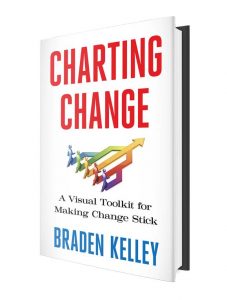
The Perfect Change & Transformation BookOn Friday I was speaking with my publisher Palgrave Macmillan (now part of Springer) about doing a second edition of Charting Change.

This means that my publisher is interested in having me create a new version of Charting Change that would include most, if not all, of the content contained in the first edition, while also adding thousands of words of new insights (plus new pictures and tools).

This causes me to ask you the following questions:

  1. What human-centered change and transformation topics are missing from Charting Change?
  2. What information would the perfect change & transformation book contain?
  3. What tools do change management professionals and transformation leaders need to enjoy greater success in their jobs, projects, and programs?
  4. Toolkit subscribers – which of my new tools should I highlight in the second edition that I didn’t introduce in the first edition?
  5. Who do you think has something compelling to add to the conversation in an additional guest expert section in the book? And what is the topic you want to hear from them on?

Charting Change introduced my Human-Centered Change™ methodology and a suite of 50+ tools available for purchase (book buyers get access to 26 of the 50+ tools). That toolkit has since grown to a collection of 70+ tools available to toolkit subscribers.

Thank you so much to everyone who has supported the first edition thus far and also to my Human-Centered Change™ Toolkit subscribers.

I’m interested to hear in the comments below your thoughts on the questions above!
(or send me an email)

If you don’t already have a first edition copy of Charting Change, you can get one here:

https://www.amazon.com/dp/1137536950/
(support my sharing of free Human-Centered Change & Innovation tools and insights)

And don’t forget to download your Free Human-Centered Change Tools!

Subscribe to Human-Centered Change & Innovation WeeklySign up here to get Human-Centered Change & Innovation Weekly delivered to your inbox every week.
Organizational Change Lessons from Successful Transformations

Organizational Change Lessons from Successful Transformations

GUEST POST from Art Inteligencia

In today’s rapidly evolving business landscape, the ability to adapt and transform is an essential requirement for organizations striving for continued success. However, organizational change is not merely about deploying new technologies or adjusting strategies; it’s about fostering a culture of adaptability and continuous improvement. This article explores this concept further, drawing lessons from notable success stories in organizational change.

Case Study 1: Netflix – Transforming Entertainment

One of the most compelling examples of successful organizational change is Netflix. Originally established as a DVD rental service, Netflix reimagined its business model to become a leading streaming service and a formidable player in content production. This transformation was driven by a forward-thinking leadership team and a company culture that embraced change.

Key to Netflix’s success was its commitment to innovation. By fostering an internal culture that valued agility and customer-focused strategy, Netflix was able to pivot and expand its offerings in response to market demands. The company’s internal processes were designed to support rapid iteration and experimentation, allowing it to respond promptly to consumer behavior shifts.

This transformation teaches us that successful organizational change requires:

  • A Visionary Leadership: Leaders must anticipate market trends and guide their organizations toward future opportunities.
  • Cultural Flexibility: An organizational culture that accepts failure as a learning opportunity encourages innovation and growth.

Case Study 2: IBM – Reinventing Through Innovation

IBM, a company with more than a century of history, has undergone several transformations to maintain its relevance in the competitive landscape. Its most recent transition from a conventional hardware and services company to a modern cloud computing and artificial intelligence giant is particularly noteworthy. IBM’s restructuring involved investing in new technologies, strategic acquisitions, and forming partnerships with leading tech companies.

The restructuring process was challenging but crucial for IBM’s survival. By focusing on building a robust technological infrastructure and upskilling its workforce, IBM managed to transition smoothly into new business domains. Additionally, the company prioritized customer-centric solutions, ensuring their innovations aligned with client needs.

IBM’s change initiative highlights several lessons:

  • Strategic Investment: Investing in emerging technologies and aligning them with company goals is vital for long-term success.
  • Talent Development: Empowering and reskilling employees can drive successful transitions.

Core Lessons in Organizational Transformation

The narratives of Netflix and IBM emphasize key lessons pertinent to organizational change:

  • Adaptability: Organizations must be agile, constantly learning and evolving to maintain their competitive edge.
  • Innovation: A culture that embraces creativity and innovation can navigate uncertainties more effectively.
  • Leadership: Visionary and committed leadership is crucial in inspiring change and driving transformation.
  • Employee Engagement: Involving employees in the change process fosters buy-in and facilitates smoother transitions.

To delve deeper into the principles and practices that lead to effective organizational change, you can explore more on Change Leadership and Embracing Uncertainty and its dynamics in detail.

The Human Element in Change

One aspect that often goes unnoticed in change management is the human element. Change can trigger emotional responses and resistance among employees. Therefore, cultivating an inclusive atmosphere that acknowledges these emotions is essential. Communication and employee involvement lay the groundwork for minimizing resistance and ensuring everyone is aligned with the organizational objectives.

Empowering employees through transparent communication and by offering opportunities for active participation can lead to greater acceptance and a smoother transition process. It’s crucial to consider the human side of change to support effective transformations.

Conclusion

Organizational change is a multifaceted journey that demands strategic vision, cultural adaptation, and inclusive engagement practices. Successful transformations, as demonstrated by Netflix and IBM, are built on the foundation of continuous innovation, investment in talent, and visionary leadership. By integrating these core lessons, organizations can navigate the complexities of change more effectively and ensure sustainable growth.

For additional insights on nurturing innovative practices within your organization, download Braden Kelley’s whitepaper titled Five Ways to Make Your Innovation Culture Smell Better.

In conclusion, the future of organizational success hinges on the ability to adapt and transform. By learning from successful transformations, organizations can develop the resilience necessary to thrive in an ever-evolving world.

Extra Extra: Futurology is not fortune telling. Futurists use a scientific approach to create their deliverables, but a methodology and tools like those in FutureHacking™ can empower anyone to engage in futurology themselves.

Image credit: Pexels

Subscribe to Human-Centered Change & Innovation WeeklySign up here to get Human-Centered Change & Innovation Weekly delivered to your inbox every week.https://bradenkelley.com/2019/11/change-leadership-and-embracing-uncertainty/

Top 100 Innovation and Transformation Articles of 2021

Top 100 Innovation and Transformation Articles of 2021

2021 marked the re-birth of my original Blogging Innovation blog as a new blog called Human-Centered Change and Innovation.

Many of you may know that Blogging Innovation grew into the world’s most popular global innovation community before being re-branded as InnovationExcellence.com and being ultimately sold to DisruptorLeague.com.

Thanks to an outpouring of support I’ve ignited the fuse of this new multiple author blog around the topics of human-centered change, innovation, transformation and design.

I feel blessed that the global innovation and change professional communities have responded with a growing roster of contributing authors and more than 15,000 newsletter subscribers.

To celebrate we’ve pulled together the Top 100 Innovation and Transformation Articles of 2021 from our archive of over 700 articles on these topics.

We do some other rankings too.

We just published the Top 40 Innovation Bloggers of 2021 and as the volume of this blog grows we may bring back a monthly ranking to complement this annual one.

But enough delay, here are the 100 most popular innovation and transformation posts of 2021.

Did your favorite make the cut?

1. All Leadership is Change Leadership – by Randy Pennington

2. Next Generation Loyalty – Part One – by Braden Kelley

3. Visual Project Charter™ – 35″ x 56″ (Poster Size) and JPG for Online Whiteboarding – by Braden Kelley

4. Where Do Innovation Strategies Usually Go Wrong? – by Jesse Nieminen

5. Black Friday Shows No Loyalty – by Braden Kelley

6. The Fail Fast Fallacy – by Rachel Audige

7. Top 40 Innovation Bloggers of 2020 – by Braden Kelley

8. What is Human-Centered Change? – by Braden Kelley

9. 10 Clever Ways to Stop Ideation Bullies from Hogging Your Brainstorming Sessions – by Howard Tiersky

10. 50 Cognitive Biases Reference – Free Download – by Braden Kelley

11. Free Customer Experience Maturity Assessment – by Braden Kelley

12. The Human-Centered Change Methodology – by Braden Kelley

13. Innovation vs. Invention vs. Creativity – by Braden Kelley

14. America Drops Out of the Ten Most Innovative Countries – by Braden Kelley

15. The One Movie All Electric Car Designers Should Watch – by Braden Kelley

16. Nine Innovation Roles – by Braden Kelley

17. No Regret Decisions: The First Steps of Leading through Hyper-Change – by Phil Buckley

18. Free Innovation Maturity Assessment – by Braden Kelley

19. Myths About Physician Entrepreneurs – by Arlen Meyers

20. Human-Centered Change – Free Tools – by Braden Kelley

21. The Five Keys to Successful Change – by Braden Kelley

22. Discipline Has a Role in Innovation – by Jesse Nieminen

23. Advances in the Management of Worthless Meeting Syndrome – by Arlen Meyers

24. 550 Quote Posters – by Braden Kelley

25. The Jobs-to-be-Done Playbook – by Braden Kelley

26. We Need a More Biological View of Technology – by Greg Satell

27. Free Human-Centered Change Tools – by Braden Kelley

28. Stoking Your Innovation Bonfire – by Braden Kelley

29. The Pyramid of Results, Motivation and Ability – by Braden Kelley

30. Experience Thinking – The Next Evolution for Design Thinking – by Anthony Mills


Build a common language of innovation on your team


31. Scaling Innovation – The What, Why, and How – by Jesse Nieminen

32. Charting Change – by Braden Kelley

33. The Experiment Canvas™ – 35″ x 56″ (Poster Size) – by Braden Kelley

34. To Change the World You Must First Learn Something About It – by Greg Satell

35. Digital Transformation Virtual Office Hours – Session One – by Braden Kelley

36. Lead Innovation, Don’t Manage It – by Arlen Meyers

37. Are doctors wasting their time on entrepreneurship? – by Arlen Meyers

38. What is design thinking? – EPISODE FIVE – Ask the Consultant – by Braden Kelley

39. Zoom Tutorial – Amazing New PowerPoint Background Feature – by Braden Kelley

40. COVID-19 Presents an Opportunity to Create an Innovation Culture – by Pete Foley

41. Increasing Organizational Agility – by Braden Kelley

42. Innovation Requires Going Fast, Slow and Meta – by Greg Satell

43. Remote Project Management – The Visual Project Charter™ – by Braden Kelley

44. Is innovation everyone’s job? – by Braden Kelley

45. What is your level of Innovation Maturity? – by Braden Kelley

46. Flaws in the Crawl Walk Run Methodology – by Braden Kelley

47. Innovation Teams Do Not Innovate – by Janet Sernack

48. We’re Disrupting People Instead of Industries Now – by Greg Satell

49. Don’t Forget to Innovate the Customer Experience – by Braden Kelley

50. Change Management Needs to Change – by Greg Satell


Accelerate your change and transformation success


51. Everyone hates to fail, why do you? – by Janet Sernack

52. Going with the Flow – by John Bessant

53. Can You Be TOO Strategic? – by Howard Tiersky

54. Competing in a New Era of Innovation – by Greg Satell

55. Fast Company is Wrong – by Braden Kelley

56. A New Age Of Innovation and Our Next Steps – by Greg Satell

57. Avoid the Addition Bias – by Paul Sloane

58. Visualizing Project Planning Success – by Braden Kelley

59. Innovation Ecosystems and Information Rheology – by Arlen Meyers

60. Rise of the Evangelist – by Braden Kelley

61. Creating 21st Century Transformational Learning – by Janet Sernack

62. Re-Skilling and Upskilling People & Teams – by Janet Sernack

63. Creating a Movement that Drives Transformational Change – by Braden Kelley

64. How to Scale Your Culture – by Arlen Meyers

65. A Trigger Strategy for Driving Radical, Transformational Change – by Greg Satell

66. Human-Centered Innovation Toolkit – by Braden Kelley

67. You Must Play and Experiment to Create and Innovate – by Janet Sernack

68. Managing Both the Present and the Future – by Janet Sernack

69. Why Change Failure Occurs – by Greg Satell

70. Developing a Future-Fitness Focus – by Janet Sernack

71. Using Intuition to Drive Innovation Success – by Braden Kelley

72. The Academic Intrapreneur Dossier – by Arlen Meyers

73. The Rise of Employee Relationship Management (ERM) – by Braden Kelley

74. An Example of Successful Alchemy – by John Bessant

75. The Dreaded Perfect Entrepreneur – by Arlen Meyers

76. Should intrapreneurs really ask for forgiveness and not permission? – by Arlen Meyers

77. Don’t Stop Thinking About Tomorrow – by Robert B. Tucker

78. Importance of Long-Term Innovation – by Greg Satell

79. Co-creating Future-fit Organizations – by Janet Sernack

80. What you should learn from the Google Health failure – by Arlen Meyers


Get the Change Planning Toolkit


81. Teaching to Win the 4th Industrial Revolution – by Arlen Meyers

82. Catalysing Change Through Innovation Teams – by Janet Sernack

83. Innovation and the Scientific Method – by Jesse Nieminen

84. Being Too Focused on the Test is Dangerous – by Arlen Meyers

85. Architecting the Organization for Change – by Braden Kelley

86. Healthcare Jugaad Innovation of a 17-Year-Old – by Braden Kelley

87. New Capability Mapping Tools for Business Architects – by Braden Kelley

88. How can I create continuous innovation in my organization? – EPISODE TWO – Ask the Consultant – by Braden Kelley

89. Thank You for Your Thinkers50 Nominations – by Braden Kelley

90. Preparing for Organizational Transformation in a Post-COVID World – by Greg Satell

91. Why Change is Hard – by Braden Kelley

92. Building a Better Change Communication Plan – by Braden Kelley

93. What is digital transformation? – EPISODE THREE – Ask the Consultant – by Braden Kelley

94. ACMP Standard for Change Management® Visualization – 35″ x 56″ (Poster Size) – Association of Change Management Professionals – by Braden Kelley

95. Borrow an Idea from a Different Field – by Paul Sloane

96. How to Go From Nail It to Scale It – by Arlen Meyers

97. Innovation in the time of Covid – Satisfycing Organizations – by Pete Foley

98. Sickcare Culture of Conformity versus a Culture of Creativity – by Arlen Meyers

99. Start 2021 with a Free Innovation Audit (Now in Portuguese or English) – by Braden Kelley

100. Outsmarting Those Who Want to Kill Change – by Greg Satell

Curious which article just missed the cut? Well, here it is just for fun:

101. Why so much medical technoskepticism? – by Arlen Meyers

These are the Top 100 innovation and transformation articles of 2021 based on the number of page views. If your favorite Human-Centered Change & Innovation article didn’t make the cut, then send a tweet to @innovate and maybe we’ll consider doing a People’s Choice List for 2021.

If you’re not familiar with Human-Centered Change & Innovation, we publish 1-5 new articles every week focused on human-centered change, innovation, transformation and design insights from our roster of contributing authors and ad hoc submissions from community members. Get the articles right in your Facebook feed or on Twitter or LinkedIn too!

Editor’s Note: Human-Centered Change & Innovation is open to contributions from any and all the innovation & transformation professionals out there (practitioners, professors, researchers, consultants, authors, etc.) who have a valuable insight to share with everyone for the greater good. If you’d like to contribute, contact us.

Subscribe to Human-Centered Change & Innovation WeeklySign up here to get Human-Centered Change & Innovation Weekly delivered to your inbox every week.