Category Archives: Entrepreneurship

What Innovators Can Learn From the Spectacular Rise and Crash of Theranos

Including its CEO Elizabeth Holmes

What Innovators Can Learn From the Spectacular Rise and Crash of Theranos

Last week in a Silicon Valley courtroom, Theranos founder and CEO Elizabeth Holmes was convicted on four counts of fraud in connection with the failed blood-testing company she founded in 2003. The Stanford dropout will soon be sentenced to up to 20 years in prison. She joins a long list of convicted fakers that includes Bernie Madoff, Jeff Skilling, John DeLorean, and many others.

For most observers, the question now is how Holmes got so far, so fast. But for innovators everywhere, I want to focus on a different question: what can we learn from this case study of innovation gone bad?

As an innovation author and trainer to corporate America, I see this as a tragedy for future startups, and the field of innovation.

From the beginning, I followed the amazing rise and spectacular fall of Theranos. At its zenith, the firm soared to a $9 billion valuation. When articles appeared on Elizabeth’s achievements, I was dazzled. Here was a young woman who’d had the gall to drop out of college and start a company that promised to change the game in healthcare.

Theranos invented the nanotainer, which collected blood through a simple, painless finger prick. Several drops of blood could then be tested by another Theranos invention, the Edison. Capable, according to company literature, of performing “hundreds” of separate tests, from standard cholesterol checks to AIDs and leukemia. “The results are faster, more accurate, and far cheaper than conventional methods,” crowed Wired Magazine in a 2014 cover story.

If only it were so. As the 18-week trial revealed, it was all smoke and mirrors.

The Edison was never able to perform any blood tests reliably. But instead of coming clean, Holmes chose to double down and lawyer up. In the book Bad Blood, Wall Street Journal reporter John Carreyrou detailed how Holmes went extreme. She harassed, threatened, and tried to silence internal whistleblowers. Carreyrou was pilloried before the Theranos staff and threatened by Holmes’ attorney and company stakeholder David Boies. Yet his damaging reporting led to Theranos’ unraveling. He carefully documented how Holmes and COO Ramesh “Sunny” Balwani resorted to using conventional test equipment behind the scenes, while pretending to patients and investors that Edison had performed the work.

As the story of Theranos now fades into history, what can be learned from this rare, behind-the-scenes insight into the amazing rise and fall of a startup that might guide the innovation efforts of others? What did Holmes get right, and where did she go wrong?

Innovators need to believe in themselves and think big, and they need self-discipline. Holmes had these attributes in spades. As a journal she kept revealed during the trial, Holmes kept up a grueling personal development regimen: “4 a.m. rise. Thank God, exercise, meditation, prayer. Eat breakfast Eat breakfast of whey and banana. Get to office by 6:45.”

Young and inexperienced in business, she apparently disciplined herself to speak in a deep and unemotional voice to make her seem older and more credible. She wore turtleneck sweaters to subliminally get people to think she might just be the second coming of Steve Jobs, her hero.

She made mentors of people like Larry Ellison and big-name investors like Tim Draper, who in turn helped convince big-name investors like the DeVoss family, the Cox family of Atlanta, and Rupert Murdock, who lost $125 million in the collapse.

Holmes’ was ultra-tough on herself to keep upping her game: “I am never a minute late,” she wrote in one entry. “I show no excitement. [I am] ALL ABOUT BUSINESS. I am not impulsive. I know the outcome of every encounter. I do not hesitate. I constantly make decisions and change them as needed. I speak rarely. I call bullshit immediately.”

Yet the one person she failed to call it on was herself.

And once she edged down that path with little lies, little deceptions, she got trapped into telling bigger and bigger lies. “Our equipment is already in use by the U.S. military on battlefields,” she promised would-be investors. It wasn’t. She was particularly good at establishing credibility, and somehow managed to charm such luminaries as Henry Kissinger, George Shultz, and James Mattis to serve on her board of directors, along with not a single scientist nor medical doctor who might have red-flagged problems with the Edison. (It is amazing that General Mattis apparently didn’t bother to check out the false claim that the military was already piloting the product on battlefields).

Holmes knew how to deflect when her offering proved vulnerable. Every good sales professional knows to “overcome objections.” But whenever visitors started asking her questions that were too close to the Big Lie (the product had major flaws), she aggressively pushed back with, “don’t ask us to reveal trade secrets.” While this shut them up, it did not solve her problem.

Another tool of innovators trying to build the buy-in for their ideas is to use the “fear of losing out” technique. There’s nothing unethical about it, unless you misrepresent facts. This strategy worked well for Holmes – at least for awhile. She used it successfully to secure big contracts, and big investments.

But the lie that did her in was a false attempt to demonstrate credibility. Before the jury, she admitted adding the logos of drug companies Pfizer and Schering-Plough to a marketing pitch to Walgreen Drugstores, at the time considering partnering with Theranos to install instant blood-testing centers in its 9,000 retail locations.

Final lesson to innovators: use creativity to make your case, but don’t fudge even on the smallest details. What Elizabeth did with the logos became a charge of wire fraud and was said to be the smoking gun that all jurors agreed on should send her to prison.

This article originally appeared in Forbes
Image credit: Wikimedia Commons

Subscribe to Human-Centered Change & Innovation WeeklySign up here to get Human-Centered Change & Innovation Weekly delivered to your inbox every week.

Problem Seeking 101

Problem Seeking 101 Charles Kettering

GUEST POST from Arlen Meyers

When federal agencies in charge of protecting Americans’ health recommended that there should be a pause in the administration of the Johnson & Johnson (J&J) COVID-19 vaccine, state health leaders listened and suspended its use. People may experience a mild headache after vaccination. The headaches associated with the blood clot occur one to three weeks after the shot and are more severe.

One expert recommended asking patients, “Is this like headaches you’ve had before? Or is the quality of the headache something that you’ve never experienced before?”

The 12 steps to biomedical innovation starts with being a problem seeker, not a problem solver. Eventually, to be successful, customer problems and solutions need to meld around a VAST business model i.e. one that is not just profitable, but that demonstrates:

1. Validity Regardless or which elements of your model you choose, they have to be valid. In other words, the dogs have to eat the food. When the dog won’t eat the food, you’ll have to change your approach and try again.

2. Automaticity At the very start of planning your venture, you should think about how you are going to work on your business, not in it. Reducing hands on time to manage operations will give you more time to lead the company and create strategies for growth and give you more personal time to enjoy the fruits of your success. Outsourcing, automating or using technologies to ramp up operations, sourcing and distribution is a key part of scaling, and something that investors want to see…which brings us to the next piece.

3. Scalability Your business model is primarily a way to create a business machine that can produce an infinite number of products. Think of it as a device that takes in customers and creates profits out the other end and can do so at quicker and quicker speeds.

4. Time and Traction Finally, your model need to create as much profit as quickly as possible with a growing customer base that is loyal to your brand.

Many doctors, scientists and engineers start with solutions looking for a problem. Some find it or, eventually, as their inventions or technology evolves, markets appear to those who have the talent to see them. The more typical model, and one that is more common among the startup community, is to find a problem and devise a solution.

But, how do you pick the IDEAL opportunity given the almost infinite possibilities? Here are some tips:

I Identify the problem: Seeing a problem is an important skill and core competency of savvy entrepreneurs. It typically is the result of personal experience, primary research talking or watching others or secondary research. Whichever problem you pick, look for ones that:

  1. Will make a very big difference in people’s lives if you solve it
  2. Has the potential to be very profitable or create lots of user defined value, typically at least 10x the value compared to existing offerings or the status quo.
  3. Is something that taps into your passion or satisfies your psychic need
  4. Anticipates future customer/stakeholder wants and needs
  5. Has an extremely high level of market pain and frustration, where customers know they have a problem and have unsuccessfully and repeatedly tried to solve it
  6. Has limited barriers to entry
  7. Has the right potential risk-return profile that matches yours
  8. Is not one dominated by incumbents
  9. Is easy to explain and understand
  10. Someone is willing to pay enough for your solution so that you can make it profitably

Where massive success comes – where a good idea becomes great – is when it meets five simple criteria:

  1. It is the first solution to a problem or gap (it is “innovative”)
  2. It is the first WORKING solution to a problem or gap (it is “innovative and effective”)
  3. It is the most affordable, comparable, option for its market (it is “innovativeeffective and affordable”)
  4. It consistently examines its effectiveness and seeks to improve (it is “innovativeeffectiveaffordableand adaptive”)
  5. It is powerful enough to create a loyal following that naturally wants to – and does – share the idea with others (it is “innovativeeffectiveaffordableadaptive and influential”)

How do you find problems worth solving?

  1. 1. Solve a problem that you already face
  2. 2. Observe a problem and solve it
  3. 3. Anticipate a problem and solve it
  4. 4. Create a problem and solve it
  5. 5. You have a personal stake in solving it
  6. 6. The 3 W’s: Will customers WANT it, is it WORTH it, can you WIN at it?

Identifying a problem starts with identifying a customer archetype that has it. Beyond guessing, identifying that person and describing their problem can only be done by talking to, working with or observing potential customers.

Doctors call it taking a pain history and documenting the chief pain complaint, the history of the present illness and their past medical history. In other words, talk to people and have them describe:

  1. Where is your pain?
  2. How bad is it?
  3. How long have you had it?
  4. On a scale of 1-10, how would you describe it?
  5. What have you done in the past to make it better?
  6. What makes it better or worse?
  7. What other problems do you have that makes the pain better or worse?
  8. How have you treated it in the past?
  9. Is the pain constant or intermittent?
  10. What would you pay to relieve the pain?

Startup geeks call this process customer discovery by “getting out of the building”. Doctors call it making house calls. Here is the ultimate list of customer discovery/development questions.

Here is a customer interview script.

Remote patient programs , for example, don’t just automatically work out. They have to be carefully planned and developed in order to gain traction and produce results. Most importantly, they have to target the right patients.

D Define and represent the problem

Primary or secondary research should give you some idea about :

  1. Market size
  2. Market growth
  3. The competitive landscape
  4. Where you intend to play
  5. What you see that others don’t.

Once you have done these things, then you can:

E Explore and experiment with possible strategies or solutions and risks involved with each by identifying customer segments and creating a value proposition canvas and a business model canvas

Here’s an into to value proposition design

When you create new value propositions and growth you need to focus on high-value customer jobs. These are not necessarily the most important jobs from your customers’ perspective. They are the most promising jobs from your perspective as a solutions provider. High-value customer jobs are characterized by the following, they are:

  • Important: When customer’s success or failure to get the job done leads to essential gains or extreme pains, respectively. Examples are managing the security risk of an ecommerce website, or designing and implementing the strategy at a company.
  • Tangible: When the pains or gains related to a job can be felt or experienced immediately or often. Examples are traffic during your daily commute, or managing a constantly overflowing email inbox.
  • Unsatisfied: When current value propositions don’t help to relieve pains or create desired gains in a satisfying way. Maybe the desired value proposition doesn’t even exist. Examples are the inexistent cure for hangovers, or calorie-free chocolate.
  • Lucrative: When many people have the job with related pains and gains or when a small number of customers are willing to pay a premium. An example of the former is listening to music on the go. An example of the latter are rare diseases for which customers or insurers are willing to pay a premium.

Here is a list of stakeholders that represent customer segments. But, job title is only one part of creating a customer persona. Here’s what Linkedin Sales Navigator won’t tell you and how to fill the gaps.

If you listen to or watch customers enough, you’ll be surprised at what you’ll discover. Here are some examples.

Don’t send out a questionnaire. Here’s why you need to interview stakeholders to identify their value factors that are most important until you get saturation.

A Act on a selected strategy or solution

L Look back and evaluate

Most businesses fail because 1) they don’t offer the right value proposition-market fit or 2) they don’t have a viable business model. Your business model canvas is anchored on your value proposition. Your value proposition (doing the job the customer wants you to do, removing the pain they have to endure to do it now and offering a product that meets or exceeds customer expectations) starts with understanding your customers. Focusing on your customers or market segments starts with those who touch the problem every day.

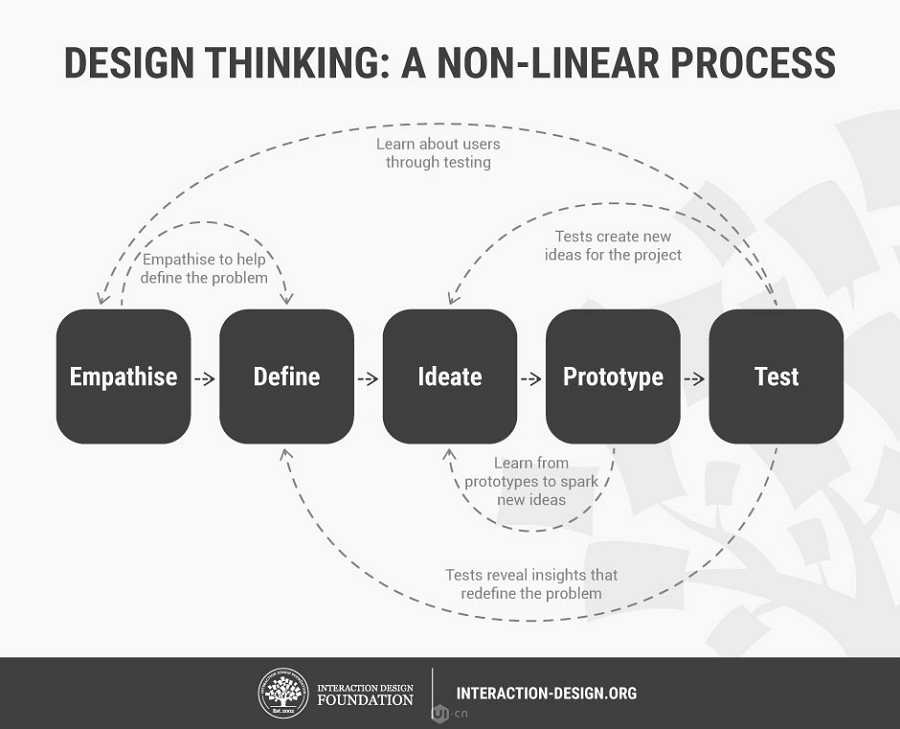
Design thinking describes this process i.e. understanding a problem from the customer perspective, putting yourself in their shoes by either interviewing them, watching them or experiencing what they experience. and create a range of solutions that you then design, prototype and test.

Design Thinking Diagram

Customer centered design means you have to learn how to talk to humans.

Before you do all this, though, decide whether the industry or market you decide to tackle is, the words of my friend, Tom Higley, the CEO at www.101010.net, the right founder-opportunity fit. That usually means finding independence, mastery and purpose and scratching all those psychological itches, be they pathological or not.

Perhaps the most powerful problem is one that you make personal but don’t take personally.

Here’s the problem with saying, “Don’t bring me problems, bring me solutions.”

The education pioneer, John Dewey, said, “a problem well-put is half solved”

That happens when you arm yourself initially with the information you get from being a problem seeker, not a problem solver. Even academic scientists are getting the message.

Image credits: MisterInnovation.com, Interaction Design Foundation

Subscribe to Human-Centered Change & Innovation WeeklySign up here to get Human-Centered Change & Innovation Weekly delivered to your inbox every week.

The Education Business Model Canvas

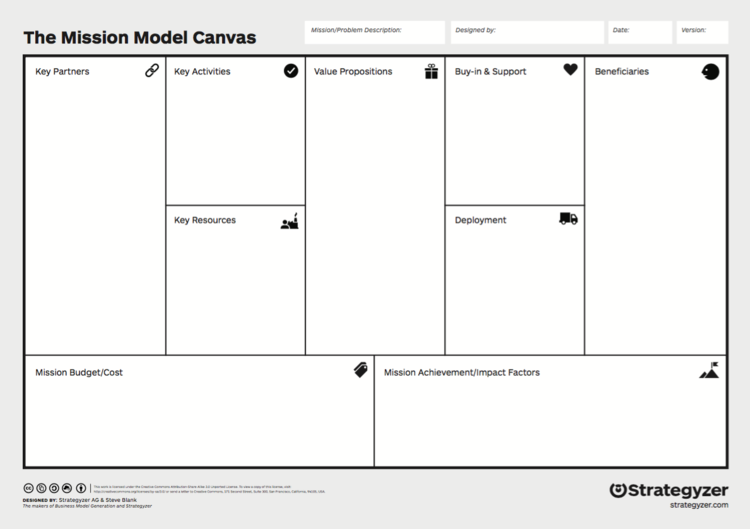
Mission Model Canvas

GUEST POST from Arlen Meyers

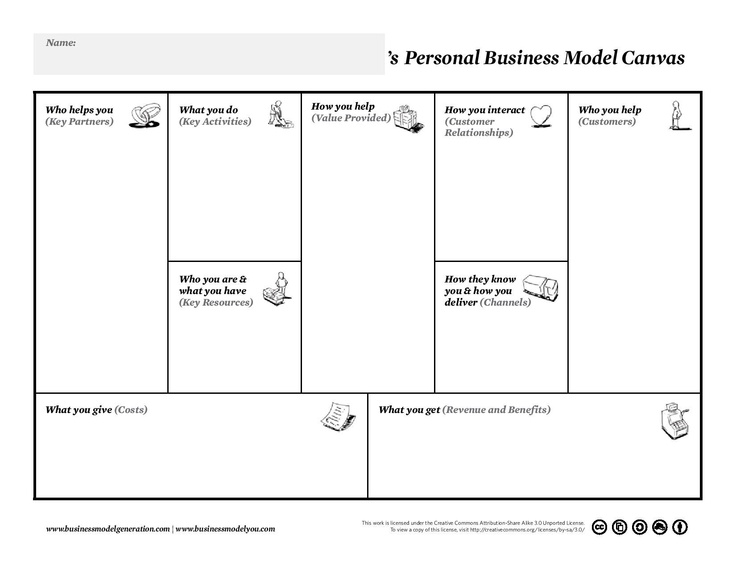
The business model canvas is one of many useful tools to design, evolve and test products and services business models. While the original model was proposed to help founders create a viable and scaleable business model, it has also helped non-profit executives, as the mission driven business model, and those looking to make a career change, using a personal business model as the Business Model You.

Personal Business Model Canvas

The construct is also useful if you are an edupreneur, trying to create and launch new educational products and services, including new courses, certificates, programs or degree offerings.

Edupreneurship rests on several foundational principles:

  1. Having an entrepreneurial mindset
  2. Intra- and entrepreneurial knowledge, skills, abilities and competencies
  3. Design thinking focused on creating stakeholder and beneficiary defined outcomes
  4. A systems engineering approach to solving wicked problems, like how to fix outcomes disparities and their social determinants
  5. A different business model
  6. More respect for and attention to edupreneurial champions
  7. Better teacher education and training
  8. An incentive and reward system for not just tweaking a failed system , but rather, making it obsolete given the basic structural changes in the US economy
  9. Eliminating unnecessary and burdensome bureaucracy, credentialing that does not add value and administrivia
  10. Paying more attention to and measuring student defined outcomes
  11. Better public-private integration
  12. K-20 integration and alignment

13. Teaching students what they need to win the 4th industrial revolution

14. Embracing cradle to career integration

15. Creating a competent diverse and equitable talent pipeline

We has seen several recent advances in edupreneurship.

Here is the boomer’s guide to teaching millenials.

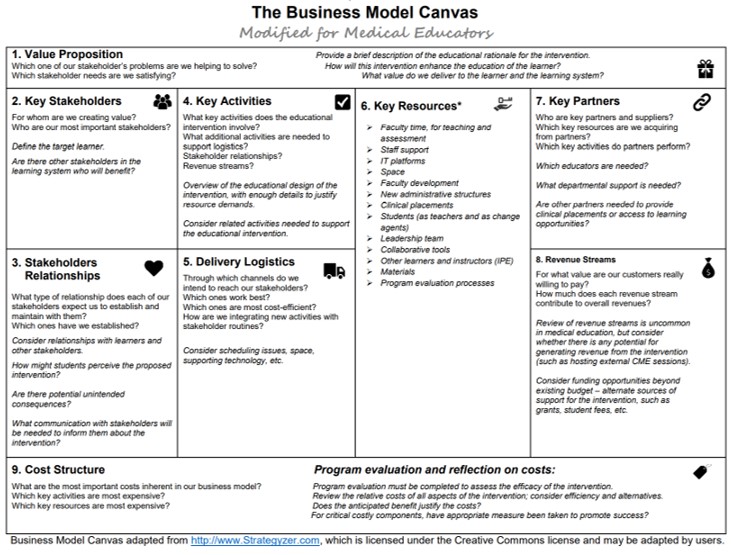
The UGME steering committee recognizes that medical education programs are faced with the ubiquitous challenge of repeated calls for innovation and that, frequently, these calls do not adequately address the associated resource demands. As medical educators, we have become highly creative in identifying strategies to do more with less, but as we know, this is not a sustainable model of stewardship. In 2016 and 2017, the UGME section collaborated with the Group on Business Affairs (GBA) to explore evolving models to support and sustain UGME programming. A result of this work is the Business Model Canvas for Medical Educators. The original Business Model Canvas was proposed by Alexander Osterwalder in 2008 and has been modified over time to fit other needs. The Table of Contents will direct you to resources, including the Business Model Canvas for Medical Educators template and two examples submitted by institutions who have successfully used the template to secure funding from within their own institution.

Business Model Canvas for Medical Educators

The edupreneurship business model canvas has a few modifications to the traditional startup one:

Customer segments: The primary customer are students. However, there are many other education stakeholders, including admininstrators, alumni, donors, employers and parents. In addition, for any given subject, potential students will have different backgrounds and experience in the subject, will have different jobs they want done, and, therefore, will have different applications for what they learned, be it finding a job, getting a promotion, or adding value where they presently work.

Value proposition: For each customer segment , you have a specific value proposision. You typically describe it in the course syllabus, telling users about the intended audience, the goals of the course, the learning objectives, and the curriculum. For example, the value proposition for a course I teach to xMBA/HA students is :

This course will introduce graduate level students in healthcare administration and leadership to the principles and practice of healthcare innovation and entrepreneurship defined as the pursuit of opportunity under volatile, uncertain, complex and ambiguous conditions with the goal of creating stakeholder defined value through the deployment of innovation using a valid, automatic, scaleable and time sensitive (VAST) business model.

Following completion of this course, you should be able to:

1. identify gaps in your health entrepreneurship competencies and develop a personal and professional development plan to address them

2. create an organizational culture of innovation, lead innovators and overcome the barriers to healthcare innovation dissemination and implementation

3. identify the multiple clinical and non-clinical ways to practice healthcare entrepreneurship

4. Create a plan to solve a problem inside or outside of your organization that meets the goals of the quintuple aim (Quality, cost, access, experience, waste/business operations)

5. Identify the startup life cycle and challenges at each stage

Channels: This describes how you will deliver your course. Will it be face to face, online or some hybrid model with elements of both?

Customer relationships: This describes how you will get, keep and grow the numbers of students who will take the course, e.g. promoting in the course catalog, attending a career or course proposal day, creating awareness on social media or using word or mouth dissemination from previous students.

Revenue model: This describes how your employer or you will generate revenue from the products. Traditionally, universisty based courses use a “butts in the seats” model, but COVID and new eductional technologies have radically changes the revenue generating possibilities, inluding advertising, freemium models, subscription models and others.

Key resources: This describes the human, physical, intellectual property and financial resources you will need to build, execute and scale your initiative. For example, do you want to copyright your materials, or , do you want to make them an open educational resource using a Creative Commons license?

Key activities: This what you need to do to perform and deliver on your value proposition, like what you will do using a learning management system, like create videos, run office hours, moderate asynchronous virtual discussions and design and grade exams and quizzes

Key partnerships: This describes who can help you, be they guest faculty, educational technology partners, corporate sponsors, e.g. if you are using project based learning techniques or online tools and resouce producers, e.g cases from the Harvard Business School collection.

Costs: This describes the tangible and intangible costs to produce your product. In most instances, your time, opportunity costs and effort will overshadow the monetary costs.

COVID has accelerated the pace of change in higher education, forcing them to create entrepreneurial universities. Teaching faculty how to use the education business model canvas should be part of faculty development to mimimize projecdt and product failure.

Here is what I learned, using the business model canvas, teaching sickcare innovation and entrepreneurship to first year medical students at the University of Colorado.

In this post , Steve Blank offers a new definition of why startups exist: a startup is an organization formed to search for a repeatable and scalable business model.

So is a new course or certificate. Use the education driven business model to make your product desireable, feasible, viable and adaptable and be sure to document your success when it comes time for your evaluation,promotion and tenure review. More likely, though, you will be including it in your failure resume, since, like the vast majority of new products, yours is likely to fail because 1) you offered a product students don’t want to buy or someone does not want to pay for, and 2) you do not have a VAST educational product business model.

Image credits: Strategyzer

Subscribe to Human-Centered Change & Innovation WeeklySign up here to get Human-Centered Change & Innovation Weekly delivered to your inbox every week.

Everyday Innovation

Everyday Innovation

GUEST POST from John Bessant

We’re all innovators, even if we never thought of calling ourselves that…

Here’s a challenge.

Close your eyes and try to visualize an entrepreneur.

There’s a good chance that what you’ve come up with will be one of the usual suspects — Elon Musk, Jeff Bezos, Jack Ma, perhaps some of the older versions like Steve Jobs or even Thomas Edison. Hopefully there’s a fair number of women represented, players like Oprah Winfrey, Beyonce or Ariana Huffington; after all statistics show that close to half of the entrepreneurs in the world are female.

But there’s an equally good chance that you won’t have come up with some of these characters, though they all have a strong claim to be featured in our ‘entrepreneur’s gallery’. They may not have become trillionaires but they certainly made an impact. People like Margaret Knight, back in the 19th century; a natural born inventor who was famous before she hit her teens for the wooden sledges she’d fashion for local kids. Working in a textile factory she witnessed an awful (but preventable) accident in which a worker was badly injured by a shuttle flying off a loom. It prompted her to develop a safety device to prevent this happening; she succeeded, her idea worked and it was widely adopted by other textile mills in the area. Unfortunately she was too young to hold a patent and in any case had little understanding of the legal mechanics of doing so. A hard lesson — but one which later served her well.
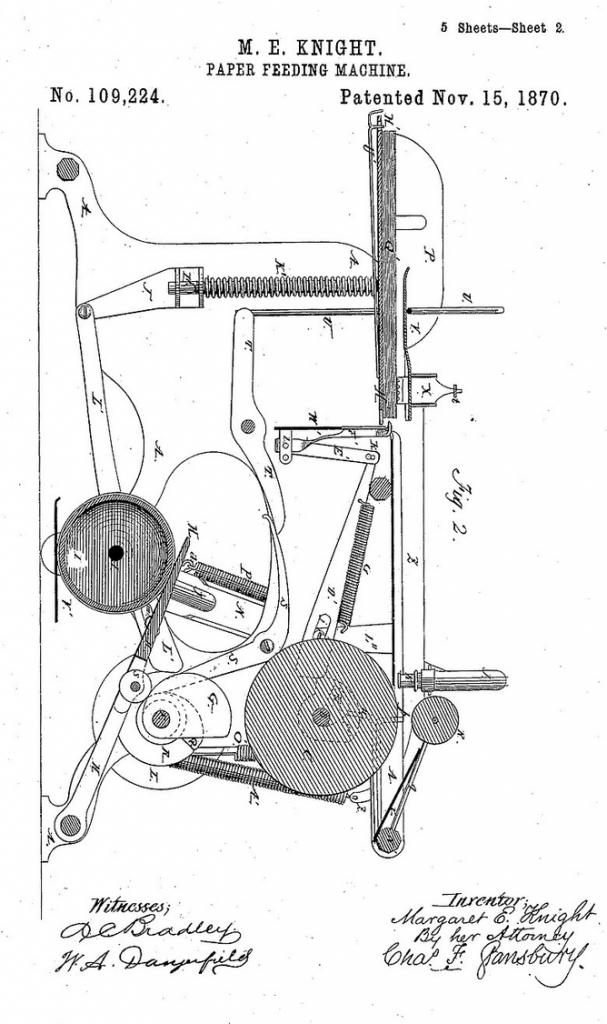
Margaret Knight Patent Illustration

She moved on through a series of jobs which gave her an appreciation of many different technologies and production processes and finally found herself at the Columbia Paper Company. Her job involved folding every paper bag by hand — a slow process and one with a high potential for human error. During her long working day (10 hour shifts, monotonously folding and gluing) she had ample opportunity to think about how to improve the process — and by night she’d sketch out her ideas in the boarding house where she was living. Within six months she’d managed to build a working prototype out of wood which could cut, fold and glue bags each time a crank was turned.

This time she tried to patent her idea, only to find someone had got there first, having stolen her concept. He’d seen the potential in the design and had decided to copy it and pass it off as his own. After all who would believe that a woman factory worker could produce something so clever and complex?

But Margaret Knight was tough as well as clever; she’d kept all her working drawings and was not going to surrender meekly. Although it cost her most of her savings she was vindicated; in 1871 she was granted US Patent 116842, the first woman in the country to hold a patent. It may have been an improvement innovation but its impact was radical. Her invention revolutionized the paper bag industry by replacing the work of thirty people with one machine. It provided the ‘dominant design’ around which others would innovate, and created the model for the paper shopping bags we still use today.

Or how about Betty Nesmith Graham, a single mother working as a secretary in the Dallas headquarters of the Texas Bank. Which meant spending much of her time typing (or to be more precise, correcting the mistakes she’s made by re-typing). In her frustration she wondered if there was a way to cover up the mistakes, somehow magically clean the paper and type over it once again. After all, when she was painting (her hobby when she got time for it) she’d not spend ages rubbing out or throwing away the canvas so she could start again. She’d just paint over what she’d done wrong, fix it, move on.
She began to experiment at home on the kitchen table. Took a small brush, mixed up some egg white and a little of her precious white tempera paint in the kitchen blender. Played around until the consistency felt right, then dipped her smallest water colour brush into the mixture and painted carefully over a line of typing on the polite letter informing her that her phone bill was overdue for payment. The black key strokes faded beneath the white, the page became blank again ready for someone to type a new line on it.

Back at work the next day it didn’t take her long to make another mistake, her fingers overstepping themselves as she tried to type faster. But this time she carefully wound the roller up a few notches, took a nail varnish pot filled with her concoction from her handbag and painted over the mistake. After a couple of minutes she picked up the mistaken page — and saw her mis-typed words erased, the letter ready for her to try again.

That was the birth of what became ‘Liquid Paper’; it wasn’t an easy journey from idea to successful business but by 1979 over 25 million bottles/year were being made and she employed over 200 people. At this high point she decided to sell the (by now very profitable) business to the Gillette Corporation for $47.5million.

Tupperware

Or Brownie Mae Wise, another single mother trying to keep her family afloat and working as a demonstrator for Stanley Home Products, selling door-to-door. They began experimenting with a new idea, hosting demonstration events in people’s houses and she took to it like a natural. Her social skills coupled with her sales gift meant that pretty soon she was the top agent with much of her success coming with a new product the company had just taken on for a client — Tupperware. She pioneered the idea of social marketing, turning the Tupperware party into a model which transformed the Tupperware business and led to her becoming a powerful role model for women of her time. In 1954 she was featured as the first woman on the cover of Business Week magazine.

With examples like these we clearly need to expand our picture of what makes an entrepreneur. We should, for example, add Dr Govindar Venkataswamy who worked all his life as a surgeon in India specializing in cataract treatment; on retirement he set himself the goal of bringing this operation within the reach of the rural poor in his native state of Tamil Nadu. To do so he needed to find a way of bringing down the cost from around $300 in a city hospital to $30, without compromising safety. He found an answer not in the world of healthcare but by adopting ideas from McDonalds, the fast-food business. The model for his Aravind eye care system worked, the average cost of the operation today is $25, it has one of the best safety records in the world and around 15million people can see who would otherwise have gone blind.

Or how about students Andrea Sreshta and Anna Stork who founded Luminaid as a response to the 2010 Haiti earthquake? They realized that there was a requirement for something beyond food, water and basic first-aid supplies — light. For vulnerable communities, access to a safe, waterproof and transportable light source, which can be powered by the sun could be valuable. Accessible lighting provides a sense of security and community; beyond this, light facilitates study into the evening, providing much-needed access to education for disadvantaged children across settings around the world. Since 2010 over 250,000 LuminAID lanterns and chargers have been distributed by major aid agency partners to those in need, 50,000 of which were sponsored directly through their Give Light, Get Light program.

People like them are also change agents, driven by the desire not for money but for impact, making the world a better place.

And what about the quiet unsung heroes who work away in organizations and who come up with new ideas and take them forward — they too qualify as change agents. People like George Laurer, working for IBM in the early 1970s. One Sunday afternoon he walked across the lawn to tell his neighbor Paul McEnroe (who also happened to be his boss) “I didn’t do what you asked.”

What McEnroe had asked for was a circular bullseye optical scanning code which could be printed on labels. This needed to be compatible with the scanners being installed in supermarkets for which IBM was developing technology. But Laurer could see the problem — printed circles in a high speed press risked blurring at the edges and misinformation. So instead he devised his own code, a pattern of vertical stripes, readable even under difficult lighting conditions.

McEnroe told him to go ahead with preparing his presentation for the next day anyway but didn’t exactly offer warm support, telling Laurer “…there’s nothing I can do about it now….you make the presentation but if it’s not accepted it’s going to be your butt not mine”

Fortunately for George — and IBM — the idea was accepted; it was the bar code strip, formally known as the Universal Product Code — UPC — which provides us with a continuing reminder of the power of such ‘quiet innovation’.

Another group we ought to add into our (now very large) community — user innovators. For many people in all walks of life frustration is often the Mother of Invention. They want a solution to a problem which is bugging them and they’re not afraid to experiment and hack their way to a solution which works. Very often they aren’t particularly interested in spreading their ideas more widely but if someone else can benefit then that’s OK. Examples include farmers improvising add-ons and fixes to their equipment or patients and their carers coming up with solutions to make living with chronic disease more comfortable.

For housewife Valerie Gordon-Hunter back in 1947 the frustration was the endless process of washing nappies for her three children and her dream of finding some kind of disposable version. She developed her own solution– the Paddi — made out of old nylon parachutes, tissue wadding and cotton wool which she sewed together at her kitchen table.

At the same time across the Atlantic Marion Donovan came up with the idea of a cover which would stop the contents of a dirty nappy from soiling surrounding clothes or bed linen. Once again the target was reducing the superhuman effort involved in constantly washing clothing; her invention was called the ‘Boater’ because of its resemblance to a boat. It involved a shower curtain as raw material sewn into a pair of pants which, with the addition of snap fasteners to replace safety pins, kept the nappy in place without soiling the surrounding clothes or bed sheets. And she hit on the idea of some kind of absorbent insert which could be disposable — experimenting with various mixes of cotton wool and once again nylon parachute material.

Disposable Diapers

Today’s market for disposable nappies is estimated at around $10bn.

Sometimes it’s a matter of inspired improvisation. On a hot July day in 1904 at the St Louis World’s fair the ice cream seller next to Ernest Hamwi’s waffle stall hit the nightmare scenario — a queue of people wanting ice cream and no dishes left to sell it in. But Ernest came to the rescue — he had the idea of rolling one of his waffles into a cone shape, and one of the great ideas in the food world was born.

Improvisation of this kind is often something which is born out of crisis; it’s useful to remember the Apollo 13 space mission which had the world holding its breath in the aftermath of the radio message “Houston, we’ve had a problem.” At 2am on April 14, 1970 the failure of a major part of the electrical system suddenly put the crew’s lives at risk. With one of its main oxygen tanks ruptured and with the clock ticking away the teams on the ground and in the module had to improvise solutions fast. They needed to secure enough breathable oxygen for three men in a capsule only designed to take two — and so built an air purifier system using plastic covers from their flight plans, plastic bags, some sticky tape and a soggy sock!

The same kind of crisis-driven improvisation led Willem Kalff to develop the world’s first kidney dialysis machine. Because he was working during wartime under Nazi occupation in the Netherlands his was something of a ‘scrapyard challenge’; he built his machine out of salvaged car and washing machine parts, orange juice cans and sausage skins.

It’s the same kind of spirit that led to ‘citizen innovators’ developing a wide range of apps to help deal with the aftermath of the 2010 Haiti earthquake; their solutions included crisis mapping, reuniting displaced families, mobilising an alternative banking system to help distribute aid and crowdsourcing design information to feed 3D printers creating urgently needed medical spare parts.

We could go on but the point is clear. Innovation– creating value from an idea — is something which all sorts of people do in many different contexts. Peter Drucker’s famous comment is helpful here; ‘innovation is what entrepreneurs do’. We’re familiar with the start-up but that’s only one of the many places in which we might find ‘entrepreneurs’ — people who make change happen.

In fact we are all potentially entrepreneurs — think about situations like these in your own life. Standing in a queue and turning over in your mind the thought that ‘there has to be a better way…’ You’re beginning the same kind of mental journey of innovation, frustration prompting you to think of alternative solutions. Or look around your home and list all the little hacks you’ve put in place to solve problems or make life easier. Innovation, once again.

We shouldn’t be surprised; after all this is something human beings have been doing for thousands of years. Our survival as a species rather depended on being able to come up with now solutions to the problem of not being eaten or having enough to eat ourselves. We’re not big or fast — but we do have half a kilogram of grey stuff inside our heads which is pretty useful at coming up with new ideas.

This isn’t just semantics. At a time when we need as much innovation as we can get (never mind trying to survive a pandemic we also have a planet whose future is in considerable doubt unless we change things pretty fast and radically) mobilizing the skills of innovation is an urgent priority. Not for nothing are efforts being made to introduce the core skills of entrepreneurial behavior to everyone from kindergarten kids through to care home residents.

And the good news is that we have learned a lot about what those skills involve; far from entrepreneurs being somehow magically different (like unicorns) we now understand the core elements in the craft. Turning ideas into value is about learning to make a journey and we have a map for that which has been drawn from over 100 years of experience of success (and failure) — a kind of supercharged ‘Trip Advisor’ or Hitchhiker’s Guide.

It still helps to have a growth mindset and plenty of ‘grit’ — being prepared to persevere in the face of obstacles and learning to manage failure as part of the process. But thinking about how to develop our skills as an ‘everyday entrepreneur’ might be a good resolution for kicking off the 2022 new year.

Image credits: Pixabay, USPTO, Unsplash

Subscribe to Human-Centered Change & Innovation WeeklySign up here to get Human-Centered Change & Innovation Weekly delivered to your inbox every week.

Top 100 Innovation and Transformation Articles of 2021

Top 100 Innovation and Transformation Articles of 2021

2021 marked the re-birth of my original Blogging Innovation blog as a new blog called Human-Centered Change and Innovation.

Many of you may know that Blogging Innovation grew into the world’s most popular global innovation community before being re-branded as InnovationExcellence.com and being ultimately sold to DisruptorLeague.com.

Thanks to an outpouring of support I’ve ignited the fuse of this new multiple author blog around the topics of human-centered change, innovation, transformation and design.

I feel blessed that the global innovation and change professional communities have responded with a growing roster of contributing authors and more than 15,000 newsletter subscribers.

To celebrate we’ve pulled together the Top 100 Innovation and Transformation Articles of 2021 from our archive of over 700 articles on these topics.

We do some other rankings too.

We just published the Top 40 Innovation Bloggers of 2021 and as the volume of this blog grows we may bring back a monthly ranking to complement this annual one.

But enough delay, here are the 100 most popular innovation and transformation posts of 2021.

Did your favorite make the cut?

1. All Leadership is Change Leadership – by Randy Pennington

2. Next Generation Loyalty – Part One – by Braden Kelley

3. Visual Project Charter™ – 35″ x 56″ (Poster Size) and JPG for Online Whiteboarding – by Braden Kelley

4. Where Do Innovation Strategies Usually Go Wrong? – by Jesse Nieminen

5. Black Friday Shows No Loyalty – by Braden Kelley

6. The Fail Fast Fallacy – by Rachel Audige

7. Top 40 Innovation Bloggers of 2020 – by Braden Kelley

8. What is Human-Centered Change? – by Braden Kelley

9. 10 Clever Ways to Stop Ideation Bullies from Hogging Your Brainstorming Sessions – by Howard Tiersky

10. 50 Cognitive Biases Reference – Free Download – by Braden Kelley

11. Free Customer Experience Maturity Assessment – by Braden Kelley

12. The Human-Centered Change Methodology – by Braden Kelley

13. Innovation vs. Invention vs. Creativity – by Braden Kelley

14. America Drops Out of the Ten Most Innovative Countries – by Braden Kelley

15. The One Movie All Electric Car Designers Should Watch – by Braden Kelley

16. Nine Innovation Roles – by Braden Kelley

17. No Regret Decisions: The First Steps of Leading through Hyper-Change – by Phil Buckley

18. Free Innovation Maturity Assessment – by Braden Kelley

19. Myths About Physician Entrepreneurs – by Arlen Meyers

20. Human-Centered Change – Free Tools – by Braden Kelley

21. The Five Keys to Successful Change – by Braden Kelley

22. Discipline Has a Role in Innovation – by Jesse Nieminen

23. Advances in the Management of Worthless Meeting Syndrome – by Arlen Meyers

24. 550 Quote Posters – by Braden Kelley

25. The Jobs-to-be-Done Playbook – by Braden Kelley

26. We Need a More Biological View of Technology – by Greg Satell

27. Free Human-Centered Change Tools – by Braden Kelley

28. Stoking Your Innovation Bonfire – by Braden Kelley

29. The Pyramid of Results, Motivation and Ability – by Braden Kelley

30. Experience Thinking – The Next Evolution for Design Thinking – by Anthony Mills


Build a common language of innovation on your team


31. Scaling Innovation – The What, Why, and How – by Jesse Nieminen

32. Charting Change – by Braden Kelley

33. The Experiment Canvas™ – 35″ x 56″ (Poster Size) – by Braden Kelley

34. To Change the World You Must First Learn Something About It – by Greg Satell

35. Digital Transformation Virtual Office Hours – Session One – by Braden Kelley

36. Lead Innovation, Don’t Manage It – by Arlen Meyers

37. Are doctors wasting their time on entrepreneurship? – by Arlen Meyers

38. What is design thinking? – EPISODE FIVE – Ask the Consultant – by Braden Kelley

39. Zoom Tutorial – Amazing New PowerPoint Background Feature – by Braden Kelley

40. COVID-19 Presents an Opportunity to Create an Innovation Culture – by Pete Foley

41. Increasing Organizational Agility – by Braden Kelley

42. Innovation Requires Going Fast, Slow and Meta – by Greg Satell

43. Remote Project Management – The Visual Project Charter™ – by Braden Kelley

44. Is innovation everyone’s job? – by Braden Kelley

45. What is your level of Innovation Maturity? – by Braden Kelley

46. Flaws in the Crawl Walk Run Methodology – by Braden Kelley

47. Innovation Teams Do Not Innovate – by Janet Sernack

48. We’re Disrupting People Instead of Industries Now – by Greg Satell

49. Don’t Forget to Innovate the Customer Experience – by Braden Kelley

50. Change Management Needs to Change – by Greg Satell


Accelerate your change and transformation success


51. Everyone hates to fail, why do you? – by Janet Sernack

52. Going with the Flow – by John Bessant

53. Can You Be TOO Strategic? – by Howard Tiersky

54. Competing in a New Era of Innovation – by Greg Satell

55. Fast Company is Wrong – by Braden Kelley

56. A New Age Of Innovation and Our Next Steps – by Greg Satell

57. Avoid the Addition Bias – by Paul Sloane

58. Visualizing Project Planning Success – by Braden Kelley

59. Innovation Ecosystems and Information Rheology – by Arlen Meyers

60. Rise of the Evangelist – by Braden Kelley

61. Creating 21st Century Transformational Learning – by Janet Sernack

62. Re-Skilling and Upskilling People & Teams – by Janet Sernack

63. Creating a Movement that Drives Transformational Change – by Braden Kelley

64. How to Scale Your Culture – by Arlen Meyers

65. A Trigger Strategy for Driving Radical, Transformational Change – by Greg Satell

66. Human-Centered Innovation Toolkit – by Braden Kelley

67. You Must Play and Experiment to Create and Innovate – by Janet Sernack

68. Managing Both the Present and the Future – by Janet Sernack

69. Why Change Failure Occurs – by Greg Satell

70. Developing a Future-Fitness Focus – by Janet Sernack

71. Using Intuition to Drive Innovation Success – by Braden Kelley

72. The Academic Intrapreneur Dossier – by Arlen Meyers

73. The Rise of Employee Relationship Management (ERM) – by Braden Kelley

74. An Example of Successful Alchemy – by John Bessant

75. The Dreaded Perfect Entrepreneur – by Arlen Meyers

76. Should intrapreneurs really ask for forgiveness and not permission? – by Arlen Meyers

77. Don’t Stop Thinking About Tomorrow – by Robert B. Tucker

78. Importance of Long-Term Innovation – by Greg Satell

79. Co-creating Future-fit Organizations – by Janet Sernack

80. What you should learn from the Google Health failure – by Arlen Meyers


Get the Change Planning Toolkit


81. Teaching to Win the 4th Industrial Revolution – by Arlen Meyers

82. Catalysing Change Through Innovation Teams – by Janet Sernack

83. Innovation and the Scientific Method – by Jesse Nieminen

84. Being Too Focused on the Test is Dangerous – by Arlen Meyers

85. Architecting the Organization for Change – by Braden Kelley

86. Healthcare Jugaad Innovation of a 17-Year-Old – by Braden Kelley

87. New Capability Mapping Tools for Business Architects – by Braden Kelley

88. How can I create continuous innovation in my organization? – EPISODE TWO – Ask the Consultant – by Braden Kelley

89. Thank You for Your Thinkers50 Nominations – by Braden Kelley

90. Preparing for Organizational Transformation in a Post-COVID World – by Greg Satell

91. Why Change is Hard – by Braden Kelley

92. Building a Better Change Communication Plan – by Braden Kelley

93. What is digital transformation? – EPISODE THREE – Ask the Consultant – by Braden Kelley

94. ACMP Standard for Change Management® Visualization – 35″ x 56″ (Poster Size) – Association of Change Management Professionals – by Braden Kelley

95. Borrow an Idea from a Different Field – by Paul Sloane

96. How to Go From Nail It to Scale It – by Arlen Meyers

97. Innovation in the time of Covid – Satisfycing Organizations – by Pete Foley

98. Sickcare Culture of Conformity versus a Culture of Creativity – by Arlen Meyers

99. Start 2021 with a Free Innovation Audit (Now in Portuguese or English) – by Braden Kelley

100. Outsmarting Those Who Want to Kill Change – by Greg Satell

Curious which article just missed the cut? Well, here it is just for fun:

101. Why so much medical technoskepticism? – by Arlen Meyers

These are the Top 100 innovation and transformation articles of 2021 based on the number of page views. If your favorite Human-Centered Change & Innovation article didn’t make the cut, then send a tweet to @innovate and maybe we’ll consider doing a People’s Choice List for 2021.

If you’re not familiar with Human-Centered Change & Innovation, we publish 1-5 new articles every week focused on human-centered change, innovation, transformation and design insights from our roster of contributing authors and ad hoc submissions from community members. Get the articles right in your Facebook feed or on Twitter or LinkedIn too!

Editor’s Note: Human-Centered Change & Innovation is open to contributions from any and all the innovation & transformation professionals out there (practitioners, professors, researchers, consultants, authors, etc.) who have a valuable insight to share with everyone for the greater good. If you’d like to contribute, contact us.

Subscribe to Human-Centered Change & Innovation WeeklySign up here to get Human-Centered Change & Innovation Weekly delivered to your inbox every week.

Entrepreneurs Must Think Like a Change Leader

Entrepreneurs Must Think Like a Change Leader

Some entrepreneurs start a business because they want to be their own boss doing something they understand. But many startup entrepreneurs start a business because they want to change something, to deliver more value for customers than existing solutions, to disrupt an industry, to become a unicorn, etc. Entrepreneurs like this will need to become masters of change and the entrepreneurial mindset framework for innovation leaders.

You have a great idea.

And you’re hoping to launch a business and change the world, making a dollar or two along the way.

Does this describe you?

If so, you will need to know how to build and operate a business. You will need to be able to profitably manufacture and sell your product and/or service. But you will also need to be really good at something that many people don’t think about when they’re creating a startup.

You must become good at leading change because you are going to be asking people to change their behavior, and people don’t do this easily and may even resist.

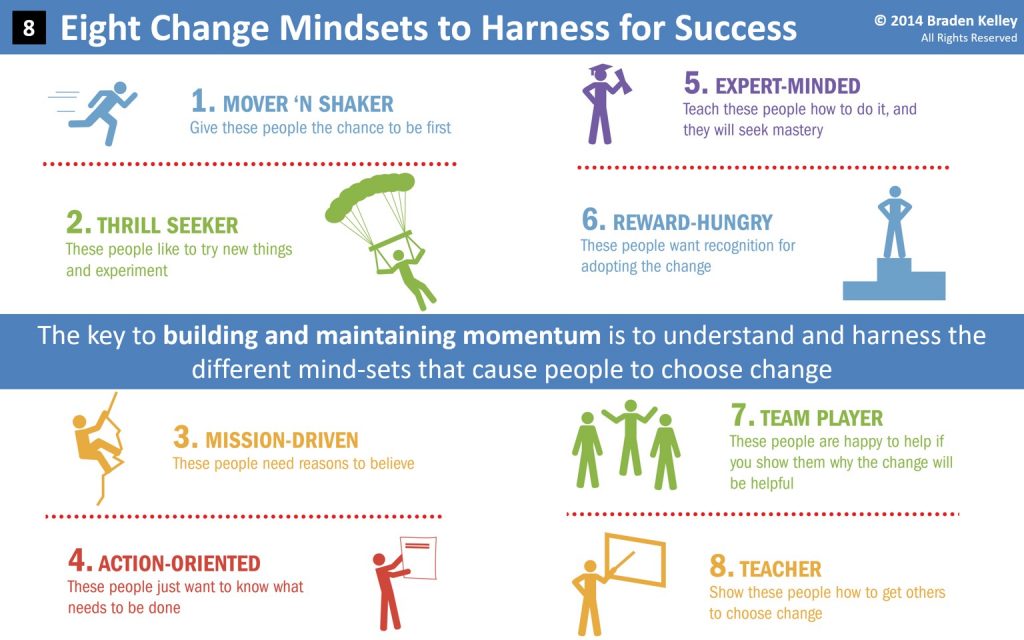
But it is possible to understand and harness the Eight Change Mindsets™ that cause people to choose change. These include:

  1. Mover ’n’ Shaker: give these people the chance to be first
  2. Thrill Seeker: these people like to try new things and experiment
  3. Mission-Driven: these people need reasons to believe
  4. Action-Oriented: these people just want to know what needs to be done
  5. Expert-Minded: teach these people how to do it, and they will seek mastery
  6. Reward-Hungry: these people want recognition for adopting the change
  7. Team Player: these people are happy to help if you show them why the change will be helpful
  8. Teacher: show these people how to get others to choose change

Getting people to choose change is important because you’ll be asking people to abandon their existing solution to adopt yours – even if it is the do-nothing solution. This is not easy because people get comfortable using their existing solution and will be uncomfortable with the idea of doing something different.

Eight Change Mindsets to Harness for Success

If you read through this list and imagine what might happen if you haven’t addressed these mindsets in your business plan, you should quickly find yourself with eight potential explanations for why people might resist your new product or service and start having ideas about how to create initiatives to leverage them to overcome potential resistance.

When we break out the trap of thinking about all customers as the same or out of demographic segmentation traps we can start to see our potential customers as people and to identify their different motivations that will determine whether our business is a raging success or a humbling failure.

This is of course assuming that you’ve leveraged my Innovation is All About Value approach to make sure that you’re hitting on all three cylinders with the product or service that you’re bringing to market:

  1. Value Creation is pretty self-explanatory. Your innovation investment must create incremental or completely new value large enough to overcome the switching costs of moving to your new solution from the old solution (including the ‘Do Nothing Solution’). New value can be created by making something more efficient, more effective, possible that wasn’t possible before, or create new psychological or emotional benefits.
  2. Value Access could also be thought of as friction reduction. How easy do you make it for customers and consumers to access the value you’ve created. How well has the product or service been designed to allow people to access the value easily? How easy is it for the solution to be created? How easy is it for people to do business with you?
  3. Value Translation is all about helping people understand the value you’ve created and how it fits into their lives. Value translation is also about understanding where on a continuum between the need for explanation and education that your solution falls. Incremental innovations can usually just be explained to people because they anchor to something they already understand, but radical or disruptive innovations inevitably require some level of education (often far in advance of the launch).

Doing well on two of them and poorly on the third will still lead to failure. Too often people only focus on value creation – to their own detriment. Helping people access the value you’re creating and to understand how it fits into their lives are equally important.

If you invest in doing all three well for your product and/or service and leverage the Eight Change Mindsets™, introduced in my latest book Charting Change, you will be unstoppable!

Subscribe to Human-Centered Change & Innovation WeeklySign up here to get Human-Centered Change & Innovation Weekly delivered to your inbox every week.

Re-Thinking for a New Era

Re-Thinking for a New Era

GUEST POST from Janet Sernack

In our last blog, we proposed, rather than living in a world where everyone hates to fail, why not adopt a rethink, respond, regroup, thrive pattern, and experience failure as an opportunity for change, unlearning, and re-thinking? Adopting this approach supports your human-centricity and enables you to become future-fit through developing your set of 21st-century superpowers in the face of the acute disruption of COVID-19. This is reinforced by Adam Grant, in his book “Think Again” (the power of not knowing what you don’t know) where he states that we are living in a time vital for re-thinking to help us become adaptive and agile and develop our future fitness to thrive in a disruptive, uncertain world.

Critical Art of Re-Thinking

The critical art of re-thinking involves being actively open-minded, hearted, and willed:

  • To learning, and possibly re-learning how to effectively question your own beliefs, mindsets, assumptions, opinions, and habits;
  • Through connection, association, detachment, and discernment to these qualities in other people’s minds and hearts;
  • And to then put our “mental pliability” and “emotional agility” to the test by creating the time and space for re-thinking with a new “set of goggles” and revising our views based on what we learn.

This potentially benefits everyone because it allows us to upgrade and update our points of view and expand our understanding of the world, we are all living in today and build our future fitness.

It also positions us for change innovation and excellence in the way we transform our approach to work and share our wisdom in life.

Making time and space for re-thinking

  • The vital role of unlearning

Embracing human-centricity and a future-fit focus involves unlearning and letting go of many of our old beliefs, mindsets, assumptions, opinions, and habits embedded in our habitual feeling and thinking systems.

Being able to discern which of these are now incomplete, ineffective, and irrelevant as we adapt, and serve people, teams, and organisations to survive, grow, and develop future fitness to thrive in the post-Covid-19 world.

Unlearning is not about forgetting, it’s about paying deep attention and developing the awareness to see, and safely and courageously step outside of our old thinking systems, mental models, biases, and paradigms.

  • Being intellectually humble

Being intellectually humble involves “knowing what we don’t know” and being inquisitive and curious enough to explore new discoveries, and pay deep attention, and be consciously aware of the rich and valuable rewards to be found in the “unknown”.

Most of us are unconsciously motivated to move away from change and learning as a result of “blindness” to our learning or survival anxieties (Schein), and the need to cover up our “learning incompetence” (when people pretend to know things they don’t).

The willingness to be actively open-minded, hearted, and willed and embrace intellectual humility helps us see things clearly and moves us towards overcoming our blind spots and weaknesses.

Re-Thinking in a Disconnected and Disruptive Era

  • Thinking, fast and slow

Daniel Kahneman, in his book “Thinking Fast and Slow,” describes the “machinery of … thought,” dividing the brain into two agents, called System 1 and System 2, which “respectively produce fast and slow thinking.”

For our purposes, at ImagineNation™, in our group, leadership, and team coaching programs, these can also be thought of as intuitive and deliberate thought.

  • Introducing System 3 thinking

My colleague, Peter Webb (www.peterjwebb.com), has added to this work by researching and validating a System 3 which he describes as considerative, which is complementary to our approach to thinking differently at ImagineNation™.

  • System 1 operates automatically and quickly, with little or no effort and no sense of voluntary control. it is intuitive, quick, and emotional.
  • System 2 allocates attention to the effortful mental activities that demand it, including complex computations. The operations of System 2 are often associated with the subjective experience of agency, choice, and concentration. It is deliberative in that is rational and calculated.
  • System 3 thinking is more considerative, thoughtful, and consequential in that it enables you to focus on what really matters, discern what makes common sense, make small decisions and take small actions to find out what works best, be compassionate, regulate your emotions and develop a tolerance for divergent values.

You can explore more these three thinking systems, and initiate your own re-thinking process by contacting Peter at https://www.peterjwebb.com/

Initiating Your Re-Thinking Strategy

  • Developing a habit of reflective practices

Our innovation coaching, leading, and teaming learning programs involve developing a regular reflective practice –which according to Turner, Lucas & Whitaker, in the learning and coaching context is:

“the ability to step away from your work and identity patterns, habits, strengths, and limitations in your work, and/within the system you work in.”

  • Pause-retreat-reflect cycle to catalyse re-thinking

At ImagineNation™ to initiate the re-thinking process, through partnering with clients to be actively open-minded, hearted, and willed through our “pause-retreat-reflect-reboot” cycle.

To support the development of the new habit, we include:

  • A personal reflection practice involves initiating or continuing a mindfulness activity.
  • A set of regular reflection activities which include different sets of reflective and generative questions.
  • Journaling processes, incorporating the CCS Cards for play and critical reflection for our clients to experiment with.

This involves practicing a set of regular retreat and reflection activities involving safely and intentionally enabling people to deeply listen and question and paradoxically dance across the 3 thinking systems simultaneously.

Enhancing your own and your team’s capability to do this will transform your approach to work, harness people’s collective intelligence to share their wisdom in life with the world, and develop future fitness to master challenges and solve problems as they arise.

  • Shifting to re-thinking
  1. Interrupt their habitual “do-feel-think” cycles (doing stuff that may not deliver the results you want, feeling the awful emotions that result from mistakes, imperfection, and failure, then thinking what to do about it).
  2. Create “stop signals” to affect a pause, long enough to stop doing stuff and become present to the range of emotions to calm down their nervous system.
  3. Connect, associate with and acknowledge how they might be feeling at this unique and specific moment in time.
  4. Pay deep attention to observing their operating thought patterns, with detachment and discernment.
  5. Intentionally choose a desired future state or outcome.
  6. Consider the impact of their feelings and thoughts on the results they are getting.
  7. Deliberate, consider and quickly choose more resourceful visceral and feeling states that compels (pulls) and mobilise them to achieve the desired future state or outcome.
  8. Finally, deliberate, consider and quickly choose more resourceful thought and feeling patterns to choose the most intelligent actions to take to achieve the desired future state or outcome.

The result is usually the development of a re-thinking process that has evolved from “do-think-feel” to “feel-think-do” (connecting to a desirable outcome, feeling present, thinking about the most intelligent thoughts and actions to embody and enact to get there, saving both time and money on wasted activities, avoiding mistakes and failures, to get to their desired future state.)

A Final Word on the Benefits of Re-Thinking

Taking just a moment to pause-retreat-reflect catalyses our rethink, respond, regroup, thrive pattern and creates opportunities for change, unlearning, and re-thinking. It is also a vital ingredient towards developing peoples’ future fitness.

Enabling us to appreciate the value of tuning into ourselves and into others, to leverage our emotional and mental muscles, towards actively creating the space for evoking and provoking different options and creative choices.  Which better enable and empower us to re-think about being, thinking, and acting differently in a new age, impacted by the technologies created by accelerated digitization.

We can then perform at higher levels, achieve our desired outcomes and goals, interact, lead and team more effectively and develop functional and highly valued collaborative relationships with others, as well as with stakeholders and customers.

To leverage the current turning point, and develop our 21st-century superpowers, to co-create a more equitable, resilient, sustainable, human-centric, and future-fit environment, within an ever-changing landscape.

Join Our Next Free “Making Innovation a Habit” Masterclass to Re-Engage 2022!

Our 90-minute masterclass and creative conversation will help you develop your post-Covid-19 re-engagement strategy.  It’s on Thursday, 10th February at 6.30 pm Sydney and Melbourne, 8.30 pm Auckland, 3.30 pm Singapore, 11.30 am Abu Dhabi and 8.30 am Berlin. Find out more.

Image credit: Unsplash

Subscribe to Human-Centered Change & Innovation WeeklySign up here to get Human-Centered Change & Innovation Weekly delivered to your inbox every week.

My Advice on Giving Advice

My Advice on Giving Advice

GUEST POST from Arlen Meyers

One way to put a toe in the water of physician entrepreneurship is to become an advisor to a startup founder or client or simply someone who wants your opinion. However, being an advisor that creates value means you have to deliver the 7Ms. You will have to deliver the value that startup CEOs are looking for: money, marketing, making something, management, manpower, mentors, monitoring the environment and mergers and acquisitions.

The same is true if someone asks you to be their mentor. The problem is often that people don’t know how to find a mentor, be a mentor or establish a relationship. The following eight steps can help.

When you get that gig, though, you will have to learn when and how to give advice and how much to give. You also have to deal with founders who have founders syndrome and those who suffer from other entrepreneurial syndromes. In short, many won’t take your advice and you will be left with the feeling that you have wasted your time.

Here’s some advice on giving advice:

  1. When you sign on, clarify expectations about when, how and how often are the best ways to communicate-face to face, email, text or phone, videochat?
  2. Have an agenda focusing on the next critical success factor you need to help achieve. Is it finding money? How about helping to recruit talent to execute the plan and scale?
  3. Avoid having to spend time giving the same advice over and over again by authoring a blog, post or eBook, like this one. Like the flipped classroom, read the assignment and then let’s discuss in class.
  4. If you get ghosted (you haven’t heard from the person who hired you in a while), don’t take it personally. Instead, talk about whether there is a problem, recalibrating your advisory role and whether it should be changed or eliminated.
  5. Use technology to block your time and synchronize schedules
  6. Understand your role as an advisor v a mentor, coach or sponsor. The expectations are different for each.
  7. Don’t work with people you can’t trust, like those who don’t pay you what and when they promised to do so, those who bad mouth you behind your back or those who make you feel unappreciated or ignored or won’t lead when there is inevitable team conflict.
  8. Focus on adding continuous value and delivering results
  9. Assign as much credit for results to others on the team
  10. Here are some tips on how to give advice.

At some point, you have probably noticed that you’re wiser when giving advice to others than you are in making decisions for yourself. You’re not alone. In psychology, it’s called Solomon’s paradox, and it often happens because we have more distance from other people’s problems than our own.

Both the advisee and the advisor have responsibilities so be careful how you pick someone’s brain.

Remember Socrates who said “I cannot teach anybody anything. I can only make them think.” By it’s very nature, advice is just that and can be accepted or ignored. Make it personal, just don’t take it personally when it’s the latter.

Image credit: Pixabay

Subscribe to Human-Centered Change & Innovation WeeklySign up here to get Human-Centered Change & Innovation Weekly delivered to your inbox every week.
Everyone hates to fail, why do you?

Everyone hates to fail, why do you?

GUEST POST from Janet Sernack

If you have ever had a significant setback, made a serious mistake, or failed at completing an important task, you will have experienced some kind of deep emotional and visceral, largely unconscious, negative, reactive response to it.

By becoming passively or aggressively externally defensive and blaming and punishing others for the outcome, or by withdrawing internally, and attributing self-blame and self-punishment for what may have happened.

Everyone hates to fail because either type of reactive response stings and causes discomfort, dissonance, sorrow, suffering, and pain since you are feeling ashamed, judged, and shamed by yourself and by others. We need to re-think how we approach and digest failure, to scale and leverage it as one of our 21st-century superpowers.

Sabotaging your chances of success

According to a recent article in Psychology Today, this reactive response triggers your avoidance motivation, which then often exceeds your motivation to succeed!

Describing that the fear of failure causes us to then unconsciously sabotage our chances of success, as well as our ability to cultivate and manifest the superpowers necessary to thrive in the 21st century.

Self-doubt settles us into a denying the need to experiment, and a reluctance, full of excuses, to experiment further with adopting, iterating, and testing new and novel ideas. Or in taking smart risks, that help you connect, explore and discover and design opportunities for making important and necessary, personal and professional changes.

Pivot and adapt to disruptive events

Yet, our ability to experiment, test, validate and iterate creative ideas is critical to surviving and thriving through the current decade of both disruption and transformation – which more of us are viewing as a series of relentless, continuous, and exponential changes, requiring unlearning and radically new learning processes.

In a 2021 Deloitte survey of 2,260 private – and public-sector CXOs in 21 countries, 60% of the respondents said that they believe disruptions like those seen in 2020 will continue. The resulting challenge is underscored by another of the survey’s findings:

Seventy percent of the CXOs do not have complete confidence in their organisation’s ability to pivot and adapt to disruptive events.

This confidence can be developed by re-thinking how we approach and digest failure, to scale and leverage it as a 21st-century superpower.

Developing 21st-century superpowers

Here are the four key superpowers, to be supported by digital technologies:

  • Nimbleness: The ability to quickly pivot and move. (“We used to do this, and now we do that.”)
  • Scalability: The ability to rapidly shift capacity and service levels. (“We used to serve x customers; we now serve 100x customers.”)
  • Stability: The ability to maintain operational excellence under pressure. (“We will persist despite the challenges.”)
  • Optionality: The ability to acquire new capabilities through external collaboration. (“Our ecosystem of partners allows us to do things we couldn’t do previously do.”)

Rethinking our fears of failure

None of these 21st-century superpowers can be developed without experimentation and collaboration.

Where you are able to self-regulate your fears of making mistakes and failure, by becoming a smart risk-taker who willingly, stretches the envelope and steps outside of your safety and comfort zones.

This helps maximise your potential and ability to learn and develop in the growth zone, where we stop self-sabotaging our chances of adapting and learning, succeeding, and growing in an uncertain and unstable world.

Everyone hates to fail because it’s hard to self-regulate the basic emotions of disappointment, anger and frustration, and deep shame. Resulting from and the distorted thinking patterns that accompany failure, often immobilising you which results in an unwillingness and inability to disrupt yourself and take intelligent actions.

Slow down to rethink, respond, regroup, play and thrive

It all starts with leading, teaching, mentoring, and coaching people to slow down, to learn, and appreciate the value of taking “time-out” for retreat and reflection.

At ImagineNation, in last week’s blog, we described how this involves developing regular reflective practices, where people can pay deep attention, and learn how to master these basic emotions and unresourceful thought patterns. How this allows them to be playful and experimental in developing new mindsets, rethinking habits, and resourceful emotional states, which are foundational for developing 21st-century superpowers.

Failure can become valued as a process and resource for effecting significant human-centric change, deepening learning, and improving your future fitness.

Consequences of avoiding failure

According to the same article in Psychology today – “shame is a psychologically toxic emotion because instead of feeling bad about our actions (guilt) or our efforts (regret) shame makes us feel who we are”.

By getting to the core of your egos, your identities, your self-esteem, and your feelings of emotional well-being and resourceful thinking habits.

Because everyone hates to fail, we all unconsciously seek ways of mitigating the implications of a potential failure – “for example, by buying unnecessary new clothes for a job interview instead of reading up on the company – which allows us to use the excuse, “I just didn’t have time to fully prepare.”

Benefits of embracing failure

Rather than succumbing to the notion that everyone hates to fail, it is much more useful to develop healthier ways of embracing and flowing with it which might:

  • Motivate you to reflect deeply to consider and deliberate as to what might be the most intelligent and brave actions to take under the range of circumstances you find yourself in.
  • Inspire you to risk-taking those intelligent actions through developing sound risk anticipation, management, and mitigation strategies that help boost your confidence.
  • Commit to doing just a bit more, in inventive ways that add value to the quality of people’s lives as well to your customer’s experience of your product or service.
  • Encourage you to access your multiple and collective intelligence, be more courageous, compassionate, and creative in co-sensing, co-discovering, co-designing, and co-creating innovative solutions to complex problems.
  • Enable you to learn from others, and harness people’s collective intelligence to adapt and grow, through teaming, in ways that serve the common good.

Tips for rethinking and self-regulating fears of failure

A few tips to support you to rethink, respond, regroup and thrive that we will explore more deeply, through real-life stories and examples, in our next two ImagineNation™ blog posts (November and December):

  1. Be willing to redefine and reframe failure as what it means in your unique context, review past failures and see if you can find benefits that resulted from them.
  2. Set approach goals and not avoidance goals to view failure as a challenge that can be mastered.
  3. Control the controllable by intentionally managing your mindsets, shifting any negative perspective, and unpacking distortion and generalisations about failures and their negative consequences.
  4. Imagine yourself doing well, achieving your goals by composing and painting a picture or image of a desirable and compelling future success.
  5. Develop healthy self-compassion for when you do mess up, make mistakes and fail, by being kind and understanding, and empathic to your won humanness.
  6. Focus on every experience, no matter what it brings is an opportunity for deep learning and creative and inventive change.

Rather than living in a world where everyone hates to fail, why not adopt the rethink, respond, regroup, thrive pattern, be future-fit and develop your set of 21st-century superpowers in the face of the acute disruption of COVID-19?

Where it is expected that the business environment, over the next three to five years, will be the most exciting and innovative period that many of us may learn from and experience in our lifetimes?

Want to know why you might have a fear of failure?

Participate in our online research study “Ten Signs you may have a fear of failure” which we adapted from the article “10 Signs That You Might Have Fear of Failure… and 2 ways to overcome it and succeed” by Guy Winch Ph.D. in Psychology Today. Click here to access the survey.

We will happily share the results and findings with you if you leave your name and email address on the form provided. By sharing these details, you will also qualify for a complimentary 30 minute one on one online innovation coaching session, with one of our global professionally certified coaches to help you overcome your own anxieties and fears about failure and develop your 21st-century superpowers.

Join our next free “Making Innovation a Habit” masterclass to re-engage 2022!

Our 90-minute masterclass and creative conversation will help you develop your post-Covid-19 re-engagement strategy.  It’s on Thursday, 10th February at 6.30 pm Sydney and Melbourne, 8.30 pm Auckland, 3.30 pm Singapore, 11.30 am Abu Dhabi and 8.30 am Berlin. Find out more.

Image credit: Unsplash

Subscribe to Human-Centered Change & Innovation WeeklySign up here to get Human-Centered Change & Innovation Weekly delivered to your inbox every week.
Sickcare Culture of Conformity versus a Culture of Creativity

Sickcare Culture of Conformity versus a Culture of Creativity

GUEST POST from Arlen Meyers

Sickcare is a culture of conformity and competition. Premeds know it. Medical students and residents learn it. But, once they graduate, they are told they will be paid for value. Unfortunately, few will teach them how to do it and reconcile the culture of conformity and competition with an innovative culture of creativity, collaboration and interprofessional communication.

We should be thankful that we are starting to see some cracks in the armor.

Here are some ways to balance the two mindsets:

  1. Start with higher education reform  To prepare students for a post-Covid future, colleges and universities need to double down on preparing them for digital jobs. But even teaching platform skills aren’t enough. Few employers are interested in hiring candidates who’ve just completed a training program, they’re looking for relevant work experience. The good news is that there are two promising models for colleges to go beyond the traditional career services function to provide students with relevant digital training and work experience.
  2. Overcome the fallacies about creativity. To avoid premature closure, teams should arrive at an “almost final” decision and then intentionally delay action in favor of additional incubation time. During this time, everyone should commit to thinking about the problem and sharing their ideas. If the team can’t find a better approach during the incubation period, they should proceed with their original solution. Leaders can improve group creativity by paying close attention to how ideas are discussed in diverse group settings. They should encourage team members to build on each other’s ideas instead of pushing individual ideas. This doesn’t mean that ideas should be accepted blindly when they contain flaws; instead, they should approach ideas with an open mind to acknowledge useful aspects and improve weaknesses using plussing or the similar “yes, but, and” approach. To promote more creative ideas, leaders should utilize simple tools to capture individual ideas before they are opened to the whole group. Group discussions should be conducted asynchronously, where team members look at each other’s ideas and use them to refine and create new ideas. If done remotely, leaders should find other ways to bring the team together to bond and build trust with each other
  3. Teach creativity and entrepreneurship in medical school and residencies. Here is something so you don’t have to do reinvent the wheel.
  4. Rethink how we recruit and accept medical students Medical education is not alone, as noted in a recent HBR article describing how Goldman Sachs changed how they recruited new hires. Perhaps it is time for medical schools to adopt three new ways of recruiting and accepting medical students.
  5. Give medical students the opportunity to get experience working in a more creative culture as part of an internship or rotation.

6.Train the trainers. Provide faculty with the knowledge, skills, abilties and competencies they need to integrate creativity, innovation and entrepreneurship as part of their basic science and clinical rotations. But, what should an introduction to entrepreneurship teaching and learning include for basic science and clinical faculty who do not have innovation and entrepreneurship domain expertise include?

The learning objective of the module should be to know how to integrate healthcare innovation and entrepreneurship topics into basic science courses and clinical rotations by challenging students with case based, problem based and project based learning in real world settings and applications to help them perfect sickcare entrepreneurial knowledge, skills, attitudes and competencies.

7. Let medical students and residents take a gap year to learn how to create and sell something. Over half of medical schools already have an arrangement whereby students can take a one year leave of absence. But they call it something other than a gap year. They call it getting an MBA. Or, offer them a fellowship in entrepreneurship and innovation.

8. Close the doctor-data scientist digital divide to create a more cooperative culture of data analytics creativity.

9. Hire leaderpreneurs to become department chairs and deans. Rethink the triple threat.

10. Give medical students and residents an exit ramp. The next phase of medical school education reform is in progress. One question medical educators and Deans will have to address is, “What business are we in?” Are you in the business of graduating doctors who will only take care of patients directly, or, are you in the business of creating opportunities for graduates to pursue biomedical careers of their choice, including non-clinical careers that do not involve seeing patients face to face for a significant part of their working life? Patients are not the only stakeholders that have a dog in the sickcare hunt.

11. Teach philanthropreneurship Philanthropreneurship has four elements. First, the driving force must be a passion to make life better for others, especially those who are underprivileged. Second, there has to be an element of giving, whether this is in terms of money or time. Third, there needs to be creativity, the envisioning of novel approaches to solving problems. And finally, philanthropreneurship requires leadership and strategic thinking– directing, organizing, and influencing the efforts of others.

12. Destroy your innovation silos Sick care badly needs innovation if it is to become healthcare . Yet, it’s questionable whether it can be fixed from inside. Despite the popularity of open innovation and community based, participatory innovation networks, healthcare organizations and doctors seem to shun outside ideas and collaboration and are perceived as arrogant know-it-alls, stuck in the ivory tower or healthcare city , when it comes to knowing what’s best for patients. They have a silo mindset that blocks collaboration with other stakeholders in the innovation supply chain. The challenge for most organizations is to create and engage stakeholders.

Innovation starts with mindset. The clinical mindset is different from the entrepreneurial mindset and the ethics of medicine are different from the ethics of business. We need to give experience, educate and train doctors who can reconcile the two. Thankfully, it is starting to happen and it will make better doctors.

Subscribe to Human-Centered Change & Innovation WeeklySign up here to get Human-Centered Change & Innovation Weekly delivered to your inbox every week.