A Framework for Innovation Leaders

by Braden Kelley and Art Inteligencia
The entrepreneurial mindset is one of the most talked-about concepts in business — and one of the most misunderstood. Most definitions focus on founders, startups, and risk-taking. But the entrepreneurial mindset is not just for people who start companies. It is the single most important cognitive asset any innovation or change leader can develop, whether they work inside a Fortune 500, a government agency, a nonprofit, or a startup garage.
After decades of working with organizations across industries to build innovation and change capability, I’ve observed a consistent pattern: the leaders who drive lasting transformation are not necessarily the most technically skilled or the most strategically sophisticated. They are the ones who think and act entrepreneurially — who see opportunity where others see constraint, who move forward under uncertainty rather than waiting for certainty, and who treat every setback as data rather than defeat.
This post is my attempt to define the entrepreneurial mindset precisely, distinguish it from related concepts, and give innovation and change leaders a practical framework for building it — in themselves and in their organizations.
What the Entrepreneurial Mindset Actually Is
The most useful definition I’ve encountered comes from the work on effectuation by researcher Saras Sarasvathy: the entrepreneurial mindset is a state of mind that is drawn to opportunity, comfortable with uncertainty, and oriented toward action and value creation — regardless of the resources currently controlled.
That last phrase is critical: regardless of the resources currently controlled. This is what separates the entrepreneurial mindset from a general “growth mindset” or “innovative thinking.” Anyone can think creatively when they have unlimited time, budget, and support. The entrepreneurial mindset activates specifically under constraint — when the resources are scarce, the path is unclear, and the outcome is uncertain. That is precisely the condition most innovation and change leaders operate in every day.
A useful way to think about it: the entrepreneurial mindset is not a personality trait. It is a cognitive orientation — a set of mental habits and behavioral patterns that can be learned, practiced, and strengthened over time. Research consistently shows that entrepreneurial thinking is developed through experience and reflection, not inherited through genes or luck.
What the Entrepreneurial Mindset Is NOT
Clearing away misconceptions is as important as defining the concept clearly. Here are the most common ones:
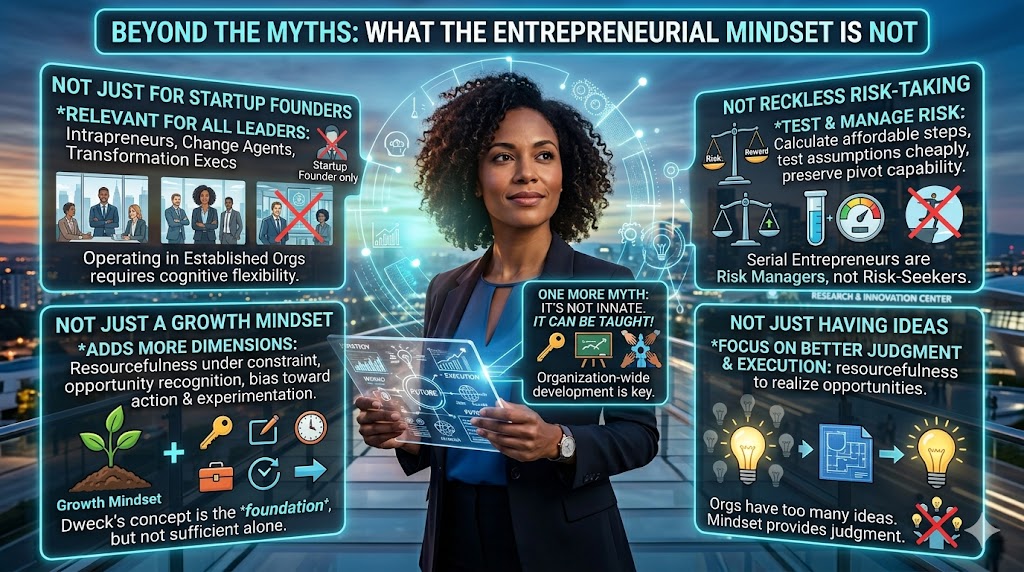
It is not only for entrepreneurs. The entrepreneurial mindset is as relevant — arguably more relevant — for leaders inside established organizations as it is for startup founders. Intrapreneurs, innovation champions, change leaders, and transformation executives all operate in conditions that require exactly the cognitive flexibility and opportunity orientation that the entrepreneurial mindset provides. The sad irony is that large organizations often hire for entrepreneurial thinking and then systematically suppress it through bureaucracy, risk aversion, and short-term measurement.
It is not about reckless risk-taking. Popular culture has romanticized the entrepreneur as a bold risk-taker who bets everything on a hunch. Serious research on successful entrepreneurs tells a very different story. They are not risk-seekers — they are risk managers who take calculated, affordable steps under uncertainty, test assumptions cheaply, and preserve the ability to pivot. This is precisely the approach that works inside organizations too.
It is not the same as a growth mindset. Carol Dweck’s growth mindset — the belief that abilities can be developed through dedication and hard work — is a necessary foundation but not sufficient on its own. The entrepreneurial mindset adds the dimensions of opportunity recognition, resourcefulness under constraint, and a bias toward action and experimentation that growth mindset alone doesn’t capture.
It is not innate. One of the most damaging myths in organizational life is that some people “just have it” and others don’t. This belief causes organizations to write off large portions of their workforce as non-entrepreneurial rather than investing in developing the mindset systematically. The evidence is clear: entrepreneurial thinking can be taught, modeled, and reinforced through the right environment and practices.
It is not about having ideas. The entrepreneurial mindset is frequently confused with creativity or ideation. Generating ideas is easy — most organizations have more ideas than they can act on. What the entrepreneurial mindset provides is not more ideas but better judgment about which opportunities to pursue, and the persistence and resourcefulness to actually realize them.
The 7 Core Characteristics of the Entrepreneurial Mindset
Based on the research literature and my own experience working with innovation and change leaders, these are the seven characteristics that most consistently distinguish people who think and act entrepreneurially:
| Characteristic | What it looks like in practice | What its absence looks like |
|---|---|---|
| Opportunity orientation | Scanning constantly for unmet needs, emerging shifts, and underserved possibilities — even in stable environments | Waiting to be told what to work on; seeing only problems, not possibilities |
| Comfort with uncertainty | Moving forward with incomplete information; making decisions under ambiguity without being paralyzed | Analysis paralysis; waiting for certainty before acting; over-reliance on data that doesn’t yet exist |
| Resourcefulness | Finding creative ways to make progress with what’s available; treating constraints as design parameters | “We don’t have the budget/headcount/technology to do this” as a full stop rather than a starting point |
| Bias toward action | Preferring small, fast experiments over long planning cycles; learning by doing rather than by theorizing | Endless planning, committee review, and refinement before anything is tested in the real world |
| Resilience and learning orientation | Treating setbacks as data; extracting lessons from failure and applying them forward without dwelling or deflecting | Avoiding risk to avoid failure; blaming external factors when things go wrong; not learning from mistakes |
| Collaborative network building | Actively building relationships across organizational and disciplinary boundaries; leveraging others’ resources and knowledge | Working in silos; reinventing wheels others have already built; not seeking out expertise beyond one’s immediate team |
| Long-range value orientation | Keeping focus on the value being created for customers, users, and stakeholders — not just on completing tasks or hitting short-term metrics | Mistaking activity for progress; optimizing for what’s measured rather than what matters |
No one embodies all seven of these characteristics equally all the time. The entrepreneurial mindset is not a state of permanent excellence — it is a set of orientations to cultivate deliberately, especially in high-pressure, high-uncertainty environments where the temptation to revert to defensive, bureaucratic behavior is strongest.
The Entrepreneurial Mindset Inside Organizations
This is where the conversation gets most relevant for readers of this blog — and where most writing on the entrepreneurial mindset falls short.
The conditions inside an established organization are fundamentally different from those faced by a startup founder. You don’t control your resources. You have legacy systems, established processes, and entrenched stakeholders. Your success is measured by metrics that may actively discourage entrepreneurial behavior. And the cultural immune system of a large organization is remarkably effective at neutralizing people who think and act differently.
This is why intrapreneurship — entrepreneurship practiced inside an established organization — is one of the most demanding forms of innovation work. It requires all the cognitive and behavioral attributes of the entrepreneurial mindset, plus the political skill, organizational intelligence, and long-term persistence to operate within a system that often wasn’t designed to support what you’re trying to do.
The most effective intrapreneurs I’ve worked with share several common practices:
They build coalitions before they need them. Rather than waiting until they have a project that needs support, they invest continuously in relationships across the organization — cultivating allies, sponsors, and collaborators who will be essential when the time comes to move quickly.
They make the business case in the language of the organization. Entrepreneurial thinking that can’t connect to the organization’s strategic priorities and financial metrics will die in the first budget cycle. The most effective intrapreneurs translate their ideas into terms that resonate with decision-makers — not abandoning the vision, but making it legible to the people who control resources.
They start small and prove the concept. Rather than seeking large commitments upfront, they find ways to run cheap, fast experiments that generate real evidence. A small proof of concept that works is worth a hundred slides that argue something might work.
They protect space for long-range thinking. The gravitational pull of the urgent always threatens to crowd out the important. Effective intrapreneurs deliberately protect time and attention for horizon-scanning, future-oriented thinking, and work that won’t pay off this quarter — because that is where the most important opportunities live.
They build organizational change capability, not just individual ideas. The most lasting contribution an intrapreneur can make is not a single successful project but a change in how the organization thinks about and approaches innovation. This requires the mindset and methods of human-centered change, not just entrepreneurial energy.
How to Develop an Entrepreneurial Mindset
The entrepreneurial mindset is not developed through reading about it. It is developed through practice — through deliberately putting yourself in situations that require entrepreneurial thinking and reflecting carefully on what you learn.
Here are the most effective practices for building it systematically:
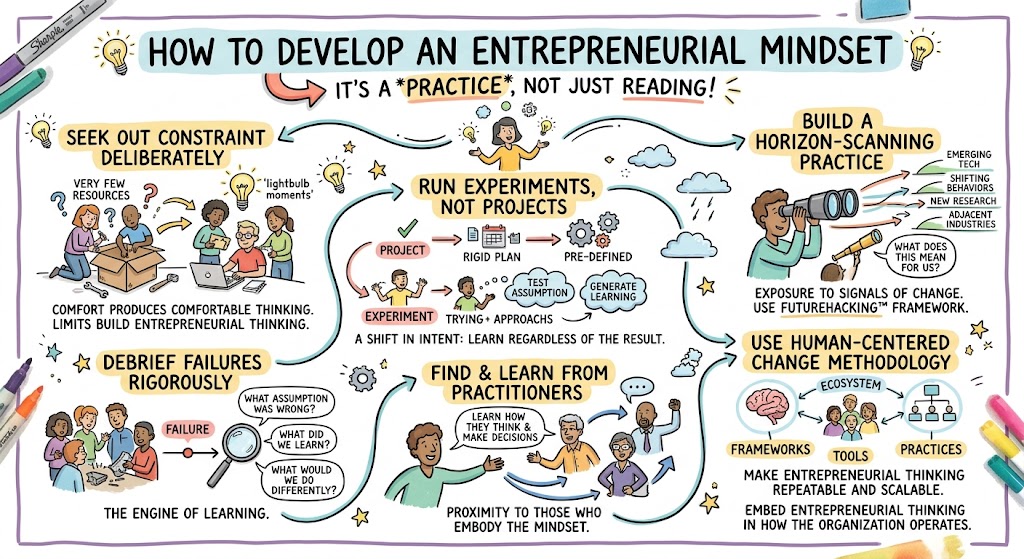
Seek out constraint deliberately. Comfortable environments produce comfortable thinking. Put yourself and your team in situations where resources are limited, the problem is genuinely unclear, and the solution is not obvious. This is where entrepreneurial thinking develops fastest.
Run experiments, not projects. The difference is in the intent. A project is designed to deliver a predetermined output. An experiment is designed to test a specific assumption and generate learning regardless of whether the hypothesis is confirmed. Shifting from project thinking to experiment thinking is one of the most powerful cognitive shifts available to innovation leaders.
Build a horizon-scanning practice. Entrepreneurial opportunity recognition requires exposure to signals of change — emerging technologies, shifting behaviors, new research, adjacent industries. Build a deliberate habit of reading widely across domains and asking regularly: what does this mean for our organization? My FutureHacking™ methodology provides a structured framework for doing this systematically.
Debrief failures rigorously. The learning value of failure is only realized through deliberate reflection. When something doesn’t work, build the habit of asking: what assumption was wrong? What did we learn? What would we do differently? This is the engine of the learning orientation that distinguishes entrepreneurial thinkers from everyone else.
Find and learn from practitioners. The fastest path to developing any mindset is proximity to people who already embody it. Seek out the most entrepreneurially minded people in your organization and industry, learn how they think, and study how they make decisions under uncertainty.
Use the Human-Centered Change methodology. Building lasting change capability in yourself and your organization requires more than individual mindset development — it requires the frameworks, tools, and practices that make entrepreneurial thinking repeatable and scalable. Human-Centered Change provides exactly this: a systematic methodology for embedding entrepreneurial and innovative thinking into how your organization operates, not just how a few exceptional individuals behave.
The Entrepreneurial Mindset and Human-Centered Change
There is a deep connection between the entrepreneurial mindset and human-centered approaches to change and innovation that I don’t think gets enough attention.
Both start with the same fundamental orientation: the belief that the most important source of insight is the human beings you are trying to serve — customers, users, employees, communities. Both are committed to understanding people deeply before proposing solutions. Both treat the world as a system of opportunities to be realized through creativity, collaboration, and action, rather than a set of problems to be managed through control and prediction.
The entrepreneurial mindset without human-centeredness produces innovation that is clever but doesn’t serve real needs — solutions in search of problems. Human-centered design without the entrepreneurial mindset produces empathy and insight that never translates into action — understanding without impact. Together, they form the foundation of the most powerful approach to innovation and change leadership available today.
This is why the work of developing the entrepreneurial mindset is not separate from the work of building human-centered change capability — it is the same work, approached from a different angle. And it is the work that I’ve devoted my career to helping organizations do.
Frequently Asked Questions About the Entrepreneurial Mindset
Is the entrepreneurial mindset only for entrepreneurs?
No — and this is one of the most damaging misconceptions about it. The entrepreneurial mindset is equally, arguably more, valuable for leaders inside established organizations. Intrapreneurs, innovation champions, change leaders, and transformation executives all operate under conditions of uncertainty, resource constraint, and organizational resistance that demand exactly the cognitive flexibility and opportunity orientation the entrepreneurial mindset provides. Large organizations that limit entrepreneurial thinking to their “innovation lab” or startup incubator are leaving enormous value on the table.
What is the difference between an entrepreneurial mindset and a growth mindset?
A growth mindset — the belief that abilities can be developed through effort and learning — is a necessary foundation but not sufficient on its own. The entrepreneurial mindset adds several dimensions that growth mindset doesn’t fully capture: opportunity recognition, comfort with genuine uncertainty (not just challenge), resourcefulness under constraint, a bias toward action and experimentation, and an orientation toward creating value for others. You can have a growth mindset and still be primarily reactive and internally focused. The entrepreneurial mindset is proactive, externally oriented, and action-biased.
Can you teach or learn an entrepreneurial mindset?
Yes — the research is clear on this. The entrepreneurial mindset is not a fixed personality trait; it is a set of cognitive orientations and behavioral habits that can be developed through deliberate practice, structured reflection, and the right environmental conditions. The most effective development approaches combine exposure to real entrepreneurial challenges, structured frameworks for thinking about opportunity and uncertainty, coaching and mentoring from experienced practitioners, and organizational cultures that reward experimentation and learning from failure rather than just success.
What is the most important characteristic of the entrepreneurial mindset?
If forced to choose one, I would say comfort with uncertainty — the ability to move forward, make decisions, and take action without waiting for certainty that will never fully arrive. This is the characteristic that most consistently separates entrepreneurial thinkers from everyone else, and it is the one most systematically trained out of people by traditional education and corporate environments that reward predictability and punish failure. Every other characteristic of the entrepreneurial mindset is easier to develop once you have built genuine tolerance for uncertainty.
How does the entrepreneurial mindset relate to innovation?
The entrepreneurial mindset is the cognitive foundation that makes sustained innovation possible. Innovation is not a process or a methodology — it is an outcome that emerges when people with the right mindset apply the right frameworks to real problems in the right organizational environment. Without the entrepreneurial mindset, innovation programs become bureaucratic exercises: stage-gate processes that filter out bold ideas, innovation theaters that generate excitement without impact, and transformation initiatives that change org charts without changing how people think and work. The entrepreneurial mindset is what makes the difference between innovation as a capability and innovation as an occasional accident.
How do you build an entrepreneurial mindset in an organization, not just in individuals?
Building organizational entrepreneurial mindset requires working at three levels simultaneously: individual (developing the skills, habits, and cognitive orientations of entrepreneurial thinking in leaders and teams), cultural (creating the psychological safety, tolerance for failure, and reward structures that allow entrepreneurial behavior to thrive), and structural (removing the bureaucratic processes, approval chains, and resource allocation models that suppress entrepreneurial action). Most organizations focus only on the individual level — training programs, workshops, and coaching — and wonder why the behavior doesn’t stick. Lasting change requires all three levels, which is exactly what the Human-Centered Change methodology is designed to address.
Bring This Thinking to Your Next Event
Braden Kelley is a LinkedIn Top Voice, bestselling author, and innovation keynote speaker who helps organizations get to the future first and build sustainable innovation cultures.
Content Authenticity Statement: The topic area, key elements to focus on, etc. were decisions made by Braden Kelley, with a little help from Claude and Google Gemini to clean up the article, add images and create infographics.
Image credits: Google Gemini
 Sign up here to get Human-Centered Change & Innovation Weekly delivered to your inbox every week.
Pingback: Forming Good Entrepreneurial Habits That Stick
Pingback: Sustaining Imagination Is Hard: Why It Matters for Leaders
Pingback: AI Tools for Entrepreneurs: A Powerful Advantage
Pingback: Why Entrepreneurs Must Think Like a Change Leader
Pingback: Intrapreneurship 2.0: Empower Employees as Founders
Pingback: Encouraging a Risk-Taking Mindset in Your Org
Pingback: The Anti-Bureaucracy Toolkit for Internal Startups
Pingback: Chief Intrapreneur: A New C-Suite Role for Innovation
Pingback: Branding Strategy for Sustainable Business Growth
Pingback: Building Cumulative Advantage for Business Growth
Pingback: Confessions of a Business Artist: Leading with Creativity
Pingback: Top 100 Innovation & Transformation Articles of 2022