Category Archives: Entrepreneurship

19 Things Physician Entrepreneurs Don’t Get About Sales and Marketing

19 Things Physician Entrepreneurs Don't Get About Sales and Marketing

GUEST POST from Arlen Meyers, M.D.

Many biomedical and health marketing and sales people ask about tips and techniques on how to sell to doctors. But, very few doctors or physician entrepreneurs have much interest in how to market and sell to patients and other customers. The conventional wisdom goes that they are “too busy” or “don’t have the time” and that they are trained to take care of patients, not take care of business.

I disagree, as I’ve explained in many other posts. However, sales is not in the medical school course catalog.

During a pandemic, that is not an option. Here is what you need to know about digital marketing now.

Here are some social media strategies you should use in the post-pandemic world.

Do you know how to rank #1 on Google?

Ogilvy, one of the most respected marketing firms globally, has recognized this shift by stating that the traditional “4 Ps of Marketing” are out and the 4 Es are in.  

  • Experience is more important than Product
  • Everywhere (Omnichannel) is now Place
  • Exchanges outweigh Price
  • Evangelism is more valuable than Promotion

Here is the job description for a social media manager for Microsoft:

Responsibilities

  • Design and execute a slate of rich social media strategies that resonate with our diverse and global audience and drive its implementation across our key campaign moments.
  • Define social media priorities, set goals and targets, aligning with audience insights. Proactively identify areas of optimization, set best practices, and communicate these across teams.
  • Partner across MSR Labs, Campaign Marketing, Community Engagement, Comms, Editorial, and Web/Media Production to support opportunities for rich scientific storytelling.
  • Serves as a trusted advisor to senior leaders through strong communication and influencing skills.
  • Creates and presents business reports that outline impact driven and provides recommendations based on outcomes.
  • Ability to focus on business priorities and create boundaries to ensure successful project completion.
  • Work with the paid social media team to execute and deliver on overall campaign KPIs.
  • Continuously improve on results by capturing and analyzing the appropriate social data/metrics, insights, and best practices, and then work with marketing managers to execute on those KPIs and leading indicators.

Qualifications

Required Qualifications:

  • 5+ years of practical experience in a global enterprise social media environment or global agency in the field of social media.
  • Experience in the use of social media platforms (Facebook, Instagram, LinkedIn, Reddit, TikTok, Twitter, Twitch, YouTube, or Club House, etc.).

Preferred Qualifications:

  • Bachelor’s Degree
  • Exceptional formal and colloquial communications skills.
  • Ability to collaborate effectively within a team and across organizational and team boundaries.
  • Ability to manage complex projects in a fast-changing environment.
  • Proven track record for new, innovative approaches, and smart risk taking.
  • Understanding and natural curiosity of evolving social media trends.
  • Experience with tools like Sprinklr, Opal, Excel, and Power BI.
  • Positive attitude, detail and customer oriented along with strong multitasking and organizational acumen.

Here are 10 things docs don’t seem to understand about healthcare sales and marketing:

1. That they are different. Said another way, the marketing team figures out the strategy. The sales team executes the battle plan. Marketing serves the interests of the buyer. Sales serves the interests of the seller.

2. That they are complementary and have to be aligned

3. That the sales plan should not be an afterthought when building the business model canvas or business plan for a new venture.

4. That branding is not sales and marketing and that B2B marketing is different than B2C marketing.

5. That the Internet and social media have revolutionized how they both are done.

6. That service after the sale is just as important as selling the product and that they need to pay attention to the aftermarket.

7. That they don’t need to worry about any of this because they work for someone else who does it or they are busy enough.

8. That they should just outsource sales and marketing to someone else and just see patients.

9. That they can just depend on word or mouth referrals. It used to be docs played golf with their friends, but they now work on Wednesdays .

10. That all they need to do is hang a shingle to be successful because they have been reading about the shortage of doctors.

11. If you are a physician entrepreneur selling to doctors, you will relate to these tips on how to sell to doctors.

12. Every customer segment in sickcare requires a different value proposition, marketing and distribution/sales strategy. The 4Ps can rapidly become the 8, 16 or 24 Ps.

13. They actually believe they are the best and that “there is no competition”. Maybe it’s time for you to step back and create a competitive analysis matrix.

14. AI, changes in social media and VR/AR are rapidly changing how marketers are building their brands, engaging customers and driving sales and lead conversion.

15. There is a big difference between vanity numbers at the top of the funnel or prospect funnel and people who are ready, willing and able to buy (about 3% of the people you contact). Here’s a way to tell the difference

16. The difference and practice of segmentation, targeting and positioning

17. These ten most effective marketing techniques are a diverse group of online and offline strategies. Each technique is most effective when it is working in concert with the others.

18. When to hire a marketer

19. Consultative sales is more about leadership than sales

Most importantly, they don’t understand that branding a service is different from branding a product. That’s, in part, why they are losing patients to non-MDs.

Most entrepreneurs, including doctors, are still stuck in the spray and pray marketing mindset instead of inbound model. The idea is , instead of you finding patients and customers, help them find you.

What’s more, they don’t understand sales operations . The main function of the sales operations team is to smooth the sales process—reduce any friction and incorporate itself to the organization so as to ensure the execution of the sales strategy.

The basic building blocks of medical practice online marketing include building a website, having an search engine optimization (SEO) plan, using social media and managing your online reputation.

Hospital strategy and marketing officers, particularly those who have been recruited from consumer goods and service industries, stare in amazement at board meetings trying to understand why their docs won’t wear the sneakers and compete with the guys down the street. They fail to understand the culture of medical education and the profession that fundamentally places institutional affiliation and engagement way down the totem pole compared to peer acceptance and cooperation.

Another problem occurs when non-sick care entrepreneurs want to hire doctors as advisors, when, in fact, they want them to be salespeople to hospitals and other doctors on commission. The fact is that , in most instances, doctors lack sales knowledge, skills, abilities and competencies to do the job.

The main reason most doctors are not sales and marketing savvy is that they never had to be and they don’t want to be. But, times have changed. Maybe with an attitude adjustment, they’ll be able to get in a quick 18 holes after all.

Image Credit: Unsplash

Subscribe to Human-Centered Change & Innovation WeeklySign up here to get Human-Centered Change & Innovation Weekly delivered to your inbox every week.

How to Write a Failure Resume

How to Write a Failure Resume

GUEST POST from Arlen Meyers, M.D.

Most resumes are designed to help you find a job, get a promotion or as part of a grant submission or other way to find money. Much like an academic CV, they enumerate your multiple accomplishments, track your professional progress and contributions and , typically, spin or conceal your failures. In the worst case, you lie about them. Here are some common ones and how to spot them.

There certainly is value in celebrating your successes and positive feedback. I mean, who doesn’t like a pat on the back or an attaboy? Do you have a personal highlight reel?

However, the flip side of the coin is you should do the same for your failures. You might want to start with that team you captained as a kid that didn’t win a game all season.

Flame outs are common, even to rising stars. Here are reasons and ways to prevent it.

Medical students and other overacheivers, for example, are not used to failure.

Entrepreneurship is the pursuit of opportunity under conditions of uncertainty with the goal of creating user defined value through the deployment of innovation using a VAST business model. During my career, I have attempted to do that in many ways wearing many hats such as a small business owner (private pratice), a technopreneur (creating medical devices), an intrapreneur (trying to add value to my organization as an employee), a social entrepreneur (creating a non-profit), a service provider (working as a consultant and advisor), a physician investor (having a financial interest in companies and helping to raise money for them) and an edupreneur (creating academic programs, working with mededtech companies and serving on editorial boards and medical information sites.) Sometimes, I succeeded. Most of the time I’ve failed…in some instances, miserably.

I started 3 medical device companies and many other organizational initiatives. One is still sitting in IP purgatory. The others I buried long ago. Some actually saw the light of day and continue to scale.

We pulled the plug on a digital health company, Medvoy, I cofounded. Here’s what I learned.

Since entrepreneurship is 1) a high risk endeavor, 2) not formally taught in medical education programs and 3) learned from mistakes requiring skin in the game, a part of your resume should include your failures as well as your successes. It’s just more honest, exposes your vulnerabilities and builds trust.

Many people would ask why you need a failure resume to know your failures? The answer is when you know your failure as a setback in your life, it leave a great impact on your personal and professional life. In addition, it makes you more “human” since we all fail and paints a richer picture of your journey of who you and how you coped with adversity. It is a measure of resilience, grit and perseverance.

A hybrid success-failure resume is a combination of the 1)good, the bad, the ugly 2) lessons learned and 3) future plans

The Good: All the fluff, rewards and accomplishments in your present resume

The Bad: Minor setbacks, disappointments and failures such as jobs you didn’t get, applications rejected, promotions denied, papers or submissions trashed, lousy grades, substandard clinical or teaching evaluations or poor performance evaluations

The Ugly: These are more major setbacks like getting fired, disciplinary actions or suspensions, tanking your last three companies or being convicted of a felony

Lessons learned: This is where you give an honest answer instead of the BS you spout when asked, “What is your biggest weakness?”

Future plans: Explain how you took personal responsibility for your screw ups and why I should bet on you if I’m an investor looking for the right jockey or an employer lookng for talent.

It’s hardly news that business leaders work in increasingly uncertain environments, where failures are bound to be more common than successes. Yet if you ask executives how well, on a scale of one to 10, their organizations learn from failure, you’ll often get a sheepish “Two—or maybe three” in response. Such organizations are missing a big opportunity: Failure may be inevitable but, if managed well, can be very useful. A certain amount of failure can help you keep your options open, find out what doesn’t work, create the conditions to attract resources and attention, make room for new leaders, and develop intuition and skill.

The key to reaping these benefits is to foster “intelligent failure” throughout your organization. McGrath describes several principles that can help you put intelligent failure to work. You should decide what success and failure would look like before you start a project. Document your initial assumptions, test and revise them as you go, and convert them into knowledge. Fail fast—the longer something takes, the less you’ll learn—and fail cheaply, to contain your downside risk. Limit the number of uncertainties in new projects, and build a culture that tolerates, and sometimes even celebrates, failure. Finally, codify and share what you learn.

These principles won’t give you a means of avoiding all failures down the road—that’s simply not realistic. They will help you use small losses to attain bigger wins over time.

Another part of your failure resume should include gaps. What were you doing between January 2019 and March 2020 anyway? Here are some tips on how to tell your side of the story.

Maybe some day hiring managers will accept the answer, “I took a gap year to get my head screwed on”. But, for now, don’t count on it.

The renowned historian Arnold Toynbee famously quipped, “Nothing fails like success when you rely on it too much.” We may have entered a world in which nothing succeeds like failures, especially if you are honest about them. Indeed, the very last entry in Johannes Haushofer’s list of setbacks is what he called his Meta-Failure: “This darn CV of Failures has received way more attention than my entire body of academic work.”

Here is what to do when your white coat gets the pink slip and some advice on explaining to the next person that you were let go.

Part of being an entrepreneur is knowing when to say no and when to pull the plug…and learn and take personal responsibility for your failure.

There is nothing wrong with giving up on a project or a dream. Stuff happens. Luck has a lot do with your success. The system is rigged.

To be happy, make it personal but don’t take it personally. Know when to quit something, Just don’t give up on yourself. The best time to fail fast and fail often is when you are young. Time is on your side, although , contrary to the saying, it won’t heal all wounds.. Take advantage of the time value of failure.

Image Credit: Unsplash

Subscribe to Human-Centered Change & Innovation WeeklySign up here to get Human-Centered Change & Innovation Weekly delivered to your inbox every week.

Scale Your Business in Four Simple Steps

Scale Your Business in Four Simple Steps

GUEST POST from Helen Yu

As a new founder at the beginning of your entrepreneurial journey, you have many tasks at hand and little bandwidth to do them all. There are countless responsibilities, from everyday tasks like investor pitch decks and elevator pitches to longer-term tasks like business plan revisions, product launch strategy and much more. How do you know if you are putting your time and energy into things that matter? It all comes back to why you started your business in the first place — understanding your “why” will keep you going when the road gets tough. But “why” alone is not enough for the long haul. You must couple your “why” with four specific steps needed to scale a business:

  1. Intentional go-to-market preparations
  2. An ability to adapt to customer needs
  3. A willingness to acclimate or even restart in the face of changing or more demanding market environments
  4. The heart to celebrate with your team when you collectively hit milestones along the way

I learned this approach while ascending one of the world’s most famous mountains.

Here is how I learned how to scale a business to success:

In 2007, I climbed to Mount Everest base camp. It took hundreds of hours of training and dedication to achieve my goal — including staying committed to the climb while my hands were freezing from the cold and my head felt heavy from the rising altitude.

Why did I keep climbing?

Because I had made a promise to my grandmother to spread her ashes on a tall mountain. That “why” gave me the will to keep moving forward. It gave me the courage to see my limitations and overcome them: to learn mountain climbing and train my body to withstand it, to find a Sherpa guide who could lead me into new territory. My goal of climbing Mount Everest started not on any map but in my mind. It was a dream that became my North Star, helping me choose the actions and paths needed to fulfill my grandmother’s wish.

Your startup has a similar North Star: the reason that led you to start the business in the first place. You also have an inner voice that serves as Sherpa guide. Why did you start this business? Who are you serving with it?

By asking yourself these questions, you will find the determination and grit to keep moving forward and find the keys to scale a business. A North Star may look distant and unattainable, but it is achievable when you take consistent actions to reach it.

1. Prepare

You may already have an answer to your “why” in a formal mission statement or vision statement, but are your company’s actions in alignment?

When strategy and execution aren’t aligned to the mission and vision, disconnects occur. Internal communications break down. Customers are dissatisfied with their interactions with your company. Growth opportunities are missed. Investors become wary of your potential to survive.

With your “why” kept front and center, you will be able to choose the actions that support it and overcome these common disconnects. It all begins with preparation. Before you begin your startup climb, be sure that you’ve lined up your partners and support team. Don’t go to market until you have processes in place to hear and respond to your customers.

Your startup’s “why” must not simply be mentioned in a high-level vision statement but must also be integrated into all of your company’s operations, from product creation to marketing.

Do your employees understand your company’s mission and vision? When your team understands their impact, they can find more fulfillment in their jobs, which leads to alignment across the company and higher performance.

2. Adapt

Your North Star, or “why,” will not change, but the vision and strategy for reaching it might. You may find the business you started is not the one that will move you forward toward that North Star. At that point, you must either implement changes within your business to move you closer to those goals or create something new entirely.

Often wedded to their original ideas, many founders resist adapting even when it becomes evident they’ve misread the voice of the customer. Stay aware and agile. This is the time to pivot, perhaps even redirect, to incorporate the customer’s voice into decision-making.

Be ready to test your assumptions of what is working and what is not. Your “why” may take you on new roads that you never thought possible, and your ability to adapt to your customers along the way can keep you moving forward.

3. Acclimate

Adapting is all about shifting direction. Acclimating means pausing, or even restarting, listening to the customer’s voice and adjusting to demanding markets that have little margin for error.

Like climbers who reverse and go back to base camp after reaching each summit, the reflective, backward steps of acclimatization will allow your business to figure out repeatable success (the cornerstone needed to scale a business!) and keep you moving forward in the long run.

4. Celebrate

Finally, don’t save all the confetti and high-fives for the very top of the mountain. Remember to celebrate small wins, too. As a founder, you need to inspire devotion in others. Celebrating the little victories along the way is an expression of gratitude to your partners and teams and reminds people why they started the journey with you.

Startup culture is complicated, with many opportunities to get off track and lose the point of why you started in the first place. By keeping the “why” of your North Star front and center while preparing, adapting, acclimating and celebrating along your journey, you will make the necessary adjustments to avoid many of the pitfalls that cause startups to fail and, instead, start to scale a business with confidence.

Originally published on Startup Nation.

Image credits: Pixabay

Subscribe to Human-Centered Change & Innovation WeeklySign up here to get Human-Centered Change & Innovation Weekly delivered to your inbox every week.

Three Steps to Digital and AI Transformation

Three Steps to Digital and AI Transformation

GUEST POST from Arlen Meyers, M.D.

In his book, The Four Steps to the Epiphany, Steve Blank described what has become the gospel of lean startup methodologies: Customer validation, customer discovery, customer creation and company building

The path to sickcare digital transformation is a bit shorter, but certainly no less difficult and plagued by failure: Personal innovation readiness, organizational innovation readiness and digital/AI transformation.

PERSONAL INNOVATION READINESS

Are you prepared to innovate? Here’s what you should know about innovation.

Before you start, prepare yourself with these things:

MINDSET

Starting down the entrepreneurship path means that you will not only have to change your mind about things, more importantly, you will have to change your mindset. Don’t make these rookie mindset mistakes. Here’s what it means to have an entrepreneurial mindset. There is a difference between a clinical and an entrepreneurial mindset. Innovation starts with the right mindset.

Here is how to cope in a VUCA world.

MOTIVATION

Organizational behavior gurus have been studying how to motivate employees for a very long time. Most have failed.

Indeed, most of your ideas will fail. Consequently, you will need a source of intrinsic motivation to keep you going. Make it personal, but don’t take it personally. Find the right mentors and sponsors to keep you on track and support you when you are down. Create a personal advisory board. Develop these entrepreneurial habits. Practice the power of negative entrepreneurial thinking.

MEANING

Meaning should drive what you are about to do. Practice virtuous entrepreneurship and find your ikigai. Instead of starting with the end in mind, start with the why in mind. Prune. Let go of the banana.

MEANS

Once these attitudes are in place, then focus on building your entrepreneurial knowledge, skills, behaviors and competencies. Take a financial inventory. Start accumulating the physical, human and emotional resources you will need to begin and sustain your journey. In addition to knowledge, you will need resources, networks, mentors, peer support and non-clinical career guidance.

METRICS

What are some standards and metrics you can us to measure your innovation readiness e.g. in the use of artificial intelligence in medicine?

The American National Standards Institute (ANSI) has released a new report that reflects stakeholder recommendations and opportunities for greater coordination of standardization for artificial intelligence (AI) in healthcare. The report, “Standardization Empowering AI-Enabled Systems in Healthcare,” reflects feedback from a 2020 ANSI leadership survey and national workshop, and pinpoints foundational principles and potential next steps for ANSI to work with standards developing organizations, the National Institute of Standards and Technology, other government agencies, industry, and other affected stakeholders.

The newly developed Medical Artificial Intelligence Readiness Scale for Medical Students (MAIRS-MS) was found to be valid and reliable tool for evaluation and monitoring of perceived readiness levels of medical students on AI technologies and applications. Medical schools may follow ‘a physician training perspective that is compatible with AI in medicine’ to their curricula by using MAIRS-MS. This scale could be benefitted by medical and health science education institutions as a valuable curriculum development tool with its learner needs assessment and participants’ end-course perceived readiness opportunities.

As an important step to ensure successful integration of AI and avoid unnecessary investments and costly failures, better consideration should be given to: (1) Needs and added-value assessment; (2) Workplace readiness: stakeholder acceptance and engagement; (3) Technology-organization alignment assessment and (4) Business plan: financing and investments. In summary, decision-makers and technology promoters should better address the complexity of AI and understand the systemic challenges raised by its implementation in healthcare organizations and systems.

ORGANIZATIONAL INNOVATION READINESS

Improvement readiness is not the same as innovation readiness.

Giffford Pinchot, who originated the term “intrapreneur”, has suggested that you rate your organization in several domains to see whether your innovation future looks bright or bleek:

  1. Transmission of vision and strategic intent
  2. Tolerance for risk, failure and mistakes
  3. Support for intrapreneurs
  4. Managers who support innovation
  5. Empowered cross functional teams
  6. Decision making by the doers
  7. Discretionary time to innovate
  8. Attention on the new, not the now
  9. Self- selection
  10. No early hand offs to managers
  11. Internal boundary crossing
  12. Strong organizational culture of support
  13. Focus on customers
  14. Choice of internal suppliers
  15. Measurement of innovation
  16. Transparency and truth
  17. Good treatment of people
  18. Ethical and professional
  19. Swinging for singles, not home runs
  20. Robust external open networks

If you ask a sample of people to rate these in your company on a scale of 1-10, don’t be surprised if the average equals somewhere between 2-4. Few organizations, you see, are truly innovative or have a truly innovative culture. Most don’t even think about how to bridge the now with the new, let alone measure it.

Do a cultural audit. Creating a culture of innovation must include SALT and PRICES

AND

  • Process
  • Recognition
  • Incentives
  • Champions
  • Encouragement
  • Structure

Here is a rubrick that might help get you started

Learn from companies in other industries who transformed. Here are some tips from Levi Strauss.

DIGTAL/AI TRANSFORMATION

Develop and deploy the 6Ps:

  1. Problem seeking
  2. Problem solving
  3. People
  4. Platform/infrastructure
  5. Process/Project management
  6. Performance indicators that meet clinical, operational and business objectives and achieve the quintuple aims.

Here are some sickeare digital transformation tips.

The path to the end of the rainbow is filled with good intentions and lots of shiny new objects. Stay focused, use your moral compass to guide you and follow the yellow brick road.

Image Credit: Pixabay

Subscribe to Human-Centered Change & Innovation WeeklySign up here to get Human-Centered Change & Innovation Weekly delivered to your inbox every week.

Forming Good Entrepreneurial Habits

Going from Said to Done

Building good entrepreneurial habits starts with understanding the entrepreneurial mindset framework.

Forming Good Entrepreneurial Habits

GUEST POST from Arlen Meyers, M.D.

Are you trying to change and practice entrepreneurial habits? Science can help and here’s how.

As you progress in your career, it often gets harder to ask for help in reaching your goals and staying accountable to yourself to achieve them. If you’ve reached a career plateau, this author recommends three strategies to hold yourself accountable to your goals:

  • Enlist an accountability partner
  • Go public in declaring and sharing goals
  • Change your environment

Here are some new entrepreneurial habits that might contribute to your success and change your innovator’s DNA gene expression:

1. Put 5 books on your nightstand that you read for 30 minutes before going to bed. William Osler suggested it for doctors but it should work for entrepreneurs, too. Yes, you can read 50 books a year. The new twist on the concept is the 5 hour rule.

2. Subscribe to 5 newsletters completely outside of your field to find new sources of innovation and inspiration. Most true innovation rarely comes from inside.

3. Write 500 words about anything, anywhere every day. It can be in a journal. It can be on a Pulse post, It can be an evolving book or it can simply be on your iPad. Perhaps the biggest gap in my formal education was in writing. The only way to overcome that deficit is to discipline yourself to practice, practice, practice.

4. Invite at least one person every day to join your linkedin network who you think you can help.

5. Practice random acts of kindness when someone asks you to do them a favor that does not compromise your integrity. It’s good for your karmic bank account.

6. Watch children play every now and then. Like Jobs said at Stanford, be playful and stay hungry.

7. Use vacations as a way to create new habits. Change the rewards and cut yourself some slack instead of practicing incessant self denial. Productivity decreases when you reach a certain numbers of hours of work in a day. Try to do more in less time by eliminating unproductive distractions, overconnectedness or finding when your creative, imaginative biorhythm kicks in. Aim to work 20 hours a week.

8. Set goals with your spouse.

9. Have a fun fund. Not an emergency fund. Not a retirement fund, A fun fund you use to reward new and constructive behaviors. Don’t make it too small or too large. Just enough.

10. When your inner voice says no, create a space between the stimulus and your response. Say yes more often and try new things. Say no more often to things and people that are not aligned with your goals.

11. Train your brain to have patience and leave more time for Type 2 thinking (slow) instead of Type 1(fast) that leads to bad decisions based on intuition and bias.

12. Think positively to act positively. Here are 10 ways to do it

13. Keep a daily log of your small accomplishments each day and congratulate yourself. Nothing succeeds like success, not matter how small.

14. See things differently. Great creators, innovators, and entrepreneurs look at the world in ways that are different from how many of us look at things. This is why they see opportunities that other people miss.

15. Move from self-awareness to self-improvement

16. Join communities that a have employees set aside time for work that is important but not urgent. We call this proactive time or pro-time.re different from one another. Balance generalism with specialized focus.

17. Set aside time for work that is important but not urgent.

18. Practice gratitude.

19. Prune

20. Practice the power of negative entrepreneurship

21. Learn something new every day

22. Do something that scares you every day

23.Make these 6 practices a habit

Changing your morning routine might help. Mine includes reading, thinking and writing articles like this one.

Take advantage of the science of happiness by doing these four things.

Here are 5 more habits to future-proof your brain.

There are no short-cuts along the entrepreneurial journey. There are only habits that take time, repetition and the motivation to develop. You should focus on a few critical behaviors that have:

Implementation criteria include:

  • Actionability: Are people able to perform the behavior?
  • Degree of visibility: Can people see others performing the behavior?
  • Measurability: Can you measure (preferably objectively) whether people are performing the behavior?
  • Speed of results: Can people performing the behavior deliver results in the short term?
  • Ease of implementation: Given the current organizational environment, how easy/difficult will it be for people to perform the new behavior?

Some of these principles apply to organizations as well. When it comes to turning strategy to action, pay attention to this check list

Here are some ways to turn insight into execution by rewiring your brain and your team’s too.

These new habits will probably take several months to create. Here are some tips, backed by research, for forming new healthy habits.

Part of surgical training involves creating patterns of behavior that are habit forming. While, on the one hand, it helps to standardize care, it also can lead to making Type 1 and Type 2 technology adoption errors and faulty diagnostic thinking because it precludes other possibilities. The same applies to entrepreneurs.

Try to avoid what your basal ganglia is telling you to do when it makes sense. Like the man says, you’ll like how you feel. But, like they say, innovation and entrepreneurship is much easier said than done. Habits will set you free.

Image credits: Pixabay

Subscribe to Human-Centered Change & Innovation WeeklySign up here to get Human-Centered Change & Innovation Weekly delivered to your inbox every week.

Mentors Advise and Sponsors Invest

Mentors Advise and Sponsors Invest

GUEST POST from Arlen Meyers

Whether you are a physician entrepreneur or intrapreneur, the primary thing that matters is that you can recruit people to help you and find the assets you need to be successful.

In the initial stages of your career, one of the most important things you can do is build relationships that will have a significant impact on your life over time. These five relationships can accelerate your path to a promotion, increase your visibility within an organization, and stretch you beyond your comfort zone into to the leader you aspire to be.

  • Mentor: A mentor can help you broaden your functional expertise, grow your emotional intelligence, and learn your company’s unwritten rules.
  • Sponsor: While mentors give you advice and perspective, sponsors advocate on your behalf and in some cases, directly present you with career advancement opportunities.
  • Partner: A partner is an ally or peer who can serve as a sounding board to broaden your perspective. This relationship is fueled by trust, a shared drive to succeed, and the recognition that you can do better together.
  • Competitor: Competition between peers is inevitable. And, when used correctly, it leads to improved performance, breakthrough ideas, and greater drive to get things done.
  • Mentee: Becoming a mentor will teach you how to bring out the best in others, recognize their strength, give feedback, and coach. In turn, it will push you to be better and to strive for more.

For workers just starting their careers, remote setups come with significant challenges, according to journalists Anne Helen Petersen and Charlie Warzel. While companies adapted to get work done virtually, in-person policies such as mentorship programs and networking events did not always make the transition, leaving new employees feeling adrift. When the authors asked early-career workers what resources they’d most benefit from, many wanted a “clearly delineated mentor who — crucially — was not also their supervisor or in charge of evaluating their performance.”

There’s an old African proverb that says, “It takes a village to raise a child.” The idea here is that young people need to interact with and build relationships with a variety of people to grow up well-versed and thrive. This can also be applied to the workplace, specifically to early career professionals.

In the initial stages of your career, one of the most important things you can do is build a village of your own. We’re not talking about a college network, LinkedIn friends, or the people who you met one time at a conference. We’re referring to the relationships that will have a significant impact on your life over time — ones that can accelerate your path to a promotion, increase your visibility within an organization, and stretch you beyond your comfort zone into to the leader you aspire to be.

Throughout our careers as executive coaches, we’ve seen success manifest as a result of these connections. In fact, there are five relationships that we believe are key to anyone’s professional growth. Think of them as your personal board of directors. It will take time to build meaningful relationships with each, so you better start NOW.

1. The Mentor

When a more experienced person teaches someone new, the knowledge transfer that takes place is unparalleled. Some of the most successful people ever have mentors to thank (in part) for their careers. Treasury Secretary Larry Summers mentored Facebook COO Sheryl Sandberg. Author and poet Maya Angelou mentored Oprah Winfrey, and music legend Ray Charles mentored the equally talented Quincy Jones.

Think of a mentor as the north star that will keep you on track when you’re feeling lost at work. They are the one person inside (or outside) of your organization who you can turn to for guidance — whether you are looking to expand your industry knowledge, navigate a difficult conversation, listen to feedback on a project, or get some encouragement when times are tough. They are reliable, wise, and most importantly, honest. Mentorship is all about having challenging conversations that help increase your self-awareness and help you grow both personally and professionally.

Great mentors are often proven leaders who have navigated corporate politics and advanced their career within an organization or industry that aligns with your longer-term goals. To find one, think about someone whose path you deeply admire but is still within reach, someone who may actually respond to your email or LinkedIn message. A potential mentor has to be open to forming a professional relationship with you because, more often than not, they’re pressed for time and mentoring takes effort.

Once you’ve identified a potential mentor, reach out to them in writing. Don’t start with “Would you be my mentor?” These kind of bonds form slowly after you’ve both had a chance to interact and build trust. Instead, share one or two things you admire about their work, and explain why you’re contacting them in the first place. You might say, “I attended the digital conference last week and was intrigued by your talk on what makes content go viral. I’m new to this field, and I’m interested in specializing in video production. I’d love to hear your career story and how you got here. Would it be possible for us to have a quick video chat sometime within the next couple of weeks so I can learn more?”

After your initial meeting, take the time to engage with them regularly — potentially quarterly or bimonthly — updating them on your projects, progress, and achievements. This will help you develop a reputation as someone who can manage stakeholders and deliver what you set out to do. Building a strong personal brand by displaying your competence, experience, and positive attitude is an effective way to attract the interest of powerful people at your company. Potential mentors will want to advise someone who is already on an upward trajectory.

2. The Sponsor

While mentors give you advice and perspective, sponsors advocate on your behalf, and in some cases, directly present you with career advancement opportunities. They play a role in the “behind closed doors” conversations that you may not be included in, and can support your boss in advocating for you in front of other members of the leadership team.

Morgan Stanley’s Managing Director Carla Harris gets it right in her TED Talk. “A mentor, frankly, is a nice-to-have,” she says, “but you can survive a long time in your career without one. You are not going to ascend in any organization without a sponsor.”

Research backs her up. A junior manager with a sponsor is 21% more likely to climb up the career ladder than someone in the same position without one. The global think tank and advisory group Coqual even devised the phrase the “sponsor effect” to describe how high power is transferred in the workplace. Their research found that “one in four white men in the middle ranks of workplaces have sponsorship, but only one in eight women and just one in 20 minorities have them,” indicating opportunities for greater sponsorship among gender and diverse groups for advancement.

To find a sponsor, you need to begin by showing people in your organization that you’re someone worth advocating for. This means you must be great at what you do — and your work must be visible.

Start by thinking about what unique skills, cultural knowledge, or generational life experiences you can share with your organization that will add value to their mission and help them reach outstanding goals. For example, if you work at an agency that is looking to bring innovative advertising offerings to their clients, your manager might be interested in learning more about emerging video-sharing networks like TikTok or live-streaming platforms like Twitch. If you have first-hand experience with these technologies, then offer to host a zoom “brown bag” lunch to share your knowledge.

Sponsors, like mentors, are in high demand and difficult to recruit. But if you develop a standout reputation, they might end up coming to you. Alternatively, you may be able to ask your mentor to make an introduction or reach out yourself for an introductory chat over coffee. Whatever you do, the first time you meet with a potential sponsor, be sure to enter the conversation with a purpose. Ask them questions about their career path, work, passions, and goals. Then, share your own. You want to build a foundation of good intention and rapport.

3. The Partner

A partnership is a mutually beneficial peer relationship. It is fueled by trust, a shared drive to succeed, and the recognition that you can do better together. Your partner is an ally who can serve as a sounding board to broaden your perspective, a collaborator to tackle problems with, and a connector that can help you build out your personal brand and expand your network.

Your partner is not always your work BFF. This relationship is more transactional. You each have an explicit intent to elevate yourselves by elevating each other.

One powerful example of a partnership can be observed through the women in President Obama’s administration. They used an “amplification” strategy to support one another and make their collective voices heard. When a woman made a key point during a meeting, the other women would repeat it, giving credit to its author.

Simply put, finding a partner is similar to finding a co-founder — look for someone whose personality and work ethic complement your own. You want a person who will fill the gaps in your working style. For instance, if you are more of an introvert who avoids public speaking, look for a partner who enjoys presenting and will promote your shared projects when doing so. If you are a strategic, big-picture person who doesn’t thrive with the details, look for a partner who is strong in analytics and operations.

It’s also important to choose a partner, such as a peer or cross-functional team-member, who are working towards the same outcome as you.

A good first step towards building this relationship is becoming an advocate for other people’s work. Pay attention to who reciprocates your enthusiasm. They may be a good candidate for the role. Ultimately, what makes a partnership work is the idea that you two will be more successful together.

4. The Competitor

The business world is full of rivalries: Steve Jobs vs. Bill Gates. Jeff Bezos vs. Elon Musk. Indra Nooyi vs. Irene Rosenfeld. Some of these rivalries have resulted in amazing breakthroughs.

Competition can be healthy if it’s focused on achieving results (a win-win) rather than battling for resources (a win-lose). When used correctly, it can serve as a motivation to hone and improve your skills and lead to improved performance, breakthrough ideas, and a greater drive to get things done.

Your competitor could be your ally or even your partner. Imagine that you and a peer come up with two great ideas for executing a project. You know that both of you have the potential to think up unique and separately effective solutions. Instead of butting heads and trying to choose one over the other, how might the end result look if you collaborated and came up with something that’s much more effective and valuable?

That’s what competitors can do. The idea is to win, not win over.

Remember that competitive relationships show up naturally at work. As Dr. Stephen Covey states in his business classic The 7 Habits of Highly Effective People, a win-win attitude possesses three vital character traits; integrity, maturity, and abundance mentality. So, choose your competitor after evaluating these traits. Once you have identified a potential competitor in your company, schedule a one-on-one meeting. One way to entice them to work with you, instead of against you, is to have a vulnerable conversation. Be sure to tell them you admire them professionally and consider them a formidable peer. Then, share your aspirations, ask them about their goals, and figure out if there are ways you can help each other succeed.

5. The Mentee

Physics Nobel Prize winner and Cal Tech Professor Richard Feynman coined the phrase, “If you want to master something, teach it.” Most of us have been teachers at some point in our lives. Whether we’re teaching our friends how to play a card game, our kids how to ride a bike, or our classmates how to better understand a difficult concept. No matter the situation, assuming the role of the teacher helps you gain greater clarity of a subject by breaking it down into simple steps, or by articulating a complex problem in a more understandable way.

At work, having a mentee serves this purpose — it allows you to be the teacher. Whether you help onboard an intern or assist a new colleague in navigating the specifics of a project they’ve been assigned, you learn more by teaching more.

Becoming a mentor also helps hone important soft skills that every leader should have: strong communication, creativity, and empathy. Employers are looking to groom leaders who can provide clear direction, be innovative problem solvers, and who have emotional intelligence. As a mentor, you are a leader and role model. You learn to bring out the best in others, recognize their strengths, give feedback, and coach. Thus, this role will push you to be better and to strive for more.

Seek out these opportunities internally by looking for interns or new employees that may need help settling in. You can also do this externally by mentoring in affinity organizations such as your alma mater or a non-profit. That said, if done at work, being a mentor will give you more visibility and help build up that good reputation we discussed.

Sometimes forming these relationships will happen randomly and without effort. But you can accomplish so much more if you are open and intentional about it. So, don’t leave things to chance. As the Roman philosopher Seneca puts it, “Luck is what happens when preparation meets opportunity.”

Some will be teachers to educate you. Some will be coaches who teach you a skill. Some will be mentors who help you develop as a person.

Mentoring can be a challenge as workers and students are more diversified.

Some of those people will be advisors who offer guidance about how to grow your company.. Some will be mentors who typically develop a more meaningful and deeper relationship that has a more lasting impact. Here are some dos and don’ts about mentoring. One is if you are terrible at relationships, don’t volunteer to be one. Stick with being a thought or key opinion leader or role model. It will save both you and your mentees a lot of disappointment.

But, most need not mentors, coaches or advisors, but rather sponsors who not only give you advice and support, but invest in you and your ideas with the expectation, like all investors, that they will get some defined, measurable return.

The ROI does not need to be just money, although generating revenue via a new program or offering helps. Other valuable deliverables are innovative ways to move forward the mission, a tool to recruit new students or employees, a way to motivate or retain existing employees, faculty to students or something that improves the customer experience.

Take the case of Dr. Smith, who was a highly regarded specialist in her field, hired to “change how we do things around here”. During the interview process, everyone expressed support and said all the right things. It worked. Unfortunately, when Dr. Smith arrived 8 months later, many in leadership positions had left or had been fired, Dr. Smith had a hard time finding someone willing to support her change agenda and, instead, was left being subsumed by the status quotidiens and an unsupportive department chairman.

For intrapreneurs, engaged employees trying to act like entrepreneurs adding value to their organizations, finding sponsors can sometimes be more difficult than finding angels or more typical investors in companies. If you are an intrapreneur looking for a sponsor, here are ten tips:

  1. Pick your spot carefully. Be sure you work on a problem that is important, not just interesting. Important means it’s something that the sponsor might want to see happen. Interesting is something that just piques your interest.
  2. Use an effective pickup line. Craft a value proposition that covers the bases and tells the story to hook potential sponsors and in no uncertain terms makes clear what’s in it for them if they give you their support and you are successful.
  3. Network before you have to. Build connections and relationships early and develop them. It starts when you are thinking of applying for a new job and need to build a potential support system at the new place.
  4. Don’t just focus on those above you in the food chain. Colleagues, coworkers and friends can be great sources of support as you move your project forward.
  5. Test a little, learn a lot. Do a pilot project or experiment to test your proof of concept. Use the results to sell your ideas to sponsors.
  6. Be careful about asking for forgiveness instead of permission .
  7. Practice intrapreneurial survival skills.
  8. Build your bench strength to go to when your sponsor gets cold feet, gets fired, moves on or retires.
  9. Think impact, scalability and sustainability. Create and validate a business model that will assure growth, sustainability and impact and that can be executed with some high level of assuredness.
  10. Think short term. While your vision might be to create something that will have long-term transformational impact, the sponsor will usually answer to someone or some thing that expects to see some immediate return on investment or signals that the effort is successful.

Getting buy in for your ideas from a manager or administrator in your organization is tough. They have conflicting claims on their time and resources and are forever doing the political calculus when it comes to placing bets. But, like most people, they buy emotionally and justify rationally and , at least at some level, they do the cost-benefit to factor in what’s in it for them and the organization. Be sure you have a good answer when you ask someone to sponsor you.

Image credits: Pixabay

Subscribe to Human-Centered Change & Innovation WeeklySign up here to get Human-Centered Change & Innovation Weekly delivered to your inbox every week.

What Entrepreneurship Education Really Teaches Us

What Entrepreneurship Education Really Teaches Us

It’s been 100 years since Harvard Business School began using the case study method. Beyond teaching specific subject matter, the case study method excels in instilling meta-skills in students. This article explains the importance of seven such skills: preparation, discernment, bias recognition, judgement, collaboration, curiosity, and self-confidence.

Now, project-based learning has emerged as another experiential learning model.

Some educators define meta-skills as a group of long-lasting abilities that allow someone to learn new things more quickly.

I have been teaching biomedical and clinical innovation and entrepreneurship for several years now and my students have told me they learned much more than how to start a company or launch an organizational initiative, In fact, we start every course with defining entrepreneurship as the pursuit of opportunity under volatile, uncertain, complex and ambiguous conditions (VUCA) with the goal of creating stakeholder defined value through the deployment of innovation using a VAST business model to achieve the quintuple aims.

Here is what I learned teaching entrepreneurship to 1st year medical students at the University of Colorado School of Medicine.

Knowledge is what you know. Skills are things you learn how to do. Abilities are your natural talents. Competencies are what you need to know how to do to accomplish a given goal. Meta-KSAs are the things that you know, learn and do that are transferable.

Here is a list entrepreneurial virtues and competencies.

Other entrepreneurial meta-KSAs you will learn about are:

  1. Failure
  2. Selling things, including yourself
  3. Stories
  4. Fear
  5. Emotions
  6. Empathy
  7. Pattern recognition
  8. Testing and experimenting
  9. Data generation and analysis
  10. Resilience and perseverance
  11. Mindset
  12. Questioning

Entrepreneurship education and training is more about learning life skills that are used to create value, not just companies. We should start teaching it in pre-school. The longer we wait, the harder it is to learn and apply the meta-KSAs. It is unlikely that the Facebook version of Meta will be as helpful.

Image credit: Pixabay

Subscribe to Human-Centered Change & Innovation WeeklySign up here to get Human-Centered Change & Innovation Weekly delivered to your inbox every week.

The ABCDEs of Technology Adoption

The ABCDEs of Technology Adoption

GUEST POST from Arlen Meyers, M.D.

Every day, doctors have to make daily decisions about whether or not to adopt a new technology and add it their clinical armamentarium, either replacing or supplementing what they do. In doing so, they run the risk of making a Type 1 or a Type 2 adoption error.

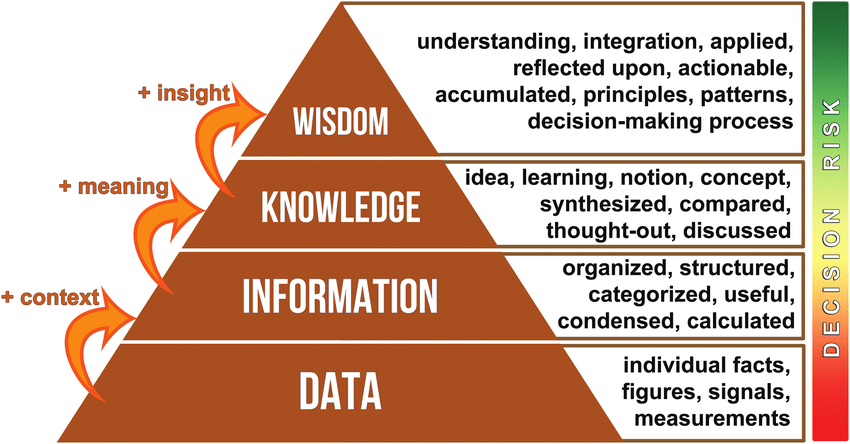
Epistemology is a branch of philosophy generally concerned with the nature of knowledge. It asks questions such as ‘How do we know?’ and ‘What is meaningful knowledge?’. Understanding what it means to have knowledge in a particular area—and the contexts and warrants that shape knowledge—has been a fundamental quest for centuries.

Data Information Knowledge Wisdom Pyramid

In Plato’s Theaetetus, knowledge is defined as the intersection of truth and belief, where knowledge cannot be claimed if something is true but not believed or believed but not true. Using an example from neonatal intensive care, this paper adapts Plato’s definition of the concept ‘knowledge’ and applies it to the field of quality improvement in order to explore and understand where current tensions may lie for both practitioners and decision makers. To increase the uptake of effective interventions, not only does there need to be scientific evidence, there also needs to be an understanding of how people’s beliefs are changed in order to increase adoption more rapidly.

Only 18% of clinical recommendations are evidence based. There are significant variations in care from one doctor to the next. Physicians practicing in the same geographic area (and even health system) often provide vastly different levels of care during identical clinical situations, including some concerning variations, according to a new analysis.

Clinical and policy experts assessed care strategies used by more than 8,500 doctors across five municipal areas in the U.S., keying in on whether they utilized well-established, evidence-backed guidelines. They found significant differences between physicians, including some working in the same specialty and hospital.

The study results were published Jan. 28 in JAMA Health Forum.

One practice difference the authors found surprising was in arthroscopic knee surgery rates. In these cases, the top 20% of surgeons performed surgery on 2%-3% of their patients, while the bottom 20% chose this invasive option for 26%-31% of patients with the same condition being treated in the same city.

The question is why?

There’s an old joke that there are two ways everyone sees the world: those that see it as a 2×2 matrix and those that don’t.

Type 1 Type 2 Errors Kris Martin

A type 1 error occurs when they make a “false positive” error and use or do something that is not justified by the evidence. Type 2 errors, on the other hand are “false negatives” where the practitioner rejects or does not do something that represents best evidence practice.

The most recent example is the campaign to get doctors to stop prescribing low value interventions and tests. The Choosing Wisely campaign, which launched five years ago, hasn’t curbed the widespread use of low-value services even as physicians and health systems make big investments in the effort, a new report found.

The analysis, released  in Health Affairs, said a decrease in unnecessary healthcare services “appear to be slow in moving” since the campaign was formed in 2012. The report found that recent research shows only small decreases in care for certain low-value services and even increases for some low-value services.

The reasons why American doctors keep doing expensive procedures that don’t work are many. The proportion of medical procedures unsupported by evidence may be nearly half. In addition, misuse of cannabis, supplements, neutriceuticals and vitamins are rampant.

Evidence-based practice is held as the gold standard in patient care, yet research suggests it takes hospitals and clinics about 17 years to adopt a practice or treatment after the first systematic evidence shows it helps patients. Here are some ways to speed the adoption of evidence based care.

Unfortunately, there are many reasons why there are barriers to adoption and penetration of new technologies that can result in these errors. I call them the ABCDEs of technology adoption:

Attitudes: While the evidence may point one way, there is an attitude about whether the evidence pertains to a particular patient or is a reflection of a general bias against “cook book medicine”

Biased Behavior: We’re all creatures of habit and they are hard to change. Particularly for surgeons, the switching costs of adopting a new technology and running the risk of exposure to complications, lawsuits and hassles simply isn’t worth the effort. Doctors suffer from conformation bias, thinking that what they do works, so why change?

Here are the most common psychological biasesHere are many more.

Why do you use or buy what you do? Here is a introduction to behavioral economics.

Cognition: Doctors may be unaware of a changing standard, guideline or recommendation, given the enormous amount of information produced on a daily basis, or might have an incomplete understanding of the literature. Some may simply feel the guidelines are wrong or do not apply to a particular patient or clinical situation and just reject them outright. In addition, cognitive biases and personality traits (aversion to risk or ambiguity) may lead to diagnostic inaccuracies and medical errors resulting in mismanagement or inadequate utilization of resources. Overconfidence, the anchoring effect, information and availability bias, and tolerance to risk may be associated with diagnostic inaccuracies or suboptimal management.

In addition,  there is a critical misunderstanding of what information randomized trials provide us and how health care providers should respond to the important information that these trials contain.

  • Has this trend been studied?
  • If so, who conducted the study?
  • Was it somebody who may make money based on study results?
  • Did the study include a control group?
  • What population did they use to test this trend?

Do you know how to read the medical literature?

Denial: Doctors sometimes deny that their results are suboptimal and in need of improvement, based on “the last case”. More commonly, they are unwilling or unable to track short term and long term outcomes to see if their results conform to standards.

Emotions: Perhaps the strongest motivator, fear of reprisals or malpractice suits, greed driving the use of inappropriate technologies that drive revenue, the need for peer acceptance to “do what everyone else is doing” or ego driving the opposite need to be on the cutting edge and winning the medical technology arms race or create a perceived marketing competitive advantage. In other words, peer pressure and social contagion is present in medicine as much as anywhere else. “Let’s do this test, just in case” is a frequent refrain from both patients and doctors, when in fact, the results of the treatment or test will have little or no impact on the outcome. It is driven by a combination of fear, the moral hazard and bias.

Here are some common customer fears when it comes to adopting a new product or technology and how to overcome them.

 Although investment in start-ups is significant, complex barriers to implementing change and innovation remain.

These “unnecessary” barriers, which vary from complicated funding structure to emotional attitudes towards healthcare, have resulted in the uneven advancement of medical technologies – to the detriment of patients in different sectors.

Economics: What is the opportunity cost of my time and expertise and what is the best way for me to optimize it? What are the incentive to change what I’m doing?

Here are three insights as to why physicians are still skeptical about using wearable technology to monitor patients’ health:

  1. Data access. Clinicians aren’t interested in using wearables if data from the devices isn’t connected to their organization’s EHR. Only 10 percent of physicians said they have integrated data from patient wearables, leaving clinicians unable to access the data or having to enter it manually.
  2. Data accuracy. Some physicians do not trust data from consumer wearable devices; for example, the FDA and other global regulators have cleared a smartwatch application that can alert patients who have already been diagnosed with atrial fibrillation when they are experiencing episodes. However, the capability is less useful as a mass screening tool and has generated many false positive results.
  3. User error and anxiety. If a wearable device is not worn correctly, it may generate inaccurate results. Some who use wearables to monitor their health can also become too focused on vitals such as heart rhythm and pulse rate, which can cause anxiety-induced physical reactions that mimic conditions such as atrial fibrillation.

The past 600 years of human history help explain why humans often oppose new technologies and why that pattern of opposition continues to this day. Calestous Juma, a professor in Harvard University’s Kennedy School of Government, explores this phenomenon in his latest book, “Innovation and Its Enemies: Why People Resist New Technologies.”

Here are the key takeaways.

Research indicates that doctors make these kinds errors frequently(http://ecp.acponline.org/sepoct01/pilson.pdf). Moreover, we are witnessing the development of digital health technologies like medical mobile apps, most of which are not clinically validated. So, how should a clinician decide when to adopt new technology? How much evidence is sufficient for an unsophisticated physician to begin adopting or applying a technological innovation for patient care? How do you strike a balance between innovation and evidence from a patient safety and quality standpoint?

Changing patient behavior has been described as the “next frontier”. To make that happen, we will need to change doctor behavior as well.Some interventions work but passive interventions don’t.

Here are some suggestions:

  1. Recognize, that like most customers, surgeons buy emotionally and justify rationally.
  2. Surgeons should be introspective about how and when they adopt new technologies and try to minimize Type 1 and Type 2 errors
  3. While an initial step is to be sure that surgeons are aware of new information that might drive an adoption decision, research indicates that simply presenting them with that information does not change behavior.
  4. Doctors should be skeptical about digital health technologies that might be technically and commercially validated, but not clinically validated.
  5. Doctors will have to resolve the conflict between best evidence and personalized medicine. We face the opportunity to individualize care yet are faced with the challenges of delivering mass customized care when it is becoming increasingly commoditized.
  6. Technology adoption, diffusion and sustainability vary depending on the product offering like drugs, devices, digital health products, care delivery innovation or business process innnovation.
  7. Doctors often have nothing to do with choosing which technology is adopted or, more importantly, paid for by a third party.
  8. Doctors, particularly those that are employed, have to concern themselves more and more with making the numbers, which involves implicitly or covertly rationing care, as irrational as it may be.
  9. Conflicts of interest hide, in some instances, the motivation for technology adoption.
  10. Doctors have high switching costs when it comes to including something new in their therapeutic armamentarium.
  11. In most instances, dissemination and implementation has more to do with leading change than the technology. Consequently it is best to get buy in from clinicians early, define a clear unmet need, have internal champions and leadership from the C-suite.
  12. Adoption and penetration happens in organizations when there is a match between the values and skills of intrapreneurs and organizational innovation readiness as demonstrated by teams that are willing to pull the oars in the same direction.
  13. Here are some ways to to change doctor prescribing habits to conform to evidence based medicine

The job doctors want virtual care technologists to do is that they want you to give them a QWILT: quality, workflow efficiencies,income, protection from liability and giving them more time spend with patients (face to face, since, in most instances, that’s how they get paid) Increasingly, they also want to spend more time “off the clock”, instead of being overburdened with EMR pajama time and answering non-urgent emails or patient portal messages.

While monetary incentives and behavioral “nudges” both have their strengths, neither of them is sufficient to reliably change clinician behavior and improve the quality of their care. Sometimes nudging helps. Organizational culture, while diverse and complex, provides another important lens to understand why clinicians are practicing in a certain way and to put forth more comprehensive, long-term solutions.

The public shares some culpability. Americans often seem to prefer more care than less. But a lot of it still comes from physicians, and from our inability to stop when the evidence tells us to. Professional organizations and others that issue such guidelines also seem better at telling physicians about new practices than about abandoning old ones.

Medicine has a lot to learn from the consumer products industry when it comes to using the power of brands to change behavior. Some are using personal information technologies to give bespoke information to individual patients, much like Amazon suggesting what books to buy based your preferences. We need to do the same thing for doctors.

Like most consumer electronics customers, doctors will almost always get more joy from technology the longer they wait for it to mature. Cutting-edge gadgets can invoke awe and temptation, but being an early adopter involves risk, and the downsides usually outweigh the benefits.

There are many barriers to the adoption and penetration of medical technologies. The history of medicine is full of examples, like the stethoscope, that took decades before they were widely adopted. Hopefully, with additional insights and data, it won’t take us that long.

Image credits: Pixabay, ResearchGate.net, Kris Martin

Subscribe to Human-Centered Change & Innovation WeeklySign up here to get Human-Centered Change & Innovation Weekly delivered to your inbox every week.
Innovation Theater – How to Fake It ‘Till You Make It

Innovation Theater - How to Fake It 'Till You Make It

GUEST POST from Arlen Meyers

The overwhelming number of doctors, engineers and scientists don’t have an entrepreneurial mindset. What’s more, when they have an idea, they don’t know what to do with it since they will not learn those competencies in their formal training. They just don’t know how to innovate their way out of our sick care mess.

But, that hasn’t stopped lots of them from trying, include non-sick care entrepreneurs. They just improvise.

Now that Elizabeth Holmes has been convicted, many are commenting on the pros and cons of the “fake it ’till you make it” ethos of entrepreneurs and Silicon Valley. But, is this really a black and white issue? Is it true that “You have no business being something you are not, or doing something without proving your worth.” I venture to say many of us, including me, have done something that was not a good fit and we have all tried things when we simple did not know what we did not know.

Here’s how to fake it when you don’t know what you are doing or you forgot your lines:

  1. Avoid these wannapreneur rookie mistakes.
  2. If you are a female, find a male wing man so someone will invest in your product
  3. Surround yourself with people who are way above your pay grade at lots of Meetups
  4. Practice Therantology
  5. When you inevitably fail, make a big deal out of it and about how much you learned from your mistakes and include them on your Linked profile. Rinse. Repeat
  6. Wear a fleece vest with your company logo
  7. Plead ignorance about how hard it is to get anybody in sick care to change and the long sales cycles.
  8. Be sure you have lots of hood ornaments (doctors with fancy titles) on your advisory board prominently posted on your website
  9. Hire a virtual assistant that answers all of your calls and says that she/he will not be able to immediately connect you because you are in an investor meeting
  10. Get your co-working space guy to allow you to use more space than you are actually paying for when people come for meetings. Bribe interns with pizza to come and look busy.
  11. Forget being your authentic self. “You are generally better off coming across as likable, which will generally require some effort, restraint, and attention to what others expect and want to see. Seeming authentic in the process is the cherry on top of the cake, but it requires a fair amount of faking.”
  12. Try being a good rebel even if you are a bad one.
No alt text provided for this image

During these times, we are supposed to wear a mask. Most of us wear a mask all the time to hide our insecurities or avoid being outed as an imposter or physician wannapreneur, so none of this should be new to you.

 In a follow-up to their February 2021 article challenging the commonly understood definition of imposter syndrome, authors Ruchika Tulshyan and Jodi-Ann Burey offer actionable steps managers can take to end imposter syndrome in their organizations. Doing so will require work at both the interpersonal and organizational levels, and success will depend in part on gathering data and implementing real mechanisms for accountability. The authors call on managers to stop calling natural, human tendencies of self-doubt, hesitation, and lack of confidence “imposter syndrome.” Those who want women to lend their full talents and expertise must question the culture at work — not their confidence at work.

These things come with practice. But, since you are part of innovation theater, practice your lines, be sure you are wearing the right costume and that the stage is set properly. Break a leg.

Subscribe to Human-Centered Change & Innovation WeeklySign up here to get Human-Centered Change & Innovation Weekly delivered to your inbox every week.

Finding the Right Physician Advisor for a Healthcare Startup

Finding the Right Physician Advisor for a Healthcare Startup

GUEST POST from Arlen Meyers

It has never been easier to create a sickcare startup, particularly in digital health. Part of that process requires that founders find the right players to be on the team. In many instances, that will involve finding physician advisors or consultants.

But, how do you find the right physician advisors?

Here are some tips:

  1. Clearly define the optimal candidate by writing a job description that includes the knowledge, skills, attitudes and competencies you want. Are you looking for someone with an entrepreneurial mindset or someone with just domain expertise? One expert suggests that they should be able to communicate a deep understanding of their domain effectively and understand the context of both their organizations and those they work with. Moreover, emotional competence is essential to developing strong interpersonal skills and succeeding in any workplace. Professionals should also strive to be effective teachers and build a large network of human connections. Finally, possessing an ethical compass will be important as algorithm-driven machines begin to make morally weighted decisions.
  2. Look for past experience and results
  3. Decide how much and what kind of compensation you are prepared to offer, either in cash, equity or both
  4. Make it clear how long you want to engage your advisor. Is it for one hour or one year or more? Or, maybe it’s best to try before you buy and hire for a renewable three-month term.
  5. Clearly define your expectations, deliverables and timelines and how you will measure the results. What roles, holes and goals do you want your advisor to fill?
  6. Solicit candidates using networks, social media channels, word of mouth referrals or responses to a call to action on your website or other marketing collateral
  7. Screen candidates using the criteria you have defined
  8. Decide whether you want someone to fill a business or clinical advisory position. Finding a clinical business advisor is difficult since few doctors or other healthcare professionals have both a clinical and entrepreneurial mindset and the knowledge, skills, abilities and competencies to help you achieve your next critical success endpoints.
  9. Agree on whether you are hiring for periodic strategic input or more tactical, hands-on execution.
  10. Interview candidates to see if they comply with your requirements and whether they are the right fit
  11. Negotiate an agreement
  12. Execute an advisory services agreement that defines the terms and conditions of the relationship

Finding the right physician advisors is an important part of recruiting your startup team. Don’t hire someone simply because of the initials after their name.

Image credits: Pixabay

Subscribe to Human-Centered Change & Innovation WeeklySign up here to get Human-Centered Change & Innovation Weekly delivered to your inbox every week.