There are many foods that we no longer eat, but because we choose to, not because they have disappeared from nature. In fact, here is a list of 21 Once-Popular Foods That We All Stopped Eating, including:
Kool-Aid
Margarine
Pudding Pops
Candy Cigarettes
etc.
But today, we’re going to talk about a food that I personally love, but that I’ve always viewed as a bit of luxury – crab legs – that is in danger of disappearing off the face of the planet due to climate change and human effects. And we’re not just talking about King Crab, but we’re also talking about Snow Crab, and we’re talking about Dungeness Crab too. And this is a catastrophe not just for diners, but to an entire industry and the livelihood of too many families to count:
That’s more than a BILLION CRABS that none of us have had the pleasure of their deliciousness.
And given the magnitude of the die off, it is possible they might disappear completely, meaning we can’t enjoy and salivate at the thought of this popular commercial from the 80’s:
Climate change and global warming are real. If you don’t believe humans are the cause, that it’s naturally occurring, fine, it’s still happening.
There can be no debate other than surrounding the actions we take from this point forward.
And while the magnitude of the devastation of other animal species that humans are responsible for is debatable, we are failing in our duties as caretakers of the earth.
This brings me back to the title of the post and the missions of this blog – to promote human-centered change and innovation.
Because we have killed off one of our very tastiest treats (King, Snow and Dungeness Crabs), at least in the short-term (and possibly forever), there is a huge opportunity to do better than krab sticks or the Krabby Patties of SpongeBob SquarePants fame.
If crab legs are going to disappear from the menus of seafood restaurants across the United States, and possibly the world, can someone invent a tasty treat that equals or exceeds the satisfaction of wielding a crab cracker and a crab fork and extracting the white gold within to dip into some sweet and slippery lemon butter?
Who is going to be first to crack this problem?
Or who will be the first to find a way to bring the crabs back from extinction?
We’re not just talking about a food to fill our bellies with, we’re talking about a pleasurable dining experience that is going away – that I know someone can save!
Humanity is obsessed with the future, and we always want to know what’s next for us.
Sometimes we want to know the future so badly that we stress ourselves out about imagined futures that won’t ever come to pass instead of dealing with what is right in front of us.
Time is Not Linear
Most people think of time in a linear fashion, but this is the wrong way of thinking about it.
It is more helpful instead to think of time as a wave (or as a pulse) emanating from a central point in an outward direction, representing all of the possible futures. Then as the next point in one of those possible futures becomes fixed, then another wave emanates from this new point representing all of the new possible futures. The math of what the future MIGHT look like gets really big, really fast – as you might imagine.
This is what makes predicting the future so difficult.
The number of inputs influencing the next step in your future journey is massive, and the number of potential next steps that are outputs of your next best action is equally massive.
So, while it is important to plan for the future and to develop a point of view on the future you would like to be the result of your actions, it is still just a guess. Making it more important and impactful to look at the near future more often than not.
Recently I came across a video from CableLabs that looks at one potential near future:
We Are Already Living in a Virtual Reality
The first choice the creators faced was augmented reality versus virtual reality, and you’ll see that they chose to highlight augmented reality instead of virtual reality. I think this is the right choice as many people would say we are living in a virtual reality already.
Our eyes and other sensory organs do their best to provide inputs to our brain about the physical reality we live in, but the information is often inaccurate and incomplete. Our brain tries to fill in the gaps, but there is some much we don’t understand about how the reality we live in operates.
The world we live in is already amazing, and there is more value in augmenting our experience of the reality we live within, than there is escaping into another reality that is more clumsy, awkward and lower fidelity than our experience of the virtual reality we live in now.
Our world is changing so fast that it is important for organizations and individuals to not just plan for the next month or the next quarter, but to plan for what we would like the near future to look like and think about the ways in which we would like to, and realistically can, influence it.
FutureHacking™ is Within Our Grasp
But the concepts of futurology and the role of the futurist seem pretty nebulous at best. It is because of this that I’ve begun creating a collection of FutureHacking™ tools to help you.
These tools will be available to license soon, and I’ll be holding virtual, and possibly in-person, workshops to explain how to use these simple tools to identify a range of potential futures, to select a preferred future, and activities to help influence its realization.
I think you’ll really like them, but in the meantime, I invite you to check out the embedded YouTube video and to share your thoughts on how you look at and plan for the future in the comments below.
Finally, make sure you’re subscribed to our newsletter to get our weekly collection of articles, along with updates on the forthcoming FutureHacking™ set of tools.
Keep innovating!
To read more about what scientists say we get wrong about time, check out this BBC article
Image Credit: Pixabay
Sign up here to get Human-Centered Change & Innovation Weekly delivered to your inbox every week.
The world needs you. The United States needs you. Your family needs you.
Both your heart and your mind are needed to work on potentially the greatest innovation challenge ever put forward.
What is it?
We must find a solution to the division and lack of meaning that has become the American experience.
I’m not sure about the country you live in, but here at home in the United States we are more divided than we have been in a long time – if ever. People are feeling such an absence of meaning and purpose in their lives that they are finding it in opposing ‘the other’.
In the most extreme cases, we are so divided that brothers and sisters, and parents and children are no longer speaking with each other or getting together for holiday meals.
We speak often about the importance of diversity of thought, diversity of group composition for innovation, but when a society reaches a point where people cannot productively disagree and debate their way forward together, innovation will inevitably begin to suffer.
When there is no dialogue, no give and take and a culture begins to emerge where opposition is mandatory, progress slows.
As long as the current situation intensifies, there will be no progress on other areas in desperate need of innovation:
Climate change
Gender equity
(Insert your favorite here)
We all need your help creating the idea fragments that we can connect as a global innovation community into meaningful ideas that hopefully lead to the inventions that will develop into the innovations we desperately need.
The innovations that will move social media from its current parallel play universe to one which actually encourages productive dialogue.
The innovations that will help people find the renewed sense of meaning and purpose that can’t be found making Sik Sok videos, watching other people play video games on Kwitch or investing in cryptocurrency pyramid schemes.
Our entrepreneurs have made a lot of cotton candy the past couple of decades and people are starving, people are hangry.
There are certain constants in the human condition, and when we as a species stray too far away, it creates huge opportunities for innovators to create new things that will bring us back into balance.
But we can’t ignore where we are now.
We must acknowledge our current situation and fight our way past it. The only way forward is through.
As a thought starter, here is an ad campaign from Heineken from 2017:
We need everyone’s help to address the meaning crisis.
We need everyone’s help to bring America (and the rest of the world) back into productive conversation and connection – to end the division.
Are you up to the task?
Are you ready to help?
Let’s start the dialogue below and get that pebble rolling downhill in the winter, gathering snow as it goes.
I would love to hear your thoughts in the comments on:
other great thought starters
good idea fragments to build on
the way through
Image credit: Pixabay
Sign up here to get Human-Centered Change & Innovation Weekly delivered to your inbox every week.
Is our organization a productive place for creating innovation? How does our organization’s innovation capability compare to that of other organizations?
Almost every organization wants to know the answers to these two questions.
The only way to get better at innovation, is to first define what innovation means. Your organization must have a common language of innovation before you can measure a baseline of innovation maturity and begin elevating both your innovation capacity and capabilities.
My first book Stoking Your Innovation Bonfire, was created to help organizations create a common language of innovation and to understand how to overcome the barriers to innovation.
The Innovation Maturity Assessment
One of the free tools I created for purchasers of Stoking Your Innovation Bonfire, and for the global innovation community, was an innovation maturity assessment with available instant scoring at http://innovation.help.
My 50 question innovation audit measures each individual’s view of the organization’s innovation maturity across a number of different areas, including: culture, process, funding, collaboration, communications, etc.
When multiple individuals at the same organization complete the questionnaire, it is then possible to form an organizational view of the organization’s level of innovation maturity.
Each of the 50 questions is scored from 0-4 using this scale of question agreement:
0 – None
1 – A Little
2 – Partially
3 – Often
4 – Fully
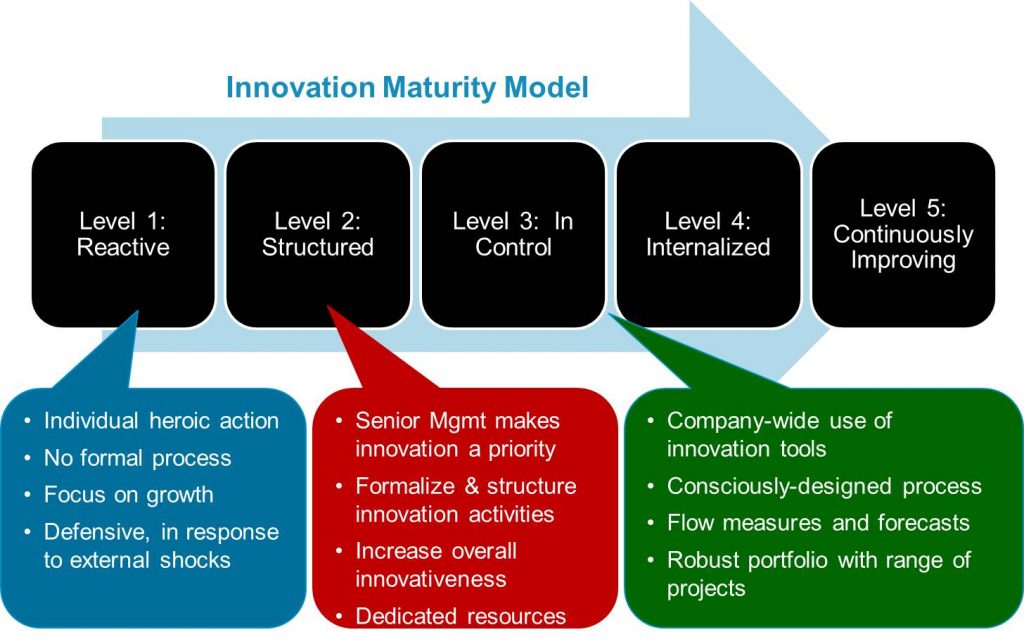
To generate an innovation maturity score that is translated to the innovation maturity model as follows:
000-100 = Level 1 – Reactive
101-130 = Level 2 – Structured
131-150 = Level 3 – In Control
151-180 = Level 4 – Internalized
181-200 = Level 5 – Continuously Improving
Image adapted from the book Innovation Tournaments by Christian Terwiesch and Karl Ulrich
Innovation Maturity is Organization-Specific
The best way to understand the innovation maturity of your organization is to have a cross-functional group of individuals across your organization fill out the assessment and then collate and analyze the submissions. This allows us to make sense of the responses and to make recommendations of how the organization could evolve itself for the better. I do offer this as a service at http://innovation.help.
What Do the Numbers Say About the Average Level of Innovation Maturity?
To date, the innovation maturity assessment web application at http://innovation.help has gathered about 400 seemingly valid responses across a range of industries, geographies, organizations and job roles.
The average innovation maturity score to date is 102.91.
This places the current mean innovation maturity score at the border between Level 1 (Reactive) and Level 2 (Structured). This is not surprising.
Looking across the fifty (50) questions, the five HIGHEST scoring questions/statements are:
We are constantly looking to improve as an organization (3.12)
I know how to submit an innovation idea (2.83)
Innovation is part of my job (2.81)
It is okay to fail once in a while (2.74)
Innovation is one of our core values (2.71)
The scores indicate that the typical level of agreement with the statements is “often” but not “always.”
Looking across the fifty (50) questions, the five LOWEST scoring questions/statements are:
Six sigma is well understood and widely distributed in our organization (1.74)
We have a web site for submitting innovation ideas (1.77)
There is more than one funding source available for innovation ideas (1.79)
We have a process for killing innovation projects (1.82)
We are considered the partner of first resort for innovation ideas (1.83)
The scores indicate that the typical level of agreement with the statements is “partially.”
What does this tell us about the state of innovation maturity in the average organization?
The numbers gathered so far indicate that the state of innovation maturity in the average organization is low, nearly falling into the lowest level. This means that on average, our organizations are focused on growth, but often innovate defensively, in response to external shocks. Many organizations rely on individual, heroic action, lacking formal processes and coordinated approaches to innovation. But, organizations are trending towards greater prioritization of innovation by senior management, an introduction of dedicated resources and a more formal approach.
The highest scoring questions tell us that our organizations are still in the process of embedding a continuous improvement mindset. We also see signs that many people view innovation as a part of their job, regardless of whether they fill an innovation role. Often, people know how to submit an innovation idea. And, we can infer that an increasing number of organizations are becoming more comfortable with the notion of productive failure, and communicating the importance of innovation across the organization.
Finally, the lowest scoring questions show us that process improvement methodologies like six sigma haven’t penetrated as many organizations as one might think. This means that many organizations lack the experience of having already spread a shared improvement methodology across the organization, making the spread of an innovation language and methodologies a little more difficult. We also see an interesting disconnect around idea submission in the high and low scoring questions that seems to indicate that many organizations are using off-line idea submission. Zombie projects appear to be a problem for the average organization, along with getting innovation ideas funded as they emerge. And, many organizations struggle to engage partners across their value and supply chains in their innovation efforts.
Conclusion
While it is interesting to look at how your organization might compare to a broader average, it is often less actionable than creating that deeper understanding and analysis of the situation within your unique organization.
But no matter where your organization might lie now on the continuum of innovation maturity, it is important to see how many variables must be managed and influenced to build enhanced innovation capabilities. It is also important to understand the areas where your organization faces unique challenges compared to others – even in comparing different sites and/or functions within the same organization.
Creating a baseline and taking periodic measurements is crucial if you are serious about making progress in your level of innovation maturity. Make your own measurement and learn how to measure your organization’s innovation maturity more deeply at http://innovation.help.
No matter what level of innovation maturity your organization possesses today, by building a common language of innovation and by consciously working to improve across your greatest areas of opportunity, you can always increase your ability to achieve your innovation vision, strategy and goals.
If so, outsourcing, artificial intelligence and robots are coming for your job.
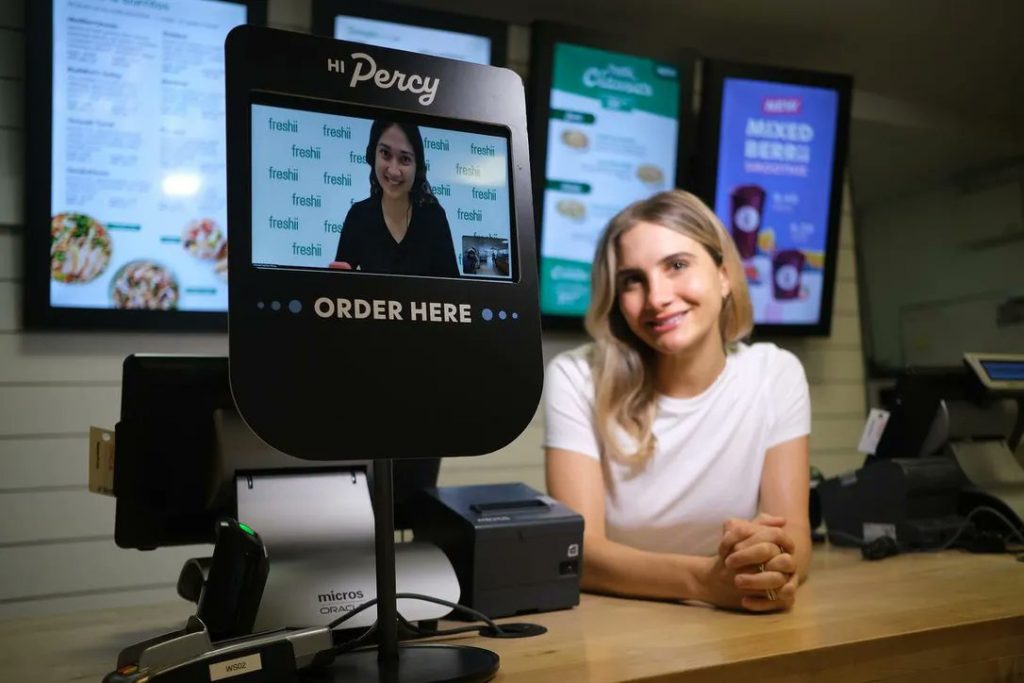
Freshii‘s founder Matthew Corrin left the quick-serve restaurant chain two months ago to focus on Percy, a technology that uses video calling to replace cashiers. Percy has more than a dozen clients in North America and employs nearly 100 workers in Pakistan, Bolivia and Nicaragua for around $3.75 per hour.
With an increasing number of voters supporting the living wage movement, and with many cities boosting their minimum wage to $15 per hour, the economic incentive is clear.
But is using video calling technology to put some of your neighbors out of work a smart move ethically, or from a branding perspective?
This first video shows what the technology looks like:
This second video explores whether this labor arbitrage is legal, and whether or not it is ethical:
The video also mentions that Jack in the Box is piloting the use of offshore resources to facilitate drive thru order taking at some of its restaurants. Further research uncovered that Jack in the Box began this pilot back in 2008. I could not find any information indicating whether the pilot was discontinued or rolled out to more locations outside the Charlotte, NC area.
But Jack in the Box isn’t the only chain experimenting with Drive Thru hacks.
Check out this Taco Bell concept being built out with an elevated restaurant and multiple Drive Thru lanes at street level to increase throughput. If you didn’t know, many fast-food restaurants do 2/3 or more of their business through the Drive Thru. Taco Bell’s concept does not mention using any outsourced labor, but the possibility is obviously there.
Using a speech-recognizing Artificial Intelligence (AI) is of course a real possibility in the Drive Thru use case in the very near future, potentially putting even outsourced labor out of a job.
So, what do you think? Innovation or not?
p.s. One thing that doesn’t appear to be part of the Percy video virtual cashier product, but would be easy to add because the camera is already there, is ‘pay by face’ technology. That extra convenience could push this concept over the top. Although, I’m still not sold that would be a good thing, especially for the millions of cashiers in the United States.
Image credit: Toronto Star, Taco Bell, ExxaPay
Sign up here to get Human-Centered Change & Innovation Weekly delivered to your inbox every week.
Turns out the pandemic prompted mass numbers of employees finally say, “take this job and shove it” to employers and careers they don’t like. Life is too short to be miserable at work.
In a recent NICE Webinar, we discussed how job quit rates have hit a historic high—even while the economy is still recovering from two years of furloughs and layoffs. This is often referred to as The Great Resignation.
Enlightening research from Gallup gathered in March of 2021 found that 48% of the working population in the United States is actively job-hunting or seeking out new opportunities.[1]
So, while we watch the labor market churn with no signs of settling, how can businesses avoid the costs of high turnover rates?
For those of you struggling with your staffing levels or with finding talent during these exceedingly challenging times, I have exciting news to share!
My latest commissioned webinar is now available ON DEMAND:
It’s being called The Great Resignation: Millions of employees leaving their jobs every month! While the trend affects every industry, nowhere else is it felt more acutely than in contact centers. How do you keep agent churn from derailing your contact center?
Smart organizations know that it’s about more than salaries. Agents want work-life balance, and on the job, great tools and support to help them do their jobs well.
In this On-Demand webinar I explore what’s driving the Great Resignation and how to keep your agents engaged and satisfied.
Learn important strategies for keeping your agents from walking out the door:
How giving agents purpose creates job satisfaction.
How to create flexibility for agents to improve work-life balance.
How to keep hybrid workforces connected and engaged.
There will be an accompanying white paper available soon.
NOTE: Commissioned thought leadership (articles, white papers, webinars, etc.) to accelerate a company’s sales and marketing efforts (including lead generation) is one of the services I provide in addition to the speeches and workshops I deliver as an innovation speaker.
Image credit: Pixabay
Sign up here to get Human-Centered Change & Innovation Weekly delivered to your inbox every week.
The harder I try not to think of myself as an artist, the stronger I’m pulled back to the idea that even if my art is a little different than traditional drawing, painting, photography, music, dance and other traditional arts, that it is still art.
Today’s article was inspired by a Lex Fridman podcast interview with the lead singer of Imagine Dragons – Dan Reynolds.
Dan is a Mormon, a musician, one of nine children, a father, and a surprisingly humble and astute person. All of these things are relevant because who we are as a person is the result of every facet of ourselves today, and in our upbringing. Our art comes from our experience and our empathetic connections to the experiences of others. While Dan is a musician, he is also an artist, and artists can and should learn from all different types of artists.
At the heart of every kind of art is truth, but more about that later.
“After silence, that which comes nearest to expressing the inexpressible is music.” — Aldous Huxley
In this article I will highlight what I took away from the interview and some of the great music they Lex and Dan discussed, but feel free to jump in and watch the conversation at any point:
The most important takeaways from the interview are these:
People have really good bullshit detectors
You must authentically feel something, and your audience must feel it too
Having a source of honest feedback is critical to progressing your art
Let’s now look at each of these and relate them from music to innovation:
1. People have really good bullshit detectors
In the interview Dan contrasts their success with two different records “Bet My Life” and “Believer” – which both did well – but “Believer” out-streamed “Bet My Life” by 10x.
Here is “Bet My Life” from YouTube with its 160 Million views on YouTube:
And “Believer” with its 2.2 Billion views on YouTube:
Okay, maybe that’s a bit more than 10x, but Dan when asked about what went wrong with “Bet My Life” he admitted that they produced the song themselves and that they took what was originally a stripped-down song and over-produced it – costing the song some of its authenticity in the process.
Here are some key thoughts from this article on the importance of truth to innovation:
“Fail to identify a solution with real innovation veracity and you are likely to miss potential elements of optimal value creation, you will likely struggle to make its value accessible, and there is a greater likelihood that you will fail to properly translate the value of the solution for your customers.
So, taken another way, the search for innovation success is a search for truth. You must therefore unlock the inner truths of your intended customers (think unmet needs or jobs-to-be-done), you must search in areas that your intended customers will feel are true for your brand, and areas that feel true to employees given the company’s mission and values. When your pursuit of innovation centers around truth and when you commit to a focused effort to increase your innovation capability – and to pursue Innovation Excellence – then and only then do you have your best chance at innovation success.”
2. You must authentically feel something, and your audience must feel it too
In innovation we often talk about how it takes 100+ ideas to find 10 projects worth investing time and money in, and from those 10 projects – if you’re lucky – you might have one show promise as a potential innovation.
In the Lex Fridman interview Dan Reynolds revealed that he writes about 100 songs a year and from those perhaps 10 might get recorded. Dan started as a drummer, and while voice is often as seen as the melody of a song, his vocals are in part driven by a percussion mindset. For innovation we like to speak about bringing different mindsets and perspectives to increase the chances of finding something meaningful.
Speaking of feeling and authenticity, Dan tells a story in the interview about how they were working on an album with famous record producer Rick Rubin and listened to a song that Dan believed in, but after hearing it he told Dan “I don’t believe you.”
The path to adoption is through belief…
Some of the songs they listened to in regard to ‘feeling it’, included Harry Nilsson’s “Without You”:
Cat Stevens’ “Father and Son”:
And Harry Chapin’s “Cat’s in the Cradle”:
Identifying whether you are transmitting authentic feelings or not is very difficult. We’ve already spoken about the importance of veracity, and if we build on that using something I wrote about in my article That’s Innovation with Two V’s, leveraging information from the movie A Good American, about how the following three components can help you identify signals and drive the transformation of DATA into INTELLIGENCE (or innovation veracity in our context):
Volume – in order to derive meaningful conclusions you need a lot of data inputs, in this case, lots of idea fragments (ideas come later)
Variety – multiple perspectives are necessary to avoid blind spots and increase the potential for connecting idea fragments
3. Having a source of honest feedback is critical to progressing your art
Making art that resonates with others is incredibly different. It is easy to get lost in our own perspective.
“If you want to go fast, go alone. If you want to go far, go together.” – African Proverb
It is incredibly important as an artist, as an innovator, that you find a group of trusted voices to allow you to accelerate the development of your art – or your innovation. Science experienced an incredible acceleration in the private clubs of London in the 1600’s, impressionist art experienced an amazing acceleration in the south of France in the 1800’s – because of the rapid exchange of ideas and feedback.
For Dan Reynolds, one of those trusted voices is his father, he also has one of his brothers as the band’s manager, another brother as their lawyer, and brings in external voices to help with the production of their records – people like Rick Rubin.
Listening to your trusted external voices can help you see where you’re falling short. There is a great quote in the interview above regarding Dan’s realization around the sometimes-uncomfortable role of a famous person in society.
“By not saying anything, I was saying everything.” – Dan Reynolds (re: LGBTQ issues at the time)
It is only from being open to receiving feedback that we can learn anything. And when it comes to art, when it comes to Optimizing Innovation Resonance:
To achieve and maintain innovation resonance, you must nurture a commitment to learning fast, both during the innovation development process and after the launch of a potential innovation. You must maintain a laser focus on how you are creating value, helping people access that value, and translating that value for people so they can understand how your potential innovation may fit into their lives. So, do you have processes in place as part of your innovation methodology for measuring and evolving solutions in place to help you get to innovation resonance?
And to help reduce the tyranny of the innovation hero and to encourage innovation collaboration, I created the Nine Innovation Roles:
Revolutionary
Conscript
Connector
Artist
Customer Champion
Troubleshooter
Judge
Magic Maker
Evangelist
… to make a place for everyone in innovation.
Conclusion
There is a reason this blog is called Human-Centered Change & Innovation. The reason is that when it comes to change, innovation and transformation, the people side of all three is everything.
To be successful, you must consider “the other.”
You must engage with “the other.”
You must understand “the other.”
This requires empathy, this requires veracity, and when you bring empathy and veracity together, you have a chance at achieving resonance.
All types of art and innovation require empathy, veracity, and resonance for success.
I hope you’ve enjoyed the interview, the music, and the conversation.
I hope all of this will help you slay your dragons, imagine a future where you are connecting more fully with your audience, and creating something amazing.
Keep innovating!
Sign up here to get Human-Centered Change & Innovation Weekly delivered to your inbox every week.
The late Clayton Christensen wrote a little book called The Innovator’s Dilemma that many of you I’m sure have read. Many people think of it as a book about disruptive innovation, but it can be much more than that if you shift your perspective.
The Classic Disruptive Innovation Example
One of the case study examples is that of mini-mills disrupting the rolled steel producers in the steel industry by starting at the bottom of the food chain with the production of low margin re-bar and then moving upwards into higher margin steel products. This is seen as the blueprint for how you disrupt an industry. You go first where the incumbents are least likely to be concerned about new entrants – low margin products – a market that incumbents might actually be happy to lose, because their average margins will actually increase and wall street will potentially reward them in the short-term with higher stock prices.
But if you shift your perspective on this case study and apply it to emerging technology, something new emerges.
Learning and Adoption Require a Compelling Use Case BEFORE They Can Occur
I’ve been listening to a lot of podcasts while I work lately. Podcasts with leading scientists from around the world. One of the core themes that continuously emerges is that innovation is really hard and takes a long time. I was really struck by iRobot co-Founder Rodney Allen Brooks speaking about how they had a target of launching the Roomba at $200 and this meant that he had FIFTY CENTS per unit to spend on a piece of silicon to power their invention. He told the story of running around Taiwan looking for a chip that was cheap enough and was handicapped in ways that wouldn’t matter for their particular application – as ALL chips in that price range are going to have severe limitations. This is a great story for highlighting some of the unexpected challenges in turning an invention into an innovation.
Another interesting innovation case study – on the failure side – is that of Google Glass. The smart glasses arrived as an overhyped and underwhelming product and died on the vine in a very short period of time. One of the key reasons for their failure was the lack of a compelling use case, and another was that technology was too front and center – so much so that Google Glass seemed like a creepy invention.
“Making access to information just instant and intuitive. By doing that, technology fades into the background, and we’re more connected with the people and things around us.”
This quote is pulled directly from the video below about Google’s reboot of their smart glasses initiative:
Google’s Live Translation Glasses arrive this time without a product page, without a formal product name and promising much less.
One of the things that really struck me in this short video is that while it is super easy to anchor on the value of the translation piece – displaying Mandarin on screen from an English voice for example – they have several other powerful uses cases, including:
People who have single-sided deafness
People who don’t want to wear hearing aids, or for whom hearing aids don’t work
People who are fully deaf
People who are trying to learn a new language
Do One Thing Really Well and Build From There
Google’s Live Translation Glasses remind me of another pair of smart glasses launched a little while back in the glow of the Google Glass failure – Amazon’s Echo Frames.
Amazon’s Echo Frames build themselves around the compelling use case of hands-free searching and calling. They have speakers and a microphone, connect to your iOS or Android smartphone, and can even be fitted with prescription lenses.
Don’t Strip the Gears on Your Innovation Machine
Our ability to imagine usually outpaces our ability to execute and it can be a challenge to rein in our imagination to match our ability to not just execute, but to do so profitably and at a pace that our customers can see their way to adopt it.
When we look at my Innovation is All About Value methodology, we can also see that companies fail less often at value creation, and more frequently at value access and value translation.
When your start small and build around a compelling use case it is easier to get the value translation right and it is easier to build the key value access components to support your value creation.
Timing matters…
Price matters…
Compelling use cases matter…
What’s yours?
Keeping the end in mind and the future in sight – is important – but it is more valuable to identify where to start and add value as you go.
Don’t strip the gears on your innovation machine and keep innovating!
Image credit: The Verge, Amazon
Sign up here to get Human-Centered Change & Innovation Weekly delivered to your inbox every week.
In the episode I define what innovation really is, how people, process and technology come together to create innovation and where people go wrong.
The conversation includes a discussion of how to craft successful innovation teams because it’s such a crucial factor for successful innovation.
I also speak about the peril of idea fragments and the importance of respecting your employees by putting funding and execution capabilities in place BEFORE you ask your employees for even a single idea.
We talk about top-down innovation…
We talk about bottom-up or middle-out innovation…
And, we also speak about many different innovation misconceptions.
So, I encourage you to check out the episode!
You can listen to the embedded podcast above or click this link to go to the podcast page.
Image credit: Pixabay
Sign up here to get Human-Centered Change & Innovation Weekly delivered to your inbox every week.


 Sign up here to get Human-Centered Change & Innovation Weekly delivered to your inbox every week.
 by Braden Kelley