Monthly Archives: January 2022

Teaching Old Fish New Tricks

Teaching Fish New Tricks

We used to assume that the world was flat.

We used to assume that the sun orbited around the earth.

We used to assume that it was impossible to go faster than the speed of sound.

These assumptions were all challenged and proved to be wrong, fundamentally extending the boundaries of potential innovation and exploration in the decades that followed.

Challenging orthodoxies or questioning your assumptions is one of the key techniques to use with your innovation teams to uncover new insights to form the seeds of future innovation.

This isn’t always easy to do, and in workshops it can be a challenge to put people in the right frame of mind for questioning assumptions and challenging orthodoxies.

I find that having a stable of short videos can help in setting the stage for the very important innovation work.

Now, let’s have a look at one of my new favorite assumption-challenging videos…

Who says you can’t teach old fish new tricks?

Yes, I said fish, not dog – which challenges an orthodoxy in and of itself.

I was intrigued to hear recently that scientists in Israel have managed to teach goldfish how to drive a car.

Don’t believe me?

Check out the video:

Gradually, we are finding out that humans aren’t as special as we like to believe.

We’ve learned that trees can communicate via root systems, research is progressing into plant sentience and yes apparently, goldfish can be taught to drive.

Now that you’ve seen this video, you can now see that the assumption that fish can’t navigate vehicles through physical space – is incorrect.

What other assumptions do we make about goldfish and other living creatures that might be incorrect.

How might we set up experiments to test these assumptions?

What are some of your favorite short videos to put people in the right mindset to challenge orthodoxies and question assumptions?

Add them to the comments!

Subscribe to Human-Centered Change & Innovation WeeklySign up here to get Human-Centered Change & Innovation Weekly delivered to your inbox every week.

Best Practices for Managing Agile Teams

Best Practices for Managing Agile Teams

GUEST POST from Chateau G Pato

In today’s rapidly changing business environment, effective management of agile teams has become critical. Agile methodologies emphasize flexibility, collaboration, and customer-centricity. However, managing agile teams comes with its unique challenges that require a nuanced approach. In this article, we delve into some of the best practices for managing agile teams and provide insights through two compelling case studies.

Best Practices for Managing Agile Teams

1. Embrace Transparency

Transparency is the cornerstone of agile team management. Ensure that all team members have access to the relevant information and understand the project goals. This clarity helps in fostering trust and aligning team efforts towards a common objective.

2. Foster a Collaborative Culture

Encourage a culture of collaboration by organizing regular stand-up meetings and retrospectives. These practices enable teams to share feedback, tackle challenges collectively, and continuously improve their processes.

3. Empower Teams with Autonomy

Empowering teams means giving them the autonomy to make decisions and take ownership of their work. Autonomy drives innovation, increases motivation, and enhances accountability.

4. Focus on Continual Learning

Agile environments thrive on continual learning. Encourage your team members to engage in learning opportunities, whether through workshops, online courses, or learning communities. This leads to growth both for individuals and the organization.

Case Study Examples

Case Study: Spotify’s Squad Model

Spotify, a great example of agile success, has implemented a unique Squad model. Each Squad works like a mini-startup with its own mission, a small cross-functional team, and complete autonomy over their area of work. This model has fostered innovation and increased agility across the organization.

Best Practice Highlighted: Empowerment through autonomy – Spotify empowers squads to make decisions independently, enabling rapid innovation and adaptation to market changes.

Case Study: ING’s Agile Transformation

ING, a Dutch multinational bank, underwent a large-scale agile transformation. ING adopted agile principles enterprise-wide, moving away from traditional hierarchical structures. The bank formed tribes, squads, and chapters to streamline operations and improve customer experiences.

Best Practice Highlighted: Transparency and collaboration – By breaking down silos and fostering collaboration, ING improved communication and accelerated product delivery.

Conclusion

Managing agile teams effectively requires a balance of transparency, collaboration, empowerment, and a commitment to continual learning. By following these best practices, organizations can harness the full potential of agile methodologies and drive meaningful innovation and growth. As illustrated by the case studies of Spotify and ING, adopting these practices can lead to exceptional organizational transformation and success.

Remember, driving change and fostering innovation in agile teams is a dynamic journey. Begin by embracing these best practices, and watch your agile teams flourish.

Bottom line: Futurology is not fortune telling. Futurists use a scientific approach to create their deliverables, but a methodology and tools like those in FutureHacking™ can empower anyone to engage in futurology themselves.

Image credit: Pexels

Subscribe to Human-Centered Change & Innovation WeeklySign up here to get Human-Centered Change & Innovation Weekly delivered to your inbox every week.

Four Innovation Ecosystem Building Blocks

Four Innovation Ecosystem Building Blocks

GUEST POST from Greg Satell

It’s hard to find anyone who wouldn’t agree that Microsoft’s 2001 antitrust case was a disaster for the company. Not only did it lose the case, but it wasted time, money and—perhaps most importantly—focus on its existing businesses, which could have been far better deployed on new technologies like search and mobile.

Today, Microsoft is a much different organization. Rather than considering open source software a cancer, it now says it loves Linux. Its cloud business is growing like wildfire and it is partnering widely to develop new quantum computers. What was previously a rapacious monopolist, is now an enthusiastic collaborator.

That’s no accident. Today, we need to compete in an ecosystem-driven world in which nobody, not even a firm as big and powerful as Microsoft, can go it alone. Power no longer comes from the top of value chains, but emanates from the center of networks. That means that strategy needs to shift from dominating industries to building collaborative ecosystems.

1. Connect to Startups

In its heyday, Microsoft enthusiastically followed Michael Porter’s five forces model. It saw threats coming not only from direct competitors, but also suppliers, customers, substitute products and new market entrants. Startups, in particular, were targeted for either acquisition or destruction if they were seen as posing a potential threat.

Today, however, Microsoft actively supports startups. Take, for example, its quantum development effort, in which it is partnering with more than a dozen entrepreneurial companies. These firms also get free access to Microsoft technologies, such as its Azure cloud platform and go-to-market resources and advice, through its Microsoft for Startups program.

Another approach that many firms take is corporate VC programs which actively invest in promising new companies. Unlike a typical investor, corporations bring a wealth of market and technical expertise, can help with things like distribution, supply chain management and marketing acumen. Corporations, for their part, get far more insight into new technologies than they could as an operating company.

Scott Lenet, President of Touchdown Ventures, which operates venture funds for corporations, told me that, “Startups thrive on new ideas and big firms know how to scale and improve those ideas. We’ve seen some of our investments really blossom based on that kind of partnership.”

2. Form Ties to the Academic World

When Sun Microsystems co-founder Bill Joy said, “no matter who you are, most of the smartest people work for someone else,” he was explicitly referring to Bill Gates’s assertion that Microsoft was an “IQ monopolist.” Joy’s position was that “It’s better to create an ecology that gets all the world’s smartest people toiling in your garden for your goals. If you rely solely on your own employees, you’ll never solve all your customers’ needs.”

Make no mistake. Innovation is never a single event. It is a process of discovery, engineering and transformation and those three things almost never happen in the same place or at the same time. That’s why the most innovative companies work hard to build links to the best minds in the academic world.

Today Microsoft has an extensive academic program that extends grants to graduate students and faculty members that are pursuing research that is of interest to the company. Google takes it even a step further, inviting dozens of the world’s top minds to work alongside its scientists and engineers for a sabbatical year.

Microsoft and Google are, of course, firms with enormous resources. However, just about any business can, for example, support the work of a young graduate student or postdoc at a local university. For even a senior researcher to collaborate with your staff is rarely prohibitively expensive. Researchers care far more about genuine support of their work than the size of your investment.

3. Leverage Domain-Specific Consortia

By the mid-1980’s, the American semiconductor industry seemed like it was doomed. Tp respond to what it saw as a national security threat, the American government created SEMATECH in 1986. It was a consortium of government agencies, research institutions and private firms focused on making the industry more competitive. By the mid 1990’s, the US was once again dominating semiconductors.

Any significantly complex technology takes years—and often decades—to develop before it becomes mature enough to engineer into a marketable product. So there is great potential in collaborating, even with competitive firms, in the pre-competitive phase to figure out the basic principles of a nascent technology.

For example, Boeing and Airbus are arch-rivals in aviation, much like DowDupont and BASF are in chemicals. Yet all of these companies, along with many others, collaborate at places like the Composites Institute (IACMI). They do this not out of any altruism, of course, but self-interest, because it is at places like the Composites Institute that they can collaborate with academic scientists, National Labs and startups working in the space.

As technology becomes more complex, domain specific consortia are becoming essential to any ecosystem strategy. The Composites Institute is just one node in the network of Manufacturing Institutes set up under the Obama Administration to support this type of collaboration. In areas ranging from advanced fabrics and biofabrication to additive manufacturing and wide-gap semiconductors, firms large and small are working with scientists to uncover new principles.

And the Manufacturing Institutes are just the start. The Internet of Things Consortium is helping bring computation to the physical world, while the Partnership on AI focuses on artificial intelligence and the Joint Center for Energy Storage Research is helping to develop advanced battery technology. All are open to the largest multinationals and the smallest startups.

4. Move From Hierarchies to Networks

Back in the 90s, when Microsoft still dominated the tech world, markets were still based on linear value chains dominated by one or two industry giants. Yet as I explain in Cascades, we are quickly moving from a world of hierarchies, to one dominated by networks and ecosystems. That changes how we need to develop and grow.

In a hierarchy-driven world, the optimal strategy was to build walls and moats to protect yourself against would-be invaders, which is why Microsoft fought tooth and nail to protect its operating system monopoly. Today, however, industry lines have blurred and technology moves too fast to be able to build effective barriers against disruption.

That’s why today “Microsoft loves Linux”, why it developed an academic program to collaborate with scientists at universities and why it often partners with startups instead of always trying to crush them. The technology being developed today is simply too complex for anyone to go it alone, which is why the only viable strategy is to actively connect to ecosystems of talent, technology and information.

Power today no longer sits at the top of hierarchies, but emanates from the center of ecosystems and you move to the center by widening and deepening connections. Closing yourself by erecting barriers will not protect you. In fact, it is an almost sure-fire way to hasten your demise.

— Article courtesy of the Digital Tonto blog
— Image credit: Pixabay

Subscribe to Human-Centered Change & Innovation WeeklySign up here to get Human-Centered Change & Innovation Weekly delivered to your inbox every week.

The Five Whys of Organizational Structure

Re-Designing the Operating Model

LAST UPDATED: November 12, 2025 at 12:36PM

The Five Whys of Organizational Structure

GUEST POST from Chateau G Pato

Leaders often embark on organizational restructuring with good intentions, aiming for agility or efficiency. Yet, most reorganizations fail not because the new chart is wrong, but because they confuse the structure (the boxes and lines on the chart) with the operating model (the mechanism by which value is created and flows through the organization). They end up playing musical chairs with reporting lines, only to find the same dysfunctions resurface within six months because, as the saying goes, structure always eats strategy for breakfast.

To implement true, sustainable change, we must apply a human-centered design approach to the organization itself. We must stop asking “What is the best structure?” and start asking “Why does our current structure fail to deliver customer value?” This requires the rigorous diagnostic tool of the Five Whys of Organizational Structure.

This process moves beyond superficial complaints and identifies the root cause of systemic friction, revealing whether the true problem is structure, process, metrics, or talent.

The Five Whys Diagnostic for Organizational Structure

The Five Whys approach, adapted from quality management, forces a deep dive into organizational friction points. Start with a symptom (e.g., “Product launches are slow”) and keep asking “Why?” until you reach the systemic cause.

Symptom: Product launches are slow.

  • Why 1: Why are product launches slow?Answer: Decisions on feature prioritization require sign-off from three different VP-level silos (Marketing, Engineering, Sales).
  • Why 2: Why do three VPs need to sign off?Answer: Because each VP controls a separate, competing budget and their compensation metrics are siloed (e.g., Sales gets paid on volume, Engineering on uptime, Marketing on lead generation). No one is measured on time-to-market.
  • Why 3: Why are their budgets and metrics siloed?Answer: Because the underlying financial reporting structure treats these functions as distinct cost centers, reinforcing the idea that they are running competing businesses rather than collaborative value streams.
  • Why 4: Why does the financial reporting structure reinforce competing cost centers?Answer: Because the entire Operating Model is designed for cost optimization and risk aversion, reflecting the stable, high-margin market we existed in 20 years ago, not the fast-paced, low-margin, high-innovation market of today.
  • Why 5: Why is the Operating Model still based on outdated assumptions?Answer: Because the executive team has never aligned on the **value streams** necessary to win today, and instead defers to the historical hierarchy to avoid conflict. The root cause is a failure of executive alignment and strategic imagination, not the org chart itself.

The Three Levers of Operating Model Design

Once the Five Whys reveal the systemic cause, the Human-Centered Change leader must pull the right lever. Re-designing the Operating Model means adjusting three interconnected elements—none of which is the org chart alone:

1. Value Stream Mapping (The Flow)

This replaces the traditional functional view with a flow view. Instead of organizing around departments (Marketing, IT, Operations), organization must happen around the customer’s journey and the **Value Stream** that delivers it (e.g., “Customer Acquisition,” “New Product Development,” “Service Resolution”). The structure is built around the work and the customer, not the people.

2. Metrics and Incentives (The Gravity)

As seen in the diagnostic, siloed metrics are the gravity that pulls teams apart. The new structure must be supported by shared, end-to-end metrics that measure the success of the Value Stream, not the individual function. If an IT team is measured on uptime, but the product team is measured on speed-to-market, the teams will always conflict. Aligning incentives is the force that pulls the organization together.

3. Decision Rights (The Speed)

The new model must explicitly define who has the authority to decide. Most friction comes from ambiguity, with decisions perpetually escalating upward. Adopting a decentralized model means pushing decision-making authority—and the associated accountability—down to the teams that have the most direct customer knowledge. This shifts the executive role from approver to architect of the system and monitor of guardrails, significantly boosting organizational speed.

Case Study 1: The Banking Giant and the Value Stream Shift

Challenge: Slow Digital Onboarding

A major international bank suffered from a glacial pace in launching new digital banking features. The Five Whys revealed that the root cause was the structural handoff: moving a new feature from Digital Banking (measured on UX) to IT (measured on stability) to Compliance (measured on risk avoidance). The customer suffered through slow, fragmented releases.

Operating Model Intervention:

The bank moved from a functional structure to a Value Stream Model. They created permanent, cross-functional “Customer Onboarding Pods,” each containing members from Digital Banking, IT, and Compliance. The pods were measured on one metric: time-to-launch for new features and reduction in customer abandonment rate. The executive leadership formally delegated the majority of compliance sign-offs to the senior Compliance member within the pod. This shift from sequential handoffs to parallel collaboration reduced the average time-to-market for simple features from eight weeks to two weeks, proving the power of aligning structure around the customer’s journey.

Case Study 2: The Manufacturing Firm and the Decentralized Decision Rights

Challenge: Centralized Command Crippling Local Innovation

A diversified global manufacturer experienced lagging innovation outside its headquarters. Every request for investment in local market-specific product modifications (e.g., smaller packaging for an emerging market) had to be approved by a centralized, U.S.-based committee. The Five Whys revealed that the central committee’s reluctance stemmed from a 20-year-old policy of standardizing inventory to reduce risk, even if it sacrificed growth opportunities.

Operating Model Intervention:

The firm did not eliminate the central committee, but they radically redefined its Decision Rights. The new model delegated 80% of all investment decisions under $500,000 to regional General Managers (GMs), provided the GMs adhered to three non-negotiable Guardrails (e.g., a minimum return on investment threshold, a maximum safety risk score, and a maximum working capital usage). The central committee’s role shifted from saying “yes” or “no” to designing and monitoring the guardrails. This empowered local GMs, leading to a 30% increase in locally-relevant product launches within the first year by pushing accountability and speed to the edge of the organization.

Conclusion: Structure is a Change Enabler

The Five Whys teaches us that the org chart is usually just a symptom of a deeper, systemic failure within the operating model. True organizational change starts with strategic integrity—a clear, executive-aligned decision on how value will be created, measured, and protected.

The process of re-designing the operating model is not a simple HR exercise; it is the ultimate act of Human-Centered Change. It forces us to remove the structural friction that frustrates employees and delays customer value, ultimately turning resistance into momentum.

“If your structure is slowing down your strategy, your structure is the wrong strategy. Reorganizing without redesigning your metrics and decision rights is an act of self-deception.”

Your first step to diagnosing your organization: Gather five key employees from different functional silos and collectively apply the Five Whys to the most painful, friction-filled process in your business.

Extra Extra: Because innovation is all about change, Braden Kelley’s human-centered change methodology and tools are the best way to plan and execute the changes necessary to support your innovation and transformation efforts — all while literally getting everyone all on the same page for change. Find out more about the methodology and tools, including the book Charting Change by following the link. Be sure and download the TEN FREE TOOLS while you’re here.

Image credit: Unsplash

Subscribe to Human-Centered Change & Innovation WeeklySign up here to get Human-Centered Change & Innovation Weekly delivered to your inbox every week.

The Role of Policy in Driving Accessibility

The Role of Policy in Driving Accessibility

GUEST POST from Art Inteligencia

In our quest to create more inclusive societies, accessibility stands as a crucial pillar for enabling equal opportunities for all. Effective policies play an instrumental role in driving accessibility by setting standards, creating frameworks, and ensuring accountability. In this article, we’ll explore how policy can enable accessibility through two compelling case studies.

Understanding the Importance of Accessibility Policies

Accessibility policies ensure that individuals with disabilities have equal access to digital and physical spaces. These policies help remove barriers, promote inclusive design, and foster environments where everyone can participate fully, regardless of their abilities.

Case Study 1: The Americans with Disabilities Act (ADA)

Signed into law in 1990, the Americans with Disabilities Act (ADA) represents a landmark policy that prohibits discrimination against individuals with disabilities. It’s a legally binding framework that covers various aspects of accessibility, including employment, public accommodations, transportation, and more.

The impact of the ADA has been profound. By setting clear standards for physical access to buildings, transportation, and public services, it has transformed the everyday lives of millions of Americans. Businesses across sectors have been prompted to prioritize accessibility in their design and operational practices.

Moreover, the ADA has inspired international movements and policies aimed at improving accessibility, serving as a model for other nations to follow. Its success illustrates how comprehensive legislation can drive meaningful change, both culturally and infrastructurally, enhancing accessibility for everyone.

Case Study 2: The European Accessibility Act (EAA)

In the European Union, the European Accessibility Act (EAA) was adopted in 2019 to harmonize accessibility requirements across member states. The EAA focuses on making key products and services more accessible, such as banking services, telecommunication, and e-commerce.

The policy mandates that these sectors adopt design practices that accommodate individuals with disabilities, thus ensuring their full participation in the digital and economic spheres. This approach has accelerated innovation within industries, prompting the development of new assistive technologies and inclusive design strategies.

By fostering a single market for accessible products and services, the EAA not only enhances accessibility across Europe but also promotes economic growth through inclusivity. It exemplifies how regional policy can spearhead innovation and improve accessibility on a large scale.

Conclusion

Policies like the ADA and the EAA underline the crucial role legislation plays in advancing accessibility. By setting standards and creating accountability, such policies become catalysts for both societal change and technological innovation. As we move toward a more inclusive future, it is imperative that governments, industries, and communities continue to advocate for and develop robust policies that can further improve accessibility worldwide.

Bottom line: Futurology is not fortune telling. Futurists use a scientific approach to create their deliverables, but a methodology and tools like those in FutureHacking™ can empower anyone to engage in futurology themselves.

Image credit: Unsplash

Subscribe to Human-Centered Change & Innovation WeeklySign up here to get Human-Centered Change & Innovation Weekly delivered to your inbox every week.

Everyday Innovation

Everyday Innovation

GUEST POST from John Bessant

We’re all innovators, even if we never thought of calling ourselves that…

Here’s a challenge.

Close your eyes and try to visualize an entrepreneur.

There’s a good chance that what you’ve come up with will be one of the usual suspects — Elon Musk, Jeff Bezos, Jack Ma, perhaps some of the older versions like Steve Jobs or even Thomas Edison. Hopefully there’s a fair number of women represented, players like Oprah Winfrey, Beyonce or Ariana Huffington; after all statistics show that close to half of the entrepreneurs in the world are female.

But there’s an equally good chance that you won’t have come up with some of these characters, though they all have a strong claim to be featured in our ‘entrepreneur’s gallery’. They may not have become trillionaires but they certainly made an impact. People like Margaret Knight, back in the 19th century; a natural born inventor who was famous before she hit her teens for the wooden sledges she’d fashion for local kids. Working in a textile factory she witnessed an awful (but preventable) accident in which a worker was badly injured by a shuttle flying off a loom. It prompted her to develop a safety device to prevent this happening; she succeeded, her idea worked and it was widely adopted by other textile mills in the area. Unfortunately she was too young to hold a patent and in any case had little understanding of the legal mechanics of doing so. A hard lesson — but one which later served her well.
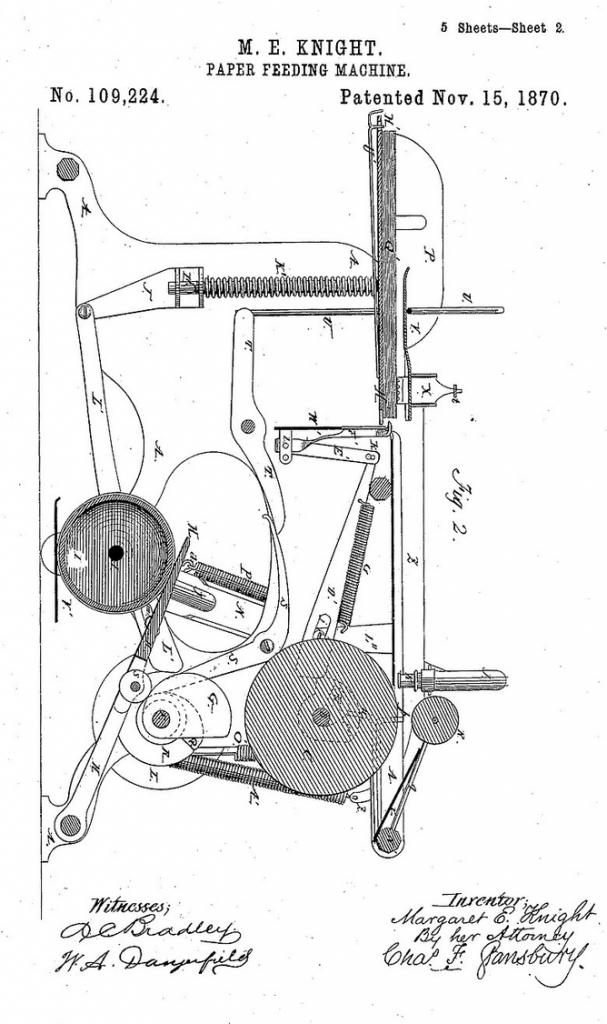
Margaret Knight Patent Illustration

She moved on through a series of jobs which gave her an appreciation of many different technologies and production processes and finally found herself at the Columbia Paper Company. Her job involved folding every paper bag by hand — a slow process and one with a high potential for human error. During her long working day (10 hour shifts, monotonously folding and gluing) she had ample opportunity to think about how to improve the process — and by night she’d sketch out her ideas in the boarding house where she was living. Within six months she’d managed to build a working prototype out of wood which could cut, fold and glue bags each time a crank was turned.

This time she tried to patent her idea, only to find someone had got there first, having stolen her concept. He’d seen the potential in the design and had decided to copy it and pass it off as his own. After all who would believe that a woman factory worker could produce something so clever and complex?

But Margaret Knight was tough as well as clever; she’d kept all her working drawings and was not going to surrender meekly. Although it cost her most of her savings she was vindicated; in 1871 she was granted US Patent 116842, the first woman in the country to hold a patent. It may have been an improvement innovation but its impact was radical. Her invention revolutionized the paper bag industry by replacing the work of thirty people with one machine. It provided the ‘dominant design’ around which others would innovate, and created the model for the paper shopping bags we still use today.

Or how about Betty Nesmith Graham, a single mother working as a secretary in the Dallas headquarters of the Texas Bank. Which meant spending much of her time typing (or to be more precise, correcting the mistakes she’s made by re-typing). In her frustration she wondered if there was a way to cover up the mistakes, somehow magically clean the paper and type over it once again. After all, when she was painting (her hobby when she got time for it) she’d not spend ages rubbing out or throwing away the canvas so she could start again. She’d just paint over what she’d done wrong, fix it, move on.
She began to experiment at home on the kitchen table. Took a small brush, mixed up some egg white and a little of her precious white tempera paint in the kitchen blender. Played around until the consistency felt right, then dipped her smallest water colour brush into the mixture and painted carefully over a line of typing on the polite letter informing her that her phone bill was overdue for payment. The black key strokes faded beneath the white, the page became blank again ready for someone to type a new line on it.

Back at work the next day it didn’t take her long to make another mistake, her fingers overstepping themselves as she tried to type faster. But this time she carefully wound the roller up a few notches, took a nail varnish pot filled with her concoction from her handbag and painted over the mistake. After a couple of minutes she picked up the mistaken page — and saw her mis-typed words erased, the letter ready for her to try again.

That was the birth of what became ‘Liquid Paper’; it wasn’t an easy journey from idea to successful business but by 1979 over 25 million bottles/year were being made and she employed over 200 people. At this high point she decided to sell the (by now very profitable) business to the Gillette Corporation for $47.5million.

Tupperware

Or Brownie Mae Wise, another single mother trying to keep her family afloat and working as a demonstrator for Stanley Home Products, selling door-to-door. They began experimenting with a new idea, hosting demonstration events in people’s houses and she took to it like a natural. Her social skills coupled with her sales gift meant that pretty soon she was the top agent with much of her success coming with a new product the company had just taken on for a client — Tupperware. She pioneered the idea of social marketing, turning the Tupperware party into a model which transformed the Tupperware business and led to her becoming a powerful role model for women of her time. In 1954 she was featured as the first woman on the cover of Business Week magazine.

With examples like these we clearly need to expand our picture of what makes an entrepreneur. We should, for example, add Dr Govindar Venkataswamy who worked all his life as a surgeon in India specializing in cataract treatment; on retirement he set himself the goal of bringing this operation within the reach of the rural poor in his native state of Tamil Nadu. To do so he needed to find a way of bringing down the cost from around $300 in a city hospital to $30, without compromising safety. He found an answer not in the world of healthcare but by adopting ideas from McDonalds, the fast-food business. The model for his Aravind eye care system worked, the average cost of the operation today is $25, it has one of the best safety records in the world and around 15million people can see who would otherwise have gone blind.

Or how about students Andrea Sreshta and Anna Stork who founded Luminaid as a response to the 2010 Haiti earthquake? They realized that there was a requirement for something beyond food, water and basic first-aid supplies — light. For vulnerable communities, access to a safe, waterproof and transportable light source, which can be powered by the sun could be valuable. Accessible lighting provides a sense of security and community; beyond this, light facilitates study into the evening, providing much-needed access to education for disadvantaged children across settings around the world. Since 2010 over 250,000 LuminAID lanterns and chargers have been distributed by major aid agency partners to those in need, 50,000 of which were sponsored directly through their Give Light, Get Light program.

People like them are also change agents, driven by the desire not for money but for impact, making the world a better place.

And what about the quiet unsung heroes who work away in organizations and who come up with new ideas and take them forward — they too qualify as change agents. People like George Laurer, working for IBM in the early 1970s. One Sunday afternoon he walked across the lawn to tell his neighbor Paul McEnroe (who also happened to be his boss) “I didn’t do what you asked.”

What McEnroe had asked for was a circular bullseye optical scanning code which could be printed on labels. This needed to be compatible with the scanners being installed in supermarkets for which IBM was developing technology. But Laurer could see the problem — printed circles in a high speed press risked blurring at the edges and misinformation. So instead he devised his own code, a pattern of vertical stripes, readable even under difficult lighting conditions.

McEnroe told him to go ahead with preparing his presentation for the next day anyway but didn’t exactly offer warm support, telling Laurer “…there’s nothing I can do about it now….you make the presentation but if it’s not accepted it’s going to be your butt not mine”

Fortunately for George — and IBM — the idea was accepted; it was the bar code strip, formally known as the Universal Product Code — UPC — which provides us with a continuing reminder of the power of such ‘quiet innovation’.

Another group we ought to add into our (now very large) community — user innovators. For many people in all walks of life frustration is often the Mother of Invention. They want a solution to a problem which is bugging them and they’re not afraid to experiment and hack their way to a solution which works. Very often they aren’t particularly interested in spreading their ideas more widely but if someone else can benefit then that’s OK. Examples include farmers improvising add-ons and fixes to their equipment or patients and their carers coming up with solutions to make living with chronic disease more comfortable.

For housewife Valerie Gordon-Hunter back in 1947 the frustration was the endless process of washing nappies for her three children and her dream of finding some kind of disposable version. She developed her own solution– the Paddi — made out of old nylon parachutes, tissue wadding and cotton wool which she sewed together at her kitchen table.

At the same time across the Atlantic Marion Donovan came up with the idea of a cover which would stop the contents of a dirty nappy from soiling surrounding clothes or bed linen. Once again the target was reducing the superhuman effort involved in constantly washing clothing; her invention was called the ‘Boater’ because of its resemblance to a boat. It involved a shower curtain as raw material sewn into a pair of pants which, with the addition of snap fasteners to replace safety pins, kept the nappy in place without soiling the surrounding clothes or bed sheets. And she hit on the idea of some kind of absorbent insert which could be disposable — experimenting with various mixes of cotton wool and once again nylon parachute material.

Disposable Diapers

Today’s market for disposable nappies is estimated at around $10bn.

Sometimes it’s a matter of inspired improvisation. On a hot July day in 1904 at the St Louis World’s fair the ice cream seller next to Ernest Hamwi’s waffle stall hit the nightmare scenario — a queue of people wanting ice cream and no dishes left to sell it in. But Ernest came to the rescue — he had the idea of rolling one of his waffles into a cone shape, and one of the great ideas in the food world was born.

Improvisation of this kind is often something which is born out of crisis; it’s useful to remember the Apollo 13 space mission which had the world holding its breath in the aftermath of the radio message “Houston, we’ve had a problem.” At 2am on April 14, 1970 the failure of a major part of the electrical system suddenly put the crew’s lives at risk. With one of its main oxygen tanks ruptured and with the clock ticking away the teams on the ground and in the module had to improvise solutions fast. They needed to secure enough breathable oxygen for three men in a capsule only designed to take two — and so built an air purifier system using plastic covers from their flight plans, plastic bags, some sticky tape and a soggy sock!

The same kind of crisis-driven improvisation led Willem Kalff to develop the world’s first kidney dialysis machine. Because he was working during wartime under Nazi occupation in the Netherlands his was something of a ‘scrapyard challenge’; he built his machine out of salvaged car and washing machine parts, orange juice cans and sausage skins.

It’s the same kind of spirit that led to ‘citizen innovators’ developing a wide range of apps to help deal with the aftermath of the 2010 Haiti earthquake; their solutions included crisis mapping, reuniting displaced families, mobilising an alternative banking system to help distribute aid and crowdsourcing design information to feed 3D printers creating urgently needed medical spare parts.

We could go on but the point is clear. Innovation– creating value from an idea — is something which all sorts of people do in many different contexts. Peter Drucker’s famous comment is helpful here; ‘innovation is what entrepreneurs do’. We’re familiar with the start-up but that’s only one of the many places in which we might find ‘entrepreneurs’ — people who make change happen.

In fact we are all potentially entrepreneurs — think about situations like these in your own life. Standing in a queue and turning over in your mind the thought that ‘there has to be a better way…’ You’re beginning the same kind of mental journey of innovation, frustration prompting you to think of alternative solutions. Or look around your home and list all the little hacks you’ve put in place to solve problems or make life easier. Innovation, once again.

We shouldn’t be surprised; after all this is something human beings have been doing for thousands of years. Our survival as a species rather depended on being able to come up with now solutions to the problem of not being eaten or having enough to eat ourselves. We’re not big or fast — but we do have half a kilogram of grey stuff inside our heads which is pretty useful at coming up with new ideas.

This isn’t just semantics. At a time when we need as much innovation as we can get (never mind trying to survive a pandemic we also have a planet whose future is in considerable doubt unless we change things pretty fast and radically) mobilizing the skills of innovation is an urgent priority. Not for nothing are efforts being made to introduce the core skills of entrepreneurial behavior to everyone from kindergarten kids through to care home residents.

And the good news is that we have learned a lot about what those skills involve; far from entrepreneurs being somehow magically different (like unicorns) we now understand the core elements in the craft. Turning ideas into value is about learning to make a journey and we have a map for that which has been drawn from over 100 years of experience of success (and failure) — a kind of supercharged ‘Trip Advisor’ or Hitchhiker’s Guide.

It still helps to have a growth mindset and plenty of ‘grit’ — being prepared to persevere in the face of obstacles and learning to manage failure as part of the process. But thinking about how to develop our skills as an ‘everyday entrepreneur’ might be a good resolution for kicking off the 2022 new year.

Image credits: Pixabay, USPTO, Unsplash

Subscribe to Human-Centered Change & Innovation WeeklySign up here to get Human-Centered Change & Innovation Weekly delivered to your inbox every week.

Collaborative Innovation for Social Good

Collaborative Innovation for Social Good

GUEST POST from Chateau G Pato

In today’s interconnected world, the challenges faced by society are multifaceted and demand solutions that are both innovative and inclusive. Collaborative innovation has emerged as a powerful approach to tackle such challenges, harnessing the collective expertise, creativity, and resources of diverse stakeholders. By working together, organizations, governments, and communities can co-create solutions that drive positive social change. This article explores the concept of collaborative innovation for social good and examines two inspiring case studies that demonstrate its potential.

Case Study 1: The Global Vaccine Alliance (Gavi)

Gavi, the Vaccine Alliance, represents a quintessential example of collaborative innovation aimed at addressing global health disparities. Founded in 2000, Gavi brings together public and private sectors in a unique partnership model to improve access to vaccines for children in the world’s poorest countries.

By leveraging the strengths of a diverse array of partners—including the World Health Organization, UNICEF, the World Bank, and the Bill & Melinda Gates Foundation—Gavi has successfully delivered vaccines to over 760 million children, preventing more than 13 million deaths. This collaborative effort showcases the power of aligning cross-sector agendas, sharing resources, and implementing a community-centered approach to achieve a common social good: improving global health outcomes.

Gavi’s success highlights the importance of sustainable financing, innovative supply chains, and data-driven strategies in achieving its mission. Through constant collaboration and adaptation, Gavi has proven that collective effort can overcome the most daunting of societal challenges.

Case Study 2: OpenIDEO’s Challenge Model

OpenIDEO, a collaborative platform created by the global design company IDEO, leverages human-centered design to tackle social issues through inclusive innovation challenges. OpenIDEO’s model invites individuals, organizations, and communities worldwide to contribute ideas and prototype solutions to pressing social challenges, fostering a culture of crowd-powered innovation.

One noteworthy project from OpenIDEO involved a challenge to find innovative solutions for enhancing economic opportunities for refugees. This challenge invited contributions from designers, NGOs, technologists, refugees themselves, and other stakeholders. The collaborative process not only generated a wealth of diverse ideas but also facilitated the formation of partnerships across sectors, leading to scalable impact through the development of job training programs, digital platforms, and supportive policy frameworks.

OpenIDEO’s model emphasizes the importance of iterative prototyping, feedback loops, and inclusive participation, demonstrating how crowdsourcing innovation can spark transformative change and drive social good.

Conclusion

Collaborative innovation for social good is not merely a trend but an essential strategy for addressing the complex challenges facing our global community. As demonstrated by Gavi and OpenIDEO, initiatives that harness the power of collective wisdom and effort can achieve remarkable outcomes. By fostering partnerships, breaking down silos, and embracing inclusivity, we can create solutions that not only meet immediate needs but also promote long-term societal well-being.

To further explore how you can get involved in collaborative innovation for social good, visit OpenIDEO and learn more about Gavi at Gavi’s website. Together, we can drive positive change and make a significant difference in the world.

Bottom line: Futurology is not fortune telling. Futurists use a scientific approach to create their deliverables, but a methodology and tools like those in FutureHacking™ can empower anyone to engage in futurology themselves.

Image credit: Pexels

Subscribe to Human-Centered Change & Innovation WeeklySign up here to get Human-Centered Change & Innovation Weekly delivered to your inbox every week.

The Impact of Leadership on Innovation Culture

The Impact of Leadership on Innovation Culture

GUEST POST from Art Inteligencia

In today’s fast-paced business environment, innovation is not merely a desirable feature but a critical factor for survival. Organizations often tout their dedication to innovation, but the difference between those that succeed and those that fail is frequently the presence of effective leadership. Leaders play a pivotal role in shaping an innovation culture, influencing it from the top-down dynamics of the organization.

Leadership: The Catalyst of Innovation

Leadership is the cornerstone of innovation culture. Effective leaders encourage a mindset of curiosity and experimentation, ensuring that innovation becomes embedded in the very fabric of the organization. They provide vision, create safe environments for taking calculated risks, and celebrate both successes and failures as essential learning experiences. By doing so, they not only inspire but also empower their teams to innovate consistently.

Case Study 1: 3M’s Leadership Philosophy

3M is often cited as a hallmark of innovation culture, and its leadership philosophy is central to this reputation. From the company’s early days, leadership at 3M promoted an ethos of research and development freedom. William L. McKnight, a former executive, was instrumental in cultivating this atmosphere. He famously championed a “15% rule,” allowing employees to dedicate a portion of their working hours to self-directed projects.

This practice led to the development of iconic products such as the Post-it Note. McKnight’s leadership created a fabric of innovation deeply woven into the culture of 3M. By empowering employees with autonomy and trust, leadership at 3M fostered a prolific environment where innovation could thrive organically.

Case Study 2: Google’s Innovation Ecosystem

Google’s approach to sustaining an innovation-driven culture is another exemplary model. Under the visionary leadership of founders Sergey Brin and Larry Page, and currently Sundar Pichai, Google created an ecosystem where creativity and “moonshot thinking” are not just encouraged but are critical to its operations. This is embodied in their “20% time” policy, similar to 3M’s philosophy, which allows employees to spend a portion of their time on projects they are passionate about.

This leadership-driven policy led to the creation of groundbreaking products like Gmail and AdSense. Beyond policies, Google’s leadership invests in creating physical and cultural environments that spark creativity and cross-pollination of ideas, from its open office spaces to the innovative use of technology. Leadership at Google orchestrates an intricate balance between freedom and structured innovation paths, ensuring consistent alignment with the company’s strategic goals.

Cultivating a Culture of Continuous Innovation

The leaders who enact transformational change within organizations are those who tailor their strategies to foster a culture of continuous innovation. They encourage diverse ideas, cross-departmental cooperation, and maintain robust feedback mechanisms. Crucially, these leaders recognize and reward innovative behavior, setting a precedent that amplifies throughout the organization.

Innovation is not solitary; it is a collaborative endeavor that demands a supportive culture. Leaders are the architects of these environments, and without their active engagement, innovation can stagnate. By observing and learning from successful models such as 3M and Google, other organizations can glean insights into crafting environments where innovation is not only possible but inevitable.

In conclusion, the impact of leadership on innovation culture is profound and unequivocal. Leaders must embody and propagate the values of innovation across every facet of the organization, ensuring that it is consistently nurtured and valued. It is through purposeful leadership that organizations can cultivate a thriving innovation culture poised for long-term success.

Bottom line: Futurology is not fortune telling. Futurists use a scientific approach to create their deliverables, but a methodology and tools like those in FutureHacking™ can empower anyone to engage in futurology themselves.

Image credit: Pixabay

Subscribe to Human-Centered Change & Innovation WeeklySign up here to get Human-Centered Change & Innovation Weekly delivered to your inbox every week.

The Impact of Customer Experience on Brand Loyalty

The Impact of Customer Experience on Brand Loyalty

GUEST POST from Chateau G Pato

In a world awash with choices and a never-ending stream of new brands vying for attention, the customer experience (CX) has emerged as the key differentiator that can significantly impact brand loyalty. From the immediacy of online interactions to the nuanced dynamics of in-store engagement, understanding and enhancing customer experience is crucial for building long-lasting relationships with customers. In this article, we’ll explore how brands leverage superior customer experiences to foster loyalty, illustrated through two compelling case studies.

Case Study 1: The Ritz-Carlton

The Ritz-Carlton stands as a benchmark in the hospitality industry when it comes to delivering exceptional customer experiences. At the heart of their service philosophy is a simple, yet powerful credo: “We are Ladies and Gentlemen serving Ladies and Gentlemen.” But it is not just a tagline; it’s a commitment to ensuring that every interaction is magical for their guests.

One of the keys to The Ritz-Carlton’s success in driving brand loyalty is their focus on personalizing guest experiences. Employees are empowered to spend up to $2,000 without management approval to resolve a guest issue, which demonstrates their commitment to ensuring customer satisfaction. For instance, there is a famous story of a Ritz-Carlton staff member noticing a child forgot their stuffed toy at the hotel. The staff not only returned the toy but also included some photos of the toy’s “extended vacation” to delight the child. Such efforts cultivate emotional connections and drive brand loyalty, making guests feel valued and appreciated.

Case Study 2: Amazon

Amazon has revolutionized the retail landscape with its relentless focus on the customer experience. From the very beginning, CEO Jeff Bezos established a culture that prioritized customer-centricity above all else, often at the expense of short-term profits.

A quintessential example of Amazon’s commitment to customer experience is their seamless and intuitive user interface, which makes shopping an effortless experience. The introduction of features like one-click purchasing and personalized recommendations has greatly enhanced the shopping experience, increasing convenience and satisfaction. But perhaps the most significant impact on brand loyalty comes from Amazon Prime. By offering benefits such as free shipping, exclusive discounts, and original content, Amazon has created a robust ecosystem that keeps customers engaged and loyal. As a result, Amazon Prime members spend significantly more annually than non-members, demonstrating the strong link between a superior customer experience and brand loyalty.

Conclusion

As the cases of The Ritz-Carlton and Amazon illustrate, brands that excel in customer experience often see a corresponding rise in customer loyalty. Whether it’s through personalized service or continuous innovation, companies that invest in understanding and enhancing their customer experience stand a better chance of maintaining their competitive advantage and nurturing lasting relationships with their customers. In an era where customer expectations are higher than ever, focusing on the customer experience isn’t just a business strategy; it’s a necessary commitment to sustain brand loyalty in the modern marketplace.

Bottom line: Futurology is not fortune telling. Futurists use a scientific approach to create their deliverables, but a methodology and tools like those in FutureHacking™ can empower anyone to engage in futurology themselves.

Image credit: Wikimedia Commons

Subscribe to Human-Centered Change & Innovation WeeklySign up here to get Human-Centered Change & Innovation Weekly delivered to your inbox every week.

Top 100 Innovation and Transformation Articles of 2021

Top 100 Innovation and Transformation Articles of 2021

2021 marked the re-birth of my original Blogging Innovation blog as a new blog called Human-Centered Change and Innovation.

Many of you may know that Blogging Innovation grew into the world’s most popular global innovation community before being re-branded as InnovationExcellence.com and being ultimately sold to DisruptorLeague.com.

Thanks to an outpouring of support I’ve ignited the fuse of this new multiple author blog around the topics of human-centered change, innovation, transformation and design.

I feel blessed that the global innovation and change professional communities have responded with a growing roster of contributing authors and more than 15,000 newsletter subscribers.

To celebrate we’ve pulled together the Top 100 Innovation and Transformation Articles of 2021 from our archive of over 700 articles on these topics.

We do some other rankings too.

We just published the Top 40 Innovation Bloggers of 2021 and as the volume of this blog grows we may bring back a monthly ranking to complement this annual one.

But enough delay, here are the 100 most popular innovation and transformation posts of 2021.

Did your favorite make the cut?

1. All Leadership is Change Leadership – by Randy Pennington

2. Next Generation Loyalty – Part One – by Braden Kelley

3. Visual Project Charter™ – 35″ x 56″ (Poster Size) and JPG for Online Whiteboarding – by Braden Kelley

4. Where Do Innovation Strategies Usually Go Wrong? – by Jesse Nieminen

5. Black Friday Shows No Loyalty – by Braden Kelley

6. The Fail Fast Fallacy – by Rachel Audige

7. Top 40 Innovation Bloggers of 2020 – by Braden Kelley

8. What is Human-Centered Change? – by Braden Kelley

9. 10 Clever Ways to Stop Ideation Bullies from Hogging Your Brainstorming Sessions – by Howard Tiersky

10. 50 Cognitive Biases Reference – Free Download – by Braden Kelley

11. Free Customer Experience Maturity Assessment – by Braden Kelley

12. The Human-Centered Change Methodology – by Braden Kelley

13. Innovation vs. Invention vs. Creativity – by Braden Kelley

14. America Drops Out of the Ten Most Innovative Countries – by Braden Kelley

15. The One Movie All Electric Car Designers Should Watch – by Braden Kelley

16. Nine Innovation Roles – by Braden Kelley

17. No Regret Decisions: The First Steps of Leading through Hyper-Change – by Phil Buckley

18. Free Innovation Maturity Assessment – by Braden Kelley

19. Myths About Physician Entrepreneurs – by Arlen Meyers

20. Human-Centered Change – Free Tools – by Braden Kelley

21. The Five Keys to Successful Change – by Braden Kelley

22. Discipline Has a Role in Innovation – by Jesse Nieminen

23. Advances in the Management of Worthless Meeting Syndrome – by Arlen Meyers

24. 550 Quote Posters – by Braden Kelley

25. The Jobs-to-be-Done Playbook – by Braden Kelley

26. We Need a More Biological View of Technology – by Greg Satell

27. Free Human-Centered Change Tools – by Braden Kelley

28. Stoking Your Innovation Bonfire – by Braden Kelley

29. The Pyramid of Results, Motivation and Ability – by Braden Kelley

30. Experience Thinking – The Next Evolution for Design Thinking – by Anthony Mills


Build a common language of innovation on your team


31. Scaling Innovation – The What, Why, and How – by Jesse Nieminen

32. Charting Change – by Braden Kelley

33. The Experiment Canvas™ – 35″ x 56″ (Poster Size) – by Braden Kelley

34. To Change the World You Must First Learn Something About It – by Greg Satell

35. Digital Transformation Virtual Office Hours – Session One – by Braden Kelley

36. Lead Innovation, Don’t Manage It – by Arlen Meyers

37. Are doctors wasting their time on entrepreneurship? – by Arlen Meyers

38. What is design thinking? – EPISODE FIVE – Ask the Consultant – by Braden Kelley

39. Zoom Tutorial – Amazing New PowerPoint Background Feature – by Braden Kelley

40. COVID-19 Presents an Opportunity to Create an Innovation Culture – by Pete Foley

41. Increasing Organizational Agility – by Braden Kelley

42. Innovation Requires Going Fast, Slow and Meta – by Greg Satell

43. Remote Project Management – The Visual Project Charter™ – by Braden Kelley

44. Is innovation everyone’s job? – by Braden Kelley

45. What is your level of Innovation Maturity? – by Braden Kelley

46. Flaws in the Crawl Walk Run Methodology – by Braden Kelley

47. Innovation Teams Do Not Innovate – by Janet Sernack

48. We’re Disrupting People Instead of Industries Now – by Greg Satell

49. Don’t Forget to Innovate the Customer Experience – by Braden Kelley

50. Change Management Needs to Change – by Greg Satell


Accelerate your change and transformation success


51. Everyone hates to fail, why do you? – by Janet Sernack

52. Going with the Flow – by John Bessant

53. Can You Be TOO Strategic? – by Howard Tiersky

54. Competing in a New Era of Innovation – by Greg Satell

55. Fast Company is Wrong – by Braden Kelley

56. A New Age Of Innovation and Our Next Steps – by Greg Satell

57. Avoid the Addition Bias – by Paul Sloane

58. Visualizing Project Planning Success – by Braden Kelley

59. Innovation Ecosystems and Information Rheology – by Arlen Meyers

60. Rise of the Evangelist – by Braden Kelley

61. Creating 21st Century Transformational Learning – by Janet Sernack

62. Re-Skilling and Upskilling People & Teams – by Janet Sernack

63. Creating a Movement that Drives Transformational Change – by Braden Kelley

64. How to Scale Your Culture – by Arlen Meyers

65. A Trigger Strategy for Driving Radical, Transformational Change – by Greg Satell

66. Human-Centered Innovation Toolkit – by Braden Kelley

67. You Must Play and Experiment to Create and Innovate – by Janet Sernack

68. Managing Both the Present and the Future – by Janet Sernack

69. Why Change Failure Occurs – by Greg Satell

70. Developing a Future-Fitness Focus – by Janet Sernack

71. Using Intuition to Drive Innovation Success – by Braden Kelley

72. The Academic Intrapreneur Dossier – by Arlen Meyers

73. The Rise of Employee Relationship Management (ERM) – by Braden Kelley

74. An Example of Successful Alchemy – by John Bessant

75. The Dreaded Perfect Entrepreneur – by Arlen Meyers

76. Should intrapreneurs really ask for forgiveness and not permission? – by Arlen Meyers

77. Don’t Stop Thinking About Tomorrow – by Robert B. Tucker

78. Importance of Long-Term Innovation – by Greg Satell

79. Co-creating Future-fit Organizations – by Janet Sernack

80. What you should learn from the Google Health failure – by Arlen Meyers


Get the Change Planning Toolkit


81. Teaching to Win the 4th Industrial Revolution – by Arlen Meyers

82. Catalysing Change Through Innovation Teams – by Janet Sernack

83. Innovation and the Scientific Method – by Jesse Nieminen

84. Being Too Focused on the Test is Dangerous – by Arlen Meyers

85. Architecting the Organization for Change – by Braden Kelley

86. Healthcare Jugaad Innovation of a 17-Year-Old – by Braden Kelley

87. New Capability Mapping Tools for Business Architects – by Braden Kelley

88. How can I create continuous innovation in my organization? – EPISODE TWO – Ask the Consultant – by Braden Kelley

89. Thank You for Your Thinkers50 Nominations – by Braden Kelley

90. Preparing for Organizational Transformation in a Post-COVID World – by Greg Satell

91. Why Change is Hard – by Braden Kelley

92. Building a Better Change Communication Plan – by Braden Kelley

93. What is digital transformation? – EPISODE THREE – Ask the Consultant – by Braden Kelley

94. ACMP Standard for Change Management® Visualization – 35″ x 56″ (Poster Size) – Association of Change Management Professionals – by Braden Kelley

95. Borrow an Idea from a Different Field – by Paul Sloane

96. How to Go From Nail It to Scale It – by Arlen Meyers

97. Innovation in the time of Covid – Satisfycing Organizations – by Pete Foley

98. Sickcare Culture of Conformity versus a Culture of Creativity – by Arlen Meyers

99. Start 2021 with a Free Innovation Audit (Now in Portuguese or English) – by Braden Kelley

100. Outsmarting Those Who Want to Kill Change – by Greg Satell

Curious which article just missed the cut? Well, here it is just for fun:

101. Why so much medical technoskepticism? – by Arlen Meyers

These are the Top 100 innovation and transformation articles of 2021 based on the number of page views. If your favorite Human-Centered Change & Innovation article didn’t make the cut, then send a tweet to @innovate and maybe we’ll consider doing a People’s Choice List for 2021.

If you’re not familiar with Human-Centered Change & Innovation, we publish 1-5 new articles every week focused on human-centered change, innovation, transformation and design insights from our roster of contributing authors and ad hoc submissions from community members. Get the articles right in your Facebook feed or on Twitter or LinkedIn too!

Editor’s Note: Human-Centered Change & Innovation is open to contributions from any and all the innovation & transformation professionals out there (practitioners, professors, researchers, consultants, authors, etc.) who have a valuable insight to share with everyone for the greater good. If you’d like to contribute, contact us.

Subscribe to Human-Centered Change & Innovation WeeklySign up here to get Human-Centered Change & Innovation Weekly delivered to your inbox every week.