Tag Archives: coaching

Feedback Giving Secrets

Feedback Giving Secrets

GUEST POST from David Burkus

A large part of doing your best work ever involves getting feedback on your performance. Feedback is how you know where to improve and where to build upon your strengths. Giving feedback is a requirement for unlocking greater performance, both individually and in teams.

But many leaders struggle to give feedback.

Sometimes this is because giving feedback, particularly constructive feedback is uncomfortable. It’s not fun to tell someone they’re under-performing. And sometimes it’s because the tactics leaders are taught to reduce that discomfort are—to put it bluntly—terrible. We’re told to combine positive and constructive criticism and sometimes even to “sandwich” in the constructive feedback around two pieces of praise.

But if you’ve ever tried this tactic, you know it doesn’t reduce the discomfort and it often makes the conversation less clear. So, don’t.

That’s the big secret to giving great feedback. Don’t mix messages. Give positive feedback and constructive feedback at different times and in different ways.

And in this article, we’ll review a few simple steps to make both positive and constructive feedback conversations less awkward and more productive.

Giving Positive Feedback

There are three keys to giving great positive feedback: 1) Do it right away, 2) Be specific, and 3) Explain why it matters.

Do It Right Away

The first key to giving great positive feedback is to do it right away. As soon as you notice someone’s exceptional actions, praise them for it. Don’t document and wait until the next check-in or performance review, comment on the behavior by the end of that day. The more quickly you offer someone praise, the more they understand that their performance matters and that they matter. Sometimes leaders want to praise publicly, so leaders will wait for the next team-wide meeting and praise a few different people. But that diminishes the importance of the individual actions by delaying the praise. And besides, there is no rule that says you can only praise someone’s actions once.

Be Specific

The second key to giving great positive feedback is to be specific. Comment on the specific behavior you observed as well the specific situation they were in. And get specific about why their action or idea was so good. While you should give your people praise like “I’m proud of you” and “You’re awesome,” too much vague praise starts to feel stale and insignificant. So, when you’re giving feedback on a specific action, be as specific as possible. As a bonus, most of the time, when a specific action is praised, people want to do more of it. You may get more of what you measure, but you always get more of what you praise.

Explain Why It Matters

The third key to giving great positive feedback is to explain why it matters. This isn’t about just saying “I really appreciated that.” Instead, it’s about connecting the specific action you’re praising to the larger whole of team or organizational success. People want to know the work they do matters, but it’s often hard to see how their day-to-day tasks fit into the bigger picture and lead to organizational success. So, the best time to help them see the whole team and the significance of their role in it is when you’re praising the actions that lead to team-wide wins.

Giving Constructive Feedback

Likewise, there are three keys to giving great constructive feedback:

  1. Comment on behavior, not intent,
  2. Co-create solutions, and
  3. Close with potential

Comment On Behavior

The first key to giving great constructive feedback is to comment on the behavior—that’s it. Comment solely on the action you observed or words you heard. Many times, when giving constructive criticism we guess at the rationale behind the behavior. This is a distraction. We’re not mind readers; we’re going to guess wrong from time to time. And when we do (or even if we guess right and the other person is in denial) we can end up moving the conversation away from the behavior that needs to change and into an unproductive argument about someone’s mindset. If the goal is to change behavior, focus on behavior.

Co-Create Solutions

The second key to giving great constructive feedback to is co-create solutions. Once you’ve commented on the behavior, and maybe even explained its effect on the rest of the team, it’s time to find a better way to behave moving forward. However, often leaders tend to just dictate what the person should do. But if you want the behavior change to stick, you have to involve the person responsible for the action. You have to co-create a solution. Instead of telling them what to do, take the time to ask questions that guide and direct them toward finding a better way to behave. You’ll get more buy-in and you’ll increase their autonomy and hence motivation to change.

Close With Potential

The third key to giving great constructive feedback is to close with potential. End on a high note. But more importantly, end on a note that emphasizes your belief in their ability to improve. In perhaps one of the best studies on teacher feedback among students, researchers found that 19 simple words at the top of the paper had a dramatic effect on whether students took the time to revise and improve. Those words: “I’m giving you this feedback because I have very high expectations and I know that you can reach them.” If leaders did the same at the closing moments of a constructive feedback conversation, that would dramatically improve the chances of people improving.

Part of the reason giving feedback is so uncomfortable for leaders is that it feels like judging people and not coaching them. And that’s why the closing moments of feedback are so important, whether it’s closing positive feedback with an explanation of why those actions are appreciated or closing constructive feedback with a comment on that person’s potential. Those final moments of the conversation make the difference between feedback that can be readily applied and feedback that’s quickly discarded. Giving feedback is about the behavior, but it’s also about why it’s so important to improve. Great feedback empowers everyone to do their best work ever.

Image credit: Pexels

Originally published at https://davidburkus.com on January 17, 2022.

Subscribe to Human-Centered Change & Innovation WeeklySign up here to get Human-Centered Change & Innovation Weekly delivered to your inbox every week.

Top 10 Human-Centered Change & Innovation Articles of November 2024

Top 10 Human-Centered Change & Innovation Articles of November 2024Drum roll please…

At the beginning of each month, we will profile the ten articles from the previous month that generated the most traffic to Human-Centered Change & Innovation. Did your favorite make the cut?

But enough delay, here are November’s ten most popular innovation posts:

  1. A Shared Language for Radical Change — by Greg Satell
  2. Leadership Best Quacktices from Oregon’s Dan Lanning — by Braden Kelley
  3. Navigating Uncertainty Requires a Map — by John Bessant
  4. The Most Successful Innovation Approach is … — by Howard Tiersky
  5. Don’t Listen to These Three Change Consultant Recommendations — by Greg Satell
  6. What We Can Learn from MrBeast’s Onboarding — by Robyn Bolton
  7. Does Diversity Increase Team Performance? — by David Burkus
  8. Customer Experience Audit 101 — by Braden Kelley and Art Inteligencia
  9. Daily Practices of Great Managers — by David Burkus
  10. An Innovation Leadership Fable – Wisdom from the Waters — by Robyn Bolton

BONUS – Here are five more strong articles published in October that continue to resonate with people:

If you’re not familiar with Human-Centered Change & Innovation, we publish 4-7 new articles every week built around innovation and transformation insights from our roster of contributing authors and ad hoc submissions from community members. Get the articles right in your Facebook, Twitter or Linkedin feeds too!

SPECIAL BONUS: While supplies last, you can get the hardcover version of my first bestselling book Stoking Your Innovation Bonfire for 51% OFF until Amazon runs out of stock or changes the price. This deal won’t last long, so grab your copy while it lasts!

Build a Common Language of Innovation on your team

Have something to contribute?

Human-Centered Change & Innovation is open to contributions from any and all innovation and transformation professionals out there (practitioners, professors, researchers, consultants, authors, etc.) who have valuable human-centered change and innovation insights to share with everyone for the greater good. If you’d like to contribute, please contact me.

P.S. Here are our Top 40 Innovation Bloggers lists from the last four years:

Subscribe to Human-Centered Change & Innovation WeeklySign up here to get Human-Centered Change & Innovation Weekly delivered to your inbox every week.

Leadership Best Quacktices from Oregon’s Dan Lanning

Leadership Best Quacktices from Oregon's Dan Lanning

by Braden Kelley

For the first time since 2012 (a couple years before Marcus Mariota won the Heisman Trophy) the University of Oregon football team is ranked number one in the NCAA football rankings and in the pole position in the race to the national championship playoff picture.

Make no mistake, this year’s Oregon Ducks’ football team is full of talent, but in sports like in business, the difference between a winner and a loser is often the character of its leadership and culture.

In the ever-changing landscape of college athletics, the role of a coach extends far beyond strategizing plays and winning games. It involves shaping young athletes into well-rounded individuals equipped not only for their sports careers but for life. Dan Lanning, head coach of the Oregon Ducks football team, exemplifies this human-centered leadership. His approach demonstrates qualities that every leader (whether in sports, business, or any other field) can learn from and apply. Here, as a passionate advocate of human-centered change and innovation, I’ll explore the key facets of Coach Lanning’s leadership that make him effective and inspiring while building a winning culture.

1. Empathy and Understanding

Coach Dan Lanning excels in creating an environment that prioritizes empathy and understanding. He recognizes that every player is unique and has different motivations, challenges, and aspirations. This individual focus allows him to connect with players on a personal level, fostering an atmosphere of trust and mutual respect. Through active listening and consistent communication, Lanning ensures that his athletes feel heard and valued, both on and off the field.

2. Commitment to Development

A true leader invests in the growth and development of their team members. Coach Lanning adopts a holistic approach to player development, emphasizing education, character building, and life skills alongside athletic prowess. By encouraging his players to excel academically and engage with their communities, Lanning instills a sense of responsibility and maturity. This well-rounded development is crucial in preparing athletes for the varied challenges of life.

3. Cultivating a Winning Mindset

While empathy and development are central to Lanning’s approach, he also understands the importance of instilling a competitive spirit. Lanning is adept at fostering a winning mindset among his players without compromising sportsmanship and integrity. He emphasizes setting ambitious goals, maintaining discipline, and embracing the process. This mentality not only contributes to the team’s success on the field but also prepares athletes to tackle future obstacles with resilience and determination. You’ll notice that even in victory, the team’s focus is brought back to the process, brought back to reinforcing a commitment to growth.

4. Innovation and Adaptability

In a rapidly evolving sports landscape, innovation and adaptability are key. Coach Lanning leads by example in embracing change and encouraging creative problem-solving. Whether it’s integrating new training technologies or developing novel game strategies, Lanning shows a willingness to experiment and adapt. This not only keeps his team competitive but also inspires his players to think outside the box and continually evolve. In the video we pick up a team meeting conversation going into the game where they are talking about looking for an opportunity to use a creative formation and play call to steal a first down, and then they perfectly executed it in the game to steal a first down.

5. Building a Strong Team Culture

Coach Lanning understands that success in sports is fundamentally a team effort. He places great emphasis on building a cohesive and inclusive team culture where every member feels they belong. By fostering collaboration and unity, Lanning creates a support system where players are encouraged to look out for each other and celebrate each other’s successes. This strong sense of community enhances team morale and motivates players to perform at their best.

6. Leading by Example

Finally, great leaders lead by example, and Dan Lanning is no exception. His work ethic, commitment, and positive attitude serve as a powerful model for his players. Lanning’s transparency and humility encourage an open dialogue where athletes feel comfortable contributing their own ideas and perspectives. This participative leadership style not only empowers players but also reinforces the collective pursuit of excellence.

Conclusion

Dan Lanning’s greatness as a leader is not measured solely by his achievements with the Oregon Ducks but by the profound impact he has on his players’ lives. His human-centered approach demonstrates that effective leadership is about nurturing potential, fostering growth, and enabling individuals to exceed their expectations. As we consider leadership in any field, Lanning’s example reminds us of the transformative power of empathy, innovation, and community.

And finally, Go Ducks!

p.s. Be sure and follow both my personal account and the Human-Centered Change and Innovation community on LinkedIn.

Image credits: Wikimedia Commons

Subscribe to Human-Centered Change & Innovation WeeklySign up here to get Human-Centered Change & Innovation Weekly delivered to your inbox every week.

Your Ability to Innovate Determined By Your Ability to Pause

Your Ability to Innovate Determined By Your Ability to Pause

GUEST POST from Janet Sernack

Many of my coaching clients have recently shared their struggles with feeling tired, emotionally overwhelmed, and cognitively overloaded and are close to burnout.  They attribute these issues to the pervasive and addictive nature of technology, exacerbated by the pandemic and divisive global conflicts, accelerating change and the rise of AI and hybrid work. As a result, many have retreated and frozen into a state of habitual, reactive ‘busyness.’ This affects their overall emotional, physical, and mental health and wellness. It also inhibits their ability to focus, create, invent and innovate and restricts their optimism, hope, and positivity about their future in an unstable and uncertain world.

The Coaching Opportunity

Coaching creates a unique opportunity to partner with people to develop their pause-power to identify the transformative actions to reverse this pervasive phenomenon to flourish in a world of unknowns.

A coaching session usually serves as a first step towards cultivating the pause-power needed to stop, observe, reflect and take valuable time out to rest, replenish, re-energize and reboot. This allows people to courageously notice, attune to, and express their true feelings and thoughts, to disrupt, dispute and deviate them to develop the pause-power required to heal and provide relief, hope and optimism for a better future.

Everyone must cultivate intentional pause-power to empower them to observe and understand their inner and outer worlds. This practice helps them remove distractions, stop multitasking, and break free from the ‘busyness’ that depletes their cognitive, emotional, and visceral resources, putting them in the driver’s seat of their mental and emotional well-being.

Self-reflection and reflective practice become potent tools, enabling people to move away from reactivity and short-term focus and towards taking the transformative actions to adapt, create, invent, and innovate. 

Hitting Your Pause Button

Being adaptive, creative, inventive and innovative involves consciously taking your hands off the controls and encouraging yourself and others to notice and disrupt your habitual and addictive ‘busyness’ (time scarcity + task focus).

This awareness is the first step towards reclaiming your focus and attention so that you can engage with and interpret the modern world rather than try to control it or withdraw from it.

Being willing to take a break and hit the ‘pause button’ stops your continuous cycle of doing. It focuses your attention on breaking limiting beliefs or unresourceful patterns and provides a support structure for applying rigorous perception practices to our daily lives.

Using pause-power to create a place, as recently described by Otto Scharmer from the Presencing Institute:

 “Between action and non-action, there is a place. A portal into the unknown. But what are we each called to contribute to the vision of the emerging future? Perhaps these times are simply doorways into the heart of the storm, a necessary journey through the cycles of time required to create change”.

What Does Pause-Power Involve?

A pause is created when you suspend activity, a time of temporary disengagement when you no longer move towards any goal. It can occur amid almost any activity and can last for an instant by taking a deep breath to get grounded, for minutes to become mindful or to take a rest, for hours to enjoy a well-deserved break, or for years to experience life in a different culture or place.

Intentionally pausing enables you to take time between your range of habitual, largely unconscious reactive responses; it helps our brain’s executive function utilize the valuable ‘empty spaces’ between stimulus and response and between different ideas. It creates a space open to options and choices for being, thinking and acting differently.

Doing this allows you to notice and disrupt unresourceful and habitual auto ‘stimulus-response’ default patterns, which usually occur when things go wrong, you make a mistake and fail, or you dive into blaming, shaming or avoiding others as part of our naturally wired defence mechanisms.

Radical Acceptance

Learning to pause is one of the critical steps in innovation because it helps you initiate a practice of radical acceptance. This requires embracing uncertainty, or ‘what is’ truly happening in the present moment, relationship, or situation, by accepting things just as they are. 

“During the moments of a pause, we become conscious of how the feeling that something is missing or wrong keeps us leaning into the future, on our way somewhere else. This gives us a fundamental choice in how we respond: We can continue our futile attempts at managing our experience or meet our vulnerability with the wisdom of Radical Acceptance”.

By being willing to dive into an ‘empty space’ from an emergent process, you can unleash possibilities, opportunities, options, and choices towards identifying the transformative actions that create your desired future.  

People who can artfully and skillfully facilitate creative conversations that funnel pause power and co-create valuable ‘empty spaces’ to occur can generate our imagination and curiosity to manifest glorious moments of insights required to emerge creative ideas.  

Pausing also enables you to observe, pay attention, notice, and regulate how your overall nervous system impacts and manages your brain’s functions. This is key to being practical, resourceful, healthy, and productive in the face of volatility, complexity, uncertainty, and accelerating change in our hyper-connected world.  

It also needs rest to do this. By applying our pause-power and giving ourselves some rest, we offer our bodies, hearts, and minds a chance to recharge, keep moving, and work towards taking the transformative actions required to build better workplaces and flourishing futures.

A Valuable Toolkit and Habit

This skill is valuable for everyone to reflect upon, cultivate and master. It is initiated by intentionally stopping by hitting an invisible cognitive ‘pause button’ to observe, pay attention, notice your inner experience, and see yourself as the cause of it.

Developing pause power involves six simple vital steps and questions:

1.Retreat from reacting to the situation – by stepping back into the present moment or time to notice, be with, allow, accept (radical acceptance), and acknowledge ‘what is’ going on internally and externally, and be willing to name it with detachment and discernment.

What is going on for me right now – how am I feeling about it?

2. Step up and out to disrupt yourself and create an opening, doorway, threshold, or empty space – to allow something new to emerge.

What can I learn from this situation?

3. Step up and out to disrupt yourself and create an opening, doorway, threshold, or empty space – to allow something new to emerge.

What can I learn from this situation?

4. Be willing to introduce and explore options and choices that allow you to deviate and refocus your attention on what really matters – taking a rest, having a holiday, completing a project, being a better person, getting a new job, or getting a promotion.

What are some of my options for change?

5. Be inquisitive, curious and open to reimagining, reinventing, and pivoting – an intention, mindset, behaviour, task, goal, or business focus to re-plenish, re-energize, re-engage and re-boot to mobilize yourself.   

How might I feel, think or act differently to achieve my outcome?

6. Step out into the system’s edges – by being calm, hopeful and optimistic, to identify the transformative actions required to move towards and exploring new creative, inventive and innovative solutions for providing value in ways people appreciate and cherish.

What will I do next?

Engaging in a Looking Lab

As many of our ImagineNation community members know, I am currently writing a book on ‘Being Innovative.’ There is a whole chapter on developing pause power to help people engage what Christian Madsbjerg calls in his latest book “Look: How to Pay Attention in a Distracted World” (Riverhead Books) – a Looking Lab, to:

“Get away from your screens, turn off your notifications, go out into the wilds of reality, and look around. Let go of all filters—clichés, conventions, colour corrections, whatever they may be. Try to pay attention to the simple act of seeing.”

He reveals that “if we choose to look for them, there are invisible worlds all around us ready to reveal their magic. The seemingly mundane or average can appear extraordinary, but only if we take the time to notice and see it”.

This is a vital part of our remarkable human capacity to transform through the slow, patient act of observing, attending, noticing, replenishing, re-energizing, re-engaging, and re-booting to take the transformative actions that will help you make the world a better place and achieve your 21st-century growth and success differently.

Please find out more about our work at ImagineNation™.

Please find out about our collective learning products and tools, including The Coach for Innovators, Leaders, and Teams Certified Program, presented by Janet Sernack, it is a collaborative, intimate, and profoundly personalised innovation coaching and learning program supported by a global group of peers over 9-weeks, and can be customised as a bespoke corporate learning program.

It is a blended and transformational change and learning program that will give you a deep understanding of the language, principles, and applications of an ecosystem focus, human-centric approach, and emergent structure (Theory U) to innovation, and upskill people and teams and develop their future fitness, within your unique innovation context. Please find out more about our products and tools.

Image Credit: Pixabay

Subscribe to Human-Centered Change & Innovation WeeklySign up here to join 17,000+ leaders getting Human-Centered Change & Innovation Weekly delivered to their inbox every week.

Thinking Differently About Leadership and Innovation

Thinking Differently About Leadership and Innovation

GUEST POST from Janet Sernack

We live in a world, with less stability, certainty, simplicity, and predictability, where regional conflicts, societal divisions, and civil unrest have increased globally. Simultaneously, technological-induced disruptive innovations and the climate crisis impact every aspect of our daily lives. This means that we live in an age of overwhelm and a world of unknowns, requiring us all to know how to uncover and eliminate our individual and collective blind spots, to be adaptive and innovative. By thinking and acting differently about leadership and innovation, we can all grow, survive, and thrive within it.

This a moment in time that calls for leaders to boldly and courageously, step up, shift out of any myopic, reactive, cost, and short-term focus, and develop their leadership consciousness.  By taking personal responsibility, and being accountable for owning and shifting their interior state or inner being, to eliminate flaws, maximize core strengths, and build confidence, capacity, and competence to adapt, innovate, and grow through disruption.  

To refocus on developing future-fit systemic and innovative solutions, that add real value in ways that serve and sustain people, profit, and the planet, differently.

Leadership is in crisis

We are experiencing a global leadership crisis.

Many leaders, in the corporate sector, and national and international institutions have become increasingly reactive. In ways that are passively or aggressively defensive, egotistic, and often self-serving. By vacillating between political correctness, denial, justification, and avoidance – and between attacking, shaming, and blaming groups, individuals, and nations for the current state of social unrest, political chaos, cultural divisions, and regional and religious conflicts.

  • Hitting a pause button

The missing key element is the leadership consciousness required in taking the time to pause, retreat (step back), reflect, and explore the deep causes, current implications, and nature of challenging, complex, and systemic problems.

Leaders are obliged to step out of their habitual comfort zones and boost their ability to bravely make sense of what is going on – and develop the foresight skills to risk mitigate and identify the most intelligent actions that will deliver high-value and high-impact outcomes that serve people, profits, and the planet.

To uncover the repetitive mindsets and behaviors that keep on producing results that no one wants, by bravely exposing and eliminating their leadership blind spots. 

Leadership blind spots

We know that most of the innovative solutions to the complex challenges we face already exist.

To unleash these desirable, value-adding, and innovative solutions, we need to empower, enable, and equip leaders to bravely and safely expose and eliminate their largely, unconscious and unknown leadership blind spots. These exist in our individual and collective leadership, they also exist in our everyday team and social interactions.

Because most leaders are smart and know what to do, and how to do it, identifying and eliminating any leadership blind spots will enable them to do it better.

Yet, despite, in many cases, years of leadership training they are at risk of being perpetually reactive, unfocused, overcome with “busyness” and addicted to the tasks involved in “getting stuff” (usually the urgent “small stuff” and not always the “important stuff”) the done. 

As defined by Dr. Karen Blakeley in “Leadership Blind Spots and What to Do about Them,” a blind spot is “a regular tendency to repress, distort, dismiss or fail to notice information, views or ideas in a particular area that results in an individual failing to learn, change or grow in response to changes in that area.”

  • Source of leadership blind spots

The majority of leaders are mostly blind to the Source from which they operate. This is often because many do not have the self-awareness and emotional intelligence to manage and self-regulate any of their unconscious un-resourceful emotional states, mindsets, and behaviors. 

Leadership Consciousness

“An ordered distinction between self and environment, simple wakefulness, one’s sense of self-hood or soul explored by “looking within”; being a metaphorical “stream” of contents, or being a mental state, mental event or mental process of the brain”.

  • Igniting the brain

Leadership blind spots are typically contained in our neurology and can be exposed and eliminated by:


Paying attention to their three core neurological levels and being intentional in cultivating their leadership consciousness.

When engaged in a coaching partnership, a leader can learn how to shift, self-regulate, and self-manage at all three levels to effectively eliminate their flaws, and learn how to think and act differently in delivering successful transformation and change initiatives.

Power of Coaching Intervention

A coach is an external disruptor who seeks to bring out the best in a leader, tap into and maximize their potential, and adds value by facilitating deep, insight-based learning processes, that shifts mindsets and result in sustainable behavior change.

Coaching helps smart people be and think beyond who they are being and beyond what they are thinking now. In ways that can empower, enable, and equip leaders to adapt, innovate, and grow, cultivate their imagination and creativity, to think and act differently in an unstable world.

This enables them to develop and implement systemic and innovative solutions in a timely way and at scale.

  • Noticing, disrupting, disputing, and deviating

Coaches partner with leaders to enable them to notice, disrupt, dispute, and deviate by accessing and harnessing resourceful emotional states, and mindsets. Coaches safely explore the “boxes”, thinking, or the “stories” a leader may have been unconsciously living within, and constricted by.

Because we can’t solve the problem with the same thinking that created it in the first instance.

Especially in a 21st-century world where developing leadership consciousness enables us to adapt, innovate, and grow by:

  • Reducing our brain’s ability to hijack us when doing its best to constantly keep us safe from danger,
  • Letting go of old pervasive Industrial Age mental models and perspectives, especially around cost and efficiency,
  • Relearning new future-fit ways of being, thinking, and acting differently.

And increases our ability to be agile, centered, and focused in thinking faster in the Disruption Age, where technology is accelerating faster than our human brains are.

Upskilling our brains!

A coaching partnership will create a safe and collective holding space to help leaders deep dive into the unknown develop strategies and develop their leadership consciousness in ways that:

  • Opens their minds, ignites their imagination, curiosity, and creativity, shifts their perspective, makes sense of things develops a whole systems perspective, and think differently,
  • Opens their hearts to become connected with self, others, systems, and with Source, and be empathic and compassionate,
  • Opens their will to let go of the need for control, and allows them to deal with paradox and the new to emerge, which can be designed, iterated, and pivoted, in ways that enable them to act differently, in designing and implementing systemic and innovative solutions.

Closing leadership blind spots to adapt, innovate and grow

A coach empowers, enables, and equips a leader’s capacity, confidence, and competence, to identify and close their leadership blind spots, be in charge of their minds, and think and act differently, to adapt, innovate, and grow in times of great uncertainty.

To convincingly work with, and flow with both their peoples overwhelm, and with the constraints in the external environment by:

  • Developing an awareness of their neurological RIGIDITY which exists within their emotional, cognitive, and visceral states, in turn, impacts their ability to mobilise, focus, and engage their efforts.

When a leader has a blind spot in this area, they may demonstrate rigidity, or functional fixedness, resulting in an inability to mobilise, they will be withdrawn, reactive, and become overly passive or even aggressive.  Because they are unconsciously at the effect of the “mental blocks” resulting from unacknowledged fears and anxiety.

  • Developing their neurological PLASTICITY and flexibility to be able to attend to, regulate, and focus their thoughts, and feelings, and be grounded, mindful, present, and intentional in taking intelligent actions.

When a leader has a blind spot in this area, they will not be able to access their brain’s ability to change, reorganize, or grow new neural networks, learn, adapt, and become resilient. They will not develop the agility required to shift mindsets or behaviours, or even learn the new skills that will equip them to be future-fit and deliver the results they seek.

  • Generating the critical and creative thinking, problem sensing, and solving skills required to improve their leadership consciousness and GENERATE their crucial elastic thinking and human skills required to see, think differently in solving complex and wicked problems, be future-fit, and lead others to thrive.

When a leader has a blind spot in this area, they will take a conventional and linear approach to decision-making problem-solving, and team development. They will safely stay stuck in what they know, even though what they did in the past may not have worked.

Adding value to the quality of peoples’ lives

If we keep on trying to solve the problem with the same thinking (and neurological state) that created it, we will continue to reproduce the results no one wants.

We will not be able to shift beyond what we think now, nor will we connect, export, and, discover the crucial new horizons we need to emerge to develop and implement the systemic and innovative solutions, in a timely way and at scale, that the world needs right now!

Imagine if leaders truly and deeply committed to cultivating their leadership consciousness, and make the time and space to eliminate their blind spots, how peaceful and harmonious the world could become!

If leaders could learn how to think and act differently, focus on adding value to the quality of people’s lives in ways they appreciate and cherish, and contribute to the common good, to serve all of humanity, how people, profit, and the planet could flourish.

Find out more about our work at ImagineNation™

Find out about our collective, learning products and tools, including The Coach for Innovators, Leaders, and Teams Certified Program, presented by Janet Sernack, is a collaborative, intimate, and deeply personalized innovation coaching and learning program, supported by a global group of peers over 9-weeks, and can be customized as a bespoke corporate learning and coaching program for leadership and team development and change and culture transformation initiatives.

Image Credit: Pexels

Subscribe to Human-Centered Change & Innovation WeeklySign up here to join 17,000+ leaders getting Human-Centered Change & Innovation Weekly delivered to their inbox every week.

Implementing Successful Transformation Initiatives for 2024

Implementing Successful Transformation Initiatives for 2024

GUEST POST from Janet Sernack

Transformation and change initiatives are usually designed as strategic interventions, intending to advance an organization’s growth, deliver increased shareholder value, build competitive advantage, or improve speed and agility to respond to fast-changing industries.  These initiatives typically focus on improving efficiency, and productivity, resolving IT legacy and technological issues, encouraging innovation, or developing high-performance organizational cultures. Yet, according to research conducted over fifteen years by McKinsey & Co., shared in a recent article “Losing from day one: Why even successful transformations fall short” – Organizations have realized only 67 percent of the maximum financial benefits that their transformations could have achieved. By contrast, respondents at all other companies say they captured an average of only 37 percent of the potential benefit, and it’s all due to a lack of human skills, and their inability to adapt, innovate, and thrive in a decade of disruption.

Differences between success and failure

The survey results confirm that “there are no short­cuts to successful transformation and change initiatives. The main differentiator between success and failure was not whether an organization followed a specific subset of actions but rather how many actions it took throughout an organizational transformation’s life cycle” and actions taken by the people involved.

Capacity, confidence, and competence – human skills

What stands out is that thirty-five percent of the value lost occurs in the implementation phase, which involves the unproductive actions taken by the people involved.

The Boston Consulting Group (BCG) supports this in a recent article “How to Create a Transformation That Lasts” – “Transformations are inherently difficult, filled with compressed deadlines and limited resources. Executing them typically requires big changes in processes, product offerings, governance, structure, the operating model itself, and human behavior.

Reinforcing the need for organizations to invest in developing the deep human skills that embed transformation disciplines into business-as-usual structures, processes, and systems, and help shift the culture. Which depends on enhancing people’s capacity, confidence, and competence to implement the “annual business-planning processes and review cycles, from executive-level weekly briefings and monthly or quarterly reviews to individual performance dialogue” that delivers and embeds the desired changes, especially the cultural enablers.

Complex and difficult to navigate – key challenges

As a result of the impact of our VUCA/BANI world, coupled with the global pandemic, current global instability, and geopolitics, many people have had their focus stolen, and are still experiencing dissonance cognitively, emotionally, and viscerally.

This impacts their ability to take intelligent actions and the range of symptoms includes emotional overwhelm, cognitive overload, and change fatigue.

It seems that many people lack the capacity, confidence, and competence, to underpin their balance, well-being, and resilience, which resources their ability and GRIT to engage fully in transformation and change initiatives.

The new normal – restoring our humanity

At ImagineNation™ for the past four years, in our coaching and mentoring practice, we have spent more than 1000 hours partnering with leaders and managers around the world to support them in recovering and re-emerging from a range of uncomfortable, disabling, and disempowering feelings.

Some of these unresourceful states include loneliness, disconnection, a lack of belonging, and varying degrees of burnout, and have caused them to withdraw and, in some cases, even resist returning to the office, or to work generally.

It appears that this is the new normal we all have to deal with, knowing there is no playbook, to take us there because it involves restoring the essence of our humanity and deepening our human skills.

Taking a whole-person approach – develop human skills

By embracing a whole-person approach, in all transformation and change initiatives, that focuses on building people’s capacity, confidence, and competence, and that cultivates their well-being and resilience to:

  • Engage, empower, and enable them to collaborate in setting the targets, business plans, implementation, and follow-up necessary to ensure a successful transformation and change initiative.
  • Safely partner with them through their discomfort, anxiety, fear, and reactive responses.
  • Learn resourceful emotional states, traits, mindsets, behaviors, and human skills to embody, enact and execute the desired changes strategically and systemically.

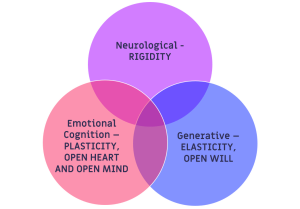
By then slowing down, to pause, retreat and reflect, and choose to operate systemically and holistically, and cultivate the “deliberate calm” required to operate at the three different human levels outlined in the illustration below:

The Neurological Level – which most transformation and change initiatives fail to comprehend, connect to, and work with. Because people lack the focus, intention, and skills to help people collapse any unconscious RIGIDITY existing in their emotional, cognitive, and visceral states, which means they may be frozen, distracted, withdrawn, or aggressive as a result of their fears and anxiety.

You can build your capacity, confidence, and competence to operate at this level by accepting “what is”:

  • Paying attention and being present with whatever people are experiencing neurologically by attending, allowing, accepting, naming, and acknowledging whatever is going on for them, and by supporting and enabling them to rest, revitalize and recover in their unique way.
  • Operating from an open mind and an open heart and by being empathic and compassionate, in line with their fragility and vulnerability, being kind, appreciative, and considerate of their individual needs.
  • Being intentional in enabling them to become grounded, mindful conscious, and truly connected to what is really going on for them, and rebuild their positivity, optimism, and hope for the future.
  • Creating a collective holding space or container that gives them permission, safety, and trust to pull them towards the benefits and rewards of not knowing, unlearning, and being open to relearning new mental models.
  • Evoking new and multiple perspectives that will help them navigate uncertainty and complexity.

The Emotional Cognition Levels – which most transformation and change initiatives fail to take into account because people need to develop their PLASTICITY and flexibility in regulating and focusing their thoughts, feelings, and actions to adapt and be agile in a world of unknowns, and deliver the outcomes and results they want to have.

You can build your capacity, confidence, and competence to operate at this level by supporting them to open their hearts and minds:

  • Igniting their curiosity, imagination, and playfulness, introducing novel ideas, and allowing play and improvisation into their thinking processes, to allow time out to mind wander and wonder into new and unexplored territories.
  • Exposing, disrupting, and re-framing negative beliefs, ruminations, overthinking and catastrophizing patterns, imposter syndromes, fears of failure, and feelings of hopelessness and helplessness.
  • Evoking mindset shifts, embracing positivity and an optimistic focus on what might be a future possibility and opportunity.
  • Being empathic, compassionate, and appreciative, and engaging in self-care activities and well-being practices.

The Generative Level – which most transformation and change initiatives ignore, because they fail to develop the critical and creative thinking, and problem sensing and solving skills that are required to GENERATE the crucial elastic thinking and human skills that result in change, and innovation.

You can build your capacity, confidence, and competence to operate at this level by:

  • Creating a safe space to help people reason and make sense of the things occurring within, around, and outside of them.
  • Cultivating their emotional and cognitive agility, creative, critical, and associative thinking skills to challenge the status quo and think differently.
  • Developing behavioral flexibility to collaborate, being inclusive to maximize differences and diversity, and safe experimentation to close their knowing-doing gaps.
  • Taking small bets, giving people permission and safety to fail fast to learn quickly, be courageous, be both strategic and systemic in taking smart risks and intelligent actions.

Reigniting our humanity – unlocking human potential  

At the end of the day, we all know that we can’t solve the problem with the same thinking that created it. Yet, so many of us keep on trying to do that, by unconsciously defaulting into a business-as-usual linear thinking process when involved in setting up and implementing a transformation or change initiative.

Ai can only take us so far, because the defining trait of our species, is our human creativity, which is at the heart of all creative problem-solving endeavors, where innovation can be the engine of change, transformation, and growth, no matter what the context. According to Fei-Fei Li, Sequoia Professor of Computer Science at Stanford, and co-director of AI4All, a non-profit organization promoting diversity and inclusion in the field of AI.

“There’s nothing artificial about AI. It’s inspired by people, created by people, and most importantly it has an impact on people”.

  • Develop the human skills

When we have the capacity, confidence, and competence to reignite our humanity, we will unlock human potential, and stop producing results no one wants. By developing human skills that enable people to adapt, be resilient, agile, creative, and innovate, they will grow through disruption in ways that add value to the quality of people’s lives, that are appreciated and cherished, we can truly serve people, deliver profits and perhaps save the planet.

Find out more about our work at ImagineNation™

Find out about our collective, learning products and tools, including The Coach for Innovators, Leaders, and Teams Certified Program, presented by Janet Sernack, is a collaborative, intimate, and deeply personalized innovation coaching and learning program, supported by a global group of peers over 9-weeks, and can be customized as a bespoke corporate learning and coaching program for leadership and team development and change and culture transformation initiatives.

Image Credit: Pixabay

Subscribe to Human-Centered Change & Innovation WeeklySign up here to join 17,000+ leaders getting Human-Centered Change & Innovation Weekly delivered to their inbox every week.

Top 10 Human-Centered Change & Innovation Articles of September 2023

Top 10 Human-Centered Change & Innovation Articles of September 2023Drum roll please…

At the beginning of each month, we will profile the ten articles from the previous month that generated the most traffic to Human-Centered Change & Innovation. Did your favorite make the cut?

But enough delay, here are September’s ten most popular innovation posts:

  1. The Malcolm Gladwell Trap — by Greg Satell
  2. Where People Go Wrong with Minimum Viable Products — by Greg Satell
  3. Our People Metrics Are Broken — by Mike Shipulski
  4. Why You Don’t Need An Innovation Portfolio — by Robyn Bolton
  5. Do you have a fixed or growth mindset? — by Stefan Lindegaard
  6. Building a Psychologically Safe Team — by David Burkus
  7. Customer Wants and Needs Not the Same — by Shep Hyken
  8. The Hard Problem of Consciousness is Not That Hard — by Geoffrey A. Moore
  9. Great Coaches Do These Things — by Mike Shipulski
  10. How Not to Get in Your Own Way — by Mike Shipulski

BONUS – Here are five more strong articles published in August that continue to resonate with people:

If you’re not familiar with Human-Centered Change & Innovation, we publish 4-7 new articles every week built around innovation and transformation insights from our roster of contributing authors and ad hoc submissions from community members. Get the articles right in your Facebook, Twitter or Linkedin feeds too!

Have something to contribute?

Human-Centered Change & Innovation is open to contributions from any and all innovation and transformation professionals out there (practitioners, professors, researchers, consultants, authors, etc.) who have valuable human-centered change and innovation insights to share with everyone for the greater good. If you’d like to contribute, please contact me.

P.S. Here are our Top 40 Innovation Bloggers lists from the last three years:

Subscribe to Human-Centered Change & Innovation WeeklySign up here to get Human-Centered Change & Innovation Weekly delivered to your inbox every week.


Great Coaches Do These Things

Great Coaches Do These Things

GUEST POST from Mike Shipulski

Good coaches listen to you. They don’t judge, they just listen.

Good coaches continually study the game. They do it in private, but they study.

Good coaches tell you that you can do better, and that, too, they do in private.

Good coaches pick you up off the floor. They know that getting knocked over is part of the game.

Good coaches never scream at you, but they will cry with you.

Good coaches never stop being your coach. Never.

Good coaches learn from you, and the best ones tell you when that happens.

Good coaches don’t compromise. Ever.

Good coaches have played the game and have made mistakes. That’s why they’re good coaches.

Good coaches do what’s in your best interest, not theirs.

Good coaches are sometimes wrong, and the best ones tell you when that happens.

Good coaches don’t care what other people think of them, but they care deeply about you.

Good coaches are prepared to be misunderstood, though it’s not their preference.

Good coaches let you bump your head or smash your knee, but, otherwise, they keep you safe.

Good coaches earn your trust.

Good coaches always believe you and perfectly comfortable disagreeing with you at the same time.

Good coaches know it’s always your choice, and they know that’s how deep learning happens.

Good coaches stick with you, unless you don’t do your part.

Good coaches don’t want credit. They want you to grow.

Good coaches don’t have a script. They create a custom training plan based on your needs.

Good coaches simplify things when it’s time, unless it’s time to make things complicated.

Good coaches aren’t always positive, but they are always truthful.

Good coaches are generous with their time.

Good coaches make a difference.

Image credit: Unsplash

Subscribe to Human-Centered Change & Innovation WeeklySign up here to join 17,000+ leaders getting Human-Centered Change & Innovation Weekly delivered to their inbox every week.


Imagination versus Knowledge

Is imagination really more important?

Imagination versus Knowledge

GUEST POST from Janet Sernack

Is imagination really more important than knowledge? How does imagination link to catalyzing collective innovation and unleashing corporate vitality?

When I did my research, I discovered that the answer is actually paradoxical!

Albert Einstein famously said “Imagination is more important than knowledge. For knowledge is limited to all we know and understand, while imagination embraces the entire world, and all there ever will be to know and understand.

Why is the answer so paradoxical?

According to a well-researched and scientific article “Einstein’s most famous quote is totally misunderstood” in BIGTHINK magazine, the author suggests that he’s really doing is encouraging people to look beyond the current, conservative frontiers of what we know and into the realm of what we’re compelled to explore next.

He describes that imagination, in Einstein’s mind, is shorthand for a thought experiment: to simulate the consequences of a theory in a regime that’s yet to be tested, where the imaginative predictions were all well-quantified far in advance of the observations/experiments.

  • Both knowledge and imagination

This means that for your imagination to take you to worthwhile places, you also need a strong foundation of knowledge of the subject to build your theory or idea.

This makes it a “both/and” paradox.

This means that you need both a deep knowledge of the subject or problem and a capacity to create, evolve and exploit mental models of things or situations that are often counterintuitive and counterfactual and don’t yet exist.

Doing this enables you to generate new lines of feeling and thinking, and to connect fields, problems, and ideas that others find unrelated. To ultimately inspire, and result in collective innovation.

How does this relate to innovation?

Most of us are already aware that companies increasingly need to innovate — across strategies, operations, offerings, and business models. Especially when business environments are experiencing a range of global and local crises, accelerating change and ongoing, relentless instability and uncertainty. Where many have become survival focused, and adopt a short-term reactive lens in attempts to restore “normality” and arrest a decline in long-term growth rates and competitiveness.

As well as arrest a serious decline in their corporate vitality.  Which is crucial for long-term success, growth, and sustainability. Yet some companies are unaware that imagination is upstream of innovation. Sadly lack the focus towards entering this critical realm and leveraging it to stimulate a capacity for collective innovation which is needed for corporate vitality to thrive.

Corporate vitality enables organizations to thrive

An organizational culture that embraces corporate vitality enables them to thrive, by knowing how to shape visionary strategies in the imagination age that enables it to:

  • Rebound and reinvent themselves, under pressure.
  • Ignite people’s imagination to co-create ideas.
  • Collaborate to accelerate collective innovation.
  • Deliver and accelerate growth in a VUCA/BANI.

Yet, according to research by the BCG Hendersen Institute in an article “Competing on Imagination”

“Big businesses often struggle to make use of imagination. They may try to make it a predictable process, and end up with routine and incrementalism. Or they may treat it like a magical power, celebrated in tales of great innovators, in the hope that good ideas will appear as needed. As companies grow, it becomes harder to be imaginative. Larger companies tend to focus on exploiting what they know and what originally gave them scale”.

What else inhibits the development of corporate vitality?

The BCG research also reveals that most companies don’t yet know how to ignite people’s imagination. Which is required to co-create ideas and collaborate.

Often because they usually lack the motivation, rigor, and knowledge required to:

  • Clarify, ignite, and activate imagination: what it means and how it works at either an individual or collective level.

Which restricts an ability to develop the capacity required to deviate from the norm and emerge creative insights and breakthroughs, invent, and innovate on a scale.

  • Strategically and systematically improve the individual and collective capacity to imagine: which keeps them stuck within their own spheres, and focuses on averages rather than on exceptions.

This also restricts individual and collective investment in creating free time and space for daydreaming, mind wandering, and meandering into the unknown.

  • Cultivate individual and collective imaginative capacity through social transmissions: that evoke new questions and provocative ideas.

Which keeps them restricted to the confines of their own, or current mental models, rigid role parameters, and focus on metrics and conventional short-term siloed approaches.

Ultimately inhibiting our capacity to alter our cognitive habits, allowing our minds to make new associations, develop, and experiment with new ideas.  That forms the foundations for cultivating a culture that catalyzes collective innovation and unleashes corporate vitality.

Taking a neurological approach

Research presented by Gabriella Rosen Kellerman and Dr Martin Seligman, in their recent book Tomorrow Mind enables us to take a neurological approach towards igniting people’s imagination – to arouse our curiosity and co-create ideas, that result in collective innovation.

  • Default Mode Network (DMN)

Stating that when we allow our minds to wander and daydream, our brain doesn’t just “power down.” Instead it “switches to a new mode of thinking, one so vital that it is our default – or the activity our brains jump to in every free moment” which specializes in two processes: imagining and planning.

This is known as our Default Mode Network (DMN). Which activates when we let our minds wander or drift into a daydream, to create spontaneous oscillations that allow us to observe novel thought streams and extract new patterns, generalizations, interpretations, and insights.

It is the place our best ideas come from.

  • Discovering what does not yet exist

In this realm, our minds break the bonds of space and time, blending memory and fantasy, creating an eternal cycle that dances between exploitation and exploration.

Allowing us to exploit our “knowns” and explore new possibilities by imagining scenes that differ radically from the actual past and the actual present, allowing us to discover and learn deeply about what does not yet exist.

What does this mean to organizations, leaders, and coaches?

  • Power of provocation

ImagineNation™ has pioneered innovation coaching by presenting The Coach for Innovators, Leaders, and Teams Certified Program, globally online for more than 10 years.  To teach the traits, mindsets, behaviors, and skills to ignite people’s imagination, based on our experience that consciousness, imagination, and curiosity are the precursors to both creativity and innovation.

Where consciousness contains the states and qualities of the mind, which is where our imagination is located, creativity is the process of bringing something new to the mind, and innovation is bringing the new to the world.

  • Being a disruptive provocateur

We teach participants to become “disruptive provocateurs” who know how to compassionately, creatively, and courageously create collective holding spaces.

That creates the permission, safe space, and trust for developing generative thinking processes that enable peoples to see and solve challenging problems that evoke and emerge new discoveries, and creative ideas and generate learning by:

  • Disrupting peoples’ habitual feelings and thought processes and comfort zones,
  • Co-creating the permission, safety, and trust to deviate and differ,
  • Space and time for elasticizing and stretching habitual thought processes.

Imagination can be provocative because it arouses scenes that differ radically from the actual past and the actual present. This allows us to discover and learn deeply about what does not yet exist. It enables us to focus on being intentional, in taking intelligent and right actions to solve the problem differently and develop corporate vitality.

  • Power of prospection

Developing the co-creative frequencies requires us to alter our cognitive habits, allowing our minds to make new associations, develop, and experiment with new ideas, and cultivate a culture that embraces corporate vitality. This involves the capacity to imagine alternate futures, and developing prospection skills – “the ability within each of us to think about the future and envision what’s possible.”

According to USA-based leading global coaching platform BetterUps’ Report on the Future Minded Leader:

“Imagining ourselves into alternate futures and evaluating them as a way to make decisions and guide present action is unique”.

These occupy at least one-quarter of our waking thoughts, and when it comes to imagining the future, we are at once both our most optimistic and pessimistic selves, which is, in essence, also contradictory. Because we can both project optimism about what is to come and make risk-averse decisions to build the foundations for envisioning a range of desirable and alternate futures.

  • Sparking corporate vitality

Building an “imagination machine” – an organization where the imagination of individuals work together is fully supported intentionally and by design involves creating space for our Default Mode Networks (DMN) to activate and lay the foundations for collective innovation by:

  • Creating space and time for reflection enables people to regain control of their attention and minds, and to allow spontaneous, generative mind wandering – by engaging in simple activities like walking, reading, bathing, exercising, and free writing.
  • Making it safe and permissible to regularly expose people to the unfamiliar and the unknown – by building their discomfort resilience, provoking and elasticizing their core and habitual thinking processes.
  • Coaching, teaching, and training people to view their worlds systemically, to wander and daydream at the edges of the social fields – to sense, perceive and emerge anomalies, and counterintuitive and counterfactual patterns and trends.
  • Coaching, teaching, and training people to safely disrupt and challenge their habitual mental models – by creating mindset flips and paradigm shifts, developing their curiosity, and enhancing their cognitive diversity and agility.
  • Introducing more playfulness into the working environment – by improvising, exploring, introducing business simulations, and learning events, as well as gamification, to generate insights, that saturate us with ideas that we can then incubate.

Imagination, collective innovation, and corporate vitality

When we combine a rigorous approach to expanding and applying both our knowledge and our imagination, we can co-create ideas, and innovate in ways that illuminate people’s hearts and minds.

By altering and elasticizing our cognitive habits, allowing our minds to make new associations and unlikely connections, we can develop, and experiment with new ideas, and cultivate a culture that leverages and scales collective innovation that unleashes real corporate vitality.

Image Credit: Pixabay

Subscribe to Human-Centered Change & Innovation WeeklySign up here to join 17,000+ leaders getting Human-Centered Change & Innovation Weekly delivered to their inbox every week.

Kickstarting Change and Innovation in Uncertain Times

Kickstarting Change and Innovation in Uncertain Times

GUEST POST from Janet Sernack

In our last article, we described why innovation is transformational, and why, at this moment in time, it is more important than ever to innovate. We stated that innovation-led growth is absolutely critical and that people need to be enabled and equipped to adapt, connect and collaborate in new ways to kickstart change in agile, constructive, equitable, and sustainable ways to innovate in uncertain times. Yet, our research and experience at ImagineNation™ over the past 10 years has revealed that many governments, communities, organizations, teams, and leaders, feel somewhat – but not very – confident in their readiness, competence, and capacity to change and innovate in a world of unknowns.

Six Strategies to Kickstart Change and Innovate in Uncertain Times

To help build this confidence we have identified six key strategies and the key first steps to help you focus your attention, kickstart change, and drive and execute your change and innovation initiatives, to survive, thrive, and flourish in uncertain times.

Strategy #1

Build change readiness and receptivity to survive and thrive in an uncertain world by:

  • Giving people permission and safety that allows them to accept and acknowledge the range of emotional reactions (fears), physical consequences (exhaustion), and work-life imbalances as a result of the imposed WFH environment.
  • Acknowledging how people are feeling helps them better re-balance, adapt, and become resilient by supporting them to develop a work-life balance to better connect with others, tolerate uncertainty to change, and innovate in uncertain times.
  • Challenging people’s habitual default patterns of remaining in the safety of their comfort zones, breaking habitual “business as usual” habits, inertia, and complacency.
  • Being empathic and compassionate with people’s anxieties, confusion, insecurity, and uncertainties about their futures at work, and supporting them through their personal conflicts.

Strategy #2

Allow, accept and ack knowledge people’s fears and struggles about change, help manage their anxiety, improve their productivity and attune them to the possibilities and potential opportunities in the current business environment by:

  • Providing individual and collective support to enable people to take back and refocus their attention, self-manage anxiety, and become grounded, mindful, and fully present, with self and with others.
  • Investing in time and money to enable people to unlearn, learn and relearn how to be change ready and change-receptive, and become adaptive to effectively facilitate successful business and digital transformation initiatives.
  • Helping people get familiar with the brain’s basic cognitive functions, and build the foundations to help get work done by regulating emotions, suppressing biases, switching tasks, solving complex problems, and thinking creatively.
  • Developing 21st-century skills to shift old mindsets, develop new behaviors and the reasoning, problem-solving, planning, and execution skills to initiate and sustain business, cultural and digital transformation initiatives to embed the changes and to innovate in uncertain times.
  • Developing the fundamental foresight and energizing vision to perceive innovation strategically and systemically, adopting an approach that is holistic, human, and technology-centered, to align, enable, and equip people to adapt and grow and to change and innovate in uncertain times.

Strategy #3

Make sense of innovation, and develop a common understanding and language as to what innovation means in a unique context by:

  • Developing an awareness that innovation is, in itself, a change process, and paradoxically requires rigorous and disciplined change management processes and a chaotic creative and collaborative interchange of ideas.
  • Clarifying an energizing and compelling “why” innovation is important to an overall “cause” developing a passionate purpose and a sense of urgency towards leveraging innovation to achieve long-term success, competitiveness, and growth.
  • Knowing how to both make connections and distinguish and leverage the differences between creativity, invention, and innovation.
  • Building the safety, permission, and trust that helps facilitate, educate and coach people to deal with the emotional consequences of failure, to reframe it as opportunities to encourage a culture of taking small bets to learn quickly.
  • Taking a disciplined and methodical approach to risk planning and management, that allows and encourages a culture of smart risk-taking to reduce risk adversity.
  • Creating a consistent and common understanding as to what innovation means in their unique government, community, social, organizational, leadership, or team context and creating an engaging and compelling narrative around it.

Strategy #4

Optimize the notion that innovation is transformational and leverage it as an overall energizing strategic and systemic alignment mechanism and set of processes to kickstart change by:

  • Improving engagement, energizing and maximizing people’s potential and intentionally cultivating their collective genius to learn how to execute and deliver deep change and innovate in uncertain times.
  • Aligning technological, processes and adopting a human-centered structure for change management to deliver business breakthroughs and digital transformation initiatives.
  • Breaking down silos and supporting people to collaborate; re-connect, re-energize and re-invent themselves in a disrupted world.
  • Maximizing differences and diversity that exist between people’s demographics, cultures, values, perspectives, knowledge, experiences, and skillsets to deliver their desired outcomes.
  • Learning and coaching people to adapt to survive and thrive by solving complex problems, uncertainty, instability, and trends that are constantly emerging.
  • Improving both customer centricity and the customers’ experience.
  • Building accountable, equitable, and sustainable business enterprises that people value, appreciate, and cherish.

Strategy #5

Challenge the status quo and conventional ways of perceiving innovation to unleash the possibilities and the opportunities and kickstart change that true innovation offers by:

  • Taking a strategic perspective in the longer term and the need for investment in innovation, rather than being reactive, and short-term profit-focused.
  • Developing an understanding of the different types of innovation and how they can be applied, including incremental, breakthrough, sustaining, and disruptive, depending on their strategic imperative and motivation for change, and not just focussing on making continuous and process improvements.
  • Improving trust in organizational boards and leadership decisions, reducing self-interest and eliminating corruption, and focussing on being in integrity to successfully empower people in change and innovate in uncertain times.

Strategy #6

Explore opportunities for measuring, benchmarking, and contextualizing the impact of innovation on business performance, leadership, executive team, and organizational ability to adapt, innovate and grow by:

  • Embracing new business models, developing leadership capabilities and collaborative competencies, capacities, and building people’s confidence to perceive their worlds differently, and with fresh eyes.
  • Letting go of “old” 20th century methods of diagnosing and assessing culture, based solely on the “nice to haves” rather than exploring the emerging “must haves” to enable people to survive and thrive by experimenting with new assessment tools like the OGI® and the GLI® to quantify and qualify current and potential strengths and weaknesses.
  • Using data to know what new mindsets, behaviors, and skills to embody and enact, differently to become future-fit and succeed in the 21st century, and accepting that some of these are “not nice”.
  • Cultivating an innovation culture to embed deep change, provide learning and coaching to evoke, provoke and create mindset shifts, behavior and systems changes, and radically new sets of artifacts and symbols.

Taking the first steps to change and innovate in 2023

Embracing a range of new and different strategic and systemic approaches governments, communities, organizations, teams, and leader organizations can successfully kickstart change and innovate in uncertain times.

By using this moment in time to choose to refuse to walk backward and sleepwalk through life, by simply committing to take the first baby steps in allowing and enabling people to pause, retreat, reflect and:

  • Recover from the effects of working mostly alone, from home, and online.
  • Re-balance work and home lives through reconnection and resolving loneliness and rebuilding a sense of belonging.
  • Know how to tolerate uncertainty and become resilient and adaptive.
  • Reimagine and refocus a more energizing, compelling, and sustainable future.
  • Reinvent themselves, their professions, business practices, and teams in meaningful and purposeful ways.

We can then confidently, meaningfully, and purposefully energetically engage and enroll people, mobilize and harness their collective genius, to innovate in uncertain times in ways that add value to the quality of people’s lives in ways they appreciate and cherish.

To kickstart changes that contribute effectively to global stability, security, connectedness, and sustainability in the current decade of transformation and disruption.

Find out about our collective, learning products and tools, including The Coach for Innovators, Leaders, and Teams Certified Program, presented by Janet Sernack, is a collaborative, intimate, and deeply personalized innovation coaching and learning program, supported by a global group of peers over 9-weeks, starting Tuesday, February 7, 2023.

It is a blended and transformational change and learning program that will give you a deep understanding of the language, principles, and applications of an ecosystem focus, human-centric approach, and emergent structure (Theory U) to innovation, and upskill people and teams and develop their future fitness, within your unique innovation context. Find out more about our products and tools.

Image Credit: Unsplash

Subscribe to Human-Centered Change & Innovation WeeklySign up here to get Human-Centered Change & Innovation Weekly delivered to your inbox every week.