How AI Changes Your Customers
Exclusive Interview with Mark Schaefer

LAST UPDATED: October 1, 2025 at 12:00PM
The rise of artificial intelligence isn’t just an upgrade to our technology; it’s a fundamental shift in what it means to be human and what it takes to lead a successful business. We’ve entered a new epoch defined by “synthetic humanity,” a term coined by Mark Schaefer to describe AI interactions that are indistinguishable from real human connection. This blurring of lines creates an enormous opportunity, which Mark Schaefer refers to as a “seam” — a moment of disruption wide open for innovators. But as algorithms become more skilled at simulating empathy and insight, what must leaders do to maintain authenticity and relevancy? In this exclusive conversation, Mark Shaefer breaks down why synthetic humanity is the most crucial concept for leaders to grasp today, how to use AI as a partner rather than a replacement, and the vital role of human creativity in a world of supercharged innovation.
The Internet, Smartphones, Social Media, and Now AI, Have All Shifted Customer Expectations
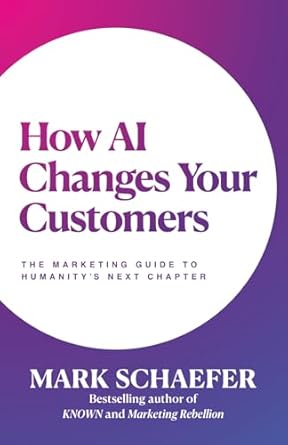
Mark Schaefer is a globally-acclaimed author, keynote speaker, and marketing consultant. He is a faculty member of Rutgers University and one of the top business bloggers and podcasters in the world. How AI Changes Your Customers: The Marketing Guide to Humanity’s Next Chapter is his twelfth book, exploring what companies should consider when it comes to artificial intelligence (AI) and their customers.
Below is the text of my interview with Mark and a preview of the kinds of insights you’ll find in How AI Changes Your Customers presented in a Q&A format:
1. I came across the term ‘synthetic humanity’ fairly early on in the book. Why is this concept so important, and what are the most important aspects for leaders to consider?
“Synthetic humanity” is my term for describing the emerging wave of AI interactions that appear, sound, and even feel human — yet are not human at all. This is not science fiction. Already, chatbots can hold natural conversations, generate art, or simulate empathy in ways that blur the line between authentic and artificial.
For leaders, this matters because customers don’t care whether an experience is powered by code or carbon; they care about how it feels. If synthetic humanity can deliver faster, easier, and more personalized service, people will embrace it. The more machines convincingly mimic us, the more vital it becomes to emphasize distinctly human qualities like compassion, vulnerability, creativity, and trust.
Leaders must navigate two urgent questions: Where do we lean into automation for efficiency? And where do we intentionally preserve human touch for meaning? Synthetic humanity can scale interactions, but it cannot scale authenticity. The most successful brands will be those that strike this balance — leveraging AI’s strengths while showcasing the irreplaceable heartbeat of humanity.
2. We discuss disruption quite a bit here on this blog. Can you share a bit more with our innovators about ‘seams’ and the opportunities they create with AI or otherwise?
Throughout history, disruptions to the status quo, such as pandemics, wars, or economic recessions, can either sink a business or elevate it to new heights. Every disruption creates a seam — a moment where the fabric of culture, business, or belief rips just wide enough for an innovator to crawl through and create something new.
We might be living in the ultimate seam.
Google CEO Sundar Pinchai calls AI the most significant innovation in human history — more important than fire, medicine, or the internet. The power of AI seems absolute and threatening. For many, it’s terrifying.
Through my new book, I’m trying to get people to view disruption through a different lens: not fear, but immense possibility.
3. Given that AI has access to all of our accumulated wisdom, does it actually create unique insights and ideas, or will innovation always be left to the humans?
AI is extraordinary at remixing existing content. It can scan millions of data points, connect patterns we might miss, and surface possibilities at lightning speed. That feels like insight, and sometimes it is. However, there is a crucial distinction: AI doesn’t truly care. It lacks context, longing, and lived experience.
Innovation often begins with a problem that aches to be solved or a vision that comes from deep within human culture. AI can suggest ten thousand options, but only a person can say, “This one matters because it touches our values, our customers, our future.”
So the real power is in the partnership. AI accelerates discovery, clears away routine work, and even provokes us with new connections. Humans bring the spark of meaning, the intuition, and the courage to act on something that has never been tried before. Innovation is not being replaced. It is being supercharged. In my earlier book “Audacious: How Humans Win in an AI Marketing World,” I note that the bots are here, but we still own crazy!
This is a time for humans to transcend “competent.” Bots can be competent and ignorable.
4. Do you have any tips for us mere mortals on how to productively use AI without developing creative and intellectual atrophy?
Yes, and it starts with how you frame the role of AI in your life. If you treat it as a replacement, you risk letting your creative muscles go slack. If you treat it as a partner, you can actually get stronger.
Here are a few practical approaches. First, use AI to stretch your perspective, not to finish your work for you. Ask it to give you ten angles on a problem, then choose one and make it your own. Second, set boundaries. Write your first draft by hand or sketch ideas before you ever touch a prompt. Let AI react to your thinking, not define it. Third, use the tool to challenge yourself. Feed it your work and ask, “What am I missing? Where are my blind spots?”
Most importantly, keep doing hard things. Struggle is where growth happens. AI can smooth the path, but sometimes you need the climb. Treat the technology as a coach, not a crutch, and you will come out sharper, faster, and even more creative on the other side.
5. I’ve heard a little bit about AI literacy. What are some of the critical aspects that we should all be aware of or try to learn more about?
 There are a few critical aspects everyone should know. First, bias. AI models are trained on human data, which means they inherit our blind spots and prejudices. If you don’t recognize this, you may mistake bias for truth. Second, limits. AI is confident even when it is wrong. Knowing how to fact-check and verify is essential. Third, prompting. The quality of your input shapes the quality of the output, so learning how to ask better questions is a new core skill.
Finally, ethics. Just because AI can do something does not mean it should. We all need to be asking: How does this affect privacy, autonomy, and trust?
AI literacy isn’t about becoming a coder. It is about being a thoughtful user, a skeptic when needed, and a leader who understands both the promise and the peril of these tools.
6. What do companies and sole proprietors worried about falling below the fold of the new AI-powered search results need to change online to stay relevant and successful?
I have many practical ideas about this in the book. In short, the old game of chasing clicks and keywords is fading. AI-powered search doesn’t just list links, it delivers answers. That means the winners will be those whose content and presence are woven deeply enough into the digital fabric that the algorithms can’t ignore them.
This requires a shift in focus. Instead of creating content that only ranks, create content that is referenced, cited, and trusted across the web. Build authority by being the source others turn to. Make your ideas so distinct and valuable that they become part of the training data itself. We are entering a golden age for PR!
It also means doubling down on brand signals that AI can’t manufacture. Human stories, original research, strong communities, and unique perspectives will travel farther than generic blog posts. And remember, AI models reward freshness and relevance, so showing up consistently matters.
The book also covers what I call “overrides.” If you create a meaningful, loyal relationship with customers and word of mouth recommendations, that will override the AI recommendations. We consider AI recommendations. We ACT on human recommendations.
7. ‘Weaponizing kindness’ was a terrifying headline I stumbled across in your book. What do organizations need to consider when using AI to interact with customers and what traps are out in front of them?
That phrase is unsettling for a reason. AI can mimic empathy so well that it risks crossing into manipulation. Imagine a chatbot that remembers your child’s name, mirrors your mood, or expresses concern in just the right tone. Done responsibly, that feels like service. Done carelessly, it feels like exploitation.
Organizations need to recognize that kindness delivered at scale is powerful, but if it is hollow or purely transactional, customers will sense it. The first trap is confusing simulation with sincerity. Just because an AI can sound caring does not mean it actually cares. The second trap is overreach. Using personal data to create hyper-tailored interactions can quickly slip from helpful to creepy.
The safeguard is transparency and choice. Be clear about when a customer is interacting with AI. Use technology to enhance human care, not replace it. Always provide people with a way to connect with a real person.
Kindness is a sacred trust in business. Weaponize it, and you erode the very loyalty and love you are trying to build. Use it authentically, and you create relationships no machine can ever replicate.
8. What changing customer expectations (thanks to AI) might companies easily overlook and pay a heavy price for?
One of the biggest shifts is speed. Customers already expect instant answers, but AI raises the bar even higher. If your competitor offers a seamless, AI-powered interaction that solves a problem in seconds, your slower, clunkier process will feel intolerable.
Another overlooked expectation is personalization. People are starting to experience products, services, and recommendations that feel almost eerily tailored to them. That sets a new standard. Companies still delivering one-size-fits-all communication will look outdated. Don’t confuse “personalization” with “personal.”
Perhaps the most subtle change is trust. As customers realize machines can fake warmth and empathy, they will value genuine human touch even more. If every interaction feels synthetic, you risk losing trust, especially if you’re not transparent about it.
The price of ignoring these shifts is steep: irrelevance. Customers rarely complain about unmet expectations anymore; they simply leave. The opportunity is to stay alert, listen closely, and respond quickly as AI reshapes what “good enough” looks like. The companies that thrive will be those that not only keep pace with AI, but also double down on the irreplaceable humanity customers still crave.
9. What unintended consequences of AI do you think companies might face and may not be preparing for? (overcoming AI slander and falsehoods might be one – agree or disagree? Others?)
I agree. In fact, I predict in the book that we cannot foresee AI’s biggest impact yet, as it will likely be an unintended consequence of the technology’s use in an unexpected way.
Where could that occur? Maybe reputational risk at scale. AI systems will generate falsehoods with the same confidence they generate facts, and those errors can stick. A single hallucination about your company, repeated enough times, becomes “truth” in the digital bloodstream. Most companies are not prepared for the speed and reach of misinformation of this kind.
Another consequence is customer dependency. If people hand over more of their decisions to AI, they may lose patience for complexity or nuance in your offerings. That can push companies toward oversimplification, even when a richer human experience would build deeper loyalty.
There is also the cultural risk. Employees might over-rely on AI, quietly eroding skills, judgment, and creativity. A workforce that outsources too much thinking can become brittle in ways that only show up during a crisis.
The real challenge is that these consequences don’t announce themselves. They creep in. Which means leaders must actively audit how AI is being used, question where it might distort reality or weaken capability, and set up safeguards now. The companies that prepare will navigate disruption. The ones that ignore it will be blindsided.
10. Can companies make TOO MUCH use of AI? If so, what would the impacts look like?
Yes, and we will start seeing this more often. It is a pattern that has repeated through history — over-indexing on tech and then bringing the people back in!
When companies lean too heavily on AI, they risk draining the very humanity that makes them memorable. On the surface, it might seem like efficiency: faster service, lower costs, and greater scale. But underneath, the impacts can be corrosive. You might be messing with your brand!
Customers may feel manipulated or devalued if a machine drives every interaction. Even perfect personalization can feel hollow if it lacks genuine care. Second, trust erodes when people sense that a brand hides behind automation rather than showing up with real human accountability. Third, within the company, over-reliance on AI can weaken employee judgment and creativity, resulting in a workforce that follows prompts rather than breaking new ground.
The real danger is commoditization. If every company automates everything, then no company stands out. The winners will be those who know when to say, “This moment deserves a person.” AI should be an amplifier, not a replacement. Too much of it and you don’t just lose connection, you lose your soul.
Conclusion
Thank you for the great conversation Mark!
I hope everyone has enjoyed this peek into the mind of the man behind the inspiring new title How AI Changes Your Customers: The Marketing Guide to Humanity’s Next Chapter!
Image credits: BusinessesGrow.com (Mark W Schaefer)
Content Authenticity Statement: If it wasn’t clear above, the short section in italics was written by Google’s Gemini with edits from Braden Kelley, and the rest of this article is from the minds of Mark Schaefer and Braden Kelley.
 Sign up here to join 17,000+ leaders getting Human-Centered Change & Innovation Weekly delivered to their inbox every week.


 This pursuit of excellence is driven by a single, powerful market force: The Amazon Effect. As Mario put it, customers no longer judge your experience solely against your industry peers. They expect every single touchpoint with your company to be as seamless, intuitive, and effective as the best experience they’ve had anywhere. This constantly escalating bar for Customer Effort Score (CES) and Customer Satisfaction (CSAT) makes a complacent CX investment a near-fatal strategic mistake. The customer experience must always be top-tier, or you simply lose the right to compete.