Tag Archives: quotes

1,000+ Free Innovation, Change and Design Quotes Slides

LAST UPDATED: November 12, 2025 at 10:21AM
1,000+ Free Innovation, Change and Design Quotes Slides

Spice Up Your Meetings, Presentations, Keynotes and Workshops

I’m flattered that people have been quoting my keynote speeches and my first two books Stoking Your Innovation Bonfire and Charting Change (now in its Second Edition).

So, I’m making some of my favorite quotes available from myself and other thought leaders in a fun, visual, easily shareable format.

I’ve been publishing them on Instagram, LinkedIn, Facebook, and Twitter.

Find a compelling quote for a meeting, presentation, workshop or keynote speech on any of these topics:

  • Innovation
  • Design
  • Customer Experience
  • Digital Transformation
  • Change
  • Creativity
  • Leadership
  • Design Thinking

Download twenty (20) volumes of fifty (50) quote posters, for a total of 1,000 (with more on the way), for FREE from my store:

You can add them all to your shopping cart at once and download them for FREE.

Print them, share them on social media, or use them in your presentations, keynote speeches or workshops.

They are all Adobe PDF’s and the best way to add them to your presentation is to:

  1. Put the PDF into FULL SCREEN MODE
  2. Take a screenshot
  3. Paste it into your presentation
  4. Crop it and adjust the size to your liking
  5. Change the background color of the slide to a suitable color (if necessary)

Contact me with your favorite quote or to book me for a keynote, workshop, or piece of commissioned content to attract new customers.

Subscribe to Human-Centered Change & Innovation WeeklySign up here to get Human-Centered Change & Innovation Weekly delivered to your inbox every week.

Hard Facts Are a Hard Thing

Hard Facts Are a Hard Thing

GUEST POST from Greg Satell

In 1977, Ken Olsen, the founder and CEO of Digital Equipment Corporation, reportedly said, “There is no reason for any individual to have a computer in his home.” It was an amazingly foolish thing to say and, ever since, observers have pointed to Olsen’s comment to show how supposed experts can be wildly wrong.

The problem is that Olsen was misquoted. In fact, his company was actually in the business of selling personal computers and he had one in his own home. This happens more often than you would think. Other famous quotes, such IBM CEO Thomas Watson predicting that there would be a global market for only five computers, are similarly false.

There is great fun in bashing experts, which is why so many inaccurate quotes get repeated so often. If the experts are always getting it wrong, then we are liberated from the constraints of expertise and the burden of evidence. That’s the hard thing about hard facts. They can be so elusive that it’s easy to believe doubt their existence. Yet they do exist and they matter.

The Search for Absolute Truth

In the early 20th century, science and technology emerged as a rising force in western society. The new wonders of electricity, automobiles and telecommunication were quickly shaping how people lived, worked and thought. Empirical verification, rather than theoretical musing, became the standard by which ideas were measured.

It was against this backdrop that Moritz Schlick formed the Vienna Circle, which became the center of the logical positivist movement and aimed to bring a more scientific approach to human thought. Throughout the 20’s and 30’s, the movement spread and became a symbol of the new technological age.

At the core of logical positivism was Ludwig Wittgenstein’s theory of atomic facts, the idea the world could be reduced to a set of statements that could be verified as being true or false—no opinions or speculation allowed. Those statements, in turn, would be governed by a set of logical algorithms which would determine the validity of any argument.

It was, to the great thinkers of the day, both a grand vision and an exciting challenge. If all facts could be absolutely verified, then we could confirm ideas with absolute certainty. Unfortunately, the effort would fail so miserably that Wittgenstein himself would eventually disown it. Instead of building a world of verifiable objective reality, we would be plunged into uncertainty.

The Fall of Logic and the Rise of Uncertainty

Ironically, while the logical positivist movement was gaining steam, two seemingly obscure developments threatened to undermine it. The first was a hole at the center of logic called Russell’s Paradox, which suggested that some statements could be both true and false. The second was quantum mechanics, a strange new science in which even physical objects could defy measurement.

Yet the battle for absolute facts would not go down without a fight. David Hilbert, the most revered mathematician of the time, created a program to resolve Russell’s Paradox. Albert Einstein, for his part, argued passionately against the probabilistic quantum universe, declaring that “God does not play dice with the universe.”

Alas, it was all for naught. Kurt Gödel would prove that every logical system is flawed with contradictions. Alan Turing would show that all numbers are not computable. The Einstein-Bohr debates would be resolved in Bohr’s favor, destroying Einstein’s vision of an objective physical reality and leaving us with an uncertain universe.

These developments weren’t all bad. In fact, they were what made modern computing possible. However, they left us with an uncomfortable uncertainty. Facts could no longer be absolutely verifiable, but would stand until they could be falsified. We could, after thorough testing, become highly confident in our facts, but never completely sure.

Science, Truth and Falsifiability

In Richard Feynman’s 1974 commencement speech at Cal-Tech, he recounted going to a new-age resort where people were learning reflexology. A man was sitting in a hot tub rubbing a woman’s big toe and asking the instructor, “Is this the pituitary?” Unable to contain himself, the great physicist blurted out, “You’re a hell of a long way from the pituitary, man.”

His point was that it’s relatively easy to make something appear “scientific” by, for example, having people wear white coats or present charts and tables, but that doesn’t make it real science. True science is testable and falsifiable. You can’t merely state what you believe to be true, but must give others a means to test it and prove you wrong.

This is important because it’s very easy for things to look like the truth, but actually be false. That’s why we need to be careful, especially when we believe something to be true. The burden is even greater when it is something that “everybody knows.” That’s when we need to redouble our efforts, dig in and make sure we verify our facts.

“We’ve learned from experience that the truth will out,” Feynman said. “The first principle is that you must not fool yourself—and you are the easiest person to fool.” Truth doesn’t reveal itself so easily, but it’s out there and we can find it if we are willing to make the effort.

The Lie of a Post-Truth World

Writing a non-fiction book can be a grueling process. You not only need to gather hundreds of pages of facts and mold them into a coherent story that interests the reader, but also to verify that those facts are true. For both of my books, Mapping Innovation and Cascades, I spent countless hours consulting sources and sending out fact checks.

Still, I lived in fear knowing that whatever I put on the page would permanently be there for anyone to discredit. In fact, I would later find two minor inaccuracies in my first book (ironically, both had been checked with primary sources). These were not, to be sure, material errors, but they wounded me. I’m sure, in time, others will be uncovered as well.

Yet I don’t believe that those errors diminish the validity of the greater project. In fact, I think that those imperfections serve to underline the larger truth that the search for knowledge is always a journey, elusive and just out of reach. We can struggle for a lifetime to grasp even a small part of it, but to shake free even a few seemingly insignificant nuggets can be a gift.

Yet all too often people value belief more than facts. That’s why they repeat things that aren’t factual, because they believe they point to some deeper truth that defy facts in evidence. Yet that is not truth. It is just a way of fooling yourself and, if you’re persuasive, fooling others as well. Still, as Feynman pointed out long ago, “We’ve learned from experience that the truth will out.”

— Article courtesy of the Digital Tonto blog
— Image credit: Pixabay

Subscribe to Human-Centered Change & Innovation WeeklySign up here to get Human-Centered Change & Innovation Weekly delivered to your inbox every week.
600 Free Innovation, Transformation and Design Quote Slides

600 Innovation, Transformation and Design Quote Slides on Innovation, Change and Design

Free Downloads for Keynote Speeches, Presentations and Workshops

Looking for a compelling quote for a keynote speech, workshop or presentation on any of these topics?

  • Innovation
  • Digital Transformation
  • Design
  • Change
  • Creativity
  • Leadership
  • Design Thinking

I’m flattered that people have been quoting my keynote speeches and my first two books Stoking Your Innovation Bonfire and Charting Change.

So, I’m making some of my favorite quotes available from myself and other thought leaders in a fun, visual, easily shareable format.

I’ve been publishing them on Instagram, LinkedIn, Facebook, and Twitter.

But now you can download twelve (12) volumes of fifty (50) quote posters, for a total of 600, for FREE from my store:

You can add them all to your shopping cart at once and download them for FREE.

Print them, share them on social media, or use them in your presentations, keynote speeches or workshops.

They are all Adobe PDF’s and the best way to add them to your presentation is to:

  1. Put the PDF into FULL SCREEN MODE
  2. Take a screenshot
  3. Paste it into your presentation
  4. Crop it and adjust the size to your liking
  5. Change the background color of the slide to a suitable color (if necessary)

Contact me with your favorite innovation, design thinking, change, transformation, or design quotes and I’ll consider adding them to my library of future downloads.

Subscribe to Human-Centered Change & Innovation WeeklySign up here to get Human-Centered Change & Innovation Weekly delivered to your inbox every week.
550 Quote Slides on Design, Innovation, and Change

550 Quote Slides on Innovation, Change and Design

Free Downloads for Keynote Speeches, Presentations and Workshops

Looking for a compelling quote for a keynote speech, workshop or presentation on any of these topics?

  • Innovation
  • Design
  • Change
  • Digital Transformation
  • Design Thinking
  • Creativity
  • Leadership

I’m flattered that people have been quoting my keynote speeches and my first two books Stoking Your Innovation Bonfire and Charting Change.

So, I’m making some of my favorite quotes available from myself and other thought leaders in a fun, visual, easily shareable format.

I’ve been publishing them on Instagram, LinkedIn, Facebook, and Twitter.

But now you can download ten (10) volumes of fifty (50) quote posters, for a total of 550, for FREE from my store:

You can add them all to your shopping cart at once and download them for FREE.

Print them, share them on social media, or use them in your presentations, keynote speeches or workshops.

They are all Adobe PDF’s and the best way to add them to your presentation is to:

  1. Put the PDF into FULL SCREEN MODE
  2. Take a screenshot
  3. Paste it into your presentation
  4. Crop it and adjust the size to your liking
  5. Change the background color of the slide to a suitable color (if necessary)

Contact me with your favorite innovation, design thinking, change, transformation, or design quotes and I’ll consider adding them to my library of future downloads.


Accelerate your change and transformation success

Subscribe to Human-Centered Change & Innovation WeeklySign up here to get Human-Centered Change & Innovation Weekly delivered to your inbox every week.
FREE Download – 500 Posters with Quotes on Innovation, Change, Transformation, Design and Creativity

Announcing 500 Downloadable Posters with Quotes on Innovation, Change, Transformation, and Design

I am honored and humbled that people have taken to quoting work from my first book Stoking Your Innovation Bonfire, my follow-up Charting Change, and my keynote speeches, so I decided to make some of the passages that have resonated with people on innovation, change, transformation, design thinking, and leadership available in a fun, visual, easily shareable format along with quotes from numerous other thought leaders.

I’ve been publishing them on Instagram, LinkedIn, Facebook, Twitter and MisterInnovation.com one at a time for individual download, but today I am excited to announce the immediate availability of ten (10) volumes of fifty (50) quote posters, for a total of 500 quote posters, for immediate free download.

Print them, share them on social media, or use them in your presentations, keynote speeches or workshops. Download any or all of the volumes of fifty (50) posters for FREE from my store:

You can add them all to your shopping cart at once and download them for FREE.

They are all Adobe PDF’s and the best way to add them to your presentation is to put the PDF into FULL SCREEN MODE, take a screenshot, paste it into your presentation, then crop it and adjust the size to your liking, and change the background color of the slide to a suitable color (if necessary).

Get them while they’re hot and I’ll keep publishing individual quotes and additional downloadable volumes in the days and months ahead.

Have a great innovation, design thinking, change, transformation, or design quote to share?

Send it to me

Keep innovating!


Accelerate your change and transformation success

Subscribe to Human-Centered Change & Innovation WeeklySign up here to get Human-Centered Change & Innovation Weekly delivered to your inbox every week.
Innovation Insights for March 21, 2012

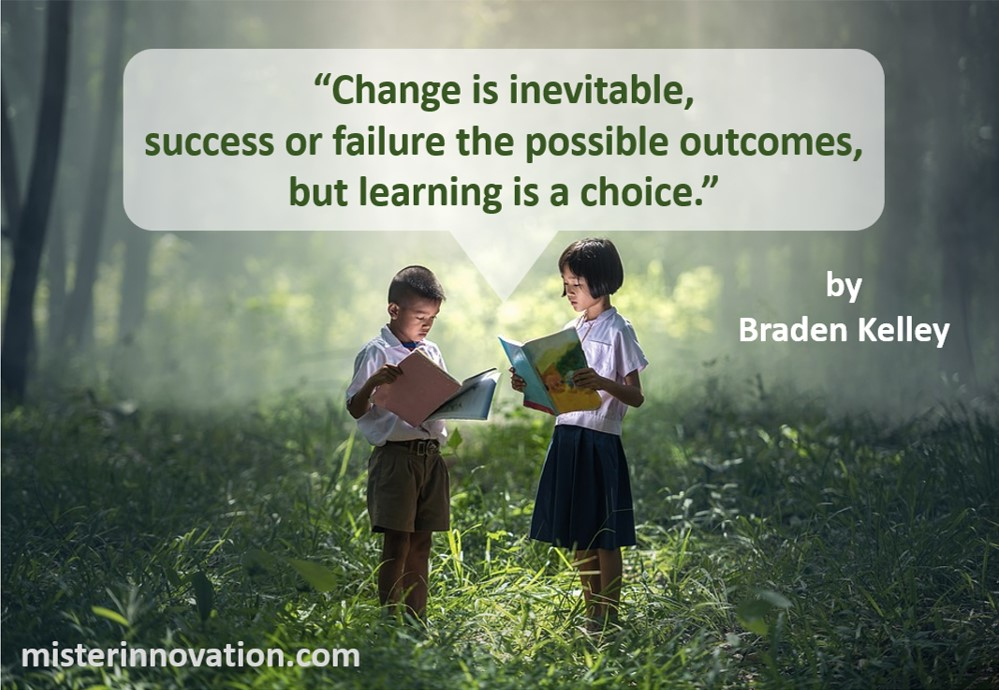
Innovation Insights for March 21, 2012I am in the middle of putting together a substantial innovation training proposal for senior leaders at another Fortune 100 company. As part of the proposal I included a few phrases about my innovation philosophy and thought I would share them here as well as on Twitter and Linkedin as part of a new series of short posts.

Here are the quotes worth sharing:

“Sustainable innovation is more about people, process, and communications than it is about inventions created by science and technology.”

“Every organization has a different level of innovation maturity and needs a system to embed innovation within the organization and its culture.”

“Innovation requires that you unlock the very best from your people and maintain a laser focus on value.”

“Creating and sustaining an innovation culture requires creating consistency across beliefs, communications and behavior.”

I’m in the process of creating a page about all of my innovation training offerings. Please contact me for all of your innovation training needs.

Subscribe to Human-Centered Change & Innovation WeeklySign up here to get Human-Centered Change & Innovation Weekly delivered to your inbox every week.

Are you the 10th person who innovates?

Are you the 10th person who innovates?“For every nine people who denounce innovation, only one will encourage it… For every nine people who do things the way they have always been done, only one will ever wonder if there is a better way. For every nine people who stand in line in front of a locked building, only one will ever come around and check the back door.”
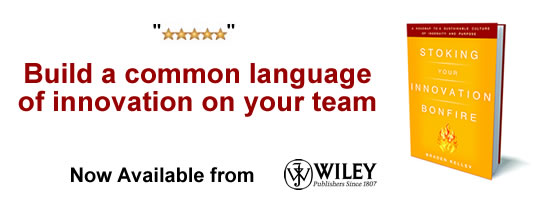
“Our progress as a species rests squarely on the shoulders of that tenth person. The nine are satisfied with things they are told are valuable. Person 10 determines for himself what has value.”

– Za Rinpoche and Ashley Nebelsieck, in The Backdoor to Enlightenment

As I’ve said before, innovation is achieved when something becomes valuable to the customer, instead of merely useful. Are you standing in line with your competitors, or are you creating the real value that will help you achieve competitive separation?

Build a Common Language of Innovation

Subscribe to Human-Centered Change & Innovation WeeklySign up here to get Human-Centered Change & Innovation Weekly delivered to your inbox every week.

50 Awesome Quotes on Risk Taking

GUEST POST from Mitch Ditkoff

  1. “Whatever you can do, or dream you can, begin it. Boldness has genius, power and magic in it.” — Goethe
  2. “Security is mostly a superstition. Life is either a daring adventure or nothing.” — Helen Keller
  3. “It’s not because things are difficult that we dare not venture. It’s because we dare not venture that they are difficult.” — Seneca
  4. “Only those who will risk going too far can possibly find out how far it is possible to go.” — T.S. Eliot
  5. “What you have to do and the way you have to do it is incredibly simple. Whether you are willing to do it is another matter.” — Peter Drucker
  6. “Go out on a limb. That’s where the fruit is.” — Jimmy Carter
  7. “I am always doing that which I cannot do, in order that I may learn how to do it.” — Pablo Picasso
  8. “Life is being on the wire, everything else is just waiting. — Karl Wallenda
  9. “If things seem under control, you are just not going fast enough.” — Mario Andretti
  10. “Don’t be afraid to take a big step. You can’t cross a chasm in two small jumps.” — David Lloyd George
  11. “It is only by risking our persons from one hour to another that we live at all.” — William James
  12. “Do one thing every day that scares you.” — Eleanor Roosevelt
  13. “Trust your own instinct. Your mistakes might as well be your own, instead of someone else’s.” — Billy Wilder
  14. “The dangers of life are infinite, and among them is safety.” — Goethe
  15. “Do not fear mistakes. There are none.” — Miles Davis
  16. “A man would do nothing, if he waited until he could do it so well that no one would find fault with what he has done.” — Cardinal Newman
  17. “Test fast, fail fast, adjust fast.” — Tom Peters
  18. “Never let the odds keep you from doing what you know in your heart you were meant to do.” — H. Jackson Brown, Jr.
  19. “Twenty years from now you will be more disappointed by the things you didn’t do than by the ones you did. So throw off the bowlines, sail away from the safe harbor, catch the trade winds in your sails. Explore. Dream. Discover.” — Mark Twain
  20. “Leap and the net will appear.” — Zen Saying
  21. “The way to develop self-confidence is to do the thing you fear and get a record of successful experiences behind you. Destiny is not a matter of chance, it is a matter of choice; it is not a thing to be waited for, it is a thing to be achieved.” — William Jennings Bryan
  22. “Pearls don’t lie on the seashore. If you want one, you must dive for it.” — Chinese proverb
  23. “Nothing will ever be attempted, if all possible objections must be first overcome.” — Samuel Johnson
  24. “And the day came when the risk to remain tight in a bud was more painful than the risk it took to blossom.” — Anais Nin
  25. “Are you placing enough interesting, freakish, long shot, weirdo bets?” — Tom Peters
  26. “Take calculated risks. That is quite different from being rash.” — General George Patton
  27. “I can accept failure. Everybody fails at something. But I can’t accept not trying. Fear is an illusion.” — Michael Jordan
  28. “Opportunity dances with those on the dance floor.” — Anonymous
  29. “Yes, risk-taking is inherently failure-prone. Otherwise, it would be called ‘sure-thing-taking.'” — Jim McMahon
  30. “People who don’t take risks generally make about two big mistakes a year. People who do take risks generally make about two big mistakes a year.” — Peter Drucker
  31. “Necessity is the mother of taking chances.” — Mark Twain
  32. “99 percent of success is built on failure.” — Charles Kettering
  33. “Progress always involves risks. You can’t steal second base and keep your foot on first.” — Frederick Wilcox
  34. “What great thing would you attempt if you knew you could not fail?” — Robert Schuller
  35. “Every society honors its live conformists and its dead troublemakers.” — Mignon McLaughlin
  36. “You can only be as good as you dare to be bad.” — John Barrymore
  37. “Anything that is successful is a series of mistakes.” — Billie Armstrong
  38. “Give me the young man who has brains enough to make a fool of himself.” — Robert Louis Stevenson
  39. “If it’s a good idea, go ahead and do it. It’s much easier to apologize than it is to get permission.” — Rear Admiral Grace Hopper
  40. “If you risk nothing, then you risk everything.” — Geena Davis
  41. “Taking a new step, uttering a new word, is what people fear most.” — Fyodor Dostoevsky
  42. “Remember, a dead fish can float down a stream, but it takes a live one to swim upstream.” — W.C. Fields
  43. “Take risks: if you win, you will be happy; if you lose, you will be wise.” — Anonymous
  44. “To dare is to lose one’s footing momentarily. To not dare is to lose oneself.” — Soren Kierkegaard
  45. “You’ll always miss 100% of the shots you don’t take.” — Wayne Gretzky
  46. “It is only in adventure that some people succeed in knowing themselves.” — Andre Gide
  47. “Do not be too timid and squeamish about your actions. All life is an experiment. The more experiments you make the better.” — Ralph Waldo Emerson
  48. “One does not discover new lands without consenting to lose sight of the shore for a very long time.” — Andre Gide
  49. “Danger can never be overcome without taking risks.” — Latin Proverb
  50. “I’ll play it first, and tell you what it is later.” — Miles Davis

Thanks to Val Vadeboncoeur for gathering these goodies. If you have other favorites, let us know.

Don’t miss an article – Subscribe to our RSS feed and join our Continuous Innovation group!


Mitch DitkoffMitch Ditkoff is the Co-Founder and President of Idea Champions and the author of “Awake at the Wheel”, as well as the very popular Heart of Innovation blog.

Subscribe to Human-Centered Change & Innovation WeeklySign up here to get Human-Centered Change & Innovation Weekly delivered to your inbox every week.

100 Awesome Quotes on What It Takes To Innovate

GUEST POST from Mitch Ditkoff

  1. “I want to put a ding in the universe.” – Steve Jobs
  2. “Ideas won’t keep. Something must be done about them.” – Alfred North Whitehead
  3. “Intuition will tell the thinking mind where to look next.” – Jonas Salk
  4. “If you have always done it that way, it is probably wrong.” – Charles Kettering
  5. “If you can dream it, you can do it.” – Walt Disney
  6. “Security is mostly a superstition. Life is either a daring adventure or nothing.” – Helen Keller
  7. “You can’t solve a problem on the same level that it was created. You have to rise above it to the next level.” – Albert Einstein
  8. “Do not fear mistakes. There are none.” – Miles Davis
  9. “The creation of something new is not accomplished by the intellect, but by the play instinct arising from inner necessity. The creative mind plays with the object it loves.” – Carl Jung
  10. “There is only one thing stronger than all the armies of the world: and that is an idea whose time has come.” – Victor Hugo
  11. “If you lose the power to laugh, you lose the power to think.” – Clarence Darrow
  12. “Ideas are like rabbits. You get a couple and learn how to handle them, and pretty soon you have a dozen.” – John Steinbeck
  13. “To accomplish great things we must dream as well as act.” – Anatole France
  14. “It is the essence of genius to make use of the simplest ideas.” – Charles Peguy
  15. “There’s no good idea that cannot be improved on.” – Michael Eisner
  16. “We don’t see things as they are, we see things as we are.” – Anais Nin
  17. “We don’t know a millionth of one percent about anything.” – Thomas Edison
  18. “The best vision is insight.” – Malcolm Forbes
  19. “Genius is infinite painstaking.” – Michelangelo
  20. “Nothing will change the fact that I cannot produce the least thing without absolute solitude.” – Goethe
  21. “Neither a lofty degree of intelligence, nor imagination, nor both together, go to the making of genius. Love, Love, Love. That is the soul of genius.” – Mozart
  22. “Swipe from the best, then adapt.” – Tom Peters
  23. “Give me the young man who has brains enough to make a fool of himself.” – Robert Louis Stevenson
  24. “You can expect no influence if you are not susceptible to influence.” – Carl Jung
  25. “Whether or not you can observe a thing depends upon the theory you use. It is the theory which decides what can be observed.” – Albert Einstein
  26. “Whatever you can do, or dream you can, begin it. Boldness has genius, power and magic in it.” – Goethe
  27. “Sit, walk, or run, but don’t wobble.” – Zen proverb
  28. “The greater the contrast, the greater the potential. Great energy only comes from a correspondingly great tension of opposites.” – Carl Jung
  29. “We don’t know who discovered water, but we’re certain it wasn’t a fish.” – John Culkin
  30. “I will act as if what I do will make a difference.” – William James
  31. “There is no such thing as a long piece of work, except one that you dare not start.” – Charles Baudelaire
  32. “What is now proved was once only imagined.” – William Blake
  33. “Remember, a dead fish can float down a stream, but it takes a live one to swim upstream.” – W.C. Fields
  34. “99 percent of success is built on failure.” – Charles Kettering
  35. “If the only tool you have is a hammer, you tend to see every problem as a nail.” – Abraham Maslow
  36. “Not everything that counts can be counted, and not everything that can be counted counts.” – Albert Einstein
  37. “The test of a first-rate intelligence is the ability to hold two opposed ideas in the mind at the same time, and still retain the ability to function.” – F. Scott Fitzgerald
  38. “The ultimate creative thinking technique is to think like God. If you’re an atheist, pretend how God would do it.” – Frank Lloyd Wright
  39. “I start where the last man left off.” – Thomas Edison
  40. “Never confuse motion with action.” – Ernest Hemingway
  41. “The greatest invention in the world is the mind of a child.” – Thomas Edison
  42. “No matter how well you perform, there’s always somebody of intelligent opinion who thinks it’s lousy.” – Sir Laurence Olivier
  43. “You must do the thing you think you cannot do.” – Eleanor Roosevelt
  44. “I’ll play it first and tell you what it is later.” – Miles Davis
  45. “The way to get good ideas is to get lots of ideas and throw the bad ones away.” – Linus Pauling
  46. “Discovery is seeing what everybody else has seen, and thinking what nobody else has thought.” – Albert Szent-Gyorgi
  47. “A pile of rocks ceases to be a rock pile when somebody contemplates it with the idea of a cathedral in mind.”- Antoine Saint-Exupery
  48. “Without a deadline, baby, I wouldn’t do nothing.” – Duke Ellington
  49. “You miss 100 percent of the shots you never take.” – Wayne Gretzky
  50. “In the beginner’s mind there are many possibilities; in the expert’s mind there are few.” – Shunryu Suzuki
  51. “Never tell people how to do things. Tell them what to do and they will surprise you with their ingenuity.” – General George Patton
  52. “The man with a new idea is a crank – until the idea succeeds.” – Mark Twain
  53. “A problem well stated is a problem half solved.” – Charles Kettering
  54. “The best thinking has been done in solitude. The worst has been done in turmoil.” – Thomas Edison
  55. “Don’t be afraid to take a big step when one is indicated. You can’t cross a chasm in two small jumps.” – David Lloyd George
  56. “The silly question is the first intimation of some totally new development.” – Alfred North Whitehead
  57. “A man is not idle because he is absorbed in thought. There is a visible labor and there is an invisible labor.” – Victor Hugo
  58. “Money never starts an idea; it is the idea that starts the money.” – William J. Cameron
  59. “Systems die; instincts remain.” – Oliver Wendell Holmes
  60. “You will never find the time for anything. If you want time, you must make it.” – Charles Burton
  61. “Whenever anything is being accomplished, it is being done, I have learned, by a monomaniac with a mission.” – Peter Drucker
  62. “One of the illusions of life is that the present hour is not the critical, decisive one.” – Ralph Waldo Emerson
  63. “The lightning spark of thought generated in the solitary mind awakens its likeness in another mind.” – Thomas Carlyle
  64. “I failed my way to success.” – Thomas Edison
  65. “Never doubt that a small group of thoughtful, committed citizens can change the world. Indeed, it is the only thing that ever has.” – Margaret Mead
  66. “The way to succeed is to double your failure rate.” – Thomas Watson, (Founder of IBM)
  67. “Innovation opportunities do not come with the tempest but with the rustling of the breeze.” – Peter Drucker
  68. “The enterprise that does not innovate ages and declines. And in a period of rapid change such as the present, the decline will be fast.” – Peter Drucker
  69. “You can only be as good as you dare to be bad.” – John Barrymore
  70. “No idea is so outlandish that it should not be considered.” – Winston Churchill
  71. “Conclusions arrived at through reasoning have very little or no influence in altering the course of our lives.” – Carlos Casteneda
  72. “After years of telling corporate citizens to ‘trust the system,’ many companies must relearn instead to trust their people – and encourage their people to use neglected creative capacities in order to tap the most potent economic stimulus of all: idea power.” – Rosabeth Moss Kanter
  73. “If the creator has a purpose in equipping us with a neck, he surely would have meant for us to stick it out.” – Arthur Koestler
  74. “If you do not express your own original ideas, if you do not listen to your own being, you will have betrayed yourself.” – Rollo May
  75. “Nothing is more dangerous than an idea when it is the only one you have.” – Emile Chartier
  76. “There’s always an element of chance and you must be willing to live with that element. If you insist on certainty, you will paralyze yourself.” – J.P. Getty
  77. “Almost all really new ideas have a certain aspect of foolishness when they are just produced.” – A.N. Whitehead
  78. “Our best ideas come from clerks and stockboys.” – Sam Walton
  79. “The gift of fantasy has meant more to me than my talent for absorbing positive knowledge.” – Albert Einstein
  80. “Every act of creation is, first of all, an act of destruction.” – Pablo Picasso
  81. “Time flies like an arrow. Fruit flies like a banana.” – Groucho Marx
  82. “Imagination is more important than knowledge.” – Albert Einstein
  83. “Genius, in truth, means little more than the faculty of perceiving in an unhabitual way.” – William James
  84. “Vision is the art of seeing things invisible.” – Jonathan Swift
  85. “The best way to predict the future is to create it.” – Alan Kay
  86. “If you go to your grave without painting your masterpiece, it will not get painted. No one else can paint it.” – Gordon MacKenzie
  87. “Taking a new step, uttering a new word, is what people fear most.” – Fyodor Dostoevsky
  88. “There is a vitality, a life force, that is translated to you into action, and because there is only one of you in all time, this expression is unique. And if you block it, it will never exist through any other medium, and will be lost.” – Martha Graham
  89. “We have approximately 60,000 thoughts in a day. Unfortunately, 95% of them are thoughts we had the day before.” – Deepak Chopra
  90. “Confusion is a word we have invented for an order that is not yet understood.” – Henry Miller
  91. “I refuse to be intimidated by reality anymore. What is reality? Nothing but a collective hunch.” – Lily Tomlin
  92. “Now that we have met with paradox we have some hope of making progress.” – Niels Bohr
  93. “Microsoft is always two years away from failure.” – Bill Gates
  94. “We’ve reached the end of incrementalism. Only those companies that are capable of creating industry revolutions will prosper in the new economy. – Gary Hamel
  95. “If I have a thousand ideas and only one turns out to be good, I am satisfied.” – Alfred Noble
  96. “I’ve been doing a lot of abstract painting lately, extremely abstract. No brush, no paint, no canvas, I just think about it.” – Steven Wright
  97. “You can’t just ask customers what they want and then try to give that to them. By the time you get it built, they’ll want something new.” – Steve Jobs
  98. “I am looking for a lot of people who have an infinite capacity to not know what can’t be done.” – Henry Ford
  99. “You can have brilliant ideas, but if you can’t get them across, your ideas won’t get you anywhere.” – Lee Iacocca
  100. “I can’t understand why people are frightened of new ideas. I’m frightened of the old ones.” – John Cage

Subscribe to Human-Centered Change & Innovation WeeklySign up here to get Human-Centered Change & Innovation Weekly delivered to your inbox every week.