Tag Archives: Futurehacking

Four Steps to the Future

Announcing the Newest FREE Addition to the FutureHacking™ Toolkit

Four Steps to the Future

LAST UPDATED: April 12, 2026 at 5:07 PM

by Braden Kelley and Art Inteligencia


The Signal vs. Noise Dilemma

In an era defined by rapid technological shifts and global volatility, the modern professional is often drowning in “trends” but starving for actionable intelligence. The challenge is no longer a lack of information, but the overwhelming volume of it.

The FutureHacking™ Philosophy posits that finding signals isn’t enough — you must be able to connect them to your specific industry, country, and competitive landscape to create value. A signal in isolation is just data; a signal in context is a roadmap.

To bridge this gap, we are thrilled to introduce the FutureHacking Signal Picker. Built specifically for the global Innovation, Futurology, and Experience Design community, this tool moves beyond passive observation. It empowers you to filter out the noise and focus on the high-leverage insights that allow you to move from simply watching the future to actively influencing it.

The Power of Finding, Connecting, and Influencing

Strategic foresight is not a spectator sport. To gain a competitive advantage, organizations must master the triad of Finding, Connecting, and Influencing. The FutureHacking Signal Picker is engineered to facilitate this shift from discovery to impact.

Precision Finding

The first hurdle is moving beyond the “obvious” trends that everyone else is already tracking. By utilizing inputs for specific industries and — crucially — adjacent industries, the Signal Picker uncovers the cross-pollination points where true disruption often begins. It helps you look where your competitors aren’t looking.

Connecting through Multiplied Impact

A signal only matters if it carries weight. Our tool utilizes a proprietary formula to rank signals based on a multiplied impact, uncertainty, and timing factor. This quantitative approach allows you to see the “connective tissue” between a signal’s potential power and its proximity to your current business model, visualized instantly through a dynamic radar chart.

Influencing the Outcome

The ultimate goal of FutureHacking is to shift the organizational mindset from asking “What will happen to us?” to “What can we make happen?” By identifying high-impact signals early, you gain the lead time necessary to shape the market, influence consumer expectations, and design experiences that define the next era of your industry.

The Four Simple But Powerful FutureHacking™ Steps

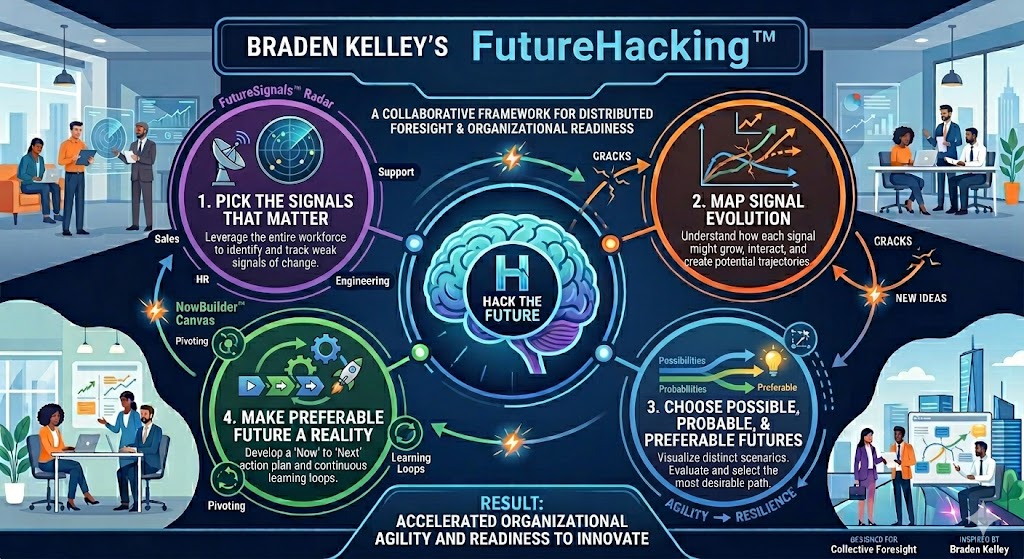
The FutureHacking Signal Picker is more than a standalone tool; it is the catalyst for a comprehensive strategic journey. By automating the initial discovery phase, it accelerates your ability to move through the proven FutureHacking™ methodology.

STEP ONE: Picking the Signals That Matter

This is where the Signal Picker does the heavy lifting. By inputting your industry, country, competitors, and adjacent sectors, you generate a prioritized list of the top ten signals. The Radar Chart visualization provides an immediate snapshot of the landscape, while the downloadable PDF ensures that these insights are ready to be shared with leadership to drive immediate alignment.

STEP TWO: Mapping Signal Evolution

Once you have identified your primary signals, the next phase is tracking their trajectory. Using FutureHacking tools, you can map how these signals are evolving — whether they are converging with other trends, gaining velocity, or shifting in uncertainty. This step prevents you from being blindsided by the speed of change.

FutureHacking Infographic

STEP THREE: Choosing the Possible, Probable, and Preferable Future

With the signals ranked by impact and timing, you can begin to construct scenarios. We move beyond simple forecasting to ask: What is possible? What is probable? And most importantly, what is our Preferable Future? The tool’s data points provide the objective foundation needed to define where your organization wants to go.

STEP FOUR: Making Your Preferable Future a Reality

The final step is the bridge to action. By analyzing the strategic implications provided by the Signal Picker, you can design the specific innovations and human-centered changes required to manifest your chosen future. It turns foresight into a tangible roadmap for Experience Design and organizational transformation.

Strategic Implications & Competitive Edge

The true value of the FutureHacking Signal Picker lies not just in the data it unearths, but in the strategic clarity it provides. By shifting from a generic “trend watching” approach to a focused signal analysis, organizations can develop a more resilient and proactive posture.

Finding Opportunity in the Adjacencies

Most organizations suffer from industry myopia — they only look at what their direct competitors are doing. The Signal Picker’s inclusion of adjacent industries acts as a secret weapon. It forces a wider lens, identifying how shifts in unrelated sectors — such as a breakthrough in biopharmaceuticals affecting the insurance market — might create a “ripple effect” that becomes your next big opportunity or threat.

Quantifying the Horizon

Strategy often fails when it is based on gut feeling alone. By ranking signals through a multiplied factor of impact, uncertainty, and timing, the tool provides a quantitative justification for innovation investment. It allows teams to visualize their “blind spots” on the radar chart, ensuring that resource allocation is balanced between defending the core and exploring the frontier.

Fostering a Future-Ready Culture

Launching this tool within your organization or community changes the conversation. It transforms strategic planning from a static, annual event into a continuous pulse. When teams can quickly download a PDF of ranked signals and implications, it democratizes foresight, allowing Human-Centered Innovation and Experience Design professionals to lead with data-backed authority and use the report as a jumping off point to input into the deep research tools that AI companies are now offering.

Conclusion & Call to Action

The future isn’t a destination that we passively reach; it is a landscape that we actively co-create. The launch of the FutureHacking Signal Picker marks a significant milestone for the global community of innovators, futurists, and designers, providing the essential “first spark” for the Human-Centered Innovation™ journey.

Join the Global FutureHacking Community

We invite you to step beyond the noise of generic trends and start tracking the signals that will actually define your industry’s next decade. Whether you are navigating digital transformation, crafting next-generation experiences, or leading organizational agility, the right signals are the foundation of your success.

Ready to Hack the Future?

Put the FutureHacking Signal Picker to work today. Input your industry parameters, download your custom Radar Chart, and take the first of the Four Simple But Powerful FutureHacking™ Steps toward making your preferable future a reality.

Access the Signal Picker Tool Now
… and then contact us when you’re ready for the full toolkit and training.

FutureHacking Signals Picker

Remember: The most effective way to predict the future is to design the signals that influence it. Let’s start hacking.

Frequently Asked Questions

How does the Signal Picker rank the top ten signals?

The tool uses a proprietary “Multiplied Impact Factor.” Instead of looking at trends in isolation, it calculates the product of three critical dimensions: Impact (the scale of potential disruption), Uncertainty (the degree of volatility), and Timing (how soon the signal will manifest). This ensures that the signals at the top of your list are both highly relevant and urgent.

Why does the tool ask for “Adjacent Industries”?

Innovation rarely happens in a vacuum; it often “leaks” from one sector to another. By analyzing adjacent industries, the Signal Picker identifies cross-industry signals that your direct competitors are likely overlooking. This provides a broader perspective necessary for the Step Two: Mapping Signal Evolution phase of the FutureHacking™ methodology.

What is the benefit of the downloadable Radar Chart?

The Radar Chart provides an immediate visual map of your strategic horizon. It allows stakeholders to see the balance between short-term certainties and long-term disruptions at a glance. By downloading the PDF, Human-Centered Innovation and Experience Design professionals can instantly present data-backed visualizations to leadership to gain buy-in for future-proofing initiatives.


Image credits: Google Gemini

Content Authenticity Statement: The topic area, key elements to focus on, etc. were decisions made by Braden Kelley, with a little help from Google Gemini to clean up the article, add images and create infographics.

Subscribe to Human-Centered Change & Innovation WeeklySign up here to get Human-Centered Change & Innovation Weekly delivered to your inbox every week.

Top 100 Innovation and Transformation Articles of 2024

Top 100 Innovation and Transformation Articles of 2024

2021 marked the re-birth of my original Blogging Innovation blog as a new blog called Human-Centered Change and Innovation.

Many of you may know that Blogging Innovation grew into the world’s most popular global innovation community before being re-branded as Innovation Excellence and being ultimately sold to DisruptorLeague.com.

Thanks to an outpouring of support I’ve ignited the fuse of this new multiple author blog around the topics of human-centered change, innovation, transformation and design.

I feel blessed that the global innovation and change professional communities have responded with a growing roster of contributing authors and more than 17,000 newsletter subscribers.

To celebrate we’ve pulled together the Top 100 Innovation and Transformation Articles of 2024 from our archive of over 2,500 articles on these topics.

We do some other rankings too.

We just published the Top 40 Innovation Bloggers of 2024 and as the volume of this blog has grown we have brought back our monthly article ranking to complement this annual one.

But enough delay, here are the 100 most popular innovation and transformation posts of 2024.

Did your favorite make the cut?

1. Organizational Debt Syndrome Poses a Threat – by Stefan Lindegaard

2. FREE Innovation Maturity Assessment – by Braden Kelley

3. The Education Business Model Canvas – by Arlen Meyers, M.D.

4. The Role of Stakeholder Analysis in Change Management – by Art Inteligencia

5. Act Like an Owner – Revisited! – by Shep Hyken

6. Iterate Your Thinking – by Dennis Stauffer

7. SpaceX is a Masterclass in Innovation Simplification – by Pete Foley

8. What is Human-Centered Change? – by Braden Kelley

9. A 90% Project Failure Rate Means You’re Doing it Wrong – by Mike Shipulski

10. Should a Bad Grade in Organic Chemistry be a Doctor Killer? – by Arlen Meyers, M.D.

11. How Netflix Built a Culture of Innovation – by Art Inteligencia

12. Fear is a Leading Indicator of Personal Growth – by Mike Shipulski

13. Sustaining Imagination is Hard – by Braden Kelley

14. No Regret Decisions: The First Steps of Leading through Hyper-Change – by Phil Buckley

15. The Art of Adaptability: How to Respond to Changing Market Conditions – by Art Inteligencia

16. Sprint Toward the Innovation Action – by Mike Shipulski

17. Marriott’s Approach to Customer Service – by Shep Hyken

18. Top 5 Future Studies Programs – by Art Inteligencia

19. Reversible versus Irreversible Decisions – by Farnham Street

20. 50 Cognitive Biases Reference – Free Download – Courtesy of TitleMax

21. Free Human-Centered Change Tools – by Braden Kelley

22. Designing an Innovation Lab: A Step-by-Step Guide – by Art Inteligencia

23. Why More Women Are Needed in Innovation – by Greg Satell

24. How to Defeat Corporate Antibodies – by Stefan Lindegaard

25. The Nine Innovation Roles – by Braden Kelley

26. Top 40 Innovation Bloggers of 2023 – Curated by Braden Kelley

27. Human-Centered Change – by Braden Kelley

28. Visual Project Charter™ – 35″ x 56″ (Poster Size) and JPG for Online Whiteboarding – by Braden Kelley

29. FutureHacking – Be Your Own Futurist – by Braden Kelley

30. ACMP Standard for Change Management® Visualization – 35″ x 56″ (Poster Size) – Association of Change Management Professionals – by Braden Kelley

Build a common language of innovation on your team


31. Overcoming Resistance to Change – by Chateau G Pato

32. Are We Abandoning Science? – by Greg Satell

33. How Networks Power Transformation – by Greg Satell

34. What Differentiates High Performing Teams – by David Burkus

35. The 6 Building Blocks of Great Teams – by David Burkus

36. Unintended Consequences. The Hidden Risk of Fast-Paced Innovation – by Pete Foley

37. The Role of Employee Training and Development in Enhancing Customer Experience – by Art Inteligencia

38. The Pyramid of Results, Motivation and Ability – by Braden Kelley

39. Your Strategy Must Reach Beyond Markets to Ecosystems – by Greg Satell

40. What is the difference between signals and trends? – by Art Inteligencia

41. Next Generation Leadership Traits and Characteristics – by Stefan Lindegaard

42. Latest Interview with the What’s Next? Podcast – Featuring Braden Kelley

43. A Tipping Point for Organizational Culture – by Janet Sernack

44. Accountability and Empowerment in Team Dynamics – by Stefan Lindegaard

45. Design Thinking for Non-Designers – by Chateau G Pato

46. The Innovation Enthusiasm Gap – by Howard Tiersky

47. The One Movie All Electric Car Designers Should Watch – by Braden Kelley

48. The Ultimate Guide to the Phase-Gate Process – by Dainora Jociute

49. Innovation Management ISO 56000 Series Explained – by Diana Porumboiu

50. How to Create an Effective Innovation Hub – by Chateau G Pato

Accelerate your change and transformation success


51. Imagination versus Knowledge – Is imagination really more important? – by Janet Sernack

52. Stoking Your Innovation Bonfire – by Braden Kelley

53. A Shortcut to Making Strategic Trade-Offs – by Geoffrey A. Moore

54. How to Make Navigating Ambiguity a Super Power – by Robyn Bolton

55. Three HOW MIGHT WE Alternatives That Actually Spark Creative Ideas – by Robyn Bolton

56. Problems vs. Solutions vs. Complaints – by Mike Shipulski

57. Innovation or Not – Liquid Trees – by Art Inteligencia

58. Everyone Clear Now on What ChatGPT is Doing? – by Geoffrey A. Moore

59. Leadership Best Quacktices from Oregon’s Dan Lanning – by Braden Kelley

60. Will Innovation Management Leverage AI in the Future? – by Jesse Nieminen

61. The Power of Position Innovation – by John Bessant

62. Creating Organizational Agility – by Howard Tiersky

63. A Case Study on High Performance Teams – by Stefan Lindegaard

64. Secrets to Overcoming Resistance to Change – by David Burkus

65. How to Write a Failure Resume – by Arlen Meyers, M.D.

66. 9 of 10 Companies Requiring Employees to Return to the Office in 2024 – by Shep Hyken

67. The Five Keys to Successful Change – by Braden Kelley

68. What is Social Analysis? – by Art Inteligencia

69. Dare to Think Differently – by Janet Sernack

70. Parallels Between the 1920’s and Today Are Frightening – by Greg Satell

71. What is Trend Spotting? – by Art Inteligencia

72. Driving Change is Not Enough – You Also Have To Survive Victory – by Greg Satell

73. 5 Simple Steps to Team Alignment – by David Burkus

74. Building a Better Change Communication Plan – by Braden Kelley

75. The Role of Leadership in Fostering a Culture of Innovation – by Art Inteligencia

76. 4 Simple Steps to Becoming Your Own Futurist – An Introduction to the FutureHacking™ methodology – by Braden Kelley

77. Four Hidden Secrets of Innovation – by Greg Satell

78. Why Organizations Struggle with Innovation – by Howard Tiersky

79. An Introduction to Strategic Foresight – by Stefan Lindegaard

80. Learning About Innovation – From a Skateboard? – by John Bessant


Get the Change Planning Toolkit


81. 800+ FREE Quote Posters – by Braden Kelley

82. Do you have a fixed or growth mindset? – by Stefan Lindegaard

83. Generation AI Replacing Generation Z – by Braden Kelley

84. The End of the Digital Revolution – by Greg Satell

85. Is AI Saving Corporate Innovation or Killing It? – by Robyn Bolton

86. The Experiment Canvas™ – 35″ x 56″ (Poster Size) – by Braden Kelley

87. America Drops Out of the Ten Most Innovative Countries – by Braden Kelley

88. 5 Essential Customer Experience Tools to Master – by Braden Kelley

89. AI as an Innovation Tool – How to Work with a Deeply Flawed Genius! – by Pete Foley

90. Four Ways To Empower Change In Your Organization – by Greg Satell

91. Agile Innovation Management – by Diana Porumboiu

92. Do Nothing More Often – by Robyn Bolton

93. Five Things Most Managers Don’t Know About Innovation – by Greg Satell

94. The Fail Fast Fallacy – by Rachel Audige

95. Top Six Trends for Innovation Management in 2025 – by Jesse Nieminen

96. How to Re-engineer the Incubation Zone – by Geoffrey A. Moore

97. Flaws in the Crawl Walk Run Methodology – by Braden Kelley

98. Master the Customer Hierarchy of Needs – by Shep Hyken

99. Rise of the Atomic Consultant – Or the Making of a Superhero – by Braden Kelley

100. A Shared Language for Radical Change – by Greg Satell

Curious which article just missed the cut? Well, here it is just for fun:

101. Is Disruption About to Claim a New Victim? – by Robyn Bolton

These are the Top 100 innovation and transformation articles of 2024 based on the number of page views. If your favorite Human-Centered Change & Innovation article didn’t make the cut, then send a tweet to @innovate and maybe we’ll consider doing a People’s Choice List for 2024.

If you’re not familiar with Human-Centered Change & Innovation, we publish 1-6 new articles every week focused on human-centered change, innovation, transformation and design insights from our roster of contributing authors and ad hoc submissions from community members. Get the articles right in your Facebook feed or on Twitter or LinkedIn too!

Editor’s Note: Human-Centered Change & Innovation is open to contributions from any and all the innovation & transformation professionals out there (practitioners, professors, researchers, consultants, authors, etc.) who have a valuable insight to share with everyone for the greater good. If you’d like to contribute, contact us.

Subscribe to Human-Centered Change & Innovation WeeklySign up here to get Human-Centered Change & Innovation Weekly delivered to your inbox every week.

AI Literacy for Every Role (Not Just CoE Members)

LAST UPDATED: March 4, 2026 at 11:14 AM

AI Literacy for Every Role (Not Just CoE Members)

GUEST POST from Art Inteligencia


I. The Myth of the “AI Specialist” Silo

In my years helping organizations navigate the Human-Centered Innovation™ landscape, I’ve seen a recurring ghost in the machine: the belief that innovation belongs in a locked room. We saw it with the early days of “Digital Transformation,” and we are seeing it again with Artificial Intelligence. Many leaders are rushing to build an AI Center of Excellence (CoE), thinking that by gathering a few specialists in a silo, they have “solved” the AI problem.

This is a dangerous misunderstanding of how organizational agility works. When you confine AI literacy to a CoE, you create a catastrophic “Assumption Gap.” The specialists understand the math, but they don’t understand the friction of the front-line salesperson or the nuanced empathy required by a customer success lead.

“Software — and by extension, AI — is far too important to be left solely to the software people.”

If the rest of your workforce remains AI-illiterate, your CoE becomes an island. You end up with “Rigid Decay,” where the specialist team builds high-tech solutions that the rest of the organization is either too afraid to use or too uninformed to integrate. To move from a static “project” mindset to a living Inherent Capability, we must democratize the language of AI.

The goal isn’t to turn every accountant into a data scientist; it is to ensure every accountant knows how to collaborate with one. We need to stop treating AI as a “specialty” and start treating it as a foundational layer of the Change Planning Canvas™.

II. Defining AI Literacy: The “Stable Spine” of Knowledge

In any Human-Centered Innovation™ initiative, we must distinguish between “tool-fluency” and “literacy.” Knowing how to type a prompt into a chatbot is a fleeting skill; understanding the logic of Generative AI and its impact on your specific value chain is a durable capability. I call this the “Stable Spine” — the core set of principles that stay upright even as the technology shifts beneath our feet.

True AI literacy for the broader workforce isn’t about learning Python. It’s about building a Common Language across the organization. When Marketing, HR, and Operations speak the same dialect of “Data Provenance,” “Hallucination Risks,” and “Iterative Refinement,” the Change Planning Canvas™ actually begins to work.

  • Beyond Tool-Picking: We must move from “What tool should I use?” to “What problem am I solving?” This reduces “Cognitive Clutter” and ensures we aren’t just automating bad processes.
  • Understanding Causal AI: Every employee should grasp the “Why” behind the output. If you don’t understand the logic, you can’t provide the “Human-in-the-Loop” oversight that prevents catastrophic brand or operational errors.
  • The Ethics of Insight: Literacy includes recognizing bias. We must learn the lessons of the past — like the “Tay” chatbot — to ensure our AI implementations don’t scale our existing organizational prejudices.

By establishing this spine, we move from “Experience Narcissism” (assuming our old ways are best) to a state of Marked Flexibility. We aren’t just using AI; we are integrating it into the very marrow of how we innovate.

III. The Role-Based AI “Squad” Strategy

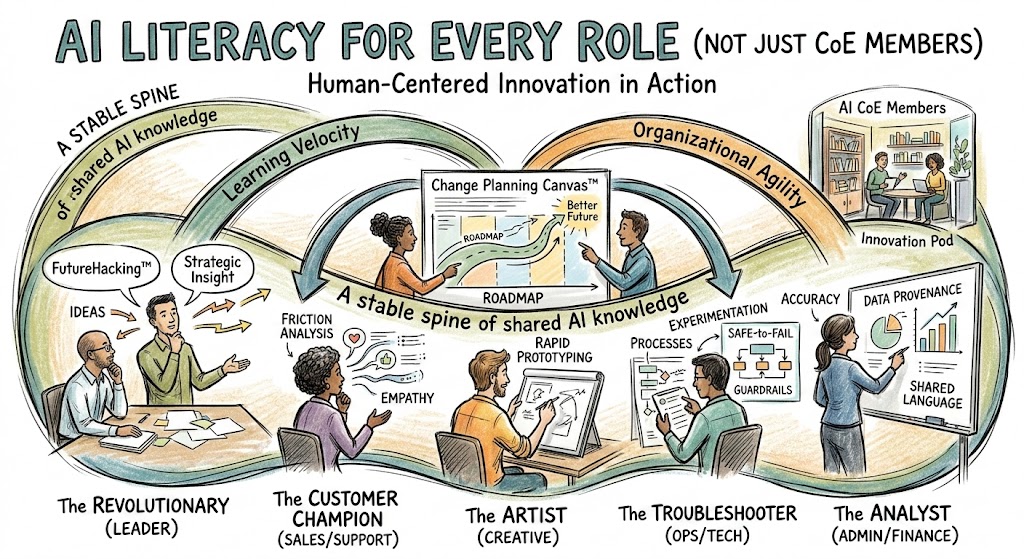
One size does not fit all in the Change Planning Canvas™. To democratize AI literacy, we must translate it into the specific “Value-Add” for different roles. When we move beyond the CoE, we empower individuals to become part of an Innovation Squad, each using AI as a “Force Multiplier” for their unique perspective.

The Persona The AI “Superpower” Human-Centered Outcome
The Revolutionary (Leadership) Strategic “FutureHacking™” and Trend Synthesis. Reducing “Time-to-Insight” to make bolder, data-backed bets.
The Customer Champion (Front Line) Real-time Friction Analysis and Sentiment Mapping. Closing the “Experience Narcissism” gap by truly hearing the customer.
The Artist & Troubleshooter (Technical/Creative) Rapid Prototyping and “Safe-to-Fail” Simulation. Increasing “Learning Velocity” without risking the core business.

By equipping The Revolutionary with AI literacy, we ensure they aren’t just chasing “Shiny Object Syndrome.” Instead, they are using AI to identify where the organization can be Markedly Flexible.

Meanwhile, The Customer Champion uses AI to sift through the “Cognitive Clutter” of thousands of feedback points, identifying the one intervention that will actually move the needle on customer loyalty. This isn’t just “using a tool” — it’s a deliberate Human-Centered Intervention to create a better future for the user.

IV. Overcoming the “70% Failure Rate” in AI Adoption

Statistics in the change management world are sobering: nearly 70% of change initiatives fail. When we layer the complexity of Artificial Intelligence onto that, the risk of “Rigid Decay” skyrockets. To beat these odds, we must look past the algorithms and focus on the PCC Framework: Psychology, Capability, and Capacity.

1. Addressing the Psychology of “Replacement Anxiety”

If an employee perceives AI as a threat to their livelihood, they will subconsciously (or consciously) sabotage its adoption. We must reframe AI as a tool for “Subjective Time Expansion.” By automating the mundane, we aren’t replacing the human; we are freeing them to perform the high-value, high-empathy tasks that AI cannot touch.

2. Clearing the “Cognitive Clutter”

AI literacy helps teams identify where they are drowning in “Cognitive Clutter” — those low-value tasks that prevent them from reaching a state of flow. Literacy allows a worker to say, “AI can handle the data synthesis here, so I can focus on the strategic intervention.”

3. Establishing “Safe-to-Fail” Zones

Organizational Agility requires a culture where experimentation is the norm. We must reward Learning Velocity. If a team tries an AI-driven workflow and it fails, but they document why and share that insight across the Change Planning Canvas™, that is a win for the entire organization.

“The goal of AI literacy is to move from fear of the unknown to the mastery of a new medium.”

By visualizing these change hurdles using collaborative tools, we ensure the entire “Squad” is literally on the same page. We aren’t just pushing a new tool; we are performing a Deliberate Intervention to evolve the company culture.

V. Moving from Theory to Practice: The Implementation Checklist

To avoid “Rigid Decay,” we must treat AI literacy as a living organism, not a one-time workshop. This checklist is designed to integrate AI into your Change Planning Canvas™, ensuring that the entire organization moves at the same Learning Velocity.

1. Audit for “Marked Flexibility”

Every department should identify three legacy processes that are currently “rigid.” Ask: “If we had an infinite amount of data synthesis capability, how would this process change?” This identifies where AI literacy can provide the most immediate Human-Centered lift.

2. Deploy “Safe-to-Fail” Micro-Pilots

Don’t wait for a company-wide rollout. Encourage Innovation Squads to run two-week experiments. The goal isn’t necessarily a “win,” but a documented insight. If the pilot fails, but the team learns something about their data quality, that is a successful intervention.

3. Establish the “Shared Vocabulary” Baseline

Create a “No-Jargon Zone.” Ensure that everyone from the CEO to the front-line intern understands the basics of Prompt Engineering, Algorithmic Bias, and Data Privacy. When everyone speaks the same language, the “Assumption Gap” disappears.

4. Visualize the Flow

Use collaborative tools to map out how AI-augmented work flows through the company. If the AI output stays in a silo, it’s useless. We must visualize how an AI-generated insight in Marketing triggers a Deliberate Intervention in Sales or Product Development.

“The future belongs to the organizations that can learn as fast as their tools evolve.”

By following this checklist, you aren’t just “buying AI” — you are building a Future-Ready culture that is Markedly Flexible and deeply human.

VI. Conclusion: The Future is Human-Led, AI-Augmented

Innovation is never about the technology itself; it is a Deliberate Intervention to create a better future. When we democratize AI literacy, we aren’t just teaching a new skill — we are dismantling “Rigid Decay” and replacing it with Organizational Agility.

By moving AI out of the CoE and into every role, we empower the Customer Champion, the Revolutionary, and the Troubleshooter to speak a Common Language. We bridge the “Assumption Gap” and ensure that our digital transformation is anchored in human empathy.

“The question is not how intelligent the AI is, but how we are intelligent in using it to expand our human potential.”

The organizations that thrive in this era will be those that prioritize Learning Velocity over static expertise. They will be the ones that use the Change Planning Canvas™ to visualize a future where AI handles the “spin” so that humans can provide the “lift.”

The future is not a destination we reach; it is a state of Marked Flexibility we inhabit every day. Let’s stop building silos and start building a literate, empowered, and innovative workforce.

Frequently Asked Questions: AI Literacy for All

1. Why should AI literacy extend beyond the Center of Excellence (CoE)?

Confining AI knowledge to a CoE creates “Rigid Decay,” where specialists build tools that the broader workforce cannot or will not use. Extending literacy to every role bridges the Assumption Gap, ensuring that AI solutions are human-centered and solve real-world friction rather than just adding to “Cognitive Clutter.”

2. Does every employee need to learn how to code or build AI models?

No. True AI literacy is about building a “Stable Spine” of knowledge—understanding the “why” and “how” of AI logic, data ethics, and Human-in-the-Loop oversight. The goal is Organizational Agility, where every “Innovation Squad” member has the common language to collaborate on the Change Planning Canvas™.

3. What is the immediate benefit of role-based AI literacy?

The primary benefit is “Subjective Time Expansion.” When every role — from the Revolutionary to the Customer Champion — understands how to use AI for data synthesis and rapid prototyping, they reduce their Learning Velocity and clear away the “Cognitive Clutter” of low-value tasks. This allows the human workforce to focus on high-empathy, high-strategy interventions that AI cannot replicate.

Image credit: Google Gemini

Subscribe to Human-Centered Change & Innovation WeeklySign up here to get Human-Centered Change & Innovation Weekly delivered to your inbox every week.