LAST UPDATED: May 6, 2026 at 9:59 AM
GUEST POST from Chateau G Pato
The High Cost of the “Quick Win”
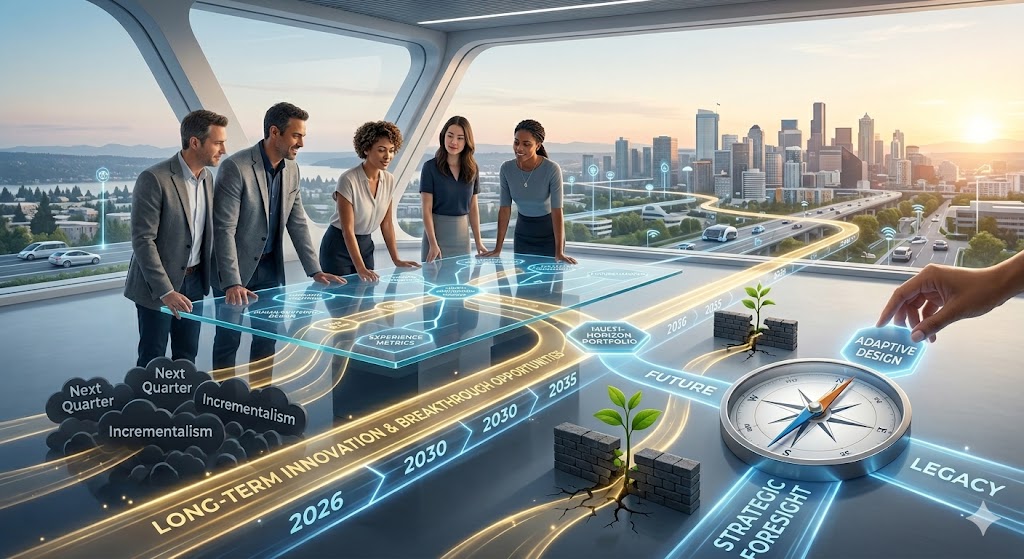
In the modern corporate landscape, the gravitational pull of the quarterly earnings report often traps even the most visionary leaders in a cycle of incrementalism. While hitting immediate targets is necessary for survival, it frequently comes at a steep price: the sacrifice of long-term relevance. When we prioritize the “quick win” above all else, we are not just choosing efficiency; we are actively accumulating “innovation debt” that will eventually come due.
Short-termism acts as a silent killer of sustainable growth. It narrows the organizational lens, forcing teams to focus exclusively on optimizing what already exists rather than exploring what could be. This creates a dangerous Innovation Gap — the widening distance between a company’s current capabilities and the rapidly evolving demands of a future market. If we don’t intentionally design our strategies to bridge this gap, we leave the door wide open for more agile disruptors to step in.
The hard truth is that short-termism isn’t usually caused by a lack of imagination. Instead, it is a failure of design and governance. To overcome it, we must move beyond the rhetoric of “thinking big” and implement structural antidotes that protect future-oriented exploration from the pressures of today’s operational demands. We must shift the narrative from mere survival to intentional, human-centered evolution.
Diagnosis: Why We Default to the Near-Term
To solve for short-termism, we must first understand the psychological and structural anchors that keep us moored to the present. It isn’t simply a lack of “bravery” in the boardroom; it is a systemic response to how we measure success and manage risk.
Loss Aversion in the C-Suite
Human psychology is naturally wired for loss aversion. In a corporate context, the perceived risk of a failed breakthrough project often outweighs the theoretical gain of a future market-leading position. This leads to a “safety-first” mentality where proven incrementalism — making the existing horse run 2% faster — feels more responsible than investing in the “unproven” radical innovation that could replace the horse entirely.
The Incentive Misalignment
We are what we measure. Most organizational KPIs, bonus structures, and performance reviews are calibrated to annual or even quarterly cycles. When leaders are rewarded for immediate efficiency and cost-cutting, they are logically disincentivized from making “long-tail” investments. We cannot expect Horizon 3 thinking from a workforce that is being compensated solely on Horizon 1 results.
Information Overload vs. Insight Scarcity
In our hyper-connected world, leaders are bombarded with daily “noise” — competitor press releases, stock fluctuations, and viral social trends. This creates a reactive posture. When we spend all our cognitive energy responding to the friction of today, we lose the capacity to identify the subtle weak signals that point toward the opportunities of tomorrow. We mistake activity for progress and urgency for importance.
Antidote 1: Designing a Multi-Horizon Portfolio
To break the cycle of short-termism, organizations must treat innovation not as a series of isolated projects, but as a balanced portfolio. Just as a financial advisor diversifies assets to manage risk and return over time, innovation leaders must diversify their initiatives across different time horizons. This structural approach ensures that the “urgent” does not permanently crowd out the “important.”
The 70/20/10 Rule Revisited
A resilient strategy typically allocates resources in a balanced ratio: 70% to core innovation (optimizing current products), 20% to adjacent innovation (expanding into new markets or capabilities), and 10% to transformational innovation (creating entirely new breakthroughs). Short-termism occurs when the 70% begins to swallow the rest. By formalizing these buckets, organizations create a mandate for long-term exploration that is protected from quarterly budget cuts.
Operationalizing the Three Horizons
Using the Three Horizons framework allows us to visualize our current state while simultaneously mapping our future. Horizon 1 represents the systems that keep the lights on today. Horizon 2 represents emerging opportunities that are gaining momentum. Horizon 3 contains the visionary ideas that will define the organization’s future a decade from now. The “antidote” lies in managing all three simultaneously, rather than waiting for Horizon 1 to decline before thinking about Horizon 3.
Decoupled Funding and Governance
One of the most effective mechanical fixes for short-termism is decoupled funding. Transformational projects should not compete for the same “pot” of money as operational maintenance. By ring-fencing budgets for long-term bets, leadership sends a clear signal that future-proofing is a non-negotiable priority. Furthermore, these projects should be governed by different metrics — focusing on “speed to learning” rather than “speed to ROI” in their early stages.
Antidote 2: Human-Centered Futurology
Futurology is often misunderstood as the pursuit of “predicting” the future. In reality, it is about preparedness. Short-termism thrives when the future feels like an abstract, distant problem. To counter this, we must bring the future into the present by making it tangible, relatable, and human-centered. We must shift our focus from what the technology can do, to what humans will value in a world reshaped by that technology.
Foresight as an Organizational Muscle
Strategic foresight should not be a once-a-year executive retreat. It must be an ongoing organizational capability. This involves “environmental scanning” — systematically looking for weak signals and peripheral trends that are currently on the edges but have the potential to move to the center. When we train our teams to spot these signals early, we reduce the “surprise factor” and give ourselves the lead time necessary to build sustainable strategies rather than reactive patches.
Scenario Planning and Speculative Design
Data and spreadsheets are often too dry to inspire long-term change. To overcome the inertia of the present, we use scenario planning and speculative design to create vivid “future worlds.” By crafting narratives about how people will live, work, and play in five or ten years, we make the risks and opportunities feel real to stakeholders today. These stories serve as a north star, helping leadership align on a shared vision that extends far beyond the next fiscal year.
Customer Empathy Beyond Today
Traditional market research tells us what customers want now based on their current frustrations. Human-centered futurology asks a different question: “How will human needs evolve?” As socio-economic conditions shift and new technologies emerge, customer behaviors will transform. By applying empathy to these future personas, we can begin designing the experiences of tomorrow today, ensuring our innovation pipeline is solving problems that will actually exist when the product finally hits the market.
Antidote 3: Architectural Excellence & Experience Design
To resist the gravitational pull of short-termism, innovation must move from a sporadic “lightning strike” to a disciplined, repeatable process. We must design an organizational architecture that is inherently flexible, allowing us to build for the future while maintaining the stability of the present. This requires a shift from focusing on isolated product features to designing holistic, long-term Experience Strategies.
Innovation Excellence (IxL)
True innovation isn’t just about the “big idea”; it’s about the infrastructure that supports it. By implementing a robust framework for Innovation Excellence, organizations create a common language and set of tools for evaluating progress. This framework acts as a structural safeguard, ensuring that projects are judged by their strategic fit and future potential rather than just their immediate profitability. It turns innovation into a core competency rather than a side project.
Designing the Infinite Customer Journey
Short-term strategy often focuses on the point of sale. Experience design, however, looks at the entire lifecycle of the human relationship with a brand. By mapping out long-term Experience Level Measures (XLMs), we can track how our innovation efforts are improving the lives of our customers over time. This human-centered data provides a powerful counter-narrative to purely financial metrics, proving that long-term loyalty and “experience-led acquisition” are more valuable than one-off transactions.
Building for Adaptability
One of the greatest enemies of long-term thinking is “rigid infrastructure” — whether that is technical debt, fixed business models, or siloed organizational charts. To stay relevant, we must design for modularity. An adaptable architecture allows an organization to pivot its strategy without a total system collapse. By building “future-ready” platforms, we ensure that when the market shifts, we have the foundation in place to move with it, rather than being forced to rebuild from scratch under the pressure of a crisis.
Antidote 4: Cultural Transformation & Psychological Safety
The most sophisticated innovation frameworks will fail if they are planted in a culture of fear. Short-termism is often a defense mechanism; when employees feel that their jobs depend on immediate success, they will naturally avoid the risks associated with long-term exploration. To counter this, we must transform the cultural “operating system” of the organization to value learning as much as it values efficiency.
Redefining Failure and Learning Loops
In a short-term culture, a project that doesn’t yield immediate ROI is labeled a “failure.” In a future-ready culture, we treat these instances as “learning dividends.” By utilizing tools like pre-mortems, teams can anticipate future roadblocks before they occur, shifting the focus from blame to prevention. We must foster an environment where “failing fast” is actually about “learning fast,” ensuring that every experiment — regardless of the financial outcome — strengthens our strategic position.
The Leader as Orchestrator
Moving away from short-termism requires a fundamental shift in leadership style. Leaders must move from “Command and Control” — where they provide all the answers and demand immediate results — to becoming an Orchestrator. This role involves setting the vision, removing obstacles, and creating the psychological safety necessary for teams to pursue bold, long-term ideas. When leaders prioritize the health of the innovation ecosystem over the daily tally of tasks, the organization gains the breathing room to innovate.
Tapping into Collective Intelligence
The “antidote” to narrow, top-down short-termism is internal crowdsourcing. Often, the front-line employees who interact with customers daily have the clearest view of emerging shifts and long-term needs. By creating democratic channels for idea submission and collaborative problem-solving, we tap into a diverse range of perspectives. This not only builds a more robust innovation pipeline but also creates a sense of shared ownership in the organization’s future, making long-term goals feel personal rather than corporate.
Implementation: Taking the First Step
The transition from a reactive, short-term posture to a proactive, future-ready strategy does not happen overnight. It requires a series of intentional, practical shifts that bridge the gap between our current operational reality and our long-term aspirations. Implementation is where theory meets the pavement, and it begins with changing who we listen to and how we measure progress.
The “Shadow Board” Strategy
To disrupt the “echo chamber” of the executive suite, forward-thinking organizations are implementing Shadow Boards — groups of younger, non-executive employees who are given the same data as the senior board to provide a different perspective. These digital natives often see the world through a lens of 2030 rather than 1990. By involving diverse voices in high-level strategic discussions, we naturally challenge short-term assumptions and gain early visibility into the cultural shifts that will define our future market.
Validating Through Micro-Experiments
We don’t need to bet the entire company on a single long-term hypothesis. Instead, we use micro-experiments to validate our assumptions. These are low-cost, high-learning pilots designed to test specific elements of a “Horizon 3” idea. By breaking down a ten-year vision into small, actionable steps, we can gather real-world data today that justifies continued investment in tomorrow. This reduces the perceived risk of long-term innovation and allows us to pivot based on evidence rather than ego.
Measuring What Matters: Leading vs. Lagging Indicators
If we only measure revenue and profit, we will always be looking in the rearview mirror. To combat short-termism, we must introduce leading indicators that track the health of our future pipeline. This includes metrics such as “speed to learning,” “percentage of revenue from new business models,” and “innovation pipeline velocity.” By shifting our focus to these forward-looking measures, we give our teams the permission — and the mandate — to prioritize the activities that will ensure our longevity.
Conclusion: The Legacy of Innovation
In the final analysis, the fight against short-termism is not just a tactical battle over budgets or timelines — it is a philosophical commitment to the infinite game of business. Companies that survive the next decade won’t be those that hit every quarterly target at any cost, but those that viewed innovation as a continuous, human-centered journey rather than a destination with a fixed ROI.
As leaders, we must recognize that our greatest contribution isn’t the efficiency we squeeze out of today’s operations, but the foundations we build for tomorrow. When we implement the antidotes of multi-horizon portfolios, strategic foresight, and cultural psychological safety, we are doing more than just planning; we are ensuring that our organizations remain relevant in a world that refuses to stand still.
The choice is clear: we can continue to be managed by the pressures of the ledger, or we can choose to design a legacy. By prioritizing long-term innovation strategy today, we aren’t just predicting the 2030s — we are actively creating them. The future is not something that happens to us; it is something we build, one intentional, human-centered decision at a time.
It’s time to stop surviving the quarter and start stoking the innovation bonfire.
Frequently Asked Questions
How can we protect long-term innovation budgets during a market downturn?
The most effective method is “decoupled funding,” where Horizon 3 budgets are ring-fenced and treated as strategic capital rather than operational expense. By separating these funds from the core business P&L, leadership ensures that the “urgent” needs of today do not cannibalize the “important” seeds of tomorrow.
What is the difference between an SLA and an XLM in innovation?
While a Service Level Agreement (SLA) measures technical performance (uptime, speed, accuracy), an Experience Level Measure (XLM) tracks the human impact of an innovation. XLMs focus on qualitative outcomes like user friction reduction, cognitive load, and emotional resonance, ensuring the strategy remains human-centered.
How does ‘FutureHacking’ help combat short-termism?
FutureHacking involves identifying weak signals in the present to build tangible future scenarios. By making the “future” feel like a concrete reality through speculative design, leaders can more easily justify the long-term investments required to navigate upcoming socio-economic shifts.
Bottom line: Futurology is not fortune telling. Futurists use a scientific approach to create their deliverables, but a methodology and tools like those in FutureHacking™ can empower anyone to engage in futurology themselves.
Image credit: Gemini
 Sign up here to get Human-Centered Change & Innovation Weekly delivered to your inbox every week.