Category Archives: Leadership

Three Mandates for Better Decisions

Three Mandates for Better Decisions

GUEST POST from Mike Shipulski

The primary responsibility of management is to allocate resources in the way that best achieves business objectives. If there are three or four options to allocate resources, which is the best choice? What is the time horizon for the decision? Is it best to hire more people? Why not partner with a contract resource company? Build a new facility or add to the existing one? No right answers, but all require a decision.

Rule 1 – Make decisions overtly. All too often, decisions happen slowly over time without knowledge the decision was actually made. A year down the road, we wake up from our daze and realize we’re all aligned with a decision we didn’t know we made. That’s bad for business. Make them overtly and document them.

Rule 2 – Define the decision criteria before it’s time to decide. We all have biases and left to our own, we’ll make the decision that fits with our biases. For example, if we think the project is a good idea, we’ll interpret the project’s achievements through our biased lenses and fund the next phase. To battle this, define the decision criteria months before the funding decision will be made. Think if-then. If the project demonstrates A, then we’ll allocate $50,000 for the next phase; if the project demonstrates A, B and C, then we’ll allocate $100,000; if the project fails to demonstrate A, B or C, then we’ll scrap the project and start a new one. If the decision criteria aren’t predefined, you’ll define them on-the-spot to justify the decision you already wanted to make.

Rule 3 – Define who will decide before it’s time to decide. Will the decision be made by anonymous vote or by a show of hands? Is a simple majority sufficient, or does it require a two-thirds majority? Does it require a consensus? If so, does it have to be unanimous or can there be some disagreement? If there can be disagreement, how many people can disagree? Does the loudest voice decide? Or does the most senior person declare their position and everyone else falls in line like sheep?

Think back to the last time your company made a big decision. Were the decision criteria defined beforehand? Can you go back to the meeting minutes and find how the project performed against the decision criteria? Were the if-then rules defined upfront? If so, did you follow them? And now that you remember how it went last time, do you think you would have made a better decision if the decision criteria and IF-THENs were in place before the decision? Now, decide how it will go next time.

And for that last big decision, is there a record of how the decision was made? If there was a vote, who voted up and who voted down? If a consensus was reached, who overtly said they agreed to the decision and who dissented? Or did the most senior person declare a consensus when in fact it was a consensus of one? If you can find a record of the decision, what does the record show? And if you can’t find the record, how do you feel about that? Now that you reflected on last time, decide how it will go next time.

It’s scary to think about how we make decisions. But it’s scarier to decide we will make them the same way going forward. It’s time to decide we will put more rigor into our decision making.

Image credit: Pexels

Subscribe to Human-Centered Change & Innovation WeeklySign up here to join 17,000+ leaders getting Human-Centered Change & Innovation Weekly delivered to their inbox every week.

Top 100 Innovation and Transformation Articles of 2025

Top 100 Innovation and Transformation Articles of 2025

2021 marked the re-birth of my original Blogging Innovation blog as a new blog called Human-Centered Change and Innovation.

Many of you may know that Blogging Innovation grew into the world’s most popular global innovation community before being re-branded as Innovation Excellence and being ultimately sold to DisruptorLeague.com.

Thanks to an outpouring of support I’ve ignited the fuse of this new multiple author blog around the topics of human-centered change, innovation, transformation and design.

I feel blessed that the global innovation and change professional communities have responded with a growing roster of contributing authors and more than 17,000 newsletter subscribers.

To celebrate we’ve pulled together the Top 100 Innovation and Transformation Articles of 2025 from our archive of over 3,200 articles on these topics.

We do some other rankings too.

We just published the Top 40 Innovation Authors of 2025 and as the volume of this blog has grown we have brought back our monthly article ranking to complement this annual one.

But enough delay, here are the 100 most popular innovation and transformation posts of 2025.

Did your favorite make the cut?

1. A Toolbox for High-Performance Teams – Building, Leading and Scaling – by Stefan Lindegaard

2. Top 10 American Innovations of All Time – by Art Inteligencia

3. The Education Business Model Canvas – by Arlen Meyers, M.D.

4. What is Human-Centered Change? – by Braden Kelley

5. How Netflix Built a Culture of Innovation – by Art Inteligencia

6. McKinsey is Wrong That 80% Companies Fail to Generate AI ROI – by Robyn Bolton

7. The Great American Contraction – by Art Inteligencia

8. A Case Study on High Performance Teams – New Zealand’s All Blacks – by Stefan Lindegaard

9. Act Like an Owner – Revisited! – by Shep Hyken

10. Should a Bad Grade in Organic Chemistry be a Doctor Killer? – by Arlen Meyers, M.D.

11. Charting Change – by Braden Kelley

12. Human-Centered Change – by Braden Kelley

13. No Regret Decisions: The First Steps of Leading through Hyper-Change – by Phil Buckley

14. SpaceX is a Masterclass in Innovation Simplification – by Pete Foley

15. Top 5 Future Studies Programs – by Art Inteligencia

16. Marriott’s Approach to Customer Service – by Shep Hyken

17. The Role of Stakeholder Analysis in Change Management – by Art Inteligencia

18. The Triple Bottom Line Framework – by Dainora Jociute

19. The Nordic Way of Leadership in Business – by Stefan Lindegaard

20. Nine Innovation Roles – by Braden Kelley

21. ACMP Standard for Change Management® Visualization – 35″ x 56″ (Poster Size) – Association of Change Management Professionals – by Braden Kelley

22. Designing an Innovation Lab: A Step-by-Step Guide – by Art Inteligencia

23. FutureHacking™ – by Braden Kelley

24. The 6 Building Blocks of Great Teams – by David Burkus

25. Overcoming Resistance to Change – Embracing Innovation at Every Level – by Chateau G Pato

26. Human-Centered Change – Free Downloads – by Braden Kelley

27. 50 Cognitive Biases Reference – Free Download – by Braden Kelley

28. Quote Posters – Curated by Braden Kelley

29. Stoking Your Innovation Bonfire – by Braden Kelley

30. Innovation or Not – Kawasaki Corleo – by Art Inteligencia


Build a common language of innovation on your team


31. Top Six Trends for Innovation Management in 2025 – by Jesse Nieminen

32. Fear is a Leading Indicator of Personal Growth – by Mike Shipulski

33. Visual Project Charter™ – 35″ x 56″ (Poster Size) and JPG for Online Whiteboarding – by Braden Kelley

34. The Most Challenging Obstacles to Achieving Artificial General Intelligence – by Art Inteligencia

35. The Ultimate Guide to the Phase-Gate Process – by Dainora Jociute

36. Case Studies in Human-Centered Design – by Art Inteligencia

37. Transforming Leadership to Reshape the Future of Innovation – Exclusive Interview with Brian Solis

38. Leadership Best Quacktices from Oregon’s Dan Lanning – by Braden Kelley

39. This AI Creativity Trap is Gutting Your Growth – by Robyn Bolton

40. A 90% Project Failure Rate Means You’re Doing it Wrong – by Mike Shipulski

41. Reversible versus Irreversible Decisions – by Farnham Street

42. Next Generation Leadership Traits and Characteristics – by Stefan Lindegaard

43. Top 40 Innovation Bloggers of 2024 – Curated by Braden Kelley

44. Benchmarking Innovation Performance – by Noel Sobelman

45. Three Executive Decisions for Strategic Foresight Success or Failure – by Robyn Bolton

46. Back to Basics for Leaders and Managers – by Robyn Bolton

47. You Already Have Too Many Ideas – by Mike Shipulski

48. Imagination versus Knowledge – Is imagination really more important? – by Janet Sernack

49. Building a Better Change Communication Plan – by Braden Kelley

50. 10 Free Human-Centered Change™ Tools – by Braden Kelley


Accelerate your change and transformation success


51. Why Business Transformations Fail – by Robyn Bolton

52. Overcoming the Fear of Innovation Failure – by Stefan Lindegaard

53. What is the difference between signals and trends? – by Art Inteligencia

54. Unintended Consequences. The Hidden Risk of Fast-Paced Innovation – by Pete Foley

55. Giving Your Team a Sense of Shared Purpose – by David Burkus

56. The Top 10 Irish Innovators Who Shaped the World – by Art Inteligencia

57. The Role of Emotional Intelligence in Effective Change Leadership – by Art Inteligencia

58. Is OpenAI About to Go Bankrupt? – by Art Inteligencia

59. Sprint Toward the Innovation Action – by Mike Shipulski

60. Innovation Management ISO 56000 Series Explained – by Diana Porumboiu

61. How to Make Navigating Ambiguity a Super Power – by Robyn Bolton

62. 3 Secret Saboteurs of Strategic Foresight – by Robyn Bolton

63. Four Major Shifts Driving the 21st Century – by Greg Satell

64. Problems vs. Solutions vs. Complaints – by Mike Shipulski

65. The Power of Position Innovation – by John Bessant

66. Three Ways Strategic Idleness Accelerates Innovation and Growth – by Robyn Bolton

67. Case Studies of Companies Leading in Inclusive Design – by Chateau G Pato

68. Recognizing and Celebrating Small Wins in the Change Process – by Chateau G Pato

69. Parallels Between the 1920’s and Today Are Frightening – by Greg Satell

70. The Art of Adaptability: How to Respond to Changing Market Conditions – by Art Inteligencia

71. Do you have a fixed or growth mindset? – by Stefan Lindegaard

72. Making People Matter in AI Era – by Janet Sernack

73. The Role of Prototyping in Human-Centered Design – by Art Inteligencia

74. Turning Bold Ideas into Tangible Results – by Robyn Bolton

75. Yes the Comfort Zone Can Be Your Best Friend – by Stefan Lindegaard

76. Increasing Organizational Agility – by Braden Kelley

77. Innovation is Dead. Now What? – by Robyn Bolton

78. Four Reasons Change Resistance Exists – by Greg Satell

79. Eight I’s of Infinite Innovation – Revisited – by Braden Kelley

80. Difference Between Possible, Potential and Preferred Futures – by Art Inteligencia


Get the Change Planning Toolkit


81. Resistance to Innovation – What if electric cars came first? – by Dennis Stauffer

82. Science Says You Shouldn’t Waste Too Much Time Trying to Convince People – by Greg Satell

83. Why Context Engineering is the Next Frontier in AI – by Braden Kelley and Art Inteligencia

84. How to Write a Failure Resume – by Arlen Meyers, M.D.

85. The Five Keys to Successful Change – by Braden Kelley

86. Four Forms of Team Motivation – by David Burkus

87. Why Revolutions Fail – by Greg Satell

88. Top 40 Innovation Bloggers of 2023 – Curated by Braden Kelley

89. The Entrepreneurial Mindset – by Arlen Meyers, M.D.

90. Six Reasons Norway is a Leader in High-Performance Teamwork – by Stefan Lindegaard

90. Top 100 Innovation and Transformation Articles of 2024 – Curated by Braden Kelley

91. The Worst British Customer Experiences of 2024 – by Braden Kelley

92. Human-Centered Change & Innovation White Papers – by Braden Kelley

93. Encouraging a Growth Mindset During Times of Organizational Change – by Chateau G Pato

94. Inside the Mind of Jeff Bezos – by Braden Kelley

95. Learning from the Failure of Quibi – by Greg Satell

96. Dare to Think Differently – by Janet Sernack

97. The End of the Digital Revolution – by Greg Satell

98. Your Guidebook to Leading Human-Centered Change – by Braden Kelley

99. The Experiment Canvas™ – 35″ x 56″ (Poster Size) – by Braden Kelley

100. Trust as a Competitive Advantage – by Greg Satell

Curious which article just missed the cut? Well, here it is just for fun:

101. Building Cross-Functional Collaboration for Breakthrough Innovations – by Chateau G Pato

These are the Top 100 innovation and transformation articles of 2025 based on the number of page views. If your favorite Human-Centered Change & Innovation article didn’t make the cut, then send a tweet to @innovate and maybe we’ll consider doing a People’s Choice List for 2024.

If you’re not familiar with Human-Centered Change & Innovation, we publish 1-6 new articles every week focused on human-centered change, innovation, transformation and design insights from our roster of contributing authors and ad hoc submissions from community members. Get the articles right in your Facebook feed or on Twitter or LinkedIn too!

Editor’s Note: Human-Centered Change & Innovation is open to contributions from any and all the innovation & transformation professionals out there (practitioners, professors, researchers, consultants, authors, etc.) who have a valuable insight to share with everyone for the greater good. If you’d like to contribute, contact us.

Subscribe to Human-Centered Change & Innovation WeeklySign up here to get Human-Centered Change & Innovation Weekly delivered to your inbox every week.

The Hidden Discipline for Transformation Success

The Hidden Discipline for Transformation Success

GUEST POST from Geoffrey A. Moore

In Zone to Win, we lay out a playbook for transformational initiatives that focus on prioritizing a single effort across the entire enterprise for a period of no longer than two years. Core to success is the unswerving commitment of the CEO, the Executive Leadership Team, and the Board of Directors to see this through to completion come hell or high water. That means it is top of the agenda at every operational review and in between has an open-door escalation path to address any obstacles that come up in real time. It also means that the company as a whole is continually getting updates on the progress being made, the importance of the mission, the imperative that it get everyone’s support.

All necessary, all good. That said, there is a hidden discipline that makes the difference between success and failure, one that can be made visible in the annual operating plan, and thereby remove some of the mystery that surrounds transformational success. It begins with the transformation team simply calling out any dependencies it has on deliverables that come from divisions in the Performance Zone.

That list will get supplemented by additional unanticipated requests that inevitably crop up in the race to get to material scale. Taken together, these are the actions that are most subject to delay or deprioritization whenever the Performance Zone gets under performance pressure. The problem is that time is the one resource you cannot replenish, so you can never afford to delay or deprioritize any request from the Transformation Zone.

So, the discipline required for success is to call out every dependency as soon as it becomes visible, put it on a strict timeline, and then monitor it relentlessly through to completion. At every juncture, you will get pushback, not for the request per se but for the timeline on which it needs to be delivered. Capitulating to that pushback is the nice thing to do—the requests always have merit in their own right—but you cannot take that route and expect the transformation to succeed.

To make this brutally clear, if at any time during a transformational initiative, you lose momentum for any reason, that initiative will fall short of the game-changing goals you set for it. Said another way, inertia is a hugely powerful force, and the world does not naturally want to transform. Give it any other path, and it will take it. Your job is to block every other path. You don’t have to be brilliant to do this. You just have to be undistractedly vigilant.

That’s what I think. What do you think?

Image Credit: Geoffrey Moore

Subscribe to Human-Centered Change & Innovation WeeklySign up here to join 17,000+ leaders getting Human-Centered Change & Innovation Weekly delivered to their inbox every week.

Top 40 Innovation Authors of 2025

Top 40 Innovation Authors of 2025After a week of torrid voting and much passionate support, along with a lot of gut-wrenching consideration and jostling during the judging round, I am proud to announce your Top 40 Innovation Authors of 2025:

  1. Robyn Bolton
    Robyn BoltonRobyn M. Bolton works with leaders of mid and large sized companies to use innovation to repeatably and sustainably grow their businesses.
    .

  2. Greg Satell
    Greg SatellGreg Satell is a popular speaker and consultant. His first book, Mapping Innovation: A Playbook for Navigating a Disruptive Age, was selected as one of the best business books in 2017. Follow his blog at Digital Tonto or on Twitter @Digital Tonto.

  3. Janet Sernack
    Janet SernackJanet Sernack is the Founder and CEO of ImagineNation™ which provides innovation consulting services to help organizations adapt, innovate and grow through disruption by challenging businesses to be, think and act differently to co-create a world where people matter & innovation is the norm.

  4. Mike Shipulski
    Mike ShipulskiMike Shipulski brings together people, culture, and tools to change engineering behavior. He writes daily on Twitter as @MikeShipulski and weekly on his blog Shipulski On Design.

  5. Pete Foley
    A twenty-five year Procter & Gamble veteran, Pete has spent the last 8+ years applying insights from psychology and behavioral science to innovation, product design, and brand communication. He spent 17 years as a serial innovator, creating novel products, perfume delivery systems, cleaning technologies, devices and many other consumer-centric innovations, resulting in well over 100 granted or published patents. Find him at pete.mindmatters@gmail.com

  6. Geoffrey A. Moore
    Geoffrey MooreGeoffrey A. Moore is an author, speaker and business advisor to many of the leading companies in the high-tech sector, including Cisco, Cognizant, Compuware, HP, Microsoft, SAP, and Yahoo! Best known for Crossing the Chasm and Zone to Win with the latest book being The Infinite Staircase. Partner at Wildcat Venture Partners. Chairman Emeritus Chasm Group & Chasm Institute

  7. Shep Hyken
    Shep HykenShep Hyken is a customer service expert, keynote speaker, and New York Times, bestselling business author. For information on The Customer Focus™ customer service training programs, go to www.thecustomerfocus.com. Follow on Twitter: @Hyken

  8. David Burkus
    David BurkusDr. David Burkus is an organizational psychologist and best-selling author. Recognized as one of the world’s leading business thinkers, his forward-thinking ideas and books are helping leaders and teams do their best work ever. David is the author of five books about business and leadership and he’s been featured in the Wall Street Journal, Harvard Business Review, CNN, the BBC, NPR, and more. A former business school professor turned sought-after international speaker, he’s worked with organizations of all sizes and across all industries.

  9. John Bessant
    John BessantJohn Bessant has been active in research, teaching, and consulting in technology and innovation management for over 25 years. Today, he is Chair in Innovation and Entrepreneurship, and Research Director, at Exeter University. In 2003, he was awarded a Fellowship with the Advanced Institute for Management Research and was also elected a Fellow of the British Academy of Management. He has acted as advisor to various national governments and international bodies including the United Nations, The World Bank, and the OECD. John has authored many books including Managing innovation and High Involvement Innovation (Wiley). Follow @johnbessant

  10. Braden Kelley
    Braden KelleyBraden Kelley is a Human-Centered Experience, Innovation and Transformation consultant at HCL Technologies, a popular innovation speaker, workshop leader, and creator of the FutureHacking™ methodology. He is the author of Stoking Your Innovation Bonfire from John Wiley & Sons and Charting Change from Palgrave Macmillan. Follow him on Linkedin, Twitter, Facebook, or Instagram.


  11. Art Inteligencia
    Art InteligenciaArt Inteligencia is the lead futurist at Inteligencia Ltd. He is passionate about content creation and thinks about it as more science than art. Art travels the world at the speed of light, over mountains and under oceans. His favorite numbers are one and zero.

  12. Stefan Lindegaard
    Stefan LindegaardStefan Lindegaard is an author, speaker and strategic advisor. His work focuses on corporate transformation based on disruption, digitalization and innovation in large corporations, government organizations and smaller companies. Stefan believes that business today requires an open and global perspective, and his work takes him to Europe, North and South America, Africa and Asia.

  13. Dainora Jociute
    Dainora JociuteDainora (a.k.a. Dee) creates customer-centric content at Viima. Viima is the most widely used and highest rated innovation management software in the world. Passionate about environmental issues, Dee writes about sustainable innovation hoping to save the world – one article at the time.

  14. Teresa Spangler
    Teresa SpanglerTeresa Spangler is the CEO of PlazaBridge Group has been a driving force behind innovation and growth for more than 30 years. Today, she wears multiple hats as a social entrepreneur, innovation expert, growth strategist, author and speaker (not to mention mother, wife, band-leader and so much more). She is especially passionate about helping CEOs understand and value the role human capital plays in innovation, and the impact that innovation has on humanity; in our ever-increasing artificial/cyber world.

  15. Soren Kaplan
    Soren KaplanSoren Kaplan is the bestselling and award-winning author of Leapfrogging and The Invisible Advantage, an affiliated professor at USC’s Center for Effective Organizations, a former corporate executive, and a co-founder of UpBOARD. He has been recognized by the Thinkers50 as one of the world’s top keynote speakers and thought leaders in business strategy and innovation.

  16. Diana Porumboiu
    Diana PorumboiuDiana heads marketing at Viima, the most widely used and highest rated innovation management software in the world, and has a passion for innovation, and for genuine, valuable content that creates long-lasting impact. Her combination of creativity, strategic thinking and curiosity has helped organisations grow their online presence through strategic campaigns, community management and engaging content.

  17. Steve Blank
    Steve BlankSteve Blank is an Adjunct Professor at Stanford and Senior Fellow for Innovation at Columbia University. He has been described as the Father of Modern Entrepreneurship, credited with launching the Lean Startup movement that changed how startups are built; how entrepreneurship is taught; how science is commercialized, and how companies and the government innovate.

  18. Jesse Nieminen
    Jesse NieminenJesse Nieminen is the Co-founder and Chairman at Viima, the best way to collect and develop ideas. Viima’s innovation management software is already loved by thousands of organizations all the way to the Global Fortune 500. He’s passionate about helping leaders drive innovation in their organizations and frequently writes on the topic, usually in Viima’s blog.

  19. Robert B Tucker
    Robert TuckerRobert B. Tucker is the President of The Innovation Resource Consulting Group. He is a speaker, seminar leader and an expert in the management of innovation and assisting companies in accelerating ideas to market.

  20. Dennis Stauffer
    Dennis StaufferDennis Stauffer is an author, independent researcher, and expert on personal innovativeness. He is the founder of Innovator Mindset LLC which helps individuals, teams, and organizations enhance and accelerate innovation success. by shifting mindset. Follow @DennisStauffer

  21. Accelerate your change and transformation success


  22. Arlen Meyers
    Arlen MyersArlen Meyers, MD, MBA is an emeritus professor at the University of Colorado School of Medicine, an instructor at the University of Colorado-Denver Business School and cofounding President and CEO of the Society of Physician Entrepreneurs at www.sopenet.org. Linkedin: https://www.linkedin.com/in/ameyers/

  23. Phil McKinney
    Phil McKinneyPhil McKinney is the Author of “Beyond The Obvious”​, Host of the Killer Innovations Podcast and Syndicated Radio Show, a Keynote Speaker, President & CEO CableLabs and an Innovation Mentor and Coach.

  24. Ayelet Baron
    Ayelet BaronAyelet Baron is a pioneering futurist reminding us we are powerful creators through award winning books, daily blog and thinking of what is possible. Former global tech executive who sees trust, relationships and community as our building blocks to a healthy world.

  25. Scott Anthony
    Scott AnthonyScott Anthony is a strategic advisor, writer and speaker on topics of growth and innovation. He has been based in Singapore since 2010, and currently serves at the Managing Director of Innosight’s Asia-Pacific operations.

  26. Leo Chan
    Leo ChanLeo is the founder of Abound Innovation Inc. He’s a people and heart-first entrepreneur who believes everyone can be an innovator. An innovator himself, with 55 US patents and over 20 years of experience, Leo has come alongside organizations like Chick-fil-A and guided them to unleash the innovative potential of their employees by transforming them into confident innovators.

  27. Rachel Audige
    Rachel AudigeRachel Audige is an Innovation Architect who helps organisations embed inventive thinking as well as a certified Systematic Inventive Thinking Facilitator, based in Melbourne.

  28. Paul Sloane
    Paul SloanePaul Sloane writes, speaks and leads workshops on creativity, innovation and leadership. He is the author of The Innovative Leader and editor of A Guide to Open Innovation and Crowdsourcing, both published by Kogan-Page.

  29. Ralph Christian Ohr
    Ralph OhrDr. Ralph-Christian Ohr has extensive experience in product/innovation management for international technology-based companies. His particular interest is targeted at the intersection of organizational and human innovation capabilities. You can follow him on Twitter @Ralph_Ohr.

  30. Dean and Linda Anderson
    Dean and Linda AndersonDr. Dean Anderson and Dr. Linda Ackerman Anderson lead BeingFirst, a consultancy focused on educating the marketplace about what’s possible in personal, organizational and community transformation and how to achieve them. Each has been advising clients and training professionals for more than 40 years.

  31. Howard Tiersky
    Howard TierskyHoward Tiersky is an inspiring and passionate speaker, the Founder and CEO of FROM, The Digital Transformation Agency, innovation consultant, serial entrepreneur, and the Wall Street Journal bestselling author of Winning Digital Customers: The Antidote to Irrelevance. IDG named him one of the “10 Digital Transformation Influencers to Follow Today”, and Enterprise Management 360 named Howard “One of the Top 10 Digital Transformation Influencers That Will Change Your World.”


  32. Chateau G Pato
    Chateau G PatoChateau G Pato is a senior futurist at Inteligencia Ltd. She is passionate about content creation and thinks about it as more science than art. Chateau travels the world at the speed of light, over mountains and under oceans. Her favorite numbers are one and zero.

  33. Shilpi Kumar
    Shilpi KumarShilpi Kumar an inquisitive researcher, designer, strategist and an educator with over 15 years of experience, who truly believes that we can design a better world by understanding human behavior. I work with organizations to identify strategic opportunities and offer user-centric solutions.

  34. Anthony Mills
    Anthony MillsAnthony Mills is the Founder & CEO of Legacy Innovation Group (www.legacyinnova.com), a world-leading strategic innovation consulting firm working with organizations all over the world. Anthony is also the Executive Director of GInI – Global Innovation Institute (www.gini.org), the world’s foremost certification, accreditation, and membership organization in the field of innovation. Anthony has advised leaders from around the world on how to successfully drive long-term growth and resilience through new innovation. Learn more at www.anthonymills.com. Anthony can be reached directly at anthony@anthonymills.com.

  35. Paul Hobcraft
    Paul HobcraftPaul Hobcraft runs Agility Innovation, an advisory business that stimulates sound innovation practice, researches topics that relate to innovation for the future, as well as aligning innovation to organizations core capabilities. Follow @paul4innovating

  36. Jorge Barba
    Jorge BarbaJorge Barba is a strategist and entrepreneur, who helps companies build new puzzles using human skills. He is a global Innovation Insurgent and author of the innovation blog www.Game-Changer.net

  37. Douglas Ferguson
    Douglas FergusonDouglas Ferguson is an entrepreneur and human-centered technologist. He is the founder and president of Voltage Control, an Austin-based change agency that helps enterprises spark, accelerate, and sustain innovation. He specializes in helping teams work better together through participatory decision making and design inspired facilitation techniques.

  38. Jeffrey Phillips
    Jeffrey Phillips has over 15 years of experience leading innovation in Fortune 500 companies, federal government agencies and non-profits. He is experienced in innovation strategy, defining and implementing front end processes, tools and teams and leading innovation projects. He is the author of Relentless Innovation and OutManeuver. Jeffrey writes the popular Innovate on Purpose blog. Follow him @ovoinnovation

  39. Alain Thys
    Alain ThysAs an experience architect, Alain helps leaders craft customer, employee and shareholder experiences for profit, reinvention and transformation. He does this through his personal consultancy Alain Thys & Co as well as the transformative venture studio Agents of A.W.E. Together with his teams, Alain has influenced the experience of over 500 million customers and 350,000 employees. Follow his blog or connect on Linkedin.

  40. Bruce Fairley
    Bruce FairleyBruce Fairley is the CEO and Founder of The Narrative Group, a firm dedicated to helping C-Suite executives build enterprise value. Through smart, human-powered digital transformation, Bruce optimizes the business-technology relationship. His innovative profit over pitfalls approach and customized programs are part of Bruce’s mission to build sustainable ‘best-future’ outcomes for visionary leaders. Having spearheaded large scale change initiatives across four continents, he and his skilled, diverse team elevate process, culture, and the bottom line for medium to large firms worldwide.

  41. Tom Stafford
    Tom StaffordTom Stafford studies learning and decision making. His main focus is the movement system – the idea being that if we can understand the intelligence of simple actions we will have an excellent handle on intelligence more generally. His research looks at simple decision making, and simple skill learning, using measures of behaviour informed by the computational, robotics and neuroscience work done in the wider group.

If your favorite didn’t make the list, then next year try to rally more votes for them or convince them to increase the quality and quantity of their contributions.

Our lists from the ten previous years have been tremendously popular, including:

Top 40 Innovation Bloggers of 2015
Top 40 Innovation Bloggers of 2016
Top 40 Innovation Bloggers of 2017
Top 40 Innovation Bloggers of 2018
Top 40 Innovation Bloggers of 2019
Top 40 Innovation Bloggers of 2020
Top 40 Innovation Bloggers of 2021
Top 40 Innovation Bloggers of 2022
Top 40 Innovation Bloggers of 2023
Top 40 Innovation Bloggers of 2024

Download PDF versions of the Top 40 Innovation Bloggers of 2020, 2021, 2022, 2023, 2024 and 2025 lists here:


Top 40 Innovation Bloggers of 2020 PDF . . . Top 40 Innovation Bloggers of 2021


Top 40 Innovation Bloggers of 2022 . . . Top 40 Innovation Bloggers of 2023


Top 40 Innovation Bloggers of 2024 . . . Top 40 Innovation Authors of 2025

Happy New Year everyone!

Subscribe to Human-Centered Change & Innovation WeeklySign up here to get Human-Centered Change & Innovation Weekly delivered to your inbox every week.

Making Empathy Your Secret Weapon

Making Empathy Your Secret WeaponGUEST POST from Greg Satell

When I first moved to Kyiv about 20 years ago, I met my friend Pavlo, who is from Belarus. Eventually our talk turned to that country’s leader, Alexander Lukashenko, and an incident in which he turned off the utilities at the US Ambassador’s residence, as well as those of other diplomats. It seemed totally outlandish and crazy to me.

“But he won,” Pavlo countered. I was incredulous, until he explained. “Lukashenko knows he’s a bastard and that the world will never accept him. In that situation all you can win is your freedom and that’s what he won.” It was a mode of thinking so outrageous and foreign to me that I could scarcely believe it.

Yet it opened my eyes and made me a more effective operator. We tend to think of empathy as an act of generosity, but it’s far more than that. Learning how to internalize diverse viewpoints is a skill we should learn not only because it helps make others more comfortable, but because it empowers us to successfully navigate an often complex and difficult world.

Identifying Shared Values

We all have ideas we feel passionately about and, naturally, we want others to adopt them. The ideas we believe in make up an important facet of our identity, dignity and sense of self. For me, as an American living in post-communist countries, the ideas embedded in democratic institutions were important and it was difficult for me to see things another way.

My conversation with Pavlo opened my eyes. Where I saw America and “the west” as a more just society, people in other parts of the world saw it as a dominant force that restricted their freedom. My big insight was that I didn’t need to agree with a perspective to understand, internalize, and leverage it as a shared value.

For example, once I was able to understand that some people saw Americans as powerful—something akin to an invading force—I was able to shed the feelings of vulnerability that arose from being in a strange and foreign land and focus on the shared value of safety in my dealings with others.

A great strategy for identifying shared values is to listen closely to what your opposition is saying. People say and do things because they believe they will be effective. Once I was able to stop dismissing Lukashenko as a corrupt thug, I was able to identify the issues surrounding safety and dominance that could be useful to me.

Building Shared Purpose

Using empathy to identify shared values is a crucial first step, but doesn’t achieve anything by itself. To move things forward, we need to build a shared purpose. Consider a famous study called the Robbers Cave Experiment, which involved 22 boys of similar religious, racial and economic backgrounds invited to spend a few weeks at a summer camp.

In the first phase, they were separated into two groups of “Rattlers” and “Eagles” that had little contact with each other. As each group formed its own identity, they began to display hostility on the rare occasions when they were together. During the second phase, the two groups were given competitive tasks and tensions boiled over, with each group name calling, sabotaging each other’s efforts and violently attacking one another.

In the third phase, the researchers attempted to reduce tensions. At first, they merely brought them into friendly contact, with little effect. The boys just sneered at each other. However, when they were tricked into challenging tasks where they were forced to work together in order to be successful, the tenor changed quickly. By the end of the camp the two groups had fallen into a friendly camaraderie.

As Francis Fukuyama writes in his recent book, “Identity can be used to divide, but it can also be used to integrate,” which is exactly what I found in my years working is foreign cultures. Once I was able to leverage shared values to create a shared purpose and began engaging in shared actions, that purpose and those actions became part of a shared identity. Yes, I was still an American, with American values and perspectives, but I became their American.

Overcoming Conflict By Designing A Dilemma

Unfortunately, building a shared purpose isn’t always possible. A simple truth is that humans build attachments to people, ideas and things. When those attachments are threatened, they will lash out. That’s why whenever we set out to make a significant impact, there will always be those who will work to undermine what we are trying to achieve in ways that are dishonest, underhanded and deceptive.

When that happens—and it always does eventually—we can get sucked into a conflict, which will likely take us off course and discredit what we’re trying to achieve. Yet, here too, developing empathy skills to identify shared values can be extremely helpful once we learn how to design a dilemma action, which puts the opponents into an impossible position.

Dilemma actions have been used for at least a century—famous examples include Gandhi’s Salt March, King’s Birmingham Campaign and Alice Paul’s Silent Sentinels—but more recently codified by the global activist, Srdja Popović. They are just as effective in an organizational context, using an opponent’s resistance against them.

One of the great things about dilemma actions is that you approach them exactly the same way you approach building allies—by identifying a shared purpose. Once you do that, you can design a constructive act rooted in that shared purpose that advances your agenda. Your opponent then has a choice: they can disrupt the act and violate the shared value or they can let it go forward and let change progress.

For example, I was once running a transformation project that was being impeded by a Sales Director hogging accounts. Although it was agreed that she would distribute her clients, she never got around to it, so I set up a meeting with a key account and one of our salespeople. When she tried to disrupt the meeting, she violated the shared value we had established, was dismissed from her position and everything fell into place after that.

Empathy Is Not Absolution

Empathy, as powerful as it can potentially be, is widely misunderstood. It is often paired with compassion in the context of creating a more beneficial workplace. That is, of course, a reasonable and worthy objective, but the one-dimensional use of the term is misleading and limits its value.

When seen only through the lens of making others more comfortable, empathy can seem like a “nice to have,” trait rather than a valuable competency and an important source of competitive advantage. It’s much easier to see the advantage of imposing your will, rather than internalizing the perspectives of others.

One thing I learned over many years living in foreign cultures is that it’s important to understand how people around you think, especially if you don’t agree with them and, as is sometimes the case, find their point of view morally reprehensible. In fact, learning more about how others think can make you a more effective leader, negotiator and manager.

Empathy is not absolution. You can internalize the ideas of others and still vehemently disagree. There is a reason that Special Forces are trained to understand the cultures in which they will operate and it isn’t because it makes them nicer people. It’s because it makes them more lethal operators.

It is only through empathy that we can understand motivations—for good or ill—and design effective strategies to build shared purpose or, if need be, design a dilemma for an opponent. To operate in an often difficult world, you need to understand your environment. That’s why building empathy skills can be like a secret weapon.

— Article courtesy of the Digital Tonto blog
— Image credit: Pexels

Subscribe to Human-Centered Change & Innovation WeeklySign up here to join 17,000+ leaders getting Human-Centered Change & Innovation Weekly delivered to their inbox every week.

It’s Impossible to Innovate When …

It's Impossible to Innovate When ...

GUEST POST from Mike Shipulski

Your company believes everything should always go as planned.

You still have to do your regular job.

The project’s completion date is disrespectful of the work content.

Your company doesn’t recognize the difference between complex and complicated.

The team is not given the tools, training, time and a teacher.

You’re asked to generate 500 ideas but you’re afraid no one will do anything with them.

You’re afraid to make a mistake.

You’re afraid you’ll be judged negatively.

You’re afraid to share unpleasant facts.

You’re afraid the status quo will be allowed to squash the new ideas, again.

You’re afraid the company’s proven recipe for success will stifle new thinking.

You’re afraid the project team will be staffed with a patchwork of part time resources.

You’re afraid you’ll have to compete for funding against the existing business units.

You’re afraid to build a functional prototype because the value proposition is poorly defined.

Project decisions are consensus-based.

Your company has been super profitable for a long time.

The project team does not believe in the project.

Image credit: 1 of 1,000+ FREE quote slides available at http://misterinnovation.com

Subscribe to Human-Centered Change & Innovation WeeklySign up here to join 17,000+ leaders getting Human-Centered Change & Innovation Weekly delivered to their inbox every week.
How Empowered Are Your Employees?

How Empowered Are Your Employees?

Editor’s Note — Braden Kelley

What Does It Mean to Empower Employees?

Employee empowerment is the practice of giving employees the authority, information, and resources they need to make decisions and take action without requiring manager approval at every step. True empowerment is not a slogan or a cultural aspiration — it is a structural commitment, backed by policy, training, and leadership behavior that consistently reinforces the message that employees are trusted to act on behalf of the organization and its customers.

The business case for employee empowerment is direct: empowered employees resolve customer issues faster, create more memorable service experiences, and are significantly more engaged in their work. Gallup research consistently shows that organizations with highly engaged, empowered workforces see 21% higher profitability, 17% higher productivity, and dramatically lower turnover than those that manage through control and approval chains.

The most important — and most underappreciated — dimension of employee empowerment is its connection to customer experience. Disempowered employees cannot deliver empowered customer experiences. When frontline staff must escalate every exception, ask permission for every deviation, and enforce policies that obviously harm the customer relationship, customers experience that disempowerment directly. The best customer experience organizations understand that empowering employees is not a separate HR initiative from improving customer experience — it is the same initiative, approached from the inside out.

Shep Hyken’s article below explores what genuine employee empowerment looks like in practice through the lens of legendary customer service organizations — and why the stories organizations tell about employee empowerment become the DNA of their service culture.

GUEST POST from Shep Hyken

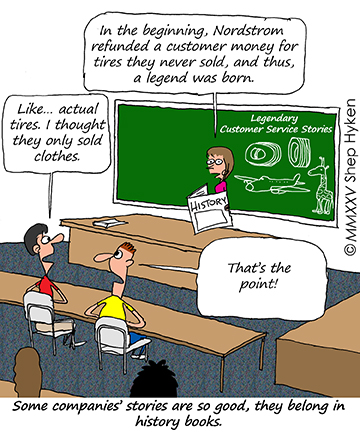
Earlier this year, I wrote a Forbes article celebrating the 50th anniversary of the famous Nordstrom story in which a man wanted to return a set of used tires – even though Nordstrom never even sold tires. That fact didn’t stop the employee from giving the customer a refund. Right or wrong, that story is still talked about 50 years later!

I’ve mentioned this story in the past, and the point is that stories like these become legends inside an organization, and if the brand is lucky, they may even get some good press. They are not easy to find, unless you intentionally look for them. Nordstrom had been in business for 75 years before this legendary story was discovered and shared.

I’ve written about many such stories. They are a reminder for every company to find its unique story that exemplifies the importance of customer service. These stories are powerful because they become a “north star” for how a company should treat its customers. Publicity is optional. The real value is cultural.

Nordstrom Tires Story Cartoon from Shep Hyken

For example, there are numerous Ritz-Carlton legendary stories, such as Joshie the Giraffe, in which the hotel staff made a big effort to return a stuffed animal to a child. There are also stories that aren’t so famous. I interviewed Horst Schulze, the first president and co-founder of the Ritz-Carlton, who shared a story about empowering employees to take care of their guests.

The short version is that the Ritz-Carlton allows employees to spend up to $2,000 to resolve a guest issue without seeking manager approval. One day a housekeeper found a guest’s computer. The guest had already checked out and flown from California to Hawaii. She took it upon herself to book an airline ticket and personally delivered the laptop to the guest.

As crazy as this may sound, the housekeeper was not reprimanded but instead was applauded for her efforts. Then, she was coached that next time, overnight shipping would be sufficient. The point is, there’s no risk in taking care of a guest. The story became a teaching moment for both the housekeeper and all Ritz staff, reinforcing the hotel chain’s commitment to empowered, guest-focused service.

Not every company will have a $2,000 empowerment policy like the Ritz-Carlton or a story like Nordstrom that literally defines their customer experience, but that doesn’t mean you can’t enjoy similar benefits.

So, here’s your assignment. Find your company’s legendary customer service story. If you don’t yet have one, start looking for those stories. Use them in training, meetings, and internal communications. Over time, they will become the DNA of your customer service culture. And who knows? Fifty years from now, someone might still be telling your story.

Put This Into Practice With the Change Planning Toolkit™

The frameworks in this article are part of the Human-Centered Change™ methodology — a visual, collaborative system of 70+ tools built around the Change Planning Canvas™. Every copy of Charting Change gives you access to 26 of the 70+ tools.

Image credits: Pexels, Shep Hyken

Subscribe to Human-Centered Change & Innovation WeeklySign up here to join 17,000+ leaders getting Human-Centered Change & Innovation Weekly delivered to their inbox every week.
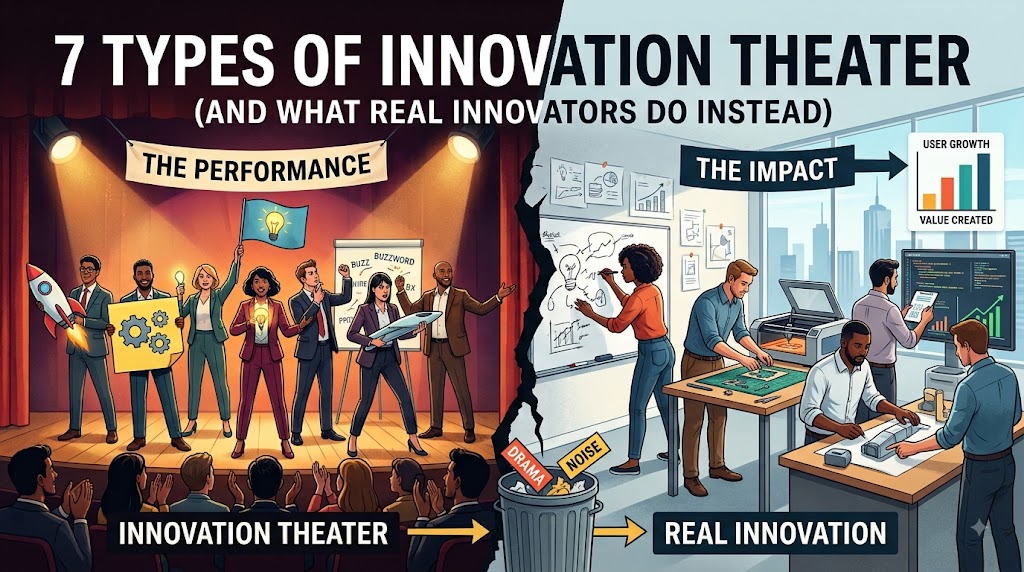
7 Types of Innovation Theater

(And What Real Innovators Do Instead)

7 Types of Innovation Theater

by Braden Kelley and Art Inteligencia


What Is Innovation Theater? (Short Answer)

Innovation theater is activity that looks innovative — labs, idea contests, perpetual pilots, AI demos, vanity metrics — while failing to change power, process, customer outcomes, or the operating model. It prioritizes the appearance of progress over impact that lands with humans.

The seven common types are: (1) Idea Cemetery, (2) Lab as Lounge, (3) Pilot Purgatory, (4) Innovation Cosplay, (5) Metric Mirage, (6) AI Annex Theater, and (7) the Hero Inventor Myth. Real innovators replace each with ownership, adoption, and measured human impact — not costume.

Why Innovation Theater Gets Funded

Theater thrives because organizations often need the appearance of momentum more than they need the risk of change. Leaders want proof they are “doing innovation.” Teams want psychological safety without political danger. Vendors want logos on walls. Photographable activity becomes a substitute for impact that lands with humans.

Real innovators are not allergic to labs, design thinking, or pilots. They refuse to let those tools become costumes. Below are seven types of innovation theater — with the signs to watch and what human-centered innovators do instead.

Type Common sign What real innovators do instead
1. Idea Cemetery Ideas collected, never decided Sponsors, kill criteria, portfolio of few bets
2. Lab as Lounge Beautiful space, weak P&L link Embed next to real constraints; measure adoption
3. Pilot Purgatory Forever demos, no scale path Design for scale; clear go/no-go
4. Innovation Cosplay Methods without decision rights Match method to mandate
5. Metric Mirage Activity vanity metrics Behavioral and business outcomes
6. AI Annex Theater Tools on broken work Redesign jobs first; free judgment time
7. Hero Inventor Myth Lone genius storytelling Team-sport innovation; reward change work

1. Idea Cemetery — When Innovation Contests Never Ship

What it is: Idea cemetery (or suggestion-box theater) is when organizations collect ideas through portals and contests, then never fund, own, or kill them.

The theater: Innovation portals and idea contests that collect brilliance, then bury it. No owners. No funding path. No kill criteria. Just a growing graveyard of good intentions and a leader who can still say, “We listen to our people.”

What real innovators do instead: They run a small portfolio of bets, not a museum of submissions. Every idea that advances has a sponsor, a question to answer, a budget band, and a date when it either graduates, pivots, or stops. Listening without a decision system is extraction dressed as engagement.

2. Lab as Lounge — Innovation Spaces Without Impact

What it is: Lab-as-lounge theater is when the innovation real estate and brand experience outrun any adopted outcome on a customer or employee journey.

The theater: Beautiful innovation space. Modular furniture. Logo wall. Inspiration quotes in sans-serif. Tours for executives and visitors. Meanwhile, the teams who own revenue, service recovery, and operations still cannot change a form field without a twelve-week ticket.

What real innovators do instead: They embed innovation next to real constraints — the call floor, the store, the claims process, the onboarding flow. Square footage is not a capability. Adopted outcomes on a named journey are. If the lab’s best KPI is visitor compliments, you have built an experience center for yourselves.

3. Pilot Purgatory — Forever Demos That Never Scale

What it is: Pilot purgatory is endless pilot projects that look like learning but avoid the hard work of scale, ownership, and replacing the old way of working.

The theater: Perpetual pilots. Forever demos. “We’re learning.” Sometimes true. Often a holding pattern that avoids data plumbing, workflow ownership, incentives, training, and the political decision to stop the old way.

What real innovators do instead: They design for scale on day one. Who owns the workflow if this works? What breaks if volume multiplies by ten? What is the go/no-go threshold? A pilot without an adoption plan is a science fair project with a corporate badge.

4. Innovation Cosplay — Methods Without Mandate

What it is: Innovation cosplay is using design thinking, agile, or “sprints” as costume when teams lack authority to change policy, budget, metrics, or process.

The theater: Methods without mandate. Design-thinking stickers on a process no one is allowed to change. Agile ceremonies that report status while governance remains waterfall. Sprints that cannot touch the actual levers of value.

What real innovators do instead: They match method to decision rights. Before the workshop, they ask: What are we empowered to decide, ship, or stop? If the honest answer is “nothing structural,” cancel the sticky notes and fix the mandate. Facilitation without power is entertainment with markers.

5. Metric Mirage — Measuring Innovation Activity, Not Value

What it is: Metric mirage is managing innovation by vanity and activity metrics — ideas filed, hackathons held, prototypes built — instead of human and business outcomes.

The theater: Dashboards of activity. Patents filed. Hours facilitated. Sometimes an “innovation NPS” that measures enthusiasm in the room rather than value in the world.

What real innovators do instead: They measure behavioral and business outcomes on a chosen journey: adoption, cycle time, retention, cost-to-serve, conversion, employee effort, revenue quality. Activity metrics can support the story; they cannot be the story. If you cannot name the human behavior that changes when you “win,” you are managing theater lighting.

6. AI Annex Theater — Tools on Broken Work

What it is: AI annex theater (a form of innovation washing) is bolting chatbots and copilots onto unbroken chaos, then calling speed alone a transformation.

The theater: Chatbots and copilots bolted onto broken work. More answers, same confusion. Faster drafts, denser interruptions. Automation that accelerates noise and gets declared transformation because the deck has gradients.

What real innovators do instead: They redesign the job, the handoff, and the decision before they celebrate the tool. AI should absorb fragmentation so humans can spend larger blocks on insight, empathy, problem definition, and judgment — a soft landing, not denser busyness. If nobody has protected deep-work capacity, you did not free people. You refilled their calendar.

7. Hero Inventor Myth — Lone Genius Over Team Sport

What it is: The hero inventor myth is when organizations celebrate a lone visionary while the people who adopt, integrate, and scale the change remain invisible.

The theater: The keynote founder of the internal startup. The genius in the corner whose idea becomes brand myth — until the next reorg erases the team that made it real.

What real innovators do instead: They treat innovation as a team sport. They reward insight and change — the unglamorous work of making something real for customers and employees. Human-centered innovation is rarely a flash of individual brilliance. It is a system that lets many people contribute and a few important things survive.

How Do You Stop Innovation Theater?

You stop innovation theater by forcing every initiative to answer five questions before the next pilot, lab ribbon-cutting, or AI annex:

  1. Who owns this after the applause? No named operator, no real initiative.
  2. What human behavior must change for this to count as success? If you only move a vanity metric, stop.
  3. What is the kill criteria? Endless learning without stop-rules is luxury consumption.
  4. What changes in the operating model if this works? If nothing structural can move, you have cosplay.
  5. Who loses if we stop pretending? Follow the incentives. Theater always has beneficiaries.

Innovation does not fail primarily because companies lack creativity. It fails when activity is allowed to impersonate progress. Real innovators optimize for impact that lands with humans — not for activity that photographs well in the annual report.

Frequently Asked Questions About Innovation Theater

What is innovation theater?

Innovation theater is activity that looks innovative — such as labs, idea contests, perpetual pilots, or AI demos — while failing to change power, process, customer outcomes, or the operating model. It prioritizes the appearance of progress over impact that lands.

How do you identify innovation theater?

Look for photographable activity without owners, kill criteria, operating-model change, or measurable behavior change. Common signs include idea programs that never ship, labs optimized for tours, endless pilots, methods without decision rights, vanity innovation metrics, AI tools on broken workflows, and lone-genius storytelling.

Why do companies do innovation theater?

Companies often fund innovation theater because the appearance of momentum feels safer than structural change. Theater provides career and brand insurance, satisfies stakeholders who want visible “innovation activity,” and avoids political risk — while real adoption would require new owners, incentives, and stop decisions.

What are the types of innovation theater?

Seven common types include the idea cemetery, lab as lounge, pilot purgatory, innovation cosplay (methods without mandate), metric mirage, AI annex theater, and the hero inventor myth. Each substitutes spectacle or activity metrics for adoption and value.

How do real innovators avoid innovation theater?

Real innovators assign owners and kill criteria, embed work in real constraints, design pilots for scale, match methods to decision rights, measure behavioral and business outcomes, redesign work before adding tools, and treat innovation as a team sport focused on human impact.


Image credits: Google Gemini

Content Authenticity Statement: The topic area, key elements to focus on, etc. were decisions made by Braden Kelley, with a little help from Google Gemini and Cursor to clean up the article, add images and create infographics.

Subscribe to Human-Centered Change & Innovation WeeklySign up here to get Human-Centered Change & Innovation Weekly delivered to your inbox every week.

Rebuilding Trust When You’ve Broken It

Rebuilding Trust When You've Broken It

GUEST POST from David Burkus

Trust is the foundation of every high-performing team. It’s the invisible force that enables collaboration, fuels innovation, and keeps teams resilient in the face of setbacks. But when that trust is broken – leaders need to focus on how to rebuild trust carefully and deliberately. Rebuilding trust isn’t as simple as offering an apology and moving on. In fact, that’s where many leaders go wrong.

They believe a sincere “I’m sorry” is all it takes to make things right again.

But it’s not.

Rebuilding trust takes far more than words—it takes sustained action. And if you’re serious about leading a high-performing team, you need to understand the process of how to truly rebuild trust when it’s been damaged.

Most Leaders Get Rebuilding Trust Wrong

Let’s start with the apology. A real apology – the kind that has the potential to begin the healing process – sounds like this: “I did this. I now know it was wrong. I see the impact it had on you. And I’m going to make it right.” That’s not the same as saying “I didn’t mean it” or “I’m sorry if anyone was offended.” Those aren’t apologies; they’re excuses dressed up in regret.

Even when leaders get the words right, they often assume the work ends there. But rebuilding trust doesn’t happen with a single moment of contrition. Trust isn’t built on words. It’s built on behavior.

What leaders fail to realize is that when they betray trust, they don’t just damage the relationship – they break an emotional loop. I call it the trust loop, and it exists in every relationship you have with your team, both collectively and individually. That loop is a cycle of expectation, action, and consistency. When everything is working well, the loop reinforces itself and trust grows. But when trust is violated, the loop shatters—and rebuilding it takes far more than a one-time gesture.

Why Words Aren’t Enough To Rebuild Trust

When you break trust and then try to move on too quickly, you’re sending an unspoken message to your team: “This wasn’t that big of a deal.” And that message undercuts any sincerity you intended with your apology. Research backs this up. Paul Zak, a neuroscientist who studies trust in organizations, found that employees in high-trust workplaces report 74% less stress and 50% higher productivity. Trust isn’t just a feel-good concept – it’s measurable, and it affects everything from performance to retention. But that kind of trust can’t exist unless leaders take full accountability, even for their mistakes.

Taking accountability isn’t just about admitting the error – it’s about acknowledging the impact. And that’s where a lot of well-meaning leaders go off track. They say, “I made a mistake,” but they don’t take the time to understand or validate how that mistake affected others. The result? Their apology feels hollow. The team sees them as principled, maybe, but detached. Or worse – performative.

To truly rebuild trust, leaders need to demonstrate both responsibility and empathy. Because your team needs to know not just that you’re sorry, but that you get it. That you see the ripple effect your actions had, and that you care enough to do better.

What Rebuilding Trust Actually Takes

So how do you rebuild trust?

It starts with a strong apology, yes. But it doesn’t end there. Here are four steps to guide the process—and none of them can be skipped.

1. Own the Mistake – and Its Impact

Rebuilding trust begins with full accountability. You must take ownership of what happened and openly acknowledge the harm it caused. That might mean calling out specific behaviors, admitting lapses in judgment, or addressing how your decision made the team feel undervalued or vulnerable. This isn’t a time to minimize, justify, or deflect. And it’s not just about your intention – it’s about the impact. The more specifically you can articulate what went wrong and why it mattered, the more credible your apology becomes.

2. Invite The Team Into The Solution

After accountability comes action. But not behind closed doors. Telling your team, “I’ll do better,” isn’t enough. They need to see you doing better. Better yet, they need to be part of the process.

Invite them into the solution. Talk through what happened. Share the thinking behind your original decision—not to excuse it, but to help the team understand where things went wrong. Then ask for input. What would they have done differently? What safeguards could be put in place to avoid a repeat? The more you co-create the fix, the more your team sees that you’re serious about change. Transparency builds credibility. And when your team sees you working on yourself, they’re more likely to work with you to rebuild what was broken.

3. Show Them You’re Changing

The most powerful way to rebuild trust is to demonstrate new behavior in old situations. If you made a decision that sidelined the team last time, then the next time a similar decision comes up, you need to do the opposite. Bring the team in early. Ask for feedback. Show them that the lesson was learned – and internalized.

They don’t need to see everything you’re doing differently. But they do need to see you behaving differently in the kinds of situations that broke trust in the first place. That’s how predictability is restored. And predictability is a cornerstone of trust.

4. Be Consistent—Every Day

This is where most leaders lose momentum. They start strong. They apologize, they make a few changes, they check in. But over time, old habits creep back in and the consistency fades. And when that happens, the message to the team is clear: “That apology wasn’t real.”

Rebuilding trust isn’t about grand gestures. It’s about small, daily actions. It’s about showing up consistently. Following through consistently. Making decisions with integrity—consistently.

The longer you sustain those behaviors, the more the trust loop starts to turn again. Slowly, day by day, your team regains their confidence – not just in your words, but in your ability to lead with integrity.

Always Be Rebuilding Trust

You don’t rebuild trust with a single apology. You rebuild trust by showing that your apology meant something. That you’ve changed. That the behavior that broke trust won’t be repeated.

And while that takes time, it’s worth it. Because trust is what makes teams resilient. Trust is what drives performance. And trust – when rebuilt the right way – can actually come back stronger than before.

So, if you’ve broken trust with your team, don’t aim for forgiveness. Aim for consistency. Start by owning your mistake. Involve your team in the fix. Show them the change. And then keep showing up – day after day.

That’s how you rebuild trust. And that’s how you restart the trust loop.

This article originally appeared on DavidBurkus.com

Image credit: Pixabay

Subscribe to Human-Centered Change & Innovation WeeklySign up here to get Human-Centered Change & Innovation Weekly delivered to your inbox every week.front

Modeling Good Board Governance

Modeling Good Board Governance

GUEST POST from Geoffrey A. Moore

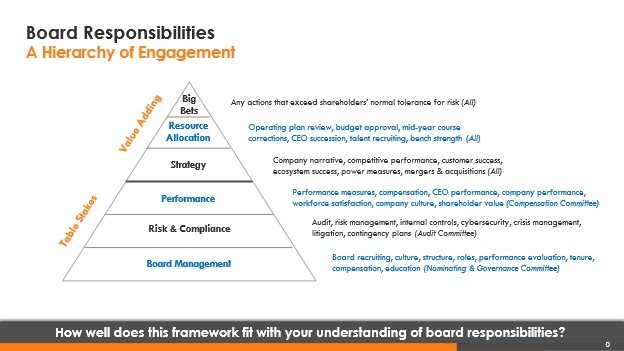
There are cartloads of checklists and commentary on the duties and responsibilities of a board of directors, none of which are particularly surprising, but collectively, somewhat mind-numbing. As a frameworks person, I need to see things in a more simple and integrated way, hence the diagram below:

Board of Directors Responsibilities Framework

Public boards should tackle this framework from the bottom up as they are liable for damages if the company fails to address risk and compliance properly, or improperly reports performance results. Foundational to their recruiting and staffing efforts should be securing strong chairpersons for each of the three anchor committees—Nominating and Governance, Audit, and Compensation. That’s table stakes. High-performing boards do their best to handle these obligations in committee so they can spend quality time on the upper levels of the framework. The obstacle here tends to be management’s presentation of the past quarter’s performance. This is necessary to bring the board up to speed on the current state of the company, but it is something that most boards spend way too much time on, given how little the board can do to move the needle. This limits the time available to devote to strategy and resource allocation, where their outside-in perspective can add a ton of value. Big bets, on the other hand, do get the full attention they deserve—they just should not happen very often given the risk-averse nature of public market shareholders.

Venture-backed companies, on the other hand, are a different kind of animal. They should approach this framework from the top down. They are big bets, and their first responsibility is to get those bets across the chasm and inside a tornado. Resource allocation and strategy are core to accomplishing these ends. Performance matters, but early on it is more about accumulating power than delivering profits. Risk and compliance are still relevant, but the shareholders have a higher tolerance for risk, and the relatively small size of the enterprise as a whole makes compliance a whole lot simpler. And finally, the board is typically comprised primarily of investors and founders with an independent director for balance—not really a governance model, built more for guidance instead.

The disparity between the public and private market board models creates a shock when venture-backed companies get acquired by public companies. The newly acquired team wakes up one morning inside a public enterprise with all its established processes and procedures and feels like it is being smothered to death. There is no halfway house here, so when we talk about acquisition integration, we need to include a deep-dive orientation to public-market expectations, and the work enterprises must do to address them. In parallel, the acquiring company needs to adopt zone management to ensure that they are holding the acquired company accountable to the right goals and metrics. This goes all the way up to the board, where people are likely still smarting from the high premium they had to pay and looking to get it back as fast as possible. Thrusting the new team into the Performance Zone is a proven path to crushing innovation and destroying shareholder value.

That’s what I think. What do you think?

Image Credit: Unsplash

Subscribe to Human-Centered Change & Innovation WeeklySign up here to join 17,000+ leaders getting Human-Centered Change & Innovation Weekly delivered to their inbox every week.