
Editor’s Note — Braden Kelley
What Does It Mean to Empower Employees?
Employee empowerment is the practice of giving employees the authority, information, and resources they need to make decisions and take action without requiring manager approval at every step. True empowerment is not a slogan or a cultural aspiration — it is a structural commitment, backed by policy, training, and leadership behavior that consistently reinforces the message that employees are trusted to act on behalf of the organization and its customers.
The business case for employee empowerment is direct: empowered employees resolve customer issues faster, create more memorable service experiences, and are significantly more engaged in their work. Gallup research consistently shows that organizations with highly engaged, empowered workforces see 21% higher profitability, 17% higher productivity, and dramatically lower turnover than those that manage through control and approval chains.
The most important — and most underappreciated — dimension of employee empowerment is its connection to customer experience. Disempowered employees cannot deliver empowered customer experiences. When frontline staff must escalate every exception, ask permission for every deviation, and enforce policies that obviously harm the customer relationship, customers experience that disempowerment directly. The best customer experience organizations understand that empowering employees is not a separate HR initiative from improving customer experience — it is the same initiative, approached from the inside out.
Shep Hyken’s article below explores what genuine employee empowerment looks like in practice through the lens of legendary customer service organizations — and why the stories organizations tell about employee empowerment become the DNA of their service culture.
GUEST POST from Shep Hyken
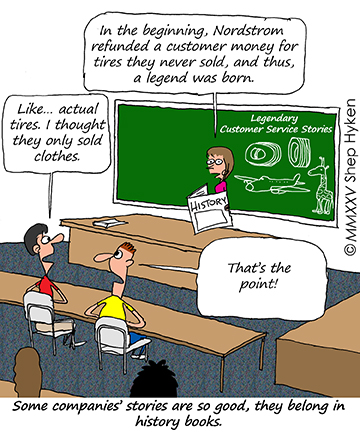
Earlier this year, I wrote a Forbes article celebrating the 50th anniversary of the famous Nordstrom story in which a man wanted to return a set of used tires – even though Nordstrom never even sold tires. That fact didn’t stop the employee from giving the customer a refund. Right or wrong, that story is still talked about 50 years later!
I’ve mentioned this story in the past, and the point is that stories like these become legends inside an organization, and if the brand is lucky, they may even get some good press. They are not easy to find, unless you intentionally look for them. Nordstrom had been in business for 75 years before this legendary story was discovered and shared.
I’ve written about many such stories. They are a reminder for every company to find its unique story that exemplifies the importance of customer service. These stories are powerful because they become a “north star” for how a company should treat its customers. Publicity is optional. The real value is cultural.
For example, there are numerous Ritz-Carlton legendary stories, such as Joshie the Giraffe, in which the hotel staff made a big effort to return a stuffed animal to a child. There are also stories that aren’t so famous. I interviewed Horst Schulze, the first president and co-founder of the Ritz-Carlton, who shared a story about empowering employees to take care of their guests.
The short version is that the Ritz-Carlton allows employees to spend up to $2,000 to resolve a guest issue without seeking manager approval. One day a housekeeper found a guest’s computer. The guest had already checked out and flown from California to Hawaii. She took it upon herself to book an airline ticket and personally delivered the laptop to the guest.
As crazy as this may sound, the housekeeper was not reprimanded but instead was applauded for her efforts. Then, she was coached that next time, overnight shipping would be sufficient. The point is, there’s no risk in taking care of a guest. The story became a teaching moment for both the housekeeper and all Ritz staff, reinforcing the hotel chain’s commitment to empowered, guest-focused service.
Not every company will have a $2,000 empowerment policy like the Ritz-Carlton or a story like Nordstrom that literally defines their customer experience, but that doesn’t mean you can’t enjoy similar benefits.
So, here’s your assignment. Find your company’s legendary customer service story. If you don’t yet have one, start looking for those stories. Use them in training, meetings, and internal communications. Over time, they will become the DNA of your customer service culture. And who knows? Fifty years from now, someone might still be telling your story.
Put This Into Practice With the Change Planning Toolkit™
The frameworks in this article are part of the Human-Centered Change™ methodology — a visual, collaborative system of 70+ tools built around the Change Planning Canvas™. Every copy of Charting Change gives you access to 26 of the 70+ tools.
Image credits: Pexels, Shep Hyken
 Sign up here to join 17,000+ leaders getting Human-Centered Change & Innovation Weekly delivered to their inbox every week.