Category Archives: Leadership

Tackle Your Toughest Challenge This Year

Tackle Your Toughest Challenge This Year

GUEST POST from Geoffrey A. Moore

This is the first in what I hope to be an extended series of blogs focused on a single topic: What is the toughest challenge your company faces today, and what would it take to overcome it? I’ve reached out to my network, so I have a few good ones to start with, but needless to say, I would be very interested to learn what you are up against in your enterprise. In the meantime, here is my first shot on goal:

“I think we had stopped innovating for a long time. Customers were disappointed. But over the past few years, we have made massive improvements to our products. In fact, many who use the products feel like they are best in class. Our big challenge is getting the market to recognize that we are not the company we were a decade ago. This tends to be very easy to accomplish in small pockets but is a huge challenge at scale.”

There is a whole cohort of global enterprises that are facing this conundrum, including the iconic enterprise tech companies that rode the client-server/Internet wave to become the great growth stocks of the 1990s, who then became overshadowed by the massive mobile/cloud wave that has driven consumer tech successes in this century, and who are now institutional, single-digit-growth anchor holdings in today’s value investors’ portfolios. What would it take to free their future from the pull of the past?

The answer comes in two parts. First, they have to participate in a wave of disruptive innovation that is inside the tornado, with AI and ML being likely current candidates. They don’t have to be the first mover or even the category leader, but they do have to gain a substantial share of some piece of the pie, enough for the world to see they are a real player and that their growth prospects have therefore materially changed. This is something that can — indeed must — be powered by internal forces, management committing to the risk, engineering committing to the task, go-to-market committing to the sales, and everyone competing like crazy to get enough share to be taken seriously.

This is a big deal in itself, but not as the quote above makes clear, the toughest challenge. Instead, it creates the toughest challenge, which is how to get the world to acknowledge and buy into the good work that has been done and that is continuing to be done. Specifically, the challenge is how to change the narrative.

Narratives are how we make sense of the world. They are the stories we tell about ourselves, our friends, our enemies, the products we use, the causes we participate in — you name it, if we have any stake in it, we tell stories about it. These stories circulate, and after a while, they become institutionalized as received wisdom or established reputation or brand image. As with “your father’s Oldsmobile,” everybody knows that so-and-so is such-and-such, without anyone giving it much thought. These narratives become signposts along the road of life. We expect them to stay the same. And that, of course, is what makes them so hard to change.

To change the narrative you need a forcing function. This has to be external to your enterprise, something that causes the world to reorient itself, and in so doing, to realize that its old signposts may no longer serve. In tech, we have been blessed with a plethora of forcing functions, something Joseph Schumpeter taught us to call “waves of creative destruction.” Such waves radically alter the allocation of budgets, and in so doing, they run roughshod over the old highways along with any of their signposts. To change your narrative, you have to position your enterprise in their path.

Satya Nadella’s “Cloud first, Mobile first” is a good example. Cloud threatened to creatively destroy Microsoft’s back office franchise, and mobile threatened to do the same to its PC operating system monopoly. Both were forcing functions. Now, it turns out that mobile did not work out for them, but cloud surely did. The point is, Satya’s tagline redefined Microsoft’s position, putting it in line for a whole new generation of investment. AMD is doing the same thing with AI chips, following Nvidia’s lead, just as Microsoft was following Amazon Web Services. Iconic companies do not have to lead the next wave. Nobody expects that, although Apple astoundingly did so not once, not twice, but three times within a space of little more than a decade. But because iconic enterprises have global footprints, because they are well positioned to capitalize on the new wave of change, they get the benefit of the doubt once they have demonstrated they can deliver products or services that make the grade.

That phrase “Satya’s tagline” leads me to my last point. You would think that changing the corporate narrative should be the function of corporate marketing, but it never is. First of all, it is unpopular, and marketing teams, aligned as they are with sales teams, are reluctant to do anything that would offend. Second, marketing does not have the clout. It wasn’t the tagline that anchored Microsoft’s change. It was the CEO himself, with the backing of the board.

And buried therein lies the third challenge — changing the narrative is deeply unpopular with value investors, particularly when it entails internal investments that impact earnings per share. It is not easy for a board of directors, who are continually reminded they are there to represent the interests of the shareholders, and the CEO, who is highly compensated to manage for shareholder value, to take a step back and do what they believe is the right thing for the long term.

Beneath a change in any corporate narrative, therefore, there is an underlying meta-narrative about the role of enterprise in relation to all its stakeholders. This includes its customers, partners, employees, and communities, as well as its investors. In that context, customers are family — they have skin in your game and are likely to stick with you through thick and thin. Investors, by contrast, do not. Your company is a financial instrument in their portfolio, and should it cease to perform the financial role they have in mind for it, they have no reason to hold onto it. You still need to take their interests seriously — they are your financial foundation — but they are not your reason for being. Customers are. So should you undertake to change your narrative, focus on why your customers need you to do so. They are your North Star.

That’s what I think. What do you think?

Image Credit: Pixabay

Subscribe to Human-Centered Change & Innovation WeeklySign up here to join 17,000+ leaders getting Human-Centered Change & Innovation Weekly delivered to their inbox every week.

What to Do When Your Plans Are Already Obsolete

HINT: It has something to do with strategy execution

What to Do When Your Plans Are Already Obsolete

GUEST POST from Robyn Bolton

We are three full weeks into the new year and I am curious, how is the strategy and operating plan you spent all Q3 and Q4 working on progressing? You nailed it, right? Everything is just as you expected and things are moving forward just as you planned.

I didn’t think so.

So, like many others, you feel tempted to double down on what worked before or  chase every opportunity with the hope that it will “future-proof” your business.

Stop.

Remember the Cheshire Cat, “If you don’t know where you’re going, any road will get you there.”

You DO know where you’re going because your goals didn’t change. You still need to grow revenue and cut costs with fewer resources than last year.

The map changed.  So you need to find a new road.

You’re not going to find it by looking at old playbooks or by following every path available.

You will find it by following these three steps (and don’t require months or millions to complete).

Return to First Principles

When old maps fail and new roads are uncertain, the most successful leaders return to first principles, the fundamental, irreducible truths of a subject:

  1. Organizations are systems
  2. Systems seek equilibrium and resist change when elements are misaligned
  3. People in the system do what the system allows, models, and rewards

Returning to these principles is the root of success because it forces you to pause and ask the right questions before (re)acting.

Ask Questions to Find the Root Cause

Based on the first principles, think of your organization as a lock. All the tumblers need to align to unlock the organization’s potential to get to where you need to go.  When the tumblers don’t align, you stay stuck in the dying status quo.

Every organization has three tumblers – Architecture (how you’re organized), Behavior (what leaders actually do), and Culture (what gets rewarded) – that must align to develop and execute a strategy in an environment of uncertainty and constant change.

But ensuring that you’ve aligned all three tumblers, and not just one or two, requires asking questions to get to the root cause of the challenges.

Is your leadership team struggling to align on a decision because they don’t have enough data or can’t agree on what it means? The Behavior and Culture tumblers are misaligned with the structure and incentives of Architecture

Are people resisting the new AI tools you rolled out?  Architectural incentives and metrics, and leadership communications and behaviors are preventing buy-in.

Struggling to squeeze growth out of a stagnant business?  Structures and systems combined with organization culture are reinforcing safety and a fixed mindset rather than encouraging curiosity and learning.

Align the Tumblers

When you diagnose the root causes you find the misaligned tumbler. And, in the process of bringing it into alignment, it will likely pull the others in, too.

By role modeling leadership behaviors that encourage transparent communication (no hiding behind buzzwords), quantifying confidence, and smart risk taking, you’ll also influence culture and may reveal a needed change in Architecture.

Modifying the metrics and rewards in Architecture and making sure that your communications and behavior encourage buy-in to new AI tools, will start to establish an AI-friendly culture.

Overhauling Architecture to encourage and reward actions that expand that stagnant business into new markets or brings new solutions to your existing customers, will build new leadership Behaviors will drive culture change.

Get to your Goals

It’s a VUCA/BANI world AND It’s only going to accelerate. That means that the strategy you developed last quarter and the operational plans you set last month will be obsolete by the end of the week.

But the strategy and the plan were never the goal. They were the road you planned based on the map you had.  When the map changes, the road does, too. But you can still get to the goal if you’re willing to fiddle with a lock.

Image credit: Pixabay

Subscribe to Human-Centered Change & Innovation WeeklySign up here to join 17,000+ leaders getting Human-Centered Change & Innovation Weekly delivered to their inbox every week.

You Cannot Be Too Busy to Prioritize

You Cannot Be Too Busy to Prioritize

GUEST POST from Stefan Lindegaard

Most teams I meet are swamped. Everyone is busy. Prioritization becomes a task on its own – or a quick fix to sort the chaos.

But here is the trap:

Prioritization often defaults to short-term execution.

We solve what is urgent.

We push what is noisy.

We clear the decks – but rarely step back.

What gets left behind?

  • Long-term initiatives
  • Capability-building
  • Strategic reflection
  • Learning, networking, and future growth

All of it gets labelled “nice to have.”

And that is where performance erodes over time.

High-performance leadership means protecting what matters – even when it is not urgent.

It is not just about doing things right. It is about making space for the things that keep you moving in the right direction.

So next time someone says, “We are too busy to focus on this right now” …

Ask: What will it cost us later if we do not?

Image Credit: Stefan Lindegaard

Subscribe to Human-Centered Change & Innovation WeeklySign up here to get Human-Centered Change & Innovation Weekly delivered to your inbox every week.

Four Ways to Manage Projects

Four Ways to Manage Projects

GUEST POST from Mike Shipulski

There are four ways to run projects.

One – 80% Right, 100% Done, 100% On Time, 100% On Budget

  • Fix time
  • Fix resources
  • Flex scope and certainty

Set a tight timeline and use the people and budget you have. You’ll be done on time, but you must accept a reduced scope (fewer bells and whistles) and less certainty of how the product/service will perform and how well it will be received by customers. This is a good way to go when you’re starting a new adventure or investigating new space.

Two – 100% Right, 100% Done, 0% On Time, 0% On Budget

  • Fix resources
  • Fix scope and certainty
  • Flex time

Use the team and budget you have and tightly define the scope (features) and define the level of certainty required by your customers. Because you can’t predict when the project will be done, you’ll be late and over budget, but your offering will be right and customers will like it. Use this method when your brand is known for predictability and stability. But, be weary of business implications of being late to market.

Three – 100% Right, 100% Done, 100% On Time, 0% On Budget

  • Fix scope and certainty
  • Fix time
  • Flex resources

Tightly define the scope and level of certainty. Your customers will get what they expect and they’ll get it on time. However, this method will be costly. If you hire contract resources, they will be expensive. And if you use internal resources, you’ll have to stop one project to start this one. The benefits from the stopped project won’t be realized and will increase the effective cost to the company. And even though time is fixed, this approach will likely be late. It will take longer than planned to move resources from one project to another and will take longer than planned to hire contract resources and get them up and running. Use this method if you’ve already established good working relationships with contract resources. Avoid this method if you have difficulty stopping existing projects to start new ones.

Four – Not Right, Not Done, Not On Time, Not On Budget

  • Fix time
  • Fix resources
  • Fix scope and certainty

Though almost every project plan is based on this approach, it never works. Sure, it would be great if it worked, but it doesn’t, it hasn’t and it won’t. There’s not enough time to do the right work, not enough money to get the work done on time and no one is willing to flex on scope and certainty. Everyone knows it won’t work and we do it anyway. The result – a stressful project that doesn’t deliver and no one feels good about.

Image credit: Pexels

Subscribe to Human-Centered Change & Innovation WeeklySign up here to join 17,000+ leaders getting Human-Centered Change & Innovation Weekly delivered to their inbox every week.

Building Your Dream Organization

Building Your Dream Organization

Exclusive Interview with Oscar Amundsen

Leaders aspire to create a “dream organization” not merely for the sake of prestige or profit, but because they recognize that a deeply aligned, human-centered culture is the ultimate multiplier of potential. In a dream organization, the traditional friction between individual aspiration and corporate objective vanishes, replaced by a shared sense of purpose and psychological safety that allows innovation to flourish naturally. These leaders understand that when employees feel truly seen, valued, and empowered to contribute their best work, the organization becomes antifragile — capable of navigating uncertainty with a level of agility and commitment that cannot be bought or mandated. Ultimately, the quest for a dream organization is an investment in a sustainable future where the workplace acts as a catalyst for both professional excellence and personal fulfillment.

Today we dive deep into what it takes to create a “dream organization” through a dialogue with our special guest.

Helping Leaders Build Their Dream Organization

Oscar AmundsenI recently had the opportunity to interview Oscar Amundsen, a full Professor of Organization Studies at the Norwegian University of Science and Technology.

He has extensive experience in researching various industries and businesses. His work is focused on change and innovation in organizations. This includes related topics such as leadership, culture, trust, motivation, and organizational development. In these fields, he has published numerous books and scientific articles.

Amundsen’s goal is to develop research-based knowledge AND at the same time make the research concrete and accessible. The point is to make the knowledge useful for creating better organizations. Whether the enterprise is in the public, voluntary or private sector.

Below is the text of my interview with Oscar and a preview of the kinds of insights you’ll find in How to Become a Dream Organization: Eight Things Leaders Need to Know to Promote Change and Innovation presented in a Q&A format:

1. What does it take for an organization to break its own practices and develop new ones?

Organizations can be seen as ‘organisms’ that develop habits. And we all know that habits are not easy to break. But organizations can also be seen as ‘tools for achieving goals’. Since the world around the organization changes, the organization itself must also change to remain a suitable tool for the (changed) tasks that need to be solved.
As a leader, you must have the ability to identify the need for change. This means you need to look both ‘outward and inward’: What is required of us in a changing environment? And what does this mean for how we work within this organization?

Many leaders overlook that the latter question requires deep knowledge of what is happening inside the organization. Therefore, you should consult with employees who are close to the core tasks of the organization. You don’t know everything yourself, and you need some knowledge from the ‘foot soldiers’ to make the organization better.

I would also add that ‘breaking away’ is precisely a hallmark of all innovation. If you are going to do things in new ways, you have to break with what is established (in a market, in a practice, etc.). However, all such breaks require a willingness to take risks. You can never know with one hundred percent certainty how it will turn out, even though you should of course avoid taking reckless chances with your business. But you must accept that things can go wrong from time to time in order to achieve something new.

2. What are the keys to promoting the ability to both change and innovate?

This is precisely the question that the book answers. I present a research-based model with eight keys to strengthening the ability for change and innovation. The book is therefore structured around eight chapters, each addressing one of these keys. The point is to show how these eight mechanisms influence the capacity for change and innovation. This knowledge gives you the opportunity to build and develop an organization that not only solves its tasks smarter and better, but also becomes an attractive place to be for both leaders and other employees.

3. Why do people resist sharing new practices?

If you have an organization where people are afraid of making mistakes and trying new things, much will happen in secret. In the book, I write about an employee who comes up with a new and efficient way of working but keeps it hidden from both colleagues and managers because she fears her solution deviates from established procedures. She knows the solution is both sound and sensible. It is only when a researcher visits the organization that she (anonymously) shares her new way of working. Her lack of trust in leadership means that a new practice remains with her, even though it could have spread (and been improved) if it had been openly discussed among employees and managers. This organization misses out on the resource that ordinary employees represent for improving and renewing the business.

4. What are the keys for leaders to manage that determine whether trust or mistrust dominates?

Let me first say that trust is worth its weight in gold in this context. The reason is that trust in an organization is absolutely fundamental to building its ability to innovate. In the book I highlight five aspects that explain why and how trust influences the organization’s ability to change and innovate.

As a leader, you should understand these aspects, because only then can you say something meaningful about the state of trust within the organization.

Practicing trust requires a certain degree of courage. Trusting someone always (in principle) involves some risk: You can never be 100 percent certain that the trust you show will be honored. It may sound strange, but despite this, I recommend a more trust-based leadership approach because it has so many positive effects.

Concretely, you should reflect on the signals you personally send out, but may be even more important: You should examine the control systems used in your organization. Is there more control than necessary in some areas? What is the purpose of that control? Is it to ‘catch’ people making mistakes, or is it to learn from mistakes?

5. Why is autonomy so important to employees?

There is solid research evidence to support the claim that autonomy is, in fact, a fundamental human need (along with mastery and belonging). All people function better when they have some influence over their own situation – of course within the goals and frameworks set by the organization. In the book, I discuss how autonomy strengthens people’s motivation and drive – and (not least) increases their willingness to contribute constructively within an organization. It is well-established knowledge from innovation research that autonomy, within good boundaries, is positive for innovation.

6. Why is it important for organizations to have positive vibes and how is this different from optimism?
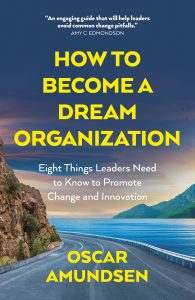
How to Become a Dream OrganizationOptimism is good, but it can actually become a ‘straitjacket’. In the book, I illustrate this through a case where I explain the spectacular fall of mobile phone manufacturer Nokia. At the turn of the millennium, they were the world’s largest mobile phone producer. But a culture developed within the company where it was ‘not allowed’ to raise objections or criticize the strategy. Management only wanted to hear good news. The short version of this story is that Nokia was therefore unprepared when the iPhone entered the market, and gradually disappeared until the remnants were bought up some years later.

On the other hand: Having positive feelings toward your own company, is of great value to the organization. This is something completely different from a demand for pure optimism. Research suggests that such positive feelings influence your relationship with colleagues and the organization. The point is that a positive atmosphere makes you more:

  • Helpful: The mechanism is ‘feel good – do good’. Things flow more smoothly, including knowledge sharing.
  • Engaged: You become willing to make sacrifices and go the extra mile.
  • Protective: You ‘speak proudly’ about the company externally and help prevent dangers and trouble.
  • Constructive: You are more likely to come up with constructive suggestions.

The last point directly impacts an organization’s ability to change and innovate, while the first three strengthen that ability indirectly.

7. What do tolerance of failure and diversity look like in practice?

Tolerance for mistakes is essential for achieving innovation. In a ‘zero-error culture,’ you will struggle to innovate simply because people are afraid to experiment, to try and fail. Although mistakes will always happen, it is useful to distinguish between different types of mistakes: What you want to encourage (and have more of) are what can be called ‘intelligent mistakes.’

These are mistakes that occur when you deliberately try something new. The goal is to learn so that you can move forward with what you are trying to develop. Other types of mistakes can be called basic or complex. These are the ones you want as few of as possible, but you cannot say they should never exist. Research shows that if you have zero tolerance for mistakes, they will be hidden, and you lose the opportunity to learn from them.

When it comes to diversity, I write in the book about how different types of perspectives and knowledge are valuable for innovation. I emphasize that leaders should demonstrate a certain level of humility and recognize that they need others’ insights to make good decisions.

8. What is practical anchoring and why is it so important?

Practical anchoring is essentially about involving the right employees in change processes. The point is that you need knowledge of actual practice to carry out sensible change work. People in the organization should see the benefit of the changes you are planning if you want them on board when changes are implemented. This makes sense not only for engagement and motivation but also to ensure you don’t create a less efficient organization with duplicate work and potential obstacles to doing a good job.

9. Why does fear play such a big role in organizations’ ability to change & innovate?

This is a broad topic, which I dedicate an entire chapter to in the book. The short version is that fear leads employees to avoid participating and contributing with their knowledge and experience. We are social beings who generally want to avoid the risk of offering an original contribution or asking a critical or fundamental question if there are potential negative consequences. In the Nokia case, we also see that people became tactical regarding their own career opportunities within the organization: They eventually learned that those who asked critical (but necessary) questions lost opportunities in the company. This caused engineers to drift to the sidelines – even on strategic technical issues.

10. Getting 100% participation is always a good thing, right?

There are many benefits to involving people in both innovation and change efforts. The point is to make the best use of the knowledge resources you have within the organization for the benefit of the organization. In addition, you become a more attractive employer if you allow people to participate in development. Modern employees actually expect to have some influence over their work situation and to use their knowledge in ways that benefit both themselves and the organization.

That said, I still emphasize in the book that there is a balance here: It’s not as if everyone should have an opinion on everything and participate in every possible process. That would only create chaos and overload for people in key roles. In the book, I use the term ‘participation satisfaction’ to describe this. People have different needs for involvement—both personally and, most importantly, based on the role they have. Conclusion: Not “the more participation, the better,” but balanced according to need.

11. Any question I didn’t ask that you want to answer?

Well, you haven’t asked me about the title of the book. I want to underline that “the dream organization” is not meant as a utopic situation. Rather, it’s meant more like a goal image. A goal image for those who want to build and become stronger in change and innovation. So, the book is about improving the organization – and at the same time making it attractive to be a part of – as a leader and as an employee.

So, the title of the book is an invitation to raise your gaze a little and ask something like: “What steps could I take to build a better organization? How can I develop a workplace where people like to work – and where change and innovation are a natural part of working?” That’s the kind of organization I want to help make reality with this book.

Thank you for taking the time for me and my book!

Conclusion

Thank you for the great conversation Oscar!

I hope everyone has enjoyed this peek into the mind of the man behind the insightful new title How to Become a Dream Organization: Eight Things Leaders Need to Know to Promote Change and Innovation!

Image credits: Oscar Amundsen, Anne Line Bakken, ChatGPT

Subscribe to Human-Centered Change & Innovation WeeklySign up here to join 17,000+ leaders getting Human-Centered Change & Innovation Weekly delivered to their inbox every week.


Asking for the Right Work Product is Key

Asking for the Right Work Product is Key

GUEST POST from Mike Shipulski

We think we have more control than we really have. We imagine an idealized future state and try desperately to push the organization in the direction of our imagination. Add emotional energy, define a rational approach, provide the supporting rationale and everyone will see the light. Pure hubris.

What if we took a different approach? What if we believed people want to do the right thing but there’s something in the way? What if like a log jam in a fast-moving river, we remove the one log blocking them all? What if like a river there’s a fast-moving current of company culture that wants to push through the emotional log jam that is the status quo? What if it’s not a log at all but, rather, a Peter Principled executive that’s threatened by the very thing that will save the company?

The Peter Principled executive is a tough nut to crack. Deeply entrenched in the powerful goings on of the mundane and enabled by the protective badge of seniority, these sticks-in-the-mud need to be helped out of the way without threatening their no-longer-deserved status. Tricky business.

Rule 1: If you get into an argument with a Peter Principled executive, you’ll lose.

Rule 2: Don’t argue with Peter Principled executive.

If we want to make it easy for the right work to happen, we’ve got to learn how to make it easy for the Peter Principled executive to get out of the way. First, ask yourself why the executive is in the way. Why are they blocking progress? What’s keeping them from doing the right thing? Usually it comes down to the fear of change or the fear of losing control. Now it’s time to think of a work product that will help make the case there’s a a better way. Think of a small experiment to demonstrate a new way is possible and then run the experiment. Don’t ask, just run it. But the experiment isn’t the work product. The work product is a short report that makes it clear the new paradigm has been demonstrated, at least at small scale. The report must be clear and dense and provide objective evidence the right work happened by the right people in the right way. It must be written in a way that preempts argument – this is what happened, this is who did it, this is what it looks like and this is the benefit.

It’s critical to choose the right people to run the experiment and create the work product. The work must be done by someone in the chain of command of the in-the-way executive. Once the work product is created, it must be shared with an executive of equal status who is by definition outside the chain of command. From there, that executive must send a gracious email back into the chain of command that praises the work, praises the people who did it and praises the leader within the chain of command who had the foresight to sponsor such wonderful work.

As this public positivity filters through the organization, more people will add their praise of the work and the leaders that sponsored it. And by the time it makes it up the food chain to the executive of interest, the spider web of positivity is anchored across the organization and can’t be unwound by argument. And there you have it. You created the causes and conditions for the log jam to unjam itself. It’s now easy for the executive to get out of the way because they and their organization have already been praised for demonstrating the new paradigm. You’ve built a bridge across the emotional divide and made it easy for the executive and the status quo to cross it.

Asking for the right work product is a powerful skill. Most error on the side of complication and complexity, but the right work product is just the opposite – simple and tight. Think sledgehammer to the forehead in the form of and Excel chart where the approach is beyond reproach; where the chart can be interpreted just one way; where the axes are labeled; and it’s clear the status quo is long dead.

Business model is dead and we’ve got to stop trying to keep it alive. It’s time to break the log jam. Don’t be afraid. Create the right work product that is the dynamite that blows up the status quo and the executives clinging to it.

Image credit: Pexels

Subscribe to Human-Centered Change & Innovation WeeklySign up here to join 17,000+ leaders getting Human-Centered Change & Innovation Weekly delivered to their inbox every week.
Humans Don’t Have to Perform Every Task

Humans Don't Have to Perform Every Task

GUEST POST from Shep Hyken

There seems to be a lot of controversy and questions surrounding artificial intelligence (AI) being used to support customers. The customer experience can be enhanced with AI, but it can also derail and cause customers to head to the competition.

Last week, I wrote an article titled Just Because You Can Use AI, Doesn’t Mean You Should. The gist of the article was that while AI has impressive capabilities, there are situations in which human-to-human interaction is still preferred, even necessary, especially for complex, sensitive or emotionally charged customer issues.

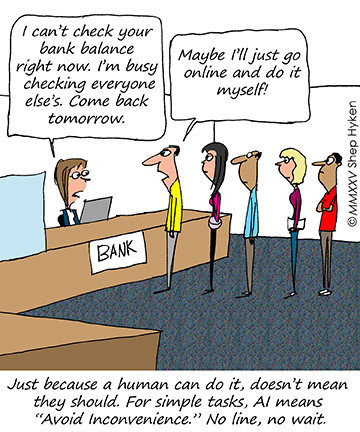
However, there is a flip side. Sometimes AI is the smart thing to use, and eliminating human-to-human interaction actually creates a better customer experience. The point is that just because a human could handle a task doesn’t mean they should. 

Before we go further, keep in mind that even if AI should handle an issue, my customer service and customer experience (CX) research finds almost seven out of 10 customers (68%) prefer the phone. So, there are some customers who, regardless of how good AI is, will only talk to a live human being.

Here’s a reality: When a customer simply wants to check their account balance, reset a password, track a package or any other routine, simple task or request, they don’t need to talk to someone. What they really want, even if they don’t realize it, is fast, accurate information and a convenient experience.

The key is recognizing when customers value efficiency over engagement. Even with 68% of customers preferring the phone, they also want convenience and speed. And sometimes, the most convenient experience is one that eliminates unnecessary human interaction.

Smart companies are learning to use both strategically. They are finding a balance. They’re using AI for routine, transactional interactions while making live agents available for situations requiring judgement, creativity or empathy.

The goal isn’t to replace humans with AI. It’s to use each where they excel most. That sometimes means letting technology do what it can do best, even if a human could technically do the job. The customer experience improves when you match the right resource to the customers’ specific need.

That’s why I advocate pushing the digital, AI-infused experience for the right reasons but always – and I emphasize the word always – giving the customer an easy way to connect to a human and continue the conversation.

In the end, most customers don’t care whether their problem is solved by a human or AI. They just want it solved well.

Image credits: Google Gemini, Shep Hyken

Subscribe to Human-Centered Change & Innovation WeeklySign up here to join 17,000+ leaders getting Human-Centered Change & Innovation Weekly delivered to their inbox every week.

The Keys to Changing Someone’s Mind

The Keys to Changing Someone's Mind

GUEST POST from Greg Satell

When is the last time you changed your mind about anything substantial? Was it another person that convinced you or an unexpected experience that changed your perspective? What led you to stop seeing something one way and start seeing it in another? I will bet it does not happen often. We rarely change our minds.

Now think about how much time we spend trying to change other people’s minds. From sales pitches and political discussions, to what we are going to have for dinner and when the kids should go to bed, we put a lot of time and effort into shaping the opinions of others. Most of that is probably wasted.

The truth is that we cannot really change anyone’s mind. Only they can do that. Yet as David McRaney explains in his new book, How Minds Change, there are new techniques that can help us be more persuasive, but they don’t require brilliant sophistry or snappy rhetoric. They involve more listening than speaking, and understanding the context in which beliefs arise.

Why We Fail To Adapt

We don’t experience the world as it is, but through the context of earlier experiences. What we think of as knowledge is really connections in our brains called synapses which develop over time. These pathways strengthen as we use them and degrade when we do not. Or, as scientists who study these things like to put it, the neurons that fire together, wire together.

It’s not just our own experiences that shape us either. In fact, a series of famous experiments done at Swarthmore College in the 1950’s showed that we will conform to the opinions of those around us even if they are obviously wrong. More recent research suggests that this effect extends out to three degrees of influence, so it’s not just people we know personally, but the friends of our friends’ friends that shape how we see things.

Finally, there are often switching costs to changing our minds. Our opinions are rarely isolated thoughts, but form a basis for decisions. Once we change our minds, we need to change our actions and that can have consequences. We may need to change how we do our jobs, what we choose to buy, how we act towards others and, sometimes, who we choose to associate ourselves with.

In The Righteous Mind, social psychologist Jonathan Haidt makes the point that our beliefs become closely intertwined with our identity. They signal our inclusion in a particular “team.” That’s why contrary views can often feel like an attack. Rather than taking in new information we often feel the urge to lash out and silence the opposing voice.

Meeting The Mind Changing Threshold

As closely as we cling to our beliefs, sometimes we do change our minds. In one study that analyzed voting behavior, it was found that when up to 20% of the information that people were exposed to contradicted their beliefs, they dug in their heels and grew more certain. Beyond that, however, their resolve tended to weaken. The informational environment can deeply influence what people believe.

Their relationship to the subject matter is also important. The elaboration likelihood model (ELM) and the heuristic-systematic model (HSM) developed in the 1980s both suggest that we treat different topics in different ways. Some topics, such as those that are important to us professionally, we’re willing to invest time in exploring systematically. Others are more marginal to us and we will tend to look for shortcuts.

For example, if we are researching a business investment, we’ll want to gather facts from a variety of different sources and study them closely. On the other hand, if we’re trying to decide which craft beer to select from a large selection at a bar, we’ll rely on subtle cues such as packaging, how the beer is described or what we see others drinking.

If we want to change someone’s mind about something we need to understand their relationship to the subject matter. If they are heavily invested in it, they are unlikely to be swayed by superficial arguments. In fact, weak or purely emotive arguments may suggest to them that the opposite is true. At the same time, if someone is not very knowledgeable or motivated to learn about a topic, bogging them down with a lot of facts is likely to bore them.

Two Strategies For Persuasion

If you want to change somebody’s mind, you can follow two different kinds of approaches. The first, which can be called “topic denial”, argues the facts. The second, called “technique denial,” exposes flaws in reasoning. For example, if you want to convince a vaccine skeptic you can either cite scientific evidence or refute the form of the argument, such as pointing out that while there may be a minimal risk to taking a vaccine, the same could be said of aspirin.

While research shows that both approaches can be effective, we need to keep context in mind. If you are in a trustful environment, such as a professional or scientific setting, a fact-based topic rebuttal can often be effective. However, if you’re trying to talk your crazy uncle out of a conspiracy theory at Thanksgiving dinner, you may want to try a technique rebuttal.

In recent years a variety of methods, such as Deep Canvassing, Street Epistemology and the Change Conversation Pyramid have emerged as effective technique rebuttal methods. Interestingly, they don’t rely on any elaborate rhetorical flourishes, but rather listening empathetically, restating the opposing position in a way that shows we understand it, identifying common ground and exploring how they came to their conclusion.

The truth is that we can never truly change somebody’s mind. Only they can do that. All too often, we treat opinions as if they were artillery in a battle. Yet attacking someone’s beliefs is more likely to raise their defenses than to convince them that they are in error. Before we can convince anyone of anything, we need to first build an environment of safety and trust.

Let Empathy Be You Secret Weapon

When we want to change somebody’s minds, our first instinct is to confront their beliefs. We want to be warriors and fight for our position. Yet because people’s opinions are often a result of their experiences and social networks, countering their beliefs won’t feel to them like merely offering a different perspective, but as an attack on their identity and dignity.

That’s why we’re much better off listening and building rapport. That’s not always easy to do, because staying silent while somebody is voicing an opinion we don’t agree with can feel like a surrender. But it doesn’t have to be. In fact, if we can identify a shared value and a shared language in an opposing viewpoint, we have a powerful tool to argue our position.

The truth is that empathy isn’t absolution. In fact, it can be our secret weapon. We don’t have to agree with someone’s belief to internalize it. We all have a need to be recognized and when we take the time to hear someone out, we honor their dignity. That makes them much more willing to hear us out. Lasting change is always built on common ground.

At some point, we all need to decide if we want to make a point or make a difference. If we really care about change, we need to hold ourselves accountable to be effective messengers and express ourselves in terms that others are willing to accept. That doesn’t in any way mean we have to compromise. It simply means that we need to advocate effectively.

To do that, we need to care more about building shared purpose than we do about winning points.

— Article courtesy of the Digital Tonto blog
— Image credit: Flickr

Subscribe to Human-Centered Change & Innovation WeeklySign up here to join 17,000+ leaders getting Human-Centered Change & Innovation Weekly delivered to their inbox every week.

Why Meeting Icebreakers Matter

Why Meeting Icebreakers Matter

GUEST POST from David Burkus

Icebreakers are not just games or frivolous activities. Many people have memories of cringeworthy and awkward games played under the pretense of “team building.” I was one of them. But the research on icebreakers is pretty clear. Icebreakers are powerful tools that can help teams find uncommon commonalities and build strong connections.

Icebreakers can be the key to unlocking a more collaborative, understanding, and high-performing team. However, the effectiveness of an icebreaker hinges on its relevance and comfort level. They should be personally meaningful and not make team members uncomfortable.

In this article, we’ll cover four such icebreakers for team meetings. They’re quick, and not cringe. Each of these icebreakers is designed to help teams connect, understand each other better, and perform at a higher level.

1. Energy Check

The Energy Check is an icebreaker that encourages team members to rate their energy level and discuss ways the team can support each other. This is done by having each team member rate their energy level on a scale of 1 to 5—with 1 being dead tired and 5 being energy to spare. Whatever the answer, the team can follow up with question about what they can do to support the person speaking. This opens up a conversation about ways the team can support each other and learn about each other’s challenges and weaknesses.

By encouraging open discussion about energy levels and support needs, this icebreaker fosters a culture of empathy and understanding within the team. It helps team members to understand that they are not alone in their struggles and that they can rely on their team for support. This can significantly improve team cohesion and performance.

2. Triple H

Triple H is an icebreaker that allows team members to share a hero, highlight, and hardship in their life or career. Each team member is asked to share a hero who inspires them, a highlight from their life or career, and a hardship they have faced. This not only allows team members to disclose personal preferences, values, and experiences, but also creates the opportunity to find uncommon commonalities and build bonds through shared experiences.

By sharing their heroes, highlights, and hardships, team members can gain a deeper understanding of each other’s motivations, achievements, and challenges. This can lead to increased empathy, respect, and cooperation within the team.

3. Defining Moment

Defining Moment is an icebreaker where team members share a defining moment that shaped who they are today. Think of it as a faster version of Triple H—one that just focuses on the highlight. Each team member is asked to share a significant event or experience in their life or career that has had a profound impact on them. This encourages team members to share something personally meaningful and helps find uncommon commonalities that are deeper and more personally meaningful.

By sharing their defining moments, team members can reveal aspects of their personality and values that may not be apparent in a professional setting. This can lead to increased understanding and respect among team members, fostering a more harmonious and productive team environment.

4. Three Snaps

Three Snaps is an icebreaker where team members share three meaningful photos from their camera roll. Each team member is asked to share three photos that are meaningful to them. This allows team members to share about themselves to the level they’re comfortable with and helps find commonalities and build connections through shared experiences and interests.

By sharing their photos, team members can give others a glimpse into their personal lives, interests, and experiences. This can lead to increased understanding and connection among team members, fostering a more cohesive and collaborative team environment.

These icebreakers, when used effectively, can be powerful tools for building a more connected, understanding, and high-performing team. They can help teams find uncommon commonalities, build strong connections, and understand each other better. In other words, these short, non-cringe icebreakers can help any team do its best work ever.

This article originally appeared on DavidBurkus.com

Image credit: Pexels

Subscribe to Human-Centered Change & Innovation WeeklySign up here to get Human-Centered Change & Innovation Weekly delivered to your inbox every week.front

Solving the AI Trust Imperative with Provenance

The Digital Fingerprint

LAST UPDATED: January 5, 2026 at 3:33 PM

The Digital Fingerprint - Solving the Trust Imperative with Provenance

GUEST POST from Art Inteligencia

We are currently living in the artificial future of 2026, a world where the distinction between human-authored and AI-generated content has become practically invisible to the naked eye. In this era of agentic AI and high-fidelity synthetic media, we have moved past the initial awe of creation and into a far more complex phase: the Trust Imperative. As my friend Braden Kelley has frequently shared in his keynotes, innovation is change with impact, but if the impact is an erosion of truth, we are not innovating — we are disintegrating.

The flood of AI-generated content has created a massive Corporate Antibody response within our social and economic systems. To survive, organizations must adopt Generative Watermarking and Provenance technologies. These aren’t just technical safeguards; they are the new infrastructure of reality. We are shifting from a culture of blind faith in what we see to a culture of verifiable origin.

“Transparency is the only antidote to the erosion of trust; we must build systems that don’t just generate, but testify. If an idea is a useful seed of invention, its origin must be its pedigree.” — Braden Kelley

Why Provenance is the Key to Human-Centered Innovation™

Human-Centered Innovation™ requires psychological safety. In 2026, psychological safety is under threat by “hallucinated” news, deepfake corporate communiques, and the potential for industrial-scale intellectual property theft. When people cannot trust the data in their dashboards or the video of their CEO, the organizational “nervous system” begins to shut down. This is the Efficiency Trap in its most dangerous form: we’ve optimized for speed of content production, but lost the efficiency of shared truth.

Provenance tech — specifically the C2PA (Coalition for Content Provenance and Authenticity) standards — allows us to attach a permanent, tamper-evident digital “ledger” to every piece of media. This tells us who created it, what AI tools were used to modify it, and when it was last verified. It restores the human to the center of the story by providing the context necessary for informed agency.

Case Study 1: Protecting the Frontline of Journalism

The Challenge: In early 2025, a global news agency faced a crisis when a series of high-fidelity deepfake videos depicting a political coup began circulating in a volatile region. Traditional fact-checking was too slow to stop the viral spread, leading to actual civil unrest.

The Innovation: The agency implemented a camera-to-cloud provenance system. Every image captured by their journalists was cryptographically signed at the moment of capture. Using a public verification tool, viewers could instantly see the “chain of custody” for every frame.

The Impact: By 2026, the agency saw a 50% increase in subscriber trust scores. More importantly, they effectively “immunized” their audience against deepfakes by making the absence of a provenance badge a clear signal of potential misinformation. They turned the Trust Imperative into a competitive advantage.

Case Study 2: Securing Enterprise IP in the Age of Co-Pilots

The Challenge: A Fortune 500 manufacturing firm found that its proprietary design schematics were being leaked through “Shadow AI” — employees using unauthorized generative tools to optimize parts. The company couldn’t tell which designs were protected “useful seeds of invention” and which were tainted by external AI data sets.

The Innovation: They deployed an internal Generative Watermarking system. Every output from authorized corporate AI agents was embedded with an invisible, robust watermark. This watermark tracked the specific human prompter, the model version, and the internal data sources used.

The Impact: The company successfully reclaimed its IP posture. By making the origin of every design verifiable, they reduced legal risk and empowered their engineers to use AI safely, fostering a culture of Human-AI Teaming rather than fear-based restriction.

Leading Companies and Startups to Watch

As we navigate 2026, the landscape of provenance is being defined by a few key players. Adobe remains a titan in this space with their Content Authenticity Initiative, which has successfully pushed the C2PA standard into the mainstream. Digimarc has emerged as a leader in “stealth” watermarking that survives compression and cropping. In the startup ecosystem, Steg.AI is doing revolutionary work with deep-learning-based watermarks that are invisible to the eye but indestructible to algorithms. Truepic is the one to watch for “controlled capture,” ensuring the veracity of photos from the moment the shutter clicks. Lastly, Microsoft and Google have integrated these “digital nutrition labels” across their enterprise suites, making provenance a default setting rather than an optional add-on.

Conclusion: The Architecture of Truth

To lead innovation in 2026, you must be more than a creator; you must be a verifier. We cannot allow the “useful seeds of invention” to be choked out by the weeds of synthetic deception. By embracing generative watermarking and provenance, we aren’t just protecting data; we are protecting the human connection that makes change with impact possible.

If you are looking for an innovation speaker to help your organization solve the Trust Imperative and navigate Human-Centered Innovation™, I suggest you look no further than Braden Kelley. The future belongs to those who can prove they are part of it.

Frequently Asked Questions

What is the difference between watermarking and provenance?

Watermarking is a technique to embed information (visible or invisible) directly into content to identify its source. Provenance is the broader history or “chain of custody” of a piece of media, often recorded in metadata or a ledger, showing every change made from creation to consumption.

Can AI-generated watermarks be removed?

While no system is 100% foolproof, modern watermarking from companies like Steg.AI or Digimarc is designed to be highly “robust,” meaning it survives editing, screenshots, and even re-recording. Provenance standards like C2PA use cryptography to ensure that if the data is tampered with, the “broken seal” is immediately apparent.

Why does Braden Kelley call trust a “competitive advantage”?

In a market flooded with low-quality or deceptive content, “Trust” becomes a premium. Organizations that can prove their content is authentic and their AI is transparent will attract higher-quality talent and more loyal customers, effectively bypassing the friction of skepticism that slows down their competitors.

Disclaimer: This article speculates on the potential future applications of cutting-edge scientific research. While based on current scientific understanding, the practical realization of these concepts may vary in timeline and feasibility and are subject to ongoing research and development.

Image credits: Google Gemini

Subscribe to Human-Centered Change & Innovation WeeklySign up here to get Human-Centered Change & Innovation Weekly delivered to your inbox every week.