Just Because You Can Use AI Doesn’t Mean You Should

Just Because You Can Use AI Doesn't Mean You Should

GUEST POST from Shep Hyken

I’m often asked, “What should AI be used for?” While there is much that AI can do to support businesses in general, it’s obvious that I’m being asked how it relates to customer service and customer experience (CX). The true meaning of the question is more about what tasks AI can do to support a customer, thereby potentially eliminating the need for a live agent who deals directly with customers.

First, as the title of this article implies, just because AI can do something, it doesn’t mean it should. Yes, AI can handle many customer support issues, but even if every customer were willing to accept that AI can deliver good support, there are some sensitive and complicated issues for which customers would prefer to talk to a human.

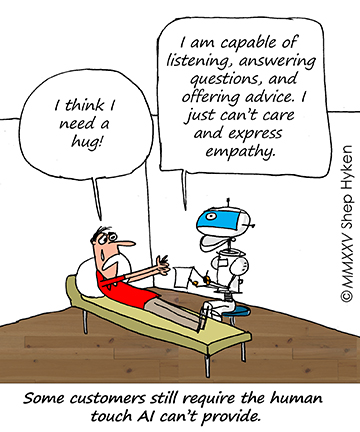
AI Shep Hyken Cartoon

Additionally, consider that, based on my annual customer experience research, 68% of customers (that’s almost seven out of 10) prefer the phone as their primary means of communication with a company or brand. However, another finding in the report is worth mentioning: 34% of customers stopped doing business with a company because self-service options were not provided. Some customers insist on the self-service option, but at the same time, they want to be transferred to a live agent when appropriate.

AI works well for simple issues, such as password resets, tracking orders, appointment scheduling and answering basic or frequently asked questions. Humans are better suited for handling complaints and issues that need empathy, complex problem-solving situations that require judgment calls and communicating bad news.

An AI-fueled chatbot can answer many questions, but when a medical patient contacts the doctor’s office about test results related to a serious issue, they will likely want to speak with a nurse or doctor, not a chatbot.

Consider These Questions Before Implementing AI For Customer Interactions

AI for addressing simple customer issues has become affordable for even the smallest businesses, and an increasing number of customers are willing to use AI-powered customer support for the right reasons. Consider these questions before implementing AI for customer interactions:

  1. Is the customer’s question routine or fact-based?
  2. Does it require empathy, emotion, understanding and/or judgment (emotional intelligence)?
  3. Could the wrong answer cause a problem or frustrate the customer?
  4. As you think about the reasons customers call, which ones would they feel comfortable having AI handle?
  5. Do you have an easy, seamless way for the customer to be transferred to a human when needed?

The point is, regardless of how capable the technology is, it doesn’t mean it is best suited to deliver what the customer wants. Live agents can “read the customer” and know how to effectively communicate and empathize with them. AI can’t do that … yet. The key isn’t choosing between AI and humans. It’s knowing when to use each one.

Image credits: Google Gemini, Shep Hyken

Subscribe to Human-Centered Change & Innovation WeeklySign up here to join 17,000+ leaders getting Human-Centered Change & Innovation Weekly delivered to their inbox every week.

6 Stages Most Organizations Skip Between Insight and Scale

6 Stages Most Organizations Skip Between Insight and Scale

by Braden Kelley and Chateau G Pato


Which Stages Do Organizations Skip Between Insight and Scale? (Short Answer)

Six stages most organizations skip between insight and scale: (1) mandate match, (2) falsifiable behavior hypothesis, (3) cheap evidence before commitment, (4) adoption design in the operating model, (5) transfer to a BAU owner, and (6) scale gates tied to adopted behavior. Insight is necessary. It is not a license to industrialize. Soft landings fund the middle on purpose.

Insight without the middle is a story. Scale without the middle is a hard landing with better branding.

Why Is the Leap From “We Learned” to “We’re Scaling” So Dangerous?

I have sat in reviews where an insight won the room and scale funding arrived in the same meeting — no mandate written, no behavior named, no cheap evidence, no BAU owner, no gate beyond the calendar. That leap feels decisive. It is usually expensive.

Most organizations jump: Insight → Scale (or Insight → Big Build → Scale). Soft landings walk the middle:

Insight → Mandate → Behavior hypothesis → Cheap evidence → Adoption design → Transfer → Scale gates → Scale

Stage Why skipped Done looks like
1. Mandate match Decision rights feel political Written levers + sponsor before experiments
2. Behavior hypothesis Solutions feel more executive-ready One falsifiable human behavior named
3. Cheap evidence Big programs attract budget Go/no-go evidence + decision date
4. Adoption design “Change management later” Work, incentives, old-path kill designed
5. Transfer to BAU Lab/pilot keeps the baby Named operator + transfer dates
6. Scale gates Calendar / impatience theater Adopted-behavior proof before rollout

1. What Is Mandate Match — and Why Do Teams Skip It?

The stage: Confirm what you are empowered to decide, ship, stop, or change because of this insight — policy, incentives, process, budget, metrics.

Why skipped: Insight workshops photograph well. Naming decision rights is political.

Breaking looks like: Beautiful insight, zero levers. Innovation cosplay.

Done looks like: Written mandate and a sponsor with levers before the next experiment.

Run it: One page — problem, who hurts, what we can change, what we cannot. Before you fund a pilot, use 11 Questions Before Funding Any Innovation Pilot.

2. Why Must Insight Become a Falsifiable Behavior Hypothesis?

The stage: Translate insight into a named behavior you can prove or kill — complete in one try, abandon workaround, time-to-confidence, first-contact make-right.

Why skipped: Solutions feel more executive-ready than hypotheses.

Breaking looks like: Roadmaps and demos with no learning theory.

Done looks like: One sentence: “We believe [who] will [behavior] when [condition], measured by [signal].”

Run it: Kill any “insight” that cannot name a behavior.

3. Why Run Cheap Evidence Before Commitment?

The stage: Run the smallest test that can falsify the behavior — contact, prototype, concierge, or instrumented pilot — before platform build or enterprise rollout.

Why skipped: Big programs attract budget. Cheap tests feel small.

Breaking looks like: Premature scale. Requirements freeze. AI epic backlogs.

Done looks like: Go/no-go evidence with a decision date — not endless “still exploring.”

Run it: Time box + kill criteria + named stopper. Structure the bet with Experiment Canvas examples when you need a falsifiable frame.

4. What Does Adoption Design in the Operating Model Require?

The stage: Design how the median person succeeds — redesigned work, incentives, enablement as practice, and a kill date for the shadow path — before scale funding.

Why skipped: “We’ll handle change management later.”

Breaking looks like: Tool bolted onto unreformed work. Shelfware with a ribbon.

Done looks like: Dual workstream truth — system ready and people able; old path time-boxed.

Run it: Treat adoption as a design deliverable equal to the product backlog. For the failure patterns when tools launch without that design, see 12 Adoption Mistakes That Turn Good Tools Into Shelfware.

5. Why Must Transfer to a BAU Owner Happen Before Scale?

The stage: Name the workflow or journey owner who will run it in BAU — with handoffs, support, and retirement of “innovation owns it.”

Why skipped: Labs and pilots keep the baby. The core never asked.

Breaking looks like: Orphan after applause. Pilot purgatory. Dual-running forever.

Done looks like: Build-operate-transfer — or embed-from-day-one — with dates and operators.

Run it: No scale review without a named BAU owner in the room. When labs become destinations instead of vehicles, see 5 Reasons Innovation Labs Fail — and 5 Replacements That Work.

6. How Do Scale Gates Tied to Adopted Behavior Prevent Hard Landings?

The stage: Expand only when behavior evidence, transfer readiness, and capacity are real — not because the roadmap quarter arrived.

Why skipped: Executive impatience. “We’re past pilot” theater.

Breaking looks like: Enterprise rollout of a costume. Hard landing at scale.

Done looks like: Scale scorecard — adopted behavior, retired workaround, owner in BAU, stop/start capacity.

Run it: Refuse scale funding that cannot show the gate evidence. Premature scale is also how good ideas die in the pipeline — see 8 Ways to Kill a Good Idea Before It Ships — and why transformations stall after applause in 9 Reasons Digital Transformations Stall After the Pilot.

How Do You Run an Insight-to-Scale Readiness Check?

Before the next “scale this insight” review, run five go/no-go questions:

  1. What are we empowered to change?
  2. What behavior are we falsifying?
  3. What cheap evidence do we have — with a decision date?
  4. Who owns BAU after applause — and what old path dies?
  5. Which adopted-behavior gate justifies scale — not which calendar date?

Don’t leap from insight to scale. Earn the middle — or inherit the hard landing.

Frequently Asked Questions

What stages come between insight and scale?

Between insight and scale, organizations should run mandate match, a falsifiable behavior hypothesis, cheap evidence before commitment, adoption design in the operating model, transfer to a BAU owner, and scale gates tied to adopted behavior — not a leap from “we learned” to “we’re scaling.”

Why do companies scale too early?

Companies scale too early when insight or a demo feels like proof of readiness, calendars and executive impatience replace behavior gates, change management is deferred, and nobody owns BAU after applause. Premature scale industrializes a costume.

How do you go from insight to scale?

Go from insight to scale by attaching mandate, naming a falsifiable human behavior, running cheap evidence with kill criteria, designing adoption and the old-path kill date, transferring to a named BAU owner, and expanding only when adopted-behavior gates and capacity are real.

What is premature scaling?

Premature scaling is forcing enterprise rollout, full integration, or big-bang launch before a named human behavior is falsified and a BAU owner exists — replacing learning with calendar politics and “we’re past pilot” without adopted-behavior proof.

What is a scale gate in innovation?

A scale gate in innovation is an evidence threshold for expansion — typically adopted behavior, retired workarounds, transfer readiness, and organizational capacity — that must be met before enterprise rollout. Calendar dates and demo applause are not scale gates.

Image credits: 1 of 1,500+ FREE quotes for you at http://misterinnovation.com

Content Authenticity Statement: The topic area, key elements to focus on, etc. were decisions made by Braden Kelley, with a little help from Google Gemini and Cursor to clean up the article, add images and create infographics.

Subscribe to Human-Centered Change & Innovation WeeklySign up here to get Human-Centered Change & Innovation Weekly delivered to your inbox every week.

Top 100 Innovation and Transformation Articles of 2025

Top 100 Innovation and Transformation Articles of 2025

2021 marked the re-birth of my original Blogging Innovation blog as a new blog called Human-Centered Change and Innovation.

Many of you may know that Blogging Innovation grew into the world’s most popular global innovation community before being re-branded as Innovation Excellence and being ultimately sold to DisruptorLeague.com.

Thanks to an outpouring of support I’ve ignited the fuse of this new multiple author blog around the topics of human-centered change, innovation, transformation and design.

I feel blessed that the global innovation and change professional communities have responded with a growing roster of contributing authors and more than 17,000 newsletter subscribers.

To celebrate we’ve pulled together the Top 100 Innovation and Transformation Articles of 2025 from our archive of over 3,200 articles on these topics.

We do some other rankings too.

We just published the Top 40 Innovation Authors of 2025 and as the volume of this blog has grown we have brought back our monthly article ranking to complement this annual one.

But enough delay, here are the 100 most popular innovation and transformation posts of 2025.

Did your favorite make the cut?

1. A Toolbox for High-Performance Teams – Building, Leading and Scaling – by Stefan Lindegaard

2. Top 10 American Innovations of All Time – by Art Inteligencia

3. The Education Business Model Canvas – by Arlen Meyers, M.D.

4. What is Human-Centered Change? – by Braden Kelley

5. How Netflix Built a Culture of Innovation – by Art Inteligencia

6. McKinsey is Wrong That 80% Companies Fail to Generate AI ROI – by Robyn Bolton

7. The Great American Contraction – by Art Inteligencia

8. A Case Study on High Performance Teams – New Zealand’s All Blacks – by Stefan Lindegaard

9. Act Like an Owner – Revisited! – by Shep Hyken

10. Should a Bad Grade in Organic Chemistry be a Doctor Killer? – by Arlen Meyers, M.D.

11. Charting Change – by Braden Kelley

12. Human-Centered Change – by Braden Kelley

13. No Regret Decisions: The First Steps of Leading through Hyper-Change – by Phil Buckley

14. SpaceX is a Masterclass in Innovation Simplification – by Pete Foley

15. Top 5 Future Studies Programs – by Art Inteligencia

16. Marriott’s Approach to Customer Service – by Shep Hyken

17. The Role of Stakeholder Analysis in Change Management – by Art Inteligencia

18. The Triple Bottom Line Framework – by Dainora Jociute

19. The Nordic Way of Leadership in Business – by Stefan Lindegaard

20. Nine Innovation Roles – by Braden Kelley

21. ACMP Standard for Change Management® Visualization – 35″ x 56″ (Poster Size) – Association of Change Management Professionals – by Braden Kelley

22. Designing an Innovation Lab: A Step-by-Step Guide – by Art Inteligencia

23. FutureHacking™ – by Braden Kelley

24. The 6 Building Blocks of Great Teams – by David Burkus

25. Overcoming Resistance to Change – Embracing Innovation at Every Level – by Chateau G Pato

26. Human-Centered Change – Free Downloads – by Braden Kelley

27. 50 Cognitive Biases Reference – Free Download – by Braden Kelley

28. Quote Posters – Curated by Braden Kelley

29. Stoking Your Innovation Bonfire – by Braden Kelley

30. Innovation or Not – Kawasaki Corleo – by Art Inteligencia


Build a common language of innovation on your team


31. Top Six Trends for Innovation Management in 2025 – by Jesse Nieminen

32. Fear is a Leading Indicator of Personal Growth – by Mike Shipulski

33. Visual Project Charter™ – 35″ x 56″ (Poster Size) and JPG for Online Whiteboarding – by Braden Kelley

34. The Most Challenging Obstacles to Achieving Artificial General Intelligence – by Art Inteligencia

35. The Ultimate Guide to the Phase-Gate Process – by Dainora Jociute

36. Case Studies in Human-Centered Design – by Art Inteligencia

37. Transforming Leadership to Reshape the Future of Innovation – Exclusive Interview with Brian Solis

38. Leadership Best Quacktices from Oregon’s Dan Lanning – by Braden Kelley

39. This AI Creativity Trap is Gutting Your Growth – by Robyn Bolton

40. A 90% Project Failure Rate Means You’re Doing it Wrong – by Mike Shipulski

41. Reversible versus Irreversible Decisions – by Farnham Street

42. Next Generation Leadership Traits and Characteristics – by Stefan Lindegaard

43. Top 40 Innovation Bloggers of 2024 – Curated by Braden Kelley

44. Benchmarking Innovation Performance – by Noel Sobelman

45. Three Executive Decisions for Strategic Foresight Success or Failure – by Robyn Bolton

46. Back to Basics for Leaders and Managers – by Robyn Bolton

47. You Already Have Too Many Ideas – by Mike Shipulski

48. Imagination versus Knowledge – Is imagination really more important? – by Janet Sernack

49. Building a Better Change Communication Plan – by Braden Kelley

50. 10 Free Human-Centered Change™ Tools – by Braden Kelley


Accelerate your change and transformation success


51. Why Business Transformations Fail – by Robyn Bolton

52. Overcoming the Fear of Innovation Failure – by Stefan Lindegaard

53. What is the difference between signals and trends? – by Art Inteligencia

54. Unintended Consequences. The Hidden Risk of Fast-Paced Innovation – by Pete Foley

55. Giving Your Team a Sense of Shared Purpose – by David Burkus

56. The Top 10 Irish Innovators Who Shaped the World – by Art Inteligencia

57. The Role of Emotional Intelligence in Effective Change Leadership – by Art Inteligencia

58. Is OpenAI About to Go Bankrupt? – by Art Inteligencia

59. Sprint Toward the Innovation Action – by Mike Shipulski

60. Innovation Management ISO 56000 Series Explained – by Diana Porumboiu

61. How to Make Navigating Ambiguity a Super Power – by Robyn Bolton

62. 3 Secret Saboteurs of Strategic Foresight – by Robyn Bolton

63. Four Major Shifts Driving the 21st Century – by Greg Satell

64. Problems vs. Solutions vs. Complaints – by Mike Shipulski

65. The Power of Position Innovation – by John Bessant

66. Three Ways Strategic Idleness Accelerates Innovation and Growth – by Robyn Bolton

67. Case Studies of Companies Leading in Inclusive Design – by Chateau G Pato

68. Recognizing and Celebrating Small Wins in the Change Process – by Chateau G Pato

69. Parallels Between the 1920’s and Today Are Frightening – by Greg Satell

70. The Art of Adaptability: How to Respond to Changing Market Conditions – by Art Inteligencia

71. Do you have a fixed or growth mindset? – by Stefan Lindegaard

72. Making People Matter in AI Era – by Janet Sernack

73. The Role of Prototyping in Human-Centered Design – by Art Inteligencia

74. Turning Bold Ideas into Tangible Results – by Robyn Bolton

75. Yes the Comfort Zone Can Be Your Best Friend – by Stefan Lindegaard

76. Increasing Organizational Agility – by Braden Kelley

77. Innovation is Dead. Now What? – by Robyn Bolton

78. Four Reasons Change Resistance Exists – by Greg Satell

79. Eight I’s of Infinite Innovation – Revisited – by Braden Kelley

80. Difference Between Possible, Potential and Preferred Futures – by Art Inteligencia


Get the Change Planning Toolkit


81. Resistance to Innovation – What if electric cars came first? – by Dennis Stauffer

82. Science Says You Shouldn’t Waste Too Much Time Trying to Convince People – by Greg Satell

83. Why Context Engineering is the Next Frontier in AI – by Braden Kelley and Art Inteligencia

84. How to Write a Failure Resume – by Arlen Meyers, M.D.

85. The Five Keys to Successful Change – by Braden Kelley

86. Four Forms of Team Motivation – by David Burkus

87. Why Revolutions Fail – by Greg Satell

88. Top 40 Innovation Bloggers of 2023 – Curated by Braden Kelley

89. The Entrepreneurial Mindset – by Arlen Meyers, M.D.

90. Six Reasons Norway is a Leader in High-Performance Teamwork – by Stefan Lindegaard

90. Top 100 Innovation and Transformation Articles of 2024 – Curated by Braden Kelley

91. The Worst British Customer Experiences of 2024 – by Braden Kelley

92. Human-Centered Change & Innovation White Papers – by Braden Kelley

93. Encouraging a Growth Mindset During Times of Organizational Change – by Chateau G Pato

94. Inside the Mind of Jeff Bezos – by Braden Kelley

95. Learning from the Failure of Quibi – by Greg Satell

96. Dare to Think Differently – by Janet Sernack

97. The End of the Digital Revolution – by Greg Satell

98. Your Guidebook to Leading Human-Centered Change – by Braden Kelley

99. The Experiment Canvas™ – 35″ x 56″ (Poster Size) – by Braden Kelley

100. Trust as a Competitive Advantage – by Greg Satell

Curious which article just missed the cut? Well, here it is just for fun:

101. Building Cross-Functional Collaboration for Breakthrough Innovations – by Chateau G Pato

These are the Top 100 innovation and transformation articles of 2025 based on the number of page views. If your favorite Human-Centered Change & Innovation article didn’t make the cut, then send a tweet to @innovate and maybe we’ll consider doing a People’s Choice List for 2024.

If you’re not familiar with Human-Centered Change & Innovation, we publish 1-6 new articles every week focused on human-centered change, innovation, transformation and design insights from our roster of contributing authors and ad hoc submissions from community members. Get the articles right in your Facebook feed or on Twitter or LinkedIn too!

Editor’s Note: Human-Centered Change & Innovation is open to contributions from any and all the innovation & transformation professionals out there (practitioners, professors, researchers, consultants, authors, etc.) who have a valuable insight to share with everyone for the greater good. If you’d like to contribute, contact us.

Subscribe to Human-Centered Change & Innovation WeeklySign up here to get Human-Centered Change & Innovation Weekly delivered to your inbox every week.

10 Innovation Roles Every Enterprise Needs

(That Aren’t “Chief Innovation Officer”)

10 Innovation Roles Every Enterprise Needs

by Art Inteligencia


What Innovation Roles Does an Enterprise Need Besides a CINO? (Short Answer)

Ten innovation roles every enterprise needs that aren’t “Chief Innovation Officer”: (1) Problem Framer, (2) Insight Partner, (3) Experiment Designer, (4) Sponsor with Levers, (5) Journey / Adoption Owner, (6) Kill Steward, (7) Transfer Operator, (8) Portfolio Steward, (9) Work Redesign Partner, and (10) Value Truth-Teller. You can keep a CINO as an orchestrator. You still need these jobs done — full-time, part-time, or embedded — or innovation stays a press release.

A Chief Innovation Officer can sponsor the system. They cannot be the system — contact, mandate, adoption, kill, transfer, and truth-telling have to live somewhere real.

Why Can’t One CINO Title Carry the Landing?

I keep watching enterprises hunt for a hero title — Chief Innovation Officer, Head of Disruption, lab leader with a better LinkedIn headline — as if one chair could substitute for contact with customers, sponsors with levers, adoption after applause, and the courage to kill a weak bet. Soft landings don’t work that way.

Innovation is a team sport. These ten roles can sit inside existing jobs. If nobody owns them, you get theater with a logo. For the costume patterns that fill the gap, see 7 Types of Innovation Theater.

Role Owns Costume
1. Problem Framer Human problem and stakes Solution spam with no owner
2. Insight Partner Lived contact evidence Synthetic personas
3. Experiment Designer Falsifiable behavior tests Demo day as destination
4. Sponsor with Levers Mandate to change the system Logo sponsorship
5. Journey / Adoption Owner BAU path after applause “Innovation owns it” forever
6. Kill Steward Honorable stop criteria Endless “still exploring”
7. Transfer Operator Industrialize into ops “Scale later”
8. Portfolio Steward Mix, capacity, stop/start Every pet project is “strategic”
9. Work Redesign Partner Jobs and decision rights with tech Tools bolted onto broken work
10. Value Truth-Teller Outcomes over vanity metrics Idea count / maturity theater

1. What Does a Problem Framer Own?

Owns: The human problem, constraints, and stakes in language the enterprise can fund.

Costume: Instant roadmaps and “AI opportunities” with no problem owner.

Why needed: Faster wrong is still wrong. Framing is the scarce skill.

Good looks like: One crisp problem statement with a named sponsor before experiments scale.

2. Why Does Every Enterprise Need an Insight Partner?

Owns: Field evidence — customers, employees, partners — jobs, friction, dignity costs.

Costume: Generated personas, scraped reviews, empathy maps nobody met.

Why needed: Innovation without contact is decoration at higher RPM.

Good looks like: Evidence that could not have been invented in the building.

3. What Does an Experiment Designer Do That Demos Don’t?

Owns: The smallest test that can prove or kill a named behavior hypothesis.

Costume: Demo day as destination; portfolio pieces that teach nothing.

Why needed: Learning requires kill criteria and instrumentation — not sticky-note volume.

Good looks like: Clear go/no-go evidence tied to what humans do. Before you fund the bet, run 11 Questions Before Funding Any Innovation Pilot.

5. Why Does a Journey / Adoption Owner Matter After Applause?

Owns: Operating path, handoffs, incentives, and success for the median user in BAU.

Costume: “Innovation owns it” forever; dual-running with no kill date for the old way.

Why needed: Demos without owners become pilot purgatory.

Good looks like: Named workflow owner before the next demo. When labs become destinations instead of vehicles, see 5 Reasons Innovation Labs Fail — and 5 Replacements That Work.

6. What Does a Kill Steward Protect?

Owns: Kill criteria, the courage to use them, and a cemetery of learning that isn’t shame.

Costume: Endless “still exploring”; nobody rewarded for stopping.

Why needed: Without honorable kills, the portfolio fills with zombies and tourism.

Good looks like: Time box + evidence threshold + named stopper.

7. Why Is Transfer Operator a Role — Not a Phase Called “Later”?

Owns: Industrialization — training ops, retiring shadow process, scaling beyond the A-team.

Costume: “Scale later”; the lab keeps the baby; the core never asked.

Why needed: Insight without transfer is a forever prototype.

Good looks like: Transfer plan and BAU operator named before build.

8. What Does a Portfolio Steward Own That Initiative Lists Don’t?

Owns: Visible bet mix, stop/start honesty, and protection of change capacity.

Costume: Every leader’s pet project is “strategic innovation.”

Why needed: Overload turns innovation into extraction of human attention.

Good looks like: What we will not fund this quarter sits beside what we will.

9. Why Does Every Enterprise Need a Work Redesign Partner?

Owns: Job design, decision rights, and deep-work policy beside new tools.

Costume: Copilots bolted onto broken process; denser busyness called innovation.

Why needed: Soft landings require redesigned work, not only faster drafts.

Good looks like: The tech investment case includes redesign line items and owners. For the designed split of human and machine work, see The AI Soft Landing.

10. What Does a Value Truth-Teller Refuse to Let Close the Review?

Owns: The scoreboard — adopted behavior, value captured, transfer, kill rate — and the refusal to let vanity close the review.

Costume: Ideas logged, hackathons held, “innovation NPS,” AI maturity slides.

Why needed: What gets measured gets funded. Activity metrics fund costume.

Good looks like: Outcomes decide funding and promotion; activity informs. For the catalog, see 12 Metrics That Actually Measure Innovation Value.

How Do You Check Innovation Role Coverage Before the Next Org Redesign?

Before the next innovation org redesign, run five go/no-go questions:

  1. Who frames the problem — and can they kill a wrong brief?
  2. Who has lived contact this month?
  3. Who holds levers, not a logo?
  4. Who owns adoption and transfer after applause?
  5. Who is rewarded for honorable kills and outcome truth — not only launches?

Keep the CINO if you want an orchestrator. Staff the ten roles if you want a landing.

Frequently Asked Questions

What innovation roles does an enterprise need?

Enterprises need role coverage for problem framing, lived insight, experiment design, sponsors with levers, journey/adoption ownership, kill stewardship, transfer into BAU, portfolio capacity, work redesign beside technology, and value truth-telling. Those jobs can be full-time, part-time, or embedded — with or without a Chief Innovation Officer.

Do you need a Chief Innovation Officer?

You may want a Chief Innovation Officer as an orchestrator and sponsor of the system. You still need the ten roles that carry contact, mandate, adoption, kill, transfer, portfolio honesty, work redesign, and outcome truth. A CINO title cannot substitute for that coverage.

How do you structure an innovation team?

Structure an innovation team around role coverage, not a single hero title: who frames problems, who gathers lived evidence, who designs falsifiable experiments, who holds levers, who owns adoption and transfer, who kills weak bets, who stewards portfolio capacity, who redesigns work, and who tells the truth about value. Embed those roles next to journeys — not only in a lab.

What roles prevent innovation theater?

Roles that prevent innovation theater include sponsors with real levers, insight partners with lived contact, experiment designers with kill criteria, adoption and transfer owners after applause, portfolio stewards who stop pet projects, work redesign partners beside tools, and value truth-tellers who refuse vanity metrics as proof of impact.

What is the difference between an innovation role and a lab?

A lab is a place or vehicle. An innovation role is ownership of a job that must get done for bets to land — framing, contact, experiments, mandate, adoption, kill, transfer, portfolio, redesign, or truth-telling. Labs fail when they become destinations; roles succeed when they are embedded with decision rights and a path into BAU.

Image credits: Unsplash

Content Authenticity Statement: The topic area, key elements to focus on, etc. were decisions made by Braden Kelley, with a little help from Google Gemini and Cursor to clean up the article, add images and create infographics.

Subscribe to Human-Centered Change & Innovation WeeklySign up here to get Human-Centered Change & Innovation Weekly delivered to your inbox every week.

The Hidden Discipline for Transformation Success

The Hidden Discipline for Transformation Success

GUEST POST from Geoffrey A. Moore

In Zone to Win, we lay out a playbook for transformational initiatives that focus on prioritizing a single effort across the entire enterprise for a period of no longer than two years. Core to success is the unswerving commitment of the CEO, the Executive Leadership Team, and the Board of Directors to see this through to completion come hell or high water. That means it is top of the agenda at every operational review and in between has an open-door escalation path to address any obstacles that come up in real time. It also means that the company as a whole is continually getting updates on the progress being made, the importance of the mission, the imperative that it get everyone’s support.

All necessary, all good. That said, there is a hidden discipline that makes the difference between success and failure, one that can be made visible in the annual operating plan, and thereby remove some of the mystery that surrounds transformational success. It begins with the transformation team simply calling out any dependencies it has on deliverables that come from divisions in the Performance Zone.

That list will get supplemented by additional unanticipated requests that inevitably crop up in the race to get to material scale. Taken together, these are the actions that are most subject to delay or deprioritization whenever the Performance Zone gets under performance pressure. The problem is that time is the one resource you cannot replenish, so you can never afford to delay or deprioritize any request from the Transformation Zone.

So, the discipline required for success is to call out every dependency as soon as it becomes visible, put it on a strict timeline, and then monitor it relentlessly through to completion. At every juncture, you will get pushback, not for the request per se but for the timeline on which it needs to be delivered. Capitulating to that pushback is the nice thing to do—the requests always have merit in their own right—but you cannot take that route and expect the transformation to succeed.

To make this brutally clear, if at any time during a transformational initiative, you lose momentum for any reason, that initiative will fall short of the game-changing goals you set for it. Said another way, inertia is a hugely powerful force, and the world does not naturally want to transform. Give it any other path, and it will take it. Your job is to block every other path. You don’t have to be brilliant to do this. You just have to be undistractedly vigilant.

That’s what I think. What do you think?

Image Credit: Geoffrey Moore

Subscribe to Human-Centered Change & Innovation WeeklySign up here to join 17,000+ leaders getting Human-Centered Change & Innovation Weekly delivered to their inbox every week.

Outcome-Driven Innovation in the Age of Agentic AI

The North Star Shift

LAST UPDATED: January 5, 2026 at 5:29PM

Outcome-Driven Innovation in the Age of Agentic AI

by Braden Kelley

In a world of accelerating change, the rhetoric around Artificial Intelligence often centers on its incredible capacity for optimization. We hear about AI designing new materials, orchestrating complex logistics, and even writing entire software applications. This year, the technology has truly matured into agentic AI, capable of pursuing and achieving defined objectives with unprecedented autonomy. But as a specialist in Human-Centered Innovation™ (which pairs well with Outcome-Driven Innovation), I pose two crucial questions: Who is defining these outcomes, and what impact do they truly have on the human experience?

The real innovation of 2026 will show not just that AI can optimize against defined outcomes, but that we, as leaders, finally have the imperative — and the tools — to master Outcome-Driven Innovation and Outcome-Driven Change. If innovation is change with impact, then our impact is only as profound as the outcomes we choose to pursue. Without thoughtful, human-centered specifications, AI simply becomes the most efficient way to achieve the wrong goals, leading us directly into the Efficiency Trap. This is where organizations must overcome the Corporate Antibody response that resists fundamental shifts in how we measure success.

Revisiting and Applying Outcome-Driven Change in the Age of Agentic AI

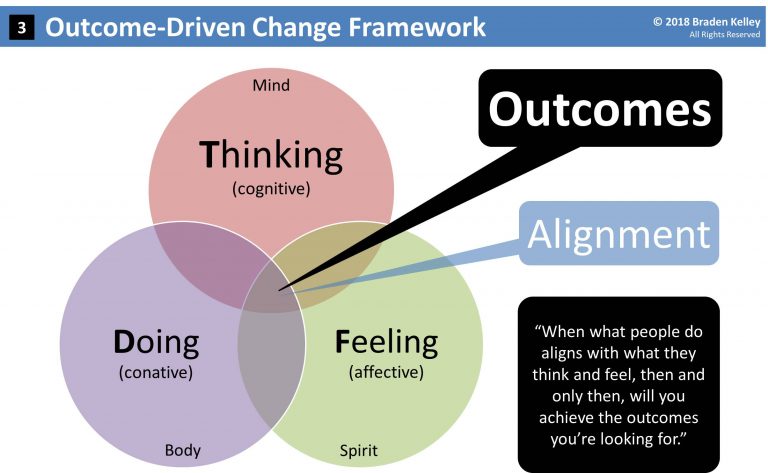
As we integrate agentic AI into our organizations, the principles of Outcome-Driven Change (ODC) I first introduced in 2018 are more vital than ever. The core of the ODC framework rests on the alignment of three critical domains: Cognitive (Thinking), Affective (Feeling), and Conative (Doing). Today, AI agents are increasingly assuming the “conative” role, executing tasks and optimizing workflows at superhuman speeds. However, as I have always maintained, true success only arrives when what is being done is in harmony with what the people in the organization and customer base think and feel.

Outcome-Driven Change Framework

If an AI agent’s autonomous actions are misaligned with human psychological readiness or emotional context, it will trigger a Corporate Antibody response that kills innovation. To practice genuine Human-Centered Change™, we must ensure that AI agents are directed to pursue outcomes that are not just numerically efficient, but humanly resonant. When an AI’s “doing” matches the collective thinking and feeling of the workforce, we move beyond the Efficiency Trap and create lasting change with impact.

“In the age of agentic AI, the true scarcity is not computational power; it is the human wisdom to define the right ‘North Star’ outcomes. An AI optimizing for the wrong goal is a digital express train headed in the wrong direction – efficient, but ultimately destructive.” — Braden Kelley

From Feature-Building to Outcome-Harvesting

For decades, many organizations have been stuck in a cycle of “feature-building.” Product teams were rewarded for shipping more features, marketing for launching more campaigns, and R&D for creating more patents. The focus was on output, not ultimate impact. Outcome-Driven Innovation shifts this paradigm. It forces us to ask: What human or business value are we trying to create? What measurable change in behavior or well-being are we seeking?

Agentic AI, when properly directed, becomes an unparalleled accelerant for this shift. Instead of building a new feature and hoping it works, we can now tell an AI agent, “Achieve Outcome X for Persona Y, within Constraints Z,” and it will explore millions of pathways to get there. This frees human teams from the tactical churn and allows them to focus on the truly strategic work: deeply understanding customer needs, identifying ethical guardrails, and defining aspirational outcomes that genuinely drive Human-Centered Innovation™.

Case Study 1: Sustainable Manufacturing and the “Circular Economy” Outcome

The Challenge: A major electronics manufacturer in early 2025 aimed to reduce its carbon footprint but struggled with the complexity of optimizing its global supply chain, product design, and end-of-life recycling simultaneously. Traditional methods led to incremental, siloed improvements.

The Outcome-Driven Approach: They defined a bold outcome: “Achieve a 50% reduction in virgin material usage across all product lines by 2028, while maintaining profitability and product quality.” They then deployed an agentic AI system to explore new material combinations, reverse logistics networks, and redesign possibilities. This AI was explicitly optimized to achieve the circular economy outcome.

The Impact: The AI identified design changes that led to a 35% reduction in material waste within 18 months, far exceeding human predictions. It also found pathways to integrate recycled content into new products without compromising durability. The organization moved from a reactive “greenwashing” approach to proactive, systemic innovation driven by a clear, human-centric environmental outcome.

Case Study 2: Personalized Education and “Mastery Outcomes”

The Challenge: A national education system faced stagnating literacy rates, despite massive investments in new curricula. The focus was on “covering material” rather than ensuring true student understanding and application.

The Outcome-Driven Approach: They shifted their objective to “Ensure 90% of students achieve demonstrable mastery of core literacy skills by age 10.” An AI tutoring system was developed, designed to optimize for individual student mastery outcomes, rather than just quiz scores. The AI dynamically adapted learning paths, identified specific knowledge gaps, and even generated custom exercises based on each child’s learning style.

The Impact: Within two years, participating schools saw a 25% improvement in mastery rates. The AI became a powerful co-pilot for teachers, freeing them from repetitive grading and allowing them to focus on high-touch mentorship. This demonstrated how AI, directed by human-defined learning outcomes, can empower both educators and students, moving beyond the Efficiency Trap of standardized testing.

Leading Companies and Startups to Watch

As 2026 solidifies Outcome-Driven Innovation, several entities are paving the way. Amplitude and Pendo are evolving their product analytics to connect feature usage directly to customer outcomes. In the AI space, Anthropic‘s work on “Constitutional AI” is fascinating, as it seeks to embed human-defined ethical outcomes directly into the AI’s decision-making. Glean and Perplexity AI are creating agentic knowledge systems that help organizations define and track complex outcomes across their internal data. Startups like Metaculus are even democratizing the prediction of outcomes, allowing collective intelligence to forecast the impact of potential innovations, providing invaluable insights for human decision-makers. These players are all contributing to the core goal: helping humans define the right problems for AI to solve.

Conclusion: The Human Art of Defining the Future

The year 2026 is a pivotal moment. Agentic AI gives us unprecedented power to optimize, but with great power comes great responsibility — the responsibility to define truly meaningful outcomes. This is not a technical challenge; it is a human one. It requires deep empathy, strategic foresight, and the courage to challenge old metrics. It demands leaders who understand that the most impactful Human-Centered Innovation™ starts with a clear, ethically grounded North Star.

If you’re an innovation leader trying to navigate this future, remember: the future is not about what AI can do, but about what outcomes we, as humans, choose to pursue with it. Let’s make sure those outcomes serve humanity first.

Frequently Asked Questions

What is “Outcome-Driven Innovation”?

Outcome-Driven Innovation (ODI) is a strategic approach that focuses on defining and achieving specific, measurable human or business outcomes, rather than simply creating new features or products. AI then optimizes for these defined outcomes.

How does agentic AI change the role of human leaders in ODI?

Agentic AI frees human leaders from tactical execution and micro-management, allowing them to focus on the higher-level strategic work of identifying critical problems, understanding human needs, and defining the ethical, impactful outcomes for AI to pursue.

What is the “Efficiency Trap” in the context of AI and outcomes?

The Efficiency Trap occurs when AI is used to optimize for speed or cost without first ensuring that the underlying outcome is meaningful and human-centered. This can lead to highly efficient processes that achieve undesirable or even harmful results, ultimately undermining trust and innovation.

Image credits: Braden Kelley, Google Gemini

Content Authenticity Statement: The topic area, key elements to focus on, etc. were decisions made by Braden Kelley, with a little help from Google Gemini to clean up the article.

Subscribe to Human-Centered Change & Innovation WeeklySign up here to get Human-Centered Change & Innovation Weekly delivered to your inbox every week.

8 Ways to Kill a Good Idea Before It Ships

A Roundup of Trap Patterns

8 Ways to Kill a Good Idea Before it Ships

by Braden Kelley and Chateau G Pato


How Do Organizations Kill a Good Idea Before It Ships? (Short Answer)

Eight trap patterns that kill a good idea before it ships: (1) premature scale, (2) death by requirements, (3) orphan after applause, (4) committee dilution, (5) metric mirage as veto, (6) competitor cosplay, (7) politics dressed as diligence, and (8) learning theater without a decision date. An honorable kill ends a weak bet on purpose. A trap kill ends a good bet by accident — or by design that nobody will admit.

Good ideas die when the organization needs safety more than it needs a landing.

Why Don’t All Idea Cemeteries Hold Bad Ideas?

I have sat in reviews where a promising bet was declared “not ready” for the third quarter in a row — not because the evidence said stop, but because the organization could not tolerate a decision. The sticky notes were fine. The hazard was the hallway: premature scale, frozen specs, missing owners, consensus that sanded the edge off the job, vanity metrics with veto power, rival screenshots mistaken for strategy, diligence loops without a date, and “still learning” as career insurance.

Innovation theater is activity that photographs well while protecting the status quo. These eight traps are different. They often kill good ideas — bets with real human jobs and early signal — before they ever get a chance to ship. Soft landings for innovation require spotting the difference between an honorable kill and a trap kill.

Trap Tell Escape
1. Premature scale “We’re past pilot” with no behavior proof Scale gates tied to adopted behavior and transfer
2. Death by requirements “Out of scope” for human context Thin specs that revise from evidence
3. Orphan after applause “Innovation owns it” forever BAU owner and old-path kill date before the next demo
4. Committee dilution “Something for everyone” One problem owner; written non-goals
5. Metric mirage as veto Green activity, red journey Outcomes decide; activity informs
6. Competitor cosplay “They have X, so we need X” Job before feature parity
7. Politics as diligence No decision date; endless new reviewers Time-boxed go/no-go with written criteria
8. Learning theater “Still exploring” past the kill/scale date Evidence-to-decision lag; ship, stop, or continue

1. How Does Premature Scale Kill a Good Idea?

The trap: Force enterprise rollout, full integration, or big-bang launch before a named behavior is falsified.

When the idea was sound: Early evidence was promising; scale politics arrived first.

The tell: “We’re past pilot” with no adopted-behavior proof. Fail-fast language retired overnight.

Escape: Scale gates tied to behavior and transfer — not calendar or executive impatience. Before you fund the next wave, use 11 Questions Before Funding Any Innovation Pilot.

2. What Is Death by Requirements?

The trap: A 40-page requirements document — or an AI-generated epic backlog — locks an assumed solution and starves contact with the job.

When the idea was sound: The insight was right; the freeze was early and political.

The tell: “Out of scope” for human context. Change requests treated as failure instead of learning.

Escape: Thin specs that trace to jobs-to-be-done and falsifiable behavior; revise from evidence. For better framing before the freeze, see 10 Design Questions That Beat a 40-Page Requirements Document.

3. How Does Orphan After Applause Kill Shipping?

The trap: The demo wins the room; nobody owns the operating path, handoffs, or retirement of the old way.

When the idea was sound: Customers or employees would have hired it — if anyone ran it in BAU.

The tell: “Innovation owns it” forever. Transfer date missing. Dual-running forever.

Escape: Named workflow owner and kill date for the old path before the next demo. Applause is not adoption.

4. Why Does Committee Dilution Kill the Edge of a Good Idea?

The trap: Every stakeholder adds a feature, caveat, or brand constraint until the idea no longer solves the original job.

When the idea was sound: Clarity existed; consensus theater erased it.

The tell: “Something for everyone.” No one would defend the original problem statement out loud.

Escape: One problem owner. Written non-goals. Refuse scope that cannot name a human outcome.

5. How Does Metric Mirage Veto a Sound Bet?

The trap: Vanity scores — ideas logged, demos held, “innovation NPS,” token metrics — or the wrong SLA veto a bet that would move a real human outcome.

When the idea was sound: Behavior or value evidence was forming; the wrong dashboard closed the case.

The tell: Green activity, red journey. “Not enough ROI slideware” without a behavior theory.

Escape: Dual scorecard — outcomes decide; activity informs. For the scoreboard that replaces idea count, see 12 Metrics That Actually Measure Innovation Value.

6. What Is Competitor Cosplay — and How Does It Kill Original Jobs?

The trap: Rebuild what a rival shipped — or what a model generated — without the struggling moment, trigger, or workaround archaeology.

When the idea was sound: Your original job insight was stronger than the copy; politics preferred a familiar shape.

The tell: Feature parity matrices. “They have X, so we need X.”

Escape: Job prompts before roadmap. Compete on progress humans hire, not screenshot similarity. Run 9 Jobs-to-Be-Done Prompts Every Product Team Should Run before you copy the artifact.

7. How Does Politics Dressed as Diligence Soft-Veto a Good Idea?

The trap: Endless security, legal, architecture, or “alignment” loops that never produce a yes/no — only delay until the sponsor leaves or the window closes.

When the idea was sound: Risks were real and manageable; the process was the weapon.

The tell: No named decision date. New reviewers appear after every gate. “Not ready” without written criteria.

Escape: Time-boxed diligence with a go/no-go owner. Publish criteria before the review starts. Diligence without a decision date is a soft veto.

8. Why Is Learning Theater Without a Decision Date a Trap?

The trap: Infinite cheap experiments, AI variants, and pilots that never graduate to ship or stop.

When the idea was sound: Enough evidence existed to decide; tourism felt safer than commitment.

The tell: “We’re still learning” past the kill/scale date. No honorable exit and no transfer.

Escape: Evidence-to-decision lag as a metric. A cemetery of honorable kills and a path to BAU. For the costume patterns these traps often wear, see 7 Types of Innovation Theater.

How Do You Audit Trap Patterns Before the Next Innovation Review?

Before the next innovation review, run five go/no-go questions. If you cannot answer them, you may be about to kill a good idea by accident:

  1. Are we scaling because evidence says go — or because the calendar says go?
  2. Who owns BAU after applause?
  3. What non-goals protect the edge of the idea?
  4. Which metric could wrongly veto a sound bet?
  5. What is the decision date — ship, stop, or continue — and who owns it?

Kill weak bets on purpose. Stop killing good ones by accident.

Frequently Asked Questions

Why do good ideas fail to ship?

Good ideas often fail to ship because of organizational trap patterns — premature scale, frozen wrong requirements, no owner after the demo, committee dilution, vanity metrics with veto power, competitor copying without the job, diligence loops without a decision date, and endless “still learning” without ship-or-stop. The idea can be sound while the pipeline is the hazard.

How do organizations kill innovation?

Organizations kill innovation by starving mandate, freezing assumed solutions, orphaning bets after applause, sanding clarity into consensus mush, vetoing on activity metrics, copying rival artifacts instead of jobs, using process as a soft veto, and confusing tourism with learning. Spotting these traps is how you protect sound bets.

What is premature scaling?

Premature scaling is forcing enterprise rollout, full integration, or big-bang launch before a named human behavior is falsified and a BAU owner exists. It kills good ideas by replacing learning with calendar politics — “we’re past pilot” without adopted-behavior proof.

How do you protect a good idea in a large company?

Protect a good idea with a named problem owner, written non-goals, thin specs tied to jobs and falsifiable behavior, a BAU owner and old-path kill date before demos scale, outcome metrics that decide funding, time-boxed diligence with published criteria, and a ship/stop/continue date. Kill weak bets on purpose — not good ones by accident.

What is the difference between killing a bad idea and killing a good one?

An honorable kill ends a weak bet when evidence says stop — with kill criteria written in advance. A trap kill ends a good bet while evidence still says go — through premature scale, process vetoes, missing owners, wrong metrics, or “still learning” without a decision date. One is skill. The other is organizational hazard.

Image credits: Pexels

Content Authenticity Statement: The topic area, key elements to focus on, etc. were decisions made by Braden Kelley, with a little help from Google Gemini and Cursor to clean up the article, add images and create infographics.

Subscribe to Human-Centered Change & Innovation WeeklySign up here to get Human-Centered Change & Innovation Weekly delivered to your inbox every week.

Top 40 Innovation Authors of 2025

Top 40 Innovation Authors of 2025After a week of torrid voting and much passionate support, along with a lot of gut-wrenching consideration and jostling during the judging round, I am proud to announce your Top 40 Innovation Authors of 2025:

  1. Robyn Bolton
    Robyn BoltonRobyn M. Bolton works with leaders of mid and large sized companies to use innovation to repeatably and sustainably grow their businesses.
    .

  2. Greg Satell
    Greg SatellGreg Satell is a popular speaker and consultant. His first book, Mapping Innovation: A Playbook for Navigating a Disruptive Age, was selected as one of the best business books in 2017. Follow his blog at Digital Tonto or on Twitter @Digital Tonto.

  3. Janet Sernack
    Janet SernackJanet Sernack is the Founder and CEO of ImagineNation™ which provides innovation consulting services to help organizations adapt, innovate and grow through disruption by challenging businesses to be, think and act differently to co-create a world where people matter & innovation is the norm.

  4. Mike Shipulski
    Mike ShipulskiMike Shipulski brings together people, culture, and tools to change engineering behavior. He writes daily on Twitter as @MikeShipulski and weekly on his blog Shipulski On Design.

  5. Pete Foley
    A twenty-five year Procter & Gamble veteran, Pete has spent the last 8+ years applying insights from psychology and behavioral science to innovation, product design, and brand communication. He spent 17 years as a serial innovator, creating novel products, perfume delivery systems, cleaning technologies, devices and many other consumer-centric innovations, resulting in well over 100 granted or published patents. Find him at pete.mindmatters@gmail.com

  6. Geoffrey A. Moore
    Geoffrey MooreGeoffrey A. Moore is an author, speaker and business advisor to many of the leading companies in the high-tech sector, including Cisco, Cognizant, Compuware, HP, Microsoft, SAP, and Yahoo! Best known for Crossing the Chasm and Zone to Win with the latest book being The Infinite Staircase. Partner at Wildcat Venture Partners. Chairman Emeritus Chasm Group & Chasm Institute

  7. Shep Hyken
    Shep HykenShep Hyken is a customer service expert, keynote speaker, and New York Times, bestselling business author. For information on The Customer Focus™ customer service training programs, go to www.thecustomerfocus.com. Follow on Twitter: @Hyken

  8. David Burkus
    David BurkusDr. David Burkus is an organizational psychologist and best-selling author. Recognized as one of the world’s leading business thinkers, his forward-thinking ideas and books are helping leaders and teams do their best work ever. David is the author of five books about business and leadership and he’s been featured in the Wall Street Journal, Harvard Business Review, CNN, the BBC, NPR, and more. A former business school professor turned sought-after international speaker, he’s worked with organizations of all sizes and across all industries.

  9. John Bessant
    John BessantJohn Bessant has been active in research, teaching, and consulting in technology and innovation management for over 25 years. Today, he is Chair in Innovation and Entrepreneurship, and Research Director, at Exeter University. In 2003, he was awarded a Fellowship with the Advanced Institute for Management Research and was also elected a Fellow of the British Academy of Management. He has acted as advisor to various national governments and international bodies including the United Nations, The World Bank, and the OECD. John has authored many books including Managing innovation and High Involvement Innovation (Wiley). Follow @johnbessant

  10. Braden Kelley
    Braden KelleyBraden Kelley is a Human-Centered Experience, Innovation and Transformation consultant at HCL Technologies, a popular innovation speaker, workshop leader, and creator of the FutureHacking™ methodology. He is the author of Stoking Your Innovation Bonfire from John Wiley & Sons and Charting Change from Palgrave Macmillan. Follow him on Linkedin, Twitter, Facebook, or Instagram.


  11. Art Inteligencia
    Art InteligenciaArt Inteligencia is the lead futurist at Inteligencia Ltd. He is passionate about content creation and thinks about it as more science than art. Art travels the world at the speed of light, over mountains and under oceans. His favorite numbers are one and zero.

  12. Stefan Lindegaard
    Stefan LindegaardStefan Lindegaard is an author, speaker and strategic advisor. His work focuses on corporate transformation based on disruption, digitalization and innovation in large corporations, government organizations and smaller companies. Stefan believes that business today requires an open and global perspective, and his work takes him to Europe, North and South America, Africa and Asia.

  13. Dainora Jociute
    Dainora JociuteDainora (a.k.a. Dee) creates customer-centric content at Viima. Viima is the most widely used and highest rated innovation management software in the world. Passionate about environmental issues, Dee writes about sustainable innovation hoping to save the world – one article at the time.

  14. Teresa Spangler
    Teresa SpanglerTeresa Spangler is the CEO of PlazaBridge Group has been a driving force behind innovation and growth for more than 30 years. Today, she wears multiple hats as a social entrepreneur, innovation expert, growth strategist, author and speaker (not to mention mother, wife, band-leader and so much more). She is especially passionate about helping CEOs understand and value the role human capital plays in innovation, and the impact that innovation has on humanity; in our ever-increasing artificial/cyber world.

  15. Soren Kaplan
    Soren KaplanSoren Kaplan is the bestselling and award-winning author of Leapfrogging and The Invisible Advantage, an affiliated professor at USC’s Center for Effective Organizations, a former corporate executive, and a co-founder of UpBOARD. He has been recognized by the Thinkers50 as one of the world’s top keynote speakers and thought leaders in business strategy and innovation.

  16. Diana Porumboiu
    Diana PorumboiuDiana heads marketing at Viima, the most widely used and highest rated innovation management software in the world, and has a passion for innovation, and for genuine, valuable content that creates long-lasting impact. Her combination of creativity, strategic thinking and curiosity has helped organisations grow their online presence through strategic campaigns, community management and engaging content.

  17. Steve Blank
    Steve BlankSteve Blank is an Adjunct Professor at Stanford and Senior Fellow for Innovation at Columbia University. He has been described as the Father of Modern Entrepreneurship, credited with launching the Lean Startup movement that changed how startups are built; how entrepreneurship is taught; how science is commercialized, and how companies and the government innovate.

  18. Jesse Nieminen
    Jesse NieminenJesse Nieminen is the Co-founder and Chairman at Viima, the best way to collect and develop ideas. Viima’s innovation management software is already loved by thousands of organizations all the way to the Global Fortune 500. He’s passionate about helping leaders drive innovation in their organizations and frequently writes on the topic, usually in Viima’s blog.

  19. Robert B Tucker
    Robert TuckerRobert B. Tucker is the President of The Innovation Resource Consulting Group. He is a speaker, seminar leader and an expert in the management of innovation and assisting companies in accelerating ideas to market.

  20. Dennis Stauffer
    Dennis StaufferDennis Stauffer is an author, independent researcher, and expert on personal innovativeness. He is the founder of Innovator Mindset LLC which helps individuals, teams, and organizations enhance and accelerate innovation success. by shifting mindset. Follow @DennisStauffer

  21. Accelerate your change and transformation success


  22. Arlen Meyers
    Arlen MyersArlen Meyers, MD, MBA is an emeritus professor at the University of Colorado School of Medicine, an instructor at the University of Colorado-Denver Business School and cofounding President and CEO of the Society of Physician Entrepreneurs at www.sopenet.org. Linkedin: https://www.linkedin.com/in/ameyers/

  23. Phil McKinney
    Phil McKinneyPhil McKinney is the Author of “Beyond The Obvious”​, Host of the Killer Innovations Podcast and Syndicated Radio Show, a Keynote Speaker, President & CEO CableLabs and an Innovation Mentor and Coach.

  24. Ayelet Baron
    Ayelet BaronAyelet Baron is a pioneering futurist reminding us we are powerful creators through award winning books, daily blog and thinking of what is possible. Former global tech executive who sees trust, relationships and community as our building blocks to a healthy world.

  25. Scott Anthony
    Scott AnthonyScott Anthony is a strategic advisor, writer and speaker on topics of growth and innovation. He has been based in Singapore since 2010, and currently serves at the Managing Director of Innosight’s Asia-Pacific operations.

  26. Leo Chan
    Leo ChanLeo is the founder of Abound Innovation Inc. He’s a people and heart-first entrepreneur who believes everyone can be an innovator. An innovator himself, with 55 US patents and over 20 years of experience, Leo has come alongside organizations like Chick-fil-A and guided them to unleash the innovative potential of their employees by transforming them into confident innovators.

  27. Rachel Audige
    Rachel AudigeRachel Audige is an Innovation Architect who helps organisations embed inventive thinking as well as a certified Systematic Inventive Thinking Facilitator, based in Melbourne.

  28. Paul Sloane
    Paul SloanePaul Sloane writes, speaks and leads workshops on creativity, innovation and leadership. He is the author of The Innovative Leader and editor of A Guide to Open Innovation and Crowdsourcing, both published by Kogan-Page.

  29. Ralph Christian Ohr
    Ralph OhrDr. Ralph-Christian Ohr has extensive experience in product/innovation management for international technology-based companies. His particular interest is targeted at the intersection of organizational and human innovation capabilities. You can follow him on Twitter @Ralph_Ohr.

  30. Dean and Linda Anderson
    Dean and Linda AndersonDr. Dean Anderson and Dr. Linda Ackerman Anderson lead BeingFirst, a consultancy focused on educating the marketplace about what’s possible in personal, organizational and community transformation and how to achieve them. Each has been advising clients and training professionals for more than 40 years.

  31. Howard Tiersky
    Howard TierskyHoward Tiersky is an inspiring and passionate speaker, the Founder and CEO of FROM, The Digital Transformation Agency, innovation consultant, serial entrepreneur, and the Wall Street Journal bestselling author of Winning Digital Customers: The Antidote to Irrelevance. IDG named him one of the “10 Digital Transformation Influencers to Follow Today”, and Enterprise Management 360 named Howard “One of the Top 10 Digital Transformation Influencers That Will Change Your World.”


  32. Chateau G Pato
    Chateau G PatoChateau G Pato is a senior futurist at Inteligencia Ltd. She is passionate about content creation and thinks about it as more science than art. Chateau travels the world at the speed of light, over mountains and under oceans. Her favorite numbers are one and zero.

  33. Shilpi Kumar
    Shilpi KumarShilpi Kumar an inquisitive researcher, designer, strategist and an educator with over 15 years of experience, who truly believes that we can design a better world by understanding human behavior. I work with organizations to identify strategic opportunities and offer user-centric solutions.

  34. Anthony Mills
    Anthony MillsAnthony Mills is the Founder & CEO of Legacy Innovation Group (www.legacyinnova.com), a world-leading strategic innovation consulting firm working with organizations all over the world. Anthony is also the Executive Director of GInI – Global Innovation Institute (www.gini.org), the world’s foremost certification, accreditation, and membership organization in the field of innovation. Anthony has advised leaders from around the world on how to successfully drive long-term growth and resilience through new innovation. Learn more at www.anthonymills.com. Anthony can be reached directly at anthony@anthonymills.com.

  35. Paul Hobcraft
    Paul HobcraftPaul Hobcraft runs Agility Innovation, an advisory business that stimulates sound innovation practice, researches topics that relate to innovation for the future, as well as aligning innovation to organizations core capabilities. Follow @paul4innovating

  36. Jorge Barba
    Jorge BarbaJorge Barba is a strategist and entrepreneur, who helps companies build new puzzles using human skills. He is a global Innovation Insurgent and author of the innovation blog www.Game-Changer.net

  37. Douglas Ferguson
    Douglas FergusonDouglas Ferguson is an entrepreneur and human-centered technologist. He is the founder and president of Voltage Control, an Austin-based change agency that helps enterprises spark, accelerate, and sustain innovation. He specializes in helping teams work better together through participatory decision making and design inspired facilitation techniques.

  38. Jeffrey Phillips
    Jeffrey Phillips has over 15 years of experience leading innovation in Fortune 500 companies, federal government agencies and non-profits. He is experienced in innovation strategy, defining and implementing front end processes, tools and teams and leading innovation projects. He is the author of Relentless Innovation and OutManeuver. Jeffrey writes the popular Innovate on Purpose blog. Follow him @ovoinnovation

  39. Alain Thys
    Alain ThysAs an experience architect, Alain helps leaders craft customer, employee and shareholder experiences for profit, reinvention and transformation. He does this through his personal consultancy Alain Thys & Co as well as the transformative venture studio Agents of A.W.E. Together with his teams, Alain has influenced the experience of over 500 million customers and 350,000 employees. Follow his blog or connect on Linkedin.

  40. Bruce Fairley
    Bruce FairleyBruce Fairley is the CEO and Founder of The Narrative Group, a firm dedicated to helping C-Suite executives build enterprise value. Through smart, human-powered digital transformation, Bruce optimizes the business-technology relationship. His innovative profit over pitfalls approach and customized programs are part of Bruce’s mission to build sustainable ‘best-future’ outcomes for visionary leaders. Having spearheaded large scale change initiatives across four continents, he and his skilled, diverse team elevate process, culture, and the bottom line for medium to large firms worldwide.

  41. Tom Stafford
    Tom StaffordTom Stafford studies learning and decision making. His main focus is the movement system – the idea being that if we can understand the intelligence of simple actions we will have an excellent handle on intelligence more generally. His research looks at simple decision making, and simple skill learning, using measures of behaviour informed by the computational, robotics and neuroscience work done in the wider group.

If your favorite didn’t make the list, then next year try to rally more votes for them or convince them to increase the quality and quantity of their contributions.

Our lists from the ten previous years have been tremendously popular, including:

Top 40 Innovation Bloggers of 2015
Top 40 Innovation Bloggers of 2016
Top 40 Innovation Bloggers of 2017
Top 40 Innovation Bloggers of 2018
Top 40 Innovation Bloggers of 2019
Top 40 Innovation Bloggers of 2020
Top 40 Innovation Bloggers of 2021
Top 40 Innovation Bloggers of 2022
Top 40 Innovation Bloggers of 2023
Top 40 Innovation Bloggers of 2024

Download PDF versions of the Top 40 Innovation Bloggers of 2020, 2021, 2022, 2023, 2024 and 2025 lists here:


Top 40 Innovation Bloggers of 2020 PDF . . . Top 40 Innovation Bloggers of 2021


Top 40 Innovation Bloggers of 2022 . . . Top 40 Innovation Bloggers of 2023


Top 40 Innovation Bloggers of 2024 . . . Top 40 Innovation Authors of 2025

Happy New Year everyone!

Subscribe to Human-Centered Change & Innovation WeeklySign up here to get Human-Centered Change & Innovation Weekly delivered to your inbox every week.

12 Metrics That Actually Measure Innovation Value (Beyond Idea Count)

12 Metrics That Actually Measure Innovation Value (Beyond Idea Count)

GUEST POST from Art Inteligencia


How Do You Measure Innovation Value Beyond Idea Count? (Short Answer)

Twelve metrics that actually measure innovation value beyond idea count: (1) adopted behavior change, (2) workaround / shadow-process retirement, (3) time-to-confidence, (4) effort or cost-to-serve delta, (5) value captured (as a range), (6) honorable kill rate, (7) pilot-to-BAU transfer rate, (8) evidence-to-decision lag, (9) mandate coverage, (10) lived-contact evidence rate, (11) named Tuesday-owner coverage, and (12) dual scorecard integrity — outcomes decide; activity only informs. Idea count, demo volume, and patent tallies photograph well and predict almost nothing about Tuesday.

Idea count measures imagination theater. Innovation value measures whether humans and the operating model changed — and whether weak bets stopped.

Why Isn’t Idea Count Innovation Value?

I have sat through innovation reviews that felt like a harvest festival. Ideas submitted. Hackathons held. Prototypes shown. AI pilots launched. Someone asked what got easier for a human on Tuesday. The room reached for a vanity dashboard the way a drowning person reaches for a brochure.

Those metrics fund costume. Real innovation value shows up when a named journey gets easier, a workaround dies, a bet is killed on purpose, and a Tuesday owner runs what used to be a demo. Soft landings are designed. These twelve metrics are how you score the landing — not the theater.

Metric Replaces Signals value when…
1. Adopted behavior change Idea count / engagement People do something different in BAU
2. Workaround retirement Forever dual-running The old path has a kill date that sticks
3. Time-to-confidence Speed-to-demo Humans succeed without heroics sooner
4. Effort / cost-to-serve delta Workshop attendance Friction and failure demand drop
5. Value captured (range) Hope-based ROI slides Behavior maps to dollars with visible assumptions
6. Honorable kill rate Infinite “still learning” Weak bets stop on purpose
7. Pilot-to-BAU transfer Forever pilots A named operator runs it in the core
8. Evidence-to-decision lag Tourism without go/no-go Learning produces a decision on a date
9. Mandate coverage Orphan pilots Bets have power to decide, ship, or stop
10. Lived-contact evidence Synthetic personas as research Real humans shaped the bet before build
11. Tuesday-owner coverage “Innovation owns it” forever Adoption has a named workflow owner
12. Dual scorecard integrity Motion celebrated as impact Red outcomes can stop green activity reviews

1. Why Does Adopted Behavior Change Measure Innovation Value?

Measures: Whether a named human behavior moved in BAU — complete in one try, abandon the workaround, finish without escalation.

Replaces: Ideas generated; “innovation engagement”; applause at the readout.

On Tuesday: One behavior hypothesis per bet. Measure what people do, not what they clap for. If the behavior did not move, you did not innovate — you performed.

2. Why Is Workaround Retirement an Innovation Metric?

Measures: Whether the old path dies when the new way works — kill date honored for shadow processes and dual-running.

Replaces: “Go-live” with both paths forever and a dashboard that still calls it success.

On Tuesday: Retirement is part of the value. Dual-running is not adoption. It is hesitation with better branding.

3. What Does Time-to-Confidence Tell You About Innovation Value?

Measures: How fast customers or employees trust they can succeed without heroics, workarounds, or a friendly insider.

Replaces: Speed-to-demo; handle-time vanity alone; “we shipped.”

On Tuesday: Confidence is a human outcome. Faster wrong is still wrong — and now it confuses people faster too.

4. How Do Effort and Cost-to-Serve Deltas Measure Innovation?

Measures: Friction reduction on a named journey — effort, repeat contacts, failure demand, cognitive load.

Replaces: Lab activity; workshop attendance; sticky-note volume.

On Tuesday: Baseline, then after. A range is honest. Fake precision is theater with decimals.

5. How Should Innovation Value Be Captured in Dollars?

Measures: Retained or expanded revenue, or cost avoided, tied to the intervention — with assumptions visible and shown as a range.

Replaces: Industry benchmark slides and hope-based ROI that never touch your journeys.

On Tuesday: Metric → behavior → dollars → named bet. For pricing methods that survive a CFO, see 7 Ways to Calculate CX ROI Without Hope-Based Slideware — then apply the same honesty to innovation bets.

6. Why Is Honorable Kill Rate a Sign of Innovation Health?

Measures: Share of bets stopped on written kill criteria — stopping as a skill, not a scandal.

Replaces: Infinite “still learning” pilots; idea cemeteries without decisions.

On Tuesday: Visible cemetery of honorable exits. Kill criteria written before funding. A portfolio that never kills is not learning. It is hoarding.

7. What Is Pilot-to-BAU Transfer Rate?

Measures: Bets that graduate with a named operator into the operating model — not forever pilots with better lighting.

Replaces: Demo day as destination; “scale later” as a lifestyle.

On Tuesday: Transfer plan before build. The lab (if it exists) is a runway, not a forever home. For why labs die when transfer never arrives, see 5 Reasons Innovation Labs Fail — and 5 Replacements That Work.

8. Why Measure Evidence-to-Decision Lag?

Measures: Time from falsifying evidence to a go/no-go — learning that decides, not learning that tours.

Replaces: More experiments without decisions; “we’re still exploring” as career insurance.

On Tuesday: Learning without a decision date is tourism. Shorten the lag between “we know” and “we choose.”

9. What Is Mandate Coverage in an Innovation Portfolio?

Measures: Percentage of active bets with explicit decision rights — decide, ship, or stop.

Replaces: Impressive orphan pilots nobody has authority to operationalize.

On Tuesday: No mandate = no fund. Methods without power are cosplay. Before you open the budget, use 11 Questions Before Funding Any Innovation Pilot.

10. Why Does Lived-Contact Evidence Rate Matter?

Measures: Percentage of bets with real human contact — jobs, friction, dignity costs — before build, not synthetic personas alone.

Replaces: Scraped reviews and generated empathy maps mistaken for research because the prose is fluent.

On Tuesday: If the insight could have been invented in the building, it is decoration. Contact is not optional when generation is cheap.

11. What Is Named Tuesday-Owner Coverage?

Measures: Percentage of bets with a workflow or journey owner after applause — incentives, handoffs, and recovery power included.

Replaces: “The innovation team owns it” forever; adoption as an afterthought slide.

On Tuesday: Owner named before demo day. Adoption is design. If nobody owns the seam, the demo owned you.

12. What Is Dual Scorecard Integrity?

Measures: Whether outcomes (behavior, retirement, transfer, value) decide funding and promotion — while activity (ideas, demos, patents) only informs.

Replaces: Dashboards that celebrate motion and call it impact.

On Tuesday: If green activity can close a red-outcome review, you are still measuring theater. For the patterns these metrics prevent, see 7 Types of Innovation Theater. For the practice habit behind this scoreboard, read 9 Habits of Human-Centered Innovators That Still Matter in the Age of AI.

How Do You Check Innovation Metrics Before the Next Review?

Before the next innovation review, run five go/no-go questions. If you cannot answer them, you are still funding costume:

  1. Which of the twelve are on our scorecard — and which vanity metrics still run promotions?
  2. Can we name one adopted behavior from last quarter’s bets?
  3. How many bets did we honorably kill — with written criteria?
  4. Who owns Tuesday for each live bet?
  5. Would a red outcome stop a green activity review?

Count ideas if you must. Fund and promote what landed — behavior, retirement of the old path, transfer to BAU, and the courage to stop.

Frequently Asked Questions

How do you measure innovation value?

Measure adopted human outcomes and portfolio discipline — behavior change, workaround retirement, time-to-confidence, effort or cost-to-serve deltas, value captured as a range, honorable kills, pilot-to-BAU transfer, decision lag, mandate coverage, lived contact, Tuesday owners, and dual scorecard integrity. Do not confuse idea count or demo volume with value.

What metrics replace idea count in innovation?

Replace idea count with metrics that name what landed: adopted behavior change, shadow-process retirement, time-to-confidence, friction reduction, value captured, kill rate, transfer to BAU, evidence-to-decision lag, mandate coverage, lived-contact evidence, named Tuesday owners, and whether outcomes — not activity — decide funding and promotion.

What are vanity metrics in innovation?

Vanity metrics celebrate motion that photographs well: ideas submitted, hackathons held, patents filed, prototypes shown, visitors hosted, AI pilots launched, and “innovation NPS.” They can inform curiosity. They should not decide funding, promotion, or whether the portfolio is healthy — unless tied to adopted outcomes on Tuesday.

How do you measure innovation ROI?

Tie a named intervention to a behavior change, then to dollars — retained or expanded revenue, or cost avoided — with assumptions visible and reported as a range. Combine that with transfer to BAU and retirement of the old path. Avoid industry benchmark slides that never touch your journeys or operating model.

What KPIs should an innovation team use?

Use a dual scorecard: outcomes that decide (adopted behavior, retirement of old paths, transfer to BAU, value captured, honorable kills) and activity that only informs (ideas, demos). Add mandate coverage, lived-contact evidence, Tuesday-owner coverage, and evidence-to-decision lag so the portfolio stays honest about power, contact, ownership, and learning that decides.

Image credits: Google Gemini

Subscribe to Human-Centered Change & Innovation WeeklySign up here to get Human-Centered Change & Innovation Weekly delivered to your inbox every week.

Making Empathy Your Secret Weapon

Making Empathy Your Secret WeaponGUEST POST from Greg Satell

When I first moved to Kyiv about 20 years ago, I met my friend Pavlo, who is from Belarus. Eventually our talk turned to that country’s leader, Alexander Lukashenko, and an incident in which he turned off the utilities at the US Ambassador’s residence, as well as those of other diplomats. It seemed totally outlandish and crazy to me.

“But he won,” Pavlo countered. I was incredulous, until he explained. “Lukashenko knows he’s a bastard and that the world will never accept him. In that situation all you can win is your freedom and that’s what he won.” It was a mode of thinking so outrageous and foreign to me that I could scarcely believe it.

Yet it opened my eyes and made me a more effective operator. We tend to think of empathy as an act of generosity, but it’s far more than that. Learning how to internalize diverse viewpoints is a skill we should learn not only because it helps make others more comfortable, but because it empowers us to successfully navigate an often complex and difficult world.

Identifying Shared Values

We all have ideas we feel passionately about and, naturally, we want others to adopt them. The ideas we believe in make up an important facet of our identity, dignity and sense of self. For me, as an American living in post-communist countries, the ideas embedded in democratic institutions were important and it was difficult for me to see things another way.

My conversation with Pavlo opened my eyes. Where I saw America and “the west” as a more just society, people in other parts of the world saw it as a dominant force that restricted their freedom. My big insight was that I didn’t need to agree with a perspective to understand, internalize, and leverage it as a shared value.

For example, once I was able to understand that some people saw Americans as powerful—something akin to an invading force—I was able to shed the feelings of vulnerability that arose from being in a strange and foreign land and focus on the shared value of safety in my dealings with others.

A great strategy for identifying shared values is to listen closely to what your opposition is saying. People say and do things because they believe they will be effective. Once I was able to stop dismissing Lukashenko as a corrupt thug, I was able to identify the issues surrounding safety and dominance that could be useful to me.

Building Shared Purpose

Using empathy to identify shared values is a crucial first step, but doesn’t achieve anything by itself. To move things forward, we need to build a shared purpose. Consider a famous study called the Robbers Cave Experiment, which involved 22 boys of similar religious, racial and economic backgrounds invited to spend a few weeks at a summer camp.

In the first phase, they were separated into two groups of “Rattlers” and “Eagles” that had little contact with each other. As each group formed its own identity, they began to display hostility on the rare occasions when they were together. During the second phase, the two groups were given competitive tasks and tensions boiled over, with each group name calling, sabotaging each other’s efforts and violently attacking one another.

In the third phase, the researchers attempted to reduce tensions. At first, they merely brought them into friendly contact, with little effect. The boys just sneered at each other. However, when they were tricked into challenging tasks where they were forced to work together in order to be successful, the tenor changed quickly. By the end of the camp the two groups had fallen into a friendly camaraderie.

As Francis Fukuyama writes in his recent book, “Identity can be used to divide, but it can also be used to integrate,” which is exactly what I found in my years working is foreign cultures. Once I was able to leverage shared values to create a shared purpose and began engaging in shared actions, that purpose and those actions became part of a shared identity. Yes, I was still an American, with American values and perspectives, but I became their American.

Overcoming Conflict By Designing A Dilemma

Unfortunately, building a shared purpose isn’t always possible. A simple truth is that humans build attachments to people, ideas and things. When those attachments are threatened, they will lash out. That’s why whenever we set out to make a significant impact, there will always be those who will work to undermine what we are trying to achieve in ways that are dishonest, underhanded and deceptive.

When that happens—and it always does eventually—we can get sucked into a conflict, which will likely take us off course and discredit what we’re trying to achieve. Yet, here too, developing empathy skills to identify shared values can be extremely helpful once we learn how to design a dilemma action, which puts the opponents into an impossible position.

Dilemma actions have been used for at least a century—famous examples include Gandhi’s Salt March, King’s Birmingham Campaign and Alice Paul’s Silent Sentinels—but more recently codified by the global activist, Srdja Popović. They are just as effective in an organizational context, using an opponent’s resistance against them.

One of the great things about dilemma actions is that you approach them exactly the same way you approach building allies—by identifying a shared purpose. Once you do that, you can design a constructive act rooted in that shared purpose that advances your agenda. Your opponent then has a choice: they can disrupt the act and violate the shared value or they can let it go forward and let change progress.

For example, I was once running a transformation project that was being impeded by a Sales Director hogging accounts. Although it was agreed that she would distribute her clients, she never got around to it, so I set up a meeting with a key account and one of our salespeople. When she tried to disrupt the meeting, she violated the shared value we had established, was dismissed from her position and everything fell into place after that.

Empathy Is Not Absolution

Empathy, as powerful as it can potentially be, is widely misunderstood. It is often paired with compassion in the context of creating a more beneficial workplace. That is, of course, a reasonable and worthy objective, but the one-dimensional use of the term is misleading and limits its value.

When seen only through the lens of making others more comfortable, empathy can seem like a “nice to have,” trait rather than a valuable competency and an important source of competitive advantage. It’s much easier to see the advantage of imposing your will, rather than internalizing the perspectives of others.

One thing I learned over many years living in foreign cultures is that it’s important to understand how people around you think, especially if you don’t agree with them and, as is sometimes the case, find their point of view morally reprehensible. In fact, learning more about how others think can make you a more effective leader, negotiator and manager.

Empathy is not absolution. You can internalize the ideas of others and still vehemently disagree. There is a reason that Special Forces are trained to understand the cultures in which they will operate and it isn’t because it makes them nicer people. It’s because it makes them more lethal operators.

It is only through empathy that we can understand motivations—for good or ill—and design effective strategies to build shared purpose or, if need be, design a dilemma for an opponent. To operate in an often difficult world, you need to understand your environment. That’s why building empathy skills can be like a secret weapon.

— Article courtesy of the Digital Tonto blog
— Image credit: Pexels

Subscribe to Human-Centered Change & Innovation WeeklySign up here to join 17,000+ leaders getting Human-Centered Change & Innovation Weekly delivered to their inbox every week.