12 Metrics That Actually Measure Innovation Value (Beyond Idea Count)

12 Metrics That Actually Measure Innovation Value (Beyond Idea Count)

GUEST POST from Art Inteligencia


How Do You Measure Innovation Value Beyond Idea Count? (Short Answer)

Twelve metrics that actually measure innovation value beyond idea count: (1) adopted behavior change, (2) workaround / shadow-process retirement, (3) time-to-confidence, (4) effort or cost-to-serve delta, (5) value captured (as a range), (6) honorable kill rate, (7) pilot-to-BAU transfer rate, (8) evidence-to-decision lag, (9) mandate coverage, (10) lived-contact evidence rate, (11) named Tuesday-owner coverage, and (12) dual scorecard integrity — outcomes decide; activity only informs. Idea count, demo volume, and patent tallies photograph well and predict almost nothing about Tuesday.

Idea count measures imagination theater. Innovation value measures whether humans and the operating model changed — and whether weak bets stopped.

Why Isn’t Idea Count Innovation Value?

I have sat through innovation reviews that felt like a harvest festival. Ideas submitted. Hackathons held. Prototypes shown. AI pilots launched. Someone asked what got easier for a human on Tuesday. The room reached for a vanity dashboard the way a drowning person reaches for a brochure.

Those metrics fund costume. Real innovation value shows up when a named journey gets easier, a workaround dies, a bet is killed on purpose, and a Tuesday owner runs what used to be a demo. Soft landings are designed. These twelve metrics are how you score the landing — not the theater.

Metric Replaces Signals value when…
1. Adopted behavior change Idea count / engagement People do something different in BAU
2. Workaround retirement Forever dual-running The old path has a kill date that sticks
3. Time-to-confidence Speed-to-demo Humans succeed without heroics sooner
4. Effort / cost-to-serve delta Workshop attendance Friction and failure demand drop
5. Value captured (range) Hope-based ROI slides Behavior maps to dollars with visible assumptions
6. Honorable kill rate Infinite “still learning” Weak bets stop on purpose
7. Pilot-to-BAU transfer Forever pilots A named operator runs it in the core
8. Evidence-to-decision lag Tourism without go/no-go Learning produces a decision on a date
9. Mandate coverage Orphan pilots Bets have power to decide, ship, or stop
10. Lived-contact evidence Synthetic personas as research Real humans shaped the bet before build
11. Tuesday-owner coverage “Innovation owns it” forever Adoption has a named workflow owner
12. Dual scorecard integrity Motion celebrated as impact Red outcomes can stop green activity reviews

1. Why Does Adopted Behavior Change Measure Innovation Value?

Measures: Whether a named human behavior moved in BAU — complete in one try, abandon the workaround, finish without escalation.

Replaces: Ideas generated; “innovation engagement”; applause at the readout.

On Tuesday: One behavior hypothesis per bet. Measure what people do, not what they clap for. If the behavior did not move, you did not innovate — you performed.

2. Why Is Workaround Retirement an Innovation Metric?

Measures: Whether the old path dies when the new way works — kill date honored for shadow processes and dual-running.

Replaces: “Go-live” with both paths forever and a dashboard that still calls it success.

On Tuesday: Retirement is part of the value. Dual-running is not adoption. It is hesitation with better branding.

3. What Does Time-to-Confidence Tell You About Innovation Value?

Measures: How fast customers or employees trust they can succeed without heroics, workarounds, or a friendly insider.

Replaces: Speed-to-demo; handle-time vanity alone; “we shipped.”

On Tuesday: Confidence is a human outcome. Faster wrong is still wrong — and now it confuses people faster too.

4. How Do Effort and Cost-to-Serve Deltas Measure Innovation?

Measures: Friction reduction on a named journey — effort, repeat contacts, failure demand, cognitive load.

Replaces: Lab activity; workshop attendance; sticky-note volume.

On Tuesday: Baseline, then after. A range is honest. Fake precision is theater with decimals.

5. How Should Innovation Value Be Captured in Dollars?

Measures: Retained or expanded revenue, or cost avoided, tied to the intervention — with assumptions visible and shown as a range.

Replaces: Industry benchmark slides and hope-based ROI that never touch your journeys.

On Tuesday: Metric → behavior → dollars → named bet. For pricing methods that survive a CFO, see 7 Ways to Calculate CX ROI Without Hope-Based Slideware — then apply the same honesty to innovation bets.

6. Why Is Honorable Kill Rate a Sign of Innovation Health?

Measures: Share of bets stopped on written kill criteria — stopping as a skill, not a scandal.

Replaces: Infinite “still learning” pilots; idea cemeteries without decisions.

On Tuesday: Visible cemetery of honorable exits. Kill criteria written before funding. A portfolio that never kills is not learning. It is hoarding.

7. What Is Pilot-to-BAU Transfer Rate?

Measures: Bets that graduate with a named operator into the operating model — not forever pilots with better lighting.

Replaces: Demo day as destination; “scale later” as a lifestyle.

On Tuesday: Transfer plan before build. The lab (if it exists) is a runway, not a forever home. For why labs die when transfer never arrives, see 5 Reasons Innovation Labs Fail — and 5 Replacements That Work.

8. Why Measure Evidence-to-Decision Lag?

Measures: Time from falsifying evidence to a go/no-go — learning that decides, not learning that tours.

Replaces: More experiments without decisions; “we’re still exploring” as career insurance.

On Tuesday: Learning without a decision date is tourism. Shorten the lag between “we know” and “we choose.”

9. What Is Mandate Coverage in an Innovation Portfolio?

Measures: Percentage of active bets with explicit decision rights — decide, ship, or stop.

Replaces: Impressive orphan pilots nobody has authority to operationalize.

On Tuesday: No mandate = no fund. Methods without power are cosplay. Before you open the budget, use 11 Questions Before Funding Any Innovation Pilot.

10. Why Does Lived-Contact Evidence Rate Matter?

Measures: Percentage of bets with real human contact — jobs, friction, dignity costs — before build, not synthetic personas alone.

Replaces: Scraped reviews and generated empathy maps mistaken for research because the prose is fluent.

On Tuesday: If the insight could have been invented in the building, it is decoration. Contact is not optional when generation is cheap.

11. What Is Named Tuesday-Owner Coverage?

Measures: Percentage of bets with a workflow or journey owner after applause — incentives, handoffs, and recovery power included.

Replaces: “The innovation team owns it” forever; adoption as an afterthought slide.

On Tuesday: Owner named before demo day. Adoption is design. If nobody owns the seam, the demo owned you.

12. What Is Dual Scorecard Integrity?

Measures: Whether outcomes (behavior, retirement, transfer, value) decide funding and promotion — while activity (ideas, demos, patents) only informs.

Replaces: Dashboards that celebrate motion and call it impact.

On Tuesday: If green activity can close a red-outcome review, you are still measuring theater. For the patterns these metrics prevent, see 7 Types of Innovation Theater. For the practice habit behind this scoreboard, read 9 Habits of Human-Centered Innovators That Still Matter in the Age of AI.

How Do You Check Innovation Metrics Before the Next Review?

Before the next innovation review, run five go/no-go questions. If you cannot answer them, you are still funding costume:

  1. Which of the twelve are on our scorecard — and which vanity metrics still run promotions?
  2. Can we name one adopted behavior from last quarter’s bets?
  3. How many bets did we honorably kill — with written criteria?
  4. Who owns Tuesday for each live bet?
  5. Would a red outcome stop a green activity review?

Count ideas if you must. Fund and promote what landed — behavior, retirement of the old path, transfer to BAU, and the courage to stop.

Frequently Asked Questions

How do you measure innovation value?

Measure adopted human outcomes and portfolio discipline — behavior change, workaround retirement, time-to-confidence, effort or cost-to-serve deltas, value captured as a range, honorable kills, pilot-to-BAU transfer, decision lag, mandate coverage, lived contact, Tuesday owners, and dual scorecard integrity. Do not confuse idea count or demo volume with value.

What metrics replace idea count in innovation?

Replace idea count with metrics that name what landed: adopted behavior change, shadow-process retirement, time-to-confidence, friction reduction, value captured, kill rate, transfer to BAU, evidence-to-decision lag, mandate coverage, lived-contact evidence, named Tuesday owners, and whether outcomes — not activity — decide funding and promotion.

What are vanity metrics in innovation?

Vanity metrics celebrate motion that photographs well: ideas submitted, hackathons held, patents filed, prototypes shown, visitors hosted, AI pilots launched, and “innovation NPS.” They can inform curiosity. They should not decide funding, promotion, or whether the portfolio is healthy — unless tied to adopted outcomes on Tuesday.

How do you measure innovation ROI?

Tie a named intervention to a behavior change, then to dollars — retained or expanded revenue, or cost avoided — with assumptions visible and reported as a range. Combine that with transfer to BAU and retirement of the old path. Avoid industry benchmark slides that never touch your journeys or operating model.

What KPIs should an innovation team use?

Use a dual scorecard: outcomes that decide (adopted behavior, retirement of old paths, transfer to BAU, value captured, honorable kills) and activity that only informs (ideas, demos). Add mandate coverage, lived-contact evidence, Tuesday-owner coverage, and evidence-to-decision lag so the portfolio stays honest about power, contact, ownership, and learning that decides.

Image credits: Google Gemini

Subscribe to Human-Centered Change & Innovation WeeklySign up here to get Human-Centered Change & Innovation Weekly delivered to your inbox every week.

Making Empathy Your Secret Weapon

Making Empathy Your Secret WeaponGUEST POST from Greg Satell

When I first moved to Kyiv about 20 years ago, I met my friend Pavlo, who is from Belarus. Eventually our talk turned to that country’s leader, Alexander Lukashenko, and an incident in which he turned off the utilities at the US Ambassador’s residence, as well as those of other diplomats. It seemed totally outlandish and crazy to me.

“But he won,” Pavlo countered. I was incredulous, until he explained. “Lukashenko knows he’s a bastard and that the world will never accept him. In that situation all you can win is your freedom and that’s what he won.” It was a mode of thinking so outrageous and foreign to me that I could scarcely believe it.

Yet it opened my eyes and made me a more effective operator. We tend to think of empathy as an act of generosity, but it’s far more than that. Learning how to internalize diverse viewpoints is a skill we should learn not only because it helps make others more comfortable, but because it empowers us to successfully navigate an often complex and difficult world.

Identifying Shared Values

We all have ideas we feel passionately about and, naturally, we want others to adopt them. The ideas we believe in make up an important facet of our identity, dignity and sense of self. For me, as an American living in post-communist countries, the ideas embedded in democratic institutions were important and it was difficult for me to see things another way.

My conversation with Pavlo opened my eyes. Where I saw America and “the west” as a more just society, people in other parts of the world saw it as a dominant force that restricted their freedom. My big insight was that I didn’t need to agree with a perspective to understand, internalize, and leverage it as a shared value.

For example, once I was able to understand that some people saw Americans as powerful—something akin to an invading force—I was able to shed the feelings of vulnerability that arose from being in a strange and foreign land and focus on the shared value of safety in my dealings with others.

A great strategy for identifying shared values is to listen closely to what your opposition is saying. People say and do things because they believe they will be effective. Once I was able to stop dismissing Lukashenko as a corrupt thug, I was able to identify the issues surrounding safety and dominance that could be useful to me.

Building Shared Purpose

Using empathy to identify shared values is a crucial first step, but doesn’t achieve anything by itself. To move things forward, we need to build a shared purpose. Consider a famous study called the Robbers Cave Experiment, which involved 22 boys of similar religious, racial and economic backgrounds invited to spend a few weeks at a summer camp.

In the first phase, they were separated into two groups of “Rattlers” and “Eagles” that had little contact with each other. As each group formed its own identity, they began to display hostility on the rare occasions when they were together. During the second phase, the two groups were given competitive tasks and tensions boiled over, with each group name calling, sabotaging each other’s efforts and violently attacking one another.

In the third phase, the researchers attempted to reduce tensions. At first, they merely brought them into friendly contact, with little effect. The boys just sneered at each other. However, when they were tricked into challenging tasks where they were forced to work together in order to be successful, the tenor changed quickly. By the end of the camp the two groups had fallen into a friendly camaraderie.

As Francis Fukuyama writes in his recent book, “Identity can be used to divide, but it can also be used to integrate,” which is exactly what I found in my years working is foreign cultures. Once I was able to leverage shared values to create a shared purpose and began engaging in shared actions, that purpose and those actions became part of a shared identity. Yes, I was still an American, with American values and perspectives, but I became their American.

Overcoming Conflict By Designing A Dilemma

Unfortunately, building a shared purpose isn’t always possible. A simple truth is that humans build attachments to people, ideas and things. When those attachments are threatened, they will lash out. That’s why whenever we set out to make a significant impact, there will always be those who will work to undermine what we are trying to achieve in ways that are dishonest, underhanded and deceptive.

When that happens—and it always does eventually—we can get sucked into a conflict, which will likely take us off course and discredit what we’re trying to achieve. Yet, here too, developing empathy skills to identify shared values can be extremely helpful once we learn how to design a dilemma action, which puts the opponents into an impossible position.

Dilemma actions have been used for at least a century—famous examples include Gandhi’s Salt March, King’s Birmingham Campaign and Alice Paul’s Silent Sentinels—but more recently codified by the global activist, Srdja Popović. They are just as effective in an organizational context, using an opponent’s resistance against them.

One of the great things about dilemma actions is that you approach them exactly the same way you approach building allies—by identifying a shared purpose. Once you do that, you can design a constructive act rooted in that shared purpose that advances your agenda. Your opponent then has a choice: they can disrupt the act and violate the shared value or they can let it go forward and let change progress.

For example, I was once running a transformation project that was being impeded by a Sales Director hogging accounts. Although it was agreed that she would distribute her clients, she never got around to it, so I set up a meeting with a key account and one of our salespeople. When she tried to disrupt the meeting, she violated the shared value we had established, was dismissed from her position and everything fell into place after that.

Empathy Is Not Absolution

Empathy, as powerful as it can potentially be, is widely misunderstood. It is often paired with compassion in the context of creating a more beneficial workplace. That is, of course, a reasonable and worthy objective, but the one-dimensional use of the term is misleading and limits its value.

When seen only through the lens of making others more comfortable, empathy can seem like a “nice to have,” trait rather than a valuable competency and an important source of competitive advantage. It’s much easier to see the advantage of imposing your will, rather than internalizing the perspectives of others.

One thing I learned over many years living in foreign cultures is that it’s important to understand how people around you think, especially if you don’t agree with them and, as is sometimes the case, find their point of view morally reprehensible. In fact, learning more about how others think can make you a more effective leader, negotiator and manager.

Empathy is not absolution. You can internalize the ideas of others and still vehemently disagree. There is a reason that Special Forces are trained to understand the cultures in which they will operate and it isn’t because it makes them nicer people. It’s because it makes them more lethal operators.

It is only through empathy that we can understand motivations—for good or ill—and design effective strategies to build shared purpose or, if need be, design a dilemma for an opponent. To operate in an often difficult world, you need to understand your environment. That’s why building empathy skills can be like a secret weapon.

— Article courtesy of the Digital Tonto blog
— Image credit: Pexels

Subscribe to Human-Centered Change & Innovation WeeklySign up here to join 17,000+ leaders getting Human-Centered Change & Innovation Weekly delivered to their inbox every week.

5 Reasons Innovation Labs Fail — and 5 Replacements That Work

5 Reasons Innovation Labs Fail — and 5 Replacements That Work

by Braden Kelley and Chateau G Pato


Why Do Innovation Labs Fail — and What Replaces Them? (Short Answer)

Innovation labs fail for five structural reasons: they sit outside power, they score activity not adoption, they confuse a place with a capability, they have no Tuesday owner or transfer path, and they run on tourist talent and hero myths. Five replacements that work: embed bets with P&L or journey owners; judge adopted human outcomes; build capability next to real constraints (not a lounge); build-operate-transfer with a named BAU operator before you build; treat innovation as a team sport with dual recognition for insight and change.

A lab is a costume if the core cannot be changed. A lab is a vehicle if bets are designed to leave the building.

The Lab Was Never the Innovation

I have toured labs that smelled like new furniture and old fear. The wall was photogenic. The coffee was better than the core’s. Someone said, “This is where innovation happens.”

That sentence is usually the tell. Innovation that can only happen “over there” is not allowed to happen where the P&L, the policy, and the median manager live. Labs rarely fail because people lack ideas. They fail because a lab is treated as a destination — space, brand, career parking, demo theater — instead of a temporary vehicle for bets that must land in a named journey with decision rights.

The five replacements are not a nicer beanbag. They are operating-model moves.

Why labs fail Replacement that works
1. Isolated from power Embed bets with journey / P&L owners
2. Activity as scoreboard Adopted outcomes in a named journey
3. Place pretends to be capability Innovate next to real constraints
4. No path to Tuesday Build-operate-transfer; named BAU operator
5. Tourist talent and hero inventors Team sport; dual credit for insight and change

1. Why Do Innovation Labs Fail When They’re Isolated From Power?

Why labs fail: The lab reports to “innovation” or a brand story. It cannot change policy, incentives, staffing, or the P&L journey it claims to disrupt. The core treats it as a zoo — interesting, contained, not allowed to bite.

Why it seduces: Distance feels safe. You can look innovative without threatening the machine. Executives get a tour. The operating model keeps its week.

Replacement that works: Embed each bet next to a named journey or P&L owner with decision rights. If a lab still exists, it is a small enablement core — facilitation, methods, a shared kill board — not a parallel company that never gets to touch the real one. Mandate first. Furniture later.

2. Why Is Activity a Fatal Scoreboard for Innovation Labs?

Why labs fail: KPIs are ideas generated, prototypes shown, visitors hosted, press hits, “innovation NPS.” Nothing has to be lived by the median employee or customer. The lab can be busy and the enterprise unchanged.

Why it seduces: Activity photographs. Adoption is political and slow. A visitor log is easier to defend than a retired workaround.

Replacement that works: Score the lab — or whatever replaces it — on behavior and adoption in a named journey: workaround retired, time-to-confidence, retained revenue, cost-to-serve, a Tuesday that got easier. If it cannot name a human outcome, it is a studio. Studios are allowed. Do not call them an innovation function.

3. Why Does Treating the Lab as a Place (Not a Capability) Cause Failure?

Why labs fail: Square footage, furniture, logo walls, and guest speakers stand in for skill, mandate, and contact with reality. Innovation happens “over there.” The rest of the company is excused from practicing it. (If you have seen Lab as Lounge theater, this is that failure as an org chart.)

Why it seduces: Real estate is procurable. Capability is practice. You can open a lab in a quarter. You cannot fake judgment in a quarter.

Replacement that works: Innovate next to real constraints — customers, the front line, regulators, the ugly system of record. Measure how bets are chosen, killed, and transferred — not Instagram tours. You can keep a room. You cannot let the room be the strategy.

4. What Replacement Works When Labs Have No Path to Tuesday?

Why labs fail: Demos never industrialize. Scale is “later.” Business-as-usual never asked for the baby. Pilot purgatory with better lighting. The lab claims success at prototype; operations claims the idea wasn’t ready. Everyone is green. Nobody is responsible.

Why it seduces: Split ownership protects both sides. The lab never has to operationalize. The core never has to adopt.

Replacement that works: Before you build, name the operator who will run it in BAU, the kill-or-scale date, and what old path dies. Build-operate-transfer — or embed from day one — so the lab is a runway, not a forever home. If there is no named operator, you are not funding innovation. You are funding a demo with a lease.

5. Why Do Tourist Talent and Hero Inventors Sink Innovation Labs?

Why labs fail: Rotations of clever people who do not have to live the change. A spotlighted visionary. The people who adopt, fix, and scale stay invisible — then the idea dies on contact with the median manager.

Why it seduces: Heroes are fundable. Operators are boring. A keynote about the inventor photographs better than a quiet transfer to a team that will still be there in November.

Replacement that works: Dual recognition for insight and change. Second frontline and operations into the bet. Co-create with the people whose Tuesday must change. If they are not on the team, you are prototyping for a museum.

Should You Keep, Convert, or Close the Innovation Lab?

Before the next lab budget, run five questions. Convert if you can answer them. Close if you cannot and will not. Keep only if the lab is already a vehicle — enablement plus transfer — not a lounge:

  1. Who can we change if we learn something uncomfortable — policy, metric, staffing, or only the slide?
  2. What adopted outcome counts as winning — in a named journey, for a named human?
  3. Where does this sit relative to a real constraint and a P&L — not relative to a floor plan?
  4. Who operates it after applause — name, role, decision rights?
  5. Who besides the inventor gets credit if it lands?

For the broader costume patterns labs often wear, see 7 Types of Innovation Theater. Before you fund the next bet the lab wants to run, use 11 Questions Before Funding Any Innovation Pilot. If the prototype “worked” and the enterprise did not, 9 Reasons Digital Transformations Stall After the Pilot is the scale anatomy. The habits that still matter when the room is gone are in 9 Habits of Human-Centered Innovators.

Don’t fund a nicer lounge. Fund a vehicle that is allowed to arrive.

Frequently Asked Questions

Why do corporate innovation labs fail?

They fail structurally more than creatively: isolation from decision rights, activity metrics instead of adoption, a place standing in for capability, no operator or transfer path into business-as-usual, and tourist talent plus hero myths. The core stays frozen while the lab performs innovation.

What should replace an innovation lab?

Replace isolation with bets embedded next to P&L or journey owners; replace activity scores with adopted human outcomes; replace the lounge with work next to real constraints; replace forever-demos with build-operate-transfer and a named BAU operator; replace hero inventors with a team sport that credits insight and change.

How do you know if an innovation lab is theater?

Theater shows up as tours, logo walls, and prototype applause with no mandate to change the core, no adopted outcome, and no named operator after the demo. If innovation can only happen in the lab, it is not allowed to happen in the business.

What is build-operate-transfer for innovation?

Build-operate-transfer means a bet is designed to leave the lab: you name who will operate it in business-as-usual, when you will scale or kill, and what old path dies — before you build. The lab is a runway. It is not a forever home for demos.

Should companies shut down their innovation labs?

Shut down a lab that is a lounge with no power, no transfer path, and no adopted outcomes. Convert one that can become a small enablement core for embedded bets. Keep one only if it is already a vehicle — mandate, operators, kill criteria — not a destination.

Image credits: Google Gemini

Content Authenticity Statement: The topic area, key elements to focus on, etc. were decisions made by Braden Kelley, with a little help from Google Gemini and Cursor to clean up the article, add images and create infographics.

Subscribe to Human-Centered Change & Innovation WeeklySign up here to get Human-Centered Change & Innovation Weekly delivered to your inbox every week.

9 Habits of Human-Centered Innovators That Still Matter in the Age of AI

9 Habits of Human-Centered Innovators That Still Matter in the Age of AI

by Braden Kelley and Art Inteligencia


Which Innovation Habits Still Matter in the Age of AI? (Short Answer)

Nine habits of human-centered innovators still matter in the age of AI: start with humans doing the job, define the problem before accelerating answers, match method to mandate, prototype to falsify behavior, design for Tuesday (adoption), kill weak bets on purpose, protect contiguous time for judgment, measure behavior not activity, and innovate with the people who must live the change. AI tempts teams to skip each habit because generation is cheap. Skipping them produces innovation cosplay at higher RPM — more demos, less impact.

Soft landings are designed. These habits are how innovators design them without waiting for a keynote.

Speed Is Not the Habit

I have watched rooms fill with the same excitement twice — once when sticky notes arrived, and again when the model could generate a persona, a journey map, and a clickable demo before lunch. The second room felt more advanced. It was often less honest.

AI did not retire human-centered innovation. It made contact with reality more urgent. Models can invent users who never existed, roadmaps that answer the wrong question beautifully, and pilots that prove the demo while the operating model stays frozen. Generation got cheap. Impact is still expensive — in the right way: humans, mandate, adoption, and judgment.

Habit AI temptation Without it
1. Start with humans Synthetic personas Empathy theater at machine speed
2. Define the problem first Instant “solutions” Faster wrong
3. Match method to mandate Orphan AI pilots Methods without power
4. Falsify a behavior Applause demos Demo day as destination
5. Design for Tuesday Model proof only Forever pilots
6. Kill weak bets Infinite cheap experiments Pilot purgatory
7. Protect judgment time Denser busyness Hard landing
8. Measure adopted outcomes Token vanity metrics Metric mirage
9. Innovate with adopters Expert-in-a-box generation Ideas that die on Tuesday

1. Why Must Human-Centered Innovators Still Start With Humans Doing the Job?

The habit: Talk to customers, employees, and partners in their language — jobs-to-be-done, friction, dignity costs — before the model writes the persona.

AI temptation: Synthetic users, scraped reviews, and generated “empathy maps” that feel researched because the prose is fluent.

On Tuesday: Field time, ride-alongs, frontline shadowing. Evidence that could not have been invented in the building. If your insight could have been written without leaving the office, it is fiction with better fonts.

Without it: Empathy theater at machine speed — and a roadmap that optimizes for a human who never existed.

2. Why Define the Problem Before You Accelerate the Answers?

The habit: Spend scarce human attention on problem definition, constraints, and stakes — then use AI to explore options inside that frame.

AI temptation: Instant roadmaps, feature lists, and “solutions” that answer the wrong question beautifully. Speed flatters the wrong problem.

On Tuesday: One crisp problem statement owned by a sponsor. Kill ideas that solve a different problem, even if the demo is gorgeous.

Without it: Faster wrong. The age of AI does not punish bad problem definition less. It scales it.

3. How Do Innovators Match Method to Mandate in the Age of AI?

The habit: Only run workshops, sprints, and experiments you are empowered to decide, ship, or stop.

AI temptation: Impressive AI pilots that nobody has authority to operationalize — autonomy for the model, no levers for the humans who must change the work.

On Tuesday: Decision rights written before kickoff. Facilitators paired with sponsors who have budget, policy, or metric levers — not just applause at the readout.

Without it: Innovation cosplay. Methods without power. A lab that photographs well and changes nothing.

4. What Does It Mean to Prototype to Falsify a Behavior?

The habit: Build the smallest test that can prove or kill a named human behavior hypothesis — not a portfolio piece.

AI temptation: Gorgeous clickable demos and agent demos that win the room and teach nothing about what people will do when the markers dry.

On Tuesday: One measurable behavior — complete in one try, abandon the workaround, time-to-confidence. Learn from what people do, not what they clap for.

Without it: Demo day becomes the destination. Learning never gets a chance to embarrass the idea.

5. Why Design for Tuesday Instead of Demo Day?

The habit: From day one, plan owners, handoffs, incentives, and what dies when the new way works. Adoption is design, not an afterthought.

AI temptation: Pilot theater that proves the model, not the operating model. Green lights on the demo; red experiences for the median user.

On Tuesday: A named workflow owner after go-live. A retirement plan for the old path. Success means the median person succeeds without heroics.

Without it: Forever pilots. Go-live with cake. Transformation that never becomes a new way of working.

6. Why Is Killing Weak Bets Still a Core Innovation Habit?

The habit: Few bets, explicit kill criteria, and social permission to stop. Stopping is a skill, not a failure.

AI temptation: Infinite cheap experiments that never end because “we’re still learning.” Learning without a decision date is tourism.

On Tuesday: Time boxes, go/no-go dates, and a visible cemetery of stopped ideas — honorable exits that free attention for what still deserves oxygen.

Without it: Idea cemeteries and pilot purgatory with better graphics. Activity that never graduates to impact.

7. How Do Human-Centered Innovators Protect Contiguous Time for Judgment?

The habit: Use AI to absorb fragmentation and glue work — then defend the reclaimed blocks for insight, empathy, decision making, and collaboration.

AI temptation: Fill every saved minute with more tickets, more prompts, denser busyness. Utilization stays green; thinking gets thinner.

On Tuesday: Calendar policy as part of the innovation bet. Depth metrics, not only output volume. Soft landing is a habit, not a slogan.

Without it: A hard landing — faster humans, less human work, and innovation that never gets contiguous minutes to notice what matters.

8. What Should Innovators Measure Instead of Activity?

The habit: Track what humans do and what the organization adopts — retention, effort, cycle time, cost-to-serve, journey success — not ideas generated or demos shipped.

AI temptation: Vanity dashboards: prompts run, tokens used, prototypes produced. Analytics that celebrate motion.

On Tuesday: A dual scorecard. Activity may inform. Outcomes decide. If the number cannot name a human behavior, it is theater with charts.

Without it: Metric mirage. Teams optimize for what photographs in the steering committee, not what lands on Tuesday.

9. Why Innovate With the People Who Must Live the Change?

The habit: Co-create with adopters and frontline owners. Treat innovation as a team sport — not a lone-genius myth or a lab-only sport.

AI temptation: Expert-in-a-box generation that skips the people whose Tuesday must change. The model sounds decisive; the organization is not invited.

On Tuesday: Dual recognition for insight and change. Frontline power funded, not only automated. The people who will live the new way help design it.

Without it: Brilliant ideas that die on contact with the median manager — and employees who know what customers deserve but are not allowed to deliver it.

How Do You Check Innovation Habits Before an AI-Assisted Sprint?

Before the next AI-assisted innovation sprint, run five go/no-go questions. If you cannot answer them, you are buying speed without a landing:

  1. Who did we talk to — real humans doing the job, in their words?
  2. What problem are we empowered to change — decide, ship, or stop?
  3. What behavior are we falsifying — not what demo are we showing?
  4. Who owns Tuesday after the demo — workflow, incentives, old path retired?
  5. What will we stop if the evidence says stop — and is stopping allowed?

If you want the patterns these habits prevent, see 7 Types of Innovation Theater and 7 Ways Design Thinking Gets Misused. For the work redesign behind habit seven, read The AI Soft Landing. For the funding gate that keeps weak bets from becoming budget lines, use 11 Questions Before Funding Any Innovation Pilot.

AI made generation cheap. Human-centered innovation still makes impact expensive — in the right way: contact with reality, mandate, adoption, and judgment. Keep the habits. Use the tools. Design the landing.

Frequently Asked Questions

What habits do human-centered innovators practice?

Human-centered innovators start with people doing the job, define the problem before accelerating solutions, match methods to decision rights, prototype to falsify behavior, design for adoption, kill weak bets, protect time for judgment, measure adopted outcomes, and co-create with the people who must live the change.

Do innovation habits still matter with AI?

Yes — more than before. AI makes personas, demos, and roadmaps cheap, which makes skipping contact with reality, mandate, and adoption more expensive. Without these habits, teams get innovation theater at higher speed: more output, less impact.

How should you use AI in human-centered innovation?

Use AI inside a human-defined problem frame — to explore options, draft artifacts, and absorb glue work — after talking to real users and clarifying decision rights. Prototype to test behavior, protect reclaimed time for judgment, and measure adoption, not token or demo volume.

What separates real innovators from innovation theater?

Real innovators optimize for impact that lands: real humans in the evidence, mandate to change the system, behavior-based learning, adoption owners after the demo, kill criteria, and outcomes that name what people do. Theater optimizes for activity that photographs — labs, decks, and demos without power or Tuesday.

Does AI replace design thinking or human-centered design?

No. AI can accelerate parts of the craft — drafting, clustering, prototyping — but it does not replace talking to humans, defining the right problem, matching method to mandate, or designing for adoption. Used without those habits, AI becomes a faster costume for the same theater.

Image credits: Unsplash

Content Authenticity Statement: The topic area, key elements to focus on, etc. were decisions made by Braden Kelley, with a little help from Google Gemini and Cursor to clean up the article, add images and create infographics.

Subscribe to Human-Centered Change & Innovation WeeklySign up here to get Human-Centered Change & Innovation Weekly delivered to your inbox every week.

Why Photonic Processors are the Nervous System of the Future

Illumination as Innovation

LAST UPDATED: January 2, 2026 at 4:59 PM

Why Photonic Processors are the Nervous System of the Future

GUEST POST from Art Inteligencia

In the landscape of 2026, we have reached a critical juncture in what I call the Future Present (which you can also think as the close-in future). Our collective appetite for intelligence — specifically the generative, agentic, and predictive kind — has outpaced the physical capabilities of our silicon ancestors. For decades, we have relied on electrons to do our bidding, pushing them through increasingly narrow copper gates. But electrons have a weight, a heat, and a resistance that is now leading us directly into the Efficiency Trap. If we want to move from change to change with impact, we must change the medium of the message itself.

Enter Photonic Processing. This is not merely an incremental speed boost; it is a fundamental shift from the movement of matter to the movement of light. By using photons instead of electrons to perform calculations, we are moving toward a world of near-zero latency and drastically reduced energy consumption. As a specialist in Human-Centered Innovation™, I see this not just as a hardware upgrade, but as a breakthrough for human potential. When computing becomes as fast as thought and as sustainable as sunlight, the barriers between human intent and innovative execution finally begin to dissolve.

“Innovation is not just about moving faster; it is about illuminating the paths that were previously hidden by the friction of our limitations. Photonic computing is the lighthouse that allows us to navigate the vast oceans of data without burning the world to power the voyage.” — Braden Kelley

The End of the Electronic Friction

The core problem with traditional electronic processors is heat. When you move electrons through silicon, they collide, generating thermal energy. This is why data centers now consume a staggering percentage of the world’s electricity. Photons, however, do not have a charge and essentially do not interact with each other in the same way. They can pass through one another, move at the speed of light, and carry data across vast “optical highways” without the parasitic energy loss that plagues copper wiring.

For the modern organization, this means computational abundance. We can finally train the massive models required for true Human-AI Teaming without the ethical burden of a massive carbon footprint. We can move from “batch processing” our insights to “living insights” that evolve at the speed of human conversation.

Case Study 1: Transforming Real-Time Healthcare Diagnostics

The Challenge: A global genomic research institute in early 2025 was struggling with the “analysis lag.” To provide personalized cancer treatment plans, they needed to sequence and analyze terabytes of data in minutes. Using traditional GPU clusters, the process took days and cost thousands of dollars in energy alone.

The Photonic Solution: By integrating a hybrid photonic-electronic accelerator, the institute was able to perform complex matrix multiplications — the backbone of genomic analysis — using light. The impact? Analysis time dropped from 48 hours to 12 minutes. More importantly, the system consumed 90% less power. This allowed doctors to provide life-saving prescriptions while the patient was still in the clinic, transforming a diagnostic process into a human-centered healing experience.

Case Study 2: Autonomous Urban Flow in Smart Cities

The Challenge: A metropolitan pilot program for autonomous traffic management found that traditional electronic sensors were too slow to handle “edge cases” in dense fog and heavy rain. The latency of sending data to the cloud and back created a safety gap that the corporate antibody of public skepticism used to shut down the project.

The Photonic Solution: The city deployed “Optical Edge” processors at major intersections. These photonic chips processed visual data at the speed of light, identifying potential collisions before a human eye or an electronic sensor could even register the movement. The impact? A 60% reduction in traffic incidents and a 20% increase in average transit speed. By removing the latency, they restored public trust — the ultimate currency of Human-Centered Innovation™.

Leading Companies and Startups to Watch

The race to light-speed computing is no longer a laboratory experiment. Lightmatter is currently leading the pack with its Envise and Passage platforms, which provide a bridge between traditional silicon and the photonic future. Celestial AI is making waves with their “Photonic Fabric,” a technology designed to solve the massive data-bottleneck in AI clusters. We must also watch Ayar Labs, whose optical I/O chiplets are being integrated by giants like Intel to replace copper connections with light. Finally, Luminous Computing is quietly building a “supercomputer on a chip” that promises to bring the power of a data center to a desktop-sized device, truly democratizing the useful seeds of invention.

Designing for the Speed of Light

As we integrate these photonic systems, we must be careful not to fall into the Efficiency Trap. Just because we can process data a thousand times faster doesn’t mean we should automate away the human element. The goal of photonic innovation should be to free us from “grunt work” — the heavy lifting of data processing — so we can focus on “soul work” — the empathy, ethics, and creative leaps that no processor, no matter how fast, can replicate.

If you are an innovation speaker or a leader guiding your team through this transition, remember that technology is a tool, but trust is the architect. We use light to see more clearly, not to move so fast that we lose sight of our purpose. The photonic age is here; let us use it to build a future that is as bright as the medium it is built upon.

Frequently Asked Questions

What is a Photonic Processor?

A photonic processor is a type of computer chip that uses light (photons) instead of electricity (electrons) to perform calculations and transmit data. This allows for significantly higher speeds, lower latency, and dramatically reduced energy consumption compared to traditional silicon chips.

Why does photonic computing matter for AI?

AI models rely on massive “matrix multiplications.” Photonic chips can perform these specific mathematical operations using light interference patterns at the speed of light, making them ideally suited for the next generation of Large Language Models and autonomous systems.

Is photonic computing environmentally friendly?

Yes. Because photons do not generate heat through resistance like electrons do, photonic processors require far less cooling and electricity. This makes them a key technology for sustainable innovation and reducing the carbon footprint of global data centers.

Disclaimer: This article speculates on the potential future applications of cutting-edge scientific research. While based on current scientific understanding, the practical realization of these concepts may vary in timeline and feasibility and are subject to ongoing research and development.

Image credits: Google Gemini

Subscribe to Human-Centered Change & Innovation WeeklySign up here to get Human-Centered Change & Innovation Weekly delivered to your inbox every week.

It’s Impossible to Innovate When …

It's Impossible to Innovate When ...

GUEST POST from Mike Shipulski

Your company believes everything should always go as planned.

You still have to do your regular job.

The project’s completion date is disrespectful of the work content.

Your company doesn’t recognize the difference between complex and complicated.

The team is not given the tools, training, time and a teacher.

You’re asked to generate 500 ideas but you’re afraid no one will do anything with them.

You’re afraid to make a mistake.

You’re afraid you’ll be judged negatively.

You’re afraid to share unpleasant facts.

You’re afraid the status quo will be allowed to squash the new ideas, again.

You’re afraid the company’s proven recipe for success will stifle new thinking.

You’re afraid the project team will be staffed with a patchwork of part time resources.

You’re afraid you’ll have to compete for funding against the existing business units.

You’re afraid to build a functional prototype because the value proposition is poorly defined.

Project decisions are consensus-based.

Your company has been super profitable for a long time.

The project team does not believe in the project.

Image credit: 1 of 1,000+ FREE quote slides available at http://misterinnovation.com

Subscribe to Human-Centered Change & Innovation WeeklySign up here to join 17,000+ leaders getting Human-Centered Change & Innovation Weekly delivered to their inbox every week.

11 Questions to Ask Before Funding Any Innovation Pilot

11 Questions to Ask Before Funding Any Innovation Pilot

by Braden Kelley and Chateau G Pato


What Should You Ask Before Funding an Innovation Pilot? (Short Answer)

Before funding any innovation pilot, ask whether you have a named human problem, a clear beneficiary, a behavior-based success measure (not theater metrics), a durable owner after applause, decision rights to change something real, kill criteria, a path beyond the A-team, a plan to retire the old way, clarity on whose interest is optimized, guardrails against a hard landing, and a useful “no.” Most wasted pilot spend fails at the funding gate — not the tech gate.

The eleven questions: (1) What human problem are we funding? (2) Whose life gets better? (3) What behavior will we measure? (4) Who owns this after applause? (5) What can we change if we learn something uncomfortable? (6) What is the kill criteria? (7) How does this scale beyond the A-team? (8) What old way will we turn off? (9) Whose interest is optimized? (10) What hard landing are we refusing? (11) If we say no, what do we still owe?

The Pilot Is a Decision, Not a Hobby

I have watched organizations fund pilots the way people buy gym memberships in January — with optimism, a logo on the slide, and almost no plan for Tuesday in March. Then they act surprised when the demo works and the operating model does not move.

Human-centered innovators treat the funding meeting as the first design decision. A pilot is not a hobby with a budget code. It is a bet that should either earn the right to change how people work — or be stopped cleanly so capacity returns to a better problem.

If you cannot answer the eleven questions below, you are not being agile. You are underwriting theater.

Question Red-flag answer Fundable answer
1. Human problem “Explore AI / innovate” One sentence: person + stuck job
2. Beneficiary “The business” Named role + felt success
3. Success measure Demos, idea count Behavior change you can observe
4. Owner after applause “Innovation team / vendor” BAU workflow owner with rights
5. Decision rights Cannot touch policy or process Pre-agreed levers to move
6. Kill criteria “We’ll keep learning” Time box + fail threshold + stopper
7. Beyond A-team Heroes + manual glue Median user + debt named
8. Turn off old way “Run both forever” Retire date or condition
9. Whose interest Deflection / savings only Human success + economics
10. Hard landing No failure mode Named harms + guardrails
11. Value of a no Only yes-path thinking Learning returned; next bet clearer

1. What Human Problem Are We Actually Funding — in One Sentence?

Why it matters: Pilots without a named human job become feature tourism. The slide says “innovation.” The calendar says “wandering.”

Red-flag answer: “Explore generative AI.” “Test the platform.” “Build our innovation muscle.”

Fundable answer: One sentence with a person, a moment, and a stuck job — e.g., “First-line agents cannot resolve billing exceptions without three systems and a supervisor.” If you need a paragraph, you do not have a problem yet. You have a vibe.

2. Whose Life Gets Better If This Works — Customer, Employee, or Both?

Why it matters: Orphan beneficiaries become orphan adoption. “Efficiency” without a face is how pilots optimize the spreadsheet and punish the humans.

Red-flag answer: “The business.” “Shareholders.” “Everyone, eventually.”

Fundable answer: A named role and what success should feel like — less shame, less rework, more confidence, more time for judgment. If both customer and employee gain, say how. If only one gains at the other’s expense, say that too. Honesty is cheaper than a failed rollout.

3. What Will We Measure That Is Behavior — Not Theater?

Why it matters: Activity metrics fund costume. Ideas generated, demos held, patents filed, “innovation NPS” — applause instruments, not proof.

Red-flag answer: Engagement with the pilot. Number of prompts. Workshop attendance.

Fundable answer: Observable human behavior on a journey — completion in one attempt, abandoned workaround, lower effort, faster time-to-confidence, fewer repeat contacts, retained customers, managers using the new path without shadow process. If you cannot name the behavior that changes when you “win,” do not fund the costume.

4. Who Owns This After the Pilot Applause Ends?

Why it matters: No durable operator is how you buy pilot purgatory. Projects end. Vendors leave. BAU inherits a half-changed Tuesday.

Red-flag answer: “The innovation lab.” “The vendor.” “We’ll figure out ownership at scale.”

Fundable answer: A named workflow owner in the business with decision rights — someone whose job still exists when the ribbon-cutting is over. If that person is not in the funding meeting, you are funding an exhibit.

5. What Are We Empowered to Change If We Learn Something Uncomfortable?

Why it matters: Methods without mandate are innovation cosplay. Sticky notes cannot move policy, incentives, or process they are forbidden to touch.

Red-flag answer: “We’re just testing technology.” “No process changes in phase one.”

Fundable answer: Pre-agreed levers — which policy, metric, handoff, or script can move if evidence says the current way is the problem. Learning that cannot change anything is entertainment with a SOW.

6. What Is the Kill Criteria — and Who Has the Courage to Use It?

Why it matters: Endless “we’re learning” is luxury consumption. Without stop-rules, pilots become pets.

Red-flag answer: No end date. No fail threshold. “The steering committee will decide later.”

Fundable answer: A time box, an evidence threshold, and a named person authorized to stop. Killing a weak pilot is not anti-innovation. It is how you protect the next good bet.

7. How Does This Scale Beyond the A-Team — or Are We Funding Heroics?

Why it matters: Hand-picked enthusiasts, clean data, and spreadsheet glue prove almost nothing about the median Tuesday.

Red-flag answer: “We’ll harden it later.” “Our best people will run it first.”

Fundable answer: Design assumptions for the median user and median manager. Integration and data debt named as costs in the pilot ask — not as a surprise after the applause. If only heroes can run it, you are funding burnout with a demo.

8. What Old Way Will We Turn Off If This Works?

Why it matters: Shadow paths keep adoption optional. Dual operating systems drain trust and attention.

Red-flag answer: “We’ll run both for a while” with no end condition.

Fundable answer: An explicit retire date or trigger for the workaround, spreadsheet, or legacy path. If you cannot turn something off, you have not finished designing the bet — only the brochure.

9. Whose Interest Is This Optimizing — Human Outcome or Cost-Containment Theater?

Why it matters: Pilots that succeed only on deflection, speed, or savings often fail on trust. Customers and employees keep score in their bodies.

Red-flag answer: Success equals containment, handle time, or “AI adoption” alone.

Fundable answer: Human success and economics in the same sentence — resolve completely, reduce effort, preserve dignity, and improve cost-to-serve or revenue quality. If the pilot cannot say who is optimized, assume it is the slide.

10. What Hard Landing Are We Refusing — and How Do We Prevent It?

Why it matters: Soft landings are designed at the funding gate. Hard landings are what you get when efficiency is the only value on the dashboard.

Red-flag answer: No failure mode for customers or employees. “We’ll monitor.”

Fundable answer: Named harms you refuse — loop traps, denser busywork, surveillance personalization, blocked escalation, rubber-stamp humans — plus guardrails: undo, consent, handoff, protected deep work, decision rights. If you cannot describe the hard landing, you are not ready to fund the soft one.

11. If We Say No, What Do We Still Owe the Organization?

Why it matters: A good no is innovation hygiene. Fear of looking “anti-innovation” is how bad pilots get yeses.

Red-flag answer: Only a yes-path. Silence after rejection. Political punishment for stopping.

Fundable answer: Even a no returns something — documented learning, clarified problem, freed capacity, a sharper next bet. Leadership that can only fund yeses will eventually fund theater.

How Do You Decide Whether to Fund an Innovation Pilot?

Run the eleven questions in one meeting. Score each green, amber, or red.

  1. Three or more reds: Do not fund. Fix the ask or kill it.
  2. Ambers: Fund only with written conditions and a named owner for each condition.
  3. All green or green-with-conditions: Fund the smallest bet that can falsify the idea — not the largest deck that can impress the room.

Funding a pilot without these answers is not agility. It is underwriting theater. Real innovators do not fear the questions. They fear spending a year proving something that was never designed to land with humans in the first place.

Frequently Asked Questions

What questions should you ask before funding an innovation pilot?

Ask what human problem you are funding, whose life gets better, what behavior you will measure, who owns the work after applause, what you can change if you learn something uncomfortable, what the kill criteria are, how it scales beyond the A-team, what old way you will turn off, whose interest is optimized, what hard landing you refuse, and what you still owe the organization if you say no.

How do you decide whether to fund an innovation pilot?

Score the eleven funding questions green, amber, or red in one meeting. Three or more reds means do not fund. Ambers require written conditions. Fund only the smallest bet that can falsify the idea when answers are green or conditionally green.

What is kill criteria for an innovation pilot?

Kill criteria are the pre-agreed time box, evidence threshold, and authority to stop a pilot that is not earning the right to continue. Without them, “we’re learning” becomes an excuse to keep funding pets instead of progress.

Why do innovation pilots waste money?

Most wasted pilot spend fails at the funding gate: no named human problem, vanity success metrics, no durable owner, no decision rights, no kill criteria, A-team heroics, dual operating systems, and optimization for slides or containment rather than human outcomes.

Should you fund an innovation pilot without a scale plan?

Not if “no scale plan” means no owner, no path beyond heroics, and no intent to retire the old way. You can fund a small learning bet — but only with kill criteria and clarity about what operating-model questions the pilot must answer before more money arrives.

Image credits: Google Gemini

Content Authenticity Statement: The topic area, key elements to focus on, etc. were decisions made by Braden Kelley, with a little help from Google Gemini and Cursor to clean up the article, add images and create infographics.

Subscribe to Human-Centered Change & Innovation WeeklySign up here to get Human-Centered Change & Innovation Weekly delivered to your inbox every week.

How Empowered Are Your Employees?

How Empowered Are Your Employees?

Editor’s Note — Braden Kelley

What Does It Mean to Empower Employees?

Employee empowerment is the practice of giving employees the authority, information, and resources they need to make decisions and take action without requiring manager approval at every step. True empowerment is not a slogan or a cultural aspiration — it is a structural commitment, backed by policy, training, and leadership behavior that consistently reinforces the message that employees are trusted to act on behalf of the organization and its customers.

The business case for employee empowerment is direct: empowered employees resolve customer issues faster, create more memorable service experiences, and are significantly more engaged in their work. Gallup research consistently shows that organizations with highly engaged, empowered workforces see 21% higher profitability, 17% higher productivity, and dramatically lower turnover than those that manage through control and approval chains.

The most important — and most underappreciated — dimension of employee empowerment is its connection to customer experience. Disempowered employees cannot deliver empowered customer experiences. When frontline staff must escalate every exception, ask permission for every deviation, and enforce policies that obviously harm the customer relationship, customers experience that disempowerment directly. The best customer experience organizations understand that empowering employees is not a separate HR initiative from improving customer experience — it is the same initiative, approached from the inside out.

Shep Hyken’s article below explores what genuine employee empowerment looks like in practice through the lens of legendary customer service organizations — and why the stories organizations tell about employee empowerment become the DNA of their service culture.

GUEST POST from Shep Hyken

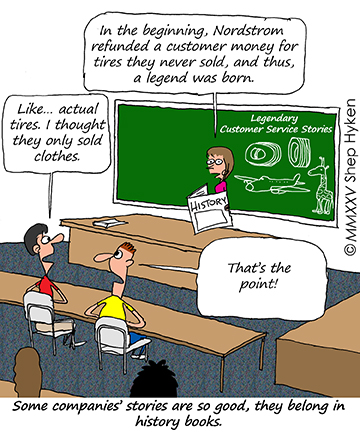
Earlier this year, I wrote a Forbes article celebrating the 50th anniversary of the famous Nordstrom story in which a man wanted to return a set of used tires – even though Nordstrom never even sold tires. That fact didn’t stop the employee from giving the customer a refund. Right or wrong, that story is still talked about 50 years later!

I’ve mentioned this story in the past, and the point is that stories like these become legends inside an organization, and if the brand is lucky, they may even get some good press. They are not easy to find, unless you intentionally look for them. Nordstrom had been in business for 75 years before this legendary story was discovered and shared.

I’ve written about many such stories. They are a reminder for every company to find its unique story that exemplifies the importance of customer service. These stories are powerful because they become a “north star” for how a company should treat its customers. Publicity is optional. The real value is cultural.

Nordstrom Tires Story Cartoon from Shep Hyken

For example, there are numerous Ritz-Carlton legendary stories, such as Joshie the Giraffe, in which the hotel staff made a big effort to return a stuffed animal to a child. There are also stories that aren’t so famous. I interviewed Horst Schulze, the first president and co-founder of the Ritz-Carlton, who shared a story about empowering employees to take care of their guests.

The short version is that the Ritz-Carlton allows employees to spend up to $2,000 to resolve a guest issue without seeking manager approval. One day a housekeeper found a guest’s computer. The guest had already checked out and flown from California to Hawaii. She took it upon herself to book an airline ticket and personally delivered the laptop to the guest.

As crazy as this may sound, the housekeeper was not reprimanded but instead was applauded for her efforts. Then, she was coached that next time, overnight shipping would be sufficient. The point is, there’s no risk in taking care of a guest. The story became a teaching moment for both the housekeeper and all Ritz staff, reinforcing the hotel chain’s commitment to empowered, guest-focused service.

Not every company will have a $2,000 empowerment policy like the Ritz-Carlton or a story like Nordstrom that literally defines their customer experience, but that doesn’t mean you can’t enjoy similar benefits.

So, here’s your assignment. Find your company’s legendary customer service story. If you don’t yet have one, start looking for those stories. Use them in training, meetings, and internal communications. Over time, they will become the DNA of your customer service culture. And who knows? Fifty years from now, someone might still be telling your story.

Put This Into Practice With the Change Planning Toolkit™

The frameworks in this article are part of the Human-Centered Change™ methodology — a visual, collaborative system of 70+ tools built around the Change Planning Canvas™. Every copy of Charting Change gives you access to 26 of the 70+ tools.

Image credits: Pexels, Shep Hyken

Subscribe to Human-Centered Change & Innovation WeeklySign up here to join 17,000+ leaders getting Human-Centered Change & Innovation Weekly delivered to their inbox every week.

Top 10 Human-Centered Change & Innovation Articles of December 2025

Top 10 Human-Centered Change & Innovation Articles of December 2025Drum roll please…

At the beginning of each month, we will profile the ten articles from the previous month that generated the most traffic to Human-Centered Change & Innovation. Did your favorite make the cut?

But enough delay, here are December’s ten most popular innovation posts:

  1. Is OpenAI About to Go Bankrupt? — by Chateau G Pato
  2. The Rise of Human-AI Teaming Platforms — by Art Inteligencia
  3. 11 Reasons Why Teams Struggle to Collaborate — by Stefan Lindegaard
  4. How Knowledge Emerges — by Geoffrey Moore
  5. Getting the Most Out of Quiet Employees in Meetings — by David Burkus
  6. The Wood-Fired Automobile — by Art Inteligencia
  7. Was Your AI Strategy Developed by the Underpants Gnomes? — by Robyn Bolton
  8. Will our opinion still really be our own in an AI Future? — by Pete Foley
  9. Three Reasons Change Efforts Fail — by Greg Satell
  10. Do You Have the Courage to Speak Up Against Conformity? — by Mike Shipulski

BONUS – Here are five more strong articles published in November that continue to resonate with people:

If you’re not familiar with Human-Centered Change & Innovation, we publish 4-7 new articles every week built around innovation and transformation insights from our roster of contributing authors and ad hoc submissions from community members. Get the articles right in your Facebook, Twitter or Linkedin feeds too!

Build a Common Language of Innovation on your team

Have something to contribute?

Human-Centered Change & Innovation is open to contributions from any and all innovation and transformation professionals out there (practitioners, professors, researchers, consultants, authors, etc.) who have valuable human-centered change and innovation insights to share with everyone for the greater good. If you’d like to contribute, please contact me.

P.S. Here are our Top 40 Innovation Bloggers lists from the last four years:

Subscribe to Human-Centered Change & Innovation WeeklySign up here to get Human-Centered Change & Innovation Weekly delivered to your inbox every week.

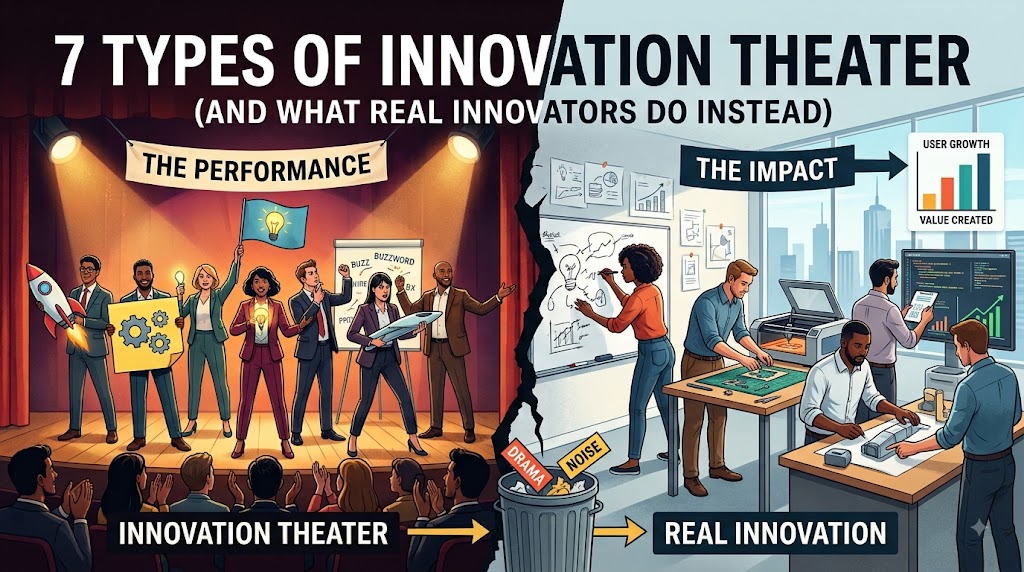
7 Types of Innovation Theater

(And What Real Innovators Do Instead)

7 Types of Innovation Theater

by Braden Kelley and Art Inteligencia


What Is Innovation Theater? (Short Answer)

Innovation theater is activity that looks innovative — labs, idea contests, perpetual pilots, AI demos, vanity metrics — while failing to change power, process, customer outcomes, or the operating model. It prioritizes the appearance of progress over impact that lands with humans.

The seven common types are: (1) Idea Cemetery, (2) Lab as Lounge, (3) Pilot Purgatory, (4) Innovation Cosplay, (5) Metric Mirage, (6) AI Annex Theater, and (7) the Hero Inventor Myth. Real innovators replace each with ownership, adoption, and measured human impact — not costume.

Why Innovation Theater Gets Funded

Theater thrives because organizations often need the appearance of momentum more than they need the risk of change. Leaders want proof they are “doing innovation.” Teams want psychological safety without political danger. Vendors want logos on walls. Photographable activity becomes a substitute for impact that lands with humans.

Real innovators are not allergic to labs, design thinking, or pilots. They refuse to let those tools become costumes. Below are seven types of innovation theater — with the signs to watch and what human-centered innovators do instead.

Type Common sign What real innovators do instead
1. Idea Cemetery Ideas collected, never decided Sponsors, kill criteria, portfolio of few bets
2. Lab as Lounge Beautiful space, weak P&L link Embed next to real constraints; measure adoption
3. Pilot Purgatory Forever demos, no scale path Design for scale; clear go/no-go
4. Innovation Cosplay Methods without decision rights Match method to mandate
5. Metric Mirage Activity vanity metrics Behavioral and business outcomes
6. AI Annex Theater Tools on broken work Redesign jobs first; free judgment time
7. Hero Inventor Myth Lone genius storytelling Team-sport innovation; reward change work

1. Idea Cemetery — When Innovation Contests Never Ship

What it is: Idea cemetery (or suggestion-box theater) is when organizations collect ideas through portals and contests, then never fund, own, or kill them.

The theater: Innovation portals and idea contests that collect brilliance, then bury it. No owners. No funding path. No kill criteria. Just a growing graveyard of good intentions and a leader who can still say, “We listen to our people.”

What real innovators do instead: They run a small portfolio of bets, not a museum of submissions. Every idea that advances has a sponsor, a question to answer, a budget band, and a date when it either graduates, pivots, or stops. Listening without a decision system is extraction dressed as engagement.

2. Lab as Lounge — Innovation Spaces Without Impact

What it is: Lab-as-lounge theater is when the innovation real estate and brand experience outrun any adopted outcome on a customer or employee journey.

The theater: Beautiful innovation space. Modular furniture. Logo wall. Inspiration quotes in sans-serif. Tours for executives and visitors. Meanwhile, the teams who own revenue, service recovery, and operations still cannot change a form field without a twelve-week ticket.

What real innovators do instead: They embed innovation next to real constraints — the call floor, the store, the claims process, the onboarding flow. Square footage is not a capability. Adopted outcomes on a named journey are. If the lab’s best KPI is visitor compliments, you have built an experience center for yourselves.

3. Pilot Purgatory — Forever Demos That Never Scale

What it is: Pilot purgatory is endless pilot projects that look like learning but avoid the hard work of scale, ownership, and replacing the old way of working.

The theater: Perpetual pilots. Forever demos. “We’re learning.” Sometimes true. Often a holding pattern that avoids data plumbing, workflow ownership, incentives, training, and the political decision to stop the old way.

What real innovators do instead: They design for scale on day one. Who owns the workflow if this works? What breaks if volume multiplies by ten? What is the go/no-go threshold? A pilot without an adoption plan is a science fair project with a corporate badge.

4. Innovation Cosplay — Methods Without Mandate

What it is: Innovation cosplay is using design thinking, agile, or “sprints” as costume when teams lack authority to change policy, budget, metrics, or process.

The theater: Methods without mandate. Design-thinking stickers on a process no one is allowed to change. Agile ceremonies that report status while governance remains waterfall. Sprints that cannot touch the actual levers of value.

What real innovators do instead: They match method to decision rights. Before the workshop, they ask: What are we empowered to decide, ship, or stop? If the honest answer is “nothing structural,” cancel the sticky notes and fix the mandate. Facilitation without power is entertainment with markers.

5. Metric Mirage — Measuring Innovation Activity, Not Value

What it is: Metric mirage is managing innovation by vanity and activity metrics — ideas filed, hackathons held, prototypes built — instead of human and business outcomes.

The theater: Dashboards of activity. Patents filed. Hours facilitated. Sometimes an “innovation NPS” that measures enthusiasm in the room rather than value in the world.

What real innovators do instead: They measure behavioral and business outcomes on a chosen journey: adoption, cycle time, retention, cost-to-serve, conversion, employee effort, revenue quality. Activity metrics can support the story; they cannot be the story. If you cannot name the human behavior that changes when you “win,” you are managing theater lighting.

6. AI Annex Theater — Tools on Broken Work

What it is: AI annex theater (a form of innovation washing) is bolting chatbots and copilots onto unbroken chaos, then calling speed alone a transformation.

The theater: Chatbots and copilots bolted onto broken work. More answers, same confusion. Faster drafts, denser interruptions. Automation that accelerates noise and gets declared transformation because the deck has gradients.

What real innovators do instead: They redesign the job, the handoff, and the decision before they celebrate the tool. AI should absorb fragmentation so humans can spend larger blocks on insight, empathy, problem definition, and judgment — a soft landing, not denser busyness. If nobody has protected deep-work capacity, you did not free people. You refilled their calendar.

7. Hero Inventor Myth — Lone Genius Over Team Sport

What it is: The hero inventor myth is when organizations celebrate a lone visionary while the people who adopt, integrate, and scale the change remain invisible.

The theater: The keynote founder of the internal startup. The genius in the corner whose idea becomes brand myth — until the next reorg erases the team that made it real.

What real innovators do instead: They treat innovation as a team sport. They reward insight and change — the unglamorous work of making something real for customers and employees. Human-centered innovation is rarely a flash of individual brilliance. It is a system that lets many people contribute and a few important things survive.

How Do You Stop Innovation Theater?

You stop innovation theater by forcing every initiative to answer five questions before the next pilot, lab ribbon-cutting, or AI annex:

  1. Who owns this after the applause? No named operator, no real initiative.
  2. What human behavior must change for this to count as success? If you only move a vanity metric, stop.
  3. What is the kill criteria? Endless learning without stop-rules is luxury consumption.
  4. What changes in the operating model if this works? If nothing structural can move, you have cosplay.
  5. Who loses if we stop pretending? Follow the incentives. Theater always has beneficiaries.

Innovation does not fail primarily because companies lack creativity. It fails when activity is allowed to impersonate progress. Real innovators optimize for impact that lands with humans — not for activity that photographs well in the annual report.

Frequently Asked Questions About Innovation Theater

What is innovation theater?

Innovation theater is activity that looks innovative — such as labs, idea contests, perpetual pilots, or AI demos — while failing to change power, process, customer outcomes, or the operating model. It prioritizes the appearance of progress over impact that lands.

How do you identify innovation theater?

Look for photographable activity without owners, kill criteria, operating-model change, or measurable behavior change. Common signs include idea programs that never ship, labs optimized for tours, endless pilots, methods without decision rights, vanity innovation metrics, AI tools on broken workflows, and lone-genius storytelling.

Why do companies do innovation theater?

Companies often fund innovation theater because the appearance of momentum feels safer than structural change. Theater provides career and brand insurance, satisfies stakeholders who want visible “innovation activity,” and avoids political risk — while real adoption would require new owners, incentives, and stop decisions.

What are the types of innovation theater?

Seven common types include the idea cemetery, lab as lounge, pilot purgatory, innovation cosplay (methods without mandate), metric mirage, AI annex theater, and the hero inventor myth. Each substitutes spectacle or activity metrics for adoption and value.

How do real innovators avoid innovation theater?

Real innovators assign owners and kill criteria, embed work in real constraints, design pilots for scale, match methods to decision rights, measure behavioral and business outcomes, redesign work before adding tools, and treat innovation as a team sport focused on human impact.


Image credits: Google Gemini

Content Authenticity Statement: The topic area, key elements to focus on, etc. were decisions made by Braden Kelley, with a little help from Google Gemini and Cursor to clean up the article, add images and create infographics.

Subscribe to Human-Centered Change & Innovation WeeklySign up here to get Human-Centered Change & Innovation Weekly delivered to your inbox every week.