Tag Archives: organizational agility

The Architecture of Organizational Agility

Beyond the Pivot

LAST UPDATED: February 24, 2026 at 5:22 PM

Architecture of Organizational Agility

by Braden Kelley and Art Inteligencia

I. Introduction: The Agility Imperative

Beyond Reactive Maneuvering toward Proactive Orchestration

The Stability Paradox

In my work with global enterprises, I often observe a recurring struggle: The Stability Paradox. Legacy organizations often possess the “fixedness” required for massive scale but lack the fluidity to respond to market shifts. Conversely, startups possess “flexibility” in spades but often collapse under their own weight due to a lack of foundational structure.

Defining True Agility

Many leaders mistake speed for agility. Speed is simply high-velocity movement in a single direction. True Agility is the architectural capability to change direction at speed without destroying the engine. It is the move from “reactive maneuvering” — constantly putting out fires — to “proactive orchestration,” where the organization anticipates the flame and adjusts its posture before the heat is even felt.

Thesis: Organizational agility is not about being liquid or formless; it is about strategic architecture. It requires knowing exactly which parts of your foundation must remain fixed to provide a stable spine, so that the rest of the enterprise can remain infinitely flexible.
Braden Kelley Flexibility Quote

II. The Human Side of Agility (Human-Centered Change)

Fueling the Adaptive Machine with Mindset and Culture

Psychological Safety as a Fuel

An agile architecture is useless if the people within it are too terrified to move. Psychological safety is the essential fuel for change. If employees fear that a “failed” experiment or a missed pivot will result in professional retribution, they will default to the status quo every time. To be truly agile, the organization must celebrate the learning gained from failure as much as the success of a win.

Shifting the Mindset: Adaptability Over Efficiency

For decades, management science focused on “Efficiency-First” — doing things right through rigid optimization. In a volatile world, we must pivot to “Adaptability-First” — ensuring we are doing the right things as the market shifts. This requires a cultural “unlearning” where we value the ability to pivot just as highly as the ability to execute.

Radical Transparency and Communication Loops

Agility requires that the “edges” of the organization — the people talking to customers and witnessing market friction — have a direct line to the “center.” By creating radical transparency and shortened communication loops, we ensure that institutional knowledge flows at the speed of the internet, allowing for collective intelligence rather than top-down bottlenecks.

The Human Truth: You cannot mandate agility; you can only design an environment where it is safe to be agile. Change doesn’t happen in the boardroom; it happens in the hearts and minds of the people on the front lines.

III. The Braden Kelley Organizational Agility Framework™

Navigating the Strategic Tension Between Flexibility and Fixedness

Introduction to the Framework

In my research and consulting, I developed the Organizational Agility Framework™ as a diagnostic tool for the modern enterprise. It moves away from the idea that everything in a business should be “fluid.” Instead, it focuses on identifying the necessary friction and structural integrity required to support rapid movement.

The Core Tension: Flexibility vs. Fixedness

The secret to sustained agility lies in the deliberate management of two opposing states:

  • The Fixed: These are your non-negotiables. They include your core values, organizational purpose, and essential guardrails. These elements provide the “stable spine” and the psychological certainty employees need to take risks.
  • The Flexible: These are your “modular” components. They include business processes, resource allocation models, and team structures. These must be designed to be disassembled and reconfigured in real-time as market conditions evolve.
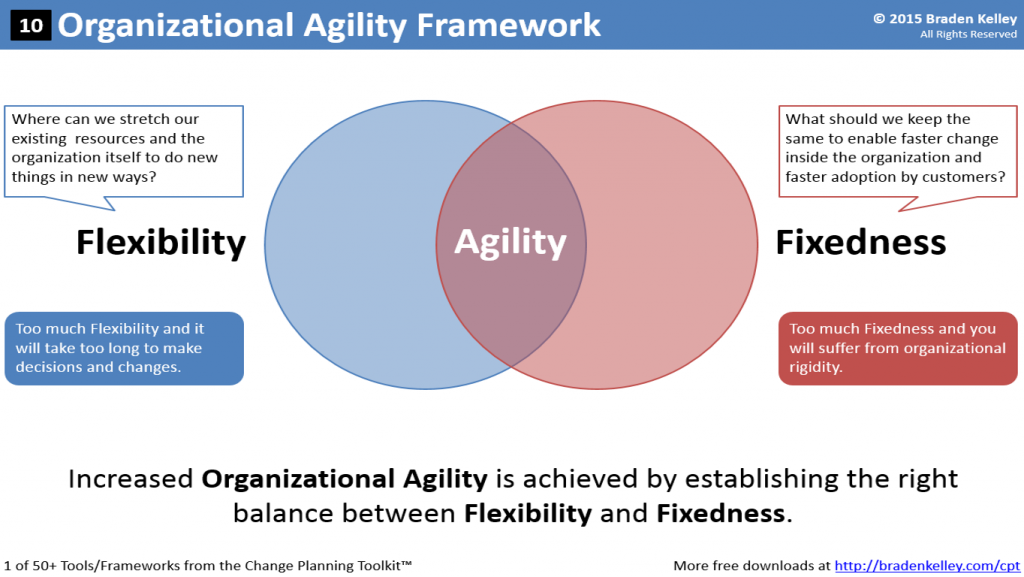
Organizational Agility Framework

Managing the Equilibrium

The framework teaches leaders how to prevent “Fixedness” from decaying into Rigidity (where you become a dinosaur) and how to prevent “Flexibility” from dissolving into Chaos (where you lose your brand identity). Agility is the active, daily management of this equilibrium.
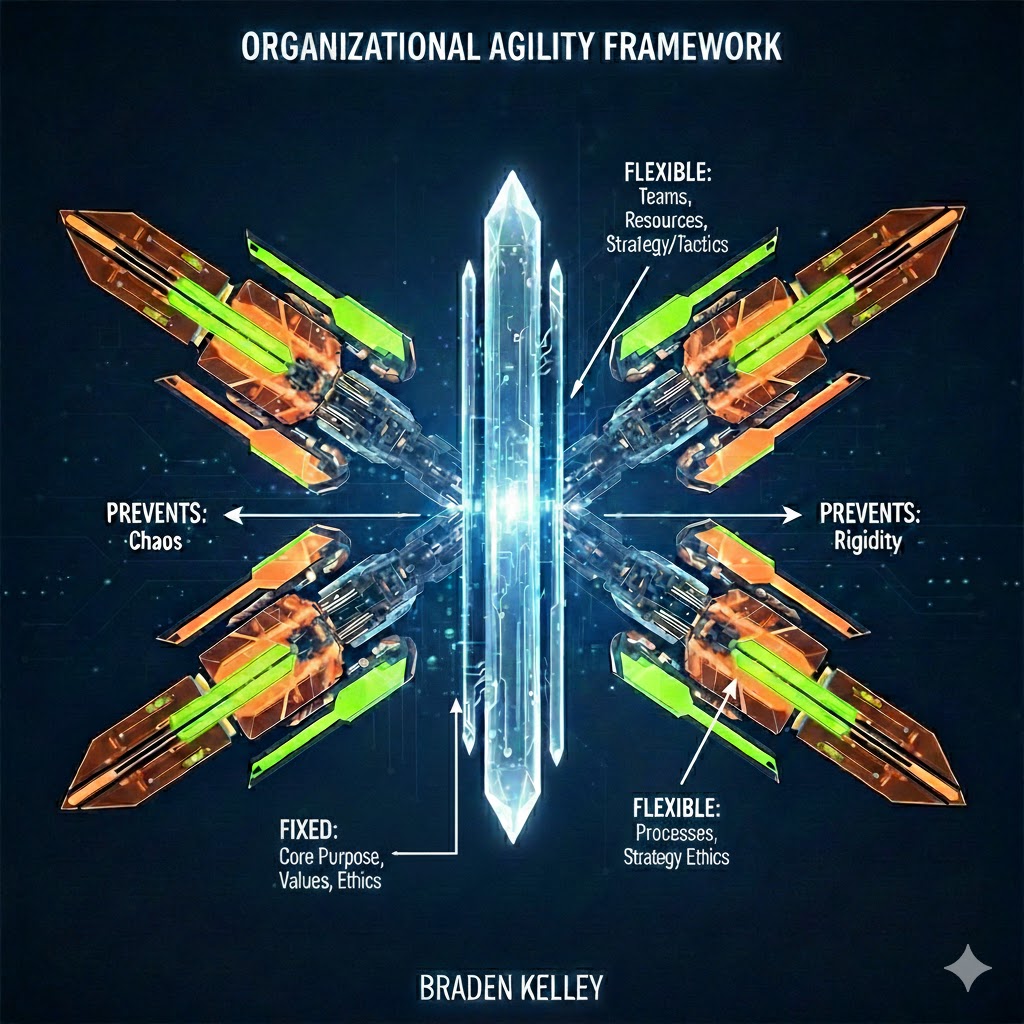
Insight: If you try to make everything flexible, you create an organization with no memory and no identity. If you keep everything fixed, you create a monument to the past. Agility is the art of knowing what to hold onto and what to let go.

IV. Designing for Modular Change

Architecting the Reconfigurable Enterprise

Loose Coupling and Micro-Structures

In a truly agile organization, we must abandon monolithic, deeply intertwined departmental silos. Instead, we move toward “Loose Coupling.” By organizing into small, cross-functional squads with clear interfaces, we ensure that one part of the business can pivot or fail without bringing down the entire system. This modularity allows for “plug-and-play” innovation.

Resource Fluidity: Escaping the Annual Budget Trap

You cannot have an agile strategy if your capital is locked in a 12-month fixed cycle. Resource Fluidity is the ability to shift talent and funding dynamically as opportunities arise. Agile organizations treat budgets as “living documents,” allowing leadership to pull resources from declining initiatives and inject them into high-growth “breakthrough” experiments in real-time.

Rapid Prototyping for Organizational Structure

We often prototype products, but we rarely prototype structure. Before committing to a company-wide reorganization, agile leaders run small-scale organizational experiments. By testing a new reporting line or a new collaborative workflow within a single “pilot” team, we can validate the human impact of the change before scaling it.

The Design Rule: Complexity is the enemy of agility. If your organizational chart requires a map and a legend to navigate, you aren’t built for speed — you’re built for bureaucracy. Simplify to amplify.

V. Measuring What Matters: Agility Metrics

Quantifying the Velocity and Resilience of Change

Time-to-Insight vs. Time-to-Action

In a traditional enterprise, the gap between identifying a market shift (Insight) and actually deploying a response (Action) can be months or even years. Agility is measured by the shrinkage of this gap. We must track our Latency of Decision — the speed at which data travels from the front lines to the decision-makers and back into the field as an executed strategy.

Learning Velocity

Success is a lagging indicator; Learning Velocity is a leading one. How quickly can your organization ingest new information, test it, and turn it into institutional knowledge? By measuring the number of validated experiments per quarter rather than just “project completions,” we shift the focus from output to outcomes.

The Resilience Score

Agility is as much about defense as it is offense. A Resilience Score assesses how much of a “shock” your organization can absorb — be it a supply chain disruption or a competitor’s surprise launch — without a significant drop in service levels or employee engagement. An agile organization doesn’t just bounce back; it “bounces forward” into a new, more relevant state.

The Measurement Shift: If you only measure efficiency, you will optimize yourself into extinction. You must measure your capacity to change, for that is where your future revenue lives.

VI. Conclusion: The Agile Organization as a Living System

Sustaining Competitive Advantage in a Volatile World

Beyond the Project Mindset

We must stop viewing “agility” as a transformation project with a start and end date. True organizational agility is a continuous practice — a state of being. It is the transition from seeing your company as a static machine to viewing it as a living system. Like any organism, your business must constantly sense, respond, and evolve to its environment to survive.

The Polymath Leader

The leaders of tomorrow must be comfortable with the “Whole-Brain” approach. They must be part scientist, using data and the Agility Framework to maintain the stable spine of the company, and part artist, using empathy and human-centered change to inspire the flexibility of the workforce. This balance is the only way to navigate the tension between what must remain fixed and what must remain fluid.

Your Sustainable Advantage

In an era where technology can be copied and capital is a commodity, your ability to change is your only sustainable competitive advantage. By architecting an enterprise that embraces both the comfort of fixed values and the excitement of flexible processes, you don’t just survive disruption — you become the disruptor.

Final Thought: Agility is the ultimate expression of confidence. It is the belief that no matter how the world changes, your organization has the structural integrity and the creative spirit to meet the moment. Let’s stop fearing the pivot and start building the platform that makes it possible.

Implementation Checklist: Activating the Agility Framework

Practical First Steps for the Human-Centered Leader

Moving from theory to practice requires a deliberate focus on the Fixed/Flexible balance. Use this checklist to audit your current state and begin the transition.

  • Identify Your “Stable Spine”:
    Document the 3-5 core values and the overarching purpose that must remain Fixed. Do your teams know these are the non-negotiable guardrails?
  • Audit for “Rigid Decay”:
    Locate one process that exists “because we’ve always done it that way” but no longer serves the customer. Mark it as Flexible and schedule a redesign.
  • Establish a “Safe-to-Fail” Zone:
    Designate one small-scale project where the team is explicitly rewarded for Learning Velocity rather than just the final ROI.
  • Assess Communication Latency:
    Track how many days it takes for a customer insight from the field to reach a decision-maker. Aim to reduce this Time-to-Insight by 20% this quarter.
  • Beta-Test a “Squad” Structure:
    Select one departmental silo and “loosely couple” a cross-functional team (e.g., Marketing, Tech, and Customer Success) to solve a single specific friction point.

Braden’s Tip: Don’t try to change the whole organization at once. Agility is built through fractal change — successful small pivots that create a blueprint for the larger enterprise to follow.

What is a Stable Spine Audit?

In my Organizational Agility Framework, a Stable Spine Audit is a strategic exercise used to identify the permanent, non-negotiable elements of an organization that provide the structural integrity required to support rapid change elsewhere.

Think of it this way: for a human to move with agility — to sprint, jump, or pivot — the spine must remain strong and aligned. If the spine is “mushy,” the limbs have no leverage. In a business, if everything is up for grabs, you don’t have agility; you have chaos.

The Core Components of the Audit

When I lead an organization through this audit, we look for three specific types of “Fixedness”:

  • 1. Core Purpose and North Star: Why does the organization exist beyond making a profit? This should be fixed. If your purpose pivots every six months, your employees will suffer from “change fatigue” and lose trust.
  • 2. Values and Ethical Guardrails: These are the behavioral non-negotiables. They define how we work. These provide psychological safety because employees know that even in a crisis, the “rules of engagement” won’t shift.
  • 3. Essential Architecture: This identifies the critical systems or data standards that must remain centralized and standardized to allow for “plug-and-play” flexibility in the branches or squads.

How to Conduct the Audit

The audit is essentially a filtering process for every major component of your business. You ask your leadership team: “Is this a Spine element or a Wing element?”

Category The Stable Spine (Fixed) The Flexible Wings (Fluid)
Strategy Long-term Vision & Purpose Quarterly Tactics & Experiments
Structure Governance & Core Values Cross-functional Squads & Roles
Process Essential Compliance & Quality Daily Workflows & Tools
People Cultural DNA & Talent Standards Specific Skills & Resource Allocation

Why It Matters for Innovation

I often see teams that are “frozen” because they don’t know what they are allowed to change. By conducting a Stable Spine Audit, you explicitly tell your team: “These five things are fixed. Everything else is a variable you can experiment with.”

This clarity actually increases the speed of innovation because it removes the “permission bottleneck.” When the spine is stable, the wings can flap as fast as they need to.

Diagnostic Questionnaire: Activating the Organizational Agility Framework

A Leadership Workshop Guide to the Stable Spine Audit

To help you activate the Organizational Agility Framework, here is a diagnostic questionnaire designed to be used in a leadership workshop. The goal is to reach a consensus on what belongs to the “Spine” (Fixed) and what belongs to the “Wings” (Flexible).

Phase 1: Identifying the Fixed (The Stable Spine)

Ask your leadership team to answer these questions individually, then compare notes. Discrepancies here usually indicate where organizational friction is coming from.

  • The “North Star” Test: If we changed our product line entirely tomorrow, what is the one reason for existing that would stay exactly the same?
  • The Value Constraint: What are the three behaviors that, if an employee violated them, would result in immediate dismissal regardless of their performance?
  • The Architectural Anchor: What is the single source of truth (data, brand guideline, or compliance rule) that every department must use to remain part of the collective whole?
  • The Non-Negotiable Promise: What is the one promise we make to our customers that we would never “pivot” away from, even for a massive short-term profit?

Phase 2: Identifying the Fluid (The Flexible Wings)

Now, look at the areas where the organization feels “slow.” These are likely things that are currently “Fixed” but should be “Flexible.”

  • The “Shadow” Processes: Which of our current “standard operating procedures” (SOPs) were created more than two years ago and haven’t been updated since?
  • The Permission Bottleneck: Who has the authority to spend $5,000 to test a new idea? If the answer is “The VP,” that process is too Fixed.
  • The Role Rigidity: Are our job descriptions based on tasks (Fixed) or outcomes (Flexible)? Can we move a person from Project A to Project B in 24 hours without a HR mountain to climb?
  • The Budgeting Cycle: If a massive market opportunity appeared tomorrow, how long would it take to reallocate 10% of our budget to pursue it?

The Audit Tally

Once you have these answers, map them out:

  1. Green Zone: Elements everyone agrees are Fixed. These are your strengths.
  2. Red Zone: Elements everyone agrees are Fixed but should be Flexible. These are your targets for immediate “unlearning.”
  3. Grey Zone: Elements where the team disagrees. This is where your cultural friction lives.

Closing the Audit

As an innovation speaker, I always remind leaders: The Spine is for Support, not for Strangulation. The goal of this audit isn’t to create more rules, but to create the clarity that allows for more freedom.

Organizational Agility: Frequently Asked Questions

1. What is the difference between organizational speed and organizational agility?

Speed is the velocity of movement in a single direction. Agility is the architectural capacity to change direction at speed without breaking the organization. While speed is about execution, agility is about reconfigurability.

2. Why does the “Stable Spine” actually help an organization move faster?

A “Stable Spine” (fixed core values, purpose, and guardrails) provides psychological safety and clarity. When employees know exactly what is non-negotiable, they no longer need to seek permission for everything else, effectively removing the “permission bottleneck” that slows down innovation.

3. How do you identify if a process should be ‘Fixed’ or ‘Flexible’?

Use the Stable Spine Audit. If a process protects your core DNA, ethical standards, or brand promise, it is “Fixed.” If a process is simply a method for delivery, resource allocation, or internal workflow, it should be “Flexible” and modular to allow for rapid adaptation to market shifts.

Image credits: Braden Kelley (1,100+ FREE quote posters at http://misterinnovation.com), Google Gemini

Content Authenticity Statement: The topic area, key elements to focus on, etc. were decisions made by Braden Kelley, with a little help from Google Gemini to clean up the article and add citations.

Subscribe to Human-Centered Change & Innovation WeeklySign up here to get Human-Centered Change & Innovation Weekly delivered to your inbox every week.

Humanizing Agility

Humanizing Agility

GUEST POST from Janet Sernack

Like many others, I invested time in isolation during the pandemic to engage in various online learning programs. As a highly credentialed coach to many global Agile and SCRUM leaders in major international and local organizations, I enrolled in an Agile coach certification program and enthusiastically attended all daily sessions. It was a disastrous learning experience, verifying my perception of the Agile community’s focus on a prescriptive rules-driven process to agility. The Agile Manifesto’s  highest priority is satisfying customers through the early and continuous delivery of valuable software; only two of the 12 principles mention people – “Business people and developers must work together daily throughout the project” and “the best architectures, requirements, and design emerge from self-organizing teams.” So, with this in mind, what might be some of the benefits of integrating a technological and process-driven disciplined approach towards humanizing agility?

I am a conceptual and analytical thinker, an entrepreneur, and an innovator who is acknowledged as a global thought leader on the people side of innovation. I also teach, mentor, and coach people to be imaginative, inquisitive, and curious, always asking many open questions. I empower, enable, and equip them to become change-agile, cognitively, and emotionally agile and develop their innovation agility. The presenters responded to my method of inquiry by assuming that I knew nothing about Agile despite knowing nothing about my background.

As a result, they failed to certify me without communicating or consulting with me directly, despite my meeting all of the course evaluation criteria and having more than 10,000 hours of facilitation and more than 1,000 hours of coaching experience on the people side of change. I also have a comprehensive background in humanizing total quality management, continuous improvement, and start-up methodologies in major organizations.

I contacted the training company and challenged their decision, only not to be “heard” and be paid lip service when confronted by a rigid, linear, conventional, disconnected approach to agility and its true role and capability in catalysing change, innovation and teaming.

This is especially true considering the senior SCRUM and Agile leaders I was coaching at the time experienced very few problems with Agile’s disciplined process and technological side. They specifically requested coaching support to develop strategies to resolve their monumental challenges and complex issues involving “getting people to work together daily” and operating as “self-organizing teams.” How do they go about humanizing agility?

Making sense of agility

Despite my disappointment, I bravely continued researching how to make sense of agility and link and integrate it with the people side of change, innovation, and teams. I intended to enable leaders to execute agile transformation initiatives successfully by combining a human-centered approach to agile software development through humanizing agility.  

Agility refers to a leader, team, or organization’s ability to make timely, effective, and sustained changes that maintain superior performance. According to Pamela Myer’s book “The Agility Shift”, – an agility shift is the intentional development of the competence, capacity and confidence to learn, adapt and innovate in changing contexts for sustainable success. We have incorporated this approach into our innovation learning and coaching curriculum at ImagineNation™ and iterated and pivoted it over the past 12 years in empowering, enabling and equipping people to become “agility shifters” by humanizing agility.

Humanizing agility differently

Agility can be humanized and expanded to include change, cognitive, innovation, and organizational agility, all powerfully fueled by people’s emotional energy. This is fundamental to achieving success through non-growth or growth strategies and delivering equitable and sustainable outcomes that will make the world a better place for all humanity.  

It involves identifying pivots, unlearning, learning, and relearning, embracing new approaches, frameworks, and tools, and developing new 21st-century mindsets, behaviors, and skills.

Humanizing agility involves empowering, enabling, and equipping people to be, think and act differently autonomously and competently, especially in the conflicted, chaotic, unstable post-COVID world of emerging unknowns.

Like innovation, agility is contextual.

Humanizing agility supports people to adapt, grow and thrive, become nimble by enabling:

  • Teams to deliver product releases as shorter sprints to collect customer feedback to iterate and pivot product development.
  • Leaders, teams, and organizations respond quickly and adapt to market changes, internally and externally.
  • People must think and feel and be able to quickly make intentional shifts to be effective, creative, inventive, and innovative in changing contexts.

That empowers, enables and equips people with the mindsets, behaviors, and skills to adapt, grow, and thrive by developing their confidence, capacity, and competence to catalyze and mobilize their power to move quickly and easily, think creatively and critically to make faster decisions and solve complex problems with less effort.  

Humanizing Agility – The Five Elements

1. Emotional energy

Emotional energy is the catalyst that fuels creativity, invention, and innovation.

Understanding and harnessing this energy inspires and motivates individuals to explore and embrace creative thinking strategies in partnership with AI.

Emotional energy catalyses people’s intrinsic motivation, conviction, hope, positivity, and optimism to approach their world purposefully, meaningfully, and differently.

When people are true to their calling, they make extra efforts and are healthier, which positively impacts their well-being and improves their resilience.

2. Change agility

Change agility is the ability to anticipate, respond, be receptive, and adapt to constant and accelerating change in an uncertain, unstable, conflicted world.

It involves developing a new perspective of change as a continuous, iterative, and learning process that has to be embedded in every action and interaction, not a separate standalone process.

Requiring the development of new mental models, states, traits, mindsets, behaviors, and skills to drive business and workforce outcomes that are critical for an organization to survive and thrive through any change.

Change becomes an ongoing opportunity, not a threat or liability, and humanizing agility in the context of change agility is a core 21st-century competency for leaders, teams and coaches.

3.Cognitive agility

Cognitive agility is the extent to which people can adapt and shift their perspectives and thought processes when doing so leads to more positive outcomes. 

Cognitive agility refers to how flexible and adaptive people can be with their thoughts in the face of change, uncertain circumstances, and random and unexpected events and situations. Being cognitively agile helps people break down their neuro-rigidity and eliminate any core fixed mindsets; it supports their neuro-plasticity and develops a growth mindset and ability to perceive the world through multiple lenses and differing perspectives.

Humanizing agility in the context of cognitive agility enables people to make sense of and understand the range of challenges, problems, and paradoxes at the deeper systemic and surface levels, preparing them for smart risk-taking, effective decision-making, and intelligent problem-solving. 

4.Innovation agility

Innovation agility is the extent to which people develop the courage, compassion and creativity to safely deep-dive into and dance with cognitive dissonance—to passionately, purposefully, and apply creative tension and develop neuro-elasticity, to play in the space where possibility lives—between the present state and the desired creative, inventive, and innovative outcome.

To empower, engage, and enable people to use their human ingenuity and harness their collective intelligence to be innovative in the age of AI by adapting and growing in ways that add value to the quality of people’s lives, which is appreciated and cherished.

5.Organizational and leadership agility

Organizational agility involves developing an ability to renew itself, adapt, innovate, change quickly, and succeed in a rapidly changing, uncertain and unstable operating environment. It requires a paradoxical balance of two things: a dynamic capability, the ability to move fast—speed, nimbleness, responsiveness and stability, and a stable foundation—a platform of things that don’t change to provide a rigorous and disciplined pillar.

Organizations and leaders prioritizing humanizing agility also prioritize differing and creative ways of being, thinking and acting. They maintain their strength by focusing on their core competencies while regularly stretching themselves for maximum flexibility, adaptiveness and resilience.

Finally…. Imagine humanizing agility

Imagine what you could do and the difference we could make to people, customers, organizations, communities and the world by humanizing agility in ways that embrace and embody the five elements of agility to harness the human ingenuity and people’s collective intelligence guide vertical, horizontal and transformational changes the world and humanity need right now.

Please find out more about our work at ImagineNation™.

Please find out about our collective learning products and tools, including The Coach for Innovators, Leaders, and Teams Certified Program, presented by Janet Sernack. It is a collaborative, intimate, and profoundly personalized innovation coaching and learning program supported by a global group of peers over 9-weeks. It can be customized as a bespoke corporate learning program.

Image Credit: Pexels

Subscribe to Human-Centered Change & Innovation WeeklySign up here to join 17,000+ leaders getting Human-Centered Change & Innovation Weekly delivered to their inbox every week.

Top 10 Human-Centered Change & Innovation Articles of January 2024

Top 10 Human-Centered Change & Innovation Articles of January 2024Drum roll please…

At the beginning of each month, we will profile the ten articles from the previous month that generated the most traffic to Human-Centered Change & Innovation. Did your favorite make the cut?

But enough delay, here are January’s ten most popular innovation posts:

  1. Top 40 Innovation Bloggers of 2023 — Curated by Braden Kelley
  2. Creating Organizational Agility — by Howard Tiersky
  3. 5 Simple Steps to Team Alignment — by David Burkus
  4. 5 Essential Customer Experience Tools to Master — by Braden Kelley
  5. Four Ways To Empower Change In Your Organization — by Greg Satell
  6. AI as an Innovation Tool – How to Work with a Deeply Flawed Genius! — by Pete Foley
  7. Top 100 Innovation and Transformation Articles of 2023 — Curated by Braden Kelley
  8. 80% of Psychological Safety Has Nothing to Do With Psychology — by Robyn Bolton
  9. How will you allocate your time differently in 2024? — by Mike Shipulski
  10. Leadership Development Fundamentals – Work Products — by Mike Shipulski

BONUS – Here are five more strong articles published in December that continue to resonate with people:

If you’re not familiar with Human-Centered Change & Innovation, we publish 4-7 new articles every week built around innovation and transformation insights from our roster of contributing authors and ad hoc submissions from community members. Get the articles right in your Facebook, Twitter or Linkedin feeds too!

Have something to contribute?

Human-Centered Change & Innovation is open to contributions from any and all innovation and transformation professionals out there (practitioners, professors, researchers, consultants, authors, etc.) who have valuable human-centered change and innovation insights to share with everyone for the greater good. If you’d like to contribute, please contact me.

P.S. Here are our Top 40 Innovation Bloggers lists from the last four years:

Subscribe to Human-Centered Change & Innovation WeeklySign up here to get Human-Centered Change & Innovation Weekly delivered to your inbox every week.



Creating Organizational Agility

Why is it that we need so much agility for digital transformation? The answer is simple: the speed of digital.

Creating Organizational Agility

GUEST POST from Howard Tiersky

Digital moves fast. Technology is changing rapidly, and changing customer expectations. Competitors are moving rapidly, and start-ups and tech companies are going after your customers. You have to be able to come up with new ideas, test them quickly in the market, make quick decisions about what you’re going to pursue or not pursue, and how you’re going to change and evolve.

Remember in the movie The Matrix, when the bullets are flying past Keanu Reeves? He’s able to move very quickly, sensing which direction a threat is coming from, and adjusting his movements to successfully avoid them. That is the kind of agility that we need in the digital arena. It’s the kind of agility that most start-ups have, and many enterprises don’t.

What are some ways you can improve your organizational agility? In this article, we’ll discuss five specific types of agility that important for success in digital and digital transformation. We’ll also discover some of the things you can do. within the context of a large enterprise, to try and improve each of those types of agility.

Sensing

The first type of agility is the agility of sensing. But what does that mean? Imagine The Matrix. The first thing you have to focus on isn’t moving, but knowing what’s going on around you, so you can be alert and aware of all the things that might require action on your part. You can think of sensing agility in four major categories:

1. Customers

  • Ultimately, your customers’ behavior drives your success. Study their behavior on your websites, mobile applications, in stores, and through the other channels in which you interact with them. Be constantly measuring and watching their behavior. Agility in this area isn’t just how quickly you’re collecting data, but how nimble and agile you are in analyzing that data, and in understanding what it means so you can determine what actions to take.In addition to your own behavioral metrics, how else can you study your customer? Make sure to measure their ongoing satisfaction, survey them, conduct usability testing, and use data from third-party research that shows technographic, behavioral trends and psychographic trends. There are many sources of information to help you understand your customer segments and how they may be changing.

2. Technology

  • Technology is changing at a rate like never before, whether it’s wearable tech, big data, or virtual reality. Things like beacons and other network tools allow us to sense where our customers are with more accuracy than ever before. There are so many technologies that have the potential, at the right point in time and at the right level of maturity, to enable you to create a new value for your customer. Paying attention to and sensing these changes in the technology landscape will allow you to quickly figure out when they’ve reached a point where you can take action. If you don’t (or don’t move quickly enough), you can expect your competitors, traditional or start-up, to be doing just that.

3. Competitors

  • It’s critical to have to sense what your competitors are doing, and to constantly research competitive strategies. How are they changing their product mix or pricing? How are they changing their customer service, and where are they failing to deliver for their current, or might fail their future, customers? How are they communicating with your customers, to bring them over to their side?

4. Regulatory

  • Regulations are especially key if you’re in a heavily regulated industry (though, most industries are subject to some level of regulation.) As regulations change over time, they can change current opportunities, or even create new ones.

That’s a lot to pay attention to! How can you effectively put sensing programs in place? The first thing to remember is that simply gathering information is not sufficient. You need to gather the information, and then analyze it to develop actionable insights. Finally, you’ll need to social and share that information with your team.

When you break it down, there’s no big mystery on how to achieve a sensing culture. The main thing you need are resources that are both dedicated to these activities, and that have the right research and analytical skills. Recognize that a part of success in digital is to be constantly sensing, and create a culture where information from sensing is being communicated and disseminated on an ongoing basis. Encourage your people to voraciously consume information, and use it in actionable ways as they develop products and services to improve the digital experience of the customer.

Technology

The primary tool of the digital world is the tool of technology. Do the tools you have at your enterprise allow you to move quickly from an idea to a customer experience?

Generally, that’s not the experience in most enterprises; many struggle with technology stacks that were created in an era before we had the need for this level of agility. They may have been conceived with a certain kind of transactional process in mind that’s either no longer applicable or reflects only one of many different types of transactional processes that you need to support. Truthfully, a lot of aging technology needs to be replaced, or needs to be wrapped so that it can gain the necessary level of agility.

Here are three specific things you can do to help guide work between your business and IT departments and see how to move forward technology that you currently have supporting digital forward.

1. Requirements

  • What does requirements mean? Traditionally, the business side would define the requirements needed for a particular project on a particular channel and IT would build them for us (hopefully successfully!) The problem this model is that the end result is only what’s needed at that moment. Today, we need to be able to change, evolve, and adapt so quickly that process is too slow. If every time we realize what we need, we have to go back through a whole time-consuming IT build, things wouldn’t move quickly enough. When you’re thinking about requirements, don’t only think in the context of what you need today, but ask the broader question of the requirements for technological agility, and communicate that to your IT department.After all, the IT department and those responsible for implementing technology all need to understand what needs to be flexible — because you can’t make everything flexible. There needs to be ongoing dialogue to focus the requirements around the things that need to be able to change on an ongoing basis.

2. Software

  • Software as a service platform is a huge help for all of us trying to make technology more agile. Why? Because in the old days, a software product (something like a major piece of enterprise software,) would require hardware implementation. It could take a year or two to implement it, and the implementation would require massive customizations. The software would be expensive to buy, implement, and customize. And if you wanted to make a change? You’re talking about abandoning major investments.In today’s SAAS world, we’ve created much more flexibility by using an integration layer around our most core systems and data. We can plug in different tools, whether a shopping cart tool, CRM, data mining tool, or mobile capabilities added into our apps. If we build out our capabilities using these types of platforms, we can swap out and change things much more rapidly.

    And with most of these SAAS platforms, we don’t have the issues associated with versions. Previously, if you were on one version of SAP, and you wanted to go to another version of SAP, it required a major headache of an upgrade. Today, versions build off core components in software. A product like SalesForce is constantly evolving and improving. Everyone is always on the most recent version of SalesForce, and you have a huge ecosystem of plug-ins and other code that’s designed to work with anyone’s implementation. That’s just one example of a SAAS platform that gives you an enormous amount of agility and flexibility, so it’s important to move yourself to SAAS platforms wherever possible.

3. Abstraction

  • You want your product development team, product owners, content creators, and marketers to be able to tweak and adjust the digital experience as much and as rapidly as possible. That means you want to try to abstract the capabilities up from the level of code.

There are three main areas of abstraction:

  1. Content Management: It’s imperative to be able to publish and edit content without needing to go through IT. I know that might sound super obvious and kind of old school, but I constantly see large enterprises where key parts of the content ecosystem isn’t accessible from a business perspective, and always requires IT involvement. Don’t let that happen to you!
  2. Presentation: It’s one thing to edit the content, but what if you want to change the layout? What if you want to change the process for content creation? Making those capabilities accessible to business users is possible with today’s experience management tools. We do a lot of work implementing these kinds of tools, and making sure that the business has the ability to make changes in the experience at their fingertips, and without having to go back to IT. This is a crucial capability for anything they’re going to want to frequently change.
  3. Business Rules: Implement a business rules engine as part of your technology stack, so that as you decide to make changes — whether in pricing, policy, or logic — they are not primarily in code that has to be changed by a developer. Then your business rules can be changed in more or less the same way your content is changed: by a business user that has the appropriate entitlements.

Decision Making

If you’re in a large enterprise, I’m guessing that you’ve had the experience of trying to move digital efforts forward, only to be faced with a multi-month or multi-quarter capital budget approval process that requires endless spreadsheets, forecasts, meetings.

On one hand, these things exist for good reason. When companies are doing a large amount of capital investment, they want to make sure that those decisions involve all the right people, and are being thoroughly vetted. It makes sense to want to spend their money carefully, but in the digital world, this process just doesn’t work. The speed of decision-making from the old, quasi pre-digital world kills our efforts in the digital arena, because digital requires moving quickly. It’s crucial to create a faster process for getting those decisions made. In the digital realm, you’re better off being fast than being right. If you’re fast but wrong, you have agility. You’ll be able to sense how what you’re doing is wrong, and can react and make a shift. If you’re slow? Forget it.

Wayne Gretzky explains that he wins at hockey not by skating to where the puck is, rather, where the puck is going to be. Can you imagine seeing where the puck is going, but then having to fill out a 25-tabbed Excel spreadsheet, submit it to the capital-approval process, and wait several months? By then, the game is over, everyone’s gone home, and the puck’s been put back in the locker room. You need to be able to move more quickly than that.

To solve this problem, make sure that you have true alignment around the goals you’re trying to drive through digital. So often these capital-approval processes are about strategy and tactics: What are we going to do? What kind of tools are we going to use? What technologies are we going to buy? What capabilities are we going to provide to our customers? That’s exactly the kind of stuff we have to be agile about.

Agree with senior management on the things we’re trying to drive through digital: brand awareness, lower acquisition cost, increased wallet share, and increased conversion on the website. Once you agree on the key business goals, find people who you trust to run digital. Give them the money, and the room to fail on the way to success.
I worked with a large energy company once that made this shift because of these problems. They made the decision to give the Chief Information Officer and the Chief Marketing Officer a substantial capital budget to rapidly drive digital, with quarterly check-ins to report how they spent the money, and what the programs were achieving. This process was hugely successful for them, and resulted in large increases in digital revenue, that far eclipsed the investments that were being made.

Unfortunately, after two years of success, another even larger energy company came in and bought the first company, telling them, “That’s not how we do it.” They dismantled the process, and the gains and growth subsided.

You can learn from their story. Try your best to get the level of autonomy and authority needed for the folks on the ground, who are actually doing these digital transformation projects.

Strategy Shifts

Ninety percent of all start-ups fail. Those that succeed don’t often achieve success because their original idea, business model, or original concept was right. As I’ve mentioned previously, Facebook started off as a dating site, eBay started out as a Pez dispenser collectors’ site, and Flickr started out as an online role-playing game. These companies succeeded because they changed and shifted their strategy many times on their way to success.

In the enterprise world, we often judge projects on whether they achieved their original vision or goal, hit their original budget, or achieve the ROI based on their original funding. This mindset doesn’t work in the digital space. You run the risk of teams starting to see issues, problems, or reasons to shift their strategy, and not doing it, because they’re afraid of being judged by the project’s original standards. They’re afraid of being told that they have to start the funding process all over again, simply because the strategy has shifted and changed the scope of the project. This isn’t how successful digital companies are operating.

Create a process that embraces and expects that the project you’re funding is going to go through a process of trial-and-error to find its way to the kind of digital transformation success that you’re seeking. Keanu Reeves can’t know where all the bullets are going to be before he goes into the room — that’s not how he avoids getting hit by a bullet. He does it by sensing what’s going on around him, and moving to where he needs to be at that particular moment in time. Give your digital teams that level of flexibility and, reward them for making those kinds of shifts.

Teaming

FROM gets involved from working with a lot of companies, and we get the same questions a lot:

  • What’s the right organizational model for digital?
  • Should there be one central digital team?
  • Should digital be part of all the different P&Ls?
  • Should it be a blend, a combination?

These are important questions. Having said that, let me disavow you of the myth that there’s one magical structure whereby all the digital work can be kind of done by one single team of people operating under one executive. That’s impossible! Digital efforts cut across every part of the organization. When you want to move quickly to make a change or bring something new to market, you need IT, Marketing, R&D, Customer Support, Engineering, Manufacturing, and any other key silos in the organization to make it happen.

As a side note for all of you balking at the idea of silos: You’re going to have them. You can structure them in different ways, e.g. phases of the customer lifecycle, customer segment, geography, but you’re going to have them if you’re a large enterprise.

The key isn’t to try to figure out how to get rid of silos, since that’s all but impossible, but to figure out how to create a culture where teaming across those silos happens rapidly, and there’s alignment and mobilization of the people that are needed. We’ve done work like this across many organizations, including our own. Teaming agility is what’s necessary to achieve that kind of alignment, whether by workshops to align goals, or just a culture of innovation that creates the organizational functionality that we need for people to be able to swarm around an opportunity quickly, instead of focusing on the friction that can exist between different departments.

These five areas of agility that are essential. Most are something large enterprises struggle with, but hopefully you’ve gained a few tips and tricks on how to overcome some of those challenges.

This article originally appeared on the Howard Tiersky blog
Image Credit: Pixabay

Subscribe to Human-Centered Change & Innovation WeeklySign up here to get Human-Centered Change & Innovation Weekly delivered to your inbox every week.


Agility is the 2023 Success Factor

Agility is the 2023 Success Factor

GUEST POST from Soren Kaplan

Agility, the ability to think fast and move quickly, is an imperative for every team this year.

That’s because there’s never been more uncertainty – around technology, the economy, global-political turmoil, and just about everything else.

I’ve led teams in both big companies and startups. I’ve built new teams. And I’ve helped fix dysfunctional ones.

There’s no shortage of research on the success factors for creating high-performing teams. In a landmark study, for example, Google identified “psychological safety” as the top characteristic of its most successful teams. Teams with people who feel safe to take risks and be vulnerable with one another showed better results.

Psychological safety is indeed important. Yet we can’t lose sight of another critical success factor for navigating today’s highly uncertain world, especially in 2023: agility.

Three Steps to Strategic Agility

The concept of “agility” in business originated from the field of agile software development. Agile software development involves “sprints” in which teams define short-term goals (typically two weeks), work diligently to achieve them, and then apply what they learned from the sprint to their next sprint’s goals.

Any team can apply the principles of agile software development to create greater overall agility. Whatever your team’s cadence of work, consider using the following approach to structure your work:

  1. Define short-term goals: What do you need to accomplish by the end of your sprint?
  2. Do the work: What work must be done and how will you do it?
  3. Evaluate progress: Based on what you achieved, what did you learn, and what’s the next logical set of short-term goals?

Approach these steps as a repetitive cycle. For example, you might have a project you expect to take three months to complete. Most traditional teams might go through a single cycle — they define their end goal, create a three-month plan, do their work, and then after the three months are up, they reflect on their progress.

If you were to work in two-week sprints during the three-month project, however, you would have five cycles of defining goals, achieving them, and then applying your learning to make your project even more effective along the way. The agile approach accelerates and leverages continuous learning, which reduces the overall risk of your project.

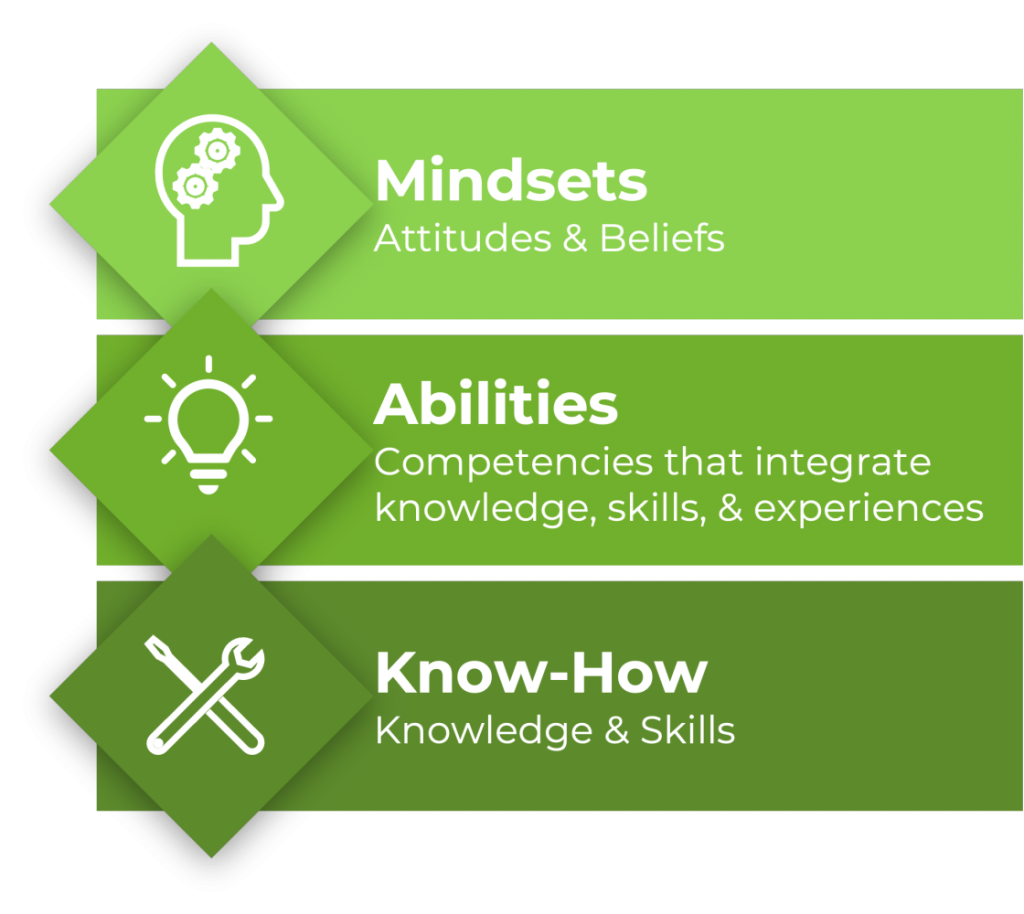
Instill Agile Mindsets, Abilities, and Know-How Into Your Team

The definition of agility isn’t just about being adaptable. Agility is the ability to think and understand quickly, so you can move faster and easier. It’s a mindset. That’s why it’s important to instill specific attitudes and beliefs in your team around the importance of being flexible and accepting that goals and work can, and should, change on a regular basis.

In my latest book, Experiential Intelligence, I highlight the importance of understanding and developing your team’s mindsets, abilities, and know-how.

From the book Experiential Intelligence

For example, consider reinforcing the following mindsets, delivering training to build certain agile abilities, and providing certain tools to help your team apply specific skills as you implement your projects:

Mindsets (attitudes and beliefs)

  • Flexibility is a key success factor
  • Assumptions always exist but can be tested
  • Iteration drives learning and success

Abilities (high-level competencies)

  • Strategic thinking
  • Pattern recognition
  • Learning by doing

Know-how (knowledge and skills)

  • Project and task prioritization
  • Assumption testing
  • “Five whys” analysis

Agile teams possess mindsets focused on moving quickly and modifying plans on a regular basis. It’s the exact opposite of how many big companies set annual plans and stick to them no matter what. Agile teams go from sprint to sprint, challenging their mindsets and identifying the abilities and know-how necessary to achieve the goals of the following sprint. That is, before they complete a sprint, they’ve already started planning for the next one. Agility becomes a core competency of the team, supported by know-how in agile methodologies and tools.

As we’ve seen over and over, every product, service, and business model eventually gets disrupted. Agility may ultimately be your only source of sustainable competitive advantage.

BONUS: Get a free sample chapter from my latest book Experiential Intelligencehere.

Image credit: Pixabay

Subscribe to Human-Centered Change & Innovation WeeklySign up here to get Human-Centered Change & Innovation Weekly delivered to your inbox every week.


Rethinking Agility for the Post-Digital Age

Rethinking Agility for the Post-Digital Age

GUEST POST from Greg Satell

For the past 50 years, innovation has largely been driven by our ability to cram more transistors onto a silicon wafer. That’s what’s allowed us to double the power of our technology every two years or so and led to the continuous flow of new products and services streaming out of innovative organizations.

Perhaps not surprisingly, over the past few decades agility has become a defining competitive attribute. Because the fundamentals of digital technology have been so well understood, much of the value has shifted to applications and things like design and user experience. Yet that will change in the years ahead.

Over the next few decades we will struggle to adapt to a post-digital age and we will need to rethink old notions about agility. To win in this new era of innovation we will have to do far more than just move fast and break things. Rather, we will have to manage four profound shifts in the basis of competition that will challenge some of our most deeply held notions.

Shift 1: From Transistor-Based Computers to New Computing Architectures

In 1965, Intel’s Gordon Moore published a paper that established predicted Moore’s Law, the continuous doubling of transistors that can fit on an integrated circuit. With a constant stream of chips that were not only more powerful, but cheaper, successful firms would rapidly prototype and iterate to speed new applications to market.

Yet now Moore’s Law is ending. Despite the amazing ingenuity of engineers, the simple reality is that every technology eventually hits theoretical limits. The undeniable fact is that atoms are only so small and the speed of light is only so fast and that limits what we can do with transistors. To advance further, we will simply have to find a different way to compute things.

The two most promising candidates are quantum computing and neuromorphic chips, both of which are vastly different from digital computing, utilizing different logic and require different computer languages and algorithmic approaches than classical computers. The transition to these architectures won’t be seamless.

We will also use these architectures in much different ways. Quantum computers will be able to handle almost incomprehensible complexity, generating computing spaces larger than the number of atoms in the known universe. Neuromorphic chips are potentially millions of times more efficient than conventional chips and are much more effective with continuous streams of data, so may be well suited for edge computing and tasks like machine vision.

Shift 2: From Bits to Atoms

The 20th century saw two major waves of innovation. The first, dominated by electricity and internal combustion, revolutionized how we could manipulate the physical world. The second, driven by quantum physics, microbial science and computing, transformed how we could work with the microscopic and the virtual.

The past few decades have been dominated by the digital revolution and it seems like things have been moving very fast, but looks can be deceiving. If you walked into an average 1950s era household, you would see much that you would recognize, including home appliances, a TV and an automobile. On the other hand, if you had to live in a 1900’s era home, with no running water or electricity, you would struggle to survive.

The next era will combine aspects of both waves, essentially using bits to drive atoms. We’re building vast databases of genes and materials, cataloging highly specific aspects of the physical world. We are also using powerful machine learning algorithms to analyze these vast droves of data and derive insights. The revolution underway is so profound that it’s reshaping the scientific method.

In the years to come, new computing architectures are likely to accelerate this process. Simulating chemistry is one of the first applications being explored for quantum computers, which will help us build larger and more detailed databases. Neuromorphic technology will allow us to shift from the cloud to the edge, enabling factories to get much smarter.

The way we interface with the physical world is changing as well. New techniques such as CRISPR helps us edit genes at will. There is also an emerging revolution in materials science that will transform areas like energy and manufacturing. These trends are still somewhat nascent, but have truly transformative potential.

Shift 3: From Rapid Iteration to Exploration

Over the past 30 years, we’ve had the luxury of working with technologies we understand extremely well. Every generation of microchips opened vast new possibilities, but worked exactly the same way as the last generation, creating minimal switching costs. The main challenge was to design applications.

So it shouldn’t be surprising that rapid iteration emerged as a key strategy. When you understand the fundamental technology that underlies a product or service, you can move quickly, trying out nearly endless permutations until you arrive at an optimized solution. That’s often far more effective than a planned, deliberate approach.

Over the next decade or two, however, the challenge will be to advance technology that we don’t understand well at all. As noted above, quantum and neuromorphic computing are still in their nascent stages. Improvements in genomics and materials science are redefining the boundaries of those fields. There are also ethical issues involved with artificial intelligence and genomics that will require us to tread carefully.

So in the future, we will need to put greater emphasis on exploration to understand these new technologies and how they relate to our businesses. Instead of looking to disrupt markets, we will need to pursue grand challenges to solve fundamental problems. Most of all, it’s imperative to start early. By the time many of these technologies hit their stride, it will be too late to catch up.

Shift 4. From Hyper Competition to Mass Collaboration

The competitive environment we’ve become used to has been relatively simple. For each particular industry, there have been distinct ecosystems based on established fields of expertise. Competing firms raced to transform fairly undifferentiated inputs into highly differentiated products and services. You needed to move fast to get an edge.

This new era, on the other hand, will be one of mass collaboration in which government partners with academia and industry to explore new technologies in the pre competitive phase. For example, the Joint Center for Energy Storage Research combines the work of five national labs, a dozen or so academic institutions and hundreds of companies to develop advance batteries. Covid has redefined how scientists collaborate across institutional barriers.

Or consider the Manufacturing Institutes set up under the Obama administration. Focusing on everything from advanced fabrics to biopharmaceuticals, these allow companies to collaborate with government labs and top academics to develop the next generation of technologies. They also operate dozens of testing facilities to help bring new products to market faster.

I’ve visited some of these facilities and have had the opportunity to talk with executives from participating companies. What struck me was how palpable the excitement about the possibilities of this new era was. Agility for them didn’t mean learning to run faster down a chosen course, but to widen and deepen connections throughout a technological ecosystem.

Over the past few decades, we have largely been moving faster and faster down a predetermined path. Over the next few decades, however, we’ll increasingly need to explore multiple domains at once and combine them into something that produces value. We’ll need to learn how to go slower to deliver much larger impacts.

— Article courtesy of the Digital Tonto blog
— Image credit: Pixabay

Subscribe to Human-Centered Change & Innovation WeeklySign up here to get Human-Centered Change & Innovation Weekly delivered to your inbox every week.


The Era of Moving Fast and Breaking Things is Over

The Era of Moving Fast and Breaking Things is Over

GUEST POST from Greg Satell

On July 16th, 1945, when the world’s first nuclear explosion shook the plains of New Mexico, the leader of the Manhattan Project, J. Robert Oppenheimer quoted from the Bhagavad Gita, “Now I am become Death, the destroyer of worlds.” Clearly, he was troubled by what he had unleashed and for good reason. The world was never truly the same after that.

Today, however, we have lost much of that reverence for the power of technology. Instead of proceeding deliberately and with caution, tech entrepreneurs have prided themselves on their willingness to “move fast and break things” and, almost reflexively, casually deride anyone who questions the practice as those who “don’t get it.”

It’s hard to see how, by any tangible metric, any of this has made us better off. We set out to disrupt industries, but disrupted people instead. It wasn’t always like this. Throughout our history we have asked hard questions and made good choices about technological progress. As we enter a new era of innovation, we desperately need to recapture some of that wisdom.

How We Put the Nuclear Genie Back in the Bottle

The story of nuclear weapons didn’t start with Oppenheimer, not by a long shot. In fact, if we were going to attribute the Manhattan Project to a single person, it would probably be a Hungarian immigrant physicist named Leo Szilard, who was one of the first to conceive of the possibility of a nuclear chain reaction.

In 1939, upon hearing of the discovery of nuclear fission in Germany he, along with fellow Hungarian emigre Eugene Wigner, decided that the authorities needed to be warned. Szilard then composed a letter warning of the possibility of a nuclear bomb that was eventually signed by Albert Einstein and sent to President Roosevelt. That’s what led to the American development program.

Yet after the explosions at Hiroshima and Nagasaki, many of the scientists who worked to develop the bomb wanted to educate the public of its dangers. In 1955, the philosopher Bertrand Russell issued a manifesto signed by a number of scientific luminaries. Based on this, a series of conferences at Pugwash, Nova Scotia were convened to discuss different approaches to protect the world from weapons of mass destruction.

These efforts involved far more than talk, but helped to shape the non-proliferation agenda and led to concrete achievements such as the Partial Test Ban Treaty. In fact, these contributions were so crucially important that the organizers of the Pugwash conferences were awarded the Nobel Peace Prize in 1995 and they continue even today.

Putting Limits On What We Do With the Code of Life

While the nuclear age started with a bang, the genetic age began with a simple article in the scientific journal Nature, written by two relatively unknown scientists named James Watson and Francis Crick, that described the structure of DNA. It was one of those few watershed moments when an entirely new branch of science arose from a single event.

The field progressed quickly and, roughly 20 years later, a brilliant researcher named Paul Berg discovered that you could merge human DNA with that from other living things, creating new genetic material that didn’t exist in nature. Much like Oppenheimer, Berg understood that, due to his work, humanity stood on a precipice and it wasn’t quite clear where the edge was.

He organized a conference at Asilomar State Beach in California to establish guidelines. Importantly, participation wasn’t limited to scientists. A wide swath of stakeholders were invited, including public officials, members of the media and ethical specialists. The result, now known as the Berg Letter, called for a moratorium on the riskiest experiments until the dangers were better understood. These norms were respected for decades.

Today, we’re undergoing another revolution in genomics and synthetic biology. New technologies, such as CRISPR and mRNA techniques, have opened up incredible possibilities, but also serious dangers. Yet here again, pioneers in the field like Jennifer Doudna are taking the lead in devising sensible guardrails and using the technology responsibly.

The New Economy Meets the New Era of Innovation

When Netscape went public in 1995, it hit like a bombshell. It was the first big Internet stock and, although originally priced at $14 per share, it opened at double that amount and quickly zoomed to $75. By the end of the day, it had settled back at $58.25. Still, a tiny enterprise with no profits was almost instantly worth $2.9 billion.

By the late 1990s, increased computing power combined with the Internet to create a new productivity boom. Many economists hailed the digital age as a “new economy” of increasing returns, in which the old rules no longer applied and a small initial advantage would lead to market dominance.

Yet today, it’s clear that the “new economy” was a mirage. Despite very real advances in processing speed, broadband penetration, artificial intelligence and other things, we seem to be in the midst of a second productivity paradox in which we see digital technology everywhere except in the economic statistics.

The digital revolution has been a real disappointment. In fact, when you look at outcomes, if anything we’re worse off. Rather than a democratized economy, market concentration has markedly increased in most industries. Income inequality in advanced economies has soared. In America wages have stagnated and social mobility has declined for decades. At the same time, social media has been destroying our mental health.

Now we’re entering a new era of innovation, in which we will unleash technologies much more powerful. New computing architectures like quantum and neuromorphic technologies will power things like synthetic biology and materials science to create things that would have seemed like science fiction a generation ago. We simply can no longer afford to be so reckless.

Shifting From Agility Toward Resilience

Moving fast and breaking things only seems like a good idea in a stable world. When you operate in a safe environment, it’s okay to take a little risk and see what happens. Clearly, we no longer live in such a world (if we ever did). Taking on more risk in financial markets led to the Great Recession. Being blase about data security has nearly destroyed our democracy. Failure to prepare for a pandemic has nearly brought modern society to its knees.

Over the next decade, the dangers will only increase. We will undergo four major shifts in technology, resources, migration and demographics. To put that in perspective, a similar shift in demography was enough to make the 60s a tumultuous decade. We haven’t seen a confluence of so many disruptive forces since the 1920s and that didn’t end well.

Unfortunately it’s far too easy to underinvest in order to mitigate the risk of a danger that may never come to fruition. Moving fast and breaking things can seem attractive because the costs are often diffuse. Although it has impoverished society as a whole and made us worse off in so many ways, it has created a small cadre of fabulously wealthy plutocrats.

Yet history is not destiny. We have the power to shape our path by making better choices. We can abandon the cult of disruption and begin to invest in resilience. In fact, we have to. By this point there should be no doubt that the dangers are real. The only question is whether we will act now or simply wait for it to happen and accept the consequences.

— Article courtesy of the Digital Tonto blog
— Image credit: Pixabay

Subscribe to Human-Centered Change & Innovation WeeklySign up here to get Human-Centered Change & Innovation Weekly delivered to your inbox every week.


Join Me at the Virtual Change Management Summit 2017

Virtual Change Management Conference

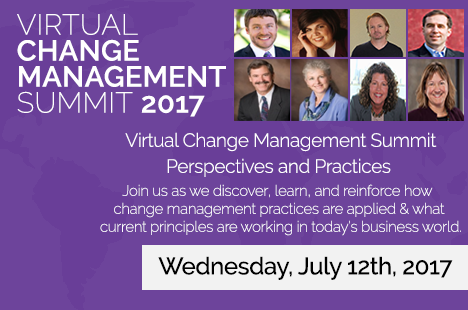
On July 12, 2017 I will be speaking at Change Management Review’s Virtual Change Management Summit 2017™, a curated collection of brand new pre-recorded global webinars bringing thought leaders and senior practitioners in the change management profession together.

The purpose of the event is to help participants discover, learn, and reinforce how change management practices and principles are applied in today’s business world.

Click here for more information and to register for this outstanding event

Why is the Virtual Change Management Summit 2017™ important to change management professionals today?

Our profession is currently fragmented and formalizing at different rates across the globe resulting in confusion about how to take part in professional development for those who have just joined the profession and for those who are in the mid-range of their career as a change management practitioner. Aside from formal certification training, there really isn’t a tangible mode to learn more about what is going on and what works unless one attends a conference or an in-person seminar.

The Virtual Change Management Summit 2017™ is an inexpensive means for change management professionals to learn, grow, and understand the business world around them from the perspective of well known experts and senior change management practitioners.

(from the Change Management Review web site)

In addition to myself, the rest of the speaking lineup will include:

  • Theresa Moulton, Editor-in-Chief, Change Management Review™
  • Dr. Dean Ackerman and Dr. Linda Ackerman Anderson, Co-Founders, Being First Inc.
  • Tim Creasey, Chief Innovation Officer, Prosci
  • Jason Little, Agile Management Consultant, Coach and Trainer
  • Kimberlee Williams, President, Center for Strategy Realization
  • Linda Hoopes, President, Resilience Alliance

The title of my presentation will be:

The Future of Project Management is… Change!

… and I will be exploring the intersections and relationships between project management, innovation management, change management, lean, six sigma, agile, lean startup, and design thinking and how organizations can fundamentally transform how they plan and execute what matters most.

I hope you’ll join us on July 12th!
(or watch the sessions on demand after their scheduled times)

Click here for more information and to register for this outstanding event


Accelerate your change and transformation success

Subscribe to Human-Centered Change & Innovation WeeklySign up here to get Human-Centered Change & Innovation Weekly delivered to your inbox every week.


Inside the Mind of Jeff Bezos

Amazon's Innovation PhilosophyIt is not too often that the leader of a Fortune 500 gives you an insight into how their company achieves competitive advantage in the marketplace in a letter to shareholders, instead of launching into a page or two of flowery prose written by the Public Relations (PR) team that works for them. The former is what Jeff Bezos tends to deliver year after year. This year’s letter is particularly interesting.


The two key insights in this year’s letter were that:

#1 – Amazon strives to view itself as a startup champion riding to the rescue of customers
#2 – Amazon chooses to be customer-obsessed, not customer-focused or customer-centric, but customer-obsessed

Both of these are crucial to sustaining innovation, and are supported by Jeff’s other main pieces of advice:

– Resisting proxies
– Embracing external trends
– Practicing high velocity decision making

But, I won’t steal Jeff’s thunder. I encourage you to read Jeff’s letter to shareholders in its entirety, check out the bonus video interview at the end, and add comments to share what you find particularly interesting in the letter.

Keep innovating!

—————————————————————-
2016 Letter to Amazon Shareholders
April 12, 2017

“Jeff, what does Day 2 look like?”

That’s a question I just got at our most recent all-hands meeting. I’ve been reminding people that it’s Day 1 for a couple of decades. I work in an Amazon building named Day 1, and when I moved buildings, I took the name with me. I spend time thinking about this topic.

“Day 2 is stasis. Followed by irrelevance. Followed by excruciating, painful decline. Followed by death. And that is why it is always Day 1.”

To be sure, this kind of decline would happen in extreme slow motion. An established company might harvest Day 2 for decades, but the final result would still come.

I’m interested in the question, how do you fend off Day 2? What are the techniques and tactics? How do you keep the vitality of Day 1, even inside a large organization?

Such a question can’t have a simple answer. There will be many elements, multiple paths, and many traps. I don’t know the whole answer, but I may know bits of it. Here’s a starter pack of essentials for Day 1 defense: customer obsession, a skeptical view of proxies, the eager adoption of external trends, and high-velocity decision making.

True Customer Obsession

There are many ways to center a business. You can be competitor focused, you can be product focused, you can be technology focused, you can be business model focused, and there are more. But in my view, obsessive customer focus is by far the most protective of Day 1 vitality.

Why? There are many advantages to a customer-centric approach, but here’s the big one: customers are always beautifully, wonderfully dissatisfied, even when they report being happy and business is great. Even when they don’t yet know it, customers want something better, and your desire to delight customers will drive you to invent on their behalf. No customer ever asked Amazon to create the Prime membership program, but it sure turns out they wanted it, and I could give you many such examples.

Staying in Day 1 requires you to experiment patiently, accept failures, plant seeds, protect saplings, and double down when you see customer delight. A customer-obsessed culture best creates the conditions where all of that can happen.

Resist Proxies

As companies get larger and more complex, there’s a tendency to manage to proxies. This comes in many shapes and sizes, and it’s dangerous, subtle, and very Day 2.

A common example is process as proxy. Good process serves you so you can serve customers. But if you’re not watchful, the process can become the thing. This can happen very easily in large organizations. The process becomes the proxy for the result you want. You stop looking at outcomes and just make sure you’re doing the process right. Gulp. It’s not that rare to hear a junior leader defend a bad outcome with something like, “Well, we followed the process.” A more experienced leader will use it as an opportunity to investigate and improve the process. The process is not the thing. It’s always worth asking, do we own the process or does the process own us? In a Day 2 company, you might find it’s the second.

Another example: market research and customer surveys can become proxies for customers – something that’s especially dangerous when you’re inventing and designing products. “Fifty-five percent of beta testers report being satisfied with this feature. That is up from 47% in the first survey.” That’s hard to interpret and could unintentionally mislead.

Good inventors and designers deeply understand their customer. They spend tremendous energy developing that intuition. They study and understand many anecdotes rather than only the averages you’ll find on surveys. They live with the design.

I’m not against beta testing or surveys. But you, the product or service owner, must understand the customer, have a vision, and love the offering. Then, beta testing and research can help you find your blind spots. A remarkable customer experience starts with heart, intuition, curiosity, play, guts, taste. You won’t find any of it in a survey.

Embrace External Trends

The outside world can push you into Day 2 if you won’t or can’t embrace powerful trends quickly. If you fight them, you’re probably fighting the future. Embrace them and you have a tailwind.
These big trends are not that hard to spot (they get talked and written about a lot), but they can be strangely hard for large organizations to embrace. We’re in the middle of an obvious one right now: machine learning and artificial intelligence.

Over the past decades computers have broadly automated tasks that programmers could describe with clear rules and algorithms. Modern machine learning techniques now allow us to do the same for tasks where describing the precise rules is much harder.

At Amazon, we’ve been engaged in the practical application of machine learning for many years now. Some of this work is highly visible: our autonomous Prime Air delivery drones; the Amazon Go convenience store that uses machine vision to eliminate checkout lines; and Alexa, our cloud-based AI assistant. (We still struggle to keep Echo in stock, despite our best efforts. A high-quality problem, but a problem. We’re working on it.)

But much of what we do with machine learning happens beneath the surface. Machine learning drives our algorithms for demand forecasting, product search ranking, product and deals recommendations, merchandising placements, fraud detection, translations, and much more. Though less visible, much of the impact of machine learning will be of this type – quietly but meaningfully improving core operations.

Inside AWS, we’re excited to lower the costs and barriers to machine learning and AI so organizations of all sizes can take advantage of these advanced techniques.

Using our pre-packaged versions of popular deep learning frameworks running on P2 compute instances (optimized for this workload), customers are already developing powerful systems ranging everywhere from early disease detection to increasing crop yields. And we’ve also made Amazon’s higher level services available in a convenient form. Amazon Lex (what’s inside Alexa), Amazon Polly, and Amazon Rekognition remove the heavy lifting from natural language understanding, speech generation, and image analysis. They can be accessed with simple API calls – no machine learning expertise required. Watch this space. Much more to come.

High-Velocity Decision Making

Day 2 companies make high-quality decisions, but they make high-quality decisions slowly. To keep the energy and dynamism of Day 1, you have to somehow make high-quality, high-velocity decisions. Easy for start-ups and very challenging for large organizations. The senior team at Amazon is determined to keep our decision-making velocity high. Speed matters in business – plus a high-velocity decision making environment is more fun too. We don’t know all the answers, but here are some thoughts.

First, never use a one-size-fits-all decision-making process. Many decisions are reversible, two-way doors. Those decisions can use a light-weight process. For those, so what if you’re wrong? I wrote about this in more detail in last year’s letter.

Second, most decisions should probably be made with somewhere around 70% of the information you wish you had. If you wait for 90%, in most cases, you’re probably being slow. Plus, either way, you need to be good at quickly recognizing and correcting bad decisions. If you’re good at course correcting, being wrong may be less costly than you think, whereas being slow is going to be expensive for sure.

Third, use the phrase “disagree and commit.” This phrase will save a lot of time. If you have conviction on a particular direction even though there’s no consensus, it’s helpful to say, “Look, I know we disagree on this but will you gamble with me on it? Disagree and commit?” By the time you’re at this point, no one can know the answer for sure, and you’ll probably get a quick yes.

This isn’t one way. If you’re the boss, you should do this too. I disagree and commit all the time. We recently greenlit a particular Amazon Studios original. I told the team my view: debatable whether it would be interesting enough, complicated to produce, the business terms aren’t that good, and we have lots of other opportunities. They had a completely different opinion and wanted to go ahead. I wrote back right away with “I disagree and commit and hope it becomes the most watched thing we’ve ever made.” Consider how much slower this decision cycle would have been if the team had actually had to convince me rather than simply get my commitment.

Note what this example is not: it’s not me thinking to myself “well, these guys are wrong and missing the point, but this isn’t worth me chasing.” It’s a genuine disagreement of opinion, a candid expression of my view, a chance for the team to weigh my view, and a quick, sincere commitment to go their way. And given that this team has already brought home 11 Emmys, 6 Golden Globes, and 3 Oscars, I’m just glad they let me in the room at all!

Fourth, recognize true misalignment issues early and escalate them immediately. Sometimes teams have different objectives and fundamentally different views. They are not aligned. No amount of discussion, no number of meetings will resolve that deep misalignment. Without escalation, the default dispute resolution mechanism for this scenario is exhaustion. Whoever has more stamina carries the decision.

I’ve seen many examples of sincere misalignment at Amazon over the years. When we decided to invite third party sellers to compete directly against us on our own product detail pages – that was a big one. Many smart, well-intentioned Amazonians were simply not at all aligned with the direction. The big decision set up hundreds of smaller decisions, many of which needed to be escalated to the senior team.

“You’ve worn me down” is an awful decision-making process. It’s slow and de-energizing. Go for quick escalation instead – it’s better.

So, have you settled only for decision quality, or are you mindful of decision velocity too? Are the world’s trends tailwinds for you? Are you falling prey to proxies, or do they serve you? And most important of all, are you delighting customers? We can have the scope and capabilities of a large company and the spirit and heart of a small one. But we have to choose it.

A huge thank you to each and every customer for allowing us to serve you, to our shareowners for your support, and to Amazonians everywhere for your hard work, your ingenuity, and your passion.

As always, I attach a copy of our original 1997 letter. It remains Day 1.

Sincerely,

Jeff

———————————

If you’d like dive deeper into the mind of Jeff Bezos, then check out this interview with him conducted by Walt Mossberg of The Verge last year at Code Conference 2016:

And here is another fascinating peek inside the mind of Jeff Bezos from 1997:


Accelerate your change and transformation success

Subscribe to Human-Centered Change & Innovation WeeklySign up here to get Human-Centered Change & Innovation Weekly delivered to your inbox every week.


10 Free Change Planning Tools

Get Your 10 Free Change Planning ToolsHave you downloaded your ten free change planning tools?

NEWSFLASH: I’ve added sample QuickStart Guide content to the download package, so if you’ve already downloaded the 10 Free Change Planning Tools, you’ll want to download them again to get this bonus content.

Research shows that 70% of change efforts fail. There are many reasons why, including that many people find the planning of a change effort overwhelming and lack tools for making the process more visual, collaborative and human.

Following the successful launch of my latest book Charting Change and a suite of tools called the Change Planning Toolkit™, I have made several access levels available to spread the methodology and help get everyone literally on the same page for change:

Get 10 Free Downloads from the Change Planning Toolkit™I am making 10 free change planning tools from the toolkit available as 11″x17″ downloads along with JUST ADDED sample content from the QuickStart Guide,
Get 26 of the 50+ Change Planning Toolkit™ toolsbut book buyers will get access to the Change Planning Toolkit™ Basic License (26 of 50 tools) at 11″x17″ size — a $500 value,
Get all 50+ tools in the Change Planning Toolkit™and buyers of the Change Planning Toolkit™ Bronze License will get access to all 50+ tools for individual educational use at an 11″x17″ size — a $1,200 value.

Change Planning Toolkit Levels and Free Downloads

I am very excited to share with you the Change Planning Toolkit™, including the popular Visual Project Charter™, Change Planning Canvas™ and many other great tools for increasing your change success!

Increase your consulting revenue or your organizational agility and get a jump on your competition!

Click here to get your 10 Free Change Planning Tools

Site licenses are available for professional or commercial use starting at $2/yr per employee*, and include access to poster size versions of many of the tools (35″x56″).

*Bronze Site Licenses have a one-time setup fee of $299. Site License fee based on total number of employees in the organization.

Below you’ll find a downloadable presentation that gives you five reasons to invest in the Change Planning Toolkit™:


Click here to get your 10 Free Change Planning Tools
Sign up for the latest news and alerts


Click on the tool name to read the article about each of the 10 Free Change Planning Tools:

  1. Five Keys to Successful Change
  2. Architecting the Organization for Change
  3. Building a Global Sensing Network
  4. Visual Project Charter™
  5. Motivation Ability Worksheet
  6. PCC Change Readiness Framework
  7. Eight I’s of Infinite Innovation™
  8. ACMP Standard for Change Management® (Visualization)
  9. Organizational Agility Framework
  10. The Eleven Change Roles™


Accelerate your change and transformation success

Subscribe to Human-Centered Change & Innovation WeeklySign up here to get Human-Centered Change & Innovation Weekly delivered to your inbox every week.