Agility vs Flexibility — What’s the Difference?
 by Braden Kelley
Agility and flexibility are related but distinct capabilities, and confusing them leads organizations to invest in the wrong things.
Flexibility is the capacity to bend without breaking — to absorb stress, accommodate variation, and adapt to different conditions without losing structural integrity. A flexible organization can handle a wider range of situations within its existing model. Flexibility is primarily about tolerance and range.
Agility is the ability to sense change coming and respond to it faster than competitors — not just absorbing variation but actively redirecting in response to new information. An agile organization doesn’t just survive disruption; it moves toward opportunity before others see it. Agility is primarily about speed and direction.
The practical distinction: a flexible supply chain can handle demand fluctuations within a known range. An agile supply chain can reconfigure itself in response to a disruption it didn’t anticipate. Flexibility keeps you stable; agility keeps you competitive.
Most organizations need both — flexibility as the foundation that prevents brittleness, and agility as the capability that enables proactive response. The article below focuses specifically on how to build organizational agility — the harder and more strategically valuable of the two.
Companies seeking to cope with the pace of accelerating change are looking for ways to go faster, and managers in non-technical disciplines have become increasingly infatuated with the Agile Software Development methodology and many are finding ways to adapt parts of it to create agile change or agile marketing or other such things. Sure agility sounds like a good thing and sure agile marketing sounds like it must be better than regular marketing, but is it?
What is agility really?
According to Dictionary.com, agility is:
“The power of moving quickly and easily; nimbleness”
OR
“The ability to think and draw conclusions quickly; intellectual acuity”
When it comes to a business context, I however prefer to define agility a bit more simply, a bit more concisely. Agility, or organizational agility in our case, is:
“How quickly an organization can change directions”
Many people, especially in an organizational or commercial context, get confused between agility and flexibility. They are NOT the same thing.
Agile vs. Flexible
Organizational agility is about how quickly an organization can change directions, while flexibility in an organization gives it the ability to do different things with the same resources, often by purchasing more flexible equipment (at a higher price) or by training people to do more than one thing (resulting in higher training costs) or by hiring people that are skilled at more than one thing (higher salary/benefit costs). Flexibility definitely has its benefits (being able to shift resources among purposes) but it also has costs like the ones mentioned above, and probably more importantly, flexibility usually decreases the efficiency of systems.
Fixedness on the other hand, reduces variability, allows you to focus on the things that do vary and get really good at executing all aspects of a system, including the acquisition of the very best tools and technology to perform each particular function. But, as you can imagine, fixedness has its downside too. If a human resource goes down due to illness or a piece of production equipment breaks, potentially, the whole system grinds to a halt.
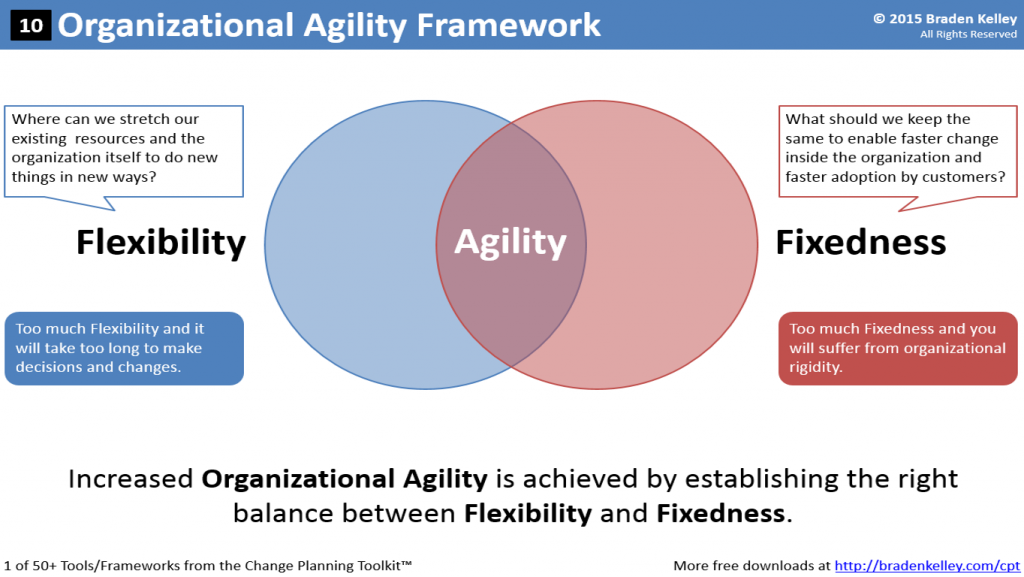
So, as you can imagine, increased organizational agility is achieved by establishing the right balance between flexibility and fixedness.
The Organizational Agility Framework
I have captured this principle below in the Organizational Agility Framework:
Click to access this framework as a scalable 11″x17″ PDF download
(Tooklit purchasers also get access to the Organizational Agility Worksheet)
The Organizational Agility Framework helps organizations:
- Adapt to changing environmental conditions
- Stretch existing resources and the organization itself to do new things in new ways
- Enable faster change inside the organization and faster adoption by customers
- Evolve profitable customer relationships to keep the organization strong and vibrant
The Organizational Agility Framework (and corresponding worksheet in the Change Planning Toolkit™) also helps you ask two key questions:
- Where can we stretch our existing resources and the organization itself to do new things in new ways?
- What should we keep the same to enable faster change inside the organization and faster adoption by customers?
Flexibility vs. Fixedness
Too much Flexibility and it will take too long to make decisions and changes.
Too much Fixedness and you will suffer from organizational rigidity.
Companies seeking increased organizational agility and an improved ability to cope with the accelerating pace of change and ever-evolving customer expectations must seek to strike that optimal balance between fixedness (so you can go fast) and flexibility (so you can quickly adapt to changing customer needs).
Organizational Agility Examples
The following real-world examples illustrate what organizational agility looks like in practice — and what distinguishes truly agile organizations from those that merely talk about agility:
Amazon — Structural agility through two-pizza teams
Amazon’s famous “two-pizza team” rule — no team should be larger than what two pizzas can feed — is a structural agility mechanism. Small, autonomous teams can make decisions, experiment, and ship without navigating layers of approval. This structure is why Amazon was able to launch AWS, Prime, and Alexa as distinct businesses while its core retail operation continued growing. The organizational design itself creates agility rather than relying on individual heroics.
Netflix — Strategic agility through willingness to cannibalize itself
Netflix demonstrated organizational agility when it pivoted from DVD-by-mail to streaming in 2007 — deliberately cannibalizing its own most profitable business to move toward the future it saw coming. It did this again when it shifted from licensing content to producing originals. Most organizations cannot make these moves because their structure and incentives protect the existing business. Netflix’s agility came from leadership’s willingness to disrupt themselves before a competitor did.
Spotify — Process agility through the Squad model
Spotify’s Squad model — autonomous cross-functional teams organized around customer outcomes rather than functional departments — is one of the most widely studied organizational agility frameworks. Squads own their roadmaps, make their own architectural decisions, and deploy independently. The result is a company that can run hundreds of simultaneous experiments and ship features continuously without coordination bottlenecks.
Toyota — Operational agility through lean manufacturing
Toyota’s production system is the original organizational agility framework — the ability to sense quality problems in real time, stop the line immediately, solve the root cause, and resume without the defect propagating downstream. The principle of jidoka (automation with a human touch) and andon cords give frontline workers the authority and responsibility to act on problems instantly. This operational agility is why Toyota consistently outperforms competitors on quality and efficiency despite producing at massive scale.
ING Bank — Enterprise agility through full organizational transformation
ING Bank’s 2015 transformation from a traditional hierarchical bank to an agile organization — restructuring 3,500 employees in the Netherlands into squads, tribes, chapters, and guilds inspired by Spotify — is one of the most cited examples of enterprise-scale organizational agility. The transformation reduced time-to-market for new features from months to weeks, improved employee engagement significantly, and positioned ING as a digital banking leader. It also demonstrated that organizational agility is achievable in highly regulated, risk-conscious industries — not just in tech startups.
What these examples have in common: In each case, organizational agility was not achieved through an agile training program or a methodology adoption. It was achieved through deliberate structural, cultural, and leadership decisions that removed the friction slowing response time and pushed decision-making authority closer to where information actually lived. The organizations that are genuinely agile have designed their agility in — not bolted it on.
Can your organization find the right balance?
More on digital transformation and organizational agility soon, so stay tuned!
In the meantime, please get yourself a copy of Charting Change as a hardcover (or ebook) and get your free downloads from the Change Planning Toolkit™ (or go ahead and purchase a license now).
 Sign up here to get Human-Centered Change & Innovation Weekly delivered to your inbox every week.
 I was watching our Seattle Seahawks lose to the Green Bay Packers on Sunday and was surprised to see a series of television ads air during the game from GE, not touting how great their products are, but why GE is a great place for software developers to come work.