Tag Archives: Velocity

Slowing Down to Speed Up Innovation

Mindfulness and Velocity

LAST UPDATED: November 28, 2025 at 9:51AM

Slowing Down to Speed Up Innovation

GUEST POST from Chateau G Pato

In the innovation world, we treat Velocity as an unambiguous virtue. Lean, Agile, Design Thinking — all rightly emphasize rapid cycles and fast feedback. Yet, when speed becomes the only metric, a dangerous pathology emerges: the Mindless Rush. Teams accelerate into execution before achieving clarity on the problem, leading to months of wasted effort solving the wrong thing, or building a feature nobody needs.

The human-centered solution is not to abandon speed, but to introduce Mindfulness. Mindfulness, in an innovation context, is the deliberate, conscious act of pausing velocity at critical junctures to focus attention and achieve profound understanding. It is the conscious investment of time upfront to prevent the far greater cost of rework and re-steering later. We are slowing down the clock for a minute so we can save hours down the road.

This approach moves us from the flawed metric of Output Velocity (how fast we shipped code) to the powerful metric of Impact Velocity (how quickly we delivered value). Impact Velocity is the true measure of innovation success.

The Three Phases Where Mindfulness Trumps Speed

Mindfulness must be strategically injected at three key organizational stages:

1. The Discovery Pause (Defining the Problem)

The greatest inhibitor to innovation is defining the problem too quickly. Teams, eager to show progress, leap from a vague symptom (“Sales are down”) to a solution (“We need a new pricing model”). The Discovery Pause mandates slowing down the initial empathy and definition phases. This involves spending intentional, deep time on ethnographic research, asking the Five Whys of the problem, and achieving a true understanding of the unarticulated human need. This pause ensures you are aiming the cannon at the right target.

2. The Decision Deliberation (Mitigating Bias)

High-velocity environments amplify cognitive biases, especially Affinity Bias (favoring ideas from people we like) and Confirmation Bias (favoring data that supports our existing belief). The Decision Deliberation forces a slow, structured review of key decisions (e.g., pivot vs. persevere, kill vs. scale). This involves bringing in an external devil’s advocate, mandating silent data review before discussion, and forcing teams to argue against their preferred hypothesis. This deliberate friction prevents the team from rushing toward a suboptimal local consensus.

3. The Learning Reflection (Codifying Insight)

Teams rush from one sprint to the next, treating success or failure as a binary outcome. The value of an experiment is not just the result, but the codified learning. The Learning Reflection mandates a formal, mindful pause after every major experiment or delivery cycle (e.g., a “Learning Day” or “Innovation Retrospective”). This time is used to document assumptions that were proven wrong, package the insights into reusable organizational assets, and adjust the thesis. If you don’t slow down to capture the learning, you’ll be condemned to repeat the costly mistake at full speed later.

Case Study 1: The Government Agency’s Procurement Paradox

Challenge: Rushing Requirements Leading to Massive Rework

A large government agency needed to modernize its aging IT infrastructure. Under political pressure to show speed, they rushed the requirements-gathering phase, delivering a massive, siloed document in six weeks. The result was a $50 million contract signed for a system that met all documented requirements but failed entirely to meet the actual, complex human needs of the end-users (the field agents). The system was unusable and required a complete re-scoping.

The Mindfulness Intervention: The Mandatory Pause

In the subsequent attempt, the new change leader mandated a Discovery Pause. The team was given an additional four weeks with a single goal: Understand the Job-to-Be-Done. They spent this time on ethnographic studies, observing field agents in their daily context, mapping their workarounds, and defining the emotional friction points. This small, intentional delay:

  • Identified that the true need wasn’t a new database, but mobile, offline data access (a requirement missed in the rush).
  • Reduced the scope of the resulting RFP by 30%, focusing only on high-value needs.

The Human-Centered Lesson:

The initial rush wasted 18 months and tens of millions of dollars. The four-week Mindfulness Pause cut the ultimate delivery timeline by over a year because the agency finally built the right thing. The total Impact Velocity was dramatically increased by accepting the initial, intentional delay.

Case Study 2: The SaaS Company and the Pivot Pause

Challenge: Rapid Iteration Without Deep Learning

A fast-growing SaaS startup embraced the “Fail Fast” mantra, running weekly A/B tests and feature deployments. They were achieving high Output Velocity, but their feature adoption rate was stagnant. They were pivoting constantly, but only in minor, incremental ways, never achieving a breakthrough.

The Mindfulness Intervention: The Learning Reflection Day

The leadership instituted a mandatory Learning Reflection Day every four weeks. All new feature development ceased for 24 hours. Teams were required to:

  • Present their failed and successful hypotheses, not just the test results.
  • Conduct a Pre-Mortem on their most successful test, deliberately trying to find flaws in the underlying assumptions.
  • Codify three key, transferable behavioral insights learned about the customer into a central knowledge base.

The Human-Centered Lesson:

This intentional slowing (the Pivot Pause) broke the cycle of shallow iteration. By reflecting mindfully, one team discovered that while a specific feature was used, the context of its use revealed a much larger, unmet need for asynchronous collaboration. This led to a large, successful product pivot they would have otherwise rushed past. The pause shifted the focus from merely reporting what happened to understanding what was learned.

The Human-Centered Call to Action: Mastering the Pause

The greatest asset of the modern innovator is not speed; it is clarity. And clarity requires attention — it requires mindfulness.

To master the pause, leaders must embed checkpoints in their innovation process where the primary metric is not execution, but Understanding. Critically, leaders must create the psychological safety for teams to propose a pause without fearing they will be labeled as blockers or slow. These pauses are not delays; they are strategic investments that prevent the costly failures of Mindless Rush.

Challenge your teams: Before you start the next sprint, schedule an extra hour for silence and contemplation on the problem statement. Find one reason why your current assumption is guaranteed to fail. This mindful friction creates the space for the breakthrough insight to emerge.

“Speed without direction is simply chaos. Mindfulness provides the direction, ensuring that when you do move fast, you are moving toward undeniable value.”

Frequently Asked Questions About Mindfulness and Velocity

1. What is the difference between “Output Velocity” and “Impact Velocity”?

Output Velocity is a measure of how quickly tasks are completed or features are shipped (e.g., lines of code, number of sprints). Impact Velocity is the true human-centered metric, measuring how quickly the organization delivers genuine, high-value outcomes to the customer or market. Mindfulness ensures high Impact Velocity.

2. How does the “Discovery Pause” prevent wasted time later?

The Discovery Pause mandates slowing down the initial problem definition phase using tools like ethnographic research and “Five Whys.” This intentional delay prevents teams from rushing into execution with a vague or incorrect problem statement, thereby avoiding the massive time and cost associated with building the wrong solution.

3. What is the purpose of the “Learning Reflection” phase?

The Learning Reflection phase is a mandatory pause after an experiment or delivery cycle to codify insight. Its purpose is not to celebrate success but to deliberately capture the assumptions that were proven right or wrong, package that learning for organizational reuse, and prevent the team from repeating costly mistakes in the next high-velocity sprint.

Your first step toward Mindful Velocity: For your next major project, introduce a mandatory 48-hour “Silent Observation Period” immediately after the project charter is approved. During this time, the team can only observe, interview, and document the current state of the problem — no ideation or solution brainstorming allowed. This enforced stillness shifts the focus from solution execution to problem empathy.

Extra Extra: Because innovation is all about change, Braden Kelley’s human-centered change methodology and tools are the best way to plan and execute the changes necessary to support your innovation and transformation efforts — all while literally getting everyone all on the same page for change. Find out more about the methodology and tools, including the book Charting Change by following the link. Be sure and download the TEN FREE TOOLS while you’re here.

Image credit: Pixabay

Subscribe to Human-Centered Change & Innovation WeeklySign up here to get Human-Centered Change & Innovation Weekly delivered to your inbox every week.

Inside the Mind of Jeff Bezos

Amazon's Innovation PhilosophyIt is not too often that the leader of a Fortune 500 gives you an insight into how their company achieves competitive advantage in the marketplace in a letter to shareholders, instead of launching into a page or two of flowery prose written by the Public Relations (PR) team that works for them. The former is what Jeff Bezos tends to deliver year after year. This year’s letter is particularly interesting.

The two key insights in this year’s letter were that:

#1 – Amazon strives to view itself as a startup champion riding to the rescue of customers
#2 – Amazon chooses to be customer-obsessed, not customer-focused or customer-centric, but customer-obsessed

Both of these are crucial to sustaining innovation, and are supported by Jeff’s other main pieces of advice:

– Resisting proxies
– Embracing external trends
– Practicing high velocity decision making

But, I won’t steal Jeff’s thunder. I encourage you to read Jeff’s letter to shareholders in its entirety, check out the bonus video interview at the end, and add comments to share what you find particularly interesting in the letter.

Keep innovating!

—————————————————————-
2016 Letter to Amazon Shareholders
April 12, 2017

“Jeff, what does Day 2 look like?”

That’s a question I just got at our most recent all-hands meeting. I’ve been reminding people that it’s Day 1 for a couple of decades. I work in an Amazon building named Day 1, and when I moved buildings, I took the name with me. I spend time thinking about this topic.

“Day 2 is stasis. Followed by irrelevance. Followed by excruciating, painful decline. Followed by death. And that is why it is always Day 1.”

To be sure, this kind of decline would happen in extreme slow motion. An established company might harvest Day 2 for decades, but the final result would still come.

I’m interested in the question, how do you fend off Day 2? What are the techniques and tactics? How do you keep the vitality of Day 1, even inside a large organization?

Such a question can’t have a simple answer. There will be many elements, multiple paths, and many traps. I don’t know the whole answer, but I may know bits of it. Here’s a starter pack of essentials for Day 1 defense: customer obsession, a skeptical view of proxies, the eager adoption of external trends, and high-velocity decision making.

True Customer Obsession

There are many ways to center a business. You can be competitor focused, you can be product focused, you can be technology focused, you can be business model focused, and there are more. But in my view, obsessive customer focus is by far the most protective of Day 1 vitality.

Why? There are many advantages to a customer-centric approach, but here’s the big one: customers are always beautifully, wonderfully dissatisfied, even when they report being happy and business is great. Even when they don’t yet know it, customers want something better, and your desire to delight customers will drive you to invent on their behalf. No customer ever asked Amazon to create the Prime membership program, but it sure turns out they wanted it, and I could give you many such examples.

Staying in Day 1 requires you to experiment patiently, accept failures, plant seeds, protect saplings, and double down when you see customer delight. A customer-obsessed culture best creates the conditions where all of that can happen.

Resist Proxies

As companies get larger and more complex, there’s a tendency to manage to proxies. This comes in many shapes and sizes, and it’s dangerous, subtle, and very Day 2.

A common example is process as proxy. Good process serves you so you can serve customers. But if you’re not watchful, the process can become the thing. This can happen very easily in large organizations. The process becomes the proxy for the result you want. You stop looking at outcomes and just make sure you’re doing the process right. Gulp. It’s not that rare to hear a junior leader defend a bad outcome with something like, “Well, we followed the process.” A more experienced leader will use it as an opportunity to investigate and improve the process. The process is not the thing. It’s always worth asking, do we own the process or does the process own us? In a Day 2 company, you might find it’s the second.

Another example: market research and customer surveys can become proxies for customers – something that’s especially dangerous when you’re inventing and designing products. “Fifty-five percent of beta testers report being satisfied with this feature. That is up from 47% in the first survey.” That’s hard to interpret and could unintentionally mislead.

Good inventors and designers deeply understand their customer. They spend tremendous energy developing that intuition. They study and understand many anecdotes rather than only the averages you’ll find on surveys. They live with the design.

I’m not against beta testing or surveys. But you, the product or service owner, must understand the customer, have a vision, and love the offering. Then, beta testing and research can help you find your blind spots. A remarkable customer experience starts with heart, intuition, curiosity, play, guts, taste. You won’t find any of it in a survey.

Embrace External Trends

The outside world can push you into Day 2 if you won’t or can’t embrace powerful trends quickly. If you fight them, you’re probably fighting the future. Embrace them and you have a tailwind.
These big trends are not that hard to spot (they get talked and written about a lot), but they can be strangely hard for large organizations to embrace. We’re in the middle of an obvious one right now: machine learning and artificial intelligence.

Over the past decades computers have broadly automated tasks that programmers could describe with clear rules and algorithms. Modern machine learning techniques now allow us to do the same for tasks where describing the precise rules is much harder.

At Amazon, we’ve been engaged in the practical application of machine learning for many years now. Some of this work is highly visible: our autonomous Prime Air delivery drones; the Amazon Go convenience store that uses machine vision to eliminate checkout lines; and Alexa, our cloud-based AI assistant. (We still struggle to keep Echo in stock, despite our best efforts. A high-quality problem, but a problem. We’re working on it.)

But much of what we do with machine learning happens beneath the surface. Machine learning drives our algorithms for demand forecasting, product search ranking, product and deals recommendations, merchandising placements, fraud detection, translations, and much more. Though less visible, much of the impact of machine learning will be of this type – quietly but meaningfully improving core operations.

Inside AWS, we’re excited to lower the costs and barriers to machine learning and AI so organizations of all sizes can take advantage of these advanced techniques.

Using our pre-packaged versions of popular deep learning frameworks running on P2 compute instances (optimized for this workload), customers are already developing powerful systems ranging everywhere from early disease detection to increasing crop yields. And we’ve also made Amazon’s higher level services available in a convenient form. Amazon Lex (what’s inside Alexa), Amazon Polly, and Amazon Rekognition remove the heavy lifting from natural language understanding, speech generation, and image analysis. They can be accessed with simple API calls – no machine learning expertise required. Watch this space. Much more to come.

High-Velocity Decision Making

Day 2 companies make high-quality decisions, but they make high-quality decisions slowly. To keep the energy and dynamism of Day 1, you have to somehow make high-quality, high-velocity decisions. Easy for start-ups and very challenging for large organizations. The senior team at Amazon is determined to keep our decision-making velocity high. Speed matters in business – plus a high-velocity decision making environment is more fun too. We don’t know all the answers, but here are some thoughts.

First, never use a one-size-fits-all decision-making process. Many decisions are reversible, two-way doors. Those decisions can use a light-weight process. For those, so what if you’re wrong? I wrote about this in more detail in last year’s letter.

Second, most decisions should probably be made with somewhere around 70% of the information you wish you had. If you wait for 90%, in most cases, you’re probably being slow. Plus, either way, you need to be good at quickly recognizing and correcting bad decisions. If you’re good at course correcting, being wrong may be less costly than you think, whereas being slow is going to be expensive for sure.

Third, use the phrase “disagree and commit.” This phrase will save a lot of time. If you have conviction on a particular direction even though there’s no consensus, it’s helpful to say, “Look, I know we disagree on this but will you gamble with me on it? Disagree and commit?” By the time you’re at this point, no one can know the answer for sure, and you’ll probably get a quick yes.

This isn’t one way. If you’re the boss, you should do this too. I disagree and commit all the time. We recently greenlit a particular Amazon Studios original. I told the team my view: debatable whether it would be interesting enough, complicated to produce, the business terms aren’t that good, and we have lots of other opportunities. They had a completely different opinion and wanted to go ahead. I wrote back right away with “I disagree and commit and hope it becomes the most watched thing we’ve ever made.” Consider how much slower this decision cycle would have been if the team had actually had to convince me rather than simply get my commitment.

Note what this example is not: it’s not me thinking to myself “well, these guys are wrong and missing the point, but this isn’t worth me chasing.” It’s a genuine disagreement of opinion, a candid expression of my view, a chance for the team to weigh my view, and a quick, sincere commitment to go their way. And given that this team has already brought home 11 Emmys, 6 Golden Globes, and 3 Oscars, I’m just glad they let me in the room at all!

Fourth, recognize true misalignment issues early and escalate them immediately. Sometimes teams have different objectives and fundamentally different views. They are not aligned. No amount of discussion, no number of meetings will resolve that deep misalignment. Without escalation, the default dispute resolution mechanism for this scenario is exhaustion. Whoever has more stamina carries the decision.

I’ve seen many examples of sincere misalignment at Amazon over the years. When we decided to invite third party sellers to compete directly against us on our own product detail pages – that was a big one. Many smart, well-intentioned Amazonians were simply not at all aligned with the direction. The big decision set up hundreds of smaller decisions, many of which needed to be escalated to the senior team.

“You’ve worn me down” is an awful decision-making process. It’s slow and de-energizing. Go for quick escalation instead – it’s better.

So, have you settled only for decision quality, or are you mindful of decision velocity too? Are the world’s trends tailwinds for you? Are you falling prey to proxies, or do they serve you? And most important of all, are you delighting customers? We can have the scope and capabilities of a large company and the spirit and heart of a small one. But we have to choose it.

A huge thank you to each and every customer for allowing us to serve you, to our shareowners for your support, and to Amazonians everywhere for your hard work, your ingenuity, and your passion.

As always, I attach a copy of our original 1997 letter. It remains Day 1.

Sincerely,

Jeff

———————————

If you’d like dive deeper into the mind of Jeff Bezos, then check out this interview with him conducted by Walt Mossberg of The Verge last year at Code Conference 2016:

And here is another fascinating peek inside the mind of Jeff Bezos from 1997:


Accelerate your change and transformation success

Subscribe to Human-Centered Change & Innovation WeeklySign up here to get Human-Centered Change & Innovation Weekly delivered to your inbox every week.

Velocity is the Only Innovation Outcome that Matters

Velocity is the Only Innovation Outcome that Matters

Recently I wrote an introductory blog post about the importance of VELOCITY as an innovation outcome. Today I want to drill a little deeper, to examine why velocity is so important to many businesses, and why innovation should be the technique that many turn to to accelerate velocity.

Few people would quibble with the argument that the pace of change is accelerating, and continues to accelerate. If, for example, you could teleport yourself to the Roman empire and examine the living conditions of the average family, you’d find that conditions weren’t overly improved for hundreds of years. New technologies were infrequent and scientific discovery was slow. Fast forward to the early Middle ages, as learning and communication improved, and we see an increasing pace of change. Comparing, say, the 1200s to the 1400s would demonstrate significant gains for the upper class in terms of products, services and technologies. But the pace of change for significant portions of the population was still slow. Consider even the 1950s and 1960s. Much of the world lacked basic infrastructure, communication systems, adequate food, while the “developed” world had all of these factors and more. Today, it’s not unusual to find people in depressed circumstances with access to cell phones, the internet, bank accounts and many of the trappings of a fully modern society. The pace of change has delivered more goods, services and technologies, and distributed them more quickly in the last few decades, than many believed possible.

Factors Driving Pace of Change

What factors drive the increasing pace of change? I’m sure better minds than mine have pondered this question, but a few factors seem relatively obvious. First, better information systems and communication systems. When communication is difficult, it is hard to transfer knowledge and information. As communications systems have advanced, the ability to spread information more broadly has improved the pace of change in many areas. Second, the distribution of education. Today, many of the world’s best universities are resident in the US, the UK, Germany and other “western” countries, but increasingly excellent universities are identified in India, China and other countries. Further, access to education, over the web, over the improved communication channels means that far more people can gain education and build skills. Third, the increasing demand for better living conditions, better lives for our children, more access to more things. Fatalism and the acceptance of a terrible life is a thing of the past. Everyone, everywhere demands a better standard of living, more access to more and better goods and services. These demands create the opportunity for a market, these demands are filled with new and better supply.

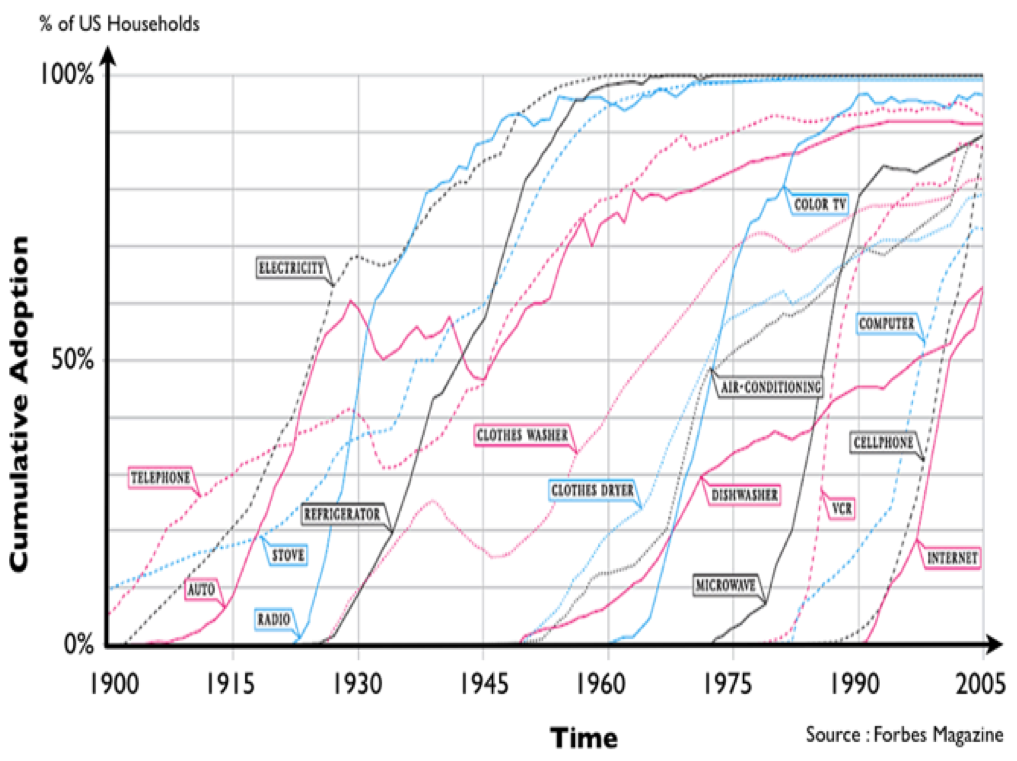
These are factors that I think are driving the increasing pace of change. But you don’t have to accept my assertions, you can see the increasing pace of change for yourself in adoption curves of technology. The “S” curves of technology adoption over the last 100 years demonstrate that it took years for a radio or television to penetrate many households, while newer products like VCRs, cell phone and PCs penetrated very quickly. One reason this is true is that the infrastructure (electricity, communication standards, interactivity) was built, deployed and stabilized. As the infrastructure got better, it became easier and easier to deploy and to use new technologies. See the increasing acceleration of adoption in the “S” curve image below.

Technology Adoption S Curves

Implications of Accelerating Change

The implications of this acceleration should be obvious – the pace of change and rate of acceleration is ever increasing. Individuals who were once satisfied with only one model of product are now more likely to be clamoring for more variety, more choice. This is something that even Henry Ford missed. Simply solving a basic transportation need led to ever increasing demands to satisfy comfort, status and ego needs. For many products and services, life expectancy is decreasing at the same rate as the accelerating pace of change. Few firms can count on long product cycle times.

Why this matters to Innovation

If these assumptions are true, then VELOCITY, as defined as speed in a specific direction, becomes very important for a firm’s ability to grow and compete. Relying on long product life cycles is not an option. Customers will demand new products, new features at an ever increasing rate. Firms can’t simply “dump” older technologies and products into “developing” markets because those market too understand the product/feature acceleration and reject older products. This acceleration means that firms must address the most significant barriers to velocity within their businesses. There are three barriers they must address:

  1. The ability to bring products to market very quickly. Most organizations have well-defined, stage-gate models that use waterfall approaches with many signoffs to reduce risk. These existing processes are long, drawn out affairs designed to prevent mistakes and perfect products rather than systems attuned to customer needs and expectations. One of the first activities many firms should undertake is to innovate their product development cycles.
  2. Few firms have invested in true innovation capabilities. Yes they have some “innovation” teams and perhaps even some systems or processes meant to sustain innovation, but they don’t consider innovation core to their business. Innovation – purposefully creating new, meaningful products and services that clients will want – will increase the organization’s speed, and potentially its velocity. It can increase velocity if…
  3. Executives create clear strategies based on the understanding of the importance of velocity. Innovation can result in more speed, based on improvements in the product development cycle time and in generating new ideas more effectively. But the difference between velocity and speed is intent. Velocity is speed in a specific direction. Executives must provide the demand for speed, combined with the insights that detail specific directions. Innovation needs far more attention from executives, in terms of greater importance and more clarity and focus.

Conclusion

So, hopefully you can see that perhaps the most important outcome innovation can deliver is velocity, that is, corporate speed with purpose. I’ve identified at least two areas where more internal speed is important, if a firm hopes to keep pace with its competitors and its market demands. Executives play an important role here as well. Our corporations become comfortable with our operating models and the internal pace of business. While our internal pace may be valuable, comfortable and well understood, our internal pace is irrelevant if the external pace of change is different. Far too many firms have too many structures that impede speed and velocity, and are too comfortable with a slow pace of change. Why they may believe they need innovation to create new products and services, these firms fail to realize how important it is to accelerate their operations and keep pace, at a minimum, with the market. And, not only is speed important, but velocity. Meaning that while we increase internal speed we do so in important, strategic directions.

In subsequent posts I’ll address the concept of innovation as a catalyst for corporate velocity.

Image credits: Pixabay, Forbes

Subscribe to Human-Centered Change & Innovation WeeklySign up here to get Human-Centered Change & Innovation Weekly delivered to your inbox every week.

Velocity, Speed and Innovation

Velocity, Speed and Innovation

Flying for 12 hours at a stretch can give you a lot of time to think, in between in-flight meals, movies and other on-board entertainment.

The more I thought about the current state of innovation, the more I realized that many of us have it all wrong. We at OVO often talk about innovation as an enabler to strategy, not a strategy itself. But I think there’s something much deeper going on than that. First, we know that many executives WANT more innovation. But they don’t want innovation for its own sake. They want innovation that drives more revenue growth, more differentiation and more creation of compelling products and services than what would otherwise happen. This means that innovation must create solutions with more return than existing methods, with only incrementally greater risk.

Executives want to be Innovative, they don’t want Innovation

In the final analysis, CEOs and senior executives don’t want INNOVATION, they want the benefits and outcomes of well-pursued innovation activities, namely, growth, differentiation, market penetration, disruption of adjacent markets and so forth. If there are easier ways to achieve these outcomes, CEOs and organizations will gladly pursue the alternatives, and forgo the risks that surround innovation. What risks? Because of the investments in management tools, techniques and training to improve efficiency and effectiveness, many businesses have very efficient but very brittle and fragile operating models. Innovation introduces risk, uncertainty and change into organizations and business models honed to avoid these issue. Further, most work teams have been right-sized and down-sized to the point where incremental work is almost impossible to engage. No, what executives want is not innovation per se, but they would like to be viewed as INNOVATIVE and enjoy the benefits of meaningful, valuable new products and services.

Why Velocity is more important than Speed

Perhaps what I’ve come to realize is that what most organizations need more than anything is VELOCITY. Let me explain what I mean by Velocity. My daughter’s physics class was working on the definition of motion and speed. Speed measures how fast an object is moving, so many feet or miles divided by the amount of time it takes to complete the distance. Physics and calculus distinguish SPEED from VELOCITY, by taking the stance that VELOCITY is Speed in a specific direction. Physicists and scientists would say that VELOCITY is a Scalar concept.

When we think about most businesses, VELOCITY is exactly what they need. They need speed to compete with a host of changes occurring in their markets, from increased competition to lowered trade barriers to a rapid increase in the abilities of individuals and firms in developing countries and markets. However, speed isn’t all that valuable if it’s in the wrong direction. VELOCITY is speed in a specific direction, and that’s what many organizations need. They need to be faster, more effective, more innovative, and end up in a place that was intentional.

VELOCITY connotes the idea that the firm is going somewhere that matters. How a firm knows where to go is dependent to some extent on corporate strategy and how well that strategy is communicated. Further, how it knows where to go is dependent on the firm’s ability to assess market trends, develop scenarios and understand customer needs. These final factors are innovation tools, which help describe a range of possible futures and help decipher which ones are relevant and important.

Speed kills, Velocity Wins

Over the next few posts I will write about speed, velocity and their relationship to innovation. Because increasingly innovation is just a method to help a firm increase its speed in a particular direction. Speed will become the new competitive weapon in a highly competitive market, but speed in and of itself is useless without intentional direction and guidance. We’ll look at why speed is ever more important, and how good innovation contributes to speed and velocity.

Another way to think of this is that innovation is a feature, and speed or velocity are the potential benefits. I’m increasingly convinced that velocity in a business sense – getting to the right markets and opportunities faster than others, and doing so intentionally – is the capability that will distinguish winners from losers in the coming years.

Image credit: Pixabay

Subscribe to Human-Centered Change & Innovation WeeklySign up here to get Human-Centered Change & Innovation Weekly delivered to your inbox every week.