Monthly Archives: September 2022

The Power of Praise

The Power of Praise

GUEST POST from Mike Shipulski

Praise happens when you tell someone they did something wonderful. Praise is virtually free and almost the most powerful force in the universe.

When you tell someone what they did was amazing, they stand three inches taller. Right in front of you, they get taller. They grow. They expand. Don’t believe me? Try it. And bring a ruler.

To deliver praise, you must pay attention. You must invest in what’s going on, you must hear what is said, and watch what is done. Congratulations. Though you have yet to deliver praise, you’ve already differentiated yourself. Next, you must compare the behavior against the norms and recognize a difference. Sure, it’s a simple difference calculation, but it’s a calculation that takes attention and caring, which in today’s rat race are in short supply. Now, you must find words the right words to describe the specialness of the behavior-why it’s different and why it matters. Then, you’ve got to deliver it in a way that is worthy of the specialness.

Deliver praise in public and be specific. This person (use their name) did (say what they did) and it’s important because (and say why it is important). And tell people what you think and feel. They (use their name) did (say what they did) and I feel (e.g., happy, excited, proud) because (tell them why you feel as you do). Feel free to steal that script, but if you do, stick to it because it’s a good one.

A rule: If you don’t praise people, you don’t know what you’re doing.

But here’s the thing about praise. If you fake it, you bring about its opposite. When you fake it, people get smaller and they get angry. They get smaller because they know they are being patronized. And they get angry for the same reason. So, a word of caution. If you deliver paise that’s fake, you will lose all credibility with the recipient and anyone in earshot. And it’s such a violation of their dignity, I don’t know a way to resurrect their trust. In short, if you fake it, it’s over for you.

Another rule: If you have the urge to deliver fake praise, don’t.

Praise is powerful, but in today’s environment is almost extinct. It’s not that praise-worthy behavior is uncommon, rather, the time and attention required to recognize and formally acknowledge praise-worthy behavior is uncommon.

If you want to elevate the performance of a team, praise their behavior. And do it in public. Pay attention and praise. Schedule a meeting, buy the pizza, and praise. Be specific, be genuine, and praise.

Yes, you will spend a lot of money on pizza, and, yes, that is the best return on investment in the universe.

Alex and his lion friend” by Tambako the Jaguar is marked with CC BY-ND 2.0.

Subscribe to Human-Centered Change & Innovation WeeklySign up here to get Human-Centered Change & Innovation Weekly delivered to your inbox every week.

Building Seamless Human-AI Workflows

Designing for Collaboration

Building Seamless Human-AI Workflows

GUEST POST from Art Inteligencia

The rise of artificial intelligence is no longer a futuristic fantasy; it’s a present-day reality reshaping our workplaces. However, the narrative often focuses on AI replacing human jobs. As a human-centered innovation thought leader, I believe the true power of AI lies not in substitution, but in synergy. The future of work is not human versus AI, but human with AI, collaborating in seamless workflows that leverage the unique strengths of both. Designing for this collaboration is the next great frontier of innovation.

The fear of automation is understandable, but it overlooks a critical point: AI excels at tasks that are often repetitive, data-intensive, and rule-based. Humans, on the other hand, bring creativity, critical thinking, emotional intelligence, and the ability to handle ambiguity and novel situations. The sweet spot lies in designing workflows where AI augments human capabilities, freeing us from mundane tasks and empowering us to focus on higher-level strategic thinking, innovation, and human connection. This requires a fundamental shift in how we design work, moving away from a purely task-oriented approach to one that emphasizes collaboration and shared intelligence.

Building seamless human-AI workflows is a human-centered design challenge. It demands that we deeply understand the needs, skills, and workflows of human workers and then thoughtfully integrate AI tools in a way that enhances their capabilities and improves their experience. This involves:

  • Identifying the Right Problems: Focusing AI on tasks that are truly draining human energy and preventing them from higher-value work. This means conducting thorough journey mapping and observational studies to pinpoint the most repetitive and tedious parts of a person’s workday. The goal is to eliminate friction, not just automate for automation’s sake.
  • Designing Intuitive Interfaces: Ensuring that AI tools are user-friendly and seamlessly integrated into existing workflows, minimizing the learning curve and maximizing adoption. The user should feel like the AI is a helpful partner, not a clunky, foreign piece of technology. The interaction should be conversational and natural.
  • Fostering Trust and Transparency: Making it clear how AI is making decisions and providing explanations when appropriate, building confidence in the technology. We must move away from “black box” algorithms and towards a model where humans understand the reasoning behind an AI’s suggestion, which is crucial for building trust and ensuring the human remains in control.
  • Defining Clear Roles and Responsibilities: Establishing a clear understanding of what tasks are best suited for humans and what tasks AI will handle, creating a harmonious division of labor. This requires ongoing communication and training to help people understand their new roles in a hybrid human-AI team. The human’s role should be elevated, not diminished.
  • Iterative Learning and Adaptation: Continuously monitoring the performance of human-AI workflows and making adjustments based on feedback and evolving needs. A human-AI workflow is not a static solution; it’s a dynamic system that requires continuous optimization based on both quantitative metrics and qualitative feedback from the people using it.

Case Study 1: Augmenting Customer Service with AI

The Challenge: Overwhelmed Human Agents and Long Wait Times

A large e-commerce company was struggling with an overwhelmed customer service department. Human agents were spending a significant amount of time answering repetitive questions and sifting through basic inquiries, leading to long wait times and frustrated customers. This was impacting customer satisfaction and agent morale, creating a vicious cycle of burnout and poor service.

The Human-AI Collaborative Solution:

Instead of simply replacing human agents with chatbots, the company implemented an AI-powered support system designed to augment human capabilities. An AI chatbot was deployed to handle frequently asked questions and provide instant answers to common issues, such as order status updates and password resets. However, when the AI encountered a complex or emotionally charged query, it seamlessly escalated the conversation to a human agent, providing the agent with a complete transcript of the interaction and relevant customer data, like past purchases and support history. The AI also assisted human agents by automatically summarizing past interactions and suggesting relevant knowledge base articles, allowing them to resolve issues more quickly and efficiently. The human agent’s role shifted from being a frontline information desk to a skilled problem-solver and relationship builder.

The Results:

The implementation of this human-AI collaborative workflow led to a significant reduction in average wait times (by over 30%) and a noticeable improvement in customer satisfaction scores. Human agents were freed from the burden of repetitive tasks, allowing them to focus on more complex and nuanced customer issues, leading to higher job satisfaction and lower burnout rates. The AI provided efficiency and speed, while the human agents provided empathy and creative problem-solving skills that the AI couldn’t replicate. The result was a superior customer service experience that leveraged the strengths of both humans and AI, creating a powerful synergy that improved the entire customer journey.

Key Insight: AI can significantly improve customer service by handling routine inquiries, freeing up human agents to focus on complex issues and build stronger customer relationships.

Case Study 2: Empowering Medical Professionals with AI-Driven Diagnostics

The Challenge: Improving Diagnostic Accuracy and Efficiency

Radiologists in a major hospital were facing an increasing workload, struggling to analyze a high volume of medical images (X-rays, MRIs, CT scans) while maintaining accuracy and minimizing diagnostic errors. This was a demanding and pressure-filled environment where human fatigue could lead to oversights with potentially serious consequences for patients. The backlog of images was growing, and the time a radiologist could spend on each case was shrinking.

The Human-AI Collaborative Solution:

The hospital integrated AI-powered diagnostic tools into the radiologists’ workflow. These AI algorithms were trained on vast datasets of medical images to identify subtle anomalies and patterns that might be difficult for the human eye to detect, acting as a highly efficient “second pair of eyes.” For example, the AI would highlight a small nodule on a lung scan, prompting the radiologist to take a closer look. However, the AI did not replace the radiologist’s expertise. The AI provided suggestions and highlighted areas of concern, but the final diagnosis and treatment plan remained firmly in the hands of the human medical professional. The radiologist’s role evolved to one of critical judgment, combining their deep clinical knowledge with the AI’s data-processing power. The AI’s insights were presented in a clear, easy-to-understand interface, ensuring the radiologist could quickly integrate the information into their workflow without feeling overwhelmed.

The Results:

The implementation of AI-driven diagnostics led to a significant improvement in diagnostic accuracy (reducing false negatives by 15%) and a reduction in the time it took to analyze medical images. Radiologists reported feeling more confident in their diagnoses and experienced reduced levels of cognitive fatigue. The AI’s ability to process large amounts of data quickly and identify subtle patterns complemented the human radiologist’s clinical judgment and contextual understanding. This collaborative workflow enhanced the efficiency and accuracy of the diagnostic process, ultimately leading to better patient outcomes and a more sustainable workload for medical professionals. The innovation wasn’t in the AI alone, but in the thoughtful design of the human-AI partnership.

Key Insight: AI can be a powerful tool for augmenting the capabilities of medical professionals, improving diagnostic accuracy and efficiency while preserving the crucial role of human expertise and judgment.

The Human-Centered Future of Work

The examples above highlight the immense potential of designing for seamless human-AI collaboration. The key is to approach AI not as a replacement for human workers, but as a powerful partner that can amplify our abilities and allow us to focus on what truly makes us human: our creativity, our empathy, and our capacity for complex problem-solving. As we continue to integrate AI into our workflows, it is crucial that we maintain a human-centered perspective, ensuring that these technologies are designed to empower and enhance the human experience, leading to more productive, fulfilling, and innovative ways of working. The future of work is collaborative, and it’s up to us to design it thoughtfully and ethically.

Extra Extra: Futurology is not fortune telling. Futurists use a scientific approach to create their deliverables, but a methodology and tools like those in FutureHacking™ can empower anyone to engage in futurology themselves.

Image credit: 1 of 900+ FREE quote slides available at <a href=”http://misterinnovation.com” target= “_blank”>http://misterinnovation.com</a>

Subscribe to Human-Centered Change & Innovation WeeklySign up here to get Human-Centered Change & Innovation Weekly delivered to your inbox every week.

Three Ways Technology Improves the Retail Customer Experience

Three Ways Technology Improves the Retail Customer Experience

GUEST POST from Shep Hyken

E-commerce hasn’t killed retail—it’s just transformed it.

For years we’ve been hearing that retail is dead, and the rash of store closures in cities across the country would seem to confirm the trend. The local mall no longer serves as a de facto community hub, if it’s even stayed open at all.

Given what we think we know, would it surprise you to learn that retail sales in 2021 were actually up more than 10% over the previous year, topping $4.44 trillion? Although fears of recession loom, the U.S. Bureau of Economic Analysis reports that both personal income and consumer spending continued to rise in June. And while e-commerce may be an unstoppable force, much of this consumer spending is still happening in brick-and-mortar stores.

That said, there’s no question that the retail experience is changing—and must continue to change. E-commerce growth and tech developments, in general, have transformed customer expectations. I always advise my clients to meet customers where they are, and where retail shoppers are right now is standing in an aisle, smartphone in hand, comparing prices and reading online reviews. Technology has become an integral part of the retail experience, and retailers would be fools to ignore that.

Luckily, they aren’t fools. Whether saving their customers time or offering them unique experiences, retailers are incorporating technology to improve the customer experience. Here are three ways they’re doing it:

1. Smart Screens Digitize the In-Store Experience – You probably remember the first time you went to fill your soda cup at your favorite fast-casual spot and found yourself facing a dizzying digital array of fountain soda choices. Smart screens are on the march, and they’re not just in restaurants anymore.

Clothing retailers are using touchscreens to help customers build their wardrobes, while furniture stores use similar tech to let shoppers design rooms in their homes. Smart screens can offer retail customers what they love about online shopping—plentiful product information, eye-catching photos and on-the-spot promotions—in an in-store setting.

Consider the cooler aisle at Walgreens, where high-resolution smart screens from Cooler Screens have transformed the drugstore chain’s fridge and freezer doors. Shoppers no longer have to brave an icy blast—they can see the beverages and frozen treats inside at a glance without even opening the door. Plus, they can get calorie counts and take advantage of instant deals—and soon will also see customer ratings and reviews.

Data showed that 90% of Walgreens customers prefer the new smart screen cooler doors to the traditional kind. For retailers looking to bridge the online/in-store gap, smart screens present the opportunity to both accomplish some point-of-sale digital marketing and enhance the customer experience.

2. Click-and-Collect Services Save Time – Another way retailers are meeting their customers’ hybrid shopping expectations is by beefing up their click-and-collect capabilities. Buying items online and picking them up in person offers consumers the best of both shopping worlds. They can browse a store’s product selection on their desktop or phone, and once their order is assembled, there’s no wait or shipping expense. Curbside pickup goes one better by allowing people to order products online and pick them up without stepping foot in the store.

I admit it’s not rocket science, but I believe that high-quality customer service depends on listening to what customers want, and many of them clearly value this hassle-free shopping experience. The 2022 Click-and-Collect Forecast shows that U.S. buyers will spend $95.87 billion via click-and-collect this year, a 19.4% increase over 2021. Retailers that expand their click-and-collect offerings stand to increase revenue by giving customers more of what they want.

Enabling this experience requires an up-to-date e-commerce website that’s optimized for mobile. Furthermore, retailers will need to achieve seamless integration between their online shopping platforms and on-the-ground operations. Many are already adapting by adding more parking spaces for click-and-collect customers and hiring more personal shoppers to gather orders.

3. Self-Service Improves Convenience – Another thing the e-commerce revolution has changed is customers’ expectations of self-service. From product page to shopping cart to checkout, the typical online shopping experience is a solo affair. While a retail store offers the possibility of assistance from a real person, many shoppers would rather take care of themselves. Smart retailers are using tech to let them.

Digital self-service kiosks help in-store shoppers get their bearings, look up product information, scan prices and see whether the item they want is in stock—and order it on the spot if it’s not. Retailers’ mobile apps enable customers to locate products, read reviews, compare prices and pounce on in-store discounts. By offering the right tech assistance, retailers give their customers a sense of control.

When customers think of self-service, self-checkout is usually the first thing that comes to mind, but even that is evolving. Going beyond the usual “Scan your first item and put it in the bag,” Amazon has launched fully autonomous checkouts. In its Amazon Go stores, customers scan a barcode going in and get charged electronically for purchased items as they leave. Instead of making customers do more work, Amazon employs its “Just Walk Out” technology to make customers’ lives easier and the retail experience friction-free.

Technology has greatly impacted people’s lives, and the retail setting is no exception. Retailers that use tech to improve the customer experience will see increased profit and customer satisfaction. Research has shown that experiences increase happiness more than things, so retailers that can provide both are setting themselves up for success.

This article originally appeared on Forbes

Image Credit: Shep Hyken

Subscribe to Human-Centered Change & Innovation WeeklySign up here to get Human-Centered Change & Innovation Weekly delivered to your inbox every week.

Cultivating a Growth Mindset

Your Personal Toolkit for Continuous Evolution

Cultivating a Growth Mindset

GUEST POST from Chateau G Pato

In a world defined by constant change, the most valuable skill is not a specific technology or a particular degree—it’s the ability to learn, unlearn, and relearn. This capacity for continuous evolution is the very essence of a growth mindset, and it is the single most powerful tool for navigating an unpredictable future. But a growth mindset is not a personality trait you are born with; it is a muscle you must actively cultivate. This article is your personal toolkit for building that muscle and unlocking your full potential.

The concept, popularized by Stanford psychologist Carol Dweck, contrasts a fixed mindset with a growth mindset. A fixed mindset is the belief that our abilities and intelligence are static and unchangeable. It leads us to avoid challenges, fear failure, and see effort as a sign of weakness. Conversely, a growth mindset is the belief that our abilities can be developed through dedication and hard work. It sees challenges as opportunities, failure as a crucial learning moment, and effort as the path to mastery. In today’s dynamic landscape, a fixed mindset is a liability, while a growth mindset is the ultimate catalyst for personal and professional growth.

Cultivating a growth mindset is a deeply personal, human-centered journey. It requires a fundamental shift in how we talk to ourselves, how we view challenges, and how we interact with the world around us. Here’s a practical framework for building your personal toolkit:

  • Practice Self-Awareness: The first step is to recognize the voice of your fixed mindset. When you face a challenge, do you hear a voice that says, “I can’t do this”? Acknowledge that voice, but don’t let it dictate your actions.
  • Embrace the “Power of Yet”: Instead of saying “I can’t do this,” reframe it to “I can’t do this… yet.” This simple word transforms a statement of finality into a statement of possibility, reframing a weakness as a temporary skill gap.
  • Reframe Failure as a Learning Opportunity: View setbacks not as a reflection of your worth, but as invaluable data. Ask yourself: “What did I learn from this? How can I do it better next time?”
  • Seek Out and Embrace Challenges: Step out of your comfort zone intentionally. Take on a new project, learn a new skill, or tackle a problem that seems beyond your current capabilities. This is where real growth happens.
  • Learn from Others’ Success: Instead of feeling threatened by the success of others, see it as inspiration. Study their journey, understand their process, and learn from their efforts.

Case Study 1: The Reinvention of an IT Professional

The Challenge: Obsolescence in a Rapidly Changing Field

John, a 20-year veteran in the IT department of a large corporation, had built his career on a specific set of legacy technologies. When the company announced a major shift to cloud computing and DevOps, his initial reaction was fear and resistance. He believed that his skills were becoming obsolete and that he was too old to learn a new, complex field. This fixed mindset led him to avoid training sessions and dismiss the new technology as a “fad,” putting his career in jeopardy.

The Growth Mindset Transformation:

After a frank conversation with his manager, John realized he had to change his perspective. He started by reframing his belief. Instead of “I can’t learn this,” he began to say, “I’m going to start learning this today.” He embraced the “power of yet.” He took online courses, sought out a mentor from a younger team, and even volunteered for a small, non-critical cloud project. He viewed every mistake not as a failure, but as a step in his learning journey. His colleagues noticed his renewed enthusiasm and his willingness to ask questions. He transformed his daily mindset from one of survival to one of learning and curiosity.

The Results:

Within two years, John became a certified cloud architect and a respected resource for his team. His willingness to embrace the new technology not only saved his career but also positioned him as a leader in the department’s transformation. His journey became a powerful case study for the entire organization, proving that a growth mindset is more than a buzzword; it’s a practical, actionable strategy for adapting to change and finding new purpose in a career.

Key Insight: A growth mindset is not limited by age or professional history; it is a choice to engage with a new future rather than retreat from it.

Case Study 2: The Startup Founder and The Failure Pivot

The Challenge: The Pain of a Failed Product Launch

Maria, a talented entrepreneur, poured two years of her life into developing a groundbreaking new SaaS product. After a public and highly anticipated launch, the product failed to gain traction. The market feedback was clear: it solved a problem that customers didn’t feel they had. Maria was devastated. Her initial reaction was to take the failure personally, believing it was a reflection of her inability as a founder. This fixed mindset told her that her idea was flawed and her efforts were wasted.

The Growth Mindset Transformation:

After taking time to process the disappointment, Maria shifted her mindset. Instead of viewing the failure as a dead end, she began to see it as a goldmine of data. She reframed the experience as a “failure pivot.” She brought her team together not to mourn the loss, but to conduct an honest, blameless post-mortem. They meticulously analyzed the customer feedback, interviewing users who didn’t adopt the product to understand their true needs and pain points. They discovered a key insight that was hidden in plain sight, which had been overshadowed by their original vision. They learned that the market needed a solution for a different, yet related, problem.

The Results:

Using the data and insights from their “failed” launch, Maria and her team made a strategic pivot. They built a new product that addressed the newly discovered, deeply felt market need. The lessons learned from the first failure allowed them to build a better, more focused product on their second attempt. This time, the product was a resounding success, and the company quickly grew to profitability. Maria’s story became an integral part of her company’s culture, celebrated as a testament to the power of embracing failure as a critical step on the path to success.

Key Insight: The growth mindset turns the emotional pain of failure into the strategic fuel for future innovation and success.

Your Toolkit in Action: The Path to Mastery

A growth mindset is the foundation of human-centered change. It empowers individuals to adapt, to learn, and to thrive in the face of uncertainty. The toolkit I’ve outlined is not a one-time fix but a daily practice. It requires consistent effort and a willingness to be vulnerable. But the rewards are immeasurable. You’ll find yourself approaching challenges with a sense of excitement rather than dread, you’ll see criticism as a gift rather than a judgment, and you’ll find a deep, lasting satisfaction in the process of continuous learning and improvement. The world is changing faster than ever before. Your greatest asset is your ability to change with it. Start building your toolkit today. The journey of continuous evolution is waiting for you.

Extra Extra: Because innovation is all about change, Braden Kelley’s human-centered change methodology and tools are the best way to plan and execute the changes necessary to support your innovation and transformation efforts — all while literally getting everyone all on the same page for change. Find out more about the methodology and tools, including the book Charting Change by following the link. Be sure and download the TEN FREE TOOLS while you’re here.

Image credit: Pexels

Subscribe to Human-Centered Change & Innovation WeeklySign up here to get Human-Centered Change & Innovation Weekly delivered to your inbox every week.

Four Things You Need to Succeed in The Good Place

Four Things You Need to Succeed in The Good Place

GUEST POST from Robyn Bolton

You have, no doubt, seen the design squiggle. The ubiquitous scribble is all loopy and knotty in the beginning until it finally sorts itself into a straight line by the end.

It illustrates the design process – “the journey of researching, uncovering insights, generating creative concepts, iteration of prototypes and eventually concluding in one single designed solution” – and its elegant simplicity has led it to be adopted by all sorts of other disciplines, including innovation.

But when I showed it to a client, her immediate response was, “It’s Jeremy Bearimy!”*

Wha????

And that is how I discovered The Good Place, a sitcom about four humans who die, go to The Good Place, and struggle to learn what it means to be good.

The show, created by Michael Schur of The Office and Parks and Recreation fame, is a brilliant treatise on ethics and moral philosophy. It also contains valuable wisdom about what innovators need to succeed.

Questions

With all due respect, “It’s the way it’s always been done” is an excuse that’s been used for hundreds of years to justify racism, misogyny…

Tahani Al-Jamil

This quote was a gut punch from the show’s fourth and final season. As innovators, we often hear people ask why change is needed. “If it ain’t broke, don’t fix it!” they proclaim.

But sometimes it is broke, and we don’t know it. At the very least, it can always be better.

So, while “it’s the way it’s always been done” at your company probably (hopefully) doesn’t include racism, misogyny, sexism, and other genuinely horrible things, framing the status quo as an enabler of those horrors is a harsh wake-up call to the dangers of an unquestioning commitment to continuing to do things the way they’ve always been done.

Decisions (not just Ideas)

If you’re always frozen in fear and taking too long to figure out what to do, you’ll miss your opportunity, and maybe get sucked into the propeller of a swamp boat.

Jason Mendoza

Even though Jason Mendoza is the resident idiot of The Good Place, he occasionally (and very accidentally) has moments of profound insight. This one to a situation that innovators are all too familiar with – analysis paralysis.

How often do requests for more data, more (or more relevant) benchmarks, or input from more people slow down decisions and progress? These requests are rarely rooted in doubt about the data, benchmarks, or information you presented. They are rooted in fear – the fear of making the wrong decision, being blamed or shamed, and losing a reputation or even a job.

But worse than being wrong, blamed, shamed, or unemployed is missing an opportunity to radically improve your business, team, or even the world. It’s the business equivalent of getting sucked into the propeller of a swamp boat.

Actions (not just decisions)

In football, trying to run out the clock and hoping for the best never works. It’s called “prevent defense.” You don’t take any chances and just try and hold on to your lead. But prevent defense just PREVENTS you from winning! It’s always better to try something.

Jason Mendoza

Jason does it again, this time invoking a lesson learned from his beloved Jacksonville Jaguars.

Few companies publicly admit to adopting a prevent defense, even though most companies engage in it. They play prevent defense when they don’t invest in innovation, focus exclusively on maintaining or incrementally improving what they currently do, or confine their innovation efforts to events like hackathons and shark tanks.

Incremental improvements and innovation theater keep you competitive. But they won’t get you ahead of the competition or make you a leader in your industry. In fact, they prevent it by making you feel good and safe when you’re really just running out the clock.

Perseverance

Come on, you know how this works. You fail and then you try something else. And you fail again and again, and you fail a thousand times, and you keep trying because maybe the 1,001st idea might work. Now, I’m gonna and try to find our 1,001st idea.

Michael

It’s hard to explain this quote without sharing massive spoilers, so let’s just say that The Good Place is an experiment that fails. A lot.

But it’s also an experiment that generates profound learning and universe-altering changes, things that would not have been possible without the failures.

Yes, smart innovators know when to kill a project. They also know when to try one more time. Wise innovators know the difference.

One final bit of wisdom

Innovation is hard. You will run into more resistance than expected, and things will rarely work out as planned. As long as you keep trying and learning, you won’t fail.

To paraphrase Jason Mendoza (again), you’re not a failed innovator, you’re pre-successful.

*For those of you who are, like I was, unfamiliar with Jeremy Bearimy, here’s a clip explaining it (WARNING: SPOILERS)

Subscribe to Human-Centered Change & Innovation WeeklySign up here to get Human-Centered Change & Innovation Weekly delivered to your inbox every week.

Scanning the Horizon to Identify Emerging Trends and Human Needs

Scanning the Horizon to Identify Emerging Trends and Human Needs

GUEST POST from Art Inteligencia

In the fast-paced world of innovation, it’s easy to get caught up in the immediate, to react to the latest competitor move or market blip. But the most impactful innovators aren’t just responding to the present; they are anticipating the future. They have a panoramic view, constantly scanning the horizon for the subtle signals that reveal emerging trends and, more importantly, the underlying human needs driving them. This is the art of strategic foresight, and it is the single greatest competitive advantage in a world of constant change.

The distinction between a trend and a fad is crucial. A fad is a fleeting novelty—a temporary spike in popularity with no lasting impact. A trend, however, is a longer-term shift in consumer behavior, technology, or culture that is driven by a fundamental change in human needs or values. While a fad can be a fun distraction, a trend is a powerful current that will shape the future of markets, industries, and society itself. The challenge for innovators is to identify these currents and understand what they mean for the people we serve.

Scanning the horizon is a deliberate, multi-faceted practice. It goes beyond simple market research and requires a blend of curiosity, empathy, and strategic thinking. It involves:

  • Observing Anomalies: Paying attention to the small, strange things that don’t fit the current narrative. The early adopters of a new technology, the unexpected success of a niche product, or a new social movement. These are often the first whispers of a major trend.
  • Connecting Disparate Fields: Looking at what is happening in seemingly unrelated industries or domains. A breakthrough in materials science might be a signal for a future innovation in retail or healthcare.
  • Engaging with Lead Users: Identifying and deeply engaging with the customers who are ahead of the curve. These “lead users” often have unmet needs that the mass market will develop in the future. Their struggles and workarounds are a goldmine of innovation opportunities.
  • Synthesizing Data with Empathy: Combining quantitative data (what people are doing) with qualitative insights (why they are doing it). The data can show you the “what,” but a deep, human-centered understanding will reveal the “why,” which is where true innovation is born.

Case Study 1: The Rise of the Sharing Economy

The Challenge: Shifting Human Needs and Asset Utilization

Before the emergence of companies like Airbnb and Uber, the concept of a sharing economy was not a mainstream idea. The world was dominated by an ownership-based model, where owning a car or a home was the primary goal. However, beneath the surface, a number of social and economic trends were quietly changing human needs. Younger generations were increasingly prioritizing experiences over ownership, urban populations were growing, and people were looking for ways to generate extra income from underutilized assets. These were the subtle signals of a massive shift in how people valued and accessed resources.

The Innovation:

Innovators at Airbnb and Uber didn’t invent the concept of sharing a room or a ride. They saw the emerging human needs and built platforms that leveraged technology to make it easy, trustworthy, and scalable. They addressed the core human needs for **flexibility, connection, and economic empowerment**. Airbnb tapped into the desire for authentic, local travel experiences and a new source of income for homeowners. Uber addressed the need for convenient, on-demand transportation and created a flexible work opportunity for drivers. They built trust into their systems through ratings and reviews, which was a critical component of their success.

The Results:

By connecting these disparate trends—the rise of mobile technology, changing generational values, and the desire for economic flexibility—these companies created entirely new industries. They didn’t just compete with existing hotels or taxi companies; they created a new paradigm for how people think about asset utilization and human-centered services. The result was not just a successful business, but a fundamental change in how we live, work, and travel.

Key Insight: The most transformative innovations often emerge from connecting seemingly unrelated trends and building a trusted platform to meet a new, underlying human need.

Case Study 2: Personalized Health and Wellness

The Challenge: The Shift from Reactive to Proactive Health

For a long time, healthcare was a largely reactive industry. We went to the doctor when we were sick. However, innovators began to notice a growing trend: people were becoming more proactive about their health. The increasing awareness of diet, exercise, and mental health was creating a new human need for **personalization, agency, and prevention**. The rise of digital technology, from wearables to at-home genetic testing, was a powerful enabler of this trend, but the core driver was a fundamental desire for more control and information about one’s own well-being.

The Innovation:

A new wave of companies emerged to meet this need. They developed products and services that moved beyond a one-size-fits-all approach. Wearable technology, like the Apple Watch, didn’t just tell time; it empowered users with continuous data about their heart rate, activity levels, and sleep patterns. At-home genetic testing companies offered insights into ancestry and health predispositions, satisfying a deep human curiosity and desire for self-knowledge. App-based wellness platforms provided personalized fitness plans, guided meditations, and nutrition advice, bringing professional-level wellness coaching to the palm of a user’s hand.

The Results:

By scanning the horizon and recognizing the shift from reactive to proactive health, these innovators created a massive new market for personalized health and wellness. They didn’t just sell a product; they sold a sense of **empowerment and control** over one’s own health journey. This has not only created billion-dollar companies but has also contributed to a broader societal change, making health and wellness a core part of our daily lives, rather than a periodic reaction to illness. The key was understanding that the technology was just a tool; the true innovation was meeting a human need for a more personalized and proactive approach to well-being.

Key Insight: True innovation lies in recognizing a fundamental shift in human values and building technology that serves a new, deeply felt need for control and personalization.

The Path Forward: From Trend-Spotting to Human-Centered Foresight

The practice of scanning the horizon is more than a predictive exercise; it’s an act of deep empathy. It requires us to listen carefully, to observe with an open mind, and to ask ourselves not just “what’s next?” but “what will people need next?” The most successful innovators understand that a great innovation isn’t just about a clever idea; it’s about a deep, resonant connection to a human need that is just beginning to emerge. By formalizing this process of strategic foresight and grounding it in a human-centered approach, we can move from being passive observers of the future to active creators of it. It’s time to put on our binoculars and start looking past the noise of today, toward the meaningful signals of tomorrow.

Extra Extra: Futurology is not fortune telling. Futurists use a scientific approach to create their deliverables, but a methodology and tools like those in FutureHacking™ can empower anyone to engage in futurology themselves.

Image credit: Pexels

Subscribe to Human-Centered Change & Innovation WeeklySign up here to get Human-Centered Change & Innovation Weekly delivered to your inbox every week.

What’s Next – The Only Way Forward is Through

What's Next - The Only Way Forward is Throughby Braden Kelley

The world needs you. The United States needs you. Your family needs you.

Both your heart and your mind are needed to work on potentially the greatest innovation challenge ever put forward.

What is it?

We must find a solution to the division and lack of meaning that has become the American experience.

I’m not sure about the country you live in, but here at home in the United States we are more divided than we have been in a long time – if ever. People are feeling such an absence of meaning and purpose in their lives that they are finding it in opposing ‘the other’.

In the most extreme cases, we are so divided that brothers and sisters, and parents and children are no longer speaking with each other or getting together for holiday meals.

We speak often about the importance of diversity of thought, diversity of group composition for innovation, but when a society reaches a point where people cannot productively disagree and debate their way forward together, innovation will inevitably begin to suffer.

When there is no dialogue, no give and take and a culture begins to emerge where opposition is mandatory, progress slows.

As long as the current situation intensifies, there will be no progress on other areas in desperate need of innovation:

  • Climate change
  • Gender equity
  • (Insert your favorite here)

We all need your help creating the idea fragments that we can connect as a global innovation community into meaningful ideas that hopefully lead to the inventions that will develop into the innovations we desperately need.

The innovations that will move social media from its current parallel play universe to one which actually encourages productive dialogue.

The innovations that will help people find the renewed sense of meaning and purpose that can’t be found making Sik Sok videos, watching other people play video games on Kwitch or investing in cryptocurrency pyramid schemes.

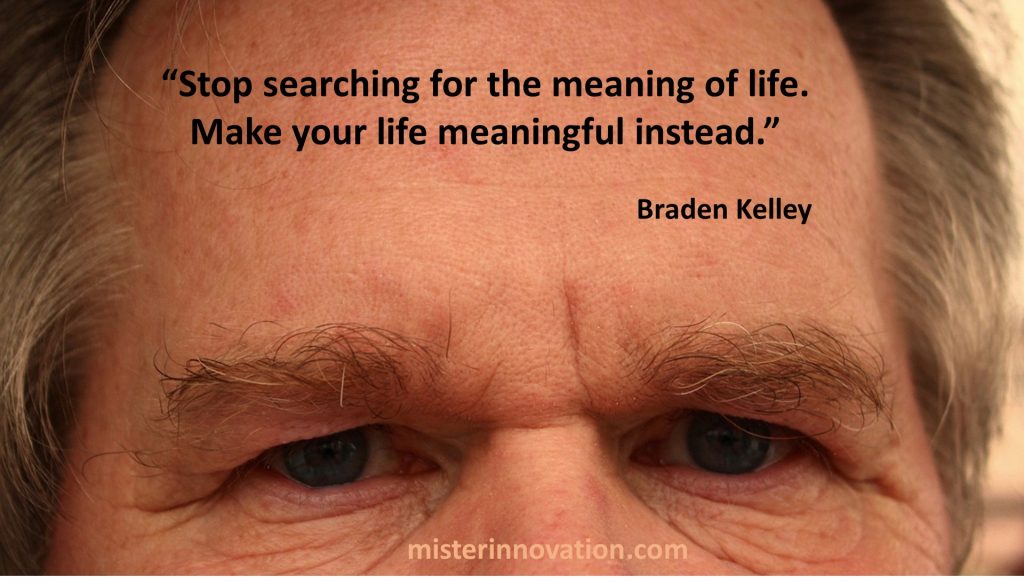
Meaning of Life Quote from Braden Kelley

Our entrepreneurs have made a lot of cotton candy the past couple of decades and people are starving, people are hangry.

There are certain constants in the human condition, and when we as a species stray too far away, it creates huge opportunities for innovators to create new things that will bring us back into balance.

But we can’t ignore where we are now.

We must acknowledge our current situation and fight our way past it. The only way forward is through.

As a thought starter, here is an ad campaign from Heineken from 2017:

We need everyone’s help to address the meaning crisis.

We need everyone’s help to bring America (and the rest of the world) back into productive conversation and connection – to end the division.

Are you up to the task?

Are you ready to help?

Let’s start the dialogue below and get that pebble rolling downhill in the winter, gathering snow as it goes.

I would love to hear your thoughts in the comments on:

  • other great thought starters
  • good idea fragments to build on
  • the way through

Image credit: Pixabay

Subscribe to Human-Centered Change & Innovation WeeklySign up here to get Human-Centered Change & Innovation Weekly delivered to your inbox every week.

Quantifying the Value of Empathy and Collaboration

The Untapped Metrics

Quantifying the Value of Empathy and Collaboration - The Untapped Metrics

GUEST POST from Chateau G Pato

In the data-driven world of modern business, we have become masterful at measuring the tangible. We track ROI, KPIs, and market share with an almost religious fervor. But what if the most powerful drivers of innovation and long-term success are the very things we struggle to quantify? This is the paradox of empathy and collaboration—they are the invisible forces that fuel human-centered innovation, yet they are rarely captured on a dashboard. It’s time to move beyond this oversight and develop a new framework for measuring what truly matters.

We’ve long held a bias toward what’s easy to count: revenue growth, cost reduction, and time-to-market. These metrics are important, but they only tell a part of the story. They measure the output of an organization, but they fail to capture the health of the engine—the human element. A company with high empathy and strong collaboration is an engine that is well-oiled, resilient, and primed for continuous innovation. A company without it is a machine running on fumes, prone to burnout, internal conflict, and a failure to connect with its customers.

The challenge lies in making the intangible tangible. We must develop a new set of metrics that allow us to gauge the strength of our human connections. This isn’t about replacing traditional business metrics; it’s about complementing them with a deeper understanding of the organizational and cultural health that underpins all successful change. By actively measuring and managing the soft skills that drive hard results, we can create a more powerful and sustainable innovation culture. The metrics we need to tap into include:

  • Empathy Quotient (EQ) Scores: Measuring the ability of teams to truly understand and feel the customer’s experience. This can be done through surveys, observational studies, and qualitative feedback.
  • Collaboration Velocity: Tracking the speed and effectiveness with which diverse teams can come together to solve a problem. This involves analyzing communication patterns, project handoffs, and feedback loops.
  • Psychological Safety Index: Gauging whether employees feel safe to take risks, voice dissenting opinions, and admit mistakes without fear of retribution. This is foundational for a truly innovative culture.
  • Customer Experience (CX) Depth: Moving beyond simple satisfaction scores to understand the emotional journey of the customer and the depth of their connection to your brand.
  • Cross-Functional Innovation Rate: Measuring the percentage of successful innovations that originated from collaboration between different departments or teams.

Case Study 1: The Healthcare Innovator and Empathy as a Metric

The Challenge: A Disconnected Patient Experience

A large hospital system was struggling with declining patient satisfaction scores, even though their clinical outcomes were excellent. The data showed that patients felt disconnected and unheard during their visits. The problem wasn’t a lack of medical expertise, but a lack of empathy in the patient-facing process. The organizational culture was focused on efficiency and procedures, with little attention paid to the emotional experience of the patient.

The New Metric and Innovation:

The hospital’s leadership team, in a human-centered change initiative, decided to make **Empathy** a core metric. They created an “Empathy Index” by integrating a new set of questions into patient surveys, focusing on qualitative feedback about how they were listened to and how well their concerns were addressed. They also conducted observational studies to see how staff interacted with patients in real-time. This new metric, along with qualitative feedback, led to a simple but profound innovation: the “Patient Story” program. Staff meetings and training sessions were no longer just about protocols; they began with a personal story from a patient or a family member, reminding the staff of the human impact of their work. Furthermore, they launched a “Listening Skills” training program, explicitly teaching doctors and nurses how to actively listen and respond with empathy.

The Results:

Within a year, the hospital’s patient satisfaction scores saw a dramatic turnaround. The Empathy Index showed a significant increase, and the qualitative feedback was overwhelmingly positive. By making empathy a measurable and celebrated metric, the hospital shifted its culture, leading to a more connected patient experience and, ultimately, better health outcomes. It proved that a soft skill could drive hard, measurable business results.

Key Insight: By creating a quantifiable metric for empathy, organizations can drive cultural and behavioral changes that lead to significant improvements in customer experience and business results.

Case Study 2: The Tech Giant’s Collaboration Velocity

The Challenge: Siloed Innovation and Slow Development

A leading technology company was an acknowledged innovator, but its sheer size had created a problem: its teams were working in silos. A new product idea would often get bogged down as it moved from engineering to marketing to sales, with each department operating on its own timeline and with its own metrics. The result was a slow, inefficient development cycle and a high percentage of promising projects being abandoned due to a lack of cross-functional alignment.

The New Metric and Innovation:

The company’s leadership team recognized that a lack of collaboration was their biggest barrier to growth. They introduced a new metric: **Collaboration Velocity**, which measured the speed at which cross-functional teams could move a project from ideation to launch. They tracked the number of inter-departmental meetings, the frequency of cross-team knowledge sharing, and the speed of project handoffs. This data revealed the key bottlenecks. As an innovation, they introduced a “Fusion Team” model. Instead of having a project move sequentially through departments, a small, multi-disciplinary team with representatives from engineering, design, and marketing was assigned to a project from day one, with shared goals and metrics. Furthermore, they used a “Project Pulse” tool to track the sentiment and psychological safety within these teams, ensuring the collaboration was healthy and productive.

The Results:

The results were immediate and impactful. The company’s Collaboration Velocity improved by over 40% in the first year. The Fusion Teams were able to launch new products in half the time of the traditional model, with far greater internal alignment and market success. The company’s overall innovation output increased, and the new metric gave leaders a clear, data-driven way to prove the value of breaking down silos and investing in collaborative team structures. The intangible value of collaboration became a powerful, measurable driver of competitive advantage.

Key Insight: Measuring the health and speed of collaboration provides a clear path to breaking down organizational silos and accelerating the pace of innovation.

The Path Forward: A New Era of Measurement

The future of innovation belongs to those who are brave enough to expand their definition of what can be measured. We must stop treating empathy and collaboration as unquantifiable “soft skills” and start seeing them as the strategic, measurable assets they truly are. By developing and integrating these new metrics into our dashboards, we are not just adding to our data; we are gaining a richer, more holistic understanding of our organizational health. This allows us to make more informed decisions, nurture a culture of trust and psychological safety, and, most importantly, build a more resilient and human-centered engine for continuous innovation. It’s time to stop flying blind and start quantifying the forces that are truly driving us forward.

Extra Extra: Because innovation is all about change, Braden Kelley’s human-centered change methodology and tools are the best way to plan and execute the changes necessary to support your innovation and transformation efforts — all while literally getting everyone all on the same page for change. Find out more about the methodology and tools, including the book Charting Change by following the link. Be sure and download the TEN FREE TOOLS while you’re here.

Image credit: Pixabay

Subscribe to Human-Centered Change & Innovation WeeklySign up here to get Human-Centered Change & Innovation Weekly delivered to your inbox every week.

Leveraging Opposition to Drive Change Forward

Leveraging Opposition to Drive Change Forward

GUEST POST from Greg Satell

Clearly, we live in a time of great flux. First, #MeToo, then Covid-19 and now a new racial consciousness in the wake of the murder of George Floyd. The most important task for leaders over the coming years will be to guide their organizations through change. Make no mistake, it won’t be easy. Important changes always encounter staunch resistance.

In Cascades, I researched dozens of change efforts ranging from historic turnarounds at major corporations like IBM and Alcoa, to political revolutions like the color revolutions in Eastern Europe and social movements like the struggle for civil and LGBT rights in America. Every one had to overcome entrenched opposition to succeed.

Yet probably the most impressive strategy for overcoming opposition I came across was how the Serbian movement called Otpor devised a plan to turn arrests to their advantage. The key to their strategy was to study their opposition, anticipate its actions and leverage them for their own benefit. Business leaders can use similar strategies to drive change forward.

Forming a Sense of Identity

Clearly, the threat of arrests poses a significant obstacle to any protest movement. In the case of Otpor, which was working to bring down the brutal Milošević regime, there was not only the threat of incarceration and embarrassment, but serious physical harm. The authorities depended on this fear to keep people in line.

So Otpor set out to make arrests a source of pride rather than fear. Anyone who was arrested got a t-shirt and the more times you were arrested, the better t-shirt you got. Once you were arrested five times, you received the coveted black Otpor t-shirt that you could wear to school the next day and impress all your friends.

Many of the transformational change efforts I researched used similar strategies. In his quest to reform the Pentagon from within, Colonel John Boyd gathered around him a passionate group of “Acolytes” which would support each other, help check facts, streamline logical arguments and hone the message of a particular reform plan.

Those who are working to undermine your efforts want to make you feel isolated and alone. Even a seemingly powerful CEO can face a skeptical board, investor community and media. So, the first step is to build a strong sense of identity, which is why even massive transformations tend to start with small groups and build out from there.

Devising an Infiltration Strategy

Whenever you set out to make a significant change, there are going to be some people who aren’t going to like it. Change of any kind threatens the status quo, which has inertia on its side and never yields its power gracefully.

Yet one of the biggest mistakes a change effort can make is to see the opposition as monolithic. While it’s easy to think that anyone who isn’t with you to be against you, the truth is that there are always shades of belief. Some really are dead set against the change you want to bring about, but others are only passively opposed, and most are probably fairly neutral.

One of the Otpor activists’ most brilliant strokes was to see arrests as an opportunity for infiltration because it gave them the opportunity to make friends with the individual police officers, most of whom didn’t particularly like arresting peaceful student protestors. Later, when many of these same officers had to decide whether to shoot into the crowd or join the movement, they chose the latter.

Make no mistake. To drive any kind of change forward you need to bring people in who don’t immediately agree with you. Transformation is never really top down or bottom up, but moves side to side. You don’t create change just by rallying your supporters, but by breaking through higher thresholds of resistance to bring in others.

Let Your Opponents Overreach and Send People Your Way

While Otpor’s infiltration strategy was highly effective, it didn’t solve the problem of arrests. Peaceful activists were still being taken in and, in many cases, abused. No amount of respectful behavior and playful banter could fully inoculate the activists from the reality that at least some of the police officers enjoyed terrorizing them.

Yet here too, Otpor found ways to use the situation to their advantage. First, every activist had the local Otpor office on speed dial. When someone got arrested, they pressed the button on their phones and their colleagues immediately knew that an arrest was under way. Which set into motion a number of actions.

First, lawyers were called to ensure that the rights of the activists would be protected. Then, a protest would be organized outside the police station and the media would be notified. An affiliate group, “Mothers of Otpor,” would show up and demand to know why their sons and daughters were being persecuted and abused.

So instead of arrests embarrassing the protestors, they embarrassed the regime. Every time it arrested an Otpor activist, it was subjected to a media barrage that showed peaceful protests outside police stations including not only well-behaved activists, but their mothers demanding to know why the regime was terrorizing their children.

Once your opposition senses that you are gaining traction, they will tend to lash out and send people your way. In my research, I’ve been truly amazed at how consistent this behavior is. It doesn’t matter whether you’re an activist executing peaceful protests, a change agent trying to scale an important program or simply someone trying to win a consensus in a meeting. Getting your opponents to overreach will often be the thing that breaks the logjam and brings change about.

Learning To Love Your Haters

Every transformational change starts with a heartfelt sense of grievance, and it doesn’t take a brutal regime to arouse passions. The need to adopt a new technology, transform a business model or shift an organizational culture, can be just as emotional as a political movement like Otpor. So it can be incredibly frustrating when people stand in the way of change.

Yet in my research, I found that successful change efforts didn’t demonize their opposition, they learned from them. In some cases, those that resisted change had good reasons and helped point out flaws in the plan. In other cases, by engaging in dialogue, they helped identify shared values and a common purpose.

The genius behind Otpor’s arrest strategy is that it made a distinction between the institution of the regime and the humanity of the police officers who were just trying to do their job and go home to their families at night. It was that insight that led them to engage with the individual officers, joke with them and get to know them on a personal basis.

And that’s the lesson we can learn, whether we are working to transform an organization, an industry, a community or society as a whole. Those that oppose us often feel just as passionately about their cause as we do ours. We overcome opposition not by overpowering it, but through identifying shared values and attracting others to our side.

— Article courtesy of the Digital Tonto blog
— Image credit: Unsplash

Subscribe to Human-Centered Change & Innovation WeeklySign up here to get Human-Centered Change & Innovation Weekly delivered to your inbox every week.

Communicating Change Through Emotion and Connection

Beyond Data

Communicating Change Through Emotion and Connection

GUEST POST from Art Inteligencia

In the world of innovation and change, we often fall into the trap of believing that the strongest argument is a spreadsheet full of data. We present charts, projections, and ROI models, confident that logic alone will win the day. But what we’re forgetting is a fundamental truth of human-centered leadership: people don’t just act on logic; they act on emotion. To truly drive change, we must learn to communicate not just to the brain, but to the heart.

Change, by its very nature, is a human experience. It is filled with uncertainty, fear of the unknown, and a natural resistance to disruption. A new strategy, a technological rollout, or an organizational restructuring isn’t just a line item on a budget; it’s a profound shift in how people work, feel, and see their future. The sterile, data-driven presentation, while intellectually sound, often fails to address the emotional core of this experience. It can feel impersonal, top-down, and threatening, creating a chasm between leadership’s vision and the workforce’s reality.

Effective communication of change, therefore, requires a strategic shift. We must move beyond the “what” and the “how” and lean into the “why”—and not just the financial “why,” but the human “why.” We need to tell stories that connect with our audience, creating a shared vision that is both compelling and empathetic. This means communicating with authenticity, vulnerability, and a genuine understanding of the human element. It is the difference between simply informing people and truly inspiring them.

The key to this is a communication model built on three pillars: Story, Empathy, and Connection. A Story gives the change a narrative arc, with a clear hero (the organization or the customer) and a compelling challenge. Empathy means acknowledging the difficulties and fears that come with change, validating people’s emotions rather than dismissing them. And Connection is about creating a shared sense of purpose, linking the change to a greater mission that people can believe in and feel a part of. When these three elements are present, change communication becomes a powerful tool for building trust and momentum.

Case Study 1: The Turnaround of a Global Tech Giant

The Challenge: Widespread Cynicism and Resistance to Change

A global technology company, once an industry leader, was facing a period of decline. Years of failed initiatives and top-down mandates had created a culture of deep-seated cynicism. When a new leadership team was brought in to enact a massive turnaround, they were met with immediate resistance. Employees were tired of being told to change without understanding why, and the data-heavy presentations from management only reinforced their feelings of being treated as numbers on a spreadsheet.

The Emotional Communication Approach:

The new CEO recognized that a traditional approach would fail. Instead of leading with a business plan, he began his first major address with a personal story. He spoke about his early days at the company, the pride he felt in its groundbreaking products, and the shared mission that once united everyone. He then moved from this emotional connection to acknowledge the current reality with brutal honesty, validating the employees’ frustration and disappointment. He framed the new strategy not as a directive, but as a collective journey to reclaim their legacy and once again become the company they were all proud to be a part of. The data and business strategy were presented not as a goal in themselves, but as the practical steps to achieve that inspiring vision.

The Results:

The shift in communication style was transformative. By leading with emotion and connection, the CEO broke through the wall of cynicism. Employees began to see the change not as another management fad, but as a genuine effort to rebuild something they all valued. Engagement and morale saw a dramatic improvement, and a culture of trust began to replace one of fear. The company’s turnaround, while still challenging, gained the crucial buy-in from its most important asset: its people. The change was no longer something happening *to* them, but something they were all doing *together*.

Key Insight: Authenticity and vulnerability can be a leader’s most powerful tools for breaking through cynicism and gaining emotional buy-in for a major change initiative.

Case Study 2: The Hospital System and a New Digital Initiative

The Challenge: Fear and Skepticism of New Technology

A large hospital system was preparing to implement a new, highly complex digital patient management system. While the technology promised to streamline processes and improve patient care, the project was met with significant skepticism from the nursing and medical staff. They were worried the new system would be clunky, time-consuming, and a barrier between them and their patients. The initial communication from IT leadership, which focused on technical specifications and efficiency gains, did little to alleviate these fears. It felt cold and disconnected from their daily reality.

The Emotional Communication Approach:

The project leadership changed tack. They stopped presenting the change as a technology project and started framing it as a human-centered one. They gathered a small group of highly respected nurses and doctors and asked them to share their own stories of why they chose to work in healthcare—the moments of connection with patients that mattered most. The leaders then used these stories, and the nurses’ and doctors’ own language, to communicate how the new system would give them back time from administrative tasks so they could focus more on the human connection they cherished. The message became: “This new technology isn’t a barrier; it’s a tool to help you do what you love more effectively.” The communication strategy included testimonials and videos from the pilot teams, sharing their emotional journey from skepticism to advocacy.

The Results:

By connecting the new technology to the emotional core of their work—caring for patients—the project team was able to build a bridge of understanding. The staff began to see the system not as a threat, but as an ally. The initial resistance faded, and early adopters became vocal champions, sharing their positive experiences with colleagues. The implementation was smoother, and the adoption rate was significantly higher than initially projected. The change was successfully communicated not as a technological upgrade, but as a way to honor and improve the most fundamental aspect of their jobs.

Key Insight: To drive change, connect new initiatives to the core values and emotional drivers that give people’s work meaning.

The Road Ahead: Building a Human-Centered Communication Strategy

As leaders of innovation, our job is not to simply implement change, but to guide people through it. The data, the business case, and the technical specifications are all necessary, but they are insufficient. We must be storytellers and empathetic listeners. We must connect the dots between the spreadsheet and the human experience. By doing so, we don’t just overcome resistance; we create a powerful, shared purpose that transforms an organization and unlocks its true potential. The most successful change initiatives will always be built not on the firm ground of logic, but on the enduring foundation of human connection.

Extra Extra: Futurology is not fortune telling. Futurists use a scientific approach to create their deliverables, but a methodology and tools like those in FutureHacking™ can empower anyone to engage in futurology themselves.

Image credit: Pexels

Subscribe to Human-Centered Change & Innovation WeeklySign up here to get Human-Centered Change & Innovation Weekly delivered to your inbox every week.