Why You Must Define Innovation

(Hint: It’s All About Efficiency)

Why You Must Define Innovation

GUEST POST from Robyn Bolton

As the world around you becomes more volatile, uncertain, complex, and ambiguous (VUCA), you know that you need to build skills to navigate it and inspire others to follow your path.

But what if you are the source of ambiguity? 

Because you are. Every time you speak.

The words we use always have clear meaning and intent to us but may not (and often don’t) have the same meaning and intent to others. 

That’s why one of the first and most essential things a company can do when starting its innovation journey is to decide what “innovation” means. It may seem like an academic exercise, but it becomes very practical when you discover that one person thinks it means something new to the world, another thinks it’s a new product, and a third thinks it means anything commercialized.

Ambiguity = Efficiency?

“Innovation” isn’t the only word that is distractingly ambiguous. Language, in general, evolved to be ambiguous because ambiguity makes it more efficient. In 2012, cognitive scientists at MIT found the ambiguity–efficiency link, noting “words with fewer syllables and easier pronunciation can be ‘reused,’ avoiding the need for a vast and increasingly complex vocabulary.” 

You read that right. In language, ambiguity leads to efficiency.

Every time you speak, you’re ambiguous. You’re also efficient.

The RIGHT level of Ambiguity = Efficiency!

In 2014, researchers at Pompeu Fabra University in Barcelona found that language’s ambiguity is critical to communicating complex ideas,

“the researchers argue that the level of ambiguity we have in language is at just the right level to make it easy to speak and be understood. If every single object and concept had its own unique word, then language is completely unambiguous – but the vocabulary is huge. The listener doesn’t have to do any guessing about what the speaker is saying, but the speaker has to say a lot. For example, “Come here” might have to be something like “I want you to come to where I am standing.” At the other extreme, if the same word is used for everything, that makes it easy for the speaker, but the listener can’t tell if she is being told about the weather or a rampaging bear.”

.

Either way, communication is hard. But Sole and Seoane argue that with just the right amount of ambiguity, the two can find a good trade-off.”

A certain level of ambiguity is efficient. Too much or too little is inefficient.

How to find the RIGHT level of Ambiguity for “Innovation”

In everyday life, it’s ok for everyone to have a slightly different definition of innovation because we all generally agree it means “something new.”  Sure, there will be differences of opinion on some things (is a new car an “innovation” if it just improved on the previous model?). Still, overall, we can exist in this world and interact with each other despite, or maybe because of, the ambiguity.

Work is a different story. If you are responsible for, working on, or even associated with innovation, you better be very clear on what “innovation” means because its definition determines expectations and success for what you do. If it means one thing to you and a different thing to your boss, and a third thing to her boss, you’re in for a world of disappointment and pain.

Let’s avoid that.  Instead:

  1. Define the word
  2. Get everyone to agree on the definition
  3. Use the word and immediately follow it with, “And by that, I mean (definition)”

Gently correct people when they use the word to mean something other than the agreed-upon definition. Once everyone uses the word correctly, you can stop defining it every time because its meaning has taken root.

So, the next time someone rolls their eyes and comments on the “theoretical” or “academic” (i.e., not at all practical, useful, or actionable) exercise of defining innovation, smile and explain that this is an exercise in efficiency.

Subscribe to Human-Centered Change & Innovation WeeklySign up here to join 17,000+ leaders getting Human-Centered Change & Innovation Weekly delivered to their inbox every week.

The Digital Revolution Has Been A Giant Disappointment

The Digital Revolution Has Been A Giant Disappointment

GUEST POST from Greg Satell

One of the most often repeated episodes in the history of technology is when Steve Jobs was recruiting John Sculley from his lofty position as CEO at Pepsi to come to Apple. “Do you want to sell sugar water for the rest of your life,”Jobs asked, “or do you want to come with me and change the world?”

It’s a strange conceit of digital denizens that their businesses are something nobler than other industries. While it is true that technology can do some wonderful things, if the aim of Silicon Valley entrepreneurs was truly to change the world, why wouldn’t they apply their formidable talents to something like curing cancer or feeding the hungry?

The reality, as economist Robert Gordon explains in the The Rise and Fall of American Growth, is that the measurable impact has been relatively meager. According to the IMF, except for a relatively short burst in growth between 1996 and 2004, productivity has been depressed since the 1970s. We need to rethink how technology impacts our world.

The Old Productivity Paradox

In the 1970s and 80s, business investment in computer technology was increasing by more than 20% per year. Strangely though, productivity growth had decreased during the same period. Economists found this turn of events so strange that they called it the productivity paradox to underline their confusion.

The productivity paradox dumbfounded economists because it violated a basic principle of how a free market economy is supposed to work. If profit seeking businesses continue to make substantial investments, you expect to see a return. Yet with IT investment in the 70s and 80s, firms continued to increase their investment with negligible measurable benefit.

A paper by researchers at the University of Sheffield sheds some light on what happened. First, productivity measures were largely developed for an industrial economy, not an information economy. Second, the value of those investments, while substantial, were a small portion of total capital investment. Third, businesses weren’t necessarily investing to improve productivity, but to survive in a more demanding marketplace.

Yet by the late 1990s, increased computing power combined with the Internet to create a new productivity boom. Many economists hailed the digital age as a “new economy” of increasing returns, in which the old rules no longer applied and a small initial advantage would lead to market dominance. The mystery of the productivity paradox, it seemed, had been solved. We just needed to wait for the technology to hit critical mass.

The New Productivity Paradox

By 2004, the law of increasing returns was there for everyone to see. Google already dominated search, Amazon ruled e-commerce, Apple would go on to dominate mobile computing and Facebook would rule social media. Yet as the dominance of the tech giants grew, productivity would once again fall to depressed levels.

Yet today, more than a decade later, we’re in the midst of a second productivity paradox, just as mysterious as the first one. New technologies like mobile computing and artificial intelligence are there for everyone to see, but they have done little, if anything, to boost productivity.

At the same time the power of digital technology is diminishing. Moore’s law, the decades old paradigm of continuous doubling in the power of computer processing is slowing down and soon will end completely. Without advancement in the underlying technology, it is hard to see how digital technology will ever power another productivity boom.

Considering the optimistic predictions of digital entrepreneurs like Steve Jobs, this is incredibly disappointing. Compare the meager eight years of elevated productivity that digital technology produced with the 50-year boom in productivity created in the wake of electricity and internal combustion and it’s clear that digital technology simply doesn’t measure up.

The Baumol Effect, The Clothesline Paradox and Other Headwinds

Much like the first productivity paradox, it’s hard to determine exactly why the technological advancement over the last 15 years has amounted to so little. Most likely, it is not one factor in particular, but the confluence of a number of them. Increasing productivity growth in an advanced economy is no simple thing.

One possibility for the lack of progress is the Baumol effect, the principle that some sectors of the economy are resistant to productivity growth. For example, despite the incredible efficiency that Jeff Bezos has produced at Amazon, his barber still only cuts one head of hair at a time. In a similar way, sectors like healthcare and education, which require a large amount of labor inputs that resist automation, will act as a drag on productivity growth.

Another factor is the Clothesline paradox, which gets its name from the fact that when you dry your clothes in a machine, it figures into GDP data, but when you hang them on a clothesline, no measurable output is produced. In much the same way, when you use a smartphone to take pictures or to give you directions, there is considerable benefit that doesn’t result in any financial transactions. In fact, because you use less gas and don’t develop film, GDP decreases somewhat.

Additionally, the economist Robert Gordon, mentioned above, notes six headwinds to economic growth, including aging populations, limits to increasing education, income inequality, outsourcing, environmental costs due to climate change and rising household and government debt. It’s hard to see how digital technology will make a dent in any of these problems.

Technology is Never Enough to Change the World

Perhaps the biggest reason that the digital revolution has been such a big disappointment is because we expected the technology to largely do the work for us. While there is no doubt that computers are powerful tools, we still need to put them to good use and we have clearly missed opportunities in that regard.

Think about what life was like in 1900, when the typical American family didn’t have access to running water, electricity or gas powered machines such as tractors or automobiles. Even something simply like cooking a meal took hours of backbreaking labor. Yet investments in infrastructure and education combined with technology to produce prosperity.

Today, however, there is no comparable effort to invest in education and healthcare for those who cannot afford it, to limit the effects of climate change, to reduce debt or to do anything of anything of significance to mitigate the headwinds we face. We are awash in nifty gadgets, but in many ways we are no better off than we were 30 years ago.

None of this was inevitable, but the somewhat the results of choices that we have made. We can, if we really want to, make different choices in the days and years ahead. What I hope we have learned from our digital disappointments is that technology itself is never enough. We are truly the masters of our fate, for better or worse.

— Article courtesy of the Digital Tonto blog
— Image credit: Pixabay

Subscribe to Human-Centered Change & Innovation WeeklySign up here to join 17,000+ leaders getting Human-Centered Change & Innovation Weekly delivered to their inbox every week.

3 Flavors of Product-Service Shift

Which One is Yours?

3 Flavors of Product-Service Shift

GUEST POST from Geoffrey A. Moore

The most profound change in enterprise computing in this century to date has been the shift in value delivery modality from product to service and the corresponding rise is XaaS or Everything-as-a-Service. The current bull market leaders in the tech sector take this for granted, and the prior generation of incumbents are still scrambling to get themselves onto the new model. For consumers this is an all-upside proposition; for enterprises, it is a balancing act of open fluidity versus secure compliance. But everyone seems to know their place in the new order—or do they?

As the product-service shift unfolds, it can manifest itself at three very different levels of value delivery, each of which has its own priorities. When you are looking to help your organization navigate the transition, it would be good to get clear as to which path you are on:

1. Infrastructure Model Transformation

This is the easiest to absorb, the impact for the most part contained on the vendor side within Finance and Legal and on the customer side within the IT organization itself. Basically, all you are doing is changing the contract from a license to a service level agreement, and staging a series of leasing payments out of op ex instead a one-time purchase out of cap ex. For clarity sake, think of this as a move to subscription, not yet to For most people in the organization, it is a non-event.

2. Operating Model Transformation

This move has the most impact on incumbent vendors and their installed base. As Todd Hewlin and J B Wood described in Consumption Economics, the shift is based on a change from the customer to the vendor as the one who must absorb goal attainment risk. In a product model, once the customer has bought and paid for it, the customer owns virtually all the risk. That can readily lead to a lot of drive-by selling, the sort of thing that built out empires of shelfware in the late 1990s. In a service model, by contrast, the vendor can never stop owning the success of the offering, not if they want to protect against their installed base churning out from underneath them. This is the true product-service shift, and even now it is sufficiently novel that both customers and vendors are still sorting out the implications for what staffing and expertise is needed on both sides of this relationship.

3. Business Model Transformation

This is the most impactful for venture-backed start-ups and the incumbent franchises they are looking to disrupt. Typically the former are re-architecting an established but aging value chain by substituting digital services for physical-world interactions. The biggest disruptions we have seen thus far are in retail, print media, financial services, transportation, hospitality, and communications, with lots more to come. They all represent daggers pointed at the heart of established enterprises because even when the latter can find ways to re-engineer their own offers to match the new paradigm, it is still painfully hard to bring the rest of their ecosystems up to speed to deliver the whole product. And to a lesser extent, the same goes for their customer bases. That is why disruption usually starts with targeting customers who have been disenfranchised by the old solution. It is only over time that the Innovator’s Dilemma bill comes to for the established vendors, but when it does, it hits with a wallop.

For most companies, the path you want to double-click on is the Operating Model Transformation, and in the next post, I want to dig in a lot deeper there.

That’s what I think. What do you think?

Image Credit: Pixabay

Subscribe to Human-Centered Change & Innovation WeeklySign up here to join 17,000+ leaders getting Human-Centered Change & Innovation Weekly delivered to their inbox every week.3

The Real Problem with Problems

The Real Problem with Problems

GUEST POST from Mike Shipulski

If you don’t know what the problem is, that’s your first problem.

A problem can’t be a problem unless there’s a solution. If there’s no possible solution, don’t try to solve it, because it’s not a problem.

If there’s no problem, you have a big problem.

If you’re trying to solve a problem, but the solution is outside your sphere of influence, you’re taking on someone else’s problem.

If someone tries to give you a gift but you don’t accept it, it’s still theirs. It’s like that with problems.

If you want someone to do the right thing, create a problem for them that, when solved, the right thing gets done.

Problems are good motivators and bad caretakers.

A problem is between two things, e.g., a hammer and your thumb. Your job is to figure out the right two things.

When someone tries to give you their problem, keep your hands in your pockets.

A problem can be solved before it happens, while it happens, or after it happened. Each time domain has different solutions, different costs, and different consequences. Your job is to choose the most appropriate time domain.

If you have three problems, solve one at a time until you’re done.

Solving someone else’s problem is a worst practice.

If you solve the wrong problem, you consume all the resources needed to solve the right problem without any of the benefits of solving it.

Ready, fire, aim is no way to solve problems.

When it comes to problems, defining IS solving.

If you learn one element of problem-solving, learn to see when someone is trying to give you their problem.

Image credit: Pixabay

Subscribe to Human-Centered Change & Innovation WeeklySign up here to join 17,000+ leaders getting Human-Centered Change & Innovation Weekly delivered to their inbox every week.

Simple Sells

How Simple Can You Make Your Business?

Simple Sells - How Simple Can You Make Your Business?

GUEST POST from Shep Hyken

I love good barbeque. I live in St. Louis, which is famous for some of the best BBQs in the world! Really! We have a number of restaurants that have competed in worldwide competitions and come back with the first-place trophy.

My friend Norman Beck loves BBQ, too. Living in Texas, he’s also exposed to some of the best BBQ in the world, although I’ll argue it’s second to St. Louis. He teased me the other day by sending pictures of dinners featuring brisket, ribs, sausage and delicious side dishes from award-winning Hutchins BBQ in North Texas. He also included a description of its marketing plan.

According to Beck, the marketing plan is simple:

  1. Cook the best BBQ in Texas. My comment: Always do your best. Beck said the owner has one goal, “Be a little better today than you were yesterday.” That’s a great goal. Even if you don’t hit it, trying makes a big difference.
  2. Sell it at a fair price. My comment: A fair price doesn’t mean the lowest price. When you sell a good product, the price is less relevant.
  3. Be nice to everyone. My comment: This is customer service 101. It’s the basics. If you have the best BBQ but treat people with disrespect, you won’t be nearly as successful. And when you combine friendly service with a great product, price becomes even less relevant. People will pay more for the best of both worlds!
  4. Close when you sell out. My comment: I love the law of scarcity. When people know they have to “act now,” or they may miss out, they make more of an effort to do business with you.
  5. Repeat. My comment: If it works, just keep doing it!

The other thing you’ll notice about Hutchins (and most other BBQ restaurants), is they don’t spend a lot of money on ambiance. Many BBQ “joints” have wooden tables and chairs. The restaurants are set for function. In other words, no fancy light fixtures or expensive plates. They keep the place clean, and that’s about it.

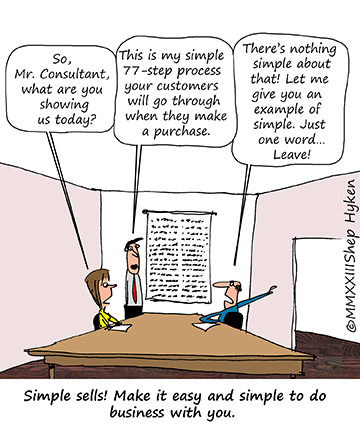
The point of all of this is simplicity. You don’t go to a BBQ restaurant unless you want BBQ. The choices are limited, and so are the quantities. The BBQ chefs know how much to prepare every day, and when they run out, they close for the night. Customers know this and don’t expect anything more.

Simple Sells Cartoon by Shep Hyken

Most likely, your business has a few more “moving parts” than a BBQ restaurant. That doesn’t mean you can’t find ways to simplify the customer experience, your internal processes, and more. Go through an exercise in simplification by asking questions like these:

  1. Is any part of the process of our customer experience (or employee experience) redundant?
  2. Is there anything in our process that is unnecessary?
  3. Is every touchpoint our customers experience with us optimized for ease and efficiency?
  4. What could we do to make it easier to do business with us?

Asking questions like these and implementing the answers will help you simplify your business.

Image Credits: Shep Hyken, Unsplash

Subscribe to Human-Centered Change & Innovation WeeklySign up here to join 17,000+ leaders getting Human-Centered Change & Innovation Weekly delivered to their inbox every week.

48-hour Flash Sale on Charting Change Hardcover

with Free Shipping Worldwide*

48-hour Flash Sale on Charting Change Hardcover

Wow! Exciting news!

From now until midnight EST on July 21, 2023 you can get the hardcover version of my latest best-selling book Charting Change for 50% off! (USE CODE FLS23 at checkout)

AND

From now until July 28, 2023 you can get the digital version (eBook) for only $12.99!

I created the Human-Centered Change methodology to help organizations get everyone literally all on the same page for change. The 70+ visual, collaborative tools are introduced in my book Charting Change, including the powerful Change Planning Canvas™. The toolkit has been created to help organizations:

  • Beat the 70% failure rate for change programs
  • Quickly visualize, plan and execute change efforts
  • Deliver projects and change efforts on time
  • Accelerate implementation and adoption
  • Get valuable tools for a low investment

You must go to SpringerLink for this Cyber Sale:

  • The 50% off hardcover offer is valid until midnight July 21, 2023 (USE CODE FLS23 at checkout)
  • The $12.99 eBook offer is valid until July 28, 2023

Click here to get either deal

Quick reminder: Everyone can download ten free tools from the Human-Centered Change methodology by going to its page on this site via the link in this sentence, and book buyers can get 26 of the 70+ tools from the Change Planning Toolkit (including the Change Planning Canvas™) by contacting me with proof of purchase.

*This offer is valid for selected English-language Palgrave eBooks and is redeemable on link.springer.com only. Titles affected by fixed book price laws, forthcoming titles and titles temporarily not available on link.springer.com are excluded from this promotion, as are reference works, handbooks, encyclopedias, subscriptions, or bulk purchases. The currency in which your order will be invoiced depends on the billing address associated with the payment method used, not necessarily your home currency. Regional VAT/tax may apply. Promotional prices may change due to exchange rates. This offer is valid for individual customers only. Booksellers, book distributors, and institutions such as libraries and corporations please visit springernature.com/contact-us. This promotion does not work in combination with other discounts or gift cards.

Navigating the AI Revolution

Leveraging the Three Horizons for Tomorrow’s Triumphs

Navigating the AI Revolution - Leveraging the Three Horizons for Tomorrow's Triumphs

GUEST POST from Teresa Spangler

The future belongs to those who prepare for it today. As we stand at the dawn of the AI revolution, we must not merely adapt to change; we must anticipate it, shape it, and turn it to our advantage. Embracing the three horizons of AI is not just about technology or strategy; it’s about purpose – our purpose as leaders to guide our organizations, our people, and our society into a prosperous, equitable, and truly human future.

Teresa Spangler

As we turn the page on a year of profound transformation, the horizon of 2024 and beyond takes shape. Artificial Intelligence (AI) is steadfastly marching forward, and as leaders, the pressing call to pilot our organizations through these new frontiers couldn’t be more poignant. We must explore how executive leadership can initiate actionable measures today to harness tomorrow’s opportunities.

As the silhouette of 2024 looms ahead, we realize that maneuvering through the turbulent waters of change requires not just a reactive approach, but a meticulously charted plan. A navigational tool that can prove invaluable in this journey is the Three Horizons framework for futures planning. This framework allows us to methodically comprehend, envision, and shape our path through the cascading waves of AI development. By exploring each horizon in detail, we can create a strategic roadmap that integrates immediate actions, mid-term plans, and long-term visions. Let’s delve deeper into this process, beginning with the groundwork of understanding today’s AI landscape.

The Groundwork: Understanding Today’s AI Landscape – Horizon 1

Diving into the fast-paced whirlwind of AI, a comprehensive grasp of today’s landscape is the cornerstone for future triumphs. Familiarity with various AI technologies, like machine learning, natural language processing, robotics, and computer vision, is now an indispensable part of the executive toolkit. However, a theory is merely the starting point.

Turning this knowledge into strategic assets necessitates that you:

  • Actively interact with AI tools like, ChatGPT, DALL-E, DeepArt and DeepDream, Stable Diffusion, Midjourney …etc. Developing even rudimentary AI models with platforms like TensorFlow or PyTorch can shed light on AI’s potential and limitations. For instance, IBM’s Project Debater showcases how AI can understand the context and form logical arguments, pushing the boundary of natural language processing.
  • Forecast AI’s immediate future is leveraging trends in AI research, market dynamics, societal needs, and regulatory shifts. Access the best industry reports and collaborate with external experts that offer invaluable insights. A recent McKinsey report, for instance, found that companies integrating AI were nearly twice as likely to be top-quartile performers in their industry.

It’s widely acknowledged that AI will significantly alter the dynamics of how our world operates. While the intricacies of this transformation can seem complex, it’s certainly not an insurmountable challenge! The Three Horizons methodology is one of many effective strategies your organization can adopt to manage this transition. By strategically navigating through these horizons with a cohesive team and a well-articulated plan, your organization will be well-positioned to embrace the AI revolution. Here are a few other methodologies you might consider:

  1. Scenario Planning: This approach involves envisioning different future states and developing strategies to succeed in each potential scenario.
  2. Backcasting: Starting with a desirable future end-state, this method works backward to identify the strategic steps required to reach that goal.
  3. Roadmapping: This technique charts out the evolution of technologies and products, helping you understand how technological progress might affect your business over time.

Choosing the right methodology will depend on your specific circumstances and objectives. Regardless of the approach, remember that the key to success lies in aligning your team and developing a clear, comprehensive plan of action.

On to Horizon 2 & 3

Navigating the Waves: Crafting the Mid-Term AI Future – Horizon 2

As part of the C-suite, your role extends beyond mere reactions to change – you’re a herald of future trends. Structuring the mid-term AI future necessitates:

  • Assimilating the implications of AI for your industry. Evaluate how job roles might evolve, identify the ethical and privacy concerns, and understand the geopolitical interplays of AI on your global strategies. For instance, AI-driven automation could reshape employment, as seen with Amazon’s warehouse robots.
  • Tailoring a 3-5 year forecast using foresight platforms like FuturePlatform to incorporate technological breakthroughs, policy changes, societal trends, and economic factors. Staying informed about AI regulations through think tanks like the AI Now Institute can help you navigate this complex terrain.

Setting the Sails: Envisioning a Decade Ahead – Horizon 3

Leadership in the AI epoch means having the courage to gaze beyond the immediate future. For the long-term horizon, consider the following:

  • Contemplating the possibilities. Quantum computing, advanced neural networks, and sophisticated AI-human interfaces might be the norm a decade from now. Consider how Microsoft’s recent advancements in quantum computing could revolutionize data processing and analysis in your industry.
  • Employing scenario planning to prepare for a multitude of futures. Use strategic planning software like Lucid chart to visualize different assumptions about technological progress, regulatory changes, and societal evolution.
  • Formulating strategic plans based on these scenarios. The essence of leadership is making today’s decisions with an eye on tomorrow’s probabilities.
  • Maximize the power of external expertise. Benefit from programs like Plazabridge Group’s Innovation Pro™, Innofusion™ Transformation, Innofusion™ Sprint, and Innofusion™ Sustainability Assessment to aid your journey. These programs offer valuable outside perspectives that can enrich your understanding and application of AI. They provide fresh insights, hands-on experience, and expert guidance in navigating the complex AI landscape. Find out more [Learn more] to embark on your AI journey.

External experts act as crucial navigators in this AI expedition. They help decode ethical challenges, demystify technological complexities, and forecast future trends, equipping executives to make well-informed, strategic decisions in the face of AI’s rapid evolution.

As we draw closer to 2024, remember that we’re not merely spectators of the emerging AI revolution – we’re the trailblazers. As leaders, we have the power to do more than respond to change; we can architect it. The ripples of our leadership will extend beyond our organizations, shaping the very fabric of our society. The future isn’t something that simply happens to us – we’re active participants in its creation. Now is the time to embrace this momentous journey, and lead with boldness and determination.

Image credit: Unsplash

Subscribe to Human-Centered Change & Innovation WeeklySign up here to join 17,000+ leaders getting Human-Centered Change & Innovation Weekly delivered to their inbox every week.

How to Make Navigating Ambiguity a Super Power

How to Make Navigating Ambiguity a Super Power

GUEST POST from Robyn Bolton

You are a leader. The boss. The person in charge.

That means you know the answer to every question, make the right decision when faced with every choice, and act confidently when others are uncertain. Right?

(Insert uproarious laughter here).

Of course not. But you act like you do because you’re the leader, the boss, the person in charge.

You are not alone. We’re all doing it.

We act like we have the answers because we’ve been told that’s what leaders do. We act like we made the right decision because that’s what leaders do in a volatile, uncertain, complex, and ambiguous (VUCA) world where we must work quickly and flexibly while doing more with less.

But what if we didn’t? 

What if we stopped pretending to have the answer or know the right choice? What if we acknowledged the ambiguity of a situation, explored its options and interpretations for just a short while, and then decided?

We’d make more informed choices. We’d be more creative and innovative. We’d inspire others.

So why do we keep pretending?

Ambiguity: Yea! Meh. Have you lost your mind?!?

Stanford’s d.School calls the ability to navigate ambiguity “the super ability” because it’s necessary for problem-finding and problem-solving. Ambiguity “involves recognizing and stewing in the discomfort of not knowing, leveraging and embracing parallel possibilities, and resolving or emerging from ambiguity as needed.”

Navigating ambiguity is essential in a VUCA world, but not all want to. They found that people tend to do one of three things when faced with ambiguity:

  • Endure ambiguity as “a moment of time that comes before a solution and is antagonistic to the objective – it must be conquered to reach the goal.”
  • Engage ambiguity as “an off-road adventure; an alternate path to a goal. It might be rewarding and helpful or dangerous and detrimental. Its value is a chosen gamble. Exhilaration and exhaustion are equally expected.”
  • Embrace ambiguity as “oceanic and ever-present. Exploration is a challenge and an opportunity. The longer you spend in it, the more likely you are to discover something new. Every direction is a possibility. Navigation isn’t simple. It requires practice and patience.

Students tend to enter the program with a resignation that ambiguity must be endured. They leave embracing it because they learn how to navigate it.

You can too.

In fact, as a leader in a VUCA world, you and your team need to.

How to Embrace (or at least Engage) Ambiguity

When you want to learn something new, the library is one of the best places to start. In this case, the Library of Ambiguity  – an incredible collection of the resources, tools, and activities that professors at Stanford’s d.School use to help their students build this super ability.

It’s easy to get overwhelmed by the number of resources, so here are three that I recommend:

Design Project Scoping Guide

  • What it is: A guide for selecting, framing, and communicating the intentions of a design project
  • When to use it: When you are defining an innovation project and need to align on scope, goals, and priorities
  • Why I like it: The guide offers excellent examples of helpful and unhelpful scoping documents.

Learning Zone Reflection Tool

  • What it is: A tool to help individuals better understand the tolerance of ambiguity, especially their comfort, learning, and panic zones
  • When to use it: Stanford used this as a reflection tool at the end of an introductory course, BUT I would use it at the start of the project as a leadership alignment and team-building tool:
    • Leadership alignment – Ask individual decision-makers to identify their comfort, learning, and panic zones for each element of the Project Scoping Guide (problem to be solved, target customer, context, goals, and priorities), then synthesize the results. As a group, highlight areas of agreement and resolve areas of difference.
    • Team-building – At the start of the project, ask individual team members to complete the worksheet as it applies to both the project scope and the process. Individuals share their worksheets and, as a group, identify areas of shared comfort and develop ways to help each other through areas of learning or panic.
  • Why I like it: Very similar to the Project Playground concept I use with project teams to define the scope and set constraints, it can be used individually to build empathy and support amongst team members.

Team Dashboards

  • What it is: A tool to build trust and confidence amongst a team working through an ambiguous effort
  • When to use it: At regular pre-defined intervals during a project (e.g., every team check-in, at the end of each Sprint, once a month)
  • What I like about it:
    • Individuals complete it BEFORE the meeting, so the session focuses on discussing the dashboard, not completing it
    • The dashboard focuses on the usual business things (progress against responsibilities, the biggest challenge, next steps) and the “softer” elements that tend to have the most significant impact on team experience and productivity (mood, biggest accomplishment, team balance between talking and doing)

Learn It. Do It.

The world isn’t going to get simpler, clearer, or slower. It’s on you as a leader to learn how to deal with it. When to slow it down and explore and when to speed it up and act. No one is born knowing. We all learn along the way. The Library will help. No ambiguity about that!

Image credit: Pexels

Subscribe to Human-Centered Change & Innovation WeeklySign up here to join 17,000+ leaders getting Human-Centered Change & Innovation Weekly delivered to their inbox every week.

Shared Values Key to Achieving the Most Radical Visions

Shared Values Key to Achieving the Most Radical Visions

GUEST POST from Greg Satell

With the political season heating up, an increasingly frequent topic of discussion is how radical candidates should be. Some say that the optimal strategy is to be mainstream and court the middle. Others argue that it is better to more extreme and rile up the passions of your most active supporters.

Yet as I explain in Cascades that’s a false choice. The truth is that once seemingly radical positions, such as voting rights for women, civil rights for disenfranchised racial groups and same-sex marriage are now considered mainstream. To win those battles, however, activists needed to appeal to shared values.

What’s key isn’t any particular policy, but whether you can appeal to common values and mobilize supporters to influence institutions that will determine whether you can bring change about. You don’t do that through enforcing ideological purity or demonizing your opposition, but by putting forward an affirmative vision for a better future.

Change Starts With Passionate Grievance

As a young man, Nelson Mandela was angry. “I was sympathetic to the ultra-revolutionary stream of African nationalism,” he would later write. “I was angry at the white man, not at racism. While I was not prepared to hurl the white man into the sea, I would have been perfectly happy if he climbed aboard his steamships and left the continent of his own volition.”

After the National Party won elections in 1948 on a white supremacist platform, things got worse for native blacks , Indians and coloureds (mixed race). Mixed marriages were outlawed and it was mandated that races would live in segregated areas. This policy of Apartheid would only become more extreme over the next half century.

Mandela and his comrades stepped up their efforts as well. Rather than just merely protesting, the African National Congress (ANC) adopted a program of direct action, including boycotts, stay-at-homes, strikes and other tactics designed to undermine the Apartheid regime. Whatever hopes for working within the system that had remained were now gone for good.

Yet while Mandela’s actions intensified, his views tempered somewhat. Originally skeptical of building links with other racial groups, he began to see the value of collaboration. That’s what set the stage dealing the first blow to Apartheid, The Freedom Charter.

Searching Out Common Values

In June 1955, the Congress of The People, a gathering that included blacks, Coloureds, Indians and liberal whites convened to draft and adopt the Freedom Charter, much like the Continental Congress gathered to produce the Declaration of Independence in America. The idea was to come up with a common and inclusive vision.

However, the Freedom Charter was anything but moderate. It was a “revolutionary document precisely because the changes it envisioned could not be achieved without radically altering the economic and political structure of South Africa… In South Africa, to merely achieve fairness, one had to destroy apartheid itself, for it was the very embodiment of injustice.”

Yet despite its radical aims, the Freedom Charter spoke to common values, such as equal rights and equal protection under the law—not just among the signatories, but for anyone living in a free society. It didn’t seem so at the time—and the struggle would go on for decades—but the Freedom Charter ended up being the first major blow to Apartheid.

In later years, when Mandela was accused of being a communist, an anarchist and worse, he would point out that nobody had to guess what he believed, because it had been written down in the Freedom Charter in 1955. Of course, it would have been conceived differently if it had been an ANC-only document-—and some within the ANC bitterly protested—but it was the common ground that document created that brought about the end of Apartheid.

Influencing Institutions

All too often, those who seek to bring about change, whether that change be in an organization, an industry, a community or throughout society as a whole, seek only to mobilize support among interest groups. That’s necessary, but far from sufficient. The truth is that only institutions can bring about real change.

In South Africa, Mandela and his comrades suffered under an all-powerful regime. Yet what they understood was that the government relied on many institutions outside the country for its survival. That was a significant vulnerability that could be exploited by mobilizing interest groups to influence key institutions.

One key campaign was taken against Barclays Bank in British university towns. For example, in 1984, Anti-Apartheid activists spray-painted “WHITES ONLY” and “BLACKS” above pairs of Barclays ATMs in British university town to draw attention to the bank’s investments in South Africa.

This of course, had little to no effect on public opinion in South Africa, but it meant a lot to the English university students that the bank wanted to attract. Barclays share of student accounts quickly plummeted from 27% to 15% and two years later Barclays pulled out all of its investments from the country.

It was a major blow that helped lead to other corporate divestments, sanctions from western governments and, eventually, the downfall of the regime. Apartheid had simply become economically untenable.

Surviving Victory

Mandela’s ascension to the Presidency of South Africa in 1994 was a historic triumph, but if it had stopped there the victory would have been limited. As we have seen more recently in places ranging from Ukraine to Egypt, even great, hard-fought victories can quickly be reversed. Every revolution inspires a counter-revolution.

To achieve lasting change, you need to plan to survive victory and you do that by reaffirming your commitment to common values. In the case of South Africa, that meant adhering to the principles of the Freedom Charter, which called for equal rights for all citizens, even for the white oppressors. That’s why today Mandela is remembered as a hero and not some tin-pot dictator.

In researching Cascades, I found that these principles held true not only in political and social contexts, but even in the corporate world. Radical change was achieved in firms ranging from IBM, Alcoa and Experian to fields like healthcare and education. In many cases, the degree of change surpassed anything anyone thought possible.

The truth is that success doesn’t depend on how radical or how moderate the vision, but how well you can appeal to shared values. Or, as Mandela himself put it, “to be free is not merely to cast off one’s chains, but to live in a way that respects and enhances the freedom of others.”

— Article courtesy of the Digital Tonto blog
— Image credit: Pixabay

Subscribe to Human-Centered Change & Innovation WeeklySign up here to join 17,000+ leaders getting Human-Centered Change & Innovation Weekly delivered to their inbox every week.

39 Digital Transformation Hacks

39 Digital Transformation Hacks

GUEST POST from Stefan Lindegaard

Here you get 39 hacks that can help yourself and your organization in its digital transformation efforts. The hacks are divided into these six main categories:

  1. Corporate Mindset
  2. Personal Leadership / Executives
  3. People – Mindset, Skills and Toolbox
  4. Organizational Structures and Processes
  5. Networking and Ecosystems
  6. Tools

This is work in progress and Grimur Fjeldsted, my co-author and partner at Transform XO and myself are very open to your feedback and input. Get in touch!

Here we go with the hacks.

1. Corporate Mindset

Strategy for a digital world: Your company needs new approaches to strategy that must be rooted in the belief that there is no such thing as a digital strategy; just strategy in a digital world. Besides crucial digital focus, your strategy approach must also be built on speed and flexibility which means that you must listen, adapt, experiment and execute better and faster than ever before – and than what your competition does.

Profitability: Digital acceleration should be geared towards driving economic benefits aimed of keeping – or developing – a healthy culture of profitability. So focus on growth and profitability and know that when setting up something new, it does not always mean that the old is bad. The key is to know the gaps and build the bridges.

Create a vision statement: You need a vision statement in order to build the narrative for the digital transformation your organization must undertake. Build upon the visions you already have in place, but have in mind that you need to think as if you are already in a digital world.

Align digital efforts to vision and overall corporate strategy: Executives – and later on their teams and the rest of the organization – need to think of digitalization as a tool to reach the goals stated in the corporate strategy – short, mid and long-term.

Ride the waves of merging industries: Exponential growth, mergers of technologies and disruption created by new business models will change the supply and value chains that make up the industries as we know them today. This will happen faster in some industries than others, but every company need to prepare themselves to be disrupted. Digital is a key enabler.

Be competitively unpredictable: Either your industry stays the same or it will be disrupted significantly in the coming years. The challenge is that you don’t know which scenario wins, so you need to prepare the organization to face either option. Agility is key for this. If you decide to be proactive on this and if you read the merging of industries right, you are on the way to become competitively unpredictable.

Develop the digital compass: Knowing where to go in the digital world is one of the biggest challenges. In this context, you must look at digital for operational elements as well as digital for transformation/innovation efforts. This covers all aspects of digital from social media, e-commerce, digital life to big data, artificial intelligence and IoT. It is difficult developing a digital compass so be ready to experiment to find the right way forward for your organization.

Step up the communication efforts: You have to develop a common understanding and a common language around digital transformation. Build your communication strategy on the above efforts.

2. Personal Leadership / Executives

Go from doing digital to being digital: Internal and external forces with a special focus on the shifts in customer expectations require new approaches for dealing with digital. Did you company react to these changes by doing digital or by being digital? Getting to know your patterns of action will help you on the long journey of understanding what digital transformation really is about.

Know the leadership challenges: Who leads on digital in your organization? Is digital leadership spread across silos, functions and business units or is it unified? Who has the ownership of the touch-points in the customer, supplier, innovation and other journeys? Do you have the capabilities and infrastructure to be data-driven or do you rely on your gut instincts? If the leadership team does not get this, all other efforts will be in vain.

Build a core team and give executives skin in the game: Set up a small core team with a mix of top level executives (at best led by the CEO him or herself) and people with the right mindset and skills towards digitalization. This team must make things happen and the key elements are to set the direction, build the belief and remove the obstacles for digital transformation. Don’t turn this into a talk, talk committee. It has to be action-driven and people – including the executives – need to be hold accountable for its success.

Focus on the root causes, not the barriers: Too many executives and their chosen teams keep fighting the barriers, but they will not go away if you don’t attack the root causes. Root causes are different for each organization. Know yours.

Bring Emotional Intelligence (EQ) into digital efforts: Develop your ability to have successful conversations with others, up, down, sideways, inside and outside the organization. The ability to empathize impacts employee engagement, retention and performance and it is critical to good teamwork. It it also critical for customer engagement and ecosystem driven innovation. This is about interacting rather than managing. It is important today and even more so in a growing digital world.

Identify the heroes and make space for the first rebels: Who sounds the alarm horn, when the rest of the organization steers towards the abyss? You need to identify the heroes who really make a difference for your digital transformation and you must beware that many of the future heroes might have the label of being a rebel today. Once you know what to look for in people and later on who the heroes are, make sure they are close to your inner circle.

Build belief, instill a sense of urgency: First, the executives and their teams must believe – and upgrade their own mindset and competences. Then, they must build belief within the organization and external stakeholders. Communication including networking and stakeholder management is key. The paradox is that this must be done with a sense of urgency that very few people can understand.

Manage speed plus complexity: Today, we all try to handle speed, but in the near future it will also be about handling complexity. The rising complexity gives leaders headaches, and thereby resistance to take the first steps towards change. Establish a collective realization to embrace change og listen and adapt much more dramatically than ever before. Maybe AI will soon help us on this.

3. People – Mindset, Skills and Toolbox

Asses your digital maturity: You need to assess not only the organizational maturity but also your personal maturity for digitalization. Once you know your starting point as well as your objectives, it becomes easier to develop in the right direction. You can find many assessment tools online although it can take some time finding one that works for you. We are working on this.

Know your network and skills: Assess your network and skills with regards to the elements that are the most important for your work and career issues today and in the near future. If you read this, you already know that digital is important. The next questions to consider are how you can grow your network in this direction and context.

Learn in new ways: You need to challenge yourself constantly in the next couple of years in order to keep up with the best – or just stay relevant. You can do this through reverse mentoring, taking classes at platforms like Singularity and Udacity and by expanding your network in directions that works for your new future. As a starter, you could look into exponential growth and how this brings along merging technologies and even industries.

Embrace the positive aspects: There are so many public perspectives on digitalization and they are both positive and negative. If you want to prosper in this new era, you must embrace the positive aspects and explore the opportunities while still keeping a healthy balance by having a realistic view and understanding of the less positive consequences. And remember that the worst you can do is to do nothing at all.

4. Organizational Structures and Processes

New ways of working: Explore the “new” ways of working which often includes buzz words such as lean, agile, experimentation, MVP, holocracy, RACI and boss-less management. Adapt the ways that can work within your organization and experiment on how to bring the past and future together.

Don’t act like a startup: You are not one, but you should still adopt a beginner’s mindset. This means you need to look at things with a fresh perspective, stay curious and be open for experimentation while learning from the failures that come along with experimentation.

Experiment, implement and standardize on digitalization: Set up small teams that work in new ways, capture the lessons learned from successes as well as failures and communicate strategically about this. Build from this to float more projects into the organization and consider establishing a new competence center. Validate and standardize well consolidated working methods across the corporation and focus on the next development.

Break down silos, review governance structures: Internal resistance is often caused by business units and functions that are working towards different objectives. This will be a major issue with digitalization as it has strong impact across the board. Assess the processes, policies and systems that prevent success in this context. Update.

Educate in new ways: Forget Harvard, INSEAD, London Business School and all the other business schools that are rooted in the last century. Ok, that might be a tad too much, but you should definitely find ways to complement traditional training and educational efforts with the offerings by the likes of Singularity University and Udacity. Learn by doing and train the trainers.

Work with HR – when/if they are ready: Most HR teams lack a strategic role when it comes to corporate transformation, digitalization and innovation. This is a paradox as everyone agrees that people are the key element here. This has to change and the core team need to help them upgrade their capabilities in this context. If successful, HR becomes a powerful partner as they have a strong influence on corporate training including the executive level.

Don’t go full frontal with learning activities: Before you push learning, use 3-6 months to influence the executives by sharing short pieces of information and insights that fit their specific situation and objectives in the context of digital transformation. Build further on this to help them develop their own ideas on how digital can help their personal agendas. Then, develop a program to upgrade their mindset, skills and toolbox (and for their key people and teams). Make it action-driven.

Note: several of the below hacks on networks and ecosystems are also highly relevant to organizational structures and processes.

5. Networking and Ecosystems

Digital business models are platforms based on networks and communities: Products have features, platforms have communities and networks. Platforms are connected, collaborative and scalable. You do not have to replace your current business models based on products as the digital business models often live alongside the traditional ones (at least for now). The key is to learn the new rules of strategy based on a platform-driven world or begin planning your exit.

Develop a networked business structure: A next generation organization is highly networked. It is plugged into physical as well as virtual assets and resources and entrepreneurial and industrial ecosystems on a global scale. The external strategic stakeholders (current and potential) must be identified and mapped based on their role in the value chain, business model ecosystem and/or supply chain. Better interaction and flow across ecosystems must be enabled.

The internal networked business structure: The same as the above needs to be done internally where the focus is also to break down silos. Here it is critical to know how to navigate the fine line between the existing corporate culture and the different culture that is often needed for a successful transformation. A mindset upgrade program must be initiated in this context, and key internal resources should get their feet wet fast.

Form a strategic alliance with IT: You cannot do it without them. But make sure IT also sees opportunities that everyone can pursue together rather than just risk that IT wants to shut down.

Be the accelerator for your ecosystems: Strive to become the accelerator that brings together your ecosystems and takes the lead in developing the services, processes and products needed for everyone to win with digitalization.

Win early and reap the benefits: The key benefit of being perceived as the thought/action leader within your industry and the preferred partner of choice within your (innovation) ecosystems is that your organization get the first look on new opportunities as well as the important heads-up on new directions within the industry.

Work with multi-layered approaches: Today, networking and ecosystems is not just organizations with its teams and people working with other organizations and their teams and people to form ecosystems. It is also the digital and virtual infrastructures of these companies and ecosystems. Furthermore, we need to have in mind that competition today is not between two or more companies, but between two or more ecosystems.

6. Tools

Current versus new services, systems and tools: What is already in place to facilitate digital transformation? How do we learn what else is needed? How do we get the new things and how do we bridge the new and the existing in ways that build competitive advantages? Getting the overview here is a job for the top executives. You might need new tools just to get this overview.

Tap into existing structures and opportunities for digital development: Many companies and service providers have been working on digital transformation for years. Just think of Watson in general (and their narrow approaches towards health and law) and the new partnership between IBM and Salesforce with regards to digital-driven sales structures. As above, you first need the overview and then you find out how to tap into what is already on the market and link this with your own efforts.

Metrics and KPI’s in a digital world: Many traditional metrics are outcome-driven in the sense that they are based on 1-3 year old decisions and the actions taken around these decisions. In the future, we need to balance traditional metrics and KPI’s with new ones that focus more on behavior in order to provide an overview of the corporate capabilities and a sense of the direction that the organization and its partners is taking. This is important in order to facilitate much faster strategy development processes and even faster responses to the markets.

Harness the power of big data: This will be the starting point for many organizations. You can start start small by forming data collection and insight teams and build up your analytical capabilities. But starting small does not mean that you should not invest heavily in this. If you are at this stage, you are years behind and you have to catch up fast.

Use digital to work smarter, not harder: What good are all the tools if they do not enable your organization to work smarter rather than harder?

Thanks!

Image Credit: Unsplash

Subscribe to Human-Centered Change & Innovation WeeklySign up here to get Human-Centered Change & Innovation Weekly delivered to your inbox every week.