Tag Archives: training

Four Key Skills All Futurists Must Have

What is a Futurist?

GUEST POST from Art Inteligencia

In the ever-changing world of modern technology, being able to adapt to new trends is essential for success. Futurists are individuals who study the implications of current technological developments, and predict how these technologies will shape the future. As technology continues to advance, the skills that futurists need to remain ahead of the curve are becoming increasingly important.

1. The primary skill of a futurist is the ability to think critically and analytically.

They must be able to analyze data sets and trends, and draw conclusions on how those trends could affect the future. They need to understand the complex relationships between various technologies and industries, and recognize how certain developments could impact the world. Additionally, they must be able to identify emerging trends and technologies, and anticipate how they could alter the landscape in the near and long term.

2. Futurists must also be well-versed in a wide range of topics.

This includes not just technology, but also economics, sociology, psychology, and politics. Understanding the nuances of these topics is important for predicting the future, as all of these fields are inextricably linked.

3. Futurists need to be able to communicate their ideas effectively.

This includes being able to present complex data and analysis in an accessible way, and engaging in dialogue with stakeholders from a variety of backgrounds. Furthermore, a futurist must be able to think outside the box and come up with creative solutions to difficult problems.

4. A futurist must have excellent problem-solving skills.

They must be able to identify potential issues before they arise, and develop strategies to mitigate them. This includes analyzing the potential consequences of certain technological developments and making decisions that will benefit society in the long term.

As technology continues to advance, the skills needed to be a successful futurist will only become more important. By developing these skills, one can stay ahead of the curve and shape the future.

Does your organization employ a futurist?

Bottom line: Futurists are not fortune tellers. They use a formal approach to achieve their outcomes, but a methodology and tools like those in FutureHacking™ can empower anyone to be their own futurist.

Image credit: Pixabay

Subscribe to Human-Centered Change & Innovation WeeklySign up here to get Human-Centered Change & Innovation Weekly delivered to your inbox every week.

Training Innovators in Interdisciplinary Thinking

Training Innovators in Interdisciplinary Thinking

GUEST POST from Art Inteligencia


The Silo Crisis in Modern Innovation

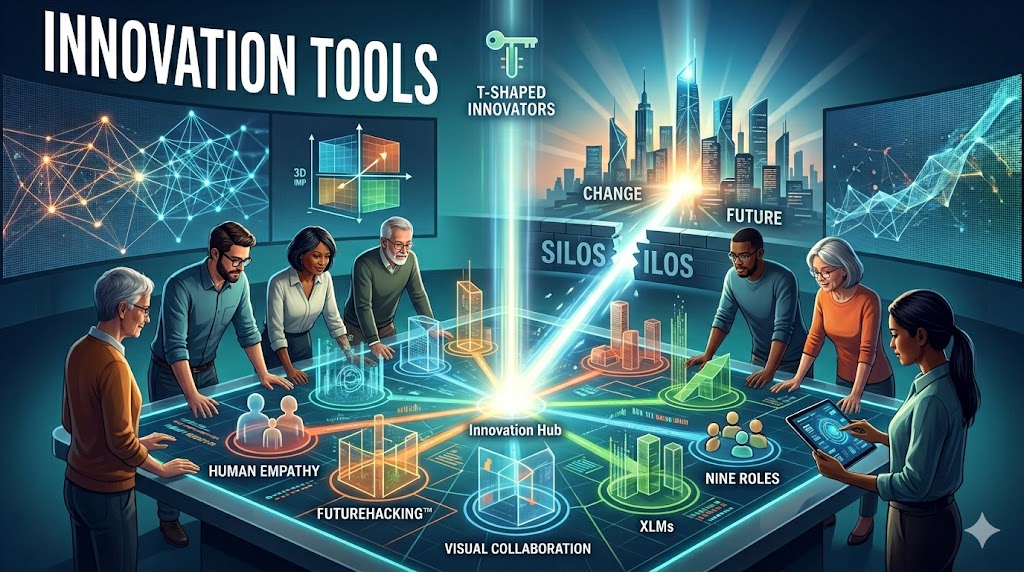
Organizations today find themselves trapped in a paradox of their own making. We possess more specialized knowledge, more advanced tools, and more data than at any point in human history. Yet, groundbreaking innovation remains frustratingly elusive. The culprit isn’t a lack of talent or capital; it is the rigid, functional silos — R&D, marketing, operations, finance — that slice our organizations into isolated fiefdoms. These departments have developed their own languages, metrics, and subcultures, creating artificial barriers that stifle collective intelligence.

Breakthrough value rarely occurs within the comfortable confines of a single discipline. Instead, it ignites at the messy, unpredictable intersections where disparate fields collide. When we look at the most transformative shifts in business and society, they are inherently interdisciplinary. To thrive in a landscape defined by accelerating technological disruption and shifting human expectations, organizations must move away from training hyper-specialized cogs. We must instead cultivate “T-shaped” innovators — professionals who possess deep domain expertise but excel in the art of collaborative translation.

Training innovators in interdisciplinary thinking is not an academic exercise in multi-tasking; it requires a fundamental rewiring of organizational culture. It demands that we move beyond standard skill acquisition to intentionally foster a mindset rooted in deep empathy, cognitive flexibility, and visual collaboration. If we want to build a future-ready enterprise, we must first build the connective tissue that allows our people to think, create, and change across boundaries.

The Core Pillars of the Interdisciplinary Mindset

To build a workforce capable of breaking through functional silos, we must first define the mental architecture of an interdisciplinary thinker. Interdisciplinary capability is not merely an accumulation of diverse facts; it is a distinct cognitive framework built upon three foundational pillars that allow individuals to navigate, translate, and synthesize complex ideas across boundaries.

1. Human-Centered Empathy as a Universal Translator

In a siloed organization, departments often protect their own turf by retreating behind specialized jargon and insular goals. Human-centered empathy serves as the ultimate antidote to this fragmentation. When we anchor the innovation process deeply in the lived experiences, unmet needs, and emotional realities of the end-user, we create a common purpose that transcends departmental politics.

Training innovators in this pillar requires shifting their primary question from a technology-first or finance-first perspective (“What can we build or sell?”) to a human-first perspective (“Whose life are we improving, and why?”). When an engineer, a marketer, and a financial analyst all focus intensely on the same human persona, their disciplinary differences melt away, replaced by a shared vocabulary of human value.

2. Cognitive Agility and Perspective-Shifting

True innovators do not look at a business challenge from a single stationary point. They possess the cognitive agility to rapidly shift perspectives, viewing a single problem through multiple distinct lenses in quick succession. Interdisciplinary training must deliberately cultivate this mental flexibility.

An agile thinker must learn to adopt the healthy skepticism of the scientist, the deep empathy of the designer, the practical execution focus of the operator, and the long-term vision of the futurist. By intentionally practicing these mental pivots, innovators learn to appreciate the validity of other departments’ constraints rather than viewing them as arbitrary roadblocks to progress.

3. Comfort with Ambiguity and the “Magic Maker” Persona

Linear, predictable processes are comfortable, but they rarely yield disruptive breakthroughs. The intersection of multiple disciplines is inherently messy, chaotic, and non-linear. Therefore, a core pillar of the interdisciplinary mindset is a high tolerance for ambiguity — the ability to operate effectively when the destination is not yet clear and the rules have not yet been written.

In our innovation frameworks, we often reference the concept of the Magic Maker — the individual who thrives in this unstructured middle zone, turning abstract, cross-functional concepts into tangible reality. Training innovators means pushing them out of the comfort of rigid checklists and teaching them to embrace iterative experimentation, prototyping, and the fast-cycle learning that occurs when different fields collide.

Overcoming the “Language Barrier” of Separate Disciplines

Even when professionals possess the right mindset, interdisciplinary collaboration often grinds to a halt because teams simply cannot understand one another. Decades of corporate specialization have created distinct tribal dialects within organizations. To build a cohesive engine of innovation, we must dismantle these communication barriers and establish shared structures for value creation.

1. Demolishing the Jargon Wall

Specialized vocabulary is a double-edged sword. While it allows deep experts to communicate efficiently with their peers, it acts as an exclusionary wall to outsiders. When an agile developer talks about “story points,” a marketer discusses “attribution models,” and a finance lead focuses on “amortization,” collaboration gives way to confusion and alienation.

Overcoming this requires an intentional effort to establish a shared organizational lexicon for innovation and change. Interdisciplinary training must teach experts to translate their specialized insights into plain, outcome-oriented language. The goal is not to dumb down the expertise, but to democratize it, ensuring that ideas are judged on their strategic merit rather than the eloquence of their departmental slang.

2. From SLAs to XLMs (Experience Level Measures)

Traditional corporate structures rely heavily on Service Level Agreements (SLAs) to govern cross-departmental handoffs. However, SLAs are inherently siloed and transactional; they measure operational efficiency (e.g., system uptime, response times) rather than holistic value. When every department hits its individual SLA targets but the final product still fails the customer, the organization is suffering from a systemic breakdown.

To train interdisciplinary innovators, we must shift our metrics from SLAs to XLMs (Experience Level Measures). XLMs capture the qualitative, cross-functional impact of business processes on human beings — whether they are customers or employees. By measuring success based on the end-to-end experience rather than isolated operational outputs, we force disparate disciplines to align their efforts toward a singular, cohesive human outcome.

3. The Power of Visual Collaboration and Canvases

When communication fails, visual tools can bridge the gap. Human beings are inherently visual creatures, yet corporate documentation remains overwhelmingly text-heavy, buried in dense slide decks and multi-page requirements documents that invite misinterpretation.

Interdisciplinary training should champion the use of collaborative, visual frameworks, such as dedicated change planning and project canvases. These tools act as a democratization layer. By mapping out problem spaces, stakeholders, risks, and value propositions on a single, shared visual canvas, engineers, marketers, and executives can literally see where their work intersects. Visual collaboration strips away corporate hierarchy and linguistic barriers, allowing teams to co-create rapidly and iteratively in real time.

Designing the Interdisciplinary Curriculum

Developing interdisciplinary innovators requires moving past passive learning models. We cannot simply lecture employees on the value of collaboration and expect them to transform. Instead, organizations must deploy an experiential curriculum that forces cognitive friction, sharpens foresight, and builds practical collaboration skills through deliberate practice.

1. FutureHacking™ and Signal Picking as Training Tools

To think across boundaries, innovators must learn to anticipate how shifts in one domain will spark ripples in another. We train individuals in this capability through our FutureHacking™ methodology, specifically focusing on the practice of cross-industry “Signal Picking.” Trainees are taught to actively scan the horizon for weak signals of change — technological, cultural, economic, or regulatory — outside of their primary industry.

A core curriculum exercise involves the use of a cross-impact matrix. Trainees are given a set of seemingly unrelated signals — for instance, a breakthrough in biosynthetic materials and a shift in urban millennial housing trends — and tasked with mapping their intersection. This forces the brain out of linear thinking and trains innovators to uncover hidden opportunities and systemic threats long before they manifest in the mainstream marketplace.

2. Experiential Rotations and Deep Shadowing

Empathy cannot be taught entirely via a slide presentation; it must be felt. An effective interdisciplinary curriculum incorporates short-term, high-impact experiential rotations and “deep shadowing” programs. This is not about training an engineer to become a marketer, but rather allowing them to sit in the marketer’s chair during a critical campaign launch or customer research cycle.

By immersing themselves in the daily realities, operational constraints, and pressures of another department, trainees build firsthand emotional intelligence. They witness the unintended friction that their own department’s outputs might cause down the line, fundamentally changing how they approach cross-functional solution design when they return to their primary roles.

3. The “Nine Innovation Roles” Alignment Exercise

Every successful innovation initiative requires a diverse ecosystem of mindsets, but teams often fail because they do not understand their internal dynamics. In our training programs, we leverage the Nine Innovation Roles framework to help individuals identify their natural innovation archetypes and learn how to collaborate intentionally with complementary profiles across the organization.

During this alignment exercise, trainees discover whether they lean toward being a strategic guide, an institutional anchor, or roles like The Conscript (the reluctant but vital operational realist) or The Magic Maker (the creative synthesizer who thrives in unstructured ambiguity). By mapping these roles transparently across a cross-functional team, trainees learn to value the cognitive diversity of their peers, transforming potential friction points into collaborative strengths.

Structural Support: Building the Infrastructure for Interdisciplinary Growth

Training individuals in interdisciplinary thinking is only half the battle. If you drop a highly collaborative, T-shaped innovator back into a rigid, traditional corporate hierarchy, the system will eventually reject them. To sustain a culture of cross-pollination, organizations must build the structural scaffolding and governance models that allow interdisciplinary capabilities to take root and flourish.

1. The Role of the Experience Management Office (XMO)

To prevent interdisciplinary insights from getting trapped in organizational vacuums, companies need a dedicated champion at the structural level. This is the primary function of an Experience Management Office (XMO). Unlike a traditional Project Management Office (PMO) that focuses primarily on timelines, budgets, and operational task execution, the XMO acts as the organization’s connective tissue.

The XMO is tasked with overseeing cross-functional training, managing the deployment of visual collaboration methodologies, and ensuring that qualitative customer and employee insights are shared transparently across all departments. By acting as a centralized hub for decentralized thinking, the XMO helps scale interdisciplinary training from an isolated HR initiative into a core business capability.

2. Rewarding the “In-Between” Spaces

Human behavior follows incentives. One of the greatest barriers to long-term interdisciplinary innovation is the traditional Key Performance Indicator (KPI) framework. When employees are evaluated solely on vertical, siloed achievements — such as lines of code written, leads generated, or calls closed — they have zero professional incentive to step outside their comfort zones and collaborate across boundaries.

Organizations must intentionally redesign their performance management systems to reward the “in-between” spaces. This means establishing shared, cross-departmental goals, recognizing individuals who actively facilitate cross-pollination, and carving out dedicated time for collaborative experimentation. When people see that bridging disciplines is actively incentivized and celebrated by leadership, the structural walls that separate them begin to crumble naturally.

Conclusion: The Future Belongs to the Connectors

The challenges facing the modern enterprise are too complex, too interconnected, and too fast-moving to be solved by any single department or discipline. When we restrict our thinking to functional silos, we don’t just limit our operational efficiency; we starve our organizations of the diverse perspectives required to create truly breakthrough value. Training innovators in interdisciplinary thinking is the ultimate antidote to this stagnation.

Innovation is not a distinct department on an organizational chart — it is a pervasive organizational capability driven by individuals who can confidently bridge worlds. By intentionally cultivating an interdisciplinary mindset, breaking down communication and language barriers, deploying experiential learning frameworks, and reinforcing these efforts with robust structural governance like an XMO, we do more than just optimize our product development pipeline.

We build highly agile, deeply empathetic organizations capable of shaping the future rather than merely reacting to it. In the next era of business, the ultimate competitive advantage will not belong to the organizations that possess the most data or the deepest pockets, but to those that can connect the dots between disparate fields to deliver cohesive, human-centered value.

Frequently Asked Questions

Why is interdisciplinary thinking critical for modern innovation?

Modern business challenges are too complex to be solved within functional silos. True breakthrough innovation occurs at the intersections of different fields. By training teams in interdisciplinary thinking, organizations dismantle communication barriers, leverage cognitive diversity, and design holistic, human-centered solutions rather than fragmented, isolated outputs.

What is the difference between an SLA and an XLM?

Service Level Agreements (SLAs) are traditional, siloed metrics that track transactional and operational efficiency, such as system uptime or response rates. Experience Level Measures (XLMs), on the other hand, measure the qualitative, cross-functional impact of business processes on the actual human experience. XLMs force disparate departments to align toward a singular, shared human outcome.

How does an Experience Management Office (XMO) support innovation?

An XMO acts as the organizational connective tissue that prevents cross-disciplinary insights from being lost in functional vacuums. Unlike a PMO focused strictly on project timelines and budgets, the XMO manages the scaling of interdisciplinary training, champions the use of visual collaboration tools, and ensures that human-centered insights are shared fluidly across the entire enterprise.


SPECIAL BONUS: Braden Kelley’s Problem Finding Canvas can be a super useful starting point for doing design thinking or human-centered design.

“The Problem Finding Canvas should help you investigate a handful of areas to explore, choose the one most important to you, extract all of the potential challenges and opportunities and choose one to prioritize.”

Image credit: Gemini

Subscribe to Human-Centered Change & Innovation WeeklySign up here to get Human-Centered Change & Innovation Weekly delivered to your inbox every week.

Ten Skills Every Futurist Should Have

Ten Skills Every Futurist Should Have

GUEST POST from Art Inteligencia

As the demand for futurists grows, so does the need for the right skill set. Futurists are employed to provide strategic advice and insights into the future of a particular industry, organization or region. They must be able to assess trends, analyze data, and make predictions about the future. To be successful in this field, a futurist must have a wide range of skills.

Here are ten skills every futurist should have:

1. Problem-Solving: Futurists must be able to recognize and solve complex problems. They must be able to take a “big picture” view and develop strategies to address the issues at hand.

2. Creativity: Futurists must be able to think outside the box and come up with creative solutions to problems. They must be able to think of innovative solutions and approaches to address the challenges they are presented with.

3. Communication: Futurists must be able to effectively communicate their ideas and findings. They must be able to explain their process and results in a manner that is understood by their clients.

4. Research: Futurists must be able to conduct detailed research and analyze data in order to identify emerging trends and patterns. They must also be able to synthesize data to form meaningful conclusions.

5. Networking: Futurists must be able to build strong relationships with stakeholders and industry experts. They must be able to form a network of contacts who can provide relevant information and insights.

6. Interpersonal Skills: Futurists must be able to work with a variety of people. They must be able to collaborate with colleagues, clients and stakeholders to achieve desired outcomes.

7. Business Acumen: Futurists must have an understanding of business principles and processes. They must be able to apply their knowledge of the industry and the organizational context to their work.

8. Critical Thinking: Futurists must be able to think critically, analyze data, and identify patterns. They must be able to draw conclusions and make informed decisions.

9. Adaptability: Futurists must be able to adjust to changing circumstances and environments. They must be able to think on their feet and come up with solutions quickly.

10. Resilience: Futurists must be able to handle failure and setbacks. They must be able to stay focused and committed to their mission despite the challenges they face.

These skills are essential for any successful futurist. By honing and developing these skills, a futurist can become an invaluable asset to any organization.

For more information on what a futurist or futurologist is and does, check out my other articles here:

Bottom line: Futurology and prescience are not fortune telling. Skilled futurologists and futurists use a scientific approach to create their deliverables, but a methodology and tools like those in FutureHacking™ can empower anyone to engage in futurology themselves.

Image credit: Pixabay

Subscribe to Human-Centered Change & Innovation WeeklySign up here to get Human-Centered Change & Innovation Weekly delivered to your inbox every week.

Now Available – Charting Change™ Facilitated Change and Project Kickoffs

Help Yourself to Successful Projects and Change Initiatives

Too often change management is seen as a subset of project management, causing the people side of change to be an afterthought. Stop it!

Architecting the Organization for Change

Successful organizations plan for change, and so I am extremely excited to announce that people can now get help powering their project or change initiative to a strong start with a facilitated Charting Change™ kickoff event requiring only a very small financial investment that will deliver a large return.

Charting Change™ Facilitated Change and Project Kickoffs include a package of products and services, valued at up to $460,600, for a deeply discounted introductory price:
(contact us for pricing)

  1. Change Readiness Audit (part of Day 1 of 3 on-site) – $5,000 value
  2. Change Saturation Heatmap (part of Day 1 of 3 on-site) – $5,000 value
  3. 20 autographed copies of Charting Change – $600 value
  4. Change Planning Toolkit

  5. Two-Day Guided Change Planning Session (Days 2&3 of 3) – $25,000 value
    • Day 1 – Introduction to the Change Planning Toolkit™
    • Day 1 – Set up the room
    • Day 2 – Conduct the change planning session
    • Day 2 – Change Planning Toolkit™ Q&A
    • Day 2 – Wrapup
  6. Certification of Change Planning Toolkit™ instructors (post-event certification exam)
  7. Change Planning Toolkit™ license (free for six months) – Up to a $425,000 value

TOTAL VALUE = Up to $460,600 for a deeply discounted introductory price
(contact us for pricing)

As part of the package I will fly to your location, work with you to facilitate a change planning or project planning session using the tools from the Change Planning Toolkit™ introduced in my latest book Charting Change, so that your next project or change initiative can be a roaring success and you and your team can become certified Change Planning Toolkit™ practitioners (if desired). If you’d like additional help with your project or change initiative beyond the Charting Change™ Facilitated Kickoff, we can stick with you to provide additional assistance via on-site or virtual support.

FOLLOW-UP SERVICE OFFERINGS

  1. Additional on-site support – by the week
  2. 100 virtual hour support package
    • Can choose a 1-day on-site for the equivalent of 30hrs
  3. Certification Exam

So invest a little in taking a more visual, more collaborative, and well, human, approach to planning your next successful project or change initiative and contact us.


Accelerate your change and transformation success

Subscribe to Human-Centered Change & Innovation WeeklySign up here to get Human-Centered Change & Innovation Weekly delivered to your inbox every week.

Every Company Needs an Innovation Coach

Retained InnovationInnovation is not a solo activity. While the rare lone genius may be able to invent something on their own (although still always inspired by others), nobody can innovate by themselves. Innovation, by its very nature, requires collaboration.

Companies are like brains. The brain is composed of two hemispheres. The left brain is typically described as the home to math and logic skills, while the right brain is described as the domain of creativity. Of course people need to develop both hemispheres to be successful, and companies are the same. Achieving operational excellence is the goal of the left brain side of the organization and innovation excellence should be the goal of the right side of the organization. Unfortunately, most organizations over-invest in operational excellence to the point that the organization fights off innovation excellence efforts like a virus.

So, what’s the cure?

Not to get sick in the first place of course!

To achieve that, consider putting an innovation wellness program in place. And what does that look like?

An innovation wellness program has at its center, an organization that is willing to reach outside its four walls for a constant stream of new inspiration. Because it is inspiration in combination with curiosity that will give the organization a fighting chance of identifying ongoing sources of unique and differentiated insights that will allow the organization to continuously reinvent itself and stay in resonance with its customers.

A couple tangible examples of innovation wellness program components include:

  1. Embedding elements of so-called Open Innovation into the core of the organization’s innovation approach rather than existing as a periodic guest
  2. Continuous reinforcement of a curiosity culture
  3. Employment of a part-time innovation coach on an ongoing basis

Robert F BrandsWhat does an innovation coach look like?

Well, one good example was the late Robert F. Brands, who was lost to the global innovation community far too soon. He was a friend, a colleague, a mentor, a partner on work we did for the United States Navy, and he helped me get the book deal for my first five-star book – Stoking Your Innovation Bonfire.

A good innovation coach helps you avoid the ten signs of innovation sickness:

  1. Nobody can articulate your definition of innovation (or you don’t have one)
  2. Nobody can articulate your innovation vision/strategy/goals (or you don’t have them)
  3. People struggle to tell the story of one or more innovations launched to wide adoption by the organization
  4. Most of what passes as innovation inside the organization would actually be classified as improvements (not innovation) by people outside the organization
  5. The organization no longer makes external innovation perspectives available to a wide audience
  6. Nobody takes the time to participate in our innovation efforts anymore
  7. Your organization is unable to accept insights and ideas from outside the organization and develop them into concepts that can be scaled to wide adoption
  8. Innovation program leadership has difficulty getting time on the CEO’s calendar any more
  9. Your innovation team is trying to do all of the innovating instead of helping to accelerate the innovation efforts of others
  10. Your pace of innovation is slower than the organizations you compete with for market share, donations, votes, etc.

A good innovation coach can help you:

1. Perform an innovation assessment

I developed a 50 question innovation audit and made it available in support of my first book Stoking Your Innovation Bonfire, so that people can do a self-evaluation of their innovation maturity here on my web site. Or if you would like to dig a little deeper into the dynamics of innovation in your organization, I can work with you to do an innovation diagnostic across your organization and/or help you establish a baseline so you can track your innovation maturity progress over time.

2. Establish a Continuous Innovation Infrastructure

Many companies confuse having a New Product Development (NPD) program or a Research & Development (R&D) program with having an innovation program, or are stuck in an ‘innovation as a project’ approach to innovation. A good innovation coach can help you define what innovation can and should mean to your organization, build a common language of innovation, create an innovation vision, establish an innovation strategy that dovetails with your organization’s overall strategy, and develop innovation goals that will help focus the organization’s efforts to realize its innovation vision and strategy.

3. Teach You Some New Innovation Tools, Methods, and Frameworks

A good innovation coach is also a skilled facilitator and can help facilitate innovation off-sites, an effective trainer who can develop the custom courses you need to teach people in the organization new tools, methods, or frameworks to improve or accelerate your innovation capabilities, and is capable of delivering inspirational keynotes to large groups inside your organization to help shift mindsets and help people feel empowered to participate in the innovation efforts of the organization. The best innovation coaches are capable not just of bringing in the tools, methods and frameworks of others, but are also capable of understanding your innovation gaps and creating new innovation tools, methods and frameworks to help you.

4. Help You Identify Insights and Opportunities

Innovation begins with inspiration, and your curiosity and exploration should lead you to identify some good insights to build on and opportunities to pursue. But, because most ideas are really idea fragments, sometimes an innovation coach or other external perspectives can help you identify the gaps in your idea fragment or opportunity identification that might make them more compelling, especially if you aren’t making a conscious use of The Nine Innovation Roles as part of your innovation process to help you avoid innovation blind spots. A good innovation coach can also help you go beyond ideas and help you focus on not just one, but all three keys to innovation success:

  • Value Creation
  • Value Access
  • Value Translation

Stoking Your Innovation Bonfire will help you learn more about each, or you can check out my previous article ‘Innovation is All About Value‘.

5. Tell You Honestly When You’re Going Off Course

A good innovation coach will have the courage to be honest with you and tell you when you’ve lost your way. Over time, many innovation teams tend to come down with shiny object syndrome or its equally evil cousin, launch fever. A competent innovation coach will be able to recognize the change and help you course correct before you pass the point of no return, and put the very existence of your innovation program at risk. A good innovation coach is able to provide a consistent external perspective, a sanity check, and may be able to also help you build external connections to invite in other external perspectives as well.

Wrapping it Up

It is easy to fall in love with the innovation process and program you’ve created. It is equally simple to form attachments to your innovation projects and artifacts and think that you’ve cracked the code, and maybe you have, but wouldn’t you like to keep one toe in the pond outside your organization just to make sure?

Book Innovation Speaker Braden Kelley for Your EventCreating and maintaining a part-time relationship with an innovation coach you trust is a great way to do that. Smart organizations keep a pulse on their level of innovation maturity over time. They’re continuously evolving their innovation infrastructure, building new capabilities, and seeking out external perspectives as a sanity check on their program evolutions over time. So what are you waiting for?

Who’s going to coach your winning innovation team?

Contact me now to set up a free introductory consultation


Accelerate your change and transformation success

Subscribe to Human-Centered Change & Innovation WeeklySign up here to get Human-Centered Change & Innovation Weekly delivered to your inbox every week.
Free Change Planning Toolkit™ Access for All*

3 Free Change Planning Toolkit™ Site Licenses*According to multiple sources, including McKinsey, 70% of change efforts fail. The reason many change efforts fail is that they often lack a clear plan.

So, what’s a company struggling to keep up with the accelerating pace of change to do?

Why not revolutionize your ability to change faster than the competition using the Change Planning Toolkit™?

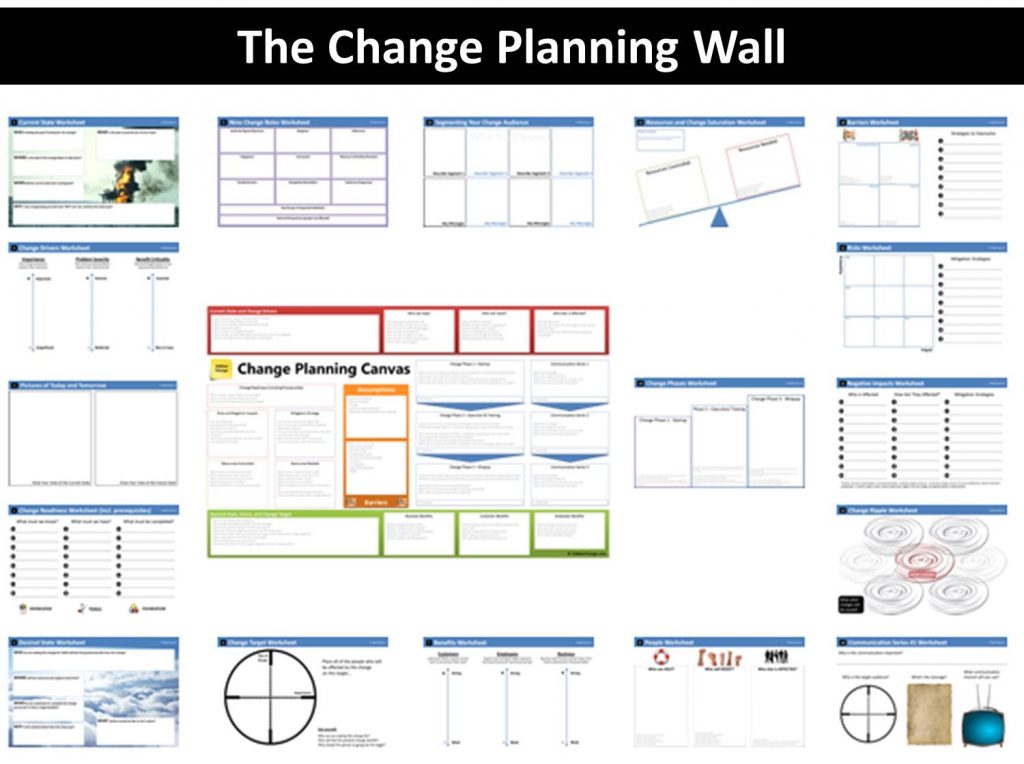
Change Planning Wall

The Change Planning Toolkit™ allows you to:

  1. Quickly visualize, plan and execute on your change initiative (from simple projects to complicated mergers or acquisitions)
  2. Deliver projects and change efforts on time
  3. Accelerate implementation and adoption
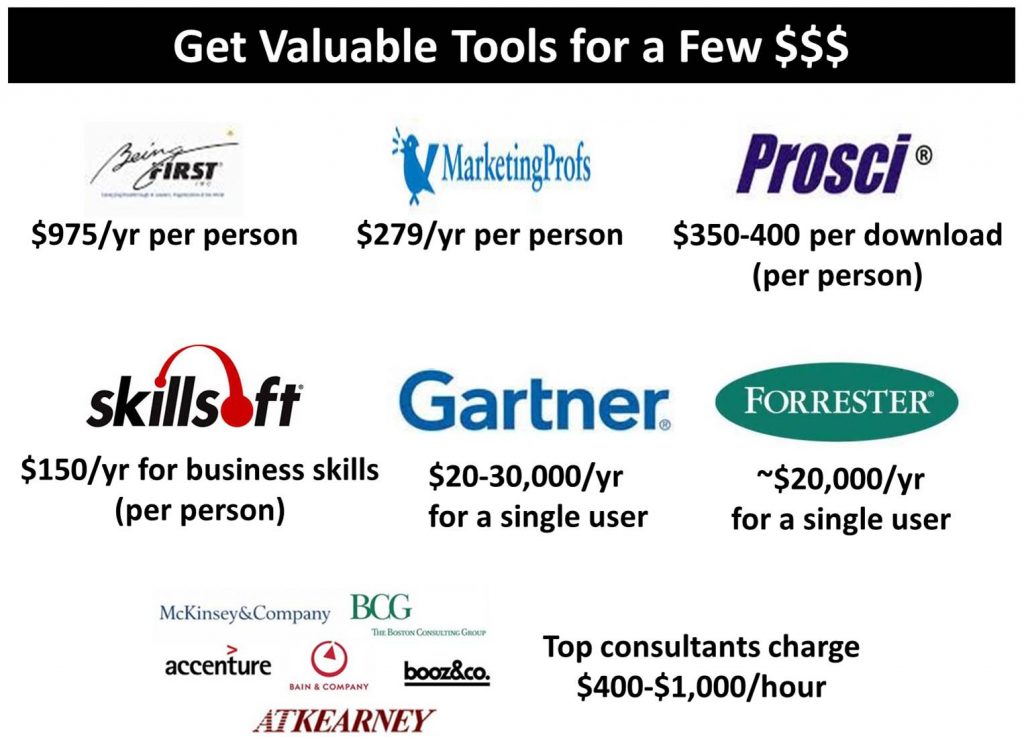
  4. Get a lot of valuable tools for a much lower cost than lesser offerings

Change Planning Toolkit Valuable Tools

I believe so much in the power of the Change Planning Toolkit™ that I am willing to offer a free* site license to the next three (3) firms to purchase a Change Planning Toolkit™ training session (which includes train-the-trainer).

For large companies like IBM, Accenture, Amazon, GE, Wells Fargo, Cognizant, HP Enterprise, Convergys, Oracle, or Microsoft, a free* site license represents a savings of up to $830,000 on tools with a value of nearly $500 million for a nominal investment in one day of training.

——————————————————————————–
Book a Training Session and get a free* site license
——————————————————————————–

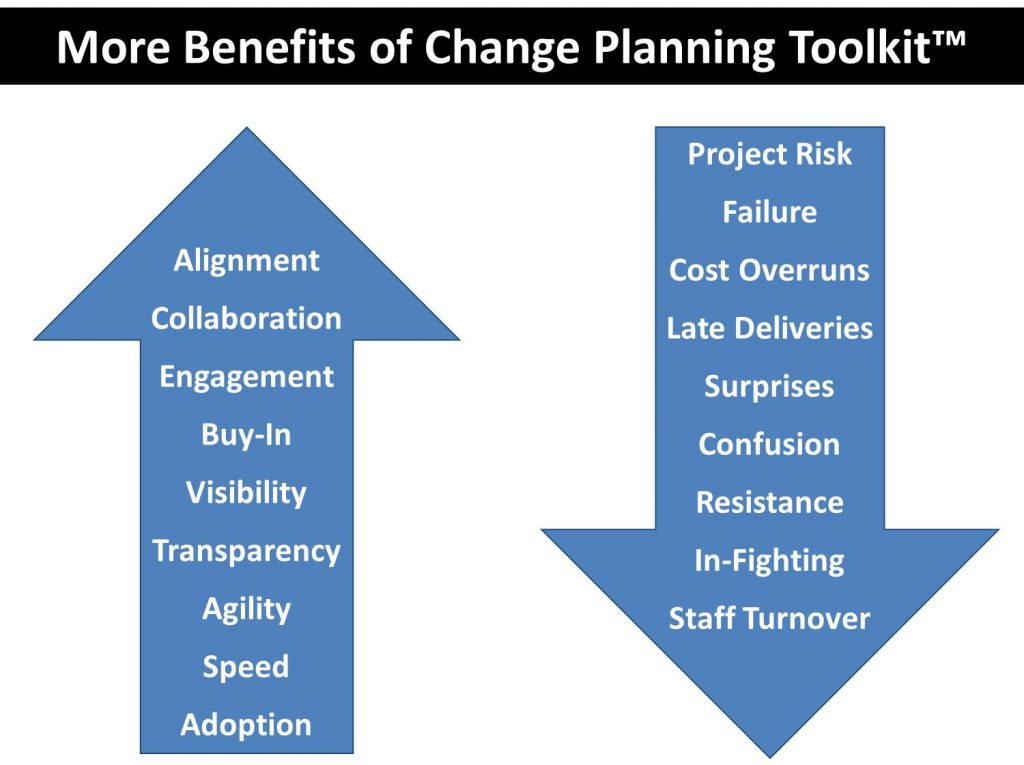
The Change Planning Toolkit™ will help you increase:

  • Alignment
  • Collaboration
  • Engagement
  • Buy-In
  • Visibility
  • Transparency
  • Agility
  • Speed
  • Adoption

Change Planning Toolkit Benefits

While decreasing:

  • Project Risk
  • Failure
  • Cost Overruns
  • Late Deliveries
  • Surprises
  • Confusion
  • Resistance
  • In-Fighting
  • Staff Turnover

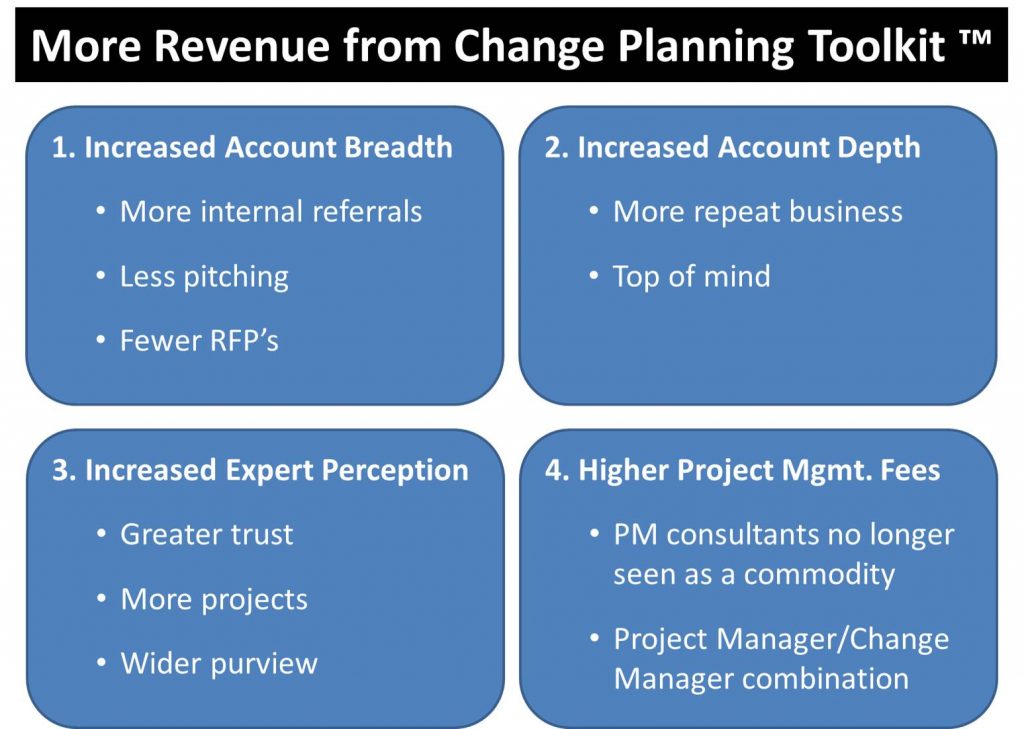
In addition, consulting firms will be able to increase their revenue and customer lifetime values using the Change Planning Toolkit™ and earn extra revenue as a reseller.

Change Planning Toolkit Benefits for Consulting Firms

Meanwhile, after the training, the QuickStart Guide and my book Charting Change (which training participants will receive**) will keep you (and your clients) on track and reinforce your learning.

——————————————————————————–
Book a Training Session and get a free* site license
——————————————————————————–

People can also get the Change Planning Toolkit™ for individual educational use for only $99.99/year (or $999.99 for a lifetime license).

* The site license is free for the first year. After 365 days it can be renewed for a very affordable $2/employee per year. Each employee gets access to tools that other companies might charge up to $20,000 for a single user to access.

** Depending on the country, book will be provided in either hardcover or digital form to training participants, but not both

——————————————————————————–
Book a Training Session and get a free* site license
——————————————————————————–


Accelerate your change and transformation success

Subscribe to Human-Centered Change & Innovation WeeklySign up here to get Human-Centered Change & Innovation Weekly delivered to your inbox every week.
Change Planning Toolkit™ Ask Me Anything Transcript

Change Planning Toolkit™ Ask Me Anything Transcript

On Thursday, June 8th I took all questions about the Change Planning Toolkit™ on TWITTER via hashtag #cptoolkit and my contact form. Here were the questions and the answers:

1. I bought your insightful book Charting Change – How can I get the supplementary materials (26 of 50 Change Planning Toolkit™ tools) that go with the book?

Charting Change book buyers can contact me using my contact form here and get me their proof of purchase. Then I will send out the Change Planning Toolkit™ Basic License to them as an 11″x17″ scalable pdf download.

Book buyers can upgrade from the Basic License to the Bronze License or get their organization on the path to success with a site license at any time.

2. Who is the Change Planning Toolkit™ designed for?

The Change Planning Toolkit™ was designed for change leaders, project managers, and program managers to make it easier to successfully plan and execute projects, programs, change initiatives, business transformations, and digital transformations.

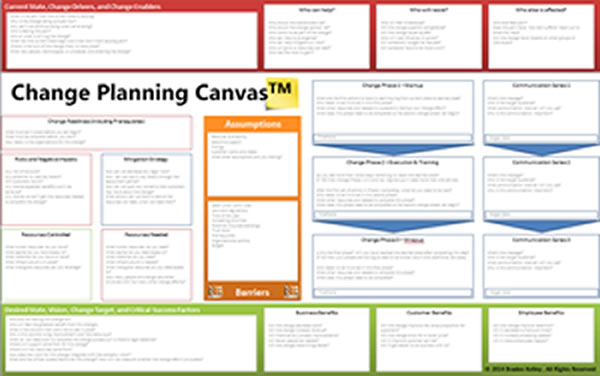
Change Planning Canvas

3. I’ve heard amazing things about the Change Planning Canvas™ – How can I get a copy of it? Is there a poster size?

Buy a copy of my latest book Charting Change, contact me with proof of purchase and I’ll send out the 11″x17″ of the Change Planning Canvas™ along with 25 other great tools!

Or, purchase a basic individual educational license and you’ll get instant access to these same 26 of 50+ tools along with a digital copy of the book (hardcover option in certain geographies).

Or, purchase a bronze individual educational license for the Change Planning Toolkit™ and you’ll get all 50+ tools, including the Change Planning Canvas™ in a scalable 11″x17″ pdf PLUS a Quickstart Guide PLUS several discounts.

There is a 35″x56″ poster size version of the Change Planning Canvas™ available for commercial site licensees. Consulting and training companies looking to grow their business, or organizations looking to increase their organizational agility and beat the 70% change failure rate should contact me about site licenses starting at $2/yr per employee.

4. What exactly is the Change Planning Toolkit™?

The Change Planning Toolkit is collection of 50+ tools to make change planning more visual, collaborative, and fun!

It is designed to be used by PMP’s in project management as well, and dovetails nicely with the ACMP Change Standard for change management professionals. In fact you can get a nice ACMP Standard Visualization in the ten free downloads.

5. What do people get when they purchase the Change Planning Toolkit™ Bronze License?

People who purchase the individual educational license of the Change Planning Toolkit™ Bronze License $1,200 worth of items for the extremely low price of $99.99/year (or $999.99 for a lifetime license) that will fundamentally transform how you plan and execute ALL of your projects and change initiatives, from this point forward, greatly increasing:

  • Project success rates
  • Organizational agility
  • Ability to beat the competition
  • Collaboration levels inside the organization
  • The innovation capacity of the organization
  • Employee retention
  • And more!

I answered most of the specifics in question three, but just to recap in a simpler way, if you purchase the bronze license, you get access to:

  • 11″x17″ scalable pdf version of all 50+ tools (including the Change Planning Canvas™)
  • QuickStart Guide
  • Use of the tools for individual educational use unless a commercial site license is purchased (starting at $2/yr per employee + small setup fee)
  • 35″x56″ poster size scalable downloads for key tools (COMMERCIAL SITE LICENSES ONLY)

6. What differentiates the Change Planning Toolkit™ from the competition?

First of all, I created the Change Planning Toolkit™ because so much of what project managers and change practitioners need to be successful didn’t exist!

So, it has been designed to play well with the Project Management Body of Knowledge (PMBOK) from the Project Management Institute (PMI), the Change Standard from the Association of Change Management Professionals (ACMP), and ADKAR from ProSci. But, the Change Planning Toolkit™ delivers value for project managers and change practitioners that those can’t.

In fact, I created a Visual Project Charter™ and a visualization of the ACMP Change Standard as free downloads to help ACMP and PMP practitioners be more successful within their existing frameworks.

So, no matter what project management or change management methodology you like to use, the Change Planning Toolkit™ will feel familiar, and will increase your ability to achieve success with the kinds of projects and change initiatives you’re already running!

7. What’s your view on change management versus project management?

Most people talk about change management as if it is a subset of project management, but that’s so not true!

People need to change this thinking because it’s a big reason why so many projects fail.

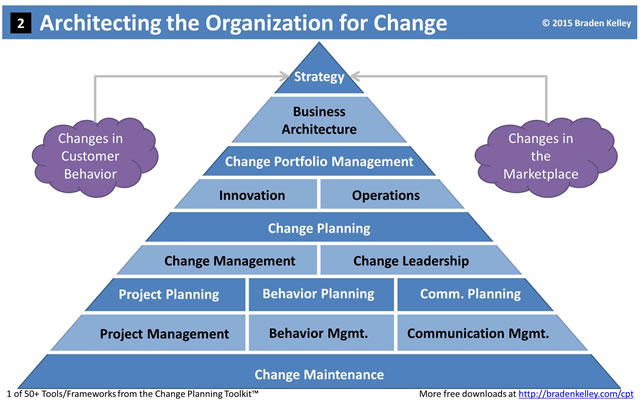
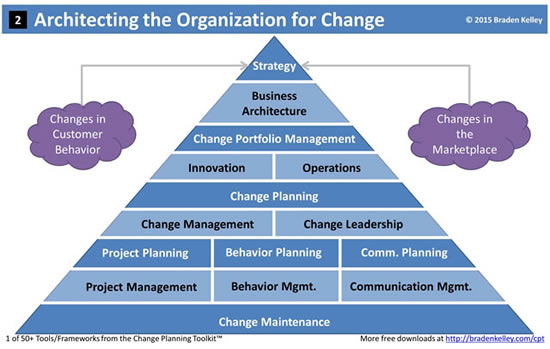
Instead what we need to do is to flip this thinking on its head and start seeing project management as a subset of change management. One of the 50+ tools in the toolkit (and in the book) visualizes what such a world can and SHOULD look like. It’s called Architecting the Organization for Change:

Architecting the Organization for Change

You’ll notice that all five of the Five Keys to Change Success are all represented here. 🙂

What’s next?

Look for more AMA (Ask Me Anything) sessions on the Change Planning Toolkit™ and The Experiment Canvas™ in future weeks!

FYI – On Twitter I am @innovate if you aren’t already following me.


Accelerate your change and transformation success

Subscribe to Human-Centered Change & Innovation WeeklySign up here to get Human-Centered Change & Innovation Weekly delivered to your inbox every week.
Ten Reasons to Hire an Innovation Keynote Speaker in 2026

Last updated: May 17, 2026

Innovation Keynote Speaker Braden Kelley

Innovation Keynote Speakers are often misunderstood, maligned, and underutilized.

We have all been to many conferences, and heard many good (and bad) keynote and session speakers with a variety of styles (all of which are perfectly acceptable), including:

1. The Motivator

Say this public speaking style and most people will envision Bill Clinton, Tony Robbins, Steve Ballmer or someone like that. Notice that not all three examples are people you think of as full of boundless energy, that can be incredibly motivating. The motivator tries to connect on an emotional level with the audience and dial up the inspiration.

2. The Academic

This speaking style is nearly, but not completely synonymous with college professors and others in the “teaching” business. My personal style straddles between The Academic and The Storyteller. The Academic focuses on bringing compelling content and connecting with the intellect of the audience, bringing them tools and concepts that done well, are easy to grasp and use.

3. The Storyteller

The Storyteller makes a strong use of similes, metaphors, and stories to get their points across. Bill Clinton straddles the line between The Motivator and The Storyteller. Storytellers try to connect on an emotional level and along with The Academic, tend to dive deeper into their points than The Motivator or The Standup comedian. Personally I love good stories and funny pictures and so my personal T-shaped speaking style embraces bits of The Storyteller and The Standup Comedian as well.

4. The Standup Comedian

The Standup Comedian aims to keep the audience laughing, using humor to underscore and to make their points. Other than comedy writers or standup comedians, few speakers will rely on this as their primary style, but many will drift into this style from time to time.

As you might expect, all of these styles are perfectly valid as long as the content is solid and valuable, but the energy of The Motivator entices a lot of people and as you can imagine, this group does the most to both help and hurt people’s perceived value of keynote speakers. Sometimes The Motivator inspires people to action, and other times they are the equivalent of cotton candy, firing people up with weak content that they can’t do anything with.

So, if with public speaking, like other communication vehicles, content is king and all speaking styles are valid, then you need to find the right content, the right speaker, and have the right reasons for employing one.

With that in mind, let’s look at the…

Top 10 Reasons to Hire an Innovation Keynote Speaker

  1. To begin an honest dialog around the role of innovation in your organization’s future
  2. To help build/reinforce your common language of innovation
  3. To bring in fresh ideas to inspire fresh insights
  4. To bring additional perspectives to existing innovation conversations
  5. To lay the groundwork for building an innovation infrastructure
  6. To help reduce the fear of innovation in your organization
  7. To reinforce your commitment to innovation publicly to your employees
  8. To increase the energy for innovation in your company
  9. To inject fresh life into an existing innovation program
  10. To combine with an innovation workshop to build new innovation capabilities

Click the image to download as a PDF:

Ten Reasons to Hire an Innovation Speaker

This is of course, not a comprehensive list of the reasons that companies around the world find value in periodically bringing in an innovation keynote speaker to dialog with their employees. Some companies choose to achieve some of these objectives via the innovation keynote, and others by sponsoring innovation training programs, or by retaining an innovation thought leader in an advisory capacity to provide the same kind of external perspectives, input, insights, and diversity of thought.

So, whether you are a new innovation leader seeking guidance on how to get off on the right foot, or an experienced Chief Innovation Officer, VP of Innovation, or Innovation Director, I encourage you to consider having myself or another innovation keynote speaker or workshop leader as a guest from time to time. I know you’ll find value in it!

Book Braden Kelley as Your Innovation Keynote Speaker

Innovation Speaker Sheet for Braden Kelley

Subscribe to Human-Centered Change & Innovation WeeklySign up here to get Human-Centered Change & Innovation Weekly delivered to your inbox every week.

December Innovation Special

December Innovation Special

As 2014 comes to a close and the holiday season continues, I thought I would make a special offer to event organizers in search of a last minute innovation speaker for a December or early January 2015 event AND to innovation managers looking to build strong momentum for their innovation efforts as we head into 2015.

Here is the offer:

Stoking Your Innovation BonfireBook me for an event occurring between December 5, 2014 and January 15, 2015 for either a:

  • 60-90 minute Innovation Keynote
  • 2-4 hour Innovation Workshop
  • 1 Day Innovation Masterclass

… and I will include a box of fifty (50) signed copies of my popular book Stoking Your Innovation Bonfire for your attendees, at no additional charge.

Book Braden Kelley for your event

P.S. In 2015 I will be launching a powerful new collaborative, visual change planning toolkit and a book, app, Quickstart Guide and eLearning to go with it. Please contact me if you are interested in getting advance access to this toolkit in exchange for being a case study for the book.

Subscribe to Human-Centered Change & Innovation WeeklySign up here to get Human-Centered Change & Innovation Weekly delivered to your inbox every week.

Build a Common Language of Innovation for 2014

Build a Common Language of Innovation for 2014As the end of 2013 approaches, why not give your employees and your organization the gift of innovation for 2014?

One of the biggest keys to innovation success is building a common language of innovation.

From creating a definition of innovation unique to your organization, to creating an innovation vision, strategy, and goals, a common language of innovation will accelerate the speed and effectiveness of your innovation efforts by aligning everyone’s understanding of what innovation means to your organization and how you plan to achieve it.

One way that organizations around the world are doing this, is to acquire my book Stoking Your Innovation Bonfire in bulk quantities to help their organization create a common language and understanding of innovation.

In addition to helping organizations identify and remove barriers to innovation, Stoking Your Innovation Bonfire also serves a great innovation primer and a good way to get everyone on the same page.

If you’d like to align and accelerate your innovation efforts going into 2014, consider:

  1. Making a bulk order of Stoking Your Innovation Bonfire from Hooks Books (an independent minority woman-owned bookseller) or 800-CEO-READ (for customized orders) to hand out as gifts
  2. Introducing the Nine Innovation Roles into your organization
  3. Contacting me about my elearning offerings (Level 1 GIMI Innovation Certification eLearning Coming Soon!)
  4. Booking me for a keynote speech, workshop or masterclass – Book Now

Keep innovating!


Build a common language of innovation on your team

Subscribe to Human-Centered Change & Innovation WeeklySign up here to get Human-Centered Change & Innovation Weekly delivered to your inbox every week.