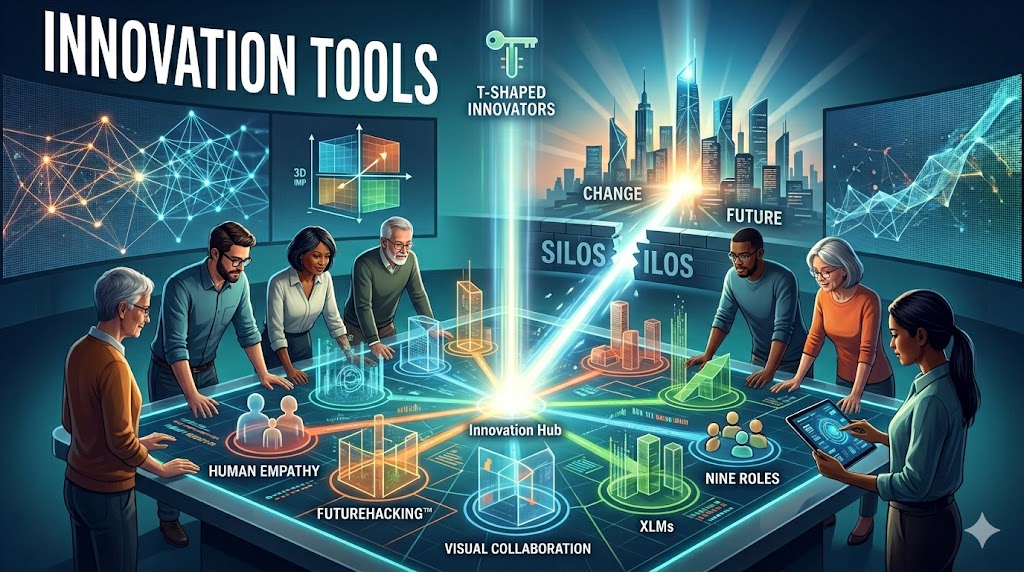
GUEST POST from Art Inteligencia
The Silo Crisis in Modern Innovation
Organizations today find themselves trapped in a paradox of their own making. We possess more specialized knowledge, more advanced tools, and more data than at any point in human history. Yet, groundbreaking innovation remains frustratingly elusive. The culprit isn’t a lack of talent or capital; it is the rigid, functional silos — R&D, marketing, operations, finance — that slice our organizations into isolated fiefdoms. These departments have developed their own languages, metrics, and subcultures, creating artificial barriers that stifle collective intelligence.
Breakthrough value rarely occurs within the comfortable confines of a single discipline. Instead, it ignites at the messy, unpredictable intersections where disparate fields collide. When we look at the most transformative shifts in business and society, they are inherently interdisciplinary. To thrive in a landscape defined by accelerating technological disruption and shifting human expectations, organizations must move away from training hyper-specialized cogs. We must instead cultivate “T-shaped” innovators — professionals who possess deep domain expertise but excel in the art of collaborative translation.
Training innovators in interdisciplinary thinking is not an academic exercise in multi-tasking; it requires a fundamental rewiring of organizational culture. It demands that we move beyond standard skill acquisition to intentionally foster a mindset rooted in deep empathy, cognitive flexibility, and visual collaboration. If we want to build a future-ready enterprise, we must first build the connective tissue that allows our people to think, create, and change across boundaries.
The Core Pillars of the Interdisciplinary Mindset
To build a workforce capable of breaking through functional silos, we must first define the mental architecture of an interdisciplinary thinker. Interdisciplinary capability is not merely an accumulation of diverse facts; it is a distinct cognitive framework built upon three foundational pillars that allow individuals to navigate, translate, and synthesize complex ideas across boundaries.
1. Human-Centered Empathy as a Universal Translator
In a siloed organization, departments often protect their own turf by retreating behind specialized jargon and insular goals. Human-centered empathy serves as the ultimate antidote to this fragmentation. When we anchor the innovation process deeply in the lived experiences, unmet needs, and emotional realities of the end-user, we create a common purpose that transcends departmental politics.
Training innovators in this pillar requires shifting their primary question from a technology-first or finance-first perspective (“What can we build or sell?”) to a human-first perspective (“Whose life are we improving, and why?”). When an engineer, a marketer, and a financial analyst all focus intensely on the same human persona, their disciplinary differences melt away, replaced by a shared vocabulary of human value.
2. Cognitive Agility and Perspective-Shifting
True innovators do not look at a business challenge from a single stationary point. They possess the cognitive agility to rapidly shift perspectives, viewing a single problem through multiple distinct lenses in quick succession. Interdisciplinary training must deliberately cultivate this mental flexibility.
An agile thinker must learn to adopt the healthy skepticism of the scientist, the deep empathy of the designer, the practical execution focus of the operator, and the long-term vision of the futurist. By intentionally practicing these mental pivots, innovators learn to appreciate the validity of other departments’ constraints rather than viewing them as arbitrary roadblocks to progress.
3. Comfort with Ambiguity and the “Magic Maker” Persona
Linear, predictable processes are comfortable, but they rarely yield disruptive breakthroughs. The intersection of multiple disciplines is inherently messy, chaotic, and non-linear. Therefore, a core pillar of the interdisciplinary mindset is a high tolerance for ambiguity — the ability to operate effectively when the destination is not yet clear and the rules have not yet been written.
In our innovation frameworks, we often reference the concept of the Magic Maker — the individual who thrives in this unstructured middle zone, turning abstract, cross-functional concepts into tangible reality. Training innovators means pushing them out of the comfort of rigid checklists and teaching them to embrace iterative experimentation, prototyping, and the fast-cycle learning that occurs when different fields collide.
Overcoming the “Language Barrier” of Separate Disciplines
Even when professionals possess the right mindset, interdisciplinary collaboration often grinds to a halt because teams simply cannot understand one another. Decades of corporate specialization have created distinct tribal dialects within organizations. To build a cohesive engine of innovation, we must dismantle these communication barriers and establish shared structures for value creation.
1. Demolishing the Jargon Wall
Specialized vocabulary is a double-edged sword. While it allows deep experts to communicate efficiently with their peers, it acts as an exclusionary wall to outsiders. When an agile developer talks about “story points,” a marketer discusses “attribution models,” and a finance lead focuses on “amortization,” collaboration gives way to confusion and alienation.
Overcoming this requires an intentional effort to establish a shared organizational lexicon for innovation and change. Interdisciplinary training must teach experts to translate their specialized insights into plain, outcome-oriented language. The goal is not to dumb down the expertise, but to democratize it, ensuring that ideas are judged on their strategic merit rather than the eloquence of their departmental slang.
2. From SLAs to XLMs (Experience Level Measures)
Traditional corporate structures rely heavily on Service Level Agreements (SLAs) to govern cross-departmental handoffs. However, SLAs are inherently siloed and transactional; they measure operational efficiency (e.g., system uptime, response times) rather than holistic value. When every department hits its individual SLA targets but the final product still fails the customer, the organization is suffering from a systemic breakdown.
To train interdisciplinary innovators, we must shift our metrics from SLAs to XLMs (Experience Level Measures). XLMs capture the qualitative, cross-functional impact of business processes on human beings — whether they are customers or employees. By measuring success based on the end-to-end experience rather than isolated operational outputs, we force disparate disciplines to align their efforts toward a singular, cohesive human outcome.
3. The Power of Visual Collaboration and Canvases
When communication fails, visual tools can bridge the gap. Human beings are inherently visual creatures, yet corporate documentation remains overwhelmingly text-heavy, buried in dense slide decks and multi-page requirements documents that invite misinterpretation.
Interdisciplinary training should champion the use of collaborative, visual frameworks, such as dedicated change planning and project canvases. These tools act as a democratization layer. By mapping out problem spaces, stakeholders, risks, and value propositions on a single, shared visual canvas, engineers, marketers, and executives can literally see where their work intersects. Visual collaboration strips away corporate hierarchy and linguistic barriers, allowing teams to co-create rapidly and iteratively in real time.
Designing the Interdisciplinary Curriculum
Developing interdisciplinary innovators requires moving past passive learning models. We cannot simply lecture employees on the value of collaboration and expect them to transform. Instead, organizations must deploy an experiential curriculum that forces cognitive friction, sharpens foresight, and builds practical collaboration skills through deliberate practice.
1. FutureHacking™ and Signal Picking as Training Tools
To think across boundaries, innovators must learn to anticipate how shifts in one domain will spark ripples in another. We train individuals in this capability through our FutureHacking™ methodology, specifically focusing on the practice of cross-industry “Signal Picking.” Trainees are taught to actively scan the horizon for weak signals of change — technological, cultural, economic, or regulatory — outside of their primary industry.
A core curriculum exercise involves the use of a cross-impact matrix. Trainees are given a set of seemingly unrelated signals — for instance, a breakthrough in biosynthetic materials and a shift in urban millennial housing trends — and tasked with mapping their intersection. This forces the brain out of linear thinking and trains innovators to uncover hidden opportunities and systemic threats long before they manifest in the mainstream marketplace.
2. Experiential Rotations and Deep Shadowing
Empathy cannot be taught entirely via a slide presentation; it must be felt. An effective interdisciplinary curriculum incorporates short-term, high-impact experiential rotations and “deep shadowing” programs. This is not about training an engineer to become a marketer, but rather allowing them to sit in the marketer’s chair during a critical campaign launch or customer research cycle.
By immersing themselves in the daily realities, operational constraints, and pressures of another department, trainees build firsthand emotional intelligence. They witness the unintended friction that their own department’s outputs might cause down the line, fundamentally changing how they approach cross-functional solution design when they return to their primary roles.
3. The “Nine Innovation Roles” Alignment Exercise
Every successful innovation initiative requires a diverse ecosystem of mindsets, but teams often fail because they do not understand their internal dynamics. In our training programs, we leverage the Nine Innovation Roles framework to help individuals identify their natural innovation archetypes and learn how to collaborate intentionally with complementary profiles across the organization.
During this alignment exercise, trainees discover whether they lean toward being a strategic guide, an institutional anchor, or roles like The Conscript (the reluctant but vital operational realist) or The Magic Maker (the creative synthesizer who thrives in unstructured ambiguity). By mapping these roles transparently across a cross-functional team, trainees learn to value the cognitive diversity of their peers, transforming potential friction points into collaborative strengths.
Structural Support: Building the Infrastructure for Interdisciplinary Growth
Training individuals in interdisciplinary thinking is only half the battle. If you drop a highly collaborative, T-shaped innovator back into a rigid, traditional corporate hierarchy, the system will eventually reject them. To sustain a culture of cross-pollination, organizations must build the structural scaffolding and governance models that allow interdisciplinary capabilities to take root and flourish.
1. The Role of the Experience Management Office (XMO)
To prevent interdisciplinary insights from getting trapped in organizational vacuums, companies need a dedicated champion at the structural level. This is the primary function of an Experience Management Office (XMO). Unlike a traditional Project Management Office (PMO) that focuses primarily on timelines, budgets, and operational task execution, the XMO acts as the organization’s connective tissue.
The XMO is tasked with overseeing cross-functional training, managing the deployment of visual collaboration methodologies, and ensuring that qualitative customer and employee insights are shared transparently across all departments. By acting as a centralized hub for decentralized thinking, the XMO helps scale interdisciplinary training from an isolated HR initiative into a core business capability.
2. Rewarding the “In-Between” Spaces
Human behavior follows incentives. One of the greatest barriers to long-term interdisciplinary innovation is the traditional Key Performance Indicator (KPI) framework. When employees are evaluated solely on vertical, siloed achievements — such as lines of code written, leads generated, or calls closed — they have zero professional incentive to step outside their comfort zones and collaborate across boundaries.
Organizations must intentionally redesign their performance management systems to reward the “in-between” spaces. This means establishing shared, cross-departmental goals, recognizing individuals who actively facilitate cross-pollination, and carving out dedicated time for collaborative experimentation. When people see that bridging disciplines is actively incentivized and celebrated by leadership, the structural walls that separate them begin to crumble naturally.
Conclusion: The Future Belongs to the Connectors
The challenges facing the modern enterprise are too complex, too interconnected, and too fast-moving to be solved by any single department or discipline. When we restrict our thinking to functional silos, we don’t just limit our operational efficiency; we starve our organizations of the diverse perspectives required to create truly breakthrough value. Training innovators in interdisciplinary thinking is the ultimate antidote to this stagnation.
Innovation is not a distinct department on an organizational chart — it is a pervasive organizational capability driven by individuals who can confidently bridge worlds. By intentionally cultivating an interdisciplinary mindset, breaking down communication and language barriers, deploying experiential learning frameworks, and reinforcing these efforts with robust structural governance like an XMO, we do more than just optimize our product development pipeline.
We build highly agile, deeply empathetic organizations capable of shaping the future rather than merely reacting to it. In the next era of business, the ultimate competitive advantage will not belong to the organizations that possess the most data or the deepest pockets, but to those that can connect the dots between disparate fields to deliver cohesive, human-centered value.
Frequently Asked Questions
Why is interdisciplinary thinking critical for modern innovation?
Modern business challenges are too complex to be solved within functional silos. True breakthrough innovation occurs at the intersections of different fields. By training teams in interdisciplinary thinking, organizations dismantle communication barriers, leverage cognitive diversity, and design holistic, human-centered solutions rather than fragmented, isolated outputs.
What is the difference between an SLA and an XLM?
Service Level Agreements (SLAs) are traditional, siloed metrics that track transactional and operational efficiency, such as system uptime or response rates. Experience Level Measures (XLMs), on the other hand, measure the qualitative, cross-functional impact of business processes on the actual human experience. XLMs force disparate departments to align toward a singular, shared human outcome.
How does an Experience Management Office (XMO) support innovation?
An XMO acts as the organizational connective tissue that prevents cross-disciplinary insights from being lost in functional vacuums. Unlike a PMO focused strictly on project timelines and budgets, the XMO manages the scaling of interdisciplinary training, champions the use of visual collaboration tools, and ensures that human-centered insights are shared fluidly across the entire enterprise.
SPECIAL BONUS: Braden Kelley’s Problem Finding Canvas can be a super useful starting point for doing design thinking or human-centered design.
“The Problem Finding Canvas should help you investigate a handful of areas to explore, choose the one most important to you, extract all of the potential challenges and opportunities and choose one to prioritize.”
Image credit: Gemini
 Sign up here to get Human-Centered Change & Innovation Weekly delivered to your inbox every week.