
GUEST POST from Diana Porumboiu
Are you one of the 84% of leaders who prioritizes innovation, yet you find your organization’s performance lacking in this area? It’s a familiar conundrum: How do we consistently create lasting impact, generate value, and achieve successful innovation?
The quest for an innovation recipe has been gaining momentum, but is it truly possible to standardize innovation?
The innovation standards that ISO (International Organization for Standardization) started to introduce in 2019 are promising just that.
Are the new ISO standards for innovation truly valuable? And if so, does it make sense to adopt them in the future? These questions don’t have easy answers, so in this article, we’ll delve into the ISO 56000 suite of innovation standards to uncover the good, the bad, and the ugly.
What exactly is the ISO standard for innovation? Who is it designed for? Should your organization consider adhering to these standards? We’ll weigh the pros and cons and provide insights into what it means in practice to be ISO 56000 compliant and whether they have the potential to transform the way you approach innovation.
The paradox of standardizing innovation
When we talk about innovation and standards, we should first clarify a few concepts.
- What is innovation?
- Why should you manage innovation?
- What is a standard in the context of innovation?
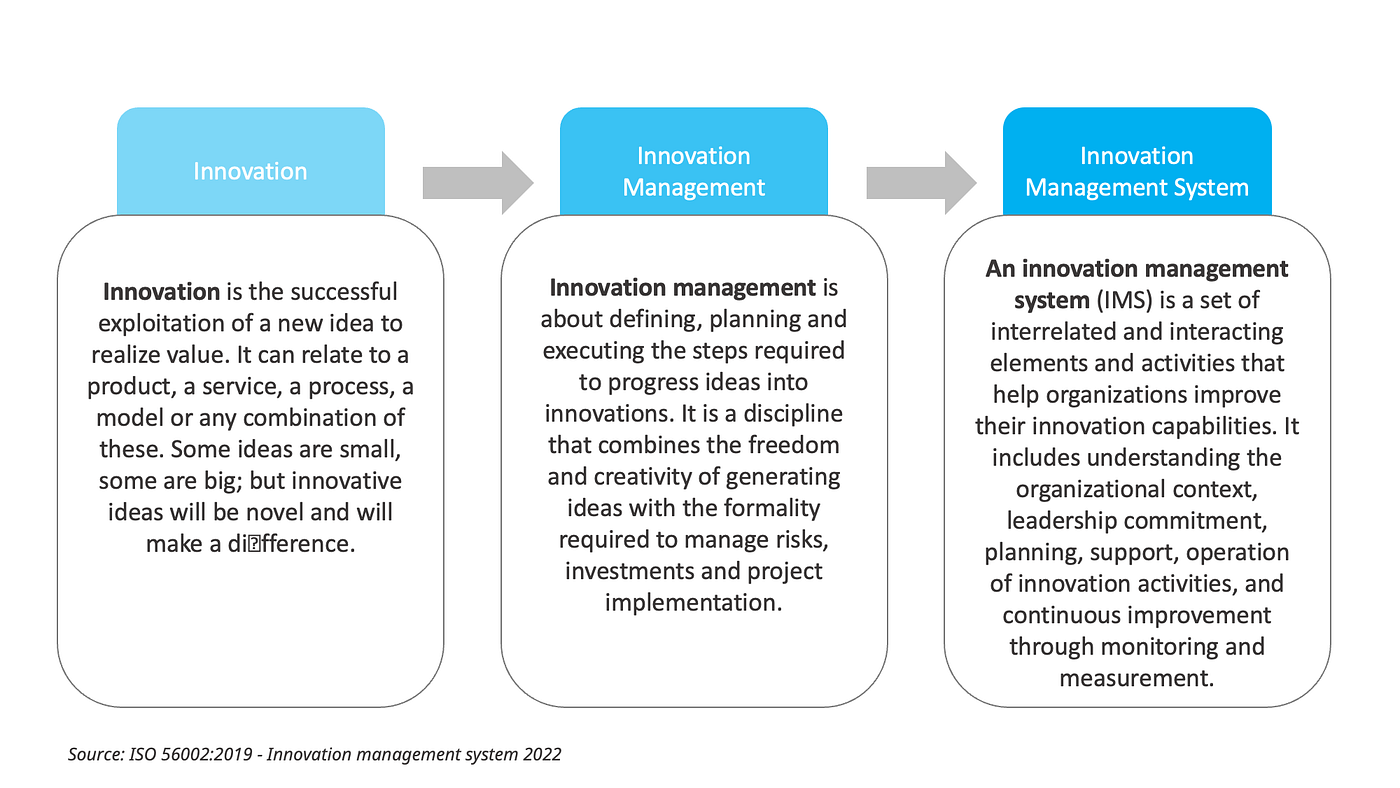
First, if you wish to transform the way you innovate, it is crucial to establish a shared understanding of what innovation means for you.
In its simplest form, the Merriam-Webster dictionary defines innovation as the introduction of something new. However, there are many types of innovation and therefore, ways of innovating. That’s why it’s important to define it within the context of your organization, your goals, and strategy.
Also, note that innovation is not just an ingredient you add to the mix and hope for a better result than before. It has to be placed at the core of the organization. That’s where innovation management comes into play.
Innovation has to be placed at the core of the organization.
Innovation management is the process through which you get to create and introduce that “something new”. This process can look different from one organization to another, which makes it more challenging to see it in perspective.
We usually structure the core aspects of innovation management into capabilities, structure, culture, and strategy. However, the International Standards for Innovation expand them further into eight principles.
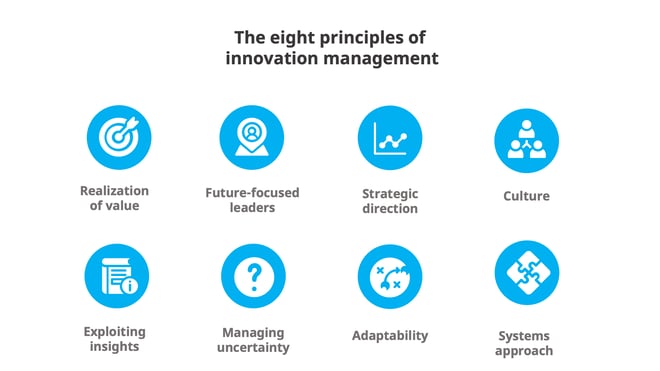
We previously explored each of these topics in detail on our blog, as they all contribute to successful innovation. But maybe the most important one, which should be your North Star, is the creation of value. Unless you add value, you are simply creating innovation theater.
Unfortunately, this is very common in organizations attempting to innovate through sporadic activities. But innovation is a complex, dynamic process that evolves over time.
At the same time, it’s understandable why the skepticism around the standards for innovation. Just as innovation is not easy, neither is adhering to a set of standards that will help you succeed at it.
Obviously, standards come with both downsides and benefits, but as pointed out in the ISO documentation, these innovation management principles are “an open set to be integrated and adapted within the organization”.
Naturally, now you might question how standardization is possible if innovation and its management are so complex and can vary so greatly across organizations and industries.
The problem is that traditionally, innovation has been seen as a creative and sometimes chaotic process that may or may not result in something new that adds value.
However, if we take a closer look at some of the most innovative companies, we see that it’s not about randomly generating wild ideas and hoping for the best.
The myth of the crazy innovator has been popularized by the media that portrays innovators as superheroes. This stereotypical view on innovation fed the belief that innovation and standardization are two opposing forces. Innovation comes from pure chaos, and standards fight it with order. In fact, creativity and standardization can be complementary. You need both for successful corporate management.
Creativity and standardization can be complementary. You need both for successful corporate management.
For example, even though Apple marketed itself as a group of rebels revolutionizing the computer, Steve Jobs actually instilled a disciplined culture where people had to adhere to his methods. In a way, he had his own set of standards for what an innovative product meant.
Similarly, Toyota, renowned for its enduring success, has developed its own system called “The Toyota Way”. Through this system, they have embraced continuous improvement as an approach to innovation, refining it into a set of principles that have become synonymous with their brand.
If it wasn’t for Toyota’s systematic approach to innovation, and Jobs’ eccentricity who insisted on doing things a certain way, today we might have had two very different companies.
Even though their way is by no means a “recipe” that can be replicated by others, we can see how having a framework sets the tone for how an organization is innovating on the long term.
Efforts have been ongoing to develop a comprehensive framework that can be universally adopted by organizations of all sizes and industries. The International Organization for Standardization (ISO) has taken a significant step in this direction with the introduction of the ISO 56000 suite of innovation standards.
Let’s next take a closer look at these standards to see if they have any practical benefits.
ISO 56000 Suite for Innovation
In essence, standards are meant to be a reference point for organizations, industries, and individuals. They are used to establish best practices, promote efficiency, enhance safety, and facilitate communication and cooperation. Even though they could seem just rigid rules, standards are simply ways of working and they are not meant to hinder creativity.
Where did the ISO standards for innovation come from? The International Organization for Standardization (ISO) is developing and promoting international standards that facilitate consistency, interoperability, and quality across various industries and sectors.
The ISO 56000 series of standards for innovation is a rather new initiative where experts from 50 countries came together in an effort to establish a common understanding of innovation and support organizations across all industries to improve their ability to survive and thrive in this uncertain world.
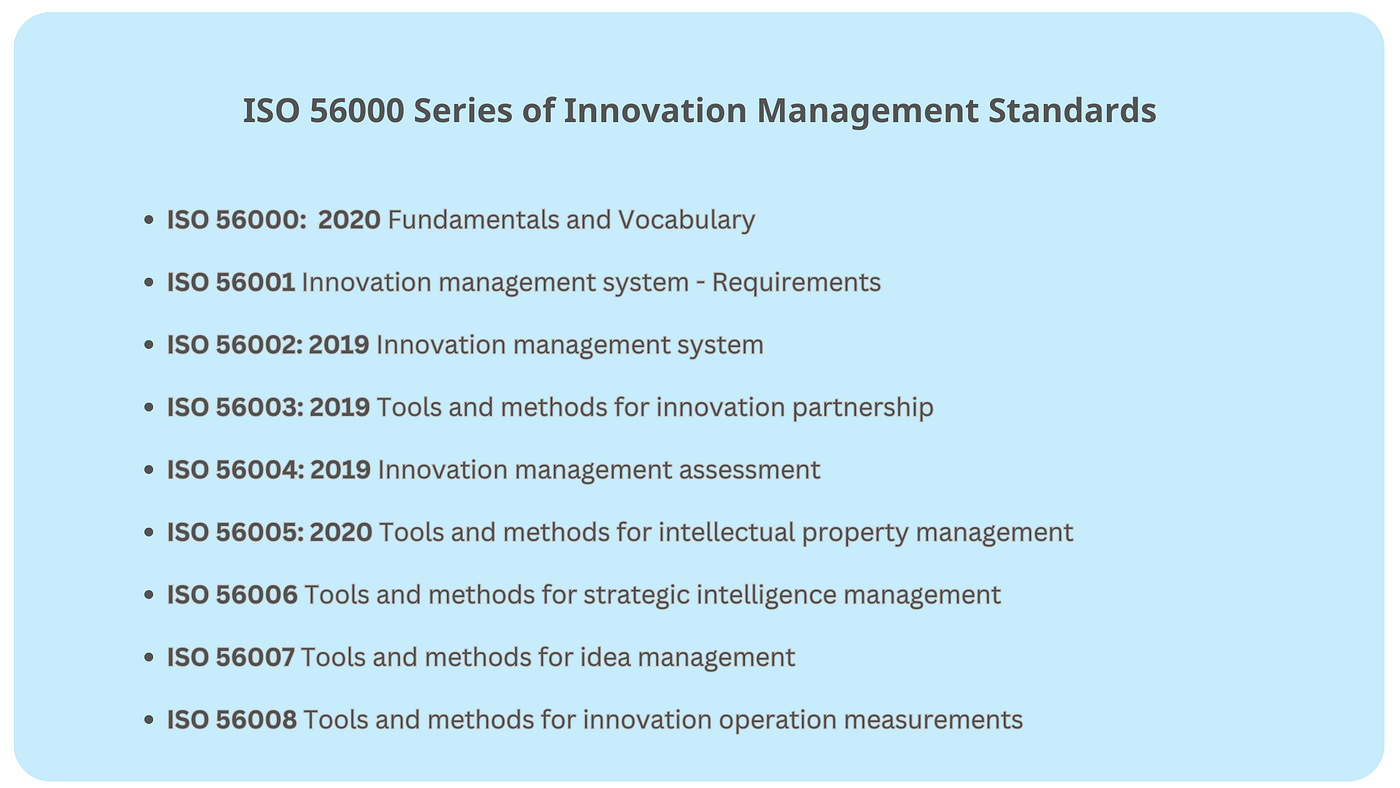
Also, note that some standards from the eight-part series are still under development (as per July 2023), so we will get back and update this article when necessary. If you consider complying with these standards, the ISO website is the official source to get them in full.
However, the standards we believe to be the most relevant in helping you succeed have already been published:
- ISO 56000 Innovation Management – Fundamentals and vocabulary
- ISO 56002 Innovation management – Innovation management system
- ISO 56003 Tools and Methods for innovation partnership.
For a better understanding of the use and purpose of the ISO standards, let’s focus on the ISO 56000 Fundamentals and vocabulary, and the ISO 56002 for Innovation management system.
ISO 56000 Innovation management — Fundamentals and vocabulary:
- Provides vocabulary, fundamental concepts, and principles of innovation management and its systematic implementation.
- Applicable to various organizations, including those implementing an innovation management system, seeking to improve their innovation capabilities, or aiming for effective communication and common understanding in innovation management.
- Suitable also for providers of training in, assessment of, or consultancy for, innovation management and innovation management systems.
- It can be applied by all types of organizations, regardless of the sector, size, or maturity level. It’s useful for different types of innovations (product, services, processes, etc), and approaches (internal, open, design-driven, etc.)
ISO 56002 Innovation management system
- Provides guidance for establishing, implementing, maintaining, and improving an innovation management system in established organizations.
- Applicable to organizations seeking sustained success in managing innovation activities, interested parties assessing innovation capabilities, and policymakers supporting innovation and competitiveness.
- Provides generic guidance applicable to all types of organizations, innovations, and approaches, with a focus on established organizations.
- This standard goes beyond the foundational principles and offers more practical guidance on how to structure, implement, and continuously improve innovation processes. It emphasizes the importance of leadership, communication, and organizational culture in fostering innovation.
- However, it does not prescribe specific activities, requirements, tools, or methods for innovation but offers general-level guidance.
How does this translate into innovation practices? Well, let’s take a step back and look at how most organizations approach innovation.
Traditionally, many organizations innovate by focusing primarily on episodic events that are centered around ideas. These could be hackathons, suggestion boxes, idea challenges, brainstorming sessions, or similar events. Something could come out of these sporadic activities, but mostly they turn out to be wasted efforts and resources.
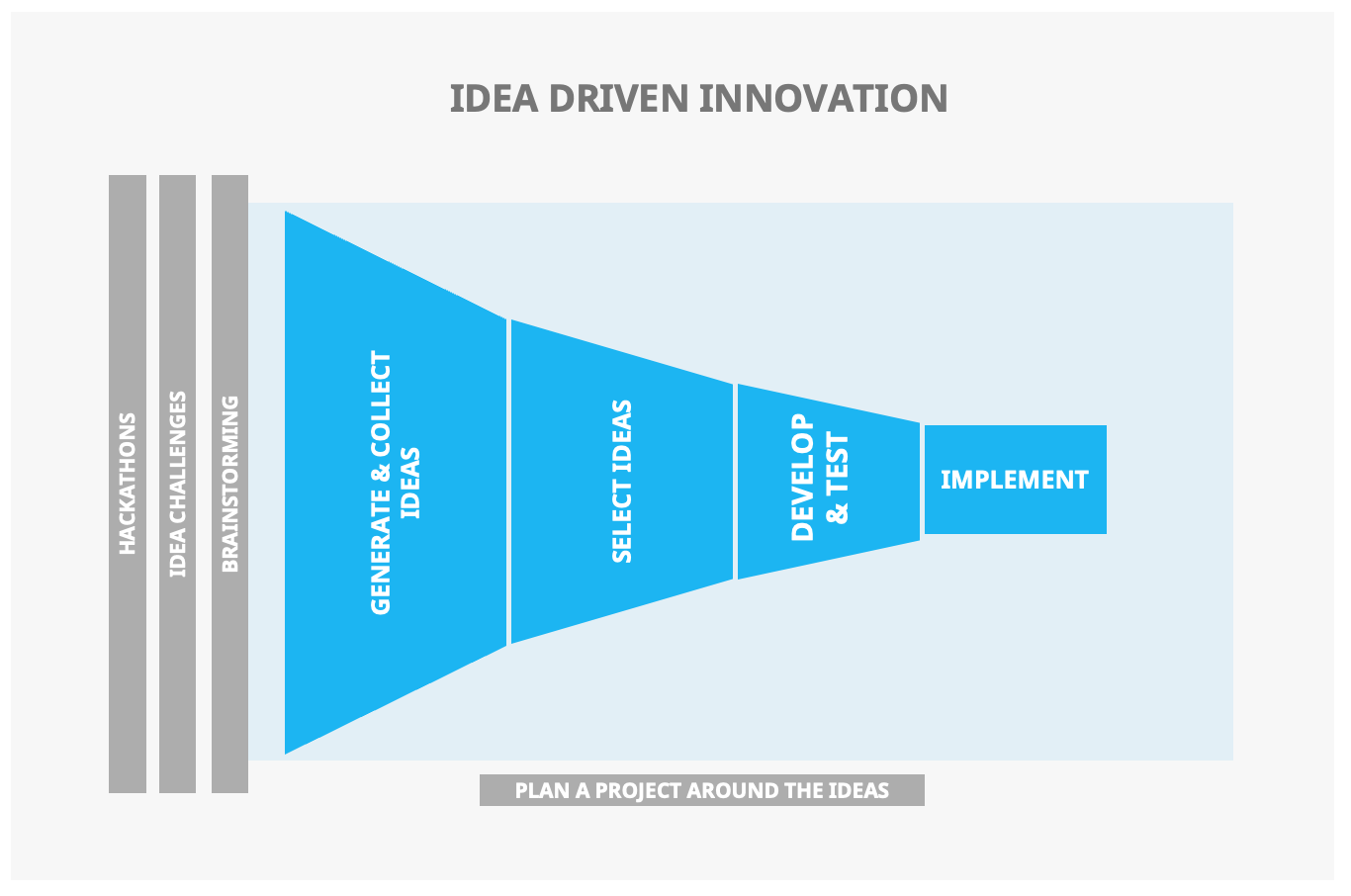
Truth be told, ideas are not worth much. The execution is more important. The issue with the old, funnel approach, which is mostly about collecting numerous ideas, filtering, evaluating, and selecting a few for implementation, is that it can overlook the essence of innovation and focus on the wrong things.
Innovation at the corporate level is not, or should not be, just about creating something new for the sake of novelty. That is an invention and not all inventions are innovations. Instead, innovation should create value and align with the overall business strategy and goals.
All in all, the traditional funnel works fine at the ideation level, but is not an all-encompassing system to repeatedly innovate at an organizational level.
ISO 56002 brings together all the elements that can enable value creation through innovation. The innovation management system, which is at the core of the ISO 56002 is made of different interrelated elements that make up the framework on which an organization can develop and deploy innovation capabilities, evaluate performance, and achieve the intended goals.
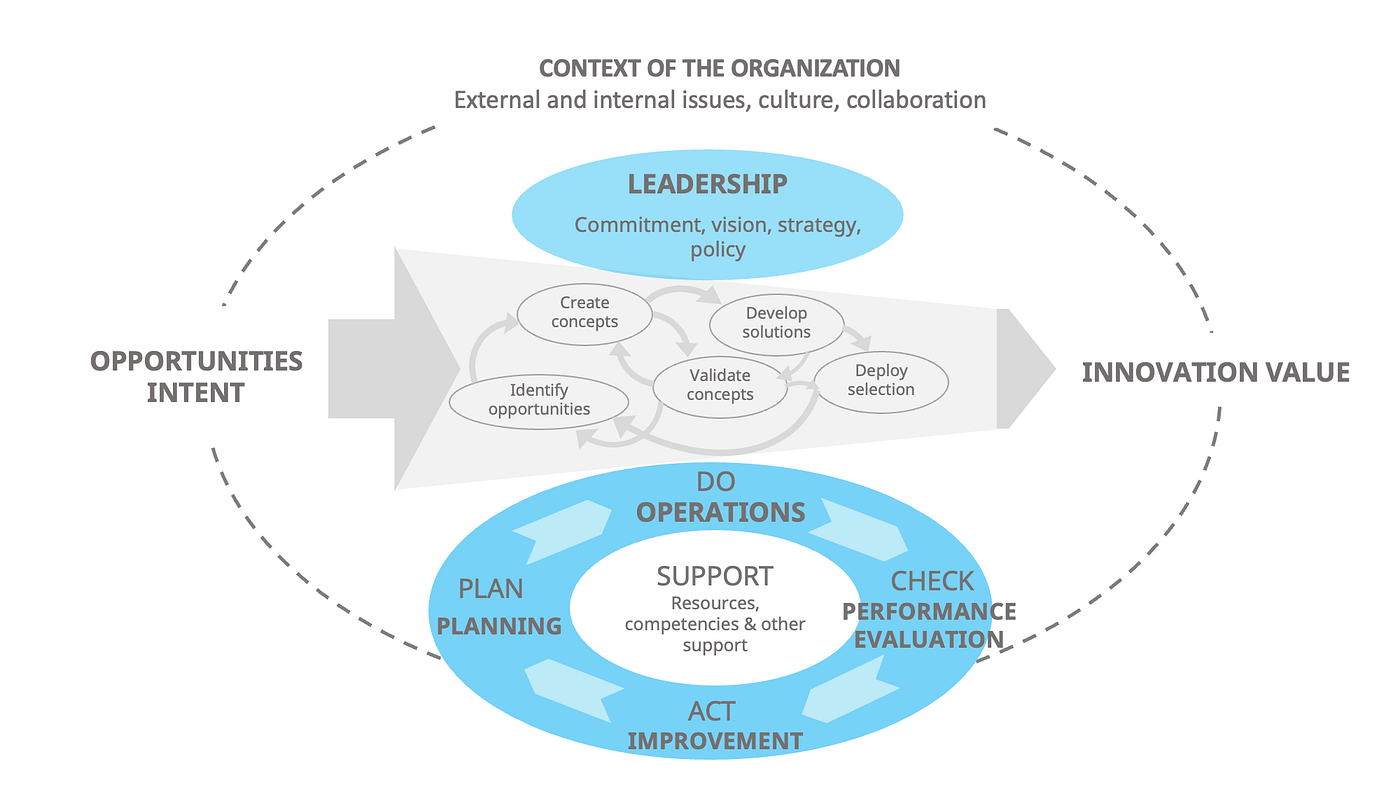
As shown in this graphic, the innovation management system can be very complex, especially for larger, more established organizations.
The good news is that you don’t have to adopt all the elements at once. You can gradually integrate them to create a system that works for your organization and its specific context. As their guideline indicates, it all starts with committing and promoting the capabilities required to create such a system.
If you’ve read our articles before, you probably noticed that we talked extensively about continuous improvement, as well as the tools and processes that drive sustained innovation. So, it’s no surprise that the ISO 56002 also integrates the PDCA (Plan – Do – Check – Act) cycle, which enables continuous improvement of the innovation practices.
This model also ties together the business strategy with the innovation strategy. It gives insights into the intent and where the innovation activities should be directed.
So, instead of collecting ideas for projects that may not add anything valuable to the bottom line, you should generate ideas based on opportunities.
In broad terms, this is how standardization can enable innovation. It’s not about a “to do” list, but about the bigger picture. The ISO 56000 suite highlights the need for an end-to-end approach to innovation, where barriers are removed, and creativity can flourish. It enables the conditions for innovation to thrive.
It’s great to see there is this attempt to establish a foundation for managing innovation as a process, through a holistic approach. Even so, there are still shortcomings that sceptics of the ISO standards are right to be concerned about. Let’s see what those are.
The Pros and Cons of ISO Standards for Innovation
What should you know before deciding to make the leap, and what are the downsides of adhering to ISO standards for innovation? Also, what are the benefits, and is it worth investing the effort, time, energy, and resources? Let’s see.
The downsides of ISO standards for innovation
- Limited scope
Innovation is multifaceted and complex and the road to success looks very different for each organization. The size, industry, and specific goals of each organization mean that the processes required to innovate can also look very different. Adopting a set of standards with such a broad scope can be very challenging for organizations.
ISO 56000 lays the ground to define fundamental concepts and vocabulary, ISO 56002 provides guidance for establishing and implementing an innovation management system and ISO 56003 focuses on specific types of innovation. Even though they attempt to provide guidance in different scenarios, they still cannot fully address every organization’s unique needs.
That’s why you need committed, knowledgeable leaders who can show the way and understand how to adapt the system to the specifics of their organization.
- Not a playbook for success
It should be clarified that even if you adhere to these standards and you put in all the work, the ISO standards are not a playbook for success.
The impact of implementing these standards can vary from one organization to another depending on the industry, maturity of the innovation practices, size, culture, and so on.
So, it’s important to set the expectations right and to take them for what they are. These standards can help you move ahead, but they won’t provide the recipe for disruptive or radical innovations, which can truly set you apart.
- Rigidity and too much focus on compliance
A lack of flexibility is on the top of leaders’ minds when they think of standards. Employees also fear that being compliant with specific standards will take away from the flexibility and freedom to think creatively or try unconventional approaches.

But having constraints is not all bad. In fact, constraints can foster creativity. Having constraints can help you understand the problem better, it can force you to be creative and think outside the box, and can ultimately turn into a source of competitive advantage.
- Costs and resources
The process of implementing ISO innovation standards can be time-consuming, complex, and costly. It requires allocating resources for conducting assessments, audits, and certifications, which can be a burden for smaller organizations with limited budgets. Other costs may include purchasing the standards, training employees on their implementation, and conducting internal assessments to ensure compliance.
What’s more, adhering to new standards involves a significant commitment of time and effort. Developing new processes, aligning existing practices with the standards, and undergoing audits or assessments demand substantial dedication. This can strain resources and may divert attention from other critical business activities.
- Workforce resistance
Embracing ISO standards often require organizational change, which can encounter resistance from employees and management. Change management efforts are essential to successfully integrate the standards, but they can add complexity and take time to fully adopt the new practices.
Leadership commitment is essential and their approach to enforcing change can make or break the initiative. If the standards will be imposed rules, they can become a cause of friction between leaders and employees.
Despite these downsides, it’s important to recognize that investment in ISO standards can bring substantial benefits. What kind of benefits?
Benefits of Adopting ISO Standards for Innovation
- Enhanced Innovation Management Practices
With the ISO standards you get the guidance and framework to develop more efficient and structured innovation management processes.
With such a complex endeavor it’s so easy to get lost in the details and forget the big picture. The ISO 56002 standards provide the guidelines on how to ideate, evaluate, and implement innovative ideas, leading to better utilization of resources and increased innovation success rates.
- Improved Governance and Organizational Structure
Without structures in place there is no common understanding of how the organization understands innovation. There are inconsistent practices, fragmented activities that lead to no results, and no clear direction or alignment with the overall strategy.
The ISO standards are like a map, showing the team the best route to take and ensuring everyone is on the same page.
Armed with these guidelines, organizations establish a smoother and more organized innovation process. Everyone knows their roles and responsibilities, communication flows better, and collaboration becomes easier. It’s like having a well-oiled machine, where everyone knows what to do and how they fit into the bigger picture.
The ISO standards also emphasize the importance of leadership and accountability. Leaders take charge and guide the innovation process, while everyone is responsible for their part in making innovation successful. For innovation to succeed, you need a strong captain steering the ship and a crew that works together.
- Increased Competitiveness and Growth
Armed with these standards, you can identify new opportunities, develop innovative products or services, and gain a competitive advantage.
Standards act as a roadmap, guiding you towards effective strategies and practices that fuel the competitive edge. As we saw in the overall structure of the ISO 56002, it promotes a culture of continuous improvement and learning within organizations. This encourages the exploration of new ideas, the identification of areas for growth, and the development of innovative solutions. It enables organizations to stay agile, responsive, and innovative in a rapidly evolving business landscape.
- Better Ability to Manage Risk
The concept of risk is too often seen as purely a negative issue that one should look to minimize by diversifying the innovation portfolio. Instead, you should look at risk through a broader lens, especially when it comes to innovation.
The concept of risk is too often seen as purely a negative issue that one should look to minimize by diversifying the innovation portfolio. Instead, you should look at risk through a broader lens, especially when it comes to innovation.

Risk is the potential of something either gaining or losing value, which means that it simply represents the uncertainty related to that something. Since working on innovation involves a lot of uncertainty, you should look at risk as more than just something to minimize. Of course, the acceptable level of risk depends on ambition, capabilities, and the types of innovations pursued.
Since working on innovation involves a lot of uncertainty, you should look at risk as more than just something to minimize.
For example, startups, particularly early-stage ones, are often more willing to take significant risks by dedicating all their resources to a single ambitious project with a high likelihood of failure but the potential for substantial rewards.
Therefore, even in the context of standards, flexibility and adaptability are crucial. You have to establish unified or separate structures for innovation activities with different leadership styles, competencies, and cultures.
Implementing an innovation management system challenges the status quo, enabling effective management of uncertainties and risks.
- Ability to Forge Meaningful and Valuable Partnerships
ISO standards help organizations forge meaningful and valuable partnerships by providing a common framework and shared language for collaboration.
The ISO 56003 can help you decide whether you should enter an innovation partnership, identify, evaluate, and select partners and assess the alignment and perceptions of value and challenges of the partnership.
Even more, through ISO standards organizations can also demonstrate their commitment to best practices and a high level of quality in their operations. This can attract potential partners who value reliability and trustworthiness. When partners see that an organization follows recognized standards, it gives them confidence that they can work together effectively and achieve mutually beneficial outcomes.
When organizations follow these standards, they can collaborate more efficiently and make better decisions together. This fosters trust and strengthens the partnership, leading to more successful projects and innovations.
- Effective Intellectual Property Management
IP management is like a safety net for new ideas and inventions. It protects them from being copied or used by others without permission. When innovators get patents, trademarks, copyrights, or keep their secrets, it gives them legal rights over their creations. This protection encourages them to invest in more research and come up with even better things.
If you are concerned about IP management, the ISO 56005 was developed as a guidance and framework to address the management of intellectual property rights.
Clear guidelines for IP management can help you protect and capitalize on your innovations. The ISO 56005 explains the steps to carry out an IP order and create an IP strategy that aligns with your business goals.
Overall, the adoption of innovation standards paves the way for continuous improvement, growth, and impactful collaborations in today’s dynamic and rapidly evolving business landscape. But ultimately, the decision to invest in the ISO standards for innovation depends on your objectives, resources, and long-term commitment to continuous improvement.
What Next?
Now that you know what’s the deal with these ISO standards for innovation, what should you do next?
- Assess Readiness: Begin by evaluating your organization’s readiness for implementing standards for innovation. It’s important to understand why transformation is necessary. Assess factors such as your maturity as an organization, your current innovation practices, resources, and commitment to driving innovation improvements.
- Familiarize Yourself with the ISO Standards: Take the time to understand the ISO standards relevant to innovation, such as ISO 56000 and its related standards. Familiarize yourself with the content as much as possible to understand where to start.
Note that you don’t have to get on board with all standards. If you are new to innovation work, you might want to start with the ISO 56000 to establish the concepts of innovation in relation to your organization. From there you will get more familiar with the topic and start to understand the basics. - Define Objectives and Benefits: If you already know you want to adopt ISO standards, make sure you have defined the objectives you aim to achieve. Consider the potential benefits for your organization, such as improved innovation management practices, enhanced competitiveness, and better risk management.
- Gain Leadership Commitment: Having that clear understanding of what you want to achieve through the standards will also help secure leadership commitment, which is vital for the successful adoption of ISO standards. Engage top management, to gain their support and endorsement of the initiative.
- Make a Plan: Next, develop a detailed plan for implementing ISO standards for innovation. The plan should outline the steps, timelines, responsibilities, and resources required for successful implementation.
- Engage Stakeholders: Involve all relevant stakeholders in the process. Seek input from employees, teams, and departments that will be impacted by the adoption of ISO standards to ensure their buy-in and cooperation. Offer training and awareness programs to employees to ensure they understand the importance and benefits of adopting these ISO standards.
- Continuous Improvement: As the innovation management system proposed by the ISO organization also outlines, continuous improvement is the backbone of any process. Once you execute the plan and start adhering to innovation standards, you should monitor progress, measure outcomes, and continually assess and improve your innovation management practices.
- Consider Certification: Lastly, the elephant in the room. Whenever you think of ISO standards you think of the ISO certificates. While certification can signal a commitment to best practices and continuous improvement in innovation management, it is not mandatory for implementing effective innovation initiatives within an organization.
You can adhere to the standards without additional investment into getting certified. The ISO 56002 is the only one that is eligible for certification, meaning that you can seek certification from accredited certification bodies to demonstrate your compliance with ISO 56002 as well as your commitment to effective innovation management.
Conclusion
Because we don’t like to do things halfway, this was a lengthy article. We didn’t go into the details of each standard because that is beside the point here. Our goal was to provide you with the bigger picture of what it means to standardize innovation practices.
This will hopefully help you better understand that innovation is not a one-time activity you do after a workshop, and that a systematic approach is essential for long-term success and growth.
Innovation can be like deciding to go to the gym or sticking to a workout routine. Sometimes the most difficult part is to get started and make that first step.
With this information at hand, you can start digging deeper into the specifics of each standard that interests you and use them as a compass to steer you in the right direction. They can give a new perspective into the methods you can use to achieve success in innovation, and help you rethink how you manage innovation at an organizational level.
Image credit: Unsplash.com, Pixabay, viima.com, iso.org
 Sign up here to join 17,000+ leaders getting Human-Centered Change & Innovation Weekly delivered to their inbox every week.

















 Drum roll please…