Fall Sale on Charting Change

Charting Change for an Outstanding 2023

Wow! Exciting news!

My publisher is having a back to school sale that will allow you to get the hardcover or the digital version (eBook) of my latest best-selling book Charting Change for 40% off!

Including FREE SHIPPING WORLDWIDE! *

I created the Human-Centered Change methodology to help organizations get everyone literally all on the same page for change. The 70+ visual, collaborative tools are introduced in my book Charting Change, including the powerful Change Planning Canvas™. The toolkit has been created to help organizations:

  • Beat the 70% failure rate for change programs
  • Quickly visualize, plan and execute change efforts
  • Deliver projects and change efforts on time
  • Accelerate implementation and adoption
  • Get valuable tools for a low investment

You must go to SpringerLink for this Cyber Sale:

  • The offer is valid until October 31, 2023 only using code HAL40

Click here to get this deal using code HAL40

SPECIAL UPDATE: On October 9-13, 2023 ONLY try the discount code 50off and save 50% off instead!

Quick reminder: Everyone can download ten free tools from the Human-Centered Change methodology by going to its page on this site via the link in this sentence, and book buyers can get 26 of the 70+ tools from the Change Planning Toolkit (including the Change Planning Canvas™) by contacting me with proof of purchase.

*This offer is valid for English-language Springer, books and eBooks in the aforementioned subject area(s) and is redeemable on link.springer.com only. Titles affected by fixed book price laws, forthcoming titles and titles temporarily not available on link.springer.com are excluded from this promotion, as are reference works, handbooks, encyclopedias, subscriptions, or bulk purchases. The currency in which your order will be invoiced depends on the billing address associated with the payment method used, not necessarily your home currency. Regional VAT/tax may apply. Promotional prices may change due to exchange rates. This offer is valid for individual customers only. Booksellers, book distributors, and institutions such as libraries and corporations please visit springernature.com/contact-us. This promotion does not work in combination with other discounts or gift cards.

Do you prize novelty or certainty?

Do you prize novelty or certainty?

GUEST POST from Mike Shipulski

When you follow the best practice, by definition your work is not new. New work is never done the same way twice. That’s why it’s called new.

Best practices are for old work. Usually, it’s work that was successful last time. But just as you can never step into the same stream twice, when you repeat a successful recipe it’s not the same recipe. Almost everything is different from last time. The economy is different, the competitors are different, the customers are in a different phase of their lives, the political climate is different, interest rates are different, laws are different, tariffs are different, the technology is different, and the people doing the work are different. Just because work was successful last time doesn’t mean that the old work done in a new context will be successful next time. The most important property of old work is the certainty that it will run out of gas.

When someone asks you to follow the best practice, they prioritize certainty over novelty. And because the context is different, that certainty is misplaced.

We have a funny relationship with certainty. At every turn, we try to increase certainty by doing what we did last time. But the only thing certain with that strategy is that it will run out of gas. Yet, frantically waving the flag of certainty, we continue to double down on what we did last time. When we demand certainty, we demand old work. As a company, you can have too much “certainty.”

When you flog the teams because they have too much uncertainty, you flog out all the novelty.

What if you start the design review with the question “What’s novel about this project?” And when the team says there’s nothing novel, what if you say “Well, go back to the drawing board and come back with some novelty.”? If you seek out novelty instead of squelching it, you’ll get more novelty. That’s a rule, though not limited to novelty.

A bias toward best practices is a bias toward old work. And the belief underpinning those biases is the belief that the Universe is static. And the one thing the Universe doesn’t like to be called is static. The Universe prides itself on its dynamic character and unpredictable nature. And the Universe isn’t above using karma to punish those who call it names.

Image credit: Pixabay

Subscribe to Human-Centered Change & Innovation WeeklySign up here to join 17,000+ leaders getting Human-Centered Change & Innovation Weekly delivered to their inbox every week.

The Best Way to Impress Your Customers

The Best Way to Impress Your Customers

GUEST POST from Shep Hyken

We have the privilege and honor of working with some amazing clients. One of them asked us to work with her team on a customer experience initiative that included every company employee. One of the regular assignments for employees there is to share examples of how they created a Moment of Magic® for a customer or colleague. They do short write-ups and share them with their managers. Here is a great example of the power of this exercise.

The client is a travel company and had a VIP client that had worked with them for more than 20 years. His agent, Katie, referred to as a relationship manager, made a hotel reservation for a trip to Europe to work on a very important court case.

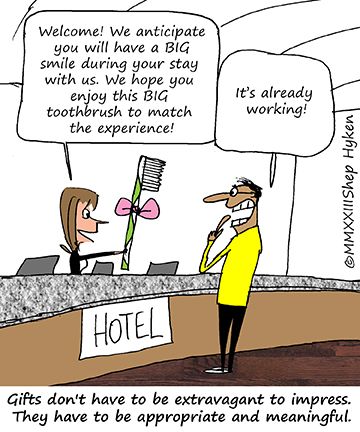
Katie decided to surprise him with a unique gift that she knew would have more impact than a bottle of champagne or a bottle of wine, which is the typical room gift her agency sent her VIP clients. Instead, she arranged for a pair of boxing gloves to be placed in his hotel room when he arrived with a note saying, “Knock them out!”

The client wrote Katie a thank-you note:

I had a busy day, as you would expect, but this is the most thoughtful and creative present I have ever received. And after a long day, I can’t stop laughing. They (the gloves) are going in a glass box and will be kept in my house with your card, so I can look at it every time I have a fight on my hands. Katie, you have no idea how this made me feel. Thank you!

Wow! The client referred to this as “the most thoughtful and creative present” he had ever received!

There are several lessons here:

1. Surprise Appreciation – It’s nice to surprise a customer with a gift for the right reason. It doesn’t have to be extravagant, but it needs to show you care. It just has to be unexpected, appreciated and memorable.

2. Make it Unique – It’s customary for travel agencies to send clients a surprise welcome gift in their hotel room. It’s usually a box of chocolates, a bottle of wine or something the hotel can provide. This gift was unique and, at the same time, very appropriate. It’s doubtful that Katie will send a pair of boxing gloves to a client again – unless there is a perfect reason to do so.

3. The Note Is Important – Katie’s note was just three words, but they were the right three words. It proves Katie was listening to her customer. That’s why her title is “relationship manager.”

Gifts don’t have to be extravagant to impress. They have to be appropriate and meaningful. If you want to learn more about how to properly gift your customers, read this article about my friend John Ruhlin and his book Giftology.

Image Credits: Pexels, Shep Hyken

Subscribe to Human-Centered Change & Innovation WeeklySign up here to join 17,000+ leaders getting Human-Centered Change & Innovation Weekly delivered to their inbox every week.


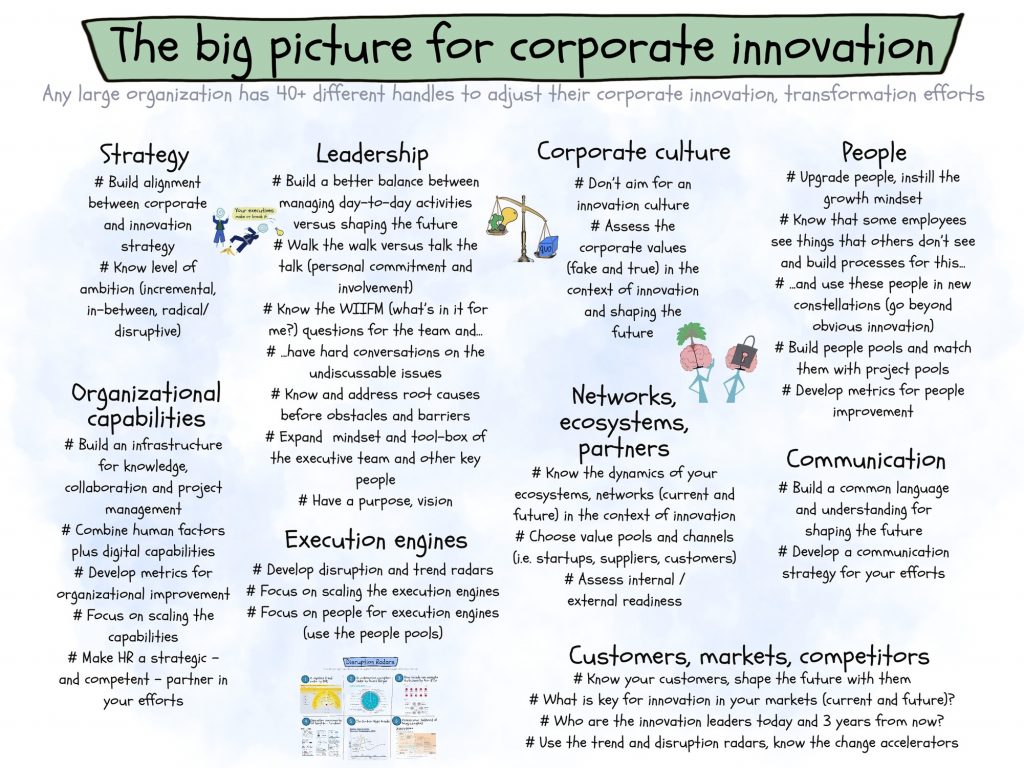
The Biggest Challenge for Innovation is Organizational Inertia

The Biggest Challenge for Innovation is Organizational Inertia

GUEST POST from Stefan Lindegaard

I often talk about organizational inertia being the biggest obstacle for innovation but if this is true for your organization what should you look out for? Here’s my take.

  1. Aligning with organizational goals and strategy: Innovation teams need to ensure that their ideas and initiatives are aligned with the broader goals and strategy of the organization. This can be challenging if there is a lack of clear communication or alignment between the innovation team and other parts of the organization.
  2. Gaining support and buy-in: Innovation teams often need to gain support and buy-in from others within the organization in order to move forward with their ideas. This can be difficult if there is resistance to change or a lack of understanding of the value of the team’s ideas.
  3. Overcoming cultural barriers and resistance to change: Many organizations have entrenched cultures and practices that can be resistant to change. This can make it difficult for innovation teams to gain support and buy-in for their ideas, and can even lead to resistance or pushback from others within the organization.
  4. Navigating organizational structure and processes: Innovation teams may face challenges related to the structure and processes of their organization, such as bureaucratic red tape or a lack of clear decision-making processes.
  5. Generating new and creative ideas: Innovation teams need to constantly come up with fresh ideas, which can be a challenging and pressure-filled task.
  6. Delivering results quickly: In today’s fast-paced business environment, innovation teams often face pressure to deliver results quickly, which can be difficult if their ideas require a significant amount of time and resources to develop.
  7. Communicating and collaborating effectively: Innovation teams often need to work closely with others, including other teams, departments, and even external partners. This can be challenging if team members have different backgrounds, perspectives, and communication styles.
  8. Operating within constraints: Innovation teams often have to work within the constraints of limited budgets, resources, and other factors, which can make it difficult to pursue new ideas and initiatives.

Overall, these challenges can make it difficult for innovation teams to be effective and successful in driving innovation within their organizations.

How to address this is very much related the specific situation of an organization and in particular the root causes they deal with.

There is, however, no doubt that this has to dealt with from the top down in order to release the full potential of innovation for the organization.

Image Credit: Stefan Lindegaard, Pixabay

Subscribe to Human-Centered Change & Innovation WeeklySign up here to get Human-Centered Change & Innovation Weekly delivered to your inbox every week.

Your Innovation is Dictated by Who You Are & What You Do

Your Innovation is Dictated by Who You Are & What You Do

GUEST POST from Robyn Bolton

Using only three words, how would you describe your company?

Better yet, what three words would your customers use to describe your company?

These three words capture your company’s identity. They answer, “who we are” and “what business we’re in.”  They capture a shared understanding of where customers allow you to play and how you take action to win. 

Everything consistent with this identity is normal, safe, and comfortable.

Everything inconsistent with this identity is weird, risky, and scary.

Your identity is killing innovation.

Innovation is something new that creates value.

Identity is carefully constructed, enduring, and fiercely protected and reinforced.

When innovation and identity conflict, innovation usually loses.

Whether the innovation is incremental, adjacent, or radical doesn’t matter. If it conflicts with the company’s identity, it will join the 99.9% of innovations that are canceled before they ever launch.

Your identity can supercharge innovation.

When innovation and identity guide and reinforce each other, it doesn’t matter if the innovation is incremental, adjacent, or radical.  It can win.

Identity-based Innovation changes your perspective. 

We typically think about innovation as falling into three types based on the scope of change to the business model:

  1. Incremental innovations that make existing offerings better, faster, and cheaper for existing customers and use our existing business model
  2. Adjacent innovations are new offerings in new categories, appeal to new customers, require new processes and activities to create or use new revenue models
  3. Radical innovations that change everything – offerings, customers, processes and activities, and revenue models

These types make sense IF we’re perfectly logical and rational beings capable of dispassionately evaluating data and making decisions.  SPOILER ALERT: We’re not.  We decide with our hearts (emotions, values, fears, and desires) and justify those decisions with our heads (logic and data).

So, why not use an innovation-typing scheme that reflects our humanity and reality?

That’s where Identity-based Innovation categories come in:

  1. Identity-enhancing innovations reinforce and strengthen people’s comfort and certainty in who they are and what they do relative to the organization.  “Organizational members all ‘know’ what actions are acceptable based on a shared understanding of what the organization represents, and this knowledge becomes codified u a set of heuristics about which innovative activities should be pursued and which should be dismissed.”
  2. Identity-stretching innovations enable and stretch people’s understanding of who they are and what they do in an additive, not threatening, way to their current identities.
  3. Identity-challenging innovations are threats and tend to occur in one of two contexts:
    • Extreme technological change that “results in the obsolescence of a product market or the convergence of multiple product markets.” (challenges “who we are”)
    • Competitors or new entrants that launch new offerings or change the basis of competition (challenges “what we do”)

By looking at your innovations through the lens of identity (and, therefore, people’s decision-making hearts), you can more easily identify the ones that will be supported and those that will be axed.

It also changes your results.

“Ok, nerd,” you’re probably thinking.  “Thanks for dragging me into your innovation portfolio geek-out.”

Fair, but let me illustrate the power of this perspective using some examples from P&G.

OfferingBusiness-Model TypesIdentity-based Categories
Charmin Smooth TearIncremental
Made Charmin easier to tear
Identity-enhancing
Reinforced Charmin’s premium experience
SwifferAdjacent
New durable product in an existing category (floor cleaning)
Identity-enhancing
Reinforced P&G’s identity as a provider of best-in-class cleaning products
Tide Dry CleanersRadical
Moved P&G into services and uses a franchise model
Identity-stretching
Dry cleaning service is consistent with P&G’s identity but stretches into providing services vs. just products

Do you see what happened on that third line?  A Radical Innovation was identity-stretching (not challenging), and it’s in the 0.1% of corporate innovations that launched!  It’s in 22 states!

The Bottom Line

If you look at innovation in the same way you always have, through the lens of changes to your business model, you’ll get the same innovation results you always have.

If you look at innovation differently, through the lens of how it affects personal and organizational identity, you’ll get different results.  You may even get radical results.

Image Credit: Unsplash

Subscribe to Human-Centered Change & Innovation WeeklySign up here to get Human-Centered Change & Innovation Weekly delivered to your inbox every week.

How to Fix Corporate Transformation Failure

How to Fix Corporate Transformation Failure

GUEST POST from Greg Satell

We live in an age in which change has become the only constant. So it’s not surprising that change management models have become popular. Executives are urged to develop a plan to communicate the need for change, create a sense of urgency and then drive the process through to completion.

Unfortunately, the vast majority of these efforts fail and it’s not hard to see why. Anybody who’s ever been married or had kids knows first-hand how difficult it can be to convince even a single person of something. Any effort to persuade hundreds, if not thousands, of people through some kind of mass effort is setting the bar pretty high.

However, as I explain in Cascades, what you can do is help them convince each other by changing the dynamic so that people enthusiastic about change can influence other (slightly less) enthusiastic people. The truth is that small groups, loosely connected, but united by a shared purpose drive transformational change. So that’s where you need to start.

The Power Of Local Majorities

In the 1950’s, the prominent psychologist Solomon Asch undertook a pathbreaking series of conformity studies. The design of the study was simple, but ingenuous. He merely showed people pairs of cards, asking them to match the length of a single line on one card with one of three on an adjacent card. The answer was meant to be obvious.

However, as the experimenter went around the room, one person after another gave the same wrong answer. When it reached the final person in the group (in truth, the only real subject, the rest were confederates), the vast majority of the time that person conformed to the majority opinion, even if it was obviously wrong!

Majorities don’t just rule, they also influence, especially local majorities. The effect is even more powerful when the issue at hand is more ambiguous than the length of a line on a card. More recent research suggests that the effect applies not only to people we know well, but that we are also influenced even by second and third-degree relationships.

So perhaps the best way to convince somebody of something is to surround them with people who hold a different opinion. To extend the marriage analogy a bit, I might have a hard time convincing my wife or daughter, say, that my jokes are funny and not at all corny, but if they are surrounded by people who think I’m hilarious, they’ll be more likely to think so too.

Changing Dynamics

The problem with creating change throughout an organization is that any sufficiently large group of people will hold a variety of opinions about virtually any matter and these opinions tend to be widely dispersed. So the first step in creating large-scale change is to start thinking about where to target your efforts and there are two tools that can help you do that.

The first, called the Spectrum of Allies, helps you identify which people are active or passive supporters of the change you want to bring about, which are neutral and which actively or passively oppose it. Once you are able to identify these groups, you can start mobilizing the most enthusiastic supporters to start influencing the other groups to shift their opinions. You probably won’t ever convince the active opposition, but you can isolate and neutralize them.

The second tool, called the Pillars of Support, identifies stakeholder groups that can help bring change about. In a typical corporation, these might be business unit leaders, customer groups, industry associations, regulators and so on. These stakeholders are crucial for supporting the status quo, so if you want to drive change effectively, you will need to pull them in.

What is crucial is that every tactic mobilizes a specific constituency in the Spectrum of Allies to influence a specific stakeholder group in the Pillars of Support. For example, in 1984, Anti-Apartheid activists spray-painted “WHITES ONLY” and “BLACKS” above pairs of Barclays ATMs in British university town to draw attention to the bank’s investments in South Africa.

This of course, had little to no effect on public opinion in South Africa, but it meant a lot to the English university students that the bank wanted to attract. Its share of student accounts quickly plummeted from 27% to 15% and two years later Barclays pulled out all of its investments from the country, which greatly damaged the Apartheid regime.

Identifying A Keystone Change

Every change effort begins with a grievance: sales are down, customers are unhappy or perhaps a new technology threatens to disrupt a business model. Change starts when leaders are able to articulate a clear and affirmative “vision for tomorrow” that is empowering and points toward a better future.

However, the vision can rarely be achieved all at once. That’s why successful change efforts define a keystone change, which identifies a tangible goal, involves multiple stakeholders and paves the way for future change. A successful keystone change can supercharge your efforts to shift the Spectrum of Allies and pull in Pillars of Support.

For example, when Experian’s CIO, Barry Libenson, set out to shift his company to the cloud, he knew it would be an enormous undertaking. As one of the largest credit bureaus in the world, there were serious concerns that shifting its computing infrastructure would create vulnerabilities in its cybersecurity and its business model.

So rather than embarking on a multi-year death march to implement cloud technology throughout the company, he started with building internal APIs to build momentum. The move involved many of the same stakeholders he would need for the larger project, but involved far less risk and was able to show clear benefits that paved the way for future change.

In Cascades, I detail a number of cases, from major turnarounds at companies like IBM and Alcoa, to movements to gain independence in India and to secure LGBT rights in America. In each case, a keystone change played a major role in bringing change about.

Surviving Victory

As Saul Alinsky pointed out decades ago, every revolution inspires a counterrevolution. So many change efforts that show initial success ultimately fail because of backlash from key stakeholders. That’s why it is crucial to plan how you will survive victory by rooting your change effort in values, skills and capabilities, rather than in specific objectives or tactics.

For example, Blockbuster Video’s initial response to Netflix in 2004 was extremely successful and, by 2007, it was winning new subscribers faster than the upstart. Yet because it rooted its plan solely in terms of strategy and tactics, the changes were only skin deep. After the CEO left because of a compensation dispute, the strategy was quickly reversed. Blockbuster went bankrupt a few years later.

Compare that to the success at Experian. In both cases, large, successful enterprises needed to move against a disruptive threat. In both cases, legacy infrastructure and business models needed to be replaced. At Experian, however, the move was not rooted in a strategy imposed from above, but through empowering the organization with new skills and capabilities.

That made all the difference, because rather than having to convince the rank and file of the wisdom of moving to the cloud, Libenson was able to empower those already enthusiastic about the initiative. They then became advocates, brought others along and, before long, the enthusiasts soon outnumbered the skeptics.

The truth is you can’t overpower, bribe or coerce people to embrace change. By focusing on changing the dynamics upon which a transformation can take place, you can empower those within your organization to drive change themselves. The role of a leaders is no longer to plan and direct action, but to inspire and empower belief.

— Article courtesy of the Digital Tonto blog
— Image credit: Unsplash

Subscribe to Human-Centered Change & Innovation WeeklySign up here to join 17,000+ leaders getting Human-Centered Change & Innovation Weekly delivered to their inbox every week.

Top 10 Human-Centered Change & Innovation Articles of September 2023

Top 10 Human-Centered Change & Innovation Articles of September 2023Drum roll please…

At the beginning of each month, we will profile the ten articles from the previous month that generated the most traffic to Human-Centered Change & Innovation. Did your favorite make the cut?

But enough delay, here are September’s ten most popular innovation posts:

  1. The Malcolm Gladwell Trap — by Greg Satell
  2. Where People Go Wrong with Minimum Viable Products — by Greg Satell
  3. Our People Metrics Are Broken — by Mike Shipulski
  4. Why You Don’t Need An Innovation Portfolio — by Robyn Bolton
  5. Do you have a fixed or growth mindset? — by Stefan Lindegaard
  6. Building a Psychologically Safe Team — by David Burkus
  7. Customer Wants and Needs Not the Same — by Shep Hyken
  8. The Hard Problem of Consciousness is Not That Hard — by Geoffrey A. Moore
  9. Great Coaches Do These Things — by Mike Shipulski
  10. How Not to Get in Your Own Way — by Mike Shipulski

BONUS – Here are five more strong articles published in August that continue to resonate with people:

If you’re not familiar with Human-Centered Change & Innovation, we publish 4-7 new articles every week built around innovation and transformation insights from our roster of contributing authors and ad hoc submissions from community members. Get the articles right in your Facebook, Twitter or Linkedin feeds too!

Have something to contribute?

Human-Centered Change & Innovation is open to contributions from any and all innovation and transformation professionals out there (practitioners, professors, researchers, consultants, authors, etc.) who have valuable human-centered change and innovation insights to share with everyone for the greater good. If you’d like to contribute, please contact me.

P.S. Here are our Top 40 Innovation Bloggers lists from the last three years:

Subscribe to Human-Centered Change & Innovation WeeklySign up here to get Human-Centered Change & Innovation Weekly delivered to your inbox every week.

Twelve Digital Disruptions of Your Sales Cycle

Twelve Digital Disruptions of Your Sales Cycle

GUEST POST from Geoffrey A. Moore

The good news for a salesperson selling into a disrupted industry is that the forces of change are bringing net new budget dollars to the table. The bad news is, the budgets have not yet landed. In effect, then, there are two kinds of sales opportunities to target. You can go after the landed budgets, the incumbent ones, knowing that they are under assault and will be dwindling, but also knowing that at present they can be deployed quickly and readily. Or, one can go after the much larger budgets that have not yet landed, the ones that will power the future of the target industry and your company’s role within it, but with the knowledge that this is a time-consuming effort that requires a completely different approach from the normal sales motion. Basically then, you can make quota in the short term while marginalizing your company’s future, or you can build a platform for the future while putting quota at much higher risk.

Of course, what we need here is an and not an or. And that is possible, provided executive leadership and compensation programs acknowledge this challenge openly and segment the field of play accordingly. The key distinction is simple. Selling into undisrupted industries requires to you to compete to consume budget, whereas in a disrupted one, you must create to consume budget. The first activity is conducted with middle managers charged with deploying operational budgets as efficiently as possible. The second is conducted with executives seeking to reallocate investment assets to meet the new challenge as effectively as possible. As just noted, these are two very different sales motions, and the challenge facing many sales teams today is that, like it or not, they have to do both, and do both well, if their companies are going to succeed.

The Impact of Digital Disruption on the Sales Cycle:

Here are twelve ways in which selling into a digitally disrupted sector calls for a radically different approach from what marketing, sales, and service teams are used to:

  1. Conventional lead generation does not work. It is based on hooking up with mid-level managers who have influence or authority over RFPs and budgets already in place. These people have no influence or authority over sales cycles involving redeployment of assets into new areas. All they will do is steer you to the old regime. Pursuing leads here will ensure you miss the next wave. And cold calling can’t succeed either. Executives employ people called administrative assistants for the express purpose of blocking your call. Instead you need to enable referrals, where a peer or trusted contact of the target executive enables the introduction.
  2. Product narratives don’t work. They are based on having an established view of the problem and of the competitive set. This is very much the case in non-disrupted industries but never so in disrupted ones. So PowerPoint presentations and demos don’t serve. All they do is disappoint and cause executives to redirect the salesperson back to a mid-level manager and an ever-diminishing established budget. Instead you need problem narratives, stories that surface the critical changes under way and that resonate with the business leaders undergoing them. That’s what the early conversations in the sales cycle need to be about.
  3. We need thought leadership here, people! Executives in disrupted industries are hungry for frameworks that can help them diagnose their new situation, envision a novel solution, and engage with peers to discuss their ideas. Slick slogans and asking “What’s keeping you up at night?” won’t cut it. But any vendor, be it a start-up or an established enterprise, who comes with a useful framework will get a good hearing, and the one whose framework gets adopted gets to orchestrate the others in building out a solution architecture. Narratives really, really matter.
  4. Relationship marketing is fundamental. Executives in disrupted industries are open to forming new relationships and are looking for a trusted advisor. To compete for this role salespeople need to monitor industry developments, personal information, and workflow status in real time so they can bring key issues and ideas to the table in a timely manner.
  5. Let’s get vertical, vertical! Digital disruption is unfolding on an industry by industry basis and manifests itself in ways unique to each one. That means that the early framing conversations need to be couched in the language and issues of the target industry, not the technologies and themes of the vendor’s industry. This requires marketing to develop a whole new set of muscles and sales to learn a new foreign language, which calls in turn for some judicious hiring of insider expertise and a sales training capability to get field teams up to speed fast.
  6. Sales and marketing need to map out a new customer journey. All sales cycles are built on an underlying model of the customer journey. These become the backbone of workflows through any CRM system. The problem in a disrupted industry is that the conventional sales cycle maps are all wrong because the journey is taking a very different route. Sales teams need to work with their counterparts in marketing to map out the new journey and align their sales cycles and their CRM systems to it.
  7. Proof-of-Concepts are necessary but not sufficient. To teams used to selling into non-disrupted markets POCs feel like going back in time, but they are key for disrupted industries where neither the problem diagnosis nor the solution prescription is well established. The challenge here is to manage them judiciously. Conservative forces inside the target customer will try to slow roll things here to buy time, whereas visionary sponsors may be too quick to want to leap to the full implementation. The trick is to make sure they are neither an obstacle to sales progress nor become a destination in and of themselves.
  8. Professional services organizations need to lean in. They have to provide insightful pre-sales consulting on a low-latency, cost-efficient basis, while still maintaining billable utilization via their other work. In addition, they have to take the lead in the first few implementations, where their role is often as not to be the chief spear catcher, and then be prepared to package up their expertise and hand it over to partners just when the projects become predictable and profitable. Running professional services inside a technology company is an incredibly important and almost always thankless endeavor. But as the next point makes clear, it is core.
  9. All offers are services-led—period. In a disrupted industry no one buys a product. The early adopters buy projects and the pragmatic majority buys solutions. Both of these offer types are services led. That means all proposals need to be services led as well. That is, they cannot be about products or even ROI; they have to be about changes under way and the responses needed to address them properly.
  10. All sales motions are land-and-expand. No responsible executive underwrites a massive re-engineering undertaking with a single check, even when they already have established a deep relationship of trust with a particular vendor. Most follow a three-phase approach, where the first phase is to prove feasibility, the second, confirm desirability, and the third, achieve scalability. There is no place in disrupted industries for fly-by selling of any kind.
  11. Customers have to step up too. This means that sales teams need to learn diplomatic ways for holding the customer’s feet to the fire, provoking them when they are not rising to the occasion, and holding them accountable when they do. Often this is best done through third parties, so creating communities of interest and sponsoring dialogs among peers become critical sales enablers.
  12. Change management becomes an integral part of every implementation. Getting the new paradigm adopted is key not only to the customer’s success but to the vendor’s continued expansion within the account as well. Service organizations and partners need to be engaged, enlisted, monitored, and compensated accordingly, and this initially at least has to be orchestrated by the sales team who has the winning proposal.

That’s what I think. What do you think?

Image Credit: Pixabay

Subscribe to Human-Centered Change & Innovation WeeklySign up here to join 17,000+ leaders getting Human-Centered Change & Innovation Weekly delivered to their inbox every week.

The Solution to Every Problem Lives Inside You

The Solution to Every Problem Lives Inside You

GUEST POST from Mike Shipulski

If you want things to be different than they are, you have a problem. And if you want things to stay the same, you also have a problem. Either way, you have a problem. You can complain, you can do something about it, or you can accept things as they are.

Complaining can be fun for a while, then it turns sour. Doing something about it can take a lot of time and energy, and it’s difficult to know what to do. Accepting things as they are can be a challenge because that means it’s time to change your perspective. But it’s your choice. So, what do you choose?

What does it look like to accept things as they are AND do something about it?

If you want someone to be different than they are, you have a problem. And if you want them to stay the same, you have a different problem. Either way, you have a problem. You can complain about them, you can do something about it, or you can accept them as they are.

Complaining about people can be fun, but only in small doses. Doing something about it, well, that’s difficult because people will do what they want to do, not what you want them to do. Accepting people as they are is difficult because it means you have to look inside and change yourself. But it’s your choice. So, what do you choose?

What does it look like to accept people as they are AND to do something that makes things better for all?

If you have a problem with things changing, the solution lives inside you. Things change. That’s what they do. And if you have a problem with things staying the same, the solution lives inside you. Things stay the same. That’s what they do. Either way, the solution lives inside you, and it’s time to look inside.

How would it feel to own your problem and look inside for the solution?

If you have a problem because you want people to be different, the solution lives inside you. People behave the way they want to behave, not the way you want them to behave. And if you have a problem because you want people to stay the same, the solution lives inside you. People change. That’s what they do. Either way, the problem is you, and it’s time to look inside for the solution.

How would it feel to accept people as they are and look inside to solve your problem?

Image credit: Pixabay

Subscribe to Human-Centered Change & Innovation WeeklySign up here to join 17,000+ leaders getting Human-Centered Change & Innovation Weekly delivered to their inbox every week.
Allow Your Customers to Die with Dignity

Allow Your Customers to Die with Dignity

GUEST POST from Shep Hyken

I’m sorry for the somewhat morbid title, but I wanted to catch your attention. Here is a short version of the story that sets up this week’s Shepard Letter.

A friend shared that one of his in-laws passed away a few months ago. Afterward, the family tried several times to cancel a newspaper subscription, but the publisher’s customer service agent kept saying, “No.” The newspaper continued to be delivered every day. Even after the subscription expired at the end of the month, the paper continues to be delivered.

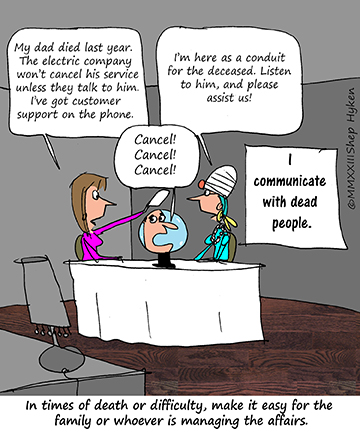
This isn’t the first time I’ve heard stories like this. Companies that charge their customers monthly or annually using a subscription model – this could include newspapers, magazines, software, utilities, and almost any type of product – should have processes in place to deal with a customer passing away or any other tragic or unusual scenario. They should make it easy for the family or whoever is managing the affairs. And, help them easily and empathetically close an account. Unfortunately, that is not always the case. All you have to do is a Google search, and you’ll find plenty of horror stories similar to my friend’s – and even far worse.

Shep Hyken Death Cartoon

Chewy.com is an online pet supply that operates a subscription model in which pet food, treats and many other items are shipped regularly. Known for amazing customer service, Chewy is a role model for handling the delicate situation of a customer who passes away. In this case, the customer is a pet. Yes, the pet owner is the paying customer, but their furry friend is the real recipient of Chewy’s products.

When a pet owner informs Chewy that their pet has passed away, the company not only makes it easy to cancel the subscription, but they also do it with style, class and empathy. They send bereaved pet owners flowers, cards and refunds for recent purchases. They also request that the pet owner donate any unopened pet food and treats to local pet shelters.

It’s obvious that Chewy has a process, and there is a protocol for handling delicate situations like these. Its people are properly trained in not just what to do but also what to say and how to say it.

It may be the death of a customer, or perhaps just someone going through a difficult or emotional time; we must have a process mapped for these situations. Our people must know how to properly manage these delicate experiences with:

  1. Empathy
  2. Sympathy
  3. Care

Image Credits: Pexels, Shep Hyken

Subscribe to Human-Centered Change & Innovation WeeklySign up here to join 17,000+ leaders getting Human-Centered Change & Innovation Weekly delivered to their inbox every week.