Tag Archives: AI

Outcome-Driven Innovation in the Age of Agentic AI

The North Star Shift

LAST UPDATED: January 5, 2026 at 5:29PM

Outcome-Driven Innovation in the Age of Agentic AI

by Braden Kelley

In a world of accelerating change, the rhetoric around Artificial Intelligence often centers on its incredible capacity for optimization. We hear about AI designing new materials, orchestrating complex logistics, and even writing entire software applications. This year, the technology has truly matured into agentic AI, capable of pursuing and achieving defined objectives with unprecedented autonomy. But as a specialist in Human-Centered Innovation™ (which pairs well with Outcome-Driven Innovation), I pose two crucial questions: Who is defining these outcomes, and what impact do they truly have on the human experience?

The real innovation of 2026 will show not just that AI can optimize against defined outcomes, but that we, as leaders, finally have the imperative — and the tools — to master Outcome-Driven Innovation and Outcome-Driven Change. If innovation is change with impact, then our impact is only as profound as the outcomes we choose to pursue. Without thoughtful, human-centered specifications, AI simply becomes the most efficient way to achieve the wrong goals, leading us directly into the Efficiency Trap. This is where organizations must overcome the Corporate Antibody response that resists fundamental shifts in how we measure success.

Revisiting and Applying Outcome-Driven Change in the Age of Agentic AI

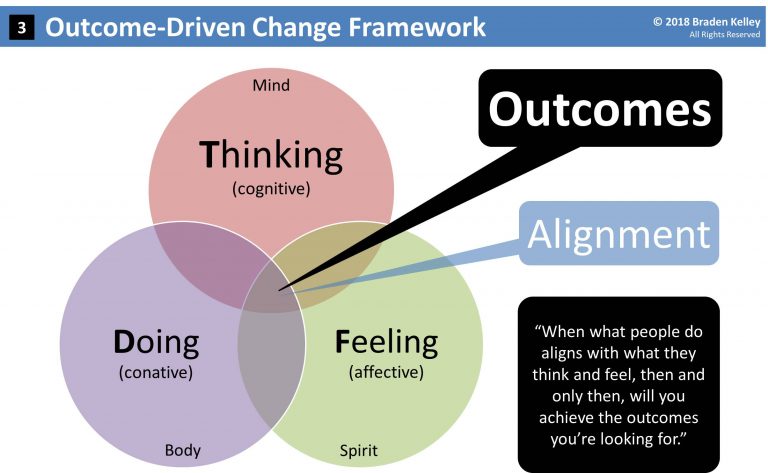
As we integrate agentic AI into our organizations, the principles of Outcome-Driven Change (ODC) I first introduced in 2018 are more vital than ever. The core of the ODC framework rests on the alignment of three critical domains: Cognitive (Thinking), Affective (Feeling), and Conative (Doing). Today, AI agents are increasingly assuming the “conative” role, executing tasks and optimizing workflows at superhuman speeds. However, as I have always maintained, true success only arrives when what is being done is in harmony with what the people in the organization and customer base think and feel.

Outcome-Driven Change Framework

If an AI agent’s autonomous actions are misaligned with human psychological readiness or emotional context, it will trigger a Corporate Antibody response that kills innovation. To practice genuine Human-Centered Change™, we must ensure that AI agents are directed to pursue outcomes that are not just numerically efficient, but humanly resonant. When an AI’s “doing” matches the collective thinking and feeling of the workforce, we move beyond the Efficiency Trap and create lasting change with impact.

“In the age of agentic AI, the true scarcity is not computational power; it is the human wisdom to define the right ‘North Star’ outcomes. An AI optimizing for the wrong goal is a digital express train headed in the wrong direction – efficient, but ultimately destructive.” — Braden Kelley

From Feature-Building to Outcome-Harvesting

For decades, many organizations have been stuck in a cycle of “feature-building.” Product teams were rewarded for shipping more features, marketing for launching more campaigns, and R&D for creating more patents. The focus was on output, not ultimate impact. Outcome-Driven Innovation shifts this paradigm. It forces us to ask: What human or business value are we trying to create? What measurable change in behavior or well-being are we seeking?

Agentic AI, when properly directed, becomes an unparalleled accelerant for this shift. Instead of building a new feature and hoping it works, we can now tell an AI agent, “Achieve Outcome X for Persona Y, within Constraints Z,” and it will explore millions of pathways to get there. This frees human teams from the tactical churn and allows them to focus on the truly strategic work: deeply understanding customer needs, identifying ethical guardrails, and defining aspirational outcomes that genuinely drive Human-Centered Innovation™.

Case Study 1: Sustainable Manufacturing and the “Circular Economy” Outcome

The Challenge: A major electronics manufacturer in early 2025 aimed to reduce its carbon footprint but struggled with the complexity of optimizing its global supply chain, product design, and end-of-life recycling simultaneously. Traditional methods led to incremental, siloed improvements.

The Outcome-Driven Approach: They defined a bold outcome: “Achieve a 50% reduction in virgin material usage across all product lines by 2028, while maintaining profitability and product quality.” They then deployed an agentic AI system to explore new material combinations, reverse logistics networks, and redesign possibilities. This AI was explicitly optimized to achieve the circular economy outcome.

The Impact: The AI identified design changes that led to a 35% reduction in material waste within 18 months, far exceeding human predictions. It also found pathways to integrate recycled content into new products without compromising durability. The organization moved from a reactive “greenwashing” approach to proactive, systemic innovation driven by a clear, human-centric environmental outcome.

Case Study 2: Personalized Education and “Mastery Outcomes”

The Challenge: A national education system faced stagnating literacy rates, despite massive investments in new curricula. The focus was on “covering material” rather than ensuring true student understanding and application.

The Outcome-Driven Approach: They shifted their objective to “Ensure 90% of students achieve demonstrable mastery of core literacy skills by age 10.” An AI tutoring system was developed, designed to optimize for individual student mastery outcomes, rather than just quiz scores. The AI dynamically adapted learning paths, identified specific knowledge gaps, and even generated custom exercises based on each child’s learning style.

The Impact: Within two years, participating schools saw a 25% improvement in mastery rates. The AI became a powerful co-pilot for teachers, freeing them from repetitive grading and allowing them to focus on high-touch mentorship. This demonstrated how AI, directed by human-defined learning outcomes, can empower both educators and students, moving beyond the Efficiency Trap of standardized testing.

Leading Companies and Startups to Watch

As 2026 solidifies Outcome-Driven Innovation, several entities are paving the way. Amplitude and Pendo are evolving their product analytics to connect feature usage directly to customer outcomes. In the AI space, Anthropic‘s work on “Constitutional AI” is fascinating, as it seeks to embed human-defined ethical outcomes directly into the AI’s decision-making. Glean and Perplexity AI are creating agentic knowledge systems that help organizations define and track complex outcomes across their internal data. Startups like Metaculus are even democratizing the prediction of outcomes, allowing collective intelligence to forecast the impact of potential innovations, providing invaluable insights for human decision-makers. These players are all contributing to the core goal: helping humans define the right problems for AI to solve.

Conclusion: The Human Art of Defining the Future

The year 2026 is a pivotal moment. Agentic AI gives us unprecedented power to optimize, but with great power comes great responsibility — the responsibility to define truly meaningful outcomes. This is not a technical challenge; it is a human one. It requires deep empathy, strategic foresight, and the courage to challenge old metrics. It demands leaders who understand that the most impactful Human-Centered Innovation™ starts with a clear, ethically grounded North Star.

If you’re an innovation leader trying to navigate this future, remember: the future is not about what AI can do, but about what outcomes we, as humans, choose to pursue with it. Let’s make sure those outcomes serve humanity first.

Frequently Asked Questions

What is “Outcome-Driven Innovation”?

Outcome-Driven Innovation (ODI) is a strategic approach that focuses on defining and achieving specific, measurable human or business outcomes, rather than simply creating new features or products. AI then optimizes for these defined outcomes.

How does agentic AI change the role of human leaders in ODI?

Agentic AI frees human leaders from tactical execution and micro-management, allowing them to focus on the higher-level strategic work of identifying critical problems, understanding human needs, and defining the ethical, impactful outcomes for AI to pursue.

What is the “Efficiency Trap” in the context of AI and outcomes?

The Efficiency Trap occurs when AI is used to optimize for speed or cost without first ensuring that the underlying outcome is meaningful and human-centered. This can lead to highly efficient processes that achieve undesirable or even harmful results, ultimately undermining trust and innovation.

Image credits: Braden Kelley, Google Gemini

Content Authenticity Statement: The topic area, key elements to focus on, etc. were decisions made by Braden Kelley, with a little help from Google Gemini to clean up the article.

Subscribe to Human-Centered Change & Innovation WeeklySign up here to get Human-Centered Change & Innovation Weekly delivered to your inbox every week.

9 Habits of Human-Centered Innovators That Still Matter in the Age of AI

9 Habits of Human-Centered Innovators That Still Matter in the Age of AI

by Braden Kelley and Art Inteligencia


Which Innovation Habits Still Matter in the Age of AI? (Short Answer)

Nine habits of human-centered innovators still matter in the age of AI: start with humans doing the job, define the problem before accelerating answers, match method to mandate, prototype to falsify behavior, design for Tuesday (adoption), kill weak bets on purpose, protect contiguous time for judgment, measure behavior not activity, and innovate with the people who must live the change. AI tempts teams to skip each habit because generation is cheap. Skipping them produces innovation cosplay at higher RPM — more demos, less impact.

Soft landings are designed. These habits are how innovators design them without waiting for a keynote.

Speed Is Not the Habit

I have watched rooms fill with the same excitement twice — once when sticky notes arrived, and again when the model could generate a persona, a journey map, and a clickable demo before lunch. The second room felt more advanced. It was often less honest.

AI did not retire human-centered innovation. It made contact with reality more urgent. Models can invent users who never existed, roadmaps that answer the wrong question beautifully, and pilots that prove the demo while the operating model stays frozen. Generation got cheap. Impact is still expensive — in the right way: humans, mandate, adoption, and judgment.

Habit AI temptation Without it
1. Start with humans Synthetic personas Empathy theater at machine speed
2. Define the problem first Instant “solutions” Faster wrong
3. Match method to mandate Orphan AI pilots Methods without power
4. Falsify a behavior Applause demos Demo day as destination
5. Design for Tuesday Model proof only Forever pilots
6. Kill weak bets Infinite cheap experiments Pilot purgatory
7. Protect judgment time Denser busyness Hard landing
8. Measure adopted outcomes Token vanity metrics Metric mirage
9. Innovate with adopters Expert-in-a-box generation Ideas that die on Tuesday

1. Why Must Human-Centered Innovators Still Start With Humans Doing the Job?

The habit: Talk to customers, employees, and partners in their language — jobs-to-be-done, friction, dignity costs — before the model writes the persona.

AI temptation: Synthetic users, scraped reviews, and generated “empathy maps” that feel researched because the prose is fluent.

On Tuesday: Field time, ride-alongs, frontline shadowing. Evidence that could not have been invented in the building. If your insight could have been written without leaving the office, it is fiction with better fonts.

Without it: Empathy theater at machine speed — and a roadmap that optimizes for a human who never existed.

2. Why Define the Problem Before You Accelerate the Answers?

The habit: Spend scarce human attention on problem definition, constraints, and stakes — then use AI to explore options inside that frame.

AI temptation: Instant roadmaps, feature lists, and “solutions” that answer the wrong question beautifully. Speed flatters the wrong problem.

On Tuesday: One crisp problem statement owned by a sponsor. Kill ideas that solve a different problem, even if the demo is gorgeous.

Without it: Faster wrong. The age of AI does not punish bad problem definition less. It scales it.

3. How Do Innovators Match Method to Mandate in the Age of AI?

The habit: Only run workshops, sprints, and experiments you are empowered to decide, ship, or stop.

AI temptation: Impressive AI pilots that nobody has authority to operationalize — autonomy for the model, no levers for the humans who must change the work.

On Tuesday: Decision rights written before kickoff. Facilitators paired with sponsors who have budget, policy, or metric levers — not just applause at the readout.

Without it: Innovation cosplay. Methods without power. A lab that photographs well and changes nothing.

4. What Does It Mean to Prototype to Falsify a Behavior?

The habit: Build the smallest test that can prove or kill a named human behavior hypothesis — not a portfolio piece.

AI temptation: Gorgeous clickable demos and agent demos that win the room and teach nothing about what people will do when the markers dry.

On Tuesday: One measurable behavior — complete in one try, abandon the workaround, time-to-confidence. Learn from what people do, not what they clap for.

Without it: Demo day becomes the destination. Learning never gets a chance to embarrass the idea.

5. Why Design for Tuesday Instead of Demo Day?

The habit: From day one, plan owners, handoffs, incentives, and what dies when the new way works. Adoption is design, not an afterthought.

AI temptation: Pilot theater that proves the model, not the operating model. Green lights on the demo; red experiences for the median user.

On Tuesday: A named workflow owner after go-live. A retirement plan for the old path. Success means the median person succeeds without heroics.

Without it: Forever pilots. Go-live with cake. Transformation that never becomes a new way of working.

6. Why Is Killing Weak Bets Still a Core Innovation Habit?

The habit: Few bets, explicit kill criteria, and social permission to stop. Stopping is a skill, not a failure.

AI temptation: Infinite cheap experiments that never end because “we’re still learning.” Learning without a decision date is tourism.

On Tuesday: Time boxes, go/no-go dates, and a visible cemetery of stopped ideas — honorable exits that free attention for what still deserves oxygen.

Without it: Idea cemeteries and pilot purgatory with better graphics. Activity that never graduates to impact.

7. How Do Human-Centered Innovators Protect Contiguous Time for Judgment?

The habit: Use AI to absorb fragmentation and glue work — then defend the reclaimed blocks for insight, empathy, decision making, and collaboration.

AI temptation: Fill every saved minute with more tickets, more prompts, denser busyness. Utilization stays green; thinking gets thinner.

On Tuesday: Calendar policy as part of the innovation bet. Depth metrics, not only output volume. Soft landing is a habit, not a slogan.

Without it: A hard landing — faster humans, less human work, and innovation that never gets contiguous minutes to notice what matters.

8. What Should Innovators Measure Instead of Activity?

The habit: Track what humans do and what the organization adopts — retention, effort, cycle time, cost-to-serve, journey success — not ideas generated or demos shipped.

AI temptation: Vanity dashboards: prompts run, tokens used, prototypes produced. Analytics that celebrate motion.

On Tuesday: A dual scorecard. Activity may inform. Outcomes decide. If the number cannot name a human behavior, it is theater with charts.

Without it: Metric mirage. Teams optimize for what photographs in the steering committee, not what lands on Tuesday.

9. Why Innovate With the People Who Must Live the Change?

The habit: Co-create with adopters and frontline owners. Treat innovation as a team sport — not a lone-genius myth or a lab-only sport.

AI temptation: Expert-in-a-box generation that skips the people whose Tuesday must change. The model sounds decisive; the organization is not invited.

On Tuesday: Dual recognition for insight and change. Frontline power funded, not only automated. The people who will live the new way help design it.

Without it: Brilliant ideas that die on contact with the median manager — and employees who know what customers deserve but are not allowed to deliver it.

How Do You Check Innovation Habits Before an AI-Assisted Sprint?

Before the next AI-assisted innovation sprint, run five go/no-go questions. If you cannot answer them, you are buying speed without a landing:

  1. Who did we talk to — real humans doing the job, in their words?
  2. What problem are we empowered to change — decide, ship, or stop?
  3. What behavior are we falsifying — not what demo are we showing?
  4. Who owns Tuesday after the demo — workflow, incentives, old path retired?
  5. What will we stop if the evidence says stop — and is stopping allowed?

If you want the patterns these habits prevent, see 7 Types of Innovation Theater and 7 Ways Design Thinking Gets Misused. For the work redesign behind habit seven, read The AI Soft Landing. For the funding gate that keeps weak bets from becoming budget lines, use 11 Questions Before Funding Any Innovation Pilot.

AI made generation cheap. Human-centered innovation still makes impact expensive — in the right way: contact with reality, mandate, adoption, and judgment. Keep the habits. Use the tools. Design the landing.

Frequently Asked Questions

What habits do human-centered innovators practice?

Human-centered innovators start with people doing the job, define the problem before accelerating solutions, match methods to decision rights, prototype to falsify behavior, design for adoption, kill weak bets, protect time for judgment, measure adopted outcomes, and co-create with the people who must live the change.

Do innovation habits still matter with AI?

Yes — more than before. AI makes personas, demos, and roadmaps cheap, which makes skipping contact with reality, mandate, and adoption more expensive. Without these habits, teams get innovation theater at higher speed: more output, less impact.

How should you use AI in human-centered innovation?

Use AI inside a human-defined problem frame — to explore options, draft artifacts, and absorb glue work — after talking to real users and clarifying decision rights. Prototype to test behavior, protect reclaimed time for judgment, and measure adoption, not token or demo volume.

What separates real innovators from innovation theater?

Real innovators optimize for impact that lands: real humans in the evidence, mandate to change the system, behavior-based learning, adoption owners after the demo, kill criteria, and outcomes that name what people do. Theater optimizes for activity that photographs — labs, decks, and demos without power or Tuesday.

Does AI replace design thinking or human-centered design?

No. AI can accelerate parts of the craft — drafting, clustering, prototyping — but it does not replace talking to humans, defining the right problem, matching method to mandate, or designing for adoption. Used without those habits, AI becomes a faster costume for the same theater.

Image credits: Unsplash

Content Authenticity Statement: The topic area, key elements to focus on, etc. were decisions made by Braden Kelley, with a little help from Google Gemini and Cursor to clean up the article, add images and create infographics.

Subscribe to Human-Centered Change & Innovation WeeklySign up here to get Human-Centered Change & Innovation Weekly delivered to your inbox every week.

Top 10 Human-Centered Change & Innovation Articles of December 2025

Top 10 Human-Centered Change & Innovation Articles of December 2025Drum roll please…

At the beginning of each month, we will profile the ten articles from the previous month that generated the most traffic to Human-Centered Change & Innovation. Did your favorite make the cut?

But enough delay, here are December’s ten most popular innovation posts:

  1. Is OpenAI About to Go Bankrupt? — by Chateau G Pato
  2. The Rise of Human-AI Teaming Platforms — by Art Inteligencia
  3. 11 Reasons Why Teams Struggle to Collaborate — by Stefan Lindegaard
  4. How Knowledge Emerges — by Geoffrey Moore
  5. Getting the Most Out of Quiet Employees in Meetings — by David Burkus
  6. The Wood-Fired Automobile — by Art Inteligencia
  7. Was Your AI Strategy Developed by the Underpants Gnomes? — by Robyn Bolton
  8. Will our opinion still really be our own in an AI Future? — by Pete Foley
  9. Three Reasons Change Efforts Fail — by Greg Satell
  10. Do You Have the Courage to Speak Up Against Conformity? — by Mike Shipulski

BONUS – Here are five more strong articles published in November that continue to resonate with people:

If you’re not familiar with Human-Centered Change & Innovation, we publish 4-7 new articles every week built around innovation and transformation insights from our roster of contributing authors and ad hoc submissions from community members. Get the articles right in your Facebook, Twitter or Linkedin feeds too!

Build a Common Language of Innovation on your team

Have something to contribute?

Human-Centered Change & Innovation is open to contributions from any and all innovation and transformation professionals out there (practitioners, professors, researchers, consultants, authors, etc.) who have valuable human-centered change and innovation insights to share with everyone for the greater good. If you’d like to contribute, please contact me.

P.S. Here are our Top 40 Innovation Bloggers lists from the last four years:

Subscribe to Human-Centered Change & Innovation WeeklySign up here to get Human-Centered Change & Innovation Weekly delivered to your inbox every week.

Can AI Replace the CEO?

A Day in the Life of the Algorithmic Executive

LAST UPDATED: December 28, 2025 at 1:56 PM

Can AI Replace the CEO?

GUEST POST from Art Inteligencia

We are entering an era where the corporate antibody – that natural organizational resistance to disruptive change – is meeting its most formidable challenger yet: the AI CEO. For years, we have discussed the automation of the factory floor and the back office. But what happens when the “useful seeds of invention” are planted in the corner office?

The suggestion that an algorithm could lead a company often triggers an immediate emotional response. Critics argue that leadership requires soul, while proponents point to the staggering inefficiencies, biases, and ego-driven errors that plague human executives. As an advocate for Innovation = Change with Impact, I believe we must look beyond the novelty and analyze the strategic logic of algorithmic leadership.

“Leadership is not merely a collection of decisions; it is the orchestration of human energy toward a shared purpose. An AI can optimize the notes, but it cannot yet compose the symphony or inspire the orchestra to play with passion.”

Braden Kelley

The Efficiency Play: Data Without Drama

The argument for an AI CEO rests on the pursuit of Truly Actionable Data. Humans are limited by cognitive load, sleep requirements, and emotional variance. An AI executive, by contrast, operates in Future Present mode — constantly processing global market shifts, supply chain micro-fluctuations, and internal sentiment analysis in real-time. It doesn’t have a “bad day,” and it doesn’t make decisions based on who it had lunch with.

Case Study 1: NetDragon Websoft and the “Tang Yu” Experiment

The Experiment: A Virtual CEO in a Gaming Giant

In 2022, NetDragon Websoft, a major Chinese gaming and mobile app company, appointed an AI-powered humanoid robot named Tang Yu as the Rotating CEO of its subsidiary. This wasn’t just a marketing stunt; it was a structural integration into the management flow.

The Results

Tang Yu was tasked with streamlining workflows, improving the quality of work tasks, and enhancing the speed of execution. Over the following year, the company reported that Tang Yu helped the subsidiary outperform the broader Hong Kong stock market. By serving as a real-time data hub, the AI signature was required for document approvals and risk assessments. It proved that in data-rich environments where speed of iteration is the primary competitive advantage, an algorithmic leader can significantly reduce operational friction.

Case Study 2: Dictador’s “Mika” and Brand Stewardship

The Challenge: The Face of Innovation

Dictador, a luxury rum producer, took the concept a step further by appointing Mika, a sophisticated female humanoid robot, as their CEO. Unlike Tang Yu, who worked mostly within internal systems, Mika serves as a public-facing brand steward and high-level decision-maker for their DAO (Decentralized Autonomous Organization) projects.

The Insight

Mika’s role highlights a different facet of leadership: Strategic Pattern Recognition. Mika analyzes consumer behavior and market trends to select artists for bottle designs and lead complex blockchain-based initiatives. While Mika lacks human empathy, the company uses her to demonstrate unbiased precision. However, it also exposes the human-AI gap: while Mika can optimize a product launch, she cannot yet navigate the nuanced political and emotional complexities of a global pandemic or a social crisis with the same grace as a seasoned human leader.

Leading Companies and Startups to Watch

The space is rapidly maturing beyond experimental robot figures. Quantive (with StrategyAI) is building the “operating system” for the modern CEO, connecting KPIs to real-work execution. Microsoft is positioning its Copilot ecosystem to act as a “Chief of Staff” to every executive, effectively automating the data-gathering and synthesis parts of the role. Watch startups like Tessl and Vapi, which are focusing on “Agentic AI” — systems that don’t just recommend decisions but have the autonomy to execute them across disparate platforms.

The Verdict: The Hybrid Future

Will AI replace the CEO? My answer is: not the great ones. AI will certainly replace the transactional CEO — the executive whose primary function is to crunch numbers, approve budgets, and monitor performance. These tasks are ripe for automation because they represent 19th-century management techniques.

However, the transformational CEO — the one who builds culture, navigates ethical gray areas, and creates a sense of belonging — will find that AI is their greatest ally. We must move from fearing replacement to mastering Human-AI Teaming. The CEOs of 2030 will be those who use AI to handle the complexity of the business so they can focus on the humanity of the organization.

Frequently Asked Questions

Can an AI legally serve as a CEO?

Currently, most corporate law jurisdictions require a natural person to serve as a director or officer for liability and accountability reasons. AI “CEOs” like Tang Yu or Mika often operate under the legal umbrella of a human board or chairman who retains ultimate responsibility.

What are the biggest risks of an AI CEO?

The primary risks include Algorithmic Bias (reinforcing historical prejudices found in the data), Lack of Crisis Adaptability (AI struggles with “Black Swan” events that have no historical precedent), and the Loss of Employee Trust if leadership feels cold and disconnected.

How should current CEOs prepare for AI leadership?

Leaders must focus on “Up-skilling for Empathy.” They should delegate data-heavy reporting to AI systems and re-invest that time into Culture Architecture and Change Management. The goal is to become an expert at Orchestrating Intelligence — both human and synthetic.

Disclaimer: This article speculates on the potential future applications of cutting-edge scientific research. While based on current scientific understanding, the practical realization of these concepts may vary in timeline and feasibility and are subject to ongoing research and development.

Image credits: Google Gemini

Subscribe to Human-Centered Change & Innovation WeeklySign up here to get Human-Centered Change & Innovation Weekly delivered to your inbox every week.

Will our opinion still really be our own in an AI Future?

Will our opinion still really be our own in an AI Future?

GUEST POST from Pete Foley

Intuitively we all mostly believe our opinions are our own.  After all, they come from that mysterious thing we call consciousness that resides somewhere inside of us. 

But we also know that other peoples opinions are influenced by all sorts of external influences. So unless we as individuals are uniquely immune to influence, it begs at the question; ‘how much of what we think, and what we do, is really uniquely us?’  And perhaps even more importantly, as our understanding of behavioral modification techniques evolves, and the power of the tools at our disposal grows, how much mental autonomy will any of us truly have in the future?

AI Manipulation of Political Opinion: A recent study from the Oxford Internet Institute (OII) and the UK AI Security Institute (AISI) showed how conversational AI can meaningfully influence peoples political beliefs. https://www.ox.ac.uk/news/2025-12-11-study-reveals-how-conversational-ai-can-exert-influence-over-political-beliefs .  Leveraging AI in this way potentially opens the door to a step-change in behavioral and opinion manipulation inn general.  And that’s quite sobering on a couple of fronts.   Firstly, for many today their political beliefs are deeply tied to our value system and deep sense of self, so this manipulation is potentially profound.  Secondly, if AI can do this today, how much more will it be able to do in the future?

A long History of Manipulation: Of course, manipulation of opinion or behavior is not new.  We are all overwhelmed by political marketing during election season.  We accept that media has manipulated public opinion for decades, and that social media has amplified this over the last few decades. Similarly we’ve all grown up immersed in marketing and advertising designed to influence our decisions, opinions and actions.  Meanwhile the rise in prominence of the behavioral sciences in recent decades has provided more structure and efficiency to behavioral influence, literally turning an art into a science.  Framing, priming, pre-suasion, nudging and a host of other techniques can have a profound impact on what we believe and what we actually do. And not only do we accept it, but many, if not most of the people reading this will have used one or more of these channels or techniques.  

An Art and a Science: And behavioral manipulation is a highly diverse field, and can be deployed as an art or a science.   Whether it’s influencers, content creators, politicians, lawyers, marketers, advertisers, movie directors, magicians, artists, comedians, even physicians or financial advisors, our lives are full of people who influence us, often using implicit cues that operate below our awareness. 

And it’s the largely implicit nature of these processes that explains why we tend to intuitively think this is something that happens to other people. By definition we are largely unaware of implicit influence on ourselves, although we can often see it in others.   And even in hindsight, it’s very difficult to introspect implicit manipulation of our own actions and opinions, because there is often no obvious conscious causal event. 

So what does this mean?  As with a lot of discussion around how an AI future, or any future for that matter, will unfold, informed speculation is pretty much all we have.  Futurism is far from an exact science.  But there are a couple of things we can make pretty decent guesses around.

1.  The ability to manipulate how people think creates power and wealth.

2.  Some will use this for good, some not, but given the nature of humanity, it’s unlikely that it will be used exclusively for either.

3.  AI is going to amplify our ability to manipulate how people think.  

The Good news: Benevolent behavioral and opinion manipulation has the power to do enormous good.  Whether it’s mental health and happiness (an increasingly challenging area as we as a species face unprecedented technology driven disruption), health, wellness, job satisfaction, social engagement, important for many of us, adoption of beneficial technology and innovation and so many other areas can benefit from this.  And given the power of the brain, there is even potential for conceptual manipulation to replace significant numbers of pharmaceuticals, by, for example, managing depression, or via preventative behavioral health interventions.   Will this be authentic? It’s probably a little Huxley dystopian, but will we care?  It’s one of the many ethical connundrums AI will pose us with.

The Bad News.  Did I mention wealth and power?  As humans, we don’t have a great record of doing the right thing when wealth and power come into the equation.  And AI and AI empowered social, conceptual and behavioral manipulation has potential to concentrate meaningful power even more so than today’s tech driven society.  Will this be used exclusively for good, or will some seek to leverage for their personal benefit at the expense of the border community?   Answers on a postcard (or AI generated DM if you prefer).

What can and should we do?  Realistically, as individuals we can self police, but we obviously also face limits in self awareness of implicit manipulations.  That said, we can to some degree still audit ourselves.  We’ve probably all felt ourselves at some point being riled up by a well constructed meme designed to amplify our beliefs.   Sometimes we recognize this quickly, other times we may be a little slower. But just simple awareness of the potential to be manipulated, and the symptoms of manipulation, such as intense or disproportionate emotional responses, can help us mitigate and even correct some of the worst effects. 

Collectively, there are more opportunities.  We are better at seeing others being manipulated than ourselves.  We can use that as a mirror, and/or call it out to others when we see it.  And many of us will find ourselves somewhere in the deployment chain, especially as AI is still in it’s early stages.  For those of us that this applies to, we have the opportunity to collectively nudge this emerging technology in the right direction. I still recall a conversation with Dan Ariely when I first started exploring behavioral science, perhaps 15-20 years ago.  It’s so long ago I have to paraphrase, but the essence of the conversation was to never manipulate people to do something that was not in there best interest.  

There is a pretty obvious and compelling moral framework behind this. But there is also an element of enlightened self interest. As a marketer working for a consumer goods company at the time, even if I could have nudged somebody into buying something they really didn’t want, it might have offered initial success, but would likely come back to bite me in the long-term.  They certainly wouldn’t become repeat customers, and a mixture of buyers remorse, loss aversion and revenge could turn them into active opponents.  This potential for critical thinking in hindsight exists for virtually every situation where outcomes damage the individual.   

The bottom line is that even today, we already ave to continually ask ourselves if what we see is real, if our beliefs are truly our own, or have they been manipulated? Media and social media memes already play the manipulation game.   AI may already be better, and if not, it’s only a matter of time before it is. If you think we are politically polarized now, hang onto your hat!!!  But awareness is key.  We all need to stay aware, be conscious of manipulation in ourselves and others, and counter it when we see it occurring for the wrong reasons.

Image credits: Google Gemini

Subscribe to Human-Centered Change & Innovation WeeklySign up here to join 17,000+ leaders getting Human-Centered Change & Innovation Weekly delivered to their inbox every week.

What’s Next for Humanity in the Age of Acceleration?

Polycrisis

What's Next for Humanity in the Age of Acceleration?

GUEST POST from Robert B. Tucker

Never in the three decades I’ve been a practicing futurist have I been so uncertain about what lies ahead. Think of the many issues that confront humanity right now: a nagging war in Ukraine, job loss due to automation and AI, the rise of authoritarianism in the U.S. and other countries, and potential bubbles setting off the next global financial crisis.

The future arriving at our doorstep will be unlike anything we’ve seen before. As I illustrate in Build a Better Future, a book that probes where we’re headed in the next 10 years, colliding issues such as these are likely to ignite the next “polycrisis,” a disruption where multiple crises occur simultaneously, interacting in ways that amplify their overall impact.

Unlike isolated crises, a polycrisis involves interconnected challenges that feed into one another, making them harder to resolve.

The COVID-19 pandemic gave us a stark illustration of how a polycrisis ignites. What started as a flu virus in Wuhan, China, quickly morphed into a public health crisis, economic meltdown, supply chain disruption, and a social upheaval, all at once.

More recently, the CrowdStrike crisis on July 19, 2024, was a stark reminder of just how deeply interconnected our systems have become and how fragile our systems are.

On July 19, 2024, thousands of travelers found themselves stranded in airports worldwide as flights were canceled en masse, their carefully laid plans thrown into disarray. In hospitals, the consequences were even more dire. Emergency rooms struggled to access patient records, delaying critical treatments and surgeries, while doctors and nurses were left scrambling to work around the digital blackout.

Meanwhile, as ATM’s stopped working, banking customers faced their own disruptions, transactions froze, and businesses and consumers were unable to process payments. While Microsoft was able to restore systems in a matter of days, it was a polycrisis wake-up call — a seemingly isolated tech failure that cascaded into worldwide economic turmoil, public frustration, and operational paralysis, exposing just how vulnerable we are to the unintended consequences of our digital era dependencies.

The war in Ukraine is an example of a poly-crisis multiplier. What started as a regional conflict quickly became a geopolitical crisis unseen since WWII. As Europe scrambled for alternatives to Russian gas, a food crisis ensued as wheat exports from the region ground to a halt, and an inflationary shock rippled through global markets. Layer in climate-driven disasters — wildfires in Canada blanketing the U.S. East Coast in smoke, record-setting heat waves in the Middle East, and extreme flooding in Asia—and you begin to see how today’s crises can combine and multiply.

The rapid advance of technology is bringing both promise and peril. AI and automation upend industries, displacing millions, while social media platforms — once heralded as tools for global connectivity — become breeding grounds for misinformation and disinformation that further erode trust in institutions.

Add to this a world where biodiversity loss threatens food security, and geopolitical conflicts spark energy crises that send shockwaves through global markets. Those who can anticipate these polycrises and navigate their complexities will not just survive, they will prevail in the future.

Looking ahead at the rapid proliferation of AI and the trend of nationalism and isolation, the world is facing not just individual problems, but deeply intertwined issues that exacerbate one another and require holistic, systemic approaches. The question is: are we prepared?

This article originally appeared in Forbes

Image credit: Pexels

Subscribe to Human-Centered Change & Innovation WeeklySign up here to get Human-Centered Change & Innovation Weekly delivered to your inbox every week.

Strengthen Your Human Agency to Thrive in the Age of AI

Strengthen Your Human Agency to Thrive in the Age of AI

GUEST POST from Robert B. Tucker

In a recent podcast, Sam Altman, CEO of OpenAI, was asked: “Who are the 20-something company founders of our era?” His response was telling: “They seem to be almost nonexistent. It’s not good. I hope this is just a weird accident of history. But something has really gone wrong.”

Actually, we do know what has gone wrong. In my just-released book, Build a Better Future: 7 Mindsets for Navigating the Age of Acceleration, I argue that what has gone wrong is a condition the futurist Alvin Toffler described 50 years ago: future shock. Too much change in too short a time. We are currently reeling under the pressure of so much political, technological, and social change. We are simply not ready for the profound changes just ahead.

While Silicon Valley tech “visionaries” promise that A.I. will bring quantum benefits in productivity, with our lives filled with abundance, superintelligence, and even a coming renaissance, other observers see a New Dark Age ahead for humanity.

Already, A.I. is responsible for the loss of tens of thousands of white-collar jobs, with more cuts on the way. On a recent edition of “60 Minutes,” Anthropic CEO Dario Amodei predicted that A.I. could wipe out half of all entry-level white-collar jobs, beginning with consulting firms, law firms, and financial service firms. Already, A.I. is not just helping employees with tasks; it is completing them.

For many young people, the age of A.I. is anything but abundant. The system seems rigged by robots and algorithms, and is a dizzying maze of complexity. The first rung on the ladder is missing entirely. There is little talk of the New Renaissance nor of A.I. as an enabler of human flourishing.

Instead, there’s bewilderment that we’ve travelled so far, so fast from that period in 2021 that came to be known as “The Great Resignation,” when 41 million Americans voluntarily left their jobs, exercising their agency to pursue new careers, start businesses, or follow their bliss.

Today, a leaner employment picture has taken hold. Large employers are shedding jobs at a pace not seen in years, shrinking career paths that once sustained middle-class families and long-term security. Nearly two million Americans have been out of work for six months or more, according to government data.

Consider the plight of job seekers today. For any open position, applicants are competing with hundreds of other job seekers on multiple job websites. For employers, A.I. performs the first few rounds of culling, so job seekers have no choice but to try and game the system. And when an interview is obtained, the exchange is often with a bot rather than a human being. The rejected applicant receives no feedback on which to hone their approach for the next opportunity.

AI did not set off these trends, but has exacerbated them. And combine AI with the “affordability crisis,” and you have a sense of why young people are often depressed and cynical.

People under the age of 40 are 24 percent less well off financially than a generation ago. Very few of them can afford a home, afford college, or pay off debilitating debt. Young men are especially challenged by the dawning age and are simply checking out instead. In five years, projections are that two women will graduate from college for every one man.

As AI changes how we work and how we add value, new mindsets will be needed. Meanwhile, problem-solving, critical thinking, and numeracy are in decline. A 2024 global assessment found that 34 percent of U.S. adults possess math skills below primary school level. One study noted that 45 percent of college students showed no significant gains in critical thinking, complex reasoning, or writing skills upon earning their four-year degree.

For many, “adulting” is becoming more difficult. Everything from paying bills on time to scheduling your own doctor’s appointments, keeping track of passwords, living within your means, cooking something that isn’t microwaved, and navigating modern life is what adulting entails. Young people often report struggling with these very tasks, especially relationship building. Surveys suggest nearly half of Americans have no close personal friends.

A key component of flourishing in the years ahead will be nurturing one’s human agency, or what people used to call motivation. By whatever name you call it, unleashing one’s agency to meet the challenge of hyper change will be essential to success in the Age of Acceleration.

Human agency is the capacity to act intentionally. It’s the ability and willingness to make choices and shape our own futures, rather than be controlled by circumstances. Human agency is the “make it happen” component in ourselves that is essential to navigating change, seizing opportunity, and building the future we most desire for ourselves.

Whatever we call it, it involves believing you can make your way in this world, and that “if it’s going to be, it’s up to me.” Start by noticing your thought patterns, replacing reactive thinking with intentional thinking. Practice self-management by asking, “What can I control here?” and acting on that. And you cultivate the conviction that your ideas and actions still matter — no matter the headlines. In an era of accelerating change, rediscovering and strengthening that sense of agency may be the most vital skill we can train ourselves to master.

When I speak to audiences of young people, I emphasize that we are not powerless. Even when it feels like the world is being driven by algorithms and A.I.-generated bots, your choice is to strive to become a fully functioning human being. Even when you’ve applied for a hundred jobs, been interviewed by bots, not by humans who gave you zero feedback, agency is a muscle. Agency is the belief that your choices matter.

Agency is the belief that if one door closes, another door opens, and it may turn out for the better.

This article originally appeared in Forbes

Image credit: Gemini

Subscribe to Human-Centered Change & Innovation WeeklySign up here to get Human-Centered Change & Innovation Weekly delivered to your inbox every week.

Is OpenAI About to Go Bankrupt?

LAST UPDATED: June 14, 2026 at 4:05 PM

Is OpenAI About to Go Bankrupt?

GUEST POST from Chateau G Pato

The innovation landscape is shifting, and the tremors are strongest in the artificial intelligence (AI) sector. For a moment, OpenAI felt like an impenetrable fortress, the company that cracked the code and opened the floodgates of generative AI to the world. But now, as a thought leader focused on Human-Centered Innovation, I see the classic signs of disruption: a growing competitive field, a relentless cash burn, and a core product advantage that is rapidly eroding. The question of whether OpenAI is on the brink of bankruptcy isn’t just about sensational headlines — it’s about the fundamental sustainability of a business model built on unprecedented scale and staggering cost.

The “Code Red” announcement from OpenAI, ostensibly about maintaining product quality, was a subtle but profound concession. It was an acknowledgment that the days of unchallenged superiority are over. This came as competitors like Google’s Gemini and Anthropic’s Claude are not just keeping pace, but in many key performance metrics, they are reportedly surpassing OpenAI’s flagship models. Performance parity, or even outperformance, is a killer in the technology adoption curve. When the superior tool is also dramatically cheaper, the choice for enterprises and developers — the folks who pay the real money — becomes obvious.

Update — May 2026

Since this article was first published in December 2025, the financial pressures on OpenAI have continued to evolve. The company has pursued additional fundraising rounds and its transition from a nonprofit to a for-profit structure has accelerated — a move widely interpreted as necessary to sustain its capital requirements. Meanwhile competition from Anthropic, Google DeepMind, Meta AI, and a wave of open-source models has intensified, compressing the window in which OpenAI can convert its brand leadership into durable revenue. The core question this article raises — whether OpenAI’s cost structure is sustainable at scale — remains as relevant today as when it was written.

The Inevitable Crunch: Performance and Price

The competitive pressure is coming from two key vectors: performance and cost-efficiency. While the public often focuses on benchmark scores like MMLU or coding abilities — where models like Gemini and Claude are now trading blows or pulling ahead — the real differentiator for business users is price. New models, including the China-based Deepseek, are entering the market with reported capabilities approaching the frontier models but at a fraction of the development and inference cost. Deepseek’s reportedly low development cost highlights that the efficiency of model creation is also improving outside of OpenAI’s immediate sphere.

Crucially, the open-source movement, championed by models like Meta’s Llama family, introduces a zero-cost baseline that fundamentally caps the premium OpenAI can charge. Llama, and the rapidly improving ecosystem around it, means that a good-enough, customizable, and completely free model is always an option for businesses. This open-source competition bypasses the high-cost API revenue model entirely, forcing closed-source providers to offer a quantum leap in utility to justify the expenditure. This dynamic accelerates the commoditization of foundational model technology, turning OpenAI’s once-unique selling proposition into a mere feature.

OpenAI’s models, for all their power, have been famously expensive to run — a cost that gets passed on through their API. The rise of sophisticated, cheaper alternatives — many of which employ highly efficient architectures like Mixture-of-Experts (MoE) — means the competitive edge of sheer scale is being neutralized by engineering breakthroughs in efficiency. If the next step in AI on its way to artificial general intelligence (AGI) is a choice between a 10% performance increase and a 10x cost reduction for 90% of the performance, the market will inevitably choose the latter. This is a structural pricing challenge that erodes one of OpenAI’s core revenue streams: API usage.

The Financial Chasm: Burn Rate vs. Reserves

The financial situation is where the “bankruptcy” narrative gains traction. Developing and running frontier AI models is perhaps the most capital-intensive venture in corporate history. Reports — which are often conflicting and subject to interpretation — paint a picture of a company with an astronomical cash burn rate. Estimates for annual operational and development expenses are in the billions of dollars, resulting in a net loss measured in the billions.

This reality must be contrasted with the position of their main rivals. While OpenAI is heavily reliant on Microsoft’s monumental investment — a complex deal involving cash and Azure cloud compute credits — Microsoft’s exposure is structured as a strategic infrastructure play. The real financial behemoth is Alphabet (Google), which can afford to aggressively subsidize its Gemini division almost indefinitely. Alphabet’s near-monopoly on global search engine advertising generates profits in the tens of billions of dollars every quarter. This virtually limitless reservoir of cash allows Google to cross-subsidize Gemini’s massive research, development, and inference costs, effectively enabling them to engage in a high-stakes price war that smaller, loss-making entities like OpenAI cannot truly win on a level playing field. Alphabet’s strategy is to capture market share first, using the profit engine of search to buy time and scale, a luxury OpenAI simply does not have without a continuous cash injection from a partner.

The question is not whether OpenAI has money now, but whether their revenue growth can finally eclipse their accelerating costs before their massive reserve is depleted. Their long-term financial projections, which foresee profitability and revenues in the hundreds of billions by the end of the decade, require not just growth, but a sustained, near-monopolistic capture of the new AI-driven knowledge economy. That becomes increasingly difficult when competitors are faster, cheaper, and arguably better, and have access to deeper, more sustainable profit engines for cross-subsidization.

The Future Outlook: Change or Consequence

OpenAI’s future is not doomed, but the company must initiate a rapid, human-centered transformation. The current trajectory — relying on unprecedented capital expenditure to maintain a shrinking lead in model performance — is structurally unsustainable in the face of faster, cheaper, and increasingly open-source models like Meta’s Llama. The next frontier isn’t just AGI; it’s AGI at scale, delivered efficiently and affordably.

OpenAI must pivot from a model of monolithic, expensive black-box development to one that prioritizes efficiency, modularity, and a true ecosystem approach. This means a rapid shift to MoE architectures, aggressive cost-cutting in inference, and a clear, compelling value proposition beyond just “we were first.” Human-Centered Innovation principles dictate that a company must listen to the market — and the market is shouting for price, performance, and flexibility. If OpenAI fails to execute this transformation and remains an expensive, marginal performer, its incredible cash reserves will serve only as a countdown timer to a necessary and painful restructuring.

Frequently Asked Questions (FAQ)

  • Is OpenAI currently profitable?
    OpenAI is currently operating at a significant net loss. Its annual cash burn rate, driven by high R&D and inference costs, reportedly exceeds its annual revenue, meaning it relies heavily on its massive cash reserves and the strategic investment from Microsoft to sustain operations.
  • How are Gemini and Claude competing against OpenAI on cost and performance?
    Competitors like Google’s Gemini and Anthropic’s Claude are achieving performance parity or superiority on key benchmarks. Furthermore, they are often cheaper to use (lower inference cost) due to more efficient architectures (like MoE) and the ability of their parent companies (Alphabet and Google) to cross-subsidize their AI divisions with enormous profits from other revenue streams, such as search engine advertising.
  • What was the purpose of OpenAI’s “Code Red” announcement?
    The “Code Red” was an internal or public acknowledgment by OpenAI that its models were facing performance and reliability degradation in the face of intense, high-quality competition from rivals. It signaled a necessary, urgent, company-wide focus on addressing these issues to restore and maintain a technological lead.

UPDATE: Just found on X that HSBC has said that OpenAI is going to have nearly a half trillion in operating losses until 2030, per Financial Times (FT). Here is the chart of their $100 Billion in projected losses in 2029. With the success of Gemini, Claude, Deep Seek, Llama and competitors yet to emerge, the revenue piece may be overstated:

OpenAI estimated 2029 financials

Bring This Thinking to Your Next Event

Braden Kelley is a LinkedIn Top Voice, bestselling author, and innovation keynote speaker who helps organizations get to the future first and build sustainable innovation cultures.

Book Braden as a Keynote Speaker →

Image credits: Google Gemini, Financial Times

Subscribe to Human-Centered Change & Innovation WeeklySign up here to get Human-Centered Change & Innovation Weekly delivered to your inbox every week.

Top 10 Human-Centered Change & Innovation Articles of November 2025

Top 10 Human-Centered Change & Innovation Articles of November 2025Drum roll please…

At the beginning of each month, we will profile the ten articles from the previous month that generated the most traffic to Human-Centered Change & Innovation. Did your favorite make the cut?

But enough delay, here are November’s ten most popular innovation posts:

  1. Eight Types of Innovation Executives — by Stefan Lindegaard
  2. Is There a Real Difference Between Leaders and Managers? — by David Burkus
  3. 1,000+ Free Innovation, Change and Design Quotes Slides — by Braden Kelley
  4. The AI Agent Paradox — by Art Inteligencia
  5. 74% of Companies Will Die in 10 Years Without Business Transformation — by Robyn Bolton
  6. The Unpredictability of Innovation is Predictable — by Mike Shipulski
  7. How to Make Your Employees Thirsty — by Braden Kelley
  8. Are We Suffering from AI Confirmation Bias? — by Geoffrey A. Moore
  9. How to Survive the Next Decade — by Robyn Bolton
  10. It’s the Customer Baby — by Braden Kelley

BONUS – Here are five more strong articles published in October that continue to resonate with people:

If you’re not familiar with Human-Centered Change & Innovation, we publish 4-7 new articles every week built around innovation and transformation insights from our roster of contributing authors and ad hoc submissions from community members. Get the articles right in your Facebook, Twitter or Linkedin feeds too!

Build a Common Language of Innovation on your team

Have something to contribute?

Human-Centered Change & Innovation is open to contributions from any and all innovation and transformation professionals out there (practitioners, professors, researchers, consultants, authors, etc.) who have valuable human-centered change and innovation insights to share with everyone for the greater good. If you’d like to contribute, please contact me.

P.S. Here are our Top 40 Innovation Bloggers lists from the last four years:

Subscribe to Human-Centered Change & Innovation WeeklySign up here to get Human-Centered Change & Innovation Weekly delivered to your inbox every week.

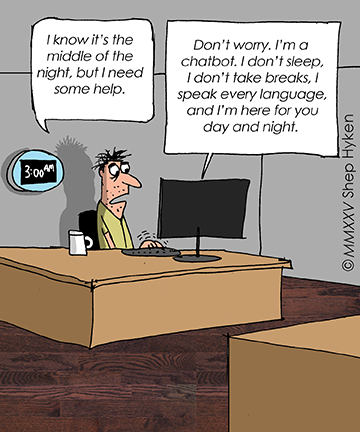
The Reasons Customers May Refuse to Speak with AI

The Reasons Customers May Refuse to Speak with AI

GUEST POST from Shep Hyken

If you want to anger your customers, make them do something they don’t want to do.

Up to 66% of U.S. customers say that when it comes to getting help, resolving an issue or making a complaint, they only want to speak to a live person. That’s according to the 2025 State of Customer Service and Customer Experience (CX) annual study. If you don’t provide the option to speak to a live person, you are at risk of losing many customers.

But not all customers feel that way. We asked another sample of more than 1,000 customers about using AI and self-service tools to get customer support, and 34% said they stopped doing business with a company or brand because self-service options were not provided.

These findings reveal the contrasting needs and expectations customers have when communicating with the companies they do business with. While the majority prefer human-to-human interaction, a substantial number (about one-third) not only prefer self-service options — AI-fueled solutions, robust frequently asked question pages on a website, video tutorials and more — but demand it or they will actually leave to find a competitor that can provide what they want.

This creates a big challenge for CX decision-makers that directly impacts customer retention and revenue.

Why Some Customers Resist AI

Our research finds that age makes a difference. For example, Baby Boomers show the strongest preference for human interaction, with 82% preferring the phone over digital solutions. Only half (52%) of Gen-Z feels the same way about the phone. Here’s why:

  1. Lack of Trust: Trust is another concern, with almost half (49%) saying they are scared of technologies like AI and ChatGPT.
  2. Privacy Concerns: Seventy percent of customers are concerned about data privacy and security when interacting with AI.
  3. Success — Or Lack of Success: While I think it’s positive that 50% of customers surveyed have successfully resolved a customer service issue using AI without the need for a live agent, that also means that 50% have not.

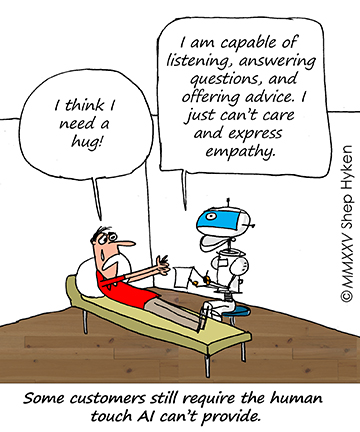
Customers aren’t necessarily anti-technology. They’re anti-ineffective technology. When AI fails to understand requests and lacks empathy in sensitive situations, the negative experience can make certain customers want to only communicate with a human. Even half of Gen-Z (48%) says they are frustrated with AI technology (versus 17% of Baby Boomers).

Why Some Customers Embrace AI

The 34% of customers who prefer self-service options to the point of saying they are willing to stop doing business with a company if self-service isn’t available present a dilemma for CX leaders. This can paralyze the decision process for what solutions to buy and implement. Understanding some of the reasons certain customers embrace AI is important:

  1. Speed, Convenience and Efficiency: The ability to get immediate support without having to call a company, wait on hold, be authenticated, etc., is enough to get customers using AI. If you had the choice between getting an answer immediately or having to wait 15 minutes, which would you prefer? (That’s a rhetorical question.)
  2. 24/7 Availability: Immediate support is important, but having immediate access to support outside of normal business hours is even better.
  3. A Belief in the Future: There is optimism about the future of AI, as 63% of customers expect AI technologies to become the primary mode of customer service in the future — a significant increase from just 21% in 2021. That optimism has customers trying and outright adopting the use of AI.

CX leaders must recognize the generational differences — and any other impactful differences — as they make decisions. For companies that sell to customers across generations, this becomes increasingly important, especially as Gen-Z and Millennials gain purchasing power. Turning your back on a generation’s technology expectations puts you at risk of losing a large percentage of customers.

What’s a CX Leader To Do?

Some companies have experimented with forcing customers to use only AI and self-service solutions. This is risky, and for the most part, the experiments have failed. Yet, as AI improves — and it’s doing so at a very rapid pace — it’s okay to push customers to use self-service. Just support it with a seamless transfer to a human if needed. An AI-first approach works as long as there’s a backup.

Forcing customers to use a 100% solution, be it AI or human, puts your company at risk of losing customers. Today’s strategy should be a balanced choice between new and traditional customer support. It should be about giving customers the experience they want and expect — one that makes them say, “I’ll be back!”

Image credit: Pixabay

This article originally appeared on Forbes.com

Subscribe to Human-Centered Change & Innovation WeeklySign up here to join 17,000+ leaders getting Human-Centered Change & Innovation Weekly delivered to their inbox every week.