Author Archives: Braden Kelley

About Braden Kelley

Braden Kelley is a Human-Centered Experience, Innovation and Transformation consultant at HCL Technologies, a popular innovation speaker, and creator of the FutureHacking™ and Human-Centered Change™ methodologies. He is the author of Stoking Your Innovation Bonfire from John Wiley & Sons and Charting Change (Second Edition) from Palgrave Macmillan. Braden is a US Navy veteran and earned his MBA from top-rated London Business School. Follow him on Linkedin, Twitter, Facebook, or Instagram.

50 Cognitive Biases Reference – Free Download

by Braden Kelley

I came across this cognitive biases infographic from TitleMax and it has a lot of great information in it, but…

The problem with long, information-rich infographics like this is that they’re hard to consume on the screen in their entirety, you can’t print them in a legible way, and they’re hard to leverage in your work. The creators of this infographic did a nice job of capturing a wide range of cognitive biases, which makes this a quite useful tool for design thinking, but not in this format.

To help everyone out, I’ve taken the original infographic and reformatted it into a five page PDF for easy reading and printing on 8.5″ x 11″ letter size paper.

Click here to download the 50 Cognitive Biases PDF (8.5″x11″)

See the original infographic below (click to access the source image):

Cognitive Biases Infographic

Click here to download the 50 Cognitive Biases PDF (8.5″x11″)

Subscribe to Human-Centered Change & Innovation WeeklySign up here to get Human-Centered Change & Innovation Weekly delivered to your inbox every week.

What is digital transformation? – EPISODE THREE – Ask the Consultant

Live from the Innovation Studio comes EPISODE THREE of a new ‘Ask the Consultant’ series of short form videos. EPISODE THREE aims to answer a question that many people struggle to answer or accurately discuss:

“What is digital transformation?”

Digital transformation is a complicated topic for people to speak intelligently about and to explore in depth because there is so much misinformation and confusion about what a digital transformation actually is – a lot of it espoused by technology vendors.

Together in this episode we’ll explore what digital transformation is by looking at two definitions that show what digital transformation is not.

1. Wikipedia’s bad definition of Digital Transformation

“Digital Transformation (DT or DX) is the adoption of digital technology to transform services or businesses, through replacing non-digital or manual processes with digital processes or replacing older digital technology with newer digital technology. Digital solutions may enable – in addition to efficiency via automation – new types of innovation and creativity, rather than simply enhancing and supporting traditional methods.”

— Wikipedia

2. This Definition of Digital Transformation Gets Closer But Still Isn’t Right

“Digital transformation is the integration of digital technology into all areas of a business, fundamentally changing how you operate and deliver value to customers. It’s also a cultural change that requires organizations to continually challenge the status quo, experiment, and get comfortable with failure.”

— EnterprisersProject

So, let’s dig into what Digital Transformation really is …

A digital transformation is the journey between a company’s current business operations to a reimagined version of itself from the perspective of how a digital native would build the same business operations leveraging the latest technology and scientific understandings of management science, leadership, decision science, business and process architecture, design, customer experience, etc.

A digital transformation can only be successfully achieved if you put customers and employees at the center to create a human-centered data model and explore the intersection between what’s needed and what’s possible to simplify processes, reduce complexity, and to design elegant experiences.

The key thing to remember is that technology comes at the end, not the beginning, starts by making strategic choices, and focuses on identifying and building the needed capabilities to execute the new strategy.

Here is a quick review list of ten things to keep in mind for a successful digital transformation:

  1. Reimagine your business from a digital native perspective
  2. A Human-Centered Data Model (customers & employees)
  3. Put your customers and employees at the center
  4. Identify intersection of what’s needed & what’s possible
  5. Simplify processes
  6. Reduce complexity
  7. Design elegant experiences
  8. Technology comes at the END – not the beginning
  9. Start by making strategic choices
  10. Build capabilities needed to achieve your transformation

}} Click here to watch the video {{

Help Shape the Next ‘Ask the Consultant’ Episode

  1. Grab a great deal on Stoking Your Innovation Bonfire on Amazon while they last!
  2. Get a copy of my latest book Charting Change on Amazon
  3. Contact me with your question for the next video episode of “Ask the Consultant” live from my innovation studio

Below are the previous episodes of ‘Ask the Consultant’:

  1. EPISODE ONE – What is innovation?
  2. EPISODE TWO – How do I create continuous innovation in my organization?
  3. All other episodes of Ask the Consultant


Accelerate your change and transformation success

Subscribe to Human-Centered Change & Innovation WeeklySign up here to get Human-Centered Change & Innovation Weekly delivered to your inbox every week.

Accelerating Complexity vs. Accelerating Change

Accelerating Complexity vs. Accelerating Change

Does the quickening pace of change or the accelerating pace of complexity pose a greater threat for humans and organizations?

Change can be incredibly disruptive to both humans and organizations.

So much so that I decided to create a more modern, visual, collaborative and effective set of methods and tools to help organizations beat the 70% change failure rate and better keep pace with the accelerating pace of change – the Change Planning Toolkit™ – introduced in my latest book Charting Change.

In the book I highlight that the pace of change is accelerating, and use the increasing rate of change in the S&P 500’s membership as a proof point:

Innosight Average Company Lifespan

Another proof point is the fact that all of our high technology has been developed in roughly the last 100 years.

There can be no doubt that the pace of change and disruption is quickening.

But how much of the accelerating disruption that we see can be attributed to what I see as an increasing pace of complexity?

If anyone doubts that we live in a time of accelerating complexity, I encourage you to check out the book The Toaster Project by Thomas Thwaites, or this TED talk given by Thomas:

I find this video quite frightening because it highlights how fragile our high-technology society is, and how much we need each other.

If a single person can’t make the simplest of electrical appliances by themselves, even over the course of a year, then imagine the complexity that organizations must manage to make even more complicated products.

Imagine the challenge of making changes to our organizations after we’ve optimized things to successfully manage this complexity.

If both complexity and change are accelerating, how can we cope?

Here are four key ways to better manage complexity and change:

  1. Choose carefully which complexity to inflict upon the organization
  2. Learn how to architect the organization for continuous change
  3. Continuously evaluate your organization’s trade-offs between flexibility and fixedness
  4. Leverage the modern, visual, and collaborative tools from the Change Planning Toolkit™ that are easily adapted to our new virtual work environment

Grab the ten free tools from the Change Planning Toolkit™ before purchasing a license so you can keep these three key frameworks front and center as you plan a more modular and conscious approach to managing the growing complexity in your organization:

  • PCC Change Readiness Framework
  • Organizational Agility Framework
  • Architecting the Organization for Continuous Change

Download the 10 Free Tools

Keep innovating!


Accelerate your change and transformation success

Subscribe to Human-Centered Change & Innovation WeeklySign up here to get Human-Centered Change & Innovation Weekly delivered to your inbox every week.

A Conversation with PepsiCo’s Chief Design Officer – Mauro Porcini

Recently I sat down with Mauro Porcini, PepsiCo’s first-ever Chief Design Officer for an Innovation Leader conversation across different topics and themes, from culture to design, from people to innovation, from strategy to failure, starting with these six questions:

  1. Why is it more important to design meaning than products?
  2. What are your favorite methods for getting to the heart of people’s wants and needs?
  3. How are you trying to spread design thinking throughout PepsiCo?
  4. Can you walk us through the creation of PepsiCo’s design website? Why was it important for your team to have an external site?
  5. If you had it all to do over again, what would you do differently?
  6. What is your approach to failure?

Click here to see Mauro’s answers on Innovation Leader


Accelerate your change and transformation success

Subscribe to Human-Centered Change & Innovation WeeklySign up here to get Human-Centered Change & Innovation Weekly delivered to your inbox every week.

Friday Funny – Unexpected Blackberry and Apple Problems

Thanks to Bettina von Stamm for bringing this comedic gem to my attention:

It does a great job of highlighting how technology companies come along and completely change parts of our common language.

For my non-European friends, Orange is a French mobile telecommunications provider (aka France Telecom).

I hope everyone has a funny Friday and a great weekend!


Accelerate your change and transformation success

Subscribe to Human-Centered Change & Innovation WeeklySign up here to get Human-Centered Change & Innovation Weekly delivered to your inbox every week.

How can I create continuous innovation in my organization? – EPISODE TWO – Ask the Consultant

Live from the Innovation Studio comes EPISODE TWO of a new ‘Ask the Consultant’ series of short form videos. EPISODE TWO tackles the second most commonly asked question of me:

“How can I create continuous innovation in my organization?”

Hint: It starts with getting a copy of Stoking Your Innovation Bonfire because I detail in the book how to overcome the key barriers to innovation.

Together in this episode we’ll explore how to create continuous innovation in your organization, why I wrote Stoking Your Innovation Bonfire, and how it can make a great course book for innovation courses at universities, executive education, and corporate training programs.

“Innovation is never easy — and not always welcome. This book is dedicated to the men and women who dedicate their lives to pushing our organizations to make more efficient use of our human capital and natural resources and to make the world a better place.”

Grab a great deal on Stoking Your Innovation Bonfire on Amazon while they last!

What question should I tackle in the next video episode of “Ask the Consultant” live from my innovation studio?

Contact me with your question

}} Click here to watch the video {{

Below are the previous episodes of ‘Ask the Consultant’:

  1. EPISODE ONE – What is innovation?
  2. All other episodes of Ask the Consultant


Accelerate your change and transformation success

Subscribe to Human-Centered Change & Innovation WeeklySign up here to get Human-Centered Change & Innovation Weekly delivered to your inbox every week.

Using Intuition to Drive Innovation Success

Using Intuition to Drive Innovation Success

Americans are in love with data, big data, analytics, artificial intelligence and machine learning.

… and the rest of the world is catching the same disease.

Data is important, don’t get me wrong, but it is only one side of the coin driving innovation and operational success.

On the other side of the coin is intuition.

As smart organizations try and make greater use of human-centered design, empathy and intuition can and must play an increasingly important role.

Bruce Kasanoff states that “Intuition is the Highest Form of Intelligence” in his article on Forbes.

Intuition is incredibly important to human-centered design from the standpoint that an “intuitive” design taps into our shared understanding as humans of how things should operate.

Intuition is the secret sauce of the quantum human computer, and as the pace of change AND complexity both accelerate, we must change our brain function to develop not just our intellectual capabilities but our instinctual capabilities as well.

Nobel Prize winner Daniel Kahneman wrote about these two ways of thinking in his book Thinking, Fast and Slow. Let’s look at a short video looking at intuition, science and dreams:

Science Intuition and Dreams – Dean Radin

Dreams can be an incredibly powerful tool for innovation, in fact the Nine Innovation Roles that play an important role in the best-selling book Stoking Your Innovation Bonfire came to me in a dream. Many experts recommend that you keep a pen and a notebook next to your bed to capture these flashes of brilliance.

Dreams and shared understanding are but two manifestations of intuition, of our interconnectedness with each other and energies greater than ourselves. But how do we leverage our intuition for innovation?

One way is to use your innovation as an input to use with a tool like The Experiment Canvas™:

The Experiment Canvas

Which is available as a free tool here on my web site from the forthcoming Disruptive Innovation Toolkit™.

You can use it to craft a hypothesis based on your intuition that you want to test, it keeps you focused on what you hope to learn during the experiment, and to consider the setup, operation, and wrapup of your experiment – among other things.

Too often people ignore their intuition because it doesn’t seem scientific. But, turning intuitive insights into hypotheses to test will help you overcome your hesitancy until you train your intuition and to learn to trust it as the potential human quantum computer that it could be. The other reason that people ignore their intuition is that well, they just can’t hear it. For many people, their intellectual mind is so busy that they can’t receive and react to what their intuitive mind is telling them.

Here is an interesting video that highlights these two points and how humans communicate behind the scenes:

Are you drowning out your intuitive mind? Are you failing to consider what is saying, and to test its assertions?

If so, please stop it, and learn new ways to keep innovating!

SPECIAL BONUS:

If you’d like to watch and learn even more about intuition…

Here is a video on Nikola Tesla and the Power of Intuition:


Accelerate your change and transformation success

Subscribe to Human-Centered Change & Innovation WeeklySign up here to get Human-Centered Change & Innovation Weekly delivered to your inbox every week.

What is innovation? – EPISODE ONE – Ask the Consultant

Live from the Innovation Studio comes EPISODE ONE of a new ‘Ask the Consultant’ series of short form videos. EPISODE ONE tackles the question people ask me more than any other:

“What is innovation?”

If you’d like to see additional potential definitions of innovation you can find 60+ additional innovation definitions here (sorry, link expired).

My definition of innovation, refined over the years, is the following:

“Innovation transforms the useful seeds of invention into widely adopted solutions valued above every existing alternative.” – Braden Kelley

The video above covers why I have defined innovation in this way, and why it is so important for every organization to have a clear definition of innovation that they disseminate WIDELY across the organization.

What question should I tackle in the next video episode of “Ask the Consultant” live from my innovation studio?

Contact me with your question

}} Click here to watch the video {{

Click to access the other episodes of Ask the Consultant


Accelerate your change and transformation success

Subscribe to Human-Centered Change & Innovation WeeklySign up here to get Human-Centered Change & Innovation Weekly delivered to your inbox every week.

Why Change is Hard

Why Change is Hard

In 250 Words or Less

When we think about change, often we look at it as being done to us, not something that we are part of. Initiating change is a scary, overwhelming process that we often avoid because we lack the tools to accumulate buy-in and successfully plan and execute the change in the face of the following obstacles/barriers:

  1. psychological/political
  2. logistical
  3. financial
  4. external

This leads to inaction and preservation of the status quo until the pain becomes too much to bear, or the promise of the change becomes so enticing, that people are willing to drop their resistance and begin engaging in the activities necessary to realize the intended outcomes of the change.

Organizations must identify up-front not only why people may resist, but also who will likely resist. Some of the typical reasons why people will resist include:

  • loss of certainty (includes fear of job loss)
  • loss of purpose, direction, or status
  • loss of mastery (includes loss of expertise/recognition)
  • loss of control or ownership
  • loss of connection or attachment
  • lack of trust or clarity
  • fear of failure (feel unprepared)
  • seeing proposed change as irrelevant or a bad idea

Finally, change is hard because even if you idedntify and overcome the resistance/obstacles/barriers, hiding below the surface is the even more daunting prospect that according to a 2009 ProSci study, 73% of organizations are at or near change saturation — the point at which organizations are incapable of absorbing additional change.

(248 words)

SPECIAL BONUS

One tool I created for the Change Planning Toolkit™ that will assist you in creating a stronger change strategy and more targeted communications as you lower resistance and get people to choose change are the Eight Change Mindsets:
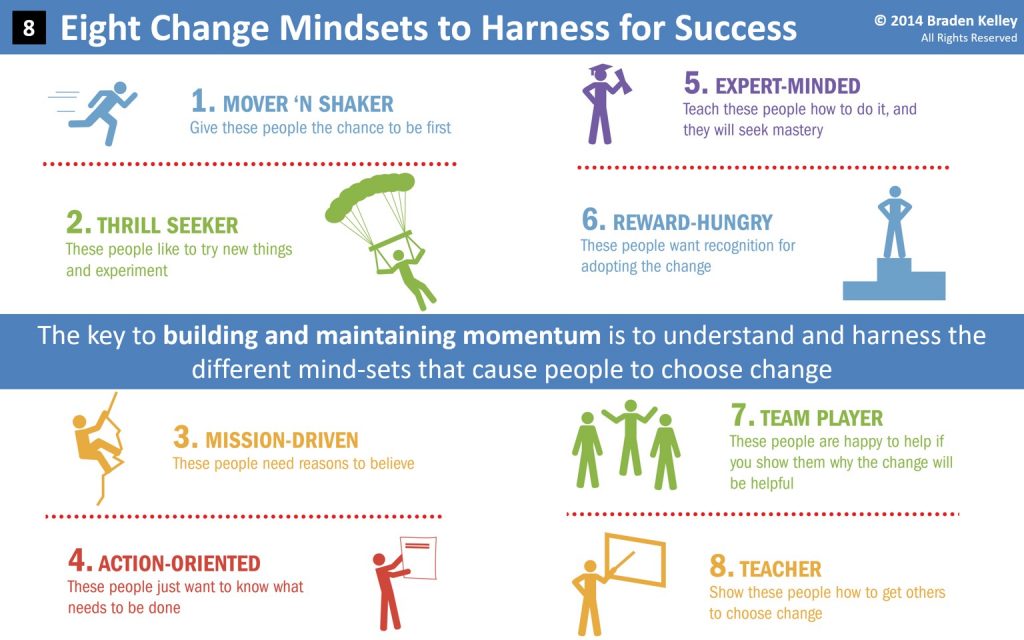
Eight Change Mindsets to Harness for Success

Obviously it is really hard to fit everything into 250 words so I had to leave some great other highlights of why change is hard, including this one:

In a 2008 global CEO study conducted by IBM on the enterprise of the future, the top challenges to successfully implementing strategic change were identified as:

  1. changing mindsets and attitudes (58 percent)
  2. corporate culture (49 percent)
  3. underestimating complexity (35 percent)
  4. shortage of resources (33 percent)
  5. lack of commitment from higher management (32 percent)
  6. lack of change know-how (20 percent)
  7. lack of motivation of employees involved (16 percent)

And here are some other challenges I would have included in the list:

  • lack of tools
  • lack of training
  • stakeholder misalignment
  • lack of buy in
  • change saturation
  • change fatigue
  • lack of change readiness
  • missing prerequisites
  • underestimating resistance
  • missing resources needed to succeed
  • underestimating risks and barriers
  • underestimating benefits of the status quo

To make change easier you’ll definitely want to transform how you plan and execute change into a more visual and collaborative approach, ideally suited for remote and hybrid interactions. It’s all laid out in my latest book Charting Change and supported by the Change Planning Toolkit™. A growing number of universities are picking up and teaching this new modern approach. Why not you?

Sources:

  1. Charting Change by Braden Kelley, Palgrave Macmillan, 2016
  2. Marsh survey on health, productivity and absenteeism—Prosci, 2009

Image Credit: Unsplash


Accelerate your change and transformation success

Subscribe to Human-Centered Change & Innovation WeeklySign up here to get Human-Centered Change & Innovation Weekly delivered to your inbox every week.

Training Your Quantum Human Computer

Quantum Human Computing

What is quantum computing?

According to Wikipedia, “Quantum computing is the use of quantum phenomena such as superposition and entanglement to perform computation. Computers that perform quantum computations are known as quantum computers.”

Rather than try and explain all of the ins and outs of how quantum computing differs from traditional computing and why it matters, I encourage you to check out this YouTube video:

In case you were curious, according to the Guinness Book of World Records, the current record holder for quantum computing is a Google machine capable of processing 72 Quantum Bits. There is supposedly a machine in China capable of 76 Qubits, but it has yet to be fully recognized as the new record holder.

So, what does quantum computing have to do with humanity and the human brain and our collective future?

Is the human brain a quantum computer?

The easy answer is – we’re not sure – but scientists are conducting experiments to try and determine whether the human brain is capable of computing in a quantum way.

As the pace of change in our world accelerates and data proliferates, we will need to train our brains to use less traditional brute force computing of going through every possibility one after another to do more parallel processing, better pattern recognition, and generating an increase in our ability to see insights straight away.

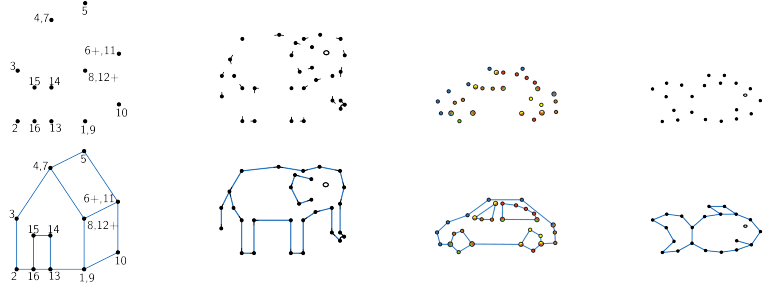
Connect the Dots

But how can we train our brains?

There are many different ways to better prepare your brain as we move from the Information Age to the Age of Insight. Let me start you off with two good ones and invite you to add more in the comments:

1. Connect the Dots

Many of us grew up doing connect-the-dot puzzles, and they seemed pretty easy. But, that is with visual queues. The image above shows a number of different visual queues. Connect the dots, especially without numbers or visual queues are great proving grounds for improving your visual pattern recognition skills.

2. DLAIY JMBULE

One of my favorites is the word game DAILY JUMBLE in my local newspaper. You can also play it online. The key here is to work not on using brute force to reorder the letters into a word, but trying to train your brain to just SEE THE WORD – instantly.

Succeeding at this and other ways of training your brain to be more like a quantum computer involves getting better at removing your conscious analytical brain from the picture and letting other parts of your brain take over. It’s not easy. It takes practice – continual practice – because it is really hard to keep the analytical brain out of the way.

So, are you willing to give it a try?

Stay tuned for the next article in this series “The Age of Insight” …

Image credits: Utrecht University, Pixabay


Accelerate your change and transformation success

Subscribe to Human-Centered Change & Innovation WeeklySign up here to get Human-Centered Change & Innovation Weekly delivered to your inbox every week.