Author Archives: admin

About admin

Braden Kelley is a Human-Centered Experience, Innovation and Transformation consultant at HCL Technologies, a popular innovation speaker, and creator of the FutureHacking™ and Human-Centered Change™ methodologies. He is the author of Stoking Your Innovation Bonfire from John Wiley & Sons and Charting Change (Second Edition) from Palgrave Macmillan. Braden is a US Navy veteran and earned his MBA from top-rated London Business School. Follow him on Linkedin, Twitter, Facebook, or Instagram.

12 Metrics That Actually Measure Innovation Value (Beyond Idea Count)

12 Metrics That Actually Measure Innovation Value (Beyond Idea Count)

GUEST POST from Art Inteligencia


How Do You Measure Innovation Value Beyond Idea Count? (Short Answer)

Twelve metrics that actually measure innovation value beyond idea count: (1) adopted behavior change, (2) workaround / shadow-process retirement, (3) time-to-confidence, (4) effort or cost-to-serve delta, (5) value captured (as a range), (6) honorable kill rate, (7) pilot-to-BAU transfer rate, (8) evidence-to-decision lag, (9) mandate coverage, (10) lived-contact evidence rate, (11) named Tuesday-owner coverage, and (12) dual scorecard integrity — outcomes decide; activity only informs. Idea count, demo volume, and patent tallies photograph well and predict almost nothing about Tuesday.

Idea count measures imagination theater. Innovation value measures whether humans and the operating model changed — and whether weak bets stopped.

Why Isn’t Idea Count Innovation Value?

I have sat through innovation reviews that felt like a harvest festival. Ideas submitted. Hackathons held. Prototypes shown. AI pilots launched. Someone asked what got easier for a human on Tuesday. The room reached for a vanity dashboard the way a drowning person reaches for a brochure.

Those metrics fund costume. Real innovation value shows up when a named journey gets easier, a workaround dies, a bet is killed on purpose, and a Tuesday owner runs what used to be a demo. Soft landings are designed. These twelve metrics are how you score the landing — not the theater.

Metric Replaces Signals value when…
1. Adopted behavior change Idea count / engagement People do something different in BAU
2. Workaround retirement Forever dual-running The old path has a kill date that sticks
3. Time-to-confidence Speed-to-demo Humans succeed without heroics sooner
4. Effort / cost-to-serve delta Workshop attendance Friction and failure demand drop
5. Value captured (range) Hope-based ROI slides Behavior maps to dollars with visible assumptions
6. Honorable kill rate Infinite “still learning” Weak bets stop on purpose
7. Pilot-to-BAU transfer Forever pilots A named operator runs it in the core
8. Evidence-to-decision lag Tourism without go/no-go Learning produces a decision on a date
9. Mandate coverage Orphan pilots Bets have power to decide, ship, or stop
10. Lived-contact evidence Synthetic personas as research Real humans shaped the bet before build
11. Tuesday-owner coverage “Innovation owns it” forever Adoption has a named workflow owner
12. Dual scorecard integrity Motion celebrated as impact Red outcomes can stop green activity reviews

1. Why Does Adopted Behavior Change Measure Innovation Value?

Measures: Whether a named human behavior moved in BAU — complete in one try, abandon the workaround, finish without escalation.

Replaces: Ideas generated; “innovation engagement”; applause at the readout.

On Tuesday: One behavior hypothesis per bet. Measure what people do, not what they clap for. If the behavior did not move, you did not innovate — you performed.

2. Why Is Workaround Retirement an Innovation Metric?

Measures: Whether the old path dies when the new way works — kill date honored for shadow processes and dual-running.

Replaces: “Go-live” with both paths forever and a dashboard that still calls it success.

On Tuesday: Retirement is part of the value. Dual-running is not adoption. It is hesitation with better branding.

3. What Does Time-to-Confidence Tell You About Innovation Value?

Measures: How fast customers or employees trust they can succeed without heroics, workarounds, or a friendly insider.

Replaces: Speed-to-demo; handle-time vanity alone; “we shipped.”

On Tuesday: Confidence is a human outcome. Faster wrong is still wrong — and now it confuses people faster too.

4. How Do Effort and Cost-to-Serve Deltas Measure Innovation?

Measures: Friction reduction on a named journey — effort, repeat contacts, failure demand, cognitive load.

Replaces: Lab activity; workshop attendance; sticky-note volume.

On Tuesday: Baseline, then after. A range is honest. Fake precision is theater with decimals.

5. How Should Innovation Value Be Captured in Dollars?

Measures: Retained or expanded revenue, or cost avoided, tied to the intervention — with assumptions visible and shown as a range.

Replaces: Industry benchmark slides and hope-based ROI that never touch your journeys.

On Tuesday: Metric → behavior → dollars → named bet. For pricing methods that survive a CFO, see 7 Ways to Calculate CX ROI Without Hope-Based Slideware — then apply the same honesty to innovation bets.

6. Why Is Honorable Kill Rate a Sign of Innovation Health?

Measures: Share of bets stopped on written kill criteria — stopping as a skill, not a scandal.

Replaces: Infinite “still learning” pilots; idea cemeteries without decisions.

On Tuesday: Visible cemetery of honorable exits. Kill criteria written before funding. A portfolio that never kills is not learning. It is hoarding.

7. What Is Pilot-to-BAU Transfer Rate?

Measures: Bets that graduate with a named operator into the operating model — not forever pilots with better lighting.

Replaces: Demo day as destination; “scale later” as a lifestyle.

On Tuesday: Transfer plan before build. The lab (if it exists) is a runway, not a forever home. For why labs die when transfer never arrives, see 5 Reasons Innovation Labs Fail — and 5 Replacements That Work.

8. Why Measure Evidence-to-Decision Lag?

Measures: Time from falsifying evidence to a go/no-go — learning that decides, not learning that tours.

Replaces: More experiments without decisions; “we’re still exploring” as career insurance.

On Tuesday: Learning without a decision date is tourism. Shorten the lag between “we know” and “we choose.”

9. What Is Mandate Coverage in an Innovation Portfolio?

Measures: Percentage of active bets with explicit decision rights — decide, ship, or stop.

Replaces: Impressive orphan pilots nobody has authority to operationalize.

On Tuesday: No mandate = no fund. Methods without power are cosplay. Before you open the budget, use 11 Questions Before Funding Any Innovation Pilot.

10. Why Does Lived-Contact Evidence Rate Matter?

Measures: Percentage of bets with real human contact — jobs, friction, dignity costs — before build, not synthetic personas alone.

Replaces: Scraped reviews and generated empathy maps mistaken for research because the prose is fluent.

On Tuesday: If the insight could have been invented in the building, it is decoration. Contact is not optional when generation is cheap.

11. What Is Named Tuesday-Owner Coverage?

Measures: Percentage of bets with a workflow or journey owner after applause — incentives, handoffs, and recovery power included.

Replaces: “The innovation team owns it” forever; adoption as an afterthought slide.

On Tuesday: Owner named before demo day. Adoption is design. If nobody owns the seam, the demo owned you.

12. What Is Dual Scorecard Integrity?

Measures: Whether outcomes (behavior, retirement, transfer, value) decide funding and promotion — while activity (ideas, demos, patents) only informs.

Replaces: Dashboards that celebrate motion and call it impact.

On Tuesday: If green activity can close a red-outcome review, you are still measuring theater. For the patterns these metrics prevent, see 7 Types of Innovation Theater. For the practice habit behind this scoreboard, read 9 Habits of Human-Centered Innovators That Still Matter in the Age of AI.

How Do You Check Innovation Metrics Before the Next Review?

Before the next innovation review, run five go/no-go questions. If you cannot answer them, you are still funding costume:

  1. Which of the twelve are on our scorecard — and which vanity metrics still run promotions?
  2. Can we name one adopted behavior from last quarter’s bets?
  3. How many bets did we honorably kill — with written criteria?
  4. Who owns Tuesday for each live bet?
  5. Would a red outcome stop a green activity review?

Count ideas if you must. Fund and promote what landed — behavior, retirement of the old path, transfer to BAU, and the courage to stop.

Frequently Asked Questions

How do you measure innovation value?

Measure adopted human outcomes and portfolio discipline — behavior change, workaround retirement, time-to-confidence, effort or cost-to-serve deltas, value captured as a range, honorable kills, pilot-to-BAU transfer, decision lag, mandate coverage, lived contact, Tuesday owners, and dual scorecard integrity. Do not confuse idea count or demo volume with value.

What metrics replace idea count in innovation?

Replace idea count with metrics that name what landed: adopted behavior change, shadow-process retirement, time-to-confidence, friction reduction, value captured, kill rate, transfer to BAU, evidence-to-decision lag, mandate coverage, lived-contact evidence, named Tuesday owners, and whether outcomes — not activity — decide funding and promotion.

What are vanity metrics in innovation?

Vanity metrics celebrate motion that photographs well: ideas submitted, hackathons held, patents filed, prototypes shown, visitors hosted, AI pilots launched, and “innovation NPS.” They can inform curiosity. They should not decide funding, promotion, or whether the portfolio is healthy — unless tied to adopted outcomes on Tuesday.

How do you measure innovation ROI?

Tie a named intervention to a behavior change, then to dollars — retained or expanded revenue, or cost avoided — with assumptions visible and reported as a range. Combine that with transfer to BAU and retirement of the old path. Avoid industry benchmark slides that never touch your journeys or operating model.

What KPIs should an innovation team use?

Use a dual scorecard: outcomes that decide (adopted behavior, retirement of old paths, transfer to BAU, value captured, honorable kills) and activity that only informs (ideas, demos). Add mandate coverage, lived-contact evidence, Tuesday-owner coverage, and evidence-to-decision lag so the portfolio stays honest about power, contact, ownership, and learning that decides.

Image credits: Google Gemini

Subscribe to Human-Centered Change & Innovation WeeklySign up here to get Human-Centered Change & Innovation Weekly delivered to your inbox every week.

11 Questions to Ask Before Funding Any Innovation Pilot

11 Questions to Ask Before Funding Any Innovation Pilot

by Braden Kelley and Chateau G Pato


What Should You Ask Before Funding an Innovation Pilot? (Short Answer)

Before funding any innovation pilot, ask whether you have a named human problem, a clear beneficiary, a behavior-based success measure (not theater metrics), a durable owner after applause, decision rights to change something real, kill criteria, a path beyond the A-team, a plan to retire the old way, clarity on whose interest is optimized, guardrails against a hard landing, and a useful “no.” Most wasted pilot spend fails at the funding gate — not the tech gate.

The eleven questions: (1) What human problem are we funding? (2) Whose life gets better? (3) What behavior will we measure? (4) Who owns this after applause? (5) What can we change if we learn something uncomfortable? (6) What is the kill criteria? (7) How does this scale beyond the A-team? (8) What old way will we turn off? (9) Whose interest is optimized? (10) What hard landing are we refusing? (11) If we say no, what do we still owe?

The Pilot Is a Decision, Not a Hobby

I have watched organizations fund pilots the way people buy gym memberships in January — with optimism, a logo on the slide, and almost no plan for Tuesday in March. Then they act surprised when the demo works and the operating model does not move.

Human-centered innovators treat the funding meeting as the first design decision. A pilot is not a hobby with a budget code. It is a bet that should either earn the right to change how people work — or be stopped cleanly so capacity returns to a better problem.

If you cannot answer the eleven questions below, you are not being agile. You are underwriting theater.

Question Red-flag answer Fundable answer
1. Human problem “Explore AI / innovate” One sentence: person + stuck job
2. Beneficiary “The business” Named role + felt success
3. Success measure Demos, idea count Behavior change you can observe
4. Owner after applause “Innovation team / vendor” BAU workflow owner with rights
5. Decision rights Cannot touch policy or process Pre-agreed levers to move
6. Kill criteria “We’ll keep learning” Time box + fail threshold + stopper
7. Beyond A-team Heroes + manual glue Median user + debt named
8. Turn off old way “Run both forever” Retire date or condition
9. Whose interest Deflection / savings only Human success + economics
10. Hard landing No failure mode Named harms + guardrails
11. Value of a no Only yes-path thinking Learning returned; next bet clearer

1. What Human Problem Are We Actually Funding — in One Sentence?

Why it matters: Pilots without a named human job become feature tourism. The slide says “innovation.” The calendar says “wandering.”

Red-flag answer: “Explore generative AI.” “Test the platform.” “Build our innovation muscle.”

Fundable answer: One sentence with a person, a moment, and a stuck job — e.g., “First-line agents cannot resolve billing exceptions without three systems and a supervisor.” If you need a paragraph, you do not have a problem yet. You have a vibe.

2. Whose Life Gets Better If This Works — Customer, Employee, or Both?

Why it matters: Orphan beneficiaries become orphan adoption. “Efficiency” without a face is how pilots optimize the spreadsheet and punish the humans.

Red-flag answer: “The business.” “Shareholders.” “Everyone, eventually.”

Fundable answer: A named role and what success should feel like — less shame, less rework, more confidence, more time for judgment. If both customer and employee gain, say how. If only one gains at the other’s expense, say that too. Honesty is cheaper than a failed rollout.

3. What Will We Measure That Is Behavior — Not Theater?

Why it matters: Activity metrics fund costume. Ideas generated, demos held, patents filed, “innovation NPS” — applause instruments, not proof.

Red-flag answer: Engagement with the pilot. Number of prompts. Workshop attendance.

Fundable answer: Observable human behavior on a journey — completion in one attempt, abandoned workaround, lower effort, faster time-to-confidence, fewer repeat contacts, retained customers, managers using the new path without shadow process. If you cannot name the behavior that changes when you “win,” do not fund the costume.

4. Who Owns This After the Pilot Applause Ends?

Why it matters: No durable operator is how you buy pilot purgatory. Projects end. Vendors leave. BAU inherits a half-changed Tuesday.

Red-flag answer: “The innovation lab.” “The vendor.” “We’ll figure out ownership at scale.”

Fundable answer: A named workflow owner in the business with decision rights — someone whose job still exists when the ribbon-cutting is over. If that person is not in the funding meeting, you are funding an exhibit.

5. What Are We Empowered to Change If We Learn Something Uncomfortable?

Why it matters: Methods without mandate are innovation cosplay. Sticky notes cannot move policy, incentives, or process they are forbidden to touch.

Red-flag answer: “We’re just testing technology.” “No process changes in phase one.”

Fundable answer: Pre-agreed levers — which policy, metric, handoff, or script can move if evidence says the current way is the problem. Learning that cannot change anything is entertainment with a SOW.

6. What Is the Kill Criteria — and Who Has the Courage to Use It?

Why it matters: Endless “we’re learning” is luxury consumption. Without stop-rules, pilots become pets.

Red-flag answer: No end date. No fail threshold. “The steering committee will decide later.”

Fundable answer: A time box, an evidence threshold, and a named person authorized to stop. Killing a weak pilot is not anti-innovation. It is how you protect the next good bet.

7. How Does This Scale Beyond the A-Team — or Are We Funding Heroics?

Why it matters: Hand-picked enthusiasts, clean data, and spreadsheet glue prove almost nothing about the median Tuesday.

Red-flag answer: “We’ll harden it later.” “Our best people will run it first.”

Fundable answer: Design assumptions for the median user and median manager. Integration and data debt named as costs in the pilot ask — not as a surprise after the applause. If only heroes can run it, you are funding burnout with a demo.

8. What Old Way Will We Turn Off If This Works?

Why it matters: Shadow paths keep adoption optional. Dual operating systems drain trust and attention.

Red-flag answer: “We’ll run both for a while” with no end condition.

Fundable answer: An explicit retire date or trigger for the workaround, spreadsheet, or legacy path. If you cannot turn something off, you have not finished designing the bet — only the brochure.

9. Whose Interest Is This Optimizing — Human Outcome or Cost-Containment Theater?

Why it matters: Pilots that succeed only on deflection, speed, or savings often fail on trust. Customers and employees keep score in their bodies.

Red-flag answer: Success equals containment, handle time, or “AI adoption” alone.

Fundable answer: Human success and economics in the same sentence — resolve completely, reduce effort, preserve dignity, and improve cost-to-serve or revenue quality. If the pilot cannot say who is optimized, assume it is the slide.

10. What Hard Landing Are We Refusing — and How Do We Prevent It?

Why it matters: Soft landings are designed at the funding gate. Hard landings are what you get when efficiency is the only value on the dashboard.

Red-flag answer: No failure mode for customers or employees. “We’ll monitor.”

Fundable answer: Named harms you refuse — loop traps, denser busywork, surveillance personalization, blocked escalation, rubber-stamp humans — plus guardrails: undo, consent, handoff, protected deep work, decision rights. If you cannot describe the hard landing, you are not ready to fund the soft one.

11. If We Say No, What Do We Still Owe the Organization?

Why it matters: A good no is innovation hygiene. Fear of looking “anti-innovation” is how bad pilots get yeses.

Red-flag answer: Only a yes-path. Silence after rejection. Political punishment for stopping.

Fundable answer: Even a no returns something — documented learning, clarified problem, freed capacity, a sharper next bet. Leadership that can only fund yeses will eventually fund theater.

How Do You Decide Whether to Fund an Innovation Pilot?

Run the eleven questions in one meeting. Score each green, amber, or red.

  1. Three or more reds: Do not fund. Fix the ask or kill it.
  2. Ambers: Fund only with written conditions and a named owner for each condition.
  3. All green or green-with-conditions: Fund the smallest bet that can falsify the idea — not the largest deck that can impress the room.

Funding a pilot without these answers is not agility. It is underwriting theater. Real innovators do not fear the questions. They fear spending a year proving something that was never designed to land with humans in the first place.

Frequently Asked Questions

What questions should you ask before funding an innovation pilot?

Ask what human problem you are funding, whose life gets better, what behavior you will measure, who owns the work after applause, what you can change if you learn something uncomfortable, what the kill criteria are, how it scales beyond the A-team, what old way you will turn off, whose interest is optimized, what hard landing you refuse, and what you still owe the organization if you say no.

How do you decide whether to fund an innovation pilot?

Score the eleven funding questions green, amber, or red in one meeting. Three or more reds means do not fund. Ambers require written conditions. Fund only the smallest bet that can falsify the idea when answers are green or conditionally green.

What is kill criteria for an innovation pilot?

Kill criteria are the pre-agreed time box, evidence threshold, and authority to stop a pilot that is not earning the right to continue. Without them, “we’re learning” becomes an excuse to keep funding pets instead of progress.

Why do innovation pilots waste money?

Most wasted pilot spend fails at the funding gate: no named human problem, vanity success metrics, no durable owner, no decision rights, no kill criteria, A-team heroics, dual operating systems, and optimization for slides or containment rather than human outcomes.

Should you fund an innovation pilot without a scale plan?

Not if “no scale plan” means no owner, no path beyond heroics, and no intent to retire the old way. You can fund a small learning bet — but only with kill criteria and clarity about what operating-model questions the pilot must answer before more money arrives.

Image credits: Google Gemini

Content Authenticity Statement: The topic area, key elements to focus on, etc. were decisions made by Braden Kelley, with a little help from Google Gemini and Cursor to clean up the article, add images and create infographics.

Subscribe to Human-Centered Change & Innovation WeeklySign up here to get Human-Centered Change & Innovation Weekly delivered to your inbox every week.

Top 10 Human-Centered Change & Innovation Articles of December 2025

Top 10 Human-Centered Change & Innovation Articles of December 2025Drum roll please…

At the beginning of each month, we will profile the ten articles from the previous month that generated the most traffic to Human-Centered Change & Innovation. Did your favorite make the cut?

But enough delay, here are December’s ten most popular innovation posts:

  1. Is OpenAI About to Go Bankrupt? — by Chateau G Pato
  2. The Rise of Human-AI Teaming Platforms — by Art Inteligencia
  3. 11 Reasons Why Teams Struggle to Collaborate — by Stefan Lindegaard
  4. How Knowledge Emerges — by Geoffrey Moore
  5. Getting the Most Out of Quiet Employees in Meetings — by David Burkus
  6. The Wood-Fired Automobile — by Art Inteligencia
  7. Was Your AI Strategy Developed by the Underpants Gnomes? — by Robyn Bolton
  8. Will our opinion still really be our own in an AI Future? — by Pete Foley
  9. Three Reasons Change Efforts Fail — by Greg Satell
  10. Do You Have the Courage to Speak Up Against Conformity? — by Mike Shipulski

BONUS – Here are five more strong articles published in November that continue to resonate with people:

If you’re not familiar with Human-Centered Change & Innovation, we publish 4-7 new articles every week built around innovation and transformation insights from our roster of contributing authors and ad hoc submissions from community members. Get the articles right in your Facebook, Twitter or Linkedin feeds too!

Build a Common Language of Innovation on your team

Have something to contribute?

Human-Centered Change & Innovation is open to contributions from any and all innovation and transformation professionals out there (practitioners, professors, researchers, consultants, authors, etc.) who have valuable human-centered change and innovation insights to share with everyone for the greater good. If you’d like to contribute, please contact me.

P.S. Here are our Top 40 Innovation Bloggers lists from the last four years:

Subscribe to Human-Centered Change & Innovation WeeklySign up here to get Human-Centered Change & Innovation Weekly delivered to your inbox every week.

Voting Open – Top 40 Innovation Authors of 2025

Vote for Top 40 Innovation AuthorsHappy Holidays!

For more than a decade I’ve devoted myself to making innovation insights accessible for the greater good, because I truly believe that the better our organizations get at deliveriseng value to their stakeholders the less waste of natural resources and human resources there will be.

As a result, we are eternally grateful to all of you out there who take the time to create and share great innovation articles, presentations, white papers, and videos with Braden Kelley and the Human-Centered Change and Innovation team. As a small thank you to those of you who follow along, we like to make a list of the Top 40 Innovation Authors available each year!

Our lists from the ten previous years have been tremendously popular, including:

Top 40 Innovation Bloggers of 2015
Top 40 Innovation Bloggers of 2016
Top 40 Innovation Bloggers of 2017
Top 40 Innovation Bloggers of 2018
Top 40 Innovation Bloggers of 2019
Top 40 Innovation Bloggers of 2020
Top 40 Innovation Bloggers of 2021
Top 40 Innovation Bloggers of 2022
Top 40 Innovation Bloggers of 2023
Top 40 Innovation Bloggers of 2024

Do you just have someone that you like to read that writes about innovation, or some of the important adjacencies – trends, consumer psychology, change, leadership, strategy, behavioral economics, collaboration, or design thinking?

Human-Centered Change and Innovation is now looking to recognize the Top 40 Innovation Authors of 2025.

It is time to vote and help us narrow things down.

The deadline for submitting votes is December 31, 2025 at midnight GMT.

Build a Common Language of Innovation on your team

The ranking will be done by me with influence from votes and nominations. The quality and quantity of contributions to this web site by an author will be a BIG contributing factor (through the end of the voting period).

You can vote in any of these three ways (and each earns points for them, so please feel free to vote all three ways):

  1. Sending us the name of the author by @reply on twitter to @innovate
  2. Adding the name of the author as a comment to this article’s posting on Facebook
  3. Adding the name of the author as a comment to this article’s posting on our Linkedin Page (Be sure and follow us)

The official Top 40 Innovation Authors of 2025 will then be announced here in early January 2026.

Here are the people who received nominations this year along with some carryover recommendations (in alphabetical order):

Adi Gaskell – @adigaskell
Alain Thys
Alex Goryachev
Andy Heikkila – @AndyO_TheHammer
Annette Franz
Arlen Meyers – @sopeofficial
Art Inteligencia
Ayelet Baron
Braden Kelley – @innovate
Brian Miller
Bruce Fairley
Chad McAllister – @ChadMcAllister
Chateau G Pato
Chris Beswick
Chris Rollins
Dr. Detlef Reis
Dainora Jociute
Dan Blacharski – @Dan_Blacharski
Daniel Burrus – @DanielBurrus
Daniel Lock
David Burkus
Dean and Linda Anderson
Dennis Stauffer
Diana Porumboiu
Douglas Ferguson
Drew Boyd – @DrewBoyd
Frank Mattes – @FrankMattes
Geoffrey A Moore
Gregg Fraley – @greggfraley
Greg Satell – @Digitaltonto
Helen Yu
Howard Tiersky
Janet Sernack – @JanetSernack
Jeffrey Baumgartner – @creativejeffrey
Jeff Freedman – @SmallArmyAgency
Jeffrey Phillips – @ovoinnovation
Jesse Nieminen – @nieminenjesse
John Bessant
Jorge Barba – @JorgeBarba
Julian Birkinshaw – @JBirkinshaw
Julie Anixter – @julieanixter
Kate Hammer – @Kate_Hammer
Kevin McFarthing – @InnovationFixer
Leo Chan
Lou Killeffer – @LKilleffer
Manuel Berdoy

Accelerate your change and transformation success

Mari Anixter- @MariAnixter
Maria Paula Oliveira – @mpaulaoliveira
Matthew E May – @MatthewEMay
Michael Graber – @SouthernGrowth
Mike Brown – @Brainzooming
Mike Shipulski – @MikeShipulski
Mukesh Gupta
Nick Jain
Nick Partridge – @KnewNewNeu
Nicolas Bry – @NicoBry
Nicholas Longrich
Norbert Majerus and George Taninecz
Pamela Soin
Patricia Salamone
Paul Hobcraft – @Paul4innovating
Paul Sloane – @paulsloane
Pete Foley – @foley_pete
Rachel Audige
Ralph Christian Ohr – @ralph_ohr
Randy Pennington
Richard Haasnoot – @Innovate2Grow
Robert B Tucker – @RobertBTucker
Robyn Bolton – @rm_bolton
Saul Kaplan – @skap5
Shep Hyken – @hyken
Shilpi Kumar
Scott Anthony – @ScottDAnthony
Scott Bowden – @scottbowden51
Shelly Greenway – @ChiefDistiller
Soren Kaplan – @SorenKaplan
Stefan Lindegaard – @Lindegaard
Stephen Shapiro – @stephenshapiro
Steve Blank
Steven Forth – @StevenForth
Tamara Kleinberg – @LaunchStreet
Teresa Spangler – @composerspang
Tom Koulopoulos – @TKspeaks
Tullio Siragusa
Yoram Solomon – @yoram

Subscribe to Human-Centered Change & Innovation WeeklySign up here to get Human-Centered Change & Innovation Weekly delivered to your inbox every week.

We’re curious to see who you think is worth reading!

Nominations Open – Top 40 Innovation Authors of 2025

Nominations Open for the Top 40 Innovation Authors of 2025Human-Centered Change and Innovation loves making innovation insights accessible for the greater good, because we truly believe that the better our organizations get at delivering value to their stakeholders the less waste of natural resources and human resources there will be.

As a result, we are eternally grateful to all of you out there who take the time to create and share great innovation articles, presentations, white papers, and videos with Braden Kelley and the Human-Centered Change and Innovation team. As a small thank you to those of you who follow along, we like to make a list of the Top 40 Innovation Authors available each year!

Our lists from the ten previous years have been tremendously popular, including:

Top 40 Innovation Bloggers of 2015
Top 40 Innovation Bloggers of 2016
Top 40 Innovation Bloggers of 2017
Top 40 Innovation Bloggers of 2018
Top 40 Innovation Bloggers of 2019
Top 40 Innovation Bloggers of 2020
Top 40 Innovation Bloggers of 2021
Top 40 Innovation Bloggers of 2022
Top 40 Innovation Bloggers of 2023
Top 40 Innovation Bloggers of 2024

Do you have someone that you like to read that writes about innovation, or some of the important adjacencies – trends, consumer psychology, change, leadership, strategy, behavioral economics, collaboration, or design thinking?

Human-Centered Change and Innovation is now looking for the Top 40 Innovation Authors of 2025.

The deadline for submitting nominations is December 24, 2025 at midnight GMT.

You can submit a nomination either of these two ways:

  1. Sending us the name of the author and the url of their blog by @reply on twitter to @innovate
  2. Sending the name of the author and the url of their blog and your e-mail address using our contact form

(Note: HUGE bonus points for being a contributing author)

So, think about who you like to read and let us know by midnight GMT on December 24, 2025.

We will then compile a voting list of all the nominations, and publish it on December 25, 2025.

Voting will then be open from December 25, 2025 – January 1, 2026 via comments and twitter @replies to @innovate.

The ranking will be done by me with influence from votes and nominations. The quality and quantity of contributions by an author to this web site will be a contributing factor.

Contact me with writing samples if you’d like to publish your articles on our platform!

The official Top 40 Innovation Authors of 2025 will then be announced on here in early January 2026.

We’re curious to see who you think is worth reading!

SPECIAL BONUS: From now until December 31, 2025 you can get either the hardcover or softcover of my latest best-selling book Charting Change (free shipping worldwide) for only £/$/€ 23.99 (~36% OFF).

Support this blog by getting your copy of Charting Change

Subscribe to Human-Centered Change & Innovation WeeklySign up here to get Human-Centered Change & Innovation Weekly delivered to your inbox every week.

FLASH SALE – 50% off THE Human-Centered Change Guidebook

48 hours only!

The Human-Centered Change Guidebook - Charting ChangeExciting news!

The publisher of my second book – Charting Change – is having a 48-hour FLASH SALE and so you can get the hardcover, softcover or the eBook for 50% off the list price using CODE FLSH50 until December 5, 2025, 11:59PM EDT. The new second edition includes loads of new content including additional guest expert sections and chapters on business architecture, project and portfolio management, and digital and business transformations!

I stumbled across this and wanted to share with everyone so if you haven’t already gotten a copy of this book to power your digital transformation or your latest project or change initiative to success, now you have no excuse!

Click here to get your copy of Charting Change for 50% off using CODE FLSH50

Of course you can get 10 free tools here from the book, but if you buy the book and contact me I will send you 26 free tools from the 50+ tools in the Change Planning Toolkit™ – including the Change Planning Canvas™!

*If discount is not applied automatically, please use this code: FLSH50. The discount is available through December 5, 2025. This offer is valid for English-language Springer, Palgrave & Apress books & eBooks. The discount is redeemable on link.springer.com only. Titles affected by fixed book price laws, forthcoming titles, and titles temporarily not available on link.springer.com are excluded from this promotion, as are reference works, handbooks, encyclopedias, subscriptions, or bulk purchases. The currency in which your order will be invoiced depends on the billing address associated with the payment method used, not necessarily your home currency. Regional VAT/tax may apply. Promotional prices may change due to exchange rates.

This offer is valid for individual customers only. Booksellers, book distributors, and institutions such as libraries and corporations, please visit springernature.com/contact-us. This promotion does not work in combination with other discounts or gift cards.

Subscribe to Human-Centered Change & Innovation WeeklySign up here to get Human-Centered Change & Innovation Weekly delivered to your inbox every week.

Top 10 Human-Centered Change & Innovation Articles of November 2025

Top 10 Human-Centered Change & Innovation Articles of November 2025Drum roll please…

At the beginning of each month, we will profile the ten articles from the previous month that generated the most traffic to Human-Centered Change & Innovation. Did your favorite make the cut?

But enough delay, here are November’s ten most popular innovation posts:

  1. Eight Types of Innovation Executives — by Stefan Lindegaard
  2. Is There a Real Difference Between Leaders and Managers? — by David Burkus
  3. 1,000+ Free Innovation, Change and Design Quotes Slides — by Braden Kelley
  4. The AI Agent Paradox — by Art Inteligencia
  5. 74% of Companies Will Die in 10 Years Without Business Transformation — by Robyn Bolton
  6. The Unpredictability of Innovation is Predictable — by Mike Shipulski
  7. How to Make Your Employees Thirsty — by Braden Kelley
  8. Are We Suffering from AI Confirmation Bias? — by Geoffrey A. Moore
  9. How to Survive the Next Decade — by Robyn Bolton
  10. It’s the Customer Baby — by Braden Kelley

BONUS – Here are five more strong articles published in October that continue to resonate with people:

If you’re not familiar with Human-Centered Change & Innovation, we publish 4-7 new articles every week built around innovation and transformation insights from our roster of contributing authors and ad hoc submissions from community members. Get the articles right in your Facebook, Twitter or Linkedin feeds too!

Build a Common Language of Innovation on your team

Have something to contribute?

Human-Centered Change & Innovation is open to contributions from any and all innovation and transformation professionals out there (practitioners, professors, researchers, consultants, authors, etc.) who have valuable human-centered change and innovation insights to share with everyone for the greater good. If you’d like to contribute, please contact me.

P.S. Here are our Top 40 Innovation Bloggers lists from the last four years:

Subscribe to Human-Centered Change & Innovation WeeklySign up here to get Human-Centered Change & Innovation Weekly delivered to your inbox every week.

Achieve Transformational Success with ‘Charting Change’

Save Until November 30, 2025 on the Softcover and eBook

Achieve Transformational Success with 'Charting Change'

📢 Attention Change Agents: Master the Art of Transformation with Charting Change!

As a Human-Centered Change and Innovation professional, I’ve seen firsthand how often brilliant initiatives falter because they neglect the most critical element: the people. That’s why I created the Human-Centered Change methodology and the Change Planning Canvas™ — a collaborative, visual approach to making change stick.

I’m thrilled to announce that the Second Edition of my best-selling book, Charting Change: A Visual Toolkit for Making Change Stick, is now available for the incredibly low price of just $17.99 for the softcover (FREE shipping worldwide) and eBook versions directly from my publisher! Don’t miss this opportunity to acquire an essential toolkit that will transform how you lead.


🛠️ Your Benefits: A New and Expanded Toolkit for Success

The Second Edition isn’t just a reprint; it’s a major expansion, born from user feedback and the accelerating pace of today’s business environment. When you grab your copy, you are investing in a comprehensive, practical guide that will help you beat the painful 70% change failure rate.

1. Expanded Coverage on Critical Modern Topics

I’ve added four new chapters to equip you for the complex, interconnected challenges of the 21st-century organization:

  • Architecting for Change: Learn how organizational design and business architecture work together to create a flexible, resilient structure, rather than just forcing change onto a rigid system.
  • Systems Thinking: Understand that change doesn’t happen in a vacuum. You’ll gain a holistic view of your organization as a complex system, allowing you to anticipate and manage ripple effects.
  • Digital Transformation: Get a clear roadmap for executing successful digital shifts that are human-centered—focusing on customer and employee experience, not just the technology.
  • Building a Continuous Change Culture: Move beyond one-off projects and discover how to hard-wire organizational agility into your DNA, making your company a learning machine ready for the future.

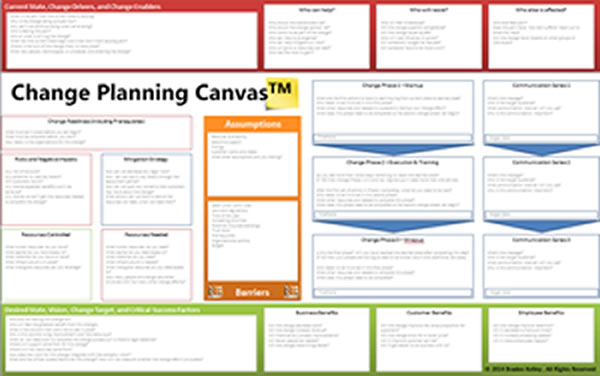
Change Planning Canvas

2. Access to the Core Change Planning Toolkit

Every book purchase grants you a complimentary Basic License to the Change Planning Toolkit™! This is invaluable, providing you with access to 26 of my 70+ frameworks and visual tools as downloadable, large-format PDFs, including:

  • The Change Planning Canvas™: A single, collaborative visual tool that gets everyone literally on the same page for discussing and planning the variables that influence your change effort.
  • Visual Guides and Worksheets: Practical, easy-to-use frameworks to visualize the current state, envision the desired state, identify benefits, and segment your audience.

3. Practical, Collaborative, and Visual Execution

Charting Change is designed to be a field guide, not a theoretical text. You will learn how to:

  • Drive Buy-in and Alignment: Use visual, collaborative techniques to draw out hidden assumptions and landmines early, ensuring stakeholders are aligned and committed.
  • Measure and Manage Readiness: Employ new visual tools, like the Organizational Agility Framework, to effectively assess your team’s and organization’s readiness for change and transition.
  • Overcome Resistance: Learn practical strategies for identifying and working with the people side of change, turning passive resistors into active supporters.
  • Build a Common Language: Establish a shared vocabulary and vision for change implementation across your entire organization, increasing the likelihood of success.

For less than the price of lunch, you can acquire the blueprint for successful, human-centered change. Stop betting on the 30% chance of success and start charting your path to transformation today!

Ready to transform your organization and your career?

📢 Grab your softcover or eBook copy of the Second Edition of Charting Change now for just $17.99 with FREE shipping worldwide included!

*This offer is valid for selected English-language Springer, Palgrave & Apress selected softcover books & eBooks. The discount is redeemable on link.springer.com only. Titles affected by fixed book price laws, forthcoming titles, and titles temporarily not available on link.springer.com are excluded from this promotion, as are reference works, handbooks, encyclopedias, subscriptions, or bulk purchases. This promotion applies exclusively to selected titles with a list price of up to £/$/€/₣80. The currency in which your order will be invoiced depends on the billing address associated with the payment method used, not necessarily your home currency. Regional VAT/tax may apply. Promotional prices may change due to exchange rates.

This offer is valid for individual customers only. Booksellers, book distributors, and institutions such as libraries and corporations, please visit springernature.com/contact-us. This promotion does not work in combination with other discounts or gift cards.

Subscribe to Human-Centered Change & Innovation WeeklySign up here to get Human-Centered Change & Innovation Weekly delivered to your inbox every week.

Top 10 Human-Centered Change & Innovation Articles of October 2025

Top 10 Human-Centered Change & Innovation Articles of October 2025Drum roll please…

At the beginning of each month, we will profile the ten articles from the previous month that generated the most traffic to Human-Centered Change & Innovation. Did your favorite make the cut?

But enough delay, here are October’s ten most popular innovation posts:

  1. AI, Cognitive Obesity and Arrested Development — by Pete Foley
  2. Making Decisions in Uncertainty – This 25-Year-Old Tool Actually Works — by Robyn Bolton
  3. The Marketing Guide for Humanity’s Next Chapter – How AI Changes Your Customers — by Braden Kelley
  4. Don’t Make Customers Do These Seven Things They Hate — by Shep Hyken
  5. Why Best Practices Fail – Five Questions with Ellen DiResta — by Robyn Bolton
  6. The Need for Organizational Learning — by Mike Shipulski
  7. You Must Accept That People Are Irrational — by Greg Satell
  8. The AI Innovations We Really Need — by Art Inteligencia
  9. Three Reasons You Are Not Happy at Work – And What to Do to Become as Happy as You Could Be — by Stefan Lindegaard
  10. The Nuclear Fusion Accelerator – How AI is Commercializing Limitless Power — by Art Inteligencia

BONUS – Here are five more strong articles published in September that continue to resonate with people:

If you’re not familiar with Human-Centered Change & Innovation, we publish 4-7 new articles every week built around innovation and transformation insights from our roster of contributing authors and ad hoc submissions from community members. Get the articles right in your Facebook, Twitter or Linkedin feeds too!

Build a Common Language of Innovation on your team

Have something to contribute?

Human-Centered Change & Innovation is open to contributions from any and all innovation and transformation professionals out there (practitioners, professors, researchers, consultants, authors, etc.) who have valuable human-centered change and innovation insights to share with everyone for the greater good. If you’d like to contribute, please contact me.

P.S. Here are our Top 40 Innovation Bloggers lists from the last four years:

Subscribe to Human-Centered Change & Innovation WeeklySign up here to get Human-Centered Change & Innovation Weekly delivered to your inbox every week.

Top 10 Human-Centered Change & Innovation Articles of September 2025

Top 10 Human-Centered Change & Innovation Articles of September 2025Drum roll please…

At the beginning of each month, we will profile the ten articles from the previous month that generated the most traffic to Human-Centered Change & Innovation. Did your favorite make the cut?

But enough delay, here are September’s ten most popular innovation posts:

  1. McKinsey is Wrong That 80% Companies Fail to Generate AI ROI — by Robyn Bolton
  2. Back to Basics for Leaders and Managers — by Robyn Bolton
  3. Growth is Not the Answer — by Mike Shipulski
  4. The Most Challenging Obstacles to Achieving Artificial General Intelligence — by Art Inteligencia
  5. Charlie Kirk and Innovation — by Art Inteligencia
  6. You Just Got Starbucked — by Braden Kelley
  7. Metaphysics Philosophy — by Geoffrey Moore
  8. Invention Through Co-Creation — by Janet Sernack
  9. Sometimes Ancient Wisdom Needs to be Left Behind — by Greg Satell
  10. The Crisis Innovation Trap — by Braden Kelley and Art Inteligencia

BONUS – Here are five more strong articles published in August that continue to resonate with people:

If you’re not familiar with Human-Centered Change & Innovation, we publish 4-7 new articles every week built around innovation and transformation insights from our roster of contributing authors and ad hoc submissions from community members. Get the articles right in your Facebook, Twitter or Linkedin feeds too!

Build a Common Language of Innovation on your team

Have something to contribute?

Human-Centered Change & Innovation is open to contributions from any and all innovation and transformation professionals out there (practitioners, professors, researchers, consultants, authors, etc.) who have valuable human-centered change and innovation insights to share with everyone for the greater good. If you’d like to contribute, please contact me.

P.S. Here are our Top 40 Innovation Bloggers lists from the last four years:

Subscribe to Human-Centered Change & Innovation WeeklySign up here to get Human-Centered Change & Innovation Weekly delivered to your inbox every week.