Tag Archives: irrational

Top 10 Human-Centered Change & Innovation Articles of October 2025

Top 10 Human-Centered Change & Innovation Articles of October 2025Drum roll please…

At the beginning of each month, we will profile the ten articles from the previous month that generated the most traffic to Human-Centered Change & Innovation. Did your favorite make the cut?

But enough delay, here are October’s ten most popular innovation posts:

  1. AI, Cognitive Obesity and Arrested Development — by Pete Foley
  2. Making Decisions in Uncertainty – This 25-Year-Old Tool Actually Works — by Robyn Bolton
  3. The Marketing Guide for Humanity’s Next Chapter – How AI Changes Your Customers — by Braden Kelley
  4. Don’t Make Customers Do These Seven Things They Hate — by Shep Hyken
  5. Why Best Practices Fail – Five Questions with Ellen DiResta — by Robyn Bolton
  6. The Need for Organizational Learning — by Mike Shipulski
  7. You Must Accept That People Are Irrational — by Greg Satell
  8. The AI Innovations We Really Need — by Art Inteligencia
  9. Three Reasons You Are Not Happy at Work – And What to Do to Become as Happy as You Could Be — by Stefan Lindegaard
  10. The Nuclear Fusion Accelerator – How AI is Commercializing Limitless Power — by Art Inteligencia

BONUS – Here are five more strong articles published in September that continue to resonate with people:

If you’re not familiar with Human-Centered Change & Innovation, we publish 4-7 new articles every week built around innovation and transformation insights from our roster of contributing authors and ad hoc submissions from community members. Get the articles right in your Facebook, Twitter or Linkedin feeds too!

Build a Common Language of Innovation on your team

Have something to contribute?

Human-Centered Change & Innovation is open to contributions from any and all innovation and transformation professionals out there (practitioners, professors, researchers, consultants, authors, etc.) who have valuable human-centered change and innovation insights to share with everyone for the greater good. If you’d like to contribute, please contact me.

P.S. Here are our Top 40 Innovation Bloggers lists from the last four years:

Subscribe to Human-Centered Change & Innovation WeeklySign up here to get Human-Centered Change & Innovation Weekly delivered to your inbox every week.

You Must Accept That People Are Irrational

You Must Accept That People Are Irrational

GUEST POST from Greg Satell

For decades, economists have been obsessed with the idea of “enlightened self-interest,” building elaborate models based on the assumption that people make rational choices. Business and political leaders have used these models to shape competitive strategies, compensation, tax policies and social services among other things.

It’s clear that the real world is far more complex than that. Consider the prisoner’s dilemma, a famous thought experiment in which individuals acting in their self-interest make everyone worse off. In a wide array of real world and experimental contexts, people will cooperate for the greater good rather than pursue pure self-interest.

We are wired to cooperate as well as to compete. Identity and dignity will guide our actions even more than the prospect for loss or gain. While business schools have trained generations of managers to assume that they can optimize results by designing incentives, the truth is that leaders that can forge a sense of shared identity and purpose have the advantage.

Overcoming The Prisoner’s Dilemma

John von Neumann was a frustrated poker player. Despite having one of the best mathematical minds in history that could probably calculate the odds better than anyone on earth, he couldn’t tell whether other players were bluffing or not. It was his failure at poker that led him to create game theory, which calculates the strategies of other players.

As the field developed, it was expanded to include cooperative games in which players could choose to collaborate and even form coalitions with each other. That led researchers at RAND to create the prisoner’s dilemma, in which two suspects are being interrogated separately and each offered a reduced sentence to confess.
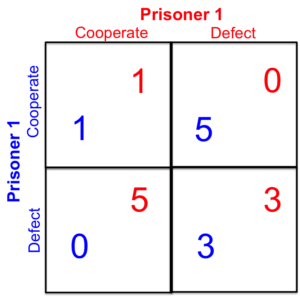
Prisoner's Dilemma

Here’s how it works: If both prisoners cooperate with each other and neither confesses, they each get one year in prison on a lesser charge. If one confesses, he gets off scot-free, while his partner gets 5 years. If they both rat each other out, then they get three years each—collectively the worst outcome of all.

Notice how from a rational viewpoint, the best strategy is to defect. No matter what one guy does, the other one is better off ratting him out. If both pursue self-interest, they are made worse off. It’s a frustrating problem. Game theorists call it a Nash equilibrium—one in which nobody can improve their position by unilateral move. In theory, you’re basically stuck.

Yet in a wide variety of real-world contexts, ranging from the survival strategies of guppies to military alliances, cooperation is credibly maintained. In fact, there are a number of strategies that have proved successful in overcoming the prisoner’s dilemma. One, called tit-for-tat, relies on credible punishments for defections. Even more effective, however, is building a culture of shared purpose and trust.

Kin Selection And Identity

Evolutionary psychology is a field very similar to game theory. It employs mathematical models to explain what types of behaviors provide the best evolutionary outcomes. At first, this may seem like the utilitarian approach that economists have long-employed, but when you combine genetics with natural selection, you get some surprising answers.

Consider the concept of kin selection. From a purely selfish point of view, there is no reason for a mother to sacrifice herself for her child. However, from an evolutionary point of view, it makes perfect sense for parents to put their kids first. Groups who favor children are more likely to grow and outperform groups who don’t.

This is what Richard Dawkins meant when he called genes selfish. If we look at things from our genes’ point of view, it makes perfect sense for them to want us to sacrifice ourselves for children, who are more likely to be able to propagate our genes than we are. The effect would logically also apply to others, such as cousins, that likely carry our genes.

Researchers have also applied the concept of kin selection to other forms of identity that don’t involve genes, but ideas (also known as memes) in examples such as patriotism. When it comes to people or ideas we see as an important part of our identity, we tend to take a much more expansive view of our interests than traditional economic models would predict.

Cultures of Dignity

It’s not just identity that figures into our decisions, but dignity as well. Consider the ultimatum game. One player is given a dollar and needs to propose how to split it with another player. If the offer is accepted, both players get the agreed upon shares. If it is not accepted, neither player gets anything.

If people acted purely rationally, offers as low as a penny would be routinely accepted. After all, a penny is better than nothing. Yet decades of experiments across different cultures show that most people do not accept a penny. In fact, offers of less than 30 cents are routinely rejected as unfair because they offend people’s dignity and sense of self.

Results from ultimatum game are not uniform, but vary in different cultures and more recent research suggests why. In a study in which a similar public goods game was played it was found that cooperative—as well as punitive—behavior is contagious, spreading through three degrees of interactions, even between people who haven’t had any direct contact.

Whether we know it or not, we are constantly building ecosystems of norms that reward and punish behavior according to expectations. If we see the culture we are operating in as trusting and generous, we are much more likely to act collaboratively. However, if we see our environment as cutthroat and greedy, we’ll tend to model that behavior in the same way.

Forging Shared Identity And Shared Purpose

In an earlier age, organizations were far more hierarchical. Power rested at the top. Information flowed up, orders went down, work got done and people got paid. Incentives seemed to work. You could pay more and get more. Yet in today’s marketplace, that’s no longer tenable because the work we need done is increasingly non-routine.

That means we need people to do more than merely carry out tasks, they need to put all of their passion and creativity into their work to perform at a high-level. They need to collaborate effectively in teams and take pride in the impact their efforts produce. To achieve that at an organizational level, leaders need to shift their mindsets.

As David Burkus explained in his TED Talk, humans are prosocial. They are vastly more likely to perform when they understand and identify with who their work benefits than when they are given financial incentives or fed some grandiose vision. Evolutionary psychologists have long established that altruism is deeply embedded in our sense of tribe.

The simple truth is that we can no longer coerce people to do what we want with Rube Goldberg-like structures of carrots and sticks, but must inspire people to want what we want. Humans are not purely rational beings, responding to stimuli as if they were vending machines that spit out desired behaviors when the right buttons are pushed, but are motivated by identity and dignity more than anything else.

Leadership is not an algorithm, but a practice of creating meaning through relationships of trust in the context of a shared purpose.

— Article courtesy of the Digital Tonto blog
— Image credit: Pixabay

Subscribe to Human-Centered Change & Innovation WeeklySign up here to join 17,000+ leaders getting Human-Centered Change & Innovation Weekly delivered to their inbox every week.

Why Rational Change Strategies Fail Irrational Humans

Why Rational Change Strategies Fail Irrational Humans

GUEST POST from Art Inteligencia


I. The Illusion of the Rational Employee

Organizations continue to design change initiatives under a fundamentally flawed assumption: that employees are logical processing units who will naturally adopt a new behavior, tool, or structure once presented with a clear business case. This reliance on cold, linear reasoning ignores the reality of human psychology. When strategy ignores experience, even the most sound plans fall apart at the point of execution.

The “Spreadsheet Trap”

Leaders frequently fall into the spreadsheet trap, assuming that if an initiative makes operational sense, delivers an attractive ROI, and looks clean on a Gantt chart, adoption will automatically follow. They treat organizational transformation as an engineering problem rather than a human journey. When adoption stalls, leadership often responds with more data, longer memos, and mandatory training, doubling down on the logic that failed to persuade in the first place.

The Predictable Irrationality of Teams

Humans are not software to be upgraded with an executive announcement; we are wired with deep-seated cognitive biases that prioritize short-term comfort over long-term optimization:

  • Status Quo Bias: The familiar path feels inherently safer than an unfamiliar one, even if the current system is visibly broken.
  • Loss Aversion: The psychological pain of losing autonomy, mastery, or familiar routines is twice as powerful as the perceived pleasure of future gains.
  • Hyperbolic Discounting: Immediate, concrete inconveniences (learning a new workflow today) heavily outweigh abstract, future payoffs (increased efficiency next quarter).

The Gap Between Strategy and Experience

Traditional change management focuses heavily on the mechanics of execution—timelines, governance structures, and milestone tracking—while ignoring the emotional and behavioral reality of the people navigating the transition. When change is managed purely as a project to be pushed onto an organization rather than an experience intentionally designed with its users, friction is guaranteed. Until change strategies account for how people actually feel, perceive, and decide, even the best ideas will continue to fail.

II. Anatomy of Failure: Where Rational Models Collapse

When change fails, leadership often points to poor communication, inadequate training, or employee stubbornness. The real culprit is more fundamental: traditional change models treat human beings as purely logical processors, ignoring the deeply rooted evolutionary mechanics that govern how we react to uncertainty and disruption.

Logic vs. Threat Detection

The human brain is wired primary for survival, not organizational efficiency. When a company announces a restructuring, a system migration, or a shift in strategy, the subconscious brain processes this shift as a potential threat to primary social needs: status, autonomy, certainty, and security. While an executive slide deck highlights long-term competitive advantage, frontline employees’ neurological threat detection systems are actively firing. Logical business cases cannot overcome an activated fight-or-flight response.

The Communication Misconnection

Leaders frequently fall into the trap of communicating change using the metrics that matter most to executives—market share, EBITDA, operational velocity, and shareholder value. However, humans do not commit emotionally to corporate key performance indicators. When you broadcast the strategic why without translating it into a clear, empathetic What’s In It For Me (WIIFM) at the individual level, a fundamental disconnect occurs. Employees view the change not as an opportunity, but as an imposition.

Cognitive Overload & Change Fatigue

Organizations rarely introduce a single change in isolation; rather, teams are subjected to a continuous stream of new software rollouts, process updates, and strategic pivots. Every transition requires conscious mental effort and depletes cognitive energy. When rational change strategies pile project upon project without accounting for human capacity, psychological safety evaporates. The result is change fatigue—manifesting either as active resistance or quiet, passive compliance that kills long-term adoption.

III. Reframing Change: From Management to Experience Design

To break the cycle of failed transformations, organizations must fundamental shift their approach from managing change to designing the change experience. Managing change views people as resources to be moved, aligned, and optimized. Experience design views people as active participants whose emotional, cognitive, and physical interactions with the change dictate its ultimate success.

Human-Centered Change Planning

Human-centered change begins with deep empathy rather than rigid directives. Instead of drafting rollout schedules in isolated boardrooms, change architects must utilize human-centered design tools to understand the human landscape:

  • Empathy Mapping: Documenting what frontline teams genuinely see, hear, feel, and say regarding their daily pain points and upcoming transitions.
  • Experience Journey Mapping: Charting every step of the transition journey from the end-user’s perspective to identify friction points, anxiety spikes, and cognitive peaks long before go-live.
  • Co-Creation: Involving the end-users early in the solution design phase, shifting them from passive recipients of change to active owners of the transformation.

Designing the Change Architecture

Relying on willpower or mandates to drive adoption is a failing strategy. Effective change design builds an environment where the desired behavior becomes the path of least resistance. By applying behavioral economics and choice architecture, organizations create structural “nudges”—reducing operational friction for new behaviors while introducing gentle friction to legacy, unproductive habits.

Fostering Psychological Safety

In a traditional rational framework, pushback is categorized as resistance to be suppressed. In a human-centered approach, doubt, anxiety, and critique are recognized as critical signals containing operational truth. Creating psychological safety allows employees to voice friction points without fear of reprisal, transforming resistance into actionable insight that refines and strengthens the overall change strategy.

IV. The Human-Centered Change Framework

To bridge the gap between logical strategic intent and irrational human behavior, organizations need an actionable, repeatable framework. The Human-Centered Change Framework moves beyond traditional top-down rollouts, embedding empathy, co-creation, and behavioral economics into every phase of the transformation journey.

1. Empathize First

Before designing solutions or setting milestones, change leaders must uncover the lived reality of the frontline. This means moving beyond superficial surveys to map hidden anxieties, cultural norms, and unspoken rules. Understanding emotional and operational blockers upfront prevents launching strategies that clash directly with organizational realities.

2. Co-Create the Future

People rarely resist their own ideas. By engaging impacted employees in shaping the rollout, workflows, and solutions, you transform potential critics into active champion leaders. Co-creation builds psychological ownership, shifting the internal narrative from “this is being done to us” to “we are building this together.”

3. Micro-Behaviors & Quick Wins

Massive strategic mandates create cognitive overload and paralyze teams. Successful change design breaks sweeping transformations down into micro-behaviors—small, manageable, low-friction habits that can be easily adopted into daily routines. Early wins build momentum and provide tangible proof of progress.

4. Iterative Feedback Loops

Human behavior is dynamic and unpredictable; static plans fail when they hit real-world complexity. Continuous feedback loops measure not just technical milestones, but behavioral adoption and emotional sentiment in real time. This agility allows change architects to adapt, refine, and support teams dynamically throughout the transition.

V. Key Takeaway & Call to Action

Strategy sets the destination, but human psychology drives the journey. Organizations do not transform because of grand visions, elegant Gantt charts, or sound financial models—they transform when individual people change their daily behaviors. If your change strategy treats human beings as purely rational processors, it isn’t a strategy; it’s a wishlist built on flawed assumptions.

The Bottom Line

To succeed in an era of continuous disruption, leaders must replace rigid change management with human-centered change design. By accounting for cognitive biases, prioritizing emotional safety, and reducing behavioral friction, you transform change from a source of fatigue into an engaging, empowering experience.

Actionable Next Step: Audit Your Change Efforts

Take an honest look at your current strategic initiatives and ask yourself and your leadership team three fundamental questions:

  • Are we communicating a corporate business case, or are we addressing the personal What’s In It For Me (WIIFM) at the frontline level?
  • Have we engaged the people impacted by this change in co-creating the solution, or are we pushing a finished mandate onto them?
  • Are we designing frictionless environments that support human behavior, or expecting sheer willpower to overcome systemic friction?

The answers will tell you whether you are managing a project destined for failure, or designing a human experience built for lasting adoption.

Frequently Asked Questions

Why do rational change strategies fail in organizations?

Rational change strategies assume employees make decisions purely on logic and data. In reality, humans are influenced by cognitive biases, threat perception, and loss aversion, causing them to resist change even when the business case is clear.

What is the difference between change management and experience design?

Traditional change management views people as assets to be moved through process mechanics and timelines. Experience design treats employees as active participants, crafting transitions around human emotion, motivation, and behavioral nudges to drive natural adoption.

How can leaders reduce change fatigue among employees?

Leaders can reduce change fatigue by co-creating solutions with frontline teams, breaking large transformations into low-friction micro-behaviors, and establishing psychological safety where feedback is actively integrated.

SPECIAL BONUS: Braden Kelley’s Problem Finding Canvas can be a super useful starting point for doing design thinking or human-centered design.

“The Problem Finding Canvas should help you investigate a handful of areas to explore, choose the one most important to you, extract all of the potential challenges and opportunities and choose one to prioritize.”

Image credit: ChatGPT

Subscribe to Human-Centered Change & Innovation WeeklySign up here to get Human-Centered Change & Innovation Weekly delivered to your inbox every week.