How to Fail Your Way to Success

How to Fail Your Way To Success

GUEST POST from Robyn Bolton

“Rapid Unscheduled Disassembly”

It’s a meme and my new favorite euphemism for getting dumped/fired (as in, “There was a rapid unscheduled disassembly of our relationship.”  Thank you, social media, for this gem)

It’s also spurred dozens of conversations with corporate leaders and innovation teams about the importance of defining success, the purpose of experiments, and the necessity of risk. 

Define Success so You Can Identify Failure

The dictionary defines “fail (verb)” as “be unsuccessful in achieving one’s goal.”

But, as I wrote last week, using your definition of success to classify something as a failure assumes you defined success correctly.

Space X didn’t define success as carrying “two astronauts from lunar orbit to the surface of the moon,” Starship’s ultimate goal. 

It defined success in 3 ways:

  • Big picture (but a bit general) – Validating “whether the design of the rocket system is sound.”
  • Ideal outcome – “Reach an altitude of 150 miles before splashing down in the Pacific Ocean near Hawaii 90 minutes [after take-off].”
  • Base Case – Fly far enough from the launchpad and long enough to generate “data for engineers to understand how the vehicle performed.”

By defining multiple and internally consistent types of success, SpaceX inspired hope for the best and set realistic expectations. And, if the rocket exploded on the launchpad? That would be a failure.

Know What You Need to Learn so You Know What You Need to Do

This was not the first experiment SpaceX ran to determine “whether the design of the rocket system was sound.”  But this probably was the only experiment they could run to get the data they needed at this point in the process.

You can learn a lot from lab tests, paper prototypes, and small-scale experiments. But you can’t learn everything. Sometimes, you need to test your idea in the wild.

And this scares the heck out of executives.

As the NYT pointed out, “Big NASA programs like the Space Launch System…are generally not afforded the same luxury of explode-as-you-learn. There tends to be much more testing and analysis on the ground — which slows development and increases costs — to avoid embarrassing public failures.”

Avoiding public failure is good. Not learning because you’re afraid of public failure is not.

So be clear about what you need to learn, all the ways you could learn it, and the trade-offs of private, small-scale experiments vs. large-scale public ones. Then make your choice and move forward.

Have Courage. Take a Risk

“Every great achievement throughout history has demanded some level of calculated risk, because with great risk comes great reward,” Bill Nelson, NASA Administrator.

“Great risk” is scary. Companies do not want to take great risks (see embarrassing public failure).

“Calculated risk” is smart. It’s necessary. It’s also a bit scary.

You take a risk to gain something – knowledge, money, recognition. But you also create the opportunity to lose something. And since the psychological pain of losing is twice as powerful as the pleasure of gaining, we tend to avoid risk.

But to make progress, you must take a risk. To take a risk, you need courage.

And courage is a skill you can learn and build. For many of us, it starts with remembering that courage is not the absence of fear. It is the choice to take action despite fear. 

When faced with a risk, face it. Acknowledge it and how you feel. Assess it by determining the best, worst, and most likely scenarios. Ask for input and see it from other people’s perspectives. Then make your choice and move forward.

How to know when you’ve successfully failed

Two quotes perfectly sum up what failure en route to success is:

“It may look that way to some people, but it’s not a failure. It’s a learning experience.”- Daniel Dumbacher, executive director of the American Institute of Aeronautics and Astronautics and a former high-level NASA official.

“Would it have been awesome if it didn’t explode? Yeah. But it was still awesome.” – Launch viewer Lauren Posey, 34.

Subscribe to Human-Centered Change & Innovation WeeklySign up here to join 17,000+ leaders getting Human-Centered Change & Innovation Weekly delivered to their inbox every week.


Embrace the Innovation Hate

Embrace the Innovation Hate

GUEST POST from Greg Satell

“Don’t worry about people stealing your ideas,” said the computing pioneer Howard Aiken. “If your ideas are any good, you’ll have to ram them down people’s throats.” The truth is that any idea important enough to be valuable will be disruptive enough to inspire significant opposition to it ever gaining traction.

This phenomenon is often known as the Semmelweis Effect, after the Hungarian physician who pioneered hand washing in hospitals. Unfortunately, the medical establishment rejected his ideas and antiseptic procedures didn’t come into common use decades later. Millions of people died needlessly.

Yet as I’ve previously explained, much of the blame lays at Semmelweis’s door. Instead of taking into account valid criticisms of how he collected and communicated his data, he railed against the establishment, became a pariah and lost all credibility. The truth is that we need our critics, if for no other reason than that they have the power to save us from ourselves.

Exposing Flaws In Your Idea

One of the most effective programs for helping to bring discoveries out of the lab is I-Corps. First established by the National Science Foundation (NSF) to help recipients of SBIR grants identify business models for scientific discoveries, it has been such an extraordinary success that the US Congress has mandated its expansion across the federal government.

Based on Steve Blank’s lean startup methodology, the program aims to transform scientists into entrepreneurs. It begins with a presentation session, in which each team explains the nature of their discovery and its commercial potential. It’s exciting stuff, pathbreaking science with real potential to truly change the world.

Inevitably, during this initial session, they are asked, “how many customers have you talked to?” and, just as inevitably, their answer comes up woefully short. They are often yelled at and ordered to “get out of the building and talk to customers.” For many, it is a dressing down that they will never forget.

Ironically, much of the success of the I-Corps program is due to these early sessions. Once the entrepreneurs realize that they are on the wrong track, they embark on a crash course of customer discovery, interviewing dozens — and sometimes hundreds — of customers in search of a business model that actually has a chance of succeeding.

Make no mistake, every idea is flawed. As Steve Blank likes to say, “no business plan survives first contact with a customer.” So you want to expose as many flaws as you can before that happens.

Identifying Shared Values

In 1992, during the war in Bosnia, massive student protests broke out in Serbia. For 26 days, they demanded an end to the war and for the country’s authoritarian leader, Slobodan Milošević, to resign. Eventually, summer came, the students went home and little, if anything, was accomplished.

“These were very ‘Occupy’ type of protests,” Srdja Popović, one of the student leaders would later tell me,” where we occupied the five biggest universities and lived there in our little islands of common sense with intellectuals and rock bands while the rest of the country was more or less supportive of Milošević’s idea.”

Yet much like the I-Corps entrepreneurs, the activists learned from the experience. “We began to understand that staying in your little blurb of common sense was not going to save the country,” Popović remembers. In later years, the activists would learn to tailor their messages specifically to less educated rural Serbians who were turned off by the anti-war protests.

In much the same way, when developing a new product, it is often better to start with a minimum viable product rather than a full-featured prototype. You do this not so people can tell you how much they love your idea, but so they can tell you what they hate it and why. You have to get out of your own “little island” to find what people truly value.

They Can Send People Your Way

In the early hours of December 11, 2013, special police forces descended into the streets of Kyiv, Ukraine to violently assault peaceful activists protesting the Yanukovych regime. Known for their brutality, the units, called Berkut, cleared the streets and sent those gathered running to the shelter to the nearby St. Michaels Cathedral.

It proved to be a turning point, but not the one that Yanukovych expected. Mustafa Nayyem, who helped spark and then lead the protests, told me that the protests were losing steam and the brutal actions of the regime threw the support of the country their way. Yanukovych was forced out of office a few months later.

Often, your most fierce opponents can be your greatest asset. In his efforts to reform the Pentagon in the 1980s, Colonel John Boyd would start by doing low-key briefings to peers and then move on to congressional staffers. As his ideas gained steam, high-ranking generals would try to crush his efforts. Inevitably, they would overreach and he would gain even more support.

The key to leveraging your opposition is to not attack or even address them directly. Start by building the support of those who are already likely to be excited by the idea. As you gain traction, others will notice and join in. Eventually, your haters will feel they need to do something drastic and that will send even more people your way.

Whenever You Have A Big Idea, Someone’s Not Going To Like It

In researching my book, Cascades, I found that every successful transformational effort had a plan to overcome opposition. They didn’t dismiss their haters, but studied them, learned from them and were able to turn the disparagement to their own advantage. As the pressure increased, their opponents inevitably make a huge mistake that would turn the tide.

This is, of course, obvious in political and social movements, but I’ve found that it is just as important in corporate and organizational transformations. Make no mistake, if you want to drive anything more than incremental change, someone isn’t going to like it and they will work to undermine your efforts anyway they can. That is just a simple fact of life.

It is also something you can use to your advantage. Those who oppose your idea can point out flaws you may have missed. You can fix them. They help you expose underlying values that others may share as well. You can work to address them. As you build support, they are likely to lash out, creating an opening for you to win the day.

All too often, we end up preaching to the choir instead of venturing out of the church and mixing with the heathens. That’s how change efforts fail. So don’t ignore your haters. Embrace them. Learn from them. They can provide the key to driving transformation forward.

— Article courtesy of the Digital Tonto blog
— Image credit: Pixabay

Subscribe to Human-Centered Change & Innovation WeeklySign up here to join 17,000+ leaders getting Human-Centered Change & Innovation Weekly delivered to their inbox every week.

Understanding Permission

Understanding Permission

GUEST POST from Geoffrey A. Moore

Permission is one of the most powerful concepts in strategic marketing, but it is an easy one to misinterpret if you are not careful. Here are five things you need to know:

1. Permission is anchored in the idea of what the world wants your company to be.

It may surprise you that the world has an agenda for your company, but it does—even if it has never heard of you. The world has unmet needs, and it is always looking for someone credible to enlist in meeting those needs. If you are a start-up, then you are credible at being highly disruptive. If you are an established and vibrant enterprise, then you are credible as a responsible steward. If you are an aging enterprise looking to rejuvenate, then you are credible as an agent of change within a conservative community.

2. Permission means you get more than one bite at the apple.

It means the customer base, and even the industry ecosystem, are willing to cut you some slack because, in their view, you represent the best chance for them to accomplish their agenda. In effect, you are granted a competitive advantage out of the box, given a status that none of your peers are getting. It is an amazing gift and is key both to start-up successes and enterprise turnarounds.

3. Permission is absolutely necessary at the point of business transformation.

There are plenty of times when you can overcome lack of permission through tenacious persistence, but not at the point of transformation. When you are turning the boat, when you are changing the direction of your enterprise, when you are entering a new space, your first encounters need to be with natural allies. They may not have bought in just yet, but they must be naturally aligned with your agenda, or you need to go elsewhere. You are simply too vulnerable otherwise.

4. Permission is an invitation to display generosity.

The prize you are after is a relationship of trust, one which will cause your target customers to privilege your company above other vendors. That’s what will secure your future in the new world. To accelerate getting to that point, begin with acts of strategic generosity, ones that demonstrate respect for the challenges your customers are hoping you can solve, and evidence that you have the wherewithal to solve them. Get these offers in play ASAP, and let the market’s viral properties drag you forward.

5. Permission has a sell-by date.

When issues and concerns come to the fore, there is a period of several years during which the pragmatist herd will wait to see who is going to step up to meet its new set of needs. If you have the wherewithal to lean in at this time but hold back instead, perhaps because you fear you will cannibalize some other aging product line, you will not be forgiven downstream. Gather the rosebuds while ye may.

That’s what I think. What do you think?

Image Credit: Unsplash

Subscribe to Human-Centered Change & Innovation WeeklySign up here to join 17,000+ leaders getting Human-Centered Change & Innovation Weekly delivered to their inbox every week.

Be Human – People Will Notice

Be Human - People Will Notice

GUEST POST from Mike Shipulski

Speak up. Your ideas can’t see daylight unless others know about them.

Be wrong. When you’re wrong, you sharpen the rightness.

Be right. When you’re right in the face of wrongness, everyone wins, except for you.

Stand tall. Stand behind your decisions, but you can’t be responsible for their outcome.

Be truthful, but not hurtful.

Be overwhelmed. This is difficult.

Give it away. When things go well, delegate credit to the up-and-coming. They’ll remember.

Support others. When someone’s in the bucket, pull them out. They’ll remember.

Pay it forward. A kind soul gave it to you, and it’s time to give it to someone else. They’ll remember.

Say “thank you.” And mean it.

Be quiet. When things are on the right track, there’s no need to derail.

Take the heat. When there’s a mistake, own it so the young don’t have to. They’ll remember.

Make room for others. Nothing blocks their growth like your career aspirations.

Say nothing negative, unless you can’t. And if you must, say it in private.

Praise publicly, loudly, and often.

Set up others for success. And when accused of doing so, plead ignorance.

Share your frustrations, but sparingly. Done skillfully, it’s a compliment.

Be human. People will notice.

Image credit: Pixabay

Subscribe to Human-Centered Change & Innovation WeeklySign up here to join 17,000+ leaders getting Human-Centered Change & Innovation Weekly delivered to their inbox every week.

Top 10 Human-Centered Change & Innovation Articles of May 2023

Top 10 Human-Centered Change & Innovation Articles of May 2023Drum roll please…

At the beginning of each month, we will profile the ten articles from the previous month that generated the most traffic to Human-Centered Change & Innovation. Did your favorite make the cut?

But enough delay, here are May’s ten most popular innovation posts:

  1. A 90% Project Failure Rate Means You’re Doing it Wrong — by Mike Shipulski
  2. ‘Innovation’ is Killing Innovation. How Do We Save It? — by Robyn Bolton
  3. Sustaining Imagination is Hard — by Braden Kelley
  4. Unintended Consequences. The Hidden Risk of Fast-Paced Innovation — by Pete Foley
  5. 8 Strategies to Future-Proofing Your Business & Gaining Competitive Advantage — by Teresa Spangler
  6. How to Determine if Your Problem is Worth Solving — by Mike Shipulski
  7. Sprint Toward the Innovation Action — by Mike Shipulski
  8. Moneyball and the Beginning, Middle, and End of Innovation — by Robyn Bolton
  9. A Shortcut to Making Strategic Trade-Offs — by Geoffrey A. Moore
  10. 3 Innovation Types Not What You Think They Are — by Robyn Bolton

BONUS – Here are five more strong articles published in April that continue to resonate with people:

If you’re not familiar with Human-Centered Change & Innovation, we publish 4-7 new articles every week built around innovation and transformation insights from our roster of contributing authors and ad hoc submissions from community members. Get the articles right in your Facebook, Twitter or Linkedin feeds too!

Have something to contribute?

Human-Centered Change & Innovation is open to contributions from any and all innovation and transformation professionals out there (practitioners, professors, researchers, consultants, authors, etc.) who have valuable human-centered change and innovation insights to share with everyone for the greater good. If you’d like to contribute, please contact me.

P.S. Here are our Top 40 Innovation Bloggers lists from the last three years:

Subscribe to Human-Centered Change & Innovation WeeklySign up here to get Human-Centered Change & Innovation Weekly delivered to your inbox every week.

Breaking Rules to Delight Customers

Breaking Rules to Delight Customers

GUEST POST from Shep Hyken

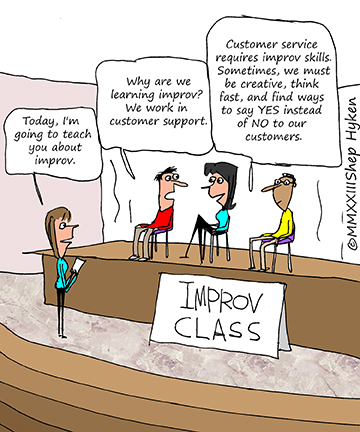
There is a massive benefit to empowering employees to “break the rules” for their customers. And what I mean by “breaking the rules” is to consider what you can do for a customer outside of the norm that doesn’t cost the company money, isn’t illegal or immoral, and won’t hurt “business as usual.” In reality, employees aren’t breaking any rules. They are finding ways to take care of the customer while not breaking the “rules” mentioned above.

One of the concepts I cover in my customer service keynote speech is the idea of the “line in the sand.” Many companies train their employees in what they can’t do for customers. They have “rules” that have little or no flexibility. While it’s essential for employees to be trained on what they shouldn’t do, it may be more important to train them on what they can do. By that, I mean how far employees are allowed to go before they have to say, “No.”

I call this The Line in the Sand concept. It is important to draw that line, which is the boundary that employees aren’t allowed to cross, but at the same time, teach them what they can do to get right up to the line.

For example, I have a client in the luxury automobile market. This client has a team that travels to auto dealerships to help dealers with demanding customers they can’t seem to please. Members of this team believe in the power of saying “Yes” instead of “No.” They have the authority to refund the entire price of the car, even if it’s 10 years old. That’s their line in the sand – their last resort. They can get right up to it but can’t go past it. And by the way, they have never made it to that last resort. They have always found other ways to make discontented customers happy without getting to that line.

The key is training, but it isn’t just imparted in one session to tell employees what to do – or not do. It’s about continuously sharing stories of what other employees are doing to meet customers’ needs and demands, all without crossing the line in the sand. When an employee does something right, congratulate them and share the example with others. And if they do something wrong, or in other words, if they cross the line, turn it into a learning opportunity that is also shared with others. Routinely sharing examples helps employees recognize their opportunities to delight their customers.

Some examples of “breaking the rules” might be honoring a warranty that expired a month ago – or stretching a 14-day return policy to the 15th or 16th day. Some retail organizations, like Nordstrom, have an easy, no-questions-asked return policy. Even though the employees at Nordstrom aren’t breaking the rules, the customer feels as if they are going above and beyond. That’s all this really is. Making customers feel like you are on their side, willing to be flexible and giving them reasons to say, “I’ll be back!”

Image Credit: Pixabay

Subscribe to Human-Centered Change & Innovation WeeklySign up here to join 17,000+ leaders getting Human-Centered Change & Innovation Weekly delivered to their inbox every week.

What is Failure?

What is Failure?

GUEST POST from Robyn Bolton

A couple of weeks ago, I wrote about my hatred of failure while acknowledging that there are things I hate more (inertia, blind allegiance to the status quo, unwillingness to try) that motivate me to risk it.

In response, I received this email from my friend and former colleague Daymara, now the Founder & CEO of Rockin’ Baker in Fayetteville, AR (shared here with her permission)

I’m the opposite. I love failing! That’s when I learn the most, that I question what and how I could better, question more and more. It triggers my brain to look back, re-evaluate, assess and spring forward. I wouldn’t be here today if I had not risked. I don’t think anyone starts anything thinking when they’d fail. But some of us aren’t afraid or hate it. I wouldn’t be here if I hate failing, wouldn’t have left my country looking for a safer place, wouldn’t have launched RBI because I didn’t have any entrepreneurial experience not even in the hospitality industry, wouldn’t have switched to focus on neurodiversity and so much more.

.

Because I came to the US, I got to meet you. Yes, I failed at seeing the signs & lost over 60% of my savings just 2 weeks before leaving Venezuela. I could’ve decided to stay because maybe it was going to be harder and the risk of failing in a country I didn’t know higher. I had a plan. If it didn’t work, come back home & start all over again.

.

I started RBI understanding that I could fail. I told myself, if I did, at least I would have an answer. Yes, I’m failing terribly at making this social enterprise work. Yet, I’ve gained so much knowledge about humanity, our differences, the unfairness that neurodivergents have to live daily, running a social enterprise and so much more. If I had hated failing, I wouldn’t be sharing my experience with other entrepreneurs so they don’t make the same mistakes I made. I wouldn’t be advocating for more equitable places for all, including women.

.

Failing feeds me to do better, to ask more questions, to explore more, to lead me to become better. I don’t love failing, I welcome it.

.

My first thought was, “Wow, this is so healthy! I wish more people felt and acted this way!”

My second thought was, “I wouldn’t apply the word ‘fail’ to any of these situations. You’re trying, learning, changing, and trying again.:

Just because you don’t get the expected outcome the first time doesn’t mean you failed.

Or does it?

What the Dictionary Says

According to Oxford Languages, “fail” (verb) means

  1. Be unsuccessful in achieving one’s goal, “he failed in his attempt to secure election.”
  2. Neglect to do something, “the firm failed to give adequate risk warnings.”
  3. Break down; cease to work well, “a truck whose brakes had failed.”

True but contextual:

  1. If success is defined as launching a new product, but customer feedback proves there’s no demand or willingness to pay, is shutting it down a failure?
  2. If you neglect something that isn’t important or doesn’t have significant ramifications, like not eating breakfast, did you fail or simply forget, run out of time, or make a mistake?
  3. If something works but not well, like an expense reporting system, is it a failure or just burdensome, a pain, or a necessary evil?

Also, incomplete.

What People Say

“Fail” has so many definitions and meanings in Daymara’s telling of her story. In addition to some of the dictionary’s definitions, she also uses “Fail” to mean:

  1. Take smart risks, “I could’ve decided to stay because maybe it was going to be harder and the risk of failing in a country I didn’t know higher. I had a plan. If it didn’t work, come back home & start all over again.”
  2. Get new information to facilitate learning,
    • “I’m the opposite. I love failing! That’s when I learn the most, that I question what and how I could better, question more and more. It triggers my brain to look back, re-evaluate, assess and spring forward.”
    • I started RBI understanding that I could fail. I told myself, if I did, at least I would have an answer.
  3. Adapt and change based on learning, “wouldn’t have switched to focus on neurodiversity”
  4. Grow, improve, evolve, “Failing feeds me to do better, to ask more questions, to explore more, to lead me to become better. I don’t love failing, I welcome it.”

What Do You Say?

Like “Innovation,” “Failure” is a word we all use A LOT that no longer has a common definition. In the dictionary, failure is bad and to be avoided. To Daymara and scores of entrepreneurs and innovators, failure is wonderful and welcome.

Progress, either towards or away from failure, requires us to define “Failure” for ourselves and our work and agree on a definition with our teammates.

So, tell me:

  1. What is failure to you?
  2. To your team?
  3. To your boss?

Subscribe to Human-Centered Change & Innovation WeeklySign up here to join 17,000+ leaders getting Human-Centered Change & Innovation Weekly delivered to their inbox every week.

Mystery of Stonehenge Solved

Mystery of Stonehenge Solved

by Braden Kelley

Forget about capturing and reverse engineering alien spacecraft to gain a competitive edge in the innovation race. Sorry, but the universe is billions of years old and even if some extra terrestrial civilization millions or billions of years older than our own managed to travel here from halfway across the galaxy and crash, it is very likely that we would be incapable of reverse engineering their technology.

Why?

When the United States captures a downed enemy aircraft we can reverse engineer it because at its core it is still an aircraft made of similar materials to those we use and made using similar manufacturing processes. Meaning that we already have the capabilities to build something similar, we just need a physical example or blueprints of the aircraft.

But, when you are talking about something made using technology thousands, millions, or billions of years more advanced than our own, it becomes less likely that we would be able to reverse engineer found technology. This is because there would likely be materials involved that we haven’t discovered yet, either entirely new elements on the periodic table or alloys that we don’t yet know how to make. Imagine what would happen if a slightly damaged Apollo-era Saturn V rocket suddenly appeared circa 50 AD next to the Pantheon in Rome. How long would it be before the Romans would be able to fly to the moon?

If a large, and overdue, solar event were to occur and destroy all of our electricity-based technology, how long would it take for us to be able to achieve spaceflight again?

Apocalypse Innovation

There is no doubt that human beings developed a different set of technologies prior to the last great apocalypse and most of this knowledge has been lost through time, warfare, and 400 feet of water or 20 feet of earth. Only tall stone constructions away from prehistoric coastlines or items locked away in dry underground vaults survived. History and technology are incredibly perishable.

Twelve thousand years later we have achieved some pretty remarkable achievements and ground penetrating radar is giving us new insight into the scope and scale of pre-apocalypse societies hidden undersea and underground.

But, there are a great many mysteries from the ancient world that we are still struggling to reverse engineer. From the pyramids to Stonehenge, people are hypothesizing a number of ways these monuments may have been built and what their true purpose might have been.

Nine years ago researchers from the University of Amsterdam determined that the blocks on stone moved around on the Giza plateau on sledges would have moved easier if someone went before them wetting the sand.

Eleven years ago, American Wally Wallington of Michigan showed in a YouTube video how he could move stones weighing more than a ton up to 300 feet per hour and then stand them up vertically all by himself.

He didn’t invent some amazing new piece of technology to do this, but instead eschewed modern technology and showed how he can do this using basic principles of physics and gravity. First let’s look at the video and then we’ll talk about what apocalypse innovation exercise is:

The apocalypse innovation exercise is one way of challenging orthodoxies and is quite simple:

  1. Identify a technology or input that is key to your product or service achieving its goal
  2. Concoct a simple reason why this technology no longer functions or this input is no longer available
  3. Have the group begin to ideate alternative inputs that could be used or alternate technologies that could be leveraged or developed to make the product or service achieve its goal again (If you are looking for a new technology, what are the first principles that you could go back to? And what are the other technology paths you could explore instead? – i.e. acoustic levitation instead of electromagnetic levitation)
  4. Pick one from the list of available options
  5. Re-engage the group to backcast what it will take to replace the existing technology or input with this new one (NOTE: backcasting is the practice of working backwards to show how an outcome will be achieved)
  6. Sketch out how the product or service will change as result of using this new technology or input
  7. Brainstorm ways that this change can be positioned as a benefit for customers

Apocalypse innovation can be a valuable innovation exercise for those products or services approaching the upper flattening of the traditional ‘S’ curve that pretty much all innovations go through and represents one way that can lead you to the steeper part of a new ‘S’ curve.

What other exercises do you like to use to help people challenge orthodoxies?

If you’d like to sign up to learn more about my new FutureHacking™ methodology and set of tools, go here.

Build a Common Language of Innovation on your team

Subscribe to Human-Centered Change & Innovation WeeklySign up here to join 17,000+ leaders getting Human-Centered Change & Innovation Weekly delivered to their inbox every week.

When Innovation Becomes Magic

When Innovation Becomes Magic

GUEST POST from Pete Foley

Arthur C Clarke’s 3rd Law famously stated:

“Any sufficiently advanced technology is indistinguishable from magic”

In other words, if the technology of an advanced civilization is so far beyond comprehension, it appears magical to a less advanced one. This could take the form of a human encounter with a highly advanced extraterrestrial civilization, how current technology might be viewed by historical figures, or encounters between human cultures with different levels of scientific and technological knowledge.

Clarke’s law implicitly assumed that knowledge within a society is sufficiently democratized that we never view technology within a civilization as ‘magic’.  But a combination of specialization, rapid advancements in technology, and a highly stratified society means this is changing.  Generative AI, Blockchain and various forms of automation are all ‘everyday magic’ that we increasingly use, but mostly with little more than an illusion of understanding around how they work.  More technological leaps are on the horizon, and as innovation accelerates exponentially, we are all going to have to navigate a world that looks and feels increasingly magical.   Knowing how to do this effectively is going to become an increasingly important skill for us all.  

The Magic Behind the Curtain:  So what’s the problem? Why do we need to understand the ‘magic’ behind the curtain, as long as we can operate the interface, and reap the benefits?  After all, most of us use phones, computers, cars, or take medicines without really understanding how they work.  We rely on experts to guide us, and use interfaces that help us navigate complex technology without a need for deep understanding of what goes on behind the curtain.

It’s a nuanced question.  Take a car as an analogy.  We certainly don’t need to know how to build one in order to use one.  But we do need to know how to operate it and understand what it’s performance limitations are.  It also helps to have at least some basic knowledge of how it works; enough to change a tire on a remote road, or to have some concept of basic mechanics to minimize the potential of being ripped off by a rogue mechanic.  In a nutshell, the more we understand it, the more efficiently, safely and economically we leverage it.  It’s a similar situation with medicine.  It is certainly possible to defer all of our healthcare decisions to a physician.  But people who partner with their doctors, and become advocates for their own health generally have superior outcomes, are less likely to die from unintended contraindications, and typically pay less for healthcare.  And this is not trivial.  The third leading cause of death in Europe behind cancer and heart disease are issues associated with prescription medications.  We don’t need to know everything to use a tool, but in most cases, the more we know the better

The Speed/Knowledge Trade-Off:  With new, increasingly complex technologies coming at us in waves, it’s becoming increasing challenging to make sense of what’s ‘behind the curtain’. This has the potential for costly mistakes.  But delaying embracing technology until we fully understand it can come with serious opportunity costs.  Adopt too early, and we risk getting it wrong, too late and we ‘miss the bus’.  How many people who invested in crypto currency or NFT’s really understood what they were doing?  And how many of those have lost on those deals, often to the benefit of those with deeper knowledge?  That isn’t to in anyway suggest that those who are knowledgeable in those fields deliberately exploit those who aren’t, but markets tend to reward those who know, and punish those who don’t.    

The AI Oracle:  The recent rise of Generative AI has many people treating it essentially as an oracle.  We ask it a question, and it ‘magically’ spits out an answer in a very convincing and sharable format.  Few of us understand the basics of how it does this, let alone the details or limitations. We may not call it magic, but we often treat it as such.  We really have little choice; as we lack sufficient understanding to apply quality critical thinking to what we are told, so have to take answers on trust.  That would be brilliant if AI was foolproof.  But while it is certainly right a lot of the time, it does make mistakes, often quite embarrassing ones. . For example, Google’s BARD incorrectly claimed the James Webb Space Telescope had taken the first photo of a planet outside our solar system, which led to panic selling of parent company Alphabet’s stock.  Generative AI is a superb innovation, but its current iterations are far from perfect.  They are limited by the data bases they are fed on, are extremely poor at spotting their own mistakes, can be manipulated by the choice of data sets they are trained on, and they lack the underlying framework of understanding that is essential for critical thinking or for making analogical connections.  I’m sure that we’ll eventually solve these issues, either with iterations of current tech, or via integration of new technology platforms.  But until we do, we have a brilliant, but still flawed tool.  It’s mostly right, is perfect for quickly answering a lot of questions, but its biggest vulnerability is that most users have pretty limited capability to understand when it’s wrong.

Technology Blind Spots: That of course is the Achilles Heel, or blind spot and a dilemma. If an answer is wrong, and we act on it without realizing, it’s potentially trouble. But if we know the answer, we didn’t really need to ask the AI. Of course, it’s more nuanced than that.  Just getting the right answer is not always enough, as the causal understanding that we pick up by solving a problem ourselves can also be important.  It helps us to spot obvious errors, but also helps to generate memory, experience, problem solving skills, buy-in, and belief in an idea.  Procedural and associative memory is encoded differently to answers, and mechanistic understanding helps us to reapply insights and make analogies. 

Need for Causal Understanding.  Belief and buy-in can be particularly important. Different people respond to a lack of ‘internal’ understanding in different ways.  Some shy away from the unknown and avoid or oppose what they don’t understand. Others embrace it, and trust the experts.  There’s really no right or wrong in this.  Science is a mixture of both approaches it stands on the shoulders of giants, but advances based on challenging existing theories.  Good scientists are both data driven and skeptical.  But in some cases skepticism based on lack of causal understanding can be a huge barrier to adoption. It has contributed to many of the debates we see today around technology adoption, including genetically engineered foods, efficacy of certain pharmaceuticals, environmental contaminants, nutrition, vaccinations, and during Covid, RNA vaccines and even masks.  Even extremely smart people can make poor decisions because of a lack of causal understanding.  In 2003, Steve Jobs was advised by his physicians to undergo immediately surgery for a rare form of pancreatic cancer.  Instead he delayed the procedure for nine months and attempted to treat himself with alternative medicine, a decision that very likely cut his life tragically short.

What Should We Do?  We need to embrace new tools and opportunities, but we need to do so with our eyes open.   Loss aversion, and the fear of losing out is a very powerful motivator of human behavior, and so an important driver in the adoption of new technology.  But it can be costly. A lot of people lost out with crypto and NFT’s because they had a fairly concrete idea of what they could miss out on if they didn’t engage, but a much less defined idea of the risk, because they didn’t deeply understand the system. Ironically, in this case, our loss aversion bias caused a significant number of people to lose out!

Similarly with AI, a lot of people are embracing it enthusiastically, in part because they are afraid of being left behind.  That is probably right, but it’s important to balance this enthusiasm with an understanding of its potential limitations.  We may not need to know how to build a car, but it really helps to know how to steer and when to apply the brakes .   Knowing how to ask an AI questions, and when to double check answers are both going to be critical skills.  For big decisions, ‘second opinions’ are going to become extremely important.   And the human ability to interpret answers through a filter of nuance, critical thinking, different perspectives, analogy and appropriate skepticism is going to be a critical element in fully leveraging AI technology, at least for now. 

Today AI is still a tool, not an oracle. It augments our intelligence, but for complex, important or nuanced decisions or information retrieval, I’d be wary of sitting back and letting it replace us.  Its ability to process data in quantity is certainly superior to any human, but we still need humans to interpret, challenge and integrate information.  The winners of this iteration of AI technology will be those who become highly skilled at walking that line, and who are good at managing the trade off between speed and accuracy using AI as a tool.  The good news is that we are naturally good at this, it’s a critical function of the human brain, embodied in the way it balances Kahneman’s System 1 and System 2 thinking. Future iterations may not need us, but for now AI is a powerful partner and tool, but not a replacement

Image credit: Pixabay

Subscribe to Human-Centered Change & Innovation WeeklySign up here to join 17,000+ leaders getting Human-Centered Change & Innovation Weekly delivered to their inbox every week.

Four Questions That Make Better Innovators

Four Questions That Make Better Innovators

GUEST POST from Greg Satell

In 1999, the day before his eighth startup went public, Steve Blank decided to retire at the age of 45. With time to reflect, he sat in a ski lodge and began to write a memoir with a “lessons learned” section at the end of each chapter. “In hindsight, it was a catharsis of moving from one part of my life to another,” he later told me.

“I was 80 pages in when I realized there was a pattern. When I sat inside the building things didn’t go very well, but when I got outside the building things turned around and got much better,” he remembered. What he meant was that it was only when he got out and talked to customers that he could really get a handle on the business.

We like to think that innovation is about ideas, but it’s really about solving problems. In order to surface problems, you need to ask questions, which is why Steve’s businesses started doing better when he got out of the building to talk to customers. The better questions you ask, the better problems you can identify. Here are four questions that will help you do that.

1.Why?

Problems come in all shapes and sizes. Some problems are relatively minor and can be worked around. Others are more fundamental and represent serious impediments to effective operations. Clearly, the more fundamental the problem you can identify, the greater the impact you can create by solving it.

One very effective technique to do that is called the 5 Whys. For example, when NY Times columnist Charles Duhigg noticed that however much he and his wife wanted to get home on time to eat dinner with their kids, they inevitably ended up getting caught up at work and arriving home late, he began to ask “why?”

The first “why” of he and his wife arriving late to dinner was because they had work to finish. Why? Because there were pesky little tasks, like responding to emails, that they needed to get done. Why? Because they couldn’t get to them during the day. Why? Because they arrived at work just before their first meeting. Why? Because they were busy getting the kids ready for school.

By the fifth “why” he realized that the problem wasn’t so much that they got caught up at work, but that it took too long to get the kids ready for school. The conundrum was solved by having the kids lay out their clothes for school the night before. The Duhiggs soon began having family dinners regularly.

It’s an incredibly powerful technique. Each why takes you a bit deeper into the problem and, as you begin to identify root causes, you’ll be able to come up with more effective solutions.

2. Where’s The Monkey?

When I work with executives, they often have a breakthrough idea they are excited about. They begin to tell me what a great opportunity it is and how they are perfectly positioned to capitalize on it. However, when I begin to dig a little deeper it appears that there is some big barrier to making it happen. When I try to ask about that, they just shut down.

One reason that this happens is that there is a fundamental tension between innovation and operations. Operational executives tend to focus on identifying clear benchmarks to track progress. That’s fine for a typical project, but when you are trying to do something truly new and different, you have to directly confront the unknown.

At Google X, the tech giant’s “moonshot factory,” the mantra is #MonkeyFirst. The idea is that if you want to get a monkey to recite Shakespeare on a pedestal, you start by training the monkey, not building the pedestal, because training the monkey is the hard part. Anyone can build a pedestal.

The problem is that most people start with the pedestal, because it’s what they know and by building it, they can show early progress against a timeline. Unfortunately, building a pedestal gets you nowhere. Unless you can actually train the monkey, working on the pedestal is wasted effort.

3. How Will We Fail?

Innovation is not a mere intellectual endeavor. It’s highly emotional. You thrive on your hopes and dreams. That’s what keeps you going and helps you block out doubts, both your own and those of others. Failure is just not something you want to contemplate. It’s just too painful.

Yet thinking seriously about failure can actually help you succeed and there are two techniques that can help you do that productively. The first, called pre-mortems, asks you to imagine that the project has failed and figure out why it happened. The second, called red teaming sets up an independent team to find flaws in the idea.

The idea isn’t to figure out ways to kill the project, but to identify holes to be plugged. For example, when the Obama administration thought it had identified Osama bin Laden’s hideout, it set up a red team to challenge the evidence. Because the red team had no emotional attachment to the initial analysis, they were able to look at it far more objectively.

As we now know, the raid on bin Laden’s compound went ahead, but the red team was able to raise important questions that strengthened the plan. To successfully innovate, you need to do the same. Identify every potential for failure that you can so that you can address those issues before going forward.

4. What Kind Of Problem Are We Trying To Solve?

Go to any innovation conference and you will undoubtedly see a wide variety of innovation experts championing their favored strategy and each will have stories that will amaze you. Design thinking, disruptive innovation, lean startup methods and open innovation have all become buzzwords because they have produced real results.

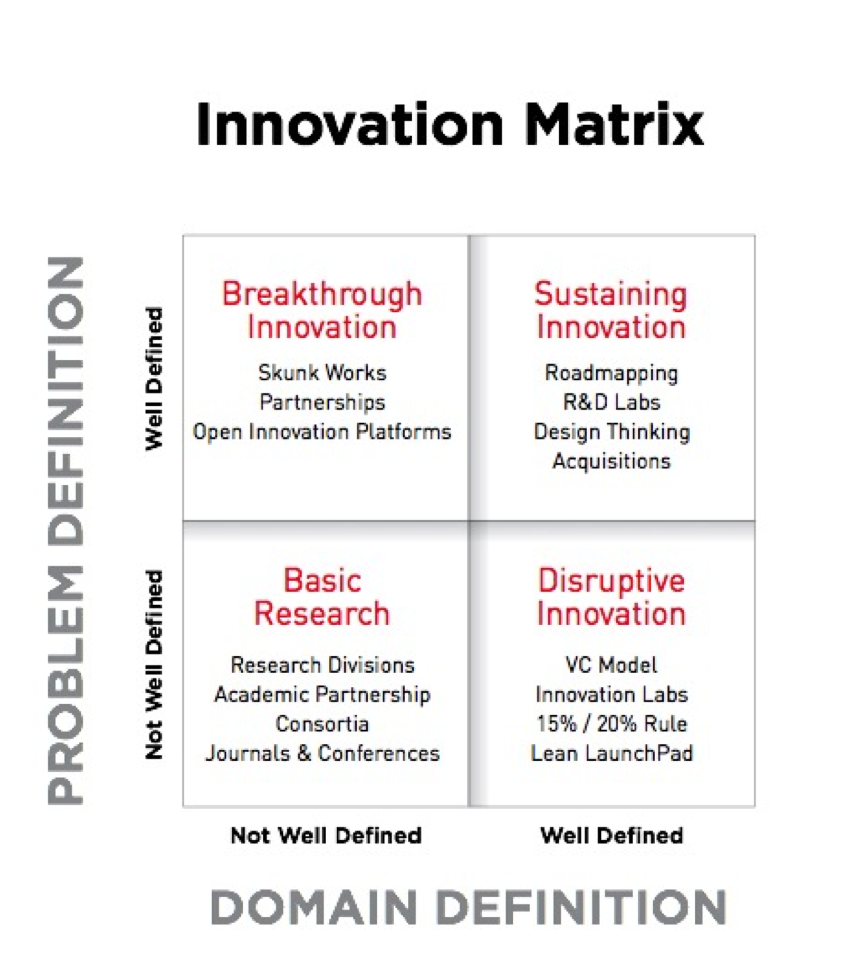
Yet none of them is a cure-all. Each performs well with some classes of problems, but not so well in others. That’s why in my book, Mapping Innovation, I advocated using the whole innovation toolbox. The trick is to match the right type of problem with the right type of solution.

Innovation Matrix Greg Satell

The truth is that there is no one “true” path to innovation. Many organizations get stuck because they end up locking themselves into a single strategy. They find something that works and say, “this is how we innovate” and end up trying to apply essentially the same solution no matter what the problem is. Eventually, that ends badly.

That’s why it’s so important to ask good questions. Every problem is, to some extent, unique. You can’t simply assume you know the solution beforehand. That’s why Steve Blank’s businesses failed when he stayed “in the building” and prospered when he got out of it. If you want to become a better innovator. Ask better questions.

— Article courtesy of the Digital Tonto blog
— Image credit: Pixabay

Subscribe to Human-Centered Change & Innovation WeeklySign up here to join 17,000+ leaders getting Human-Centered Change & Innovation Weekly delivered to their inbox every week.