Reverse Innovation

Reverse Innovation

GUEST POST from Mike Shipulski

Innovation is a result of accumulated knowledge acquired over decades that is made manifest with mundane means.

It can be helpful to understand the required mindset by working things backward.

If you want innovation, solve new problems.

If you want to solve new problems, wall off design space responsible for success.

Block the team from reusing the same old recipe for success so there will be discomfort.

Without discomfort, there can be no innovation. Seek it out.

Prohibit solutions that live in familiar design space to demand the product or service do new things.

When the product or service must do new things, new lines of customer goodness must be created.

To create new lines of customer goodness, you’ve got to look at new facets of the customers’ lives.

To look at new facets of the customers’ lives, look more broadly at the jobs customers want to do.

You can ask customers what new jobs they want to do, but they won’t be able to tell you.

When you want to understand which new jobs will change the game, watch the work.

When you watch the work, watch more than the work. Watch everything.

When you come back to the office with new jobs that will disrupt the industry, you will be misunderstood for at least a year.

Misunderstanding is a precursor to innovation. Seek it out.

Misunderstanding blocks support for new work, but at least you’ll know you’re on to something.

When you get no support for the new work, do it anyway.

Rinse and repeat, as needed.

Image credit: Pixabay

Subscribe to Human-Centered Change & Innovation WeeklySign up here to join 17,000+ leaders getting Human-Centered Change & Innovation Weekly delivered to their inbox every week.

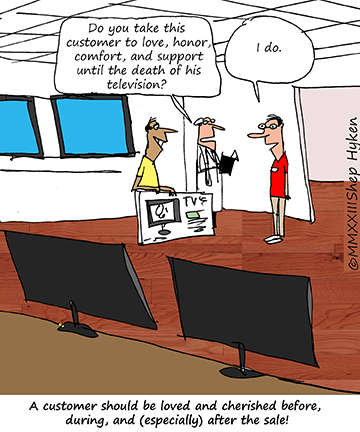
Customer Service is Like Being Married

Customer Service is Like Being Married

GUEST POST from Shep Hyken

The buying cycle for a customer typically includes a little research, talking to a salesperson, making the purchase, and whatever happens after the sale. That could include a follow-up from the salesperson, dealing with customer service for a problem, or any other interaction you have with the company or brand after the sale is made.

Many companies spend a lot of money and expend tremendous effort to get you in the door or to their website. They entice you with marketing messages, advertising, and anything else that could tip the scale to move a customer from thinking about buying to actually making the purchase.

Marketing messages and advertising campaigns create credibility. A salesperson’s promises make you feel good about doing business with them and their company. And if all goes well, eventually, a sale is made.

Some refer to this moment as “closing the deal.” I always joke about that phrase. “Closing the deal” signifies an ending, but in reality, it’s the beginning of the financial relationship. To put it in dating terms, everything else was courting the customer. Once the customer decides to buy, it’s like you proposed to them, and they said, “Yes.” And when the sale is finally made, it’s like getting married. And that is far from the end. It’s actually the beginning.

Once you can officially call someone a customer (versus a prospect), it’s time to keep them. In other words, you want to make the relationship last.

According to the American Psychological Association, in 2022, approximately 40-50% of first marriages end in divorce. And the No. 1 reason for divorce is simple: a lack of commitment. So, my question to a business is, “What percentage of your customers churn out after the first sale?” In other words, what’s the divorce rate of your customers?

Once the sale is made, there is the honeymoon phase, in which the customer is excited about the purchase, and you let the customer know how excited you are about doing business with them. How long does that last? Ideally, the honeymoon phase should never end. While the excitement compared to the first time doing business may ebb and flow, the customer should always feel appreciated and, in marital terms, loved.

So what do you do to court your customers and, more importantly, keep your customers in the honeymoon phase? You don’t need to answer me. Spend time with your team and discuss what you do after the sale is made to keep your clients from divorcing you and starting a new relationship with a competitor.

Image Credit: Pixabay

Subscribe to Human-Centered Change & Innovation WeeklySign up here to join 17,000+ leaders getting Human-Centered Change & Innovation Weekly delivered to their inbox every week.

Four Keys to Effective Team Communication

Four Keys to Effective Team Communication

GUEST POST from David Burkus

Communication is what makes a team a team. Otherwise, it’s just a group of individuals working away at their desks, handing work up to some unnamed boss. In reality, people don’t work in a vacuum. And much of one individual’s work requires coordinating with one or more teams. Effective team communication makes individuals and teams dramatically more productive.

But unfortunately, a majority of employees say poor communication is the reason they’re falling behind and missing deadlines. That means, as a leader, one of your primary responsibilities is helping the team communicate and collaborate effectively.

In this article, we’ll outline four keys to effective team communication.

1. Match the Tool to the Goal

The first key to effective team communication is to match the tool to the goal. There are so many different collaboration tools available to teams today. From “old school” methods like in-person meetings, memos, and email to modern methods like video conferencing, Slack, and maybe even the metaverse. But every tool chosen comes with certain strengths and certain weaknesses. And as a result, different tools are more appropriate for different tasks. For instance, if the goal of the communication is to generate ideas, then face-to-face meetings are likely still the best method. But if you’re just presenting information to the team, video conference should suffice—or even better, just record yourself talking over the slide deck, send it out as a video, and save everyone from one more meeting.

Smart leaders consider the goal of the communication they are asking their team to engage in, and then select the appropriate medium of communication accordingly. More importantly, they don’t just choose the medium they prefer—but they consider the entire team and chose what is best for everyone.

2. Amplify Unheard Voices

The second key to effective team communication is to amplify unheard voices. On any team, there are certain voices that are louder and more frequent, and others that go unheard. Sometimes this is because of existing gender, racial, or ethnic biases that leave certain voices unnoticed or quickly dismissed. But often even the medium of communication chosen favors some team members and leaves others less likely to contribute. The setting of in-person meetings can favor loud, extroverted participants and signal introverted, more contemplative participants to contribute less often. The technology required for video conferences often favors more tech-savvy participants than those with great ideas who can’t figure out how to get off mute fast enough to share them. Even email communication can favor those with better written communication skills or those who utilize long-form writing as a tool for thinking.

Smart leaders understand their team and know who is favored or un-favored by the chosen tool for communication. Armed with that knowledge, they make a plan to pay attention to the oft-unheard voices and amplify those comments to ensure that everyone’s voice is heard, and everyone’s opinion considered.

3. Create A Safe Environment

The third key to effective team communication is to create a safe environment. This doesn’t mean a “safe space” where team members will never encounter an idea they disagree with. Rather it refers to a team environment of psychological safety, where team members feel safe to express their disagreements, and also their “crazy” ideas, suggestions, and perspectives. Psychologically safe teams are marked by a mutual sense of trust and respect—and those are two different qualities. When team members trust each other, they express themselves fully. But only if they feel their expression is respected by the team will they continue to trust them.

Smart leaders build trust by signaling their own vulnerability and admit when they don’t know the answer (which not only shows their trusting the team but also gives the team a chance to express different ideas). They also build respect by modeling active listening when others are sharing and showing a willingness to consider all ideas—not just defend their own.

4. Don’t Be Always On

The fourth key to effective team communication is to avoid being in constant communication—don’t be always on. While it may seem like high-performing teams are constantly communicating, it turns out many are marked by long periods without any real-time messaging. They definitely communicate—but they do it in quick bursts where everyone shares updates, problems, and the team solves in problems or roadblocks mentioned. Then they go their separate ways and trust each other to performing independently—which also allows each person enough time to focus and do the deep work that “always on” environments prevent.

Smart leaders teach their team to communicate in bursts, running meetings efficiently and infrequently. But some leaders inherit teams already in constant communication, so rather than flipping immediately to bursty communication they develop “no meeting Mondays” or certain small periods of time for team members to block out communication and focus—then gradually expand that time until the team is communicating less but better.

When you take these four together, and communicate in bursts in a safe environment, amplifying unheard voices and using the appropriate tools, you’ll find that your team’s communication improves. You’ll find the quality of their work improves. And you might just feel like your team is doing its best work ever.

Image credit: Pexels

Originally published at https://davidburkus.com on March 13, 2023.

Subscribe to Human-Centered Change & Innovation WeeklySign up here to get Human-Centered Change & Innovation Weekly delivered to your inbox every week.

Basketball, Banks and Banana Splits

Is failure everywhere?

Basketball, Banks and Banana Splits

GUEST POST from Robyn Bolton

When asked to describe his test for determining what is and isn’t hard-core pornography, Supreme Court Justice Potter Stewart responded, “I know it when I see it.”

In that sense, pornography and failure may have a lot in common.

By accident, I spent the month of April thinking, writing (here and here), and talking about failure. Then, in the last week, a bank failed, two top-seeded sports teams were eliminated in the first round of the playoffs, and the New York Times wrote a feature article on the new practice of celebrating college rejections.

Failure was everywhere.

But was it?

SVB, Signature, First Republic – Failure.

On Monday, First Republic Bank became the third bank this year to fail. Like Silicon Valley Bank and Signature Bank, it met the definition of bank failure according to the FDIC – “the closing of a bank by a federal or state banking regulatory agency…[because] it is unable to meet its obligations to depositors and others.”

It doesn’t matter if the bank is a central part of the entrepreneurial ecosystem, is on the cutting edge of new financial instruments like cryptocurrency, or caters to high-net-worth individuals. When you give money to a bank, an institution created to keep your money safe, and it cannot give it back because it spent it, that is a failure.

Milwaukee Bucks – Failure?

Even if you’re not an NBA fan, you probably heard about the Milwaukee Bucks star Giannis Antetokounmpo’s interview after the team’s playoff elimination. 

Here’s some quick context – the Milwaukee Bucks had the best regular season record and were widely favored to win the title. Instead, they lost in Game 5 to the 8th-ranked Miami Heat. After the game, a reporter asked Antetokounmpo if he viewed the season as a failure, to which Antetokounmpo responded:

“It’s not a failure; it’s steps to success. There’s always steps to it. Michael Jordan played 15 years, won six championships. The other nine years was a failure? That’s what you’re telling me? It’s a wrong question; there’s no failure in sports.”

If you haven’t seen the whole clip, it’s worth your time:

The media went nuts, fawning over Antetokounmpo’s thoughtful and philosophical response, the epitome of an athlete who gives his all and is graceful in defeat. One writer even went so far as to proclaim that “Antetokounmpo showed us another way to live.”

But not everyone shared that perspective. In the post-game show, four-time NBA champion Shaquille O’Neal was one of the first to disagree,

“I played 19 seasons and failed 15 seasons; when I didn’t win it, it was a failure, especially when I made it to the finals versus the (Houston) Rockets and lost, made it to the finals for the fourth time with the (Los Angeles) Lakers and lost, it was definitely a failure.

.

I can’t tell everybody how they think, but when I watch guys before me, the Birds, the Kareems, and you know that’s how they thought, so that’s how I was raised.

.

He’s not a failure as a player, but is it a failure as a season? I would say yes, but I also like his explanation. I can understand and respect his explanation, but for me, when we didn’t win it, it was always my fault, and it was definitely a failure.”

Did Antetokounmpo fail?  Are the Bucks a failure? Was their season a failure?

It depends.

College Rejections – Not Failure

Failure is rarely fun, but it can be absolutely devastating if all you’ve ever known is success. Just ask anyone who has ever applied to college. Whether it was slowly opening the mailbox to see if it contained a big envelope or a small one or hesitatingly opening an email to get the verdict, the college application process is often the first time people get a taste of failure.

Now, they also get a taste of ice cream.

Around the world, schools are using the college application and rejection process as a learning experience:

  • LA: Seniors gather to feed their rejection letters into a shredder and receive an ice cream sundae. The student with the most rejections receives a Barnes & Noble gift card. “You have to learn that you will survive and there is a rainbow at the other end,” said one of the college counselors.
  • NYC: After adding their rejection letters to the Rejection Wall, students pull a prize from the rejection grab bag and enjoy encouraging notes from classmates like, “You’re too sexy for Vassar” or “You’ve been rejected, you’re too smart. Love, NYU.”
  • Sydney, Australia: a professor started a Rejection Wall of Fame after receiving two rejections in one day, sharing his disappointment with a colleague only to hear how reassured they were that they weren’t alone.

“I know it when I see it” – Failure

I still don’t know a single definition or objective test for failure.

But I do know that using “I’ll know it when I see it” to define failure is a failure. 

It’s a failure because we can define success and failure before we start. 

Sometimes failure is easy to define – if you are a bank and I give you money, and you don’t give it back to me with interest, that is a failure. Sometimes the definition is subjective and even personal, like defining failure as not making the playoffs vs. not winning a championship, or not applying to a school vs. not getting in.

Maybe failure is everywhere. Maybe it’s not.

I’ll know it when I define it.

Image credit: Pixabay

Subscribe to Human-Centered Change & Innovation WeeklySign up here to join 17,000+ leaders getting Human-Centered Change & Innovation Weekly delivered to their inbox every week.

When the Startup Romance Dies

When the Startup Romance Dies

GUEST POST from Greg Satell

Every startup is exciting and romantic in the beginning. The founders usually know each other well and want to work together. They bring on others who are likeminded and committed to the mission of the enterprise. Long hours and shared experience makes the business feel less like work and more like a family.

Yet as the company grows and more people are brought on, the social fabric begins to fray. Roles, which once were fluid and interchangeable, begin to formalize and solidify. Tight camaraderie gives way to office politics. What was once a “family” begins to seem like just another place to work and earn a living.

The story is so common that nobody should be surprised when it happens, but inevitably most are, which is why few entrepreneurs prepare for it. Often, because they still feel connected to the senior team, they don’t even realize it’s happening until it’s too late. That’s a shame, because the breakdown of the family atmosphere can be avoided if you prepare for it.

The Dunbar Dilemma

In 1992, anthropologist Robin Dunbar published his groundbreaking paper on optimal group sizes. For humans, he estimated the maximum group size that can maintain stable relationships to be about 150, now known as the Dunbar Number. Other researchers using different methodologies have come up with slightly higher numbers, but the general principle stands. Go past a certain point and natural connections start to break down.

That’s why around when an organization hits 150-200 employees, the “family atmosphere” starts to break down and take on a decidedly more corporate feel. Early employees don’t feel the same bonds with the latecomers and new employees don’t build the same camaraderie when they join the company.

Inevitably, the change in atmosphere is attributed to the type of people hired, rather than the number of people in the organization. So the first step to solving the problem is to simply acknowledge that running a larger enterprise is different than running a small one. Culture will no longer take care of itself, you have to work to build and maintain it.

All too often, entrepreneurs attempt to reorganize the company at this point. That’s almost always a mistake. Valdis Krebs, who researches organizational networks, notes that reorganizations can often sever informal ties that you aren’t aware of but that are crucial to how the company functions.

The Importance Of Boundary Spanners

In the early 1970s, sociologist Mark Granovetter began researching how professional, technical and managerial workers found jobs in the Boston area. He was somewhat surprised to find that they often found work someone they knew, but not a close contact, like a friend or family member, but someone more removed, like a friend of a friend or a distant cousin. He called this principle the Strength of Weak Ties.

Further analysis shows why it works. Those who are closest to us know pretty much the same things we do, because they frequent similar places and do similar things. So if we want to gain access to new information, we need to broaden our scope and connect with people further out on the social spectrum.

In a small startup, the strength of weak ties plays a negligible role, because everybody knows each other through first-degree connections. However, once the Dunbar threshold of 150-200 people is passed, that’s no longer true. As the company grows, information increasingly needs to flow through second and third degree connections.

Network scientists call people who link disparate networks in an organization boundary spanners and they are crucial for maintaining culture as an organization grows. Once you understand the importance of boundary spanners, you can start redesigning programs and platforms to optimize for connection.

Redesigning Programs And Platforms For Connection

Every organizational culture is unique, so there are no hard and fast rules for designing programs and platforms to optimize for connection, but the best place to start is to build on what you already have. Often, companies accidentally find that an existing program that was built for another purpose effectively builds boundary spanners.

For example, Facebook originally designed its six week engineering bootcamp to help it scale by immersing new engineers in its methods and codebase, no matter what their level of experience. However, what it found was that bootcampers would build bonds during those six weeks that would persist long after they moved to disparate parts of the company.

In a similar vein, Experian found that its employees that participated in its “Le Tour de Experian” bike rides to benefit charity would build bonds that would span across organizational boundaries and lead to professional collaborations. So it built Employee Resource Groups and Clubs to build connections across a wider variety of interests.

Other companies, such as General Electric, encourage high potential executives to work in different divisions to create boundary spanners. Still others create seminars and best practice programs. There are many ways you can network your organization, once you learn to prioritize connections to build boundary spanners.

Evolving Leadership & Culture

In the early days of a startup most of the energy is necessarily focused on action items, such as developing a product, coming up with a go-to-market strategy and executing basic tasks. Job titles tend to be fluid and everybody pitches in where they can. With a small number of people, work can often be organized through quick huddles and whiteboard sessions.

Yet as the organization grows, more formal procedures and processes begin to take shape. Communication, necessarily, becomes more formal and less ad hoc. Roles within the company solidify and employees are increasingly expected to “stay in their lane.” Entrepreneurial leaders begin to spend less time focusing on the details of day-to-day execution.

This is when it is crucial for leaders to evolve from operational managers to what General Stanley McChrystal, in his book Team of Teams, calls “empathetic crafters of culture.” In a larger organization, a leaders role cannot be merely to plan and direct action, but needs to increasingly focus on shaping connections within the firm.

Perhaps most of all, entrepreneurs need to understand that the transition from a small startup to a significant enterprise doesn’t necessarily mean you have to lose “the family.” It just means that the leadership and culture need to evolve. That won’t simply happen all by itself. You have to put in the time and effort to make it so.

— Article courtesy of the Digital Tonto blog
— Image credit: Pixabay

Subscribe to Human-Centered Change & Innovation WeeklySign up here to join 17,000+ leaders getting Human-Centered Change & Innovation Weekly delivered to their inbox every week.


Generation AI Replacing Generation Z

Generation AI Replacing Generation Z

by Braden Kelley

The boundary lines between different named generations are a bit fuzzy but the goal should always be to draw the boundary at an event significant enough to create substantial behavior changes in the new generation worthy of consideration in strategy formation.

I believe we have arrived at such a point and that it is time for GenZ to cede the top of strategy mountain to a new generation I call Generation AI (GenAI).

The dividing line for Generation AI falls around 2014 and the people of GenAI are characterized by being the first group of people to grow up not knowing a world without easy access to generative artificial intelligence (AI) tools that begin to transform their interactions with our institutions and each other.

We have already seen professors and teachers having to police AI-generated school essays, while the rest of us are trying to cope with frighteningly realistic deep fake audio and video. But what other impacts on people’s behavior will we see as a result of the coming ubiquity of artificial intelligence?

It is important to remember that generative artificial intelligence is not really artificial intelligence but collective intelligence informed by what we the people have contributed to the training/reference set. As such these large language models are predicting the next word or combining existing content based on whatever training set they are exposed to. They are not creating original thought.

Generative AI is being built into nearly all of our existing software and cloud tools, and GenAI will grow up only knowing a reality where every application and web site they interact with will have an AI component to it. Generation AI will not know a time where they cannot ask an AI, in the same way that GenZ relies on social search, and Gen X and Millenials assume search engines hold their answers.

Our brains are changing to focus more on processing and less on storage. These changes make us more capable, but more vulnerable too.

This new AI technology represents a double-edge sword and its effects could fall on either edge of the sword in different areas:

Option 1 – Best Case

  • Generative AI will amplify creativity by encouraging recombination of existing images, text, audio and video in new inspiring ways using the outputs of AI as inputs into human creativity

Option 2 – Worst Case

  • Generative AI will reduce creativity because people will become reliant on using artificial intelligence to create, creating an echo chamber of new content only created from existing content, leading to AI outputs becoming the only outputs and a world where people spend more time interacting with AI’s than with other people

Which of these two options on the impact of AI reliance do you see as the most likely in the areas where you focus?

How do you see Generation AI impacting the direction of societies around the world?

Are you planning to add Generation AI to your marketing strategies and strategic planning for 2024 or beyond?

Reference

For reference, here is timeline of previous American generations according to an article from NPR:

Though there is a consensus on the general time period for generations, there is not an agreement on the exact year that each generation begins and ends.

Generation Z – Born 2001-2013 (Age 10-22)

These kids were the first born with the Internet and are suspected to be the most individualistic and technology-dependent generation. Sometimes referred to as the iGeneration.

EDITOR’S NOTE: This description is erroneous, the differentiating factor of GenZ is that they experienced the rise of social media.

Millennials – Born 1980-2000 (Age 23-43)

They experienced the rise of the Internet, Sept. 11 and the wars that followed. Sometimes called Generation Y. Because of their dependence on technology, they are said to be entitled and narcissistic.

Generation X – Born 1965-1979 (Age 44-58)

They were originally called the baby busters because fertility rates fell after the boomers. As teenagers, they experienced the AIDs epidemic and the fall of the Berlin Wall. Sometimes called the MTV Generation, the “X” in their name refers to this generation’s desire not to be defined.

EDITOR’S NOTE: GenX also experienced the rise of the personal computer and this has influenced their parenting of a large portion of Millenials and GenZ

Baby Boomers – Born 1943-1964 (Age 59-80)

The boomers were born during an economic and baby boom following World War II. These hippie kids protested against the Vietnam War and participated in the civil rights movement, all with rock ‘n’ roll music blaring in the background.

Silent Generation – Born 1925-1942 (Age 81-98)

They were too young to see action in World War II and too old to participate in the fun of the Summer of Love. This label describes their conformist tendencies and belief that following the rules was a sure ticket to success.

GI Generation – Born 1901-1924 (Age 99+)

They were teenagers during the Great Depression and fought in World War II. Sometimes called the greatest generation (following a book by journalist Tom Brokaw) or the swing generation because of their jazz music.

If you’d like to sign up to learn more about my new FutureHacking™ methodology and set of tools, go here.

Build a Common Language of Innovation on your team

Subscribe to Human-Centered Change & Innovation WeeklySign up here to join 17,000+ leaders getting Human-Centered Change & Innovation Weekly delivered to their inbox every week.
Mission Critical Doesn’t Mean What You Think it Does

Mission Critical Doesn't Mean What You Think it Does

GUEST POST from Geoffrey A. Moore

God bless NASA for giving us the phrase “mission critical,” and God bless The Princess Bride for teaching us that not all words mean what we think they do.

In the case of mission-critical, specifically, the term has two distinct connotations, each of which leads to a distinctively different management priority.

1. Must achieve this outcome to succeed. This is what most people first think of when they hear the phrase. We will put a man on the moon and bring him back by the end of the decade. Anything that is on the critical path to that objective is mission critical.

2. Must not fall below this standard or we will be disqualified. This refers to a host of other things that, if not done properly, could have catastrophic consequences for the mission. Securing adequate funding, managing finances carefully, acquiring and maintaining proper facilities, and complying with pertinent regulations all come under this heading. You get no prize for doing any of these things right, but there can be a whopping penalty for getting them wrong.

When mission-critical equates to achieving success, the goal is to allocate the maximum amount of resources to the activity in question because it is the source of highest return. Indeed, it is your whole reason to be. Often in this situation there is no fixed upper boundary as to how much success can be achieved, so more is always going to be better here. That is why managers seeking budget for their efforts like to position them as mission-critical.

When mission-critical equates to disqualification risk, however, this approach backfires. That’s because there is a natural human tendency in risk-bearing situations to over-allocate resources as a hedge against what potentially could be a catastrophic failure. No one wants to get blamed for anything like this. Thus there is almost always an unproductive use of resources associated with these workloads and processes.

The proper goal for managing disqualification risk is to deploy the least amount of resources needed to achieve an acceptable level of risk, understanding that risk itself can never be eliminated entirely. To do this requires investing both in governance systems and in cultural discipline—the better the systems, the more disciplined the culture, the fewer the resources will be required.

Entrepreneurial cultures who grew up with the mantra “We don’t need no stinkin’ systems” will find it hard to execute this playbook, but until they do, they will be unable to scale. Conversely, risk-averse cultures who are unwilling to even approach the efficient frontier of risk will also fail here as well. You cannot compete effectively if a host of your best players are tied up on the sidelines. In short, there is no substitute for getting disqualification risk right, and successful organizations will testify this is always a work in progress.

So the next time you hear the word mission-critical, perk your ears up and apply this filter. Whatever is under discussion, for sure you are going to want to do this thing right. But before that, make sure you are doing the right thing.

That’s what I think. What do you think?

Image Credit: Pixabay

Subscribe to Human-Centered Change & Innovation WeeklySign up here to join 17,000+ leaders getting Human-Centered Change & Innovation Weekly delivered to their inbox every week.

“I don’t know,” is a clue you’re doing it right

“I don’t know,” is a clue you’re doing it right

GUEST POST from Mike Shipulski

If you know how to do it, it’s because you’ve done it before. You may feel comfortable with your knowledge, but you shouldn’t. You should feel deeply uncomfortable with your comfort. You’re not trying hard enough, and your learning rate is zero.

Seek out “don’t know.”

If you don’t know how to do it, acknowledge you don’t know, and then go figure it out. Be afraid, but go figure it out. You’ll make mistakes, but without mistakes, there can be no learning.

No mistakes, no learning. That’s a rule.

If you’re getting pressure to do what you did last time because you’re good at it, well, you’re your own worst enemy. There may be good profits from a repeat performance, but there is no personal growth.

Why not find someone with “don’t know” mind and teach them?

Find someone worthy of your time and attention and teach them how. The company gets the profits, an important person gets a new skill, and you get the satisfaction of helping someone grow.

No learning, no growth. That’s a rule.

No teaching, no learning. That’s a rule, too.

If you know what to do, it’s because you have a static mindset. The world has changed, but you haven’t. You’re walking an old cowpath. It’s time to try something new.

Seek out “don’t know” mind.

If you don’t know what to do, it’s because you recognize that the old way won’t cut it. You know have a forcing function to follow. Follow your fear.

No fear, no growth. That’s a rule.

Embrace the “don’t know” mind. It will help you find and follow your fear. And don’t shun your fear because it’s a leading indicator of novelty, learning, and growth.

Image credit: Pixabay

Subscribe to Human-Centered Change & Innovation WeeklySign up here to join 17,000+ leaders getting Human-Centered Change & Innovation Weekly delivered to their inbox every week.

Five Key Findings – 2023 State of CX Report

Unlock The Secrets To Exceptional Customer Service

Five Key Findings - 2023 State of CX Report

GUEST POST from Shep Hyken

Are you looking for a competitive advantage to keep your customers coming back? I have the answer. The 2023 Achieving Customer Amazement (ACA) study, sponsored by Five9, uncovers the current state of customer service and customer experience (CX). This customer service and CX research is vital to anyone in any industry (B2B or B2C) who has customers—and that’s everyone!

Each year we survey more than 1,000 consumers about what they like, dislike, want and more to find out what it takes to get customers to come back. Regardless of the type of business or industry you are in, your customers will compare the experiences they have with you to the best customer experience they have had with any type of business—not just your direct competitors. In other words, customers are smarter and expect more because of the “rock star” companies that are setting a higher benchmark.

To kick off the new report, I have compiled a list of five of the most important findings:

1. Bulletproof Yourself From Your Competition

Okay, maybe you can’t completely bulletproof yourself from competitors, but creating a good service experience can give you an amazing competitive advantage. Seventy-six percent of the more than 1,000 American consumers we surveyed are willing to go out of their way to do business with a company that provides better customer service. Furthermore, a great service experience makes prices less relevant. We asked, “Is customer service more important than price?” Almost half (48%) said, “Yes!”

2. The Top Three Most Important Things When It Comes to Customer Service

This may seem like common sense, but unfortunately, it’s not as common as it should be. What customers want is simple. The top three “customer wants” are: (1) Employees who are helpful; (2) Being able to reach the right person in customer support; and (3) Knowledgeable employees.

3. The Top Three Reasons a Customer Will Leave You

Once again, you will probably say, “That’s common sense.” If so, why do so many companies fail on these three? They are: 1. Rudeness; 2. Inconsistent information; and 3. The inability to connect with someone from customer support. What’s interesting about “rudeness” being the top reason a customer leaves is that back in the 1980s—40 years ago—the White House commissioned a study with the Technical Assistance Research Program (TARP) which found that the top reason a customer would leave to do business elsewhere was rudeness or apathy. Basically, an employee being impolite or indifferent toward the customer. And here we are, decades later, and nothing has changed.

4. If You Want Your Customers to Trust You More, Deliver a Great Customer Service Experience

There is an old saying that people like to do business with people (and brands and companies) they know, like and trust. It’s easy to get people to know and like you, but it’s much more difficult to earn their trust. When you do, customers come back. You can’t have loyalty without trust. Here’s the finding: 82% of customers say great service increases their trust in a company.

5. Customers Love a Convenient, Low/No Friction Experience

You can’t ignore the impact of a convenient experience. Eighty-eight percent said convenience was important when deciding where they wanted to do business. Fifty-three percent would pay more if they knew they would receive a more convenient experience, and 69% say a convenient experience alone will make them want to come back. All things being equal, it’s the company that is easier to do business with that will win over its customers.

Conclusion

Of course, there are many more stats, facts and findings in this report, but these should give you an idea of just how important customer service can be to your organization. The findings will help you make better customer-focused decisions and make a case for investment in new technologies and customer service training to unlock the competitive advantage you’ve been looking for.

This article originally appeared on Forbes.com

Image Credit: Pixabay

Subscribe to Human-Centered Change & Innovation WeeklySign up here to join 17,000+ leaders getting Human-Centered Change & Innovation Weekly delivered to their inbox every week.

Making Employees Happy At Work

GUEST POST from David Burkus

As long as people remain the center of organizations, attracting, retaining, and motivating those people—keeping them happy at work—will be one of the most important elements of a leader’s job. Work is central to our lives. For most adults, work occupies the majority of waking hours. And being happy at work can make a big difference in whether those hours are a drain or not. And, by extension, whether those hours are productive or not.

But that job as become more and more difficult over time.

In recent years some of the circumstances around job satisfaction and happiness at work have been outside of leaders’ control—global pandemics and being always on the verge of a recession come to mind. But there are a few adjustments inside of leaders’ control that can dramatically effect happiness. In particular, research from Mark Mortensen and Amy Edmondson suggests four specific components effect the “employee value proposition” and hence their happiness at work.

In this article, we’ll review those four elements of employee happiness and offer suggestions on how to leverage each to make employees happy at work.

Material Offerings

The first element that makes employees happy at work is material offerings. Material offerings include compensation, bonuses, and perks, the office and individual workspace, location, and even schedule and flexibility. This is what most leaders think about when they think about satisfaction and happiness at work. But unless you’re a senior leader or business owner, there’s not a lot you can change—and even if you are, some of those changes will take a lot of time. If you’re a front-line leader or middle manager, then your options are even more limited.

However, there’s always some room inside the organizational/industry constraints you might be able to find. You may not be able to move offices, but you could give the team more autonomy over the design of their workspace. You might not be able to set the working hours, but you can work with the team to find a little more flexibility inside of those hours. And it’s worth considering any area you do have control over. Even if you can’t make big changes, your team will appreciate that you’re making the effort.

Opportunity to Grow

The second element that makes employees happy at work is opportunity to grow. This refers to an organization’s opportunities to develop and grow employees, which include assigning new roles, implementing job rotations, and offering training aimed at helping them acquire new skills. Humans are intrinsically motivated by progress—they want to know they’re growing in their knowledge, skills, and abilities. In addition, they want to know they work in an organization that has room for them to grow into new roles and take on new challenges.

And leaders at all levels can help create (or increase awareness) of opportunities to grow. So long as the organization isn’t shrinking, there will be opportunities for individuals to get promoted or take on new challenges. But often those opportunities don’t present themselves fast enough to be salient. So as a leader, it’s vital to get to know the people on your team—their career goals and their development needs—and create opportunities to learn for them. You may not be able to promote them immediately. But you can help them feel growth by assigning them new tasks or projects that will help them prepare for that desired promotion.

Connection and Community

The third element that makes employees happy at work is connection and community. This refers to an employee’s sense of being appreciated and valued for their identity, experiencing mutual accountability, building social relationships, and being supported by an energizing culture that encourages candid expression and fosters a sense of belonging. Humans are social creatures. And as social creatures, the people we work with have a significant effect on our satisfaction and happiness. People want to feel they belong and that they’re appreciated.

And connection and community is where middle managers and front-line leaders make the most difference in employees being happy at work. Because most people’s experience of work—and connection and community—is actually a reflection of the team they work with or the location the work at. If you take time to connect with each of your people and hold space for group conversations and experiences unrelated to work, that will help amplify your team’s feelings of connection. If you take the time to celebrate small wins, and encourage others to do the same, you’ll help increase everyone’s feeling of appreciation and belonging.

Meaning and Purpose

The fourth element that makes employees happy at work is meaning and purpose. This refers to the organization’s aspirational reasons for existing and employees desire to see their contribution to work that makes the world better. Many organizations attempt create a sense of meaning and purpose through mission statements or vision statements. But just like connection and community, meaning and purpose is felt more strongly on the individual and team level. Which means leaders at all levels need to create a direct connection between the larger mission and the individual purpose of their specific team.

People want to do work that matters, and to work for leaders who tell them they matter. And as a leader, one of the most powerful ways you can do that is by helping people answer the question “who is served by the work that we do?” And then reminding them of that answer on a regular basis. This not only creates a more motivated team, but it also creates a team that feels more meaning and purpose as well.

It’s important to look at these elements both individually and collaboratively. Individually, you may have noticed a specific element which your team lacks. But these elements work together to create an overall experience. Material offerings are great, but there is a diminishing return on their increase in happiness. It takes all four to create an environment where employees feel happy at work and hence feel like they can do their best work ever.

Image credit: Pixabay

Originally published at https://davidburkus.com on May 15, 2022.

Subscribe to Human-Centered Change & Innovation WeeklySign up here to get Human-Centered Change & Innovation Weekly delivered to your inbox every week.