Author Archives: Braden Kelley

About Braden Kelley

Braden Kelley is a Human-Centered Experience, Innovation and Transformation practice lead at HCL Technologies, a popular innovation speaker, and creator of the FutureHacking™ and Human-Centered Change™ methodologies. He is the author of Stoking Your Innovation Bonfire from John Wiley & Sons and Charting Change (Second Edition) from Palgrave Macmillan. Braden is a US Navy veteran and earned his MBA from top-rated London Business School. Follow him on Linkedin, Twitter, Facebook, or Instagram.

Innovation Keynote and Change Planning Workshop Special

January Innovation and Change Planning Toolkit Special

To kickoff January with a bang I thought I would make a special offer to companies and event organizers who would like to get an excellent innovation keynote for their company or event attendees AND get a jump on your competitors by getting trained on how to use my new collaborative, visual change planning toolkit before they do.

This will be a great way to help innovation, change and project managers build strong momentum and results early in 2015.

Here is the offer:

Stoking Your Innovation BonfireBook me between January 21 and March 31, 2015 for either a:

  • 60-90 minute Innovation Keynote
  • 2-4 hour Innovation Workshop
  • 1 Day Innovation Masterclass

… and your attendees will at no additional charge:

  1. Be one of the first groups to get their hands on my revolutionary collaborative, visual change planning toolkit
  2. Get a 1 Day Workshop focused on organizational change and how to use the change planning toolkit

Buy an innovation keynote and get a full-day change planning toolkit workshop for free!

What could be better than that?

Book Braden Kelley for your event

P.S. If you missed my recent webinar ‘Innovation is All About Change’, click here and use PASSCODE 1515 to access the FREE recording (link expired).


Accelerate your change and transformation success

Subscribe to Human-Centered Change & Innovation WeeklySign up here to get Human-Centered Change & Innovation Weekly delivered to your inbox every week.

Agile Change Management is Coming

Agile Change Management

How fast is your organization capable of changing to continue to remain relevant and successful in the marketplace?

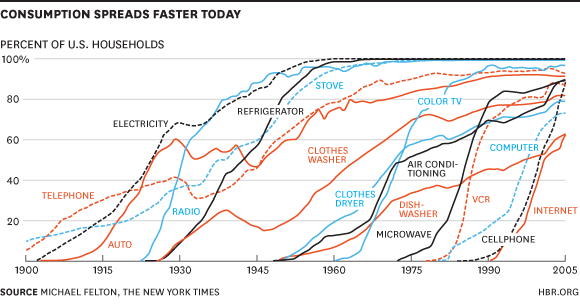
The world is changing at an accelerating pace as new technologies are discovered, developed, released and adopted by consumers faster than ever before. At the same time companies are rising to global scale faster and large, successful companies are disappearing faster too.

In this new reality that we all face, organizations of all types are going to need to:

  • Change how they change
  • Increase their organizational agility
  • Increase the flexibility of the organization
  • Become capable of continuous change
  • Inhibit the appearance and/or growth of change gaps that can doom your company

It is because of this tidal wave of change and a recognition that there is a need in the marketplace for more human change processes and tools that make change seem less overwhelming, that my next book for Palgrave Macmillan will focus on the best practices and next practices of organizational change (aka change management), and I’ve developed a new collaborative, visual change planning toolkit to go with it (but more about that later).

One way to do all of the items in the bulleted list above is to take more of an agile approach to change, to adopt some of the values and principles of the Agile Software Development methodology and use those to create a set of what could be described as Agile behaviors within the organization. If you are not familiar with the Agile Software Development methodology, I have included below the Agile Software Development Manifesto from http://agilemanifesto.org that details the values and principles of Agile Software Development. As you read through the manifesto I hope you’ll see that the values and principles can easily be applied to other endeavors outside of software development, whether that might in the project management discipline of your organization, or within your larger change initiatives.

Manifesto for Agile Software Development

We are uncovering better ways of developing software by doing it and helping others do it.

Through this work we have come to value:

  1. Individuals and interactions over processes and tools
  2. Working software over comprehensive documentation
  3. Customer collaboration over contract negotiation
  4. Responding to change over following a plan

That is, while there is value in the items on the right, we value the items in bold more.

Principles behind the Agile Manifesto

We follow these principles:

  • Our highest priority is to satisfy the customer through early and continuous delivery of valuable software.
  • Welcome changing requirements, even late in development. Agile processes harness change for the customer’s competitive advantage.
  • Deliver working software frequently, from a couple of weeks to a couple of months, with a preference to the shorter timescale.
  • Business people and developers must work together daily throughout the project.
  • Build projects around motivated individuals. Give them the environment and support they need, and trust them to get the job done.
  • The most efficient and effective method of conveying information to and within a development team is face-to-face conversation.
  • Working software is the primary measure of progress.
  • Agile processes promote sustainable development. The sponsors, developers, and users should be able to maintain a constant pace indefinitely.
  • Continuous attention to technical excellence and good design enhances agility.
  • Simplicity–the art of maximizing the amount of work not done–is essential.
  • The best architectures, requirements, and designs emerge from self-organizing teams.
  • At regular intervals, the team reflects on how to become more effective, then tunes and adjusts its behavior accordingly.

Agile and Constant Change

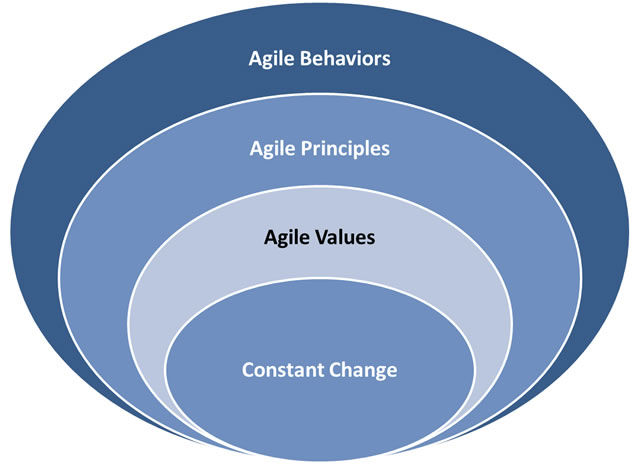
FIGURE 1

You will see in FIGURE 1 that constant change sits at the center, Agile Values providing the initial direction for an organization with a committed goal of becoming more agile. Radiating out from Agile Values as we pursue success in coping with constant change will be our Agile Principles. But, ultimately we can’t live our values or follow our principles if we don’t exhibit behaviors that personify those values and principles. Unless our organizations begin to behave in a more agile way then the potential of truly becoming more agile will remain just words, and go largely unfulfilled.

It is because of the challenge of behaving in a new way that I encourage all of your to make a move towards a formal pursuit of organizational agility. To help you in this pursuit, I will soon be releasing my brand new collaborative, visual change planning toolkit for companies to use on their own (with free training for a select few who agree to use it and document their experience for the book). In addition I will be launching separate training for consultants so they can use the tools with clients in their change management and project management practices. Please register your interest here.

Using this new set of change planning and execution tools and processes will not only make change seem less overwhelming, but it will also help you build alignment behind your effort, help you work through as a group how to LITERALLY all get on the same page for change, and create a more agile organization as adoption of the tools spreads.

Stay tuned for more great change content coming soon!

In the meantime, check out the different ways to get involved.


Accelerate your change and transformation success


SPECIAL BONUS: You can now access my latest webinar ‘Innovation is All About Change’ compliments of CoDev with passcode 1515 (link expired)


Subscribe to Human-Centered Change & Innovation WeeklySign up here to get Human-Centered Change & Innovation Weekly delivered to your inbox every week.

Innovation is All About Change – Webinar Recording

Innovation is All About Change - Webinar RecordingThe hardest part of making any change is taking that first step. We may point our shoulders in the direction we want to travel, but planning our change journey and mapping the steps to get there can still feel overwhelming. This is true for co-creation and open innovation projects, change programs — even personal change.

Often it helps to be with others who are on a similar path. It also helps to have tools that simplify steps and offer motivation. I’m delighted to invite you to view an exclusive conversation/webinar with me and my friends at CoDev (including host Cheryl Perkins of Innovationedge) that we recorded on January 15, 2015.

Click here and use PASSCODE 1515 to access the FREE recording of this webinar (link expired)

In this interactive 60-minute session, I share key tools and guidelines from my new, not-yet-published book from Palgrave Macmillan and give you some insights into what is in my new collaborative, visual change planning toolkit.

I discuss:

  • How organizational change and project/ portfolio management tie together
  • Useful frameworks to move from the ‘what’ to the ‘how’
  • Best (and next) Innovation practices
  • Roles and responsibilities based on the Nine Innovation Roles (from his last book Stoking Your Innovation Bonfire.)
  • How innovation is all about change

I encourage you to view the webinar recording with other members of your senior management team, and anyone else you think might have interest in the intersection of change initiatives, project management, and innovation.

Click here and use PASSCODE 1515 to access the FREE recording of this webinar (link expired)


Build a common language of innovation on your team

Subscribe to Human-Centered Change & Innovation WeeklySign up here to get Human-Centered Change & Innovation Weekly delivered to your inbox every week.

Is Jibo Joining Your Family?

Is Jibo Joining Your Family?

I wrote a couple of months ago about the Amazon Echo, the latest piece of hardware to emerge from the South Lake Union headquarters of one my city’s largest employers. A piece of hardware that follows in the wake of the successful Amazon Kindle and the failed Amazon Fire Phone.

The Amazon Echo aims to get you to put a computer in the center of your living room and to talk to it as if it were a person, building on the increasing comfort we have in talking to Siri, or Cortana, or Google. My previous article highlighted how this growing area of technology in phones, and increasingly in what is apparently a new wave of consumer devices, has the potential to disrupt the business model of Google and Bing, and potentially change our relationship with our devices.

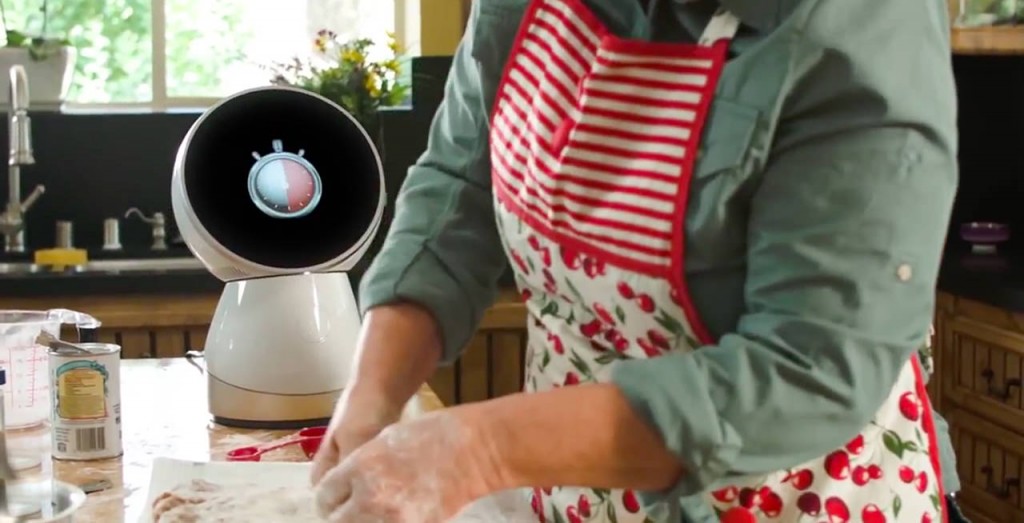
Where Amazon Echo invites you to name their new computing device and speak to it, another rival technology (that was actually announced BEFORE the Amazon Echo) has recently come to my attention that is being positioned almost like a pet or a new member of the family. It’s called Jibo, and it was launched as an IndieGogo campaign and it quickly hit its $100,000 goal in four days, and raised $1 million in its first seven days. To date they’ve raised $2.3 million (pre-selling about 4,800 units) according to their myjibo.com web site, but as of yet they are still not shipping the device.

By comparison, according to Amazon’s web site, the Amazon Echo will be in stock on January 17, 2015.

Rather than trying to explain what the Jibo is, I’ve embedded their promotional video below (8 million views and counting):

So, what do you think, are you ready for Jibo (or the Amazon Echo) to become part of your family?

And you believe this new class of devices (and our increasing reliance on Siri and Cortana) have the potential to disrupt Google and Bing’s ability to make money?

Innovation or Not?

Sound off in the comments.

UPDATE to banner: You can now access a free recording of this webinar using PASSCODE 1515 here (link expired)


Build a common language of innovation on your team

Subscribe to Human-Centered Change & Innovation WeeklySign up here to get Human-Centered Change & Innovation Weekly delivered to your inbox every week.

Speed of Change

Speed of Change

Are You Innovating at the Speed of Change?

The world is changing all around us at an increasing rate, and individuals (and yes organizations too) are struggling to cope with this ever increasing pace of change.

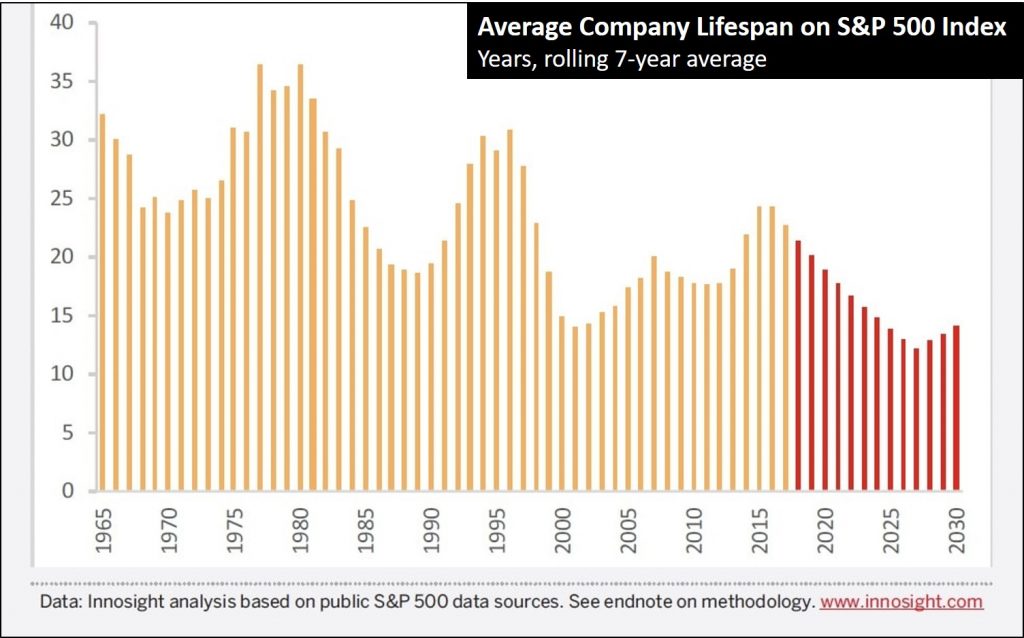
In fact, over the last 50 years the average lifespan of a company on the S&P 500 has dropped from 61 years to 18 years (and is forecast to shrink further in the future).1

Innosight Average Company Lifespan

Nobody of course wants to be one of those organizations that goes out of business, but the fact is that if your organization can’t innovate and change at the speed of change of its customers’ wants and needs, and the pace of geopolitical, social, and economic change in the world around it, then it will likely have to change its sign from open to CLOSED, permanently.

Your organization may indeed be doomed to fail if it develops on or more of the following change gaps:

  1. Your speed of hiring is slower than the speed of your growth
  2. Your speed of market understanding is slower than the pace of market change
  3. Your speed of insight dissemination and acceptance is slower than the pace of market change
  4. Your speed of idea commercialization is slower than the pace of market change
  5. Your speed of innovation is slower than the competition’s speed of innovation
  6. Your speed of internal change is slower than the rate of external change

The last one is of course the largest and the most important, and the most complex, being composed of your speed of:

  • Market Analysis (gathering of insights and inspiration)
  • Invention (creation of innovation source material)
  • Design (building a potential solution around an invention)
  • Development (taking the design and creating a scalable, launch ready solution)
  • Test (Evaluating with customers whether the solution works as designed and scales as intended)
  • Evolution (Launching the solution into the marketplace with open eyes and ears, pivoting/improving as necessary)

While it is possible to enter a market too early, you can survive this tactical error if you enter in a small way instead of committing to a global launch with grand customer promises. However, much more damage comes to organizations that enter too late. So, as an organization we must be constantly striving to get faster at discovering new market insights and adapting and aligning our organization to fulfill newly discovered market needs more quickly than our competition, otherwise we might find ourselves locked out of our customers’ top consideration set tier.

Consumption Spreads Faster

What other change gaps do you see as you look at your business or that of your competition?

This is the first of many articles that I will be writing in the run up to my second book (to be published by Palgrave Macmillan), in which I will explore the importance and implications of change in the ongoing success of organizations, along with building up a concise set of best practices and next practices for change.

To help kick off this journey I will be conducting a FREE webinar with my friends over at CoDev, focusing on how Innovation is All About Change. This exclusive sneak peek and Live Q&A will take place from 12:00-1:00pm ET on January 15, 2015, and will feature a quick introduction to a new visual, collaborative change planning toolkit that I’ve developed and am ready to share with the world. Click here to register (link expired).

I hope you’ll come join me on this journey to improve the pace of change in our organizations!

UPDATE to banner: You can now access a free recording of this webinar using PASSCODE 1515 here (link expired)

1. Innosight/Richard N. Foster/Standard & Poor’s
2. Image Source: Wikipedia


Build a common language of innovation on your team

Subscribe to Human-Centered Change & Innovation WeeklySign up here to get Human-Centered Change & Innovation Weekly delivered to your inbox every week.

FREE Webinar – Innovation is All About Change

FREE Webinar - Innovation is All About Change

The hardest part of making any change is taking that first step. We may point our shoulders in the direction we want to travel, but planning our change journey and mapping the steps to get there can still feel overwhelming. This is true for co-creation and open innovation projects, change programs — even personal change.

Often it helps to be with others who are on a similar path. It also helps to have tools that simplify steps and offer motivation. I’m delighted to invite you to an exclusive conversation/webinar with me and my friends at CoDev (including host Cheryl Perkins of Innovationedge) on Thursday, January 15, 2015 at 12 pm ET.

Click here and use PASSCODE 1515 to access the FREE recording of this webinar (link expired)

In this interactive 60-minute session, I will share key tools and guidelines from my new, not-yet-published book from Palgrave Macmillan and give you some insights into what is in my new collaborative, visual change planning toolkit.

I will discuss:

  • How organizational change and project/ portfolio management tie together
  • Useful frameworks to move from the ‘what’ to the ‘how’
  • Best (and next) Innovation practices
  • Roles and responsibilities based on the Nine Innovation Roles (from his last book Stoking Your Innovation Bonfire.)
  • How innovation is all about change

I encourage your questions and look forward to dialogue with you, other members of your senior management team, and anyone else you think might have interest in the intersection of change initiatives, project management, and innovation.

Click here and use PASSCODE 1515 to access the FREE recording of this webinar (link expired)


Build a common language of innovation on your team

Subscribe to Human-Centered Change & Innovation WeeklySign up here to get Human-Centered Change & Innovation Weekly delivered to your inbox every week.

We Are Target. Who Are You?

By now you’ve probably seen the video of the Target employee standing on the checkout counter delivering a Mel Gibson, Braveheart inspired speech to fellow employees prior to opening the doors on Black Friday (nearly 4 million views and counting).

The video ends with “Because we are more than just a store. This is a team! This is a family! This is Target!!!”

It left me with one central idea at the end, and that’s the title of this article “We Are Target. Who Are You?” and the reason it left me with this idea is that in our companies we too often take the passion out of business. We inadvertently, through the way we communicate internally, end up sending the message that people should leave their passion at home, or feel passionate about something else other than our company.

What would happen if didn’t kill people’s passion at the same time we time we’re busy killing their creativity?

What kinds of connections with our customers could we form if we were (from the top to the bottom) passionate about serving our customers, about crushing the competition, and trying to be better than them in every way?

Do you want to work for a mediocre company?

Does your company want to be mediocre?

Does your company want to provide crappy customer service?

If not, then first work on making your company excellent in every way possible, and then give people permission to be passionate about serving customers and about demonstrating that excellence.

Then you’ll be ready to shout it from the rooftops!
(or at least from the counter)


Build a common language of innovation on your team

Subscribe to Human-Centered Change & Innovation WeeklySign up here to get Human-Centered Change & Innovation Weekly delivered to your inbox every week.

December Innovation Special

December Innovation Special

As 2014 comes to a close and the holiday season continues, I thought I would make a special offer to event organizers in search of a last minute innovation speaker for a December or early January 2015 event AND to innovation managers looking to build strong momentum for their innovation efforts as we head into 2015.

Here is the offer:

Stoking Your Innovation BonfireBook me for an event occurring between December 5, 2014 and January 15, 2015 for either a:

  • 60-90 minute Innovation Keynote
  • 2-4 hour Innovation Workshop
  • 1 Day Innovation Masterclass

… and I will include a box of fifty (50) signed copies of my popular book Stoking Your Innovation Bonfire for your attendees, at no additional charge.

Book Braden Kelley for your event

P.S. In 2015 I will be launching a powerful new collaborative, visual change planning toolkit and a book, app, Quickstart Guide and eLearning to go with it. Please contact me if you are interested in getting advance access to this toolkit in exchange for being a case study for the book.

Subscribe to Human-Centered Change & Innovation WeeklySign up here to get Human-Centered Change & Innovation Weekly delivered to your inbox every week.

Is Amazon Echo the Answer to Google?

Is Amazon Echo Answer to Google?

Today Amazon launched the Echo – an internet appliance with voice recognition and response designed to be to your living room what Siri and Cortana are to your pocket (you ask, it answers).

It is a bold move for Amazon in the wake of their disastrous market entry into the phone market with the Amazon Fire phone, and whether by luck or by design represents more of what customers are likely to give Amazon permission to do in the marketplace. And even though the Amazon Fire phone may be a failure, Amazon no doubt has learned a lot from the experience and from their experience with the Kindle e-reader and Kindle Fire tablets that will help them with the Echo.

The Echo is one reason that Google is worried about Amazon in the search market, because what would do Echo (Amazon), Siri (Apple) and Cortana (Microsoft) truly represent for Google but a direction in the search business that represents a huge revenue threat for Google.

When you ask Echo, Siri, or Cortana a question instead of typing it into a Google (or Bing) search box, Google (or Microsoft) make zero dollars, not even a single cent.

People may forget (or not even know) that Amazon has a search engine company, and owns other search related assets like iMDb and Alexa. Don’t think Amazon sees search as a new frontier for them?

Check out the A9 web site (which years ago used to look just like Google with a simple search box) to get a better sense of how Amazon thinks about search,

So what does nirvana look like in a world with Echo in the center?

Check out Amazon’s promotional video, which has already received 500,000 views at the time I wrote this article:

So, does echo fit into your life? Do you want it to?

I for one have signed up for an invitation to buy one (though it is not actually worth $99 to me – the Amazon Prime member discounted price – down from $199) hoping that Amazon in its infinite wisdom will send me one for free so that I can check it out and report back on it here on the world’s most popular innovation web site.

Oh, and by the way, if you didn’t already know Google now lets you search with your voice on your desktop too, but of course that it’s in the browser so they can still show you ads and make money.

I can’t help thinking that Amazon is behind schedule with this product though. I’m sure they probably wanted to be by invitation only over the summer and shipping in volume for the Christmas, Chanukkah and Kwanza gift giving season, but what are you going to do, invention is hard, unpredictable work. Whether this invention will turn into an innovation, only the consumer market can decide.


Build a common language of innovation on your team

Subscribe to Human-Centered Change & Innovation WeeklySign up here to get Human-Centered Change & Innovation Weekly delivered to your inbox every week.

Are You Lying to Your Customers?

Are You Lying to Your Customers?

It seems like every company these days is trying to claim that they are innovative, trying to claim that they are customer-centric, trying to claim that their employees are important to them. But are they?

Can all this be true?

Or, are all of these companies lying to their customers, lying to their employees, and lying to their shareholders?

Many companies say that they are committed to innovation, but employees know the truth. If employees’ experience around the innovation efforts of the company (and its outcomes) isn’t consistent with the innovation messages being communicated, then not only will innovation participation and outcomes be low, but ongoing trust and loyalty will be further eroded in the organization.

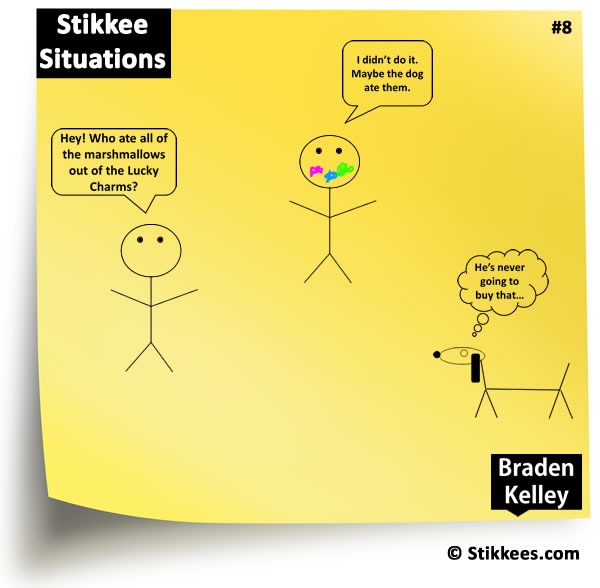
Employees can see the Lucky Charms on your face when you say you’re committed to innovation publicly, but behind the scenes your actions demonstrate that you really are not.

And don’t be fooled, customers will start to see the Lucky Charms show up on your face, no matter how hard you try and convince them that the marshmallow goodness is not there.

If you aren’t going to define what innovation means to your company, if you aren’t going to create a common language of innovation, if you aren’t going to teach people new innovation skills and support innovation at all levels by making limited amounts of time and capital available to push their ideas forward, then don’t say you’re committed to innovation. You’ll tear the organization down instead of building it up.

Lying to CustomersIf customers don’t see you increasing your level of value creation, improving your level of value access, and doing a better job at value translation (see Innovation is All About Value), especially when compared to the competition, then they too will become disillusioned, frustrated, and start to look for other alternative solutions that deliver more value then all of your offerings.

Meanwhile, shareholders behave like customers on steroids. If you are being rewarded with an innovation premium by the market, you can’t be “all hat and no cattle” for very long, meaning you have to deliver compelling inventions on a repeated basis with a strong potential to become the innovations that drive the future growth of the company. This is hard to do once, let alone on a repeated basis. We will likely see Apple be the latest victim in the next twelve months.

Why? Because AAPL is at an all-time high based on the likely high percentage of people that are likely to upgrade from an iPhone 4 or 5s to an iPhone 6 or 6 Plus. What about after that? Well, the smartphone industry is about to enter the same place that the PC industry hit a few years ago, when replacement cycles began to lengthen, reducing revenues, and forcing prices (and margins) lower. Simultaneously carriers will seek to extract more of the margin from the overall equation, and if Google/Motorola/Lenovo, Nokia and others start to bring $99 smartphones developed for India and other places to the richer economies that will in their next generation likely be “good enough” compared to the high end $699 handsets, more people will choose to wait longer between upgrades, or trade down with their next purchase, much as they did when $400 laptops started to become the rage.

So, what are we to learn from Apple’s pending share price collapse about the middle of next year?

Well, the first thing we will learn is that continuous innovation is hard. Now I’m not saying that Apple is going to go away, HP and Dell haven’t gone away, but Apple’s share price in Q2/Q3 2015 will struggle, they will face employee defections, and it will become more like Dell, HP and Microsoft than Facebook or Google. Not because those companies are any more or less innovative than any of the others, but because the growth paradigms are different and those companies are still in a different place on their growth curves.

We can also learn that continuous innovation requires consistency, commitment, the ability to recognize and prepare for the inevitable peaking of any growth curve, the organizational agility necessary to change as fast as the wants and needs of your customers and your environment, and the ability to understand what your customers will give you permission to do (so you know where to go next when your most profitable growth curve begins to peak).

You should see by now that continuous innovation is about far more than technological innovation, but instead requires not only continuous commitment, but also a continuous willingness and ability to change, and a continuous scanning of your environment using a Global Sensing Network.

Do you have one?

What is yours telling you about your company’s future?

Please note the following licensing terms for Stikkee Situations cartoons:

1. BLOGS – Link back to http://stikkeechange.com/category/stikkees/ and you can embed them for free
2. PRESENTATIONS, please send $25 to me on PayPal by clicking the button 3. NEWSLETTERS & WEB SITES, please send me $50 on PayPal by clicking the button
License for presentations - $25
License for newsletters and web sites - $50

Subscribe to Human-Centered Change & Innovation WeeklySign up here to get Human-Centered Change & Innovation Weekly delivered to your inbox every week.