Author Archives: Braden Kelley

About Braden Kelley

Braden Kelley is a Human-Centered Experience, Innovation and Transformation practice lead at HCL Technologies, a popular innovation speaker, and creator of the FutureHacking™ and Human-Centered Change™ methodologies. He is the author of Stoking Your Innovation Bonfire from John Wiley & Sons and Charting Change (Second Edition) from Palgrave Macmillan. Braden is a US Navy veteran and earned his MBA from top-rated London Business School. Follow him on Linkedin, Twitter, Facebook, or Instagram.

Using Boredom to Help Students Learn

Bored Game TeacherWhat do you get when you take the technology away from a group of 10 and 11 year olds and ask them to be creative with a handful of household objects?

Well, Thomas Fraser, a teacher at Crestwood Elementary School in Edmonton, Canada, troubled by the short attention spans of today’s youngsters endeavored to find out by creating what he calls the Bored Game, which involves giving students a handful of common household objects with the only instruction being to do something interesting with them.

The reaction at first from his group of always on youngsters were perplexed looks of how can I create something without an iPad, smartphone or a computer?

Then they started to get into it, and were sad when they didn’t get to play the Bored Game.

CTV recorded an interview about the Bored Game that you can watch here:

(sorry, video is no longer available)

My favorite part of the story is that they’re finding that the performance of the children in a range of subjects is increasing as the children have this periodic time to play and engage their creative problem solving skills.

So, maybe we need less technology in the classroom if we want to teach kids how to learn?

In my opinion, we focus too much on teaching kids to repeat activities, facts, and figures, focusing and what they’re able to memorize and regurgitate and not enough on actually teaching kids creative problem solving and how to learn. We don’t need a new generation of trivia experts, we need a new generation of problem solvers that can help repair the world.

We’ve all heard the saying “If you give a man a fish he’ll eat for a day, if you teach a man to finish he’ll never go hungry.”

If you want your child to be more successful, you have to do the same thing…

“Good teachers teach kids how to do well on the test, great teachers teach kids how to learn so they do well in life.”

For more, I encourage you to check out the Edmonton Journal Article (link expired)

Image credit: Edmonton Journal


Accelerate your change and transformation success

Subscribe to Human-Centered Change & Innovation WeeklySign up here to get Human-Centered Change & Innovation Weekly delivered to your inbox every week.

Change the World – Step Two

Change the World - Step TwoAre you and your organization ready for change?

Too often organizations define the change effort they want to pursue without first identifying whether there are people, resources, legislation, etc. present that must be in place before the change effort can begin. We will explore the circumstances you may want to explore before beginning any change effort and the areas to explore as potential prerequisites to the change program and its eventual success.

During the course of any change initiative many different challenges will appear, and the most successful change efforts will anticipate those challenges and have a plan for dealing with them. Part of that anticipation begins with identifying how ready the organization is for change and understanding what some of the top challenges are.

In a 2008 global CEO study conducted by IBM on the enterprise of the future, IBM identified the top challenges to successfully implementing strategic change as:

  1. Changing mindsets and attitudes (58%)
  2. Corporate culture (49%)
  3. Underestimation of complexity (35%)
  4. Shortage of resources (33%)
  5. Lack of higher management commitment (32%)
  6. Lack of change know-how (20%)
  7. Lack of motivation of involved employees (16%)

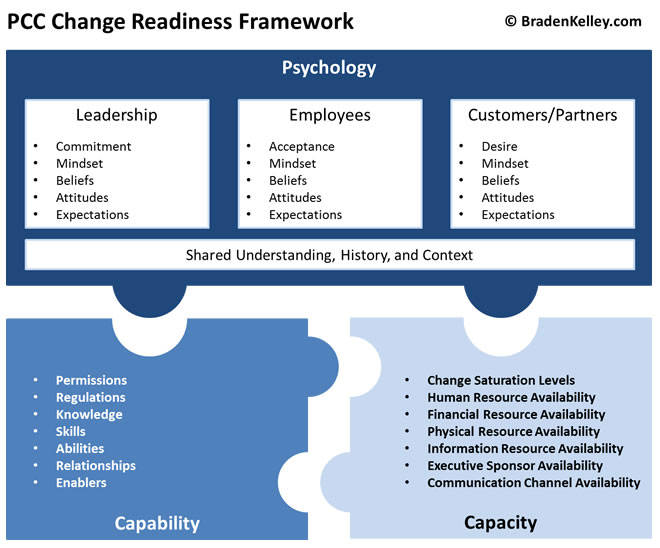
You will notice that many of the items on this list are more about the people factors of change rather than the process or technology factors of change. The weight of the human dimensions of change is reflected in my PCC Change Readiness Framework™. This framework focuses on the psychology of key groups surrounding the identified change, the capabilities needed to successfully execute the change, and the organization’s capacity to tackle this change effort (along with everything else).

PCC Change Readiness Framework

You will notice that I don’t speak about organizational psychology or culture in my PCC Change Readiness Framework™. The reason I don’t highlight culture in the same way that many other people do is that in today’s more social, customer-centric business, we must look more broadly than the typical inward focus of company culture when it comes to identifying the readiness of not only employees, but leaders, customers, and partners too. Inevitably many of our change efforts will have some impact on one or more external groups (possibly even non-profit entities and one or more governments).

You will notice that within the PSYCHOLOGY box there is a common focus on the mindsets, attitudes, beliefs and expectations of the individuals. Culture is incorporated into the psychology realm by focusing on what the shared understandings are around the potential change, but more broadly too. And, finally you will notice that my PCC Change Readiness Framework™ highlights the need for successful change efforts to move towards gaining commitment to the change from leadership, acceptance of the change by employees, and a desire for the change from customers and partners.

Within the CAPABILITY box of my PCC Change Readiness Framework™ we must investigate whether our change effort has any regulatory or statutory implications and whether we are ready to adapt, adopt or influence the changes necessary in this sphere. We must also ask ourselves a series of questions:

  • “Do we need to get permission from anyone to do this?”
  • “What knowledge, skills, and abilities needed for this change do we already possess?”
  • “What knowledge, skills, and abilities needed for this change do we need to acquire?”
  • “What relationships do we possess that will be useful in advancing the change?”
  • “What relationships do we need to build to help advance the change?”
  • “What are the enablers of making this change successful?”

Within the CAPACITY box we have to look at where our resources are approaching, or have already achieved, change saturation. This means they are unable to productively participate in any more change efforts or adopt any more change. But we also have to look at the availability of our resources:

  • Human
  • Financial
  • Physical
  • Information
  • Executive Sponsors
  • Space in our desired communication channels

It is easy to take for granted that the organization will have the capacity to undertake your change effort, but often there are capacity constraints that you will run into, especially as the pace and volume of change increases inside an organization. The one that is easiest to overlook and fail to plan for, is making sure that you’re going to be able to communicate your change messages in your desired messaging channels (they may already be full).

In my upcoming collaborative, visual Change Planning Toolkit™ you will find the companion tools for the PCC Change Readiness Framework™, two large format change readiness worksheets to download for printing that will help you collaboratively explore all of these topics and more.

Be sure and sign up for the Braden Kelley newsletter to receive the latest news on my new book on the best practices and next practices of organizational change (January 2016) and the licensing options for the Change Planning Toolkit™.

Finally, when you consider all of the potential stumbling blocks in advance of the change that we highlighted above, evaluate your readiness in each area, and make a plan for closing any gaps (before you even begin your change effort), you will greatly increase the chances of its success. But, there are certain items that are not just good to know in advance, but are actually prerequisites for change, and we will explore that topic in the book, so stay tuned!

EDITOR’S NOTE: I’ve gone ahead and created a free downloadable flipbook PDF for people to grab. It was inspired by Art Inteligencia’s article titled Change Readiness: What It Is and How to Achieve It.

PCC Change Readiness Framework Flipbook

P.S. In case you missed it, click to read Change the World – Step One


Accelerate your change and transformation success

Subscribe to Human-Centered Change & Innovation WeeklySign up here to get Human-Centered Change & Innovation Weekly delivered to your inbox every week.

Most Companies Fail at Innovation Because…

Most Companies Fail at Innovation Because...Most companies fail at innovation because they fail at change.

There you go, there is the entire article in a single sentence. Please click the like button or leave a comment on your way out, and I’ll turn out the lights.

I’m actually serious, but I didn’t come to this single sentence overnight, but through decades of research and experience. It coalesced however this morning in an interview with Chad McAllister that will air next month.

This sentence also highlights the reason why after writing the popular Stoking Your Innovation Bonfire (a book about innovation) and traveling the world delivering innovation keynotes and workshops, that my next book for Palgrave Macmillan (@PalgraveBiz) will be about change, not innovation.

Because after all, my life’s work is to help others change the world for the better by creating and sharing valuable tools and insights that hopefully serve to accelerate innovation and change in communities around the world.

I will continue on to say though that if you want to be successful at innovation you need to get better at planning, leading, managing, and maintaining change.

If you doubt the linkage, please check out my other article Managing Innovation is About Managing Change. This will give you a great example of how innovation inflicts change on the organization.

And if you’d like to learn more about making your organization more change capable, then I encourage you to check out my article Change the World – Step One, which is the first in a series of articles I will be publishing here in the run up to the launch of my book in January 2016 to help organizations build a stronger, more sustainable approach to change. This first article outlines the Four Keys to Successful Change, with much more content and a whole Change Planning Toolkit™ being released over the next few months.


Accelerate your change and transformation success

Subscribe to Human-Centered Change & Innovation WeeklySign up here to get Human-Centered Change & Innovation Weekly delivered to your inbox every week.

Change the World – Step One

Change the World - Step OneDo you want to change the world?

Even just one tiny corner of your own world?

Change often feels overwhelming, scary even, and frequently we don’t know where to begin.

Stoking Your Innovation Bonfire focused on helping organizations identify and remove barriers to innovation, and has also served as a great innovation primer for innovation practitioners all over the world.

As people choose and commit to going down the innovation path in a measured way, one of the first things they discover is that many things will have to change inside the organization and in how the entity engages with others outside the organization for their new product or service ideas to successfully walk the transitional path from insight to idea to experiment to implementation project to market offering and market success.

Because of this, my next book and most of my future articles here on Innovation Excellence in the run up to the release of my Change Planning Toolkit™ will be focused on helping people build a strong foundation for achieving successful organizational change. This series of articles will culminate with the launch of a new book from Palgrave Macmillan in January 2016 on the best practices and next practices of organizational change and an introduction to my Change Planning Toolkit™.

So, if we’re hoping to change the world, our world, whether that is with a big W or a little one, where should we begin?

Let’s begin by painting a background for the landscape of organizational change.

Four Keys to Successful Change

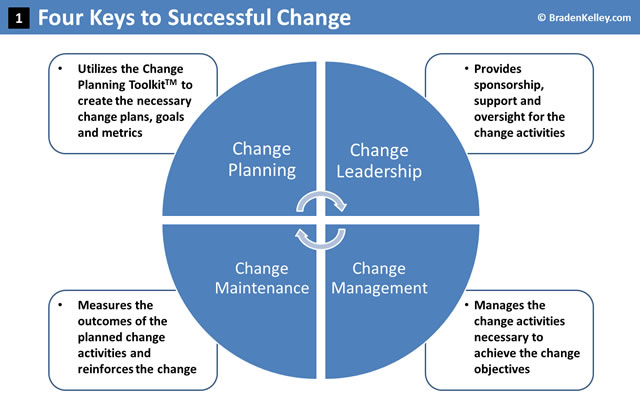
Above you’ll see a visualization of the Four Keys to Successful Change. Leave one out and eventually your change effort, no matter how big or small, will eventually fail. If you’re setting setting out to change the world, even a small corner of it, then you’ll want to be sure to consider each of the four keys and make sure that you proceed in a measured way that takes each into account.

Let’s look at each briefly in turn before we look at each area in more detail in future posts, and eventually in the book in January 2016.

The Four Keys to Successful Change

1. Change Planning

Change Planning is the first key to successful organizational change, and it focuses on drawing out the key issues of the necessary change and puts some structure and timeline around them. You will find you have a better experience and a more successful outcome if you use a more visual, collaborative method using something like the Change Planning Toolkit™ I will be releasing soon to help you create the necessary change plans, goals, metrics, etc.

2. Change Leadership

Change Leadership is the second key to successful organizational change, and is important because good change leadership provides the sponsorship, support and oversight necessary for the change activities to receive the visibility, care, and attention they need to overcome inertia and maintain momentum throughout the process of transformation.

3. Change Management

Change Management represents the third key to successful organizational change, and it is probably the one most people think of when they think about organizational change because it focuses on managing the change activities necessary to achieve the change objectives. The term itself has some challenges however as the term also refers to the management of code changes during the software development process and its relationship with project management is confused. We will dig more into the relationship between project management and change management in a future article.

4. Change Maintenance

Change Maintenance represents the fourth and probably most neglected key to successful organizational change. Many change leaders lose interest after the major launch milestones are achieved, and this is a real risk to sustained success of the change effort. During the change maintenance phase is when you measure the outcomes of the planned change activities and reinforce the change, to make sure the change effort has met the change objectives and when you ensure that the behavior change becomes a permanent one. Neglect this phase and people often slip back into their old, well worn patterns of behavior.

Conclusion

This is the first article in a series to help make changing the world seem a little less overwhelming, a little less scary. I hope you have found the article and the framework a useful first building block as we work together to build a strong foundation for successful organizational change. To be alerted when the Change Planning Toolkit™ becomes available, please be sure and click the link below to join the mailing list, and stay tuned for the next article in this series!

Sign up for updates on the Change Planning Toolkit™ (Charting Change Insiders)

Image credit: Youthventure.org


Accelerate your change and transformation success

Subscribe to Human-Centered Change & Innovation WeeklySign up here to get Human-Centered Change & Innovation Weekly delivered to your inbox every week.

Your Chance to Help Change Change

Your Chance to Help Change ChangeMy first book Stoking Your Innovation Bonfire was designed to help organizations identify and remove barriers to innovation, but readers also found it to be a great primer on how to take a structured, sustainable approach to innovation, and as a result the book has found its way into university courses and libraries around the world.

I’ve been thinking over the last few years about where I could provide the most value in a follow-up book, and it came to me that innovation is really all about change and that where most organizations fail to achieve innovation is in successfully making all of the changes necessary to transform their inventions into innovations. At the same time, the world has changed, the pace of change is accelerating and organizations are struggling to cope with the speed of changes required of them, including the digital transformation they need to make.

So, my next book, this time for Palgrave Macmillan, will focus on highlighting the best practices and next practices of organizational change. And where does any successful change effort begin?

With good planning. But it is really hard for most people to successfully plan a change effort, because it is hard to visualize everything that needs to be considered and everything that needs to be done to affect the changes necessary to support an innovation, a digital transformation effort, a merger integration, or any other kind of needed organizational change.

But my Change Planning Toolkit™ and my new book (January 2016) are being designed to help you get everyone literally all on the same page for change. Both the book and my collaborative, visual Change Planning Toolkit™ are nearly complete. But before they are, I’d like to engage you, the intelligent, insightful Innovation Change Management community to help contribute your wisdom and experience to the book.

I’m looking for a few change management tips and quotes attributable to you (not someone else) to include in the book along with the other best practices and next practices of organizational change that I’ve collected and the introduction to my Change Planning Toolkit™ that I’m preparing.

It’s super simple to contribute. Just fill out the form, and the best contributions will make it into the book or into a series of articles that I’ll publish here and on a new site focused on organizational change that I’m about ready to launch.

I look forward to seeing your great organizational change quotes and tips!

UPDATE: The book is now out! Grab a copy here:


Accelerate your change and transformation success

Subscribe to Human-Centered Change & Innovation WeeklySign up here to get Human-Centered Change & Innovation Weekly delivered to your inbox every week.

Conference Wrapup – Change Management 2015

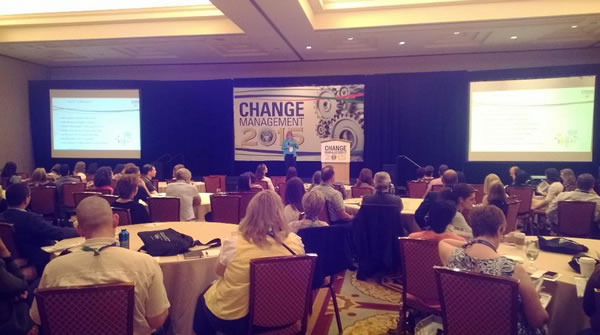
Change Management 2015

Recently I had the opportunity to attend the Association of Change Management Professionals’ (ACMP®) annual conference in Las Vegas, Nevada, titled appropriately Change Management 2015. The event represented a convening of nearly 1,000 change management professionals from around the globe, including countries as geographically dispersed as Qatar and Australia, but with the bulk of the attendees being from the United States, Canada, and Australia.

Nearly 1,000 attendees is a pretty decent size, much bigger than any innovation event that I’ve ever been to, but this larger number of attendees is quite small when you consider the number of people serving in official or unofficial change management roles around the world (either as employees or consultants), or when compared to the number of project managers (estimated at 16.5 million people around the world) and potentially as many as 1.5 million six sigma black belts and green belts sprinkled around the world.

Meanwhile, a couple of the leading training organizations in the change management space have trained just short of 100,000 people in the principles of change management.

If you agree that proactively managing change in organizations is at least as important as the practice of Six Sigma, and potentially as important as project management, that means that as the pace and importance of change continues to gather steam, there could be the need to train between 1.4 million and 16.4 million change management professionals in the next few years.

Professionalizing the Change Management Profession

One of the things that occured at the conference was the highlighting of the ACMP Standard for Change Management™ and the new ACMP Qualified Education Provider™ (QEP™) program. Both of these are steps along the way to building momentum for a change management certification that the ACMP® hopes will become the gold standard for people worldwide to highlight that they have the skills knoweldge, and experience to be recognized as a Certified Change Management Professional™ (CCMP™).

Kicking it off with Dan Pink

The opening keynote at the event was delivered by Dan Pink, author of ‘Drive’ and several other books. Much of his speech was about the societal impacts of the greater availability of information that we enjoy today, and how that will also affect our ability to sell, to influence, and to affect change. In sales, it used to be that the seller nearly always had more information than the buyer, that is rarely the case any more. Because of this shift in information availability, experts are being called on more to be a curator of information than as a way to access information. Dan highlighted how nearly everything that we do in business involves sales and change, yet business schools and MBA programs teach neither sales nor change (they might teach a course on leadership if you’re lucky). And if the ABC’s of sales used to be “Always Be Closing” then the new ABC’s of sales are Attunement, Buoyancy and Clarity.

One interesting personal productivity insight that Dan shared was the idea that asking yourself questions before doing something is a better preparation method than positive self talk. Another was how by reducing your feelings of personal power before going into a conversation can actually increase your effectiveness at getting people to do something. And finally, consider these points related to change:

  • Context is more important than the individual
  • When engaging people for change, it’s very important to use the audience’s language not yours
  • Instead of focusing on changing people’s minds, focus on making it easy for people to do something
  • When information goes down easier it is more likely to stick (rhyming, distillation, etc.)

The IBM Research Perspective

There was a great quote from Hilary Bland of IBM at the conference that illustrates the necessary future direction and importance of change management:

“The ability to anticipate, manage and capitalize on pervasive change is often the difference between market leadership and extinction.”

Between IBM’s research study in 2008 and their followup study in 2014, they’ve seen a shift from organizations managing change on projects to organizations increasingly focusing on enterprise transformation. While the 2008 study examined how organizations manage change and gained practical knowledge, the 2014 study gained insights into the new environment of continuous transformation & the attributes of organizations that are highly successful in managing change.

One of the findings from IBM’s 2014 study was that 74% of respondents are concerned employees are not fully prepared to adapt to an increasingly digital work environment. This sentiment also manifests in the finding that only 20% of organizations successfully deliver on more than 75% of their projects.

And while the digital revolution provides new opportunities to lead change – bottom-up, top-down, sideways – the fact is that 87% of the IBM study respondents stated that not enough focus is currently placed on change management in critical projects and that only 44% of high performance change organizations understand change benefits – Scary!

On final interesting tidbit from the 2014 IBM Research findings – In 2008 only 20% of surveyed companies were using internal resources to manage change projects, but this number is 84% now – highlighting a perceived need for companies to build their own internal change management capability instead of relying on consultants.

Here is a link to the latest IBM study ‘Making Change Work 2014’ – https://ibm.biz/BdRV9y

Gearing Up for Change – A Case Study

Columbia Sportswear shared several learnings from the change management components of their SAP upgrade, including:

  • Success comes not from just saying things multiple times but doing things multiple times
  • We had to stress that company success is determined by the quality of and access to data
  • Initially we were given a tiny training budget, so we went out and got data to build support for an increase
  • We used learnings from a previous failure to build support for our new approach
  • Our first steps were to capture tribal knowledge, map processes, and write standard operating procedures (SOP’s)
  • We then trained execs in our change methodology and did monthly change surveys to
  • We won support from senior management to bring in long term temporary employees to free up our super users to participate in the project. This was a priority!
  • Focus was key! The company had to say “We’re going to do this upgrade, make/sell products, and nothing else!” – and then of course remind people…
  • We had to get creative in our communications, both in terms of building new communication channels and creative messaging, but also we had to work really hard not to talk about the system being changed, but instead focus on how this was a company evolution.
The Culture Question

There were several good culture questions and comments that came up from various sessions, including:

  • When it comes to culture change, you have to define which parts of the culture you’re going to retain too.
  • Findings from IBM’s study on making change work… 1. Lead at all levels 2. Make change matter 3. Build the muscle
  • People at IBM got social really fast around the topic of change because managers were looking at profiles and who was contributing
  • Engagement = Communication + Co-creation
  • Successful change efforts blend effective approaches to the task side and the people side
  • Pace of change is both a driver for change management and a resistor
  • Accountability key to embedding your change into normal operations
  • People hate being off plan. They will want to tell people about the green behind the red. Consider only allowing people time with the boss to discuss yellow/red projects and how the boss can help, instead of making people feel like they have to be green.
  • When change saturation exists, consider having cross-functional resource conversations to look for solutions.
  • “Change has to start by doing less” -Lisa Bodell
  • “Change Leaders should keep these three things in mind – Ask killer questions, Reverse assumptions, and Kill a stupid rule” – Lisa Bodell

Learning as it Relates to Change

There was a great session at the Conference with Christine Cox, PhD. looking at breakthroughs in organizational learning. Some of the key takeaways included:

  • People who multitask (or who sit next to multitaskers during lectures) exhibit lower comprehension
  • Memory can be improved by relating learning to yourself
  • To harness emotion for better learning you want to tap into people’s emotions without overactivating them
  • People strongly remember moments where they made connections and generated those connections or insight
  • Learning is also increased when the right social elements are added
  • Give people opportunity to share what they’ve learned and reflect on its self-relevance
  • Spacing is also important for learning. No cramming!
  • 12 hour learning spacing that includes a night’s sleep helps comprehension more than 12 hours of spacing during waking hours
  • Instructional design should perhaps shift from content delivery to creating the space for insight
  • Incorporating some forms of generation into the learning situation – like polls, guided reflection, writing answers, explaining to another, hearing from another – can increase retention

All Trains Change for Change

Carmen Bianco, the President of the Manhattan Transit Authority (MTA) discussed how our world is changing and how the MTA has to focus on technology, strategy and culture. One of the big questions the MTA is grapplin with is:

How can we get more technology underground so that we can get more train cars per hour moving through the system?

The MTA is ordering 1,000 new train cars and growth is causing them to explore how they can change their culture to be more customer-focused and how they can move more train cars per hour and how they can get more people into each train car. Carmen’s initial focus on culture change has been on top executives so that the middle of the organization knows they’re serious. For change to filter all of the way down, the alignment and commitment has to work its way down. Carmen feels that if he can get everyone on his team to be that good boss, that’s a home run because it effects countless numbers of people. Carmen has also instituted no meeting days at MTA where he requires managers to get out with their employees and then do a debrief with him at the end of the day.

Carmen spoke about the challenge they face with 44% of executives and 41% of operating supervisors becoming pension eligible soon. The potential retirement of 44% of managers next year is both a risk and an opportunity to culture change progress. He spoke about how just when it seemed like he wasn’t changing the culture, the super storm came and provided a galvanizing opportunity. He marveled as he watched the MTA perform with the customer in mind (even sacrificing sleep). He feels blessed to have a phenomenal group of employees who have come up with ideas like FastTrack, where we had 900 employees working in the same area. At first citizens and the media ridiculed the idea, but now people are asking ‘When are you bringing this to my neighborhood?’ The creation of FastTrack reminded me of that scene in the Apollo 13 movie. It’s a good idea to keep that Apollo 13 scene ‘What do you have?’ in mind for constraint-focused brainstorming.

A Whirlwind Tour of Change

The Nike and Peoplefirm session highlighted the importance of communication strategies and creativity in change. PG&E and BeingFirst highlighted how building a change capability within an organization takes time (within PG&E it has taken 2 1/2 years just to START). Year 1 at PG&E may have focused on a lot of change leadership training, but year 2 has to be more about demonstrating results. An internal change group can act as middleware translator between consultants and the organization on a range of projects. Change saturation was discussed many times at the conference, and PG&E talked about how they monitor it at a workgroup level, monitoring what initiatives are effecting different workgroups. In the Marriott session it was highlighted that the most used change tools at Marriott include change overview, stakeholder analysis and communication plan. Chris Churchill and Paul O’Keeffe of Accenture spoke about Agile Change Management and the importance of integrating your change process into your Aigle process, including your task wall or kanban wall process.

Finally, closing keynote speaker Lisa Bodell offered these Eight Statements for Change that she advises organizations work to answer in the affirmative:

  1. People in our organization actively think about pushing boundaries and use trends
  2. Our employees are comfortable asking provocative questions
  3. People think on their feet
  4. People see it through
  5. We are Looking forward 5-10 years
  6. We constantly push for continual improvement
  7. We purposefully hire diverse teams
  8. We look at adjacencies and distant companies and apply best practices

The conference definitely was a whirlwind, and I’d like to thank the Change Management 2015 conference organizers for inviting me to cover the event for the Innovation Excellence audience. Hopefully they’ll have me back as a speaker next year at Change Management 2016 in Grapevine, Texas.

In 2016 my new change management content site will be in full swing and my second book for Palgrave Macmillan (@PalgraveBiz) comes out in January 2016 to highlight the best practices and next practices of organizational change and introduces the new collaborative, visual change planning toolkit. I’ve got some great guest experts lined up as contributors and am finalizing the final few sponsors and contributors in the next couple of months (along with the manuscript), so stay tuned!

Accelerate your change and transformation success

Subscribe to Human-Centered Change & Innovation WeeklySign up here to get Human-Centered Change & Innovation Weekly delivered to your inbox every week.

A Lifetime of Innovations

A Lifetime of InnovationThis week I was in Michigan for a family wedding and I had a great conversation with a family member about the history of Lifetime Products and how probably more than twenty years ago he saw the founder of Lifetime Products at a trade show demonstrating their first product, a basketball hoop that could be raised and lowered in seconds with the help of a pole or broom handle.

The founder was standing there and repeatedly saying “The basketball hoop goes up, the basketball hoop goes down.”

My family member was recounting how when he saw the guy at the tradeshow repeating this mantra over and over that he laughed at him, and how more than twenty years later how silly he feels because the guy has created a multimillion dollar company from these simple beginnings and his belief in the company’s first product.

Basketball hoops were the company’s only product for the first nine years until they started manufacturing a picnic table designed to fold flat.

According to my family member the company’s fortunes changed one day when a buyer at Walmart asked a simple question:

“Do you think you make a folding table?”

It obviously would have been easy at this point for the company to respond, “No, we make basketball hoops.” but given that business owners should always be watching to see what customers are struggling with and listening to hear what they might give you permission to sell them, it was smart for Lifetime Products in this situation to say “Of course.”

It also makes sense when you remember that two of the main questions you are always looking to answer for any new product are:

1. Can we make it profitably at scale at a price point where the value delivered is greater than the price?
2. Is there a market for it?

If the answer to question #2 has already been determined to be yes (like in this situation), then it simply becomes a matter of figuring out how to make question #1 true.

Lifetime Products found a way and so it is no longer about just “The basketball hoop goes up, the basketball hoop goes down.”

Basketball hoops may still be an important part of their product line, but their blow molded folding tables have nearly completely replaced much of their heavier wooden competition and they’ve moved on to make folding chairs, sheds, playgrounds, tent trailers, composters, and kayaks.

Now with 2,200 employees and revenue likely north of $250 million, the company is definitely no laughing matter.


Accelerate your change and transformation success

Subscribe to Human-Centered Change & Innovation WeeklySign up here to get Human-Centered Change & Innovation Weekly delivered to your inbox every week.

Can Windows 10 Disrupt Android and Get Microsoft Back in Handset Game?

Microsoft Tries to Disrupt Mobile Phone Market

Can Windows 10 Disrupt Android and Get Microsoft Back in Handset Game?I came across an article on Mashable recently highlighting a new Microsoft experiment. It highlights something that Microsoft has prototyped to test as part of their strategy to regain momentum in the mobile phone market by focusing on markets outside the United States where the first generation of the smartphone adoption battle hasn’t already been decided.

The first Microsoft branded phones are now appearing in the market as the relevance of the Nokia brand in the mobile phone market has nearly completely disappeared. With a single digit market share, Microsoft has to do something disruptive to get back in the game and get some value out of their huge Nokia acquisition. Most people would say that doing something disruptive is outside of Microsoft’s comfort zone, but there are examples to the contrary where Microsoft has been more innovative than Google or Apple, so nothing is impossible.

So enough buildup. What exactly is Microsoft fooling around with as a potential strategy to get back in the global smartphone market?

It is this…

Microsoft is working with Xiaomi to prove that it is possible to bring Windows to Android hardware. The technical details aren’t all that important, the bigger question is whether Android handset owners would consider doing this or not.

The big value proposition highlighted in the Mashable article is that Windows is less hungry for resources than Android and so especially for people with older smartphones the switch could make their handset feel more responsive. Someone switching like this probably wouldn’t make Microsoft any immediate money, but of course the hope would be that when they upgraded that they would choose a Microsoft OS handset for their next smartphone.

As someone who ditched his Android phone for a Nokia Lumia phone running Windows Phone and never looked back, I can confirm that Windows Phone is better than Android (althought the App selection is much smaller).

Given that Windows Phone biggest weakness is probably App availability, Microsoft better do everything they can to convert phones over to their new Windows 10 OS, other way that gap will never close. Will this experiment be fully unleashed? Will it work? Could Microsoft disrupt the smartphone market and get back in the game with this approach?

I guess only time will tell.

In the meantime, if you want to see more, check out the video above and work on your Chinese at the same time.

If you’re not sure what I meant by seamless computing when I referred to it above, I encourage you to check out my previous article – Cloud Computing is Dead, Long Live the Cloud! (which is also available as a narrated audio file)


Accelerate your change and transformation success

Subscribe to Human-Centered Change & Innovation WeeklySign up here to get Human-Centered Change & Innovation Weekly delivered to your inbox every week.

Listen to Crowd Computing is Dead, Long Live the Cloud!

by Braden Kelley

The Innovation Excellence version of my recent article Cloud Computing is Dead, Long Live the Cloud! has done so well that Umano has decided to turn it into an audio-article that you can listen to while you work, drive, etc. if you were too busy to read it when it came out. 😉

Here is the audio file for your listening enjoyment:

(sorry, umano seems to have gone out of business)

Hopefully I will be able to bring you more of my articles narrated in this way for those of you who prefer to listen to content instead of read it.

Keep innovating!


Accelerate your change and transformation success

Subscribe to Human-Centered Change & Innovation WeeklySign up here to get Human-Centered Change & Innovation Weekly delivered to your inbox every week.

Whither Innovation in Indiana?

Whither Innovation in Indiana?Now that I’ve got your attention, let’s talk about homosexuality and whether it has any impact on innovation. There probably are two no more polarizing topics in the United States than homosexuality and abortion. But the truth is that if both sides of the political and religious spectrum focused on the golden rule, there would be less corruption, we’d all be a lot happier, probably have more innovation, and our politics would be more productive.

Today we have another great case study for how short people’s attention spans have gotten, how the government can help or hinder innovation, how little investigative journalism still remains in the United States, and how easily people are swayed by a soundbite that runs contrary to (or in support of) their own personal religious or political beliefs.

But this article isn’t going to be some diatribe in support or opposition to Indiana’s Religious Freedom Restoration Act (RFRA) legislation (referred to by the media as an anti-gay law) because I freely admit I don’t fully understand all of the implications of a similar federal law and whether federal protections for gays apply to the state law.

Instead I’d like to focus briefly on what this controversy brings to mind for me in regards to the efforts of hard-working folks attempting to stimulate innovation in Indiana (and elsewhere).

Point #1: People Must Feel Safe to Innovate

If we take Maslow’s Heirarchy of Needs as gospel (okay, maybe that’s dangerous word choice), then safety is one of the most important needs for people, and in order to innovate people must feel safe. True innovation usually requires taking risks and doing things in a new way, and if people feel that trying something new or even just being different has a high price, then people won’t step out of their comfort zone and push the boundaries of conventional wisdom. So if we are truly trying to do everything we can to inspire innovation in our region, shouldn’t we also try to do everything we can to make it feel like a place where it is safe to be different and where that difference is potentially even celebrated?

Point #2: Diversity is Important (to a point)

We all look at the same situation through different eyes and a different history of experiences, values and beliefs. This diversity can help create different idea fragments that can be connected together to create revolutionary new ideas with the potential to become innovations. But at the same time, having some shared experiences helps to make it easier to communicate and to have a higher level of trust (assuming those experiences were good ones). So if we are truly trying to do everything we can to inspire innovation in our region, shouldn’t we also do everything we can to make different groups of people look to our region as a good place to move to so we have a diverse talent pool?

Conclusion: If Culture Trumps Strategy, Environment Trumps Startups

The world is changing. It used to be that companies started and grew in the community where they were founded, hiring increasing numbers of people from the surrounding areas and attracting others from elsewhere. Now, an increasing number of companies (especially digital ones) are moving to more distributed models where they create satellite offices where the talent is rather than trying to attract all of the talent to a single location.

Economically this is meaning that it is becoming less important that the next Facebook starts in your town than it is for the next Facebook to want to have an office in your town. This means that for cities, counties, states and countries, the greater economic impact is likely to be made not from trying to encourage lots of startups, but instead from trying to create an environment that young, talented people choose to live in.

And when you create a place that is attractive for smart, creative people to move to, you know what, you’re likely to end up not just with more growing digital companies seeking a presence, but also a larger number of startups than if you started with the goal of specifically trying to encourage startups.

Does your region focus on creating startups as the primary goal or on making itself an attractive place for a young, diverse and talented population to live?

Does this uproar help Indiana establish its as an attractive place to be, or work against that perception?

I’ll let you decide!

P.S. If you’re curious, here are The Metro Areas With the Largest, and Smallest, Gay Populations (for what it’s worth, Indianapolis isn’t on either list)


Accelerate your change and transformation success

Subscribe to Human-Centered Change & Innovation WeeklySign up here to get Human-Centered Change & Innovation Weekly delivered to your inbox every week.