Author Archives: Braden Kelley

About Braden Kelley

Braden Kelley is a Human-Centered Experience, Innovation and Transformation practice lead at HCL Technologies, a popular innovation speaker, and creator of the FutureHacking™ and Human-Centered Change™ methodologies. He is the author of Stoking Your Innovation Bonfire from John Wiley & Sons and Charting Change (Second Edition) from Palgrave Macmillan. Braden is a US Navy veteran and earned his MBA from top-rated London Business School. Follow him on Linkedin, Twitter, Facebook, or Instagram.

Voting Open for Thinkers50 Top Management Thinkers for 2015

Thinkers50 - Nominations and Votes NeededThank you everyone for your nominations for the Innovation category of the Thinkers50 Distinguished 2015 Distinguished Achievement Awards. The short lists for the eight categories will be announced in early September.

September 1st is the last day to cast your votes for the Thinkers50 Top Management Thinkers for 2015.

Click here to vote for me for the Thinkers50 Top Management Thinkers for 2015 by filling in the following:

Your Name
Your Email
Person who gets your vote: Braden Kelley
That person’s title: Founder
That person’s organization: Innovation Change Leadership
That person’s email address: thinkers50@bradenkelley.com

Click here to vote for me for the Thinkers50 Top Management Thinkers for 2015

Thank you in advance!

I am deeply grateful for your continuing support.

Sincerely,

Braden

Image source: https://www.pinterest.com/pin/436145545136453823/


Accelerate your change and transformation success

Subscribe to Human-Centered Change & Innovation WeeklySign up here to get Human-Centered Change & Innovation Weekly delivered to your inbox every week.

Is Innovation a Priority for CEOs?

Is Innovation a Priority for CEOs?

We’d all like to be the best at everything and to make everything a priority, but that’s just not the real world.

So what did CEOs say was their priority when they were surveyed by KPMG for their Global CEO Outlook 2015.

Here are nine of the key findings from the report:

  1. 62% of CEOs are optimistic on the economy
  2. 54% are optimistic on company performance
  3. 74% believe the competitive environment is getting tougher
  4. 52% believe aggressive growth strategies prevail
  5. 30% feel they are not risking enough for growth
  6. 86% are concerned about the loyalty of their customers
  7. 42% are pursuing a mix of both organic and inorganic growth
  8. 47% of CEOs are pursuing significant geographic expansion
  9. 73% feel regulatory environment having a big impact on their business

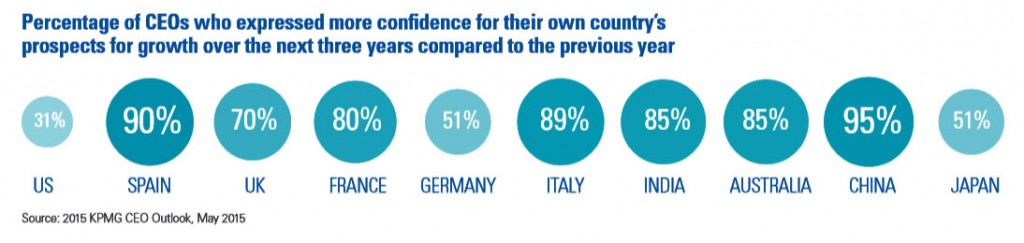
It is also interesting that American CEOs are more pessimistic about growth prospects than their international brethren:

KPMG CEOs Confidence

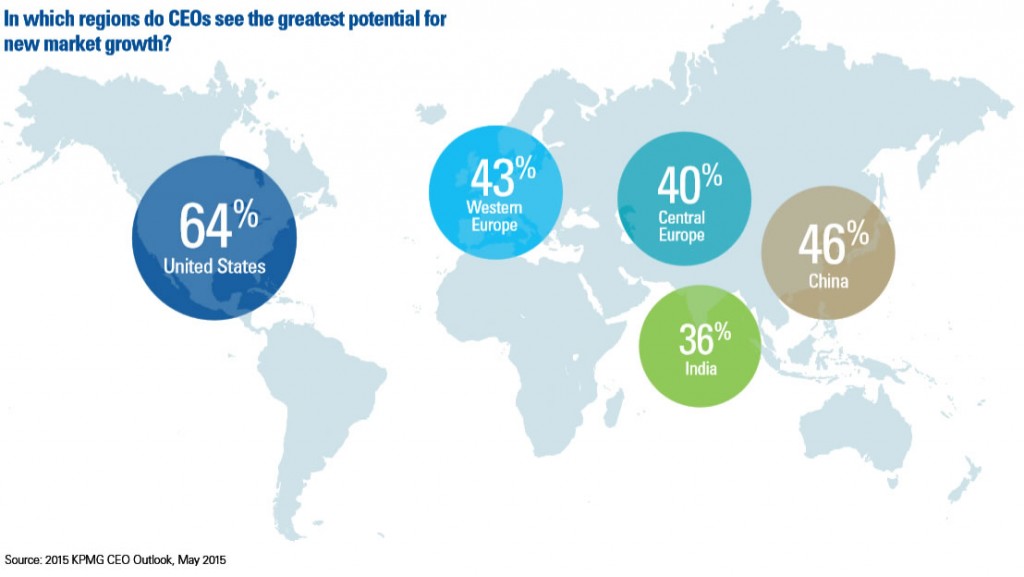
Especially given that survey respondents see the greatest potential for growth in the United States:

KPMG Growth Potential

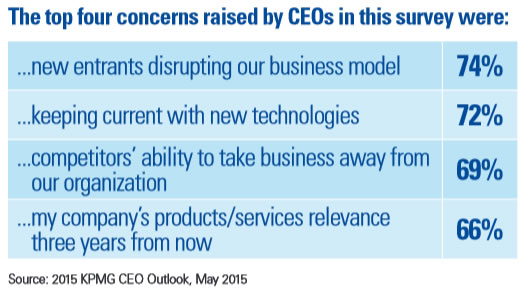
And while American, German, and Japanese CEOs definitely live in the most mature markets, part of their growth pessimism may come from more completely grasping the impact of the top four concerns of CEOs voiced in the survey:

KPMG Top 4 Concerns

“Maintaining status quo, while incredibly comfortable, is the most risky thing you can do in today’s world.” – Mark A. Goodburn, Global Head of Advisory, KPMG

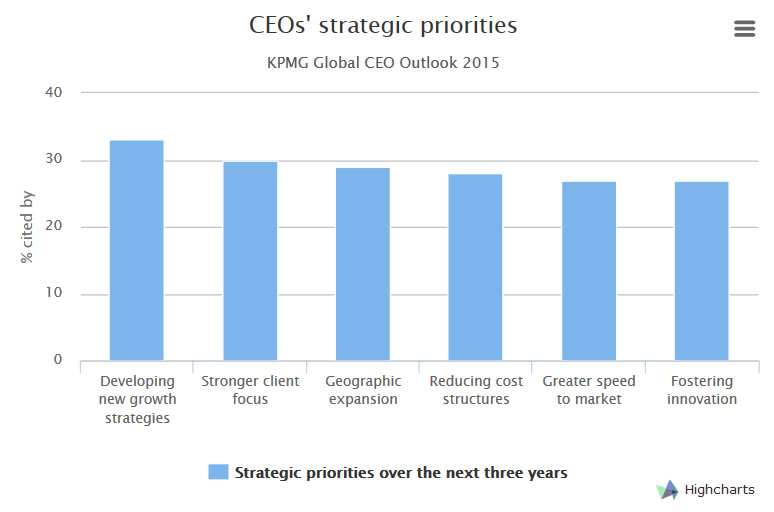
Most interesting for me is the chart at the very top that shows fostering innovation as a lower priority than developing new growth strategies. Obviously innovation is just one component of any holistic growth strategy, but shouldn’t fostering innovation be a little more important if CEOs hope to create sustainable growth?

But it shouldn’t be surprising that this option scored the lowest, because my experience has been that leaders want innovation but they often aren’t willing to invest the dollars required when the rubber hits the road, and even more troublesome is that many leaders don’t understand how to foster innovation. Most CEOs see innovation as a project and not as an organizational capability they need to develop in order to help fend off disruption. Anyways, here are the top three barriers to innovation CEOs identified in the survey:

  1. Rapidly changing customer dynamics
  2. Unsure of which technologies will deliver the greatest return
  3. Budget constraints

Maybe there is no money for innovation and companies are so worried about disruption is because the survey tagged the CFO as the executive gaining the most clout in the C-suite and the CIO came in last. Just a thought.

So what’s holding you back from making sustained innovation a priority?

2026 Update: If you would like to see the latest update to this CEO survey (2025) — go here


Accelerate your change and transformation success

Subscribe to Human-Centered Change & Innovation WeeklySign up here to get Human-Centered Change & Innovation Weekly delivered to your inbox every week.

Get More Done

Get More Done

What Matters Most Management (WMMM) is the Key to Success

Most times you’ll see this posed as a question “What matters most?” as people grapple with finding the meaning of life. That is not the case here…

Instead I would like to share with you my simple management philosophy that will help you be more successful in today’s sometimes overwhelming, chaotic world of too many competing demands on your time.

I will help you succeed on a whim! (well, okay a WMMM)

Your success in this case comes from following the whim (or WMMM) of What Matters Most Management. It can be tailored for use in managing your time, a project, etc. For simplicity we’ll look at time management today by popular request (people ask me all the time how I manage to get so much done).

It involves quite simply making a quick inventory of all of the things that you could focus on today, or that you’re being asked to focus on, and identifying three key things:

1. How big of an impact will completing this task have (Hi/Med/Lo)

2. How big of an effort will it take to complete this task (Hi/Med/Lo)

3. When will my energy be the best for completing this task (Morning/Afternoon/Evening)

This daily inventory of tasks can be done in your head, or on paper, depending on how detail oriented you are. After you have your mental or written list, then plan your day, prioritizing of course any tasks with a low effort/high impact combination (often very rare).

You will also want to prioritize any tasks that involve getting others to do work. Getting others started on their work sooner rather than later, will lead to those tasks getting done faster because they are not sitting in your inbox.

Consider also whether it makes sense to start a task you can’t finish today or not. Sometimes there is no advantage to starting something today instead of tomorrow if you’ll end up finishing it tomorrow either way. Other times there will be tasks you need to finish tomorrow that you’ll have to start today to make it work. Going through this exercise is how you’ll identify What Matters Most (WMM).

I find this method to suit an organic person like me much more than a rigid system like Franklin Covey, plus systems like that don’t take into account when the ideal time might be to do a certain type of work based on the composition of your day and personal energy patterns. Save up somewhat mindless, administrative type work for when you’re brain is tired and do your more creative, intense work when your mind is fresh.

It’s also amazing how frequently the Pareto Principle proves out (where the items that deliver 80% of the value only require 20% of your effort, and vice versa). Focus on that 20% that will drive the 80% of your potential positive perception in the minds of others and in tangible impact in your life.

The WMMM approach works the same on projects, and can be super powerful when a family, project team, etc. all follow a similar philosophy.

The WMMM approach can also be used by product managers and entrepreneurs to create more successful products and services!

Go ahead! Try it! I think you’ll find that you’ll get more done, and sometimes more importantly, people will notice.

Image credit: earningmoneytoday.com

This article originally appeared on Linkedin


Accelerate your change and transformation success

Subscribe to Human-Centered Change & Innovation WeeklySign up here to get Human-Centered Change & Innovation Weekly delivered to your inbox every week.

Last Chance for Nominations for the 2015 Distinguished Achievement Awards

Thinkers50 - Nominations and Votes NeededAugust 1st is the last day to nominate someone for a 2015 Thinkers50 Distinguished Achievement Award.

I would greatly appreciate your nomination for a 2015 Distinguished Achievement Award in this category:

  • Innovation

Click here to nominate me for the 2015 Distinguished Achievement Award by filling in the following fields with whatever information you would like (I’ve included some thought starters):

Your Name
Your Email
Nominee’s Name: Braden Kelley
Nominee’s email: thinkers50@bradenkelley.com
Awards for which this Thinker is being nominated: INNOVATION
Comments:

Braden Kelley is the author of the five-star book ‘Stoking Your Innovation Bonfire’ from John Wiley & Sons, a chapter in ‘A Guide to Open Innovation and Crowdsourcing’ from Kogan Page, and a new book in January 2016 for Palgrave Macmillan on the next practices of organizational change to complement his upcoming collaborative, visual change planning toolkit. Braden is a recognized thought leader on the topic of continuous innovation and change. He earned his MBA from top-rated London Business School and has published 650+ articles (Wired, The Atlantic, The Washington Post, Social Media Today, and more) and nearly a dozen white papers while living and working in England, Germany, and the United States. He is an experienced public speaker, and in 2006 started what has become the world’s most popular innovation web site, InnovationExcellence.com.

Click here to nominate me for the 2015 Distinguished Achievement Award

Thank you in advance!


There is also a short form at http://www.thinkers50.com/scanning/identify-new-thinkers/ that you can use for identifying new thinkers (and all of the above info works). 😉


I am deeply grateful for your continuing support.

Sincerely,

Braden

Image source: Thinkers50

Subscribe to Human-Centered Change & Innovation WeeklySign up here to get Human-Centered Change & Innovation Weekly delivered to your inbox every week.

Innovation is Human

Innovation is Human

In many ways organizations are like humans, and others have described organizations and organizational change in biological terms before. But this biological context applies to innovation as well, and I’d like to put it forward quickly in simple terms.

As humans we must eat to survive, but if we focus too much on eating, we get unhealthy.

If we don’t focus enough on eating or if we eat the wrong things, we get unhealthy.

If we don’t enjoy enough variety in our experiences, we get unhealthy.

If we don’t spend enough time synthesizing those new experiences to uncover insights via sleep, we get unhealthy.

If we don’t eliminate our waste, we get unhealthy.

And finally, and probably most important to our health, we must exercise to increase our strength, flexibility, agility, reduce our stress levels, to build new capabilities, and to increase our longevity.

But, you can exercise too much, and get unhealthy as well.

The key is balance.

And the same is true for organizations, and parallels for all of these human activities can be drawn to the activities of organizations as well.

And while our interactions with food can be compared to our focus on the day to day operations within the context of the organization, the pursuit of innovation is the exercise for the organization.

And in much the same way that many people resist exercise even though they know it is good for them, many organizations do as well.

But for organizations to stay fit and enjoy a long and productive life, they must strike that balance between a healthy diet and exercise.

So, is your organization going to be fit or fat?

And next time someone in your organization says that innovation isn’t important, or that they can’t focus on it right now, ask them if they think exercise is important, then remind them that innovation like exercise is how we reinvigorate our organizations and keep them vibrant and alive, and go find yourself a carrot stick.

Keep innovating!

Image credit: fitinafatworld.wordpress.com

Subscribe to Human-Centered Change & Innovation WeeklySign up here to get Human-Centered Change & Innovation Weekly delivered to your inbox every week.

13th Annual Change Management Conference Wrapup

13th Annual Change Management Conference WrapupRecently I had the opportunity to attend the 13th Annual Change Management Conference in New York, NY, hosted by The Conference Board. The event represented a convening of 200+ change management professionals from around the United States.

200+ attendees is a pretty decent size, but this larger number of attendees is quite small when you consider the number of people serving in official or unofficial change management roles around the world (either as employees or consultants), or when compared to the number of project managers (estimated at 16.5 million people around the world) and potentially as many as 1.5 million six sigma black belts and green belts sprinkled around the world.

Meanwhile, a couple of the leading training organizations in the change management space have trained just short of 100,000 people in the principles of change management.

If you agree that proactively managing change in organizations is at least as important as the practice of Six Sigma, and potentially as important as project management, that means that as the pace and importance of change continues to gather steam, there could be the need to train between 1.4 million and 16.4 million change management professionals in the next few years.

Insights from The Conference Board’s Council on Change Management

The tweet stream kicked off with a tweet from Joe Rafter of PG&E (@jrafter65) capturing the essence of what was to come:

“Investing in better change & transformation today. Change is in everyone’s role.”

The first session highlighted the Council’s Five Guiding Principles for Changing How We Change:

  1. Agile, Conitnuous and Iterative
  2. Future Focused
  3. Dynamic Conversation & Engagement
  4. Change Leadership From All Levels
  5. Adoption & Behavior Change

Kinthi Sturtevant of IBM highlighted that they are rarely seeing 2, 3 or 4 year projects. Now it’s 30-60-90 day change projects.

We heard John Horn of Prudential talking about their transformation to a focus on talent as a differentiator that is not hr led, but leader led. Interesting that Prudential has talent catalysts in the same way as Intuit has design catalysts.

We heard Barbara Mitchell of Mayo Clinic talking about the importance of embedding your change plan in your project plan. But I disagree with this strategy. The focus should be the reverse. Your project plan should be part of your change plan. In my estimation, project planning should be part of our change planning efforts, but to make this happen we need more change planning tools like my upcoming Change Planning Toolkit™.

Wendy Branche of Tyco spoke about how organizations must make change a capability not just a competency. Distributing and democratizing change must be a priority. At Tyco change is a business process and a leadership competency and positioning change in such a manner has accelerated participation in change.

People First in Change Management

Gisela Paulsen of Genentech spoke about leading people through a difficult transition, and her feelings were captured well in this quote:

“If you lead change with integrity and transparency you can’t go wrong.”

The company had to deal with a product that was dying in two years as a superior product came on the market from a competitor, and one of the ways they dealt with it was by allowing employees to start spending 40% of their time on career development activities.

She spoke about the importance of paying attention to the community and its well-being during the change process, and how leading on the way down is a lot harder and you learn more about leadership than learning during a growth phase.

One other key message from Gisela was that as a change leader, you must be courageous, and not be afraid to ask for things. Who knows? Leadership might say yes!

The Innovation Accelerator

Roberto Masiero and Dr. Eric Hieger of ADP spoke about their efforts to accelerate innovation, and it was funny that they intentionally dressed different to highlight the difference between the old ADP and the new ADP. There

One key question they asked was:

Do we intentionally accelerate pace amplitude scale and complexity in a VUCA environment?
(VUCA being Volatile, Uncertain, Complex, and Ambiguous)

How Do You Measure Change Success?

Tim Creasey of ProSci spoke a lot about the importance of metrics and scorecards. Here are a couple of the key takeaways:

Tim Creasey’s definition of Change Management is “catalyzing individual transitions to deliver organizational results.”

  1. Most of the people at the conference feel they do a poor job of measuring change management performance
  2. My big takeaway was that many times the ROI of change mgmt activities are likely baked into the overall ROI for systems projects especially, but the investment and the commitment is not. You need to highlight this for people. Vendors are going to highlight their most successful projects in helping calculate ROI, but those projects are also most likely to have invested in change management.

Rethinking Change

Lior Arussy of Strativity spoke about rethinking change including the following question:

What would happen if your scorecard was stories you collected instead?

Change is not an island.

The talk prompted this question in my mind:

Does everyone agree that transformation is used for change with a capital c?

Most organizations still don’t recognize need for a sustainable change management practice. This must change.

The $1 Billion Wakeup Call

Melanie Francis spoke about her observations of how as organizations approach $1 Billion in revenue that change management begins to become formalized into the organization.

Do You Speak Digital?

Sheila Chavda of McDonald’s spoke about some of the changes they’ve undergone in building a stronger digital focus at the company, including some of their focus areas:

  1. Direction and Leadership
  2. Culture, Climate, and Accountability
  3. Coordination and Control
  4. Capabilities, Motivation and External Orientation
  5. Innovation and Learning

Sheila shared a great story about an ophthalmologist who created an application called Peek that is capable of turning a smartphone into an eye exam tool (without the corresponding usual expense), making eye care more accessible worldwide.

Here is a great quote from Sheila:

“Game changing insights aren’t enough, without repeatable processes they become hallucinations of a really smart guy.”

Meanwhile, in the other session Chris Gray of Bridge Consulting shared this gem – “A butterfly is not a better caterpillar.”

Korn Ferry Research Results

Scott Stevenson of Korn Ferry shared some of their findings from research focusing on learning agility and change leadership. Their findings included:

  • People must decide to learn something new for change success to occur
  • Change management requires accurately predicting how a group will learn what is needed and managing to their individual/collective learning styles
  • Innovation strategies require more mental agility and change agility

Finally, Scott shared how he was always surprised by how little organizations invest in understanding employee drivers.

Leading Through Change

Shannon Wallace of GM shared stories of their transition in HR from executive HR to shared services model and the unexpected resistance they faced from HR employees.The resistance came from people being used to being the person people depended on. People were used to being firefighters. They decided to use pie charts to show difference in how people will spent their time before the change and how they will spend it post change. They also developed a “What would you do?” set of scenarios based on all of the different questions they got from people. They also created ~50 different modules to help people understand how different scenarios were going to change in the new model.

Creating the Future Together

Kelley Kurtzman of Verizon Wireless spoke about how as technology shifts, peoples expectations shift, and how their approach to employees and change focuses on three stages:

  1. Engage
  2. Educate
  3. Empower

Kelley also mentioned that any great employee engagement program has to be grounded in employee concerns.

One thing Verizon Wireless did to increase employee engagement and cooperation was to create ride-along video snippets so people can see what different tasks look like. Kelley talked about the power of involving employees in designing the solutions that will make them more productive. One result was to provide front line call center supervisors at Verizon Wireless with tablets with call metrics on them so they can be on the floor instead of off in a separate cubicle.

Finally, Kelley shared a great metaphor about the interaction between EQ and IQ as it relates to Emotional Intelligence:

“EQ is the front wheel of bicycle (Direction) while IQ is the back wheel (Power).”

Is Your Change Management Agile?

Paul O’Keeffe and Randy Wandmacher of Accenture Strategy spoke first about how in the digital age, expectations are different. We’ve heard people say at the conference that if they can’t see results this quarter, it’s too slow.

They continued on by discussing how research shows that change doesn’t cause organizations to go off track, it exposes organizational dysfunction. Too much change too fast is not destructive, high performing organizations go at a pace slightly faster than that of ordinary ones. The reason this is true is that people don’t have to go through the prototypical change ‘valley of despair’. High performing organizations have the agility to skip the ‘valley of despair’. One way they do is by building and maintaining a high level of trust in the organization.

People’s acceptance of #change is not a smooth curve, but a step function, increasing where intellectual understanding intersects with emotional agreement. The best organizations realize the benefits of change, build people’s change capabilities, end in good place with each change effort, so there is an appetite to do more change and to continue to improve business performance.

Becoming change agile means building a capability to successfully manage change on a daily basis. The steps in our change model to enable agility include:

  1. Clearly define the intended business performance and desired benefits
  2. Understand the organizational context/health
  3. Vision
  4. Leadership
  5. Resources
  6. Discipline
  7. Energy

The insights from Vision, Leadership, Resources, Discipline and Energy are used to master the dynamics occurring in the organization.

Poor performing organizations have a disconnect in perceived performance on Leadership and Teamwork. Poor performing organizations have a higher level of fear and frustration. Organizations that attain the highest levels of performance are those that truly thrive on change.

Most organizations would like to be more agile according to votes here at the conference, but few have it as C-suite priority. In fact, most organizations miss an opportunity during big projects like ERP to build capabilities for the future in change and agility.

The future of change agility should be to focus on insight-driven change, building capabilities and being change navigators.

Finally, it’s crazy that @innovate has more Twitter followers than @AccentureStrat. 😉

Closing Session with The Conference Board’s Council on Change Management

In the closing session Molly Breazeale shared this quote to keep in mind about relationships as you think through your change efforts:

“The conversation is the relationship.” – Susan Scott

Kent Greenes of The Conference Board spoke about co-creation and the difference between involvement and inclusion and the importance of organizing management and non-management input together in a common group to help move people from ‘I’ to ‘We’. “Imagine the look you’re going to get from your CEO when you say that leading change from the top is not enough.”

Isabelle Suares of Cisco spoke about how the speed of market changes requires greater speed internally in order to realize an ROI on our products. Increasingly shorter windows of opportunity to monetize intellectual property before newer technology supplants it. Co-Design embedded in all initiatives at Cisco, in all phases, in an iterative process with full participation.

Lauren Chesley of Verizon Communications spoke about how they wanted leaders to drive transformation, deliver on priorities, and be strong people managers for culture.

Andrea Tennyson of Cargill spoke about how they focus on nine key stakeholders including: customers, suppliers, consumers, employees, communities, governments, and three more. Some of their key focus areas sometimes conflict and from a change standpoint this can be difficult as they look to co-create. For transformation they leveraged their Leadership Forum (1,575 participants – 1,325 virtual & 250 local), and their Change Leader Network, Change Community of Practice, Leadership Academy Alumni, and Corporate Center. They made a shift in decision making away from Change Leadership Team and pushed the ability farther down into the organization.

Finally, a closing thought from Twitter from Tim Creasey of ProSci, and I’m not sure who to attribute it to, but I definitely heard it at the event:

“Go where the bright spots are in your organization – on gaining sponsorship for change management.”

The conference definitely was a whirlwind, and I’d like to thank The Conference Board for putting on a great 13th Annual Change Management Conference and to the organizers for inviting me to cover the event for the Innovation Excellence audience. Hopefully they’ll have me back as a speaker next year at their 14th annual event.

In 2016 my new change management content site will be in full swing and my second book for Palgrave Macmillan (@PalgraveBiz) comes out in January 2016 to highlight the best practices and next practices of organizational change and introduces my new collaborative, visual Change Planning Toolkit™. I’ve got some great guest experts and case studies to include in the book, so stay tuned!

Accelerate your change and transformation success

Subscribe to Human-Centered Change & Innovation WeeklySign up here to get Human-Centered Change & Innovation Weekly delivered to your inbox every week.

Death of the Chief Innovation Officer

Death of the Chief Innovation Officer

Among my innovation peers, we have talked about how crucial executive commitment is, and some organizations have responded by hiring Innovation Managers, Innovation Directors, VP’s of Innovation, and Chief Innovation Officers (CINO’s not CIO’s so there is no confusion with Chief Information Officers).

One of the dangers of putting people in charge of innovation though, is that unless you carefully craft the positions and communicate their place and purpose across the organization, you can leave people feeling that innovation is not their job.

But, the reality is that everyone has a role to play in innovation, and in my five-star book Stoking Your Innovation Bonfire (available at many local libraries) I outlined nine innovation roles that must me filled at the appropriate times for innovation to be successful. The Nine Innovation Roles include:

  1. Revolutionary
  2. Artist
  3. Conscript
  4. Connector
  5. Troubleshooter
  6. Customer Champion
  7. Judge
  8. Magic Maker
  9. Evangelist

It is because everyone has a role to play in innovation, and because everyone is innovative in their own way, that installing a Chief Innovation Officer may not be the best idea.

Any time you put someone in charge of something at that level of the organization, you end up with someone who thinks they are in charge of the area, in control of innovation. And innovation is not something that you should seek to control, but instead to facilitate.

The idea that people are either innovative or not, and either possess the Innovator’s DNA or they don’t, is complete poppycock (feel free to insert a stronger or more colorful word if you’d like, but I’ll try and keep it PG – for now).

Is there is any type of work more in need of a servant leader than the innovation efforts of the company?

So, if you fire your Chief Innovation Officer (CINO) how are you going to make your organization more innovative?

The answer is to hire an Innovation Enablement Leader.

The implication is that this person’s job will be to lead not to manage, and to enable instead of control. The job of an Innovation Enablement Leader is to facilitate the Seven C’s of a Successful Innovation Culture (working title):

  1. Cultivating a Culture of Curiosity
  2. Collection of inspiration and insight
  3. Connections
  4. Creation
  5. Collaboration
  6. Commercialization
  7. Communications

More on the details of the Seven C’s of a Successful Innovation Culture in a future article.

Responsibility for innovation should remain with the business, under an innovation vision, strategy and goals set by the CEO and senior leadership. The job of an Innovation Enablement Leader (or Innovation Facilitator) meanwhile is to serve the rest of the organization and to work across the organization to help remove barriers to innovation and to focus on the Seven C’s of a Successful Innovation Culture. This could also providing a set of tools and methodologies for creative problem solving and other aspects of innovation work, organizing events, and other activities that support deepening capabilities across the Seven C’s of Successful Innovation Culture.

Most organizations have innovated at least once in their existence, and in many organizations people are still innovating. A true Innovation Enablement Leader is more of a coach, supporting emergent innovation, and helping people test and learn, prototype and find the right channel to scale the most promising insight-driven ideas (or work with the organization to create new channels).

So, are you seeking to control innovation with a Chief Innovation Officer or to facilitate it with an Innovation Enablement Leader?

Keep innovating!

P.S. If you’re looking to hire an Innovation Enablement Leader, drop me an email.

Image credit: E Sotera (via interaction-design.org)

This article originally appeared on Linkedin


Accelerate your change and transformation success

Subscribe to Human-Centered Change & Innovation WeeklySign up here to get Human-Centered Change & Innovation Weekly delivered to your inbox every week.
5 Keys to Developing an Innovation Culture

5 Keys to Developing an Innovation CultureThe Interview

Listen to the interview on The Everyday Innovator Podcast

I had the pleasure of being interviewed by Chad McAllister recently for the Everyday Innovator Podcast on the topic of how an organization can become more innovative. Below you will find Chad’s summary of the Five Keys to Developing an Innovation Culture that I shared with him:

  1. Learn the basics of culture change, such as the 8-step Kotter change model or the Leading Change Formula. Braden is developing a Change Planning Toolkit™ based on his experience and research helping organizations change their culture to support innovation. We’ll discuss this in detail in a future interview when the Toolkit is available.
  2. Build a common language of innovation. Define what innovation means for the organization. Braden’s definition is that innovation transforms the useful seeds of invention into widely adopted solutions valued above every existing alternative. Then build vision, strategy, and goals for innovation. Finally, consider what infrastructure is needed to support innovation.
  3. Create a connected organization. Design the organization to apply the additional talents and skills employees have but are not used in their primary role. This “overhang” of capabilities can be applied for innovation by connecting people with the work that needs to be done. One model, used at Cisco, is to create internal internships to contribute to other projects. Another is Intuit’s innovation vacations (my term) that allows employees to take a scheduled break from the regular work to work on a short-term basis for another project.
  4. Identify those who care about innovation. Recognize that some employees are most comfortable in day-to-day operational roles and maintaining the status quo while others are constantly looking to change things for the better. Those that are seeking to make improvements, especially from the customer’s perspective, should be identified to contribute to product development. This also involves unlocking employees’ initiative, creativity, and passion.
  5. Make innovation a team sport. There is no such thing as a lone innovator. All innovators have a team around them. Braden created The Nine Innovation Roles™ for effective innovation teams: revolutionary, conscript, connector, artist, customer champion, troubleshooter, judge, magic maker, and evangelist. See details in the blog post he wrote for Innovation Excellence.

Listen to the interview on The Everyday Innovator Podcast

Image credit: EverythingZoomer.com


Accelerate your change and transformation success

Subscribe to Human-Centered Change & Innovation WeeklySign up here to get Human-Centered Change & Innovation Weekly delivered to your inbox every week.

Drowning in a Sea of Content

Drowning in Content

In #MyIndustry, content creation (I’m an author, keynote speaker and publisher), there is already a flood of content and the flood waters will not recede anytime soon. In fact, the rate of content creation is increasing as more companies launch content marketing and inbound marketing campaigns to pull customers to them.

Before the Internet came along, content was naturally limited by the potential throughput possible through a relatively fixed number of available channels:

  • Handful of TV stations
  • Radio stations
  • 1 or 2 local newspapers
  • A few dozen magazines
  • A handful of book publishers

Things remained relatively stable for several decades, then beginning in about 1980 this began to change. Cable and satellite television began to arrive taking television from a handful of stations to hundreds. The number of magazines began to grow, doubling between 1980-2000 according to Pew Research, online services and eventually the Internet emerged to provide a plethora of alternatives to traditional newspapers, and satellite and internet radio arrived. At the same time Amazon, Lulu and others launched the self-publishing revolution.

The amount of content available to people has exploded over the last 35 years. I saw a statistic recently that more than 1 TRILLION photos will be taken in 2015, compared to 2.7 Trillion photos cumulatively stored through the end of 2014.

With the rate of the content deluge increasing and with none of it draining out the bottom of the Internet bathtub, it will become harder and harder for a content creator like myself to capture people’s attention and to afford to continue to deliver quality insights from research, collaboration, and connection.

Being a content creator is a lot like being a space object, there are lots of asteroids in space, and it is easy to float around as an asteroid, but to carefully tend and cultivate an ecosystem that helps you attract enough mass and an atmosphere capable of generating and growing life is much harder.

Creating unique and differentiated insights to power content that educates, informs, or entertains (or potentially all three) is hard enough, but if you want to create something with its own source of gravity, you need to collect and harness many more skills, while also looking for potential collaborators with complimentary skills.

This will always be true for artists, musicians, authors, and any other kind of content creator. There is no going back?

So, what’s your center of gravity?

And how can you make it stronger?

In my own content creation sphere, I continue to work to strengthen the center of gravity in the innovation arena by working on a site redesign with my great Innovation Excellence co-Founders and the digital professionals at Juice Interactive, and growing a new center of gravity in the change arena with some new partners as we seek contributing authors for an upcoming launch of Charting-Change.com.

Helping to make innovation and change insights accessible for the greater good is what drives me, and I’ll keep doing it as long as I possibly can!

Image credit: Bunchcast


Accelerate your change and transformation success

Subscribe to Human-Centered Change & Innovation WeeklySign up here to get Human-Centered Change & Innovation Weekly delivered to your inbox every week.

Measuring Organizational Agility – The Triple T Metric v1.0

Measuring Organizational Agility - The Triple T MetricThere is an increasing amount of chatter and confusion out there around what organizational agility is and feeling that it must be important to organizational success.

But, before we discuss organizational agility, it is important to define what we mean by the term.

BusinessDictionary.com has a decent definition:

“The capability of a company to rapidly change or adapt in response to changes in the market. A high degree of organizational agility can help a company to react successfully to the emergence of new competitors, the development of new industry-changing technologies, or sudden shifts in overall market conditions.”

Usually people begin speaking about organizational agility and its importance to the success of the organization when they speak about the increasing pace of change, and the challenge the organization faces in keeping up.

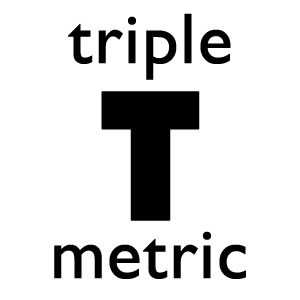
Because of this, one of the key measures of organizational agility you may want to consider using, I like to call the Triple T Metric:

Time
to
Transform

The Triple T Metric is a measure of how long it takes an organization to make a transformation. But to measure your progress on the Triple T Metric over time, you must define it and measure it in a consistent manner. So, if a transformation is like a trip from Point A to Point B, we must define Point A and Point B.

  • Point A = the point in time at which the organization recognizes a change is needed away from the steady state
  • Point B = the point in time at which the organization successfully arrives at the new steady state

You’ll notice that Point A doesn’t start at the point at which people AGREE that a change is needed and AGREE to make it, but at the point the organization RECOGNIZES a change is needed. This is because there is great opportunity to increase your organizational agility by increasing the speed at which the organization moves from recognizing the need for change, to agreeing to change, to planning the change, to executing the change.

This is just v1.0 of our discussion of the Triple T Metric, to introduce the concept. We’ll get into more detail in a future post.

All of these transitions must be included because organizational agility is ultimately about how quickly the organization can successfully plan, lead, and execute (manage and maintain) a change effort, increasing your organizational agility requires that you increase both your change capability and your change capacity.

How fast can your organization change?

If you want to learn how to change faster, and make your organization more agile, grab a copy of Charting Change and the supporting materials for book buyers!


Accelerate your change and transformation success

Subscribe to Human-Centered Change & Innovation WeeklySign up here to get Human-Centered Change & Innovation Weekly delivered to your inbox every week.