Top 10 Human-Centered Change & Innovation Articles of October 2025

Top 10 Human-Centered Change & Innovation Articles of October 2025Drum roll please…

At the beginning of each month, we will profile the ten articles from the previous month that generated the most traffic to Human-Centered Change & Innovation. Did your favorite make the cut?

But enough delay, here are October’s ten most popular innovation posts:

  1. AI, Cognitive Obesity and Arrested Development — by Pete Foley
  2. Making Decisions in Uncertainty – This 25-Year-Old Tool Actually Works — by Robyn Bolton
  3. The Marketing Guide for Humanity’s Next Chapter – How AI Changes Your Customers — by Braden Kelley
  4. Don’t Make Customers Do These Seven Things They Hate — by Shep Hyken
  5. Why Best Practices Fail – Five Questions with Ellen DiResta — by Robyn Bolton
  6. The Need for Organizational Learning — by Mike Shipulski
  7. You Must Accept That People Are Irrational — by Greg Satell
  8. The AI Innovations We Really Need — by Art Inteligencia
  9. Three Reasons You Are Not Happy at Work – And What to Do to Become as Happy as You Could Be — by Stefan Lindegaard
  10. The Nuclear Fusion Accelerator – How AI is Commercializing Limitless Power — by Art Inteligencia

BONUS – Here are five more strong articles published in September that continue to resonate with people:

If you’re not familiar with Human-Centered Change & Innovation, we publish 4-7 new articles every week built around innovation and transformation insights from our roster of contributing authors and ad hoc submissions from community members. Get the articles right in your Facebook, Twitter or Linkedin feeds too!

Build a Common Language of Innovation on your team

Have something to contribute?

Human-Centered Change & Innovation is open to contributions from any and all innovation and transformation professionals out there (practitioners, professors, researchers, consultants, authors, etc.) who have valuable human-centered change and innovation insights to share with everyone for the greater good. If you’d like to contribute, please contact me.

P.S. Here are our Top 40 Innovation Bloggers lists from the last four years:

Subscribe to Human-Centered Change & Innovation WeeklySign up here to get Human-Centered Change & Innovation Weekly delivered to your inbox every week.

Cutting-Edge Ways to Decouple Data Growth from Power and Water Consumption

The Sustainability Imperative

LAST UPDATED: November 1, 2025 at 8:59 AM

Cutting-Edge Ways to Decouple Data Growth from Power and Water Consumption

GUEST POST from Art Inteligencia

The global digital economy runs on data, and data runs on power and water. As AI and machine learning rapidly accelerate our reliance on high-density compute, the energy and environmental footprint of data centers has become an existential challenge. This isn’t just an engineering problem; it’s a Human-Centered Change imperative. We cannot build a sustainable future on an unsustainable infrastructure. Leaders must pivot from viewing green metrics as mere compliance to seeing them as the ultimate measure of true operational innovation — the critical fuel for your Innovation Bonfire.

The single greatest drain on resources in any data center is cooling, often accounting for 30% to 50% of total energy use, and requiring massive volumes of water for evaporative systems. The cutting edge of sustainable data center design is focused on two complementary strategies: moving the cooling load outside the traditional data center envelope and radically reducing the energy consumed at the chip level. This fusion of architectural and silicon-level innovation is what will decouple data growth from environmental impact.

The Radical Shift: Immersive and Locational Cooling

Traditional air conditioning is inefficient and water-intensive. The next generation of data centers is moving toward direct-contact cooling systems that use non-conductive liquids or leverage natural environments.

Immersion Cooling: Direct-to-Chip Efficiency

Immersion Cooling involves submerging servers directly into a tank of dielectric (non-conductive) fluid. This is up to 1,000 times more efficient at transferring heat than air. There are two primary approaches: single-phase (fluid remains liquid, circulating to a heat exchanger) and two-phase (fluid boils off the server, condenses, and drips back down).

This method drastically reduces cooling energy and virtually eliminates water consumption, leading to Power Usage Effectiveness (PUE) ratios approaching the ideal 1.05. Furthermore, the fluid maintains a more stable, higher operating temperature, making the waste heat easier to capture and reuse, which leads us to our first case study.

Case Study 1: China’s Undersea Data Center – Harnessing the Blue Economy

China’s deployment of a commercial Undersea Data Center (UDC) off the coast of Shanghai is perhaps the most audacious example of locational cooling. This project, developed by Highlander and supported by state entities, involves submerging sealed server modules onto the seabed, where the stable, low temperature of the ocean water is used as a natural, massive heat sink.

The energy benefits are staggering: developers claim UDCs can reduce electricity consumption for cooling by up to 90% compared to traditional land-based facilities. The accompanying Power Usage Effectiveness (PUE) target is below 1.15 — a world-class benchmark. Crucially, by operating in a closed system, it eliminates the need for freshwater entirely. The UDC also draws nearly all its remaining power from nearby offshore wind farms, making it a near-zero carbon, near-zero water compute center. This bold move leverages the natural environment as a strategic asset, turning a logistical challenge (cooling) into a competitive advantage.

Case Study 2: The Heat Reuse Revolution at a Major Cloud Provider

Another powerful innovation is the shift from waste heat rejection to heat reuse. This is where true circular economy thinking enters data center design. A major cloud provider (Microsoft, with its various projects) has pioneered systems that capture the heat expelled from liquid-cooled servers and redirect it to local grids.

In one of their Nordic facilities, the waste heat recovered from the servers is fed directly into a local district heating system. The data center effectively acts as a boiler for the surrounding community, warming homes, offices, and water. This dramatically changes the entire PUE calculation. By utilizing the heat rather than simply venting it, the effective PUE dips well below the reported operational figure, transforming the data center from an energy consumer into an energy contributor. This demonstrates that the true goal is not just to lower consumption, but to create a symbiotic relationship where the output of one system (waste heat) becomes the valuable input for another (community heating).

“The most sustainable data center is the one that gives back more value to the community than it takes resources from the planet. This requires a shift from efficiency thinking to regenerative design.”

Innovators Driving the Sustainability Stack

Innovation is happening at every layer, from infrastructure to silicon:

Leading companies and startups are rapidly advancing sustainable data centers. In the cooling space, companies like Submer Technologies specialize in immersion cooling solutions, making it commercially viable for enterprises. Meanwhile, the power consumption challenge is being tackled at the chip level. AI chip startups like Cerebras Systems and Groq are designing new architectures (wafer-scale and Tensor Streaming Processors, respectively) that aim to deliver performance with vastly improved energy efficiency for AI workloads compared to general-purpose GPUs. Furthermore, cloud infrastructure provider Crusoe focuses on powering AI data centers exclusively with renewable or otherwise stranded, environmentally aligned power sources, such as converting flared natural gas into electricity for compute, tackling the emissions challenge head-on.

The Future of Decoupling Growth

To lead effectively in the next decade, organizations must recognize that the convergence of these technologies — immersion cooling, locational strategy, chip efficiency, and renewable power integration — is non-negotiable. Data center sustainability is the new frontier for strategic change. It requires empowered agency at the engineering level, allowing teams to move fast on Minimum Viable Actions (MVAs) — small, rapid tests of new cooling fluids or localized heat reuse concepts — without waiting for monolithic, years-long CapEx approval. By embedding sustainability into the very definition of performance, we don’t just reduce a footprint; we create a platform for perpetual, human-driven innovation.

You can learn more about how the industry is adapting to these challenges in the face of rising heat from AI in the video:

This video discusses the limitations of traditional cooling methods and the necessity of liquid cooling solutions for next-generation AI data centers.

Disclaimer: This article speculates on the potential future applications of cutting-edge scientific research. While based on current scientific understanding, the practical realization of these concepts may vary in timeline and feasibility and are subject to ongoing research and development.

UPDATE: Apparently, Microsoft has been experimenting with underwater data centers for years and you can learn more about them and progress in this area in this video here:

Image credit: Google Gemini

Subscribe to Human-Centered Change & Innovation WeeklySign up here to get Human-Centered Change & Innovation Weekly delivered to your inbox every week.

To Survive the Sudden Acceleration You Need a Navigator’s Mindset

To Survive the Sudden Acceleration You Need a Navigator's Mindset

GUEST POST from Robert B. Tucker

When I began writing Build a Better Future six years ago, I thought I was writing a book about managing change. I didn’t realize we were entering the fastest-evolving era in human history — an era where the pace of change sometimes outstrips our ability to process it.

Events kept overtaking me. Drafts grew outdated before the ink was dry. What I came to see is that thriving in what is being called the Age of Acceleration demands something new; not a roadmap, but a compass. Not a fixed plan, but a mindset. That compass, I’ve come to believe, is made up of seven essential navigational mindsets. Together, they form a way of thinking and meeting reality that equips us to meet the future with resilience, clarity, and purpose.

1. The Preparedness Mindset: Learning to Expect the Unexpected

Preparedness begins with the acceptance that disruption is the new normal. COVID-19 taught us that the unthinkable can become tomorrow’s headline. Leaders like Dr. Andrew Smith of the Rowan-Salisbury School System in North Carolina didn’t have a pandemic playbook to follow — but they had a mindset. Smith stepped back, assessed, and used a simple business tool to restore order amid chaos.

Preparedness isn’t about fear; it’s about readiness. It’s the ability not just to bounce back, but to bounce forward. Whether facing the next pandemic, a job transition, or a technological revolution, this mindset helps us stay grounded when the winds of change howl.

2. The Futurist Mindset: Learning to Spot the Signals Amid the Noise

Futurists don’t predict the future; we can’t. What we do is forecast change, whether social, demographic, technological, geopolitical, or otherwise. Like meteorologists, we forecast what is most likely to occur. We look beyond the noise of the daily news cycle to discern patterns and “weak signals” of what’s emerging. In Build a Better Future, I introduced the D.I.T.O. framework: Direction, Implications, Threats, and Opportunities. It’s a simple but powerful tool to think through what’s changing, why it matters, and how to respond.

The challenge today isn’t the lack of information; it’s information overload. We live in what I call an “attention-fracking economy” — where our focus is mined, monetized, and sold to the highest bidder. Adopting the Futurist Mindset gives us a tool for reclaiming our attention and redirecting it toward insight rather than distraction.

3. The Adaptability Mindset: Learn, Unlearn, Relearn

As an innovation advisor and “coach” to C-suite executives for 30 years, I’ve had a ringside seat working with disrupted companies and industries. In the Age of Acceleration, denial of marketplace change is a growing liability. Kodak, Nokia, and Sears learned that lesson too late.

But adaptability is not about giving up your principles. If you told your employees that diversity and inclusion are important values, but then capitulate to political winds, that’s not adaptation but conformity. True adaptation requires discernment: knowing when to bend and when to stand firm. People like Dietrich Bonhoeffer, Nelson Mandela, and Aleksey Navalny remind us that sometimes the most courageous adaptation is moral resistance.

4. The Human Agency Mindset: Take Back the Inner-Compass

Even as AI and automation reshape work and life, we remain the authors of our own story. Yet our sense of agency — our belief that we can influence events — is under siege. Endless scrolling, algorithmic manipulation, and the loneliness epidemic are symptoms of a deeper erosion of human will.

Reclaiming agency starts with awareness: What’s going into your mind each hour? What are you allowing to shape your worldview? Technology can amplify our creativity or numb it; the choice is ours. As I like to remind my audiences, we’re not backseat passengers in someone else’s self-driving car. We can grab the wheel.

5. The Long View Mindset: Think Beyond the Quarter

Most of us live in the tyranny of the immediate — the next deadline, the next quarter, the next news alert. The Long View Mindset restores perspective. It reminds us that today’s actions echo into tomorrow’s outcomes.

As former Treasury Secretary Robert Rubin once noted, “Evaluating past decisions is one of the most overlooked leadership disciplines.” History doesn’t repeat itself, but it rhymes. When we connect past, present, and future, we make wiser decisions — and build legacies that endure.

6. The Anticipatory Mindset: Learning to See Around Corners

Every decision — from choosing a career path to making a certain investment — is a bet on the future. The Anticipatory Mindset helps us make those bets intelligently. Psychologist Philip Tetlock’s research shows that the best forecasters aren’t gurus with crystal balls; they’re thoughtful people who continually update their assumptions, seek diverse viewpoints, and stay humble about what they don’t know.

In organizations and in life, the goal isn’t to be certain — it’s to be ready.

7. The Visionary Mindset: Lead With Imagination and Integrity

Our age is not short of visionaries; it’s short of genuine ones. The tech barons who promise that AI will “save humanity” are often selling something — mainly their stock. The Visionary Mindset calls us to look higher.

History offers models of authentic vision: Pierre Teilhard de Chardin’s evolutionary spirituality, Barbara Marx Hubbard’s call for conscious evolution, Buckminster Fuller’s insistence that we design our way to abundance. Real visionaries don’t surrender to decline; they create alternatives. They see the possible amid the peril — and they invite others to help build it.

Becoming a Modern Navigator

Taken together, these seven aptitudes form what I call the Navigator’s Mindset — a way of approaching life with curiosity, courage, and moral clarity. Navigators are those who don’t fear change but face it with intelligence and resolve. They see opportunity in turbulence and responsibility in leadership.

The world will keep accelerating. Technologies will keep advancing. Institutions will keep straining under the pressure of transformation. But your mindset — your compass — remains yours to shape. There is no final destination in the Age of Acceleration — only direction, purpose, and the daily courage to keep steering toward a better tomorrow.

The future is not set in stone. It’s something we build: one day, one choice, and one good decision at a time.

This article originally appeared in Forbes

Image credit: Pixabay

Subscribe to Human-Centered Change & Innovation WeeklySign up here to get Human-Centered Change & Innovation Weekly delivered to your inbox every week.

Four Pillars of Innovation

People, Learning, Judgment and Trust

Four Pillars of Innovation

GUEST POST from Mike Shipulski

Innovation is a hot topic. Everyone wants to do it. And everyone wants a simple process that works step-wise – first this, then that, then success.

But Innovation isn’t like that. I think it’s more effective to think of innovation as a result. Innovation as something that emerges from a group of people who are trying to make a difference. In that way, Innovation is a people process. And like with all processes that depend on people, the Innovation process is fluid, dynamic, complex, and context-specific.

Innovation isn’t sequential, it’s not linear and cannot be scripted.. There is no best way to do it, no best tool, no best training, and no best outcome. There is no way to predict where the process will take you. The only predictable thing is you’re better off doing it than not.

The key to Innovation is good judgment. And the key to good judgment is bad judgment. You’ve got to get things wrong before you know how to get them right. In the end, innovation comes down to maximizing the learning rate. And the teams with the highest learning rates are the teams that try the most things and use good judgement to decide what to try.

I used to take offense to the idea that trying the most things is the most effective way. But now, I believe it is. That is not to say it’s best to try everything. It’s best to try the most things that are coherent with the situation as it is, the market conditions as they are, the competitive landscape as we know it, and the the facts as we know them.

And there are ways to try things that are more effective than others. Think small, focused experiments driven by a formal learning objective and supported by repeatable measurement systems and formalized decision criteria. The best teams define end implement the tightest, smallest experiment to learn what needs to be learned. With no excess resources and no wasted time, the team wins runs a tight experiment, measures the feedback, and takes immediate action based on the experimental results.

In short, the team that runs the most effective experiments learns the most, and the team that learns the most wins.

It all comes down to choosing what to learn. Or, another way to look at it is choosing the right problems to solve. If you solve new problems, you’ll learn new things. And if you have the sightedness to choose the right problems, you learn the right new things.

Sightedness is a difficult thing to define and a more difficult thing to hone and improve. If you were charged with creating a new business in a new commercial space and the survival of the company depended on the success of the project, who would you want to choose the things to try? That person has sightedness.

Innovation is about people, learning, judgement and trust.

And innovation is more about why than how and more about who than what.

HALLOWEEN BONUS: Save 30% on the eBook, hardcover or softcover of Braden Kelley’s latest book Charting Change (now in its second edition) — FREE SHIPPING WORLDWIDE — using code HAL30 until midnight October 31, 2025

Image credit: Unsplash

Subscribe to Human-Centered Change & Innovation WeeklySign up here to join 17,000+ leaders getting Human-Centered Change & Innovation Weekly delivered to their inbox every week.

Measuring Human vs. AI Satisfaction

Insights from Customer Contact Week (Nashville)

LAST UPDATED: October 30, 2025 at 1:00PM

Measuring Human vs. AI Satisfaction

by Braden Kelley

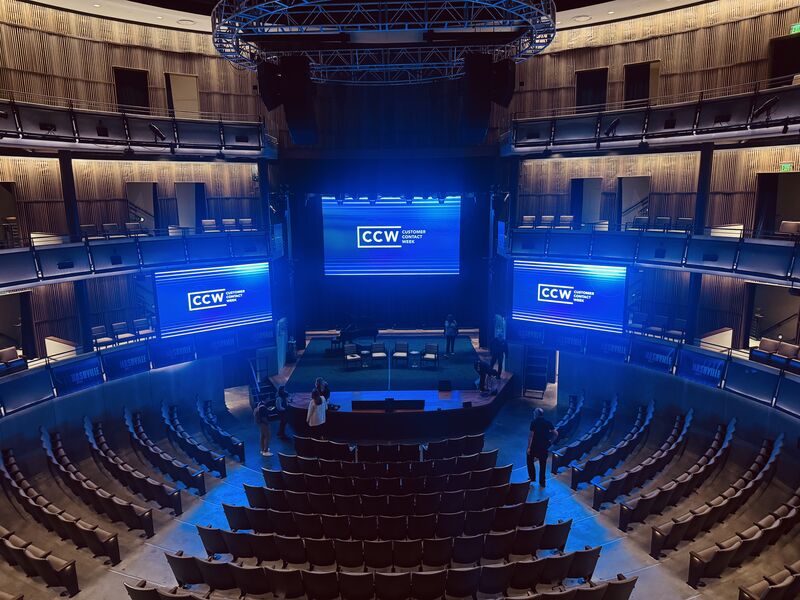
One of the sessions I had the opportunity to attend at Customer Contact Week in Nashville featured Brian Cantor (Customer Management Practice), Gene Kropfelder (Ally Financial) and Scott Rhinehart (Alorica). Two overarching themes of the session were that bringing technology and human elements together continues to be a challenge and that with every interaction you are either building or destroying trust. Gene highlighted that his outlook is that people don’t need another bank they need a better bank, and this mindset is something that he tries to help permeate throughout the organization. Two ways they try to be that better bank in customer experience terms is by first, creating transparency around the wait times in different support channels and second, by trying to make every interaction feel different/better than the interactions they have with Ally’s competitors.

Artificial Intelligence (AI) was obviously a focus of the session and the fact that personalization requires knowing the interactions a customer has had and what they’ve been exposed to, but AI (or humans) have to leverage that knowledge in a helpful and not a creepy way.

When it comes to AI, it’s not what AI can do, but what does it do better and what activities should it take on. Implementing AI in any situation should start with a shared understanding of what problem you’re trying to solve, clearly defined outcomes (work backwards from these, utilizing well-defined checkpoints), a well-communicated WIFM (What’s in it for me?), and a crawl/walk/run approach. Don’t go too big too fast.

We have learned along the way that artificial intelligence can be very useful for helping support agents lean in with the information they (and customers) need. AI as a tool to summarize research query responses versus a list of search results (links). AI can help us understand where agents are spending the time and serve as a knowledge base auditor (article inconsistencies, gaps, etc.).

One important question that came up is “How can we help with handle time?”:

  • CSAT and NPS are important but handle time is important not just for the company (cost) but also for the customer – so they can get back to their life

A more challenging question that all contact center managers must ask is “How do you measure AI satisfaction versus human satisfaction?”:

  • The reason this is a challenging questions is because most of the easily solvable questions will go the AI and the cases that often don’t have a good resolution will be the ones that go to humans
  • At the same time we need to consider the impact of automating certain types of calls (often the easy ones). Will this make the human’s job more stressful (no easy calls)? Will they need more breaks as a result?
  • In the quest for efficiency be careful not to have your humans provide a robotic experience (reading scripts, no authority or decision making capability or flexibility)

Our humanity (both customer and employee) will always be important. Both have to learn to trust AI outputs, impacting the rate and amount of adoption, especially if you don’t have a plan for how to build that trust over time. And, it is important to have human retain accountability – AI generated, human reviewed before submission (i.e. call summaries). Finally, it is important to understand that while we may view the digital native generations as preferring a technological solution, the reality is that even the younger generations will still reach out for a human touchpoint on important questions/issues. So we humans are safe – for now.

HALLOWEEN BONUS: Save 30% on the eBook, hardcover or softcover of my latest book Charting Change (now in its second edition) — FREE SHIPPING WORLDWIDE — using code HAL30 until midnight October 31, 2025

Image credits: Customer Management Practice

Subscribe to Human-Centered Change & Innovation WeeklySign up here to get Human-Centered Change & Innovation Weekly delivered to your inbox every week.

Doing the Basics Can Be Surprising

Doing the Basics Can Be Surprising

GUEST POST from Shep Hyken

Just in case you didn’t know, I have a weekly customer service and Customer Experience (CX) podcast, Amazing Business Radio, that has been running for 12 years. Each week, I get the honor of interviewing some very smart people. Recently, I met Eric Stone, author of Jumpstart Your Workplace Culture. One of the topics we discussed was the WOW experience.

Before we go further, I have always had concerns about organizations that attempt to WOW their customers at every interaction. It’s just impossible to do. The concept of WOW is often associated with going above and beyond what’s expected, so much so that the customer is “blown away” by the experience. The problem is that’s not always possible. That’s why I took it out of my vocabulary and started using the word amazing to describe what I think WOW really is all about, which is a consistent and predictable experience that ALWAYS meets, and only occasionally exceeds, the customer’s expectations. It’s easy to say, “The people at that company are amazing.” It’s a little clunky and awkward to say, “The people at that company are WOW.”

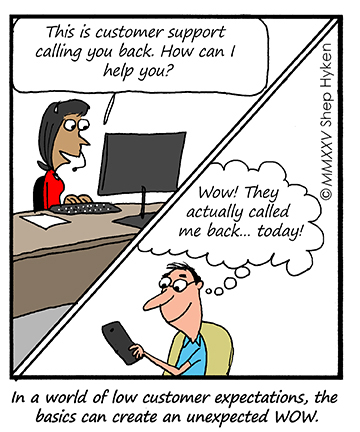
That’s why I loved what Stone said: “Wow is a surprise.” In other words, it’s not about every experience. It’s about the occasional opportunity to surprise a customer. It could be something big, such as handling an emergency situation in which employees go above and beyond. As I said earlier, you can’t count on that type of opportunity for every transaction, but what you can do is find little ways to surprise your customers. For example, if you return a call quickly, the customer might say, “Wow, that was fast!” That’s not an over-the-top or above-and-beyond experience, but it’s a small surprise.

With that in mind, let’s use the return phone call as an example. When you know people are often surprised and make comments like, “Wow, that was fast,” simply because you called them back quickly, don’t just say, “Thank you,” and feel good about the experience. Instead, operationalize the experience. In other words, make quickly returned calls part of your official process. Set a standard, such as all calls are to be returned within two hours (or whatever the appropriate length of time you feel is right for you).

With that as an example, what other interactions do you have with customers that need to be formally operationalized? Here are a few ideas to get your creative juices flowing:

  • All phone calls are to be answered within three rings.
  • A promise to only transfer a customer once, knowing you’ll get the customer to the right person the first time.
  • Proactive updates to inform customers before they reach out to you asking for information.
  • Following up after a resolution to make sure a customer is still happy.
  • Acknowledging customer milestones, such as congratulating them on their 10th order with you, their birthday, etc.

None of these ideas are above-and-beyond types of WOW experiences, but they will cause a customer to notice. Use these examples to help you get creative about finding other simple or small WOWs you can operationalize and make part of the customer’s regular experience when they do business with you.

HALLOWEEN BONUS: Save 30% on the eBook, hardcover or softcover of Braden Kelley’s latest book Charting Change (now in its second edition) — FREE SHIPPING WORLDWIDE — using code HAL30 until midnight October 31, 2025

Image Credits: Pexels

This article was originally published on Forbes.com

Subscribe to Human-Centered Change & Innovation WeeklySign up here to join 17,000+ leaders getting Human-Centered Change & Innovation Weekly delivered to their inbox every week.

The Intersection Between Ethics and Metaphysics

The Intersection Between Ethics and Metaphysics

GUEST POST from Geoffrey A. Moore

Ethics partners with metaphysics in order to create strategies for living. Metaphysics provides the situation analysis and ethics the prescribed course of action. The two are indispensable to one another. Metaphysics without ethics is idle speculation, ethics without metaphysics, arbitrary action. Taken together, however, they supply our fundamental equipment for living.

In that context, ethics is chartered to help us “do good.” It has two central questions to answer: What kind of good should we want to bring about? and What is the right way to achieve that end? Each one raises its own set of issues to work through.

With respect to what is good, the core issue is that, in English at any rate, the word good has three distinct meanings. It can refer to what is pleasurable, what feels good. It can refer to what is fit for purpose, what works good. And it can refer to actions beneficial to others, what I would argue simply is good. Importantly, these three dimensions can team up with one another to create as many as eight different categories of goodness, illustrated by the table below:
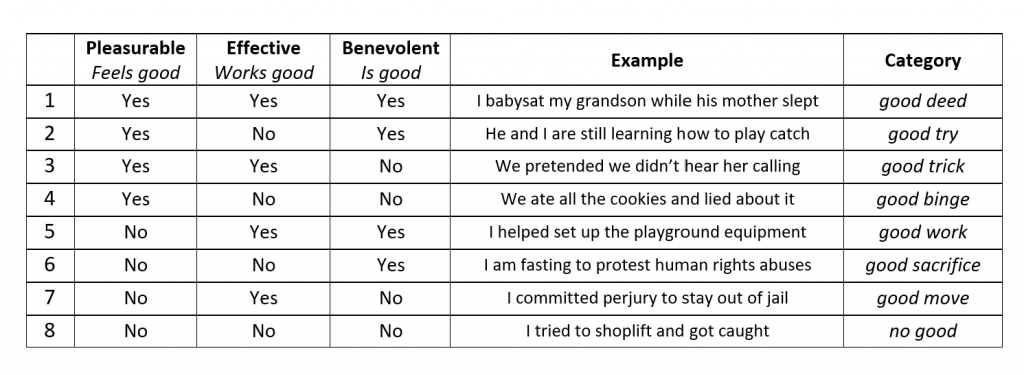
Geoffrey Moore Pleasurable Effective Table

Many of the ethical quandaries philosophers wrestle with arise from trying to unite some or all of these categories into a single concept of goodness. This is simply a mistake. That said, the type of goodness that is most proper to ethics is benevolence, actions beneficial to others (see rows 1,2, 5, and 6). It need not concern itself with either pleasure or effectiveness, both of which, while certainly desirable, are intrinsically amoral.

Focusing on actions beneficial to others, the core of ethics is prescriptive, offering behavioral guidelines that are most likely to generate benevolent outcomes. This is the realm of virtue. Once again, however, there is more than one dimension to take into account, leading to more than one kind of virtue. In this case, it is determined by the situation or context in which the action is undertaken, what we called in The Infinite Staircase the geography of ethics.

The geography of ethics is organized into four zones divided by two defining axes. The first axis distinguishes between society and community, the former being the realm of impersonal third-party relationships, the latter that of personal first-and-second-party relationships). This is essentially the distinction between them and us, and while in its polarized form it can be highly disruptive, it is nonetheless universally observed and absolutely essential to managing human relationships.

The second axis addresses the degree of contact involved, contrasting global situations which involve large populations that have little to no direct contact with each other versus local situations where we participate in exchanges with people we encounter in our daily lives. There is still a distinction between them and us, but local relationships require us to enact and incorporate our responses into our everyday behavior.

When paired, the axes generate four zones, each highlighting a different virtue:
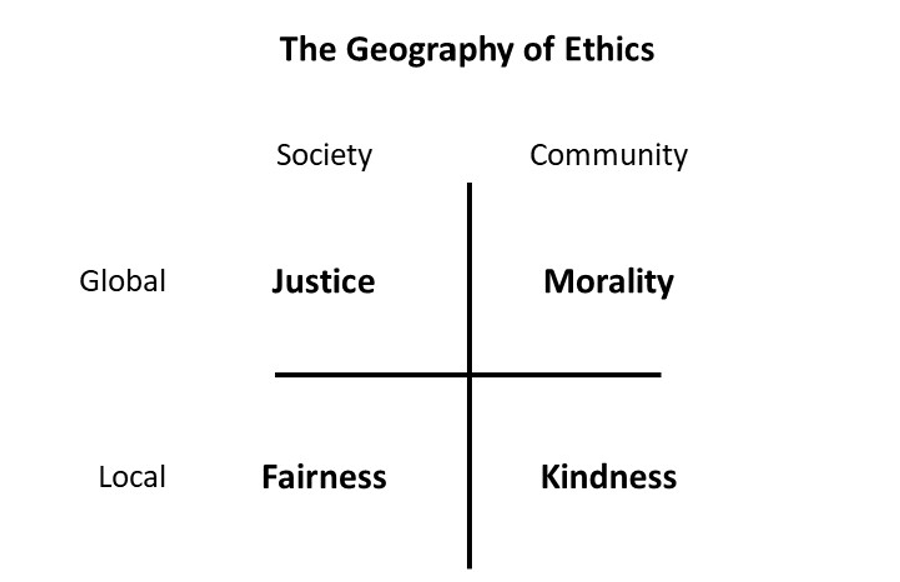
Geoffrey Moore Geography of Ethics

Kindness is unique in that it is the only virtue that is universally valued. It is anchored in unconditional love, something that we as mammals have all personally experienced in our infancy, else we would not be alive today. Unlike the other virtues called out here, it does not depend upon the resources of culture, language, narrative, and analytics to activate itself. Once we engage with those forces, we will find ourselves increasingly at odds with people who have opposing views, but prior to so doing, we are all one family. Kindness, thus, is the glue that holds community together, and as such it deserves our greatest respect.

Fairness comes next. The ability to play fair, something children learn at a very early age, sets us apart from all other animals. That’s because it calls upon narrative and analytics to operationalize itself. Specifically, it asks us to imagine a situation in which we are the other person, and they are us, and to then determine whether or not we would endorse the action under consideration. This is the first bridge to connect us with them, and thus is the foundation for social equity and inclusion. Importantly, it is distinct from kindness, for it is possible to be kind without being fair and to be fair without being kind. Kindness by nature is personal, fairness by nature is impersonal, and together they govern our day-to-day ad hoc relationships.

To scale beyond local governance we must transition from the essentially intuitive disciplines of kindness and fairness to the more formalized ones of morality and justice. Both the latter are essential to social welfare, but neither comes into being easily, and each poses challenges humankind continues to struggle with.

Morality is the actionable extension of metaphysics. It teaches us how to align our behavior with the highest forces in the universe, be they sacred or secular. It does so through inspirational narratives that recruit us into imitating role models and committing to values we will live by, and if necessary, be willing to die for. These values are captured in moral codes that assist our day-to-day decision-making. We judge ourselves and others in terms of how well our actual behavior measures up to these codes.

In this way morality becomes foundational to identity. As such, we want it to be both stable and authoritative. Religion provides stable authority by holding certain texts and traditions to be both sacred and undeniable. This works fine up to the boundaries of the religious faith, but beyond that, it encounters disbelief and unbelief, as well as counter-beliefs, all of which deny such authority. The question for the believers then becomes, is such denial acceptable, or must it be confronted and overcome?

Call this the challenge of righteousness. Deeply moved by their own commitments, the righteous seek to impose moral sanctions on entire populations that do not share their views. The current engagement with abortion rights in the U.S. is a relatively benign example. Conservative parties empowered by the recent action of the Supreme Court are challenging a secular tradition of tolerance that is deeply ingrained in American culture. This tolerance is anchored by the First Amendment’s guarantee of religious freedom, itself a product of the European Enlightenment’s efforts to counteract more than a hundred years of sustained religious warfare between Protestants and Catholics, fueled by righteousness of a similar kind. At present, the First Amendment still has the upper hand, but in other societies, we have watched the opposite unfold, and it can leave deep rents in the social fabric.

Whereas conservatives on the right are challenged when they seek to bend the domain of morality to their ends, progressives on the left are equally challenged when they seek to bend the domain of justice to theirs. Justice represents society’s best attempt to institutionalize fairness at scale. It is comprised of two domains—legal justice and social justice. Legal justice represents the rule of law. It is foundational to safety and security, ensuring accountability with respect to personal acts, laws, elections, and dispute resolution. Social justice, in contrast, represents a commitment to equity. It is aspirational, anchored in empathy for all those who are disadvantaged.

The challenge is that legal justice can reinforce, even institutionalize, social injustice, as both our prison and homeless populations bear witness. This is further exacerbated by failed autocratic states exporting their disadvantaged populations to democratic nations, creating crises of immigration around the world. In response, progressives committed to social justice often seek to subvert legal controls in order to create more equitable outcomes, turning a blind eye to illegal immigration and encampments, as well as misdemeanor crimes like shoplifting and drug use. This has the unintended consequence, however, of encouraging free riders to further exploit these looser controls, pushing the boundaries of tolerance ever closer to intolerability, as cities like San Francisco, Portland, and Seattle can testify.

To operate successfully at scale, both morality and justice call for a balance between accountability and empathy. The righteous tend to withdraw empathy in the name of accountability, the progressives to withdraw accountability in the name of empathy. Neither approach suffices. Citizenship calls for us all to hold these two imperatives in tandem, even when they pull us in opposite directions.

That’s what I think. What do you think?

HALLOWEEN BONUS: Save 30% on the eBook, hardcover or softcover of Braden Kelley’s latest book Charting Change (now in its second edition) — FREE SHIPPING WORLDWIDE — using code HAL30 until midnight October 31, 2025

Image Credit: Unsplash and Geoffrey Moore

Subscribe to Human-Centered Change & Innovation WeeklySign up here to join 17,000+ leaders getting Human-Centered Change & Innovation Weekly delivered to their inbox every week.

The Indispensable Role of CX

Insights from CCW’s 25-Year Journey

LAST UPDATED: October 28, 2025 at 12:00PM
The Indispensable Role of CX

by Braden Kelley

I recently had the privilege of sitting down with Mario Matulich, President of Customer Management Practice, at Customer Contact Week (CCW) in Nashville. As an organization celebrating its 25th anniversary, CCW has been a critical barometer for the entire customer experience and contact center industry. Our conversation wasn’t just a look back, but a powerful exploration of the strategic mandate facing CX leaders today, particularly how we manage innovation and human-centered change in an era dominated by AI and tightening budgets.

CCW at 25: The Hub for Benchmarking and Breakthroughs

Mario underscored that CCW is far more than just a conference; it’s a living repository of industry knowledge. Professionals attend for actionable takeaways, which primarily fall into three categories: benchmarking performance against industry leaders, learning about new trends (like Generative AI’s impact), and, critically, sourcing the right vendors and capabilities needed to execute their strategies. It’s where leaders come to calibrate their investment strategies and learn how to do more with their finite resources.

Mario MatulichThis pursuit of excellence is driven by a single, powerful market force: The Amazon Effect. As Mario put it, customers no longer judge your experience solely against your industry peers. They expect every single touchpoint with your company to be as seamless, intuitive, and effective as the best experience they’ve had anywhere. This constantly escalating bar for Customer Effort Score (CES) and Customer Satisfaction (CSAT) makes a complacent CX investment a near-fatal strategic mistake. The customer experience must always be top-tier, or you simply lose the right to compete.


The Strategic Disconnect: CX vs. The Contact Center

One of the most valuable parts of our discussion centered on the subtle, yet crucial, distinction between a Customer Experience (CX) professional and a Contact Center (CC) professional. While both are dedicated to the customer journey, their scope and focus often differ:

  • The CX Professional: Often owns the entire end-to-end customer journey, from marketing to product use to support. Their responsibilities and definition of success are deeply influenced by where CX sits organizationally — is it under Marketing, Operations, or the CEO?
  • The CC Professional: Focused on the operational efficiency, quality, and effectiveness of the voice and digital support channels. Their reality is one of doing a lot with a little, constantly asked to manage complex interactions while being, ironically, often looked to as a prime source of cuts in a downturn.

Social media, for instance, is still a relevant customer service channel, not just a marketing one. However, the operational reality is that many companies, looking for cost-effective solutions, outsource social media support to Business Process Outsourcing (BPO) providers, highlighting the ongoing tension between strategic experience design and operational efficiency.

“Being a CX leader in your industry is not a temporary investment you can cut and reinstate later. Those who cut, discover quickly that regaining customer trust and market position is exponentially harder than maintaining it.” — Braden Kelley

AI in the Contact Center: From Hypothesis to Hyper-Efficiency

The conversation inevitably turned to the single biggest factor transforming the industry today: Artificial Intelligence. Mario and I agreed that while the promise of AI is vast, the quickest, most immediate win for nearly every organization lies in agent assist.

This is where Generative AI tools empower the human agent in real-time — providing instant knowledge base look-ups, auto-summarizing previous interactions, and drafting responses. It’s a human-centric approach that immediately boosts productivity and confidence, improving Agent Experience (AX) and reducing training time.

However, implementing AI successfully isn’t a “flip-the-switch” deployment. The greatest danger is the wholesale adoption of complex technology without rigor. True AI success, Mario noted, must be implemented via the classic innovation loop: hypothesis, prototyping, and testing. AI isn’t a solution; it’s a tool that must be carefully tuned and validated against human-centered metrics before scaling.

The Mandate for Enduring Investment

A recurring theme was the strategic folly of viewing CX as a cost center. In a downturn, the contact center is often the first place management looks for budgetary reductions. Yet, the evidence is overwhelming: CX leadership is not a temporary investment. When you are leading in your industry in customer experience, that position must be maintained. Cut your investment at your peril, and you risk a long, painful road to recovery when the market turns. The CX team, despite being resource-constrained, often represents the last line of defense for the brand, embodying the human-centered change we preach.

As CCW moves into its next 25 years, the lesson is clear: customer expectations are only rising. The best leaders will leverage AI not just to cut costs, but to augment their people and apply the innovation principles of rigorous testing to truly master the new era of customer orchestration. The commitment to a great customer experience is the single, enduring investment that will future-proof your business.

HALLOWEEN BONUS: Save 30% on the eBook, hardcover or softcover of my latest book Charting Change (now in its second edition) — FREE SHIPPING WORLDWIDE — using code HAL30 until midnight October 31, 2025

Image credits: Customer Management Practice

Content Authenticity Statement: The topic area, key elements to focus on, etc. were decisions made by Braden Kelley, with a little help from Google Gemini to clean up the article.

Subscribe to Human-Centered Change & Innovation WeeklySign up here to get Human-Centered Change & Innovation Weekly delivered to your inbox every week.

Reduce Innovation Risk with this Nobel Prize Winning Formula

Reduce Innovation Risk with this Nobel Prize Winning Formula

GUEST POST from Robyn Bolton

As a kid, you’re taught that when you’re lost, stay put and wait for rescue. Most executives are following that advice right now—sitting tight amid uncertainty, hoping someone saves them from having to make hard choices and take innovation risk.

This year’s Nobel Prize winners in Economics have bad news: there is no rescue coming. Joel Mokyr, Philippe Aghion, and Peter Howitt demonstrated that disruption happens whether you participate or not. Freezing innovation investments doesn’t reduce innovation risk.  It guarantees competitors destroy you while you stand still.

They also have good news: innovation follows predictable patterns based on competitive dynamics, offering a framework for making smarter investment decisions.

How We Turned Stagnation into a System for Growth

For 99.9% of human history, economic growth was essentially zero. There were occasional bursts of innovation, like the printing press, windmills, and mechanical clocks, but growth always stopped.

200 years ago, that changed. Mokyr identified that the Industrial Revolution created systems connecting two types of knowledge: Propositional knowledge (understanding why things work) and Prescriptive knowledge (practical instructions for how to execute).

Before the Industrial Revolution, these existed separately. Philosophers theorized. Artisans tinkered. Neither could build on the other’s work. But the Enlightenment created feedback loops between theory and practice allowing countries like Britain to thrive because they had people who could translate theory into commercial products.

Innovation became a system, not an accident.

Why We Need Creative Destruction

Every year in the US, 10% of companies go out of business and nearly as many are created. This phenomenon of creative destruction, where companies and jobs constantly disappear and are replaced, was identified in 1942. Fifty years later, Aghion and Howitt built a mathematical model proving its required for growth.

Their research also lays bare some hard truths:

  1. Creative destruction is constant and unavoidable. Cutting your innovation budget does not pause the game. It forfeits your position. Competitors are investing in R&D right now and their innovations will disrupt yours whether you participate or not.
  2. Competitive position predicts innovation investments. Neck-to-neck competitors invest heavily in innovation because it’s their only path to the top. Market leaders cut back and coast while laggards don’t have the funds to catch-up. Both under-invest and lose.
  3. Innovation creates winners and losers. Creative destruction leads to job destruction as work shifts from old products and skills to new ones. You can’t innovate and protect every job but you can (and should) help the people affected.

Ultimately, creative destruction drives sustained growth. It is painful and scary, but without it, economies and society stagnate. Ignore it at your peril. Work with it and prosper.

From Prize-winning to Revenue-generating

Even though you’re not collecting the one million Euro prize, these insights can still boost your bottom line if you:

  • Connect your Why teams with your How teams. Too often, Why teams like Strategy, Innovation, and R&D, chuck the ball over the wall to the How teams in Operations, Sales, Supply Chain, and front-line operations. Instead, connect them early and often and ensure the feedback loop that drives growth
  • Check your R&D and innovation investments. Are your R&D and innovation investments consistent with your strategic priorities or your competitive position? What are your investments communicating to your competitors? It’s likely that that “conserving cash” is actually coasting and ceding share.
  • Invest in your people and be honest with them. Your employees aren’t dumb. They know that new technologies are going to change and eliminate jobs. Pretending that won’t happen destroys trust and creates resistance that kills innovation. Tell employees the truth early, then support them generously through transitions.

What’s Your Choice?

Playing it safe guarantees the historical default: stagnation. The 2025 Nobel Prize winners proved sustained growth requires building innovation systems and embracing creative destruction.

The only question is whether you will participate or stagnate.

HALLOWEEN BONUS: Save 30% on the eBook, hardcover or softcover of Braden Kelley’s latest book Charting Change (now in its second edition) — FREE SHIPPING WORLDWIDE — using code HAL30 until midnight October 31, 2025

Image credit: Wikimedia Commons

Subscribe to Human-Centered Change & Innovation WeeklySign up here to join 17,000+ leaders getting Human-Centered Change & Innovation Weekly delivered to their inbox every week.

The Voicebots are Coming

Your Next Customer Support Agent May Not Be a Human

LAST UPDATED: October 27, 2025 at 1:00PM
The Voicebots are Coming

by Braden Kelley

Last week I had the opportunity to attend Customer Contact Week (CCW) in Nashville, Tennessee and learn that the familiar, frustrating tyranny of the touch-tone IVR (Interactive Voice Response) system is finally ending. For too long, the gateway to customer service has felt like a maze designed to prevent contact, not facilitate it. But thanks to the rapid evolution of Conversational AI — fueled by Generative Large Language Models (LLMs) — the entire voice interaction landscape is undergoing a revolutionary, and necessary, change. As a thought leader focused on human-centered change, innovation and experience design, I can tell you the future of the call center isn’t purely automated; it’s intelligently orchestrated.

The voicebot — the modern AI-powered voice agent — is moving past its days as a simple chatbot with a synthesized voice. Today’s AI agents use Natural Language Processing (NLP) to understand intent, context, and even tone, allowing them to handle complex, multi-step issues with startling accuracy. More importantly, they are ushering in the era of the bionic contact center, where the human agent is augmented, not replaced. This hybrid model — where AI handles the heavy lifting and humans provide empathy, complex reasoning, and necessary approvals — is the key to achieving both massive scale and superior Customer Experience (CX).

Overcoming the Voice Friction: The Tech Foundation

The shift to true voice AI required overcoming significant friction points that plagued older systems:

  • Barge-In and Latency: Modern voicebots offer near-instantaneous response times and can handle barge-in (when a customer interrupts the bot) naturally, mimicking human conversation flow.
  • Acoustic Noise: Advanced speech recognition models are highly resilient to background noise and varied accents, ensuring high accuracy even in noisy home or car environments.
  • Intent Nuance: LLMs provide the deep contextual understanding needed to identify customer intent, even when the customer uses vague or emotional language, turning frustrated calls into productive ones.

The Dual Pillars of Voice AI in CX

Conversational AI is transforming voice service through two primary deployment models, both of which reduce Customer Effort Score (CES) and boost Customer Satisfaction (CSAT):

1. Full Call Automation (The AI Front Line)

This model is deployed for high-volume, routine, yet critical interactions. The voicebot connects directly to the company’s backend systems (CRM, ERP, knowledge base) to pull personalized information and take action in real-time. Crucially, these new AI agents move beyond rigid scripts, using Generative AI to create dynamic, human-like dialogue that resolves the issue instantly. This 24/7 self-service capability slashes queue times and dramatically lowers the cost-to-serve.

2. Human-AI Collaboration (The Bionic Agent)

This is where the real human-centered innovation lies. The AI agent handles the bulk of the call — identifying the customer, verifying identity, diagnosing the problem, and gathering data. When the request hits a complexity threshold — such as requiring a policy override, handling an escalated complaint, or needing a final human authorization — the AI performs a contextual handoff. The human agent receives the call along with a complete, structured summary of the conversation, the customer’s intent, and often a recommended next step, turning a frustrating transfer into a seamless, empowered human interaction.

OR, even better can be the solution where a single human agent provides approvals or other guidance to multiple AI voice agents that continue owning their calls while waiting for the human to respond (possibly simultaneously helping the customer with additional queries) before continuing with the conversation through to resolution.

Customer Contact Week Nashville

“The most powerful application of voice AI isn’t automation, it’s augmentation. By freeing human agents from transactional drudgery, we elevate them to be empathic problem solvers, enhancing both their job satisfaction and the customer’s outcome.” — Braden Kelley


Measuring the Success of the Handoff

The quality of the transitions between AI and human is the true measure of success. Leaders must track metrics that assess the efficacy of the handoff itself:

  • Repeat Story Rate: The percentage of customers who have to repeat information to the human agent after an AI handoff. This must be near zero.
  • Agent Ramp-up Time (Post-Transfer): The time it takes for the human agent to absorb the AI-generated context and take meaningful action. Lower is better.
  • Post-Handoff CSAT: The customer satisfaction score specifically captured after a complex AI-to-human transfer, measuring the seamlessness of the experience.

The Agentic Future

The voicebots are indeed coming, and they are bringing with them the most significant shift in customer service since the telephone itself. The next evolution will see agentic AI — bots that can dynamically choose between multiple tools and knowledge sources to resolve novel problems without being strictly pre-scripted. The challenge for leaders is to ensure that as this technology scales, our focus remains firmly on the human experience, leveraging the best of AI’s speed and the best of human empathy to create a truly effortless and satisfying customer journey.

🤖 Companies to Watch in AI Voicebots

The voicebot space is rapidly evolving, driven by generative AI, and the recent Customer Contact Week (CCW) in Nashville highlighted several key players. Companies to watch in this generative AI voicebot and contact center space include market-leading platforms like NICE, Genesys, Zoom and Five9, all of whom are heavily integrating generative and agentic AI features—such as real-time coaching and automated post-call summaries — into their core Contact Center as a Service (CCaaS) offerings.

Beyond the traditional CCaaS providers, specialist AI firms like Replicant, Voice.AI and ASAPP (who had a significant presence at the event) continue to stand out by focusing on either full end-to-end voice automation for complex transactions or providing advanced Human-in-the-Loop AI features to augment live agents, particularly in regulated industries like financial services.

Additionally, major cloud vendors like Google Cloud and AWS (Amazon Connect) are increasingly aggressive, leveraging their foundational AI models to provide scalable, next-generation AI agents and contact center platforms, ensuring they remain transformative forces in customer experience (CX) automation.

HALLOWEEN BONUS: Save 30% on the eBook, hardcover or softcover of my latest book Charting Change (now in its second edition) — FREE SHIPPING WORLDWIDE — using code HAL30 until midnight October 31, 2025

Image credits: Customer Management Practice, Google Gemini

Content Authenticity Statement: The topic area, key elements to focus on, vendors to mention, etc. were decisions made by Braden Kelley, with a little help from Google Gemini to clean up the article.

Subscribe to Human-Centered Change & Innovation WeeklySign up here to get Human-Centered Change & Innovation Weekly delivered to your inbox every week.