Tag Archives: benchmarking

Customer Experience Benchmarking

How Do You Actually Compare?
Customer Experience Benchmarking

by Braden Kelley and Art Inteligencia

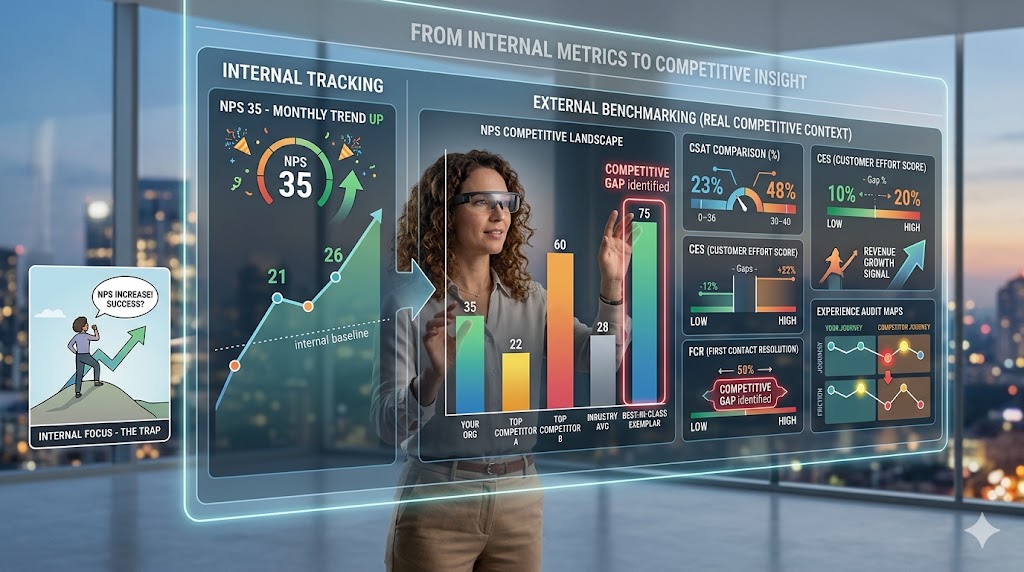
Most organizations benchmark their customer experience against themselves. They track NPS month over month, monitor CSAT scores quarter over quarter, and celebrate when the numbers move up. What they rarely do is answer the question that actually matters for competitive survival: how does our experience compare to what our customers can get elsewhere?

Customer experience benchmarking — the systematic comparison of your experience performance against competitors, industry standards, and best-in-class exemplars — is one of the most underused tools in the CX practitioner’s toolkit. It is also one of the most important. CX leaders generate 6x the revenue growth of bottom-quartile peers, per the Forrester CX Index 2026. The gap between leaders and laggards is widening, not narrowing. Organizations that don’t know where they stand relative to that gap are making investment decisions in the dark.

What is Customer Experience Benchmarking?

Customer experience benchmarking is the process of systematically measuring your organization’s experience performance against external reference points — competitors, industry standards, and best-in-class organizations — to understand where you lead, where you lag, and where investment will generate the greatest competitive return.

It is distinct from customer experience measurement, which tracks your own performance over time. Benchmarking adds the external context that transforms a metric from a number into a signal. A Net Promoter Score of 35 means nothing in isolation. A Net Promoter Score of 35 in an industry where the average is 22 means you are performing above average. A score of 35 in an industry where leaders are at 60 means you have a significant competitive gap to close.

Without benchmarking, organizations routinely invest in improving metrics that are already competitive while ignoring gaps that are costing them customers and revenue.

Why Most CX Benchmarking Falls Short

The most common form of CX benchmarking — comparing NPS, CSAT, and CES scores against published industry averages — is useful but severely limited. CSAT is typically based on how consumers feel about a service or product on a sliding scale, and CES measures how effortless it is for customers to interact with an organization. These are legitimate signals, but they have three critical limitations as benchmarking tools:

They measure what customers say, not what they experience. Survey-based metrics capture customer perceptions at a moment in time, filtered through whatever prompted them to respond. They systematically miss the silent majority — customers who had mediocre experiences but didn’t feel strongly enough to complete a survey — and they overrepresent the emotional extremes.

They measure aggregate outcomes, not specific experience drivers. Knowing your NPS is below industry average tells you that you have a problem. It doesn’t tell you where in the journey the problem lives, what is causing it, or what to fix. Benchmarking aggregate scores without diagnosing the specific experience gaps producing them leads to unfocused investment that improves the score without improving the underlying experience.

They don’t capture the full competitive experience landscape. Published industry benchmarks aggregate across organizations with very different models, customer bases, and experience investments. Your real competitive benchmark is not the industry average — it is the specific alternatives your customers are comparing you to, evaluated on the specific dimensions they care about most.

The Four Levels of Customer Experience Benchmarking

Effective customer experience benchmarking operates at four levels, each providing different and complementary insight:

Level 1: Internal Benchmarking

Comparing your own experience performance across time periods, customer segments, channels, geographies, or business units. Internal benchmarking establishes your baseline, identifies where performance is improving or declining, and surfaces the internal variations that indicate what better is possible — if your highest-performing region or channel is significantly outperforming others, the gap represents an internal benchmark that can be studied and replicated.

Best tools: NPS, CSAT, CES trend analysis; journey analytics; complaint and escalation rate tracking; customer effort mapping across channels.

Level 2: Competitive Benchmarking

Comparing your experience performance directly against the specific competitors your customers are most likely to consider as alternatives. This is the most commercially important form of benchmarking and the most underinvested. Analyzing competitor reviews on platforms like Google and Trustpilot and looking for patterns in customer feedback — recurring praise or common complaints — is a starting point. But the most valuable competitive benchmarking requires actually walking the competitor’s experience firsthand — going through their onboarding, calling their support line, submitting a service request — to understand the experience your customers are comparing you to.

Best tools: Mystery shopping of competitors; competitor review analysis; win/loss interview research; shared customer feedback analysis; direct experience walking.

Level 3: Industry Benchmarking

Comparing your performance against published industry standards and research benchmarks. Tools like Contentsquare’s 2026 Digital Experience Benchmark, built from 99 billion web sessions across 6,500+ websites in 9 industries, provide cross-device behavior data spanning traffic, engagement, frustration, conversion, and retention. Forrester’s CX Index, the ACSI (American Customer Satisfaction Index), and industry-specific research provide standardized benchmarks across NPS, CSAT, and CES by sector.

Best tools: Forrester CX Index; ACSI scores by industry; Contentsquare Digital Experience Benchmark; J.D. Power studies; industry association research.

Level 4: Best-in-Class Benchmarking

Comparing your experience against the best experiences your customers encounter anywhere — not just in your industry, but across the categories they interact with most frequently. This is the most ambitious and most valuable form of benchmarking, because customers don’t evaluate your experience against your direct competitors alone. They evaluate it against every excellent experience they have — Amazon’s delivery reliability, Apple’s onboarding simplicity, Ritz-Carlton’s service recovery. When an experience falls below the best available standard in any category, it registers as inadequate regardless of industry norms.

Best tools: Cross-industry experience research; direct walking of best-in-class exemplars; customer interviews that explicitly ask “what’s the best experience you’ve had with any company in any category, and what made it great?”
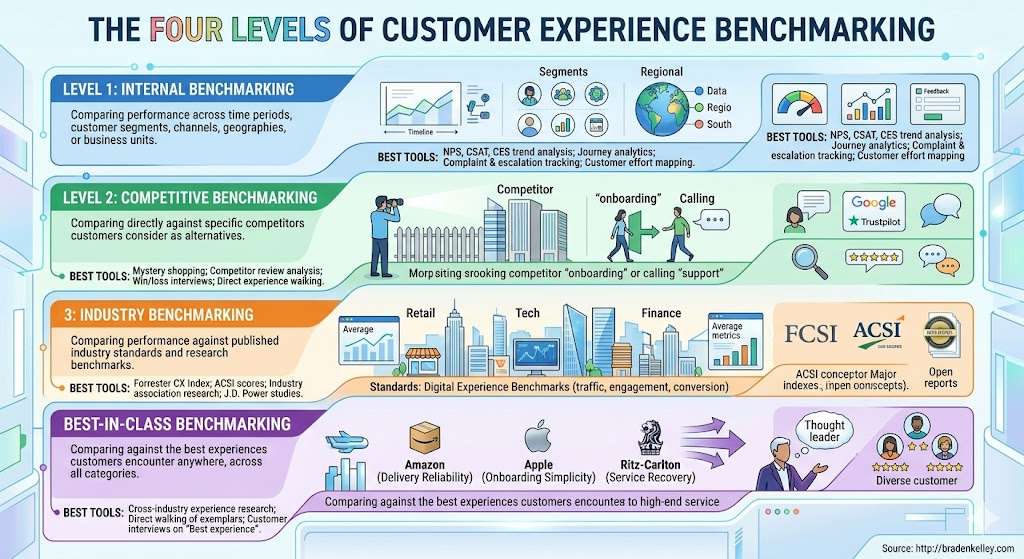
Four Levels of Customer Experience Benchmarking Infographic

Key Customer Experience Benchmarks by Metric

Net Promoter Score (NPS) Benchmarks

NPS ranges from -100 to +100. General interpretation: above 0 is good, above 20 is favorable, above 50 is excellent, above 70 is world-class. Industry averages vary significantly:

  • Technology/SaaS: 35–45 average; leaders 60+
  • Financial Services: 30–40 average; leaders 55+
  • Retail: 40–50 average; leaders 65+
  • Healthcare: 25–35 average; leaders 50+
  • Telecommunications: 15–25 average; leaders 40+
  • Hospitality: 50–60 average; leaders 75+

Customer Satisfaction Score (CSAT) Benchmarks

CSAT is typically measured on a 1–5 or 1–10 scale and converted to a percentage of satisfied respondents. Industry averages cluster around 75–85% across most sectors, with leaders consistently achieving 90%+. ACSI data for 2025–2026 shows overall US customer satisfaction at approximately 77.4 out of 100 across industries.

Customer Effort Score (CES) Benchmarks

CES measures how easy it is for customers to interact with your organization, typically on a 1–7 scale. Lower effort scores are better. Research by CEB (now Gartner) found that reducing customer effort is more predictive of loyalty than delighting customers — 96% of customers with high-effort experiences become more disloyal, versus only 9% of those with low-effort experiences.

First Contact Resolution (FCR) Benchmarks

FCR measures the percentage of customer issues resolved on first contact. Industry average FCR rates cluster around 70–75%, with best-in-class operations achieving 85–90%. Every percentage point improvement in FCR drives measurable improvements in both CSAT and cost-to-serve.

How to Conduct a Customer Experience Benchmark

Step 1: Define what you are benchmarking and why
Benchmarking everything produces noise. Start with the specific experience dimensions most likely to be affecting your competitive position — the areas where you suspect you may be lagging, or where you are investing most heavily and want to validate that your performance justifies the investment.

Step 2: Select your benchmark references
For each dimension, identify the most relevant reference points: your direct competitors for competitive benchmarking, published industry research for industry benchmarking, and best-in-class exemplars for aspirational benchmarking. The most valuable benchmarks are often the ones that are hardest to obtain — direct competitor experience walking and cross-industry best-in-class research — precisely because they reveal gaps that published survey data doesn’t surface.

Step 3: Gather data across multiple methods
No single data source provides complete benchmark insight. Effective benchmarking combines quantitative measures (NPS, CSAT, CES, FCR) with qualitative research (customer interviews, journey walking, competitor experience analysis) and observational data (direct observation of experience delivery, mystery shopping). Each source surfaces different dimensions of the experience gap.

Step 4: Map gaps to their revenue implications
A benchmark gap is only useful if it is connected to a business outcome. For each significant gap identified, estimate the revenue implication: how much churn is this gap contributing to? How much expansion revenue is it suppressing? How much competitive displacement is it enabling? This translation from experience gap to revenue impact is what makes benchmarking findings actionable at the executive level.

Step 5: Prioritize investments by competitive return
Not all gaps are worth closing. Prioritize experience investments that address gaps in dimensions your customers care most about, where closing the gap would produce the largest competitive differentiation, and where the investment required is proportionate to the revenue at stake.
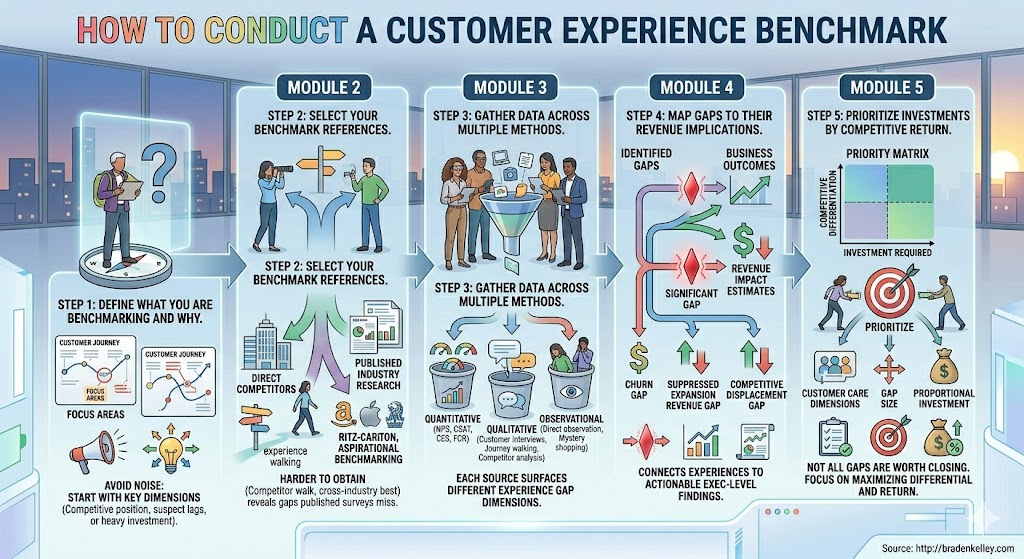
How to Conduct a Customer Experience Benchmark Infographic

The Role of an Experience Audit in Benchmarking

A customer experience audit is the most comprehensive benchmarking instrument available — one that combines internal experience measurement, competitive experience walking, and best-in-class gap analysis into a single, systematic assessment.

Unlike survey-based benchmarking that measures what customers say about their experience, an experience audit walks the actual experience — physically and digitally traversing every significant touchpoint across your customer journey and your competitors’ — to produce a firsthand, evidence-based comparison (customer journey mapping helps here). It identifies:

  • The specific touchpoints where your experience is measurably inferior to the best available alternatives
  • The friction gaps — moments where your experience requires more effort than competitors’ equivalents
  • The consistency gaps — channels or segments where your experience significantly underperforms your own average
  • The service recovery gaps — how your response to failures compares to competitive and best-in-class standards
  • The personalization gaps — where competitors are demonstrating deeper customer understanding than you are

The output is not a score comparison — it is a prioritized, actionable roadmap of experience improvements ranked by their estimated competitive and financial impact. This is benchmarking that produces decisions, not just data.

Frequently Asked Questions About Customer Experience Benchmarking

What is customer experience benchmarking?

Customer experience benchmarking is the process of systematically measuring your organization’s experience performance against external reference points — competitors, industry standards, and best-in-class organizations — to understand where you lead, where you lag, and where investment will generate the greatest competitive return. It differs from customer experience measurement, which tracks your own performance over time, by adding the external context needed to interpret whether your metrics represent a competitive advantage, a competitive parity position, or a competitive gap that requires urgent attention.

What metrics are used for customer experience benchmarking?

The primary metrics used for customer experience benchmarking are Net Promoter Score (NPS), Customer Satisfaction Score (CSAT), Customer Effort Score (CES), and First Contact Resolution (FCR). Published industry benchmarks for these metrics are available from Forrester, the ACSI, J.D. Power, and industry-specific research sources. However, survey-based metric benchmarking has significant limitations — it measures what customers say, not what they experience, and it measures aggregate outcomes rather than the specific experience drivers producing those outcomes. The most valuable benchmarking combines metric comparison with direct competitive experience walking and qualitative customer research.

How do you benchmark against competitors on customer experience?

Competitive customer experience benchmarking requires multiple approaches used in combination. Quantitative approaches include comparing published NPS, CSAT, and review scores across competitors; analyzing competitor reviews on platforms like Google, Trustpilot, and G2 for recurring patterns; and using win/loss interview research to understand the experience factors most frequently cited in competitive displacement. Qualitative approaches include directly walking the competitor’s experience — going through their onboarding, calling their support line, submitting a service request — to build firsthand understanding of the experience your customers are comparing you against. A customer experience audit typically includes direct competitive benchmarking as a core component.

What is a good NPS score by industry?

NPS benchmarks vary significantly by industry. In technology and SaaS, average NPS is typically 35–45 with leaders above 60. In financial services, averages run 30–40 with leaders above 55. Retail averages 40–50 with leaders above 65. Healthcare averages 25–35 with leaders above 50. Telecommunications typically averages 15–25 with leaders above 40. Hospitality averages 50–60 with leaders above 75. The most meaningful benchmark is not the industry average but the performance of the specific competitors your customers are most likely to compare you against — and the gap between your current performance and best-in-class in your sector.

What is the difference between customer experience measurement and benchmarking?

Customer experience measurement tracks your own performance over time — monitoring NPS, CSAT, CES, and other metrics to identify trends and evaluate the impact of specific investments. Customer experience benchmarking adds external context by comparing your performance against competitors, industry standards, and best-in-class organizations. Measurement tells you whether you are getting better or worse. Benchmarking tells you whether you are competitive — whether your current performance represents an advantage, parity, or a gap that is costing you customers and revenue. Both are necessary, but benchmarking is what connects experience performance to competitive and financial outcomes.

Ready to understand how your experience compares to competitors and best-in-class standards? Learn more about the Experience Audit →

Content Authenticity Statement: The topic area, key elements to focus on, etc. were decisions made by Braden Kelley, with a little help from Claude and Google Gemini to clean up the article, add images and create infographics.

Image credits: Google Gemini

Subscribe to Human-Centered Change & Innovation WeeklySign up here to get Human-Centered Change & Innovation Weekly delivered to your inbox every week.
The Indispensable Role of CX

Insights from CCW’s 25-Year Journey

LAST UPDATED: October 28, 2025 at 12:00PM
The Indispensable Role of CX

by Braden Kelley

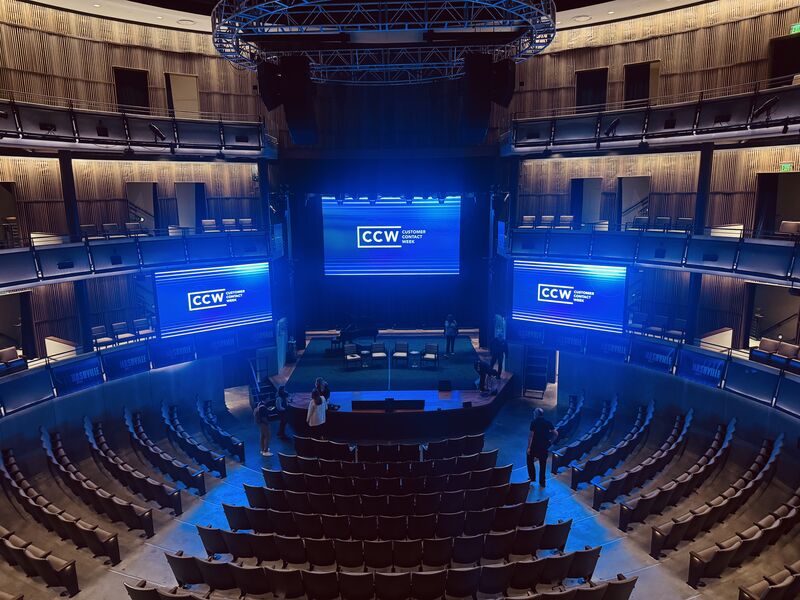
I recently had the privilege of sitting down with Mario Matulich, President of Customer Management Practice, at Customer Contact Week (CCW) in Nashville. As an organization celebrating its 25th anniversary, CCW has been a critical barometer for the entire customer experience and contact center industry. Our conversation wasn’t just a look back, but a powerful exploration of the strategic mandate facing CX leaders today, particularly how we manage innovation and human-centered change in an era dominated by AI and tightening budgets.

CCW at 25: The Hub for Benchmarking and Breakthroughs

Mario underscored that CCW is far more than just a conference; it’s a living repository of industry knowledge. Professionals attend for actionable takeaways, which primarily fall into three categories: benchmarking performance against industry leaders, learning about new trends (like Generative AI’s impact), and, critically, sourcing the right vendors and capabilities needed to execute their strategies. It’s where leaders come to calibrate their investment strategies and learn how to do more with their finite resources.

Mario MatulichThis pursuit of excellence is driven by a single, powerful market force: The Amazon Effect. As Mario put it, customers no longer judge your experience solely against your industry peers. They expect every single touchpoint with your company to be as seamless, intuitive, and effective as the best experience they’ve had anywhere. This constantly escalating bar for Customer Effort Score (CES) and Customer Satisfaction (CSAT) makes a complacent CX investment a near-fatal strategic mistake. The customer experience must always be top-tier, or you simply lose the right to compete.

The Strategic Disconnect: CX vs. The Contact Center

One of the most valuable parts of our discussion centered on the subtle, yet crucial, distinction between a Customer Experience (CX) professional and a Contact Center (CC) professional. While both are dedicated to the customer journey, their scope and focus often differ:

  • The CX Professional: Often owns the entire end-to-end customer journey, from marketing to product use to support. Their responsibilities and definition of success are deeply influenced by where CX sits organizationally — is it under Marketing, Operations, or the CEO?
  • The CC Professional: Focused on the operational efficiency, quality, and effectiveness of the voice and digital support channels. Their reality is one of doing a lot with a little, constantly asked to manage complex interactions while being, ironically, often looked to as a prime source of cuts in a downturn.

Social media, for instance, is still a relevant customer service channel, not just a marketing one. However, the operational reality is that many companies, looking for cost-effective solutions, outsource social media support to Business Process Outsourcing (BPO) providers, highlighting the ongoing tension between strategic experience design and operational efficiency.

“Being a CX leader in your industry is not a temporary investment you can cut and reinstate later. Those who cut, discover quickly that regaining customer trust and market position is exponentially harder than maintaining it.” — Braden Kelley

AI in the Contact Center: From Hypothesis to Hyper-Efficiency

The conversation inevitably turned to the single biggest factor transforming the industry today: Artificial Intelligence. Mario and I agreed that while the promise of AI is vast, the quickest, most immediate win for nearly every organization lies in agent assist.

This is where Generative AI tools empower the human agent in real-time — providing instant knowledge base look-ups, auto-summarizing previous interactions, and drafting responses. It’s a human-centric approach that immediately boosts productivity and confidence, improving Agent Experience (AX) and reducing training time.

However, implementing AI successfully isn’t a “flip-the-switch” deployment. The greatest danger is the wholesale adoption of complex technology without rigor. True AI success, Mario noted, must be implemented via the classic innovation loop: hypothesis, prototyping, and testing. AI isn’t a solution; it’s a tool that must be carefully tuned and validated against human-centered metrics before scaling.

The Mandate for Enduring Investment

A recurring theme was the strategic folly of viewing CX as a cost center. In a downturn, the contact center is often the first place management looks for budgetary reductions. Yet, the evidence is overwhelming: CX leadership is not a temporary investment. When you are leading in your industry in customer experience, that position must be maintained. Cut your investment at your peril, and you risk a long, painful road to recovery when the market turns. The CX team, despite being resource-constrained, often represents the last line of defense for the brand, embodying the human-centered change we preach.

As CCW moves into its next 25 years, the lesson is clear: customer expectations are only rising. The best leaders will leverage AI not just to cut costs, but to augment their people and apply the innovation principles of rigorous testing to truly master the new era of customer orchestration. The commitment to a great customer experience is the single, enduring investment that will future-proof your business.

HALLOWEEN BONUS: Save 30% on the eBook, hardcover or softcover of my latest book Charting Change (now in its second edition) — FREE SHIPPING WORLDWIDE — using code HAL30 until midnight October 31, 2025

Image credits: Customer Management Practice

Content Authenticity Statement: The topic area, key elements to focus on, etc. were decisions made by Braden Kelley, with a little help from Google Gemini to clean up the article.

Subscribe to Human-Centered Change & Innovation WeeklySign up here to get Human-Centered Change & Innovation Weekly delivered to your inbox every week.

Top 10 Human-Centered Change & Innovation Articles of June 2025

Top 10 Human-Centered Change & Innovation Articles of June 2025Drum roll please…

At the beginning of each month, we will profile the ten articles from the previous month that generated the most traffic to Human-Centered Change & Innovation. Did your favorite make the cut?

But enough delay, here are June’s ten most popular innovation posts:

  1. Why Business Transformations Fail — by Robyn Bolton
  2. Three Ways Strategic Idleness Accelerates Innovation and Growth — by Robyn Bolton
  3. Overcoming the Fear of Innovation Failure — by Stefan Lindegaard
  4. Making People Matter in AI Era — by Janet Sernack
  5. Yes the Comfort Zone Can Be Your Best Friend — by Stefan Lindegaard
  6. Your Digital Transformation Starting Point — by Braden Kelley
  7. Learn More About the Problem Before Trying to Solve It — by Mike Shipulski
  8. Putting Human Agency at the Center of Decision-Making — by Greg Satell
  9. Innovation or Not – SpinLaunch — by Art Inteligencia
  10. Team Motivation Does Not Have to be Hard — by David Burkus

BONUS – Here are five more strong articles published in May that continue to resonate with people:

If you’re not familiar with Human-Centered Change & Innovation, we publish 4-7 new articles every week built around innovation and transformation insights from our roster of contributing authors and ad hoc submissions from community members. Get the articles right in your Facebook, Twitter or Linkedin feeds too!

Build a Common Language of Innovation on your team

Have something to contribute?

Human-Centered Change & Innovation is open to contributions from any and all innovation and transformation professionals out there (practitioners, professors, researchers, consultants, authors, etc.) who have valuable human-centered change and innovation insights to share with everyone for the greater good. If you’d like to contribute, please contact me.

P.S. Here are our Top 40 Innovation Bloggers lists from the last four years:

Subscribe to Human-Centered Change & Innovation WeeklySign up here to get Human-Centered Change & Innovation Weekly delivered to your inbox every week.

Top 10 Human-Centered Change & Innovation Articles of May 2025

Top 10 Human-Centered Change & Innovation Articles of May 2025Drum roll please…

At the beginning of each month, we will profile the ten articles from the previous month that generated the most traffic to Human-Centered Change & Innovation. Did your favorite make the cut?

But enough delay, here are May’s ten most popular innovation posts:

  1. What Innovation is Really About — by Stefan Lindegaard
  2. ‘Stealing’ from Artists to Make Innovations Both Novel and Familiar — by Pete Foley
  3. Benchmarking Innovation Performance — by Noel Sobelman
  4. Transform Your Innovation Approach with One Word — by Robyn Bolton
  5. Building Innovation Momentum Without the Struggle — Five Questions for Tendayi Viki
  6. Change Behavior to Change Culture — by Mike Shipulski
  7. The Real Reason Your Team Isn’t Speaking to You — by David Burkus
  8. The Enemy of Customer Service is … — by Shep Hyken
  9. Three Real Business Threats (and How to Solve Them) — by Robyn Bolton
  10. Better Customer Experiences Without Customer Feedback — by Shep Hyken

BONUS – Here are five more strong articles published in April that continue to resonate with people:

If you’re not familiar with Human-Centered Change & Innovation, we publish 4-7 new articles every week built around innovation and transformation insights from our roster of contributing authors and ad hoc submissions from community members. Get the articles right in your Facebook, Twitter or Linkedin feeds too!

Build a Common Language of Innovation on your team

Have something to contribute?

Human-Centered Change & Innovation is open to contributions from any and all innovation and transformation professionals out there (practitioners, professors, researchers, consultants, authors, etc.) who have valuable human-centered change and innovation insights to share with everyone for the greater good. If you’d like to contribute, please contact me.

P.S. Here are our Top 40 Innovation Bloggers lists from the last four years:

Subscribe to Human-Centered Change & Innovation WeeklySign up here to get Human-Centered Change & Innovation Weekly delivered to your inbox every week.

Benchmarking Innovation Performance

Closing the Gap Between Aspiration and Execution

Benchmarking Innovation Performance

GUEST POST from Noel Sobelman

In today’s volatile, technology-driven world, where the pace of change continues to accelerate, most executive teams agree on one thing: innovation, whether incremental, adjacent, or transformative, is critical. What’s far less clear is how to measure whether their innovation efforts are working or how to systematically improve them. That’s where benchmarking comes in.

Benchmarking isn’t just a diagnostic tool, it’s a strategic accelerator. It provides clarity where there’s ambiguity, reveals blind spots that internal reviews often miss, and equips leadership teams with hard data to make smarter, faster, and more confident decisions about innovation investments and process improvements.

This article explores benchmarking as a strategic capability for quantifying the gap between current innovation performance and best-in-class execution. It also outlines how companies can use benchmarking to unlock more reliable, scalable, and profitable innovation outcomes.

From Insight to Action: Why Benchmark Innovation?

Innovation is inherently risky with outcomes that are hard to predict, but the processes that support it don’t have to be. Effective innovation systems are structured, repeatable, measurable, and continuously improving. Benchmarking enables companies to see those systems clearly and objectively. It replaces assumptions with insight and turns performance anecdotes into verifiable data.

Used strategically, benchmarking helps executive teams build a compelling case for change grounded in facts rather than opinions. It offers a concrete way to quantify gaps between current and desired performance, helping to expose where process inefficiencies or capability gaps are holding the organization back. Benchmarking also supports leadership in identifying maturity levels across critical innovation capabilities, from governance and investment decision-making to resource management and project execution.

Importantly, it links development capabilities directly to measurable business outcomes. That means innovation isn’t just about creativity or culture, it’s about performance that can be tracked, improved, and scaled. By grounding decisions in comparative data, benchmarking makes it easier to align managers around realistic year-over-year improvement targets that are both ambitious and realistic.

Defining Performance: What Benchmarking Measures

For benchmarking to drive real improvement, it must look at the right dimensions of performance. At Accel, we use a multi-dimensional benchmarking model that examines four distinct categories of innovation performance: innovation effectiveness, project performance, process application, and portfolio management.

Innovation effectiveness reflects senior leadership’s ability to guide success across the full innovation spectrum, from product line extensions to transformative new ventures. This includes new product vitality, the percentage of revenue generated by recent launches, as well as return on R&D investment and the proportion of spend lost due to delayed or ineffective decision-making (aka, wasted development spending). When measuring leadership effectiveness in creating new sources of growth beyond the core business, we include leading indicators like evidence-based portfolio metrics, progress metrics, and scaling metrics such as user engagement, retention rate, and referral rate.

Innovation project performance reflects how well teams execute against their objectives. It includes metrics such as time-to-market, time-to-profitability, and schedule predictability, alongside actual-to-planned measures of product cost, profitability, and quality. These indicators help determine whether teams are executing effectively while meeting the business and customer needs they set out to address. New venture project performance measures include validated assumptions and cumulative evidence strength across solution desirability, business viability, and technical feasibility dimensions.

Innovation process application focuses on how consistently and effectively innovation methodologies are applied. Here, we assess actual versus estimated project cycle times across development phases as well as the accuracy of development cost forecasts. We also examine the frequency of project re-scoping, exception reviews, team turnover, and the reuse of design or code elements, all of which serve as indicators of process health. For transformative innovation processes, we also assess learning velocity, experimentation rigor, evidence-based decision-making, metered funding practices, core business leverage, and engagement with external ecosystems.

Finally, innovation portfolio management metrics reveal how well an organization aligns its innovation resources with its strategy. We evaluate factors such as strategic alignment, investment allocation, resource utilization, and portfolio value realization. When these are off-target, companies often see a mismatch between growth ambition and investment mix, poor development throughput, or low return on their innovation spend.

Accel Management Group innovation performance benchmark metrics

Figure 1. Innovation Performance Benchmark Metrics

Together, these four categories offer a comprehensive view of performance and their connection to business outcomes, and more importantly, a roadmap for targeted, results-driven improvement.

How It Works: Accel’s Benchmarking Approach

The benchmarking process begins by establishing a clear, accurate picture of the company’s current state. This involves gathering available performance data, then evaluating it for consistency and comparability across sources. We reconcile discrepancies and normalize contextual factors like company size, product line complexity, regulatory classification, innovation type, and development methodology.

AI accelerates this process by enabling faster data harmonization, natural language processing to analyze qualitative inputs (such as project postmortems or customer feedback), and machine learning algorithms that detect hidden drivers of performance variance across projects, teams, or business units.

Once we’ve built this baseline, we assess capability maturity across several critical dimensions. These include innovation process structure, governance and decision-making frameworks, execution models (such as gated, Agile, or transformative approaches), and portfolio management practices. We also analyze resource management, discovery and ideation, new venture incubation efforts, alignment with business strategy, culture, and organizational mechanisms such as incentives and reward systems.

From there, we compare the organization’s practices and outcomes against peer companies, industry leaders, and Accel’s leading practice reference model. The output isn’t just a list of issues; it’s a prioritized set of capability gaps linked directly to performance impact. We then work with executive teams to develop action plans and change roadmaps, aligning leadership around where to invest, where to restructure, and where to accelerate change.

Noel Sobelman benchmarking approach

Figure 2. Benchmarking Approach

What Benchmarking Reveals: A Snapshot from the Field

We’ve seen across multiple clients and industries how benchmarking can uncover hidden obstacles to innovation performance. Consider the example of one of our clients, a MedTech manufacturer that decided to benchmark their capabilities after struggling with missed launch dates and underwhelming innovation returns. Their leadership team believed that product complexity and regulatory challenges were the root cause. But when we dug into the data, a different picture emerged.

The company was not consistently tracking core new product development performance metrics, making it difficult to identify root issues or assess improvement opportunities. Sample project data revealed that early-phase development cycles, specifically Concept and Planning Phases, were taking two to three times longer than industry benchmarks. Moreover, the company was investing heavily in detailed design before evaluating technical feasibility or validating customer requirements, which led to protracted development timelines, late-stage surprises, compliance-driven rework, and chronic cost overruns.

Our assessment also uncovered a lack of system-level architecture discipline and siloed project planning without proper integration to balance customer needs against technical, market window, schedule, and resource considerations. In short, while the organization believed it had a process problem, benchmarking revealed a deeper issue: a maturity gap in early-phase project planning, risk management, and system design.

By framing these insights within industry benchmarks and leading practices, the company was able to galvanize leadership support for a targeted transformation. The result was a realigned innovation and portfolio management process focused on early project de-risking, customer need validation, and robust front-end planning, leading to faster cycle times, fewer late-stage surprises, and improved innovation throughput.

Why It Matters: The Strategic Case for Benchmarking

Benchmarking delivers more than operational insights, it unlocks real business value. Companies that benchmark and act on the findings tend to outperform peers in key areas. For instance, best-in-class organizations generate over 45 percent of their revenue from new products. Their time-to-market is over 40 percent faster, and their R&D resources are more efficiently allocated toward high-impact initiatives like platform innovation and next-generation solutions.

In contrast, companies that don’t benchmark often lack visibility into why projects fail, where delays originate, or how resources are being utilized. This results in lower returns on innovation investment, lower project success rates, and internal misalignment on where and how to improve. We’ve seen cases where products missed their mark not because the core idea was flawed, but because teams moved too quickly into development without validating customer needs or failed to adapt to shifting customer expectations. The result: products that launched late, didn’t resonate with customers, or had to be reworked at a significant cost.

When benchmarking is integrated into an ongoing performance management system, it serves as a feedback loop, continuously guiding decision-making and capability development. That’s why it’s not just a one-time diagnostic, but a strategic discipline that supports innovation as a competitive advantage. AI technologies enhance this feedback loop by transforming benchmarking into a dynamic, continuous process, automatically updating benchmarks as internal and external data sources evolve, and alerting teams to emerging gaps or opportunities in real time.

Conclusion: A Tool for Strategic Transformation

In a world where innovation separates leaders from followers, benchmarking is more than a diagnostic, it’s a tool for strategic transformation. By providing hard data on where you stand and where to focus, it turns vague aspirations into actionable priorities and ensures that innovation efforts are aligned with measurable business outcomes.

But benchmarking only delivers value when it’s integrated into the broader innovation system, driving continuous improvement and sharper execution over time. That’s where its real power lies, as an ongoing discipline that builds organizational maturity and long-term advantage.

For executive teams looking to sharpen their innovation capability, a few critical questions should guide the next steps:

  • Do we have an objective understanding of how our innovation performance stacks up against peers?
  • Are our development processes delivering the speed, quality, predictability, and customer impact we need?
  • Can we clearly measure how innovation contributes to growth and profitability?
  • Most importantly, are we investing in the right capabilities to win in the future?

You can’t improve what you don’t measure, and you can’t lead if you don’t know where you stand.

Image credits: Accel Management Group, Noel Sobelman, Pexels

Subscribe to Human-Centered Change & Innovation WeeklySign up here to join 17,000+ leaders getting Human-Centered Change & Innovation Weekly delivered to their inbox every week.

Benchmarking Innovation Across Industries

Your Compass for Disruption

Benchmarking Innovation Across Industries

GUEST POST from Chateau G Pato

In our perpetually accelerating world, the concept of innovation has evolved from a differentiator to an absolute imperative. Yet, many organizations find themselves sailing without a compass, unsure if their innovation efforts are truly moving them forward or simply spinning their wheels. How do you measure the efficacy of your innovation engine? How do you ensure your investments yield meaningful returns? And, most critically for the human-centered leader, how do you cultivate an environment where impactful, empathetic innovation consistently blossoms? The answer lies in the strategic, often counter-intuitive, practice of benchmarking innovation across industries.

Benchmarking, when applied to innovation, isn’t about mere imitation. It’s a profound exercise in strategic empathy – understanding the deep-seated mechanisms, cultural enablers, and human-centric design philosophies that drive breakthrough success in seemingly unrelated fields. Imagine innovation as a vast ocean: by observing the tides, currents, and successful voyages in different parts of this ocean, you gain insights far beyond the shores of your own industry. This cross-pollination of knowledge is the wellspring of truly disruptive thinking.

The Irresistible Case for Cross-Industry Innovation Benchmarking

Why cast your gaze beyond your immediate competitors? The reasons are compelling:

  • Shattering Paradigms: Your industry’s “best practices” often represent the collective wisdom of the past, not the blueprint for the future. Looking externally forces a healthy challenge to entrenched assumptions, revealing fresh perspectives on customer pain points and value creation.
  • Early Warning System & Opportunity Radar: Innovation frequently originates at the periphery. By observing how diverse industries respond to macro trends – technological shifts, demographic changes, or evolving consumer values – you gain an early understanding of both threats and untapped opportunities for your own organization.
  • Unearthing Novel Methodologies & Human-Centered Approaches: A financial services firm might discover powerful agile methodologies from a leading software developer, or a public sector agency could adapt customer journey mapping techniques perfected by a world-class hospitality chain. These aren’t just process improvements; they’re often deeply rooted in understanding and serving human needs better.
  • Fostering a Growth Mindset & Innovation Culture: Actively seeking and integrating external insights cultivates an organizational culture of continuous learning, curiosity, and bold experimentation. It signals to your teams that innovation is a shared journey, not a siloed activity.
  • Setting Ambitious, Data-Driven Goals: Understanding what “great” looks like elsewhere provides empirical context for setting truly ambitious yet achievable innovation metrics, from ideation velocity to commercialization success rates and the human impact of new offerings.

The Strategic Imperative: How to Benchmark Effectively

Effective cross-industry innovation benchmarking isn’t a passive observation; it’s a deliberate, strategic endeavor. Here’s a structured approach:

  1. Pinpoint Your Innovation Challenge: Be specific. Is it accelerating product development, enhancing customer experience, fostering internal creativity, or improving innovation ROI? Your focus determines who you’ll benchmark.
  2. Identify Unconventional Leaders: Look beyond direct competitors. Who is consistently lauded for innovation, regardless of their sector? Think companies known for breakthrough user experiences, unique business models, or unparalleled operational agility. Don’t shy away from smaller, nimble players who are disrupting.
  3. Deconstruct Their Innovation Ecosystem: This is where the depth comes in. Don’t just look at their products. Investigate:
    • Culture: How do they foster psychological safety and risk-taking?
    • Processes: What methodologies (e.g., design thinking, lean startup) do they employ?
    • Structure: How are their innovation teams organized and empowered?
    • Metrics: What do they measure to track innovation success?
    • Technology & Tools: What platforms enable their innovation?
    • Customer Centricity: How deeply do they understand and integrate user needs?
  4. Translate & Adapt, Don’t Copy: This is critical. The goal is to extract the underlying principles and human-centered philosophies, then thoughtfully translate them to your unique organizational context, capabilities, and customer base. A direct copy rarely works; thoughtful adaptation almost always adds value.
  5. Implement, Measure & Iterate Relentlessly: Apply the insights. Crucially, establish clear metrics (e.g., speed to market, patent applications, employee innovation engagement, customer satisfaction with new features, revenue from new offerings) to track the impact of your adapted approaches. Be prepared to learn, refine, and evolve.

Case Study 1: Healthcare’s Surgical Precision from Formula 1 Pits

The Great Ormond Street Hospital & McLaren Racing

In a powerful example of radical cross-industry learning, the cardiac surgery team at Great Ormond Street Hospital for Children in London faced a persistent challenge: transferring critically ill children from the operating theatre to intensive care. Errors, though rare, could have devastating consequences. They turned not to other hospitals, but to the fast-paced, high-stakes world of Formula 1 motor racing, specifically the pit crew of McLaren.

The hospital observed how McLaren’s pit crews executed complex, time-sensitive tasks with astonishing precision under immense pressure. They benchmarked their meticulous checklists, clear communication protocols, designated roles, and rigorous post-event debriefs. By adapting these human-centered process disciplines – focusing on pre-planning, standardized handovers, and structured team communication – the hospital significantly reduced errors and improved patient safety during this critical transition phase. It wasn’t about the cars; it was about the flawless execution of a complex, human-driven process.

Case Study 2: Financial Services Reimagining Customer Experience from Entertainment

Capital One & Walt Disney Parks and Resorts

For years, financial services were synonymous with rigidity and impersonal transactions. Capital One, seeking to radically transform its customer experience, didn’t just look at other banks. They looked at organizations renowned for creating magical, seamless human experiences. One key inspiration? Walt Disney Parks and Resorts.

Capital One benchmarked Disney’s approach to “imagineering” the customer journey, from the moment of initial interaction to ongoing engagement. They studied how Disney designs for emotion, manages queues (wait times), onboards new visitors (customers), and resolves issues with an emphasis on delight. This led to Capital One’s development of new branch designs (Capital One Cafés) that are less transactional and more experiential, offering inviting spaces, digital tools, and human support for financial well-being. They also redesigned their digital interfaces and customer service protocols, infusing a sense of warmth and proactive problem-solving, much like Disney’s commitment to creating memorable moments. They benchmarked not financial products, but the art and science of creating genuinely positive human interactions.

Your Call to Action: Broaden Your Horizon, Deepen Your Impact

As the lines between industries continue to blur, and as customer expectations for seamless, intuitive, and valuable experiences escalate, the future belongs to organizations willing to learn from anyone, anywhere. Don’t allow the comfortable confines of your industry’s echo chamber to limit your potential. Be curious. Be courageous. Be human-centered in your quest for knowledge.

By intentionally looking beyond your immediate competitive landscape – by recognizing that the best solutions to your challenges might exist in an entirely different domain – you not only accelerate your innovation velocity but also enrich your organizational culture. It’s time to equip your innovation engine with a compass that points beyond the obvious, towards the uncharted territories of cross-industry brilliance. That’s where true disruption, and lasting human value, will be found.

Extra Extra: Because innovation is all about change, Braden Kelley’s human-centered change methodology and tools are the best way to plan and execute the changes necessary to support your innovation and transformation efforts — all while literally getting everyone all on the same page for change. Find out more about the methodology and tools, including the book Charting Change by following the link. Be sure and download the TEN FREE TOOLS while you’re here.

Image credit: Pexels

Subscribe to Human-Centered Change & Innovation WeeklySign up here to get Human-Centered Change & Innovation Weekly delivered to your inbox every week.

Benchmarking Innovation – Standards and Practices

Benchmarking Innovation - Standards and Practices

GUEST POST from Art Inteligencia

In today’s rapidly evolving business landscape, the ability to innovate consistently and effectively is more critical than ever. Yet, defining how to measure and benchmark innovation remains a complex challenge. Benchmarking innovation involves evaluating how different organizations manage to achieve success in innovative practices and understanding the key components that contribute to their performance. As a human-centered change and innovation thought leader, I propose that there are several layers to effectively benchmarking innovation: defining innovation metrics, recognizing best practices, and understanding the cultural components of innovation.

Defining Innovation Metrics

Measuring innovation is not a one-size-fits-all proposition. Organizations must carefully select metrics that align with their strategic goals. Common metrics might include research and development expenditure, the number of new products or services launched, the percentage of revenue from these new offerings, and the scope of patent filings. However, organizations should also consider less conventional metrics, such as the speed of idea to implementation, customer satisfaction, and customer adoption rates. Establishing clear metrics upfront is critical, as they guide both internal evaluations and external benchmarking activities.

Recognizing Best Practices

Analyzing the best practices of companies renowned for their innovative capabilities can provide powerful insights. Companies like Apple, Google, and 3M are often cited for their innovation successes. By studying their methodologies, such as Apple’s focus on user-centric design or Google’s commitment to creating a ‘20% time’ for creativity, organizations can adopt practices that may fit their own innovation frameworks. Collaboration, cross-functional teams, and fostering a culture where risk-taking is encouraged are just as important as technological advancements. Benchmarking against these exemplary models helps companies identify gaps and opportunities within their own structures.

Understanding Cultural Components

The culture of innovation within an organization plays a pivotal role in its success. It’s a blend of leadership, employee empowerment, and the willingness to embrace failure as a stepping stone to success. Effective innovation cultures often feature strong leadership commitment to innovation as a core value, continuous learning opportunities, and a structure that rewards both individual and team contributions to innovation. These cultural components can be benchmarked against industry peers and leaders in unrelated industries to gather insights and adapt strategies to fit their unique environments.

Case Study 1: Apple’s User-Centric Innovation Model

Apple Inc. has consistently been at the forefront of innovation, primarily due to its unwavering commitment to a user-centric approach. The company benchmarks its innovation efforts not merely by technological advancements but by its ability to address user needs in transformative ways. A key standard that Apple employs is its design philosophy, where form and function go hand-in-hand.

By analyzing customer feedback, market trends, and user behaviors, Apple has refined its processes to keep innovation at the core. They benchmark the success of their products not only through sales but also through customer satisfaction metrics and brand loyalty scores. For instance, the iterative improvements in the iPhone line demonstrate how Apple remains responsive to consumer needs while maintaining stringent internal standards for innovation. This approach has made Apple’s innovation practices a standard reference point for companies worldwide.

Case Study 2: 3M’s Diversification and Employee Initiative

3M is a quintessential example of fostering innovation through employee initiative and diversification. Known for its wide range of products spanning numerous industries, 3M has built an innovation culture that emphasizes cross-pollination of ideas, allowing innovation to flow across diverse sectors of the company.

One of their hallmark practices is the ‘15% rule,’ which allows employees to dedicate a portion of their working time to pursue ideas they are passionate about. This practice, which can be seen as a unit of measurement itself, ensures that 3M cultivates an environment ripe for spontaneous innovation. Benchmarking their success often involves comparing the ratio of resources allocated to these initiatives versus the resulting revenue from new product lines. Internal metrics focus on the balance and effectiveness of diversification strategies, which in turn reinforce 3M’s position as an innovation leader.

Integrating Benchmarking into Innovation Strategy

To integrate benchmarking effectively into your innovation strategy, companies should create a structured approach. Begin with a thorough internal analysis of current innovation practices. Identify strengths and areas for improvement by comparing against industry standards and leading companies in related fields.

Engage in cross-industry benchmarking to broaden perspectives and bring insights from diverse practices and challenges. Involve diverse teams in the benchmarking process to ensure that findings are holistic and inclusive of different viewpoints within your organization.

Finally, make sure that learnings from benchmarking efforts translate into actionable strategies—whether it be modifying internal processes, updating metrics, or investing in cultural shifts. This continuous learning and adaptation cycle is key to maintaining competitive edge and fostering sustained innovation.

Conclusion

Benchmarking innovation is an ongoing journey of learning, adapting, and applying. While it involves comparing metrics and practices, it is ultimately about transforming insights into innovative practices that propel an organization forward. By embracing both the measurable and intangible elements of innovation, businesses can ensure that they not only keep pace with the rapidly changing world but lead the charge into new frontiers of possibility.

Extra Extra: Futurology is not fortune telling. Futurists use a scientific approach to create their deliverables, but a methodology and tools like those in FutureHacking™ can empower anyone to engage in futurology themselves.

Image credit: Pixabay

Subscribe to Human-Centered Change & Innovation WeeklySign up here to get Human-Centered Change & Innovation Weekly delivered to your inbox every week.