‘Innovation’ is Killing Innovation. How Do We Save It?

'Innovation' is Killing Innovation. How Do We Save It?

GUEST POST from Robyn Bolton

How do people react when you say “innovation?”

  1. Lean forward, eyes glittering, eager to hear more
  2. Stare blankly and nod slowly
  3. Roll their eyes and sigh
  4. Wave their hands dismissively and tell you to focus on other, more urgent priorities.

If you answered C, you’re in good company.

Innovation is a buzzword. Quick searches of Amazon and Google Scholar result in 100,000+ books and 200,000+ articles on the topic, while a scan of the SEC’s database yields 8,000 K-1 filings with the word “innovation” in 2020 alone.

“Innovation” is meaningless, like all buzzwords. There’s a reason that practitioners and consultants insist on establishing a common definition before starting innovation work. I’ve been in meetings with ten people, asked each person to define “innovation,” and heard 12 different answers.

But all this pales in comparison to the emotional response it elicits. Some people get incredibly excited, bouncing out of their seats, ready to bring their latest idea to life (whether it should be brought to life is a different story.). Some nod solemnly as if confronted by a necessary evil, accepting a fate beyond their control. Most roll their eyes because they’ve been through this before and, like all management “flavors of the month,” this too shall pass.

“Innovation” is killing Innovation

The emotions and opinions we tie to “innovation” overwhelm the dictionary definition, making it difficult to believe that the process and, more importantly, the result will be different this time.

We need a different word.

One that has the same meaning and none of the baggage.

This may feel impossible, but if “literally” can mean “figuratively” (do NOT get me started on this 2013 decision) and the Oxford English Dictionary can add 700 new words in 2022, surely we can figure this out.

10 alternatives to ‘Innovation’

The following options are sourced primarily from conversations with other experts and practitioners.

  1. Invention
  2. Ideation
  3. Incubation
  4. Improvement
  5. Creation
  6. Design
  7. Growth
  8. Transformation
  9. Business R&D*

Yes, #10 is intentionally missing because…

What do you think?

Finding a new word (or maybe changing how “innovation” is perceived, understood, and pursued) is a group effort. One person alone can’t do it, and a few people on a call complaining about the state of things certainly won’t (we’ve tried).

What do you think?

Do we need a different word for “innovation,” or should we keep it and deal with the baggage?

If we need a different word, what could it be? What do YOU use?

If we keep it, how do you combat the misunderstanding, eye rolls, and emotional baggage?

Let us know in the comments.


* This option came directly from a conversation with a client last week, and I kinda love it. 

We discussed the challenge of getting engineers to stay in a discovery mindset rather than jumping immediately to solutions. Even though they work in R&D (the function), he observed that 99.9% of their work (and, honestly, their careers) is spent on the D in R&D (development).

That’s when it clicked.

Research begins with investigation and inquiry to understand a broad problem and then uses the resulting insights to solve a specific problem. It is a learning process, just like the early stages of Innovation. And, just like in the early days of Innovation, you can’t predict the result or routinize the work.

Development focuses on bringing the “new or modified product or process to production,” Just like the later phases of Innovation when prototyping and experimentation are required, and risk is driven out of the proposition.

Traditional R&D focuses on technical and scientific exploration and solutioning,

Innovation focuses on market, consumer/customer, and business model exploration and solutioning.

It is R&D for the business. 

Business R&D.

Image credits: Pixabay

Subscribe to Human-Centered Change & Innovation WeeklySign up here to join 17,000+ leaders getting Human-Centered Change & Innovation Weekly delivered to their inbox every week.

The Shareholder Value Myth

The Shareholder Value Myth

GUEST POST from Greg Satell

The Business Roundtable, an influential group of almost 200 CEOs of America’s largest companies, a few years ago issued a statement that discarded the old notion that the sole purpose of a business is to provide value to shareholders. Instead, it advocated serving a diverse group of stakeholders including customers, employees, suppliers and communities.

The idea is not a new one. In fact, Jack Welch once called shareholder value the dumbest idea in the world. Nevertheless, The Wall Street Journal opinion page immediately pounced, suggesting that the move was just an attempt to “appease the socialists” and that it would undermine financial accountability.

It’s hard to see how acknowledging accountability to stakeholders other than investors would undermine accountability to investors. Shareholders, after all, have the power to fire CEOs. Even more importantly though, the notion that performance can be reduced down to a single metric is foolhardy and dangerous. Managing a business is simply tougher than that.

The Principal-Agent Problem

Every business seeks to make a profit. Ones that do not achieve that basic requirement do not stay in business for long. However, that doesn’t mean that the only reason a business exists is to make money. Clearly, in order to earn a profit over the long term, you need to provide value for others. Anybody who has ever run a business knows this.

Yet a large corporation is very different from an ordinary business in that there is what’s known as a principal-agent problem. The shareholders are a dispersed group that have relatively little information, while the managers of the business are a small group with an asymmetric informational advantage.

So you can see how the concept of shareholder value can be attractive. If you can reduce performance down to a single metric, such as stock performance, then the principal-agent problem is solved. Shareholders, as principal owners of the company, can hold managers, as their agents, accountable.

Yet this is a fantasy. There are many things that a manager can do, such as reducing investment or making a lot of sexy acquisitions, that can increase short-term financial performance, but hurt performance in the long run. So the concept of shareholder value has always been a murky one.

From Value Chains To Ecosystems

For decades, the dominant view of strategy was based on Michael Porter’s ideas about competitive advantage. In essence, he argued that the key to long-term success was to dominate the value chain by maximizing bargaining power among suppliers, customers, new market entrants and substitute goods.

Yet there was a fatal flaw in the notion that wasn’t always obvious. In an industrial economy, where technology is relatively static, value chains are stable. However, in a fast moving information economy, firms increasingly depend on ecosystems to compete. That drastically changes the game.

Ecosystems are nonlinear and complex. Power emanates from the center instead of at the top of a value chain. You move to the center by connecting out. So while an industry giant may possess significant bargaining power, exercising that bargaining power can be problematic, because it can weaken links to other nodes in the ecosystem.

So the increased emphasis on stakeholders is not merely some newfound socialistic altruism, but a realistic strategic shift. In a networked-driven world you need to continually widen and deepen links to other stakeholders within the ecosystem. That’s how you gain access to resources like talent, technology and information.
Building Power Through Gaining Trust

In a famous 1937 paper, Nobel Prize winning economist Ronald Coase argued that the function of a firm was to minimize transaction costs, especially information costs. For example, it makes sense to keep employees on staff, even if you might not need them today, so that you don’t need to search for people tomorrow when a job comes in.

Another way to minimize transaction costs is through building trustful relationships. If the stakeholders within ecosystems that you operate trust you, you gain greater access to information and decrease the amount of resources you need to spend on enforcing formal and informal norms. In fact, a study from Accenture Strategy recently found that building trust with stakeholders is increasingly becoming a competitive advantage.

In The Good Jobs Strategy MIT’s Zeynep Ton found that investing more in well-trained employees can actually lower costs and drive sales in the low-cost retail industry. While the sector is often thought of as highly transactional, her research indicates that a dedicated and skilled workforce results in less turnover, better customer service and greater efficiency.

For example, when the recession hit in 2008, Mercadona, Spain’s leading discount retailer, needed to cut costs. But rather than cutting wages or reducing staff, it asked its employees to contribute ideas. The result was that it managed to reduce prices by 10% and increased its market share from 15% in 2008 to 20% in 2012.

In other cases, competitors collaborate to improve their industrial ecosystems for customers. So it is should not be surprising that firms are increasingly investing in structures that are focused on ecosystems, such as Internet of Things Consortium, Partnership on AI and the Manufacturing Institutes. Again, power in an ecosystem resides at the center, not at the top, so to compete you have to connect.

Clearly, it could be argued that by investing in these partnerships, business are increasing shareholder value. However, to do so would be to essentially argue that investing in stakeholder ecosystems and pursuing shareholder value are equivalent, which reduces the debate to one of semantics rather than substance.

Manage For Mission, Not For Metrics

Perhaps one of the most interesting lines in the Business Roundtable statement was the assertion that “each of our individual companies serves its own corporate purpose,” because it acknowledges that the notion of purpose can’t be reduced to a single concept or metric.

Historically, the lines between industries were fairly clear-cut. Ford competed with GM and Chrysler. Later, foreign competition became more important, but the basic logic of the industry remained fairly stable: you produced cars and sold them to the public through a network of dealers.

Today, however, industry lines have blurred considerably. A company like Amazon competes with Walmart in retail, Microsoft, IBM and Google in cloud computing, and Netflix and Warner Media in entertainment. The company itself is much more than simply a bundle of operations competing in different value chains, but a platform for accessing a variety of ecosystems of talent, technology and information.

In much the same way, automobile manufacturers are making investments to transform themselves into mobility companies. To do so, they are building ecosystems made up of technology giants, startups and others. They are not seeking to “maximize bargaining power,” but rather to prepare for a future that hasn’t taken shape yet.

That’s why today, business leaders need to manage for mission, not for metrics. Building trustful relationships among a diverse set of stakeholders may not be as simple or as clear cut as “maximizing shareholder value,” but it’s increasing what profit-seeking businesses need to do to compete.

— Article courtesy of the Digital Tonto blog
— Image credit: Pixabay

Subscribe to Human-Centered Change & Innovation WeeklySign up here to join 17,000+ leaders getting Human-Centered Change & Innovation Weekly delivered to their inbox every week.

Why Great Teams Embrace Failure

And How to Do Failure Properly

Why Great Teams Embrace Failure

GUEST POST from David Burkus

Failure is feedback. And that maxim is nowhere more true than on teams. When individual team members or the whole team experiences a failure, how they respond can be the difference between a team that continuously improves and enhances performance, and a team that falls apart.

And research backs this up. One of the first studies of psychological safety focused on how teams responded to failure. Amy Edmondson examined the teams of nurses on various wards of a hospital and found that the teams with the highest rated leaders had a higher than average rate of reported medical errors. It wasn’t until looking further that she found the medical error rates were actually the same as other wards…but lower rated leaders who punished failures scared nurses away from reporting them. In other words, the great teams with great leaders embraced failure. And in doing so, they made it easier for everyone on the team to learn from mistakes and get better.

In this article, we’ll review three ways many teams embrace failure on individual, team, and system-wide levels in order to learn, grow, and better perform.

Learning Moments

The first way great teams embrace failure is through learning moments. A learning moment is a positive or negative outcome of any situation that is openly and freely shared to benefit all. And learning moments aren’t strictly a euphemism for failures. A learning moment happens whenever a team member experiences a personal failure and shares that failure with the team along with what they’re learned as a result. The idea is to grant amnesty over the occasional screw-up so long as the person brings a lesson as well. Over time, learning moments become opportunities to discuss how to change one’s approach or put systems in place to reduce failures in the future. But most importantly, learning moments destigmatize failures and move them from being something to be denied at all costs to something that increases performance. Failure is a great teacher—and when team member’s share learning moments they’re reducing the tuition for everyone else on the team by saving them from their own failures.

Post-Mortems

The second way great teams embrace failure is through post-mortems. A post-mortem is exactly what it sounds like…it’s a meeting to discuss a project after it has died. It’s meant to diagnosis teamwide failures (though many high performing teams also conduct post-mortems after the completion of successful projects as well). The purpose of the meeting is not to find someone to blame, or someone to give all the credit. The goal is to extract lessons from the project about where the team is strong and where they need improvement. When people are open and honest about their weaknesses and contributions to failure, teams celebrate the vulnerability that was just signaled.

Many teams can conduct an effective post-mortem with just five simple questions:

  1. What was our intended result?
  2. What was the actual result?
  3. Why were they different?
  4. What will we do the same next time?
  5. What will we do differently next time?

These five answers help identify the parts of the project that teams need to improve, while keeping them focused on the future and not on blaming people for actions in the past.

Failure Funerals

The third way great teams embrace failure is through failure funerals. As if a post-mortem didn’t sound morbid enough, failure funerals are useful rituals to reflect on failures that happened due to situations outside of the team’s control. Sometimes failures just happen. The environment changes, unforeseen regulations are created, or clients inexplicably decide to part ways. When that happens, it’s important to create moments for teams mourn the loss—but also extract some learning. This can be a short as a 15- or 30-minute meeting where team members share their feelings about the project that failed—and pivot toward what they appreciated about serving on the project and what they learned. Some teams even observe a moment of silence or a toast to the project gone wrong. These types of celebrations not only focus the team on lessons learned, but they encourage future risk-taking and keep teams motivated even when those chances of failure are high. Failure is inevitable—learning is a choice. And the purpose of a failure funeral is to make the deliberate choice to learn.

In fact, each of these three rituals represent a deliberate choice toward learning. Great teams embrace failure because doing so embraces learning. Those extra lessons help them improve over time—and trust each other more over time—and eventually become a team where everyone feels they can do their best work ever.

Image credit: David Burkus

Originally published at https://davidburkus.com on May 1, 2023.

Subscribe to Human-Centered Change & Innovation WeeklySign up here to join 17,000+ leaders getting Human-Centered Change & Innovation Weekly delivered to their inbox every week.

How to Determine if Your Problem is Worth Solving

How to Determine if Your Problem is Worth Solving

GUEST POST from Mike Shipulski

How do you decide if a problem is worth solving?

If it’s a new problem, try to solve it.

If it’s a problem that’s already been solved, it can’t be a new problem. Let someone else re-solve it.

If a new problem is big, solve it in a small way. If that doesn’t work, try to solve it in a smaller way.

If there’s a consensus that the problem is worth solving, don’t bother. Nothing great comes from consensus.

If the Status Quo tells you not to solve it, you’ve hit paydirt!

If when you tell people about solving the problem they laugh, you’re onto something.

If solving the problem threatens the experts, double down.

If solving the problem obsoletes your most valuable product, solve it before your competition does.

If solving the problem blows up your value proposition, light the match.

If solving the problem replaces your product with a service, that’s a recipe for recurring revenue.

If solving the problem frees up a factory, well, now you have a free factory to make other things.

If solving the problem makes others look bad, that’s why they’re trying to block you from solving it.

If you want to know if you’re doing it right, make a list of the new problems you’ve tried to solve.

If your list is short, make it longer.

EDITOR’S NOTE: Braden Kelley’s Problem Finding Canvas can be a super useful starting point for doing design thinking or human-centered design.

“The Problem Finding Canvas should help you investigate a handful of areas to explore, choose the one most important to you, extract all of the potential challenges and opportunities and choose one to prioritize.”

Image credit: Pixabay

Subscribe to Human-Centered Change & Innovation WeeklySign up here to join 17,000+ leaders getting Human-Centered Change & Innovation Weekly delivered to their inbox every week.

CEOs Should Get Out of the C Suite

Starbucks Shows the Way

CEOs Should Get Out of the C Suite

GUEST POST from Shep Hyken

There is a gap between the C-Suite and reality. Many leaders make decisions from their office, mistakenly believing that they understand what their company’s customers want and expect. One way to close that gap is to leave the C-Suite and take a trip to the front line. And not just once, but on a regular basis.

More than 30 years ago, I wrote my first book, Moments of Magic: Be a Star With Your Customers and Keep Them Forever. There is a chapter in the book titled Understand Your Customer. In this chapter, I shared an example from Anheuser-Busch. Back then, the world’s largest brewer had a program called “All Aboard,” in which executives went out with delivery drivers and salespeople to restaurants, taverns, liquor stores, grocery stores and anywhere else that sold beer. The goal was to hear firsthand from their customers. This put the executives in touch with reality and helped them make better customer-focused decisions.

In my most recent book, I’ll Be Back: How to Get Customers to Come Back Again and Again, I included a similar story. It was back in November 1989 when Microsoft co-founder Bill Gates, already a billionaire, was touring the product support department’s new building. Gates asked a manager, “Do you mind if I take a customer call?” According to the story, he took the phone and answered, “Hello, this is Microsoft Product Support, William speaking. How may I help you?” Of course, the call went well. So well, in fact, that the customer called back and specifically asked for “the nice man named William who straightened it (her problem) all out.”

When was the last time you heard of a billionaire CEO taking customer support calls? When have you heard of the CEO of any large company spending time on the phones in a contact center or venturing out of the office to work on the front line? That’s the reason I love the concept behind the reality TV show Undercover Boss. The CEO or president of a company does exactly what the executives at Anheuser-Busch and Bill Gates did. They just do it covertly, and it’s amazing what they learn.

Recently, I read an article in RetailWire about the new Starbucks CEO, Laxman Narasimhan, who plans to work a half shift once a month as a barista at a Starbucks café. His goal is to “promote a better connection and engagement between leadership and workers.” He wrote a letter to employees that characterized the “health” of the company as needing to be stronger despite the brand’s already strong performance.

That’s a wonderful example of a modern leader taking the time to understand what’s happening on the front line, not just with customers, but also with employees. My only suggestion is that he require his fellow C-suite leaders and VPs to do the same. Imagine how powerful a monthly meeting to compare notes from fellow executives spending time on the front lines could be!

Mark Ryski, founder and CEO of HeadCount Corporation, commented on the RetailWire article. He said, “This must be more than for ‘show’—Mr. Narasimhan sends a strong message that frontline workers and their work are important, but now he needs to live up to that commitment. Having executives get first-hand experience by working a shift is not new, but it never goes out of style. All executives should commit to spending some time working the front lines so that they can truly understand the employees’ and customers’ experience.”

So, when I’m suggesting the C-suite get out of the C-suite, it’s not to fire or replace them. It’s to get them out of their offices to move around and get to know what’s really going on with the company. If you care about your customers and employees—and I know you do—then get out of the C-suite!

This article originally appeared on Forbes.com

Image Credit: Shep Hyken

Subscribe to Human-Centered Change & Innovation WeeklySign up here to join 17,000+ leaders getting Human-Centered Change & Innovation Weekly delivered to their inbox every week.

Accountability and Empowerment in Team Dynamics

Accountability and Empowerment in Team Dynamics

GUEST POST from Stefan Lindegaard

A winning mindset is crucial for team leaders and teams striving to achieve their goals. Empowerment and accountability are two key elements that contribute to a mindset of success in team dynamics.

When team members feel empowered to make decisions and take the initiative, they are more engaged and motivated to excel.

Coupled with accountability, which ensures team members are responsible for their actions and outcomes, these two elements form a powerful mindset that can unlock your team’s full potential.

The Value of Empowerment and Accountability:

Empowerment fosters an environment where team members are encouraged to use their unique skills and expertise to contribute to the team’s success. This sense of autonomy can boost creativity and innovation, as team members feel they have the freedom and support to explore new ideas and take calculated risks.

Accountability, on the other hand, establishes a culture where team members are held responsible for their actions and the results they produce. When team members are accountable for their work, they are more likely to take ownership of their tasks and strive for high-quality outcomes. By embracing a mindset of empowerment and accountability, teams can achieve a synergistic effect that leads to improved performance, collaboration, and overall success.

Action Suggestions for Team Leaders and Teams:

# 1 – Set Clear Expectations: Ensure that team members understand their roles, responsibilities, and performance expectations. This clarity will help them feel more confident in taking ownership of their work and being accountable for their outcomes.

# 2 – Cultivate a Growth Mindset and Psychological Safety: Encourage team members to view challenges as opportunities for growth and learning while fostering an environment where they feel safe to take risks, express opinions, and ask for help. This combination will help them embrace empowerment and accountability as essential aspects of their development.

# 3 – Encourage Open Communication and Feedback: Create an environment where team members feel comfortable discussing their successes and challenges openly. Encourage them to give and receive constructive feedback, helping each other grow and improve.

# 4 – Celebrate Success and Learn from Mistakes: Acknowledge and reward team members for their contributions and achievements. At the same time, use setbacks as learning opportunities to reinforce the importance of taking ownership and being accountable for their work.

Your team’s success is a direct reflection of the mindset you cultivate within it. As a team leader or member, you have the power to ignite the potential of your team by embracing a growth mindset, psychological safety, empowerment, and accountability.

Now is the time to challenge the status quo, defy mediocrity, and strive for excellence. Make the conscious choice to create a team culture that dares to empower, holds each other accountable, and thrives in the face of adversity. The success of your team lies in your hands.

Are you ready to unleash it?

Image Credit: Pixabay

Subscribe to Human-Centered Change & Innovation WeeklySign up here to get Human-Centered Change & Innovation Weekly delivered to your inbox every week.

Innovation Is Driving Away Your Top Talent

Innovation Is Driving Away Your Top Talent

GUEST POST from Robyn Bolton

You want and need the best, most brilliant, most awesome-est people at your company. But with unemployment at a record low, the battle for top talent is fierce.

So, you vow not to enter the battle and invest in keeping your best people and building a reputation that attracts other extraordinary talents.

You offer high salaries, great benefits, flexible work arrangements, the prestige of working for your company, and the promise of rapid career progression. All things easily matched or beaten by other companies, so you get creative.

INNOVATION!

Your best people are full of ideas and have the confidence and energy to make things happen. So, you unleash them. You host hackathons and shark tanks. You install idea collection software and run contests. You offer training on how to be more innovative. You encourage employees to spend 20% of their time on passion projects.

And they quit.

They quit participating in all the opportunities you offer.

They quit sharing ideas.

They quit your company,

Not because they are ungrateful.

Or because they don’t want to innovate.

Or because they don’t have ideas.

They quit because they realize one of the following “truths”

They’re not “Innovators”

High performers believe they need to work on an innovation project to progress (because management explicitly or implicitly communicates this). But when they finally get their chance, they struggle. The project falls behind schedule, struggles to meet objectives, and is quietly canceled. They see this as a failure. They believe they failed.

But they didn’t fail. They learned something very uncomfortable – they’re not good at everything.

Innovation is different than Operation. When you’re operating, you’re working in a world full of knowledge, where cause and effect are predictable and “better” is easily defined. When you’re innovating, you’re working in a world full of assumptions, where things are unpredictable, patterns emerge slowly, and few things are defined. Most people are great at operating. Some people are great at innovating. Extraordinarily few are great at both.

Innovation is a hobby, not an imperative

The problem with innovation efforts like hackathons, shark tanks, and “20% Time” is that people pour their hearts and souls into them and get nothing in return. Sure, an award, a photo with the CEO, and bragging rights motivate them for a few weeks. But when their hard work isn’t nurtured, developed, and brought to a conclusion (either launched or shelved), they realize it was all a ruse.

They are disappointed but hope the next time will be different. It isn’t.

They stop participating to spend time on “more important” things (their “real” work). But they still care, so they keep tabs on other people’s efforts, quietly hoping this time will be different. It isn’t.

They grow cynical.

They choose to stay and accept that innovation isn’t valued or resign and go somewhere it is.

Their potential is bigger than your box

“I felt like Dorothy in the Wizard of Oz. Before the training, the world was black and white. After, it was full color. I don’t want to go back to black and white.”

For this person, the training had gone wonderfully awry.

The training built their innovation skills but motivated them to find another job because it opened their eyes. They realized that while they loved the uncertainty and creativity of innovation, their place in the organization wouldn’t allow them to innovate. They were in a box on an org chart. They no longer wanted to be in that box, but the company expected them to stay.

But are these “truths” true?

As Mom always said, actions speak louder than words.

  • Who does your company value more – innovators or operators? The answer lies in who you promote.
  • Is innovation a strategic priority? The answer lies in where and how you allocate resources (people, money, and time).
  • Do you want to retain the person or the resource? The answer lies in your willingness to support the person’s growth.

Speak the truth early and often

If a top performer struggles in an innovation role, don’t wait until the project “fails” to reassure them that operators are as (or more) important and loved as innovators. Connect them with senior execs who faced the same challenges. Make sure their next role is as desirable as their current one.

(Or, if innovators are truly valued more than operators, tell them that, too.)

If innovation is an imperative, commit as much time and effort to planning what happens after the event as you do planning the event itself. Have answers to how people will be freed up to continue to work on their projects, money will be allocated, and decisions will be made.

(Or, if innovation really is a corporate hobby, follow the model of top universities and let people participate f they want and give everyone else time off to pursue their hobbies).

If you want to retain the person more than the resource, work with them to plot a path to the next role. Be honest about the time and challenge of moving between boxes and the effects on their career. And if they still want to break out of the box, help them.

(Or, if you want them to stay in the box, tell them that, too.)

Don’t let Innovation! drive away your top talent. Use honesty to keep them.

Image credits: Pixabay

Subscribe to Human-Centered Change & Innovation WeeklySign up here to join 17,000+ leaders getting Human-Centered Change & Innovation Weekly delivered to their inbox every week.

Top 10 Human-Centered Change & Innovation Articles of April 2023

Top 10 Human-Centered Change & Innovation Articles of April 2023Drum roll please…

At the beginning of each month, we will profile the ten articles from the previous month that generated the most traffic to Human-Centered Change & Innovation. Did your favorite make the cut?

But enough delay, here are April’s ten most popular innovation posts:

  1. Rethinking Customer Journeys — by Geoffrey A. Moore
  2. What Have We Learned About Digital Transformation Thus Far? — by Geoffrey A. Moore
  3. Design Thinking Facilitator Guide — by Douglas Ferguson
  4. Building A Positive Team Culture — by David Burkus
  5. Questions Are More Powerful Than We Think — by Greg Satell
  6. 3 Examples of Why Innovation is a Leadership Problem — by Robyn Bolton
  7. How Has Innovation Changed Since the Pandemic? — by Robyn Bolton
  8. 5 Questions to Answer Before Spending $1 on Innovation — by Robyn Bolton
  9. Customers Care About the Destination Not the Journey — by Shep Hyken
  10. Get Ready for the Age of Acceleration — by Robert B. Tucker

BONUS – Here are five more strong articles published in March that continue to resonate with people:

If you’re not familiar with Human-Centered Change & Innovation, we publish 4-7 new articles every week built around innovation and transformation insights from our roster of contributing authors and ad hoc submissions from community members. Get the articles right in your Facebook, Twitter or Linkedin feeds too!

Have something to contribute?

Human-Centered Change & Innovation is open to contributions from any and all innovation and transformation professionals out there (practitioners, professors, researchers, consultants, authors, etc.) who have valuable human-centered change and innovation insights to share with everyone for the greater good. If you’d like to contribute, please contact me.

P.S. Here are our Top 40 Innovation Bloggers lists from the last three years:

Subscribe to Human-Centered Change & Innovation WeeklySign up here to get Human-Centered Change & Innovation Weekly delivered to your inbox every week.

What I Learned Solving a Business Crisis

What I Learned Solving a Business Crisis

GUEST POST from Greg Satell

By 2006 we knew we had a serious problem. Our company’s onetime flagship product, called Afisha, was in a steady decline and it was becoming all too clear that something had to be done. What had once been a market leader that generated huge profits, which fueled the growth of our company had slowly, but surely, lost its market position.

It was clear that the business was in crisis, but nobody was exactly sure what to do about it. Operationally, nothing had really changed. We still believed in our product and our people. Nevertheless, the marketplace had evolved and our business model, which once had seemed bulletproof, was no longer viable.

We didn’t know it at the time, but Afisha’s brightest days were still ahead. We were able to reimagine the business model, strengthen the brand and return to profitability. What we learned is that solving a crisis is not a straightforward linear process, but a journey of discovery. You never know what you’ll find so you need to be willing to experiment.

Acknowledging The Problem

As I explained in Mapping Innovation, when Afisha came out in 2000, it was an immediate hit. At its core, it was simply a guide to restaurants, nightlife and other entertainment, somewhat similar to Timeout. Its restaurant, music and movie columnists quickly became tastemakers in Kyiv, while its sex advice column, achieved a cult-level status. Ad dollars soon came rolling in

In 2006, all of those elements that had made Afisha successful were still in place, but the business environment had changed significantly. The ad market, which had been worth less than $100 million dollars in 2000, was now quickly approaching a billion dollars. Strong multinational publishers like Hearst, Hachette and Rodale had begun investing heavily into Ukrainian versions of top international titles like Cosmopolitan, Elle and Men’s Health.

What we had to accept was that Afisha, although still popular with readers, was no longer a dominant brand. At the same time, the free distribution model which it had once depended on to quickly achieve wide readership was now seen as a liability among advertisers. That diminished our ability to command top ad rates while, at the same time, the booming media market sent our editorial costs through the roof.

None of this happened all at once, so it was easy to believe that Afisha was just going through a temporary downturn. It was only when we were able to acknowledge that our once-successful model had become fundamentally broken that we were able to start moving forward.

Assembling A Broad-Based Team

Once we had acknowledged the problem we assembled a meeting to come up with a strategy to move forward. This included the publisher and editor-in-chief of Afisha, several of the key staff, our company founder, me (as CEO) as well as several company leaders outside of Afisha who had specific knowledge and skills and who were widely respected.

The composition of the meeting was important. Clearly, the Afisha team had to be deeply involved in the process. Having the company founder and me there made it clear that the business had the full backing of the executive leadership. However, in many ways, it was those outside the core Afisha team who had critical impacts.

For the Afisha team and the executive leadership, the business model was so familiar it seemed almost like second-hand. Bringing in other leaders from around the company helped us look at the business in new ways. They asked questions that challenged us, made observations that we hadn’t seen and suggested things that wouldn’t have occurred to us.

Identifying Issues And Developing Options

As the working group met and got down to business, we began to identify problems. First, as noted above, the competitive landscape had shifted dramatically and, although Afisha remained a beloved brand, international titles had taken away significant market share. Second, the free distribution model was no longer financially viable.

As we discussed options, we were able to quickly build consensus on two actions. We would redesign the magazine and the website to beef up the editorial content and better compete with the international titles. We would also look for partners to license Afisha to other cities in Ukraine and create a more national brand.

We also came up with a third option that was considerably more speculative. For years, we had been giving paid subscribers Afisha cards to receive discounts at local merchants. We thought that we could add value to the card by creating an event calendar that was exclusive to Afisha card holders.

Our reasoning was that if we could increase subscribers through upgrading the Afisha card, we could reduce our reliance on free distribution and improve the economics of the business. It seemed like a longshot, but it was also low risk. All we had to do was sign up some partners for events and publish an event calendar in the magazine and on the website.

Finding The Unexpected

The editorial and licensing strategies, which seemed like no brainers, were, at best, mildly successful. Readers seemed to like the new design and expanded editorial content, but then again they liked the old Afisha too. We were able to set up licenses for five major Ukrainian cities, giving up close to national coverage, but the licensees struggled to earn a profit.

The Afisha card strategy, on the other hand, was an unexpected hit. We had hoped to be able to do one event a week, but were soon so deluged with partners that we had to limit events to one per day. From happy hours and shopping nights to club openings and movie festivals, it seemed like everybody wanted to work with us.

Before we knew it, we were able to upgrade events from a promotional activity to a seriously profitable business. We organized a nationwide Frisbee contest for a beer launch, a French movie festival for an upscale coffee brand and organized party trips with sponsors. To our amazement, the business just grew and grew.

What we learned from the experience is that you can’t plan your way out of a crisis. If we were able to plan effectively, we wouldn’t have been in the crisis in the first place. Our success wasn’t the product of our own brilliance, but our willingness to experiment. That’s how we came across the “happy accident” that led to the events business.

The truth is that it takes some bad luck to get into a crisis and it takes some good luck to get out of one. Sound management can help stem the bleeding, but if you are ever going to rebuild a successful business, you have to experiment and allow for the unexpected.

— Article courtesy of the Digital Tonto blog
— Image credit: Pixabay

Subscribe to Human-Centered Change & Innovation WeeklySign up here to join 17,000+ leaders getting Human-Centered Change & Innovation Weekly delivered to their inbox every week.

The Pitfalls of Crowdsourcing

How to Overcome Them to Spur Innovation

The Pitfalls of Crowdsourcing: How to Overcome Them to Spur Innovation

GUEST POST from Diana Porumboiu

There is a lot of buzz around open collaboration as a driver for innovation. Studies, academia, research, and the myriad of examples from companies are boasting about the amazing results brought by ideas from external parties. A study shows that 85% of the top global brands have used crowdsourcing during the last decade.

But is crowdsourcing truly effective to spur innovation? Even though its popularity increased so much, there’s also plenty of evidence that dispute its effectiveness.

As tempting as it is to fall into the trap of the latest trends in innovation methods, it’s not wise to jump headfirst. So, we decided to write this article and show you the hard facts of crowdsourcing, which will help you decide if this is something your organization can benefit from.

For this, we’ll explain the pitfalls of crowdsourcing and provide practical tips on how to overcome them. To put things in perspective, let’s start with the broader picture, of what crowdsourcing is, or isn’t. 

What is crowdsourcing?

As the word indicates, crowdsourcing is all about leveraging the power of the crowds. If you’ve been reading our blog, or worked with innovation topics before, you might think that we are actually referring to open innovation. Not quite. Indeed, the two terms are oftentimes used interchangeably, and the concepts are similar.

But it’s best to make the difference between the two, because setting on the right terminology will also help you better communicate your innovation initiatives to your organization, and to external stakeholders too.

Basically, both crowdsourcing and open innovation refer to engaging external individuals to participate in the innovation process by suggesting ideas and solutions to a specific topic.

Crowdsourcing is the practice of obtaining ideas, solutions, or services from a large, sometimes undefined group of people through an open call. It is a process that leverages the collective intelligence and creativity of a crowd to solve problems, generate new ideas, or carry out tasks.

On the other hand, open innovation includes many other activities that involve people outside the initial working group (open data, scouting, trend research, idea management, etc.). If you want to learn more about the topic, our blog provides vast resources on open innovation which you can find here.

Now, while open innovation, as the name states, is specifically done to generate more innovation, crowdsourcing is used in other contexts too. Methods like crowd labor, crowdfunding, or crowd curation can be valuable if you need to outsource routine and well-defined tasks, manual work or fund your project. These can, in fact, be part of an innovation strategy, but they are not specifically targeting innovation.

That’s where crowdsourcing for innovation comes into play, and what we’ll focus on next.

The pitfalls of crowdsourcing

While crowdsourcing can be an effective way to generate ideas, solve problems, and engage with a community, unless it is properly planned, executed, and managed, it can come up short.

Let’s take a closer look at each of these pitfalls. 

  • Risk management: 

There are many risks that come with open collaboration, and some of the most cited are intellectual property and data privacy. Organizations are apprehensive about exposing themselves to the large public and weary about potential conflicts that could arise from ownership, and copyright as well as exposure to competitors.

So, when considering crowdsourcing as part of your innovation strategy, you should weigh the risks associated with it.

There are four main things to keep in mind when it comes to legal risks associated with crowdsourcing:

  • Existing patents and patents protection for technical solutions
    • Trademarks applicable when sourcing new product names, logos or brands
  • Design of the visual appearance of new products
  • Copyrights for any original texts

That’s why it’s best to have clearly pre-defined contractual terms, NDAs and confidentiality agreements that deal with intellectual property ownership and data protection. So, make sure to establish clear ownership and copyright guidelines upfront.

This can include requiring contributors to agree to terms and conditions that grant the sponsoring organization the right to use and modify the contributions. Providing clear attribution and recognition for contributors can also help to avoid disputes over ownership. Rewarding participation doesn’t just help with motivation and engagement, but it can also mitigate the legal risks.

  • Crowd management: 

The success of your crowdsourcing initiative hinges on the participation of individuals who provide ideas. However, many crowdsourcing projects fall short due to low engagement levels, inadequate idea generation, or low quality.

These issues may arise because contributors don’t recognize the significance of their contributions, lack motivation, misunderstand project requirements, or are unaware of the initiative.

Because crowdsourcing initiatives require a lot of time, effort and specific skills it’s best to delegate the project to someone who is not involved in everyday innovation activities (if you have those already in place).

Even so, crowdsourcing should still be aligned with the overall innovation and strategic goals, and therefore managed as part of existing processes. 

To ensure crowdsourcing runs smoothly, contributors are engaged, decide on the roles and responsibilities for managing the process and ensure that there is adequate support for contributors.

Also, to reach the right people, and as many as possible, you should design effective campaigns that encourage participation.

To ensure quality control establish clear guidelines and criteria for contributions. This can include specific requirements for content, format, and presentation, as well as screening and review processes to filter out low-quality or irrelevant contributions.

Using a platform that allows for peer-review or voting can also help to separate the wheat from the chaff. This what can also facilitate evaluation, which we’ll explore next in more detail.

  • Idea evaluation: 

Evaluating ideas is one of the most complex and challenging aspects of idea management, particularly when it comes to crowdsourcing initiatives where you have a significant number of ideas to sift through and assess.

  • First, it can be time-consuming and overwhelming to select the ideas to develop.
  • Second, ideas and perspectives might differ so there will be inconsistency and biases in the evaluation process.
  • Third, there is a tendency to pick the familiar over the distant ones.
  • And last, there is also the issue of the quality and level of detail of ideas varying widely, making it difficult to determine which ideas are truly innovative and valuable.

With all these challenges, you could overlook potentially great ideas. What’s more, in a crowdsourcing environment, there is often limited interaction between the idea generators and the evaluators, which can make it challenging to provide feedback and refine the ideas further.

To mitigate this, you need a methodical framework for evaluating ideas. You can learn everything about idea evaluation from this article.

In short, to create an evaluation process that works for you, it’s best to decide on a set of criteria that can help you sift through the ideas. For example, Viima’s evaluation tool gives you the flexibility to choose your own metrics and then analyze and make decisions based on those criteria, without the hassle of going through each of every idea individually.

To have a clearer understanding of how this works in practice, try out the crowdsourcing board template. We set it up so you can easily and safely start collecting ideas from outside the organization.

But remember that even with the best tool, before opening up the organization to the crowds, you will still have to work out your internal process and how that fits into the bigger picture, which takes us to the next point. 

  • Process integration: 

Poorly designed or executed processes can lead to low-quality submissions or misunderstandings about the goals of the initiative. A study suggests that besides the issue of managing crowds, organizations also fail to create a process around it.

This is a trap in which many organizations fall. Unless you build a process and plan that goes beyond the first steps of the crowdsourcing initiative, you might waste a lot of time and distract internal teams from using the time and resources on actually executing the strategy.

So, first thing first is to ask yourself if crowdsourcing will serve a bigger purpose. If so, how will it be part of your internal processes and what resources it will require?  Crowdsourcing shouldn’t impede internal practices and processes. It should align with the overall strategy and provide value for the organization.

Crowdsourcing shouldn’t impede internal practices and processes. It should align with the overall strategy and provide value for the organization.


Although we have discussed a number of potential pitfalls of crowdsourcing, it’s important to recognize that these issues are often complex and multifaceted. As such, there is rarely a single reason for failure.

To provide a more comprehensive understanding of crowdsourcing, we will next look at some examples of both failed and successful initiatives. 

When crowdsourcing goes wrong

1. Pepsi Refresh

In 2010, Pepsi launched “Pepsi Refresh”, a crowdsourcing initiative that invited people to submit their ideas for projects that could benefit their communities, with the winning ideas receiving funding from Pepsi.

While the initiative generated significant attention, it was ultimately considered a failure. Even though in terms of reach and visibility the campaign was a great success, the goal of increasing sale was missed. In fact, “Pepsi Refresh” did the opposite, losing the parent company some $350m.

One reason was the lack of alignment between the initiative and Pepsi’s core brand message. While Pepsi had traditionally focused on promoting its products, the Refresh Project shifted the company’s focus to community engagement and social responsibility.

Another issue with the Refresh Project was the complexity of the submission and voting processes. There were also concerns about transparency and fairness in the voting process. Some critics suggested that the system was easily manipulated, allowing certain ideas to receive more votes than they deserved, while others were unfairly overlooked.

This outcome highlights the importance of ensuring alignment with business strategy and values, as well as the big role played by transparency.

2. Nokia’s “IdeasProject”

Nokia’s “IdeasProject” was a crowdsourcing initiative launched in 2008 to gather ideas from customers and the public for the company’s product development. While the initiative generated significant interest and engagement from users, it ultimately failed to produce significant results, and was eventually discontinued.

One reason for the failure of the IdeasProject was a lack of follow-through and implementation of the ideas generated. While thousands of ideas were submitted and discussed on the platform, few were actually developed or brought to market by Nokia. This led to disillusionment and disengagement among users, who felt that their contributions were not valued or taken seriously.

Another issue was the lack of clear communication and marketing of the IdeasProject. Many customers and potential contributors were not aware of the initiative or did not understand its purpose, which limited the overall reach and impact of the platform.

3. Yahoo’s “Assignments”

In 2007, Yahoo launched “Assignments,” a platform aimed to leverage the collective intelligence of its users to generate high-quality content. The initiative allowed users to submit original content, including articles, photos, and videos, which other users could rate and review. Yahoo planned to use the best-rated content to enhance its news and information websites.

Yahoo failed to create a strong community around the initiative, which made it difficult to generate high-quality content. Furthermore, there were concerns about copyright violations, as some of the content submitted by users was copyrighted material.

Because the platform was plagued with issues, including a lack of quality control over articles submitted and disputes over payments to writers, the platform was eventually shut down in 2012.

When crowdsourcing goes right

Despite the challenges associated with crowdsourcing, we should acknowledge that there is still potential for success, and not all crowdsourcing efforts are doomed to fail.

1. Linux

Linux is a popular open-source operating system that was developed through a crowdsourcing initiative. The project was started by Linus Torvalds in 1991, who was a computer science student at the University of Helsinki in Finland. Torvalds wanted to create a free and open operating system that could be used by anyone, and he enlisted the help of other developers from around the world to contribute to the project.

The project’s success is attributed to its collaborative and decentralized development model, which fosters innovation and customization, as well as a strong community of passionate and supportive developers. Moreover, Linux’s technical merits, such as stability, security, and flexibility, make it a popular choice for a diverse range of applications, from web servers and supercomputers to smartphones and home appliances.

2. Ford

The “Make it Driveable” crowdsourcing campaign by Ford was launched in 2018 to gather ideas and solutions for making vehicles more accessible to people with disabilities. The campaign invited individuals and organizations to submit their ideas for features or modifications that would make driving and traveling in a car easier for people with disabilities.

The campaign engaged a diverse range of people and organizations, including disability advocates, engineers, and designers, in the co-creation process who generated a broad range of innovative ideas and solutions.

The “Make it Driveable” campaign showcased Ford’s innovation and leadership in the automotive industry, demonstrating the potential for crowdsourcing to drive meaningful change and create value for both the company and its stakeholders.

3. Lego

As mentioned above, Lego’s crowdsourcing platform, Lego Ideas has been running successfully since 2008. The platform allows Lego fans to submit their own designs for new Lego sets, and the community votes on their favorite designs. The Lego Ideas platform has been hugely successful, with several of the winning designs becoming popular and highly sought-after sets.

For Lego, crowdsourcing is a cost-effective approach to supplement its in-house capabilities and expand their line of products. Even more, because of the voting system they can assess whether a product idea has potential and demand among its customers.

For participants, Lego Ideas provides a valuable platform to share and contribute to the company’s mission of inspiring future builders. Users can gain recognition from their peers for their ideas and benefit financially if their product is successfully released to the market.

These are just a few examples which show how crowdsourcing can be applied successfully, as long as it’s in line with the company’s core values and goals, and it’s built on a framework that enables systematic use of the ideas from outside the organization.

But as previous examples have shown, crowdsourcing can also go wrong even for the most successful organizations. These examples can hopefully help you make a more informed decision, and inspire in the way you approach crowdsourcing, or open collaboration in general.

To recap, you need alignment between your crowdsourcing initiatives and the overarching strategy, integration with internal processes, a framework that enables idea management, evaluation and development and last but not least, an effective campaign to gather the crowds around your organization.

How to start crowdsourcing

First thing first. Does crowdsourcing align with your current strategic plans? If it does, the first step is to develop a clear plan for using crowdsourcing effectively.

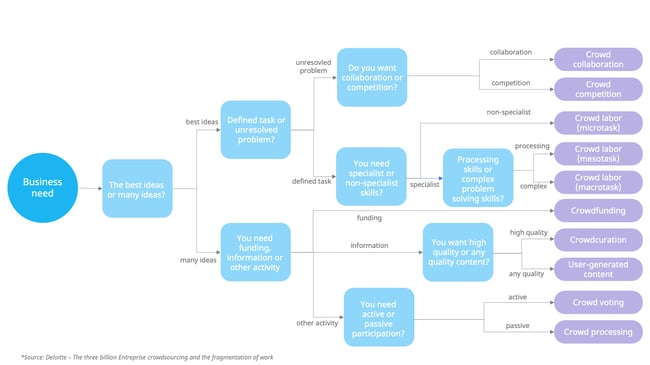
If you are not sure which way to go, as a first step in choosing your approach, you can find inspiration in this chart from Deloitte, which shows a variety of crowdsourcing activities that cater for different needs.
Viima Crowdsourcing 1

Depending on your strategy, industry, and your company profile, you will probably know what type of crowdsourcing is most appropriate for your organization.

This will help you decide on other factors such as the type of contributions you are after, the resources required, and the audience you will target.  
Viima Crowdsourcing 2


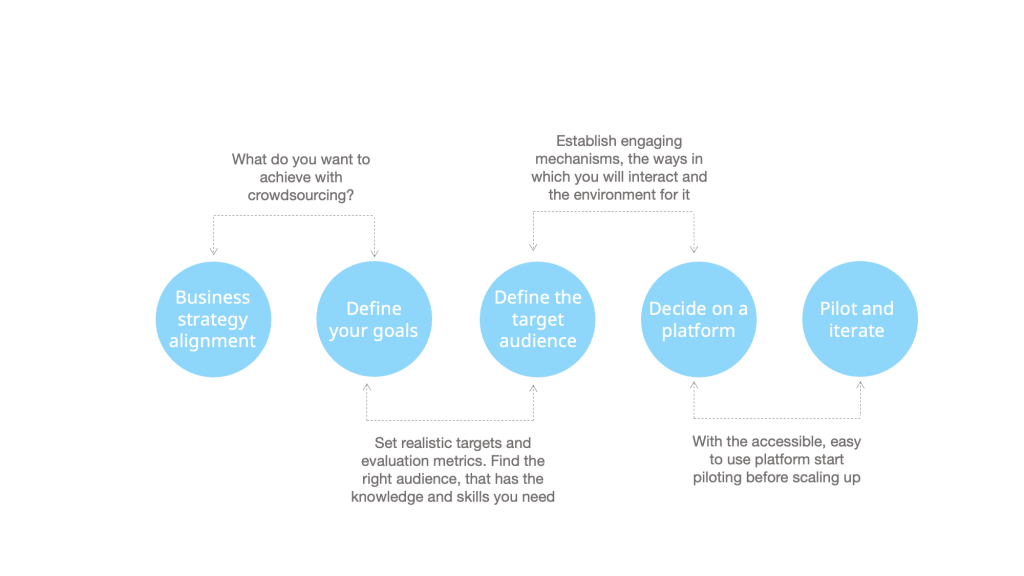
1. Define your goals and set boundaries

The first step is to set clear goals for your crowdsourcing campaign. What do you want to achieve: is it brand awareness, ideas for improving products or customer satisfaction?

Decide on a set of metrics that will help you evaluate the success of the campaign and measure its impact. This will help you adjust as needed but also set realistic targets about the outcomes you think are possible. If you’re set to get disruptive or completely novel ideas that require technical knowledge and complex solutions, you have to carefully consider whom you want to target with the campaign.

2. Define the target audience and the engagement mechanisms

This step is essential for the success of your crowdsourcing. Without the right participants, you won’t have enough relevant ideas.

Think about who would have the most knowledge and expertise in this area and who would be most interested in providing their ideas and insights. Consider demographics such as age, occupation, location, and interests.

Depending on the goals you set or the types of ideas you are after, you will need different audiences. Sometimes there might be more generic ones, while in other cases you will want specific people with knowledge of the topic or interest in the field. On the other hand, sometimes it is more beneficial to have a diverse audience that can bring new and fresh ideas.

Once you have identified your target audience, you need to develop engagement mechanisms that will motivate them to participate in your crowdsourcing campaign.

Engagement mechanisms refer to the various ways in which you can interact with your target audience and encourage them to contribute their ideas. These mechanisms may include online platforms, social media channels, email campaigns, targeted advertising, events, and rewards or incentives.

It’s important to remember that engagement mechanisms should be designed specifically for the target audience.

3. Decide on a platform to support your activities

Once you have decided on the goals, determined the target audience, and the engaging mechanisms, you should next look for a platform that can cater to all your needs.

The platform should act as a transparent communication and exchange forum for participants. It should be easily accessible and simple to use, but also flexible enough to allow different use cases.

As mentioned above, many crowdsourcing failures are related to the inability of organizations to manage and integrate the initiative in their existing processes. Providing feedback and encouraging ongoing participation are also other important elements to consider when scouting for a crowdsourcing tool.

To get an idea of what open innovation platforms are out there and how they can be used for crowdsourcing, you can read this Guide to Open Innovation Platforms: How to Unlock the Power of Collaboration.

The selection criteria should consider factors such as accessibility to the target audience, the ability to integrate relevant engagement mechanisms to promote ongoing participation, and the capability to distribute incentives after the completion of activities.

4. Pilot and iterate

Consider starting with a pilot initiative to test the approach before scaling up.

No matter how well you prepare for something new, like crowdsourcing might be for some, you will most likely stumble a couple of times. And that’s completely fine.

No amount of research and shortlisting will give you the full scope of how it works in practice for your organization. That’s why it’s important to pilot on a smaller scale. And once you’re happy with the pilot results you are ready to scale up.

Doing pilots allows you to test the platform, check for compatibility with the platform, and test your plan and ways of working.

If you are not sure about the first step, get started with a platform and see how it would work in practice internally. Some vendors offer free user-based versions, like us here at Viima, and some have demos or other free trials.

Additionally, piloting may also help evaluate if you’re searching via the wrong criteria (of if your goals are misguided), or if your ways of working or processes are wrong for what you want to achieve. Also, consider using feedback from participants to iterate and refine the initiative over time.

Conclusions

As you can see, just as there are good parts about crowdsourcing, there are also bad ones. There is no one size fits all solution when you want to innovate, and just like many other methods and tools, crowdsourcing can be a great enabler for innovation.

Regardless of the pitfalls and numerous failures from other companies, crowdsourcing can still be highly beneficial for your organization.

To summarize, let’s recap the positive aspects of using crowdsourcing for innovation and the main factors to consider to fully leverage its benefits.
First, for crowdsourcing to work well, it should make sense for the organization’s strategy and overall goals. Make a plan, assess the needs and the capabilities to manage a process like this. Because indeed, crowdsourcing should be designed as a process that complements, and doesn’t hinder other activities within the organization.

Second, make sure you choose the right platform from the get-go. For optimal results you should aim for something that is flexible enough that allows multiple uses, from external idea collection to managing the entire innovation process.

Lastly, don’t over-rely on technology either, because that is just a tool that helps you move forward and be more efficient. The true benefits come when you start building connections, nurture talent and find new approaches to solve problems.

Image credits: Viima, Pixabay

Subscribe to Human-Centered Change & Innovation WeeklySign up here to join 17,000+ leaders getting Human-Centered Change & Innovation Weekly delivered to their inbox every week.