Questions Asked But Not Always Answered

Questions Asked But Not Always Answered

GUEST POST from Mike Shipulski

This seems like a repeat of the last time we set a project launch date without regard for the work content. Do you see it that way?

This person certainly looks the part and went to the right school, but they have not done this work before. Why do you think we should hire them even though they don’t have the experience?

The last time we ran a project like this it took two years to complete. Why do you think this one will take six months?

If it didn’t work last time, why do you think it will work this time?

Why do you think we can do twice the work we did last year while reducing our headcount?

The work content, timeline, and budget are intimately linked. Why do you think it’s possible to increase the work content, pull in the timeline, and reduce the budget?

Seven out of thirteen people have left the team. How many people have to leave before you think we have a problem?

Yes, we’ve had great success with that approach over the last decade, but our most recent effort demonstrated that our returns are diminishing. Why do you want to do that again?

If you think it’s such a good idea, why don’t you do it?

Why do you think it’s okay to add another project when we’re behind on all our existing projects?

Customers are buying the competitive technology. Why don’t you believe that they’re now better than we are?

This work is critical to our success, yet we don’t have the skills sets, capacity, or budget to hire it out. Why are you telling us you will get it done?

This problem seems to fit squarely within your span of responsibility. Why do you expect other teams to fix it for you?

I know a resource gap of this magnitude seems unbelievable but is what the capacity model shows. Why don’t you believe the capacity model?

We have no one to do that work. Why do you think it’s okay to ask the team to sign up for something they can’t pull off?

Based on the survey results, the culture is declining. Why don’t you want to acknowledge that?

Image credit: Pixabay

Subscribe to Human-Centered Change & Innovation WeeklySign up here to join 17,000+ leaders getting Human-Centered Change & Innovation Weekly delivered to their inbox every week.

Customer Service is a Team Sport

Customer Service is a Team Sport

GUEST POST from Shep Hyken

The other day I was having breakfast with 11 of my friends. The server came over, introduced herself, and said, “I’ll be taking care of you.” She took our orders, and a few minutes later, a different server dropped off three of our meals. Then, two more servers brought a few more meals a moment later, and another server showed up just after that with the rest of our meals. It wasn’t until after all the meals were served that our original server came over to ask if everything tasted great.

Was it this server’s job to simply take our orders and let others do the work? No!

I observed all of the people who brought us our meals. They also had other tables to attend to. And, I noticed that our server was dropping food off at different tables.

Different restaurants may have different processes, but in this one, the food is prepared, plated and set on a counter with heat lamps. Once the food is ready, it doesn’t matter whose table the food is for, whoever is available to take the hot food out immediately becomes responsible for the meal.

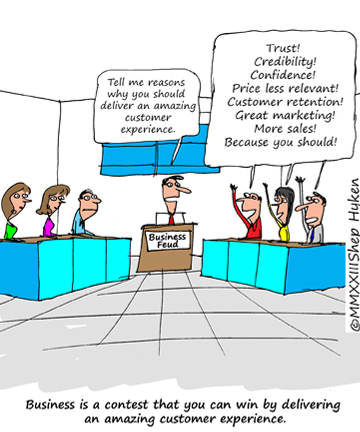
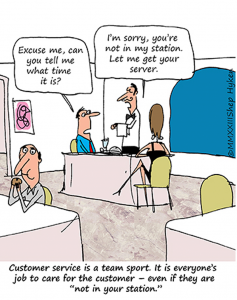
I liked what I was seeing. The employees recognized that customer service is a team sport. It’s everyone’s job to make sure the customers leave happy.

Shep Hyken Waiter Cartoon

Unfortunately, I’ve also witnessed the opposite at a restaurant. The food is set out on the counter, but the server responsible for it is busy taking care of another table. So, the food just sits there while other employees ignore it – because it’s not for one of “their guests.” Talk about a lack of team spirit!

Another example of this lack of team spirit is something I once saw at an airport. A baggage handler was driving a load of bags out to an airplane, and one of them fell off. I watched as numerous other baggage handlers drove by it. They would slow down, look at the bag sitting there by itself on the tarmac and then drive away. At least a half-dozen employees drove by the bag and did nothing. I’m pretty sure that the passenger arrived at their destination and was disappointed when their luggage didn’t show up at the baggage carousel.

The point of these examples is that everyone must take care of the customer, regardless of who the customer “belongs” to. If they see that something isn’t right, they shouldn’t just ignore it like the baggage handlers did.

Lately, I’ve resurrected a concept I used to cover in keynote speeches: every employee has at least two jobs. The first is to do the job they were hired to do. The second is to take care of the customer. When all employees understand that, the customer will most certainly have a better experience.

Image Credit: Shep Hyken, Pixabay

Subscribe to Human-Centered Change & Innovation WeeklySign up here to join 17,000+ leaders getting Human-Centered Change & Innovation Weekly delivered to their inbox every week.

A Global Perspective on Psychological Safety

A Global Perspective on Psychological Safety

GUEST POST from Stefan Lindegaard

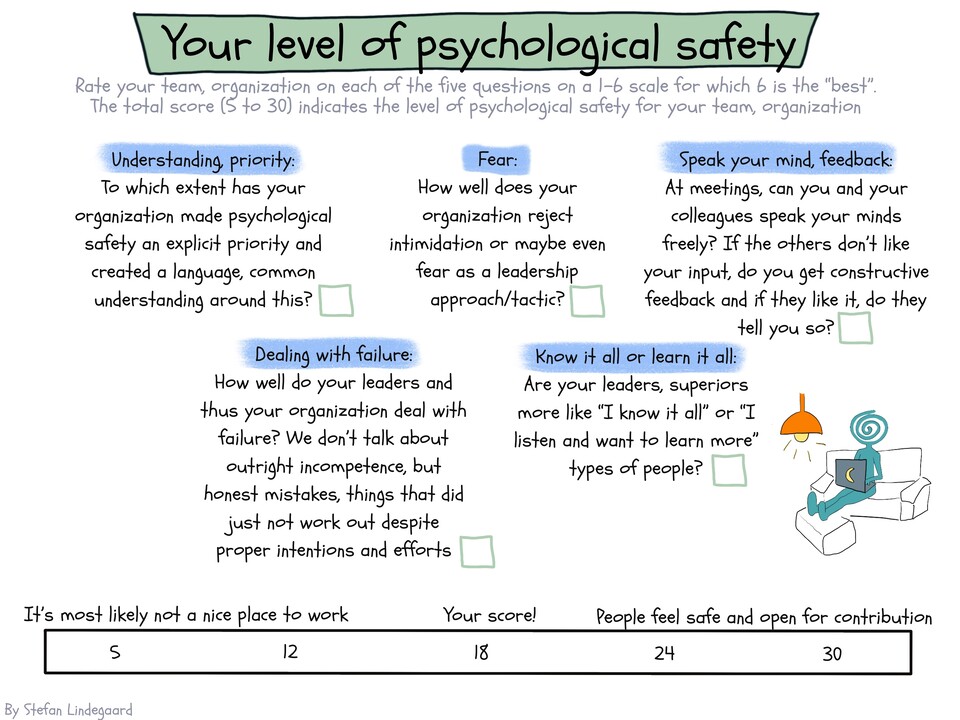
Professor Amy C. Edmondson defines psychological safety as “a belief that one will not be punished or humiliated for speaking up with ideas, questions, concerns, or mistakes.” Achieving psychological safety is essential for fostering innovation and maintaining a competitive edge in today’s rapidly changing business landscape.

In this article, I will share my personal perspectives on psychological safety across different regions around the world, based on my extensive travel and interactions with leaders and organizations over many years. Please note that these observations are not exhaustive but serve as a reflection of my experiences in these regions.

Northern Europe – high psychological safety today

Northern European countries, including the Nordic region and countries like the Netherlands and Germany, are known for their high levels of psychological safety. Leaders in these countries often adopt a more participative and collaborative approach to decision-making, promoting open communication and employee empowerment. Flat organizational structures are more common, allowing for reduced power distance between employees and managers.

For example, in Sweden, the practice of “fika” – regular coffee breaks where employees gather and engage in informal conversations – encourages open dialogue and builds trust among team members. In the Netherlands, the “polder model” of consensus-based decision-making fosters a cooperative atmosphere where diverse opinions are valued and considered.

Southern Europe, Middle East, and parts of Asia – potential for growth through proper implementation

In Southern European countries like Italy, Spain, and Greece, as well as Middle Eastern and other countries such as Turkey and China, top-down and hierarchical leadership styles are more prevalent. Cultural norms and values that emphasize deference to authority can make it challenging to establish psychological safety in these contexts. However, there is significant potential for growth if organizations can adopt more inclusive leadership styles and promote open communication.

In some companies in these regions, forward-thinking leaders are beginning to recognize the value of psychological safety and are implementing practices such as regular feedback sessions, team-building activities, and mentorship programs to foster a more supportive and inclusive work environment.

Psychological Safety Graphic by Stefan Lindegaard

Southeast Asia – an emerging tipping point

Countries in Southeast Asia, including Thailand, Indonesia, and Malaysia, are witnessing a shift in leadership styles, driven by a younger generation and visionary veterans who are blending Eastern and Western approaches. While these countries may currently lag in innovation, their appetite for learning and desire to transform organizational cultures could lead to rapid advancements in psychological safety.

In Southeast Asia, several organizations are embracing the concept of a growth mindset, encouraging employees to take risks, learn from mistakes, and continuously improve. By adopting more inclusive leadership styles and creating spaces for open communication, these countries have the potential to foster psychological safety and drive innovation.

North America – a tale of two realities

In innovation hotspots in the United States and Canada, psychological safety is already well-established. The war for talent in these areas has led organizations to prioritize employee well-being and create inclusive environments. However, other parts of North America may not share the same level of psychological safety, and it’s essential to differentiate between these diverse contexts.

Innovation-driven companies in North America often prioritize transparency and openness, with leaders who actively seek employee input and promote a culture of collaboration. By empowering employees to take initiative, express their ideas, and challenge conventional thinking, these organizations create a psychologically safe environment that fuels creativity and innovation.

Latin America and Africa – unique challenges and opportunities

In Latin American and African countries, cultural norms, economic conditions, and political contexts can vary widely, leading to diverse approaches to psychological safety. While some organizations may struggle with hierarchical leadership styles and limited resources, others are embracing more inclusive practices and leveraging local talent.

Recognizing the unique challenges and opportunities in these regions is crucial for fostering psychological safety and driving innovation. For example, in countries like Brazil and South Africa, companies are increasingly focusing on employee development and well-being, investing in leadership training, and promoting open communication.

Conclusion

Psychological safety is a critical component of successful organizations across the globe. While the degree of psychological safety may vary from region to region, leaders in all contexts can benefit from fostering a supportive, inclusive, and open environment that encourages employees to speak up and share their ideas.

As a global community, we can learn from one another’s experiences and perspectives to advance the development and implementation of psychological safety in organizations worldwide. I encourage readers to share their own insights and experiences with psychological safety in different regions and explore how we can collectively promote a more psychologically safe and innovative world.

So, what are your thoughts on psychological safety from a global perspective?

Feel free to share your comments, perspectives, and questions.

Let’s learn together.

Image Credit: Pixabay

Subscribe to Human-Centered Change & Innovation WeeklySign up here to get Human-Centered Change & Innovation Weekly delivered to your inbox every week.

Unlocking the Power of Imagination

How Humans and AI Can Collaborate for Innovation and Creativity

Unlocking the Power of Imagination

GUEST POST from Teresa Spangler

Imagination is not only the uniquely human capacity to envision that which is not, and, therefore, the foundation of all invention and innovation. In its arguably most transformative and revelatory capacity, it is the power that enables us to empathize with humans whose experiences we have never shared. ~J.K. Rowling

Part I of a 3 Part Series: Simple Strategies

Imagination has always been crucial in human innovation, creativity, and problem-solving. It enables us to envision possibilities beyond the present and find solutions to problems that do not exist yet. 

However, with Artificial Intelligence (AI) advancements, humans must develop their imaginative skills to stay competitive. To achieve that, it is important to understand the eight subsections of imagination – Effectuative, Intellectual or Constructive, Imaginative Fantasy, Empathy, Strategic, Emotional, Dreams, and Memory Reconstruction. Each of these subsections plays a crucial role in the human imagination, and as AI becomes more sophisticated, it will challenge humans to improve their imaginative abilities in each of these areas.

Understanding the Eight Subsections of Imagination

Effectuative Imagination: Effectuative imagination is the ability to imagine the consequences of one’s actions. It enables individuals to plan, make decisions, and predict outcomes. For example, a CEO may use effectuative imagination to anticipate the impact of a new product launch on the company’s financials.

To improve effectuative imagination, humans can:

  • Think about potential consequences before making decisions
  • Analyze data and use it to predict possible outcomes
  • Consider alternative scenarios before deciding on a course of action

Intellectual or Constructive Imagination: Intellectual or constructive imagination is the ability to imagine abstract concepts and ideas. It allows individuals to envision new inventions, theories, and ways of thinking. For example, a scientist may use constructive imagination to develop a new theory that explains a complex natural phenomenon.

To improve intellectual or constructive imagination, humans can:

  • Challenge assumptions and think outside the box
  • Experiment with new ideas and concepts
  • Combine existing ideas and concepts to create new ones

Imaginative Fantasy:  Imaginative fantasy is the ability to create and imagine fantastical worlds and stories. It enables individuals to escape from reality and explore the limits of their imaginations. For example, a writer may use imaginative fantasy to create a new universe for their story.

To improve imaginative fantasy, humans can:

  • Engage in creative activities such as writing, drawing, or painting
  • Read books or watch movies that take them to new worlds
  • Use their imagination to create new stories or scenarios

Empathy:  Empathy is the ability to imagine and understand the emotions and experiences of others. It enables individuals to connect with others more deeply and be more compassionate. For example, a therapist may use empathy to understand their client’s emotions and experiences.

To improve empathy, humans can:

  • Practice active listening and ask questions to understand others better
  • Imagine themselves in other people’s shoes
  • Practice kindness and compassion towards others

 Strategic Imagination:  Strategic imagination is the ability to imagine and plan for the future. It enables individuals to anticipate potential challenges and opportunities and to develop effective strategies. For example, a business leader may use strategic imagination to create a long-term growth plan for their company.

To improve strategic imagination, humans can:

  • Develop a long-term vision for their personal or professional life
  • Identify potential challenges and opportunities and develop strategies to address them
  • Use data and analysis to inform their decisions

Emotional Imagination:  Emotional imagination is the ability to imagine and experience a wide range of emotions. It enables individuals to empathize with others and connect with their emotions. For example, an actor may use emotional imagination to convincingly portray a character’s emotions.

To improve emotional imagination, humans can:

  • Practice mindfulness and self-awareness to understand their own emotions better
  • Engage in creative activities such as writing or acting to explore different emotions
  • Practice empathy to understand other people’s emotions better

Dreams:  Dreams are a manifestation of our subconscious mind and imagination. They enable us to explore our deepest desires, fears, and aspirations. Dreams are also a way for our brains to process and consolidate memories. For example, a person may have a dream about an experience that helps them understand and process their emotions.

To improve dreams and imagination, humans can:

  • Keep a dream journal to record and reflect on their dreams
  • Practice lucid dreaming to control and direct their dreams
  • Engage in creative activities such as writing or drawing to explore dream worlds and scenarios

Memory Reconstruction:  Memory reconstruction is remembering past events and experiences and using our imagination to fill in gaps and create a coherent narrative. It enables individuals to sense their past and create a personal identity. For example, a person may reconstruct childhood memories to understand how past experiences have shaped who they are today.

To improve memory reconstruction and imagination, humans can:

  • Reflect on past experiences and try to understand how they have influenced their life
  • Engage in creative activities such as writing or drawing to explore memories and create new narratives
  • Practice mindfulness to become more aware of their thoughts and feelings

How AI May Challenge Us to Become More Imaginative

As AI becomes more sophisticated, it will challenge humans to improve their imaginative abilities in each of the eight subsections of imagination. Working alongside AI can spark us to new levels of thinking. Consider AI as your partner in growing your own imagination, your creativity and your abilities to be more inventive.

Examples:

  • Effectuative Imagination: AI can analyze data and provide insights humans can use to make better decisions.
  • Intellectual or Constructive Imagination: AI can identify patterns and connections between data sets that humans may not have noticed, leading to new ideas and theories.
  • Imaginative Fantasy: AI can generate creative ideas and scenarios that humans may not have thought of independently. However, imaginative people can raise the bar on creativity by using these AI-generated fantasies.
  • Empathy: AI can analyze social media data and sentiment analysis to understand how people are feeling and to predict future trends.
  • Strategic Imagination: AI can analyze market data and economic indicators to identify potential challenges and opportunities for businesses and organizations.
  • Emotional Imagination: AI can analyze facial expressions and tone of voice to understand people’s emotions and to provide personalized recommendations and support.
  • Dreams: AI can use generative models to create realistic dream scenarios and to help individuals explore and process their subconscious thoughts and emotions.
  • Memory Reconstruction: AI can analyze large data sets and identify patterns and connections humans may not have noticed, leading to new insights and narratives.

Working Alongside AI to Unlock Human Imagination

AI is not a threat to human imagination but rather a tool that can help us unlock our full imaginative potential. By collaborating with AI, humans can gain new insights and perspectives that inform their imaginative processes. Here are some strategies for working alongside AI to unlock human imagination:

  • Use AI-powered tools to analyze data and identify patterns and connections that can inform imaginative processes.
  • Collaborate with AI-powered systems to generate new ideas and scenarios.
  • Use virtual and augmented reality tools to explore new environments and possibilities.
  • Leverage AI-powered chatbots and virtual assistants to provide personalized support and recommendations.
  • Participate in cross-functional teams that include both humans and AI-powered systems.

How Companies Can Support Employee Imagination

Companies have a critical role in supporting their employees’ imaginative skills. By doing so employees will be come more engaged and productive.  Here are a few strategies that companies can use to support employee imagination:

  • Encourage creativity by providing opportunities for employees to explore new ideas and experiment with new approaches.
  • Foster diversity and inclusion by promoting diverse perspectives and experiences and creating a safe and inclusive work environment.
  • Invest in technology and tools that support imaginative work, such as AI-powered systems, virtual and augmented reality tools, and collaborative platforms.
  • Provide learning and development opportunities focusing on imaginative skills, such as creativity, emotional intelligence, and strategic thinking.
  • Encourage collaboration by creating cross-functional teams and promoting a culture of collaboration.

Imagination is essential for the future of innovation and human productivity. The eight subsections of imagination provide a framework for understanding and developing imaginative abilities. As AI becomes more sophisticated, it will challenge humans to improve their imaginative skills in each of these areas. Humans can unlock new ideas and solutions that drive innovation and progress by developing imaginative skills and working alongside AI.

Moreover, individuals can develop their imaginative skills by embracing change, fostering curiosity, developing a growth mindset, practicing mindfulness, collaborating with AI, exploring new forms of art and creativity, practicing divergent thinking, and fostering the eight subsections of imagination.

Companies have a crucial role in supporting their employees’ imaginative skills. They can encourage creativity, foster diversity and inclusion, invest in technology and tools supporting imaginative work, provide learning and development opportunities focusing on imaginative skills, and encourage collaboration.

In the age of AI, humans must strive to maintain their unique skills and abilities. Imagination is a human trait that AI cannot replicate. Developing our imaginative skills and working alongside AI can unlock new opportunities and create a better future for ourselves and the world.

Image credit: Pixabay

Subscribe to Human-Centered Change & Innovation WeeklySign up here to join 17,000+ leaders getting Human-Centered Change & Innovation Weekly delivered to their inbox every week.

Reasons Change Management Frequently Fails

Reasons Change Management Frequently Fails

GUEST POST from Greg Satell

In 1983, McKinsey consultant Julien Phillips published a paper in the journal Human Resource Management that described an “adoption penalty” for firms that didn’t adapt to changes in the marketplace quickly enough. His ideas became McKinsey’s first change management model that it sold to clients.

So it is notable, to say the least, that in 2015, more than 35 years later, McKinsey found that only 26% of organizational transformations succeed. It’s not hard to see why. While traditional change management models offer sensible frameworks for fairly obvious changes, truly transformational efforts almost always encounter fierce resistance.

That’s an important distinction that leads to a significant difference. As I found when researching my book, Cascades, successful transformations identify resistance from the start and effectively plan to overcome opposition. Clearly, today, when change is so often a matter of survival, traditional change management models are no longer enough.

Preparing For Resistance

The change management industry was developed to solve a particular and discrete problem. While there were clear and coherent models for other critical business functions, such as marketing and finance, there was a relative dearth of models to help drive change. Phillips’ model and those that came after sought to fill that gap.

Yet as the McKinsey data clearly shows, those models have not been widely successful and it’s not hard to see why. Much as any competitive strategy that doesn’t anticipate the response from competitors is doomed to failure, any transformation strategy that doesn’t take into account those who oppose change is unlikely to succeed.

In my research, however, I found that when resistance is anticipated and accounted for, transformational efforts can achieve astounding results. At Wyeth Pharmaceuticals, the team implemented lean manufacturing techniques across 17,000 employees and cut costs by 25%. At Experian, CIO Barry Libenson shifted its entire technological infrastructure to the cloud and improved profitability across the entire company.

What made the difference is that in both cases, those leading the transformation didn’t assume that the changes would be embraced. In fact, just the opposite. They expected resistance and built a plan to overcome it.

Mapping The Terrain

Traditional change management models start with steps that encourage communicating the need for change and building a sense of urgency. Yet that can often backfire. While communication efforts can and often do excite many about the prospect for transformation, they also alert the opposition to step up their efforts to undermine change.

So the first step is to map the terrain upon which the battle for change will be fought (and make no mistake, any significant transformation effort is always a battle). There are two tools, borrowed from nonviolent political movements, that can help you do this: The Spectrum of Allies and the Pillars of Support. Both have been battle tested for decades.

The Spectrum of Allies, helps you identify which people are active or passive supporters of the change you want to bring about, which are neutral and which actively or passively oppose it. Once you are able to identify these groups, you can start mobilizing the most enthusiastic supporters to start influencing the other groups to shift their opinions. You probably won’t ever convince the active opposition, but you can isolate and neutralize them.

The Pillars of Support identifies stakeholder groups that can help bring change about. Some of these may be internal stakeholders, such as business units or functional groups within an organization. However, some of the most important stakeholders are often external, such as customer groups, industry associations, regulators and so on.

At this point, you are still planning, rather than implementing change. Most of all, you are listening and remain respectful of others who don’t hold the same views you do. The information you gather in these early stages will be critical for overcoming resistance later on.

The Myth of A Quick Win

One of the key tenets of change management is the need to achieve some quick, short term wins to help build momentum. The truth is that these types of objectives are often not meaningful to many, if not most, key stakeholders. In fact, they can often signal to those skeptical of change that the initiative is not serious.

In my research, I found that every successful transformation I studied identified a keystone change which had a clear and tangible goal, involved multiple stakeholders and paved the way for greater change down the road. Because these require the involvement of multiple stakeholders, they are never quick or easy.

For example, in the Wyeth transformation noted above, the keystone change was to reengineer factory changeovers, a difficult and complex task. In Experian’s shift to cloud technology, the keystone change was to build internal API’s. During Lou Gerstner’s historic turnaround at IBM in the 90s, he sought to shift the company from a “proprietary stack of technologies” to its “customers’ stack of business processes.”

In each case, key constituencies in the Spectrum of Allies were mobilized to influence key institutional stakeholders in the Pillars of Support. That takes time, patience and no small amount of effort. In some cases, it took a few tries to identify a keystone change that could succeed.

Every Revolution Inspires Its Own Counter-Revolution

Many change management efforts start with a large kickoff, complete with a vigorous communication campaign designed to create a sense of urgency and rally the troops. What’s often overlooked is that these efforts often alert those who are opposed to change that they need to begin undermining change efforts before they gain momentum.

As the change efforts gain momentum, these undermining efforts may quiet somewhat, but they very rarely disappear, even after the goals of the transformation have already been achieved. For example, at Blockbuster Video, initial efforts to address the disruptive threat posed by Netflix were successful, but that strategy was quickly reversed when a new CEO came aboard.

That’s why it’s crucial that you set out from the beginning to survive victory and you do that by rooting your efforts not in specific goals or objectives, but in common values. As Irving Wladawsky-Berger, a key player in IBM’s historic turnaround, told me, “Because the transformation was about values first and technology second, we were able to continue to embrace those values as the technology and marketplace continued to evolve.”

Perhaps most of all, you need to remember that there’s a reason that the vast majority of transformational efforts fail: Change is hard and it can’t be easily managed. Yet history has shown that it can be achieved, even under the worst conditions and against the greatest odds, if you learn to anticipate and overcome those who would seek to undermine it.

— Article courtesy of the Digital Tonto blog
— Image credit: Pixabay

Subscribe to Human-Centered Change & Innovation WeeklySign up here to join 17,000+ leaders getting Human-Centered Change & Innovation Weekly delivered to their inbox every week.


A Flop is Not a Failure

Why innovation thrives on being able to reframe

A Flop is Not a Failure

GUEST POST from John Bessant

Mexico City, Olympic Games, 1968. The stadium is packed, the wider world looks on via TV coverage. Everywhere there’s an air of expectancy but also an awareness that at such high altitude it’s going to be hard for athletes to beat their best. Records are there to be broken, you have to hope for something special.

And in the high jump event they weren’t disappointed. The record for men’s high jump had hovered around 2.23 m for several years. But a young 21-year-old was about to change that; Dick Fosbury, representing the USA broke this with a height of 2.24 m and won the gold medal.

What was so spectacular was not just the achievement but the way it was accomplished. Unlike other athletes who did the (apparently obvious) thing of running and then jumping over the bar, swinging one leg behind the other, Fosbury paused at the moment of jumping, turned his back and flopped over it backwards. Why would anyone do that?

Fosbury had an answer — he’d been working on it for five years before his Mexico success. He’d been frustrated with the limits of the traditional ‘straddle’ jump and experimented with alternative ways of getting over the bar, finally hitting on and perfecting his backwards approach. The big advantage of doing this was that it gave him a lower and different centre of gravity and allowed for more clearance over the bar.

The ‘Fosbury flop’ as it quickly became known opened up new possibilities for the sport; within ten years it had become the dominant mode for all jumpers and helped move the world record to 2.45 m which was set in 1993 by Javier Sotomayor. These days anyone attempting the high jump has come to resemble the ‘fish flopping on the deck of a boat’ as one newspaperman described Fosbury’s Mexico model.

John Bessant Doodly Image

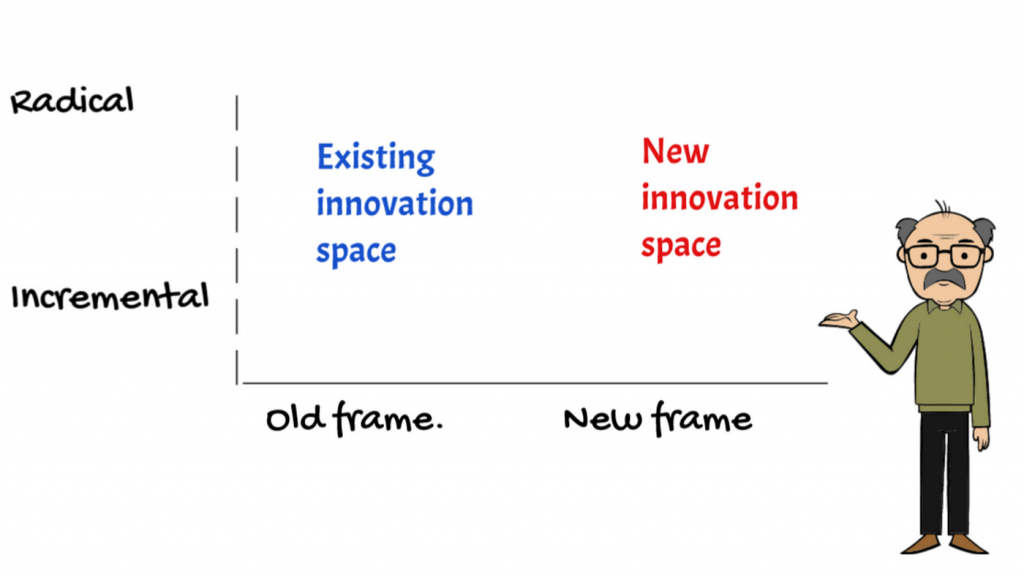
What Fosbury’s feat reminds us of is the power of reframing in innovation. Innovation can take place anywhere along a continuum from doing what we do better — incremental — to doing something completely different — radical. And it can cover what we offer the world — product or service — and the ways we create a deliver that offering — process. That gives us plenty to keep us busy in our innovation day.

But sometimes we can reframe, look at what we’re doing in a different way, identify novel approaches. For example we can rethink the positioning of our innovation — opening up a new market segment or moving into a new geographical area. There’s plenty of learning and pivoting involved in doing that — as Netflix discovered when it began to extend its offer from the USA to Canada and then Europe and beyond.

We can be more radical and change the story we tell and who we tell it to — think about Starbucks and others and the way they repositioned coffee from a simple hot drink to something consumed in as many varieties and combinations as fine wine. Or Haagen Dasz and others who reframed the idea of ice cream as a sensuous adult pleasure rather than as a treat for kids on hot days. Or Henry Ford, bringing the motor car from the small luxury goods market to being a ‘car for Everyman at a price every man can afford’.

This kind of reframing opens up new possibilities but poses new challenges. Just as Fosbury and his followers had to rethink so much of their approach and learn new tricks (not least about where and how to land!) so this kind of position reframing requires major modifications to our product/service offering and our delivery processes.

Think about low-cost airlines — if your main idea is to offer flights at half the price of your competitors, you’ll quickly find out how fast you can lose money. The only way you can make that model work, selling seats to a market who otherwise couldn’t afford to fly will be to radically change your processes, stripping costs and complexity out of everything from booking to check-in, to boarding right through to turnaround time management. Master those tricks and you not only have a viable business model, you’ve got something which the rest of the pack have to catch up with.

But reframing doesn’t stop there; business model innovation is a very hot topic these days and at heart it is finding ways to change the game by replacing one business model with an alternative. Business models set out the architecture through which an innovation can deliver value– for which market segments, with which value proposition and so on. Business model innovation is all about replacing that system with a different better one.

We’ve got plenty of examples of this happening — think about Uber or AirBnB and how they’ve not only become successful new models themselves but also offered templates for others to use in different fields. Or what Spotify and the music streaming services have done to entertainment by changing the model from ownership to rental.

It’s the same with capital goods makers like Caterpillar or Rolls Royce. Instead of selling products on a one-off basis they now offer the functionality of those products to their customers on a rental basis, charging them for ‘power by the hour’ for example.

Once again such reframing isn’t trivial, it drives innovation in product and service and it requires major rethinking about the processes which create and deliver such service. If Rolls-Royce, General Electric and others are being paid for the number of hours their engines are keeping airliners in the air then they need to work hard to ensure that they are reliable and well-maintained. So, they’ve had to innovate in their products to improve reliability through intelligent condition monitoring, they’ve had to install skilled staff at airports making sure engines are quickly and regularly checked and serviced and they’ve had to rethink their financial and support operations to reflect the changed approach.

Beyond all of this comes the possibility of completely reframing the whole approach to innovation — innovation model innovation. Sometimes it’s not enough just to tweak and adapt the product or service development pathway or revise arrangements for process improvement. Sometimes there’s a need for a radical rethink.

A good example of this is the experience of Procter and Gamble and their emerging response to the opportunities and challenges posed by ‘open innovation’. Faced with a world in which ‘not all the smart people work for you’ they reframed their approach to creating thousands of new products from one which had dominated a century and a half of growth through Research and Develop. They replaced it with a new strategic approach to innovation, with the deceptively simple label of ‘Connect and develop’.

The challenge was easy to express and CEO Alan Lafley did so in 2000 when he launched the program. In the future P&G would get 50% of its innovations from outside as distinct from the previous model which was 100% home grown. Simple to say but it has taken then 25 years to turn the challenge into a viable and successful new model. On the way they’ve had to re-engineer so much, finding ways to identify and filter external ideas, to assimilate them and deploy that new knowledge in new directions for the business and simultaneously to make better use of knowledge which P&G had created and then never found a home for.

There’s a useful Greek word — paradigm — which can be used to describe the way we see the world. It’s like the mental spectacles through which we see which problems to focus on and which solutions might be relevant. Change the spectacles — reframe to a new paradigm — and everything looks different, opening up new and fruitful possibilities. It’s an idea which has been put forward by Thomas Kuhn the philosopher of science to explain how our thinking progress follows a pattern of ‘punctuated equilibrium’ — long periods of working within a particular frame followed by a transition to a new way of looking and thinking.

Paradigm innovation is powerful and influential; it changes the world. Which might be a fitting epilogue to the fulsome obituaries which have appeared in response to the sad news of Dick Fosbury’s death last month. He was a true innovator and he changed the way athletes thought about their challenge, helping them aim and reach higher.

Image Credits: Eugene Register-Guard (From the Medford Star-Tribune, 1964), John Bessant (Doodly)

You can find a podcast version of this here and a video version here

And if you’d like to learn with me take a look at my online course here

Subscribe to Human-Centered Change & Innovation WeeklySign up here to join 17,000+ leaders getting Human-Centered Change & Innovation Weekly delivered to their inbox every week.
Instant Revenue

Instant Revenue

GUEST POST from Mike Shipulski

If you want to grow the top line right now, create a hard constraint – the product cannot change – and force the team to look for growth outside the product. Since all the easy changes to the product have been made, without a breakthrough the small improvements bring diminishing returns. There’s nothing left here. Make them look elsewhere.

If you want to grow the top line without changing the product, make it easier for customers to buy the products you already have.

If you want to make it easier for customers to buy what you have, eliminate all things that make buying difficult. Though this sounds obvious and trivial, it’s neither. It’s exceptionally difficult to see the waste in your processes from the customers’ perspective. The blackbelts know how to eliminate waste from the company’s perspective, but they’ve not been taught to see waste from the customers’ perspective. Don’t believe me? Look at the last three improvements you made to the customers’ buying process and ask yourself who benefitted from those changes. Odds are, the changes you made reduced the number of people you need to process the transactions by pushing the work back into the customers’ laps. This is the opposite of making it easier for your customers to buy.

Have you ever run a project to make it easier for customers to buy from you?

If you want to make it easier for customers to buy the products you have, pretend you are a customer and map their buying process. What you’ll likely learn is that it’s not easy to buy from you.

1. How can you make it easier for the customer to choose the right product to buy?

Please don’t confuse this with eliminating the knowledgeable people who talk on the phone with customers. And, fight the urge to display all your products all at once. Minimize their choices, don’t maximize them.

2. How can you make it easier for customers to buy what they bought last time?

A hint: when an existing customer hits your website, the first thing they should see is what they bought last time. Or, maybe, a big button that says – click here to buy [whatever they bought last time]. This, of course, assumes you can recognize them and can quickly match them to their buying history.

3. How can you make it easier for customers to pay for your product?

Here’s a rule to live by: if they don’t pay, you don’t sell. And here’s another: you get no partial credit when a customer almost pays.

As you make these improvements, customers will buy more. You can use the incremental profits to fund the breakthrough work to obsolete your best products.

Image credit: Pixabay

Subscribe to Human-Centered Change & Innovation WeeklySign up here to join 17,000+ leaders getting Human-Centered Change & Innovation Weekly delivered to their inbox every week.

Customers Care About the Destination Not the Journey

Customers Care About the Destination Not the Journey

GUEST POST from Shep Hyken

On a recent flight, the captain of the airplane announced over the PA system what time we would arrive at our destination. That would have been enough to make most people happy. However, he continued his announcement with a three-minute-plus speech. We learned that we would take off to the west, make a U-turn a few minutes later to head east, how high we would go, the various cities we would be flying over, that we would take a right turn as we approached the runway to land, and more. I looked around and noticed many people were annoyed or had stopped paying attention to the long-winded announcement.

The point is most customers don’t care as much about the details of the journey as they care about the destination.

Here’s another example, which has nothing to do with a journey but does have to do with an overload of details that can hurt a sale or erode the customer experience. Some people love a fancy, expensive sports car, while others just want reliable transportation. Even though these customers essentially want the same thing – a car to get them from one place to another – they are very different customers.

Shep Hyken Lobster Cartoon

A few years ago, my wife and I were looking for a new car. We narrowed it down to the make and model – even the color – we thought we wanted. We walked into the dealership and were approached by a salesperson who was very friendly and engaging. Then, we told him what we were looking for. So, he took us over to the exact car we wanted. He was very excited. He started to share details about the size of the engine, how many cylinders, how quickly the car could accelerate from zero to 60, the RPMs, and other details that mattered nothing to us.

Had he asked why we were interested in this model car, he would have realized we had no real interest in such details. Our version of the destination was that we wanted a nice-looking car (and it was) that was comfortable, safe, and easy to drive. Maybe we wanted to know a few other details about the car, but nothing to the extent he was sharing. Had he paid attention, he would have noticed he had us when he said, “I have the exact car you’re looking for.”

My point is that most customers don’t care about the details behind the experience or product they are buying. It’s up to us to recognize this and respond accordingly. All they want to know is what awaits them at their metaphorical destination.


Image Credit: Shep Hyken, Pixabay

Subscribe to Human-Centered Change & Innovation WeeklySign up here to join 17,000+ leaders getting Human-Centered Change & Innovation Weekly delivered to their inbox every week.
How to Accelerate Your Career in the Age of AI and Continuous Disruption

How to Accelerate Your Career in the Age of AI and Continuous Disruption

GUEST POST from Robert B. Tucker

Artificial intelligence. Aging populations. The climate crisis. The world is changing more rapidly than any other moment in history, opening the door to both unprecedented volatility and unmatched innovation. The time to prepare for tomorrow’s challenges is now — at an immersive California conference designed specifically to equip future-forward thinkers to lead the charge.

As host of the Pacific Coast Futures Retreat, I’m convening a broad range of futurists, scientists, government officials, tech and NGO leaders and others to join me in Santa Barbara for an immersive, think tank-style gathering to focus on equipping leaders to face the driving forces of change. I believe that, because of exploding technology, geopolitical shocks, and worsening climate crisis, that in the next ten years there will be more change than in the last 50.

Registration is now open for the May 2 retreat, which is limited to 60 future-minded attendees.

Artificial intelligence, climate change and the aging population will disrupt millions who are unprepared. But those same forces also provide an incredible opportunity for those ready to lead change and prosper. At the retreat, we’ll immerse ourselves in preparing our businesses, organizations, schools and society for what’s coming next — because every aspect of our world will be impacted by these challenges and threats:

I’ll be joined by these future-focused innovators:

  • Rinaldo Brutoco (founder and CEO of the World Business Academy), on “Driving the Net Zero Energy Future Through Innovation”
  • Jim Cathcart (speaker, author and personal development expert) on “Maximizing Your Potential, and Maximizing Your Future”
  • Chris Chirgwin (tech entrepreneur and CIO in a major governmental organization) on “Navigating The Future of Technology & Opportunities in Emerging Tech-Trends”
  • Dr. Don Gilman (technology and leadership strategist) on “Outsmarting VUCA: Achieving Success in a Volatile, Uncertain, Complex & Ambiguous World”
  • Rich Sorkin (co-founder of the climate risk startup Jupiter Intelligence) on “How to Seize the Opportunities in Climate Change”

Across more than three decades as a futurist, I have never witnessed the confluence of mega-forces that we are experiencing today. In the next 10 years, some of the greatest fortunes in history will be created by those who understand the emerging landscape and are prepared to ride the waves of change. I’m fired up and ready to navigate this terrain with fellow futurists on May 2.

This article originally appeared in Forbes
Image credit: Pexels

Subscribe to Human-Centered Change & Innovation WeeklySign up here to get Human-Centered Change & Innovation Weekly delivered to your inbox every week.

3 Examples of Why Innovation is a Leadership Problem

Through the Looking Glass

3 Examples of Why Innovation is a Leadership Problem

GUEST POST from Robyn Bolton

Do you sometimes feel like you’re living in an alternate reality?

If so, you’re not alone.  Most innovators feel that way at some point.

After all, you see things that others don’t.

Question things that seem inevitable and true.

Make connections where others only see differences.

Do things that seem impossible.

It’s easy to believe that you’re the crazy one, the Mad Hatter and permanent resident of Wonderland.

But what if you’re not the crazy one?

What if you’re Alice?

And you’re stepping through the looking glass every time you go to work?

In Lewis Carroll’s book, the other side of the looking glass is a chessboard, and all its inhabitants are chess pieces that move in defined and prescribed ways, follow specific rules, and achieve defined goals.  Sound familiar?

Here are a few other things that may sound familiar, too

“The rule is, jam tomorrow and jam yesterday – but never jam today.” – The White Queen

In this scene, the White Queen offers to hire Alice as her lady’s maid and pay her “twopence a week and jam every other day.”  When Alice explains that she doesn’t want the job, doesn’t like jam, and certainly doesn’t want jam today, the queen scoffs and explains the rule.

The problem, Alice points out, is that it’s always today, and that means there’s never jam.

Replace “jam” with “innovation,” and this hits a little too close to home for most innovators.

How often do you hear about the “good old days” when the company was more entrepreneurial, willing to experiment and take risks, and encouraged everyone to innovate?

Innovation yesterday.

How often do you hear that the company will invest in innovation, restart its radical innovation efforts, and disrupt itself as soon as the economy rebounds, business improves, and things settle down a bit?  Innovation tomorrow.

But never innovation today.  After all, “it’s [innovation] every other day: today isn’t any other day, you know.”

“When I use a word, it means just what I choose it to mean – neither more, not less.” – Humpty Dumpty

In this scene, poor Alice tries to converse with Humpty Dumpty, but he keeps using the “wrong” words.  Except they’re not the wrong words because they mean exactly what he chooses them to mean.

Even worse, when Alice asks Humpty to define confusing terms, he gets angry, speaks in a “scornful tone,” and smiles “contemptuously” before “wagging his head gravely from side to side.

We all know what the words we use mean, but we too often think others share our definitions.  We use “innovation” and “growth,” assuming people know what we mean.  But they don’t.  They know what the words mean to them.  And that may or may not be what we mean.

When managers encourage people to share ideas, challenge the status quo, and take risks, things get even trickier.  People listen, share ideas, challenge the status quo, and take risks.  Then they are confused when management doesn’t acknowledge their efforts.  No one realizes that those requests meant one thing to the managers who gave them and a different thing to the people who did them.

“It takes all the running you can do, to keep in the same place.  If you want to go somewhere else, you must run at least twice as fast as that!” – The Red Queen

In this scene, the Red Queen introduces life on the other side of the looking glass and explains Alice’s new role as a pawn.  Of course, the explanation comes after a long sprint that seems to get them nowhere and only confuses Alice more.

When “tomorrow” finally comes, and it’s time for innovation, it often comes with a mandate to “act with urgency” to avoid falling behind.  I’ve seen managers set goals of creating and launching a business with $250M revenue in 3 years and leadership teams scrambling to develop a portfolio of businesses that would generate $16B in 10 years.

Yes, the world is moving faster, so companies need to increase the pace at which they operate and innovate.  But if you’re doing all you can, you can’t do twice as much.  You need help – more people and more funding, not more meetings or oversight.

“Life, what is it but a dream?”

Managers and executives, like the kings and queens, have roles to play.  They live in a defined space, an org chart rather than a chessboard, and they do their best to navigate it following rules set by tradition, culture, and HR.

But you are like Alice.  You see things differently.  You question what’s taken as given.  And, every now and then, you probably want to shake someone until they grow “shorter – and fatter – and softer – and rounder – and…[into] a kitten, after all.”

So how do you get back to reality and bring everyone with you?  You talk to people.  You ask questions and listen to the answers.  You seek to understand their point of view and then share yours.

Some will choose to stay where they are.

Some will choose to follow you back through the looking glass.

They will be the ones who transform a leadership problem into a leadership triumph.

Image credits: Pixabay

Subscribe to Human-Centered Change & Innovation WeeklySign up here to join 17,000+ leaders getting Human-Centered Change & Innovation Weekly delivered to their inbox every week.