Tag Archives: flexibility

The Architecture of Organizational Agility

Beyond the Pivot

LAST UPDATED: February 24, 2026 at 5:22 PM

Architecture of Organizational Agility

by Braden Kelley and Art Inteligencia

I. Introduction: The Agility Imperative

Beyond Reactive Maneuvering toward Proactive Orchestration

The Stability Paradox

In my work with global enterprises, I often observe a recurring struggle: The Stability Paradox. Legacy organizations often possess the “fixedness” required for massive scale but lack the fluidity to respond to market shifts. Conversely, startups possess “flexibility” in spades but often collapse under their own weight due to a lack of foundational structure.

Defining True Agility

Many leaders mistake speed for agility. Speed is simply high-velocity movement in a single direction. True Agility is the architectural capability to change direction at speed without destroying the engine. It is the move from “reactive maneuvering” — constantly putting out fires — to “proactive orchestration,” where the organization anticipates the flame and adjusts its posture before the heat is even felt.

Thesis: Organizational agility is not about being liquid or formless; it is about strategic architecture. It requires knowing exactly which parts of your foundation must remain fixed to provide a stable spine, so that the rest of the enterprise can remain infinitely flexible.
Braden Kelley Flexibility Quote

II. The Human Side of Agility (Human-Centered Change)

Fueling the Adaptive Machine with Mindset and Culture

Psychological Safety as a Fuel

An agile architecture is useless if the people within it are too terrified to move. Psychological safety is the essential fuel for change. If employees fear that a “failed” experiment or a missed pivot will result in professional retribution, they will default to the status quo every time. To be truly agile, the organization must celebrate the learning gained from failure as much as the success of a win.

Shifting the Mindset: Adaptability Over Efficiency

For decades, management science focused on “Efficiency-First” — doing things right through rigid optimization. In a volatile world, we must pivot to “Adaptability-First” — ensuring we are doing the right things as the market shifts. This requires a cultural “unlearning” where we value the ability to pivot just as highly as the ability to execute.

Radical Transparency and Communication Loops

Agility requires that the “edges” of the organization — the people talking to customers and witnessing market friction — have a direct line to the “center.” By creating radical transparency and shortened communication loops, we ensure that institutional knowledge flows at the speed of the internet, allowing for collective intelligence rather than top-down bottlenecks.

The Human Truth: You cannot mandate agility; you can only design an environment where it is safe to be agile. Change doesn’t happen in the boardroom; it happens in the hearts and minds of the people on the front lines.

III. The Braden Kelley Organizational Agility Framework™

Navigating the Strategic Tension Between Flexibility and Fixedness

Introduction to the Framework

In my research and consulting, I developed the Organizational Agility Framework™ as a diagnostic tool for the modern enterprise. It moves away from the idea that everything in a business should be “fluid.” Instead, it focuses on identifying the necessary friction and structural integrity required to support rapid movement.

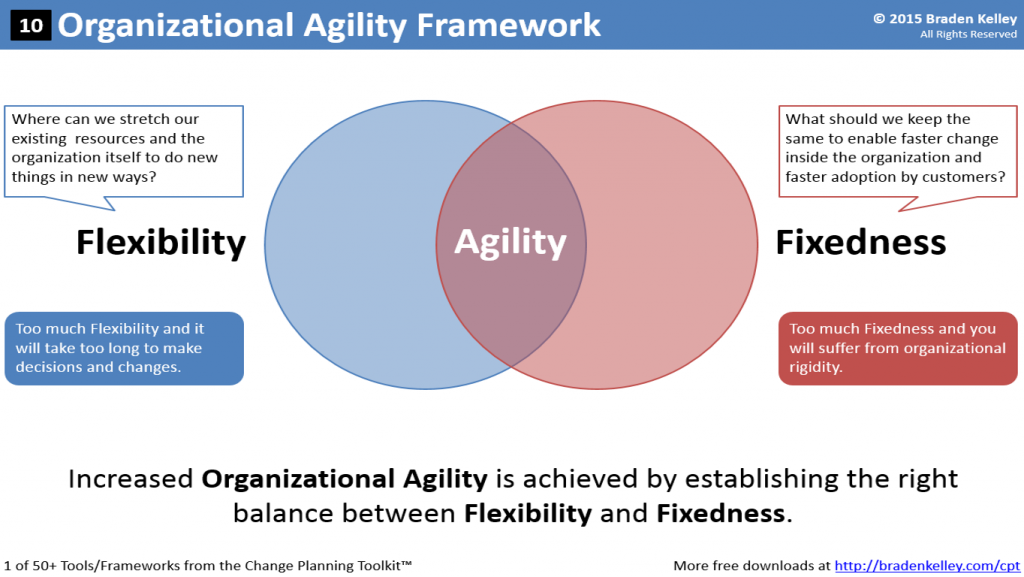
The Core Tension: Flexibility vs. Fixedness

The secret to sustained agility lies in the deliberate management of two opposing states:

  • The Fixed: These are your non-negotiables. They include your core values, organizational purpose, and essential guardrails. These elements provide the “stable spine” and the psychological certainty employees need to take risks.
  • The Flexible: These are your “modular” components. They include business processes, resource allocation models, and team structures. These must be designed to be disassembled and reconfigured in real-time as market conditions evolve.
Organizational Agility Framework

Managing the Equilibrium

The framework teaches leaders how to prevent “Fixedness” from decaying into Rigidity (where you become a dinosaur) and how to prevent “Flexibility” from dissolving into Chaos (where you lose your brand identity). Agility is the active, daily management of this equilibrium.
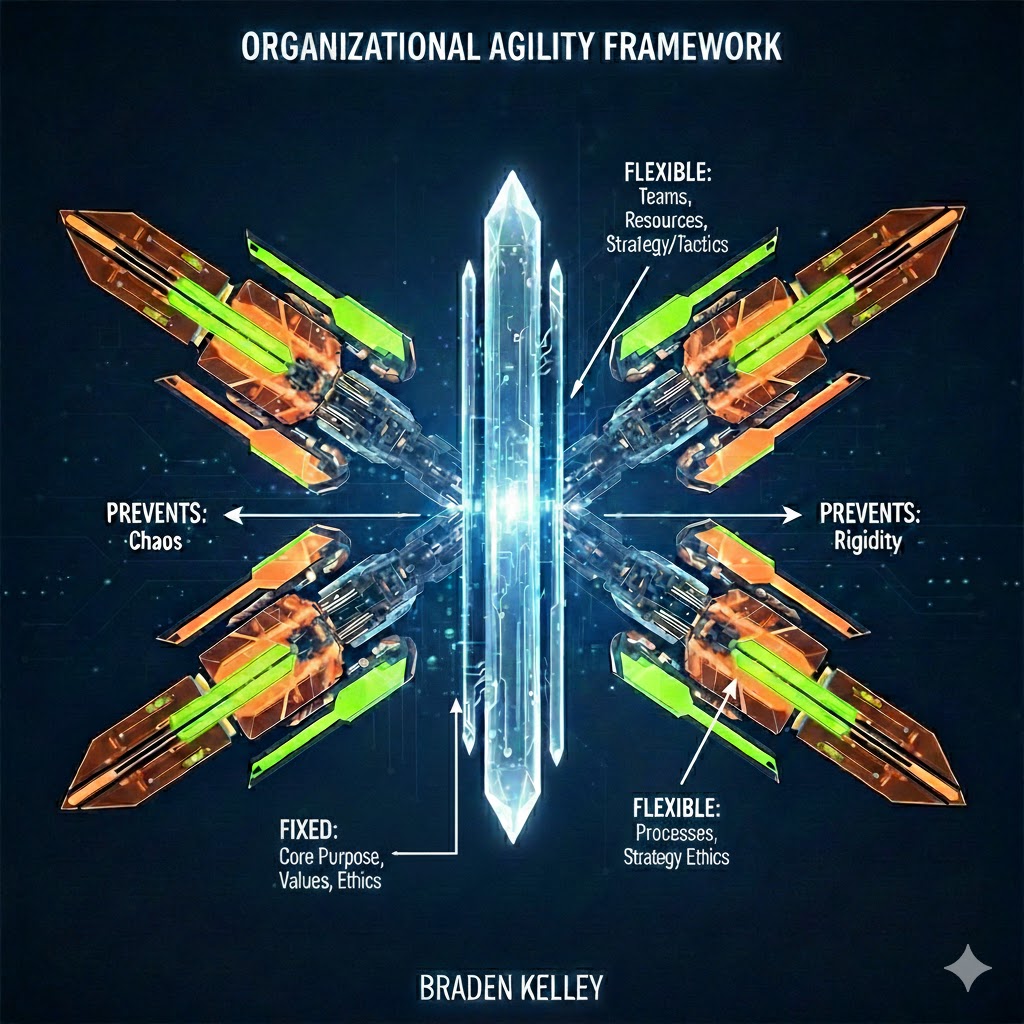
Insight: If you try to make everything flexible, you create an organization with no memory and no identity. If you keep everything fixed, you create a monument to the past. Agility is the art of knowing what to hold onto and what to let go.

IV. Designing for Modular Change

Architecting the Reconfigurable Enterprise

Loose Coupling and Micro-Structures

In a truly agile organization, we must abandon monolithic, deeply intertwined departmental silos. Instead, we move toward “Loose Coupling.” By organizing into small, cross-functional squads with clear interfaces, we ensure that one part of the business can pivot or fail without bringing down the entire system. This modularity allows for “plug-and-play” innovation.

Resource Fluidity: Escaping the Annual Budget Trap

You cannot have an agile strategy if your capital is locked in a 12-month fixed cycle. Resource Fluidity is the ability to shift talent and funding dynamically as opportunities arise. Agile organizations treat budgets as “living documents,” allowing leadership to pull resources from declining initiatives and inject them into high-growth “breakthrough” experiments in real-time.

Rapid Prototyping for Organizational Structure

We often prototype products, but we rarely prototype structure. Before committing to a company-wide reorganization, agile leaders run small-scale organizational experiments. By testing a new reporting line or a new collaborative workflow within a single “pilot” team, we can validate the human impact of the change before scaling it.

The Design Rule: Complexity is the enemy of agility. If your organizational chart requires a map and a legend to navigate, you aren’t built for speed — you’re built for bureaucracy. Simplify to amplify.

V. Measuring What Matters: Agility Metrics

Quantifying the Velocity and Resilience of Change

Time-to-Insight vs. Time-to-Action

In a traditional enterprise, the gap between identifying a market shift (Insight) and actually deploying a response (Action) can be months or even years. Agility is measured by the shrinkage of this gap. We must track our Latency of Decision — the speed at which data travels from the front lines to the decision-makers and back into the field as an executed strategy.

Learning Velocity

Success is a lagging indicator; Learning Velocity is a leading one. How quickly can your organization ingest new information, test it, and turn it into institutional knowledge? By measuring the number of validated experiments per quarter rather than just “project completions,” we shift the focus from output to outcomes.

The Resilience Score

Agility is as much about defense as it is offense. A Resilience Score assesses how much of a “shock” your organization can absorb — be it a supply chain disruption or a competitor’s surprise launch — without a significant drop in service levels or employee engagement. An agile organization doesn’t just bounce back; it “bounces forward” into a new, more relevant state.

The Measurement Shift: If you only measure efficiency, you will optimize yourself into extinction. You must measure your capacity to change, for that is where your future revenue lives.

VI. Conclusion: The Agile Organization as a Living System

Sustaining Competitive Advantage in a Volatile World

Beyond the Project Mindset

We must stop viewing “agility” as a transformation project with a start and end date. True organizational agility is a continuous practice — a state of being. It is the transition from seeing your company as a static machine to viewing it as a living system. Like any organism, your business must constantly sense, respond, and evolve to its environment to survive.

The Polymath Leader

The leaders of tomorrow must be comfortable with the “Whole-Brain” approach. They must be part scientist, using data and the Agility Framework to maintain the stable spine of the company, and part artist, using empathy and human-centered change to inspire the flexibility of the workforce. This balance is the only way to navigate the tension between what must remain fixed and what must remain fluid.

Your Sustainable Advantage

In an era where technology can be copied and capital is a commodity, your ability to change is your only sustainable competitive advantage. By architecting an enterprise that embraces both the comfort of fixed values and the excitement of flexible processes, you don’t just survive disruption — you become the disruptor.

Final Thought: Agility is the ultimate expression of confidence. It is the belief that no matter how the world changes, your organization has the structural integrity and the creative spirit to meet the moment. Let’s stop fearing the pivot and start building the platform that makes it possible.

Implementation Checklist: Activating the Agility Framework

Practical First Steps for the Human-Centered Leader

Moving from theory to practice requires a deliberate focus on the Fixed/Flexible balance. Use this checklist to audit your current state and begin the transition.

  • Identify Your “Stable Spine”:
    Document the 3-5 core values and the overarching purpose that must remain Fixed. Do your teams know these are the non-negotiable guardrails?
  • Audit for “Rigid Decay”:
    Locate one process that exists “because we’ve always done it that way” but no longer serves the customer. Mark it as Flexible and schedule a redesign.
  • Establish a “Safe-to-Fail” Zone:
    Designate one small-scale project where the team is explicitly rewarded for Learning Velocity rather than just the final ROI.
  • Assess Communication Latency:
    Track how many days it takes for a customer insight from the field to reach a decision-maker. Aim to reduce this Time-to-Insight by 20% this quarter.
  • Beta-Test a “Squad” Structure:
    Select one departmental silo and “loosely couple” a cross-functional team (e.g., Marketing, Tech, and Customer Success) to solve a single specific friction point.

Braden’s Tip: Don’t try to change the whole organization at once. Agility is built through fractal change — successful small pivots that create a blueprint for the larger enterprise to follow.

What is a Stable Spine Audit?

In my Organizational Agility Framework, a Stable Spine Audit is a strategic exercise used to identify the permanent, non-negotiable elements of an organization that provide the structural integrity required to support rapid change elsewhere.

Think of it this way: for a human to move with agility — to sprint, jump, or pivot — the spine must remain strong and aligned. If the spine is “mushy,” the limbs have no leverage. In a business, if everything is up for grabs, you don’t have agility; you have chaos.

The Core Components of the Audit

When I lead an organization through this audit, we look for three specific types of “Fixedness”:

  • 1. Core Purpose and North Star: Why does the organization exist beyond making a profit? This should be fixed. If your purpose pivots every six months, your employees will suffer from “change fatigue” and lose trust.
  • 2. Values and Ethical Guardrails: These are the behavioral non-negotiables. They define how we work. These provide psychological safety because employees know that even in a crisis, the “rules of engagement” won’t shift.
  • 3. Essential Architecture: This identifies the critical systems or data standards that must remain centralized and standardized to allow for “plug-and-play” flexibility in the branches or squads.

How to Conduct the Audit

The audit is essentially a filtering process for every major component of your business. You ask your leadership team: “Is this a Spine element or a Wing element?”

Category The Stable Spine (Fixed) The Flexible Wings (Fluid)
Strategy Long-term Vision & Purpose Quarterly Tactics & Experiments
Structure Governance & Core Values Cross-functional Squads & Roles
Process Essential Compliance & Quality Daily Workflows & Tools
People Cultural DNA & Talent Standards Specific Skills & Resource Allocation

Why It Matters for Innovation

I often see teams that are “frozen” because they don’t know what they are allowed to change. By conducting a Stable Spine Audit, you explicitly tell your team: “These five things are fixed. Everything else is a variable you can experiment with.”

This clarity actually increases the speed of innovation because it removes the “permission bottleneck.” When the spine is stable, the wings can flap as fast as they need to.

Diagnostic Questionnaire: Activating the Organizational Agility Framework

A Leadership Workshop Guide to the Stable Spine Audit

To help you activate the Organizational Agility Framework, here is a diagnostic questionnaire designed to be used in a leadership workshop. The goal is to reach a consensus on what belongs to the “Spine” (Fixed) and what belongs to the “Wings” (Flexible).

Phase 1: Identifying the Fixed (The Stable Spine)

Ask your leadership team to answer these questions individually, then compare notes. Discrepancies here usually indicate where organizational friction is coming from.

  • The “North Star” Test: If we changed our product line entirely tomorrow, what is the one reason for existing that would stay exactly the same?
  • The Value Constraint: What are the three behaviors that, if an employee violated them, would result in immediate dismissal regardless of their performance?
  • The Architectural Anchor: What is the single source of truth (data, brand guideline, or compliance rule) that every department must use to remain part of the collective whole?
  • The Non-Negotiable Promise: What is the one promise we make to our customers that we would never “pivot” away from, even for a massive short-term profit?

Phase 2: Identifying the Fluid (The Flexible Wings)

Now, look at the areas where the organization feels “slow.” These are likely things that are currently “Fixed” but should be “Flexible.”

  • The “Shadow” Processes: Which of our current “standard operating procedures” (SOPs) were created more than two years ago and haven’t been updated since?
  • The Permission Bottleneck: Who has the authority to spend $5,000 to test a new idea? If the answer is “The VP,” that process is too Fixed.
  • The Role Rigidity: Are our job descriptions based on tasks (Fixed) or outcomes (Flexible)? Can we move a person from Project A to Project B in 24 hours without a HR mountain to climb?
  • The Budgeting Cycle: If a massive market opportunity appeared tomorrow, how long would it take to reallocate 10% of our budget to pursue it?

The Audit Tally

Once you have these answers, map them out:

  1. Green Zone: Elements everyone agrees are Fixed. These are your strengths.
  2. Red Zone: Elements everyone agrees are Fixed but should be Flexible. These are your targets for immediate “unlearning.”
  3. Grey Zone: Elements where the team disagrees. This is where your cultural friction lives.

Closing the Audit

As an innovation speaker, I always remind leaders: The Spine is for Support, not for Strangulation. The goal of this audit isn’t to create more rules, but to create the clarity that allows for more freedom.

Organizational Agility: Frequently Asked Questions

1. What is the difference between organizational speed and organizational agility?

Speed is the velocity of movement in a single direction. Agility is the architectural capacity to change direction at speed without breaking the organization. While speed is about execution, agility is about reconfigurability.

2. Why does the “Stable Spine” actually help an organization move faster?

A “Stable Spine” (fixed core values, purpose, and guardrails) provides psychological safety and clarity. When employees know exactly what is non-negotiable, they no longer need to seek permission for everything else, effectively removing the “permission bottleneck” that slows down innovation.

3. How do you identify if a process should be ‘Fixed’ or ‘Flexible’?

Use the Stable Spine Audit. If a process protects your core DNA, ethical standards, or brand promise, it is “Fixed.” If a process is simply a method for delivery, resource allocation, or internal workflow, it should be “Flexible” and modular to allow for rapid adaptation to market shifts.

Image credits: Braden Kelley (1,100+ FREE quote posters at http://misterinnovation.com), Google Gemini

Content Authenticity Statement: The topic area, key elements to focus on, etc. were decisions made by Braden Kelley, with a little help from Google Gemini to clean up the article and add citations.

Subscribe to Human-Centered Change & Innovation WeeklySign up here to get Human-Centered Change & Innovation Weekly delivered to your inbox every week.

What Innovation is Really About

What Innovation is Really About

GUEST POST from Stefan Lindegaard

Sometimes a short and simple word-play brings out some great reflection.

  1. Resistance kills Change
  2. Fear kills Experimentation
  3. Bureaucracy kills Speed
  4. Control kills Flexibility
  5. Tradition kills Disruption
  6. Pressure kills Creativity
  7. Hierarchy kills Agility
  8. Silos kills Collaboration
  9. Organizational inertia trumps Talent

Now, read that RIGHT to LEFT.

This is in many ways the essence of innovation in my view.

Image Credits: Stefan Lindegaard

Subscribe to Human-Centered Change & Innovation WeeklySign up here to get Human-Centered Change & Innovation Weekly delivered to your inbox every week.

Five Secrets to Being a Great Team Player

Five Secrets to Being a Great Team Player

GUEST POST from David Burkus

Our world requires collaboration. Just about every job now requires collaborating on teams and every employee’s calendar is full of evidence of collaboration. In one study, up to 85% of participants’ work weeks were spent working in direct collaboration or a result of collaboration with a team.

But it can be difficult to collaborate with people whose perspectives, preferences, and personalities are different from our own. Still, getting what you want from your work and career requires being a great team player. And if you want to be a leader, you’ll need to be a great team player first. (And really…that will never stop…even leaders often lead in teams.)

In this article, we’ll outline the five (5) essential qualities needed to become a great team player—and offer a few ways to develop those qualities and get them noticed.

1. Capable

The first quality is that great team players are capable. This is a fundamental quality of anyone working, really. You must have the necessary knowledge, skills, and abilities to do the tasks being asked of you. But on teams, it’s just as important to be seen as capable by the other members of your team. The team needs to know they can rely on you—and that when you say you’ll have something completed it will be completed on time and as you said.

Working with teams, the way you demonstrate your capability is two-fold: Do what you say you’re going to do, and don’t say something you don’t know to be true. Over time, keeping these two commitments will demonstrate that you can be relied on—because you are capable.

2. Humble

The second quality is that great team players are humble. While great team players are capable, they also don’t think too highly of the skills and knowledge they have. Great team players don’t think little of themselves, they just understand that the needs of the team come before their own. Humble teammates aren’t fighting for their ideas to be heard all the time or seeking to dominate in debates. Instead, they use their voice to amplify others and contribute the bigger, team-wide wins.

Working with teams, humility is often inferred based on behavior in meetings, whether in-person or virtual. Humble teammates aren’t trying to be the lead role in the meeting, instead they’re often acting as a facilitator ensuring every teammate has a chance to speak. And when they do speak, it’s often to build upon others’ ideas instead of constantly insisting on their own.

3. Helpful

The third quality is that great team players are helpful. The best way to put capabilities and humility into practice is by helping others on the team—not constantly trying to convince others to help you. Great team players are the ones in meetings thinking about what they can contribute and how they can help others get unstuck. At the same time, it’s important to be careful not to over-help and lose the needed time to complete your own commitments.

Working with teams, the easiest way to assess your helpfulness is to audit your calendar. Look at everything scheduled on your calendar last week and compared the appointments that furthered your personal goals versus the appointments that helped others hit their goals. You don’t want helpful appointments to dominate, or even be half and half. But if 25 percent of your calendar is spent helping others, then it’s a safe assumption that they see you as helpful.

4. Flexible

The fourth quality is that great team players are flexible. As teams work to complete projects, changes will happen—pivots are required. All work requires flexibility. But often in the face of change many people respond by becoming more stubborn and insisting even more on their original ideas or plan of action. Great team players serve the team by reading the changes in the environment and helping the plan pivot quickly.

Working with teams, the most common changes that require flexibility often happen around priorities. New tasks get added to the team’s list, or environmental changes reshuffle what is urgent. When that happens, taking the lead to check-in with the team and discuss how changes affect priorities can keep the team more productive and keep you seen as a flexible, but high performer.

5. Purposeful

The fifth quality is that great team players are purposeful. All great teams have a sense of purpose behind their work—they know why their work matters and that keeps them bonded together and motivated to achieve more. Great team players amplify this purpose by becoming a source of supporting stories and constant reminders about that purpose. This includes not just talking about why the work that team does matters, but also how it fits into the larger mission or vision of the organization and why that matters.

Working with teams, the easiest way to reinforce purpose is to share gratitude on a regular basis. But not just any old thank you note. Purposeful gratitude expresses appreciation for the effort someone else put in, but also includes a reminder of how that effort helped serve the purpose of the team. Regularly done, it not only builds camaraderie amongst the team, but it also enhances motivation.

As you review this list, one or two qualities probably stood out as ones you already embodied—but one or two probably stood out as ones you need to work on. That’s true for nearly everyone, and it creates a great plan of action. Get started improving where you need to—and get started getting noticed where you already shine. That will help you not only raise your own performance, but help support everyone else on the team as they do their best work ever.

Image credit: Unsplash

Originally published at https://davidburkus.com on April 10, 2023

Subscribe to Human-Centered Change & Innovation WeeklySign up here to get Human-Centered Change & Innovation Weekly delivered to your inbox every week.

Principles of Inclusive Design

Creating for All

Principles of Inclusive Design

GUEST POST from Chateau G Pato

In our rapidly changing world, designing products and services that serve a diverse user base has never been more important. Inclusive design is not just a trend; it is a movement towards accessibility, equity, and respect for human diversity. At the heart of this approach lies a profound commitment to creating solutions that are not only user-friendly but fully accessible to everyone, regardless of their abilities or circumstances.

In this article, we will explore the core principles of inclusive design and illustrate them with two compelling case studies. By understanding these principles, designers and innovators can craft experiences that are not only innovative but profoundly inclusive. For further insights, explore our articles on Five Immutable Laws of Change and Human-Centered Innovation.

Core Principles of Inclusive Design

Inclusive design involves several key principles:

  • Recognize Diversity and Uniqueness: Understand the varied needs of different users and design with empathy.
  • Create Flexible Solutions: Develop adaptable solutions that can cater to a broad range of needs.
  • Offer Equal Use: Ensure that products and services provide the same means of use for all users, avoiding the need for adaptation or specialized solutions.
  • Offer Equitable Experience: The experience should be equally satisfying for everyone, encouraging user engagement and delight.

Let’s delve into two real-world examples where these principles are skillfully applied.

Case Study 1: Microsoft and the Inclusive Design Toolkit

Microsoft has been a pioneer in applying inclusive design principles. Their Inclusive Design Toolkit is a testament to their commitment to accessibility and innovation.

The toolkit was created based on extensive research and user feedback, and it offers guidelines that help designers create products that consider a wide array of potential users. For instance, Microsoft Word now includes accessibility checkers, which assists users in creating documents that are accessible to people with disabilities.

One significant feature is the ability to provide real-time subtitles during video calls on Microsoft Teams. This functionality addresses the needs of hearing-impaired users, foreign language speakers, and those in noisy environments, showcasing Microsoft’s commitment to creating flexible, equitable solutions.

Case Study 2: OXO’s Universal Design Approach

Another exemplary application of inclusive design principles is found in the work of OXO, a company that revolutionized kitchen tools with its commitment to ease of use for all.

OXO’s journey began with a simple potato peeler. Sam Farber, the founder, realized his wife, who had arthritis, found it difficult to use traditional peelers. The solution was the OXO Good Grips range, featuring soft rubber handles that were comfortable for everyone, whether or not they had physical limitations.

This universal design approach has become a staple of OXO’s philosophy, ensuring that their products are accessible, functional, and engaging for a diverse user base. The success of OXO emphasizes the power of inclusive design to create products that resonate with, and are appreciated by, a vast audience.

Conclusion

Inclusive design is not just about compliance or accessibility; it is about creating experiences that resonate with everyone. As demonstrated by Microsoft and OXO, companies that embrace inclusive design open the door to innovation, engagement, and satisfaction.

By adhering to the core principles of inclusive design—recognizing diversity, creating flexible solutions, ensuring equal use, and offering equitable experiences—we can achieve a more inclusive world. For more strategies on this transformative approach, explore our writings on Five Immutable Laws of Change and Human-Centered Innovation.

As designers and innovators, the call to action is clear: Let’s build a future that is open, accessible, and welcoming to all.

Extra Extra: Futurology is not fortune telling. Futurists use a scientific approach to create their deliverables, but a methodology and tools like those in FutureHacking™ can empower anyone to engage in futurology themselves.

Image credit: Pixabay

Subscribe to Human-Centered Change & Innovation WeeklySign up here to get Human-Centered Change & Innovation Weekly delivered to your inbox every week.

Balancing the Need for Structure and Flexibility in Change Management Plans

Balancing the Need for Structure and Flexibility in Change Management Plans

GUEST POST from Art Inteligencia

In the ever-evolving landscape of modern business, change is a constant. Organizations face continuous pressure to adapt to new market demands, technological advancements, and internal challenges. As a result, change management has become an indispensable discipline to ensure smooth transitions and sustained organizational success. However, one of the fundamental dilemmas in change management is achieving the right balance between structure and flexibility.

Too much structure can stifle creativity, slow down the process, and lead to resistance from employees. On the other hand, too much flexibility can result in chaos, lack of accountability, and ultimately, failure to achieve the desired objectives. The key lies in finding the sweet spot that allows for both structured approaches and adaptable methodologies. In this article, we will explore how to strike this balance with insights from two real-world case studies.

Case Study 1: A Manufacturing Giant Finds Its Balance

Company: XYZ Manufacturing Inc.
Industry: Manufacturing
Challenge: Adapting to new digital technologies

XYZ Manufacturing Inc., a leader in industrial equipment manufacturing, faced a significant challenge in adapting its legacy systems to incorporate new digital technologies like IoT sensors and advanced analytics. To navigate this transformation, the company initiated a comprehensive change management plan.

Structured Approach: XYZ Manufacturing Inc. began with a detailed impact analysis to identify areas most affected by the change. This analysis informed the development of a structured roadmap with clear milestones, deadlines, and well-defined roles and responsibilities. Additionally, the company established a Change Management Office (CMO) responsible for overseeing the implementation of the plan, ensuring that each department adhered to the predefined guidelines.

Flexibility: Despite the rigid structure, the CMO recognized the importance of flexibility to adapt to real-time scenarios. For instance, during the implementation of new IoT sensors on the factory floor, unexpected technical glitches occurred. Instead of rigidly sticking to the initial timeline, the CMO allowed for flexibility in the schedule and allocated resources to troubleshoot the issues. Feedback loops were established to gather insights from employees on the ground, which led to iterative adjustments in the implementation plan.

Outcome: By balancing structure with flexibility, XYZ Manufacturing Inc. successfully integrated digital technologies into its operations, resulting in enhanced productivity and reduced downtime. The company’s ability to adapt swiftly to challenges without derailing from its overall plan was pivotal to its success.

Case Study 2: A Healthcare Provider’s Agile Transformation

Company: HealthPlus Services
Industry: Healthcare
Challenge: Implementing Electronic Health Records (EHR)

HealthPlus Services, a prominent healthcare provider, embarked on an ambitious project to implement an Electronic Health Records (EHR) system across its network of hospitals and clinics. The aim was to improve patient care, streamline operations, and ensure compliance with industry regulations.

Structured Approach: The project kicked off with a meticulous planning phase, involving cross-functional teams from IT, medical staff, and administration. A project charter was established, outlining objectives, timelines, and key performance indicators. Comprehensive training programs were designed to ensure that all medical staff were proficient in using the new EHR system. Regular progress reports and checkpoints were set up to monitor adherence to the plan.

Flexibility: Despite the detailed planning, HealthPlus Services understood that the healthcare environment is dynamic and unpredictable. They adopted an agile methodology, allowing for adaptive changes throughout the project. When initial rollouts revealed user-interface challenges and resistance from some medical staff, the organization swiftly pivoted by incorporating their feedback into system enhancements. Additionally, they extended the training programs and introduced peer mentors to provide on-the-ground support.

Outcome: Through a balanced approach that combined thorough planning with an agile mindset, HealthPlus Services successfully implemented the EHR system. The flexible aspects of the plan allowed for real-time adjustments that led to higher user satisfaction and smoother adoption. Ultimately, the quality of patient care improved significantly, and operational efficiencies were realized.

Key Takeaways

The experiences of XYZ Manufacturing Inc. and HealthPlus Services highlight the importance of balancing structure and flexibility in change management plans. Here are the key takeaways for achieving this balance:

  1. Start with a Clear Structure: Launch change initiatives with a well-defined structure, including impact analysis, milestones, roles, and responsibilities.
  2. Embrace Flexibility: Allow for adaptive changes based on real-time feedback and unexpected challenges. Incorporate flexible timelines and iterative adjustments.
  3. Foster Open Communication: Create feedback loops and channels for employees to voice concerns and suggestions, ensuring their input shapes the change process.
  4. Stay Agile in Execution: Adopt agile methodologies to facilitate iterative and incremental progress, enabling the organization to pivot when necessary.
  5. Empower Your Change Agents: Equip your Change Management Office or equivalent body with the authority and resources needed to adapt plans while maintaining overall alignment with objectives.

Successfully navigating change requires a harmonious blend of structure and flexibility. By learning from the experiences of others and applying these principles, organizations can enhance their ability to adapt, innovate, and thrive in an ever-changing business environment.

Bottom line: Futurology is not fortune telling. Futurists use a scientific approach to create their deliverables, but a methodology and tools like those in FutureHacking™ can empower anyone to engage in futurology themselves.

Image credit: Pexels

Subscribe to Human-Centered Change & Innovation WeeklySign up here to get Human-Centered Change & Innovation Weekly delivered to your inbox every week.

Accelerating Complexity vs. Accelerating Change

Accelerating Complexity vs. Accelerating Change

Does the quickening pace of change or the accelerating pace of complexity pose a greater threat for humans and organizations?

Change can be incredibly disruptive to both humans and organizations.

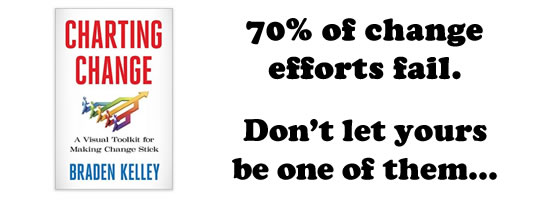
So much so that I decided to create a more modern, visual, collaborative and effective set of methods and tools to help organizations beat the 70% change failure rate and better keep pace with the accelerating pace of change – the Change Planning Toolkit™ – introduced in my latest book Charting Change.

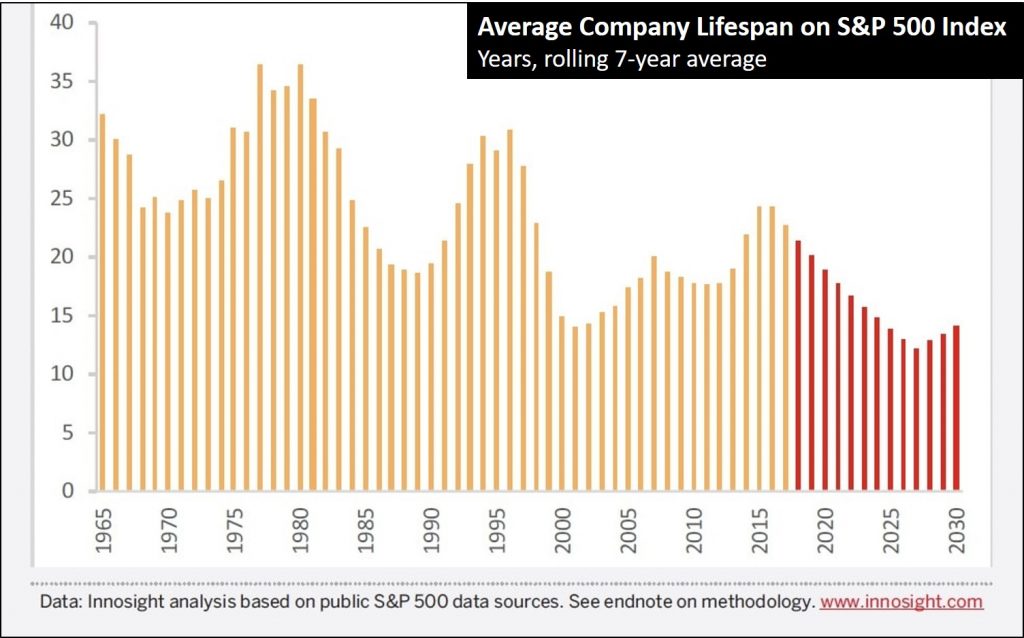
In the book I highlight that the pace of change is accelerating, and use the increasing rate of change in the S&P 500’s membership as a proof point:

Innosight Average Company Lifespan

Another proof point is the fact that all of our high technology has been developed in roughly the last 100 years.

There can be no doubt that the pace of change and disruption is quickening.

But how much of the accelerating disruption that we see can be attributed to what I see as an increasing pace of complexity?

If anyone doubts that we live in a time of accelerating complexity, I encourage you to check out the book The Toaster Project by Thomas Thwaites, or this TED talk given by Thomas:

I find this video quite frightening because it highlights how fragile our high-technology society is, and how much we need each other.

If a single person can’t make the simplest of electrical appliances by themselves, even over the course of a year, then imagine the complexity that organizations must manage to make even more complicated products.

Imagine the challenge of making changes to our organizations after we’ve optimized things to successfully manage this complexity.

If both complexity and change are accelerating, how can we cope?

Here are four key ways to better manage complexity and change:

  1. Choose carefully which complexity to inflict upon the organization
  2. Learn how to architect the organization for continuous change
  3. Continuously evaluate your organization’s trade-offs between flexibility and fixedness
  4. Leverage the modern, visual, and collaborative tools from the Change Planning Toolkit™ that are easily adapted to our new virtual work environment

Grab the ten free tools from the Change Planning Toolkit™ before purchasing a license so you can keep these three key frameworks front and center as you plan a more modular and conscious approach to managing the growing complexity in your organization:

  • PCC Change Readiness Framework
  • Organizational Agility Framework
  • Architecting the Organization for Continuous Change

Download the 10 Free Tools

Keep innovating!


Accelerate your change and transformation success

Subscribe to Human-Centered Change & Innovation WeeklySign up here to get Human-Centered Change & Innovation Weekly delivered to your inbox every week.
Increasing Organizational Agility

Increasing Organizational Agilityby Braden Kelley

Companies seeking to cope with the pace of accelerating change are looking for ways to go faster, and managers in non-technical disciplines have become increasingly infatuated with the Agile Software Development methodology and many are finding ways to adapt parts of it to create agile change or agile marketing or other such things. Sure agility sounds like a good thing and sure agile marketing sounds like it must be better than regular marketing, but is it?

What is agility really?

According to Dictionary.com, agility is:

“The power of moving quickly and easily; nimbleness”
OR
“The ability to think and draw conclusions quickly; intellectual acuity”

When it comes to a business context, I however prefer to define agility a bit more simply, a bit more concisely. Agility, or organizational agility in our case, is:

“How quickly an organization can change directions”

Many people, especially in an organizational or commercial context, get confused between agility and flexibility. They are NOT the same thing.

Agile vs. Flexible

Organizational agility is about how quickly an organization can change directions, while flexibility in an organization gives it the ability to do different things with the same resources, often by purchasing more flexible equipment (at a higher price) or by training people to do more than one thing (resulting in higher training costs) or by hiring people that are skilled at more than one thing (higher salary/benefit costs). Flexibility definitely has its benefits (being able to shift resources among purposes) but it also has costs like the ones mentioned above, and probably more importantly, flexibility usually decreases the efficiency of systems.

Fixedness on the other hand, reduces variability, allows you to focus on the things that do vary and get really good at executing all aspects of a system, including the acquisition of the very best tools and technology to perform each particular function. But, as you can imagine, fixedness has its downside too. If a human resource goes down due to illness or a piece of production equipment breaks, potentially, the whole system grinds to a halt.

So, as you can imagine, increased organizational agility is achieved by establishing the right balance between flexibility and fixedness.

The Organizational Agility Framework

I have captured this principle below in the Organizational Agility Framework:

Organizational Agility Framework


Click to access this framework as a scalable 11″x17″ PDF download
(Tooklit purchasers also get access to the Organizational Agility Worksheet)

The Organizational Agility Framework helps organizations:

  • Adapt to changing environmental conditions
  • Stretch existing resources and the organization itself to do new things in new ways
  • Enable faster change inside the organization and faster adoption by customers
  • Evolve profitable customer relationships to keep the organization strong and vibrant

The Organizational Agility Framework (and corresponding worksheet in the Change Planning Toolkit™) also helps you ask two key questions:

  1. Where can we stretch our existing resources and the organization itself to do new things in new ways?
  2. What should we keep the same to enable faster change inside the organization and faster adoption by customers?

Flexibility vs. Fixedness

Too much Flexibility and it will take too long to make decisions and changes.

Too much Fixedness and you will suffer from organizational rigidity.

Companies seeking increased organizational agility and an improved ability to cope with the accelerating pace of change and ever-evolving customer expectations must seek to strike that optimal balance between fixedness (so you can go fast) and flexibility (so you can quickly adapt to changing customer needs).

Can your organization find the right balance?

More on digital transformation and organizational agility soon, so stay tuned!

In the meantime, please get yourself a copy of Charting Change as a hardcover (or ebook) and get your free downloads from the Change Planning Toolkit™ (or go ahead and purchase a license now).

Subscribe to Human-Centered Change & Innovation WeeklySign up here to get Human-Centered Change & Innovation Weekly delivered to your inbox every week.
Innovation Quotes of the Day – June 9, 2012


“The real challenge, therefore, is to turn innovation from a buzzword into a systemic and widely distributed capability. It has to be woven into the everyday fabric of the company just like any other organizational capability, such as quality, or supply chain management, or customer service.”

– Rowan Gibson


“I believe that we underestimate children’s ability to understand the real world and I think that the education system and the business world need each other more than they realize. We need to re-imagine our public-private partnerships and expectations when it comes to education, and we need to start educating today’s young kids for tomorrow’s world.”

– Braden Kelley


“Before you start ideating, you need a set of really novel strategic insights. These are like the raw material out of which exciting innovation breakthroughs are built. If you ask people to innovate in a game-changing way without first building a foundation of novel strategic insights, you find that it’s mostly a waste of time. You get a lot of ideas that are either not new at all, or so crazy that they’re way out in space.”

– Rowan Gibson


“Instead of pursuing the current education mantra of more, better, faster, we need to instead rethink how we educate our children because we need to prepare them for a different world. A world in which flexibility, adaptibility, creativity, and problem solving will be prized ahead of the deep technical knowledge that is fast becoming a commodity and easily available.”

– Braden Kelley


What are some of your favorite innovation quotes?

Add one or more to the comments, listing the quote and who said it, and I’ll share the best of the submissions as future innovation quotes of the day!

Subscribe to Human-Centered Change & Innovation WeeklySign up here to get Human-Centered Change & Innovation Weekly delivered to your inbox every week.

Innovation QuickStart Guide

Innovation QuickStart GuideYou know how sometimes when you order a product you get this inch-thick instruction manual that you never read, but also how there is sometimes a QuickStart Guide of 5-10 simple steps to get you up and running quickly?
Well, Stoking Your Innovation Bonfire is the instruction manual that an increasing number of organizations are ordering for teams to help them with their innovation efforts. But, I’m sure companies could also use an Innovation QuickStart. So, here is one you could use (excerpted in part from my book):

10 Steps to Get Your Innovation Efforts Off to a Good Start

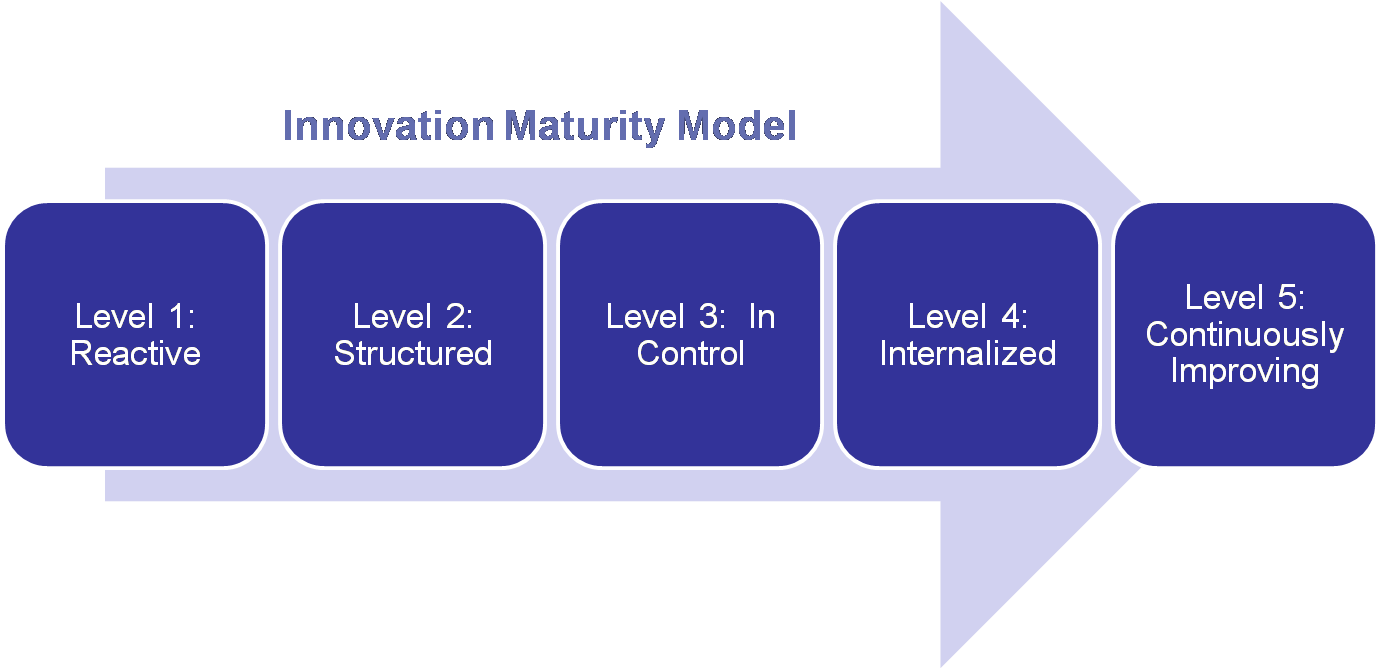
1. Conduct an Innovation Audit

How can you know where you are going to go with innovation if you don’t first know where you already are? For this reason I created a 50 question innovation audit and linked it to an Innovation Maturity Model from Karl T. Ulrich and Christian Terwiesch of Wharton Business School.

Innovation Maturity Model

2. Define What Innovation Means for Your Organization

Here is a simple exercise you can do next time you get together in your organization to talk about innovation. Have everyone in the group write down what their definition of innovation is, and then compare that to the official definition of innovation for the organization (if you have one) and the innovation definitions of others in the group. Defining innovation as an organization is important because it helps you determine what kinds of innovation you are focusing on as an organization, and what kinds of innovation you ARE NOT focusing on.

3. Create a Common Language of Innovation

Creating a definition of innovation is the first step in creating a common language of innovation. The importance of creating a common language of innovation is that language is one of the most important components of culture. If people in your organization don’t talk about innovation in a consistent way and see communications reinforcing the common language, how can you possibly hope to embed innovation in the culture of the organization? Ensuring consistent language in presentations, emails, etc. and having people read the same book on innovation or taking the same training courses are just some ways to help create and reinforce a common language of innovation.

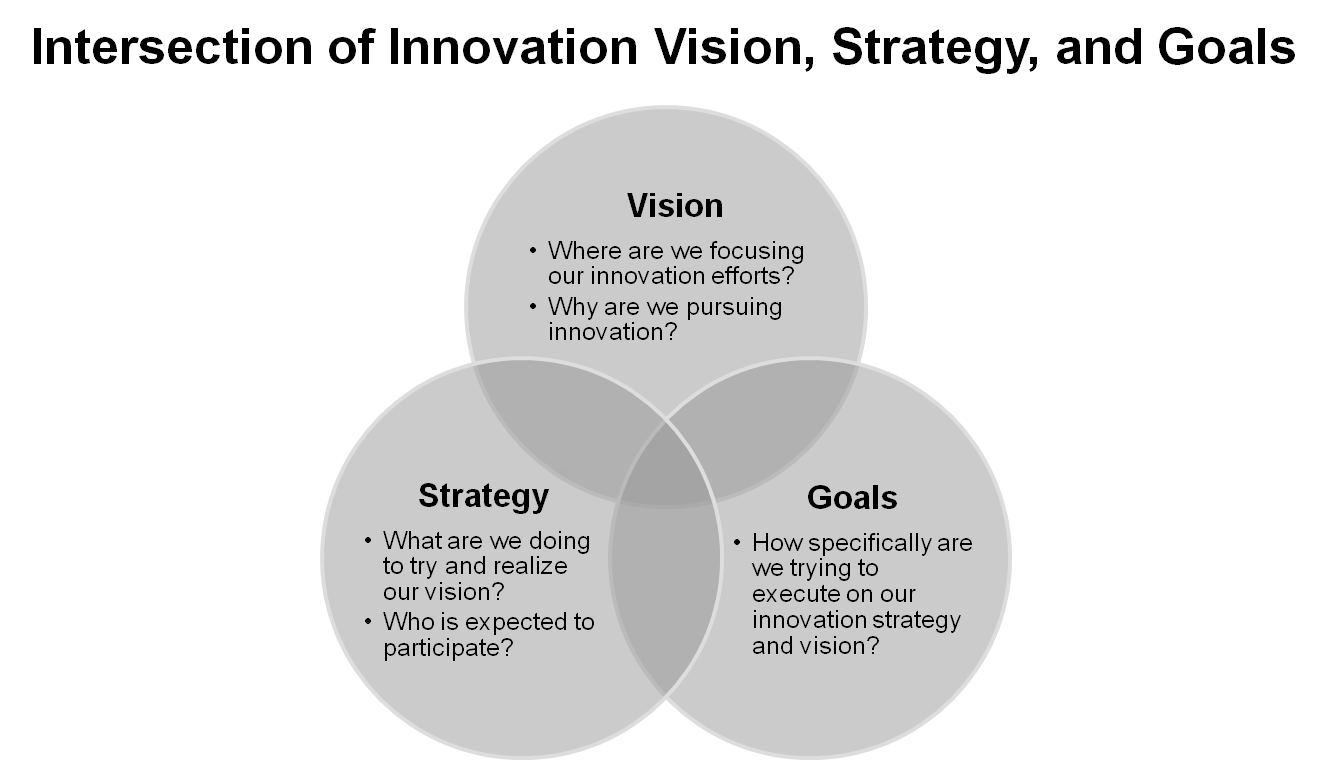
4. Define Your Innovation Vision

A startup begins life as a single-minded entity focused on innovating for one set of customers with a single product or service. Often as a company grows to create a range of products and/or services, the organization can start to lose track of what it is trying to achieve, which customers it is trying to serve, and the kind of solutions that are most relevant and desired by them.

Jack Welch, CEO of GE once said, “Good business leaders create a vision, articulate the vision, passionately own the vision, and relentlessly drive it to completion.”

Vision is about focus and vision is about the ‘where’ and the ‘why’ not the ‘what’ or the ‘how’. A vision gives the business a sense of purpose and acts as a rudder when the way forward appears uncertain. An innovation vision is no less important, and it serves the same basic functions. An innovation vision can help to answer some of the following questions for employees:

  • Is innovation important or not?
  • Are we focusing on innovation or not?
  • What kind of innovation are we pursuing as an organization?
  • Is innovation a function of some part of the business?
  • Or, is innovation something that we are trying to place at the center of the business?
  • Are we pursuing open or closed innovation, or both?
  • Why should employees, suppliers, partners, and customers be excited to participate?

When people have questions, they tend not to move forward. For that reason it is crucial that an organization’s leadership both has a clear innovation vision, and clearly and regularly communicates it to key stakeholders. If employees, suppliers, partners, and customers aren’t sure what the innovation vision of the organization is, how can they imagine a better way forward?

Pre-Order Nine Innovation Roles Card Decks

5. Define Your Innovation Strategy

Many organizations take the time to create an organizational strategy and a mission statement, only to then neglect the creation of an innovation vision and an innovation strategy. An innovation strategy is not merely a technology roadmap from R&D or an agenda for new product development. Instead, an innovation strategy identifies who will drive a company’s profitable revenue growth and what will represent a strong competitive advantage for the firm going forward. Under this umbrella the innovation goals for the organization can be created.

An innovation strategy sets the innovation direction for an organization towards the achievement of its innovation vision. It gives members of the organization an idea of what new achievements and directions will best benefit the organization when it comes to innovation. As with organizational strategy, innovation strategy must determine WHAT the organization should focus on (and WHAT NOT to) so that tactics can be developed for HOW to get there.

Innovation Vision Strategy Goals

6. Define Your Innovation Goals

Just as managers and employees need goals to know what to focus on and to help them be successful, organizations need innovation goals too. Clear innovation goals, when combined with a clear innovation strategy and a single-minded innovation vision for the organization, will maximize the instinctual innovation that emerges from employees and the intellectual innovation that occurs on directed innovation projects.

While an innovation vision determines the kinds of innovation that an organization, and an innovation strategy determines what the organization will focus on when it comes to innovation, it is the innovation goals that break things down into tangible objectives that employees can work against. Let’s look at P&G as an example to see how these three things come together at the highest level:

Innovation Vision

  • Reach outside the company’s own R&D department for innovation

Innovation Strategy

  • Create a formal program (Connect + Develop) to focus on this vision

Innovation Goal

  • Source 50% of the company’s innovation from outside

The 50% goal gives employees and management something to measure against, and it sets a very visible benchmark that the whole organization can understand and visualize how big the commitment and participation must be in order to reach it. It is at this point of communicating the innovation goals that senior management also has to communicate how they intend to support their efforts and how they will help employees reach the innovation goals.

7. Create a Pool of Money to Fund Innovation Projects

Product managers leading product groups and general managers leading business units typically have revenue numbers they are trying to hit, and they will spend their budgets trying to hit those numbers. As a result, there are often precious little financial resources (and human resources) available for innovation projects that don’t generate immediate progress toward this quarter’s business goals. As a result, many organizations find themselves setting money aside outside of the product or business unit silos that can be allocated on the future needs of the business instead of the current needs of the product managers and general managers. This also allows the organization to build an innovation portfolio of projects with different risk profiles and time horizons. But, however you choose to fund innovation projects, the fact remains that you need to have a plan for doing so, or the promising projects that form your future innovation pipeline – will never get funded.

8. Create Human Resource Flexibility to Staff Innovation Projects

Some organizations allow employees to spend a certain percentage of their time on whatever they want, but most don’t. Some organizations allow employees to pitch to spend a certain percentage of their time on developing a promising idea, but most organizations are running so lean that they feel there is no time or money for innovation. Often this is true and so employees sometimes work on promising ideas on their own time, but they shouldn’t have to. And if you make them do so, it will be much more likely that they will develop the promising idea with others outside the company and the organization will gain nothing from these efforts.

Don’t turn your motivated intrapreneurs into entrepreneurs.

You must find a way to create resource flexibility. Organizations that want to continue to grow and thrive must staff the organization in a way that allows managers to invest a portion of their employees’ time into promising innovation projects. One model to consider is that of Intuit, which allows employees to form project teams and to accumulate percent time and then schedule time off to work on an innovation project with co-workers in the same way that they schedule a vacation. This allows the manager to plan for the employees’ absence from the day-to-day and allows the employee to focus on the innovation project during that scheduled leave from their workgroup. But that’s just one possible way to create human resource flexibility.

Pre-Order Nine Innovation Roles Card Decks

9. Focus on Value – Innovation is All About Value

Value creation is important, but you can’t succeed without equal attention being paid to both value access and value translation because innovation is all about value…

Innovation = Value Creation (x) Value Access (x) Value Translation = Success!

Now you will notice that the components are multiplicative not additive. Do one or two well and one poorly and it doesn’t necessarily add up to a positive result. Doing one poorly and two well can still doom your innovation investment to failure. Let’s look at the three equation components in brief:

Value Creation is pretty self-explanatory. Your innovation investment must create incremental or completely new value large enough to overcome the switching costs of moving to your new solution from the old solution (including the ‘Do Nothing Solution’). New value can be created by making something more efficient, more effective, possible that wasn’t possible before, or create new psychological or emotional benefits.

Value Access could also be thought of as friction reduction. How easy do you make it for customers and consumers to access the value you’ve created. How well has the product or service been designed to allow people to access the value easily? How easy is it for the solution to be created? How easy is it for people to do business with you?

Value Translation is all about helping people understand the value you’ve created and how it fits into their lives. Value translation is also about understanding where on a continuum between the need for explanation and education that your solution falls. Incremental innovations can usually just be explained to people because they anchor to something they already understand, but radical or disruptive innovations inevitably require some level of education (often far in advance of the launch). Done really well, value translation also helps to communicate how easy it will be for customers and consumers to exchange their old solution for the new solution.

The key thing to know here is that even if you do a great job at value creation, if you do a poor job at either value access or value translation, you can still fail miserably.

10. Focus on Creating a Culture of Learning Fast

There is a lot of chatter out there about the concept of ‘failing fast’ as a way of fostering innovation and reducing risk. Sometimes the concept of ‘failing fast’ is merged with ‘failing cheap’ to form the following refrain – ‘fail fast, fail cheap, fail often’.

Now don’t get me wrong, one of the most important things an organization can do is learn to accept failure as a real possibility in their innovation efforts, and even to plan for it by taking a portfolio approach that balances different risk profiles, time horizons, etc.

But when it comes to innovation, it is not as important whether you fail fast or fail slow or whether you fail at all, but how fast you learn. And make no mistake, you don’t have to fail to innovate (although there are always some obstacles along the way). With the right approach to innovation you can learn quickly from failures AND successes.

The key is to pursue your innovation efforts as a discrete set of experiments designed to learn certain things, and instrumenting each project phase in such a way that the desired learning is achieved.

The central question should always be:

“What do we hope to learn from this effort?”

When you start from this question, every project becomes a series of questions you hope to answer, and each answer moves you closer to identifying the key market insight and achieving your expected innovation. The questions you hope to answer can include technical questions, manufacturing questions, process questions, customer preference questions, questions about how to communicate the value to customers, and more. AND, the answers that push you forward can come from positive discrete outcomes OR negative discrete outcomes of the different project phases.

The ultimate goal of a ‘learning fast’ approach to innovation is to embed in your culture the ability to extract the key insights from your pursuits and the ability to quickly recognize how to modify your project plan to take advantage of unexpected learnings, and the flexibility and empowerment to make the necessary course corrections.

The faster you get at learning from unforeseen circumstances and outcomes, the faster you can turn an invention into an innovation by landing smack on what the customer finds truly valuable (and communicating the value in a compelling way). Fail to identify the key value AND a compelling way to communicate it, and you will fail to drive mass adoption.

Click the image to download a PDF flipbook:

Summary

When you start with an innovation audit and creating a common language of innovation (including a definition of innovation), it sets you up well to create a coherent innovation vision, strategy, and goals. And then if you build in the financial and human resource flexibility necessary to create a focus on value creation, access and translation – and support it with a culture that is focused on learning fast – YOU WILL have built a solid foundation for your innovation efforts to grow and mature on top of. Are there more things that go into embedding innovation into your culture and creating sustainable innovation success? Absolutely. But, if you work diligently on these ten items you will get your innovation efforts off to a strong start.

What are you waiting for?

Image Credits: Stoking Your Innovation Bonfire


Build a Common Language of Innovation
Subscribe to Human-Centered Change & Innovation WeeklySign up here to get Human-Centered Change & Innovation Weekly delivered to your inbox every week.