Tag Archives: bureaucracy

Three Facts That Business Leaders Refuse to Accept

Three Facts That Business Leaders Refuse to Accept

GUEST POST from Greg Satell

In the late 90s Fortune magazine named Enron the most innovative company for six consecutive years, right up until the company collapsed in scandal. GE’s strategy of stack ranking was seen as a model to be emulated by other firms, even though there was no evidence it worked. McKinsey advised companies to fight a war for talent.

Today, we know better. It’s obvious that Enron was incredibly dysfunctional, that stack ranking undermines a high-performance culture and that talent is something that you build through upskilling, not something you “win” in a metaphorical war. It’s mind boggling to think of all the damage that was done before those ideas were exposed.

Yet if we accept all that we need to ask ourselves which ideas are widely accepted today that don’t hold water. Every era has its own fictions, things that are accepted because they are repeated, but lack any serious foundation. They become memes replicating themselves throughout the zeitgeist, rarely being questioned. Here are three truths that will surprise you.

1. Bigger Organizations Are More Innovative

We tend to think of innovation as something startups do. Big organizations, with their bloated bureaucracies and cumbersome decision making, are less nimble. Yet a recent book, Corporate Explorer, by Stanford professor Charles O’Reilly, Harvard Professor ​​Paul Lawrence and consultant Andrew Binns finds that larger firms have more resources, talent and ideas.

This may seem surprising, but there is ample evidence supporting the principle that larger enterprises innovate more effectively. A 1969 study of local health departments found that the larger ones serving larger communities were more innovative. A 1986 analysis of footwear manufacturers found that the bigger ones had more technical specialists and adopted more radical innovation. Same thing when researchers looked at German banks’ adoption of telecommunication services.

Clearly startups have advantages. They tend to be less bureaucratic and can make decisions faster. They are also less invested in incumbent systems and technologies, which makes change easier. Yet innovation isn’t just about speed, it’s also about commitment to solving important problems and larger enterprises have more resources and scope to do that.

That’s why when you look at the most cutting edge technologies, like quantum computing, artificial intelligence, materials science, synthetic biology and others, you tend to find large organizations at the core. Don’t get me wrong, not every big company can innovate, but the ones that can come up with new ideas and execute them consistently, year after year and decade after decade, are enterprises with scale.

2. Levels Of Bureaucracy And Hierarchy Are Increasing, Not Decreasing

About a decade ago, the management guru Gary Hamel wrote a highly cited article in Harvard Business Review entitled First, Let’s Fire All the Managers. He analyzed the success of Morningstar, a leading manufacturer of tomato products that operates with a flat management structure and called for other corporations to follow its lead.

“A hierarchy of managers exacts a hefty tax on any organization,” he wrote. “This levy comes in several forms. First, managers add overhead, and as an organization grows, the costs of management rise in both absolute and relative terms.” The article was very influential and helped bolster other flat models, such as Holacracy.

For a while now, management gurus have been advocating for flatter organizations, yet there is little evidence that eliminating managers is a viable model. In fact, when Wharton Professor Ronnie Lee took a close look at game software developers, he found that the number of levels of bureaucracy increased significantly, not decreased, over the last 50 years.

Certainly, the “flat organization” idea hasn’t caught on. “Since 1983, the size of the bureaucratic class—the number of managers and administrators in the US workforce—has more than doubled, while employment in other categories has grown by only 40%,” Hamil recently wrote.

The inescapable conclusion is that we’ve failed to do away with bureaucracies and hierarchies because they serve a useful purpose. While flatter structures can inspire creativity, we need hierarchies to execute complex operations well. That might not play well when your trying to sell consulting projects or on the keynote stage, but it’s the truth.

3. Markets Are Becoming Less Competitive, not More (At least in the US)

Today it’s become an article of faith that everything moves faster. Business pundits tell us that we’re living in a VUCA world (Volatile, Uncertain, Complex and Ambiguous). These are taken as basic truths that are beyond questioning or reproach. Yet are things actually moving any faster than in earlier eras? The evidence is surprisingly scarce.

The data, however, tell a very different story. A report from the OECD found that markets, especially in the United States, have become more concentrated and less competitive, with less churn among industry leaders. The number of young firms have decreased markedly as well, falling from roughly half of the total number of companies in 1982 to one third in 2013.

A comprehensive 2019 study from the National Bureau of Economic Research found two correlated, but countervailing trends: the rise of “superstar” firms and the fall of labor’s share of GDP. Essentially, the typical industry has fewer, but larger players. Their increased bargaining power leads to more profits, but lower wages.

The truth is that we don’t really disrupt industries anymore. We disrupt people. Economic data shows that for most Americans, real wages have hardly budged since 1964. Income and wealth inequality remain at historic highs. Anxiety and depression, already at epidemic levels, worsened during the Covid-19 pandemic.

What You See Is How You’ll Act

When ideas are repeated often enough, we begin to take them as self-evident and don’t even question them. People take it for granted that small organizations are more innovative than larger ones, that flatter organizations outperform those with high levels of bureaucracy and that business is more competitive today than in earlier eras.

If you believe all that, then you would avoid getting involved with a large organization if you want to innovate, you would try to eliminate levels of hierarchy and create a high sense of urgency about everything you do. Yet when you examine the evidence it becomes clear that none of these things are factual.

The truth is that size has little to do with innovation. As we saw during Covid, the most pathbreaking advances came from collaborations between organizations, public and private, large and small. The levels of hierarchy in an organization aren’t nearly as important as its networks. Pushing too many initiatives is more likely to result in a high level of change fatigue and diminished mental health than lead to genuine results.

When we look back at earlier eras, it’s easy to see the errors in the zeitgeist. It seems obvious that the robber barons undermined society, that excessive tariffs during the depression would impoverished society and that Enron was a fraud. Yet we need to look with the same skeptical eye at prevalent beliefs today.

As Richard Dawkins has explained, memes are selfish. They propagate themselves for their own benefit, not necessarily for ours. We need to learn to be fiercer advocates for our fates.

— Article courtesy of the Digital Tonto blog
— Image credit: Pexels

Subscribe to Human-Centered Change & Innovation WeeklySign up here to join 17,000+ leaders getting Human-Centered Change & Innovation Weekly delivered to their inbox every week.

What Innovation is Really About

What Innovation is Really About

GUEST POST from Stefan Lindegaard

Sometimes a short and simple word-play brings out some great reflection.

  1. Resistance kills Change
  2. Fear kills Experimentation
  3. Bureaucracy kills Speed
  4. Control kills Flexibility
  5. Tradition kills Disruption
  6. Pressure kills Creativity
  7. Hierarchy kills Agility
  8. Silos kills Collaboration
  9. Organizational inertia trumps Talent

Now, read that RIGHT to LEFT.

This is in many ways the essence of innovation in my view.

Image Credits: Stefan Lindegaard

Subscribe to Human-Centered Change & Innovation WeeklySign up here to get Human-Centered Change & Innovation Weekly delivered to your inbox every week.

Measuring the Impact of Removing Bureaucracy

Valuing the Void

LAST UPDATED: February 7, 2026 at 9:28AM

Measuring the Impact of Removing Bureaucracy

GUEST POST from Chateau G Pato

In the high-stakes theater of global business, we are obsessed with the act of addition. We add features, we add departments, we add “oversight,” and we certainly add more layers to the organizational chart. But as a human-centered change and innovation leader, I have observed a recurring tragedy: organizations are so busy building the “perfect” structure that they inadvertently build a tomb for their best ideas. To reach a state of continuous innovation, we must stop asking what we can add and start asking what we can subtract. We must learn to value the void.

Most leaders treat bureaucracy as a necessary evil — a sort of administrative tax on doing business. But in Braden Kelley’s book Stoking Your Innovation Bonfire, I highlight that bureaucracy is actually a form of innovation friction. It is the primary reason why “Value Creation” fails to translate into “Value Access.” If your organization’s internal hurdles are higher than the market’s barriers to entry, you aren’t just slow; you are obsolete. Measuring the impact of removing these hurdles is the key to unlocking what I call the Innovation Multiplier.

Organizations have spent decades perfecting the art of adding process. New rules are layered on top of old ones. Approval steps multiply. Forms proliferate. Metrics are created to manage other metrics. Over time, bureaucracy quietly expands until it becomes the invisible tax on every employee’s time, energy, and creativity.

Yet when leaders ask how much bureaucracy costs, the room often goes quiet. Bureaucracy is rarely measured directly. Instead, it hides inside cycle times, disengagement scores, missed opportunities, and innovation theater. To lead meaningful change, we must learn how to value the void — to measure not just what we add, but what we intentionally remove.
hype

“Bureaucracy is the only organizational asset that appreciates without ever creating value. The moment you remove it, value appears.”

— Braden Kelley

Why Removing Bureaucracy Creates Value

Bureaucracy exists for understandable reasons: risk management, coordination, compliance, and control. But over time, processes outlive their purpose. What once reduced risk begins to create it. What once enabled scale begins to suffocate adaptability.

Removing bureaucracy creates value not by doing more, but by enabling better work. When unnecessary steps disappear, organizations reclaim:

  • Time that can be reinvested in customers
  • Cognitive bandwidth for problem-solving and creativity
  • Decision velocity that matches market reality
  • Employee trust and ownership

The challenge is that absence is hard to measure. You can’t easily see the meeting that never happened or the approval that was never required. That is why leaders must adopt new ways of measuring impact.

The Metrics of Subtraction: Defining the Void

How do we measure “nothing”? We don’t. We measure the energy released when the nothingness is created. When you remove a layer of middle management or a redundant approval process, you create a “void” that is immediately filled by three critical things: Velocity, Autonomy, and Cognitive Surplus.

Velocity is easy to track — it’s the Cycle Time of Insight. How long does it take for a customer complaint to become a product feature? If the answer is “six months and four committee meetings,” your bureaucracy is costing you market share. Autonomy is measured by the Decision-to-Execution Ratio. Finally, Cognitive Surplus is the most human-centered metric of all. It is the mental energy previously wasted on navigating politics that is now spent on solving customer problems.

How to Measure the Impact of Removing Bureaucracy

Valuing the void requires leaders to rethink measurement. Traditional KPIs focus on outputs. Bureaucracy removal demands metrics that capture regained capacity and enabled outcomes.

  • Time Recovered: Hours returned to value-creating work
  • Decision Latency: Time from insight to action
  • Employee Effort Scores: How hard it feels to get work done
  • Opportunity Throughput: Ideas acted on versus stalled

The goal is not anarchy. It is intentional simplicity — designing just enough structure to support trust, speed, and accountability.

Case Study 1: Bayer’s Radical Decentralization

A few years ago, Bayer — a company with a history dating back to 1863 — realized it was being outpaced by more nimble competitors. The culprit was a rigid hierarchy where a simple marketing decision might require ten levels of approval. In 2024, they launched Dynamic Shared Ownership (DSO), a model designed to “delete” the bureaucracy from the inside out.

By shifting decision-making power to small, customer-centric teams, Bayer saw an immediate impact. In Southeast Asia, launch timelines for new consumer health products were slashed by 40% to 60%. The “void” created by removing middle-management bloat resulted in an additional €2 million in revenue within a single quarter. More importantly, employee engagement skyrocketed because the “friction” of daily work had finally been addressed.

Case Study 2: Haier and the Death of the Manager

The Chinese giant Haier offers perhaps the most extreme example of valuing the void. They famously eliminated 12,000 middle-management positions and restructured into 4,000 autonomous Microenterprises (MEs). In the Haier model, there are no “bosses” — only “entrepreneurs” and “customers.” By removing the bureaucratic layer that typically separates the two, they created a RenDanHeYi ecosystem where value is created in real-time.

When Haier acquired the legacy-heavy GE Appliances, many skeptics thought the model would fail. Instead, GE Appliances saw a massive surge in innovation, launching more products in three years than they had in the previous decade. The “void” here was the removal of the corporate antibody that resists change, allowing the American brand to pivot 3ith the speed of a startup while maintaining the scale of a global leader.

“Innovation is not about the lightbulb; it is about the wiring. If the wiring is clogged with bureaucratic corrosion, the light will never turn on. Removing bureaucracy is the act of polishing the connection between a human need and a technological solution.”

Braden Kelley

Case Study 3: A Financial Services Firm Reclaims Decision Speed

A global financial services organization faced growing frustration from both customers and employees. Product changes required an average of fourteen approvals across compliance, legal, risk, and operations. While each step had once served a purpose, together they created months-long delays.

Instead of digitizing the process, leadership chose to question it. A cross-functional team mapped every approval step and asked a simple question: What risk does this step actually mitigate today?

The outcome was striking. Nearly 40 percent of approvals were found to be redundant, outdated, or symbolic rather than functional. By removing those steps and clarifying decision rights, the firm reduced:

  • Product change cycle time by 52 percent
  • Internal escalations by 33 percent
  • Employee-reported frustration in engagement surveys

The most telling metric, however, was opportunity capture. Teams launched new offerings while competitors were still navigating internal approvals. The value came not from a new system, but from the intentional removal of friction.

Case Study 4: Healthcare Administration Without the Paper Chase

A regional healthcare provider struggled with clinician burnout. While leadership invested in wellness programs, exit interviews revealed a different story. Doctors and nurses were spending more time navigating administrative requirements than caring for patients.

Using a time-based bureaucracy audit, the organization tracked how much clinician time was consumed by non-clinical documentation, approvals, and reporting. The results were sobering: nearly 30 percent of working hours were absorbed by low-value administrative tasks.

By eliminating redundant documentation, simplifying reporting requirements, and trusting clinical judgment within defined boundaries, the organization achieved measurable outcomes:

  • Patient-facing time increased by 18 percent
  • Clinician burnout scores declined within six months
  • Patient satisfaction scores improved without adding staff

In this case, the value of removing bureaucracy showed up not just in efficiency, but in humanity.

The Landscape of Lean Transformation

The quest to measure and remove bureaucracy has birthed a specialized ecosystem of companies. Companies like HYPE Innovation and Brightidea remain the gold standard for managing the “Innovation Pipeline” while bypassing traditional silos. Startups like Fairgen are using synthetic data to speed up consumer insights, effectively removing the “bureaucracy of research.” In the realm of organizational design, Boundaryless provides the frameworks for companies to transition into platform-based structures like Haier’s. Additionally, Perceptyx has revolutionized the way we measure the “Human Experience,” providing the hard data needed to prove that eliminating bureaucracy is the #1 driver of employee workload satisfaction in 2025.

In conclusion, the “void” is not empty space; it is potential energy. As an innovation speaker, I urge you to look at your organization’s “Chart of Innovation” and find the places where the lines stop or circle back on themselves. Those are the places where value goes to die. If you want to be a leader of Human-Centered Change, you must become an architect of the void. You must be willing to tear down the walls of bureaucracy so that the light of innovation can finally reach every corner of your company.

Insight & FAQ for Innovation Leaders

1. How do you define Value Access in the context of bureaucracy?
Value Access is the measure of how easily a customer or employee can interact with the value created. Bureaucracy acts as “friction” — the more layers and signatures required, the lower the Value Access, which ultimately devalues the innovation itself.

2. What is the most effective metric for measuring bureaucratic impact?
The most effective metric is “Time-to-Value.” By tracking how long an idea spends in “waiting states” versus “active development,” you can quantify the exact financial cost of your organization’s bureaucracy.

3. Can bureaucracy ever be a positive force for innovation?
Bureaucracy is often a mutation of necessary governance. The goal isn’t to remove all structure, but to ensure that the structure serves the human, not the other way around. We aim for “Minimum Viable Governance” that ensures safety and scale without sacrificing speed.

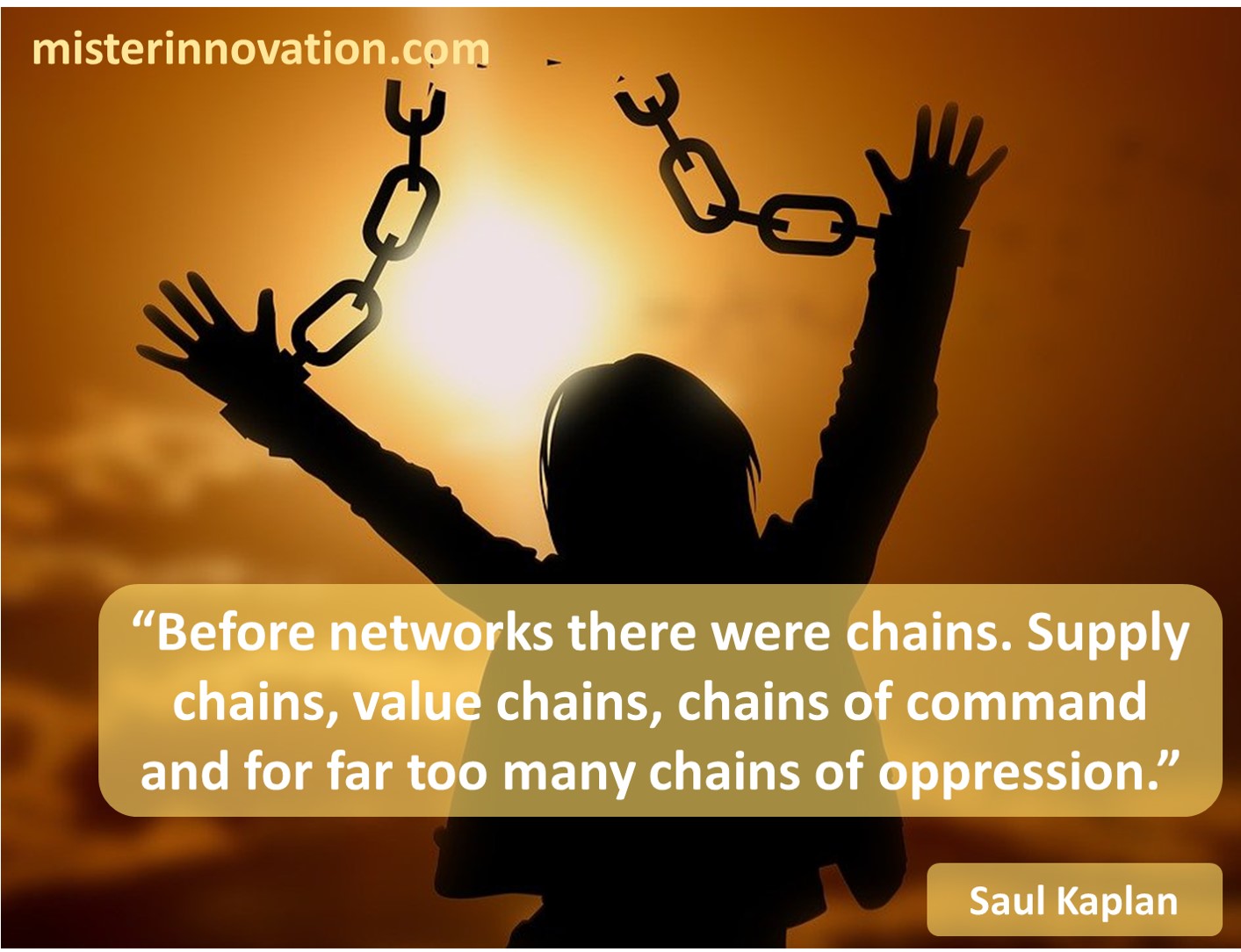
Image credits: 1 of 1,050+ FREE quotes for your meetings & presentations available at http://misterinnovation.com

Subscribe to Human-Centered Change & Innovation WeeklySign up here to get Human-Centered Change & Innovation Weekly delivered to your inbox every week.

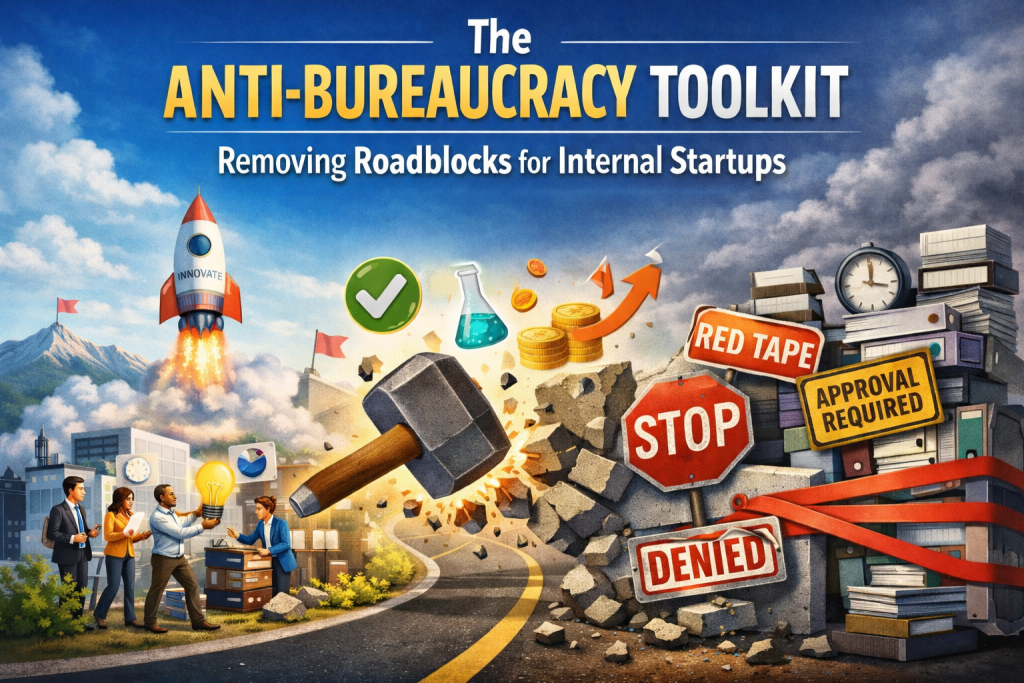
The Anti-Bureaucracy Toolkit

Removing Roadblocks for Internal Startups

LAST UPDATED: February 2, 2026 at 12:54PM

The Anti-Bureaucracy Toolkit

GUEST POST from Chateau G Pato

In most large organizations, the immune system is hyper-active. It is designed to find anything “foreign”—a new business model, a non-standard procurement request, or a disruptive technology—and neutralize it. While these systems excel at protecting the core business and maintaining operational excellence, they are the primary cause of death for internal startups.

To innovate at the speed of the market, we must move beyond the “Innovation Theater” of colorful sticky notes and beanbag chairs. We need to dismantle the invisible fences of bureaucracy. This toolkit is about creating a “Green Lane” for innovation—a set of protocols that allow internal ventures to bypass the friction of the legacy machine without breaking the company.


The Core Components of the Toolkit

1. The “Metabolic Rate” Alignment

Bureaucracy thrives on annual budget cycles and quarterly reviews. Internal startups, however, operate on a weekly or even daily metabolic rate. Removing roadblocks starts with shifting from “Annual Budgeting” to “Metered Funding.” Instead of a massive upfront investment, provide small tranches of capital tied to the validation of specific hypotheses.

2. The Legal and Procurement “Sandbox”

Nothing kills a pilot faster than a 60-page Master Service Agreement (MSA) for a $5,000 experiment. The Anti-Bureaucracy Toolkit requires a pre-negotiated “Lite” contract framework. This allows internal teams to engage with external startups or vendors in days rather than months.

3. Governance as a Service (GaaS)

Instead of the innovation team seeking permission from HR, IT, and Finance, these departments should provide dedicated liaisons whose job is to say “How can we make this happen?” rather than “Here is why you can’t.”


Case Studies in Bureaucracy Busting

Case Study A: The Global Financial Services Pivot

A major European bank struggled to launch a mobile-first micro-investment app because the internal IT compliance checklist involved over 200 security gates designed for core banking systems. The innovation lead implemented a “Risk-Tiering” model. Since the app didn’t touch the core ledger in its Alpha phase, they bypassed 80% of the gates. Result: The app launched in 4 months instead of the projected 18, capturing a demographic the bank had previously ignored.

Case Study B: Manufacturing Giant’s Procurement Hack

A Fortune 500 manufacturer found that its internal startups were failing because they couldn’t buy specialized components from non-approved vendors. The solution was the creation of a “Strategic Experimentation Fund” with its own corporate credit card and a modified compliance charter. This empowered teams to source materials instantly, reducing prototype iteration time by 65%.


“Innovation is not a department; it is the byproduct of an ecosystem that values velocity over validation and curiosity over compliance. If your processes are designed to prevent failure, they are simultaneously designed to prevent growth.”

— Braden Kelley


The Real Cost of Bureaucracy

Bureaucracy is often invisible to those who benefit from it. For internal startups, it shows up as endless approvals, premature financial scrutiny, and rigid processes that assume certainty where none exists.

Every extra form, meeting, or gate sends a signal: avoid risk, avoid attention, avoid change. Over time, innovation teams stop behaving like startups and start behaving like survivors.

The cost is not just speed. It is lost insight, missed markets, and talent that learns to stop trying.

Designing Governance for Exploration

The goal of anti-bureaucracy is not chaos. It is alignment. Exploration requires different constraints than execution. Leaders must intentionally design operating models that reflect this reality.

The Anti-Bureaucracy Toolkit focuses on enabling movement while maintaining trust:

  • Exploration charters that define boundaries instead of permissions
  • Incremental funding tied to evidence, not forecasts
  • Pre-approved tools and vendors for rapid experimentation
  • Executive sponsors who remove friction in real time
  • Metrics that reward learning velocity

The Leadership Imperative

Anti-bureaucracy is a leadership behavior, not a process initiative. Leaders must actively protect internal startups from being measured by the wrong standards at the wrong time.

This means rewarding teams for evidence over polish, curiosity over certainty, and progress over perfection.

If bureaucracy is left unchallenged, it will always win. If it is redesigned with intent, innovation has a fighting chance.

Frequently Asked Questions

What is the biggest roadblock for internal startups?

The primary roadblock is often “organizational friction”—legacy processes in procurement, legal, and IT that are designed for risk mitigation in the core business rather than the speed and agility required for new ventures.

How can an innovation speaker help change this culture?

An innovation speaker like Braden Kelley provides the external perspective and framework necessary to align leadership, helping them see that bureaucracy is a choice and providing the tools to dismantle it while also helping to build an entrepreneurial mindset inside organizations.

What is metered funding?

Metered funding is an investment approach where capital is released in small increments based on the startup hitting specific learning milestones, rather than providing a large lump sum upfront.

To learn more about human-centered change and organizational agility, visit the work of Braden Kelley.

Image credits: ChatGPT

Subscribe to Human-Centered Change & Innovation WeeklySign up here to get Human-Centered Change & Innovation Weekly delivered to your inbox every week.