The Fourth Inning in the Future of Work

The Future of Work Evolution: What Inning Are We In?

• Editor’s Note: The State of the Game in 2026

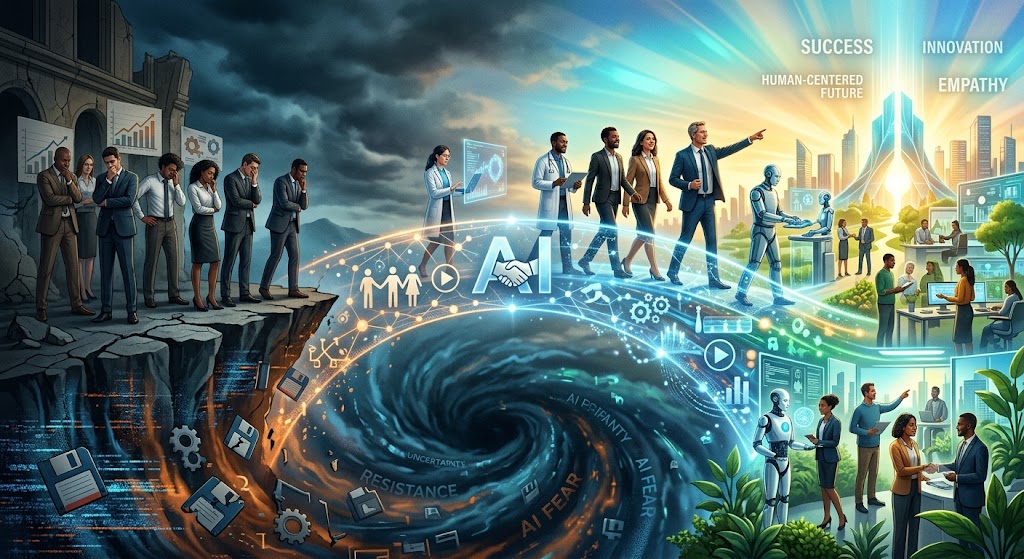
When tech strategist Geoffrey A. Moore penned this piece in the spring of 2024, the “top of the fourth inning” was characterized by the initial, frantic rush toward generative AI adoption and a baseline shift toward customer success. Two years later, as we navigate 2026, the game has rapidly intensified.

We are no longer just talking about shifting toward “outcomes”—we are actively building the infrastructure to measure them. The baseline has evolved from simple subscription tracking to deep Experience Management Offices (XMOs) and Experience Level Measures (XLMs), proving that human-centered value is the ultimate digital metric. Furthermore, the early AI hype has matured into what we call the AI Soft Landing, where organizations are moving past experimental tools to restructure workflows around systemic, human-led collaboration. Read on to explore Geoffrey’s brilliant structural breakdown of how we arrived at this pivotal inning.

GUEST POST from Geoffrey A. Moore

It’s spring of 2024, and as Major League baseball is getting underway, everyone in tech is talking about the future of work. Let me suggest we are in the top of the fourth inning, a couple of runners on base, but still much to be decided (all with the understanding that an inning in tech lasts somewhere between one and two decades—and you thought baseball games were long!). At any rate, here’s how I see it playing out.

The first inning where tech made a definitive impact on work spanned the 1970s and 80s when the dominant paradigm was proprietary mainframe computing and the focus was on management information systems. This was an era of control cultures where the mantra was plan your work and then work your plan. IBM and Oracle were the dominant players, and workflows were organized around reports.

The second inning emerged with the rise of client-server computing in the 1990s, where the focus was on real-time business processes. This was an era of competition cultures where the mantra was give me my objectives, give me my resources, and get the hell out of my way. Microsoft and Cisco were the dominant players, and workflows were organized around documents.

The third inning emerged out of the tech bubble popping at the turn of the century, where the dominant paradigm transitioned to cloud computing combined with mobile applications, and the focus shifted from B2B complex systems to B2C volume operations. This was an era of creativity cultures where the mantra was think different. Google and Apple were the dominant players, and workflows were organized around transactions.

Now we find ourselves at the top of the fourth inning, initiated with the rise of artificial intelligence, where the focus is on as-a-service subscription business models, the economics of churn, and the importance of the customer experience. This is an era of collaboration cultures where the mantra is put customer success before everything else. The dominant players have yet to be determined, but we do know that workflows will be organized around outcomes.

And that’s the point. Information technology that began at the periphery of the business as a back office report generation utility has now migrated to the very core of the enterprise’s mission, vision, and values. That’s why digital transformation is getting so much attention. But how to transform, and how to use digital technology to ensure that customers achieve the outcomes they seek, is very much still a work in progress.

That’s what I think. What do you think?

Image Credit: Gemini

Subscribe to Human-Centered Change & Innovation WeeklySign up here to join 17,000+ leaders getting Human-Centered Change & Innovation Weekly delivered to their inbox every week.

Crossing the Chasm of Fear

AI Soft Landing scenario — Leading People Through the Anxiety of Transformation and AI

LAST UPDATED: June 14, 2026 at 5:48 PM

Crossing the Chasm of Fear

by Braden Kelley and Art Inteligencia


The Hidden Friction in Modern Transformation

Change doesn’t fail because the technology is broken or the strategy is fundamentally flawed; it fails because organizations consistently underestimate the immense gravity of human fear.

We are living in an era of unprecedented, continuous disruption where the rapid, omnipresent rise of Artificial Intelligence (AI) has magnified workplace anxiety to an all-time high. This paradigm shift has fundamentally altered the conversation from standard operational “inertia” to a deep-seated, existential dread regarding professional relevance, personal autonomy, and long-term job security.

To build an agile, future-ready organization, leaders must stop merely trying to “manage” resistance and start actively dismantling fear. True transformation requires moving past rigid, top-down mandates to embrace genuine co-creation, psychological safety, and a commitment to human-centered design.

I. Mapping the Topography of Fear in the AI Era

To successfully guide an organization through a significant shift, leaders must first understand that the friction they encounter is rarely intellectual; it is emotional. In the wake of the generative AI revolution, traditional change management frameworks are proving insufficient precisely because they treat resistance as a logistical hurdle rather than a psychological defense mechanism.

The Shift from Traditional Resistance to Existential Anxiety

Standard change models were built for linear transitions — such as upgrading an ERP system or relocating an office — where the destination is clear and the skill gap is manageable. AI, however, introduces non-linear disruption. Employees are not just resisting a new tool; they are experiencing existential anxiety. The underlying fear is no longer “How do I use this software?” but rather “Does my expertise still matter?”

The Core Drivers of Workplace Fear

This widespread anxiety is fueled by three distinct, interconnected human dynamics:

  • Loss of Competence & Relevance: Professionals who have spent decades perfecting their craft suddenly face systems that can replicate aspects of their output in seconds. The fear of being rendered obsolete overnight leads to defensive behaviors and a reluctance to engage with new platforms.
  • Loss of Autonomy: Employees worry about losing the human element of decision-making. There is a deep-seated anxiety that their daily workflows will be dictated by black-box algorithms, reducing human agency to mere data entry and validation.
  • The “Black Box” Effect: Because advanced AI models operate behind complex neural layers, the lack of transparency breeds immediate distrust. When people do not understand how a technology arrives at a conclusion, they naturally default to worst-case scenario thinking regarding its intent and accuracy.

The Real Cost of Inaction

When leadership fails to recognize and mitigate these fears, the organization pays a heavy cultural tax. This friction rarely manifests as open defiance. Instead, it operations below the surface as:

  • Quiet Quitting: Disengagement driven by the belief that effort is futile in an automated future.
  • Malicious Compliance: Following instructions to the letter while ignoring obvious system errors, effectively letting the new technology fail to prove a point.
  • Organizational Paralysis: A total stall in innovation, as teams become too risk-averse to experiment with new digital capabilities.

II. Redefining the Approach: Moving from Mandates to Co-Creation

The traditional corporate playbook for technology deployment relies heavily on top-down enforcement. Executives select a platform, managers set a deployment date, and training sessions are scheduled to push the workforce into compliance. While this rigid approach might work for static software updates, it completely fractures when applied to cognitive, disruptive technologies like Artificial Intelligence. To cross the chasm of fear, leadership must fundamentally redefine how change is initiated.

The Failure of Top-Down Dictates

When an disruptive technology is thrust upon an organization from above, it triggers the corporate equivalent of an immune system response. Employees perceive the uninvited change as an existential threat to their routines and livelihoods. Pushing mandates down the organizational chart only hardens resistance, forcing anxiety underground and transforming potential advocates into silent saboteurs.

The Power of Participatory Innovation

The alternative to top-down friction is Participatory Innovation — the deliberate practice of shifting the narrative from “This is being done to you” to “You are building this with us.” True ecosystem agility requires flattening the hierarchy of contribution and inviting the entire workforce into the design process. Rather than treating front-line employees as passive recipients of change, organizations must treat them as active co-creators of their own future workflows.

This approach transforms the deployment strategy by:

  • Engaging front-line staff at the inception stage to identify real, daily friction points that AI can genuinely alleviate, rather than forcing technology where it doesn’t fit.
  • Utilizing cross-functional design sessions that break down legacy silos, allowing technical developers and domain experts to build tools in tandem.
  • Establishing iterative feedback loops that give employees a direct hand in shaping, tweaking, and refining the automated systems they are expected to use.

Lowering Resistance Through Shared Ownership

Human beings rarely destroy what they help build. When an employee looks at a newly integrated AI assistant or a redesigned digital workflow and recognizes their own insights, feedback, and domain expertise baked into the final product, the underlying psychological dynamic shifts instantly. The fear of the unknown is replaced by a powerful sense of pride of authorship, transforming potential resistance into proactive, self-sustaining adoption.

III. The Strategic Blueprint: Crossing the Chasm of Fear

Dismantling fear and establishing a culture of participatory innovation requires more than good intentions; it demands an operationalized, human-centered strategy. To successfully cross the chasm of anxiety and achieve meaningful adoption, leaders must execute a deliberate, multi-layered blueprint that prioritizes human experience alongside technical milestone delivery.

Step 1: Cultivate Psychological Safety First

Before introducing a single algorithmic tool, leadership must anchor the organizational culture in psychological safety. If employees believe that experimenting with AI or voicing skepticism will jeopardize their standing, they will retreat into defensive compliance.

  • Create dedicated, judgment-free forums where teams can openly discuss their anxieties, ask “naive” technical questions, and challenge assumptions without fear of retribution.
  • Frame the early stages of AI adoption as an iterative experiment rather than a high-stakes, zero-fault mandate. Normalize failure as a natural, necessary component of learning to collaborate with intelligent systems.

Step 2: Demystify the “Black Box”

Fear thrives in obscurity. When technology is shrouded in complex, dense jargon, employees default to worst-case scenario thinking. Crossing the chasm requires pulling back the curtain on how automated tools function.

  • Provide transparent, accessible education tailored to non-technical users. Demystify the data sources, logic, and operational boundaries of the AI models being deployed.
  • Shift the corporate narrative away from “automation as a replacement” and explicitly reframe it as “augmentation as a partner.” Clearly demonstrate how these tools can absorb repetitive cognitive drudgery, freeing individuals to focus on high-value, uniquely human tasks.

Step 3: Define New “Experience Level Measures” (XLMs)

Traditional change management focuses almost exclusively on cold Operational Measures—tracking system uptime, deployment timelines, software licenses, and output volume. To manage the human friction of transformation, organizations must measure what actually matters: the human experience of the transition.

  • Implement Experience Level Measures (XLMs) to actively track sentiment, cognitive friction, and confidence levels across the workforce during the rollout.
  • Establish an Experience Management Office (XMO). This cross-functional entity acts as the empathetic heartbeat of the transformation, monitoring XLMs in real time and intervening with support, tailored training, or process redesign when emotional friction spikes.

Step 4: Re-skilling with Dignity and Equity

True fairness in transformation means ensuring that the rewards of technological advancement are relative to the effort invested by the people keeping the organization running. If employees feel that upskilling only leads to their own displacement or unfair workloads, adoption will fail.

  • Demonstrate a visible, legally backed commitment to the long-term value of your human capital through robust, funded re-skilling pathways that dignify the worker’s career trajectory.
  • Align future organizational recognition, bonuses, and growth opportunities with equitable outcomes: ensure that the harder working individuals who lean into the challenge of adapting and mastering new tools receive the tangible rewards of that shared success.

IV. Activating the Ecosystem: Leveraging Multi-Dimensional Roles

Successfully steering an organization away from anxiety and toward sustainable innovation requires a diverse network of human capabilities. Relying solely on technical project managers or traditional IT leaders to drive adoption is a structural mistake; these roles are designed to optimize systems, not to heal a fractured human culture. To operationalize empathy and scale change, leadership must activate a multi-dimensional ecosystem of specialized roles.

Beyond the Project Manager

While project managers excel at tracking timelines, budgets, and deployment milestones, they rarely possess the specialized tools or bandwidth required to navigate deep-seated psychological friction. Orchestrating a human-centered transformation requires shifting the focus from managing tasks to nurturing human relationships. Organizations must look beyond standard job titles and intentionally cultivate specific archetypes designed to bridge the gap between human anxiety and technological capability.

The Right People in the Right Seats

To dismantle fear at every layer of the enterprise, leaders should identify, empower, and deploy three distinct operational archetypes across the transformation ecosystem:

  • The Evangelist: This role is responsible for crafting the overarching human narrative of the transformation. The Evangelist does not merely pitch the features of a new AI tool; they communicate the authentic “Why” behind the change. By generating real, unforced energy and painting a vivid picture of a more fulfilling, augmented future, they inspire teams to lift their heads above immediate anxieties and look toward the long-term horizon.
  • The Connector: Change rarely scales effectively through top-down mandates; it spreads horizontally through social proof and trusted networks. Connectors are the cross-functional linchpins who span legacy departmental boundaries. They excel at identifying grassroots wins in one pocket of the organization, translating those successes for other teams, and ensuring that insights, feedback, and shared resources flow seamlessly across the entire ecosystem.
  • The Coach: While Evangelists inspire groups and Connectors build bridges, the Coach works on the front lines of human emotion. Operating with high emotional intelligence, Coaches provide one-on-one empathy and guidance to individuals experiencing severe friction. They help employees navigate personal technical skill gaps, address specific career anxieties, and safely transition into new ways of working without losing their professional dignity.

Conclusion: The Ultimate Reward of a Human-Centered Future

Technology provides the raw capability, but human adoption provides the actual organizational value. As we navigate the complex, non-linear disruptions of the Artificial Intelligence era, it is becoming increasingly clear that the true competitive advantage does not belong to the enterprise with the largest budget or the most advanced algorithms. The future belongs to the organizations that can move their people past anxiety and into a state of shared purpose.

Crossing the chasm of fear requires leaders to abandon the outdated illusion of top-down control. By anchoring your transformation strategy in radical transparency, psychological safety, and participatory innovation, you transform a potentially threatening disruption into a collective opportunity. Measuring the journey through human-centric lenses like Experience Level Measures (XLMs) and deploying empathetic archetypes ensures that no one is left behind in the wake of progress.

Ultimately, when you design fear out of your corporate culture, you unlock the ultimate reward: an agile, resilient, and infinitely innovative workforce. By treating employees as respected co-creators of their digital future, you don’t just achieve a successful technology rollout — you build a human-centered ecosystem capable of thriving through any disruption the future brings.

Frequently Asked Questions

Why do traditional change management frameworks fail when introducing AI?
Traditional frameworks treat change as a linear, logistical hurdle focused on training and compliance. AI introduces non-linear disruption that triggers deep psychological and existential anxiety regarding job security, relevance, and loss of human autonomy. Overcoming this requires an empathy-driven, human-centered approach rather than top-down mandates.
What is Participatory Innovation and how does it reduce resistance?
Participatory Innovation is the practice of actively involving front-line employees in co-creating and designing their future workflows instead of pushing changes down from the executive level. Because human beings rarely destroy what they help build, this shared ownership transforms fear of the unknown into pride of authorship.
What are Experience Level Measures (XLMs) and why are they necessary?
While traditional operational measures track cold metrics like system uptime or deployment timelines, Experience Level Measures (XLMs) actively quantify human sentiment, cognitive friction, and adoption confidence. They are critical because technology only provides capability; human adoption is what actually unlocks organizational value.


Operationalize Organizational Empathy

Ready to Bridge the Gap Between Technology and Human Experience?

Technology only provides capability; human adoption creates the value. If you want to move past cold operational metrics and design fear out of your transformation, let’s connect. Get expert guidance on architecting impactful Experience Level Measures (XLMs) or establishing a dedicated Experience Management Office (XMO) tailored to your culture.

EDITOR’S NOTE: This is a visualization of but one possible future. I will be publishing other possible futures as they crystallize in my mind (or as you suggest them for me to explore).

Image credits: Google Gemini

Content Authenticity Statement: The topic area, key elements to focus on, etc. were decisions made by Braden Kelley, with a little help from Google Gemini to clean up the article, add images and create infographics.

Subscribe to Human-Centered Change & Innovation WeeklySign up here to get Human-Centered Change & Innovation Weekly delivered to your inbox every week.

The Circular Harvest — How Systems Engineering and Design Thinking Are Rewriting the Future of Farming

The Circular Harvest — How Systems Engineering and Design Thinking Are Rewriting the Future of Farming

by Braden Kelley and Art Inteligencia


I. Introduction: The Industrialist in the Mud

For generations, the global imagination has romanticized agriculture. We cling to a nostalgic, cottage-industry myth of farming—one filled with rustic barns, predictable seasons, and manual labor. But as a futurist and innovation strategist, I look at the reality of our current global landscape and see a system under immense friction. Our traditional models of food production are increasingly vulnerable to climate volatility, geopolitical shifts, and severe supply chain disruptions.

Take the United Kingdom’s strawberry market as a prime case study. Historically, during the bleak winter months, the UK has been forced to import roughly 90% of its strawberries. This reliance creates a massive carbon footprint, accumulating thousands of unnecessary air miles just to place fresh fruit on supermarket shelves. It is a textbook example of a broken user experience within our food ecosystem.

The Agri-Tech Paradigm Shift

True innovation occurs when we challenge these deeply entrenched systemic flaws. This is precisely what unfolded when Sir James Dyson turned his attention to the British countryside. His entry into agriculture was not a billionaire’s eccentric hobby; it was a massive, calculated manufacturing scale operation. Today, Dyson Farming spans over 36,000 acres, fundamentally shifting the paradigm of what a modern farm can be.

By treating the field not as a scenic backdrop, but as an advanced production ecosystem, Dyson has proven that high-technology and ecology are entirely symbiotic. He recognized that solving our grandest challenges requires us to ditch nostalgia in favor of relentless, forward-thinking execution.

“Farming is not a cottage-industry, or something quaint and nostalgic; efficient, high-technology agriculture holds many of the keys to our future.”

— Sir James Dyson

II. The Genesis: From Airflow to Agriculture

To understand how a company world-renowned for cyclonic vacuums, digital motors, and hair care ends up producing millions of British strawberries, you have to look past the end product and examine the underlying mindset. True cross-industry innovation happens when we stop defining ourselves by what we make, and start defining ourselves by how we solve problems.

For Sir James Dyson, the connection to the land is deeply personal. Long before he was an industrialist, he grew up in an agricultural community in North Norfolk. His early winters were spent lifting wet potato sacks and hauling brussels sprouts—hard, manual labor that left a lasting impression of the sheer grit required to sustain farming. When he returned to agriculture decades later, he didn’t see a separate world; he saw an industry ripe for the same system optimization principles that drive advanced manufacturing.

The Universal Laws of Engineering

To a systems engineer, a factory floor and an agricultural field are fundamentally governed by the same variables: inputs, throughput, energy transfers, and waste mitigation. Whether you are guiding airflow through a bagless vacuum cleaner or orchestrating the micro-climate around a living organism, the goal is peak operational efficiency.

Dyson looked at traditional farming and spotted classic design friction points: unmitigated environmental dependency, unpredictable yields, high labor inefficiency, and the massive carbon cost of importing out-of-season fruit. It was a broken system screaming for a design thinking intervention.

“Growing things is rather like making things – I am a manufacturer, and I have approached farming from that point of view… A factory should be well designed, well-built and work most efficiently as a machine, using the latest technology for production. The same applies to farming.”

— Sir James Dyson

Solving What Doesn’t Work

The core ethos of Dyson has always been a relentless desire to fix things that are fundamentally broken or inefficient. By exporting core fluiddynamics, automated robotics, and thermodynamic expertise from the laboratory to the greenhouse, Dyson Farming bypassed incremental adjustments. Instead, they designed a predictable, localized agricultural machine capable of operating 365 days a year.

III. The 26-Acre Glasshouse: Bringing Systems Thinking to the Strawberry

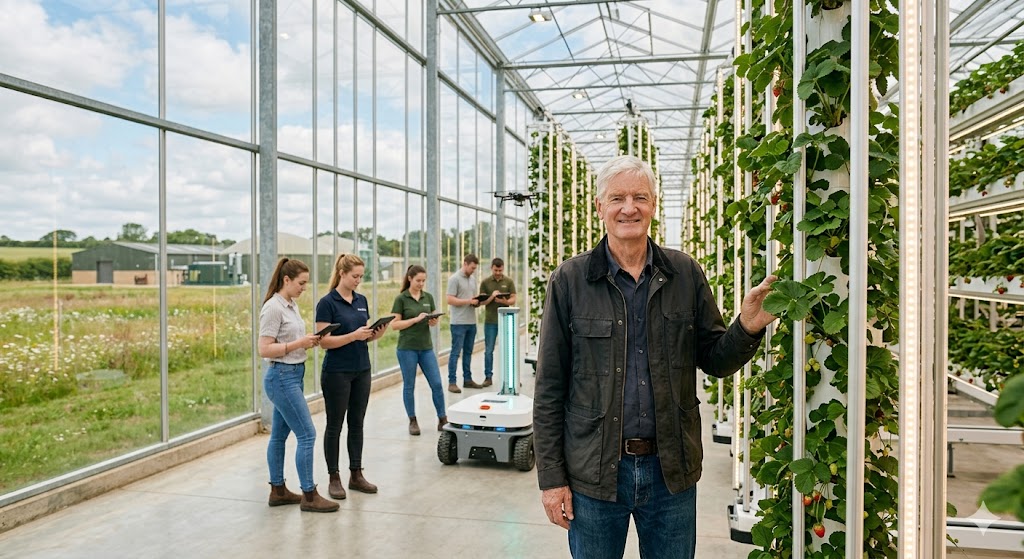
In Carrington, Lincolnshire, sits a 26-acre glasshouse that serves as the physical manifestation of Dyson’s systems-led philosophy. This facility is far from a passive greenhouse; it functions as a highly automated, data-driven food laboratory containing upwards of 1.2 million strawberry plants. By controlling every variable—from ambient temperature and humidity to root nutrition and light wavelengths—Dyson has removed the unpredictability of traditional farming, turning strawberry cultivation into a precise, scalable process.

Central to this facility is the implementation of a Hybrid Vertical Growing System (HVGS). Rather than planting traditionally in the ground, rows of strawberries are suspended on advanced, dynamic aluminum rigs that maximize vertical space. These massive structures operate like slow-moving Ferris wheels, rotating the plants to ensure they receive uniform exposure to natural sunlight. By optimizing the three-dimensional footprint of the glasshouse, Dyson Farming generates a 250% increase in yield per square meter compared to traditional flat-field farming methods.

The Integration of Robotics and Automation

Managing over a million plants across a 26-acre footprint requires an entirely new operational framework. Dyson engineers have bridged the gap between agriculture and advanced manufacturing by introducing proprietary automation suites directly to the gutters. Intelligent vision-sensing robots navigate the rows, using machine learning algorithms to calculate the exact color profile and ripeness of individual berries before picking them with absolute precision.

Furthermore, the facility mitigates disease without relying on standard chemical interventions. At night, autonomous rail-guided vehicles traverse the dark aisles, passing targeted ultraviolet (UV-C) light over the foliage to neutralize powdery mildew and mold spores before they can take root. When pests like aphids do emerge, the engineering team deploys biological controls, programmatically releasing predatory insects to establish a natural balance within the micro-climate.

Data-Driven Climate Architecture

Every element of the glasshouse acts as an interconnected sensor node. Advanced climate software dynamically adjusts the glasshouse’s roof vents, internal shading screens, and massive LED growth lamps based on real-time meteorological data. By treating the physical structure as a macro-machine designed to cater to the physiological needs of the plant, Dyson has managed to extend the British strawberry season to a full 12 months, delivering fresh fruit to local markets even in the depths of winter.

IV. The Closed-Loop Ecosystem: The Ultimate Circular Economy

True innovation within complex systems requires us to look beyond immediate outputs and design for industrial symbiosis. A standalone high-tech glasshouse is an engineering achievement; however, if it relies on fossil fuels to maintain its tropical winter temperatures, it fails the test of sustainable experience design. Dyson Farming resolved this challenge by implementing a highly integrated, closed-loop circular economy framework at their Carrington site.

The 26-acre strawberry glasshouse does not burden the local energy grid. Instead, it operates adjacent to a massive, industrial-scale Anaerobic Digestion (AD) plant. This facility processes organic matter—primarily energy crops grown on the surrounding farm alongside organic crop waste from the glasshouse itself—breaking it down using specialized bacteria to produce biogas. This gas is then captured and utilized to drive massive turbines, generating enough clean electricity to power more than 10,000 homes.

The Thermodynamic Cascade

In a standard power plant, the massive amount of heat generated by electricity production is lost to the atmosphere as waste. Dyson’s engineering team viewed this thermal loss as an untapped input. They designed a closed system of insulated subterranean piping to capture this surplus heat from the AD plant’s generators, channeling it directly into the glasshouse structure. This steady, recycled thermal energy maintains the internal climate at an optimal 18–20°C even when outdoor temperatures drop below freezing.

The circularity extends deep into the byproduct architecture of the process:

  • Renewable Heat: The thermal energy from the generator cooling systems replaces fossil-fuel heating, mitigating thousands of tons of carbon emissions.
  • Nutrient Digestion: The solid and liquid organic residue left over after anaerobic digestion—known as digestate—is treated and used as a nutrient-dense organic fertilizer across Dyson’s 36,000 acres of open-field farming, eliminating the need for synthetic, petroleum-derived fertilizers.
  • Carbon Capture: Carbon dioxide emissions from the gas engines are cleaned, cooled, and pumped directly into the glasshouse to accelerate plant photosynthesis during daylight hours.
  • Hydrological Security: The glasshouse roof acts as a massive rain catchment system, funneling water into a 50-million-gallon local lagoon to supply the precise, closed-loop drip irrigation network.

“It might seem odd for an industrialist who makes vacuum cleaners, hairdryers and robotics to be interested in farming but I see it as an extension of that. This is all about machinery, mechanics and science improving things, it’s regenerative and it’s the right way to farm.”

— Sir James Dyson

Designing Out the Concept of Waste

By connecting these disparate operational layers—thermodynamics, microbiology, mechanical engineering, and botany—Dyson Farming has created a highly resilient agricultural machine. This ecosystem model proves that the future of sustainability doesn’t lie in reducing our output, but in optimizing the interconnected loops between our inputs, resources, and environments.

V. Futurology & The Human Element: The Future of the Agronomist

When analyzing the future of labor and automation, my strategic foresight research often highlights a concept I call the AI Soft Landing—the intentional transition where automation doesn’t displace the human workforce, but rather elevates it to perform higher-value, more rewarding roles. Agriculture is on the absolute frontline of this shift. Globally, the farming sector faces a profound demographic crisis; in the UK, the average age of an agricultural worker hovers around 59 years old. By shifting the paradigm from manual labor to high-technology operations, Dyson Farming has effectively dropped their average workforce age to 40, turning farming into a highly attractive destination for the next generation of talent.

The employee experience at a modern agri-tech facility looks completely different than it did a generation ago. The workforce is no longer composed solely of manual pickers working under unpredictable skies; instead, the glasshouse is managed by data analysts, drone operators, software engineers, and advanced agronomists. Humans work alongside machine intelligence, using data dashboards to monitor sap flow, track nutrient profiles, and optimize robotic picking schedules. We are witnessing the birth of a new professional class: the tech-driven land steward.

Biodiversity as an Engineering KPI

A true human-centered innovation framework recognizes that humanity cannot thrive unless the surrounding natural ecosystem thrives with it. In a traditional industrial farming setup, maximizing yield often comes at the direct expense of local biodiversity. Dyson’s systems-engineering approach treats the surrounding environment not as an external variable, but as a critical part of the macro-machine that must be carefully maintained.

Across their expansive holdings, biodiversity metrics are tracked with the same rigor as manufacturing outputs. The operation actively manages over 400 kilometers of native hedgerows, establishes extensive wildflower margins to support wild pollinators, and constructs dedicated nesting boxes for barn owls and birds of prey. By utilizing automated data collection and drone surveying, the engineering teams treat soil health, water purity, and wildlife populations as vital key performance indicators (KPIs) of the farm’s long-term commercial sustainability.

“Dyson Farming is developing new approaches to efficient, high-technology agriculture, which we hope will lead to a commercially sustainable future… Sustainable food production, food security and the environment are vital to the nation’s health and the nation’s economy.”

— Sir James Dyson

The Legacy of Participatory Ecosystems

Ultimately, this model proves that top-down design is obsolete in complex ecological and economic systems. By inviting engineers, biologists, and local communities to co-create a localized food production system, Dyson Farming demonstrates how strategic foresight can be grounded in practical, scalable realities. They are redefining what it means to be a custodian of the land in the twenty-first century.

VI. Conclusion: The Blueprint for Cross-Disciplinary Innovation

The transformation of Dyson Farming from an experimental project into a high-yielding, circular agricultural powerhouse offers a profound lesson for leadership across all sectors: true breakthrough innovation rarely happens by staying safely inside your comfort zone. It occurs at the intersection of disciplines, when a proven methodology from one industry is boldly exported to completely rewrite the rules of another.

Sir James Dyson did not attempt to alter the fundamental biological mechanics of how a strawberry grows. Instead, he and his engineering teams used systems thinking and human-centered experience design to re-engineer the entire macro-environment surrounding the plant. By connecting thermodynamics, robotics, and microbiology into a cohesive, closed-loop engine, they transformed a volatile, seasonal gamble into a predictable, localized, and commercially viable reality.

The Takeaway for Tomorrow’s Leaders

As we look to the future, the grand challenges of our era—whether in food security, healthcare, or energy infrastructure—will not be solved by siloed thinking. They require an expansive, ecosystem-wide view that treats waste as an unutilized input and views automation as a tool to elevate the human workforce. Dyson Farming serves as a brilliant blueprint for this exact ethos. It proves that when you possess a relentless desire to fix what is broken, bring manufacturing precision to the natural world, and design with the wider ecosystem in mind, you can build a sustainable, resilient future—one system, and one harvest, at a time.

Frequently Asked Questions: Systems Thinking in Agriculture

How does an engineering company like Dyson transition successfully into commercial farming?

Dyson approached agriculture not as a traditional farming operation, but as an advanced manufacturing and systems engineering challenge. By treating a greenhouse or a field exactly like a factory floor, they mapped their existing core competencies—such as fluid dynamics, thermal management, automation, and robotics—directly onto agricultural friction points. This systemic mindset allowed them to optimize inputs, design out waste, and create a highly predictable, climate-resilient growing process.

What exactly makes Dyson Farming’s strawberry greenhouse a “closed-loop” ecosystem?

The 26-acre glasshouse achieved circular sustainability by integrating directly with an adjacent Anaerobic Digestion (AD) plant. The AD plant processes energy crops and organic waste to generate clean electricity for the local grid. Dyson engineers capture the natural by-products of this process: the waste heat is piped back to warm the glasshouse in winter, the captured carbon dioxide is used to accelerate plant photosynthesis, and the nutrient-dense digestate residue replaces synthetic chemicals as an organic fertilizer for the open fields.

How does advanced agricultural automation impact the human workforce and employment?

Instead of completely displacing human workers, advanced automation elevates the employee experience and shifts workforce demographics. By integrating automated vision-sensing picking robots and autonomous UV-C disease-control rovers, Dyson Farming eliminates grueling, repetitive manual labor. This transforms the traditional agricultural role into high-value career paths, attracting a younger generation of data analysts, software developers, drone pilots, and tech-driven agronomists.


Image credits: Gemini

Content Authenticity Statement: The topic area, key elements to focus on, etc. were decisions made by Braden Kelley, with a little help from Google Gemini to clean up the article, add images and create infographics.

Subscribe to Human-Centered Change & Innovation WeeklySign up here to get Human-Centered Change & Innovation Weekly delivered to your inbox every week.

Why VUCA is a Myth

Why VUCA is a Myth

GUEST POST from Greg Satell

“Imagine, if you will, a factory as clean, spacious and continuously operating as a hydroelectric plant. The production floor is barren of men,” Fortune magazine declared in its November 1946 issue. Soon the world entered a new world of mass production and mass retail. Then came a green revolution, a space race, genomics, computers, the Internet and now artificial intelligence.

Today it’s become an article of faith that everything moves faster. Business pundits tell us that we’re living in a VUCA world (Volatile, Uncertain, Complex and Ambiguous). These are taken as basic truths that are beyond questioning or reproach. Yet are things actually moving any faster than in earlier eras? The evidence is surprisingly scarce.

The inescapable truth is that some things move faster today and others move slower. We don’t have—nor should we want—more change today than before. We need to be more thoughtful about change, more deliberate about the ones we undertake and more tenacious in our pursuit of them. We should aim to have less disruption and more progress.

An Era of Industrial Stability

Since Jack Welch took over GE in the 1980s, the management ethos has been taken over by a cult of disruption. Pundits say we must “innovate or die.” Managers feel pressure to launch new initiatives, to pivot and then pivot again, because the competition has become so rabid that “only the paranoid survive.”

The data, however, tell a very different story. A report from the OECD found that markets, especially in the United States, have become more concentrated and less competitive, with less churn among industry leaders. The number of young firms have decreased markedly as well, falling from roughly half of the total number of companies in 1982 to one third in 2013.

A comprehensive 2019 study from the National Bureau of Economic Research found two correlated, but countervailing trends: the rise of “superstar” firms and the fall of labor’s share of GDP. Essentially, the typical industry has fewer, but larger players. Their increased bargaining power leads to more profits, but lower wages.

With all of the hype around things like artificial intelligence, this may seem hard to believe. However, once you start to think about where you actually spend your money, food, shelter healthcare, travel and so on the reality sets in that most of the economy involves atoms and not bits and, if you do a bit more research, you’ll find that those industries are, for the most part, less competitive.

The truth is that we don’t really disrupt industries anymore. We disrupt people. Economic data shows that for most Americans, real wages have hardly budged since 1964. Income and wealth inequality remain at historic highs. Anxiety and depression, already at epidemic levels, worsened during the Covid-19 pandemic.

The Limits Of Digital Dominance

Over the past several decades, innovation has become largely synonymous with digital technology. When the topic of innovation comes up, somebody usually points to a company like Apple, Google or Facebook rather than, say, a car company, a hotel or a restaurant. Today, seven out of the ten most valuable companies in the world are digital firms.

This is largely because of two forces converging. The first is Moore’s Law, the exponential doubling of the number of transistors we have been able to cram onto a silicon wafer. Yet our ability to do that is coming up against the constraints of physics. Advancement in conventional chips has already slowed and, at some point, it will stop altogether.

The other force driving the digital economy has been increasing returns. As the economist W. Brian Arthur explained in a 1996 article in Harvard Business Review, certain conditions, such as high upfront investment, negligible marginal costs and network effects, lead to “winner take all markets where the fastest firm reaps incredible benefits.

Yet consider that information and communication technologies only make up about 6% of GDP value added in advanced economies and you begin to see the problem. The Silicon Valley model simply doesn’t work outside of software and consumer gadgets. In industries that have a low tolerance for failure, such as manufacturing and healthcare, you can’t simply move fast and break things because you’ll likely break something important.

Moving Slow To Go Fast

When Covid hit in the winter of 2020, it was a mysterious disease with no known cure. Yet in a mere matter of months vaccines were developed and being tested. By the end of the year two firms, Pfizer and Moderna received emergency authorization and people started getting their shots. Given that before Covid it took more than a decade to develop and test a vaccine, this was almost unheard of speed.

Yet look a little closer and it becomes clear that the real story is somewhat different. Katalin Karikó, published her first paper on the mRNA technology used to make the vaccines in 1990. She wasn’t able to win grants to fund her work and, in 1995, was told that she could either direct her energies in a different way, or be demoted. She took the demotion, worked through it and, a decade later, began to see some success.

Today, of course, mRNA technology is moving very quickly. Funding is flooding into labs to potentially cure or prevent a wide range of diseases, from cancer to malaria, vastly more efficiently than anything we’ve ever seen before. There are similar slow moving revolutions underway in quantum computing, drug and materials discovery and other things.

There’s nothing usual about any of this. It’s long been known that technology follows an s-curve pattern, starting slowly, then hitting an exponential phase in which it moves very quickly before leveling off again. For example, after penicillin became commercially available in 1945, we entered a golden age of antibiotics and scientists quickly uncovered dozens of compounds that could fight infection, before things slowed to a crawl.

At any given time, there are many s-curves going on at once. Some are just beginning to crawl, others speeding up and still others slowing down. Pointing out the ones that are speeding up and ignoring everything else that’s going on may be exciting, but it’s not the way to get the best results.

Rethinking The Change Gospel

It’s no accident that VUCA is a military term. The ever-present mantra that we are living in a time of volatility, uncertainty, complexity and ambiguity makes corporate executives feel like swashbuckling heroes. The truth is that there is very little evidence that is the case and a veritable mountain to the contrary.

There is also evidence that all the hype around change is doing real damage. Leaders conjure up dramatic images of “burning platforms” to justify launching ambitious initiatives, which rarely succeed. These failures then are given as confirmation for how dire the need for change really is and more initiatives are launched with similar results.

That is the change gospel. Transformation has, all too often, become an end in itself rather than a means to an end. We end up pivoting so much that we end up right where we started. The problem with cheerleading change is that it puts the cart before the horse. People don’t embrace change because you came up with a fancy slogan, they adopt what they find meaningful, that creates genuine value to their lives and their work.

We need to have more reverence for the mundane and ordinary. When you look at previous eras in which more genuine transformation took place and far more economic value was produced, there was much less talk about disruption and much more focus on improving the human condition.

The truth is that we’re not really disrupting industries anymore as much as we are disrupting ourselves and fairy tales and living in a VUCA era will not change those basic facts. We need to think less about disruption and more about tackling grand challenges that will impact the world in significant ways. Innovation should serve people, not the other way around.

— Article courtesy of the Digital Tonto blog
— Image credit: Wikimedia Commons

Subscribe to Human-Centered Change & Innovation WeeklySign up here to join 17,000+ leaders getting Human-Centered Change & Innovation Weekly delivered to their inbox every week.

Top 10 Human-Centered Change & Innovation Articles of May 2026

Top 10 Human-Centered Change & Innovation Articles of May 2026Drum roll please…

At the beginning of each month, we will profile the ten articles from the previous month that generated the most traffic to Human-Centered Change & Innovation. Did your favorite make the cut?

But enough delay, here are May’s ten most popular innovation posts:

  1. Making Change Stick — by David Burkus
  2. Why You Need to Leverage Shared Values in Change Leadership — by Greg Satell
  3. Why Zero UI Will Redefine Experience Design — by Art Inteligencia
  4. Winning with Artificial Intelligence in 90 Days — Exclusive Interview with Charlene Li
  5. The Micro-Enterprise Explosion — by Braden Kelley
  6. Direction of Fit — by Geoffrey A. Moore
  7. The End of AI Data Centers — by Braden Kelley
  8. Cognitive Enhancement and the Augmented Worker — by Braden Kelley
  9. Leveraging Multi-Agent Orchestration Frameworks for Innovation — by Art Inteligencia
  10. We Must Think Less Like Engineers and More Like Gardeners — by Greg Satell

BONUS – Here are five more strong articles published in April that continue to resonate with people:

If you’re not familiar with Human-Centered Change & Innovation, we publish 4-7 new articles every week built around innovation and transformation insights from our roster of contributing authors and ad hoc submissions from community members. Get the articles right in your Facebook, Twitter or Linkedin feeds too!

Build a Common Language of Innovation on your team

Have something to contribute?

Human-Centered Change & Innovation is open to contributions from any and all innovation and transformation professionals out there (practitioners, professors, researchers, consultants, authors, etc.) who have valuable human-centered change and innovation insights to share with everyone for the greater good. If you’d like to contribute, please contact me.

P.S. Here are our Top 40 Innovation Bloggers lists from the last five years:

Subscribe to Human-Centered Change & Innovation WeeklySign up here to get Human-Centered Change & Innovation Weekly delivered to your inbox every week.

Thin Lizzy – An Innovation Miracle from a Monster

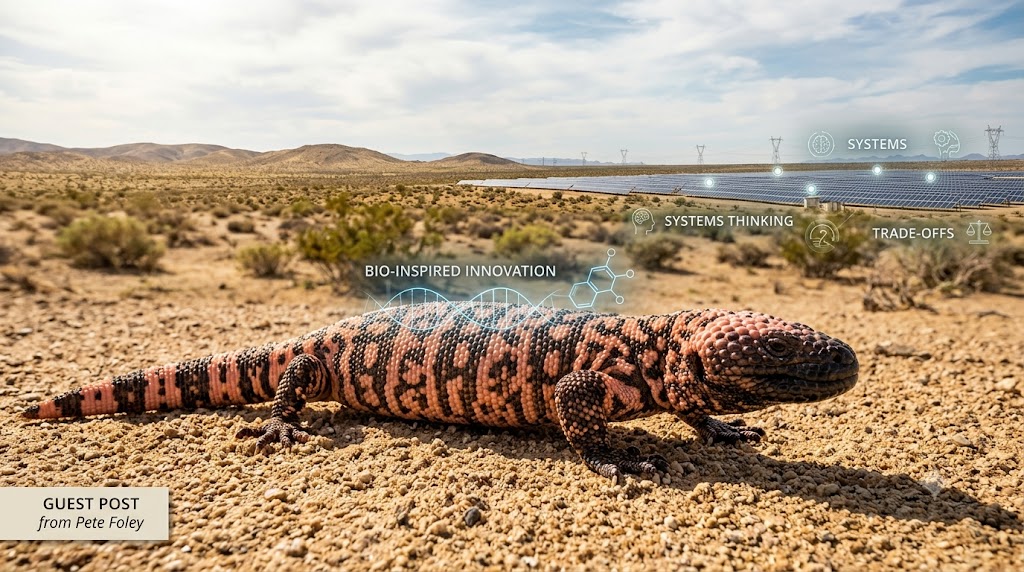
Gila monster in the Southwest desert - a source of bio-inspired innovation and GLP-1 medical breakthroughs

GUEST POST from Pete Foley

The pejoratively named Gila monster is a protected and borderline endangered species that inhabits my adopted Southwest.  It is the only venomous lizard in the USA, but while its venom can be deadly, human deaths are extremely rare.  It’s generally a shy, slow moving creature that spends much of its time underground.  It presents little danger unless you try to handle it, and if you are lucky enough to see one, it’s pink and black colors make it quite stunning to look at.

Monsters and Weight Loss: But whether you perceive it as beauty or beast, it has recently played a surprisingly important and beneficial role in human health.  As many reading this will already know, it’s venom is the origin of GLP-1’s. These are the ‘miracle ingredient’ found in diabetes and weight loss drugs like Ozempic and Wegovy.  GLP-1’s were initially isolated from Gila Monster venom about 30 years ago. These ‘Thin Lizzy’ drugs are now manufactured synthetically, but it’s unlikely that we’d have discovered them without the help of this maligned ‘monster’

A Benevolent Monster. Type-II diabetes and obesity are deadly diseases, and GLP-1’s have helped many patients live longer, better quality lives. I sometimes worry about over and unsupervised use, and long term effects of such a widely used new drug.  But there is no question around the benefits it has brought to the human race.  Gila is a benevolent monster, and we owe it our thanks for saving countless lives.  

Bio-Inspired Innovation:  In a broad sense, this is a great example of biomimicry, or at least copying innovation from nature.  Nature is a huge untapped resource of largely pre-cooked innovations.  Pretty much any problem we face, somewhere nature has already solved. It’s not always easy to find or adapt those solutions, but sometimes when we do, we get miracles like GLP-1. We can find innovations anywhere in nature, but marginal environments often have disproportionately more. They force evolution, as nature has to solve more difficult problems.  Often we hear biodiversity expressed in terms of ‘number of species’. That is a valid claim. There is no question, for example, that the density of species and fierce competition in the Amazon make it a rich source of biodiversity, and hence bio-derived innovation. But the huge number and diversity of species there also adds to the ‘needle in a haystack’ challenge we find with seeking innovation in nature. But the extremely harsh, hot, dry, environment of Southwest Deserts can also drive unusual adaptations.  In the case of GLP-1’s, their metabolism and glucose management help the Gila monster navigate an environment where food and water is scarce, and feeding sporadic.   Perhaps more importantly, given the harshness of the environment here, it’s likely that GLP-1’s are the tip of the ice-berg, and that our desert contains a reservoir of many more useful secrets waiting to be unlocked, especially around metabolism and water management.

Destruction of Wilderness:  But marginal environments are often also where species are most fragile and under threat.  In the desert southwest, the Gila’s habitat (and that of other marginalized species like the desert tortoise) is being squeezed from all directions.  An historic drought has gripped much of the area for decades.  And we are now compounding that with massive housing developments, even bigger industrial scale solar farms, and the massive infrastructure needed to transmit the energy those farms create. Even more recently, we are further compounding that ’squeeze’ with data centers, increased mining for rare metals and more.  These ‘developments’ not only destroy massive swathes of wilderness, and put additional pressure on already endangered species, but also compound drought and climate change by piling rapidly accelerating heat island effects on top of a warming climate.

Don’t Shoot Yourself in the Foot. As an innovator I embrace change, and recognize that progress inevitably comes with trade-offs.  But change needs to be managed thoughtfully, especially the inevitable trade offs that change creates in a complex system. Speed is often important, but it needs to be weighed against the need to have some basic understanding of the broad impact we have beyond the narrow, core objective. To use a ‘western’ analogy, in a gunfight it’s important to fire first, but not so fast that you shoot yourself in the foot.

The Desert is an Ocean with its Life Underground: In my last article I talked about the need for more scientists in leadership positions. One of the reasons for this is that our leaders today often appear unable, or perhaps unwilling to look at the big, complex picture, but instead over-simplify issues.  Nowhere is this more evident than in the southwest United States, where in the rush for growth, ‘renewable’ energy, raw material independence and AI development is destroying huge swathes of wilderness. While well intentioned, this is often driven by leaders who are focused on narrow goals, and ignore collateral damage by simplistically regarding the Mojave and as ‘s ‘only a desert’. But that desert is really an extremely complex and fragile system. GLP-1’s are likely the tip of the iceberg. We don’t know what else lies below the surface, but we need to be careful that we don’t destroy it before we have a chance to find out

The Pros and Cons of Solar Energy in the Desert: Just taking mass solar as an example of well intentioned but overly simplistic thinking.  Our deserts are rapidly getting littered with massive industrial scale solar farms, together with the equally massive infrastructure needed to transport the electricity they create to population centers, and/or AI data centers.

At a basic level, the concept of solar is a good one; what’s not to love about pollution free energy independence?  But if we look at the bigger, far more complex picture, it’s nowhere near that simple.

Too Hot For Solar? For example, a hot sunny desert is a superficially obvious place to build solar infrastructure.  But that’s until we realize that surface temperatures are so hot cells operate far below optimum efficiency.  Meanwhile dust further reduces efficiency, and remote locations make building, maintaining and connecting these farms difficult, expensive and environmentally damaging.

Collateral Damage: Solar farms and their infrastructure do extensive damage to our desert wilderness. They remove habitat for endangered species, and block migration roots for others.  Their installation and maintenance uses scarce water, and creates significant CO2 emissions (the thing they were supposed to prevent).  Much of the technology is shipped from China, posing a question around true energy independence, and that shipping and manufacture also creates CO2.  Climate change is a global issue, and while shifting CO2 emission for solar manufacture from the US to China may look good on some spreadsheets, it does nothing to solve the actual problem. 

These solar farms also create enormous amounts of dust.  Installing them requires removing of both surface crust and vegetation whose slow growing root systems hold the desert surface together (and ironically store CO2 via a symbiotic relationship with a mycelium).  That dust not only reduces the efficiency of the solar panels themselves, but also presents a hazard to traffic, and can even be quite toxic.  Mojave desert dust contains both natural asbestos and potentially deadly valley fever.  Its why all construction has to be constantly sprayed with increasingly scarce water.

With industrial scale desert solar, the narrow view of ‘renewable and ‘clean’ solar energy’ is highly attractive.  The reality is more complex, and full of trade offs that pit a green core technology against the environmental cost of construction, maintenance, eventual decommissioning, destruction of habitat and unintended consequences such as toxic dust. This makes a superficially simple choice far more complex. Some trade offs are alignable. For example, we can probably calculate actual net CO2 savings over the lifetime of a solar farm after manufacture, shipping, installation and decommissioning are taken into account.  But I’m not even sure if we can truly compare some of the other trade offs.  How do we quantify the trade off between toxic dust and reduced CO2 emissions?  Or how do we quantify and compare the impact of water usage, or loss of habitat to endangered species? 

Simplistic Focus: The result is a very complex calculation. But what is clear is that our leaders today typically ignore this, and instead remain simplistically focused on the narrow view.  Maybe if we could get more scientists into leadership positions we might do a better job of understanding trade offs, and the cost benefit of new technologies.  Today politicians all too often line up in favor of, or in opposition to projects based on overly simplistic, partisan frames, when really we need to manage complex trade offs. 

Calculating the Cost of Change in Complex Systems: Now, although I believe we need to do much better at managing complex systems, that doesn’t mean the pendulum needs to swing to far in the other direction. Complexity and uncertainty should not become an excuse for procrastination, inaction, or what I like to call the tyranny of data. The later is when we get stuck generating data and reports in increasing detail that add so much complexity, we never make a decision. As an innovator I embrace change, and recognize that progress inevitably comes with trade-offs.  But it’s about balance, and its critical to understand those trade offs at a systems level before charging ahead with initiatives, but still be willing to move forward embracing some uncertainty. All innovation comes with some risk, but smart innovators minimize those risks and balance them against timely progress.  And scientists are trained to learn as they go. That’s a balance I’d argue our leaders are struggling with today, swinging between inaction, and massive investments based on limited knowledge.

Solar is one example. But there are many more. In my home city of Las Vegas we are already facing a severe water crisis and extreme heat island effects.  In light of that, the mass destruction of wilderness to build 250,000 new MacMansions in the desert seems to lack even minimal big picture thinking.  Data centers, the innovation de jour are a more complex challenge. There is certainly a demand for them, and there is  a powerful, albeit US centric argument for keeping the US at the head of the AI innovation curve.  That means we do need data centers, but the cost in water and energy, two resources that are in relatively short supply here, arguably makes the SouthWest a poor choice of location.  Although I’ll acknowledge that data centers are rapidly becoming a somewhat universal ‘good idea as long as it’s not here’ technology.

Embracing Complexity and Solving Trade Offs:  But embracing complexity and looking at these at a systems level does not mean stopping innovation or progress. Quite the opposite, it should ultimately help us to innovate more effectively, and maybe face-plant less often. Identifying and challenging trade offs had long been a source of innovation, and is at the core of many innovation processes.  For example, with AI, could the US stay ahead of the AI curve by focusing data centers on more useful tasks, while cutting out less useful and energy expensive ‘slop’ such as action figures and/or caricatures?  That is maybe where regulation comes in, but as I mentioned in my last article, regulation without understanding risks both being ineffective, or creating unintended collateral damage. So this all supports the need for more technical ‘savvy’ in leadership.  
 
We Don’t Know What We Don’t Know.  When we try to evaluate trade off’s associated with innovation, what we don’t know is always one of the biggest challenges.  Who would have guessed 30 years ago that the Gila monster would provide the cure for obesity, and significantly reduce Type -II diabetes.  As mentioned before, we can be fairly sure that our desert wilderness holds many more untapped innovations, but we just don’t know what they are.  That harsh environment drove the evolution of tools for metabolism and glucose management that today treat obesity and diabetes management.  Longer term, could they also be a source of chemistry with efficacy against cancers, where glucose restriction and differentiation between the kinetics of healthy and cancer cell replication are effects we have, and will likely continue to exploit?  That’s speculation, but it highlights that we often don’t know all of the trade offs, and so those complex models need to be monitored and updated.  Narrow focus on a simplistic model means we miss so many potential opportunities. We also risk destroying the sources of the innovations and breakthroughs we haven’t found yet

Image credits: Google Gemini

Subscribe to Human-Centered Change & Innovation WeeklySign up here to join 17,000+ leaders getting Human-Centered Change & Innovation Weekly delivered to their inbox every week.

Demystifying the Mind of the Machine

Why Mechanistic Interpretability is the Cornerstone of Human-Centered AI Transformation

LAST UPDATED: June 12, 2026 at 5:43 PM

Mechanistic Interpretability

GUEST POST from Art Inteligencia


The Agentic Wall of Trust

We are moving rapidly from the era of “Copilot AI” — tools that merely assist us — to the era of “Agentic AI,” where autonomous digital agents manage complex, end-to-end operational workflows. While this leap promises unprecedented efficiency, organizations are hitting a psychological and operational wall of trust. Quite simply, you cannot easily manage, scale, or trust a workforce — human or digital — if you have no idea how it thinks.

Successful digital transformation relies fundamentally on psychological safety. To transition teams from skeptical resistance to confident collaboration, we must crack open the AI black box. Mechanistic interpretability is the human-centered key required to build that trust, ensuring our digital counterparts are as transparent as they are capable.

What is Mechanistic Interpretability? (Moving Beyond the Black Box)

To manage a hybrid workforce effectively, we must first understand the tools we are introducing.
Mechanistic interpretability is an emerging discipline within AI safety that rejects the
notion that deep learning models must remain permanent “black boxes.” Instead, it treats these complex
neural networks much like physical objects or intricate biological systems that can be meticulously
reverse-engineered.

From “What” to “Why”

Traditional AI explainability methods typically look at the relationship between inputs and outputs, telling
us what data points led to a specific conclusion. Mechanistic interpretability goes a layer deeper.
It maps out the internal “circuits” of neural networks to reveal exactly how a model formed a
specific concept or arrived at its decision path.

The Analogy: Traditional explainability is like looking at a car’s dashboard speed indicator
to see how fast you are going. Mechanistic interpretability is like pulling apart the engine block to see
exactly how the gears mesh and transfer power.

By understanding the specific mathematical pathways — or circuits — that trigger certain responses, innovation
and change leaders gain the tangible visibility needed to evaluate, audit, and confidently deploy
autonomous systems at scale.

The Human-Centered Change Angle: Why Trust Requires Transparency

Technology is only as effective as the human culture that adopts it. In the context of experience design and digital transformation, change leaders know that uncertainty breeds anxiety, and anxiety breeds resistance. If the inner logic of autonomous AI agents remains inscrutable and hidden, human employees will naturally — and rightfully — reject them.

The Psychology of Change and Safety

At its core, successful organizational transformation relies on psychological safety. Employees need to know that their operational environment is predictable and fair. Introducing autonomous agents that make high-stakes operational decisions without an audible trail completely dismantles that safety. Mechanistic interpretability restores this balance, transforming a mysterious, threatening entity into a predictable, reliable digital teammate.

Designing the Hybrid Workforce

We aren’t just deploying software anymore; we are designing a hybrid workforce. For humans and machines to co-create effectively, there must be clear boundaries and mutual understanding. Change managers cannot successfully integrate autonomous agents into workflows if they cannot explain the “why” behind the machine’s actions to front-line workers.

Mechanistic interpretability provides the concrete, transparent auditability required to bridge this gap. By mapping the neural pathways, we give change leaders the tools they need to transition teams from skeptical, defensive resistance to confident, proactive collaboration.

Strategic Benefits: Moving from Skepticism to Collaboration

When organizations peel back the layers of the AI black box, the benefits ripple far beyond the IT department. Implementing mechanistic interpretability fundamentally shifts how an organization interacts with autonomous technology, turning a potential point of friction into a catalyst for growth.

Fostering Psychological Safety

When teams understand how an AI partner arrives at a conclusion, the AI ceases to be an existential threat or an unpredictable wildcard. Instead, it becomes a predictable, reliable teammate. This transparency lowers the barrier to adoption, alleviating employee anxiety and creating an environment where human workers feel safe enough to experiment and co-create alongside digital agents.

Ensuring Ethical Alignment and Compliance

Organizational values can easily be lost in a complex web of code. By using circuit-mapping to proactively analyze deep learning models, change and innovation leaders can ensure AI agents strictly align with human ethics and corporate guardrails. This allows organizations to catch, diagnose, and fix algorithmic bias or unwanted behaviors before they ever manifest in front-of-house operations or customer experiences.

Accelerating Innovation Velocity

Skepticism slows down rollouts, leading to bloated timelines and stalled digital transformations. Transparent models are inherently easier to debug, audit, refine, and scale. By providing clear visibility into the system’s logic, leadership can confidently greenlight deployments, safely turning what would have been a sluggish, heavily resisted rollout into an agile, high-velocity transformation.

Framework for Change Leaders: Implementing Interpretable AI

Moving from the theory of trustworthy AI to operational reality requires a deliberate, strategic approach. Innovation and change leaders must actively design the bridge between deep technical data science and human-centered workforce management. This three-step framework outlines how to operationalize mechanistic interpretability within your transformation strategy.

Step 1: Set the Transparency Standard

Trust begins at procurement and development. Change leaders must partner with technology executives to demand mechanistic interpretability capabilities from day one. Whether evaluating third-party AI vendors or guiding internal data science teams, transparency should be treated as a non-negotiable KPI alongside accuracy and speed. Do not deploy autonomous agents into operational workflows unless you have a mechanism to map their internal decision pathways.

Step 2: Translate Tech to Touch

The insights generated by neural circuit-mapping are useless if they remain trapped in the engineering lab. The core responsibility of the modern change manager is translation. Leadership must establish cross-functional roles that can take highly complex interpretability data and translate it into clear, accessible language for the broader workforce. When front-line employees can grasp the “why” behind an AI agent’s behavior, the barrier of skepticism naturally dissolves.

Step 3: Establish Continuous Feedback Loops

Workforce integration is an iterative experience design process, not a one-time event. Use the ongoing insights gained from model audits to establish continuous learning loops. As the AI’s internal logic is mapped and understood, use those insights to upskill human workers, showing them exactly how to better prompt, guide, and co-create with their digital counterparts. Conversely, use human feedback to refine the machine’s guardrails, creating a continuously optimizing loop of human-machine collaboration.

Conclusion: The Future of Experience Design is Human+Machine

The ultimate goal of business innovation has never been about simply deploying smarter technology; it is about designing better, more meaningful human experiences. As we enter the era of autonomous digital workflows, the metrics of success must evolve. We cannot build a high-performing organization on a foundation of hidden logic and employee anxiety.

By embracing mechanistic interpretability, change leaders can ensure that the rise of autonomous agents does not come at the expense of workplace trust or psychological safety. Peering inside the machine allows us to confidently manage the risks of digital transformation, secure our workflows, and align technology with our deepest organizational values. When we remove the mystery from AI, we humanize it — unlocking the true, collaborative potential of the next era of work.

Frequently Asked Questions

What is Mechanistic Interpretability?

Mechanistic interpretability is an AI safety discipline that treats deep learning models like physical objects to be reverse-engineered. Instead of treating AI as an inscrutable “black box,” it maps out the internal neural “circuits” to show exactly how a model formed a specific concept or decision path.

Why is mechanistic interpretability important for human-centered change?

Successful digital transformation relies on psychological safety and trust. Change leaders cannot successfully integrate autonomous agents into hybrid human-machine workforces if the AI’s logic remains hidden. This discipline provides the transparent auditability needed to move teams from skeptical resistance to confident collaboration.

How does this framework accelerate organizational innovation?

Transparent AI models are fundamentally easier to audit, debug, and scale. By removing the anxiety of unpredictable machine behavior and ensuring alignment with corporate values, organizations can confidently greenlight deployments and achieve high-velocity transformation.


Disclaimer: This article speculates on the potential future applications of cutting-edge scientific research. While based on current scientific understanding, the practical realization of these concepts may vary in timeline and feasibility and are subject to ongoing research and development.

Image credits: Gemini

Subscribe to Human-Centered Change & Innovation WeeklySign up here to get Human-Centered Change & Innovation Weekly delivered to your inbox every week.

The Neuroscience of Creativity

What Innovation Leaders Need to Know
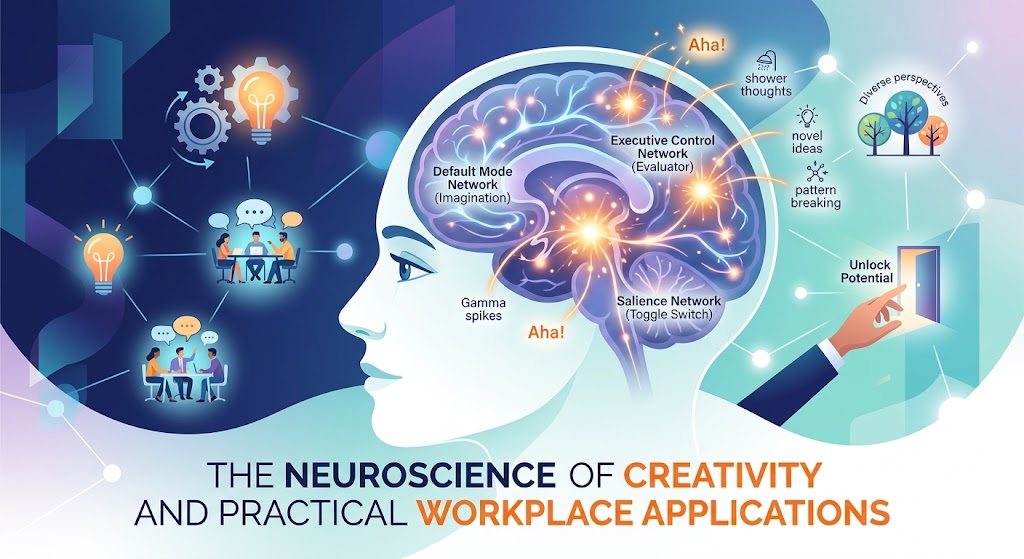
The Neuroscience of Creativity

Editor’s Note — Braden Kelley

What is the Neuroscience of Creativity?

The neuroscience of creativity is the study of the brain processes, neural networks, and biological mechanisms that underlie creative thinking and creative behavior. Neuroscience research has identified that creativity emerges not from a single “creative brain region” but from the dynamic interaction of three large-scale brain networks: the Default Mode Network (DMN), which generates novel associations during open, unfocused thinking; the Executive Control Network (ECN), which evaluates and refines ideas through focused analytical thinking; and the Salience Network (SN), which switches attention between the two.

For innovation leaders, the practical implication is significant: creativity is not a fixed trait — it is a neurological process that can be supported or suppressed by the organizational environment. Chronic stress, lack of psychological safety, and always-on work cultures suppress the brain activity most essential for creative cognition. Organizations that protect time for unfocused thinking, build genuine psychological safety, and cultivate intrinsic motivation are not just following management best practices — they are creating the neurological conditions the creative brain needs to function at its best.

The article below translates the most important findings from creativity neuroscience into practical guidance for innovation leaders — connecting what brain science now confirms about how creative thinking actually works to what you can do to build more creative, more innovative organizations.

by Braden Kelley and Art Inteligencia

Creativity is not a personality trait. It is not a gift that some people have and others don’t. It is a neurological process — a specific pattern of brain activity that can be understood, cultivated, and deliberately supported through the right organizational conditions.

For innovation leaders, this distinction is everything. If creativity is a trait, your job is to hire for it and hope. If creativity is a process, your job is to understand that process and design the organizational environment that enables it. The neuroscience of the past two decades has made the second view definitively clear — and the practical implications for how organizations should be structured, how teams should work, and how leaders should lead are profound.

This guide translates the most important findings from creativity neuroscience into practical guidance for innovation leaders — connecting what we now know about how the creative brain works to what you can actually do to build more creative, more innovative organizations.

What Neuroscience Has Revealed About Creativity

For most of the 20th century, creativity was studied through psychological tests and self-report measures. The rise of neuroimaging — fMRI, EEG, and related technologies — has allowed researchers to observe the creative brain in action for the first time, and the findings have overturned several long-held assumptions.

The Three Brain Networks That Drive Creativity

The most important neuroscience finding for innovation leaders is that creativity is not a function of a single brain region or a single type of thinking. It emerges from the dynamic interaction of three large-scale brain networks that work in specific patterns during creative thought. Researchers have confirmed this through analysis of data from 857 patients across 36 fMRI brain imaging studies, mapping a common brain circuit that underlies creative cognition.

The Default Mode Network (DMN) — The network of brain regions active when we are not focused on a specific external task: the posterior cingulate cortex, medial prefrontal cortex, and temporal regions. The DMN was long dismissed as the “resting state” of the brain. We now know it is the engine of imagination, self-reflection, and spontaneous idea generation. It is most active during mind-wandering, daydreaming, and the mental states we typically try to eliminate from the workplace. This is where novel associations are generated — where the brain makes the unexpected connections between seemingly unrelated concepts that are the hallmark of creative insight.

The Executive Control Network (ECN) — The network responsible for focused, goal-directed thought: working memory, attention regulation, and deliberate cognitive control. The ECN is what we use when we concentrate on a specific problem, evaluate options, and make deliberate decisions. Traditional models of creativity treated divergent (generative) and convergent (evaluative) thinking as opposing modes requiring different people. Neuroscience has shown they are sequential phases of a single creative process — both essential, both neurologically distinct.

The Salience Network (SN) — The network that monitors both the external environment and internal mental states, detecting what is important and switching attention between the DMN and ECN as needed. The salience network is the traffic controller of the creative process — determining when to shift from focused analytical thinking to open associative thinking and back again. High-performing creative individuals show stronger functional connectivity in the salience network, suggesting that the ability to fluidly switch between focused and diffuse thinking modes is a key component of creative capacity.

The implication for organizational design is significant: creative cognition requires the brain to move fluidly between open, associative, internally-directed thinking and focused, evaluative, goal-directed thinking. Organizational environments that only support one mode — typically the focused, task-oriented mode — systematically suppress half of the creative process.

The Role of Incubation and Mind Wandering

One of the most counterintuitive and practically important findings from creativity neuroscience is the role of mind wandering and incubation — periods of unfocused, seemingly unproductive mental activity — in the creative process.

When we step away from a problem and allow the mind to wander, the Default Mode Network becomes highly active. During this activity, the brain continues processing the problem below conscious awareness — making novel associations, exploring tangential connections, and reorganizing information in ways that focused attention actively prevents. This is why creative insights so often arrive in the shower, on a walk, or just before sleep — moments when focused attention is relaxed and the DMN can operate freely.

Research published in 2026 by neuroscientists at Northwestern University showed that dreams can be nudged in specific directions and that sleeping on a problem produces measurable creative benefits — confirming that the incubation effect is not metaphorical but neurological. The brain literally continues working on creative problems during unfocused and sleep states in ways that produce insights that focused work alone cannot.

The organizational implication is direct: environments that schedule every minute, eliminate downtime, and treat unfocused thinking as unproductive are neurologically hostile to the creative process. Building space for mind wandering — breaks, walks, protected thinking time, reduced meeting density — is not a wellness initiative. It is a creativity infrastructure investment.

The Neuroscience of Psychological Safety and Creativity

The amygdala — the brain’s primary threat detection system — plays a critical role in creativity, and not in a productive way. When people perceive social threat — the risk of judgment, rejection, or humiliation for expressing an unconventional idea — the amygdala activates a threat response that directly suppresses activity in the prefrontal cortex, the region most associated with creative and executive function.

This is the neurological mechanism underlying the organizational psychology finding that psychological safety is the strongest predictor of team innovation and creative performance. It is not merely that people choose not to share ideas when they feel unsafe — their brains are literally operating in a state that makes creative cognition more difficult. The threat response that social judgment activates is the same response that would help them escape a physical predator, and it produces the same result: narrowed attention, reduced cognitive flexibility, and suppressed associative thinking.

Creating psychological safety is therefore not just a management practice — it is a neurological prerequisite for the creative brain to function at its full capacity.

Stress, Cortisol, and Creative Performance

Cortisol — the primary stress hormone — has a well-documented inverted-U relationship with cognitive performance. Moderate arousal and mild stress can enhance focus and performance on routine tasks. But high and chronic stress significantly impairs the prefrontal cortex function and DMN activity that creative cognition depends on.

The implications for innovation management are significant: the high-pressure, deadline-driven, always-on work environments that many organizations treat as signals of productivity and commitment are neurologically incompatible with sustained creative performance. Organizations that create chronic stress through unrealistic deadlines, unpredictable workloads, and cultures of constant urgency are paying a creativity tax that never appears on the balance sheet but consistently limits their innovation capacity.

Dopamine and the Reward System in Creativity

The neurotransmitter dopamine plays a central role in creativity through two distinct pathways. The mesolimbic pathway is associated with reward, motivation, and the pleasurable sensation of discovery — the feeling of insight and the intrinsic motivation to explore and create. The mesocortical pathway modulates prefrontal cortex function, influencing cognitive flexibility, working memory, and the ability to make novel associations.

Dopamine is released in response to novelty, unexpected rewards, and the anticipation of reward. This means that environments rich in novelty, intellectual stimulation, and the intrinsic rewards of interesting, challenging work activate the dopaminergic systems that support creative cognition. Environments that are routine, predictable, and driven by extrinsic motivation — compliance, fear of failure, external rewards — provide significantly less dopaminergic fuel for creative thinking.

The practical implication: intrinsic motivation is not just a management preference — it is a neurochemical condition for optimal creative performance. Innovation cultures that rely primarily on extrinsic motivators are working against the brain’s creativity chemistry.

What This Means for Innovation Leaders: Seven Organizational Design Principles

The neuroscience of creativity is not merely academically interesting — it has specific, actionable implications for how innovation leaders should design their organizations, manage their teams, and structure their own creative practice.

1. Design for Cognitive Mode Switching, Not Just Focus

The creative process requires fluid movement between focused, analytical thinking (ECN-dominant) and open, associative thinking (DMN-dominant). Most organizations design exclusively for focused work — open-plan offices, back-to-back meeting schedules, and real-time communication tools that create constant interruption. This design systematically suppresses the DMN activity that generates novel associations and creative insight.

Designing for creativity means creating conditions for both modes: protected time for focused analytical work, and protected time for open, unfocused exploration. This includes building transitions between modes — walks, breaks, sleep — that allow the incubation process to operate. The most creative organizations are not those with the most focused workers; they are those that have learned to alternate between depth of focus and freedom of exploration in productive rhythms.

2. Build Psychological Safety as Infrastructure, Not Culture

Because psychological safety is a neurological prerequisite for creative cognition — not just a cultural nice-to-have — it needs to be treated as infrastructure rather than aspiration. This means designing specific practices that make it structurally safe to share unconventional ideas: anonymous ideation, dedicated devil’s advocate roles, explicit norms against judgment during generative phases, and leadership behaviors that visibly model intellectual risk-taking and curiosity rather than certainty and competence performance.

3. Reduce Chronic Stress Deliberately

Managing organizational stress is a creativity imperative, not just a wellbeing initiative. This means auditing the sources of chronic, creativity-suppressing stress in the work environment: unrealistic deadlines, unpredictable workloads, ambiguous expectations, and cultures of constant urgency. It means making structural changes — not just wellness programs — that reduce the cortisol load on creative workers. The organizations that protect creative time from deadline pressure, that build slack into innovation timelines, and that resist the temptation to fill every available hour with urgent tasks are the ones whose creative workers can actually do their best thinking.

4. Cultivate Intrinsic Motivation

Because dopamine — the neurochemical fuel for creative cognition — is released in response to novelty, intellectual stimulation, and the intrinsic rewards of interesting work, organizational design for creativity must prioritize intrinsic motivation. This means connecting innovation work to meaningful purposes that people care about; giving creative workers genuine autonomy over how they approach problems; ensuring that creative challenges are genuinely challenging — neither too routine nor too overwhelming; and reducing the dominance of extrinsic motivators like performance scores and financial incentives that activate compliance behavior rather than creative exploration.

5. Protect and Leverage Incubation

Building incubation into innovation processes is one of the highest-leverage and most underused tools available to innovation leaders. Structured incubation means deliberately scheduling breaks from active problem-solving — walks, overnight reflection, weekend distance from a stuck problem — and treating this time not as wasted but as a necessary phase of the creative process. Organizations that never leave space for the brain to process problems below conscious awareness are systematically excluding the most powerful part of their creative capacity from their innovation work.

6. Design for Cognitive Diversity

Research confirms that neurodivergent employees — those with ADHD, autism spectrum conditions, dyslexia, and other neurological variations — often show distinctive creative capacities precisely because of how their brains process information differently. Research published in October 2025 revealed that ADHD’s hallmark mind wandering might actually boost creativity — people who deliberately let their thoughts drift scored higher on creative tests. Separately, a study found that neurodivergent employees make up nearly half of the creative industry’s workforce and bring valuable skills that fuel creativity, yet face increasing challenges that hinder their performance at work.

Organizations that design for neurotypical processing norms — open-plan offices that prevent deep focus, meeting cultures that favor verbal quick-thinking over reflective processing, and evaluation systems that favor extroversion — are systematically excluding significant creative capacity. Designing for cognitive diversity means accommodating different processing styles, providing options for different working environments, and evaluating creative contribution on the quality of ideas rather than the confidence with which they are expressed.

7. Use Environmental Design as a Creativity Tool

The physical and social environment directly affects the neurological conditions for creative work. Moderate ambient noise (approximately 70 decibels — the level of a coffee shop) has been shown to enhance creative performance compared to both silence and loud noise, by providing sufficient stimulation to activate associative thinking without overwhelming focused attention. Natural light, exposure to nature, and varied spatial environments have been shown to reduce stress hormone levels and support the cognitive flexibility that creativity requires. Temperature, air quality, and even ceiling height measurably affect creative performance through their effects on physiological arousal and cognitive state.

These are not soft factors — they are neurological inputs that directly affect creative output. Organizations that treat physical environment as a real estate optimization problem rather than a creativity infrastructure investment are leaving measurable performance on the table.

The Neuroscience of Team Creativity

Individual creativity is necessary but insufficient for organizational innovation. What happens when creative individuals work in teams — and how does neuroscience inform team design for collective creativity?

The most important finding for team creativity is that the same psychological safety dynamics that operate at the individual level operate at the team level — but are amplified by group dynamics. A single high-status team member who reacts negatively to unconventional ideas can suppress creative contribution from the entire team by triggering amygdala threat responses in others. The neurological contagion of threat states is real: negative emotional signals are processed rapidly and automatically in ways that shift entire groups from exploratory to defensive cognitive modes.

The inverse is also true. Teams with strong psychological safety, clear shared purpose, and a culture of building on each other’s ideas rather than evaluating them create conditions where individual DMN activity and associative thinking are reinforced rather than suppressed by social context. This is the neurological basis of effective brainstorming and collaborative ideation — not as a technique but as an environmental condition that enables individual brains to do their most creative work in a shared context.

Research on team size consistently shows that smaller teams — two to five people — produce more creative solutions than larger groups for most innovation challenges. This is at least partly neurological: larger groups activate more complex social monitoring demands that consume cognitive resources needed for creative thinking, while smaller groups can develop the trust and familiarity that reduces threat-state activation and enables more free-ranging creative exploration.

Applying Neuroscience to Your Innovation Practice

The practical application of creativity neuroscience for innovation leaders is not about turning your organization into a neuroscience research lab. It is about making better organizational design decisions by understanding the biological mechanisms underlying creative performance.

Start with an honest audit of your current environment against the neuroscience principles above: Does your organization design for cognitive mode switching or only for focused work? Are your innovation teams operating in conditions of psychological safety or threat? Is chronic stress systematically suppressing creative capacity? Are your motivation structures activating intrinsic or extrinsic drivers? Is physical environment designed for creative performance or just operational efficiency?

The gap between where most organizations are on these dimensions and where the neuroscience suggests they should be is typically significant — and closing it does not require large capital investment. The most powerful creativity infrastructure changes are often structural and cultural: protecting thinking time, reducing meeting density, building psychological safety practices, and designing team environments that support rather than suppress the neurological conditions for creative work.

Frequently Asked Questions: Neuroscience of Creativity

What does neuroscience tell us about creativity?

Neuroscience has shown that creativity emerges from the dynamic interaction of three large-scale brain networks: the Default Mode Network (which generates novel associations during mind wandering and open thinking), the Executive Control Network (which evaluates and refines ideas through focused analytical thinking), and the Salience Network (which switches attention between the other two networks). Creative cognition requires fluid movement between these networks — which means that organizational environments designed only for focused, task-oriented work are systematically suppressing half of the creative process. Psychological safety, low chronic stress, intrinsic motivation, and protected time for unfocused thinking are all neurologically important conditions for creative performance.

What part of the brain is responsible for creativity?

Creativity is not localized to a single brain region — it emerges from the interaction of three large-scale networks. The Default Mode Network (including the medial prefrontal cortex, posterior cingulate cortex, and temporal regions) is active during open, associative thinking and generates novel connections. The Executive Control Network (including the dorsolateral prefrontal cortex and anterior cingulate cortex) supports focused evaluation and refinement. The Salience Network (including the anterior insula and dorsal anterior cingulate cortex) regulates switching between the other two networks. Research analyzing 857 patients across 36 fMRI studies has confirmed a common brain circuit for creativity that spans all three networks.

Can creativity be developed or is it innate?

Neuroscience is unambiguous: creativity is a process, not a fixed trait. While individuals show variation in creative capacity — influenced by genetics, early environment, and cognitive style — the neurological networks that support creative cognition are plastic and can be strengthened through practice, environmental design, and deliberate cultivation. The most important implication for organizations is that creative capacity is substantially determined by environmental conditions — psychological safety, stress levels, motivation structures, and time for unfocused thinking — that leaders can actively design for. This shifts the innovation leader’s job from identifying creative individuals to creating the organizational conditions that enable creative performance across the team.

Why does psychological safety matter for creativity?

Psychological safety matters for creativity because the threat of social judgment — the risk of being seen as foolish, wrong, or unconventional — activates the amygdala’s threat response, which directly suppresses activity in the prefrontal cortex and Default Mode Network that creative cognition depends on. When people feel unsafe sharing ideas, they are not merely choosing to stay quiet — their brains are literally operating in a neurological state that makes creative thinking harder. Creating psychological safety is therefore a neurological prerequisite for creative performance, not just a cultural preference. Teams with strong psychological safety show measurably better creative output because their members’ brains can operate in the open, associative mode that generates novel ideas.

How does stress affect creativity?

Chronic stress significantly impairs creative performance through its effect on cortisol — the primary stress hormone. While moderate arousal can enhance performance on routine, analytical tasks, high and sustained cortisol levels impair prefrontal cortex function and Default Mode Network activity — the two neurological systems most critical for creative cognition. Organizations that create chronic stress through unrealistic deadlines, unpredictable workloads, and cultures of constant urgency are paying a significant creativity tax. Managing organizational stress is not just a wellbeing initiative — it is a creativity performance imperative with measurable effects on innovation output.

What is the role of the Default Mode Network in creativity?

The Default Mode Network (DMN) is the set of brain regions — including the medial prefrontal cortex, posterior cingulate cortex, and temporal regions — that become active when we are not focused on a specific external task. Once dismissed as the brain’s “resting state,” the DMN is now understood as the engine of imagination, spontaneous idea generation, and the associative thinking that connects seemingly unrelated concepts. It is most active during mind wandering, daydreaming, and incubation — the mental states most organizations try to eliminate. Protecting time for DMN activity through breaks, walks, and reduced meeting density is one of the highest-leverage and most underused creativity investments available to innovation leaders.

Want to build an organization where the conditions for creative performance are systematically designed in rather than accidentally present? Explore the Human-Centered Change methodology — a practical framework for building the organizational conditions that enable innovation at scale.

Content Authenticity Statement: The topic area, key elements to focus on, etc. were decisions made by Braden Kelley, with a little help from Claude and Google Gemini to clean up the article, add images and create infographics.

Image credits: Google Gemini

Subscribe to Human-Centered Change & Innovation WeeklySign up here to get Human-Centered Change & Innovation Weekly delivered to your inbox every week.

Everyday Leadership

Everyday Leadership

GUEST POST from Mike Shipulski

What if your primary role every day was to put other people in a position to succeed? What would you start doing? What would you stop doing? Could you be happy if they got the credit and you didn’t? Could you feel good about their success or would you feel angry because they were acknowledged for their success? What would happen if you ran the experiment?

What if each day you had to give ten compliments? Could you notice ten things worthy of compliment? Could you pay enough attention? Would it be difficult to give the compliments? Would it be easy? Would it scare you? Would you feel silly or happy? Who would be the first person you’d compliment? Who is the last person you’d compliment? How would they feel? What could it hurt to try it for a week?

What if each day you had to ask five people if you can help them? Could you do it even for one day? Could you ask in a way the preserves their self-worth? Could you ask in a sincere way? How do you think they would feel if you asked them? How would you feel if they said yes? How about if they said no? Would the experiment be valuable? Would it be costly? What’s in the way of trying it for a day? How do you feel about what’s in the way?

What if you made a mistake and you had to apologize to five people? Could you do it? Would you do it? Could you say “I’m sorry. I won’t do it again. How can I make it up to you?” and nothing else? Could you look them in the eye and apologize sincerely? If your apology was sincere, how would they feel? And how would you feel? Next time you make a mistake, why not try to apologize like you mean it? What could it hurt? Why not try?

What if every day you had to thank five people? Could you find five things to be thankful for? Would you make the effort to deliver the thanks face-to-face? Could you do it for two days? Could you do it for a week? How would you feel if you actually did it for a week? How would the people around you feel? How do you feel about trying it?

What if every day you tried to be a leader?

Image credits: Pixabay

Subscribe to Human-Centered Change & Innovation WeeklySign up here to join 17,000+ leaders getting Human-Centered Change & Innovation Weekly delivered to their inbox every week.

Giving Customers and Employees the Best Day Ever Experience

Giving Customers and Employees the Best Day Ever Experience

GUEST POST from Shep Hyken

Steve Spangler is a teacher, businessman and Emmy award-winning TV personality who has amassed more than 4.5 billion views across YouTube and TikTok. The secret to his success can be summed up in one word: engagement. And recently, he decided to write about it, authoring a book titled The Engagement Effect: Cultivating Experiences that Ignite Connection, Build Trust, and Inspire Action.

In our interview, Spangler shared ideas that will make you a better leader. His insights in the book offer practical strategies for transforming abstract engagement concepts into actionable approaches that work across industries. While he shared many ideas, the concept of The Best Day Ever Experience stands out. Almost everything in the books points to creating an engaging experience that gets employees to love where they work and engage more with customers, and customers to want to return and tell others about their experience.

Engagement Is About Creating Experiences, Not Just Transactions

As Spangler emphasizes, engagement isn’t a gimmick or technique. It’s a mindset. It starts with the belief that people want to connect, and it’s our job as leaders to create the kind of experiences that invite a connection. True engagement happens when you go beyond just selling a product or service to creating an experience that connects emotionally and intellectually with people. Whether in business, school or any setting, making your audience feel involved and valued turns a simple exchange into something memorable. When people feel engaged, they are more likely to become loyal and talk about their experiences with others.

The Best Day Ever Experience

Spangler discussed his early days as a teacher, when he decided to make Halloween special for his students. In his science class, he exploded a pumpkin, lit a gummy bear on fire and sent electricity through the students (safely, of course!).

The following day, the father of one of these students approached Spangler. The conversation started out sounding like an angry, concerned parent who asked, “Am I to understand that you detonated an explosion in front of a group of children?” He shared more details about what happened in that class, and the father wasn’t actually angry at all. He was elated!

It turns out his daughter, who never talked about school, had come home so excited that she talked about everything she experienced that day. On that Halloween night, instead of wanting to rush out and go trick-or-treating like most kids, his daughter made everyone stay at the dinner table until she shared every detail about the day. She summarized by saying, “Daddy, today was the best day ever.”

The Best Day Ever Experience is about emotional connection. It’s transformational, not just transactional. The principal at Spangler’s school complimented him by saying, “If it gets to the dinner table, you win.” That wasn’t just praise. It was a benchmark. In other words, if what you create for your customers or employees is so impactful that they metaphorically “bring it home,” talking about it excitedly to others, then you’ve created a transformational experience, one they will remember, want to experience again and share with others.

Chewy.com Creates Best Day Ever Experiences

Spangler shared a business example using Chewy.com as the case study. Chewy sells pet supplies online, and there are plenty of similar stories about how Chewy creates intense loyalty with its customers.

In the early years of Chewy.com, a customer called to cancel his monthly dog food delivery subscription. Unfortunately, his dog passed away. That month’s delivery showed up, reminding him that he had to make the call. He was very emotional as he shared his story. The Chewy.com employee expressed empathy and sympathy. She informed him that the subscription was canceled, and he would receive a refund for the most recent delivery. She asked that he give the dog food to a neighbor or donate it to an animal shelter. That would have been a friendly end to the story, but there’s more.

Two days later, there was a knock at the customer’s door. A local florist delivered a plant with a note from Chewy.com about how they wanted him to know that his friends at the company were thinking about him and how hard it is to lose a “best friend.” Spangler summarizes by saying, “A sad and touching moment, yes, but also a Best Day Ever moment.”

Final Words

All leaders are experience designers, whether they realize it or not. Every meeting, message and moment is an opportunity to create an experience that is memorable (or forgettable). Spangler’s book serves as a roadmap for leaders who are ready to transform their approach from transactional to transformational. The way you treat employees and customers shapes their memories and creates loyalty. Focus on how you present ideas and products, not just what you offer. The question every leader should ask is, “Are we creating experiences so memorable that our employees and customers rush to tell others about them?”

This article was originally published on Forbes.com.

Image Credit: Pixabay

Subscribe to Human-Centered Change & Innovation WeeklySign up here to join 17,000+ leaders getting Human-Centered Change & Innovation Weekly delivered to their inbox every week.