Another AI Soft Landing Scenario Exploration — The Neurological Frontier
LAST UPDATED: May 17, 2026 at 7:02 PM
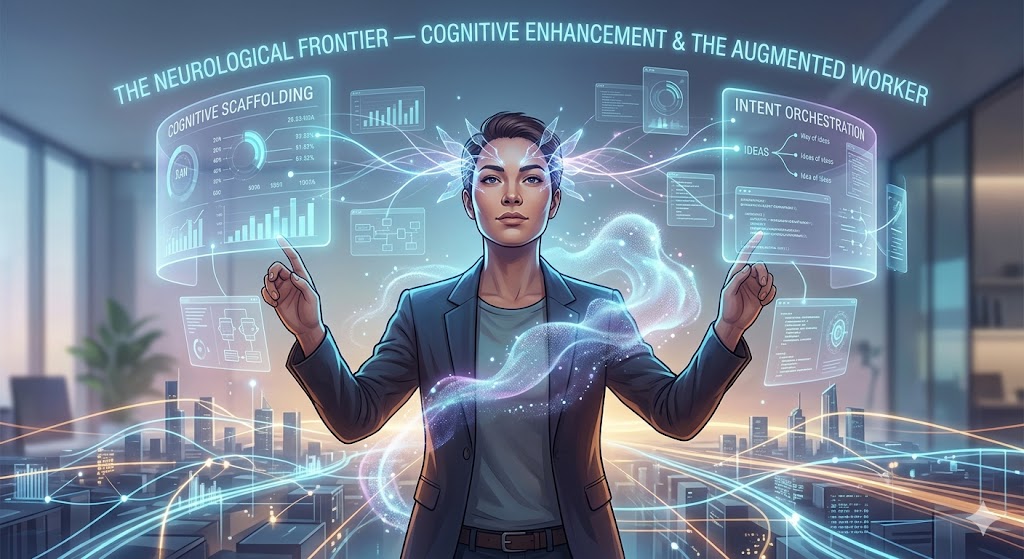
by Braden Kelley and Art Inteligencia
- The Victorian Hypothesis: Exploring a return to artisanal value and the “Human Premium.”
- The Human Premium Renaissance: Economic value will migrate to the “biological origin” — the hand-carved, the human-thought, and the uniquely flawed.
- The AI New Deal: Government as the employer of first resort.
- The Micro-Enterprise Explosion: Entrepreneurship or bust?
Beyond the Automated Horizon
For years, the mainstream narrative surrounding the rise of artificial intelligence has been trapped in a stark, binary choice: either humanity must race against the machine to protect traditional jobs, or we must retreat entirely to purely manual, artisanal, or civic labor. This false dichotomy creates an atmosphere of anxiety, framing AI as an inevitable displacement engine. However, there is a much more compelling, optimistic, and techno-progressive path forward — one that doesn’t replace the worker, but upgrades them.
We are on the cusp of an incremental “Cyborg Transition.” Rather than the dramatic, invasive sci-fi brain chips often popularized in media, this evolution is happening softly and ubiquitously. It is a gradual merging with AI tools through augmented cognition, extended memory, and real-time decision-making support. Just as smartphones transitioned from luxury gadgets to indispensable external brains that we feel lost without, advanced AI agents are becoming a normalized extension of our intellectual identity.
As each generation grows up with deeper, more fluid AI integration, the definition of “human labor” will expand rather than contract. The economy doesn’t lose human workers; it amplifies their potential. Value is shifting rapidly from the speed of task execution to the depth of intent orchestration, empathy, and strategic conceptualization.
Yet, this thrilling neurological frontier brings urgent socioeconomic challenges. As we design this future, we must confront pointed questions about accessibility: Who can afford premium cognitive augmentation, and who risks being left behind as an unaugmented underclass? The future of work is not about automation replacing humanity — it is about intentionally designing a human-centered transition that elevates us all.

I. The Human-AI Symbiosis: Anatomy of the Augmented Worker
The relationship between humans and technology is shifting from a utilitarian model of “user and tool” to a deeply integrated, symbiotic partnership. The augmented worker does not merely operate AI; they think alongside it. This symbiosis fundamentally alters how cognitive tasks are processed, distributed, and executed in the modern enterprise.
Cognitive Scaffolding and Memory Extension
Generative AI and advanced LLMs are evolving far beyond reactive search engines or drafting assistants. They now function as cognitive scaffolding — external structures that support and expand human working memory. By offloading the heavy lifting of data retrieval, synthesis, and administrative tracking to ambient AI, workers dramatically reduce their mental load. This allows the human brain to bypass structural cognitive bottlenecks and maintain focus on higher-order problem solving.
Continuous Contextual Awareness
The true power of the augmented worker lies in real-time, proactive support. Instead of a worker pausing their workflow to query a database, ambient AI companions continuously listen, observe, and analyze the operational environment. Whether an employee is in a customer meeting, a design sprint, or a complex engineering review, the AI proactively feeds them historical context, relevant cross-functional data, and predictive outcomes. Decision-making is no longer limited by what a single human can recall in the moment.
Redefining Human Labor: Intent Orchestration
As task execution becomes increasingly automated, the baseline definition of valuable human labor is undergoing a radical expansion. The economic value of a worker is shifting from how fast they can build to how deeply they can conceptualize. Human labor is becoming a discipline of intent orchestration. In this new paradigm, the most valuable skills are human-centered: empathy, strategic vision, ethical judgment, and the ability to ask the right questions to direct autonomous systems toward meaningful innovation.

II. The Incremental Cyborg: How Augmentation Becomes Normalized
Society often envisions the integration of human and machine as a sudden, disruptive event — a dystopian leap marked by invasive cybernetics. In reality, the transition is smooth, behavioral, and highly incremental. We do not notice ourselves becoming cyborgs because the technology adapts to our natural behaviors, slowly weaving itself into the fabric of daily life until it becomes entirely invisible.
The Generational Shift in Technological Adaptation
Every generation establishes a new baseline for what feels “natural.” Digital natives seamlessly adapted to glass touchscreens, shifting human-computer interaction from rigid commands to fluid gestures. The next generation of workers will natively interface with multi-modal AI agents from early childhood. For these individuals, a software tool that does not anticipate their needs, remember their preferences, or actively collaborate with them will feel as broken and archaic as a rotary phone feels to a teenager today.
The Frictionless Interface
The acceleration of this transition is directly tied to the elimination of user-interface friction. The barrier between human thought and digital execution is shrinking rapidly. We are moving away from keyboard-and-mouse dependencies toward high-bandwidth, natural modalities: conversational voice, subtle eye-tracking, contextual gesture control, and predictive text. As these interfaces become completely frictionless, the delay between conceptualizing an idea and seeing it manifested by an AI tool drops to near zero.
The Psychology of Integration: Expanding Intellectual Identity
The final stage of normalization is psychological. When a tool responds instantly, holds perfect recall of your entire career’s output, and matches your cognitive rhythm, the human brain naturally begins to treat it as an extension of the self. This is the phenomenon of extended cognition. Workers will no longer view AI as external enterprise software they have to log into; instead, they will view it as a peripheral lobe of their own brain. The line where the human mind ends and the digital asset begins will blur, permanently expanding our sense of personal intellectual identity.
III. Innovation and Experience Design in the Augmented Workplace
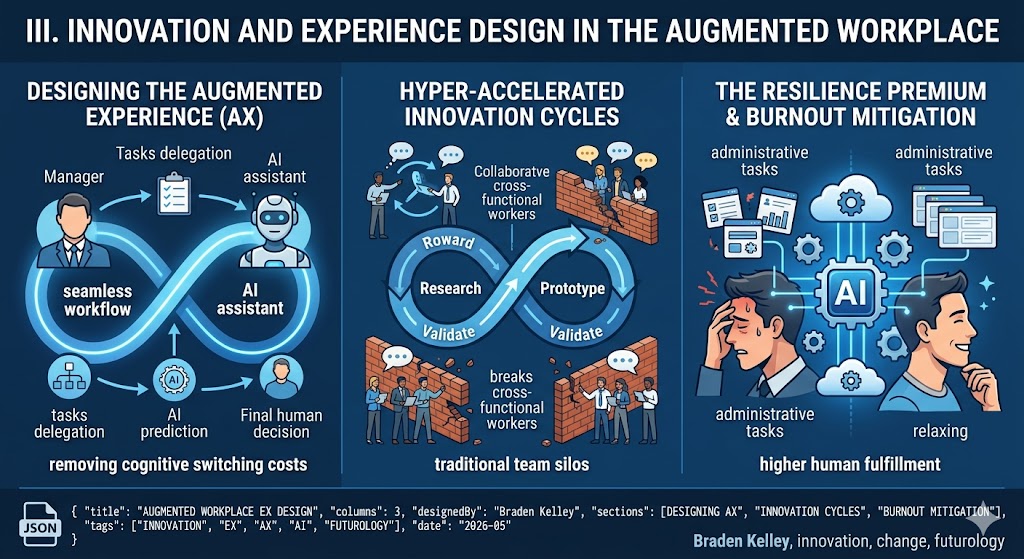
As the capabilities of the workforce expand, the frameworks we use to design business processes and employee experiences must evolve in tandem. Managing an augmented workforce requires a radical shift from traditional human resource management to intentional Experience Design. Organizations must build environments that don’t just utilize tools for efficiency, but actively harmonize human creativity with machine intelligence.
Designing the Augmented Experience (AX)
Traditional User Experience (UX) and User Interface (UI) design paradigms are no longer sufficient. When humans and AI operate in a continuous, bidirectional feedback loop, we must design for the Augmented Experience (AX). AX design focuses on creating non-disruptive, ambient workflows where the AI transitions smoothly between passive observer, active assistant, and autonomous executor. The goal is to eliminate cognitive switching costs, ensuring that software feels like a natural collaborator rather than a demanding administrative chore.
Hyper-Accelerated Innovation Cycles
The democratization of specialized, cross-functional knowledge through AI removes the traditional bottlenecks of organizational silos. An augmented worker in marketing can instantly understand technical architectural constraints; a developer can instantly run predictive financial models on their code. By collapsing the time required to research, prototype, and validate ideas, organizations can transition from rigid, linear development models to continuous, hyper-accelerated innovation cycles. The distance between a strategic spark and market reality shrinks from months to hours.
The Resilience Premium and Burnout Mitigation
Historically, technological revolutions have been used to squeeze more volume out of the worker, leading to chronic stress and burnout. A human-centered approach to augmentation reverses this trend, aiming for a Resilience Premium. By offloading low-value administrative friction, repetitive reporting, and data sorting to AI, we free up human cognitive capacity. Workers can redirect their energy toward high-empathy, high-creativity tasks — the exact areas where human fulfillment is highest — resulting in both a more innovative enterprise and a healthier, more resilient workforce.
IV. The Dark Side of the Frontier: The Unaugmented Underclass
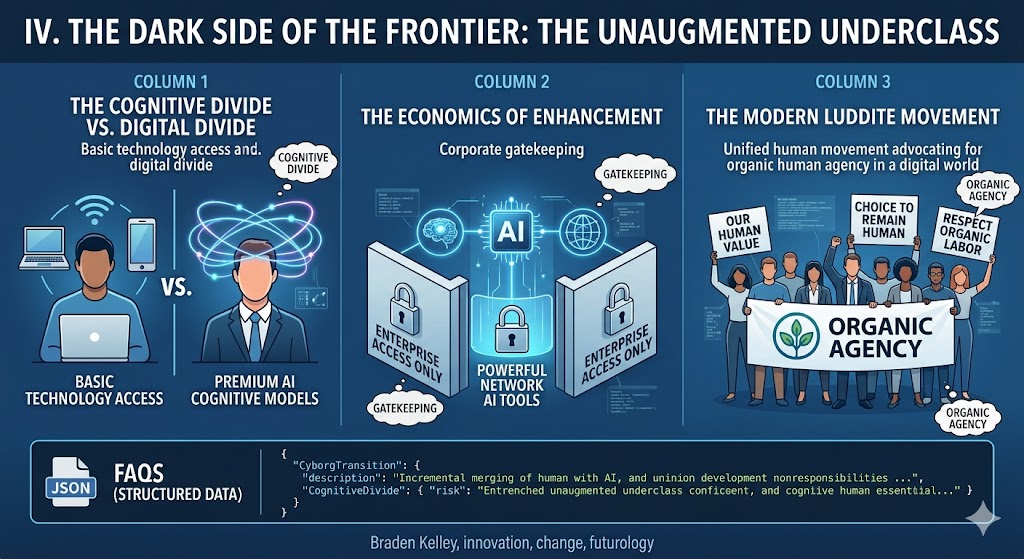
While the potential for human elevation is immense, a techno-progressive future is never guaranteed to be an equitable one. As cognitive augmentation becomes the primary driver of economic value, the traditional gaps in society will mutate. We must look past the optimistic horizon to confront a stark societal risk: the creation of a deeply entrenched, structurally excluded unaugmented underclass.
The Cognitive Divide vs. The Digital Divide
For decades, policymakers and technologists have fought to close the “digital divide” — the gap between those with access to internet-connected hardware and those without. The neurological frontier introduces a far more insidious challenge: the Cognitive Divide. This is not a matter of whether a worker has a screen, but whether they have access to premium, high-tier cognitive models that actively shape thought, strategy, and problem-solving velocity. When the barrier to entry for high-paying roles is the quality of your digital mind-extension, inequality becomes deeply intellectual.
The Economics of Enhancement: Corporate Gatekeeping
Advanced, specialized AI ecosystems require massive computational power and proprietary datasets, meaning they will largely be controlled by elite tech conglomerates and well-funded enterprises. If these cognitive tools remain locked behind corporate paywalls or exorbitant personal subscription models, then only the wealthiest individuals and organizations will afford the “upgrade.” This threatens to create a feedback loop where the augmented class accumulates wealth and influence at a velocity that the unaugmented cannot mathematically match, cementing a new form of economic caste system.
The Modern Luddite Movement and Cultural Backlash
We must also anticipate a profound cultural and psychological pushback. Not everyone will want to integrate with ambient AI systems, and many will view the blurring lines of human identity as a fundamental threat to human dignity. This resistance will likely fuel a modern Luddite movement — not driven by an ignorant fear of technology, but by a conscious desire to preserve unaugmented human agency. Society will face severe fragmentation as companies face an identity crisis: how to manage, value, and respect the labor of workers who choose to remain “organically human” in an ecosystem designed entirely for the augmented.
Conclusion: Designing a Human-Centered Autonomous Future
The neurological frontier is not a distant science fiction scenario; it is an active transition unfolding across the global workforce today. By moving past the paralyzing fear of automation and embracing the potential of incremental cyborg symbiosis, we open the door to a massive expansion of human creativity, capability, and fulfillment. The economy does not have to lose its workers to AI — it can choose to lift them up.
A Call to Action for Innovation and Change Leaders
This optimistic future will not happen by accident. Business leaders, change agents, and experience designers cannot treat AI merely as a tool for cutting costs and optimizing headcounts. We must actively architect organizational cultures and technical ecosystems that prioritize human agency. True innovation lies in designing the Augmented Experience responsibly, ensuring that technology serves as a platform for human elevation rather than a mechanism for worker exploitation or burnout.
The Ultimate Metric of Progress
As we navigate this profound shift, the ultimate benchmark of our success must change. We can no longer measure progress solely by the efficiency of our algorithms or the number of tasks automated away. Instead, we must evaluate our organizations by a human-centered standard: How much more capable, creative, and fulfilled are the people within our ecosystem? The Resilience Premium must become a core metric of the modern enterprise.
We are not being replaced by artificial intelligence; we are being challenged by it. We are being pushed to shed the routine, administrative friction of our daily work and step into roles defined by deep empathy, bold imagination, and strategic intent orchestration. The frontier of human labor is expanding — it is now our responsibility to design an equitable, inspiring transition that leaves no worker behind.
Frequently Asked Questions
What is the “Cyborg Transition” in the context of the modern workforce?
The Cyborg Transition refers to the incremental, behavioral merging of human workers with AI tools to enhance cognitive capabilities. Instead of relying on invasive sci-fi brain chips, this transition happens softly through everyday software, ambient AI companions, and natural interfaces (voice, gesture) that expand human memory, context, and decision-making velocity until the tool feels like a natural extension of the worker’s intellectual identity.
How does cognitive augmentation change the definition of human labor?
Cognitive augmentation expands human labor rather than contracting it. As AI automates routine task execution and administrative friction, the value of human work shifts to “intent orchestration.” Human labor is redefined around uniquely human-centered skills: empathy, strategic conceptualization, ethical judgment, and the creative vision required to direct autonomous systems toward meaningful innovation.
What is the “Cognitive Divide” and why is it a risk?
The Cognitive Divide is the socio-economic gap between workers who have access to premium, high-tier cognitive AI tools and those who do not. Unlike the traditional digital divide (which focuses on basic hardware/internet access), the Cognitive Divide threatens to create an “unaugmented underclass” structurally locked out of high-paying roles because they cannot afford the digital mind-extensions controlled by elite corporate gatekeepers.
EDITOR’S NOTE: This is a visualization of but one possible future. I will be publishing other possible futures as they crystallize in my mind (or as you suggest them for me to explore).
Image credits: Google Gemini
Content Authenticity Statement: The topic area, key elements to focus on, etc. were decisions made by Braden Kelley, with a little help from Google Gemini to clean up the article, add images and create infographics.
 Sign up here to get Human-Centered Change & Innovation Weekly delivered to your inbox every week.
Interesting article.
I am also contemplating similar matters as my own thinking circles the import of AI and its potential impact on individuals and society. To help me with this exercise, I am using AI to help me design an AI augmented system that I hope will enable me to structure, accelerate and improve my exploratory thinking, as well as produce real-world artifacts intended for existence in the digital realm.
Please allow me to share some of my thoughts, which are in no way finalized – but they’re what I have to offer in the present moment, which I feel is much in the spirit of your article in and of itself.
In the article, many things stood out, but two themes jumped out:
1) I felt an overriding emphasis in the article on fairness, justice, service and so forth. These are not AI issues. These are policy issues, and policy issues morph over time because they are actually human issues that echo the tenor and priorities of their era. So the article felt more like a social policy piece than a discussion of proposing what an AI Augmented future that explores what extreme cognitive augmentation might produce in terms of work (and worker) of the future. There are many historical precedents (mostly in the physical world) that point to extinction level events in terms of specific skills clusters (what we used to call “jobs” or, in todays more lofty language, “careers”), an output landscape characteristic of Price’s Law and a wealth distribution in a Pareto distribution. These are also human issues, as they reflect what happens when humans choose to focus themselves on something. I should also mention here Rogers work on the adoption of innovation, which generally speaking follows a Gaussian model. These crutches lead us to understand that a very small group will produce A LOT of high-impact AI related outputs, and an even smaller group still will reap the economic benefits thereof. If these models hold true, some of them very old and very well tested, a huge swathe of society will not even be seated at the AI table because they cannot find it or cannot even begin to conceive of its existence beyond having heard the term in the mass media.
2) To me, it seemed that you chose to reduce AI equity to the issue of access. This under-serves the very real fact that the distribution of AI related ability (i.e. “AI talent”) is not uniformely represented in the population. Not everyone is capable of the higher order conceptual thinking you mention AI will free people to engage in. After all, by definition, 5 out of every 10 people have below average intelligence – how will those with even mild cognitive challenges engage in the kind of mental exercises that are currently maxing out those among us with the greatest cognitive gifts? Even in the half of the population that has above average intelligence, not everyone will choose the AI path, opting instead to pursue their definition of success along alternative, somehow superior avenues (beauty, athleticism, music, etc, etc, etc….) that they feel might produce a bigger and faster payoff than working in what is still in its essence an emergent and uncrystallized field.
Thank you for sharing your thoughts Graham. The AI soft landing series is indeed intended to be a policy exploration of potential hypotheses that counter the relative flood of high pDoom sentiments, often foolishly on the part of individuals leading frontier model companies. It is indeed exciting and terrifying to be living through the next revolution, and this time is different. The Internet was an enabling technology more than a replacing one (with the greatest disruption falling on retail and the US Postal Service). AI creates more a horses vs. cars dilemma as AI enters the labor market for cognitive labor and embodied AI enters the physical labor market at a rapid pace in the coming years. In the short term AI is more of a tool to accelerate human productivity, but very soon we’ll see entire organizations run by AI and embodied AI with human guides. We will take some bumps and bruises, but amazing things will emerge along the way and we will find a new equilibrium. Be sure and check out the newest installment from yesterday — https://bradenkelley.com/2026/05/founding-an-american-ai-sovereign-wealth-fund/ — and future hypotheses for what an AI soft landing might look like each Tuesday (until I run out of ideas).
Pingback: Founding an American AI Sovereign Wealth Fund