Tag Archives: AI soft landing

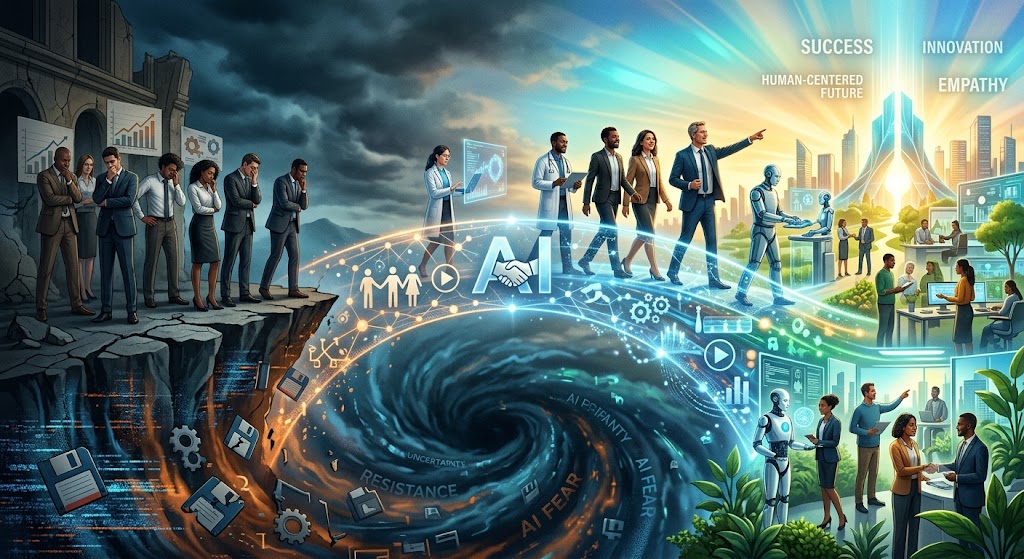
Crossing the Chasm of Fear

AI Soft Landing scenario — Leading People Through the Anxiety of Transformation and AI

LAST UPDATED: June 14, 2026 at 5:48 PM

Crossing the Chasm of Fear

by Braden Kelley and Art Inteligencia


The Hidden Friction in Modern Transformation

Change doesn’t fail because the technology is broken or the strategy is fundamentally flawed; it fails because organizations consistently underestimate the immense gravity of human fear.

We are living in an era of unprecedented, continuous disruption where the rapid, omnipresent rise of Artificial Intelligence (AI) has magnified workplace anxiety to an all-time high. This paradigm shift has fundamentally altered the conversation from standard operational “inertia” to a deep-seated, existential dread regarding professional relevance, personal autonomy, and long-term job security.

To build an agile, future-ready organization, leaders must stop merely trying to “manage” resistance and start actively dismantling fear. True transformation requires moving past rigid, top-down mandates to embrace genuine co-creation, psychological safety, and a commitment to human-centered design.

I. Mapping the Topography of Fear in the AI Era

To successfully guide an organization through a significant shift, leaders must first understand that the friction they encounter is rarely intellectual; it is emotional. In the wake of the generative AI revolution, traditional change management frameworks are proving insufficient precisely because they treat resistance as a logistical hurdle rather than a psychological defense mechanism.

The Shift from Traditional Resistance to Existential Anxiety

Standard change models were built for linear transitions — such as upgrading an ERP system or relocating an office — where the destination is clear and the skill gap is manageable. AI, however, introduces non-linear disruption. Employees are not just resisting a new tool; they are experiencing existential anxiety. The underlying fear is no longer “How do I use this software?” but rather “Does my expertise still matter?”

The Core Drivers of Workplace Fear

This widespread anxiety is fueled by three distinct, interconnected human dynamics:

  • Loss of Competence & Relevance: Professionals who have spent decades perfecting their craft suddenly face systems that can replicate aspects of their output in seconds. The fear of being rendered obsolete overnight leads to defensive behaviors and a reluctance to engage with new platforms.
  • Loss of Autonomy: Employees worry about losing the human element of decision-making. There is a deep-seated anxiety that their daily workflows will be dictated by black-box algorithms, reducing human agency to mere data entry and validation.
  • The “Black Box” Effect: Because advanced AI models operate behind complex neural layers, the lack of transparency breeds immediate distrust. When people do not understand how a technology arrives at a conclusion, they naturally default to worst-case scenario thinking regarding its intent and accuracy.

The Real Cost of Inaction

When leadership fails to recognize and mitigate these fears, the organization pays a heavy cultural tax. This friction rarely manifests as open defiance. Instead, it operations below the surface as:

  • Quiet Quitting: Disengagement driven by the belief that effort is futile in an automated future.
  • Malicious Compliance: Following instructions to the letter while ignoring obvious system errors, effectively letting the new technology fail to prove a point.
  • Organizational Paralysis: A total stall in innovation, as teams become too risk-averse to experiment with new digital capabilities.

II. Redefining the Approach: Moving from Mandates to Co-Creation

The traditional corporate playbook for technology deployment relies heavily on top-down enforcement. Executives select a platform, managers set a deployment date, and training sessions are scheduled to push the workforce into compliance. While this rigid approach might work for static software updates, it completely fractures when applied to cognitive, disruptive technologies like Artificial Intelligence. To cross the chasm of fear, leadership must fundamentally redefine how change is initiated.

The Failure of Top-Down Dictates

When an disruptive technology is thrust upon an organization from above, it triggers the corporate equivalent of an immune system response. Employees perceive the uninvited change as an existential threat to their routines and livelihoods. Pushing mandates down the organizational chart only hardens resistance, forcing anxiety underground and transforming potential advocates into silent saboteurs.

The Power of Participatory Innovation

The alternative to top-down friction is Participatory Innovation — the deliberate practice of shifting the narrative from “This is being done to you” to “You are building this with us.” True ecosystem agility requires flattening the hierarchy of contribution and inviting the entire workforce into the design process. Rather than treating front-line employees as passive recipients of change, organizations must treat them as active co-creators of their own future workflows.

This approach transforms the deployment strategy by:

  • Engaging front-line staff at the inception stage to identify real, daily friction points that AI can genuinely alleviate, rather than forcing technology where it doesn’t fit.
  • Utilizing cross-functional design sessions that break down legacy silos, allowing technical developers and domain experts to build tools in tandem.
  • Establishing iterative feedback loops that give employees a direct hand in shaping, tweaking, and refining the automated systems they are expected to use.

Lowering Resistance Through Shared Ownership

Human beings rarely destroy what they help build. When an employee looks at a newly integrated AI assistant or a redesigned digital workflow and recognizes their own insights, feedback, and domain expertise baked into the final product, the underlying psychological dynamic shifts instantly. The fear of the unknown is replaced by a powerful sense of pride of authorship, transforming potential resistance into proactive, self-sustaining adoption.

III. The Strategic Blueprint: Crossing the Chasm of Fear

Dismantling fear and establishing a culture of participatory innovation requires more than good intentions; it demands an operationalized, human-centered strategy. To successfully cross the chasm of anxiety and achieve meaningful adoption, leaders must execute a deliberate, multi-layered blueprint that prioritizes human experience alongside technical milestone delivery.

Step 1: Cultivate Psychological Safety First

Before introducing a single algorithmic tool, leadership must anchor the organizational culture in psychological safety. If employees believe that experimenting with AI or voicing skepticism will jeopardize their standing, they will retreat into defensive compliance.

  • Create dedicated, judgment-free forums where teams can openly discuss their anxieties, ask “naive” technical questions, and challenge assumptions without fear of retribution.
  • Frame the early stages of AI adoption as an iterative experiment rather than a high-stakes, zero-fault mandate. Normalize failure as a natural, necessary component of learning to collaborate with intelligent systems.

Step 2: Demystify the “Black Box”

Fear thrives in obscurity. When technology is shrouded in complex, dense jargon, employees default to worst-case scenario thinking. Crossing the chasm requires pulling back the curtain on how automated tools function.

  • Provide transparent, accessible education tailored to non-technical users. Demystify the data sources, logic, and operational boundaries of the AI models being deployed.
  • Shift the corporate narrative away from “automation as a replacement” and explicitly reframe it as “augmentation as a partner.” Clearly demonstrate how these tools can absorb repetitive cognitive drudgery, freeing individuals to focus on high-value, uniquely human tasks.

Step 3: Define New “Experience Level Measures” (XLMs)

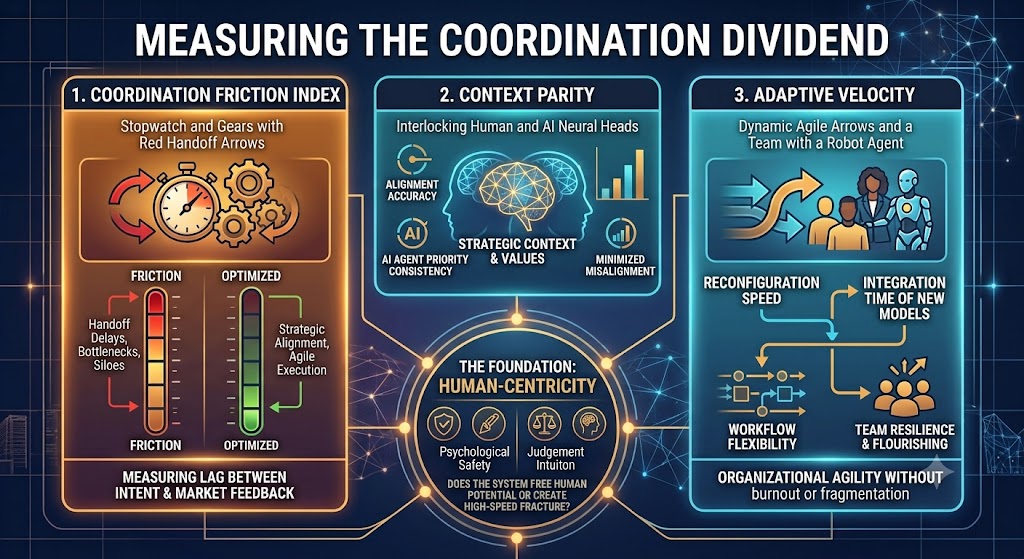
Traditional change management focuses almost exclusively on cold Operational Measures—tracking system uptime, deployment timelines, software licenses, and output volume. To manage the human friction of transformation, organizations must measure what actually matters: the human experience of the transition.

  • Implement Experience Level Measures (XLMs) to actively track sentiment, cognitive friction, and confidence levels across the workforce during the rollout.
  • Establish an Experience Management Office (XMO). This cross-functional entity acts as the empathetic heartbeat of the transformation, monitoring XLMs in real time and intervening with support, tailored training, or process redesign when emotional friction spikes.

Step 4: Re-skilling with Dignity and Equity

True fairness in transformation means ensuring that the rewards of technological advancement are relative to the effort invested by the people keeping the organization running. If employees feel that upskilling only leads to their own displacement or unfair workloads, adoption will fail.

  • Demonstrate a visible, legally backed commitment to the long-term value of your human capital through robust, funded re-skilling pathways that dignify the worker’s career trajectory.
  • Align future organizational recognition, bonuses, and growth opportunities with equitable outcomes: ensure that the harder working individuals who lean into the challenge of adapting and mastering new tools receive the tangible rewards of that shared success.

IV. Activating the Ecosystem: Leveraging Multi-Dimensional Roles

Successfully steering an organization away from anxiety and toward sustainable innovation requires a diverse network of human capabilities. Relying solely on technical project managers or traditional IT leaders to drive adoption is a structural mistake; these roles are designed to optimize systems, not to heal a fractured human culture. To operationalize empathy and scale change, leadership must activate a multi-dimensional ecosystem of specialized roles.

Beyond the Project Manager

While project managers excel at tracking timelines, budgets, and deployment milestones, they rarely possess the specialized tools or bandwidth required to navigate deep-seated psychological friction. Orchestrating a human-centered transformation requires shifting the focus from managing tasks to nurturing human relationships. Organizations must look beyond standard job titles and intentionally cultivate specific archetypes designed to bridge the gap between human anxiety and technological capability.

The Right People in the Right Seats

To dismantle fear at every layer of the enterprise, leaders should identify, empower, and deploy three distinct operational archetypes across the transformation ecosystem:

  • The Evangelist: This role is responsible for crafting the overarching human narrative of the transformation. The Evangelist does not merely pitch the features of a new AI tool; they communicate the authentic “Why” behind the change. By generating real, unforced energy and painting a vivid picture of a more fulfilling, augmented future, they inspire teams to lift their heads above immediate anxieties and look toward the long-term horizon.
  • The Connector: Change rarely scales effectively through top-down mandates; it spreads horizontally through social proof and trusted networks. Connectors are the cross-functional linchpins who span legacy departmental boundaries. They excel at identifying grassroots wins in one pocket of the organization, translating those successes for other teams, and ensuring that insights, feedback, and shared resources flow seamlessly across the entire ecosystem.
  • The Coach: While Evangelists inspire groups and Connectors build bridges, the Coach works on the front lines of human emotion. Operating with high emotional intelligence, Coaches provide one-on-one empathy and guidance to individuals experiencing severe friction. They help employees navigate personal technical skill gaps, address specific career anxieties, and safely transition into new ways of working without losing their professional dignity.

Conclusion: The Ultimate Reward of a Human-Centered Future

Technology provides the raw capability, but human adoption provides the actual organizational value. As we navigate the complex, non-linear disruptions of the Artificial Intelligence era, it is becoming increasingly clear that the true competitive advantage does not belong to the enterprise with the largest budget or the most advanced algorithms. The future belongs to the organizations that can move their people past anxiety and into a state of shared purpose.

Crossing the chasm of fear requires leaders to abandon the outdated illusion of top-down control. By anchoring your transformation strategy in radical transparency, psychological safety, and participatory innovation, you transform a potentially threatening disruption into a collective opportunity. Measuring the journey through human-centric lenses like Experience Level Measures (XLMs) and deploying empathetic archetypes ensures that no one is left behind in the wake of progress.

Ultimately, when you design fear out of your corporate culture, you unlock the ultimate reward: an agile, resilient, and infinitely innovative workforce. By treating employees as respected co-creators of their digital future, you don’t just achieve a successful technology rollout — you build a human-centered ecosystem capable of thriving through any disruption the future brings.

Frequently Asked Questions

Why do traditional change management frameworks fail when introducing AI?
Traditional frameworks treat change as a linear, logistical hurdle focused on training and compliance. AI introduces non-linear disruption that triggers deep psychological and existential anxiety regarding job security, relevance, and loss of human autonomy. Overcoming this requires an empathy-driven, human-centered approach rather than top-down mandates.
What is Participatory Innovation and how does it reduce resistance?
Participatory Innovation is the practice of actively involving front-line employees in co-creating and designing their future workflows instead of pushing changes down from the executive level. Because human beings rarely destroy what they help build, this shared ownership transforms fear of the unknown into pride of authorship.
What are Experience Level Measures (XLMs) and why are they necessary?
While traditional operational measures track cold metrics like system uptime or deployment timelines, Experience Level Measures (XLMs) actively quantify human sentiment, cognitive friction, and adoption confidence. They are critical because technology only provides capability; human adoption is what actually unlocks organizational value.


Operationalize Organizational Empathy

Ready to Bridge the Gap Between Technology and Human Experience?

Technology only provides capability; human adoption creates the value. If you want to move past cold operational metrics and design fear out of your transformation, let’s connect. Get expert guidance on architecting impactful Experience Level Measures (XLMs) or establishing a dedicated Experience Management Office (XMO) tailored to your culture.

EDITOR’S NOTE: This is a visualization of but one possible future. I will be publishing other possible futures as they crystallize in my mind (or as you suggest them for me to explore).

Image credits: Google Gemini

Content Authenticity Statement: The topic area, key elements to focus on, etc. were decisions made by Braden Kelley, with a little help from Google Gemini to clean up the article, add images and create infographics.

Subscribe to Human-Centered Change & Innovation WeeklySign up here to get Human-Centered Change & Innovation Weekly delivered to your inbox every week.

The 3 Day Workweek Transition

Another AI Soft Landing Scenario Exploration

LAST UPDATED: June 7, 2026 at 11:44 AM

The 3 Day Workweek Transition

by Braden Kelley and Art Inteligencia


For decades, technologists have promised that automation would liberate humanity from excessive labor. Instead, each productivity revolution has largely produced the opposite: more output, faster expectations, perpetual connectivity, and escalating burnout.

But artificial intelligence may finally force a different outcome — not because organizations suddenly become altruistic, but because the social, demographic, and economic pressures become impossible to ignore.

We’ve looked at some of these potential outcomes in the previous articles in this series:

So, what if AI doesn’t create a permanent unemployment crisis? What if instead it accelerates the transition from a five-day workweek to a three-day one?

I. The Doom Narrative Assumes Productivity Gains Must Eliminate Workers

A. The Dominant Fear

Most AI displacement narratives operate under a rigid assumption: companies maximize efficiency, workers become redundant, structural unemployment rises, wealth concentrates further, and governments fail to respond. While this scenario is entirely plausible, it is by no means inevitable.

B. The Hidden Assumption

The flaw underneath most AI doom scenarios is the belief that productivity gains must translate directly into workforce reduction. Historically, however, societies have routinely converted massive productivity leaps into reduced labor hours rather than mass unemployment. Consider the precedents:

  • The structural decline from 70-hour industrial workweeks
  • The cultural and legal emergence of the weekend
  • The institutionalization of paid vacations and overtime protections
  • The establishment of standardized parental leave

Key Takeaway: The future of work is a socially negotiated outcome, not a technologically predetermined fate.

II. AI May Create Too Much Productivity for the Existing Work Model

A. The Coming Efficiency Shock

AI systems are moving past simple automation and are beginning to rapidly compress core operational layers: analysis, content generation, software development, coordination, research, customer support, and administrative work. Organizations will soon face a stark realization: the exact same operational output can now be achieved with dramatically fewer labor hours.

B. The Problem Companies Will Face

Initially, standard corporate reflex will drive many firms to pursue predictable paths: reducing headcount, intensifying output expectations, or chasing unlimited scaling. However, this traditional playbook triggers severe second-order consequences that are difficult to manage:

  • Acute workforce burnout and collapsing employee engagement
  • Severe political backlash and regulatory scrutiny
  • A structural drop in consumer demand and widespread social instability

The Economic Paradox: A society cannot sustain mass productivity if its citizens lack the purchasing power, meaning, or time required to participate in civic life and fuel the consumer economy.

III. The Demographic Crisis Changes the Equation

A. Aging Populations

Many advanced economies are already hitting a structural wall, facing an unprecedented convergence of declining birth rates, aging populations, acute caregiving shortages, and shrinking workforce participation. The industrial-era assumption of an endless, expanding supply of labor hours is no longer viable.

B. AI Creates an Opportunity

Rather than triggering mass displacement, AI arrived precisely when societies needed a pressure valve. The technology offers an opportunity to maintain or increase economic output while allowing humans to claw back time for essential, non-automated societal pillars:

  • Family caregiving and intergenerational support
  • Early childhood and continuing education
  • Active community participation and local stewardship
  • Personal health, wellness, and lifelong learning

The Strategic Pivot: The central economic question of the AI era shifts from “How do we maximize labor?” to “How do we maximize societal resilience?”

IV. The Transition Won’t Arrive All At Once

A. The Early Adopters

The shift away from the traditional schedule will begin unevenly across the economic landscape. Knowledge-intensive industries — where cognitive load is high and AI integration is easiest — will serve as the testing ground. These sectors will likely pioneer the transition in waves:

  • Moving first to compressed four-day workweeks
  • Transitioning to explicit 30-hour structural caps
  • Evolving ultimately toward pure, outcome-based work models

B. Competitive Pressure Reverses

In the initial phase of AI adoption, companies will compete fiercely on raw productivity and margin expansion. However, once that baseline efficiency becomes commoditized, the battlefield shifts. Top-tier talent will no longer optimize for salary alone; they will flock to organizations offering time autonomy, flexibility, and protection against cognitive overload. Corporate sustainability, retention, and the human experience will become the ultimate competitive advantages.

C. Governments Eventually Incentivize the Shift

As the workplace changes, public policy will have to evolve to stabilize the labor market. Rather than relying on radical disruptions like Universal Basic Income (UBI) or a post-work utopia, states are more likely to deploy targeted regulatory mechanisms to catalyze labor-sharing structures:

  • Progressive payroll tax reforms favoring reduced-hour employers
  • Tax credits for dedicated caregiving time
  • Direct fiscal incentives for standardizing shortened workweeks
  • Targeted AI productivity taxes to offset workforce transitions

The Operational Reality: This transition is not about a sudden, revolutionary end to labor. It is a structured, gradual redistribution of time designed to keep the economic engine balanced.

V. The Real Transformation Is Cultural

A. Society Equates Work With Worth

The most formidable barrier to a shortened workweek isn’t economic or technological — it is deeply psychological. Modern societies have spent generations conditioning individuals to anchor their identity, social status, and self-worth entirely to their professional productivity. Stripped of the traditional five-day grind, many people face a sudden existential void, simply because they do not know who they are outside the context of their labor.

B. AI Forces a New Question

As machines increasingly master optimization, pattern recognition, and routine cognitive tasks, the definition of valuable human contribution must pivot. Human value will detach from mere administrative throughput and re-center around uniquely human capabilities:

  • Radical creativity and abstract conceptualization
  • Deep relational empathy and emotional intelligence
  • Environmental and organizational stewardship
  • Collaborative meaning-making and proactive community building

The Core Challenge: The ultimate test of the AI era is existential: Can our social institutions redefine human purpose and self-worth before the pace of technological disruption outpaces our psychological adaptation?

VI. The Risks and Tensions

A. Unequal Access and the Digital Divide

The transition to a three-day workweek will not be distributed evenly at the start. Highly optimized knowledge workers, affluent nations, and AI-native industries will likely capture these time dividends first. Meanwhile, frontline, service, and manual labor sectors could face a starkly different reality: intensified labor extraction, gig-economy fragmentation, and deepening economic precarity as legacy structures resist change.

B. The Threat of Hyper-Intensification

There is a distinct danger that organizations will misinterpret efficiency gains. Rather than reducing required hours, many corporate structures will default to demanding vastly more output per hour. If left unchecked, this could transform a potential time dividend into an era of hyper-presenteeism, where the remaining working hours become dense, high-pressure environments that accelerate burnout rather than relieving it.

C. Institutional Inertia and Legacy Leadership

A significant bottleneck to this cultural shift lies within corporate leadership itself. Millions of managers remain culturally and psychologically attached to industrial-era metrics: visibility, seat time, and presenteeism. Overcoming this deeply ingrained management logic will require more than just data; it will likely require a profound generational leadership change across major institutions.

The Operational Risk: Without deliberate guardrails and progressive organizational design, the default trajectory of AI adoption will favor capital concentration over the equitable redistribution of human time.

VII. Why This Represents a “Soft Landing”

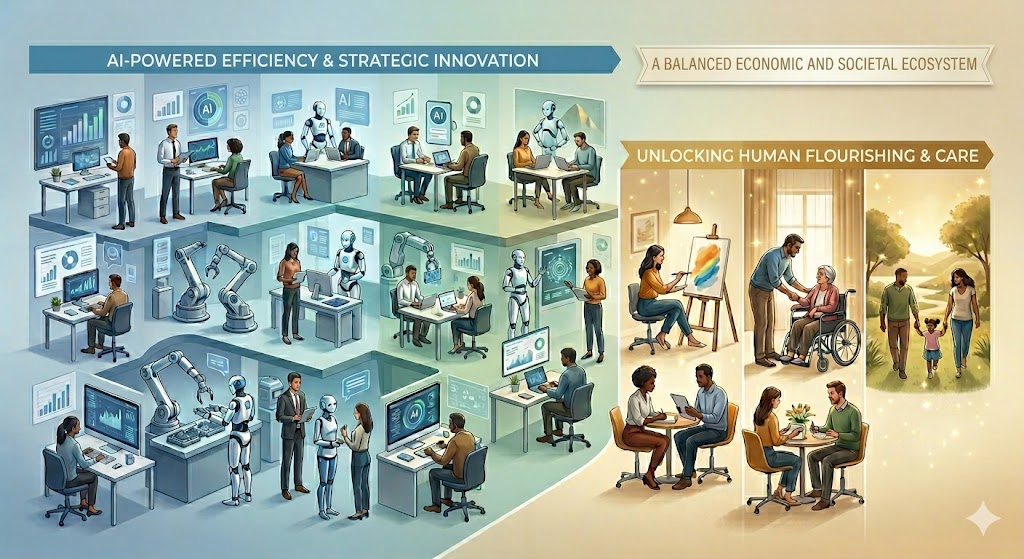
A “soft landing” does not mean that technological disruption completely vanishes or that the transition will be entirely frictionless. Instead, it means that society actively chooses to gradually convert AI-driven productivity into time, structural flexibility, systemic resilience, and human flourishing — rather than allowing 100% of the economic gains to accumulate solely as concentrated capital.

In this balanced future state, the core elements of human drive remain intact:

  • Humans still work and find fulfillment in solving hard problems
  • Professional ambition and merit still exist and are rewarded
  • Innovation and strategic breakthroughs still matter deeply

The fundamental shift is that labor is no longer culturally or economically expected to consume the vast majority of a human life.

The Ultimate Paradigm Shift: AI does not end work. It changes the role work plays in civilization.

Closing Thought

For centuries, human technological progress has been fundamentally measured by a single metric: how much more we could produce. We engineered tools to maximize throughput, optimize supply chains, and squeeze every ounce of efficiency out of the working day.

The artificial intelligence era breaks this linear trajectory. Because the efficiency gains of AI are exponential rather than incremental, they force us to choose between a crisis of human obsolescence or an era of human liberation.

Ultimately, a successful transition means changing our yardstick for civilizational success. The next era of progress should not be measured by how much more humans can produce, but by how much more fully humans are finally allowed to live.

Frequently Asked Questions

1. Will AI actually create a 3-day workweek, or will it just lead to massive layoffs?

While the immediate corporate reflex might be headcount reduction, a purely displacement-driven model creates severe second-order crises, including collapsing consumer demand and intense political backlash. The “Soft Landing” hypothesis argues that social, demographic, and economic pressures—such as an aging global workforce—will force societies to convert AI productivity gains into reduced working hours rather than mass unemployment, mirroring historical shifts like the creation of the 5-day workweek.

2. How does an aging demographic prevent widespread AI unemployment?

Many advanced economies are facing structural labor shortages due to declining birth rates and aging populations. Instead of completely replacing humans, AI-driven automation will act as an economic buffer. It will allow societies to sustain necessary economic output and GDP growth with fewer total human labor hours, freeing up individuals to focus on essential, non-automatable human sectors like family caregiving, community resilience, and continuing education.

3. What is the difference between this transition and Universal Basic Income (UBI)?

Universal Basic Income often implies a “post-work” society where citizens are compensated because their labor is no longer economically viable. The 3-day workweek transition is a model of labor-sharing and time redistribution. In this future, human labor, ambition, and innovation remain central to society, but the productivity dividends of AI are used to purchase time autonomy and reduce cognitive burnout, rather than decoupling humans from work entirely.

EDITOR’S NOTE: This is a visualization of but one possible future. I will be publishing other possible futures as they crystallize in my mind (or as you suggest them for me to explore).

Image credits: Google Gemini

Content Authenticity Statement: The topic area, key elements to focus on, etc. were decisions made by Braden Kelley, with a little help from Google Gemini to clean up the article, add images and create infographics.

Subscribe to Human-Centered Change & Innovation WeeklySign up here to get Human-Centered Change & Innovation Weekly delivered to your inbox every week.

The Coming Tribal Fragmentation

Another AI Soft Landing Scenario Exploration — City-States and the Patchwork Polity

LAST UPDATED: May 31, 2026 at 5:32 PM

The Coming Tribal Fragmentation - Patchwork Policy

by Braden Kelley and Art Inteligencia


When historians look back at the twilight of the Western Roman Empire, they don’t point to a single afternoon when the lights went out. Instead, they chart a long, uneven devolution. As the administrative center in Rome grew too slow, too rigid, and too broke to manage its sprawling frontiers, the legions pulled back. The roads decayed, centralized currency lost its teeth, and power withdrew into localized fiefdoms, fortified towns, and monastic communities.

A similar fracturing is quietly underway today, but the invading force isn’t the Visigoths — it is the sheer velocity of exponential technology.

For years, debates around an “AI Soft Landing” have operated under a flawed assumption: that the transition will be managed by a singular, top-down policy framework. We wait for a grand federal directive — a national UBI, a sweeping regulatory bill, a unified retraining initiative. But the federal apparatus is simply not built for this speed. While centralized governments paralyze themselves with partisan gridlock and bureaucratic inertia, the economic and social fabric of the country is mutating in real-time. To understand the full context of this journey, you can explore the previous hypotheses here:

The center cannot hold, and it won’t. But its failure to manage a uniform landing does not mean a catastrophic crash is inevitable. Instead, we are entering an era of political speciation — a tribal fragmentation highly reminiscent of the Italian peninsula in the 15th century.

When the overarching authority of the Holy Roman Empire and the Papacy fractured, Italy did not slide into a dark age. Instead, it gave rise to a brilliant, chaotic patchwork of city-states. Venice became a maritime commercial powerhouse; Florence established itself as a financial capital fueled by a humanistic cultural Renaissance; Milan thrived on military manufacturing. Each city-state constructed a radically different social contract, economy, and political structure to survive a shifting world.

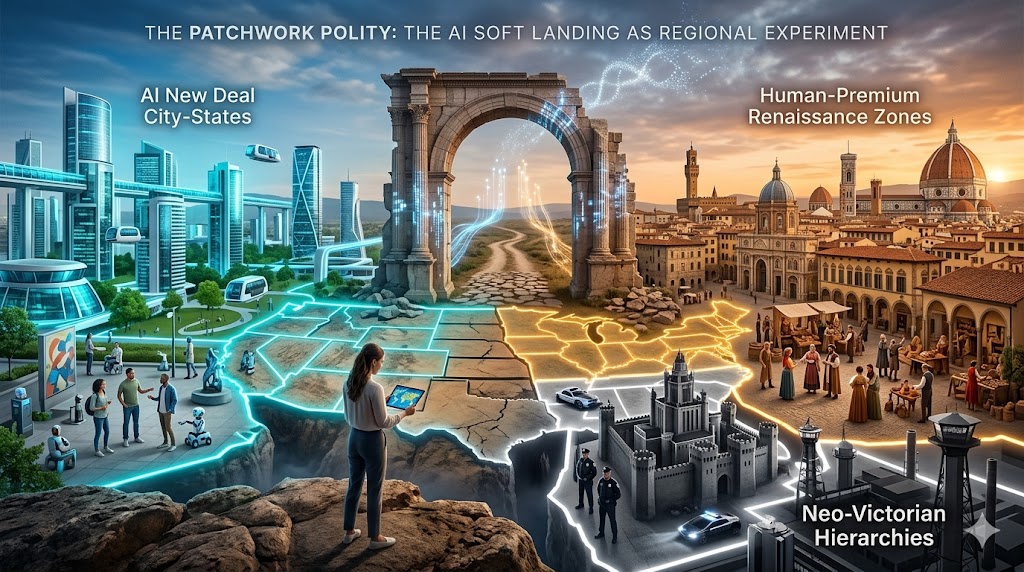
We are on the cusp of the Patchwork Polity. As the nation-state loses its capacity to cushion the disruptions of machine intelligence, power is devolving to cities, regional compacts, and ideological enclaves. The future of the AI Soft Landing will not be a single blanket rolled out from Washington D.C., but a mosaic of localized experiments. Americans, and global citizens at large, are about to sort themselves into communities organized around their preferred relationship with AI, capital, and human labor.

Welcome to the new map.

The Drivers of Speciation: Why the Center Cannot Hold

Biologists use the term speciation to describe the process by which a single evolutionary lineage splits into distinct, isolated species due to environmental pressures. In the context of the AI transition, social and political speciation is driven by a stark reality: exponential technology has completely decoupled from the linear pace of centralized governance.

This geographic and cultural fracturing is accelerated by three primary systemic forces:

1. Regulatory Paralyzation

While Washington debates committees, definitions, and jurisdictional boundaries, AI capabilities double every few months. This structural inertia creates a massive governance vacuum. Because a uniform, federal “cushion” isn’t coming in time, local municipal leaders, governors, and regional coalitions are forced to invent their own survival strategies to handle local labor market displacement.

2. Infrastructure and Capital Decoupling

AI is not distributed equally. It requires immense physical infrastructure: hyper-scale data centers, robust electrical grids, and close proximity to top-tier technical talent. Regions anchored by tech corridors naturally pull away from rural or legacy-industrial areas. This economic divergence creates distinct localized biomes, making a one-size-fits-all economic policy functionally impossible.

3. The Ideological Sorting Effect

The cultural divide over AI is profound. Some view automation as ultimate liberation from toil; others see it as an existential threat to human meaning, dignity, and livelihood. As these views harden, citizens will increasingly migrate — physically and digitally — toward communities that reflect their core values. We will see people vote with their feet, actively choosing social contracts based on how those regions balance or restrict machine labor.

“Just as the breakdown of Roman infrastructure forced medieval populations to cluster around local lords or fortified monasteries for safety, the legislative paralysis of the federal government forces modern communities to cluster around localized economic models for survival.”

When the macro-environment becomes too volatile and the centralized state fails to provide security, safety becomes a local initiative. The result is the fragmentation of a uniform society into distinct, localized ideological tribes.

Mapping the Patchwork Polity: Archetypes of the New Commons

As centralized frameworks dissolve, the political landscape reshapes itself into distinct, specialized ecosystems. If we were to map this new world, we wouldn’t see traditional red and blue states, but rather a complex mosaic of ideological and economic models. Three primary archetypes will dominate this fragmented future, each representing a fundamentally different social contract with machine intelligence.

1. The AI New Deal City-States (The Tech-Communes)

The Vibe: Ultra-modern, highly automated, post-labor optimization.

Centered around existing technology hubs and deep-pocketed metropolitan corridors, these city-states lean entirely into the curve of automation. Rather than fighting algorithmic efficiency, they aggressively tax the productivity gains of hyper-scale AI systems, autonomous infrastructure, and robotic labor to fund a robust local safety net.

In these enclaves, traditional human work is optional. Citizens receive a combination of Universal Basic Income and Universal Basic Services — including free municipal transit, automated healthcare, and civic housing. The social contract is simple: surrender the concept of labor-driven identity in exchange for machine-provided abundance and abundant leisure.

2. The Human-Premium Renaissance Zones (The Neo-Guilds)

The Vibe: Florence in the 1400s — high culture, premium handmade goods, human-to-human connection.

Standing in stark ideological opposition to the tech-communes are the Human-Premium Renaissance zones. These regions — often wealthy cultural capitals, university towns, or scenic coastal enclaves — intentionally legislate machine intelligence out of core human experiences. They enact strict “Human-Premium” labeling laws and certification metrics, ensuring that fields like education, therapy, law, artisanal manufacturing, and hospitality remain strictly the domain of flesh and blood.

Like the craft guilds of medieval Europe, these zones protect human mastery. While living here is highly expensive due to the lack of automated efficiency, the economy thrives on a premium marketplace where wealthy outsiders pay a massive surplus for the luxury of authentic, unfiltered human interaction and craftsmanship.

3. The Neo-Victorian Hierarchies (The Corporate Enclaves)

The Vibe: Strict stratification, private governance, efficiency above equity.

Where public local governments fail entirely to manage displacement, massive technology conglomerates and private equity cartels step in to fill the void. These are privatized corporate enclaves — gated geographic zones entirely owned, policed, and optimized by proprietary AI networks.

For the non-elite citizens living within these borders, the social contract mirrors nineteenth-century company towns. Individuals trade their behavioral data, sovereign privacy, and continuous gig-labor in exchange for access to privately managed infrastructure, drone-enforced security, and basic corporate-subsidized sustenance. Wealth is strictly bifurcated between the algorithmic asset owners and the vast underclass of human edge-case handlers who keep the machines fed.

“Just as fifteenth-century Venice, Florence, and Milan developed entirely incompatible political structures to navigate the shifts of their era, these three modern archetypes will create wildly divergent definitions of what it means to live a successful human life.”

The Dynamics of the Patchwork: How They Coexist and Clash

A map fractured into radical ideological experiments cannot remain static. Just as the Italian city-states were locked in a perpetual dance of shifting alliances, economic espionage, and low-grade warfare, the archetypes of the Patchwork Polity do not exist in isolation. They are deeply codependent, inherently suspicious of one another, and constantly forced to navigate the friction of their incompatible social structures.

This macro-relationship is defined by three main geopolitical and economic pressure points:

1. Data Tariffs and Algorithmic Friction

Trade between these zones looks nothing like traditional commerce. When a Human-Premium Zone trades with an AI New Deal City-State, the friction is cultural and technical. The Neo-Guilds protect their local markets by slapping massive “compute tariffs” on imported goods or services generated by automated systems. Conversely, the Tech-Communes demand unfettered access to behavioral data streams from anyone wishing to plug into their hyper-efficient logistics networks. Economic warfare is no longer fought over physical borders, but over data privacy boundaries and algorithmic access.

2. The Border Paradox and Refugee Flows

Borders in the Patchwork Polity are strictly monitored, yet highly porous to specific human talent. We are witnessing a unique, modern brain drain:

  • Artists, educators, and artisans flee the hyper-automated Tech-Communes, seeking asylum and high wages in the Human-Premium Renaissance zones where their humanity is valued as an economic asset.
  • Displaced gig-workers and data-serfs trapped in the Neo-Victorian Hierarchies risk everything to cross into AI New Deal territories, searching for the safety net of a machine-funded basic income.

Managing these highly specialized refugee flows requires a complex web of immigration protocols, digital identity tracking, and ideological vetting.

3. The Condottieri of the Digital Age

In Renaissance Italy, city-states relied on condottieri — highly professional, mercenary military captains who sold their strategic skills to the highest bidder. In the Patchwork Polity, we see the rise of the digital condottieri: elite squads of prompt engineers, cybersecurity syndicates, data scientists, and systems architects.

These highly mobile cognitive specialists hold no allegiance to any single ideology or municipality. They sell their optimization services to the highest bidding corporate enclaves, build the automated defensive networks for the tech-communes, or help human-premium zones develop sophisticated firewalls to keep out illicit, unverified AI tools. They are the true fluid elite of a fragmented world.

“Peace in this fragmented landscape is never permanent; it is a dynamic equilibrium maintained by mutual economic dependence and a mutual recognition that no single zone can entirely destroy the others without destroying the supply chains that keep itself alive.”

This isn’t a story of a world completely breaking down — it is a story of a world breaking apart into hyper-focused specialized zones. The true test of the patchwork landing is not whether these regions can learn to love each other, but whether their structural codependency can prevent localized friction from escalating into systemic collapse.

Conclusion: Embracing the Mosaic

When the Western Roman Empire dissolved into a fragmented tapestry of localized rule, it felt to those living through it like the end of civilization. But viewed through the long lens of history, it was simply the messy, chaotic birth of a new political and economic landscape. The decay of centralized authority gave way to localized experiments that eventually birthed the modern world.

We must apply that same historical perspective to the AI transition. The dream of a uniform, centrally managed “AI Soft Landing” orchestrated by federal policy is dead. The sheer velocity of machine intelligence has outrun the slow, linear machinery of national governance. But as the macro-structure fractures, we are discovering that the absence of a singular nationwide cushion does not guarantee a nationwide crash.

Instead, the landing is happening in pieces. It is a mosaic of micro-landings, some softer and more elegant than others. The future belongs to the agile, the local, and the community-driven. Survival in this new era requires a profound shift in mindset: we must stop waiting for a grand national compromise that will never come, and instead start focusing on the local social contracts we can actively shape.

The Core Truth of the Patchwork Polity:

You can no longer choose whether or not the AI revolution happens. But as the nation-state devalues and power devolves, you will increasingly get to choose your tribe. You will choose whether you want to live in a world of machine-funded leisure, human-centric craftsmanship, or hyper-efficient corporate optimization.

The political map of the mid-twenty-first century is being redrawn before our eyes, shifting away from massive, contiguous geopolitical blocs and toward a vibrant, volatile, and highly competitive patchwork. It will be chaotic, it will be unequal, and it will require unprecedented levels of regional agility. But it will also be a period of immense social creativity.

The centralized state is giving way to the mosaic. It is time to find your place on the map — or start building the community that can chart its own way down.

Frequently Asked Questions

Q: Will the federal government have any role left in a fragmented “Patchwork Polity”?

A: Yes, but its role will shrink to structural baseline management. The federal government will likely focus on basic national defense, broad interstate commerce guardrails, and managing the fundamental infrastructure layers (like the national power grid). Direct economic cushions, labor laws, and social contracts will be almost entirely driven by local city-states and regional compacts.

Q: How can a Human-Premium Renaissance zone survive economically against hyper-efficient AI cities?

A: By treating scarcity as a luxury asset. Just as fine art, handmade mechanical watches, and live musical performances command immense price premiums today, these zones thrive on the deliberate lack of automation. They export highly valued human-certified expertise and luxury goods, pulling in massive capital from wealthy citizens in automated zones who are starved for authentic human connection.

Q: What is the biggest risk of this geographic and political sorting?

A: Extreme friction and inequality. If people sort themselves strictly by their philosophical and economic relationship with AI, we risk creating regions that cannot communicate or trade smoothly with one another. This deepens the “Cognitive Divide,” making economic and physical mobility incredibly difficult for citizens trying to move between incompatible regional ecosystems.


EDITOR’S NOTE: This is a visualization of but one possible future. I will be publishing other possible futures as they crystallize in my mind (or as you suggest them for me to explore).

Image credits: Google Gemini

Content Authenticity Statement: The topic area, key elements to focus on, etc. were decisions made by Braden Kelley, with a little help from Google Gemini to clean up the article, add images and create infographics.

Subscribe to Human-Centered Change & Innovation WeeklySign up here to get Human-Centered Change & Innovation Weekly delivered to your inbox every week.
Founding an American AI Sovereign Wealth Fund

Another AI Soft Landing Scenario Exploration — The Digital Commons Dividend

LAST UPDATED: May 23, 2026 at 10:32 PM

Founding an American AI Sovereign Wealth Fund

by Braden Kelley and Art Inteligencia


As we navigate the profound shifts brought about by generative and agentic AI, the question is no longer if the world will change, but how we will land. This article is the sixth installment in our AI Soft Landing series — a collection of hypotheses exploring how humanity and industry might transition into an AI-augmented future without systemic collapse.To understand the full context of this journey, you can explore the previous hypotheses here:

I. Introduction: The Silent Enclosure of the Digital Commons

The modern internet was built as a decentralized, public town square — a collective monument to human knowledge, cultural expression, and daily creativity. For decades, billions of individuals contributed their thoughts, art, code, and conversations under the shared assumption that they were participating in a living global community. Today, however, this vast digital landscape is being quietly enclosed and mined as the ultimate raw material for proprietary corporate infrastructure.

Large Language Models and generative AI systems do not exist in a vacuum. They are entirely dependent on the cumulative output of humanity; they cannot think, synthesize, or generate without the foundation of our collective history. As tech enterprises rapidly financialize this knowledge, we face a fundamental imbalance: the data is ours, but the immense financial dividend is theirs alone.

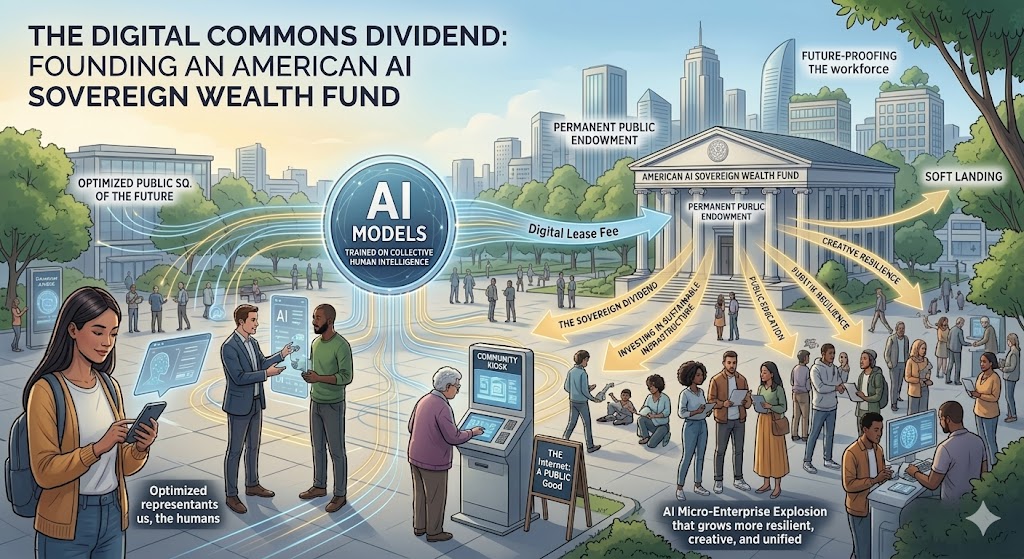
Rather than chasing this paradigm with endless, stagnant copyright litigation or choking progress with reactive, heavy-handed regulation, America needs a proactive framework of economic experience design. We must establish an American AI Sovereign Wealth Fund. By shifting the model from unchecked data extraction to a structured public lease agreement, we can transform corporate data consumption into a permanent public endowment that ensures human innovation and economic stability go hand in hand.

II. The Shared Foundation: Why the Internet is a Public Good

To understand the necessity of an AI Sovereign Wealth Fund, we must first reframe how we view the digital ecosystem. The internet is not a corporate invention; it is a foundational public good. The underlying infrastructure — from the early architecture of DARPA to foundational web protocols — was built on public funding, institutional research, and open-source collaboration. It was designed to belong to everyone and no one simultaneously.

The true value of this infrastructure, however, lies in what humanity built on top of it. Every blog post, forum reply, public photograph, open-source line of code, and digital article is a distinct product of human labor, creativity, and lived experience. When AI companies scrape the web to train their neural networks, they are not merely indexing information like a search engine; they are consuming and absorbing the collective cultural inheritance of humanity to create highly profitable, commercial alternatives to human labor.

In any other sector, the extraction of valuable resources from a shared public space requires a clear financial framework. When a mining or drilling company extracts minerals or oil from public land, they pay lease fees and royalties back to the state to compensate the public. The digital world should be no different. AI enterprises are operating in a “free extraction zone” that belongs to the public. If they wish to use the public commons to fuel their corporate innovations, they must pay a digital lease fee to the public who built it.

Securing the Digital Commons

III. The Mechanism: From “Data Scraping” to “Model Leasing”

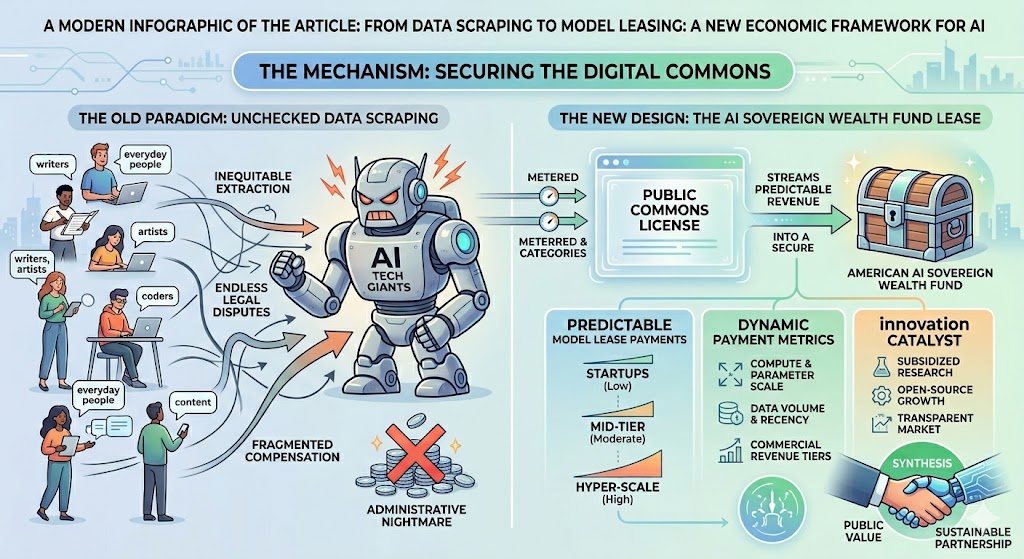
Trying to protect the digital commons by paying individual users micro-cents for every tweet, review, or article is an administrative nightmare and a functional dead end. The value of human data does not reside in a single isolated post; it emerges from the collective synthesis of the entire public web. Therefore, the regulatory mechanism must treat the public web as a unified national asset, shifting the paradigm from transactional data purchasing to a systemic “Model Leasing” framework.

Under this design, any enterprise operating commercial AI models within the United States would be required to secure a Public Commons License. Instead of a one-time purchase of static datasets, this license functions as an ongoing lease. The lease payments would be structured dynamically to mirror the scale of the extraction, scaling across clear, predictable metrics:

  • Compute and Parameter Scale: Higher baseline fees for frontier models requiring massive infrastructure and massive ingestion footprints.
  • Data Volume and Recency: Fees tied to the continuous scraping and integration of real-time human data feeds.
  • Commercial Revenue Tiers: A sliding scale ensuring that monetized enterprise AI platforms contribute proportionally to their commercial success.

Crucially, this framework is designed to foster innovation rather than stifle it. By creating a transparent, predictable cost structure, we can offer low-cost or subsidized lease tiers for academic research, open-source developers, and early-stage startups. The heaviest financial responsibility will naturally rest on the hyper-scale tech giants who are driving the most aggressive commercialization of human output, turning a chaotic regulatory battlefield into a structured, reliable market mechanism.

Designing the American AI Sovereign Wealth Fund

IV. Designing the American AI Sovereign Wealth Fund

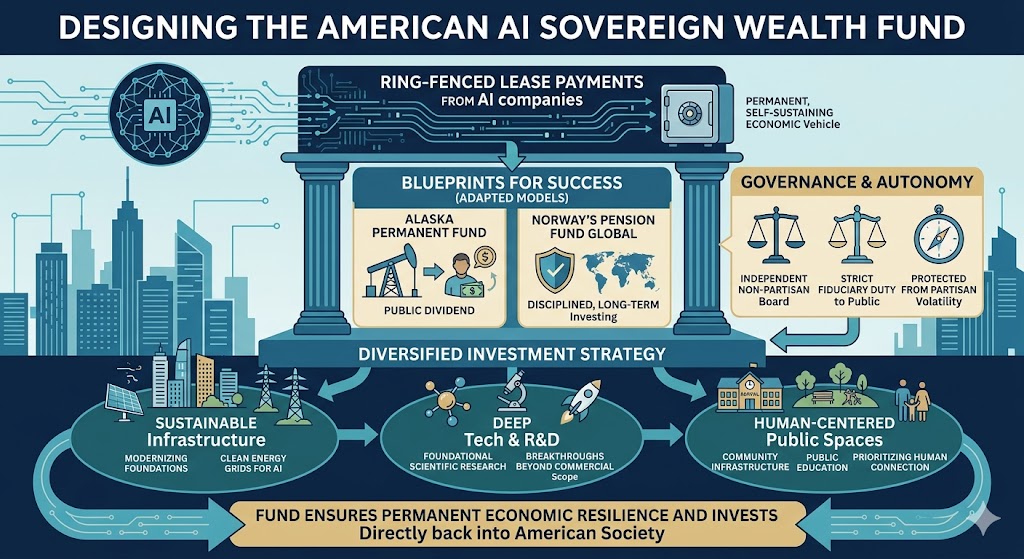
An innovative revenue mechanism is only as effective as the architecture built to manage it. The digital lease payments collected from AI operators cannot simply disappear into the general federal budget to patch short-term deficits. Instead, they must be funneled directly into a dedicated, ring-fenced economic vehicle: the American AI Sovereign Wealth Fund. This fund will transform the temporary, fast-moving revenues of the technology boom into a permanent, self-sustaining financial legacy for all citizens.

While the United States has never established a national-level wealth fund, we have highly successful, battle-tested blueprints to draw from. The Alaska Permanent Fund has successfully turned non-renewable oil wealth into a continuous public dividend for decades, while Norway’s Government Pension Fund Global demonstrates how disciplined, long-term global investing can secure the financial future of an entire nation. The American AI Sovereign Wealth Fund will adapt these principles for the intangible, fast-growing digital asset class.

To protect the fund from political volatility and short-term legislative maneuvering, it must be established as an autonomous institution. It will be managed by an independent, non-partisan board of professionals with a strict fiduciary duty to the American public. The fund’s investment strategy will be diversified across a broad spectrum of resilient assets, including:

  • Sustainable Infrastructure: Directing capital into modernizing the physical foundations of the country, including clean energy grids capable of supporting next-generation computing.
  • Deep Tech and R&D: Investing in foundational scientific research and breakthroughs that lie outside the immediate commercial scope of venture capital.
  • Human-Centered Public Spaces: Funding physical community infrastructure, public education, and parks to ensure that a digital-first economy still prioritizes tangible human connection.

By building a robust, independent investment engine, the fund ensures that the immense wealth generated by AI efficiency is compound-invested directly back into the fabric of American society, establishing a foundation of permanent economic resilience.

V. The Human-Centered Dividend: Navigating the Great American Contraction

As artificial intelligence scales, it will fundamentally reorder the relationship between capital, productivity, and human labor. We are entering an era of unprecedented efficiency, yet this transition brings the distinct challenge of structural labor shifts — a phase of economic recalibration where traditional employment models will face intense pressure. In this environment, corporate productivity will skyrocket, but the traditional mechanism for distributing that wealth through 40-hour workweeks will become heavily disrupted.

The American AI Sovereign Wealth Fund is designed to serve as the critical macroeconomic cushion for this transition. The financial returns generated by the fund will be distributed directly to citizens as a Sovereign Dividend. It is vital to frame this payout correctly: this is not a welfare program or a government handout. It is a rightful return on investment for the citizen-creators whose collective human intelligence, data, and cultural history built the foundational engine of the entire AI economy. It treats the American public as shareholders in the technological future they co-created.

By providing a reliable, baseline dividend, we can orchestrate a “soft landing” that prevents widespread economic precarity. Instead of leaving individuals stranded by automation, this human-centered dividend provides the financial security needed to spark an explosion of grass-roots entrepreneurship. When citizens are unburdened from survival-level economic anxiety, they are empowered to take risks — funding local services, launching specialized consultancies, and building micro-enterprises. This safety net transforms a threat of labor contraction into an expansion of human creativity, allowing individuals to focus on what they do best: innovate, care for one another, and design unique human experiences.

A New Social Contract for the Synthesized Age

VI. Conclusion: A New Social Contract for the Synthesized Age

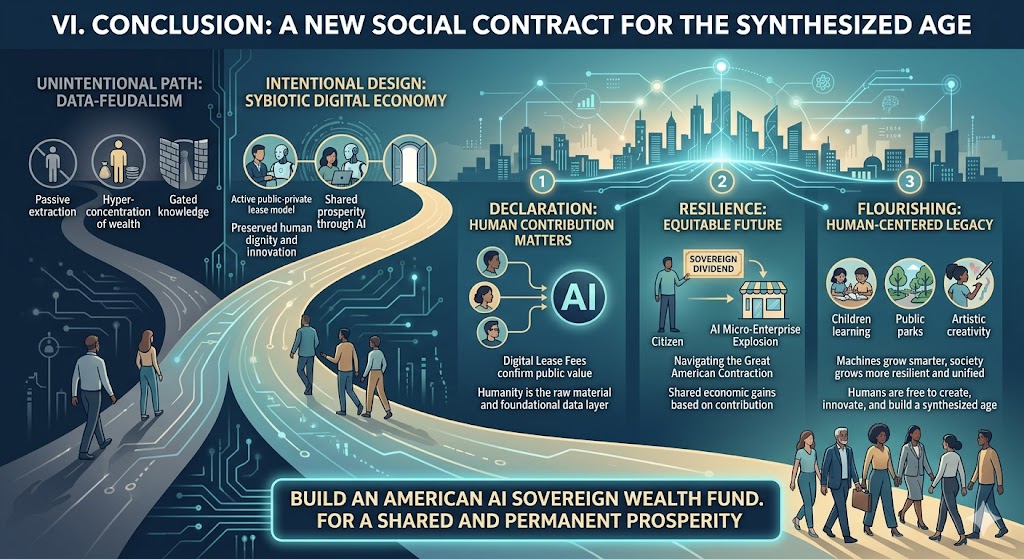
We stand at a critical crossroads in the evolution of the digital economy. The rapid maturation of artificial intelligence has made it clear that the passive laissez-faire approach to data extraction is no longer sustainable. We can either slide quietly into a hyper-concentrated system of data-feudalism — where a handful of corporate entities gatekeep and monetize the synthesized sum of human knowledge — or we can intentionally design a system where technological progress directly funds human flourishing.

The creation of an American AI Sovereign Wealth Fund funded by model lease agreements is not a radical departure from American economic tradition; it is its logical evolution. It recognizes that innovation thrives when public assets are respected, valued, and paid for. By establishing this fund, we declare that human contribution is foundational, permanent, and worthy of equitable compensation.

As our machines grow smarter and more capable, our primary focus must remain on ensuring our society grows more resilient, unified, and creatively alive. By building this new macroeconomic bridge, we can navigate the structural shifts of the coming decades with confidence, transforming the immense promise of the AI era into a lasting, human-centered legacy that lifts up every single citizen who helped build it.

Frequently Asked Questions

1. Why should AI companies pay to use public internet data?

The modern internet is a public good built on government-funded infrastructure and decades of collective human contribution. AI models cannot generate value without training on the billions of articles, photos, and open-source code blocks created by real people. Just as a mining company pays a lease to extract minerals from public land, AI companies should pay a digital lease fee to extract value from the public digital commons.

2. Will a “Model Leasing” framework crush tech innovation?

No. The lease framework is designed to be tiered and predictable, specifically protecting early-stage startups and open-source developers. Subsidized or low-cost license tiers will ensure that academic research and grassroots innovation thrive, while the heaviest financial responsibility falls on hyper-scale tech giants who are generating massive commercial revenues directly from human data extraction.

3. How is the Sovereign Dividend different from traditional welfare?

The Sovereign Dividend is not a handout; it is a rightful return on investment. Because every citizen’s collective data and cultural history formed the foundational training material for AI, the American public acts as the foundational shareholders of the AI economy. Payouts from the fund are corporate-backed dividends reflecting the value of what humanity co-created.


EDITOR’S NOTE: This is a visualization of but one possible future. I will be publishing other possible futures as they crystallize in my mind (or as you suggest them for me to explore).

Image credits: Google Gemini

Content Authenticity Statement: The topic area, key elements to focus on, etc. were decisions made by Braden Kelley, with a little help from Google Gemini to clean up the article, add images and create infographics.

Subscribe to Human-Centered Change & Innovation WeeklySign up here to get Human-Centered Change & Innovation Weekly delivered to your inbox every week.

Cognitive Enhancement and the Augmented Worker

Another AI Soft Landing Scenario Exploration — The Neurological Frontier

LAST UPDATED: May 17, 2026 at 7:02 PM

Cognitive Enhancement and the Augmented Worker

by Braden Kelley and Art Inteligencia


As we navigate the profound shifts brought about by generative and agentic AI, the question is no longer if the world will change, but how we will land. This article is the fifth installment in our AI Soft Landing series — a collection of hypotheses exploring how humanity and industry might transition into an AI-augmented future without systemic collapse.To understand the full context of this journey, you can explore the previous hypotheses here:

Beyond the Automated Horizon

For years, the mainstream narrative surrounding the rise of artificial intelligence has been trapped in a stark, binary choice: either humanity must race against the machine to protect traditional jobs, or we must retreat entirely to purely manual, artisanal, or civic labor. This false dichotomy creates an atmosphere of anxiety, framing AI as an inevitable displacement engine. However, there is a much more compelling, optimistic, and techno-progressive path forward — one that doesn’t replace the worker, but upgrades them.

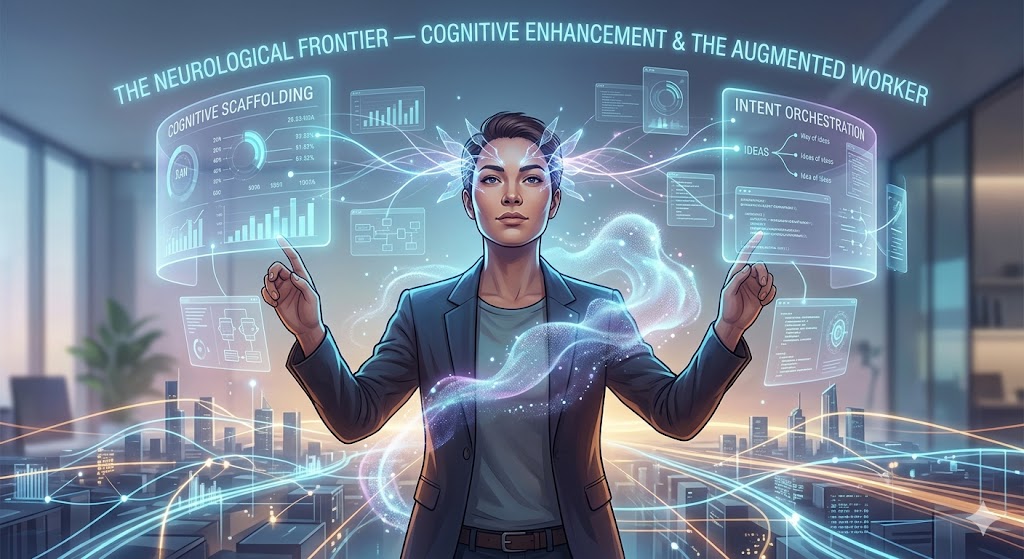
We are on the cusp of an incremental “Cyborg Transition.” Rather than the dramatic, invasive sci-fi brain chips often popularized in media, this evolution is happening softly and ubiquitously. It is a gradual merging with AI tools through augmented cognition, extended memory, and real-time decision-making support. Just as smartphones transitioned from luxury gadgets to indispensable external brains that we feel lost without, advanced AI agents are becoming a normalized extension of our intellectual identity.

As each generation grows up with deeper, more fluid AI integration, the definition of “human labor” will expand rather than contract. The economy doesn’t lose human workers; it amplifies their potential. Value is shifting rapidly from the speed of task execution to the depth of intent orchestration, empathy, and strategic conceptualization.

Yet, this thrilling neurological frontier brings urgent socioeconomic challenges. As we design this future, we must confront pointed questions about accessibility: Who can afford premium cognitive augmentation, and who risks being left behind as an unaugmented underclass? The future of work is not about automation replacing humanity — it is about intentionally designing a human-centered transition that elevates us all.

Human AI Symbiosis Infographic

I. The Human-AI Symbiosis: Anatomy of the Augmented Worker

The relationship between humans and technology is shifting from a utilitarian model of “user and tool” to a deeply integrated, symbiotic partnership. The augmented worker does not merely operate AI; they think alongside it. This symbiosis fundamentally alters how cognitive tasks are processed, distributed, and executed in the modern enterprise.

Cognitive Scaffolding and Memory Extension

Generative AI and advanced LLMs are evolving far beyond reactive search engines or drafting assistants. They now function as cognitive scaffolding — external structures that support and expand human working memory. By offloading the heavy lifting of data retrieval, synthesis, and administrative tracking to ambient AI, workers dramatically reduce their mental load. This allows the human brain to bypass structural cognitive bottlenecks and maintain focus on higher-order problem solving.

Continuous Contextual Awareness

The true power of the augmented worker lies in real-time, proactive support. Instead of a worker pausing their workflow to query a database, ambient AI companions continuously listen, observe, and analyze the operational environment. Whether an employee is in a customer meeting, a design sprint, or a complex engineering review, the AI proactively feeds them historical context, relevant cross-functional data, and predictive outcomes. Decision-making is no longer limited by what a single human can recall in the moment.

Redefining Human Labor: Intent Orchestration

As task execution becomes increasingly automated, the baseline definition of valuable human labor is undergoing a radical expansion. The economic value of a worker is shifting from how fast they can build to how deeply they can conceptualize. Human labor is becoming a discipline of intent orchestration. In this new paradigm, the most valuable skills are human-centered: empathy, strategic vision, ethical judgment, and the ability to ask the right questions to direct autonomous systems toward meaningful innovation.

Incremental Cyborg Infographic

II. The Incremental Cyborg: How Augmentation Becomes Normalized

Society often envisions the integration of human and machine as a sudden, disruptive event — a dystopian leap marked by invasive cybernetics. In reality, the transition is smooth, behavioral, and highly incremental. We do not notice ourselves becoming cyborgs because the technology adapts to our natural behaviors, slowly weaving itself into the fabric of daily life until it becomes entirely invisible.

The Generational Shift in Technological Adaptation

Every generation establishes a new baseline for what feels “natural.” Digital natives seamlessly adapted to glass touchscreens, shifting human-computer interaction from rigid commands to fluid gestures. The next generation of workers will natively interface with multi-modal AI agents from early childhood. For these individuals, a software tool that does not anticipate their needs, remember their preferences, or actively collaborate with them will feel as broken and archaic as a rotary phone feels to a teenager today.

The Frictionless Interface

The acceleration of this transition is directly tied to the elimination of user-interface friction. The barrier between human thought and digital execution is shrinking rapidly. We are moving away from keyboard-and-mouse dependencies toward high-bandwidth, natural modalities: conversational voice, subtle eye-tracking, contextual gesture control, and predictive text. As these interfaces become completely frictionless, the delay between conceptualizing an idea and seeing it manifested by an AI tool drops to near zero.

The Psychology of Integration: Expanding Intellectual Identity

The final stage of normalization is psychological. When a tool responds instantly, holds perfect recall of your entire career’s output, and matches your cognitive rhythm, the human brain naturally begins to treat it as an extension of the self. This is the phenomenon of extended cognition. Workers will no longer view AI as external enterprise software they have to log into; instead, they will view it as a peripheral lobe of their own brain. The line where the human mind ends and the digital asset begins will blur, permanently expanding our sense of personal intellectual identity.

Augmented Workplace Infographic

III. Innovation and Experience Design in the Augmented Workplace

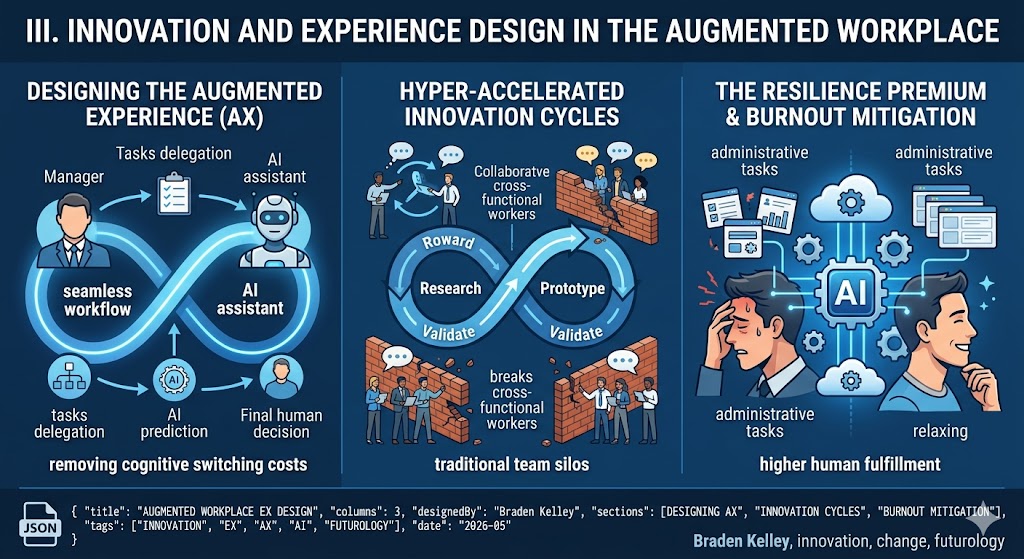
As the capabilities of the workforce expand, the frameworks we use to design business processes and employee experiences must evolve in tandem. Managing an augmented workforce requires a radical shift from traditional human resource management to intentional Experience Design. Organizations must build environments that don’t just utilize tools for efficiency, but actively harmonize human creativity with machine intelligence.

Designing the Augmented Experience (AX)

Traditional User Experience (UX) and User Interface (UI) design paradigms are no longer sufficient. When humans and AI operate in a continuous, bidirectional feedback loop, we must design for the Augmented Experience (AX). AX design focuses on creating non-disruptive, ambient workflows where the AI transitions smoothly between passive observer, active assistant, and autonomous executor. The goal is to eliminate cognitive switching costs, ensuring that software feels like a natural collaborator rather than a demanding administrative chore.

Hyper-Accelerated Innovation Cycles

The democratization of specialized, cross-functional knowledge through AI removes the traditional bottlenecks of organizational silos. An augmented worker in marketing can instantly understand technical architectural constraints; a developer can instantly run predictive financial models on their code. By collapsing the time required to research, prototype, and validate ideas, organizations can transition from rigid, linear development models to continuous, hyper-accelerated innovation cycles. The distance between a strategic spark and market reality shrinks from months to hours.

The Resilience Premium and Burnout Mitigation

Historically, technological revolutions have been used to squeeze more volume out of the worker, leading to chronic stress and burnout. A human-centered approach to augmentation reverses this trend, aiming for a Resilience Premium. By offloading low-value administrative friction, repetitive reporting, and data sorting to AI, we free up human cognitive capacity. Workers can redirect their energy toward high-empathy, high-creativity tasks — the exact areas where human fulfillment is highest — resulting in both a more innovative enterprise and a healthier, more resilient workforce.

Dark Side of the Frontier Infographic

IV. The Dark Side of the Frontier: The Unaugmented Underclass

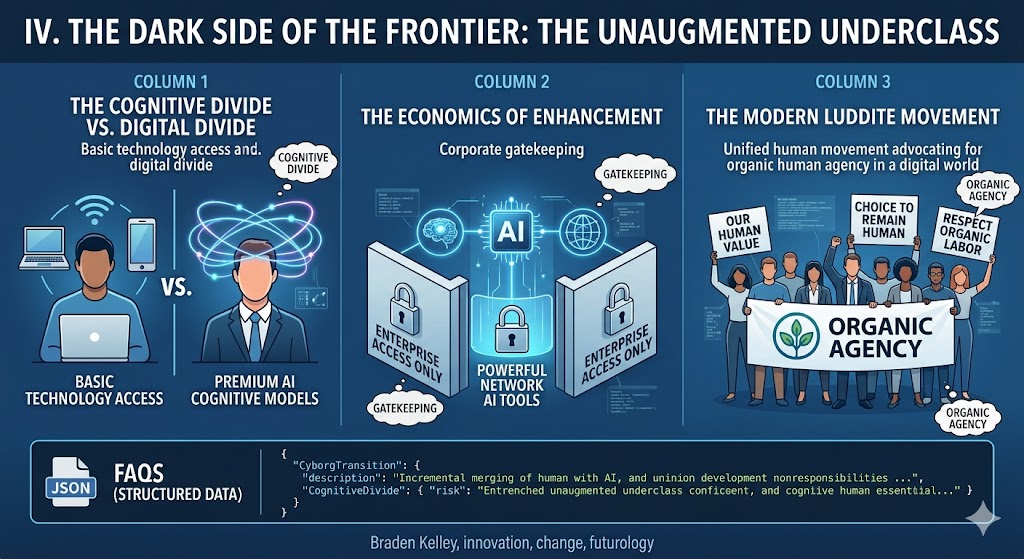
While the potential for human elevation is immense, a techno-progressive future is never guaranteed to be an equitable one. As cognitive augmentation becomes the primary driver of economic value, the traditional gaps in society will mutate. We must look past the optimistic horizon to confront a stark societal risk: the creation of a deeply entrenched, structurally excluded unaugmented underclass.

The Cognitive Divide vs. The Digital Divide

For decades, policymakers and technologists have fought to close the “digital divide” — the gap between those with access to internet-connected hardware and those without. The neurological frontier introduces a far more insidious challenge: the Cognitive Divide. This is not a matter of whether a worker has a screen, but whether they have access to premium, high-tier cognitive models that actively shape thought, strategy, and problem-solving velocity. When the barrier to entry for high-paying roles is the quality of your digital mind-extension, inequality becomes deeply intellectual.

The Economics of Enhancement: Corporate Gatekeeping

Advanced, specialized AI ecosystems require massive computational power and proprietary datasets, meaning they will largely be controlled by elite tech conglomerates and well-funded enterprises. If these cognitive tools remain locked behind corporate paywalls or exorbitant personal subscription models, then only the wealthiest individuals and organizations will afford the “upgrade.” This threatens to create a feedback loop where the augmented class accumulates wealth and influence at a velocity that the unaugmented cannot mathematically match, cementing a new form of economic caste system.

The Modern Luddite Movement and Cultural Backlash

We must also anticipate a profound cultural and psychological pushback. Not everyone will want to integrate with ambient AI systems, and many will view the blurring lines of human identity as a fundamental threat to human dignity. This resistance will likely fuel a modern Luddite movement — not driven by an ignorant fear of technology, but by a conscious desire to preserve unaugmented human agency. Society will face severe fragmentation as companies face an identity crisis: how to manage, value, and respect the labor of workers who choose to remain “organically human” in an ecosystem designed entirely for the augmented.

Conclusion: Designing a Human-Centered Autonomous Future

The neurological frontier is not a distant science fiction scenario; it is an active transition unfolding across the global workforce today. By moving past the paralyzing fear of automation and embracing the potential of incremental cyborg symbiosis, we open the door to a massive expansion of human creativity, capability, and fulfillment. The economy does not have to lose its workers to AI — it can choose to lift them up.

A Call to Action for Innovation and Change Leaders

This optimistic future will not happen by accident. Business leaders, change agents, and experience designers cannot treat AI merely as a tool for cutting costs and optimizing headcounts. We must actively architect organizational cultures and technical ecosystems that prioritize human agency. True innovation lies in designing the Augmented Experience responsibly, ensuring that technology serves as a platform for human elevation rather than a mechanism for worker exploitation or burnout.

The Ultimate Metric of Progress

As we navigate this profound shift, the ultimate benchmark of our success must change. We can no longer measure progress solely by the efficiency of our algorithms or the number of tasks automated away. Instead, we must evaluate our organizations by a human-centered standard: How much more capable, creative, and fulfilled are the people within our ecosystem? The Resilience Premium must become a core metric of the modern enterprise.

We are not being replaced by artificial intelligence; we are being challenged by it. We are being pushed to shed the routine, administrative friction of our daily work and step into roles defined by deep empathy, bold imagination, and strategic intent orchestration. The frontier of human labor is expanding — it is now our responsibility to design an equitable, inspiring transition that leaves no worker behind.

Frequently Asked Questions

What is the “Cyborg Transition” in the context of the modern workforce?

The Cyborg Transition refers to the incremental, behavioral merging of human workers with AI tools to enhance cognitive capabilities. Instead of relying on invasive sci-fi brain chips, this transition happens softly through everyday software, ambient AI companions, and natural interfaces (voice, gesture) that expand human memory, context, and decision-making velocity until the tool feels like a natural extension of the worker’s intellectual identity.

How does cognitive augmentation change the definition of human labor?

Cognitive augmentation expands human labor rather than contracting it. As AI automates routine task execution and administrative friction, the value of human work shifts to “intent orchestration.” Human labor is redefined around uniquely human-centered skills: empathy, strategic conceptualization, ethical judgment, and the creative vision required to direct autonomous systems toward meaningful innovation.

What is the “Cognitive Divide” and why is it a risk?

The Cognitive Divide is the socio-economic gap between workers who have access to premium, high-tier cognitive AI tools and those who do not. Unlike the traditional digital divide (which focuses on basic hardware/internet access), the Cognitive Divide threatens to create an “unaugmented underclass” structurally locked out of high-paying roles because they cannot afford the digital mind-extensions controlled by elite corporate gatekeepers.


EDITOR’S NOTE: This is a visualization of but one possible future. I will be publishing other possible futures as they crystallize in my mind (or as you suggest them for me to explore).

Image credits: Google Gemini

Content Authenticity Statement: The topic area, key elements to focus on, etc. were decisions made by Braden Kelley, with a little help from Google Gemini to clean up the article, add images and create infographics.

Subscribe to Human-Centered Change & Innovation WeeklySign up here to get Human-Centered Change & Innovation Weekly delivered to your inbox every week.
The Micro-Enterprise Explosion

Another AI Soft Landing Scenario Exploration — Entrepreneurship or Bust

LAST UPDATED: May 9, 2026 at 3:38 PM

The Micro-Enterprise Explosion

by Braden Kelley and Art Inteligencia


As we navigate the profound shifts brought about by generative and agentic AI, the question is no longer if the world will change, but how we will land. This article is the fourth installment in our AI Soft Landing series — a collection of hypotheses exploring how humanity and industry might transition into an AI-augmented future without systemic collapse.To understand the full context of this journey, you can explore the previous hypotheses here:

In this edition, we move from the contraction of the old to the explosion of the new. We will investigate the Micro-Enterprise Explosion, a future where AI collapses the minimum viable scale of entrepreneurship, turning the “middle class” into a league of self-orchestrated, high-output firms.

Over the next six sections, we will break down the collapse of organizational friction, identify the un-automatable human pillars of value, and confront the tensions of a fragmented, autonomous economy.

I. Introduction: Beyond the Cubicle and the Gig

The prevailing discourse around Artificial Intelligence often traps us in a binary trap: either AI is a job-destroyer that will leave millions idle, or it is a productivity booster that will simply make our 9-to-5s more efficient. Both perspectives miss a much more fundamental shift. We are moving beyond the traditional “gig economy” and the standard corporate cubicle into a new era of Economic Orchestration.

Historically, the “Theory of the Firm” suggested that large corporations existed because the costs of coordinating tasks — legal, marketing, accounting — were too high for individuals to manage alone. You needed a department for everything. AI is systematically dismantling those barriers, collapsing the minimum viable scale of a global enterprise.

“The future middle class may not be employed. It may be self-orchestrated.”

In this new landscape, AI doesn’t just automate tasks; it democratizes the infrastructure of the corporation. This is the Micro-Enterprise Explosion. It is a future where the “Human Premium” is applied at the smallest possible scale, allowing individuals to operate as high-output firms capable of delivering what once required an entire floor of a skyscraper.

Instead of giant corporations absorbing everyone, we are witnessing the rise of “Nano-Capitalism,” where the primary skill is no longer technical execution, but the ability to orchestrate an AI-driven fleet.

Nano-Capitalism and the Collapse of Organizational Friction

II. The Collapse of Organizational Friction

For over a century, the size of a company was dictated by “transaction costs.” As first proposed by economist Ronald Coase, firms grew large because it was cheaper to manage employees internally than to find, contract, and coordinate with outside specialists for every single task. You built a marketing department, a legal team, and an accounting wing because the friction of the marketplace was too high to do otherwise.

AI is the ultimate friction-reduction engine. By acting as an ubiquitous operational layer, AI agents are now capable of absorbing the coordination costs that once justified massive corporate hierarchies.

  • From Hiring to Prompting: Tasks that previously required a week of cross-departmental meetings — such as drafting a multi-state employment contract, reconciling complex international accounts, or generating a localized go-to-market strategy — can now be orchestrated by a single individual utilizing specialized AI agents.
  • Infrastructure on Demand: AI provides the back-office “bones” of a corporation (Legal, IT, Accounting, and Customer Service) as a software-defined utility rather than a payroll-defined burden.

This shift leads us directly into “Nano-Capitalism.” In this model, the high-output individual isn’t just a freelancer “gigging” for others; they are a low-overhead, high-leverage firm. When the cost of organizational complexity drops toward zero, the competitive advantage of the “Giant Corporation” begins to evaporate, paving the way for a swarm of agile micro-enterprises.

The Human Premium

III. The Migration of Value: Where Humans Still Win

If AI can handle the “how” of business — the technical execution, the data crunching, and the administrative heavy lifting — then where does the value go? As we have discussed in the Human Premium concept, value migrates away from routine competence and toward the uniquely human elements that machines cannot replicate.

In the era of the micro-enterprise, the “orchestrator” succeeds by focusing on five critical pillars of human value:

  • Taste & Curation: In a world of infinite AI-generated content and products, the human ability to say “this is good” or “this matters” becomes the ultimate filter. Success is driven by aesthetic and strategic judgment.
  • Trust & Authenticity: As deepfakes and automated interactions proliferate, humans will crave the “Proof of Personhood.” People want to buy from, and partner with, individuals they can hold accountable.
  • Niche Expertise: AI is excellent at the average of all human knowledge, but it often struggles with “the last mile” — the hyper-specific, local, or experimental context that only a specialist understands.
  • Relationships: Business remains a social endeavor. The ability to navigate complex office politics, build long-term partnerships, and provide true empathy is an un-automatable asset.
  • Community Identity: Micro-enterprises don’t just sell products; they build “tribes.” Value is generated by fostering a sense of belonging and shared identity that a black-box algorithm cannot feel.

The shift is clear: We are moving from a world where you are paid for what you can do to a world where you are paid for who you are and how you see the world. Technical execution is now a commodity; human insight is the new scarcity.

Agentic Intuition

IV. The Great Fragmentation: Tensions and Trade-offs

While the collapse of the traditional corporate ladder offers a path toward a “Soft Landing,” it also introduces a significant structural tension. The move away from centralized institutions toward a decentralized swarm of micro-enterprises creates a Great Fragmentation of the workforce.

This transition is not without its friction. As we move into this new reality, we must navigate several critical trade-offs:

  • Autonomy vs. Volatility: The micro-enterprise offers unparalleled freedom and the ability to “captain your own vessel.” However, it replaces the steady (if often illusory) paycheck of the 9-to-5 with the market-driven volatility of a solo practitioner. The safety net is no longer provided by the employer; it must be built by the individual.
  • The Death of Institutional Loyalty: Traditional careers were built on a social contract of mutual loyalty between the “Company Man” and the organization. In a fragmented economy, that contract dissolves. Relationship-building shifts from vertical (climbing the ladder) to horizontal (networking across the ecosystem).
  • From Specialized Doer to Generalist Orchestrator: The most successful participants in the micro-enterprise explosion will be those who embrace a FutureHacking mindset. Success requires moving beyond a single specialized skill to becoming a generalist who can direct multiple AI agents across diverse domains like marketing, strategy, and operations.

This fragmentation creates a world that is more resilient in the aggregate — millions of small nodes are harder to break than a few giant pillars — but more demanding on the individual. The “Soft Landing” depends on our ability to manage this newfound autonomy without falling into the trap of isolation or burnout.

Economic Participation vs Traditional Employment

V. Economic Participation vs. Traditional Employment

The most startling statistic of the next decade may be a widening gap between “employment” numbers and “economic participation.” In a world of AI-leveraged firms, traditional payrolls may shrink while productivity and value creation actually accelerate. This is the heart of the “Soft Landing”: decoupling the idea of a livelihood from the idea of a job.

To navigate this shift, we must redefine what a “middle class” looks like:

  • The Self-Orchestrated Middle Class: For the last century, the middle class was defined by its relationship to a large employer (and the benefits that came with it). The future middle class will likely consist of “Portfolio Professionals” — individuals managing multiple revenue streams, intellectual property, and AI-driven services.
  • GDP Without Payroll: We are entering an era where a company can reach a billion-dollar valuation with fewer than ten employees. This means wealth will be generated through equity and ownership of micro-assets rather than hourly wages.
  • The Infrastructure Gap: The “Soft Landing” becomes a “Hard Crash” if our social structures don’t evolve. We urgently need to transition toward:
    • Portable Benefits: Health insurance and retirement plans that belong to the individual, not the employer.
    • Decentralized Professional Guilds: New versions of unions that provide community, collective bargaining for AI tool pricing, and continuous upskilling.

Ultimately, a decline in traditional employment isn’t a sign of failure; it’s a sign of a fundamental architectural change in how value is captured. The goal is a society where high economic participation is the norm, even if the “9-to-5” becomes a historical relic.

Orchestrating Your Own Landing

VI. Conclusion: Orchestrating Your Own Landing

The “Soft Landing” for the AI era isn’t a passive event that happens to us; it is a future we must actively orchestrate. As we have explored in this hypothesis, the Micro-Enterprise Explosion represents a pivot from a world of massive, rigid institutions to a world of agile, high-leverage individuals.

We are moving toward a reality where the primary competitive advantage is no longer the size of your workforce, but the clarity of your vision and the quality of your human-centered judgment. To thrive in this environment:

  • Adopt a Captain’s Mindset: Stop looking for a seat on someone else’s ship. Start learning how to captain your own AI-powered vessel. The tools to build, market, and scale are now at your fingertips.
  • Double Down on the Human: While AI handles the operational layer, focus your energy on the “Human Premium” — your unique taste, your deep relationships, and the trust you build within your niche.
  • Practice FutureHacking: Success in a fragmented economy requires the ability to see signals early and pivot quickly. Treat your career as a series of experiments in value creation rather than a linear path.

The goal is no longer to find “safety” in a large corporation, but to find resilience in your own ability to create. The Micro-Enterprise Explosion is our opportunity to reclaim agency over our work, turning the threat of automation into the fuel for a new era of human-centered entrepreneurship.


Call to Action: Identify one “departmental” task — be it legal drafting, basic market research, or data analysis — that you can offload to an AI agent this week. Begin your transition from a “Doer” to an “Orchestrator” today.

Frequently Asked Questions

What exactly is a “Micro-Enterprise”?

A micro-enterprise is a business operating at a very small scale — typically one to five people — that leverages AI to perform the operational tasks (legal, marketing, support) that previously required large corporate departments. This allows individuals to maintain high-level output with minimal overhead.

How does the “Human Premium” apply to small businesses?

The Human Premium is the value assigned to qualities AI cannot replicate: unique taste, personal trust, niche expertise, and deep relationships. In a micro-enterprise, these qualities become the primary competitive advantage as technical execution becomes commoditized by AI tools.

What is the difference between the Gig Economy and Nano-Capitalism?

The gig economy often involves individuals performing commoditized tasks for large platforms. Nano-capitalism, or the micro-enterprise model, involves individuals owning the “means of orchestration,” using AI to act as independent firms that create and capture high-margin value through their own intellectual property and brands.


EDITOR’S NOTE: This is a visualization of but one possible future. I will be publishing other possible futures as they crystallize in my mind (or as you suggest them for me to explore).

Image credits: Google Gemini

Content Authenticity Statement: The topic area, key elements to focus on, etc. were decisions made by Braden Kelley, with a little help from Google Gemini to clean up the article, add images and create infographics.

Subscribe to Human-Centered Change & Innovation WeeklySign up here to get Human-Centered Change & Innovation Weekly delivered to your inbox every week.
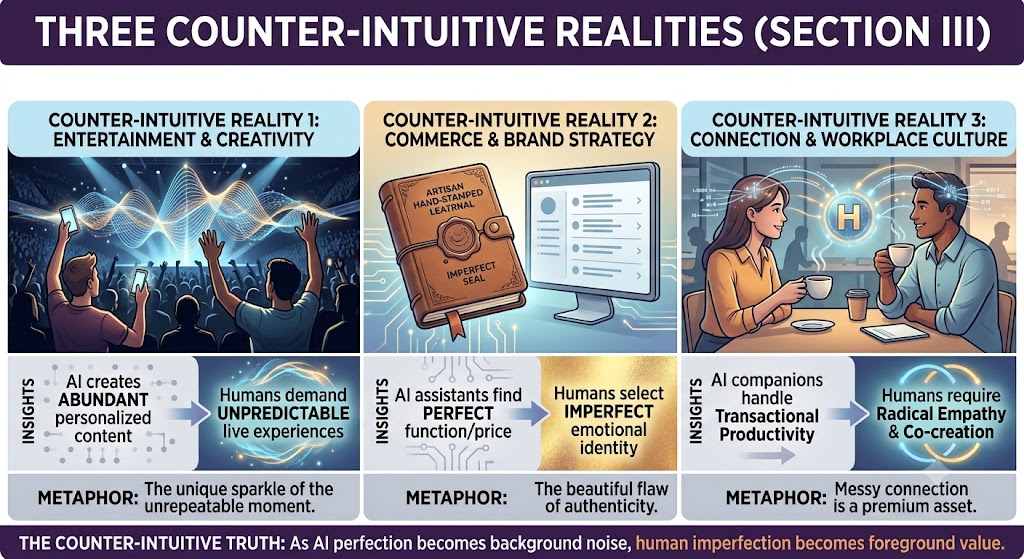
The AI New Deal

Another AI Soft Landing Scenario Exploration — Government as the Employer of First Resort

LAST UPDATED: May 2, 2026 at 5:33 PM

The AI New Deal

by Braden Kelley and Art Inteligencia


The Structural Gap: Why Process Automation Requires a Civic Pivot

As we navigate the accelerating displacement of cognitive and administrative labor, the conversation around the “AI soft landing” has reached a critical juncture. In my previous explorations, I’ve examined how our future might mirror the extreme wealth gaps of Victorian England and how we might witness a Human Premium Renaissance, where uniquely human traits become our most valuable currency.

However, a significant structural link is missing. While AI is exceptionally efficient at automating process, it is incapable of automating presence. This creates a dangerous void: as middle-class administrative roles evaporate, we risk losing the economic liquidity and social cohesion that sustain our communities.

The prevailing solution often discussed is Universal Basic Income (UBI). But as I have argued, UBI is a fiscal mirage — a passive mechanism that fails to account for the human need for agency and the staggering mathematical reality of devalued tax bases. We don’t need a handout; we need a Civic Dividend. We must move from a scarcity mindset focused on protecting obsolete jobs to an abundance mindset that funds the essential work we have historically neglected. This is the foundation of the AI New Deal: positioning the government as the Employer of First Resort.

The Fiscal and Psychological Mirage of UBI

Universal Basic Income (UBI) is often presented as the “silver bullet” for the AI age, but a closer look at the mechanics reveals it to be a flawed tool for a human-centered transition. From a design perspective, UBI solves for survival but fails to solve for contribution.

First, we must confront the Math Problem. Funding a meaningful UBI requires a robust and consistent tax base. However, as AI drives down the cost of labor toward zero, the income tax pool — the traditional engine of government revenue — shrinks alongside it. Relying on passive redistribution in a devalued labor market is a race to the bottom that risks a permanent “subsistence trap” for the majority of the population.

Second, there is the Agency Problem. Innovation thrives on human agency — the ability to act, create, and impact one’s environment. UBI provides a safety net but offers no platform for growth. By decoupling income from contribution, we risk creating a “useless class” not because humans lack value, but because we have failed to design systems that utilize their unique “Human Premium.”

Finally, we must consider the Inflation Trap. Without a mechanism to ensure the circulation of capital through local, human-to-human services, stagnant UBI payments are easily consumed by the rising costs of private-sector essentials. To achieve a soft landing, we need a dynamic model that prioritizes the Velocity of Money over the mere distribution of funds.

The Core Concept: The Civic Dividend

To bridge the gap between AI-driven efficiency and human necessity, we must introduce the Civic Dividend. This is not a social safety net designed for the desperate; it is a strategic economic platform designed for a high-functioning society. At its heart is a fundamental shift in the social contract: the Government as the Employer of First Resort.

In this model, the government doesn’t just step in when the private market fails; it proactively identifies and funds the “work that matters” — the essential maintenance of our physical, social, and cultural existence. These are the roles that require empathy, physical dexterity, and contextual judgment — capabilities that remain firmly in the human domain.

The Civic Dividend operates on the principle that human labor is a public asset. By offering potential employment in public works, care networks, and community resilience projects, the state ensures that most citizens have the opportunity to contribute. This creates a “Social Floor” of activity and income that is immune to algorithmic displacement.

Crucially, this work is not “make-work” intended to keep hands busy. It is the vital labor required to repair our crumbling infrastructure, support our aging population, and revitalize our neighborhoods. Unlike a handout, these wages are earned, providing the dignity of contribution while fueling the Velocity of Money. As these wages are spent at local bakeries, barbershops, and bookstores, they sustain a secondary human-to-human service economy that AI simply cannot replicate.

Three Pillars of AI New Deal

The Three Pillars of the AI New Deal

The success of the AI New Deal rests on a strategic focus on the “Un-automatable.” We must direct our collective energy toward three specific domains where human presence, judgment, and physical interaction are not just preferred, but essential for a thriving society.

Pillar 1: Physical and Digital Infrastructure

We are currently witnessing a “Tragedy of the Commons” in our physical world. Our bridges, transit systems, and power grids require more than just algorithmic optimization; they require physical intervention. The AI New Deal would mobilize a modern workforce to focus on Community Resilience — retrofitting cities for climate adaptation, urban “rewilding” to restore local ecosystems, and maintaining the physical nodes that allow our digital world to function. This work creates a tangible, high-quality public environment that serves as a shared wealth for all citizens.

Pillar 2: The Social and Care Fabric

As we automate cognitive tasks, the “Human Premium” in care becomes our most valuable asset. We are facing a global loneliness epidemic and an aging demographic that requires empathy, companionship, and nuanced psychological support. By professionalizing and scaling roles in elder care, mental health mentorship, and early childhood development, we transform these from marginalized sectors into the prestigious cornerstones of our new economy. These are roles where the goal is not “efficiency” (doing more with less time), but “effectiveness” (the quality of the human connection).

Pillar 3: Community Vitality and Cultural Resilience

In an era of AI-generated noise, local culture and verified information are at risk of erosion. The AI New Deal funds the “Civic Architects” — the local journalists, community theater directors, and public artists who document and celebrate the unique identity of a place. This pillar ensures that while our tools become more global and algorithmic, our lived experiences remain local, vibrant, and distinctly human. We aren’t just building roads; we are building the social connective tissue that prevents the isolation often triggered by rapid technological shifts.

Economic Mechanics: The Velocity of Human Connection

Economic Mechanics: The Velocity of Human Connection

The fiscal engine of the AI New Deal is built on a fundamental economic principle: the Velocity of Money. In a hyper-automated private sector, capital tends to pool at the top, concentrating in the hands of those who own the compute and the algorithms. Without a mechanism to pull that capital back into the hands of the many, the local economy — the shops, services, and neighborhood hubs — withers.

The Civic Dividend solves this by creating a continuous loop of circulation. When the government pays a living wage to a community health worker or a local infrastructure specialist, that income doesn’t sit idle. It is immediately recycled into the Human-to-Human (H2H) service economy. This worker buys bread from a local baker, gets a haircut from a neighborhood barber, and visits a local gym. These secondary businesses thrive precisely because their customers have earned, discretionary income to spend.

To fund this transition, we must look toward Automation Royalties or “Compute Taxes.” Rather than taxing labor — which AI is making artificially cheap — we shift the tax burden to the high-margin output of automated systems. This creates a sustainable cycle: the efficiency of AI funds the resilience of the human community.

Furthermore, the AI New Deal acts as a natural Inflation Buffer. By investing in public housing maintenance, efficient public transit, and community-led food resilience, we lower the “floor” of the cost of living. This ensures that the wages provided by the Civic Dividend maintain high purchasing power, shielding the population from the volatility of a purely algorithmic private market.

Addressing the Critics: Efficiency vs. Resilience

Critics often argue that government-led employment is inherently “inefficient” compared to the lean, optimized nature of the private sector. From the perspective of human-centered innovation, this critique misses the mark because it uses the wrong metric for success. In an AI-dominated age, social resilience is a far more valuable outcome than marginal efficiency.

The private sector’s drive for efficiency is exactly what is displacing workers. If we allow that same logic to dictate our social response, we end up with a society that is “optimized” into instability. The AI New Deal isn’t about competing with AI on speed or cost; it is about providing the stability that the private market, by its very nature, cannot offer. We are designing for systemic health, not just quarterly throughput.

Another common concern is the fear of “make-work” or a lack of individual choice. However, the AI New Deal is designed as a platform, not a cage. By providing a guaranteed social floor of meaningful work, we actually increase career mobility. When a citizen’s basic survival and dignity are secured through the Civic Dividend, they are more — not less — likely to take risks, launch their own H2H small businesses, or pursue creative endeavors in the Human Premium Renaissance.

Finally, we must recognize that this is a choice of design. We can choose to view displaced workers as a “surplus” to be managed, or we can view them as a massive, untapped reserve of human talent ready to be deployed toward the public good. The “inefficiency” of paying a human to do what an algorithm could do is only an inefficiency if you ignore the catastrophic social cost of a disengaged, impoverished populace.

AI New Deal: Designing a New Social Contract

Conclusion: Designing a New Social Contract

We stand at a unique design crossroads in human history. The rapid advancement of artificial intelligence has presented us with a fundamental choice: do we design a future of automated irrelevance, where a vast majority of the population subsists on a dwindling digital handout, or do we design a future of civic abundance?

The AI New Deal is more than an economic policy; it is a reaffirmation of the value of human contribution. It recognizes that while technology can manage our systems, only humans can care for our communities, preserve our culture, and maintain our physical world. By moving toward a model of the Government as the Employer of First Resort, we ensure that the wealth generated by the AI revolution is directly reinvested into the human experience.

This “soft landing” requires us to be bold. We must stop asking how we will survive without the jobs of the past and start asking what kind of world we could build if we finally had the resources and the hands to do it. The Civic Dividend offers a path where technology does the “tasks” so that humans can finally do the “work” of being human—creating a society that is not just more efficient, but more resilient, more connected, and more purposeful.

The tools are in our hands, and the need is all around us. Now, we simply need the courage to sign a new contract with ourselves and build the future we actually want to live in.


Braden Kelley is a leading futurist and trusted voice in human-centered innovation and change. Stay tuned for next week’s next installment in this series on the AI Soft Landing.

Frequently Asked Questions

How is the AI New Deal different from Universal Basic Income (UBI)?

While UBI provides a passive payment regardless of activity, the AI New Deal is a “Civic Dividend” based on active contribution. It positions the government as the Employer of First Resort, paying living wages for essential public work — such as infrastructure maintenance and care services — rather than providing a handout that lacks a connection to social agency or the local service economy.

How can the government afford to become the ‘Employer of First Resort’?

The funding shifts from taxing human labor to taxing the high-margin output of automated systems, often referred to as “Automation Royalties” or “Compute Taxes.” By capturing the wealth generated by AI-driven efficiency, the state can reinvest that capital into the Human-to-Human (H2H) economy, ensuring currency continues to circulate through physical communities.

Does this mean the government is creating ‘make-work’ just to keep people busy?

No. The AI New Deal focuses on the “Un-automatable” — high-value needs that are currently neglected, such as climate resilience, elder care, and mental health support. These are not arbitrary tasks; they are the essential services required for a functional, healthy society that AI cannot perform because they require human empathy, physical presence, and contextual judgment.

EDITOR’S NOTE: This is a visualization of but one possible future. I will be publishing other possible futures as they crystallize in my mind (or as you suggest them for me to explore).

Image credits: Google Gemini

Content Authenticity Statement: The topic area, key elements to focus on, etc. were decisions made by Braden Kelley, with a little help from Google Gemini to clean up the article, add images and create infographics.

Subscribe to Human-Centered Change & Innovation WeeklySign up here to get Human-Centered Change & Innovation Weekly delivered to your inbox every week.
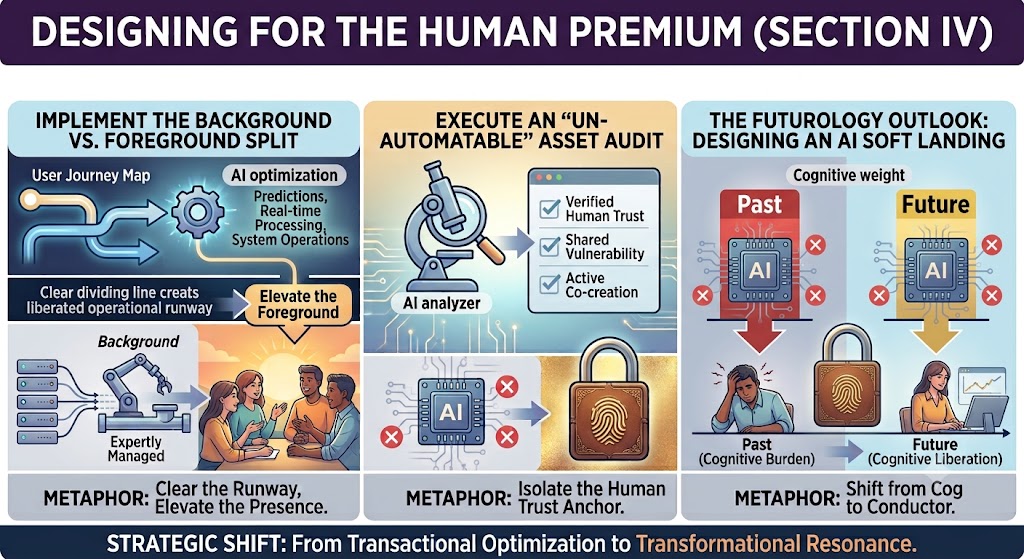
The Human-Premium Renaissance

Another AI Soft Landing Scenario Exploration

LAST UPDATED: April 24, 2026 at 6:52 PM

The Human-Premium Renaissance

by Braden Kelley and Art Inteligencia


I. Beyond the “Empty Desk”

The prevailing narrative surrounding embodied AI and robotics is often one of inevitable displacement. As automation reaches a scale where it can replicate human labor at a fraction of the cost, the fear of an “empty desk” economy—one where human participation is optional—has become a central anxiety of the 2020s.

Defining the “Soft Landing”

A soft landing represents a societal transition that sidesteps the extremes of total economic collapse or violent revolution. It is the search for a new equilibrium where human value is not just preserved, but reimagined within a landscape of infinite machine productivity.

The Core Thesis: Value in the Biological

While many forecast a return to a “Victorian” class structure defined by service and servitude, this scenario proposes a more viable, long-term alternative. The Human-Premium Renaissance suggests that:

  • Commoditized Perfection: As AI makes perfect execution free, the market value of “flawless” drops to zero.
  • The Premium of Imperfection: Economic value will migrate to the “biological origin”—the hand-carved, the human-thought, and the uniquely flawed.
  • Narrative over Utility: We are moving toward an era where we no longer pay for what a product does, but for the human story behind its creation.

In this scenario, human labor isn’t a cost to be minimized; it is the unique identifier that prevents a product from becoming a valueless commodity.

II. The Framework: Utility Floor vs. Premium Ceiling

The viability of this soft landing rests on a bifurcation of the economy into two distinct layers. This structure allows for mass survival through automation while preserving a high-value labor market for human endeavor.

The Utility Floor: The World of “Perfect Commodities”

In this layer, AI and embodied robotics handle the fundamental requirements of modern life. Logistics, basic food production, energy management, and routine diagnostics are optimized to a point where the marginal cost of production approaches zero.

  • Standardization: Everything produced at the floor is “perfect” but uniform.
  • Abundance: Scarcity is eliminated for basic needs, preventing the societal collapse often predicted in mass-unemployment scenarios.
  • Devaluation: Because these goods are generated without human effort, they lack the “prestige” required to command a premium price.

The Premium Ceiling: The Human Narrative

Above the utility floor sits the “Premium Ceiling.” This is a market tier where consumers—who now have their basic needs met by the floor—spend their discretionary wealth on items and services that possess a biological provenance.

  • Authenticity as the New Scarcity: In a world of infinite digital and robotic replicas, the one thing that cannot be mass-produced is the unique perspective and history of a specific human being.
  • The Human-Centric Premium: We see the rise of “Slow Innovation,” where the value is found in the time, struggle, and intent behind the creation rather than the speed of its delivery.

The Strategic Shift: From Utility to Origin

This transition represents a fundamental shift in how we define economic value. We move away from asking “What can this do for me?” (Utility) and toward asking “Who made this, and what is their story?” (Origin).

While the Utility Floor keeps society running, the Premium Ceiling gives society a reason to keep trading, creating, and connecting.

III. Economic Viability: Why This Model Works

The skeptic’s immediate response to a “human-premium” model is usually grounded in the cold logic of the bottom line: If a machine can do it cheaper, why would anyone pay for a human? The answer lies in the shifting definition of value in a post-scarcity utility environment.

The Scarcity of Authenticity

In an era of infinite AI-generated content and robotic manufacturing, “perfection” is no longer a differentiator—it is a baseline requirement. When every digital image is flawlessly composed and every physical object is mathematically precise, human attention, history, and original thought become the only truly non-fungible resources.

  • Effort Heuristic: Humans are psychologically predisposed to value objects and services more highly when they perceive a high degree of effort or “struggle” behind them.
  • Biological Connection: We are social animals who seek the “ghost in the machine.” We don’t just want a solution; we want to know another consciousness intended for us to have it.

The Veblen Good Effect

As basic needs are met by the Utility Floor, discretionary spending migrates toward status symbols. In this scenario, human labor becomes a Veblen Good—a luxury item where demand increases as the price (and the perceived exclusivity of the human touch) rises.

“The hand-carved chair with its slight, organic imperfections becomes a status symbol of the elite, while the flawless, 3D-printed alternative becomes the hallmark of the masses.”

Democratization of Expertise and the “Company of One”

Unlike previous industrial shifts that required massive capital for factories, AI is a capital of the mind. This technology allows individual artisans and “augmented experts” to compete with monolithic corporations.

  • Skill Augmentation: AI doesn’t just replace the expert; it allows the “middle-skill” human to perform at an elite level, spreading the ability to generate high-value, personalized work across a much larger population.
  • Niche Viability: Lowering the cost of production allows for the “Long Tail” of human services to thrive. Small-scale, highly specialized human businesses become economically sustainable because their overhead is managed by AI.

By moving the human worker from a “cost to be minimized” to a “feature to be highlighted,” companies can maintain high margins and justify the continued circulation of capital back into human hands.

Preventing the Consolidation - Breaking the Monopoly on Production

IV. Preventing Wealth Consolidation: Breaking the Monopoly on Production

One of the greatest risks of an AI-driven economy is the “Winner-Take-All” effect, where the owners of the most powerful algorithms capture the entirety of global productivity. However, the Human-Premium Renaissance offers structural defenses against this consolidation by shifting the power of production from centralized capital to distributed intelligence.

The “Company of One” Era

In previous industrial revolutions, scale was a prerequisite for success. You needed a factory to compete with a factory. Today, AI acts as a force multiplier for the individual. When the cost of sophisticated research, design, and logistics drops to near zero, the competitive advantage of a massive corporation—its ability to manage complexity—evaporates.

  • Democratized Innovation: Individual creators can now orchestrate global supply chains and reach global audiences with the same efficiency as a Fortune 500 company.
  • Agility over Scale: Smaller, human-led entities can pivot and personalize their offerings faster than a shareholder-beholden giant, allowing wealth to remain with the creator.

The Circular Human Economy

As global logistics become a commodity (the Utility Floor), we anticipate a resurgence in localized, high-trust commerce. AI-assisted cooperatives and local “Experience Stewards” can replace centralized “Gig Economy” platforms.

  • Localism: Trust is a human currency that does not scale well in an algorithm. By focusing on community-specific needs, human workers can create “walled gardens” of value that shareholders cannot easily penetrate.
  • Profit Retention: When the “platform” is a decentralized protocol rather than a Silicon Valley intermediary, more of the transaction value stays in the pockets of the local human service provider.

Narrative Ownership and Provenance

To prevent AI from simply harvesting and replicating human creativity for the benefit of shareholders, this scenario relies on Digital Provenance.

  • Certification of Origin: Using watermarking and blockchain-based verification, human-made products carry a “digital signature.” This allows creators to maintain the equity of their original work.
  • The Authenticity Tax: If a company uses AI to mimic a specific human’s style or narrative, the legal and social frameworks of the Renaissance model demand a “royalty of origin,” ensuring capital flows back to the human inspiration.

Wealth consolidation occurs when production is centralized. The Renaissance scenario is inherently decentralizing, as it prizes the one thing that cannot be mass-produced: the individual human perspective.

V. Comparing the “Soft Landings”: Victorian vs. Renaissance

To understand the trajectory of our economic future, we must distinguish between two types of “soft landings.” While both scenarios avoid immediate catastrophe, they offer fundamentally different versions of human dignity and wealth distribution.

Feature Victorian England Scenario Human-Premium Renaissance
Core Driver Inequality of Wealth and Power. Inequality of Authenticity and Scarcity.
The Human Role Tasks: Performing labor AI won’t do (low-cost servitude). Meaning: Performing labor AI can’t do (high-value narrative).
Economic Logic Humans as “Cheap Alternatives” to expensive robots. Humans as “Luxury Exceptions” to cheap, mass-produced AI.
Social Structure Centralized and Rigidly Hierarchical. Decentralized and Networked Communities.
Primary Value Obedience and Time. Trust and Shared Experience.
Role of AI The “Master’s Tool” for efficiency. The “Artisan’s Apprentice” for augmentation.

The Crucial Distinction

In the Victorian Scenario, the “servant class” is trapped by a lack of access to capital and a surplus of desperate labor. Success is measured by how well one can serve the elite.

In the Renaissance Scenario, the “artisan class” is empowered by AI to bypass traditional gatekeepers. Success is measured by how well one can connect with other humans through unique, un-automatable narratives. One is a world of servitude; the other is a world of stewardship.

While the Victorian model is a race to the bottom in cost, the Renaissance model is a race to the top in meaning.

Innovation Challenge - From Optimization to Orchestration

VI. The Innovation Challenge: From Optimization to Orchestration

For decades, the core driver of innovation has been Efficiency—doing things faster, cheaper, and with less friction. In the Human-Premium Renaissance, this paradigm reaches its logical conclusion: AI handles all optimization. When efficiency is “solved,” the new frontier of innovation becomes the Human Experience.

The Innovation of “Friction”

In a world of instant gratification provided by the Utility Floor, value is created by intentionally “slowing down” the experience. This is the art of Meaningful Friction.

  • Intentionality over Velocity: Future innovation won’t focus on how to get a product to a customer in ten minutes, but on how to make the ten minutes they spend with your brand the most memorable part of their day.
  • Biological Synchronization: Designing systems that align with human circadian rhythms, emotional cycles, and social needs rather than purely digital throughput.

The New Leadership Role: The Narrative Orchestrator

The role of the leader must shift. We are moving away from the “Optimization Officer” model toward the Narrative Orchestrator.

  • Curation as Strategy: Leaders will spend less time managing processes (AI will do this) and more time curating the talent, stories, and human connections that define the brand’s “Premium” status.
  • Stewardship of Trust: Because trust is a non-automatable resource, the primary job of leadership is to protect and grow the “Trust Equity” between the human staff and the customer base.

Redefining Innovation Maturity

In this scenario, a “mature” organization is not one with the most advanced tech stack, but one that has successfully integrated AI to the point of Invisibility.

Innovation maturity will be measured by an organization’s ability to use AI to automate the “Work” so it can empower its people to perform the “Art.”

This shift forces a total rethink of R&D. We are no longer just solving technical problems; we are solving for human belonging, status, and meaning in a post-labor world.

VII. Conclusion: Choosing Our Trajectory

The transition to an economy defined by embodied AI and mass automation does not have a predetermined destination. While the technical capabilities of generative systems and robotics are advancing at an exponential rate, the social and economic architecture we build around them remains a matter of human agency.

A Choice of Valuations

The “Victorian” and “Renaissance” scenarios represent two distinct paths for the future of work. One path values human time as a commodity—a low-cost alternative to a machine. The other values human time as a canvas—the unique source of narrative and meaning that an algorithm cannot replicate.

The Final Frontier of Competitive Advantage

As we move deeper into the 2030s, the most successful organizations will not be those that achieved the highest level of automation, but those that used that automation to solve the “Utility Floor” problem so they could focus entirely on the “Premium Ceiling.”

The ultimate goal of AI should not be to replace the worker, but to replace the “work”—the repetitive, the mundane, and the soul-crushing—thereby freeing the human to perform the “art” that only they can provide.

The soft landing is within reach, but it requires us to stop asking how we can compete with machines and start asking how we can better complement each other. The future isn’t defined by the artificial; it is defined by what becomes possible when the artificial is so ubiquitous that the human finally becomes the premium.

Frequently Asked Questions: The Human-Premium Renaissance

1. What is the difference between the “Utility Floor” and the “Premium Ceiling”?

The Utility Floor refers to the baseline economy where AI and robotics produce essential goods (food, logistics, basic software) at near-zero marginal cost, making them affordable commodities. The Premium Ceiling is the high-value market tier where consumers pay a significant markup for products and services with a “biological provenance”—meaning they are created, curated, or delivered by humans.

2. How does this scenario prevent massive wealth consolidation?

Unlike previous industrial shifts that required massive capital, AI acts as a “capital of the mind.” This allows for the rise of the Company of One, where individuals use AI to handle complex operations, allowing them to compete with large corporations. Furthermore, because “authenticity” cannot be mass-produced by a central algorithm, the value remains distributed among individual human creators and local communities.

3. Why is “human imperfection” considered an economic asset?

In a world where AI can generate “perfect” results instantly, perfection becomes a devalued commodity. Human “errors” or “uniqueness” serve as proof of biological origin—a signal of authenticity that AI cannot authentically replicate. This creates an Effort Heuristic, where consumers psychologically value the struggle and intent of a human creator over the sterile precision of a machine.

EDITOR’S NOTE: This is a visualization of but one possible future. I will be publishing other possible futures as they crystallize in my mind (or as you suggest them for me to explore).

Image credits: Google Gemini

Content Authenticity Statement: The topic area, key elements to focus on, etc. were decisions made by Braden Kelley, with a little help from Google Gemini to clean up the article, add images and create infographics.

Subscribe to Human-Centered Change & Innovation WeeklySign up here to get Human-Centered Change & Innovation Weekly delivered to your inbox every week.
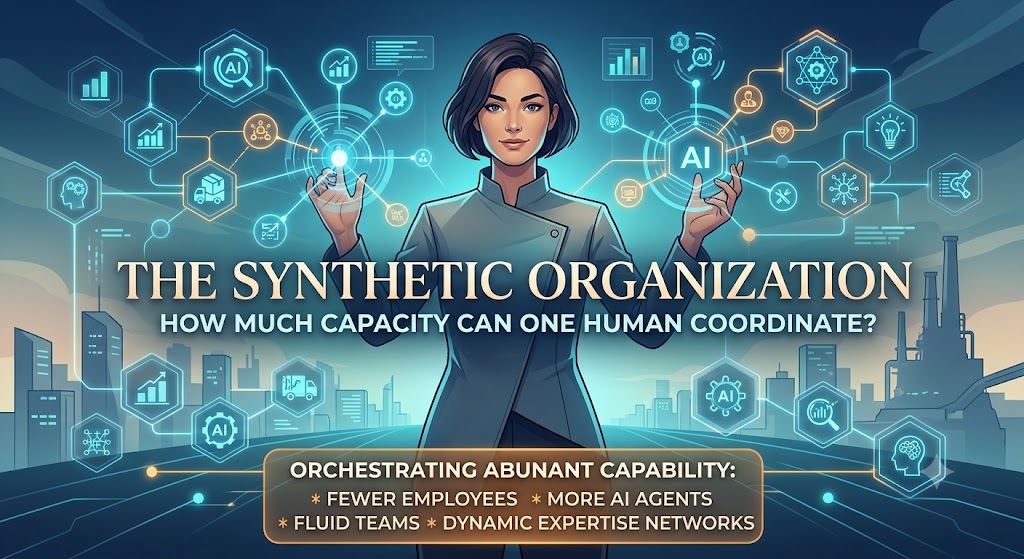
Why an AI Soft Landing Might Look Like Victorian England

LAST UPDATED: April 18, 2026 at 3:29 PM

Why an AI Soft Landing Might Look Like Victorian England

by Braden Kelley and Art Inteligencia


The Mirage of the Post-Scarcity Utopia

For decades, the prevailing narrative surrounding artificial intelligence has been one of a post-scarcity “Star Trek” future. The logic was simple: as machines took over the labor, the dividends of automation would be harvested by the state and redistributed via Universal Basic Income (UBI), freeing humanity to pursue art, philosophy, and leisure.

The AI Promise vs. The Fiscal Reality

However, this utopian vision ignores the gravity of The Great American Contraction. As we approach 2026 and beyond, the friction between exponential technological growth and a $37 trillion+ national debt (with a $2 trillion annual budget deficit) creates a structural barrier to redistribution. When the tax base of human labor erodes, the math for a livable UBI simply fails to compute.

The Victorian Hypothesis

If UBI is a mathematical and political impossibility fueled by corporate and human greed, we must look toward an alternative “soft landing.” This hypothesis suggests a vertical restructuring of society. As AI drives the cost of production and the demand for goods into a deflationary spiral, the purchasing power of the remaining “employed elite” will skyrocket.

The result isn’t a horizontal distribution of wealth, but a return to a Neo-Victorian social hierarchy. In this reality, the new digital gentry will use their outsized wealth to employ a massive “servant class” to maintain stately homes and personal lives, creating a world where status is defined by the human labor one can afford to command.

Neo-Victorian Hypothesis Infographic

The Great American Contraction: Why UBI is a Non-Starter

The conversation around the transition to an AI-driven economy often treats Universal Basic Income as an inevitability — a safety net that will naturally catch those displaced by the silicon wave. However, this assumes a level of fiscal elasticity that no longer exists. We are entering The Great American Contraction, a period where the traditional levers of government spending are restricted by the sheer weight of historical obligation and systemic greed.

The Debt Ceiling of Compassion

With a national debt exceeding $37 trillion, a $2 trillion budget deficit and rising interest rates, the federal government’s “room to maneuver” has effectively vanished. A livable UBI requires a massive, consistent tax base. As AI begins to hollow out the middle class, the very tax revenue needed to fund such a program disappears. To fund UBI under these conditions would require a level of sovereign borrowing that the global markets simply will not support, leading to a reality where the government cannot afford to be the savior of the displaced.

The Greed Variable

Even if the math were more favorable, the human element remains a constant. Corporate interests, focused on margin preservation and shareholder value, are unlikely to support the aggressive taxation required to fund a social floor. In the race to the bottom of production costs, the primary goal of the “winners” in the AI revolution will be wealth concentration, not social equity. The political willpower to force a massive transfer of wealth from AI-profiting corporations to the idle masses is a historical outlier that we should not count on repeating.

The Velocity of Displacement

Finally, the speed of the AI transition is its most disruptive feature. Legislative bodies move in years, while AI cycles move in weeks. By the time a political consensus for UBI could be formed, the economic floor will have already fallen out. This lag time creates a vacuum that will be filled not by government checks, but by a desperate search for subsistence, setting the stage for the return of the domestic labor economy.

The Deflationary Paradox: Collapse of Demand and Cost

In a traditional economy, unemployment leads to recession, which usually leads to stagflation or managed recovery. However, the AI-driven “soft landing” introduces a unique mechanical failure: the Deflationary Paradox. As AI and advanced robotics permeate every sector, the labor cost of producing goods and services begins to approach zero, but the pool of consumers capable of buying those goods simultaneously evaporates.

The Production Floor Drops

We are witnessing the end of the labor theory of value. When an AI can design, a robot can manufacture, and an automated fleet can deliver a product without a single human touchpoint, the marginal cost of production hits the floor. In a desperate bid to capture the dwindling “active” capital in the market, companies will engage in a race to the bottom, causing the prices of physical and digital goods to deflate at a rate unseen in modern history.

The Demand Vacuum

While cheap goods sound like a boon, they are a symptom of a deeper rot: the Demand Vacuum. As the middle class is hollowed out, the velocity of money slows to a crawl. The economy shifts from a mass-consumption model to a precision-consumption model. Most businesses will fail not because they can’t produce, but because there are no longer enough customers with a paycheck to buy, even at rock-bottom prices.

The Purchasing Power of the “Remaining”

This is where the Victorian shift begins. For the small percentage of Americans who retain their income — the innovators, the orchestrators, and the entrepreneurs — this deflationary environment is a golden age. Their dollars, fixed in value while the cost of everything else drops, suddenly possess exponential purchasing power. When a gallon of milk or a digital service costs mere pennies in relative terms, the “wealthy” find themselves with a massive surplus of capital that cannot be spent on “things” alone. This surplus will naturally be redirected toward the one thing that remains scarce and high-status: the dedicated service of another human being.

The New “Stately Home” Economy

As the Deflationary Paradox takes hold, we will see a fundamental shift in the definition of luxury. In the pre-AI era, luxury was defined by the acquisition of high-tech gadgets or rare goods. In the Neo-Victorian era, where machines produce goods for nearly nothing, “luxury” will pivot back toward the human-centered experience. Status will no longer be measured by what you own, but by whose time you command.

From Software to Service

For the “In-Group” — those entrepreneurs and specialized leaders still generating significant revenue — capital will lose its utility in the digital marketplace. When software is free and manufactured goods are commoditized, wealth seeks the only remaining friction: human presence. We will see a massive migration of capital away from Silicon Valley “platforms” and toward the local domestic economy. The wealthy will stop buying more “things” and start buying “lives” — the total dedicated attention of house managers, chefs, valets, and tutors.

The Modern Manor

This economic shift will be physically manifested in the return of the Stately Home. These won’t just be houses; they will be complex ecosystems of employment. Large estates will once again become the primary employer for local communities. As traditional corporate offices vanish, the residence becomes the center of both social and economic power. These modern manors will require extensive human staffs to cook, clean, maintain grounds, and provide security — services that, while technically possible via robotics, will be performed by humans as a deliberate signal of the owner’s immense “effectively wealthy” status.

The Return of the Domestic Professional

Perhaps the most jarring aspect of this transition will be the class of worker entering domestic service. We are not talking about a traditional blue-collar service shift, but the “Victorianization” of the former middle class. Displaced white-collar professionals — accountants, teachers, and middle managers — will find that their highest-paying opportunity is no longer in a cubicle, but in managing the complex domestic affairs, private education, and logistics of the new digital aristocracy. It is a “soft landing” in name only; while they may live in proximity to grandeur, their survival is entirely tethered to the whims of their employer.

Socio-Economic Stratification: The Two-Tiered Reality

The inevitable result of the “Victorian Soft Landing” is the formalization of a rigid, two-tiered social structure. Unlike the 20th century, which was defined by a fluid and expanding middle class, the post-contraction era will be characterized by extreme polarization. The economic “missing middle” creates a vacuum that forces every citizen into one of two distinct realities: the Digital Gentry or the Dependent Class.

The Corporate and Government Gentry

A small percentage of Americans — likely less than 10% — will remain tethered to the engines of primary wealth creation. This “In-Group” consists of high-level AI orchestrators, strategic entrepreneurs, and essential government officials who maintain the infrastructure of the state. Because their income is derived from high-margin automated systems while their cost of living has plummeted due to deflation, they possess a level of functional wealth that rivals the landed gentry of the 19th century. To this group, the “Great Contraction” is not a crisis, but a refinement of their dominance.

The Dependent Class

For those outside the digital fortress, the reality is stark. Without a national UBI to provide a floor, the majority of the population becomes the “Dependent Class.” Their economic utility is no longer found in the marketplace of ideas or manufacturing, but in the marketplace of personal service. In this neo-Victorian landscape, you either work for the companies that own the AI, work for the government that protects it, or you work directly for the individuals who do.

The Choice: Service or Scarcity

This stratification reintroduces a primal power dynamic into the American workforce. When the cost of basic survival (food and shelter) is low due to deflation, but the opportunity for independent income is zero, the wealthy gain total leverage. The “soft landing” is, in truth, a forced labor transition. Those who are not “useful” to the gentry — either as specialized labor or domestic support — face the grim reality of the Victorian workhouse era: they must find a patron to serve, or they will starve in a world of plenty.

Experience Design in the Neo-Victorian Era

Experience Design in the Neo-Victorian Era

From the perspective of experience design and futurology, the shift toward a Victorian-style social structure will fundamentally alter the aesthetic of status. In a world where AI can generate perfect, flawless goods and digital experiences at zero marginal cost, “perfection” becomes a commodity. Status, therefore, will be redesigned around human friction and intentional inefficiency.

The Aesthetic of Inequality

We will see a move away from the sleek, minimalist “Apple-esque” design of the early 21st century toward a more ornate, human-heavy luxury. Experience design for the elite will emphasize things that AI cannot authentically replicate: the slight imperfection of a hand-cooked meal, the presence of a uniformed gatekeeper, and the physical maintenance of vast, non-automated gardens. Architecture will pivot back to “human-centric” layouts—designing spaces not for efficiency, but to accommodate the movement and housing of a live-in staff.

Designing for Disconnect

The most challenging aspect of this new era will be the Experience of the Invisible. Designers will be tasked with creating systems that allow the Digital Gentry to interact with their environment without acknowledging the vast economic disparity surrounding them. This involves “Social UX” — designing layers of intermediation where the “Dependent Class” provides the comfort, but the “Gentry” only interacts with the result. It is a return to the “back-stairs” architecture of the 19th century, modernized for a digital age.

The UX of Survival

For the majority, the “User Experience” of daily life will be one of Hyper-Personal Patronage. Navigation of the economy will no longer be about interfaces or platforms, but about the “UX of Relationships.” Survival will depend on the ability to design one’s persona to be indispensable to a wealthy patron. In this reality, human-centered design takes on a darker, more literal meaning: the human becomes the product, the service, and the infrastructure all at once.

Conclusion: Preparing for the Retro-Future

The “Soft Landing” we are currently engineering is not the one we were promised. As the Great American Contraction forces a collision between astronomical debt and the deflationary power of AI, the middle-class dream of a subsidized leisure class is evaporating. In its place, we are seeing the blueprints of a Retro-Future — a world that looks forward technologically but moves backward socially.

A Call for Human-Centered Transition

If we continue to view innovation solely through the lens of efficiency and margin preservation, the Victorian outcome is not just possible — it is inevitable. We must realize that without a radical redesign of how we value human contribution beyond mere “market productivity,” we are simply building a more efficient feudalism. True Experience Design must now focus on the social fabric, or we risk creating a world where the only “innovation” left is finding new ways for the many to serve the few.

Final Thought: The Soft Landing Paradox

We must be careful what we wish for when we ask for a “seamless” transition. A landing that is “soft” for the Digital Gentry is one where the friction of poverty and the noise of the displaced have been successfully silenced by the return of the servant class. History doesn’t repeat, but it does rhyme — and right now, the future sounds remarkably like 1837. The question is no longer if AI will change our world, but whether we have the courage to design a future that doesn’t require us to retreat into our past.

Frequently Asked Questions

Why would prices deflate if the economy is struggling?

In this scenario, AI and robotics drive the marginal cost of production toward zero. Simultaneously, massive job displacement creates a “demand vacuum.” To capture what little liquid currency remains, companies must drop prices drastically, leading to a reality where goods are incredibly cheap but income is even scarcer.

How does this differ from the 20th-century middle class?

The 20th century was defined by a “horizontal” distribution where many people owned moderate assets. The Neo-Victorian model is “vertical.” The middle class disappears, replaced by a tiny, hyper-wealthy elite (Digital Gentry) and a large class of people who provide them with personalized human services (the Servant Class).

Isn’t UBI a more logical solution to AI displacement?

While logical in theory, the “Great American Contraction” hypothesis suggests that high national debt and corporate prioritisation of margins make a livable UBI politically and fiscally impossible. Without a state-funded floor, the market defaults to the oldest form of social safety: personal patronage and domestic service.

EDITOR’S NOTE: This is a visualization of but one possible future. I will be publishing other possible futures as they crystallize in my mind (or as you suggest them for me to explore).

Image credits: Google Gemini

Content Authenticity Statement: The topic area, key elements to focus on, etc. were decisions made by Braden Kelley, with a little help from Google Gemini to clean up the article, add images and create infographics.

Subscribe to Human-Centered Change & Innovation WeeklySign up here to get Human-Centered Change & Innovation Weekly delivered to your inbox every week.