Preparing for the Post-Labor Knowledge Economy
by Braden Kelley and Art Inteligencia
I. Introduction: The Horizon of the Post-Labor Era
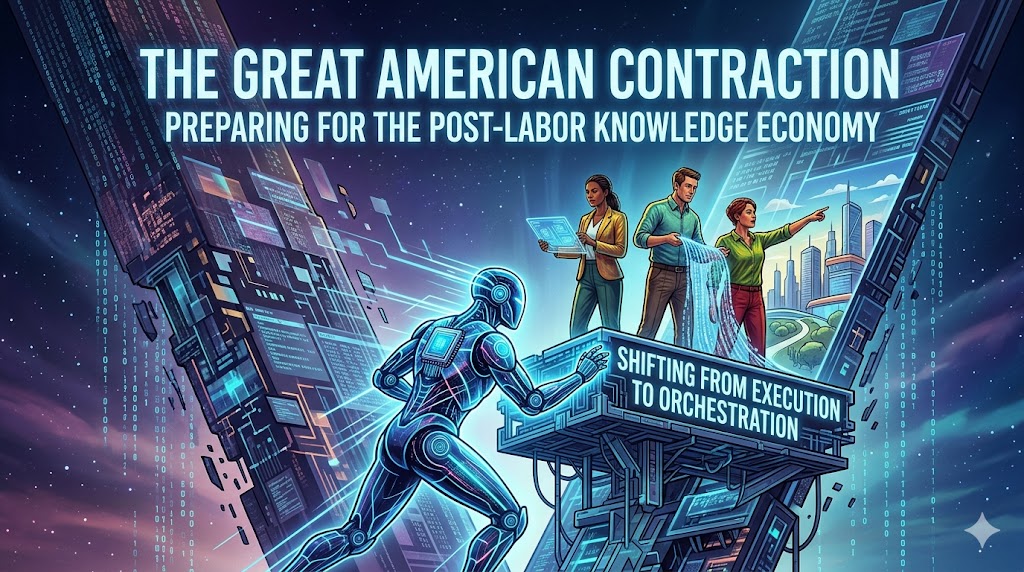
We are standing on the precipice of a profound structural shift. The rapid convergence of generative AI, autonomous agentic workflows, and evolving demographic realities is no longer just reshaping industries — it is fundamentally redefining the relationship between human labor and value creation. The traditional models that have governed the corporate world for decades are being challenged by an imminent economic phenomenon: The Great American Contraction.
This contraction is not a standard macroeconomic downturn or a temporary corporate downsizing cycle. Instead, it represents a permanent, structural reduction in the demand for traditional, volume-based knowledge work labor. As technology transitions from a tool used by humans to an autonomous entity capable of executing complex intellectual tasks, organizations must confront a stark new reality. We are moving rapidly toward a post-labor knowledge economy where market leadership will not be determined by the size of an enterprise’s headcount, but by the agility of its architecture and the depth of its human insight.
To navigate this shift successfully, forward-thinking executives, innovation leaders, and experience designers must look beyond short-term efficiency gains. Preparing for this next era requires a proactive commitment to human-centered change management and strategic futurology. This deep-dive builds upon the foundational concepts first introduced in the original framework on The Great American Contraction, providing a roadmap for organizations looking to transform disruption into an unprecedented competitive advantage.
II. Understanding ‘The Great American Contraction’
To successfully navigate the emerging economic landscape, we must first accurately diagnose the forces at play. The Great American Contraction is a term that describes the systemic decoupling of business productivity from traditional human labor hours. For the last century, scaling a knowledge-based business required a proportional scaling of headcount. If you wanted to process more claims, write more code, or manage more customer accounts, you hired more people. That linear relationship is permanently fracturing.
The Macro Drivers of Structural Shift
This contraction is fueled by three compounding macroeconomic and technological trends:
- The Cognitive Automation Velocity: Unlike previous industrial revolutions that automated physical labor, current advancements target high-level cognitive tasks — data synthesis, legal analysis, software architecture, and creative asset generation — at near-zero marginal cost.
- The Shift from Assets to Agents: Organizations are rapidly moving away from static software tools toward autonomous agentic ecosystems that require minimal human intervention to execute complex, multi-step business processes.
- Demographic Realities: A naturally tightening labor market in specialized sectors is accelerating corporate incentives to build resilient, tech-driven operational frameworks that minimize dependency on scarce talent pools.
Why This Is Not a Standard Downsizing Cycle
It is a critical mistake for enterprise leaders to view this era through the lens of traditional corporate restructuring. In a typical economic recession, companies cut headcount to survive short-term revenue declines, only to rehire when demand rebounds. The Great American Contraction is entirely different. The labor demand is contracting because the capacity to execute knowledge work has been permanently commoditized by technology.
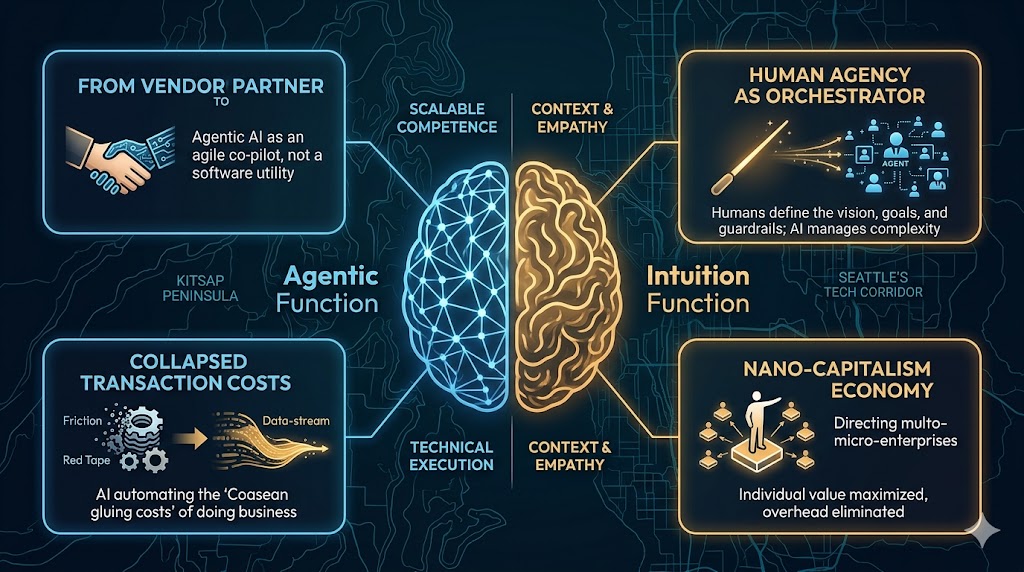
Value is rapidly migrating away from the execution of knowledge tasks and toward the orchestration, governance, and human validation of automated systems.
The Futurist Lens: Reimagining Organizational Scale
From a futurology perspective, this paradigm shift requires leaders to entirely reinvent how they define organizational maturity and scale. Historically, a “large” or “powerful” company was measured by its tens of thousands of full-time employees (FTEs). In the post-labor knowledge economy, market capitalization and societal impact will be driven by ultra-lean, highly leveraged enterprises. Success will belong to organizations that can orchestrate vast networks of AI capabilities, grounded firmly by human-centered strategy, empathy, and experience design.
III. Shifting from Labor to Orchestration: The New Knowledge Architecture
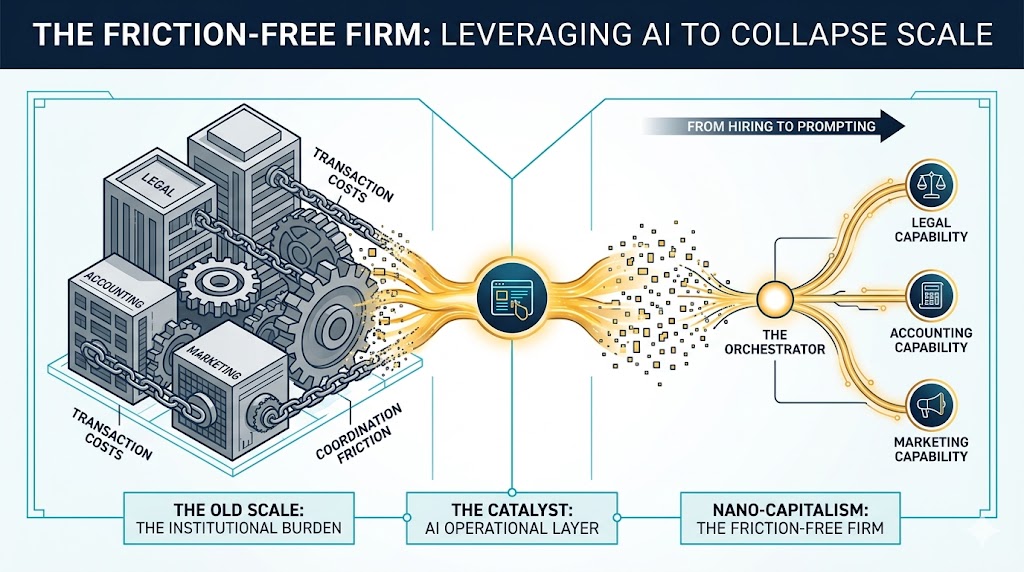
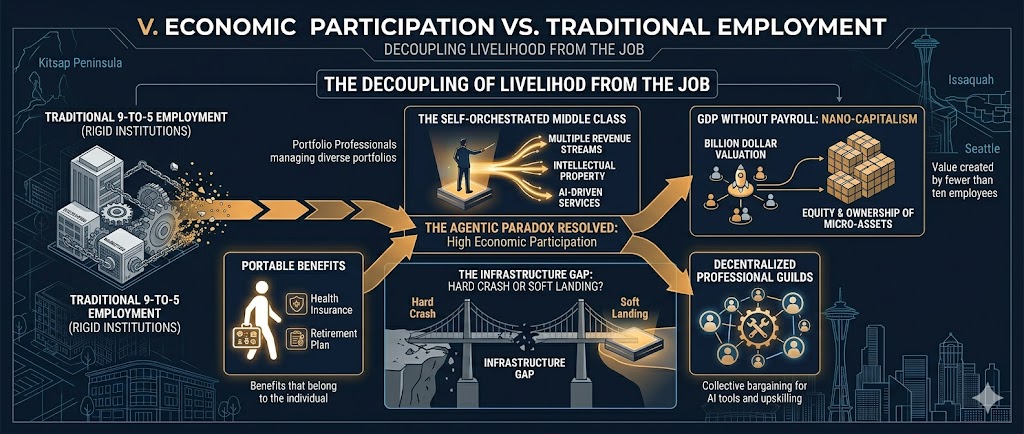
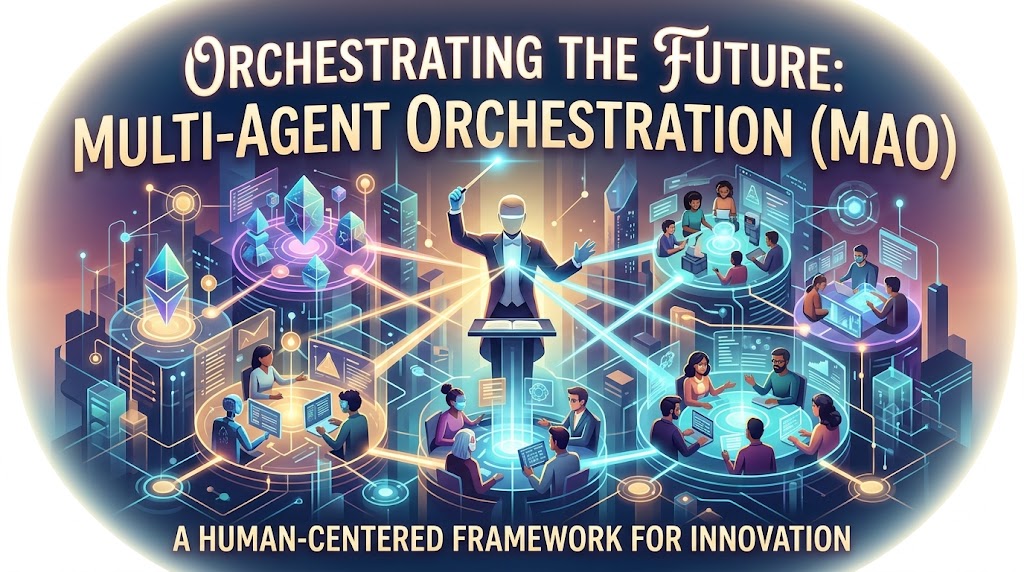
As the capacity to execute routine intellectual tasks becomes a cheap, ubiquitous commodity, the traditional structure of corporate departments must undergo a radical evolution. In the post-labor knowledge economy, value creation undergoes a massive migration. To survive The Great American Contraction, organizations must transition their human workforces away from direct task execution and toward system orchestration.
The Migration of Value
Historically, the bulk of corporate payroll has gone toward the doing of work — writing lines of code, drafting legal briefs, assembling financial models, or creating marketing assets. Today, autonomous agents can handle these tasks in fractions of a second. Consequently, human value is moving upstream. The new premium is placed on the following core activities:
- Curating Intent: Framing the right problems to solve and defining the precise strategic boundaries for automated systems.
- Auditing and Verification: Acting as the ultimate arbiter of truth, quality, and ethical alignment to ensure machine outputs meet human standards.
- Continuous Innovation: Connecting disparate insights to create entirely new business models, experiences, and paradigms that data-driven algorithms cannot predict.
Human-Centered Design in an Automated World
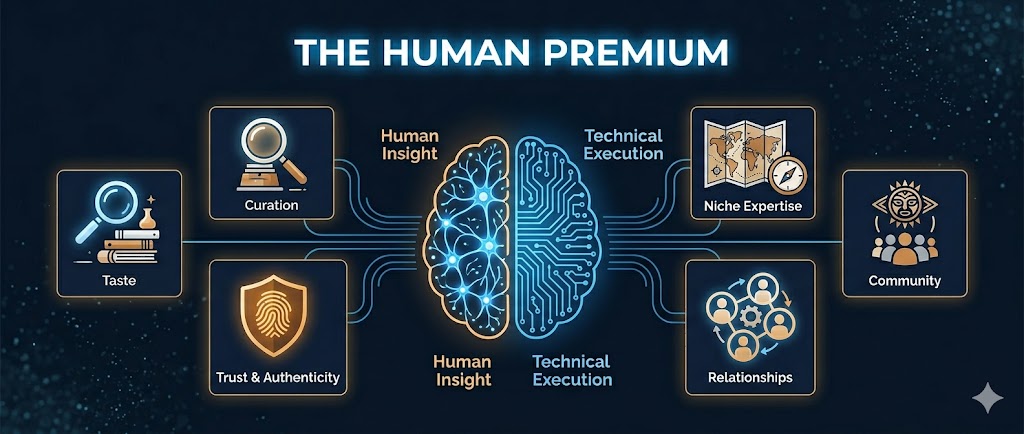
When every competitor has access to the same powerful cognitive automation engines, technology ceases to be a sustainable competitive differentiator. Differentiation returns entirely to the human element. This is where experience design (CX/EX) and human-centered innovation frameworks become mission-critical. Enterprises must intentionally design customer journeys and employee experiences that preserve authentic empathy, trust, and emotional intelligence — qualities that machines can simulate but never genuinely possess.
Defining the “Orchestrator” Skillset
The workforce that remains must be rapidly upskilled to fit the profile of an Enterprise Orchestrator. This specialized role requires a unique hybrid of technical literacy and deeply human soft skills. The core competencies of the modern orchestrator include:
| Traditional Knowledge Worker Role |
The Post-Labor Orchestrator Shift |
| Subject Matter Executor: Specializes in deep, narrow execution (e.g., manual copywriting or standard data analysis). |
Systems Architect: Understands how to connect multiple AI agents, databases, and human touchpoints to solve complex problems. |
| Content Creator: Focuses heavily on the volume and initial production of assets. |
Context Curator & Editor: Directs the vision, refines the nuance, and injects brand voice and human empathy into raw outputs. |
| Process Follower: Relies on linear, established operational playbooks. |
Adaptive Problem Solver: Thrives in ambiguity, continually redesigned workflows as technological capabilities shift. |
By transforming your workforce from an army of creators into a lean team of orchestrators, your organization builds the structural resilience required to thrive amidst ongoing economic contraction.
IV. Strategic Imperatives for Enterprise Leaders
Navigating The Great American Contraction requires more than passive adaptation; it demands a aggressive, proactive overhaul of enterprise strategy. Leaders cannot afford to wait for the post-labor economy to fully stabilize before changing how they run their businesses. To maintain a competitive edge, corporate executives must immediately execute three strategic imperatives.
1. Redefining Corporate Capacity
For decades, procurement, HR, and finance departments have used Full-Time Equivalent (FTE) headcount as the primary metric to calculate corporate capacity and scale. In a post-labor knowledge economy, tracking headcount is an obsolete way to measure capability. Leaders must shift toward outcome-focused, algorithmic capacity modeling.
Instead of asking, “How many analysts do we need to launch this product?” the question must become, “What orchestration framework and human oversight are required to deliver this outcome at scale?” This shift untethers organizational growth from linear payroll inflation, allowing lean enterprises to achieve massive operational leverage.
2. Embedding Continuous Innovation as an Operational Core
When cognitive tasks can be commoditized and replicated by competitors almost instantly, static business models will decay at an unprecedented rate. Innovation can no longer be treated as a periodic workshop or a isolated R&D department — it must be embedded directly into the daily operational workflow.
Organizations must build structural systems that allow for constant experimentation. This means creating micro-feedback loops where insights from customer experience design (CX) are immediately fed into autonomous development cycles, allowing the business to continuously reinvent its value proposition before the market forces a collapse.
3. Upskilling for Cognitive Adaptability
The transition from a workforce of executors to a lean team of orchestrators cannot happen overnight without an intentional, empathetic commitment to human-centered change. Enterprise leaders have a responsibility to actively guide their talent through this friction point.
Training programs must pivot away from teaching specific software tools or rigid, linear processes, as those workflows will likely be automated within months. Instead, enterprise training must focus intensely on building cognitive adaptability. This includes deep development in:
- Critical thinking and advanced prompt engineering curation
- Strategic systems thinking and cross-functional integration
- Empathy-driven user experience design and ethical risk management
By treating upskilling as a core pillar of your digital transformation strategy, you reduce organizational friction, honor the human side of change, and build a workforce capable of steering the company through the ongoing contraction.
V. Designing the Future: A Framework for Resilient Innovation
Surviving the structural shifts of The Great American Contraction requires a rigorous, repeatable methodology. Organizations cannot rely on ad-hoc technological adoption; they must intentionally design their future operating state. By combining the principles of strategic futurology, experience design, and human-centered change management, enterprise leaders can build a comprehensive framework for resilient innovation.
The Braden Kelley Approach to Human-Centered Change
Too often, digital transformation initiatives focus entirely on technological capabilities while ignoring the human element. This imbalance is exactly why large-scale corporate pivots fail. In a post-labor economy, successful transformation must lead with empathy. When introducing autonomous agents and cognitive automation, leaders must actively manage the psychological transition of their workforce. This means establishing psychological safety, framing automation as an expansion of human capability rather than a replacement of human worth, and transparently mapping new career pathways for evolving roles.
The Automation vs. Humanity Matrix
To avoid over-automating critical touchpoints — or under-automating operational bottlenecks — organizations must systematically audit their business architecture. Leaders should map organizational workflows across two primary variables: cognitive volume and emotional necessity. This creates a clear roadmap for where to deploy seamless technology versus where to deepen human presence:
| Workflow Classification |
Strategic Action |
Operational Execution |
High Volume / Low Emotional Touch
(e.g., standard billing, routine data migration) |
Autonomous Automation |
Fully offload to autonomous agentic systems. Remove human friction entirely to achieve maximum operational efficiency. |
High Volume / High Emotional Touch
(e.g., customer onboarding, complex escalations) |
Human Orchestration |
Deploy AI engines to generate solutions behind the scenes, but utilize human experience designers to deliver the touchpoint with empathy. |
Low Volume / High Emotional Touch
(e.g., high-value strategic partnerships, crisis management) |
Pure Human Experience |
Intentionally restrict technology to a passive, supporting role. Maximize direct human-to-human connection, trust, and deep design thinking. |
Practicing Agile Futurology
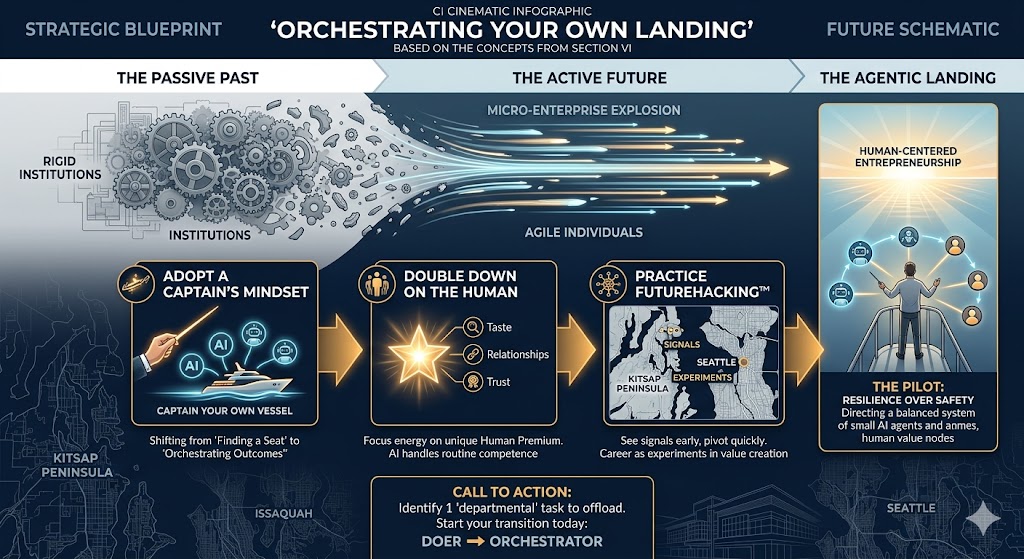
The post-labor knowledge economy moves far too quickly for traditional five-year strategic plans. Instead, innovation leaders must practice agile futurology. This involves building continuous signal-scanning networks across your industry to identify emerging technological capabilities, regulatory shifts, and economic contractions before they cause disruption. By converting these weak signals into actionable corporate experiments, your organization transitions from a defensive posture of reacting to change, to an offensive posture of actively driving it.
VI. Conclusion: The Opportunity Within the Contraction
While the phrase The Great American Contraction inherently signals a shrinking of traditional roles, it does not mean the future of business is bleak. For forward-thinking leaders, this macro-economic shift represents one of the greatest expansions of creative and strategic capability in human history. By removing the burden of manual, volume-based knowledge execution, we are effectively liberating human intellect to focus on what it does best: inventing, connecting, and empathizing.
The Optimistic Futurist Outlook
The transition into a post-labor knowledge economy should not be viewed as a destination of widespread professional obsolescence, but as an evolution toward higher-value contributions. When machines completely handle the commoditized execution of ideas, the human premium shifts entirely to the quality of our curiosity, the strength of our ethics, and the depth of our experience design. The organizations that thrive in this new era will be those that view automation not as a tool to cut costs, but as a mechanism to amplify human potential.
The Call to Action for Innovators
The post-labor economy is not a distant, theoretical concept — it is actively being constructed around us today. Waiting for the dust to settle before choosing a direction is a guaranteed path to irrelevance. Executive leaders, experience designers, and corporate strategists must seize the initiative immediately by taking tangible steps toward systemic transformation:
- Begin dismantling legacy capacity models tied strictly to full-time equivalent headcount.
- Audit operational workflows to systematically separate high-volume automation tasks from high-empathy human touchpoints.
- Commit deeply to human-centered change management, ensuring your workforce is actively upskilled into strategic orchestrators.
The future of work will not be defined by what technology can do, but by how courageously human leaders choose to design the transition. To explore the foundational research, frameworks, and strategic insights driving this transformation, return to the original thesis and join the ongoing conversation and access the tools (FutureHacking, Human-Centered Change, etc.) here on bradenkelley.com.
Frequently Asked Questions
What is ‘The Great American Contraction’?
The Great American Contraction is a structural macroeconomic shift characterized by a permanent decoupling of business productivity from traditional human labor hours. Driven by advanced generative AI and autonomous agentic ecosystems, it represents a contraction in the market demand for volume-based, routine knowledge work execution, shifting the corporate premium toward human orchestration and strategic design.
What is a post-labor knowledge economy?
A post-labor knowledge economy is an economic landscape where the direct execution of cognitive and intellectual tasks (such as coding, basic analysis, and content generation) is largely commoditized and performed autonomously by technology at near-zero marginal cost. In this economy, human value centers entirely on orchestration, continuous innovation, ethical oversight, and empathy-driven experience design.
How should corporate leaders prepare for this economic shift?
Enterprise leaders must rapidly implement three strategic changes: redefine corporate capacity metrics away from full-time equivalent (FTE) headcount toward capability outcomes; systematically embed continuous innovation into daily operations; and aggressively invest in employee upskilling focused on cognitive adaptability, systems thinking, and human-centered change management.
Content Authenticity Statement: The topic area, key elements to focus on, etc. were decisions made by Braden Kelley, with a little help from Google Gemini to clean up the article, add images and create infographics.
Image credit: Gemini
 Sign up here to get Human-Centered Change & Innovation Weekly delivered to your inbox every week.
 Drum roll please…