An Experience Level Measure (XLM) is a metric that quantifies human experience success — not just system uptime or ticket speed. Where a traditional SLA (Service Level Agreement) commits to technical or operational performance, an XLM asks whether people can reach their goal without unnecessary friction, confusion, or cognitive fatigue.
The XLM (Experience Level Measure) Matrix™ is Braden Kelley’s visual workshop framework for moving from a specific “ugh” moment (friction) → to an XLM that measures the absence of that friction → to the innovation or design lever that improves it. Use it for customer, employee, partner, patient, or constituent experiences.
In short:
- SLA = Did the system/process meet a technical threshold?
- XLM = Did the human succeed without avoidable pain?
- XLA (Experience Level Agreement) = A commitment to experience outcomes, informed by XLMs
- XLM Matrix™ = The tool that connects friction → measure → fix
Free download: Get the XLM Matrix™ (11″×17″)
Related: Experience Design Glossary — XLM & XLA · Customer Experience Audit

by Braden Kelley
The Crisis of the “Efficient but Empty” Experience
In our current landscape of rapid digital transformation, we have achieved unprecedented levels of speed and automation. Organizations have mastered the “how” of delivery, yet many find themselves facing a growing paradox: processes are becoming more efficient while human satisfaction is simultaneously declining. We are successfully building faster systems that often leave the user feeling more like a cog in a machine than a valued participant.
The root of this issue lies in our reliance on traditional Service Level Agreements (SLAs). For decades, SLAs have served as the gold standard for operational success, measuring technical markers like system uptime, response times, and throughput. While these metrics are essential for maintaining infrastructure, they are fundamentally “cold” metrics. They can tell you that a system is functioning, but they cannot tell you if the person using that system is thriving, frustrated, or merely exhausted by the interaction.
To innovate effectively in a human-centered future, we must look beyond technical availability and begin measuring the actual quality of the human encounter. We need a shift in perspective—moving from monitoring system performance to measuring human success. This evolution requires a new framework: Experience Level Measures (XLMs). By focusing on how an innovation impacts the user’s cognitive load, sense of agency, and emotional resonance, we can move past “efficient but empty” outputs and toward solutions that deliver genuine value.
Introducing the XLM Matrix
To bridge the gap between technical output and human success, we developed the XLM (Experience Level Measure) Matrix. This visual framework is designed to help innovation teams move beyond abstract empathy and toward concrete, measurable experience improvements. By visualizing the relationship between friction, measurement, and action, teams can align their efforts with the outcomes that actually move the needle for their users.
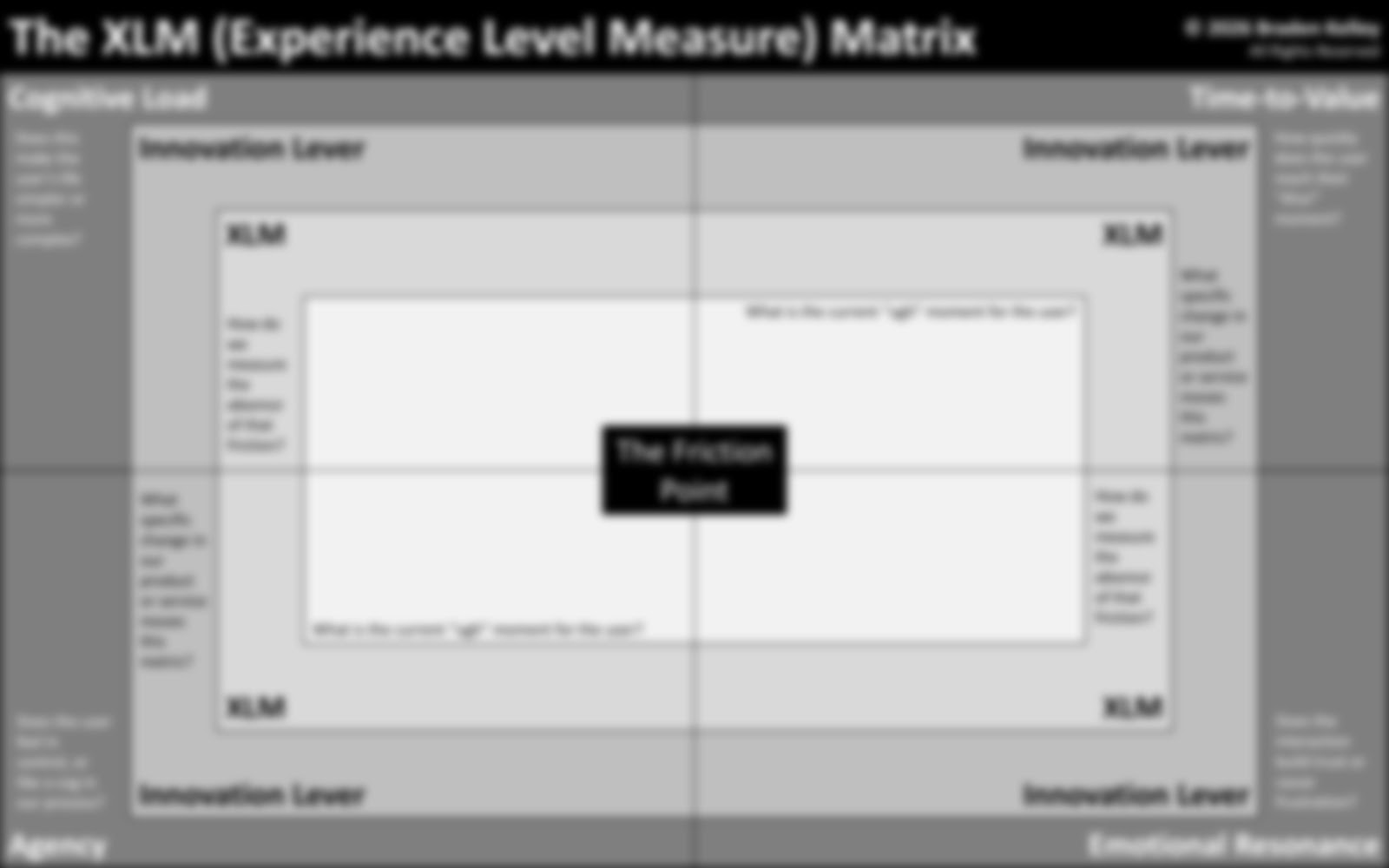
The matrix is structured as a series of concentric rings, requiring teams to work from the “inside out” to ensure every innovation is rooted in a real-world human need:
- The Inner Circle (The Friction Point): This is the starting line. Here, teams identify the specific “ugh” moment—the point in the journey where the user currently feels confused, slowed down, or disempowered.
- The Middle Ring (The XLM): This layer transforms qualitative frustration into a quantitative metric. It asks: “How do we measure the absence of that friction?” An XLM isn’t about system uptime; it’s about the user’s success rate in reaching their goal without cognitive fatigue.
- The Outer Ring (The Innovation Lever): Once the friction is identified and the metric is set, the outer ring focuses on the solution. It identifies the specific change in the product, service, or workflow that will directly influence the XLM and eliminate the friction point.
By using this “Target Logic,” teams ensure that they aren’t just innovating for the sake of novelty, but are strategically pulling levers that have a measurable impact on the human experience.
The Four Pillars of Human-Centered Innovation
To provide a comprehensive view of the user experience, the XLM Matrix is divided into four critical quadrants. Each quadrant represents a fundamental pillar of how humans interact with technology and services. By examining an innovation through these four lenses, teams can uncover hidden friction points and prioritize improvements that resonate most deeply with their audience.
1. Cognitive Load
“Does this make the user’s life simpler or more complex?”
In an age of information abundance, mental energy is a finite resource. This pillar focuses on the mental effort required to complete a task. Innovation here is about reducing noise, simplifying navigation, and ensuring that the “cost of thinking” is kept to an absolute minimum.
2. Time-to-Value
“How quickly does the user reach their ‘Aha!’ moment?”
Success is often determined by the distance between a user’s first interaction and their first realization of value. This quadrant measures the speed of relevance. Effective innovation in this space removes barriers to entry and streamlines the path to a meaningful outcome.
3. Agency
“Does the user feel in control, or like a cog in the process?”
As systems become more autonomous, maintaining human agency is vital. This pillar explores whether a tool empowers the user or forces them into a rigid, predetermined path. High-agency innovations provide the user with the autonomy to make meaningful choices and direct the outcome.
4. Emotional Resonance
“Does the interaction build trust or cause frustration?”
Every interaction leaves an emotional footprint. This quadrant assesses the “vibe” of the experience. It looks beyond function to ask if the solution feels reliable, empathetic, and aligned with the user’s values, transforming a transactional moment into a relational one.
How to Use the Matrix with Your Team
The XLM Matrix is most effective when used as a collaborative workshop tool. By gathering cross-functional perspectives—from product and design to engineering and customer success—you can ensure a 360-degree view of the human experience. Follow these three steps to run your first experience audit:
Step 1: The Empathy Audit
Focus on the Inner Circle. Select one of the four quadrants and ask the team to identify the most persistent “ugh” moment currently facing the user. Be specific. Instead of saying “the checkout process is slow,” identify the exact friction point, such as “the user feels overwhelmed by the number of form fields.”
Step 2: Defining the Metric
Move to the Middle Ring. Once the friction point is clear, brainstorm how you would measure its absence. This is your Experience Level Measure (XLM). If the friction is cognitive overload from form fields, your XLM might be “reduction in time spent on the checkout page” or “a 20% increase in completion rate without support intervention.”
Step 3: Pulling the Innovation Lever
Reach the Outer Ring. Now, identify the specific technical or design change that will move that metric. This is your “Innovation Lever.” It could be an AI-driven auto-fill feature, a progress bar to improve the sense of agency, or a “save for later” option to reduce immediate emotional pressure.
Repeat this process for each quadrant to build a robust, human-centered innovation roadmap that prioritizes meaningful outcomes over simple feature checklists.
Conclusion: Creating a Human-Centered Future
The transition from measuring system performance to measuring human success is not just a technical shift; it is a cultural one. As we move deeper into an era of agentic AI and rapid digital acceleration, the organizations that thrive will be those that prioritize the human experience as their primary north star. Innovation is no longer defined solely by what we can build, but by how effectively we enable people to feel, act, and succeed.
The XLM Matrix provides a structured, repeatable path to this future. By moving from the friction of the “ugh” moment to the strategic clarity of the innovation lever, your team can ensure that every project delivers meaningful, human-centered value. It is time to stop guessing how our users feel and start building for their success.
Start Your Experience Transformation Today
Ready to move beyond SLAs? Download the high-resolution, 11″x17″ (works as A3 too) printable version of The XLM Matrix and begin identifying the measures that truly matter for your innovation team. You can also use it virtually by uploading it and locking it down as a background in Miro, Mural, LucidSpark, Figjam or the FREE Microsoft Whiteboard or Google Jamboard.
Frequently Asked Questions
What is the difference between an SLA and an XLM?
A Service Level Agreement (SLA) measures technical system performance, such as uptime or response speed. An Experience Level Measure (XLM) focuses on human outcomes, measuring how effectively an innovation reduces cognitive load, increases user agency, or builds emotional resonance.
How does the XLM Matrix help innovation teams?
The XLM Matrix provides a visual framework to move from identifying user friction (“ugh” moments) to defining specific metrics and identifying the technical or design “levers” required to improve the human experience.
Can the XLM Matrix be used for internal digital transformation?
Yes. The matrix is highly effective for internal projects. By measuring the cognitive load and time-to-value for employees using new internal tools, organizations can ensure their digital transformation efforts actually increase productivity rather than just adding complexity.
Image credits: Braden Kelley, Google Gemini
 Sign up here to get Human-Centered Change & Innovation Weekly delivered to your inbox every week.
Pingback: Trust-Based Contracts & Innovation Partnerships - Human-Centered Change and Innovation
Pingback: Leveraging Multi-Agent Orchestration Frameworks for Innovation - AI