LAST UPDATED: April 29, 2026 at 6:28 PM
by Braden Kelley and Art Inteligencia
The Work Design Gap
We are not struggling to build artificial intelligence. We are struggling to design work for it.
Across industries, organizations are layering AI onto workflows that were never meant for collaboration. The result is predictable: inefficiency, mistrust, and unrealized value.
The real divide is not human versus AI. It is between work that is intentionally designed for collaboration and work that is not.
Why Traditional Tools Fail Us
Most of our management tools were built for a different era.
- Process maps assume predictability
- Org charts assume static roles
- RACI models assume clear ownership
But human and AI collaboration is dynamic, contextual, and continuously learning. These tools help us optimize yesterday’s work, not design tomorrow’s.
What we need is a new visual language for collaboration.
Introducing the Human–AI Collaboration Canvas
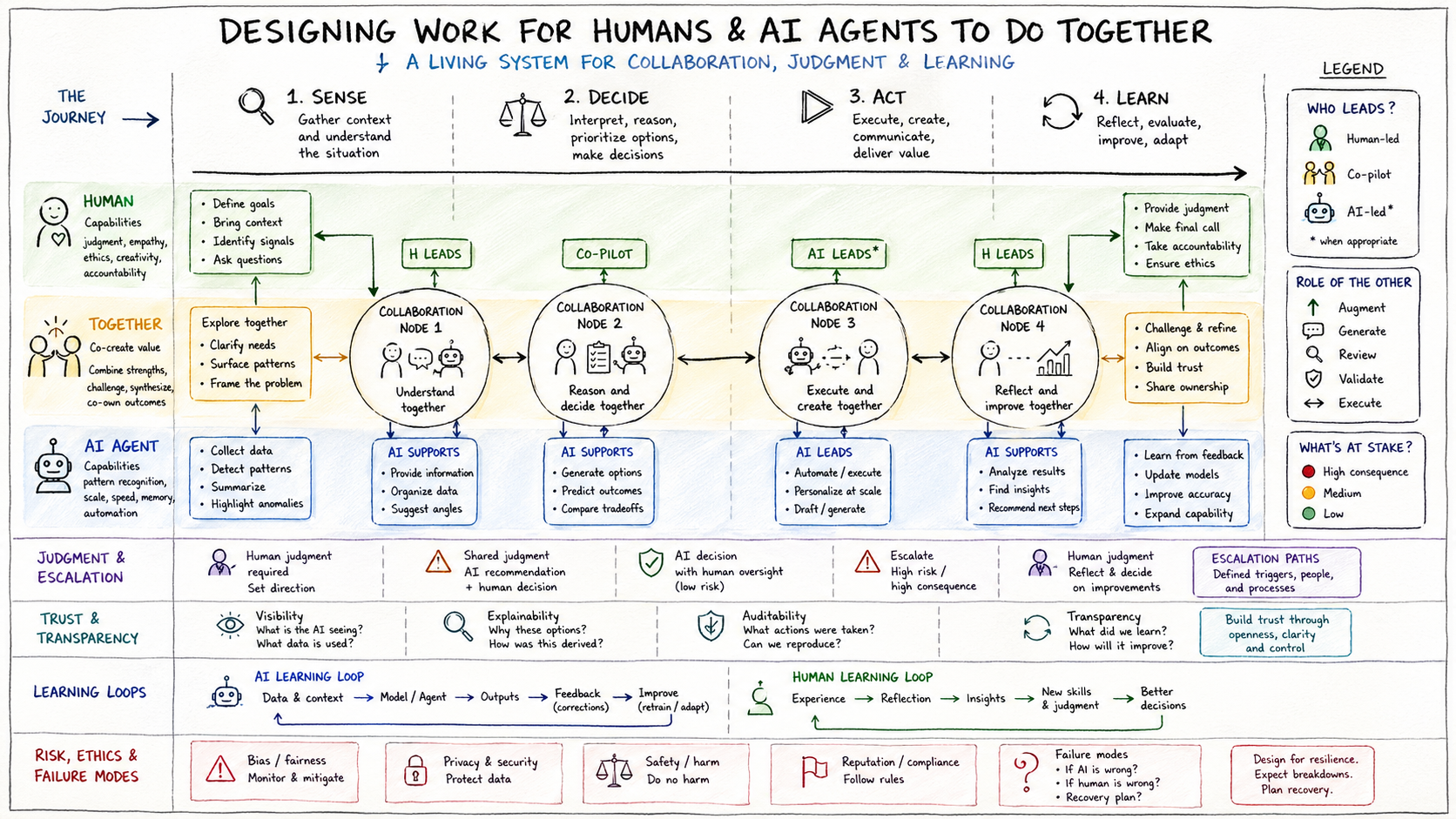
The infographic below is not just a diagram. It is a thinking tool.
Its purpose is to make invisible interactions visible, clarify roles without over-constraining them, and embed judgment, trust, and learning into how work gets done.
This is a shift from process design to system design for collaboration.
The Three-Lane Model: A More Honest Representation of Work
The canvas is built around three interconnected lanes:
The Human Lane
Where judgment, empathy, ethics, and accountability live. Humans frame the problem, not just solve it.
The AI Agent Lane
Where scale, speed, pattern recognition, and automation operate. AI expands what is possible.
The “Together” Lane
This is where value is actually created. Co-creation, co-decision, and co-learning happen here.
If you are not explicitly designing the middle lane, you are leaving value on the table.
The Work Journey: Sense → Decide → Act → Learn
Instead of rigid workflows, the canvas maps work as an adaptive cycle:
- Sense: Understand context and gather signals
- Decide: Blend human reasoning with AI recommendations
- Act: Execute with scale and oversight
- Learn: Reflect, adapt, and improve
Learning is not the end of the process. It feeds everything.
Collaboration Nodes: Where the Magic (or Failure) Happens
At key points in the journey are collaboration nodes—the moments where humans and AI interact.
Each node forces three critical questions:
- Who leads?
- What is the role of the other?
- What is at stake?
Most AI failures are not technical failures. They are interaction design failures.
Making Judgment Visible
One of the biggest risks in AI adoption is invisible decision-making.
The canvas highlights:
- Where human judgment is required
- Where AI recommendations are sufficient
- Where escalation is necessary
Automation without explicit judgment design is just risk at scale.
Designing for Trust, Not Just Performance
Capability alone is not enough. Systems must be trusted to be used effectively.
This requires:
- Transparency
- Explainability
- Auditability
The real question is not “Can the AI do this?” but “Will humans trust and use this appropriately?”
Learning Loops: The System That Gets Smarter
The canvas includes two reinforcing learning loops:
- AI Learning Loop: Data → Model → Output → Feedback → Improvement
- Human Learning Loop: Experience → Reflection → Insight → Better decisions
The real competitive advantage is not AI itself. It is how quickly your combined system learns.
Risk, Ethics, and Failure by Design
No system is perfect. The best systems are designed with failure in mind.
The canvas highlights:
- Bias and fairness
- Privacy and security
- Safety and compliance
It also asks essential questions:
- What happens if the AI is wrong?
- What happens if the human is wrong?
- How do we recover?
Resilience comes from designing for breakdowns, not ignoring them.
How to Use This Canvas
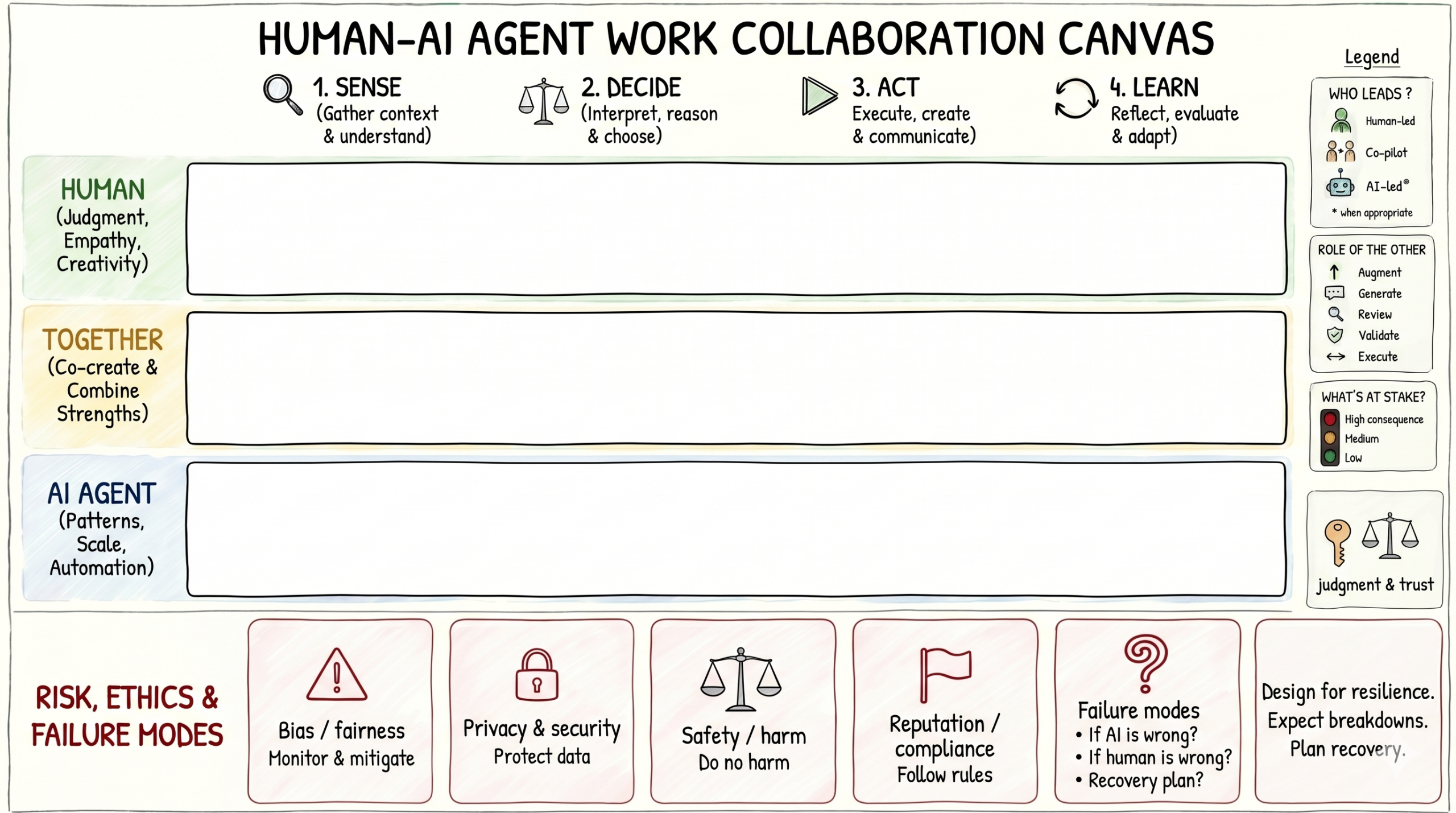
This is a practical tool, not a theoretical one.
- Use it in workshops to map collaboration
- Audit existing workflows
- Design new human–AI systems from scratch
A simple place to start:
- Map one critical workflow
- Identify collaboration nodes
- Redesign the “together” lane first
Designing for a More Human Future
AI does not reduce the need for humans. It raises the bar for how we design work.
The goal is not efficiency alone. The goal is better decisions, better experiences, and better outcomes.
The organizations that win will not be the ones with the most AI. They will be the ones who best design how humans and AI work together.
EDITOR’S NOTE: You should read this article too to learn more about atomizing work for man and machine to do together.
Content Authenticity Statement: The topic area, key elements to focus on, etc. were decisions made by Braden Kelley, with a little help from ChatGPT and Google Gemini to clean up the article, add images and create infographics.
Image credits: Google Gemini, ChatGPT
 Sign up here to get Human-Centered Change & Innovation Weekly delivered to your inbox every week.