Tag Archives: politics

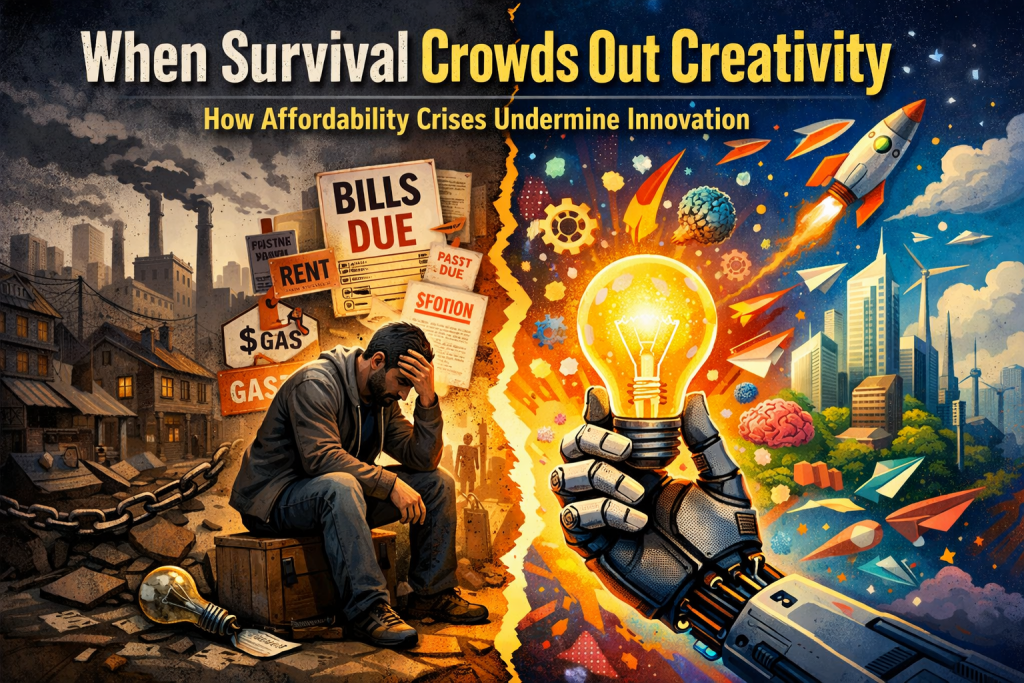
When Survival Crowds Out Creativity: How Affordability Crises Undermine Innovation

An exploration of how rising costs of living reduce cognitive surplus, suppress innovation, and limit organizational and societal progress.

LAST UPDATED: January 19, 2026 at 4:43 PM
When Survival Crowds Out Creativity: How Affordability Crises Undermine Innovation

GUEST POST from Art Inteligencia

I am frequently asked about the ingredients of a successful innovation ecosystem. We talk about venture capital, high-speed internet, patent laws, and university partnerships. But we rarely talk about the most fundamental requirement of all: human physiological and psychological security.

Innovation is not a purely intellectual exercise; it is an emotional and biological one. It requires a specific state of mind — one that is open, curious, and willing to embrace the possibility of failure. However, when a society faces systemic affordability challenges — skyrocketing rents, food insecurity, and the crushing weight of debt — we are effectively taxing the cognitive bandwidth of our greatest resource: people.

“Innovation is not a luxury of the elite, but a byproduct of a society that provides its citizens enough stability to dream. When we price people out of their basic needs, we price ourselves out of our future.” — Braden Kelley


The Cognitive Tax of Scarcity

To understand why affordability kills innovation, we must look at how the human brain functions under stress. Human-centered innovation is rooted in the idea that people solve problems when they have the mental “slack” to do so. When an individual is constantly calculating how to cover a 30% increase in rent or skipping meals to pay for childcare, they are operating in survival mode.

In survival mode, the brain’s prefrontal cortex — the center for higher-order thinking, long-term planning, and creative synthesis — takes a backseat to the amygdala. We become more reactive, more short-term focused, and significantly more risk-averse. You cannot disrupt an industry when you are terrified of an eviction notice.

This “scarcity mindset” creates a hidden drain on productivity and creativity. It is a form of Innovation Debt that we are accruing as a society, where the interest is paid in ideas that were never born because the potential innovators were too exhausted to think of them.

In organizations, this manifests as:

  • Employees avoiding bold ideas for fear of failure
  • Reduced participation in innovation programs
  • Higher burnout and turnover among creative talent
  • A preference for incrementalism over experimentation

“Innovation requires slack — slack in time, money, attention, and emotional safety. When survival becomes the primary occupation, imagination is the first casualty.” — Braden Kelley


Case Study 1: The Silicon Valley “Talent Flight”

The Situation

For decades, Silicon Valley was the undisputed epicenter of global innovation. However, by the early 2020s, the median home price in the region exceeded $1.5 million. While established tech giants could afford to pay engineers high salaries, the support ecosystem — the teachers, the artists, the junior researchers, and the “garage tinkerers” — could not.

The Innovation Impact

Innovation thrives on cross-pollination. When only the wealthy can afford to live in a hub, the diversity of thought collapses. We began to see a “homogenization of innovation,” where new startups focused almost exclusively on problems faced by high-income individuals (e.g., luxury delivery apps) rather than solving systemic human challenges. The high cost of living created a barrier to entry that effectively barred the next generation of “scrappy” innovators who didn’t have a safety net or venture backing.

The Result

Data showed a significant migration of talent to “secondary” hubs like Austin, Denver, and Lisbon. While this decentralization has benefits, the initial friction and lost momentum in the primary hub represented a massive opportunity cost for breakthrough research that requires physical proximity and intense collaboration.


The Death of the “Garage Startup”

The “garage startup” is a cherished myth in innovation circles, but it relies on a very real economic reality: the availability of low-cost, low-risk space. Hewlett-Packard, Apple, and Google all started in spaces that were relatively cheap to rent or own.

In today’s urban environments, that “low-risk space” has vanished. When every square foot of a city is optimized for maximum real estate yield, there is no room for the inefficient, messy work of early-stage experimentation. We are replacing “maker spaces” with luxury condos, and in doing so, we are dismantling the physical infrastructure of the Fail Fast philosophy. If the cost of your “lab” (your garage or basement) is $3,000 a month, you cannot afford to fail. And if you cannot afford to fail, you will never truly innovate.


Case Study 2: Food Insecurity in the Academic Pipeline

The Situation

A 2023 study of graduate students in North America revealed that nearly 30% experienced some form of food insecurity. These are the individuals tasked with the most rigorous scientific and social research — the literal “R” in R&D.

The Innovation Impact

Graduate students are the primary engine of university-led innovation. When these researchers spend their nights worrying about calorie counts instead of quantum counts, the quality of research suffers. The persistence required to push through a failed experiment is diminished when physical health is compromised.

The Result

Universities noted a decline in “high-risk, high-reward” thesis topics. Students began gravitating toward “safe” research areas with guaranteed funding or clear paths to corporate employment to pay off student loans and eat. The “Failure Budget” for these young innovators was effectively zero, leading to a stifling of the very exploratory research that historically leads to major scientific breakthroughs.


Case Study 3: A Manufacturing Firm’s Productivity Paradox

A mid-sized manufacturing company invested heavily in digital transformation and innovation training, yet saw minimal improvement in idea generation or experimentation. Leadership initially blamed culture and skills.

A deeper assessment revealed a different root cause: nearly 40 percent of the workforce was experiencing food or housing insecurity. Employees were working second jobs, skipping medical care, and managing chronic stress.

The company shifted strategy. It introduced wage stabilization, subsidized meals, and emergency financial support. Within twelve months, participation in continuous improvement programs doubled, and frontline innovation proposals increased by over 60 percent.

Innovation did not fail due to lack of tools. It failed due to lack of breathing room.


Why Affordability Shapes Risk Appetite

Innovation requires people to take risks that may not pay off immediately. But when the margin for error is razor-thin, risk becomes reckless rather than courageous.

Employees who fear eviction or medical debt are far less likely to:

  • Challenge entrenched assumptions
  • Experiment with unproven ideas
  • Advocate for long-term investments
  • Speak candidly about systemic flaws

Affordability challenges quietly turn organizations into compliance machines rather than learning systems.


Conclusion: A Call for Human-Centered Policy

If we want to maintain a competitive edge in a rapidly changing world, we must view affordability as an innovation policy. Rent control, affordable housing, student debt relief, and food security are not just “social issues”; they are the foundational layers of a healthy innovation funnel.

We need to create “slack” in our systems. We need to ensure that the next great thinker is not working three gig-economy jobs just to keep the lights on. As leaders, we must advocate for a world where people are free to use their entire brain for the work of change, rather than wasting half of it on the math of survival.

True innovation starts with a simple human truth: A mind preoccupied with where to sleep cannot dream of how to fly.


Frequently Asked Questions

Q: How do high housing costs impact an organization’s innovation potential?

A: High housing costs force talent to relocate or spend a disproportionate amount of cognitive energy on survival. This reduces “cognitive bandwidth,” making employees more risk-averse and less likely to engage in the creative problem-solving or “intrapreneurship” required for organizational growth.

Q: What is the “Cognitive Tax” of affordability challenges?

A: The cognitive tax is the mental drain caused by financial stress. When individuals are worried about basic needs like food and rent, their prefrontal cortex — the area responsible for complex decision-making and creativity — is overwhelmed by the stress of survival, effectively lowering their functional IQ and creative output.

Q: Can innovation survive in an environment of economic scarcity?

A: While scarcity can occasionally breed “frugal innovation,” systemic affordability challenges generally stifle breakthrough innovation. Breakthroughs require “slack” — time, resources, and mental space — to experiment and fail. Without basic economic security, individuals cannot afford the risk of failure.

Disclaimer: This article speculates on the potential future direction of society based on current factors. It is hard to predict whether commercial, political and charitable organizations will respond in ways sufficient to alter the course of history or not.

Image credits: ChatGPT

Subscribe to Human-Centered Change & Innovation WeeklySign up here to get Human-Centered Change & Innovation Weekly delivered to your inbox every week.

We Must Hold AI Accountable

We Must Hold AI Accountable

GUEST POST from Greg Satell

About ten years ago, IBM invited me to talk with some key members on the Watson team, when the triumph of creating a machine that could beat the best human players at the game show Jeopardy! was still fresh. I wrote in Forbes at the time that we were entering a new era of cognitive collaboration between humans, computers and other humans.

One thing that struck me was how similar the moment seemed to how aviation legend Chuck Yeager described the advent of flying-by-wire, four decades earlier, in which pilots no longer would operate aircraft, but interface with a computer that flew the plane. Many of the macho “flyboys” weren’t able to trust the machines and couldn’t adapt.

Now, with the launch of ChatGPT, Bill Gates has announced that the age of AI has begun and, much like those old flyboys, we’re all going to struggle to adapt. Our success will not only rely on our ability to learn new skills and work in new ways, but the extent to which we are able to trust our machine collaborators. To reach its potential, AI will need to become accountable.

Recognizing Data Bias

With humans, we work diligently to construct safe and constructive learning environments. We design curriculums, carefully selecting materials, instructors and students to try and get the right mix of information and social dynamics. We go to all this trouble because we understand that the environment we create greatly influences the learning experience.

Machines also have a learning environment called a “corpus.” If, for example, you want to teach an algorithm to recognize cats, you expose it to thousands of pictures of cats. In time, it figures out how to tell the difference between, say, a cat and a dog. Much like with human beings, it is through learning from these experiences that algorithms become useful.

However, the process can go horribly awry. A famous case is Microsoft’s Tay, a Twitter bot that the company unleashed on the microblogging platform in 2016. In under a day, Tay went from being friendly and casual (“humans are super cool”) to downright scary, (“Hitler was right and I hate Jews”). It was profoundly disturbing.

Bias in the learning corpus is far more common than we often realize. Do an image search for the word “professional haircut” and you will get almost exclusively pictures of white men. Do the same for “unprofessional haircut” and you will see much more racial and gender diversity.

It’s not hard to figure out why this happens. Editors writing articles about haircuts portray white men in one way and other genders and races in another. When we query machines, we inevitably find our own biases baked in.

Accounting For Algorithmic Bias

A second major source of bias results from how decision-making models are designed. Consider the case of Sarah Wysocki, a fifth grade teacher who — despite being lauded by parents, students, and administrators alike — was fired from the D.C. school district because an algorithm judged her performance to be sub-par. Why? It’s not exactly clear, because the system was too complex to be understood by those who fired her.

Yet it’s not hard to imagine how it could happen. If a teacher’s ability is evaluated based on test scores, then other aspects of performance, such as taking on children with learning differences or emotional problems, would fail to register, or even unfairly penalize them. Good human managers recognize outliers, algorithms generally aren’t designed that way.

In other cases, models are constructed according to what data is easiest to acquire or the model is overfit to a specific set of cases and is then applied too broadly. In 2013, Google Flu Trends predicted almost double as many cases there actually were. What appears to have happened is that increased media coverage about Google Flu Trends led to more searches by people who weren’t sick. The algorithm was never designed to take itself into account.

The simple fact is that an algorithm must be designed in one way or another. Every possible contingency cannot be pursued. Choices have to be made and bias will inevitably creep in. Mistakes happen. The key is not to eliminate error, but to make our systems accountable through, explainability, auditability and transparency.

To Build An Era Of Cognitive Collaboration We First Need To Build Trust

In 2020, Ofqual, the authority that administers A-Level college entrance exams in the UK, found itself mired in scandal. Unable to hold live exams because of Covid-19, it designed and employed an algorithm that based scores partly on the historical performance of the schools students attended with the unintended consequence that already disadvantaged students found themselves further penalized by artificially deflated scores.

The outcry was immediate, but in a sense the Ofqual case is a happy story. Because the agency was transparent about how the algorithm was constructed, the source of the bias was quickly revealed, corrective action was taken in a timely manner, and much of the damage was likely mitigated. As Linus’s Law advises, “given enough eyeballs, all bugs are shallow.”

The age of artificial intelligence requires us to collaborate with machines, leveraging their capabilities to better serve other humans. To make that collaboration successful, however, it needs to take place in an atmosphere of trust. Machines, just like humans, need to be held accountable, their decisions and insights can’t be a “black box.” We need to be able to understand where their judgments come from and how they’re decisions are being made.

Senator Schumer worked on legislation to promote more transparency in 2024, but that is only a start and the new administration has pushed the pause button on AI regulation. The real change has to come from within ourselves and how we see our relationships with the machines we create. Marshall McLuhan wrote that media are extensions of man and the same can be said for technology. Our machines inherit our human weaknesses and frailties. We need to make allowances for that.

— Article courtesy of the Digital Tonto blog
— Image credit: Flickr

Subscribe to Human-Centered Change & Innovation WeeklySign up here to join 17,000+ leaders getting Human-Centered Change & Innovation Weekly delivered to their inbox every week.

Stealing From the Garden of Eden

Stealing From the Garden of Eden

GUEST POST from Greg Satell

The story of the Garden of Eden is one of the oldest in recorded history, belonging not only to the world’s three major Abrahamic faiths of Judaism, Christianity and Islam, but also having roots in Greek and Sumerian mythology. It’s the ultimate origin archetype: We were once pure, innocent and good, but then were corrupted in some way and cast out.

As Timothy Snyder points out in his excellent course on The Making of Modern Ukraine, this template of innocence, corruption and expulsion often leads us to a bad place, because it implies that anything we do to remove that corrupting influence would be good and just. When you’re fighting a holy war, the ends justify the means.

The Eden myth is a favorite of demagogues, hucksters and con artists because it is so powerful. We’re constantly inundated with scapegoats— the government, big business, tech giants, the “billionaire” class, immigrants, “woke” society — to blame for our fall from grace. We need to learn to recognize the telltale signs that someone is trying to manipulate us.

The Assertion Of Victimhood

In 1987, a rather drab and dull Yugoslavian apparatchik named Slobodan Milošević was visiting Kosovo field, the site of the Serbs humiliating defeat at the hands of the Ottoman empire in 1389. While meeting with local leaders, he heard a commotion outside and found police beating back a huge crowd of Serbs and Montenegrins.

“No one should dare to beat you again!” Milošević is reported to have said and, in that moment, that drab apparatchik was transformed into a political juggernaut who left death and destruction in his path. For the first time since World War II, a genocide was perpetrated in Europe and the term ethnic cleansing entered the lexicon.

In Snyder’s book, Bloodlands, which chronicled the twin horrors of Hitler and Stalin, he points out that if we are to understand how humans can do such atrocious things to other humans, we first need to understand that they saw themselves as the true victims. When people believe that their survival is at stake, there is very little they won’t assent to.

The assertion of victimhood doesn’t need to involve life and death. Consider the recent Twitter Files “scandal,” in which the social media giant’s new owner leaked internal discussions about content moderation. The journalists who were given access asserted that those discussions amounted to an FBI-Big Tech conspiracy to censor important information. They paint sinister pictures of dark forces working to undermine our access to information.

When you read the actual discussions, however, what you see is a nuanced discussion about how to balance a number of competing values. How do we balance national security and public safety with liberty and free speech? At what point does speech become inciteful and problematic? Where should lines be drawn?

The Dehumanization Of An Out-group

Demagogues, hucksters and con men abhor nuance because victimhood requires absolutes. The victim must be completely innocent and the perpetrator must be purely evil for the Eden myth sleight of hand to work. There are no innocent mistakes, only cruelty and greed will serve to build the narrative.

Two years after Milošević political transformation at Kosooe field he returned there to commemorate the 600 anniversary of the Battle of Kosovo, where he claimed that “​​the Serbs have never in the whole of their history conquered and exploited others.” Having established that predicate, the stage was set for the war in Bosnia and the atrocities that came with it.

Once you establish complete innocence, the next step is to dehumanize the out-group. The media aren’t professionals who make mistakes, they are “scum who spread lies.” Tech giants aren’t flawed organizations, but ones who deliberately harm the public. Public servants like Anthony Fauci and philanthropists like Bill Gates are purported to engage in nefarious conspiracies that undermine the public well-being.

The truth is, of course, that nothing is monolithic. People have multiple motivations, some noble, others less so. Government agencies tend to attract mission-driven public servants, but can also be prone to overreach and abuse of power. Entrepreneurs like Elon Musk can have both benevolent aspirations to serve mankind and problematic character flaws.

It is no accident that the states in the US with the fewest immigrants tend to have the most anti-immigrant sentiment. The world is a messy place, which is why real-world experience undermines the Manichean worldview that demagogues, hucksters and con artists need to prepare the ground for what comes next.

The Vow For Retribution

It is now a matter of historical record what came of Milošević. After the horrors of the genocides his government perpetrated, his regime was brought down in the Bulldozer Revolution, the first of a string of Color Revolutions that spread across Eastern Europe. He was then sent to The Hague to stand trial, where would die in his prison cell.

Milošević made a common mistake (and one Vladimir Putin is repeating today). Successful demagogues, hucksters and con artists know to never make good on their vows for retribution. In order to serve its purpose, the return to Eden must remain aspirational, a fabulous yonder that will never be truly attained. Once you actually try to get there, it will be exposed as a mirage.

Yet politicians who vow to bring down evil corporations can depend on a steady stream of campaign contributions. In much the same way, entrepreneurs and entrepreneurs who rail against government bureaucrats can be enthusiastically invited to speak to the media and at investor conferences.

It is a ploy that has continued to be effective from antiquity to the present-day because it strikes at our primordial tendencies toward tribalism and justice, which is why we can expect it to continue. It’s a pattern that recurs with such metronomic regularity precisely because we are so vulnerable to it.

Being Aware Is Half The Battle

In my friend Bob Burg’s wonderful book, Adversaries into Allies, he makes the distinction between persuasion and manipulation. Bob says that persuasion involves helping someone to make a decision by explaining the benefits of a particular course of action, while manipulation takes advantage of negative emotions, such as anger, fear and greed.

So it shouldn’t be surprising that those who want to manipulate us tell origin stories in which we were once innocent and good until a corrupting force diminished us. It is that narrative that allows them to assert victimhood, dehumanize an out-group and promise, if given the means, that they will deliver retribution and a return to our rightful place.

These are the tell-tale signs that reveal demagogues, hucksters and con artists. It doesn’t matter if they are seeking backing for a new technology, belief in a new business model or public office, there will always be an “us” and a “them” and there can never be a “we together,” because “they,” are trying to deceive us, take what is rightfully ours and rob us of our dignity.

Yet once we begin to recognize those signs, we can use those emotional pangs as markers that alert us to the need to scrutinize claims more closely, seek out a greater diversity of perspectives and examine alternative narratives. We can’t just believe everything we think. It is the people who are telling us things that we want to be true that are best able to deceive us.

Those who pursue evil and greed always claim that they are on the side of everything righteous and pure. That’s what we need to watch out for most.

— Article courtesy of the Digital Tonto blog
— Image credit: Gemini

Subscribe to Human-Centered Change & Innovation WeeklySign up here to join 17,000+ leaders getting Human-Centered Change & Innovation Weekly delivered to their inbox every week.

Top 10 Human-Centered Change & Innovation Articles of April 2025

Top 10 Human-Centered Change & Innovation Articles of April 2025Drum roll please…

At the beginning of each month, we will profile the ten articles from the previous month that generated the most traffic to Human-Centered Change & Innovation. Did your favorite make the cut?

But enough delay, here are April’s ten most popular innovation posts:

  1. Innovation or Not? – Kawasaki Corleo — by Braden Kelley
  2. From Resistance to Reinvention — by Noel Sobelman
  3. How Innovation Tools Help You Stay Safe — by Robyn Bolton
  4. Should My Brand Take a Political Stand? — by Pete Foley
  5. Innovation Truths — by Mike Shipulski
  6. Good Management is Not Good Strategy — by Greg Satell
  7. ChatGPT Blew My Mind with its Strategy Development — by Robyn Bolton
  8. Five Questions Great Leaders Always Ask — by David Burkus
  9. Why So Many Smart People Are Foolish — by Greg Satell
  10. Beyond Continuous Improvement Culture — by Mike Shipulski

BONUS – Here are five more strong articles published in March that continue to resonate with people:

If you’re not familiar with Human-Centered Change & Innovation, we publish 4-7 new articles every week built around innovation and transformation insights from our roster of contributing authors and ad hoc submissions from community members. Get the articles right in your Facebook, Twitter or Linkedin feeds too!

Build a Common Language of Innovation on your team

Have something to contribute?

Human-Centered Change & Innovation is open to contributions from any and all innovation and transformation professionals out there (practitioners, professors, researchers, consultants, authors, etc.) who have valuable human-centered change and innovation insights to share with everyone for the greater good. If you’d like to contribute, please contact me.

P.S. Here are our Top 40 Innovation Bloggers lists from the last four years:

Subscribe to Human-Centered Change & Innovation WeeklySign up here to get Human-Centered Change & Innovation Weekly delivered to your inbox every week.

We Need to Solve the Productivity Crisis

We Need to Solve the Productivity Crisis

GUEST POST from Greg Satell

When politicians and pundits talk about the economy, they usually do so in terms of numbers. Unemployment is too high or GDP is too low. Inflation should be at this level or at that. You get the feeling that somebody somewhere is turning knobs and flicking levers in order to get the machine humming at just the right speed.

Yet the economy is really about our well being. It is, at its core, our capacity to produce goods and services that we want and need, such as the food that sustains us, the homes that shelter us and the medicines that cure us, not to mention all of the little niceties and guilty pleasures that we love to enjoy.

Our capacity to generate these things is determined by our productive capacity. Despite all the hype about digital technology creating a “new economy,” productivity growth for the past 50 years has been tremendously sluggish. If we are going to revive it and improve our lives we need to renew our commitment to scientific capital, human capital and free markets.

Restoring Scientific Capital

In 1945, Vannevar Bush, delivered a report, Science, The Endless Frontier, that argued that the US government needed to invest in “scientific capital” and through basic research and scientific education. It would set in motion a number of programs that would set the stage for America’s technological dominance during the second half of the century.

Bush’s report led to the development of America’s scientific infrastructure, including agencies such as the National Science Foundation (NSF), National Institutes of Health (NIH) and DARPA. Others, such as the National Labs and science programs at the Department of Agriculture, also contribute significantly to our scientific capital.

The results speak for themselves and returns on public research investment have been shown to surpass those in private industry. To take just one example, it has been estimated that the $3.8 billion invested in the Human Genome Project resulted in nearly $800 billion in economic impact and created over 300,000 jobs in just the first decade.

Unfortunately, we forgot those lessons. Government investment in research as a percentage of GDP has been declining for decades, limiting our ability to produce the kinds of breakthrough discoveries that lead to exciting new industries. What passes for innovation these days displaces workers, but does not lead to significant productivity gains.

So the first step to solving the productivity puzzle would be to renew our commitment to investing in the type of scientific knowledge that, as Bush put it, can “turn the wheels of private and public enterprise.” There was a bill before congress to do exactly that, but unfortunately it got bogged down in the Senate due to infighting.

Investing In Human Capital

Innovation, at its core, is something that people do, which is why education was every bit as important to Bush’s vision as investment was. “If ability, and not the circumstance of family fortune, is made to determine who shall receive higher education in science, then we shall be assured of constantly improving quality at every level of scientific activity,” he wrote.

Programs like the GI Bill delivered on that promise. We made what is perhaps the biggest investment ever in human capital, sending millions to college and creating a new middle class. American universities, considered far behind their European counterparts earlier in the century, especially in the sciences, came to be seen as the best in the world by far.

Today, however, things have gone horribly wrong. A recent study found that about half of all college students struggle with food insecurity, which is probably why only 60% of students at 4-year institutions and even less at community colleges ever earn a degree. The ones that do graduate are saddled with decades of debt

So the bright young people who we don’t starve we are condemning to decades of what is essentially indentured servitude. That’s no way to run an entrepreneurial economy. In fact, a study done by the Federal Reserve Bank of Philadelphia found that student debt has a measurable negative impact on new business creation.

Recommitting Ourselves To Free and Competitive Markets

There is no principle more basic to capitalism than that of free markets, which provide the “invisible hand” to efficiently allocate resources. When market signals get corrupted, we get less of what we need and more of what we don’t. Without vigorous competition, firms feel less of a need to invest and innovate, and become less productive.

There is abundant evidence that is exactly what has happened. Since the late 1970s antitrust enforcement has become lax, ushering in a new gilded age. While digital technology was hyped as a democratizing force, over 75% of industries have seen a rise in concentration levels since the late 1990s, which has led to a decline in business dynamism.

The problem isn’t just monopoly power dominating consumers, either, but also monopsony, or domination of suppliers by buyers, especially in labor markets. There is increasing evidence of collusion among employers designed to keep wages low, while an astonishing abuse of non-compete agreements that have affected more than a third of the workforce.

In a sense, this is nothing new. Adam Smith himself observed in The Wealth of Nations that “Our merchants and master-manufacturers complain much of the bad effects of high wages in raising the price, and thereby lessening the sale of their goods both at home and abroad. They say nothing concerning the bad effects of high profits. They are silent with regard to the pernicious effects of their own gains. They complain only of those of other people.”

Getting Back On Track

In the final analysis, solving the productivity puzzle shouldn’t be that complicated. It seems that everything we need to do we’ve done before. We built a scientific architecture that remains unparalleled even today. We led the world in educating our people. American markets were the most competitive on the planet.

Yet somewhere we lost our way. Beginning in the early 1970s, we started reducing our investment in scientific research and public education. In the early 1980s, the Chicago school of competition law started to gain traction and antitrust enforcement began to wane. Since 2000, competitive markets in the United States have been in serious decline.

None of this was inevitable. We made choices and those choices had consequences. We can make other ones. We can choose to invest in discovering new knowledge, educate our children without impoverishing them, to demand our industries compete and hold our institutions to account. We’ve done these things before and can do so again.

All that’s left is the will and the understanding that the economy doesn’t exist in the financial press, on the floor of the stock markets or in the boardrooms of large corporations, but in our own welfare as well as in our ability to actualize our potential and realize our dreams. Our economy should be there to serve our needs, not the other way around.

— Article courtesy of the Digital Tonto blog
— Image credits: Unsplash

Subscribe to Human-Centered Change & Innovation WeeklySign up here to join 17,000+ leaders getting Human-Centered Change & Innovation Weekly delivered to their inbox every week.

Top 10 Human-Centered Change & Innovation Articles of August 2023

Top 10 Human-Centered Change & Innovation Articles of August 2023Drum roll please…

At the beginning of each month, we will profile the ten articles from the previous month that generated the most traffic to Human-Centered Change & Innovation. Did your favorite make the cut?

But enough delay, here are August’s ten most popular innovation posts:

  1. The Paradox of Innovation Leadership — by Janet Sernack
  2. Why Most Corporate Innovation Programs Fail — by Greg Satell
  3. A Top-Down Open Innovation Approach — by Geoffrey A. Moore
  4. Innovation Management ISO 56000 Series Explained — by Diana Porumboiu
  5. Scale Your Innovation by Mapping Your Value Network — by John Bessant
  6. The Impact of Artificial Intelligence on Future Employment — by Chateau G Pato
  7. Leaders Avoid Doing This One Thing — by Robyn Bolton
  8. Navigating the Unpredictable Terrain of Modern Business — by Teresa Spangler
  9. Imagination versus Knowledge — by Janet Sernack
  10. Productive Disagreement Requires Trust — by Mike Shipulski

BONUS – Here are five more strong articles published in July that continue to resonate with people:

If you’re not familiar with Human-Centered Change & Innovation, we publish 4-7 new articles every week built around innovation and transformation insights from our roster of contributing authors and ad hoc submissions from community members. Get the articles right in your Facebook, Twitter or Linkedin feeds too!

Have something to contribute?

Human-Centered Change & Innovation is open to contributions from any and all innovation and transformation professionals out there (practitioners, professors, researchers, consultants, authors, etc.) who have valuable human-centered change and innovation insights to share with everyone for the greater good. If you’d like to contribute, please contact me.

P.S. Here are our Top 40 Innovation Bloggers lists from the last three years:

Subscribe to Human-Centered Change & Innovation WeeklySign up here to get Human-Centered Change & Innovation Weekly delivered to your inbox every week.

Four Transformation Secrets Business Leaders Can Learn from Social and Political Movements

Four Transformation Secrets Business Leaders Can Learn from Social and Political Movements

GUEST POST from Greg Satell

In 2004, I was managing a major news organization during the Orange Revolution in Ukraine. One of the things I noticed was that thousands of people, who would normally be doing thousands of different things, would stop what they were doing and start doing the same things all at once, in nearly complete unison, with no clear authority guiding them.

What struck me was how difficult it was for me to coordinate action among the people in my company. I thought if I could harness the forces I saw at work in the Orange Revolution, it could be a powerful model for business transformation. That’s what started me out on the 15-year journey that led to my book, Cascades.

What I found was that many of the principles of successful movements can be applied to business transformation. Also, because social and political movements so well documented—there are often thousands of contemporary accounts from every conceivable perspective—we can gain insights that a traditional case studies miss. Here are four principles you can apply.

1. Failure Doesn’t Have To Be Fatal

One of the things that amazed me while researching revolutionary movements was how consistently failure played a part in their journey. Mahatma Gandhi’s early efforts to bring independence to India led to the massacre at Amritsar in 1919. Our own efforts in Ukraine in 2004 ultimately led to Viktor Yanukovych’s rise to power in 2010.

In the corporate context, it is often a crisis that leads to transformational change. In the early 90s, IBM was nearly bankrupt and many thought the company should be broken up. That’s what led to the Gerstner revolution that put the company back on track and a similar crisis at Alcoa presaged record profits under Paul O’Neil.

In fact, Lou Gertner would later say that failure and transformation are inextricably linked. “Transformation of an enterprise begins with a sense of crisis or urgency,” he told a groups of Harvard Business School students. “No institution will go through fundamental change unless it believes it is in deep trouble and needs to do something different to survive.”

What’s important about early failures is what you learn from them. In every successful transformation I researched, what turned the tide was when the insights gained from early failures were applied to create a keystone change that set out a clear and concrete initiative, involved multiple stakeholders and paved the way for a greater transformation down the road.

2. Don’t Bet Your Transformation On Persuasion

Any truly transformational change is going to encounter significant resistance. Those who fear change and support the status quo can be expected to work to undermine your efforts. That’s fairly obvious in social and political movements like the civil rights movements or the struggle against Apartheid, but often gets overlooked in the corporate context.

All too often change management efforts seek to convince opponents through persuasion. That’s unlikely to succeed. Betting your transformation on the idea that, given the right set of arguments or snappy slogans, those who oppose the change that you seek will immediately see the light is unrealistic. What you can do, however, is set out to influence stakeholders who can wield influence.

For example, in the 1980s, anti-Aparthied activists activists led a campaign against Barclays Bank in British university towns. That probably did little to persuade white nationalists in South Africa, but it severely affected Barclays’ business, which pulled its investments from South Africa. That and similar efforts made Apartheid economically untenable and helped lead to its downfall.

In a corporate transformation, there are many institutions, such as business units, customer groups, industry associations, and others that can wield significant influence. By looking at stakeholder groups more broadly, you can win important allies that can help you drive transformation forward.

3. Be Explicit About Your Values

Today, we regard Nelson Mandela as an almost saintly figure, but it wasn’t always that way. Throughout his career as an activist, he was accused of being a communist, an anarchist and worse. When confronted with these accusations, however, he always pointed out that no one had to guess what he believed in, because it was written down in the Freedom Charter in 1955.

Being explicit about values helped to signal to external stakeholders, such as international institutions, that the anti-Aparthied activists shared common values. In fact, although the Freedom Charter was a truly revolutionary document, its call for things like equal rights and equal protection would be considered utterly unremarkable in most countries.

After Apartheid fell and Mandela rose to power, the values spelled out in the Freedom Charter became important constraints. If, for example, a core value is that all national groups should be treated equal, then Mandela’s government clearly couldn’t oppress whites. His reconciliation efforts are a big part of the reason he is so revered today.

Irving Wladawsky-Berger, one of Gerster’s key lieutenants, told me how values played a similar role during IBM’s turnaround years. “The Gerstner revolution wasn’t about technology or strategy, it was about transforming our values and our culture to be in greater harmony with the market… Because the transformation was about values first and technology second, we were able to continue to embrace those values as the technology and marketplace continued to evolve.”

4. Every Revolution Inspires A Counter-Revolution

After the Orange Revolution ended in 2005, we felt triumphant. We overcame enormous odds and had won. Little did we know that there would be much darker days ahead. In 2010, Viktor Yanukovych, the man we took to the streets to keep out of power, was elected president in an election that international observers judged to be free and fair.

While surprising, this is hardly uncommon. Similar events took place during the Arab Spring. The government of Hosni Mubarrak was overthrown only to be replaced by that of Abdel Fattah el-Sisi, who is possibly even more oppressive. Harvard professor Rita Gunther McGrath points out that in today’s business environment, competitive advantage tends to be transient.

The truth is that every revolution inspires a counter-revolution. That’s why the early days of victory are often the most fragile. That’s when you tend to take your foot off the gas and relax, while at the same time those who oppose the change you worked to build are just beginning to plan to redouble their efforts.

That’s why you need a plan to survive victory from the start rooted in shared values. In the final analysis, driving change is less about a series of objectives than it is about forming a common cause. That’s just as true in a corporate transformation as it is in a social or political revolution.

— Article courtesy of the Digital Tonto blog
— Image credit: Pixabay

Subscribe to Human-Centered Change & Innovation WeeklySign up here to join 17,000+ leaders getting Human-Centered Change & Innovation Weekly delivered to their inbox every week.

Four Ways Governments Can Accelerate the Digital Transformation of Their Economies

Four Ways Governments Can Accelerate the Digital Transformation of Their Economies

GUEST POST from Art Inteligencia

In today’s digital world, governments have a critical role to play in accelerating digital transformation. As technology continues to evolve, governments must find ways to embrace and apply new technologies, while also ensuring that their citizens have access to the most advanced digital services.

To ensure success, there are several key steps that the government should take.

1. Governments Should Invest in Digital Infrastructure

By investing in the infrastructure necessary to support digital transformation, the government can create a platform for innovation and adoption of new technologies. This includes things like high-speed broadband, 5G networks, and cloud computing capabilities.

2. Governments Should Provide Incentives to Spur Digital Adoption

This could come in the form of tax breaks, grants, and other incentives to organizations that are investing in digital transformation. This will help create a climate of investment and innovation, which will in turn help accelerate the transformation process.

3. Governments Should Create a Supportive Regulatory Environment

This means creating laws and regulations that are conducive to digital transformation, such as data privacy and security laws. This will help ensure that organizations can safely and securely adopt new technologies and services.

4. Governments Should Invest in Digital Literacy and Education

By investing in digital literacy and education, the government can ensure that citizens have the tools and knowledge necessary to take advantage of the digital transformation. This can include programs such as coding boot camps and digital literacy courses for adults.

Conclusion

By taking these steps, the government can create an environment that is conducive to digital transformation and help accelerate the process. In doing so, the government can ensure that its citizens have access to the most advanced digital services and technologies, and that organizations can take advantage of the opportunities that come with digital transformation.

Image credit: Pixabay

Subscribe to Human-Centered Change & Innovation WeeklySign up here to get Human-Centered Change & Innovation Weekly delivered to your inbox every week.

3 Things Politicians Can Do to Create Innovation

3 Things Politicians Can Do to Create Innovation

GUEST POST from Greg Satell

In the 1960s, the federal government accounted for more than 60% of all research funding, yet by 2016 that had fallen to just over 20%. During the same time, businesses’ share of R&D investment more than doubled from about 30% to almost 70%. Government’s role in US innovation, it seems, has greatly diminished.

Yet new research suggests that the opposite is actually true. Analyzing all patents since 1926, researchers found that the number of patents that relied on government support has risen from 12% in the 1980s to almost 30% today. Interestingly, the same research found that startups benefitted the most from government research.

As we struggle to improve productivity from historical lows, we need the public sector to play a part. The truth is that the government has a unique role to play in driving innovation and research is only part of it. In addition to funding labs and scientists, it can help bring new ideas to market, act as a convening force and offer crucial expertise to private businesses.

1. Treat Knowledge As A Public Good

By 1941, it had become clear that the war raging in Europe would soon envelop the US. With this in mind, Vannevar Bush went to President Roosevelt with a visionary idea — to mobilize the nation’s growing scientific prowess for the war effort. Roosevelt agreed and signed an executive order that would create the Office of Scientific Research and Development (OSRD).

With little time to build labs, the OSRD focused on awarding grants to private organizations such as universities. It was, by all accounts, an enormous success and lead to important breakthroughs such as the atomic bomb, proximity fuze and radar. As the war was winding down, Roosevelt asked Bush to write a report to continue OSRD’s success peacetime.

That report, titled Science, The Endless Frontier, was delivered to President Truman and would set the stage for America’s lasting technological dominance. It set forth a new vision in which scientific advancement would be treated as a public good, financed by the government, but made available for private industry. As Bush explained:

Basic research leads to new knowledge. It provides scientific capital. It creates the fund from which the practical applications of knowledge must be drawn. New products and new processes do not appear full-grown. They are founded on new principles and new conceptions, which in turn are painstakingly developed by research in the purest realms of science.

The influence of Bush’s idea cannot be overstated. It led to the creation of new government agencies, such as the National Science Foundation (NSF), the National Institutes of Health (NIH) and, later, the Defense Advanced Research Projects Agency (DARPA). These helped to create a scientific infrastructure that has no equal anywhere in the world.

2. Help to Overcome the Valley of Death

Government has a unique role to play in basic research. Because fundamental discoveries are, almost by definition, widely applicable, they are much more valuable if they are published openly. At the same time, because private firms have relatively narrow interests, they are less able to fully leverage basic discoveries.

However, many assume that because basic research is a primary role for public investment that it is its only relevant function. Clearly, that’s not the case. Another important role government has to play is helping to overcome the gap between the discovery of a new technology and its commercialization, which is so fraught with peril that it’s often called the “Valley of Death.”

The oldest and best known of initiative is SBIR/STTR program, which is designed to help startups commercialize cutting-edge research. Grants are given in two phases. In the first, a proof-of-concept phase, grants are capped at $150,000. If that’s successful, up to $1 million more can be awarded. Some SBIR/STTR companies, such as Qualcomm, iRobot and Symantec, have become industry leaders.

Other more focused programs have also been established. ARPA-e focuses exclusively on advanced energy technologies. Lab Embedded Entrepreneurship Programs (LEEP) give entrepreneurs access to the facilities and expertise of the National Labs in addition to a small grant. The Manufacturing Extension Program (MEP) helps smaller companies build the skills they need to be globally competitive.

3. Act As a Convening Force

A third role government can play is that of a convening force. For example, in 1987 a non-profit consortium made up of government labs, research universities and private sector companies, called SEMATECH, was created to regain competitiveness in the semiconductor industry. America soon regained its lead, which continues even today.

The reason that SEMATECH was so successful was that it combined the scientific expertise of the country’s top labs with the private sector’s experience in solving real world problems. It also sent a strong signal that the federal government saw the technology as important, which encouraged private companies to step up their investment as well.

Today, a number of new initiatives have been launched that follow a similar model. The most wide-ranging is the Manufacturing USA Institutes, which are helping drive advancement in everything from robotics and photonics to biofabrication and composite materials. Others, such as JCESR and the Critical Materials Institute, are more narrowly focused.

Much like its role in supporting basic science and helping new technologies get through the “Valley of Death,” acting as a convening force is something that, for the most part, only the federal government can do.

Make No Mistake: This Is Our New Sputnik Moment

In the 20th century three key technologies, electricity, internal combustion and computing drove economic advancement and the United States led each one. That is why it is often called the “American Century.” No country, perhaps since the Roman Empire, has ever so thoroughly dominated the known world.

Yet the 21st century will be different. The most important technologies will be things like synthetic biology, materials science and artificial intelligence. These are largely nascent and it’s still not clear who, if anybody, will emerge as a clear leader. It is very possible that we will compete economically and technologically with China, much like we used to compete politically and militarily with the Soviet Union.

Yet back in the Cold War, it was obvious that the public sector had an important role to play. When Kennedy vowed to go to the moon, nobody argued that the effort should be privatized. It was clear that such an enormous undertaking needed government leadership at the highest levels. We pulled together and we won.

Today, by all indications, we are at a new Sputnik moment in which our global scientific and technological leadership is being seriously challenged. We can respond with imagination, creating novel ways to, as Bush put it, “turn the wheels of private and public enterprise,” or we can let the moment pass us by and let the next generation face the consequences.

One thing is clear. We will be remembered for what we chose to do.

— Article courtesy of the Digital Tonto blog
— Image credit: Pixabay

Subscribe to Human-Centered Change & Innovation WeeklySign up here to get Human-Centered Change & Innovation Weekly delivered to your inbox every week.

Top 10 Human-Centered Change & Innovation Articles of September 2022

Top 10 Human-Centered Change & Innovation Articles of September 2022Drum roll please…

At the beginning of each month we will profile the ten articles from the previous month that generated the most traffic to Human-Centered Change & Innovation. Did your favorite make the cut?

But enough delay, here are September’s ten most popular innovation posts:

  1. You Can’t Innovate Without This One Thing — by Robyn Bolton
  2. Importance of Measuring Your Organization’s Innovation Maturity — by Braden Kelley
  3. 3 Ways to Get Customer Insights without Talking to Customers
    — by Robyn Bolton
  4. Four Lessons Learned from the Digital Revolution — by Greg Satell
  5. Are You Hanging Your Chief Innovation Officer Out to Dry? — by Teresa Spangler
  6. Why Good Job Interviews Don’t Lead to Good Job Performance — by Arlen Meyers, M.D.
  7. Six Simple Growth Hacks for Startups — by Soren Kaplan
  8. Why Diversity and Inclusion Are Entrepreneurial Competencies
    — by Arlen Meyers, M.D.
  9. The Seven P’s of Raising Money from Investors — by Arlen Meyers, M.D.
  10. What’s Next – The Only Way Forward is Through — by Braden Kelley

BONUS – Here are five more strong articles published in August that continue to resonate with people:

If you’re not familiar with Human-Centered Change & Innovation, we publish 4-7 new articles every week built around innovation and transformation insights from our roster of contributing authors and ad hoc submissions from community members. Get the articles right in your Facebook, Twitter or Linkedin feeds too!

Have something to contribute?

Human-Centered Change & Innovation is open to contributions from any and all innovation and transformation professionals out there (practitioners, professors, researchers, consultants, authors, etc.) who have valuable human-centered change and innovation insights to share with everyone for the greater good. If you’d like to contribute, please contact me.

P.S. Here are our Top 40 Innovation Bloggers lists from the last two years:

Subscribe to Human-Centered Change & Innovation WeeklySign up here to get Human-Centered Change & Innovation Weekly delivered to your inbox every week.