Tag Archives: organizational change

Catalysing Change Through Innovation Teams

Catalysing Change Through Innovation Teams

Guest Post from Janet Sernack

What makes Israel so innovative? And what has this got to do with teaming? One of the key discoveries, we made, almost ten years ago, when we relocated to Israel, was the power of its innovation eco-system – the result of a collaboration between the state, venture capital firms, successful entrepreneurs, educational system, business system, incubators, and accelerators. Reinforcing and validating the importance and role of collaboration, where a range of new, inspirational, and adaptive models that lean into complexity and catalyze and embed innovative workplace culture changes, have emerged. Where some organizations have strategically and systemically, courageously invested in applying these new models internally, in catalyzing change through innovation teams.

Transform creative discoveries

Innovation teams transform creative discoveries and ideas into new platforms and business models in timely, agile, and disciplined ways that bring significant value to the market and organization. Who, according to Nick Udall, CEO and co-founder of nowhere, effectively deliver the desired step-changes, breakthrough innovations, and organizational transformation, in ways that “move beyond what we know and step into the unknown, where the relationship between cause and effect is more ambiguous, hidden, subtle and multi-dimensional.”

New collaborative models

The range of new collaborative models, include teams and teaming, tribes, collectives, and eco-systems, are all designed to help organizations innovate in turbulent times.

Where they empower and enable everyone to be involved in innovating, and in responding to the diverse assortment of complex challenges emerging from the Covid-19 crises. They also empower and enable people to co-sense and co-create inventive solutions to the range of “complex” challenges, in ways that potentially engineer 21st-century adaptability, growth, success, and sustainability, in countries, communities, and organizations.

Capacity to change

Groups, teams, and teaming are now the “DNA of cultures of innovation”, who fuel organizations, with an “evolutionary advantage – the capacity to change as fast as change itself.” As we transition from our pre-Covid-19 conventional business-as-usual “normals”, organizations have the opportunity to adapt to the high levels of ambiguity by leveraging their peoples’ collective genius.

Utilizing innovation teams to multiply their value and co-create innovation cultures that catalyze growth, in the post-Covid-19 world through:

  • Emerging and exploring possibilities
  • Discovering creative opportunities
  • Making strategic decisions
  • Incubating and accelerating new ideas.

Realm of the creative team

According to Dr. Nick Udall in “Riding the Creativity Roller-Coaster” – creative teams embrace and work with the unknown, intangible, invisible, the unconscious and the implicate, that their key challenges are “to wander with wonder into the unknown.”

Through cultivating a 21st-century skill set, including – attending and observing, questioning, listening and differing, risk-taking and experimenting, and teaming and networking that enables them to be, think and act differently.

Catalyzing change through innovation teams involves creating a culture of innovation, which according to the authors of “Eat, Sleep, Innovate” – is one in which (mindsets) and behaviors that drive innovation come naturally.

Where creative teams are formed around a Passionate Purpose, that propels them into the unknown, in an unpredictable world, where they connect and stretch with cognitive dissonance and creative tension, through developing discomfort resilience. To co-create collective breakthroughs that shift them beyond managing the probable, toward leading what’s possible.

Role of collective mindsets and behaviors

One of the key elements that we can intentionally cultivate is our ability to develop habits that build our mental toughness and emotional agility to cope with stress and adversity, at the same time, paradoxically, create, invent and innovate.

The one thing that we can all control, and is controllable, are our individual and collective mindsets – how we think, feel and choose to act, in solving complex problems, performing and innovating, to dance on the edges of our comfort zones, in the face of the kinds of uncertainties we confront today.

Challenges in creating a culture of innovation 

Our research at ImagineNation™ has found that many organizations are disappointed and disillusioned with many of the conventional approaches to effecting culture change, largely because of variables including:

  • Confusion between the role of climate, culture, and engagement assessments and processes, knowing which one aligns to their purpose, strategy, and goals and delivers the greatest and most relevant value.
  • The typically large financial investment that is required to fund them.
  • The time it takes to design or customize, and implement them.
  • The complexity of tools and processes available that are involved in contextualizing and measuring desired changes.
  • Designating responsibility and accountability for role modeling, leading, and implementing the desired changes.
  • Building peoples’ readiness and receptivity to the desired change.
  • Efforts are required in removing the systemic blockers to change.
  • Designing and delivering the most appropriate change and learning interventions.
  • The false promises of “innovation theatre”.
  • The time it takes to reap desired results, often years.

In response to our client’s need for speedy, cost-effective, and simple, internal and collaborative culture change initiatives, we developed an integrated, simple, yet profoundly effective approach that integrates three powerful streams for catalyzing change through innovation teams:

  1. Team development and teaming skills
  2. Education and learning interventions
  3. Coaching and mentoring initiatives

By taking these variables into account, focussing on building the internal capability, and offering a different and fresh perspective towards catalyzing change through innovation teams.

Creating a culture of innovation – the innovation team 

We took inspiration from our 32 years of collective knowledge, wisdom, and experience across the domains of change management, culture, leadership, and team development as well as from our 8 years of iterating and pivoting our approach to the People Side of Innovation.

Coupling this with our extensive research sources, we developed and customized a team-based action and blended learning and coaching methodology for innovation teams, described as:

  • Change catalysts who operate with senior leadership sponsorship, empowered and equipped to trigger internal change management, engagement, and learning initiatives.
  • Teachers, coaches, and mentors who provide coaching and mentoring support to educate people in innovation principles and processes that cultivate sustainable innovation through co-creating learning programs and events.
  • A small effective and cohesive team, of evangelists, agitators, coaches, and guides and enables the whole organization to participate through partnering and collaborating on potentially ground-breaking (Moonshot) projects, aligned to the organization’s vision, purpose, and strategy.
  • Amazing networkers and influencers who work both within and outside of silos to inspire and motivate people to co-operate and collaborate by taking a systemic perspective, leveraging organizational independencies, to co-sense and co-create groundbreaking (Moonshot) prototypes that they pitch to senior leaders.
  • Being customer-obsessed and equipped with the innovation agility – capacity, competence, and confidence to adapt, transform, and constantly innovate to maximize the impact of innovation across the organization to affect growth, and deliver improved value by making innovation everyone’s job, every day, to make innovation a habit and way of life.

Developing the future fit future-facing company

Involves a commitment toward catalyzing change through innovation teams, leveraging teams, tribes, collectives as internal growth engines, who collaborate quickly to respond to ambiguity, turbulence, and rapid developments. By being nimble and agile, leading with open minds, hearts, and will to be present and compassionate to emerging human needs, courageously experiment with different business models, and creatively contribute to an improved future, for everyone.

This is the first in a series of three blogs about catalyzing change through innovation teams, why innovation teams are important in catalyzing culture change, and what an innovation team does.

Check out our second blog which describes how an innovation team operates and our final blog which includes an evidence-based case study of an effective and successful innovation team in a client organization.

Find out about our learning products and tools, including The Coach for Innovators Certified Program, a collaborative, intimate, and deep personalized innovation coaching and learning program, supported by a global group of peers over 8-weeks, starting Tuesday, October 19, 2021.

It is a blended and transformational change and learning program that will give you a deep understanding of the language, principles, and applications of a human-centered approach and emergent structure (Theory U) to innovation, within your unique context. Find out more

Image credit: Unsplash.com

Subscribe to Human-Centered Change & Innovation WeeklySign up here to get Human-Centered Change & Innovation Weekly delivered to your inbox every week.

What is Human-Centered Change?

by Braden Kelley

Arriving into the profession of change management and leadership honestly, having led organizational change programs for world-beating organizations like Wunderman and Microsoft, I’m excited to help others take their change efforts to new heights using new tools.

What is Human-Centered Change?

People Are the Heartbeat of Change

It should go without saying that if anything should be human-centered, it should be change. But, ten years ago, and even to a great extent today, the practice of change management is still very much process-centric instead of human-centric.

Worse yet, digital transformations are unfortunately often technology-centric instead of human-centric.

Because of this mismatch between what’s needed to plan and execute change successfully and the tools available to organizational change management (OCM) professionals, I decided to create a Human-Centered Change methodology. At its core is the Change Planning Toolkit and my latest book Charting Change explains how to put the 70+ visual, collaborative tools and frameworks into practice.

Only by using the more visual and collaborative methods that humans prefer can you give yourself the opportunity to literally get everyone all on the same page for change, and to beat the 70% change failure rate.

Are People Ready for Change?

Too often we run head long into yet another change initiative without considering what the levels of change readiness and change saturation are across the organization’s various human, financial and physical resources.

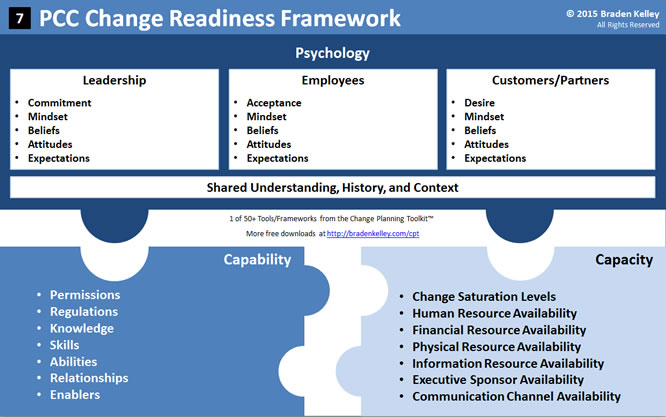
PCC Change Readiness Framework

To help people identify whether the people AND the organization are ready for change I created the PCC Change Readiness Framework. It starts with the organization’s shared understanding history and context and then helps you evaluate various components of:

  1. Psychology
  2. Capability
  3. Capacity

Exploring these three areas in detail will allow you to uncover many of the human elements that not only will determine whether your change effort will be a success or not, but that you will need to create a plan to manage.

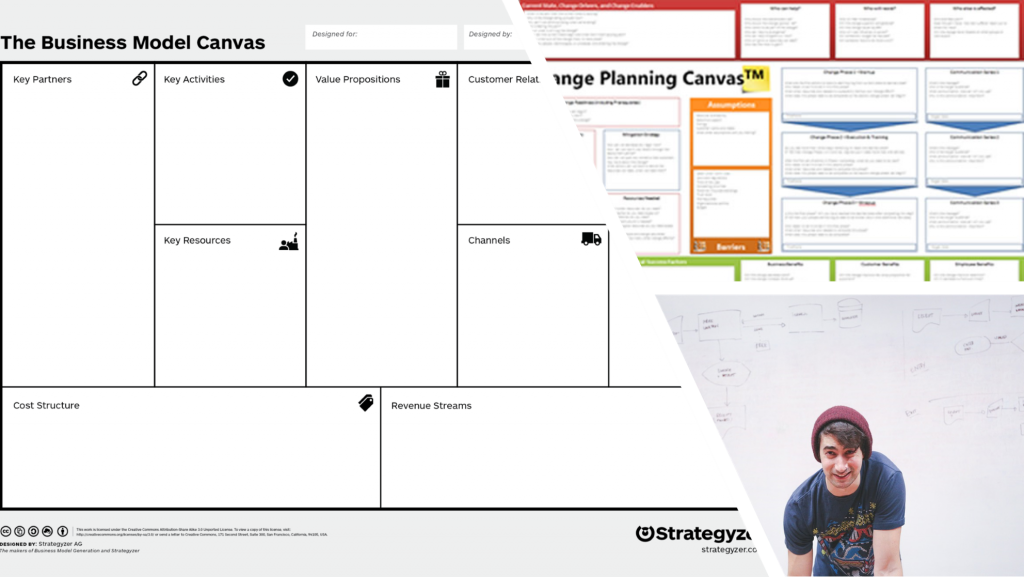
Business Model Canvas and Change Planning Canvas

What does Human-Centered Change look like?

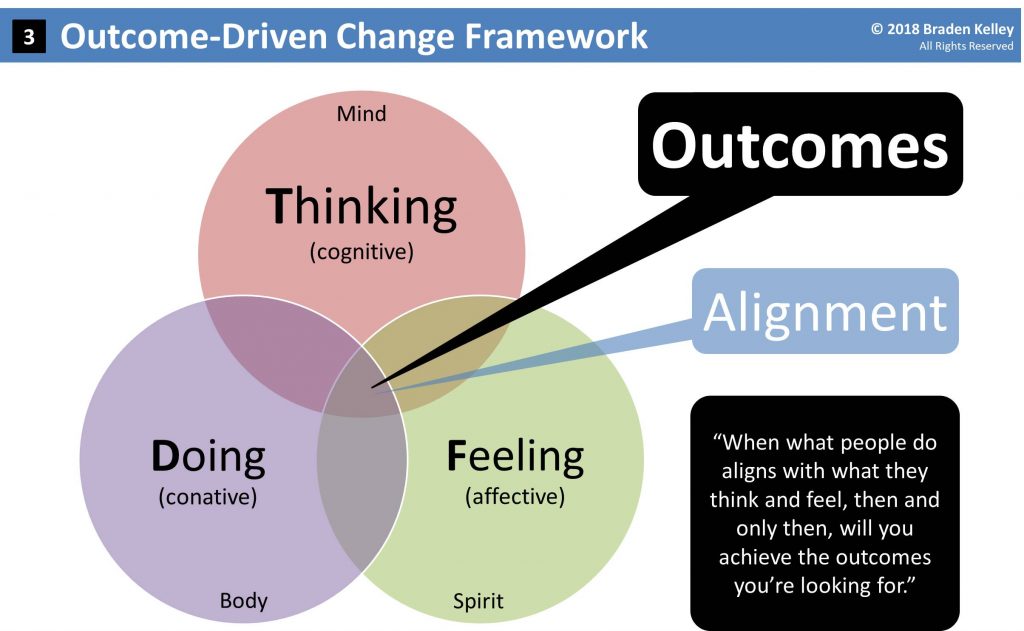
Visual, collaborative tools like the Empathy Map, Business Model Canvas, Service Design Blueprint, Lean Canvas, Value Proposition Canvas, Experience Maps, and even Customer Journey Maps have laid the groundwork for a more powerful modern way of working that leverages the whole brain of individuals and groups:

  1. Cognitive (thinking)
  2. Conative (doing)
  3. Affective (feeling)

And where these tools all represent the beginning of a visual, collaborative endeavor to create change, they are missing the tools to help plan for and execute the changes that are being proposed.

Outcome-Driven Change Framework by Braden Kelley

This is where the Change Planning Toolkit comes in. It has been designed with the Change Planning Canvas™ at its core to feel familiar to those already using the aforementioned tools and empower teams to take the next steps on their journey to be successful:

  1. Change Initiatives
  2. Digital Transformation
  3. Design Thinking
  4. Service Design
  5. Experience Design
  6. Customer Experience (CX) Improvement Efforts
  7. Projects (make sure you also get the Visual Project Charter™)
  8. Innovation and Intrapreneurship
  9. Startup Creation
  10. New Product Development (NPD)

What About Other Change Methodologies like ProSci ADKAR or the ACMP Standard for Change Management?

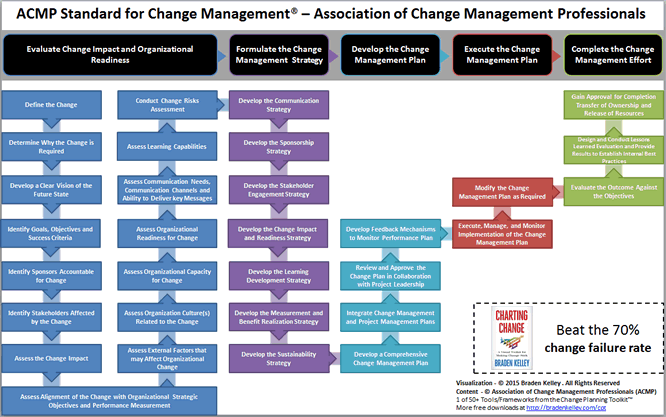
The human-centered change methodology is informed by the very best thinking in the various change disciplines to date, and consistent with other methodologies like ProSci’s ADKAR, PMI’s PMBOK, and the Association of Change Management Professionals (ACMP) Standard for Change Management. These other methodologies have their uses, and in fact I’ve created a poster-size visualization of the ACMP Standard:

ACMP Standard Visualization

But Human-Centered Change goes beyond these process-focused methodologies to create more visual and collaborative approaches for change leaders to use in planning and executing productive change programs.

How to Begin Practicing Human-Centered Change

The Human-Centered Change methodology will help you beat the 70% change failure rate, create more efficient and effective change initiatives (and even projects), and accelerate your pace of successful change in order to keep up with the accelerating pace of change all around us and to be more nimble, agile, and responsive than your competition.

There is a simple three step process for people to familiarize themselves with the Change Planning Toolkit’s 70+ tools used with the Human-Centered Change methodology:

  1. 10 free tools available to download now
  2. 26 free tools when you buy the book
  3. 70+ tools when you license the toolkit

I’ve invested more than $1 million into the Change Planning Toolkit so you don’t have to, and so you can leverage this investment to gain all of the benefits above while also saving yourself thousands or millions of dollars in consulting fees – every year.


Accelerate your change and transformation success

Subscribe to Human-Centered Change & Innovation WeeklySign up here to get Human-Centered Change & Innovation Weekly delivered to your inbox every week.

Leveraging Emotional Intelligence in Driving Successful Organizational Change

Leveraging Emotional Intelligence in Driving Successful Organizational Change

GUEST POST from Chateau G Pato

Emotional intelligence (EI) has emerged as a critical factor for leading successful organizational change. By understanding and managing emotions, leaders can foster a culture of adaptability and resilience. This article will explore two case studies that highlight the impact of EI in organizational transformation.

Case Study 1: FedEx Express

At FedEx Express, integrating emotional intelligence into leadership development has led to significant improvements in core competencies. The company’s Global Learning Institute implemented a six-month process for new managers to develop EI skills, resulting in an 8-11% increase in leadership competencies. Notably, 72% of participants experienced substantial increases in decision-making abilities, and 60% reported improvements in quality of life. This case exemplifies how EI can enhance leadership effectiveness and influence organizational culture positively¹.

Case Study 2: Amadori

Amadori, a leading company in the agri-food sector, linked emotional intelligence to performance outcomes. Managers in the top 25% of EI scores outperformed those in the lower quartile, demonstrating a strong correlation between EI and managerial success. The study also found a significant positive relationship between managers’ EI scores and employee engagement levels. This case study underscores the importance of EI in achieving high performance and fostering employee commitment².

Conclusion

These case studies demonstrate that emotional intelligence is not just a soft skill but a powerful tool for driving change and achieving sustainable success. Leaders who prioritize EI can create an environment where change is embraced, and performance is enhanced.

For organizations looking to harness the power of emotional intelligence in driving change, these case studies serve as compelling evidence of its transformative potential.

References:
(1) Case Study: Emotional Intelligence Improves Leadership at FedEx. https://www.6seconds.org/2014/01/14/case-study-emotional-intelligence-people-first-leadership-fedex-express/.
(2) Case Study: Linking Emotional Intelligence to Bottom Line Results at …. https://www.6seconds.org/2022/02/21/case-study-linking-emotional-intelligence-to-bottom-line-results-at-amadori/.
(3) The Role of Emotional Intelligence in Effective Change Leadership …. https://bradenkelley.com/2020/07/the-role-of-emotional-intelligence-in-effective-change-leadership/.
(4) Emotional Intelligence Case Studies | RocheMartin. https://www.rochemartin.com/resources/case-studies.
(5) Military Leaders’ Perceived Importance of Emotional Intelligence …. https://digitalcommons.umassglobal.edu/edd_dissertations/189/.

SPECIAL BONUS: Futurology is not fortune telling. Futurists use a scientific approach to create their deliverables, but a methodology and tools like those in FutureHacking™ can empower anyone to engage in futurology themselves.

Image credit: Pixabay

Subscribe to Human-Centered Change & Innovation WeeklySign up here to get Human-Centered Change & Innovation Weekly delivered to your inbox every week.
Balancing Agility and Stability

Strategies for managing organizational change during a digital transformation

Balancing Agility and Stability

GUEST POST from Art Inteligencia

In today’s fast-paced business environment, organizations must adapt and evolve continuously to stay competitive. The rapid pace of technological advancements has spurred the need for digital transformation, requiring organizations to embrace new technologies, processes, and ways of thinking. While digital transformation offers numerous benefits, including increased efficiency, improved customer experiences, and accelerated growth, it also presents significant challenges, particularly in terms of managing organizational change.

One of the key challenges organizations face during a digital transformation is striking a balance between agility and stability. On one hand, organizations must be agile enough to respond to the ever-changing business landscape and quickly adopt new technologies. On the other hand, they must also maintain a level of stability to ensure that the organization remains aligned with its strategic goals and objectives.

To navigate this balancing act successfully, organizations must develop strategies that prioritize both agility and stability. One effective approach is to create a culture that values experimentation, collaboration, and continuous learning. By fostering a culture of innovation, organizations can empower their employees to adapt to change more effectively and drive the digital transformation process forward.

Case Study 1: Netflix

As a pioneer in the digital streaming industry, Netflix has undergone several major transformations since its inception. One of the key factors driving Netflix’s success has been its ability to balance agility and stability effectively. By continuously experimenting with new technologies and business models, such as its shift from DVD rentals to online streaming, Netflix has remained at the forefront of the industry.

Netflix’s commitment to agility is exemplified by its famous “culture of freedom and responsibility,” which encourages employees to take risks and think outside the box. At the same time, Netflix also maintains a level of stability by setting clear strategic goals and objectives that guide decision-making at all levels of the organization.

Case Study 2: General Electric

General Electric (GE) provides another compelling example of how organizations can successfully manage organizational change during a digital transformation. In recent years, GE has embarked on a digital transformation journey aimed at leveraging the power of data and analytics to drive innovation and growth across its various business units.

To balance agility and stability, GE has implemented a comprehensive change management strategy that focuses on employee engagement, continuous learning, and cross-functional collaboration. By providing employees with the tools and support they need to adapt to new technologies and ways of working, GE has been able to drive significant improvements in efficiency, customer satisfaction, and business performance.

Conclusion

Managing organizational change during a digital transformation requires a delicate balance between agility and stability. By creating a culture of innovation, setting clear strategic goals, and empowering employees to adapt to change, organizations can navigate the challenges of digital transformation successfully. By learning from the experiences of companies like Netflix and General Electric, organizations can develop effective strategies for managing organizational change and driving long-term success in the digital age.

Bottom line: Futures research is not fortune telling. Futurists use a scientific approach to create their deliverables, but a methodology and tools like those in FutureHacking™ can empower anyone to engage in futures research themselves.

Image credit: Lit C1

Subscribe to Human-Centered Change & Innovation WeeklySign up here to get Human-Centered Change & Innovation Weekly delivered to your inbox every week.
Why Your Employees Resist Change

(It’s Not What You Think)

Why Your Employees Resist Change

GUEST POST from Chateau G Pato

When a major organizational change initiative stalls — a digital transformation, a new market strategy, or a culture shift — the natural reaction from leadership is often to blame the resistors. “They’re afraid of the unknown,” is the common refrain. “They lack the right mindset.”

As a Human-Centered Change leader, I can tell you that this is dangerously simplistic. Employees are not inherently resistant to change; they are resistant to poorly executed change. The root of resistance is not fear of the future, but a deep-seated, rational rejection of four specific dysfunctions that sabotage otherwise brilliant strategies. We must move beyond blaming the people and start fixing the process.

The true sources of resistance are rational, structural, and predictable. They can be found in the failure of leadership to properly define, communicate, and support the shift — creating a gap between the organizational mandate and the employee’s lived reality.

The Four Rational Pillars of Resistance

Resistance is a logical defense mechanism against threats to an employee’s professional identity, competence, and time. These four pillars must be addressed proactively:

1. Loss of Competence and Identity (The “Unlearning” Tax)

When you implement a new system or process, you are telling long-tenured employees that the specific knowledge and skills they spent years mastering — their professional currency — are suddenly devalued. This is the Unlearning Tax. Resistance here is not about being anti-technology; it is a fear of becoming incompetent and losing professional identity.

  • The Fix: Validate the past. Leaders must explicitly thank employees for their past mastery and redefine their new role as one that leverages their institutional knowledge while mastering new tools. Invest heavily in high-support, low-stakes training environments. The cost of “unlearning” must be acknowledged and managed.

2. Lack of Strategic Connection (The “Why” Deficit)

Employees are not robots; they need to understand the Strategic Connection of the change. When change is presented as a mandate (“Do this new thing because we said so”) rather than as a solution (“This new thing is how we win in the next decade”), resistance flares. A lack of transparent, two-way communication causes employees to fill the information void with negative speculation and fear.

  • The Fix: Connect the change to the customer, the competition, and the collective mission. The “Why” must be constantly reiterated by mid-level managers who have been empowered with the full strategic context. It must be a clear, simple narrative that everyone can repeat.

3. Perceived Workload Saturation (The “Capacity” Crisis)

The number one killer of change initiatives is the failure to stop doing old work. Employees are often asked to implement the new process while maintaining 100% of the old one. Resistance arises from the rational belief that they simply lack the capacity to take on more work. This creates anxiety, stress, and burnout — all precursors to outright resistance. The employee is rationally protecting their sanity.

  • The Fix: Institute a “Stop Doing” List. For every new process introduced, the change leadership team must mandate the retirement or deferral of an equal amount of current work. If the change promises efficiency, that time must be visibly and immediately freed up for adoption and learning.

4. History of Failure (The “Cynicism” Debt)

If your organization has a history of launching sweeping, flavor-of-the-month initiatives that disappear after six months, resistance is a rational, learned behavior. Employees who resisted the last abandoned project were ultimately right, and they were rewarded with less effort. This historical pattern creates a “Cynicism Debt” that must be repaid with consistent, sustained follow-through and visible executive commitment.

  • The Fix: Start small, prove success quickly, and maintain commitment relentlessly. Avoid the grand, vague launch. Focus on demonstrated integrity through pilot programs that deliver visible, small wins before attempting scaling. Leadership commitment must be structural, not just rhetorical.

Case Study 1: The ERP Implementation and the Loss of Identity

The Scenario: ERP Implementation in a Supply Chain Firm

A global supply chain firm implemented a new, centralized ERP system to improve efficiency. The implementation was technically flawless, yet adoption by long-term logistics managers was below 20%. Leadership saw it as Luddite resistance.

The True Resistance:

The old, fragmented system had allowed logistics managers to leverage their deep, tacit knowledge to manually override system suggestions and execute complex, non-standard shipments, making them operational heroes. The new, rigid ERP system removed all manual controls, making the process cleaner but rendering the managers’ deep, personal expertise obsolete. Their resistance was a rational defense of their value and expertise (Loss of Competence and Identity).

The Lesson:

Leadership failed to design a new role that valued their institutional knowledge (e.g., training them to be “ERP Process Architects” who could optimize the system parameters) instead of marginalizing them as simple data entry clerks. The change was perceived as a demotion, regardless of the technology’s benefits.

The Human-Centered Change Intervention

The Human-Centered Change™ Methodology treats resistance as feedback. It forces the change team to map the “As-Is” employee experience and the “To-Be” experience, specifically identifying and mitigating the transition costs associated with the four pillars above.

  1. Diagnosis: Stop surveying satisfaction with the change. Start surveying capacity and belief (e.g., “Do you believe this change will still be a priority six months from now?”).
  2. De-risking: Partner with the most resistant employees. They are often the most knowledgeable about the current system’s limitations. Treat their resistance as a rational design constraint, not a personality flaw.
  3. Dedicated Capacity: Budget not just for training, but for **”Transition Overload Pay”** or mandating a temporary 20% reduction in baseline tasks for adopting teams. This addresses the Capacity Crisis directly.

Case Study 2: The Culture Shift and the Cynicism Debt

The Scenario: Agile Transformation at an IT Firm

An IT consulting firm attempted to switch from waterfall to Agile methodologies for the third time in four years. Despite expensive training, teams were performing “fake Agile,” simply relabeling old processes without real behavior change.

The True Resistance:

This was a classic case of Cynicism Debt. Employees had seen two previous, failed attempts at “transformation.” The rational response was to wait it out. Their resistance wasn’t to Agile itself (they knew it worked for competitors) but to the leadership’s proven lack of sustained commitment. They were betting, correctly, that if they simply dragged their feet, the initiative would die, saving them the effort of learning a new system that would be abandoned.

The Lesson:

Leadership failed to repay the Cynicism Debt. They launched the third attempt with the same high-hype, low-follow-through approach. The only way to overcome this is through a painful, sustained demonstration of commitment, starting with non-negotiable changes in the Executive team’s behavior and metrics, proving the commitment is structural, not superficial. Only integrity repays cynicism.

Conclusion: Resistance as Data

Resistance is not a challenge to be overcome with morale posters; it is critical data that reveals the flaws in your change strategy. When employees push back, they are telling you: 1) You haven’t adequately valued their past, 2) You haven’t clearly connected the strategy, 3) You haven’t freed up their time, or 4) You haven’t earned their trust.

Stop blaming your people. Start designing a change process that respects their knowledge, their capacity, and their intelligence.

“Resistance is the organization’s way of telling you where your plan lacks integrity, clarity, or capacity.” — Braden Kelley

Your first step toward overcoming resistance: Select your most vocal resistor and invite them to be an unpaid, official ‘Red Team’ consultant on the change project, making their critique central to your de-risking strategy.

Extra Extra: Because innovation is all about change, Braden Kelley’s human-centered change methodology and tools are the best way to plan and execute the changes necessary to support your innovation and transformation efforts — all while literally getting everyone all on the same page for change. Find out more about the methodology and tools, including the book Charting Change by following the link. Be sure and download the TEN FREE TOOLS while you’re here.

Image credit: Pexels

Subscribe to Human-Centered Change & Innovation WeeklySign up here to get Human-Centered Change & Innovation Weekly delivered to your inbox every week.
What Are the Functions of Change Management?

What Are the Functions of Change Management?

GUEST POST from Art Inteligencia

Change Management (OCM) is the process of managing and implementing changes within an organization. It involves planning, analyzing, and implementing changes in order to maximize efficiency and minimize disruption. Change management is an important part of any organization’s growth, as it allows for the organization to stay up-to-date with the latest technology, trends, and customer demands.

The primary functions of change management are to identify the areas of an organization which need to be changed, plan how to best implement these changes, and then execute the plan. OCM also helps to ensure that all stakeholders are informed of any changes and are given the opportunity to provide input.

The first step in the change management process is to identify which areas need to be changed and why. This is usually done by conducting a thorough analysis of the current state of the organization and its processes. Once the areas needing improvement have been identified, it is important to develop a plan of action which outlines how the changes will be implemented. This plan should include a timeline, resources, and steps which must be completed in order to reach the desired outcome.

The second function of change management is to ensure that all stakeholders are informed of the changes and are given the opportunity to provide input. It is important to ensure that all stakeholders feel heard and that their opinions are taken into consideration when making changes. This will make the transition to the new process smoother and ensure that everyone is on the same page.

The third function of change management is to implement the changes. This involves ensuring that the necessary resources are available and that the plan is followed. It also involves monitoring and evaluating the progress of the changes to ensure that they are effective.

OCM is an important part of any organization’s success. By properly planning, analyzing, and implementing changes, organizations can ensure that they remain competitive and successful in the ever-changing business environment. It is important to remember that change management is not a one-time event, but rather a continuous process which must be monitored and evaluated in order to ensure that the changes are successful and beneficial for the organization.

Image credit: Unsplash

Subscribe to Human-Centered Change & Innovation WeeklySign up here to get Human-Centered Change & Innovation Weekly delivered to your inbox every week.
What We Must Know About Organizational Change

What We Must Know About Organizational Change

GUEST POST from Art Inteligencia

Organizational change is a necessary part of the modern business world, and it can bring both positive and negative results. Organizations need to be aware of the potential impacts of change and be prepared to manage them appropriately in order to ensure a successful transition.

One of the key elements of successful organizational change is effective communication. Organizations must ensure that all employees understand the change and its implications. It is important to clearly communicate the goals and objectives of the change and provide employees with the necessary tools and resources to succeed. Leaders should also be prepared to answer questions and address any concerns that employees may have.

Another important factor to consider when implementing organizational change is the impact it may have on existing processes and procedures. It is important to evaluate current practices and assess their relevance in the new environment. It may also be necessary to make adjustments to existing systems to ensure they are aligned with the new goals and objectives.

In addition, organizations should understand the potential risks associated with organizational change. It is important to identify potential problems and develop strategies to mitigate them. Organizations should also consider the potential impact of change on employee morale and morale.

Finally, organizations should recognize that the process of change can be difficult and complex. It is important to provide adequate training and support to employees to ensure they are equipped to handle the new environment. It is also important to ensure that the change is managed in a way that maximizes its positive benefits for the organization.

Organizational change can be a difficult but necessary process. Organizations should ensure that they are prepared to manage the process effectively in order to maximize its positive impacts. By understanding the potential risks and benefits of change, organizations can ensure a successful transition.

Image credit: Pexels

Subscribe to Human-Centered Change & Innovation WeeklySign up here to get Human-Centered Change & Innovation Weekly delivered to your inbox every week.
Introduction to the Change Planning Toolkit™

Introduction to the Change Planning Toolkit

The business world is showing an increasing interest in the people side of change, and there is a very real reason for this…

Companies are spending an increasing amount of their budget on technology and working to transform their operations to be more digital in order to provide a better experience for customers, employees, partners and suppliers while simultaneously creating a more efficient and effective business.

Everyone knows that a lot of technology projects fail to achieve their intended objectives, timings, and budgets. This fact and the increasing investment levels are causing more executives to look for ways to de-risk these technology investments in digitizing the business.

That’s why we’re seeing an uptick in the hiring and certification of change management professionals, which is great, but companies are still thinking about the relationship between project management and change management backwards.

In most cases change management is brought to bear as an afterthought, a bolt on to project management when the reverse should be true. Managing a change is a bigger endeavor than managing a project, and in fact you could say that because every project changes something, that every project is a change initiative.

It is thinking about managing projects in this way that I sat down to begin managing a new project several years ago and like many project managers, I found myself sitting at my computer by myself starting at an empty Microsoft Word template for a project charter knowing the uphill battle I’m going to face trying to route this document around via email and succeeding at both getting any responses at all and at getting meaningful input and a diversity of perspectives to make my project charter a really strong document that anyone will actually look at after week two of the project. I also found myself thinking that there has to be a better to plan and execute change initiatives and projects.

ACMP Standard Visualization

And sure people like pull ADKAR (a modified version of AIDA from the marketing world) and the ACMP Standard for Change Management (see the visualization I created above and download it for free here) and John Kotter’s change leadership approach, but they all fall short of making the planning and execution of change initiatives and projects a more visual and collaborative process, so I found myself starting to create new tools to help people (intended to link up with the PMBOK and ACMP Standard for Change Management).

These tools started to collect until they formed a comprehensive and new visual, collaborative approach to planning and executing change initiatives, and yes projects. This collection of tools became known as the Change Planning Toolkit™ and was first introduced in my latest book Charting Change which pairs nicely with my first book Stoking Your Innovation Bonfire. Both are designed to pack more insights into each chapter than most books contain in the entirety of their pages. Two of the most important frameworks introduced in the book are the Five Keys to Successful Change:

Five Keys to Successful Change 550

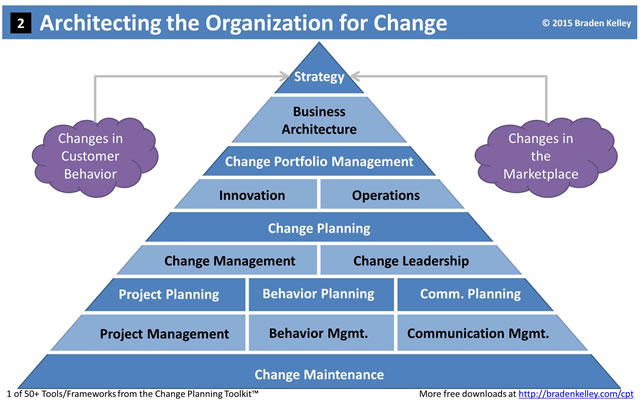
And the Architecting the Organization for Change framework:

Architecting the Organization for Change

Both frameworks are designed to help people challenge the way they think about organizational change. They are designed to help people think about more than change management and to think differently about how organizations are transformed and how change management and project management relate to each other.

To help people begin their participation in changing change I’ve made ten free tools available for download from the 50+ tools in the Change Planning Toolkit™, and people who buy a copy of Charting Change get access to 26 of the 50+ tools (including the Visual Project Charter™ and the Change Planning Canvas™). The book does a great job of helping to explain the philosophy behind the toolkit and how to get started with the tools, but people who purchase access to all 50+ tools (including tools to help people think through their Digital Transformation) also get a QuickStart Guide to explain each tool.

But if we are going to truly work together to change how change is planned and executed I thought it would make sense to give people a more in depth sneak preview into what’s inside the toolkit and so I’ve created the following Introduction to the Change Planning Toolkit™ webinar recording:


I encourage you to reflect upon your own experiences planning and executing both projects and change initiatives and what you’ve found lacking in the tools you call upon from ProSci, PMI, ACMP or others and then check out the book and the webinar and then let me know if there are any tools that you feel are still missing – and if it makes sense, I’ll create them!

My goal in creating all of these tools for you after all is to help you beat the 70% change failure rate, so let’s work together at changing change so our organizations are capable with more capably transforming themselves as the environment changes around them.

You can let me know if there are any change tools that you still need (or if you’d like me to come show you and your team personally how to use them) via the contact form.

Let’s change change together!

Change Planning Toolkit Million Dollar Value

Subscribe to Human-Centered Change & Innovation WeeklySign up here to get Human-Centered Change & Innovation Weekly delivered to your inbox every week.

Send Me Your Questions About Change or Digital Transformation

Send Me Your Questions About Change or Digital Transformation

I’m planning on recording a webinar in the next couple of days titled An Introduction to the Change Planning Toolkit™ and before I do I would throw out an open call for questions:

  1. What have you always been curious about when it comes to organizational change?
  2. Where do you get stuck when it comes to achieving successful organizational change, adoption, or project completion?
  3. What do you think should be in the Change Planning Toolkit™?
  4. What have you always been curious about when it comes to the Change Planning Toolkit™ and how it helps you beat the 70% change failure rate?
  5. What have you always been curious about when it comes to digital transformation?

So, let me know what questions you have related to any of these five questions by Midnight (PDT) on Monday, April 9, 2018 in Seattle, WA (GMT -8:00) and I will do my best to answer them when I record the webinar.

Click here to send me your questions


Accelerate your change and transformation success

Subscribe to Human-Centered Change & Innovation WeeklySign up here to get Human-Centered Change & Innovation Weekly delivered to your inbox every week.

Transform Your Business with a Change Success Manager

Transform Your Business with a Change Success Manager

“Stealing the role of customer success manager from the world of SaaS is the key to making your digital transformation efforts a success.”

I was speaking with a headhunter recently about some of the roles she was recruiting for and there was one that captured my attention. It was a posting she had for a customer success manager at one of your favorite three letter software companies. And, as she extolled the merits of the role I found myself thinking that the management practice of organizational change is still so immature. There are still so many missing tools and mindsets in the organizational behavior area of management science.

What I found so captivating about the responsibilities of a customer success manager, is that the kinds of tasks she described are exactly the kinds of activities that need to be performed as part of any organizational change effort. The difference is that software companies have recognized that they need to have people dedicated, ideally from the very beginning of the process, to help connect the cross-functional dots for the customer behind the scenes, actively manage expectations and outcomes, ensure a mutual understanding of what success looks like, and to make sure that it is ultimately achieved.

Technology companies everywhere seem to be racing to embrace the role of customer success manager as a new member of their army of service professionals. And, the customer success manager, above all else, strives to ensure that every customer moves beyond purchase, beyond installation, beyond first use, to productive use, deepening engagement, and the holy grail of retention and referral.

And retention is key in SaaS businesses because the churn rate (13% per year on adverage) is higher than other subscription type businesses (6-8% per year according to Recurly Research), but lower than the churn rate for some wireless carriers (which averages between 1-3% per month). Churn rate is a statistic measuring those customers who choose not to renew their service, or to switch their service to another subscription provider. A churned customer doesn’t write you a check for next year, or future years either.

The main reason SaaS customers churn, especially after their first year, is that the perceived value of the subscription is insufficient relative to the price to justify renewing it. They may have bought the software but didn’t install it, installed it but never really got up and running with it, or just found it too hard to get the value out of the software that they were promised. The old technology sales model didn’t care about these situations. Tech companies just focused on closing the sale, recognizing the revenue and moving on to close the next prospect. With the SaaS model, sales are no longer king, adoption and engagement are king. If the customer doesn’t adopt, engage and expand their footprint with your SaaS offering then it is easy for them to switch to an offering of a competitor.

So, if customer success managers are so instrumental to the success of technology companies in the era of the cloud, why shouldn’t they also be considered instrumental inside of our organizations as the key to successful change?

The problem is that too many organizations are still stuck in an upside-down paradigm where change management is seen as a bolt on to project management, instead of truly architecting our organizations for successful change.

Companies that want to be successful over the long term understand that change is not an event but a constant. They strategically select those capabilities and competencies needed for the next phase of their evolution, plan a portfolio of change initiatives that executes upon their strategy, and understand that change saturation and change readiness must always be considered. Companies that succeed in this era of unending change will constantly manage the expectations of their people around each change initiative and how the process will work and what the technology can and can’t do.

It is not surprising that companies would first embrace a role that adds tremendous value on the revenue generating side of the business first. Technology companies have determined customer success managers are critical to helping customer organizations adopt changes imposed by new technologies while ultimately increasing the lifetime value of each new customer. But for similar reasons internal to the organization, companies must also now embrace the need for a role I’d like to call the change success manager.

A change success manager is a change manager on steroids. However, in today’s business climate most people think of a change manager as the person a project manager brings in near the end of a software implementation project that does the training or communications. That may be how companies are doing the so-called people side of change today, but it is wrong!

This new role of change success manager is intended to lead each change initiative inside the organization from beginning to end. A change success manager is brought in at the beginning of the process to reach across the organization and identify a cross functional team specific to the needs of each change initiative for the purposes of convene as part of a change planning workshop. This change planning team will facilitate each change planning workshop using tools like the Change Planning Toolkit™ to identify the change leadership team that will take decisions and remove roadblocks for the change management team that will facilitate the actions necessary to advance the change initiative to its desired outcomes.

And, unlike the current model of change that many organizations follow, a change success manager will have one or more project managers on their change management team to identify the appropriate pace for the project, and the right size for the work packages, in order to maintain momentum across the entire duration of the change initiative and increase the adoption of internal change – just like a customer success manager increases the adoption of external changes!

This article originally appeared on CIO.com


Accelerate your change and transformation success

Subscribe to Human-Centered Change & Innovation WeeklySign up here to get Human-Centered Change & Innovation Weekly delivered to your inbox every week.